Magazine research
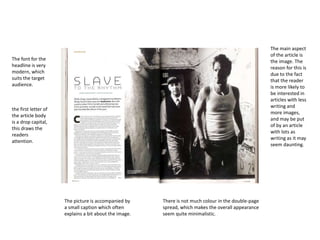
There is not much colour in the double-page
spread, which makes the overall appearance
seem quite minimalistic.
The main aspect
of the article is
the image. The
reason for this is
due to the fact
that the reader
is more likely to
be interested in
articles with less
writing and
more images,
and may be put
of by an article
with lots as
writing as it may
seem daunting.
The font for the
headline is very
modern, which
suits the target
audience.
The picture is accompanied by
a small caption which often
explains a bit about the image.
the first letter of
the article body
is a drop capital,
this draws the
readers
attention.
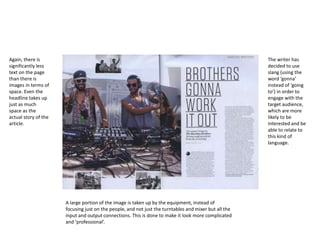
The writer has
decided to use
slang (using the
word ‘gonna’
instead of ‘going
to’) in order to
engage with the
target audience,
which are more
likely to be
interested and be
able to relate to
this kind of
language.
Again, there is
significantly less
text on the page
than there is
images in terms of
space. Even the
headline takes up
just as much
space as the
actual story of the
article.
A large portion of the image is taken up by the equipment, instead of
focusing just on the people, and not just the turntables and mixer but all the
input and output connections. This is done to make it look more complicated
and ‘professional’.
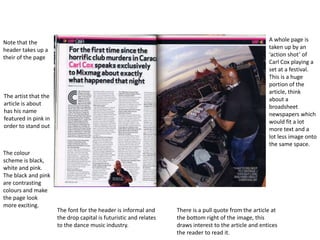
Note that the
header takes up a
their of the page
The artist that the
article is about
has his name
featured in pink in
order to stand out
A whole page is
taken up by an
‘action shot’ of
Carl Cox playing a
set at a festival.
This is a huge
portion of the
article, think
about a
broadsheet
newspapers which
would fit a lot
more text and a
lot less image onto
the same space.
The colour
scheme is black,
white and pink.
The black and pink
are contrasting
colours and make
the page look
more exciting.
The font for the header is informal and
the drop capital is futuristic and relates
to the dance music industry.
There is a pull quote from the article at
the bottom right of the image, this
draws interest to the article and entices
the reader to read it.

Dance music magazine layout research

  • 1.
  • 2.
    There is notmuch colour in the double-page spread, which makes the overall appearance seem quite minimalistic. The main aspect of the article is the image. The reason for this is due to the fact that the reader is more likely to be interested in articles with less writing and more images, and may be put of by an article with lots as writing as it may seem daunting. The font for the headline is very modern, which suits the target audience. The picture is accompanied by a small caption which often explains a bit about the image. the first letter of the article body is a drop capital, this draws the readers attention.
  • 3.
    The writer has decidedto use slang (using the word ‘gonna’ instead of ‘going to’) in order to engage with the target audience, which are more likely to be interested and be able to relate to this kind of language. Again, there is significantly less text on the page than there is images in terms of space. Even the headline takes up just as much space as the actual story of the article. A large portion of the image is taken up by the equipment, instead of focusing just on the people, and not just the turntables and mixer but all the input and output connections. This is done to make it look more complicated and ‘professional’.
  • 4.
    Note that the headertakes up a their of the page The artist that the article is about has his name featured in pink in order to stand out A whole page is taken up by an ‘action shot’ of Carl Cox playing a set at a festival. This is a huge portion of the article, think about a broadsheet newspapers which would fit a lot more text and a lot less image onto the same space. The colour scheme is black, white and pink. The black and pink are contrasting colours and make the page look more exciting. The font for the header is informal and the drop capital is futuristic and relates to the dance music industry. There is a pull quote from the article at the bottom right of the image, this draws interest to the article and entices the reader to read it.