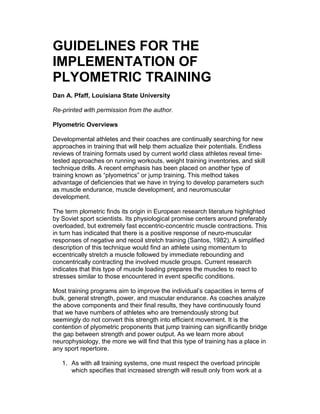
GUIDELINES FOR THE
IMPLEMENTATION OF
PLYOMETRIC TRAINING
Dan A. Pfaff, Louisiana State University

Re-printed with permission from the author.

Plyometric Overviews

Developmental athletes and their coaches are continually searching for new
approaches in training that will help them actualize their potentials. Endless
reviews of training formats used by current world class athletes reveal time-
tested approaches on running workouts, weight training inventories, and skill
technique drills. A recent emphasis has been placed on another type of
training known as p “lyometric” jump training. This method takes
                              s or
advantage of deficiencies that we have in trying to develop parameters such
as muscle endurance, muscle development, and neuromuscular
development.

The term plometric finds its origin in European research literature highlighted
by Soviet sport scientists. Its physiological promise centers around preferably
overloaded, but extremely fast eccentric-concentric muscle contractions. This
in turn has indicated that there is a positive response of neuro-muscular
responses of negative and recoil stretch training (Santos, 1982). A simplified
description of this technique would find an athlete using momentum to
eccentrically stretch a muscle followed by immediate rebounding and
concentrically contracting the involved muscle groups. Current research
indicates that this type of muscle loading prepares the muscles to react to
stresses similar to those encountered in event specific conditions.

Most training programs aim to improve the indivi as a a i sntr o
                                                  d l c p ci i ems f
                                                   u’           te
bulk, general strength, power, and muscular endurance. As coaches analyze
the above components and their final results, they have continuously found
that we have numbers of athletes who are tremendously strong but
seemingly do not convert this strength into efficient movement. It is the
contention of plyometric proponents that jump training can significantly bridge
the gap between strength and power output. As we learn more about
neurophysiology, the more we will find that this type of training has a place in
any sport repertoire.

   1. As with all training systems, one must respect the overload principle
      which specifies that increased strength will result only from work at a
greater intensity to which the athlete is accustomed. This is
   accomplished by volume and intensity values—not by adding weight
   to the athlete.

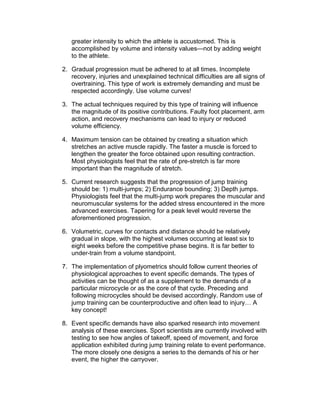
2. Gradual progression must be adhered to at all times. Incomplete
   recovery, injuries and unexplained technical difficulties are all signs of
   overtraining. This type of work is extremely demanding and must be
   respected accordingly. Use volume curves!

3. The actual techniques required by this type of training will influence
   the magnitude of its positive contributions. Faulty foot placement, arm
   action, and recovery mechanisms can lead to injury or reduced
   volume efficiency.

4. Maximum tension can be obtained by creating a situation which
   stretches an active muscle rapidly. The faster a muscle is forced to
   lengthen the greater the force obtained upon resulting contraction.
   Most physiologists feel that the rate of pre-stretch is far more
   important than the magnitude of stretch.

5. Current research suggests that the progression of jump training
   should be: 1) multi-jumps; 2) Endurance bounding; 3) Depth jumps.
   Physiologists feel that the multi-jump work prepares the muscular and
   neuromuscular systems for the added stress encountered in the more
   advanced exercises. Tapering for a peak level would reverse the
   aforementioned progression.

6. Volumetric, curves for contacts and distance should be relatively
   gradual in slope, with the highest volumes occurring at least six to
   eight weeks before the competitive phase begins. It is far better to
   under-train from a volume standpoint.

7. The implementation of plyometrics should follow current theories of
   physiological approaches to event specific demands. The types of
   activities can be thought of as a supplement to the demands of a
   particular microcycle or as the core of that cycle. Preceding and
   following microcycles should be devised accordingly. Random use of
   jump training can be counterproductive and often lead to injury… A
   key concept!

8. Event specific demands have also sparked research into movement
   analysis of these exercises. Sport scientists are currently involved with
   testing to see how angles of takeoff, speed of movement, and force
   application exhibited during jump training relate to event performance.
   The more closely one designs a series to the demands of his or her
   event, the higher the carryover.
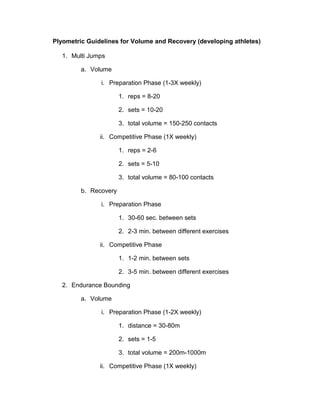
Plyometric Guidelines for Volume and Recovery (developing athletes)

   1. Multi Jumps

         a. Volume

               i. Preparation Phase (1-3X weekly)

                       1. reps = 8-20

                       2. sets = 10-20

                       3. total volume = 150-250 contacts

               ii. Competitive Phase (1X weekly)

                       1. reps = 2-6

                       2. sets = 5-10

                       3. total volume = 80-100 contacts

         b. Recovery

               i. Preparation Phase

                       1. 30-60 sec. between sets

                       2. 2-3 min. between different exercises

               ii. Competitive Phase

                       1. 1-2 min. between sets

                       2. 3-5 min. between different exercises

   2. Endurance Bounding

         a. Volume

               i. Preparation Phase (1-2X weekly)

                       1. distance = 30-80m

                       2. sets = 1-5

                       3. total volume = 200m-1000m

               ii. Competitive Phase (1X weekly)
1. distance = 40-80m

                   2. sets = 1-3

                   3. total volume = 200m-600m

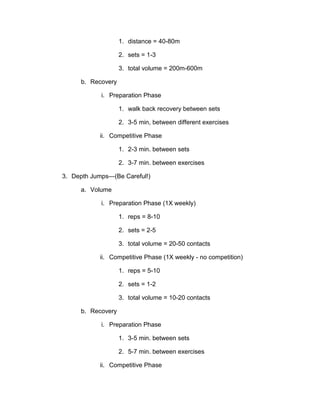
     b. Recovery

            i. Preparation Phase

                   1. walk back recovery between sets

                   2. 3-5 min, between different exercises

            ii. Competitive Phase

                   1. 2-3 min. between sets

                   2. 3-7 min. between exercises

3. Depth Jumps—(Be Careful!)

     a. Volume

            i. Preparation Phase (1X weekly)

                   1. reps = 8-10

                   2. sets = 2-5

                   3. total volume = 20-50 contacts

            ii. Competitive Phase (1X weekly - no competition)

                   1. reps = 5-10

                   2. sets = 1-2

                   3. total volume = 10-20 contacts

     b. Recovery

            i. Preparation Phase

                   1. 3-5 min. between sets

                   2. 5-7 min. between exercises

            ii. Competitive Phase
1. 5-7 min. between sets

                       2. full recovery between exercises

   4. Jump-Throw Combinations

         a. Volume

                 i. Preparation Phase (1-2X weekly

                       1. reps = 6-10

                       2. sets = 4-6

                       3. total volume + 12-30 contacts

         b. Competitive Phase (1X weekly)

                       1. reps = 3-5

                       2. sets = 3-4

                       3. total volume = 12-20 contacts

Plyometric Inventory

   1. Multi-Jumps

         a. In Place Jump Circuits (*see examples below)

         b. Standing Long lump

         c. Standing Triple Jump

         d. Repetitive Hurdle Hopping (DL, SL)

         e. Double Leg Vertical jumps

         f. Double Leg Repetitive Bounds

         g. Repetitive Single Leg Hops

         h. Single Leg Combinations

             (Exercises C-H can utilize a run-up)

   ***Note: for a change of stimulus and/or injury allowance, do these
   exercises in jumping pit or in a pool.
2. Endurance Bounding

         a. Scissor Bounding

         b. Repetitive Hopping (RRRR…) and (LLLL…)

         c. AtraeL gB u d g(R R R
             l n t e o n i L L L …)
              e          n

         d. R p tv TieJ mp g(L L R a d( RLRRL...)
             e ei e r l u i L R L …) n R
                 t
                 i   p    n

         e. C mb ai B u d g(L R L R
             o i t n o n i L R L R …)
                n o      n

   3. Depth Jumps

         a. Box Rebounds (vertical and horizontal)

         b. Box Combinations

         c. Box Twist Jumps

         d. Box-Hurdle Combinations

         e. Lateral Box Combinations

   4. Jump-Throw Combinations

         a. Two Hops + Overhead Backwards Throw (OHB)

         b. Two Hops + Between the Legs Forward (BLF)

         c. Box Jump + OHB

         d. Box Jump + BLF

*In Place Jump Circuit Examples:

   *M.J. (Kilimanjaro)

       Star Jumps

       180-360 Degrees

       Speed Skater

       Line Hops

       Dynamic Step-Ups

       Single Leg Butt Kick
M.J. (Everest)

    Lunge jumps

    Tuck Jumps

    Butt Kicks

    Lateral Squat Jumps

    Downhill Jumps

    Straddle Jumps

Dan pfaff - guidelines for plyometric training

  • 1.
    GUIDELINES FOR THE IMPLEMENTATIONOF PLYOMETRIC TRAINING Dan A. Pfaff, Louisiana State University Re-printed with permission from the author. Plyometric Overviews Developmental athletes and their coaches are continually searching for new approaches in training that will help them actualize their potentials. Endless reviews of training formats used by current world class athletes reveal time- tested approaches on running workouts, weight training inventories, and skill technique drills. A recent emphasis has been placed on another type of training known as p “lyometric” jump training. This method takes s or advantage of deficiencies that we have in trying to develop parameters such as muscle endurance, muscle development, and neuromuscular development. The term plometric finds its origin in European research literature highlighted by Soviet sport scientists. Its physiological promise centers around preferably overloaded, but extremely fast eccentric-concentric muscle contractions. This in turn has indicated that there is a positive response of neuro-muscular responses of negative and recoil stretch training (Santos, 1982). A simplified description of this technique would find an athlete using momentum to eccentrically stretch a muscle followed by immediate rebounding and concentrically contracting the involved muscle groups. Current research indicates that this type of muscle loading prepares the muscles to react to stresses similar to those encountered in event specific conditions. Most training programs aim to improve the indivi as a a i sntr o d l c p ci i ems f u’ te bulk, general strength, power, and muscular endurance. As coaches analyze the above components and their final results, they have continuously found that we have numbers of athletes who are tremendously strong but seemingly do not convert this strength into efficient movement. It is the contention of plyometric proponents that jump training can significantly bridge the gap between strength and power output. As we learn more about neurophysiology, the more we will find that this type of training has a place in any sport repertoire. 1. As with all training systems, one must respect the overload principle which specifies that increased strength will result only from work at a
  • 2.
    greater intensity towhich the athlete is accustomed. This is accomplished by volume and intensity values—not by adding weight to the athlete. 2. Gradual progression must be adhered to at all times. Incomplete recovery, injuries and unexplained technical difficulties are all signs of overtraining. This type of work is extremely demanding and must be respected accordingly. Use volume curves! 3. The actual techniques required by this type of training will influence the magnitude of its positive contributions. Faulty foot placement, arm action, and recovery mechanisms can lead to injury or reduced volume efficiency. 4. Maximum tension can be obtained by creating a situation which stretches an active muscle rapidly. The faster a muscle is forced to lengthen the greater the force obtained upon resulting contraction. Most physiologists feel that the rate of pre-stretch is far more important than the magnitude of stretch. 5. Current research suggests that the progression of jump training should be: 1) multi-jumps; 2) Endurance bounding; 3) Depth jumps. Physiologists feel that the multi-jump work prepares the muscular and neuromuscular systems for the added stress encountered in the more advanced exercises. Tapering for a peak level would reverse the aforementioned progression. 6. Volumetric, curves for contacts and distance should be relatively gradual in slope, with the highest volumes occurring at least six to eight weeks before the competitive phase begins. It is far better to under-train from a volume standpoint. 7. The implementation of plyometrics should follow current theories of physiological approaches to event specific demands. The types of activities can be thought of as a supplement to the demands of a particular microcycle or as the core of that cycle. Preceding and following microcycles should be devised accordingly. Random use of jump training can be counterproductive and often lead to injury… A key concept! 8. Event specific demands have also sparked research into movement analysis of these exercises. Sport scientists are currently involved with testing to see how angles of takeoff, speed of movement, and force application exhibited during jump training relate to event performance. The more closely one designs a series to the demands of his or her event, the higher the carryover.
  • 3.
    Plyometric Guidelines forVolume and Recovery (developing athletes) 1. Multi Jumps a. Volume i. Preparation Phase (1-3X weekly) 1. reps = 8-20 2. sets = 10-20 3. total volume = 150-250 contacts ii. Competitive Phase (1X weekly) 1. reps = 2-6 2. sets = 5-10 3. total volume = 80-100 contacts b. Recovery i. Preparation Phase 1. 30-60 sec. between sets 2. 2-3 min. between different exercises ii. Competitive Phase 1. 1-2 min. between sets 2. 3-5 min. between different exercises 2. Endurance Bounding a. Volume i. Preparation Phase (1-2X weekly) 1. distance = 30-80m 2. sets = 1-5 3. total volume = 200m-1000m ii. Competitive Phase (1X weekly)
  • 4.
    1. distance =40-80m 2. sets = 1-3 3. total volume = 200m-600m b. Recovery i. Preparation Phase 1. walk back recovery between sets 2. 3-5 min, between different exercises ii. Competitive Phase 1. 2-3 min. between sets 2. 3-7 min. between exercises 3. Depth Jumps—(Be Careful!) a. Volume i. Preparation Phase (1X weekly) 1. reps = 8-10 2. sets = 2-5 3. total volume = 20-50 contacts ii. Competitive Phase (1X weekly - no competition) 1. reps = 5-10 2. sets = 1-2 3. total volume = 10-20 contacts b. Recovery i. Preparation Phase 1. 3-5 min. between sets 2. 5-7 min. between exercises ii. Competitive Phase
  • 5.
    1. 5-7 min.between sets 2. full recovery between exercises 4. Jump-Throw Combinations a. Volume i. Preparation Phase (1-2X weekly 1. reps = 6-10 2. sets = 4-6 3. total volume + 12-30 contacts b. Competitive Phase (1X weekly) 1. reps = 3-5 2. sets = 3-4 3. total volume = 12-20 contacts Plyometric Inventory 1. Multi-Jumps a. In Place Jump Circuits (*see examples below) b. Standing Long lump c. Standing Triple Jump d. Repetitive Hurdle Hopping (DL, SL) e. Double Leg Vertical jumps f. Double Leg Repetitive Bounds g. Repetitive Single Leg Hops h. Single Leg Combinations (Exercises C-H can utilize a run-up) ***Note: for a change of stimulus and/or injury allowance, do these exercises in jumping pit or in a pool.
  • 6.
    2. Endurance Bounding a. Scissor Bounding b. Repetitive Hopping (RRRR…) and (LLLL…) c. AtraeL gB u d g(R R R l n t e o n i L L L …) e n d. R p tv TieJ mp g(L L R a d( RLRRL...) e ei e r l u i L R L …) n R t i p n e. C mb ai B u d g(L R L R o i t n o n i L R L R …) n o n 3. Depth Jumps a. Box Rebounds (vertical and horizontal) b. Box Combinations c. Box Twist Jumps d. Box-Hurdle Combinations e. Lateral Box Combinations 4. Jump-Throw Combinations a. Two Hops + Overhead Backwards Throw (OHB) b. Two Hops + Between the Legs Forward (BLF) c. Box Jump + OHB d. Box Jump + BLF *In Place Jump Circuit Examples: *M.J. (Kilimanjaro)  Star Jumps  180-360 Degrees  Speed Skater  Line Hops  Dynamic Step-Ups  Single Leg Butt Kick
  • 7.
    M.J. (Everest)  Lunge jumps  Tuck Jumps  Butt Kicks  Lateral Squat Jumps  Downhill Jumps  Straddle Jumps