International Journal of Trend in Scientific Research and Development (IJTSRD)
Volume 5 Issue 4, May-June 2021 Available Online: www.ijtsrd.com e-ISSN: 2456 – 6470
@ IJTSRD | Unique Paper ID – IJTSRD43630 | Volume – 5 | Issue – 4 | May-June 2021 Page 1525
Damage Assessment System for Aircraft Structural
Defects using Wavelet Transform
V. Akilan, S. Rajkumar
Assistant Professor, Department of Aeronautical Engineering,
Dhanalakshmi Srinivasan Engineering College, Perambalur, Tamil Nadu, India
ABSTRACT
Defects are often arises on the inner surface of aircraft structures, but most of
conventional techniques can determine only the damages and cannot
determine the degree of damage. Digital Image Processing and Wavelet
Transform are used in this project. Characteristics parameters such as the
length of the crack can be exactly detected to measure the faults of aircraft
structure. Generally failures of different aircraft components and parts are
revealed and examined by the use of non-destructiveexaminationmethods.In
further detailed explanation and interpretation of failures optical and
scanning electron microscopyareused.Thispaperpresentsa newapproachin
automation for crack detection on pavement surface images. The method is
based on the continuous wavelet transform. Then, wavelet coefficients
maximal values are searched andtheir propagationthroughscalesisanalyzed.
Finally, a post-processing givesa binaryimagewhichindicatesthepresenceor
not of cracks on the pavement surface image.
KEYWORDS: Digital Image Processing, Wavelet, scanning electron microscopy
How to cite this paper: V. Akilan | S.
Rajkumar "Damage Assessment System
for Aircraft Structural Defects using
Wavelet Transform"
Published in
International Journal
of Trend in Scientific
Research and
Development(ijtsrd),
ISSN: 2456-6470,
Volume-5 | Issue-4,
June 2021, pp.1525-1527, URL:
www.ijtsrd.com/papers/ijtsrd43630.pdf
Copyright © 2021 by author (s) and
International Journal ofTrendinScientific
Research and Development Journal. This
is an Open Access article distributed
under the terms of
the Creative
Commons Attribution
License (CC BY 4.0)
(http: //creativecommons.org/licenses/by/4.0)
1. INTRODUCTION
Numerous cases of failures of different aircraft components
and parts with abundant data and in-depth analysis of
causes, development and manifestation of failures can be
found in the literature. The check-up of the integrity of
aircraft components is carried out by trainedandcompetent
personnel. The regular inspection of particular components
is scheduled depending on the number of flying hours,
lifetime and priority as specified by strict international
regulations.
Failure of an aircraft structural component can have
catastrophic consequences, with resultant loss of life and of
the aircraft. The investigation of defects and failures in
aircraft structures is, thus, of vital importance in preventing
further incidents. This review discusses the common failure
modes observed in aircraft structures, with examplesdrawn
from case histories. The review will also outline the
investigative procedures employed in the examination of
failed components.
The wavelet transform has become a useful computational
tool for a variety of signal andimageprocessingapplications.
For example, the wavelet transform is useful for the
compression of digital image files; smaller files are
important for storing images using less memory and for
transmitting images faster and more reliably. The FBI uses
wavelet transforms for compressing digitally scanned
fingerprint images. NASA's Mars Rovers used wavelet
transforms for compressing images acquired by their 18
cameras. The wavelet-based algorithm implemented in
software onboard the Mars Rovers is designed to meet the
special requirements of deep-space communication. In
addition, JPEG2K (the newer JPEG image _le format)isbased
on wavelet transforms. Wavelet transforms are also useful
for `cleaning' signals and images (reducing unwanted noise
and blurring). Some algorithms for processing astronomical
images, for example, are based on wavelet and wavelet-like
transforms.
2. CRACK DETECTION
In general, failures occur when a component or structure is
no longer able to withstand the stresses imposed on it
during operation. Commonly, failures are associated with
stress concentrations, which can occur for several reasons
including: Design errors, e.g. the presence of holes, notches,
and tight fillet radii; The microstructure of the material may
contain voids, inclusions etc.; Corrosive attack of the
material, e.g. pitting, can also generate a local stress
concentration. From our records and case histories data, an
assessment can be made of the frequency of failure modes.
This reveals that the incidence of fatigue failure dominates
the distribution in aircraft.
3. IMAGE PROCESSING
Modern digital technology has made it possible to
manipulate multi-dimensional signals with systems that
range from simple digital circuits to advanced parallel
computers. The goal of this manipulation can bedividedinto
three categories: Image Processing image in® image out,
Image Analysis image in® measurements out, Image
IJTSRD43630
International Journal of Trend in Scientific Research and Development (IJTSRD) @ www.ijtsrd.com eISSN: 2456-6470
@ IJTSRD | Unique Paper ID – IJTSRD43630 | Volume – 5 | Issue – 4 | May-June 2021 Page 1526
Understanding image in® high-level descriptionout. We will
focus on the fundamental concepts of image processing.
Space does not permit us to make more than a few
introductory remarks about image analysis. Image
understanding requires an approach that differs
fundamentally from the theme of this book. Further, we will
restrict ourselvestotwo–dimensional (2D)imageprocessing
although most of the concepts and techniques that are to be
described can be extended easily to three or more
dimensions. We begin with certain basic definitions. An
image defined in the “real world” is considered to be a
function of two real variables, for example, a(x,y) with a as
the amplitude (e.g. brightness) of the image at the real
coordinate position (x,y). An image may be considered to
contain sub-images sometimes referred to as regions–of–
interest, ROIs, or simply regions. This concept reflects the
fact that images frequently contain collections of objects
each of which can be the basis for a region.
3.1. COMMON VALUES
There are standard values for the various parameters
encountered in digital image processing.Thesevaluescanbe
caused by video standards, by algorithmic requirements, or
by the desire to keep digital circuitry simple. Table 1 gives
some commonly encountered values. Quite frequently we
see cases of M=N=2K where {K = 8,9,10}. This can be
motivated by digital circuitry or by the use of certain
algorithms such as the (fast) Fourier transform.
Parameter Symbol Typical values
Rows N 256,512,525,625,1024,1035
Columns M 256,512,768,1024,1320
Gray L 2,64,256,1024,4096,16384
Table 1.1: Common values of digital image parameters
The number of distinct gray levels is usually a power of 2,
that is, L=2B where B is the number of bits in the binary
representation of the brightness levels. When B>1 we speak
of a gray-level image; when B=1 we speak of a binary image.
In a binary image there are just two gray levels which can be
referred to, for example, as “black” and “white” or “0” and
“1”.
3.1.1. WAVELET TRANSFORM
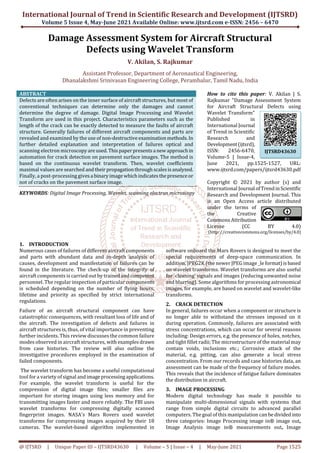
Figure 1.3 A comparative preproduction of original
signals. The red line is the original signal. The blue
dash line is the approximated signal with (a)K = 0 (b)
K = 1 (c) K = 2 (d) K = 3 (e) K = 4 (f) K = 5
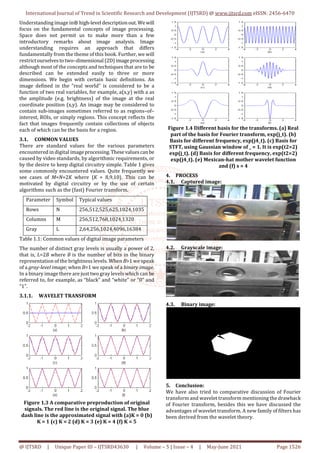
Figure 1.4 Different basis for the transforms. (a) Real
part of the basis for Fourier transform, exp(j_t). (b)
Basis for different frequency, exp(j4_t). (c) Basis for
STFT, using Gaussian window of _ = 1. It is exp(t2=2)
exp(j_t). (d) Basis for different frequency, exp(t2=2)
exp(j4_t). (e) Mexican-hat mother wavelet function
and (f) s = 4
4. PROCESS
4.1. Captured image:
4.2. Grayscale image:
4.3. Binary image:
5. Conclusion:
We have also tried to comparative discussion of Fourier
transform and wavelet transform mentioning the drawback
of Fourier transform, besides this we have discussed the
advantages of wavelet transform. A new family of filters has
been derived from the wavelet theory.
International Journal of Trend in Scientific Research and Development (IJTSRD) @ www.ijtsrd.com eISSN: 2456-6470
@ IJTSRD | Unique Paper ID – IJTSRD43630 | Volume – 5 | Issue – 4 | May-June 2021 Page 1527
Novel methods based on rotational self-nulling probes and
linearly scanned probes were developed. Tests were
performed on both in-house manufactured specimens
(containing slots machined around holes) and samples
provided by leading airplane manufacturers.
By wavelet Analysis results in a non stationarysignal andfor
much clear processing. Very efficient to use this process and
get a high clarity and accurate degree of defect. This method
is software based, so less time is required and compare to
the NDT and other methods.
REFERENCES
[1] Rummel W. D. et al-“The detection of Fatigue Cracks
by Non-Destructive Testing Methods” NASA
contractor Report CR-2369, Feb. 1974.
[2] Goransen U. – “Elements of Damage Tolerance
Verification”. Paper presented at 1983 ICAF Meeting,
Toulouse.
[3] Daubechies. I. “The wavelet transforms time-
frequency localization and signal analysis”. IEEE
TransformationandInformationTheory36:961-1005,
1990.
[4] Daubechics. I. “Ten Lectures on Wavelets”. SIAM,
Philadelphia, PA, 1992.
[5] Daubechies. I. “Ten Lectures On Wavelets”. SIAM,
1992.
[6] A. Cohen I. Daubechies J.-C. “Feauveau. Biorthogonal
bases of compactly supported wavelets”.
Communications on Pure and Appl. Math., 45(5):485–
560, June 1992.
[7] Burrus. C. S, Gopinath. R. A, and Guo. H. “Introduction
to Wavelets and Wavelet Transforms”. Prentice Hall,
1997.
[8] Mallat. S. “A Wavelet Tour of Signal Processing”.
Academic Press, 1998.
[9] Bajaba. N. S, Ainefaie. K. A.“Multipledamagedetection
in structure using wavelet transforms”. Academic
Press, 1998.

Damage Assessment System for Aircraft Structural Defects using Wavelet Transform

  • 1.
    International Journal ofTrend in Scientific Research and Development (IJTSRD) Volume 5 Issue 4, May-June 2021 Available Online: www.ijtsrd.com e-ISSN: 2456 – 6470 @ IJTSRD | Unique Paper ID – IJTSRD43630 | Volume – 5 | Issue – 4 | May-June 2021 Page 1525 Damage Assessment System for Aircraft Structural Defects using Wavelet Transform V. Akilan, S. Rajkumar Assistant Professor, Department of Aeronautical Engineering, Dhanalakshmi Srinivasan Engineering College, Perambalur, Tamil Nadu, India ABSTRACT Defects are often arises on the inner surface of aircraft structures, but most of conventional techniques can determine only the damages and cannot determine the degree of damage. Digital Image Processing and Wavelet Transform are used in this project. Characteristics parameters such as the length of the crack can be exactly detected to measure the faults of aircraft structure. Generally failures of different aircraft components and parts are revealed and examined by the use of non-destructiveexaminationmethods.In further detailed explanation and interpretation of failures optical and scanning electron microscopyareused.Thispaperpresentsa newapproachin automation for crack detection on pavement surface images. The method is based on the continuous wavelet transform. Then, wavelet coefficients maximal values are searched andtheir propagationthroughscalesisanalyzed. Finally, a post-processing givesa binaryimagewhichindicatesthepresenceor not of cracks on the pavement surface image. KEYWORDS: Digital Image Processing, Wavelet, scanning electron microscopy How to cite this paper: V. Akilan | S. Rajkumar "Damage Assessment System for Aircraft Structural Defects using Wavelet Transform" Published in International Journal of Trend in Scientific Research and Development(ijtsrd), ISSN: 2456-6470, Volume-5 | Issue-4, June 2021, pp.1525-1527, URL: www.ijtsrd.com/papers/ijtsrd43630.pdf Copyright © 2021 by author (s) and International Journal ofTrendinScientific Research and Development Journal. This is an Open Access article distributed under the terms of the Creative Commons Attribution License (CC BY 4.0) (http: //creativecommons.org/licenses/by/4.0) 1. INTRODUCTION Numerous cases of failures of different aircraft components and parts with abundant data and in-depth analysis of causes, development and manifestation of failures can be found in the literature. The check-up of the integrity of aircraft components is carried out by trainedandcompetent personnel. The regular inspection of particular components is scheduled depending on the number of flying hours, lifetime and priority as specified by strict international regulations. Failure of an aircraft structural component can have catastrophic consequences, with resultant loss of life and of the aircraft. The investigation of defects and failures in aircraft structures is, thus, of vital importance in preventing further incidents. This review discusses the common failure modes observed in aircraft structures, with examplesdrawn from case histories. The review will also outline the investigative procedures employed in the examination of failed components. The wavelet transform has become a useful computational tool for a variety of signal andimageprocessingapplications. For example, the wavelet transform is useful for the compression of digital image files; smaller files are important for storing images using less memory and for transmitting images faster and more reliably. The FBI uses wavelet transforms for compressing digitally scanned fingerprint images. NASA's Mars Rovers used wavelet transforms for compressing images acquired by their 18 cameras. The wavelet-based algorithm implemented in software onboard the Mars Rovers is designed to meet the special requirements of deep-space communication. In addition, JPEG2K (the newer JPEG image _le format)isbased on wavelet transforms. Wavelet transforms are also useful for `cleaning' signals and images (reducing unwanted noise and blurring). Some algorithms for processing astronomical images, for example, are based on wavelet and wavelet-like transforms. 2. CRACK DETECTION In general, failures occur when a component or structure is no longer able to withstand the stresses imposed on it during operation. Commonly, failures are associated with stress concentrations, which can occur for several reasons including: Design errors, e.g. the presence of holes, notches, and tight fillet radii; The microstructure of the material may contain voids, inclusions etc.; Corrosive attack of the material, e.g. pitting, can also generate a local stress concentration. From our records and case histories data, an assessment can be made of the frequency of failure modes. This reveals that the incidence of fatigue failure dominates the distribution in aircraft. 3. IMAGE PROCESSING Modern digital technology has made it possible to manipulate multi-dimensional signals with systems that range from simple digital circuits to advanced parallel computers. The goal of this manipulation can bedividedinto three categories: Image Processing image in® image out, Image Analysis image in® measurements out, Image IJTSRD43630
  • 2.
    International Journal ofTrend in Scientific Research and Development (IJTSRD) @ www.ijtsrd.com eISSN: 2456-6470 @ IJTSRD | Unique Paper ID – IJTSRD43630 | Volume – 5 | Issue – 4 | May-June 2021 Page 1526 Understanding image in® high-level descriptionout. We will focus on the fundamental concepts of image processing. Space does not permit us to make more than a few introductory remarks about image analysis. Image understanding requires an approach that differs fundamentally from the theme of this book. Further, we will restrict ourselvestotwo–dimensional (2D)imageprocessing although most of the concepts and techniques that are to be described can be extended easily to three or more dimensions. We begin with certain basic definitions. An image defined in the “real world” is considered to be a function of two real variables, for example, a(x,y) with a as the amplitude (e.g. brightness) of the image at the real coordinate position (x,y). An image may be considered to contain sub-images sometimes referred to as regions–of– interest, ROIs, or simply regions. This concept reflects the fact that images frequently contain collections of objects each of which can be the basis for a region. 3.1. COMMON VALUES There are standard values for the various parameters encountered in digital image processing.Thesevaluescanbe caused by video standards, by algorithmic requirements, or by the desire to keep digital circuitry simple. Table 1 gives some commonly encountered values. Quite frequently we see cases of M=N=2K where {K = 8,9,10}. This can be motivated by digital circuitry or by the use of certain algorithms such as the (fast) Fourier transform. Parameter Symbol Typical values Rows N 256,512,525,625,1024,1035 Columns M 256,512,768,1024,1320 Gray L 2,64,256,1024,4096,16384 Table 1.1: Common values of digital image parameters The number of distinct gray levels is usually a power of 2, that is, L=2B where B is the number of bits in the binary representation of the brightness levels. When B>1 we speak of a gray-level image; when B=1 we speak of a binary image. In a binary image there are just two gray levels which can be referred to, for example, as “black” and “white” or “0” and “1”. 3.1.1. WAVELET TRANSFORM Figure 1.3 A comparative preproduction of original signals. The red line is the original signal. The blue dash line is the approximated signal with (a)K = 0 (b) K = 1 (c) K = 2 (d) K = 3 (e) K = 4 (f) K = 5 Figure 1.4 Different basis for the transforms. (a) Real part of the basis for Fourier transform, exp(j_t). (b) Basis for different frequency, exp(j4_t). (c) Basis for STFT, using Gaussian window of _ = 1. It is exp(t2=2) exp(j_t). (d) Basis for different frequency, exp(t2=2) exp(j4_t). (e) Mexican-hat mother wavelet function and (f) s = 4 4. PROCESS 4.1. Captured image: 4.2. Grayscale image: 4.3. Binary image: 5. Conclusion: We have also tried to comparative discussion of Fourier transform and wavelet transform mentioning the drawback of Fourier transform, besides this we have discussed the advantages of wavelet transform. A new family of filters has been derived from the wavelet theory.
  • 3.
    International Journal ofTrend in Scientific Research and Development (IJTSRD) @ www.ijtsrd.com eISSN: 2456-6470 @ IJTSRD | Unique Paper ID – IJTSRD43630 | Volume – 5 | Issue – 4 | May-June 2021 Page 1527 Novel methods based on rotational self-nulling probes and linearly scanned probes were developed. Tests were performed on both in-house manufactured specimens (containing slots machined around holes) and samples provided by leading airplane manufacturers. By wavelet Analysis results in a non stationarysignal andfor much clear processing. Very efficient to use this process and get a high clarity and accurate degree of defect. This method is software based, so less time is required and compare to the NDT and other methods. REFERENCES [1] Rummel W. D. et al-“The detection of Fatigue Cracks by Non-Destructive Testing Methods” NASA contractor Report CR-2369, Feb. 1974. [2] Goransen U. – “Elements of Damage Tolerance Verification”. Paper presented at 1983 ICAF Meeting, Toulouse. [3] Daubechies. I. “The wavelet transforms time- frequency localization and signal analysis”. IEEE TransformationandInformationTheory36:961-1005, 1990. [4] Daubechics. I. “Ten Lectures on Wavelets”. SIAM, Philadelphia, PA, 1992. [5] Daubechies. I. “Ten Lectures On Wavelets”. SIAM, 1992. [6] A. Cohen I. Daubechies J.-C. “Feauveau. Biorthogonal bases of compactly supported wavelets”. Communications on Pure and Appl. Math., 45(5):485– 560, June 1992. [7] Burrus. C. S, Gopinath. R. A, and Guo. H. “Introduction to Wavelets and Wavelet Transforms”. Prentice Hall, 1997. [8] Mallat. S. “A Wavelet Tour of Signal Processing”. Academic Press, 1998. [9] Bajaba. N. S, Ainefaie. K. A.“Multipledamagedetection in structure using wavelet transforms”. Academic Press, 1998.