DALBERG GLOBAL DEVELOPMENT ADVISORS
Inside perspectives from BRIC and beyond
Presented by James Mwangi and Gaurav Gupta
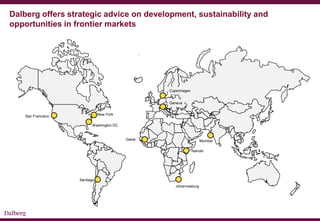
Dalberg offers strategic advice on development, sustainability and
opportunities in frontier markets


                                                  Copenhagen


                                                  Geneva


    San Francisco              New York

                          Washington DC


                                          Dakar                    Mumbai

                                                               Nairobi


                    Santiago
                                                    Johannesburg
Our role is shifting with a changing world

 Integrating efforts to assist in development...   ... with moves to create and capture value


                                                                                                2
BRIC countries provide a template for rapid transformation


                                                             3
The BRIC countries show us how transformation has played out in the recent past

 1990: From widespread poverty                        2010: To mass markets

                                                        ...


  BRIC in1990:                                         BRIC in 2010:
 • Average GDP per capita: $ 1.815                     • Average GDP per capita: $ 5.417
 • Foreign Direct Investments to the BRICs: $ 4.5      • Foreign Direct Investments to the BRICs: $ 208 billion
   billion                                             • Still 15.3% of population below the national poverty
 • India had 36% and Russia 30% of their population      line on average
   below the poverty line                              • Literacy in India is 66% while the rest are almost
 • China and India were less than 30% urbanized          100%
 • India had less than 50% literacy
                                                                                                                  4
There are signs that a new wave of countries is embarking on the same path


        New emerging economies beyond BRIC are characterized by
        • Strong, steady growth of more than 3% per year through the global economic down turn
        • A current wealth base of a GDP per capita of more than $500
        • Relatively stable security and governance conditions
        • Relatively good or improving ease of doing business                                    5
Our entire model for thinking about these countries must shift
  From meeting a charitable need                                To commercial engagement


 • 15 countries beyond BRIC have seen an average annual growth above 5% during the global crisis
 • By 2020 more than half of African households are expected to have discretionary spending power led by a
   growing urban middle class
 • Africa’s collective GDP is now at $1,6 trillion – on level with Brazil’s and Russia’s
 • Foreign direct investment in Africa has increased from $9 bn in 2000 to $62 bn in 2008
 • Since 1990 Western Europe’s share of trade with Africa has shrunk to half while Asia’s has more than doubled
                                                                                                                  6
The transformation of these countries will feed on their untapped human potential


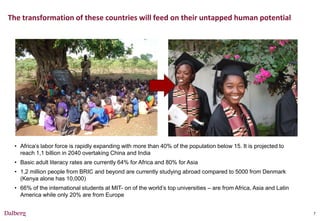
 • Africa’s labor force is rapidly expanding with more than 40% of the population below 15. It is projected to
   reach 1,1 billion in 2040 overtaking China and India
 • Basic adult literacy rates are currently 64% for Africa and 80% for Asia
 • 1,2 million people from BRIC and beyond are currently studying abroad compared to 5000 from Denmark
   (Kenya alone has 10,000)
 • 66% of the international students at MIT- on of the world’s top universities – are from Africa, Asia and Latin
   America while only 20% are from Europe


                                                                                                                    7
Three illustrative cases highlight some of the potential opportunities in these economies

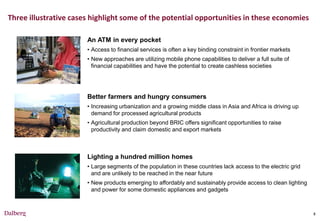
                       An ATM in every pocket
                       • Access to financial services is often a key binding constraint in frontier markets
                       • New approaches are utilizing mobile phone capabilities to deliver a full suite of
                         financial capabilities and have the potential to create cashless societies


                       Better farmers and hungry consumers
                       • Increasing urbanization and a growing middle class in Asia and Africa is driving up
                         demand for processed agricultural products
                       • Agricultural production beyond BRIC offers significant opportunities to raise
                         productivity and claim domestic and export markets


                       Lighting a hundred million homes
                       • Large segments of the population in these countries lack access to the electric grid
                         and are unlikely to be reached in the near future
                       • New products emerging to affordably and sustainably provide access to clean lighting
                         and power for some domestic appliances and gadgets


                                                                                                                8
A bank in every pocket: Mobile banking and innovative agent banking models
are providing millions of people with access to financial services


  • In 2000 less than 10% of Kenyans had access
    to a bank account

  • Today 80% have access to mobile phones

  • Since the launch of mobile money in 2007
    more than 14 million users have signed up

  • Today more than 60% of the adult population   Million users
    has a mobile money account                                               MPesa

  • As banks are developing platforms to direct                              banks
    access to banking services and new service
    models a steep increase in the access to
    financial serices is seen

  • Services available for mobile and agent                                  MKesho
    banking are developed at a very high pace


                                                                                      9
Farmers to consumers: Fast growing urban populations drives vast increase in demand
for processed agriculture products
                                                              Projected growth in food consumption indexed:
  • On the demand side, Frontier markets are                     SSA vs. developed countries (2000-2018)
    urbanizing at an unprecedented rate with Africa’s                                                              CAGR
    urban population projected to almost double         160
                                                                                                                 2000-2018
                                                                                                                  2.6%
    from 230M in 2000 to 430M in 2020                   155

                                                        150
  • Rising incomes in the middle class are also         145

    changing consumption habits particularly around     140           Sub-Saharan Africa
    food                                                135

                                                        130                                                       1.4%
  • This creates opportunities for new products to      125
    capture uncontested market                          120

                                                        115                                Developed countries
                                                        110

  • On the supply side productivity in most frontier    105

    markets significantly lags behind Europe and the    100

    US (e.g. average annual milk production per                2000                 2008                  2018
    cow in EU ~4700 litres, Africa ~500litres)
  • Governments and commercial farmers are
    increasingly looking at technology and skills to
    close these gaps
  • There are also opportunities to introduce
    technology and business models around
    processing and marketing foods for the growing
    consumer segment and for export
Lighting a hundred million homes: In Africa alone, the potential market for off-grid
portable clean lighting solutions is estimated at $10Bn
                                                             Over the next 20 years, Africa will rapidly surpass Asia to
 • African BOP households and small businesses               become the largest un-electrified market in the world
   currently spend over $10 billion on lighting annually
   - growing to over $11bn                                                  809                                      2009
                                                                                                698
                                                                                  561     589
                                                                                                                     2030
 • Most unelectrified households are currently lit with
   battery driven or kerosene lamps which are costly            34 13                                    21    5
   and inefficient                                               Latin       Asia         Africa       Middle East
                                                                America
 • Africa’s non-electrified population will grow to 120
   million households (630 million people) and over 10
   million small businesses by 2015                           The global solar portable lighting market is
                                                              dominated by India and China
 • In addition 20 out of 60 million on-grid households                            9%             8%
   are “under-electrified”                                         6%                                  Other
                                                                                 30%             22% India
 • The market will easily experience 40-50% annual                40%
                                                                                                 20% China
   sales growth, and 5-6 million African households will
   own solar portable lights by 2015                              27%               49%                    US, Canada,
                                                                                                   50%     Europe,
 • It is expected that by 2015 nearly 12 million SPLs will        20%               19%                    Australia, Japan
   be owned by African households and SMEs
                                                              Number of    Global sales         Africa sales
                                                             manufacturers
                                                                                                                              11
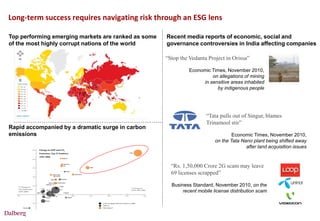
Long-term success requires navigating risk through an ESG lens

Top performing emerging markets are ranked as some   Recent media reports of economic, social and
of the most highly corrupt nations of the world      governance controversies in India affecting companies

                                                     “Stop the Vedanta Project in Orissa”

                                                               Economic Times, November 2010,
                                                                        on allegations of mining
                                                                    in sensitive areas inhabited
                                                                          by indigenous people


                                                                      “Tata pulls out of Singur, blames
                                                                      Trinamool stir”
Rapid accompanied by a dramatic surge in carbon
emissions                                                                          Economic Times, November 2010,
                                                                           on the Tata Nano plant being shifted away
                                                                                         after land acquisition issues


                                                       “Rs. 1,50,000 Crore 2G scam may leave
                                                       69 licenses scrapped”

                                                       Business Standard, November 2010, on the
                                                            recent mobile license distribution scam
Investing in growth: Why ESG investments makes sense in emerging markets

                                                      ESG assets under management
 What are the material ESG issues?                    USD trillions
  • Environmental                                                                                    6,8
  • Social                                                                   +21%                    0,5         Australasia
  • Governance
                                                                              3,6                    3,6         Europe
                                                             2,6
 Why is it important to investors?                           0,4
                                                                              1,3
  • Risk mitigation:                                                          2,3                    2,7
                                                                                                                 North
                                                             2,2                                                 America
    – Sustainable companies better avoid crises
    – Customer, supplier and employee loyalty               2003              2006                   2008


  • Earnings and growth impact:                       Percent of LPs who expect to invest in emerging regions by
    – Efficient use of resources can                  date
      reduce/control business costs                                                                                    2007
                                                                                                68
    – Forces long term thinking                         MESA                                              83           2008
                                                                                                            89
                                                                                                                       2009
                                                                                    43
  • Capital flows                                        CEE+
                                                                                          57
                                                        Russia
    – Significant capital flows into sustainability                                                  75
      themes                                            Latin           20
                                                                                  40
    – ESG-oriented investors likely to have longer    America
                                                                                               65
      horizons/hold periods                                        4
                                                          Asia               30
                                                                                         52
                                                                                                                               13
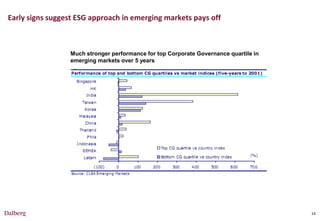
Early signs suggest ESG approach in emerging markets pays off


                 Much stronger performance for top Corporate Governance quartile in
                 emerging markets over 5 years


                                                                                      14
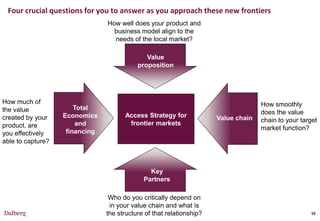
Four crucial questions for you to answer as you approach these new frontiers
                                How well does your product and
                                  business model align to the
                                  needs of the local market?

                                              Value
                                           proposition


How much of                                                                         How smoothly
the value              Total
                                      Access Strategy for                           does the value
created by your    Economics                                          Value chain
                                       frontier markets                             chain to your target
product, are            and
                                                                                    market function?
you effectively     financing
able to capture?


                                               Key
                                             Partners

                                 Who do you critically depend on
                                 in your value chain and what is
                                the structure of that relationship?                                  15
Some fast movers from Beyond BRIC are already having an impact in Denmark


                                   … can Denmark move fast enough to claim its
                                   share of the emerging opportunities?


                                                                                 16

Dalberg - Beyond BRIC

  • 1.
    DALBERG GLOBAL DEVELOPMENTADVISORS Inside perspectives from BRIC and beyond Presented by James Mwangi and Gaurav Gupta
  • 2.
    Dalberg offers strategicadvice on development, sustainability and opportunities in frontier markets Copenhagen Geneva San Francisco New York Washington DC Dakar Mumbai Nairobi Santiago Johannesburg
  • 3.
    Our role isshifting with a changing world Integrating efforts to assist in development... ... with moves to create and capture value 2
  • 4.
    BRIC countries providea template for rapid transformation 3
  • 5.
    The BRIC countriesshow us how transformation has played out in the recent past 1990: From widespread poverty 2010: To mass markets ... BRIC in1990: BRIC in 2010: • Average GDP per capita: $ 1.815 • Average GDP per capita: $ 5.417 • Foreign Direct Investments to the BRICs: $ 4.5 • Foreign Direct Investments to the BRICs: $ 208 billion billion • Still 15.3% of population below the national poverty • India had 36% and Russia 30% of their population line on average below the poverty line • Literacy in India is 66% while the rest are almost • China and India were less than 30% urbanized 100% • India had less than 50% literacy 4
  • 6.
    There are signsthat a new wave of countries is embarking on the same path New emerging economies beyond BRIC are characterized by • Strong, steady growth of more than 3% per year through the global economic down turn • A current wealth base of a GDP per capita of more than $500 • Relatively stable security and governance conditions • Relatively good or improving ease of doing business 5
  • 7.
    Our entire modelfor thinking about these countries must shift From meeting a charitable need To commercial engagement • 15 countries beyond BRIC have seen an average annual growth above 5% during the global crisis • By 2020 more than half of African households are expected to have discretionary spending power led by a growing urban middle class • Africa’s collective GDP is now at $1,6 trillion – on level with Brazil’s and Russia’s • Foreign direct investment in Africa has increased from $9 bn in 2000 to $62 bn in 2008 • Since 1990 Western Europe’s share of trade with Africa has shrunk to half while Asia’s has more than doubled 6
  • 8.
    The transformation ofthese countries will feed on their untapped human potential • Africa’s labor force is rapidly expanding with more than 40% of the population below 15. It is projected to reach 1,1 billion in 2040 overtaking China and India • Basic adult literacy rates are currently 64% for Africa and 80% for Asia • 1,2 million people from BRIC and beyond are currently studying abroad compared to 5000 from Denmark (Kenya alone has 10,000) • 66% of the international students at MIT- on of the world’s top universities – are from Africa, Asia and Latin America while only 20% are from Europe 7
  • 9.
    Three illustrative caseshighlight some of the potential opportunities in these economies An ATM in every pocket • Access to financial services is often a key binding constraint in frontier markets • New approaches are utilizing mobile phone capabilities to deliver a full suite of financial capabilities and have the potential to create cashless societies Better farmers and hungry consumers • Increasing urbanization and a growing middle class in Asia and Africa is driving up demand for processed agricultural products • Agricultural production beyond BRIC offers significant opportunities to raise productivity and claim domestic and export markets Lighting a hundred million homes • Large segments of the population in these countries lack access to the electric grid and are unlikely to be reached in the near future • New products emerging to affordably and sustainably provide access to clean lighting and power for some domestic appliances and gadgets 8
  • 10.
    A bank inevery pocket: Mobile banking and innovative agent banking models are providing millions of people with access to financial services • In 2000 less than 10% of Kenyans had access to a bank account • Today 80% have access to mobile phones • Since the launch of mobile money in 2007 more than 14 million users have signed up • Today more than 60% of the adult population Million users has a mobile money account MPesa • As banks are developing platforms to direct banks access to banking services and new service models a steep increase in the access to financial serices is seen • Services available for mobile and agent MKesho banking are developed at a very high pace 9
  • 11.
    Farmers to consumers:Fast growing urban populations drives vast increase in demand for processed agriculture products Projected growth in food consumption indexed: • On the demand side, Frontier markets are SSA vs. developed countries (2000-2018) urbanizing at an unprecedented rate with Africa’s CAGR urban population projected to almost double 160 2000-2018 2.6% from 230M in 2000 to 430M in 2020 155 150 • Rising incomes in the middle class are also 145 changing consumption habits particularly around 140 Sub-Saharan Africa food 135 130 1.4% • This creates opportunities for new products to 125 capture uncontested market 120 115 Developed countries 110 • On the supply side productivity in most frontier 105 markets significantly lags behind Europe and the 100 US (e.g. average annual milk production per 2000 2008 2018 cow in EU ~4700 litres, Africa ~500litres) • Governments and commercial farmers are increasingly looking at technology and skills to close these gaps • There are also opportunities to introduce technology and business models around processing and marketing foods for the growing consumer segment and for export
  • 12.
    Lighting a hundredmillion homes: In Africa alone, the potential market for off-grid portable clean lighting solutions is estimated at $10Bn Over the next 20 years, Africa will rapidly surpass Asia to • African BOP households and small businesses become the largest un-electrified market in the world currently spend over $10 billion on lighting annually - growing to over $11bn 809 2009 698 561 589 2030 • Most unelectrified households are currently lit with battery driven or kerosene lamps which are costly 34 13 21 5 and inefficient Latin Asia Africa Middle East America • Africa’s non-electrified population will grow to 120 million households (630 million people) and over 10 million small businesses by 2015 The global solar portable lighting market is dominated by India and China • In addition 20 out of 60 million on-grid households 9% 8% are “under-electrified” 6% Other 30% 22% India • The market will easily experience 40-50% annual 40% 20% China sales growth, and 5-6 million African households will own solar portable lights by 2015 27% 49% US, Canada, 50% Europe, • It is expected that by 2015 nearly 12 million SPLs will 20% 19% Australia, Japan be owned by African households and SMEs Number of Global sales Africa sales manufacturers 11
  • 13.
    Long-term success requiresnavigating risk through an ESG lens Top performing emerging markets are ranked as some Recent media reports of economic, social and of the most highly corrupt nations of the world governance controversies in India affecting companies “Stop the Vedanta Project in Orissa” Economic Times, November 2010, on allegations of mining in sensitive areas inhabited by indigenous people “Tata pulls out of Singur, blames Trinamool stir” Rapid accompanied by a dramatic surge in carbon emissions Economic Times, November 2010, on the Tata Nano plant being shifted away after land acquisition issues “Rs. 1,50,000 Crore 2G scam may leave 69 licenses scrapped” Business Standard, November 2010, on the recent mobile license distribution scam
  • 14.
    Investing in growth:Why ESG investments makes sense in emerging markets ESG assets under management What are the material ESG issues? USD trillions • Environmental 6,8 • Social +21% 0,5 Australasia • Governance 3,6 3,6 Europe 2,6 Why is it important to investors? 0,4 1,3 • Risk mitigation: 2,3 2,7 North 2,2 America – Sustainable companies better avoid crises – Customer, supplier and employee loyalty 2003 2006 2008 • Earnings and growth impact: Percent of LPs who expect to invest in emerging regions by – Efficient use of resources can date reduce/control business costs 2007 68 – Forces long term thinking MESA 83 2008 89 2009 43 • Capital flows CEE+ 57 Russia – Significant capital flows into sustainability 75 themes Latin 20 40 – ESG-oriented investors likely to have longer America 65 horizons/hold periods 4 Asia 30 52 13
  • 15.
    Early signs suggestESG approach in emerging markets pays off Much stronger performance for top Corporate Governance quartile in emerging markets over 5 years 14
  • 16.
    Four crucial questionsfor you to answer as you approach these new frontiers How well does your product and business model align to the needs of the local market? Value proposition How much of How smoothly the value Total Access Strategy for does the value created by your Economics Value chain frontier markets chain to your target product, are and market function? you effectively financing able to capture? Key Partners Who do you critically depend on in your value chain and what is the structure of that relationship? 15
  • 17.
    Some fast moversfrom Beyond BRIC are already having an impact in Denmark … can Denmark move fast enough to claim its share of the emerging opportunities? 16