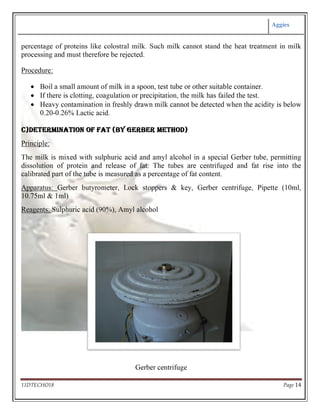
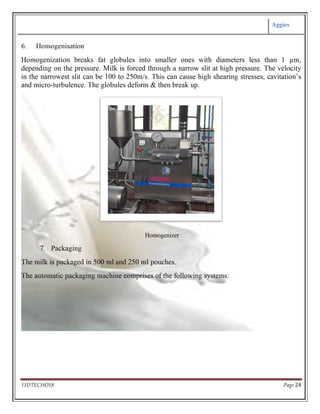
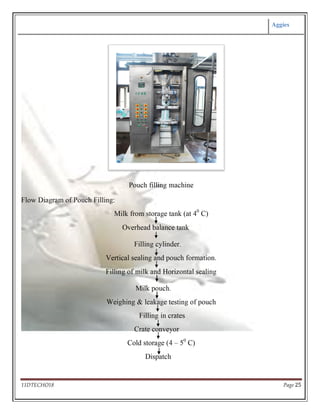
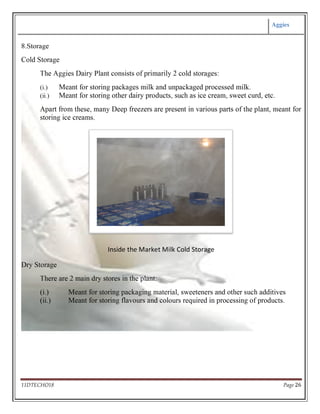
Aggies
11DTECHO18 Page 1
Training reporT
on
aggies
WSFDT
Submitted by:- submitted to:-
Sadaf ahmad er. Ajeet yonA vishwAsi
11dtech108, 7th
semester dairy engineer
Prof. (dr) john david Er. AvinAsh singh sir
Advisor Dairy incharge
Aggies
11DTECHO18 Page 2
ACKNOWLEDGEMENT
With immense pleasure and satisfaction, I, Sadaf ahmad is presenting this report.
Preparation of this report is based on the co-ordination of so many people that it is very
difficult for me to express my gratitude to them for their aid. However, I have tried my best to
acknowledge them.
I am highly obliged to Prof. (Dr.) ramesh ChanDra (Dean W.S.F.D.T) who provided
me the opportunity to undergo in plant-training at AGGIES dairy as a mandatory part of our
curriculum.
I pay my humble acknowledgment to Prof. (Dr.) John DaviD (Staff aDviSor), er.
AvinAsh singh, (Dairy incharge) for his guidance to me doing the training and active
encouragement due to which I was able to complete my training.
I should express my thanks to Er. AjEEt YonA VishwAsi (Dairy EnginEEr) & Mr.
Priyanshu srivastava (AccountAnt) of Aggies Student Training Dairy, for their
valuable inputs during my Training Period.
I am very thankful to all the suggestions and technical knowledge and skills, which were
embodied into me by the valuable support of employees at AGGIES as these are of immense
help and importance for me in my future endeavor.
Aggies
11DTECHO18 Page 3
History of Student training dairy
The student training dairy was established in 1965 under the leadership of pioneer Prof. James
N Warner who was first head of department of Dairy technology, AAI-DU, having capacity of
5,000 LPD.
It is situated inside the premises of Sam Higginbottom Institute of Agriculture, Technology and
Sciences (SHIATS) under Warner School of Food and Dairy Technology (WSFDT) to provide
training opportunities to students of WSFDT as well as other departments.
The area covered by the plant is 500m2
.
During 1965 – 1975, it was handling 5,000 litres of milk daily i.e. its full capacity.
In 1992, it was named as AGGIES, a unit of SHIATS.
The initial structure of student training dairy comprises of one manager, two supervisor, ten
workers.
Now a day, the training dairy is handling 500 litres of milk per day. A number of products like
market milk, ghee, sweet curd, plain curd, flavoured milk, paneer, ice lollies, softy, lassi etc are
being manufactured. Inspite of being a training dairy instead of commercial dairy some of its
products like ghee, curd, paneer, flavoured milk is very popular.
The golden achievement of this student training dairy is that its trainees have attained reputed
posts in a no of companies like AL-AIN Dairy (Dubai), ITC limited, MOTHER dairy,
AMUL, GOWARDHAN etc.
ADDRESS OF DAIRY : - Aggies Student Training Dairy.
Department Of Dairy
SHIATS, Naini-211007
Dist.-Allahabad
UP (INDIA)
YEAR OF ESTABLISHMENT : - 1992
FORM OF ORGANIZATION : - Student Training Dairy
DISTANCE FROM CITY : - AGGIES is 7 KM away from Allahabad City.
Aggies
11DTECHO18 Page 5
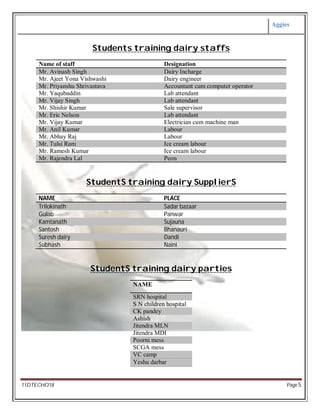
Students training dairy staffs
Name of staff Designation
Mr. Avinash Singh Dairy Incharge
Mr. Ajeet Yona Vishwashi Dairy engineer
Mr. Priyanshu Shrivastava Accountant cum computer operator
Mr. Yaqubuddin Lab attendant
Mr. Vijay Singh Lab attendant
Mr. Shishir Kumar Sale supervisor
Mr. Eric Nelson Lab attendant
Mr. Vijay Kumar Electrician cum machine man
Mr. Anil Kumar Labour
Mr. Abhay Raj Labour
Mr. Tulsi Ram Ice cream labour
Mr. Ramesh Kumar Ice cream labour
Mr. Rajendra Lal Peon
StudentS training dairy SupplierS
NAME PLACE
Trilokinath Sadar bazaar
Gulab Panwar
Kamtanath Sujauna
Santosh Bhanauri
Suresh dairy Dandi
Subhash Naini
StudentS training dairy parties
NAME
SRN hospital
S N children hospital
CK pandey
Ashish
Jitendra MLN
Jitendra MDI
Poorni mess
SCGA mess
VC camp
Yeshu darbar
Aggies
11DTECHO18 Page 6
Fundamental knowledge oF milk
Definition-
Acc. to PFA, Milk may be defined as the whole, fresh, clean, lacteal secretion obtained by the
complete milking of one or more healthy milch animal, excluding that obtained within 15 days
before & 5 days after calving.
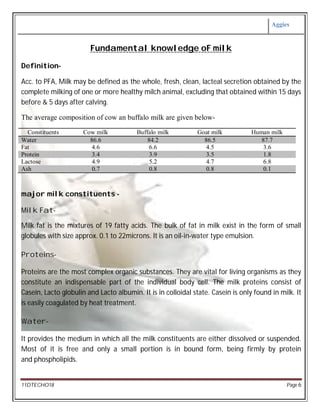
The average composition of cow an buffalo milk are given below-
Constituents Cow milk Buffalo milk Goat milk Human milk
Water 86.6 84.2 86.5 87.7
Fat 4.6 6.6 4.5 3.6
Protein 3.4 3.9 3.5 1.8
Lactose 4.9 5.2 4.7 6.8
Ash 0.7 0.8 0.8 0.1
major milk constituents -
Milk Fat-
Milk fat is the mixtures of 19 fatty acids. The bulk of fat in milk exist in the form of small
globules with size approx. 0.1 to 22microns. It is an oil-in-water type emulsion.
Proteins-
Proteins are the most complex organic substances. They are vital for living organisms as they
constitute an indispensable part of the individual body cell. The milk proteins consist of
Casein, Lacto globulin and Lacto albumin. It is in colloidal state. Casein is only found in milk. It
is easily coagulated by heat treatment.
Water-
It provides the medium in which all the milk constituents are either dissolved or suspended.
Most of it is free and only a small portion is in bound form, being firmly by protein
and phospholipids.
Aggies
11DTECHO18 Page 7
Lactose (MiLk Sugar)-
It is found only in milk. It exist in true solution phase and is fermented by LAB to yield lactic
acid. It is very important for cultured milk products. It can also cause souring in milk and its
products.
Mineral Matter-
Although it is present in small quantity, it is very essential for human body. These are mostly
salts like Mg, Na, P, N etc. It influences physico-chemical properties of milk and also effect
the nutritive value.
Minor Milk constituents-
PhosPholiPids-
There are three types of phospholipids (Lecithin, Cephalic and Sphingomylein). Lecithin is
important constituent as it helps in the formation of outer membrane of fat globules.
Pigment-
There are two type of pigment present in milk, Fat Soluble and Fat insoluble. Carotene is fat
soluble and is responsible for the yellow colour of milk. The other two are Xanthophylls and
riboflavin. Carotene also acts as an anti-oxidant and as a source of Vitamin A.
Milk EnzyMEs-
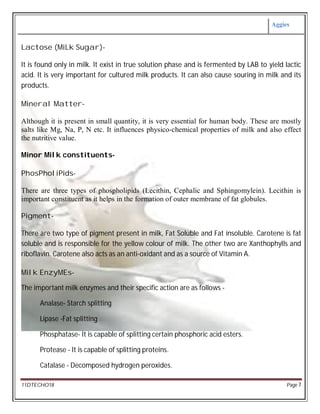
The important milk enzymes and their specific action are as follows -
Analase- Starch splitting
Lipase -Fat splitting
Phosphatase- It is capable of splitting certain phosphoric acid esters.
Protease - It is capable of splitting proteins.
Catalase - Decomposed hydrogen peroxides.
Aggies
11DTECHO18 Page 8
Vitamins-
Vitamins are present in minute quantities in milk or any other food but play a very important
role in vital functioning of human body. There are 25 vitamins present in milk. These are fat
soluble e.g. Vit. A, D, E, K, apart from fat soluble there are water soluble vitamins as B-
complex(B1, riboflavin or B2, niacin, pyridoxine or B6.)
Role of milk in human life
Milk is one of the most complete food available in nature for human consumption. Milk
contains all nutrients in balanced proportions to meet the demand of humans. It is not only
necessary for children but it is every essential for adults too. Milk proteins are one of the most
high quality proteins. It is essential proper growth of body.
It supplies-
Body – building proteins
Bone- forming minerals
Health giving vitamins
Energy giving lactose & fat
Energy value-
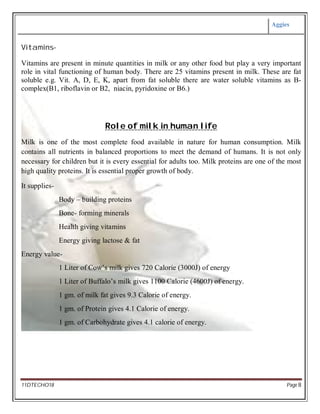
1 Liter of Cow’s milk gives 720 Calorie (3000J) of energy
1 Liter of Buffalo’s milk gives 1100 Calorie (4600J) of energy.
1 gm. of milk fat gives 9.3 Calorie of energy.
1 gm. of Protein gives 4.1 Calorie of energy.
1 gm. of Carbohydrate gives 4.1 calorie of energy.
Aggies
11DTECHO18 Page 9
DAIRY ACTIVITY
In the reception section, milk is received through cans (cap. 40 lit). It is then examined for its
organoleptic quality (colour, odour, taste, acidity) and presence of any visible foreign matter. A
representative sample is taken for various test such as COB test, CLR reading, fat test etc. to be
conducted in the QC lab. The bulk of milk is then weighed and the milk suppliers are paid on
the basis of fat % and CLR reading of their milk. The milk is then pumped to the processing
section for further treatment.
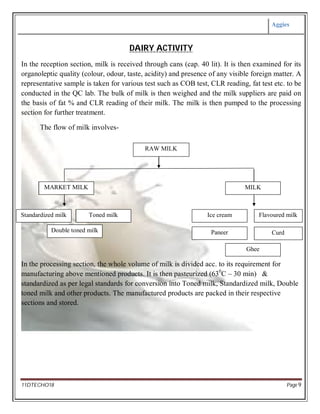
The flow of milk involves-
In the processing section, the whole volume of milk is divided acc. to its requirement for
manufacturing above mentioned products. It is then pasteurized (630
C – 30 min) &
standardized as per legal standards for conversion into Toned milk, Standardized milk, Double
toned milk and other products. The manufactured products are packed in their respective
sections and stored.
RAW MILK
MARKET MILK MILK
PRODUCTS
Standardized milk Toned milk
Double toned milk Paneer
Ice cream Flavoured milk
Curd
Ghee
Aggies
11DTECHO18 Page 10
Training Overview
The training was performed in the different section as follows:
 RMRD
 Processing
 Manufacturing
 Record Keeping
Milk reception
Aggies Student Training dairy receive milk only from milk cans of various capacity varies
from 40 to 45 litres, from village society’s Dudhiya.
RMRD( raw milk reception dock) is the section where the unloading, weighing, testing,
chilling and transfer of milk to the production section take place. The raw milk is received
from various chilling centre and dairies through tankers or cans.
Milk Reception Flow Chart
Raw Milk in Cans
Grading
Filtration and Weighing
Sampling, Analysis & Testing
Clarification
Chilling of Raw Milk (5o
C)
Storage of Raw Chilled Milk in storage tank (below 5o
C)
Aggies
11DTECHO18 Page 11
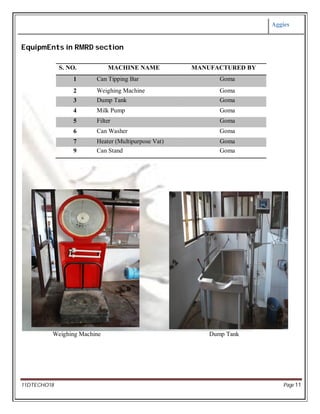
EquipmEnts in RMRD section
Weighing Machine Dump Tank
S. NO. MACHINE NAME MANUFACTURED BY
1 Can Tipping Bar Goma
2 Weighing Machine Goma
3 Dump Tank Goma
4 Milk Pump Goma
5 Filter Goma
6 Can Washer Goma
7 Heater (Multipurpose Vat) Goma
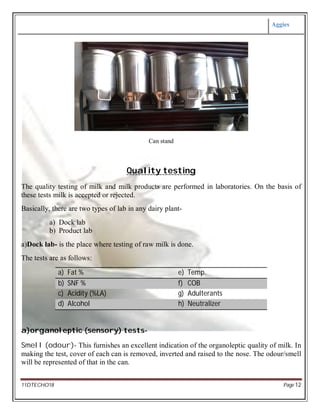
9 Can Stand Goma
Aggies
11DTECHO18 Page 12
Can stand
Quality testing
The quality testing of milk and milk products are performed in laboratories. On the basis of
these tests milk is accepted or rejected.
Basically, there are two types of lab in any dairy plant-
a) Dock lab
b) Product lab
a)Dock lab- is the place where testing of raw milk is done.
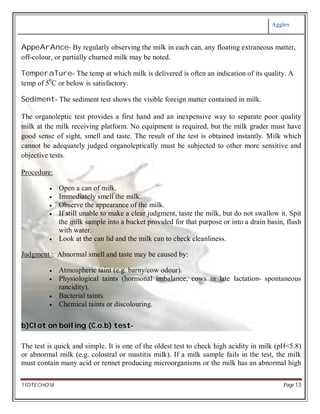
The tests are as follows:
a) Fat % e) Temp.
b) SNF % f) COB
c) Acidity (%LA) g) Adulterants
d) Alcohol h) Neutralizer
a)organoleptic (sensory) tests-
Smell (odour)- This furnishes an excellent indication of the organoleptic quality of milk. In
making the test, cover of each can is removed, inverted and raised to the nose. The odour/smell
will be represented of that in the can.
Aggies
11DTECHO18 Page 13
AppeArAnce- By regularly observing the milk in each can, any floating extraneous matter,
off-colour, or partially churned milk may be noted.
TemperaTure- The temp at which milk is delivered is often an indication of its quality. A
temp of 50
C or below is satisfactory.
Sediment- The sediment test shows the visible foreign matter contained in milk.
The organoleptic test provides a first hand and an inexpensive way to separate poor quality
milk at the milk receiving platform. No equipment is required, but the milk grader must have
good sense of sight, smell and taste. The result of the test is obtained instantly. Milk which
cannot be adequately judged organoleptically must be subjected to other more sensitive and
objective tests.
Procedure:
 Open a can of milk.
 Immediately smell the milk.
 Observe the appearance of the milk.
 If still unable to make a clear judgment, taste the milk, but do not swallow it. Spit
the milk sample into a bucket provided for that purpose or into a drain basin, flush
with water.
 Look at the can lid and the milk can to check cleanliness.
Judgment : Abnormal smell and taste may be caused by:
 Atmospheric taint (e.g. barny/cow odour).
 Physiological taints (hormonal imbalance, cows in late lactation- spontaneous
rancidity).
 Bacterial taints.
 Chemical taints or discolouring.
b)Clot on boiling (C.o.b) test-
The test is quick and simple. It is one of the oldest test to check high acidity in milk (pH<5.8)
or abnormal milk (e.g. colostral or mastitis milk). If a milk sample fails in the test, the milk
must contain many acid or rennet producing microorganisms or the milk has an abnormal high
Aggies
11DTECHO18 Page 15
Procedure: Measure 10ml Gerber acid in butyrometer
Pipette out 10.75ml of milk and add 1ml amyl alcohol
Shake well
Centrifuge at 1100rpm for 5ml
Read the percentage of fat.
d)Determination of Snf in milk-
SNF is determined by measuring specific gravity and fat percent of the milk samples.
Materials:- Lactometer & Thermometer
Procedure:-
Milk sample
Pour it to a cylinder
Let the lactometer into the cylinder without touching the slides
Take the reading from the lactometer
Note the corrected lactometer reading
Calculation:-
SNF = CLR / 4 + 0.2 F+ 0.5
CLR = LR taken at 84⁰F (280
C)
e)Lactometer reading-
Milk is sampled in the stainless steel cylinder and a lactometer is dipped in it. The marking
which touches the level of the milk gives the lactometer reading. An LR of 26 for whole milk
and 32 for skim milk is optimum.
Aggies
11DTECHO18 Page 16
g)Acidity test-
Bacteria that normally develop in raw milk produce more or less of lactic acid. In the acidity
test the acid is neutralized with 0.1N Sodium hydroxide and the amount of alkaline is
measured. From this, the percentage of lactic acid can be calculated.
Fresh milk contains in this test also "natural acidity" which is due to the natural ability to resist
pH changes .The natural acidity of milk is 0.16 - 0.18%. Figures higher than this signifies
developed acidity due to the action of bacteria on milk sugar.
Apparatus:
 A porcelain dish or small conical flask
 10 ml pipette, graduated
 1 ml pipette
 A Burette, 0.1 ml graduations
 A glass rod for stirring the milk in the dish
 A Phenolphthalein indicator solution, 0.5%in 50% Alcohol
 N Sodium hydroxide solution.
Procedure:
9 ml of the milk measured into the porcelain dish/conical flask, 1 ml Phenolphthalein is added
and then slowly from the burette, 0.1 N Sodium hydroxide under continuous mixing, until a
faint pink color appears.
The number of ml of Sodium hydroxide solution divided by 10 expresses the percentage of
lactic acid.
Calculation:- Titrable acidity as % lactic acid = Titre value X 0.09
h)AdulterAtion test-
Rosalic acid TesT / deTecTion of neuTRalizeRs-
Take 2 ml rosalic acid solution (0.05% in 60:40 ethyl alcohol and distilled water) in a test tube,
add 2 ml of milk. Rose-Red colour development indicates neutralizer presence in milk.
Aggies
11DTECHO18 Page 17
Starch teSt-
Take 3 ml. Milk in a test tube, boil and cool under tap water. Add a drop of 1% Iodine solution.
Presence of starch is indicated by the appearance of a blue colour which disappears when the
sample is boiled and re-appears on cooling.
Salt teSt-
Take 5 ml of silver nitrate (0.1341%) solution in a test tube and add two drops of potassium
chromate (10%) solution. It will give brick red colour. To this add exactly 1 ml of milk and
mix. Observe the colour, if yellow colour appears then it shows salt test positive. If not, then
the salt test is negative.
Sugar TeST-
Take 3 ml of milk in a test tube and add 5 ml dilute HCl (1:2) containing resorcinol (0.1 gm.
resorcinol dissolved in 100 ml dilute HCl). Mix well and keep the test tube in boiling water for
5 minutes. Brick red colour formation indicates sugar test positive.
Alcohol TesT-
Take 5 ml milk in a test tube add 5 ml (60% v/v, sp. gr. 0.91 g/ml) alcohol with constant shake.
Formation of precipitates indicates alcohol test positive.
TesT for NiTraTe CompouNds -
Take 5 ml of milk in a Test Tube and drain it from the test tube. Add 2ml (5%) Diphenyl amine
reagent in the test tube. Development of blue colour indicates the presence of nitrate
compounds in milk.
The glassware used in the test must be cleaned properly with glass distilled water.
Reagent: Dissolve 0.085 g of diphenylamine in 50 ml of glass distilled water, and then
gradually add 450 ml of concentrated sulphuric acid. Ensure that the solution is colorless.
TesT for Ammonium Compound -Take 1 ml of milk and add 2 ml. of Nessler’s reagent in
test tube. The appearances of yellow to brown colouration confirm presence of ammonium
compound. The intensity of colour varies from yellow to brown colour depending upon the
concentration of ammonium compounds in milk.
Aggies
11DTECHO18 Page 18
TesT for Hydrogen Peroxide (H2O2)-
Dissolve 1 gm V2O5 (Vanadium Pent oxide) in 100 ml of 6% H2SO4 (6+94). To 10 ml of
sample add 10 drops of reagent and mix. The development of pink or red colour indicates
presence of H2O2.
TesT for formalin in milk -
Take milk sample (2 ml) in a test tube and add 2 ml of 90 percent H2SO4 containing ferric
chloride (5 gm. in 100 ml H2SO4) from the side of the test tube slowly. Formation of purple
ring at the junction indicates formaldehyde is present in milk.
Urea TesT-
Procedure:
Take 5 ml. of milk sample and add 5 ml. of 1.6 percent DMAB reagent and mix well. For
comparison, prepare a control, that is, milk sample containing no added urea. A distinct yellow
colour if observed in milk sample indicates milk containing “added urea”. The control
however, would show a slight yellow colour due to the presence of natural urea in milk.
i)Methylene Blue Reduction test (MBRt)-
Take 10 ml of the milk sample in the test tube. Add 1 ml standard solution of methylene blue.
Close the open end of the test tube with a cotton plug. Mix thoroughly and place the test tube
in a water bath maintained at 37o
C. Hold the test tube in the water bath till the colour
disappears. Note the time taken for the colour change. The reduction time is proportional to the
number of bacteria present in the milk as given below-
Reduction Time Quality of Milk Approximate microbes /mL
Over 4.5 hours Good 2 lakhs or less
2.5-4.5 hours Average 2 lakhs to 20 lakhs
Less than 2.5 hours Poor 20 lakhs to 1 crore
Aggies
11DTECHO18 Page 20
The flow diagram of manufacture is-
Receiving water in pasteurizimg vat
Pre-heating (38- 430
C)
Addition of smp, whole milk and mixing
Filteration
Pasteurization (630
C/30 min.)
Cooling (50
C)
Packaging and storage (50
C)
Double ToneD Milk-
Double toned milk (DTM) is made from cow and/or buffalo milk by adding fresh skim milk or
a mixture of water and skim milk powder and/or by removing fat by partial separation, or by
doing both. The standard throughout India for this fluid milk is minimum of 1.5% milk fat and
9.0% SNF. Double-toned milk should be pasteurized.
It is probable that DTM cannot be made from cow milk by partial separation alone. The
addition of powder is necessary to ensure the required SNF (minimum 9.0%). Since cow milk
may have around 8.5% SNF, DTM cannot contain 9.0% SNF. Extra SNF must normally be
added in the form of skim milk powder. Buffalo milk would seldom have this difficulty
because whole buffalo milk must legally contain at least 9.0% SNF.
Flow chart of double toned milk manufacture
Receiving milk
(Grading, sampling, weighing, testing)
Pre-heating (35 to 40⁰C)
Filtration/clarification
Cooling and storage (5⁰C or below)
Standardisation
Pasteurisation (63⁰C/30 min or 72⁰C/15 seconds)
Homogenization (2500 psi)
Aggies
11DTECHO18 Page 21
Packaging
Storage (5⁰C or below)
1. Receiving Milk
The milk in cans or such containers is graded, emptied, measured by weight, sampled and
is delivered to the pasteurizing unit.
2. Pre-Heating
The milk is preheated at 35-40o
C. This helps in efficient clarification
3. Filtration
Filtration removes visible foreign matter. While filtration removes suspended foreign
matter by the straining process, clarification removes the same by centrifugal
sedimentation.
4. Standardization
Standardization of milk refers to the adjustment of Fat & SNF value to confirm legal
standards.
Operating parameters for Standardization:
Products Fat [%] SNF [%]
Full cream milk 6 9
Toned milk 3 8.5
Double toned milk 1.5 9
Skim milk 0.5 8.7
Standardized milk 4.5 8.5
Separation of milk fat may be done by two ways:
1. Separation by gravity.
2. Separation by centrifugal force.
Separation by Centrifugal Force
Aggies
11DTECHO18 Page 27
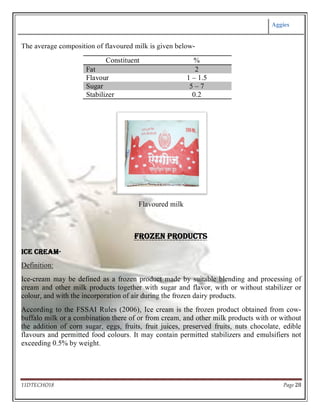
Flavoured milk-
Flavoured milk are milk to which some flavour has been added. the product should contain a
fat % at least equal to the minimum legal requirement for market milk. But when the fat level
is lower (1-2 %), the term ‘drink’ is used.
The purpose is:
• to make milk more palatable to those who do not relish it as such.
• to stimulate the sale of milk.
• to put skim milk to profitable use.
Flow chart of flavoured milk:-
Toned milk
Processing
(Pasteurization + Homogenization)
Standardization
Addition of Sugar @ 8.0 %
Addition of Colour and Essence
Packaging
Bottle Filling Pouch Filling
Crowing Storage
Sterilization Dispatch
Storage
Constituent %
Fat 2
Flavour 1 – 1.5
Sugar 5 – 7
Stabilizer 0.2
Aggies
11DTECHO18 Page 30
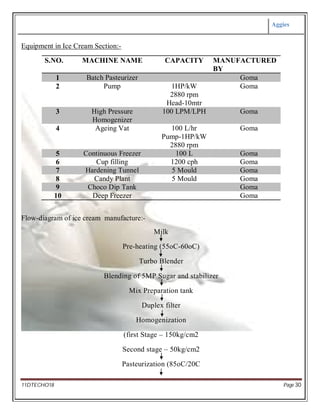
Equipment in Ice Cream Section:-
S.NO. MACHINE NAME CAPACITY MANUFACTURED
BY
1 Batch Pasteurizer Goma
2 Pump 1HP/kW
2880 rpm
Head-10mtr
Goma
3 High Pressure
Homogenizer
100 LPM/LPH Goma
4 Ageing Vat 100 L/hr
Pump-1HP/kW
2880 rpm
Goma
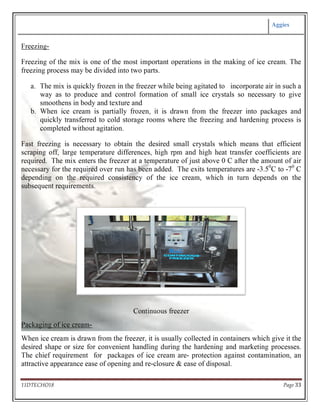
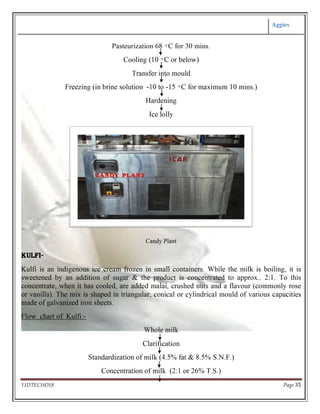
5 Continuous Freezer 100 L Goma
6 Cup filling 1200 cph Goma
7 Hardening Tunnel 5 Mould Goma
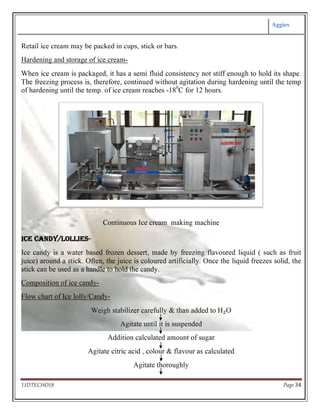
8 Candy Plant 5 Mould Goma
9 Choco Dip Tank Goma
10 Deep Freezer Goma
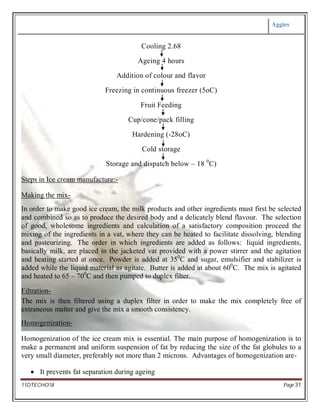
Flow-diagram of ice cream manufacture:-
Milk
Pre-heating (55oC-60oC)
Turbo Blender
Blending of 5MP Sugar and stabilizer
Mix Preparation tank
Duplex filter
Homogenization
(first Stage – 150kg/cm2
Second stage – 50kg/cm2
Pasteurization (85oC/20C
Aggies
11DTECHO18 Page 31
Cooling 2.68
Ageing 4 hours
Addition of colour and flavor
Freezing in continuous freezer (5oC)
Fruit Feeding
Cup/cone/pack filling
Hardening (-28oC)
Cold storage
Storage and dispatch below – 18 0
C)
Steps in Ice cream manufacture:-
Making the mix-
In order to make good ice cream, the milk products and other ingredients must first be selected
and combined so as to produce the desired body and a delicately blend flavour. The selection
of good, wholesome ingredients and calculation of a satisfactory composition proceed the
mixing of the ingredients in a vat, where they can be heated to facilitate dissolving, blending
and pasteurizing. The order in which ingredients are added as follows: liquid ingredients,
basically milk, are placed in the jacketed vat provided with a power stirrer and the agitation
and heating started at once. Powder is added at 350
C and sugar, emulsifier and stabilizer is
added while the liquid material as agitate. Butter is added at about 600
C. The mix is agitated
and heated to 65 – 700
C and then pumped to duplex filter.
Filtration-
The mix is then filtered using a duplex filter in order to make the mix completely free of
extraneous matter and give the mix a smooth consistency.
Homogenization-
Homogenization of the ice cream mix is essential. The main purpose of homogenization is to
make a permanent and uniform suspension of fat by reducing the size of the fat globules to a
very small diameter, preferably not more than 2 microns. Advantages of homogenization are-
 It prevents fat separation during ageing
Aggies
11DTECHO18 Page 32
 Produces more uniform ice cream with a smoother texture
 Improves whipping ability
 Decrease the risk of churning occurring in the freezer and
 Leads to the use of slightly less stabilizer
Here a pressure of 1500 psi at first stage and 500 psi at second stage is applied.
Pasteurization-
Proper pasteurization destroys all pathogenic or disease producing bacteria, thereby
safeguarding the health of the consumer. The advantages of pasteurization are:
i. It renders the mix completely free of pathogenic bacteria
ii. It dissolves and helps to blend the ingredients of the mix
iii. It improves flavor
iv. It improves keeping quality
v. It produces a more uniform product
The pasteurization time temperature combination in the ice cream plant here is 85 +50
C for 25
seconds.
Chilling-
The mix is then chilled to about 70
C to facilitate ageing and after which it is pumped over to
ageing vat.
Aging the mix-
After cooling the mix the mix is pumped to ageing tanks and it should held in ageing tanks
until used. Ageing refers to holding the mix at a low temperature for a definite time before
freezing. Ageing produces the following results.
a. It improves the body and texture of ice cream
b. Improves whipping capacity of the mix
c. Increased maximum overrun
d. Increases melting resistance
The purpose of this step is to allow hydrocolloids to swell, the casein to become hydrated, the
viscosity to increase, the texture to become finer, to increase the resistance to melting, the whip
ability to improve, fats to crystallize out and aroma to develop uniformity throughout.
Aggies
11DTECHO18 Page 36
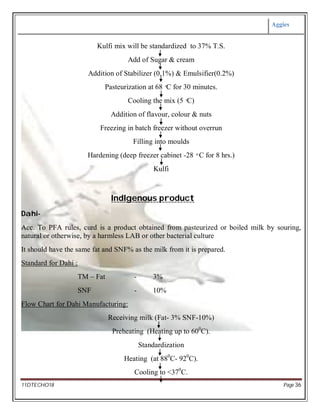
Kulfi mix will be standardized to 37% T.S.
Add of Sugar & cream
Addition of Stabilizer (0.1%) & Emulsifier(0.2%)
Pasteurization at 68 ͦC for 30 minutes.
Cooling the mix (5 ͦC)
Addition of flavour, colour & nuts
Freezing in batch freezer without overrun
Filling into moulds
Hardening (deep freezer cabinet -28 ͦ C for 8 hrs.)
Kulfi
IndIgenous product
Dahi-
Acc. To PFA rules, curd is a product obtained from pasteurized or boiled milk by souring,
natural or otherwise, by a harmless LAB or other bacterial culture
It should have the same fat and SNF% as the milk from it is prepared.
Standard for Dahi :
TM – Fat - 3%
SNF - 10%
Flow Chart for Dahi Manufacturing:
Receiving milk (Fat- 3% SNF-10%)
Preheating (Heating up to 600
C).
Standardization
Heating (at 880
C- 920
C).
Cooling to <370
C.
Aggies
11DTECHO18 Page 40
Khoa
Khoa is a heat coagulated milk product obtained by partial dehydration of milk of buffalo, cow
or their admixture and shall not contain any ingredients foreign to milk.
“According to PFA Rules (1976), khoa is the product obtained from cow or buffalo milk or a
combination thereof, by rapid drying. The milk fat content should not be less than 20% of the
finished product.”
BIS specification of Khoa:
Characteristics Requirements for type
Pindi Danedar Dhap
Total solids (% by mass,
min.)
65 60 55
Fat (% by mass on dry
basis, min.)
37 37 37
Total Ash (% by mass, on
dry basis, min.)
6.0 6.0 6.0
Titrable Acidity (as lactic
acid- % by mass, max.)
0.8 0.9 0.6
Method of production:
Milk Taken : 20 lit
Yield : 20-25 %
Shelf Life : 4-5 days at room temperature
Normally 2 to 3 kg or more of milk (preferably buffalo) is taken per batch and boiled in a
karahi over a brisk non-smoky fire. The milk is stirred vigorously and constantly with a
circular motion by a khunti. During this operation all paths of the pan with which their milk
comes in contact are lightly scraped to prevent a milk from scorching. Constant evaporation of
milk takes place and the milk thickens progressively. At a certain concentration, (cow milk 2.8;
buffalo milk 2.5), heat coagulation of milk proteins begins and their concentration becomes
progressively ‘insoluble’ in water. This stage is marked by an abrupt change in color. The
heating is continued with greater control hereafter and the speed of stirring-cum-scrapping
increase. Soon the viscous mask reaches a semi-solid/pasty consistency and begins to dry up.
Very close attention is paid to the last stages. The final product is ready when it shows signs of
Aggies
11DTECHO18 Page 41
leaving the bottom and sides of the karahi and sticking together. The khoa path is invariably
made after removing the pan from the fire and working the contents up and down in to a single
compact mass.
Butter
Butter may be defined as a fat concentrate which is obtained by churning cream, gathering the
fat globules into a compact mass and then working it.
Acc. to PFA, table (creamery) butter is the product obtained from cow or buffalo milk or a
combination thereof, or from cream or curd, with or without addition of common salt and
annatto or carotene as colouring matter. It should be free from other animal fat, wax and
mineral oils, vegetable oil & fat.
Composition of butter-
Constituent Percentage
Butter fat 80.2
Moisture 16.3
Salt 2.5
Curd 1.0
Equipment in butter and ghee section:-
Butter churn
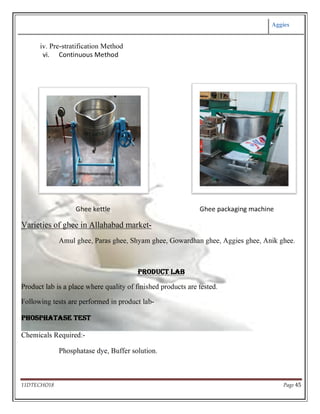
Ghee kettle 1000 1itres
Ghee Tin seaming Machine
Cream Vat 1000 litres
Aggies
11DTECHO18 Page 42
Flow diagram
Receiving cream
(grading, weighing sampling, testing)
Neutralization
Standardisation (35⁰C to 40% fat)
Pasteurisation (82⁰C-88⁰C/no hold) Or Vacreation
Cooling (20⁰C to 22⁰C)
Cooling
Ripening (20⁰C to 22⁰C)
Ageing (5⁰C to 10⁰C)
Churning
Salting and working
Washing
Packaging and storage (-23⁰C to -29⁰C)
Ghee
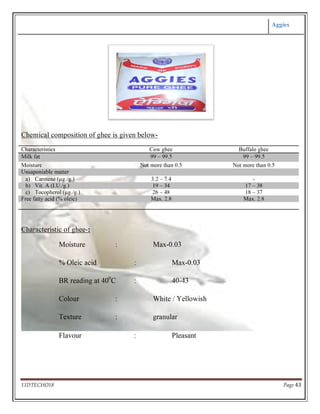
Acc. to PFA, ghee is the pure sclarified fat derived solely from milk or from desi butter or from
cream to which no colouring matter is added. It should contain not less than 99.5% fat.
Today the anuual production of ghee may be estimated at over 500 million kg. with a value of
Rs. 1,250 crores at the present rate. The largest ghee producing states are- Uttar Pradesh,
Andhra Pradesh, Punjab , Rajasthan, MP, Bihar etc.
The average per capita consumption of ghee today works out to less than 1 kg. per annum.
Aggies
11DTECHO18 Page 44
The flow diagram of ghee manufacturing is-
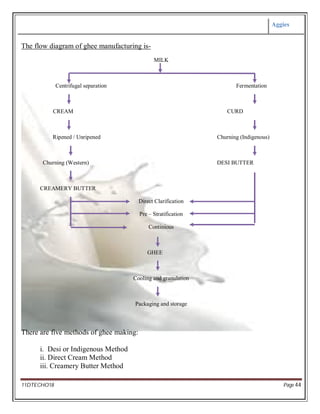
MILK
Centrifugal separation Fermentation
CREAM CURD
Ripened / Unripened Churning (Indigenous)
Churning (Western) DESI BUTTER
CREAMERY BUTTER
Direct Clarification
Pre – Stratification
Continious
GHEE
Cooling and granulation
Packaging and storage
There are five methods of ghee making:
i. Desi or Indigenous Method
ii. Direct Cream Method
iii. Creamery Butter Method
Aggies
11DTECHO18 Page 46
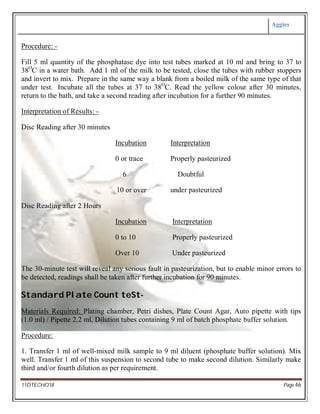
Procedure: -
Fill 5 ml quantity of the phosphatase dye into test tubes marked at 10 ml and bring to 37 to
38O
C in a water bath. Add 1 ml of the milk to be tested, close the tubes with rubber stoppers
and invert to mix. Prepare in the same way a blank from a boiled milk of the same type of that
under test. Incubate all the tubes at 37 to 38O
C. Read the yellow colour after 30 minutes,
return to the bath, and take a second reading after incubation for a further 90 minutes.
Interpretation of Results: -
Disc Reading after 30 minutes
Incubation Interpretation
0 or trace Properly pasteurized
6 Doubtful
10 or over under pasteurized
Disc Reading after 2 Hours
Incubation Interpretation
0 to 10 Properly pasteurized
Over 10 Under pasteurized
The 30-minute test will reveal any serious fault in pasteurization, but to enable minor errors to
be detected, readings shall be taken after further incubation for 90 minutes.
Standard Plate Count teSt-
Materials Required: Plating chamber, Petri dishes, Plate Count Agar, Auto pipette with tips
(1.0 ml) / Pipette 2.2 ml, Dilution tubes containing 9 ml of batch phosphate buffer solution.
Procedure:
1. Transfer 1 ml of well-mixed milk sample to 9 ml diluent (phosphate buffer solution). Mix
well. Transfer 1 ml of this suspension to second tube to make second dilution. Similarly make
third and/or fourth dilution as per requirement.
Aggies
11DTECHO18 Page 47
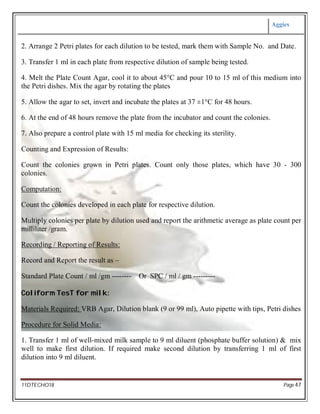
2. Arrange 2 Petri plates for each dilution to be tested, mark them with Sample No. and Date.
3. Transfer 1 ml in each plate from respective dilution of sample being tested.
4. Melt the Plate Count Agar, cool it to about 45°C and pour 10 to 15 ml of this medium into
the Petri dishes. Mix the agar by rotating the plates
5. Allow the agar to set, invert and incubate the plates at 37 ±1°C for 48 hours.
6. At the end of 48 hours remove the plate from the incubator and count the colonies.
7. Also prepare a control plate with 15 ml media for checking its sterility.
Counting and Expression of Results:
Count the colonies grown in Petri plates. Count only those plates, which have 30 - 300
colonies.
Computation:
Count the colonies developed in each plate for respective dilution.
Multiply colonies per plate by dilution used and report the arithmetic average as plate count per
milliliter /gram.
Recording / Reporting of Results:
Record and Report the result as –
Standard Plate Count / ml /gm -------- Or SPC / ml / gm ---------
Coliform TesT for milk:
Materials Required: VRB Agar, Dilution blank (9 or 99 ml), Auto pipette with tips, Petri dishes
Procedure for Solid Media:
1. Transfer 1 ml of well-mixed milk sample to 9 ml diluent (phosphate buffer solution) & mix
well to make first dilution. If required make second dilution by transferring 1 ml of first
dilution into 9 ml diluent.
Aggies
11DTECHO18 Page 48
2. Arrange 2 Petri plates for each sample mark them with Sample No. and Date.
3. Transfer 1 ml in each plate respective dilution of sample to be tested.
4. Add 10 to 15 ml of VRB Agar, previously melted and cooled to about 45°C.
5. Mix the contents thoroughly by rotating the plates and allow the agar to solidify. Pour
additional approximately 5 ml. of the media over the surface of the solidified medium and
allow solidifying again.
6. Invert plates and incubate the plates at 37 ±1°C for 18 -24 hours.
Counting and Expression of Results:
Count dark red colonies measuring at least 0.5 mm in diameter.
Computation:
Count dark red with red precipitate colonies measuring at least 0.5 mm in diameter in each
plate for each dilution plated. Multiply colonies per plate by dilution used and report the
arithmetic average as Coliform Count-----/ml/gm. of products.
Recording / Reporting of Results:
Record and Report the result as - Coliform Count / ml /gm. of product.
TesT of Coliform BaCTeria By liquid media (PCT):
Materials Required:
Auto pipette with tips /pipettes of 2.2 ml.
Brilliant green bile broth 2% in tubes.
Procedure:
Transfer 1 ml from first dilution of sample into Brilliant Green Bile Broth 2% tube in triplicate.
Incubate for 48 hours at 37 ±1°C and observe for acid and gas production.
Production of gas and opacity in at least two tubes out of three constitutes the positive
presumptive test.
Aggies
11DTECHO18 Page 49
If PCT is positive and simultaneously typical colonies observed on solid media. This confirms
the presence of coli form in the sample. If required further confirmation may be done using
streak techniques on EMB agar or microscopically.
Disposal of Used Media:
Sterilize all used Petri plates and PCT tubes with media after observation / counting by
autoclaving at 15 psi for 20 minutes. Cool plates and tubes. Collect all solid media in polythene
bags and dispose.
TesTing of ghee:-
Determination of moisture-
Hot air-oven method-
Procedure:
Weigh accurately about 10 grams of properly mixed Ghee in a previously tared aluminium
dish.
Loosen the lid of the dish and heat in an oven at 105 O
C for 1 hrs.
Remove the dish after closing the lid and cool in a desiccator and weigh.
Heat in the oven for further period of 1 hour, cool and weigh. Repeat it till the weight between
two successive heating does not exceed 1 mg.
Calculation:
Moisture % = W1 X 100 / W
Where,
W1 = weight loss
W = weight of oil taken
Water quality TesT-
Purpose: To check the quality of water.
Hardness:-
Take 50 ml of water in 250 ml conical flask, add 1 ml ammonia buffer and few drops of
Erichrome Black T/ Solochrome Black T indicator. Purplish pink color was obtained after
addition of indicator. Now titrate it against N/50 EDTA till blue color obtained.
Note down the vol. used of EDTA.
Multiply reading with 20 to obtain the result
pH TesT:-
Use pH strips or universal indicator.
Aggies
11DTECHO18 Page 52
RefRigeRation section:-
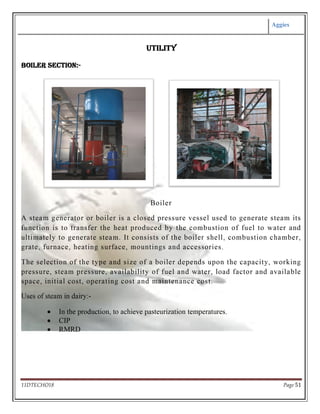
Cooling is defined as the reduction of temperature by removing heat. For cooling
medium circuits, basically two systems are used:
1. Compression refrigeration installation, where gas is compressed with a
compressor and condenses during the cooling phase.
2. Vapour absorption system in which hot water is used to cool the
normal water.
Refrigeration is a main requirement to keep the milk & milk products save from deterioration.
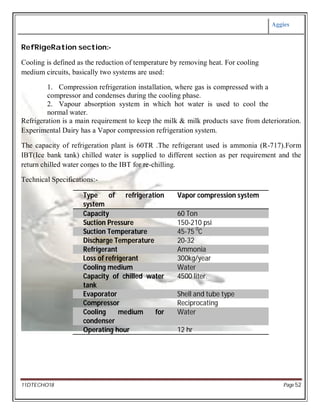
Experimental Dairy has a Vapor compression refrigeration system.
The capacity of refrigeration plant is 60TR .The refrigerant used is ammonia (R-717).Form
IBT(Ice bank tank) chilled water is supplied to different section as per requirement and the
return chilled water comes to the IBT for re-chilling.
Technical Specifications:-
Type of refrigeration
system
Vapor compression system
Capacity 60 Ton
Suction Pressure 150-210 psi
Suction Temperature 45-75 0
C
Discharge Temperature 20-32
Refrigerant Ammonia
Loss of refrigerant 300kg/year
Cooling medium Water
Capacity of chilled water
tank
4500 liter.
Evaporator Shell and tube type
Compressor Reciprocating
Cooling medium for
condenser
Water
Operating hour 12 hr
Aggies
11DTECHO18 Page 53
Compression refrigeration installations-
These units are mainly used for smaller units such as refrigerators. They can be
used for industrial purposes when large amounts of heat are available.
Principle-
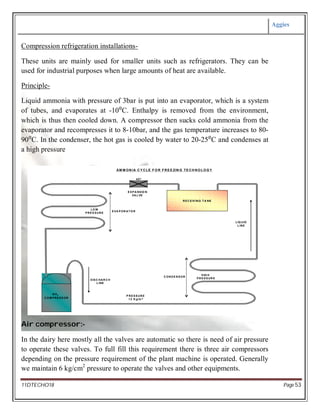
Liquid ammonia with pressure of 3bar is put into an evaporator, which is a system
of tubes, and evaporates at -10⁰C. Enthalpy is removed from the environment,
which is thus then cooled down. A compressor then sucks cold ammonia from the
evaporator and recompresses it to 8-10bar, and the gas temperature increases to 80-
90⁰C. In the condenser, the hot gas is cooled by water to 20-25⁰C and condenses at
a high pressure
Air compressor:-
In the dairy here mostly all the valves are automatic so there is need of air pressure
to operate these valves. To full fill this requirement there is three air compressors
depending on the pressure requirement of the plant machine is operated. Generally
we maintain 6 kg/cm2
pressure to operate the valves and other equipments.
C O M PRESS OR
REC EIV ING T A NK
DISC HAR C H
L INE
P RESSURE
1 2 K g/m 2
C ONDE NSOR
HIG H
PR ESSUR E
LIQ UID
L INE
EVA POR AT O R
LO W
PRES SURE
EXPA NSIO N
VA L VE
45 0
N H3
AM M ON IA C Y CLE F O R FRE E ZIN G TE CH NO LO G Y
Aggies
11DTECHO18 Page 54
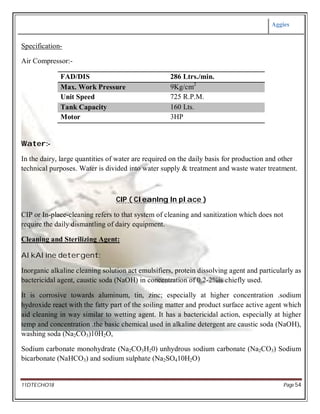
Specification-
Air Compressor:-
FAD/DIS 286 Ltrs./min.
Max. Work Pressure 9Kg/cm2
Unit Speed 725 R.P.M.
Tank Capacity 160 Lts.
Motor 3HP
Water:-
In the dairy, large quantities of water are required on the daily basis for production and other
technical purposes. Water is divided into water supply & treatment and waste water treatment.
CIP ( CleanIng In place )
CIP or In-place-cleaning refers to that system of cleaning and sanitization which does not
require the daily dismantling of dairy equipment.
Cleaning and Sterilizing Agent:
AlkAline detergent:
Inorganic alkaline cleaning solution act emulsifiers, protein dissolving agent and particularly as
bactericidal agent, caustic soda (NaOH) in concentration of 0.2-2%is chiefly used.
It is corrosive towards aluminum, tin, zinc; especially at higher concentration .sodium
hydroxide react with the fatty part of the soiling matter and product surface active agent which
aid cleaning in way similar to wetting agent. It has a bactericidal action, especially at higher
temp and concentration .the basic chemical used in alkaline detergent are caustic soda (NaOH),
washing soda (Na2CO3)10H2O,
Sodium carbonate monohydrate (Na2CO3H20) unhydrous sodium carbonate (Na2CO3) Sodium
bicarbonate (NaHCO3) and sodium sulphate (Na2SO410H2O)
Aggies
11DTECHO18 Page 55
For protection against corrosion of aluminum, inhibitors such as sodium silicates (as water
glass Na2sio3) is used.
Acid Solution:
Solution of organic and inorganic acid in concentration of 0.5-2%.are used to remove hard
deposits such has water scale and milk stone which are usually formed or hot surface. Such
deposits do not dissolve in alkaline .the acid which are principally used are nitric acid (0.5%)
or phosphoric acid (2%). Other acid should be only with caution since they may cause
corrosion.
The surface active agent also called wetting agent are added to cleaning solution to lower the
surface tension or tension and therefore increase the wetting ability and water solubility .an
increase penetration is obtained because the cleaning solution is better able to enter in to the
pores of the soiling matter and into crevices.
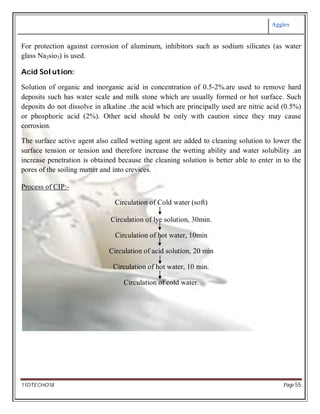
Process of CIP:-
Circulation of Cold water (soft)
Circulation of lye solution, 30min.
Circulation of hot water, 10min
Circulation of acid solution, 20 min
Circulation of hot water, 10 min.
Circulation of cold water.
Aggies
11DTECHO18 Page 56
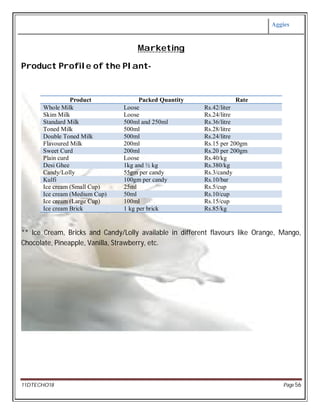
Marketing
Product Profile of the Plant-
Product Packed Quantity Rate
Whole Milk Loose Rs.42/liter
Skim Milk Loose Rs.24/litre
Standard Milk 500ml and 250ml Rs.36/litre
Toned Milk 500ml Rs.28/litre
Double Toned Milk 500ml Rs.24/litre
Flavoured Milk 200ml Rs.15 per 200gm
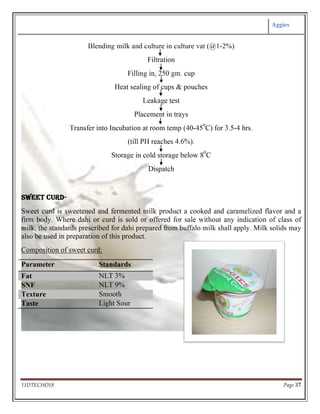
Sweet Curd 200ml Rs.20 per 200gm
Plain curd Loose Rs.40/kg
Desi Ghee 1kg and ½ kg Rs.380/kg
Candy/Lolly 55gm per candy Rs.3/candy
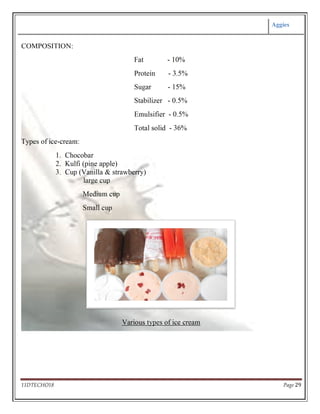
Kulfi 100gm per candy Rs.10/bar
Ice cream (Small Cup) 25ml Rs.5/cup
Ice cream (Medium Cup) 50ml Rs.10/cup
Ice cream (Large Cup) 100ml Rs.15/cup
Ice cream Brick 1 kg per brick Rs.85/kg
** Ice Cream, Bricks and Candy/Lolly available in different flavours like Orange, Mango,
Chocolate, Pineapple, Vanilla, Strawberry, etc.
Aggies
11DTECHO18 Page 57
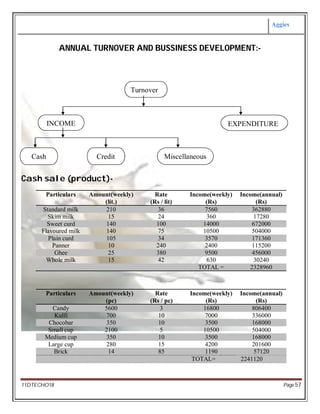
ANNUAL TURNOVER AND BUSSINESS DEVELOPMENT:-
Cash sale (product)-
Particulars Amount(weekly)
(lit.)
Rate
(Rs / lit)
Income(weekly)
(Rs)
Income(annual)
(Rs)
Standard milk 210 36 7560 362880
Skim milk 15 24 360 17280
Sweet curd 140 100 14000 672000
Flavoured milk 140 75 10500 504000
Plain curd 105 34 3570 171360
Panner 10 240 2400 115200
Ghee 25 380 9500 456000
Whole milk 15 42 630 30240
TOTAL = 2328960
Particulars Amount(weekly)
(pc)
Rate
(Rs / pc)
Income(weekly)
(Rs)
Income(annual)
(Rs)
Candy 5600 3 16800 806400
Kulfi 700 10 7000 336000
Chocobar 350 10 3500 168000
Small cup 2100 5 10500 504000
Medium cup 350 10 3500 168000
Large cup 280 15 4200 201600
Brick 14 85 1190 57120
TOTAL= 2241120
Turnover
INCOME EXPENDITURE
Cash Credit Miscellaneous
Aggies
11DTECHO18 Page 58
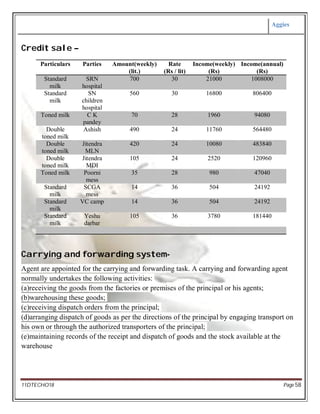
Credit sale –
Particulars Parties Amount(weekly)
(lit.)
Rate
(Rs / lit)
Income(weekly)
(Rs)
Income(annual)
(Rs)
Standard
milk
SRN
hospital
700 30 21000 1008000
Standard
milk
SN
children
hospital
560 30 16800 806400
Toned milk C K
pandey
70 28 1960 94080
Double
toned milk
Ashish 490 24 11760 564480
Double
toned milk
Jitendra
MLN
420 24 10080 483840
Double
toned milk
Jitendra
MDI
105 24 2520 120960
Toned milk Poorni
mess
35 28 980 47040
Standard
milk
SCGA
mess
14 36 504 24192
Standard
milk
VC camp 14 36 504 24192
Standard
milk
Yeshu
darbar
105 36 3780 181440
Carrying and forwarding system-
Agent are appointed for the carrying and forwarding task. A carrying and forwarding agent
normally undertakes the following activities:
(a)receiving the goods from the factories or premises of the principal or his agents;
(b)warehousing these goods;
(c)receiving dispatch orders from the principal;
(d)arranging dispatch of goods as per the directions of the principal by engaging transport on
his own or through the authorized transporters of the principal;
(e)maintaining records of the receipt and dispatch of goods and the stock available at the
warehouse
Aggies
11DTECHO18 Page 59
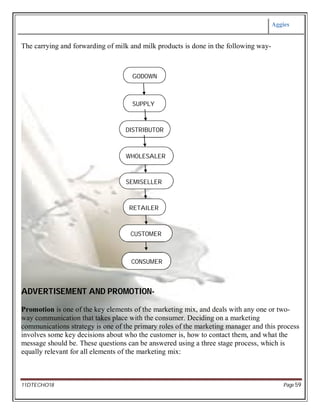
The carrying and forwarding of milk and milk products is done in the following way-
ADVERTISEMENT AND PROMOTION-
Promotion is one of the key elements of the marketing mix, and deals with any one or two-
way communication that takes place with the consumer. Deciding on a marketing
communications strategy is one of the primary roles of the marketing manager and this process
involves some key decisions about who the customer is, how to contact them, and what the
message should be. These questions can be answered using a three stage process, which is
equally relevant for all elements of the marketing mix:
GODOWN
SUPPLY
DISTRIBUTOR
WHOLESALER
SEMISELLER
RETAILER
CUSTOMER
CONSUMER
Aggies
11DTECHO18 Page 60
Segmentation
Dividing the marketing into distinct groups
Targeting
Deciding which of these groups to communicate with, and how to talk to them.
Positioning
How the product or brand should be perceived by the target groups.
Messaging
Delivering a specific message in order to influence the target groups.
Advertising is just one element of the marketing communication arsenal, which can be divided
into the following areas:
ADVERTISING – A MASS MEDIA APPROACH TO PROMOTION
 Outdoor
 Business directories
 Magazines / newspapers
 TV / cinema
 Radio
 Newsagent windows
SALES PROMOTION - PRICE / MONEY RELATED COMMUNICATIONS
 Coupons
 Discounts
 Competitions
 Loyalty incentives
PUBLIC RELATIONS - USING THE PRESS TO YOUR ADVANTAGE
 Press launches
 PR events
 Press releases
Aggies
11DTECHO18 Page 61
PERSONAL SELLING – ONE TO ONE COMMUNICATION WITH A POTENTIAL
BUYER
 Salesmen
 Experiential marketing
 Dealer or showroom sales activities
 Exhibitions
 Trade shows
DIRECT MARKETING - TAKING THE MESSAGE DIRECTLY TO THE
CONSUMER
 Mail order catalogues
 Bulk mail
 Personalised letters
 Email
 Telemarketing
 Point of sale displays
 Packaging design
DIGITAL MARKETING – NEW CHANNELS ARE EMERGING CONSTANTLY
 Company websites
 Social media applications such as Facebook or Twitter
 Blogging
 Mobile phone promotions using technology such as blue-tooth
 YouTube
 E-commerce
PRICING STRATEGY
The price of a product in the market is an important factor influencing consumer demand.
Hence to be marketable, a dairy product must be competitively priced. This implies that the
costs involved in raw material procurement, processing, packaging, storage, marketing and
distribution must be kept as low as possible. generally the price of a dairy product will involve
the following costs-
 Cost of raw milk
 Cost of raw milk collection and transportation
Aggies
11DTECHO18 Page 62
 Cost of processing
 Cost of packaging
 Cost of marketing and distribution
 Taxes and tariffs
 Profit margins at each stage of the marketing channel (Collection, Processing
and marketing margins)
In order to arrive at a realistic costing of a product, all those elements involved at each stage
must be carefully calculated on a unit basis. This is known as Cost Accounting. The table
below shows some of the essential cost elements:
Market function Cost element
1. Raw milk procurement Cost of raw milk; labour; materials etc.; collection
margin
2. Transportation Transport cost; labour; materials and equipment;
transport margin
3. Processing Raw materials; machinery and equipment; labour;
packaging; energy; taxes; marketing and distribution;
processing margin
4. Marketing and distribution Transport; labour; materials; rent; retail margin
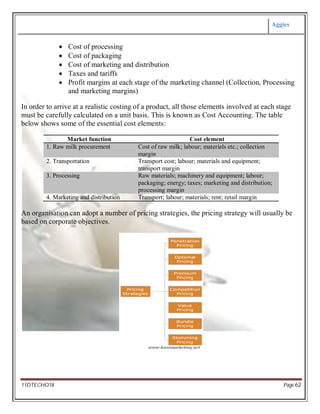
An organisation can adopt a number of pricing strategies, the pricing strategy will usually be
based on corporate objectives.
Aggies
11DTECHO18 Page 63
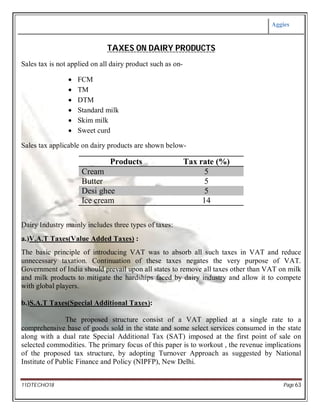
TAXES ON DAIRY PRODUCTS
Sales tax is not applied on all dairy product such as on-
 FCM
 TM
 DTM
 Standard milk
 Skim milk
 Sweet curd
Sales tax applicable on dairy products are shown below-
Products Tax rate (%)
Cream 5
Butter 5
Desi ghee 5
Ice cream 14
Dairy Industry mainly includes three types of taxes:
a.)V.A.T Taxes(Value Added Taxes) :
The basic principle of introducing VAT was to absorb all such taxes in VAT and reduce
unnecessary taxation. Continuation of these taxes negates the very purpose of VAT.
Government of India should prevail upon all states to remove all taxes other than VAT on milk
and milk products to mitigate the hardships faced by dairy industry and allow it to compete
with global players.
b.)S.A.T Taxes(Special Additional Taxes):
The proposed structure consist of a VAT applied at a single rate to a
comprehensive base of goods sold in the state and some select services consumed in the state
along with a dual rate Special Additional Tax (SAT) imposed at the first point of sale on
selected commodities. The primary focus of this paper is to workout , the revenue implications
of the proposed tax structure, by adopting Turnover Approach as suggested by National
Institute of Public Finance and Policy (NIPFP), New Delhi.
Aggies
11DTECHO18 Page 64
c.)C.S.T Taxes(Central Sales Taxes) :
This Act may be called the Central Sales Taxes, 1956. The central sales tax
presently charged at 2 per cent on dairy products should be reduced to 0 per cent.
REGULATORY REQUIREMENT OF DAIRY INDUSTRY
The restrictions, licenses, and laws applicable to a product or business, imposed by
the government
The Indian processed dairy industry has grown and diversified enormously in the last few
years. To ensure the proper development and growth of this industrial sector, the Government
of India has instituted various laws and regulations. The various regulations that govern the
dairy processing industry can broadly be classified into:
 Compulsory legislation
 Voluntary standards
 Other government regulation
Compulsory LegisLation
FSSAI (2006)
Milk and Milk Product Order (MMPO) 1992
The Milk and Milk Product Order (MMPO), 1992, issued on June 9, 1992 seeks to ensure the
supply of liquid milk, an essential commodity, to consumers by regulating its processing and
distribution.
Salient Features of the MMPO Order include the following:
1) Registrations for units handling up to 75,000 litres of milk per day are granted by the State
Governments and units with more than 75,000 litres per day capacity are registered by the
Central Registering Authority.
2) The Certificate also specifies the milkshed area, which, under the order is defined as a
geographical area demarcated by the Registering Authority for the collection of milk by the
registered unit.
Aggies
11DTECHO18 Page 65
3) Maintenance of specified hygienic conditions in the premises where milk and milk products
are handled, processed, manufactured or stored.
Standards on Weights and Measures (Packaged Commodities) Rules, 1977
These Rules lay down certain obligatory conditions for all commodities that are packed form,
with respect to declarations on quantities contained. These Rules are operated by the
Directorate of Weights and Measures, under the Ministry of Food and Civil Supplies.
Export (Quality Control & Inspection) Act, 1963
The Export Inspection Council is responsible for the operation of this Act. Under the Act, a
large number of exportable commodities have been notified for compulsory pre-shipment
inspection. The quality control and inspection of various export products is administered
through a network of more than fifty offices located around major production centres and ports
of shipment. In addition, organizations may be recognized as agencies for inspection and /or
quality control. Recently, the government has exempted agriculture and food products, fruit
products and fish and fishery products from compulsory pre-shipment inspections, provided
that the exporter has a firm letter from the overseas buyer stating that the overseas buyer does
not require pre-shipment inspection from official Indian inspection agencies.
Pollution Control
No Objection Certificate from Pollution Control Board is a must.
Voluntary StandardS
There are two organizations that deal with voluntary standardization and certification systems
in the food sector. The Bureau of Indian Standards looks after standardization of processed
foods and standardization of raw agricultural produce is under the purview of the Directorate
of Marketing and Inspection.
Bureau of Indian Standards (BIS)
The activities of BIS are two fold, the formulation of Indian standards in the processed foods
sector and the implementation of standards through promotion and through voluntary and third
party certification systems. BIS has on record, standards for most of processed foods. In
general, these standards cover raw materials permitted and their quality parameters, hygienic
conditions under which products are manufactured and packaging and labelling requirements.
Aggies
11DTECHO18 Page 66
Manufacturers complying with standards laid down by the BIS can obtain and "ISI" mark that
can be exhibited on product packages. BIS has identified certain items like food
colours/additives, vanaspati, containers for packing, milk powder and condensed milk, for
compulsory certification.
Directorate of Marketing and Inspection (DMI)
The DMI enforces the Agricultural Products (Grading and Marketing) Act, 1937. Under this
Act, Grade Standards are prescribed for agricultural and allied commodities. These are known
as "Agmark" Standards. Grading under the provisions of this Act is voluntary. Manufacturers
who comply with standard laid down by DMI are allowed to use "Agmark" labels on their
products.
Other Government reGulations
Industrial Licence:
Foreign investment
Foreign technology agreement
Import of capital goods
Import of second hand capital goods
Dividend balancing
MAXIMUM RETAIL PRICE-
Maximum retail price (MRP) means price at which the product shall be sold in retail and
which include all taxes levied on the product. It is inclusive of all taxes and the profit
margins of wholesalers and retailer. This includes the local taxes which may vary according
to place. Thus at places where local taxes is low, the difference between the selling price and
the MRP allows for huge margin and retailer may sell the product for price below the MRP.
There are no standard rules governing fixing up of MRP of the product unless it is a ration
commodity. Manufacturer can decide the price and MRP has to be printed on the product. No
wholesale dealer or retailer shall obliterate, smudge or alter the retail sale price indicated by the
manufacturer or the packer or the importer. So even one or two rupee extra charged by
retailers citing various excuses like refrigeration cost and transport costs are just ways to
fleece the consumers.
Aggies
11DTECHO18 Page 67
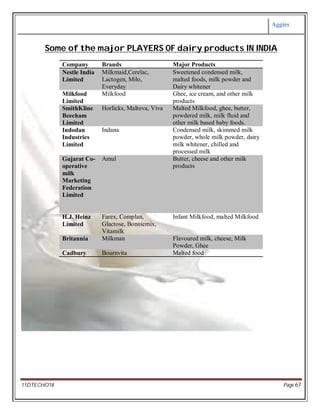
Some of the major PLAYERS OF dairy products IN INDIA
Company Brands Major Products
Nestle India
Limited
Milkmaid,Cerelac,
Lactogen, Milo,
Everyday
Sweetened condensed milk,
malted foods, milk powder and
Dairy whitener
Milkfood
Limited
Milkfood Ghee, ice cream, and other milk
products
SmithKline
Beecham
Limited
Horlicks, Maltova, Viva Malted Milkfood, ghee, butter,
powdered milk, milk fluid and
other milk based baby foods.
Indodan
Industries
Limited
Indana Condensed milk, skimmed milk
powder, whole milk powder, dairy
milk whitener, chilled and
processed milk
Gujarat Co-
operative
milk
Marketing
Federation
Limited
Amul Butter, cheese and other milk
products
H.J. Heinz
Limited
Farex, Complan,
Glactose, Bonniemix,
Vitamilk
Infant Milkfood, malted Milkfood
Britannia Milkman Flavoured milk, cheese, Milk
Powder, Ghee
Cadbury Bournvita Malted food
Aggies
11DTECHO18 Page 68
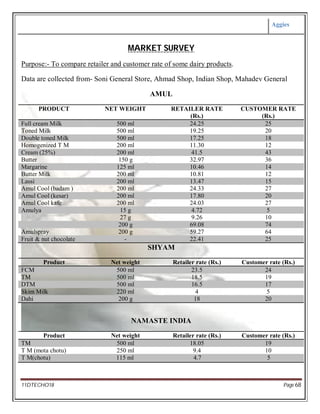
MARKET SURVEY
Purpose:- To compare retailer and customer rate of some dairy products.
Data are collected from- Soni General Store, Ahmad Shop, Indian Shop, Mahadev General
AMUL
PRODUCT NET WEIGHT RETAILER RATE
(Rs.)
CUSTOMER RATE
(Rs.)
Full cream Milk 500 ml 24.25 25
Toned Milk 500 ml 19.25 20
Double toned Milk 500 ml 17.25 18
Homogenized T M 200 ml 11.30 12
Cream (25%) 200 ml 41.5 43
Butter 150 g 32.97 36
Margarine 125 ml 10.46 14
Butter Milk 200 ml 10.81 12
Lassi 200 ml 13.47 15
Amul Cool (badam ) 200 ml 24.33 27
Amul Cool (kesar) 200 ml 17.80 20
Amul Cool kafe 200 ml 24.03 27
Amulya 15 g 4.72 5
27 g 9.26 10
200 g 69.08 74
Amulspray 200 g 59.27 64
Fruit & nut chocolate - 22.41 25
SHYAM
Product Net weight Retailer rate (Rs.) Customer rate (Rs.)
FCM 500 ml 23.5 24
TM 500 ml 18.5 19
DTM 500 ml 16.5 17
Skim Milk 220 ml 4 5
Dahi 200 g 18 20
NAMASTE INDIA
Product Net weight Retailer rate (Rs.) Customer rate (Rs.)
TM 500 ml 18.05 19
T M (mota chotu) 250 ml 9.4 10
T M(chotu) 115 ml 4.7 5
Aggies
11DTECHO18 Page 69
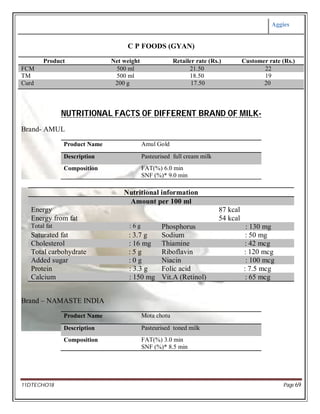
C P FOODS (GYAN)
Product Net weight Retailer rate (Rs.) Customer rate (Rs.)
FCM 500 ml 21.50 22
TM 500 ml 18.50 19
Curd 200 g 17.50 20
NUTRITIONAL FACTS OF DIFFERENT BRAND OF MILK-
Brand- AMUL
Product Name Amul Gold
Description Pasteurised full cream milk
Composition FAT(%) 6.0 min
SNF (%)* 9.0 min
Nutritional information
Amount per 100 ml
Energy 87 kcal
Energy from fat 54 kcal
Total fat : 6 g Phosphorus : 130 mg
Saturated fat : 3.7 g Sodium : 50 mg
Cholesterol : 16 mg Thiamine : 42 mcg
Total carbohydrate : 5 g Riboflavin : 120 mcg
Added sugar : 0 g Niacin : 100 mcg
Protein : 3.3 g Folic acid : 7.5 mcg
Calcium : 150 mg Vit.A (Retinol) : 65 mcg
Brand – NAMASTE INDIA
Product Name Mota chotu
Description Pasteurised toned milk
Composition FAT(%) 3.0 min
SNF (%)* 8.5 min
Aggies
11DTECHO18 Page 70
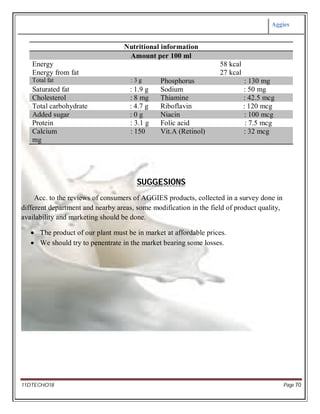
Nutritional information
Amount per 100 ml
Energy 58 kcal
Energy from fat 27 kcal
Total fat : 3 g Phosphorus : 130 mg
Saturated fat : 1.9 g Sodium : 50 mg
Cholesterol : 8 mg Thiamine : 42.5 mcg
Total carbohydrate : 4.7 g Riboflavin : 120 mcg
Added sugar : 0 g Niacin : 100 mcg
Protein : 3.1 g Folic acid : 7.5 mcg
Calcium : 150
mg
Vit.A (Retinol) : 32 mcg
SUGGESIONS
Acc. to the reviews of consumers of AGGIES products, collected in a survey done in
different department and nearby areas, some modification in the field of product quality,
availability and marketing should be done.
 The product of our plant must be in market at affordable prices.
 We should try to penentrate in the market bearing some losses.
Aggies
11DTECHO18 Page 72
BiBliography
 Outlines of dairy technology by Su Kumar De
 Dairy plant engineering and management by Tufail Ahmed
 Dairy chemistry by M P Mathur, D Datta Roy & P. Dinakar
 Dairy microbiology by J S Yadav& Sunita Grover
 Advances in indigenous milk products by John David
 www.google.com
 www.yahoo.com
 www.Answer.com
 www.dairyinfo.com
.
Aggies
11DTECHO18 Page 73

Training report

  • 1.
    Aggies 11DTECHO18 Page 1 TrainingreporT on aggies WSFDT Submitted by:- submitted to:- Sadaf ahmad er. Ajeet yonA vishwAsi 11dtech108, 7th semester dairy engineer Prof. (dr) john david Er. AvinAsh singh sir Advisor Dairy incharge
  • 2.
    Aggies 11DTECHO18 Page 2 ACKNOWLEDGEMENT Withimmense pleasure and satisfaction, I, Sadaf ahmad is presenting this report. Preparation of this report is based on the co-ordination of so many people that it is very difficult for me to express my gratitude to them for their aid. However, I have tried my best to acknowledge them. I am highly obliged to Prof. (Dr.) ramesh ChanDra (Dean W.S.F.D.T) who provided me the opportunity to undergo in plant-training at AGGIES dairy as a mandatory part of our curriculum. I pay my humble acknowledgment to Prof. (Dr.) John DaviD (Staff aDviSor), er. AvinAsh singh, (Dairy incharge) for his guidance to me doing the training and active encouragement due to which I was able to complete my training. I should express my thanks to Er. AjEEt YonA VishwAsi (Dairy EnginEEr) & Mr. Priyanshu srivastava (AccountAnt) of Aggies Student Training Dairy, for their valuable inputs during my Training Period. I am very thankful to all the suggestions and technical knowledge and skills, which were embodied into me by the valuable support of employees at AGGIES as these are of immense help and importance for me in my future endeavor.
  • 3.
    Aggies 11DTECHO18 Page 3 Historyof Student training dairy The student training dairy was established in 1965 under the leadership of pioneer Prof. James N Warner who was first head of department of Dairy technology, AAI-DU, having capacity of 5,000 LPD. It is situated inside the premises of Sam Higginbottom Institute of Agriculture, Technology and Sciences (SHIATS) under Warner School of Food and Dairy Technology (WSFDT) to provide training opportunities to students of WSFDT as well as other departments. The area covered by the plant is 500m2 . During 1965 – 1975, it was handling 5,000 litres of milk daily i.e. its full capacity. In 1992, it was named as AGGIES, a unit of SHIATS. The initial structure of student training dairy comprises of one manager, two supervisor, ten workers. Now a day, the training dairy is handling 500 litres of milk per day. A number of products like market milk, ghee, sweet curd, plain curd, flavoured milk, paneer, ice lollies, softy, lassi etc are being manufactured. Inspite of being a training dairy instead of commercial dairy some of its products like ghee, curd, paneer, flavoured milk is very popular. The golden achievement of this student training dairy is that its trainees have attained reputed posts in a no of companies like AL-AIN Dairy (Dubai), ITC limited, MOTHER dairy, AMUL, GOWARDHAN etc. ADDRESS OF DAIRY : - Aggies Student Training Dairy. Department Of Dairy SHIATS, Naini-211007 Dist.-Allahabad UP (INDIA) YEAR OF ESTABLISHMENT : - 1992 FORM OF ORGANIZATION : - Student Training Dairy DISTANCE FROM CITY : - AGGIES is 7 KM away from Allahabad City.
  • 5.
    Aggies 11DTECHO18 Page 5 Studentstraining dairy staffs Name of staff Designation Mr. Avinash Singh Dairy Incharge Mr. Ajeet Yona Vishwashi Dairy engineer Mr. Priyanshu Shrivastava Accountant cum computer operator Mr. Yaqubuddin Lab attendant Mr. Vijay Singh Lab attendant Mr. Shishir Kumar Sale supervisor Mr. Eric Nelson Lab attendant Mr. Vijay Kumar Electrician cum machine man Mr. Anil Kumar Labour Mr. Abhay Raj Labour Mr. Tulsi Ram Ice cream labour Mr. Ramesh Kumar Ice cream labour Mr. Rajendra Lal Peon StudentS training dairy SupplierS NAME PLACE Trilokinath Sadar bazaar Gulab Panwar Kamtanath Sujauna Santosh Bhanauri Suresh dairy Dandi Subhash Naini StudentS training dairy parties NAME SRN hospital S N children hospital CK pandey Ashish Jitendra MLN Jitendra MDI Poorni mess SCGA mess VC camp Yeshu darbar
  • 6.
    Aggies 11DTECHO18 Page 6 Fundamentalknowledge oF milk Definition- Acc. to PFA, Milk may be defined as the whole, fresh, clean, lacteal secretion obtained by the complete milking of one or more healthy milch animal, excluding that obtained within 15 days before & 5 days after calving. The average composition of cow an buffalo milk are given below- Constituents Cow milk Buffalo milk Goat milk Human milk Water 86.6 84.2 86.5 87.7 Fat 4.6 6.6 4.5 3.6 Protein 3.4 3.9 3.5 1.8 Lactose 4.9 5.2 4.7 6.8 Ash 0.7 0.8 0.8 0.1 major milk constituents - Milk Fat- Milk fat is the mixtures of 19 fatty acids. The bulk of fat in milk exist in the form of small globules with size approx. 0.1 to 22microns. It is an oil-in-water type emulsion. Proteins- Proteins are the most complex organic substances. They are vital for living organisms as they constitute an indispensable part of the individual body cell. The milk proteins consist of Casein, Lacto globulin and Lacto albumin. It is in colloidal state. Casein is only found in milk. It is easily coagulated by heat treatment. Water- It provides the medium in which all the milk constituents are either dissolved or suspended. Most of it is free and only a small portion is in bound form, being firmly by protein and phospholipids.
  • 7.
    Aggies 11DTECHO18 Page 7 Lactose(MiLk Sugar)- It is found only in milk. It exist in true solution phase and is fermented by LAB to yield lactic acid. It is very important for cultured milk products. It can also cause souring in milk and its products. Mineral Matter- Although it is present in small quantity, it is very essential for human body. These are mostly salts like Mg, Na, P, N etc. It influences physico-chemical properties of milk and also effect the nutritive value. Minor Milk constituents- PhosPholiPids- There are three types of phospholipids (Lecithin, Cephalic and Sphingomylein). Lecithin is important constituent as it helps in the formation of outer membrane of fat globules. Pigment- There are two type of pigment present in milk, Fat Soluble and Fat insoluble. Carotene is fat soluble and is responsible for the yellow colour of milk. The other two are Xanthophylls and riboflavin. Carotene also acts as an anti-oxidant and as a source of Vitamin A. Milk EnzyMEs- The important milk enzymes and their specific action are as follows - Analase- Starch splitting Lipase -Fat splitting Phosphatase- It is capable of splitting certain phosphoric acid esters. Protease - It is capable of splitting proteins. Catalase - Decomposed hydrogen peroxides.
  • 8.
    Aggies 11DTECHO18 Page 8 Vitamins- Vitaminsare present in minute quantities in milk or any other food but play a very important role in vital functioning of human body. There are 25 vitamins present in milk. These are fat soluble e.g. Vit. A, D, E, K, apart from fat soluble there are water soluble vitamins as B- complex(B1, riboflavin or B2, niacin, pyridoxine or B6.) Role of milk in human life Milk is one of the most complete food available in nature for human consumption. Milk contains all nutrients in balanced proportions to meet the demand of humans. It is not only necessary for children but it is every essential for adults too. Milk proteins are one of the most high quality proteins. It is essential proper growth of body. It supplies- Body – building proteins Bone- forming minerals Health giving vitamins Energy giving lactose & fat Energy value- 1 Liter of Cow’s milk gives 720 Calorie (3000J) of energy 1 Liter of Buffalo’s milk gives 1100 Calorie (4600J) of energy. 1 gm. of milk fat gives 9.3 Calorie of energy. 1 gm. of Protein gives 4.1 Calorie of energy. 1 gm. of Carbohydrate gives 4.1 calorie of energy.
  • 9.
    Aggies 11DTECHO18 Page 9 DAIRYACTIVITY In the reception section, milk is received through cans (cap. 40 lit). It is then examined for its organoleptic quality (colour, odour, taste, acidity) and presence of any visible foreign matter. A representative sample is taken for various test such as COB test, CLR reading, fat test etc. to be conducted in the QC lab. The bulk of milk is then weighed and the milk suppliers are paid on the basis of fat % and CLR reading of their milk. The milk is then pumped to the processing section for further treatment. The flow of milk involves- In the processing section, the whole volume of milk is divided acc. to its requirement for manufacturing above mentioned products. It is then pasteurized (630 C – 30 min) & standardized as per legal standards for conversion into Toned milk, Standardized milk, Double toned milk and other products. The manufactured products are packed in their respective sections and stored. RAW MILK MARKET MILK MILK PRODUCTS Standardized milk Toned milk Double toned milk Paneer Ice cream Flavoured milk Curd Ghee
  • 10.
    Aggies 11DTECHO18 Page 10 TrainingOverview The training was performed in the different section as follows:  RMRD  Processing  Manufacturing  Record Keeping Milk reception Aggies Student Training dairy receive milk only from milk cans of various capacity varies from 40 to 45 litres, from village society’s Dudhiya. RMRD( raw milk reception dock) is the section where the unloading, weighing, testing, chilling and transfer of milk to the production section take place. The raw milk is received from various chilling centre and dairies through tankers or cans. Milk Reception Flow Chart Raw Milk in Cans Grading Filtration and Weighing Sampling, Analysis & Testing Clarification Chilling of Raw Milk (5o C) Storage of Raw Chilled Milk in storage tank (below 5o C)
  • 11.
    Aggies 11DTECHO18 Page 11 EquipmEntsin RMRD section Weighing Machine Dump Tank S. NO. MACHINE NAME MANUFACTURED BY 1 Can Tipping Bar Goma 2 Weighing Machine Goma 3 Dump Tank Goma 4 Milk Pump Goma 5 Filter Goma 6 Can Washer Goma 7 Heater (Multipurpose Vat) Goma 9 Can Stand Goma
  • 12.
    Aggies 11DTECHO18 Page 12 Canstand Quality testing The quality testing of milk and milk products are performed in laboratories. On the basis of these tests milk is accepted or rejected. Basically, there are two types of lab in any dairy plant- a) Dock lab b) Product lab a)Dock lab- is the place where testing of raw milk is done. The tests are as follows: a) Fat % e) Temp. b) SNF % f) COB c) Acidity (%LA) g) Adulterants d) Alcohol h) Neutralizer a)organoleptic (sensory) tests- Smell (odour)- This furnishes an excellent indication of the organoleptic quality of milk. In making the test, cover of each can is removed, inverted and raised to the nose. The odour/smell will be represented of that in the can.
  • 13.
    Aggies 11DTECHO18 Page 13 AppeArAnce-By regularly observing the milk in each can, any floating extraneous matter, off-colour, or partially churned milk may be noted. TemperaTure- The temp at which milk is delivered is often an indication of its quality. A temp of 50 C or below is satisfactory. Sediment- The sediment test shows the visible foreign matter contained in milk. The organoleptic test provides a first hand and an inexpensive way to separate poor quality milk at the milk receiving platform. No equipment is required, but the milk grader must have good sense of sight, smell and taste. The result of the test is obtained instantly. Milk which cannot be adequately judged organoleptically must be subjected to other more sensitive and objective tests. Procedure:  Open a can of milk.  Immediately smell the milk.  Observe the appearance of the milk.  If still unable to make a clear judgment, taste the milk, but do not swallow it. Spit the milk sample into a bucket provided for that purpose or into a drain basin, flush with water.  Look at the can lid and the milk can to check cleanliness. Judgment : Abnormal smell and taste may be caused by:  Atmospheric taint (e.g. barny/cow odour).  Physiological taints (hormonal imbalance, cows in late lactation- spontaneous rancidity).  Bacterial taints.  Chemical taints or discolouring. b)Clot on boiling (C.o.b) test- The test is quick and simple. It is one of the oldest test to check high acidity in milk (pH<5.8) or abnormal milk (e.g. colostral or mastitis milk). If a milk sample fails in the test, the milk must contain many acid or rennet producing microorganisms or the milk has an abnormal high
  • 15.
    Aggies 11DTECHO18 Page 15 Procedure:Measure 10ml Gerber acid in butyrometer Pipette out 10.75ml of milk and add 1ml amyl alcohol Shake well Centrifuge at 1100rpm for 5ml Read the percentage of fat. d)Determination of Snf in milk- SNF is determined by measuring specific gravity and fat percent of the milk samples. Materials:- Lactometer & Thermometer Procedure:- Milk sample Pour it to a cylinder Let the lactometer into the cylinder without touching the slides Take the reading from the lactometer Note the corrected lactometer reading Calculation:- SNF = CLR / 4 + 0.2 F+ 0.5 CLR = LR taken at 84⁰F (280 C) e)Lactometer reading- Milk is sampled in the stainless steel cylinder and a lactometer is dipped in it. The marking which touches the level of the milk gives the lactometer reading. An LR of 26 for whole milk and 32 for skim milk is optimum.
  • 16.
    Aggies 11DTECHO18 Page 16 g)Aciditytest- Bacteria that normally develop in raw milk produce more or less of lactic acid. In the acidity test the acid is neutralized with 0.1N Sodium hydroxide and the amount of alkaline is measured. From this, the percentage of lactic acid can be calculated. Fresh milk contains in this test also "natural acidity" which is due to the natural ability to resist pH changes .The natural acidity of milk is 0.16 - 0.18%. Figures higher than this signifies developed acidity due to the action of bacteria on milk sugar. Apparatus:  A porcelain dish or small conical flask  10 ml pipette, graduated  1 ml pipette  A Burette, 0.1 ml graduations  A glass rod for stirring the milk in the dish  A Phenolphthalein indicator solution, 0.5%in 50% Alcohol  N Sodium hydroxide solution. Procedure: 9 ml of the milk measured into the porcelain dish/conical flask, 1 ml Phenolphthalein is added and then slowly from the burette, 0.1 N Sodium hydroxide under continuous mixing, until a faint pink color appears. The number of ml of Sodium hydroxide solution divided by 10 expresses the percentage of lactic acid. Calculation:- Titrable acidity as % lactic acid = Titre value X 0.09 h)AdulterAtion test- Rosalic acid TesT / deTecTion of neuTRalizeRs- Take 2 ml rosalic acid solution (0.05% in 60:40 ethyl alcohol and distilled water) in a test tube, add 2 ml of milk. Rose-Red colour development indicates neutralizer presence in milk.
  • 17.
    Aggies 11DTECHO18 Page 17 StarchteSt- Take 3 ml. Milk in a test tube, boil and cool under tap water. Add a drop of 1% Iodine solution. Presence of starch is indicated by the appearance of a blue colour which disappears when the sample is boiled and re-appears on cooling. Salt teSt- Take 5 ml of silver nitrate (0.1341%) solution in a test tube and add two drops of potassium chromate (10%) solution. It will give brick red colour. To this add exactly 1 ml of milk and mix. Observe the colour, if yellow colour appears then it shows salt test positive. If not, then the salt test is negative. Sugar TeST- Take 3 ml of milk in a test tube and add 5 ml dilute HCl (1:2) containing resorcinol (0.1 gm. resorcinol dissolved in 100 ml dilute HCl). Mix well and keep the test tube in boiling water for 5 minutes. Brick red colour formation indicates sugar test positive. Alcohol TesT- Take 5 ml milk in a test tube add 5 ml (60% v/v, sp. gr. 0.91 g/ml) alcohol with constant shake. Formation of precipitates indicates alcohol test positive. TesT for NiTraTe CompouNds - Take 5 ml of milk in a Test Tube and drain it from the test tube. Add 2ml (5%) Diphenyl amine reagent in the test tube. Development of blue colour indicates the presence of nitrate compounds in milk. The glassware used in the test must be cleaned properly with glass distilled water. Reagent: Dissolve 0.085 g of diphenylamine in 50 ml of glass distilled water, and then gradually add 450 ml of concentrated sulphuric acid. Ensure that the solution is colorless. TesT for Ammonium Compound -Take 1 ml of milk and add 2 ml. of Nessler’s reagent in test tube. The appearances of yellow to brown colouration confirm presence of ammonium compound. The intensity of colour varies from yellow to brown colour depending upon the concentration of ammonium compounds in milk.
  • 18.
    Aggies 11DTECHO18 Page 18 TesTfor Hydrogen Peroxide (H2O2)- Dissolve 1 gm V2O5 (Vanadium Pent oxide) in 100 ml of 6% H2SO4 (6+94). To 10 ml of sample add 10 drops of reagent and mix. The development of pink or red colour indicates presence of H2O2. TesT for formalin in milk - Take milk sample (2 ml) in a test tube and add 2 ml of 90 percent H2SO4 containing ferric chloride (5 gm. in 100 ml H2SO4) from the side of the test tube slowly. Formation of purple ring at the junction indicates formaldehyde is present in milk. Urea TesT- Procedure: Take 5 ml. of milk sample and add 5 ml. of 1.6 percent DMAB reagent and mix well. For comparison, prepare a control, that is, milk sample containing no added urea. A distinct yellow colour if observed in milk sample indicates milk containing “added urea”. The control however, would show a slight yellow colour due to the presence of natural urea in milk. i)Methylene Blue Reduction test (MBRt)- Take 10 ml of the milk sample in the test tube. Add 1 ml standard solution of methylene blue. Close the open end of the test tube with a cotton plug. Mix thoroughly and place the test tube in a water bath maintained at 37o C. Hold the test tube in the water bath till the colour disappears. Note the time taken for the colour change. The reduction time is proportional to the number of bacteria present in the milk as given below- Reduction Time Quality of Milk Approximate microbes /mL Over 4.5 hours Good 2 lakhs or less 2.5-4.5 hours Average 2 lakhs to 20 lakhs Less than 2.5 hours Poor 20 lakhs to 1 crore
  • 20.
    Aggies 11DTECHO18 Page 20 Theflow diagram of manufacture is- Receiving water in pasteurizimg vat Pre-heating (38- 430 C) Addition of smp, whole milk and mixing Filteration Pasteurization (630 C/30 min.) Cooling (50 C) Packaging and storage (50 C) Double ToneD Milk- Double toned milk (DTM) is made from cow and/or buffalo milk by adding fresh skim milk or a mixture of water and skim milk powder and/or by removing fat by partial separation, or by doing both. The standard throughout India for this fluid milk is minimum of 1.5% milk fat and 9.0% SNF. Double-toned milk should be pasteurized. It is probable that DTM cannot be made from cow milk by partial separation alone. The addition of powder is necessary to ensure the required SNF (minimum 9.0%). Since cow milk may have around 8.5% SNF, DTM cannot contain 9.0% SNF. Extra SNF must normally be added in the form of skim milk powder. Buffalo milk would seldom have this difficulty because whole buffalo milk must legally contain at least 9.0% SNF. Flow chart of double toned milk manufacture Receiving milk (Grading, sampling, weighing, testing) Pre-heating (35 to 40⁰C) Filtration/clarification Cooling and storage (5⁰C or below) Standardisation Pasteurisation (63⁰C/30 min or 72⁰C/15 seconds) Homogenization (2500 psi)
  • 21.
    Aggies 11DTECHO18 Page 21 Packaging Storage(5⁰C or below) 1. Receiving Milk The milk in cans or such containers is graded, emptied, measured by weight, sampled and is delivered to the pasteurizing unit. 2. Pre-Heating The milk is preheated at 35-40o C. This helps in efficient clarification 3. Filtration Filtration removes visible foreign matter. While filtration removes suspended foreign matter by the straining process, clarification removes the same by centrifugal sedimentation. 4. Standardization Standardization of milk refers to the adjustment of Fat & SNF value to confirm legal standards. Operating parameters for Standardization: Products Fat [%] SNF [%] Full cream milk 6 9 Toned milk 3 8.5 Double toned milk 1.5 9 Skim milk 0.5 8.7 Standardized milk 4.5 8.5 Separation of milk fat may be done by two ways: 1. Separation by gravity. 2. Separation by centrifugal force. Separation by Centrifugal Force
  • 27.
    Aggies 11DTECHO18 Page 27 Flavouredmilk- Flavoured milk are milk to which some flavour has been added. the product should contain a fat % at least equal to the minimum legal requirement for market milk. But when the fat level is lower (1-2 %), the term ‘drink’ is used. The purpose is: • to make milk more palatable to those who do not relish it as such. • to stimulate the sale of milk. • to put skim milk to profitable use. Flow chart of flavoured milk:- Toned milk Processing (Pasteurization + Homogenization) Standardization Addition of Sugar @ 8.0 % Addition of Colour and Essence Packaging Bottle Filling Pouch Filling Crowing Storage Sterilization Dispatch Storage
  • 28.
    Constituent % Fat 2 Flavour1 – 1.5 Sugar 5 – 7 Stabilizer 0.2
  • 30.
    Aggies 11DTECHO18 Page 30 Equipmentin Ice Cream Section:- S.NO. MACHINE NAME CAPACITY MANUFACTURED BY 1 Batch Pasteurizer Goma 2 Pump 1HP/kW 2880 rpm Head-10mtr Goma 3 High Pressure Homogenizer 100 LPM/LPH Goma 4 Ageing Vat 100 L/hr Pump-1HP/kW 2880 rpm Goma 5 Continuous Freezer 100 L Goma 6 Cup filling 1200 cph Goma 7 Hardening Tunnel 5 Mould Goma 8 Candy Plant 5 Mould Goma 9 Choco Dip Tank Goma 10 Deep Freezer Goma Flow-diagram of ice cream manufacture:- Milk Pre-heating (55oC-60oC) Turbo Blender Blending of 5MP Sugar and stabilizer Mix Preparation tank Duplex filter Homogenization (first Stage – 150kg/cm2 Second stage – 50kg/cm2 Pasteurization (85oC/20C
  • 31.
    Aggies 11DTECHO18 Page 31 Cooling2.68 Ageing 4 hours Addition of colour and flavor Freezing in continuous freezer (5oC) Fruit Feeding Cup/cone/pack filling Hardening (-28oC) Cold storage Storage and dispatch below – 18 0 C) Steps in Ice cream manufacture:- Making the mix- In order to make good ice cream, the milk products and other ingredients must first be selected and combined so as to produce the desired body and a delicately blend flavour. The selection of good, wholesome ingredients and calculation of a satisfactory composition proceed the mixing of the ingredients in a vat, where they can be heated to facilitate dissolving, blending and pasteurizing. The order in which ingredients are added as follows: liquid ingredients, basically milk, are placed in the jacketed vat provided with a power stirrer and the agitation and heating started at once. Powder is added at 350 C and sugar, emulsifier and stabilizer is added while the liquid material as agitate. Butter is added at about 600 C. The mix is agitated and heated to 65 – 700 C and then pumped to duplex filter. Filtration- The mix is then filtered using a duplex filter in order to make the mix completely free of extraneous matter and give the mix a smooth consistency. Homogenization- Homogenization of the ice cream mix is essential. The main purpose of homogenization is to make a permanent and uniform suspension of fat by reducing the size of the fat globules to a very small diameter, preferably not more than 2 microns. Advantages of homogenization are-  It prevents fat separation during ageing
  • 32.
    Aggies 11DTECHO18 Page 32 Produces more uniform ice cream with a smoother texture  Improves whipping ability  Decrease the risk of churning occurring in the freezer and  Leads to the use of slightly less stabilizer Here a pressure of 1500 psi at first stage and 500 psi at second stage is applied. Pasteurization- Proper pasteurization destroys all pathogenic or disease producing bacteria, thereby safeguarding the health of the consumer. The advantages of pasteurization are: i. It renders the mix completely free of pathogenic bacteria ii. It dissolves and helps to blend the ingredients of the mix iii. It improves flavor iv. It improves keeping quality v. It produces a more uniform product The pasteurization time temperature combination in the ice cream plant here is 85 +50 C for 25 seconds. Chilling- The mix is then chilled to about 70 C to facilitate ageing and after which it is pumped over to ageing vat. Aging the mix- After cooling the mix the mix is pumped to ageing tanks and it should held in ageing tanks until used. Ageing refers to holding the mix at a low temperature for a definite time before freezing. Ageing produces the following results. a. It improves the body and texture of ice cream b. Improves whipping capacity of the mix c. Increased maximum overrun d. Increases melting resistance The purpose of this step is to allow hydrocolloids to swell, the casein to become hydrated, the viscosity to increase, the texture to become finer, to increase the resistance to melting, the whip ability to improve, fats to crystallize out and aroma to develop uniformity throughout.
  • 36.
    Aggies 11DTECHO18 Page 36 Kulfimix will be standardized to 37% T.S. Add of Sugar & cream Addition of Stabilizer (0.1%) & Emulsifier(0.2%) Pasteurization at 68 ͦC for 30 minutes. Cooling the mix (5 ͦC) Addition of flavour, colour & nuts Freezing in batch freezer without overrun Filling into moulds Hardening (deep freezer cabinet -28 ͦ C for 8 hrs.) Kulfi IndIgenous product Dahi- Acc. To PFA rules, curd is a product obtained from pasteurized or boiled milk by souring, natural or otherwise, by a harmless LAB or other bacterial culture It should have the same fat and SNF% as the milk from it is prepared. Standard for Dahi : TM – Fat - 3% SNF - 10% Flow Chart for Dahi Manufacturing: Receiving milk (Fat- 3% SNF-10%) Preheating (Heating up to 600 C). Standardization Heating (at 880 C- 920 C). Cooling to <370 C.
  • 40.
    Aggies 11DTECHO18 Page 40 Khoa Khoais a heat coagulated milk product obtained by partial dehydration of milk of buffalo, cow or their admixture and shall not contain any ingredients foreign to milk. “According to PFA Rules (1976), khoa is the product obtained from cow or buffalo milk or a combination thereof, by rapid drying. The milk fat content should not be less than 20% of the finished product.” BIS specification of Khoa: Characteristics Requirements for type Pindi Danedar Dhap Total solids (% by mass, min.) 65 60 55 Fat (% by mass on dry basis, min.) 37 37 37 Total Ash (% by mass, on dry basis, min.) 6.0 6.0 6.0 Titrable Acidity (as lactic acid- % by mass, max.) 0.8 0.9 0.6 Method of production: Milk Taken : 20 lit Yield : 20-25 % Shelf Life : 4-5 days at room temperature Normally 2 to 3 kg or more of milk (preferably buffalo) is taken per batch and boiled in a karahi over a brisk non-smoky fire. The milk is stirred vigorously and constantly with a circular motion by a khunti. During this operation all paths of the pan with which their milk comes in contact are lightly scraped to prevent a milk from scorching. Constant evaporation of milk takes place and the milk thickens progressively. At a certain concentration, (cow milk 2.8; buffalo milk 2.5), heat coagulation of milk proteins begins and their concentration becomes progressively ‘insoluble’ in water. This stage is marked by an abrupt change in color. The heating is continued with greater control hereafter and the speed of stirring-cum-scrapping increase. Soon the viscous mask reaches a semi-solid/pasty consistency and begins to dry up. Very close attention is paid to the last stages. The final product is ready when it shows signs of
  • 41.
    Aggies 11DTECHO18 Page 41 leavingthe bottom and sides of the karahi and sticking together. The khoa path is invariably made after removing the pan from the fire and working the contents up and down in to a single compact mass. Butter Butter may be defined as a fat concentrate which is obtained by churning cream, gathering the fat globules into a compact mass and then working it. Acc. to PFA, table (creamery) butter is the product obtained from cow or buffalo milk or a combination thereof, or from cream or curd, with or without addition of common salt and annatto or carotene as colouring matter. It should be free from other animal fat, wax and mineral oils, vegetable oil & fat. Composition of butter- Constituent Percentage Butter fat 80.2 Moisture 16.3 Salt 2.5 Curd 1.0 Equipment in butter and ghee section:- Butter churn Ghee kettle 1000 1itres Ghee Tin seaming Machine Cream Vat 1000 litres
  • 42.
    Aggies 11DTECHO18 Page 42 Flowdiagram Receiving cream (grading, weighing sampling, testing) Neutralization Standardisation (35⁰C to 40% fat) Pasteurisation (82⁰C-88⁰C/no hold) Or Vacreation Cooling (20⁰C to 22⁰C) Cooling Ripening (20⁰C to 22⁰C) Ageing (5⁰C to 10⁰C) Churning Salting and working Washing Packaging and storage (-23⁰C to -29⁰C) Ghee Acc. to PFA, ghee is the pure sclarified fat derived solely from milk or from desi butter or from cream to which no colouring matter is added. It should contain not less than 99.5% fat. Today the anuual production of ghee may be estimated at over 500 million kg. with a value of Rs. 1,250 crores at the present rate. The largest ghee producing states are- Uttar Pradesh, Andhra Pradesh, Punjab , Rajasthan, MP, Bihar etc. The average per capita consumption of ghee today works out to less than 1 kg. per annum.
  • 44.
    Aggies 11DTECHO18 Page 44 Theflow diagram of ghee manufacturing is- MILK Centrifugal separation Fermentation CREAM CURD Ripened / Unripened Churning (Indigenous) Churning (Western) DESI BUTTER CREAMERY BUTTER Direct Clarification Pre – Stratification Continious GHEE Cooling and granulation Packaging and storage There are five methods of ghee making: i. Desi or Indigenous Method ii. Direct Cream Method iii. Creamery Butter Method
  • 46.
    Aggies 11DTECHO18 Page 46 Procedure:- Fill 5 ml quantity of the phosphatase dye into test tubes marked at 10 ml and bring to 37 to 38O C in a water bath. Add 1 ml of the milk to be tested, close the tubes with rubber stoppers and invert to mix. Prepare in the same way a blank from a boiled milk of the same type of that under test. Incubate all the tubes at 37 to 38O C. Read the yellow colour after 30 minutes, return to the bath, and take a second reading after incubation for a further 90 minutes. Interpretation of Results: - Disc Reading after 30 minutes Incubation Interpretation 0 or trace Properly pasteurized 6 Doubtful 10 or over under pasteurized Disc Reading after 2 Hours Incubation Interpretation 0 to 10 Properly pasteurized Over 10 Under pasteurized The 30-minute test will reveal any serious fault in pasteurization, but to enable minor errors to be detected, readings shall be taken after further incubation for 90 minutes. Standard Plate Count teSt- Materials Required: Plating chamber, Petri dishes, Plate Count Agar, Auto pipette with tips (1.0 ml) / Pipette 2.2 ml, Dilution tubes containing 9 ml of batch phosphate buffer solution. Procedure: 1. Transfer 1 ml of well-mixed milk sample to 9 ml diluent (phosphate buffer solution). Mix well. Transfer 1 ml of this suspension to second tube to make second dilution. Similarly make third and/or fourth dilution as per requirement.
  • 47.
    Aggies 11DTECHO18 Page 47 2.Arrange 2 Petri plates for each dilution to be tested, mark them with Sample No. and Date. 3. Transfer 1 ml in each plate from respective dilution of sample being tested. 4. Melt the Plate Count Agar, cool it to about 45°C and pour 10 to 15 ml of this medium into the Petri dishes. Mix the agar by rotating the plates 5. Allow the agar to set, invert and incubate the plates at 37 ±1°C for 48 hours. 6. At the end of 48 hours remove the plate from the incubator and count the colonies. 7. Also prepare a control plate with 15 ml media for checking its sterility. Counting and Expression of Results: Count the colonies grown in Petri plates. Count only those plates, which have 30 - 300 colonies. Computation: Count the colonies developed in each plate for respective dilution. Multiply colonies per plate by dilution used and report the arithmetic average as plate count per milliliter /gram. Recording / Reporting of Results: Record and Report the result as – Standard Plate Count / ml /gm -------- Or SPC / ml / gm --------- Coliform TesT for milk: Materials Required: VRB Agar, Dilution blank (9 or 99 ml), Auto pipette with tips, Petri dishes Procedure for Solid Media: 1. Transfer 1 ml of well-mixed milk sample to 9 ml diluent (phosphate buffer solution) & mix well to make first dilution. If required make second dilution by transferring 1 ml of first dilution into 9 ml diluent.
  • 48.
    Aggies 11DTECHO18 Page 48 2.Arrange 2 Petri plates for each sample mark them with Sample No. and Date. 3. Transfer 1 ml in each plate respective dilution of sample to be tested. 4. Add 10 to 15 ml of VRB Agar, previously melted and cooled to about 45°C. 5. Mix the contents thoroughly by rotating the plates and allow the agar to solidify. Pour additional approximately 5 ml. of the media over the surface of the solidified medium and allow solidifying again. 6. Invert plates and incubate the plates at 37 ±1°C for 18 -24 hours. Counting and Expression of Results: Count dark red colonies measuring at least 0.5 mm in diameter. Computation: Count dark red with red precipitate colonies measuring at least 0.5 mm in diameter in each plate for each dilution plated. Multiply colonies per plate by dilution used and report the arithmetic average as Coliform Count-----/ml/gm. of products. Recording / Reporting of Results: Record and Report the result as - Coliform Count / ml /gm. of product. TesT of Coliform BaCTeria By liquid media (PCT): Materials Required: Auto pipette with tips /pipettes of 2.2 ml. Brilliant green bile broth 2% in tubes. Procedure: Transfer 1 ml from first dilution of sample into Brilliant Green Bile Broth 2% tube in triplicate. Incubate for 48 hours at 37 ±1°C and observe for acid and gas production. Production of gas and opacity in at least two tubes out of three constitutes the positive presumptive test.
  • 49.
    Aggies 11DTECHO18 Page 49 IfPCT is positive and simultaneously typical colonies observed on solid media. This confirms the presence of coli form in the sample. If required further confirmation may be done using streak techniques on EMB agar or microscopically. Disposal of Used Media: Sterilize all used Petri plates and PCT tubes with media after observation / counting by autoclaving at 15 psi for 20 minutes. Cool plates and tubes. Collect all solid media in polythene bags and dispose. TesTing of ghee:- Determination of moisture- Hot air-oven method- Procedure: Weigh accurately about 10 grams of properly mixed Ghee in a previously tared aluminium dish. Loosen the lid of the dish and heat in an oven at 105 O C for 1 hrs. Remove the dish after closing the lid and cool in a desiccator and weigh. Heat in the oven for further period of 1 hour, cool and weigh. Repeat it till the weight between two successive heating does not exceed 1 mg. Calculation: Moisture % = W1 X 100 / W Where, W1 = weight loss W = weight of oil taken
  • 50.
    Water quality TesT- Purpose:To check the quality of water. Hardness:- Take 50 ml of water in 250 ml conical flask, add 1 ml ammonia buffer and few drops of Erichrome Black T/ Solochrome Black T indicator. Purplish pink color was obtained after addition of indicator. Now titrate it against N/50 EDTA till blue color obtained. Note down the vol. used of EDTA. Multiply reading with 20 to obtain the result pH TesT:- Use pH strips or universal indicator.
  • 52.
    Aggies 11DTECHO18 Page 52 RefRigeRationsection:- Cooling is defined as the reduction of temperature by removing heat. For cooling medium circuits, basically two systems are used: 1. Compression refrigeration installation, where gas is compressed with a compressor and condenses during the cooling phase. 2. Vapour absorption system in which hot water is used to cool the normal water. Refrigeration is a main requirement to keep the milk & milk products save from deterioration. Experimental Dairy has a Vapor compression refrigeration system. The capacity of refrigeration plant is 60TR .The refrigerant used is ammonia (R-717).Form IBT(Ice bank tank) chilled water is supplied to different section as per requirement and the return chilled water comes to the IBT for re-chilling. Technical Specifications:- Type of refrigeration system Vapor compression system Capacity 60 Ton Suction Pressure 150-210 psi Suction Temperature 45-75 0 C Discharge Temperature 20-32 Refrigerant Ammonia Loss of refrigerant 300kg/year Cooling medium Water Capacity of chilled water tank 4500 liter. Evaporator Shell and tube type Compressor Reciprocating Cooling medium for condenser Water Operating hour 12 hr
  • 53.
    Aggies 11DTECHO18 Page 53 Compressionrefrigeration installations- These units are mainly used for smaller units such as refrigerators. They can be used for industrial purposes when large amounts of heat are available. Principle- Liquid ammonia with pressure of 3bar is put into an evaporator, which is a system of tubes, and evaporates at -10⁰C. Enthalpy is removed from the environment, which is thus then cooled down. A compressor then sucks cold ammonia from the evaporator and recompresses it to 8-10bar, and the gas temperature increases to 80- 90⁰C. In the condenser, the hot gas is cooled by water to 20-25⁰C and condenses at a high pressure Air compressor:- In the dairy here mostly all the valves are automatic so there is need of air pressure to operate these valves. To full fill this requirement there is three air compressors depending on the pressure requirement of the plant machine is operated. Generally we maintain 6 kg/cm2 pressure to operate the valves and other equipments. C O M PRESS OR REC EIV ING T A NK DISC HAR C H L INE P RESSURE 1 2 K g/m 2 C ONDE NSOR HIG H PR ESSUR E LIQ UID L INE EVA POR AT O R LO W PRES SURE EXPA NSIO N VA L VE 45 0 N H3 AM M ON IA C Y CLE F O R FRE E ZIN G TE CH NO LO G Y
  • 54.
    Aggies 11DTECHO18 Page 54 Specification- AirCompressor:- FAD/DIS 286 Ltrs./min. Max. Work Pressure 9Kg/cm2 Unit Speed 725 R.P.M. Tank Capacity 160 Lts. Motor 3HP Water:- In the dairy, large quantities of water are required on the daily basis for production and other technical purposes. Water is divided into water supply & treatment and waste water treatment. CIP ( CleanIng In place ) CIP or In-place-cleaning refers to that system of cleaning and sanitization which does not require the daily dismantling of dairy equipment. Cleaning and Sterilizing Agent: AlkAline detergent: Inorganic alkaline cleaning solution act emulsifiers, protein dissolving agent and particularly as bactericidal agent, caustic soda (NaOH) in concentration of 0.2-2%is chiefly used. It is corrosive towards aluminum, tin, zinc; especially at higher concentration .sodium hydroxide react with the fatty part of the soiling matter and product surface active agent which aid cleaning in way similar to wetting agent. It has a bactericidal action, especially at higher temp and concentration .the basic chemical used in alkaline detergent are caustic soda (NaOH), washing soda (Na2CO3)10H2O, Sodium carbonate monohydrate (Na2CO3H20) unhydrous sodium carbonate (Na2CO3) Sodium bicarbonate (NaHCO3) and sodium sulphate (Na2SO410H2O)
  • 55.
    Aggies 11DTECHO18 Page 55 Forprotection against corrosion of aluminum, inhibitors such as sodium silicates (as water glass Na2sio3) is used. Acid Solution: Solution of organic and inorganic acid in concentration of 0.5-2%.are used to remove hard deposits such has water scale and milk stone which are usually formed or hot surface. Such deposits do not dissolve in alkaline .the acid which are principally used are nitric acid (0.5%) or phosphoric acid (2%). Other acid should be only with caution since they may cause corrosion. The surface active agent also called wetting agent are added to cleaning solution to lower the surface tension or tension and therefore increase the wetting ability and water solubility .an increase penetration is obtained because the cleaning solution is better able to enter in to the pores of the soiling matter and into crevices. Process of CIP:- Circulation of Cold water (soft) Circulation of lye solution, 30min. Circulation of hot water, 10min Circulation of acid solution, 20 min Circulation of hot water, 10 min. Circulation of cold water.
  • 56.
    Aggies 11DTECHO18 Page 56 Marketing ProductProfile of the Plant- Product Packed Quantity Rate Whole Milk Loose Rs.42/liter Skim Milk Loose Rs.24/litre Standard Milk 500ml and 250ml Rs.36/litre Toned Milk 500ml Rs.28/litre Double Toned Milk 500ml Rs.24/litre Flavoured Milk 200ml Rs.15 per 200gm Sweet Curd 200ml Rs.20 per 200gm Plain curd Loose Rs.40/kg Desi Ghee 1kg and ½ kg Rs.380/kg Candy/Lolly 55gm per candy Rs.3/candy Kulfi 100gm per candy Rs.10/bar Ice cream (Small Cup) 25ml Rs.5/cup Ice cream (Medium Cup) 50ml Rs.10/cup Ice cream (Large Cup) 100ml Rs.15/cup Ice cream Brick 1 kg per brick Rs.85/kg ** Ice Cream, Bricks and Candy/Lolly available in different flavours like Orange, Mango, Chocolate, Pineapple, Vanilla, Strawberry, etc.
  • 57.
    Aggies 11DTECHO18 Page 57 ANNUALTURNOVER AND BUSSINESS DEVELOPMENT:- Cash sale (product)- Particulars Amount(weekly) (lit.) Rate (Rs / lit) Income(weekly) (Rs) Income(annual) (Rs) Standard milk 210 36 7560 362880 Skim milk 15 24 360 17280 Sweet curd 140 100 14000 672000 Flavoured milk 140 75 10500 504000 Plain curd 105 34 3570 171360 Panner 10 240 2400 115200 Ghee 25 380 9500 456000 Whole milk 15 42 630 30240 TOTAL = 2328960 Particulars Amount(weekly) (pc) Rate (Rs / pc) Income(weekly) (Rs) Income(annual) (Rs) Candy 5600 3 16800 806400 Kulfi 700 10 7000 336000 Chocobar 350 10 3500 168000 Small cup 2100 5 10500 504000 Medium cup 350 10 3500 168000 Large cup 280 15 4200 201600 Brick 14 85 1190 57120 TOTAL= 2241120 Turnover INCOME EXPENDITURE Cash Credit Miscellaneous
  • 58.
    Aggies 11DTECHO18 Page 58 Creditsale – Particulars Parties Amount(weekly) (lit.) Rate (Rs / lit) Income(weekly) (Rs) Income(annual) (Rs) Standard milk SRN hospital 700 30 21000 1008000 Standard milk SN children hospital 560 30 16800 806400 Toned milk C K pandey 70 28 1960 94080 Double toned milk Ashish 490 24 11760 564480 Double toned milk Jitendra MLN 420 24 10080 483840 Double toned milk Jitendra MDI 105 24 2520 120960 Toned milk Poorni mess 35 28 980 47040 Standard milk SCGA mess 14 36 504 24192 Standard milk VC camp 14 36 504 24192 Standard milk Yeshu darbar 105 36 3780 181440 Carrying and forwarding system- Agent are appointed for the carrying and forwarding task. A carrying and forwarding agent normally undertakes the following activities: (a)receiving the goods from the factories or premises of the principal or his agents; (b)warehousing these goods; (c)receiving dispatch orders from the principal; (d)arranging dispatch of goods as per the directions of the principal by engaging transport on his own or through the authorized transporters of the principal; (e)maintaining records of the receipt and dispatch of goods and the stock available at the warehouse
  • 59.
    Aggies 11DTECHO18 Page 59 Thecarrying and forwarding of milk and milk products is done in the following way- ADVERTISEMENT AND PROMOTION- Promotion is one of the key elements of the marketing mix, and deals with any one or two- way communication that takes place with the consumer. Deciding on a marketing communications strategy is one of the primary roles of the marketing manager and this process involves some key decisions about who the customer is, how to contact them, and what the message should be. These questions can be answered using a three stage process, which is equally relevant for all elements of the marketing mix: GODOWN SUPPLY DISTRIBUTOR WHOLESALER SEMISELLER RETAILER CUSTOMER CONSUMER
  • 60.
    Aggies 11DTECHO18 Page 60 Segmentation Dividingthe marketing into distinct groups Targeting Deciding which of these groups to communicate with, and how to talk to them. Positioning How the product or brand should be perceived by the target groups. Messaging Delivering a specific message in order to influence the target groups. Advertising is just one element of the marketing communication arsenal, which can be divided into the following areas: ADVERTISING – A MASS MEDIA APPROACH TO PROMOTION  Outdoor  Business directories  Magazines / newspapers  TV / cinema  Radio  Newsagent windows SALES PROMOTION - PRICE / MONEY RELATED COMMUNICATIONS  Coupons  Discounts  Competitions  Loyalty incentives PUBLIC RELATIONS - USING THE PRESS TO YOUR ADVANTAGE  Press launches  PR events  Press releases
  • 61.
    Aggies 11DTECHO18 Page 61 PERSONALSELLING – ONE TO ONE COMMUNICATION WITH A POTENTIAL BUYER  Salesmen  Experiential marketing  Dealer or showroom sales activities  Exhibitions  Trade shows DIRECT MARKETING - TAKING THE MESSAGE DIRECTLY TO THE CONSUMER  Mail order catalogues  Bulk mail  Personalised letters  Email  Telemarketing  Point of sale displays  Packaging design DIGITAL MARKETING – NEW CHANNELS ARE EMERGING CONSTANTLY  Company websites  Social media applications such as Facebook or Twitter  Blogging  Mobile phone promotions using technology such as blue-tooth  YouTube  E-commerce PRICING STRATEGY The price of a product in the market is an important factor influencing consumer demand. Hence to be marketable, a dairy product must be competitively priced. This implies that the costs involved in raw material procurement, processing, packaging, storage, marketing and distribution must be kept as low as possible. generally the price of a dairy product will involve the following costs-  Cost of raw milk  Cost of raw milk collection and transportation
  • 62.
    Aggies 11DTECHO18 Page 62 Cost of processing  Cost of packaging  Cost of marketing and distribution  Taxes and tariffs  Profit margins at each stage of the marketing channel (Collection, Processing and marketing margins) In order to arrive at a realistic costing of a product, all those elements involved at each stage must be carefully calculated on a unit basis. This is known as Cost Accounting. The table below shows some of the essential cost elements: Market function Cost element 1. Raw milk procurement Cost of raw milk; labour; materials etc.; collection margin 2. Transportation Transport cost; labour; materials and equipment; transport margin 3. Processing Raw materials; machinery and equipment; labour; packaging; energy; taxes; marketing and distribution; processing margin 4. Marketing and distribution Transport; labour; materials; rent; retail margin An organisation can adopt a number of pricing strategies, the pricing strategy will usually be based on corporate objectives.
  • 63.
    Aggies 11DTECHO18 Page 63 TAXESON DAIRY PRODUCTS Sales tax is not applied on all dairy product such as on-  FCM  TM  DTM  Standard milk  Skim milk  Sweet curd Sales tax applicable on dairy products are shown below- Products Tax rate (%) Cream 5 Butter 5 Desi ghee 5 Ice cream 14 Dairy Industry mainly includes three types of taxes: a.)V.A.T Taxes(Value Added Taxes) : The basic principle of introducing VAT was to absorb all such taxes in VAT and reduce unnecessary taxation. Continuation of these taxes negates the very purpose of VAT. Government of India should prevail upon all states to remove all taxes other than VAT on milk and milk products to mitigate the hardships faced by dairy industry and allow it to compete with global players. b.)S.A.T Taxes(Special Additional Taxes): The proposed structure consist of a VAT applied at a single rate to a comprehensive base of goods sold in the state and some select services consumed in the state along with a dual rate Special Additional Tax (SAT) imposed at the first point of sale on selected commodities. The primary focus of this paper is to workout , the revenue implications of the proposed tax structure, by adopting Turnover Approach as suggested by National Institute of Public Finance and Policy (NIPFP), New Delhi.
  • 64.
    Aggies 11DTECHO18 Page 64 c.)C.S.TTaxes(Central Sales Taxes) : This Act may be called the Central Sales Taxes, 1956. The central sales tax presently charged at 2 per cent on dairy products should be reduced to 0 per cent. REGULATORY REQUIREMENT OF DAIRY INDUSTRY The restrictions, licenses, and laws applicable to a product or business, imposed by the government The Indian processed dairy industry has grown and diversified enormously in the last few years. To ensure the proper development and growth of this industrial sector, the Government of India has instituted various laws and regulations. The various regulations that govern the dairy processing industry can broadly be classified into:  Compulsory legislation  Voluntary standards  Other government regulation Compulsory LegisLation FSSAI (2006) Milk and Milk Product Order (MMPO) 1992 The Milk and Milk Product Order (MMPO), 1992, issued on June 9, 1992 seeks to ensure the supply of liquid milk, an essential commodity, to consumers by regulating its processing and distribution. Salient Features of the MMPO Order include the following: 1) Registrations for units handling up to 75,000 litres of milk per day are granted by the State Governments and units with more than 75,000 litres per day capacity are registered by the Central Registering Authority. 2) The Certificate also specifies the milkshed area, which, under the order is defined as a geographical area demarcated by the Registering Authority for the collection of milk by the registered unit.
  • 65.
    Aggies 11DTECHO18 Page 65 3)Maintenance of specified hygienic conditions in the premises where milk and milk products are handled, processed, manufactured or stored. Standards on Weights and Measures (Packaged Commodities) Rules, 1977 These Rules lay down certain obligatory conditions for all commodities that are packed form, with respect to declarations on quantities contained. These Rules are operated by the Directorate of Weights and Measures, under the Ministry of Food and Civil Supplies. Export (Quality Control & Inspection) Act, 1963 The Export Inspection Council is responsible for the operation of this Act. Under the Act, a large number of exportable commodities have been notified for compulsory pre-shipment inspection. The quality control and inspection of various export products is administered through a network of more than fifty offices located around major production centres and ports of shipment. In addition, organizations may be recognized as agencies for inspection and /or quality control. Recently, the government has exempted agriculture and food products, fruit products and fish and fishery products from compulsory pre-shipment inspections, provided that the exporter has a firm letter from the overseas buyer stating that the overseas buyer does not require pre-shipment inspection from official Indian inspection agencies. Pollution Control No Objection Certificate from Pollution Control Board is a must. Voluntary StandardS There are two organizations that deal with voluntary standardization and certification systems in the food sector. The Bureau of Indian Standards looks after standardization of processed foods and standardization of raw agricultural produce is under the purview of the Directorate of Marketing and Inspection. Bureau of Indian Standards (BIS) The activities of BIS are two fold, the formulation of Indian standards in the processed foods sector and the implementation of standards through promotion and through voluntary and third party certification systems. BIS has on record, standards for most of processed foods. In general, these standards cover raw materials permitted and their quality parameters, hygienic conditions under which products are manufactured and packaging and labelling requirements.
  • 66.
    Aggies 11DTECHO18 Page 66 Manufacturerscomplying with standards laid down by the BIS can obtain and "ISI" mark that can be exhibited on product packages. BIS has identified certain items like food colours/additives, vanaspati, containers for packing, milk powder and condensed milk, for compulsory certification. Directorate of Marketing and Inspection (DMI) The DMI enforces the Agricultural Products (Grading and Marketing) Act, 1937. Under this Act, Grade Standards are prescribed for agricultural and allied commodities. These are known as "Agmark" Standards. Grading under the provisions of this Act is voluntary. Manufacturers who comply with standard laid down by DMI are allowed to use "Agmark" labels on their products. Other Government reGulations Industrial Licence: Foreign investment Foreign technology agreement Import of capital goods Import of second hand capital goods Dividend balancing MAXIMUM RETAIL PRICE- Maximum retail price (MRP) means price at which the product shall be sold in retail and which include all taxes levied on the product. It is inclusive of all taxes and the profit margins of wholesalers and retailer. This includes the local taxes which may vary according to place. Thus at places where local taxes is low, the difference between the selling price and the MRP allows for huge margin and retailer may sell the product for price below the MRP. There are no standard rules governing fixing up of MRP of the product unless it is a ration commodity. Manufacturer can decide the price and MRP has to be printed on the product. No wholesale dealer or retailer shall obliterate, smudge or alter the retail sale price indicated by the manufacturer or the packer or the importer. So even one or two rupee extra charged by retailers citing various excuses like refrigeration cost and transport costs are just ways to fleece the consumers.
  • 67.
    Aggies 11DTECHO18 Page 67 Someof the major PLAYERS OF dairy products IN INDIA Company Brands Major Products Nestle India Limited Milkmaid,Cerelac, Lactogen, Milo, Everyday Sweetened condensed milk, malted foods, milk powder and Dairy whitener Milkfood Limited Milkfood Ghee, ice cream, and other milk products SmithKline Beecham Limited Horlicks, Maltova, Viva Malted Milkfood, ghee, butter, powdered milk, milk fluid and other milk based baby foods. Indodan Industries Limited Indana Condensed milk, skimmed milk powder, whole milk powder, dairy milk whitener, chilled and processed milk Gujarat Co- operative milk Marketing Federation Limited Amul Butter, cheese and other milk products H.J. Heinz Limited Farex, Complan, Glactose, Bonniemix, Vitamilk Infant Milkfood, malted Milkfood Britannia Milkman Flavoured milk, cheese, Milk Powder, Ghee Cadbury Bournvita Malted food
  • 68.
    Aggies 11DTECHO18 Page 68 MARKETSURVEY Purpose:- To compare retailer and customer rate of some dairy products. Data are collected from- Soni General Store, Ahmad Shop, Indian Shop, Mahadev General AMUL PRODUCT NET WEIGHT RETAILER RATE (Rs.) CUSTOMER RATE (Rs.) Full cream Milk 500 ml 24.25 25 Toned Milk 500 ml 19.25 20 Double toned Milk 500 ml 17.25 18 Homogenized T M 200 ml 11.30 12 Cream (25%) 200 ml 41.5 43 Butter 150 g 32.97 36 Margarine 125 ml 10.46 14 Butter Milk 200 ml 10.81 12 Lassi 200 ml 13.47 15 Amul Cool (badam ) 200 ml 24.33 27 Amul Cool (kesar) 200 ml 17.80 20 Amul Cool kafe 200 ml 24.03 27 Amulya 15 g 4.72 5 27 g 9.26 10 200 g 69.08 74 Amulspray 200 g 59.27 64 Fruit & nut chocolate - 22.41 25 SHYAM Product Net weight Retailer rate (Rs.) Customer rate (Rs.) FCM 500 ml 23.5 24 TM 500 ml 18.5 19 DTM 500 ml 16.5 17 Skim Milk 220 ml 4 5 Dahi 200 g 18 20 NAMASTE INDIA Product Net weight Retailer rate (Rs.) Customer rate (Rs.) TM 500 ml 18.05 19 T M (mota chotu) 250 ml 9.4 10 T M(chotu) 115 ml 4.7 5
  • 69.
    Aggies 11DTECHO18 Page 69 CP FOODS (GYAN) Product Net weight Retailer rate (Rs.) Customer rate (Rs.) FCM 500 ml 21.50 22 TM 500 ml 18.50 19 Curd 200 g 17.50 20 NUTRITIONAL FACTS OF DIFFERENT BRAND OF MILK- Brand- AMUL Product Name Amul Gold Description Pasteurised full cream milk Composition FAT(%) 6.0 min SNF (%)* 9.0 min Nutritional information Amount per 100 ml Energy 87 kcal Energy from fat 54 kcal Total fat : 6 g Phosphorus : 130 mg Saturated fat : 3.7 g Sodium : 50 mg Cholesterol : 16 mg Thiamine : 42 mcg Total carbohydrate : 5 g Riboflavin : 120 mcg Added sugar : 0 g Niacin : 100 mcg Protein : 3.3 g Folic acid : 7.5 mcg Calcium : 150 mg Vit.A (Retinol) : 65 mcg Brand – NAMASTE INDIA Product Name Mota chotu Description Pasteurised toned milk Composition FAT(%) 3.0 min SNF (%)* 8.5 min
  • 70.
    Aggies 11DTECHO18 Page 70 Nutritionalinformation Amount per 100 ml Energy 58 kcal Energy from fat 27 kcal Total fat : 3 g Phosphorus : 130 mg Saturated fat : 1.9 g Sodium : 50 mg Cholesterol : 8 mg Thiamine : 42.5 mcg Total carbohydrate : 4.7 g Riboflavin : 120 mcg Added sugar : 0 g Niacin : 100 mcg Protein : 3.1 g Folic acid : 7.5 mcg Calcium : 150 mg Vit.A (Retinol) : 32 mcg SUGGESIONS Acc. to the reviews of consumers of AGGIES products, collected in a survey done in different department and nearby areas, some modification in the field of product quality, availability and marketing should be done.  The product of our plant must be in market at affordable prices.  We should try to penentrate in the market bearing some losses.
  • 72.
    Aggies 11DTECHO18 Page 72 BiBliography Outlines of dairy technology by Su Kumar De  Dairy plant engineering and management by Tufail Ahmed  Dairy chemistry by M P Mathur, D Datta Roy & P. Dinakar  Dairy microbiology by J S Yadav& Sunita Grover  Advances in indigenous milk products by John David  www.google.com  www.yahoo.com  www.Answer.com  www.dairyinfo.com .
  • 73.