• The culturesystem in Egypt and
throughout most of the tilapia
producing countries is one of
monosex culture via sex reversal using
a 3-phase production system
employing reproductive, nursery and
final growout cycles.
• Generally, only large farms can afford
to have hatchery and nursery phases
and generate an excess of fry or
fingerlings for sale to smaller farms.
Reproductive phase
:
• Fryare necessary inputs in
aquaculture operations.
• Fry for freshwater Nile tilapia, as well
as others, are produced in
hatcheries.
6.
Definitions
• A hatcheryis a facility for breeding fish to produce fry
and fingerlings for grow-out.
• Fry are the very young tilapia soon after hatching.
• Fingerlings are juveniles 1–3 g in weight that have
completed a nursery phase of culture and are ready to
be stocked into grow-out ponds.
• Grow-out is stocking tilapia fingerlings into ponds and
feeding them until they are big enough to be eaten or
sold
7.
22/10/2008 Dr WaleedEl-Hawarry
Male papilla
Female papilla with
oviduct
anus
anus
Visual Selection of the Genital Papilla
Visual Selection of the Genital Papilla
8.
1
.
Early in one
afternoon,the dominant
male begins to clean
the spawning area that
he guards
.
2
.
The male displays
his reflective side to
females and induces
their final ovary
maturation
.
9.
• 3. Afemale with
mature follicles
enters the dominant
male's spawning
area and cleans the
area with him.
• 4. The male and the
female
communicate
through body
vibration while
discharging gamete
10.
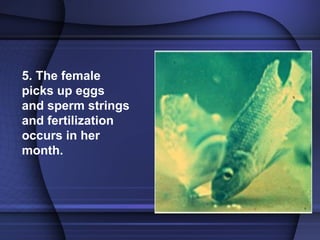
5. The female
picksup eggs
and sperm strings
and fertilization
occurs in her
month.
#7 Tilapia with a minimum weight of 25 to 30 g can be separated by visual inspection of the genital papilla. The male genital papilla is pointed and contains only the small urogenital pore which is difficult to observe. The female papilla is rounded and contains a small opening to the urinary duct and a larger oviduct. Selection is usually based on the presence or absence of the oviduct. Males are stocked for further growth while females can be used as brood stock or discarded. Visual selection of male tilapia is costly because of the extra labor needed to separate males from females.
#13 Tilapia spawn naturally in a variety of containers. Most cultured tilapia are spawned in small earthen ponds. Fry and small fingerlings are periodically harvested from the ponds with a seine net. Normal stocking density in earthen ponds is 1 brooder per m2 and a ratio of 1 male for every 2 to 3 females. Tilapia can also be spawned in small mesh cages (hapas) or in concrete or fiberglass tanks. Tilapia do not need a soft substrate to spawn. Males, though unable to dig a nest, still defend a territory and females lay their eggs on the hard bottom. Stocking density in cages or tanks is 3 to 5 brooders per m2 and a ratio of 1 male to 1 female.
#14 Small fry (0.05 g) can be harvested 18 days after stocking brood fish by partial seine harvest of full ponds or by pond draining to remove all fry. Pond margins are seined with a 1.6-mm mesh net daily to remove fry. Daily seining is continued for 1 month after which the pond is drained and a new spawning cycle started. Complete fry harvest is accomplished by draining the pond water to a sump or catch basin. Brood fish are removed from the catch basin before fry removal. Brood fish are lifted from the catch basin with a large mesh net that was placed in the catch basin before the pond was filled with water and the spawning cycle started. After brood fish are removed, fry are captured with 1.6-mm mesh nets or dip-nets. Spawning ponds must be poisoned or completely dried to eliminate any fry that remain in the pond after harvest before the next spawning cycle is started. Often, male and female brooders are held separately for a 7 to 10 day rest period before restocking in the spawning pond.
#15 Removing fry from spawning ponds 18 days after stocking brood fish results in higher numbers of fry per female but survival of fragile fry is reduced due to handling stress. Larger fry (1 g) can be captured 40 days after stocking brood fish to increase survival. However, cannibalism of large fry on small fry lowers the number of fry harvested per female. Most tilapia farmers prefer to harvest fry 18 days after stocking brood fish because the number of offspring per female available for stocking nursery ponds is higher than waiting 40 days after stocking brood fish to harvest fry.
#29 Some farmers prefer to remove the eggs from the mouths of females and incubate the eggs artificially. Farmers collecting eggs must be able to easily collect the females. Brood fish are stocked into hapas to facilitate female collection. Females are collected 5 days after placing them with the males to assure that eggs and not fry are collected. The eggs are transferred to a hatchery and placed in incubators with clean flowing water. The recently hatched yolk-sac fry are removed from the incubators and placed in containers with clean flowing water to allow them to absorb their yolk sacs and become stronger. When the fry are free swimming and looking for food, they can be transferred to ponds with zooplankton or placed in larger containers where they are fed a nutritious powdered feed.




![Human Reproduction [ Reproductive System ] Notes @irfanullah_mehar Irfanullah...](https://cdn.slidesharecdn.com/ss_thumbnails/humanreproductionreproductivesystemnotesirfanullahmeharirfanullahmeharjanantantra-260111172350-56e85778-thumbnail.jpg?width=640&height=640&fit=bounds)


