M sold some apples and received an amount of money.
If M had sold 10 more apples for the same amount of money, the price of
one apple would be RM2 less than the original price.
If M had sold 10 less apples for the same amount of money, the price of
one apple would be RM4 more than the original price.
a) How many apples did M sell?
b) What was the price of one apple?
Solution 1:
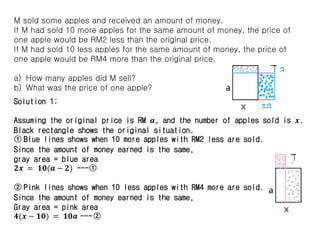
Assuming the original price is RM 𝒂, and the number of apples sold is 𝒙.
Black rectangle shows the original situation.
① Blue lines shows when 10 more apples with RM2 less are sold.
Since the amount of money earned is the same,
gray area = blue area
𝟐𝒙 = 𝟏𝟎(𝒂 − 𝟐) ---①
② Pink lines shows when 10 less apples with RM4 more are sold.
Since the amount of money earned is the same,
Gray area = pink area
𝟒(𝒙 − 𝟏𝟎) = 𝟏𝟎𝒂 --- ②
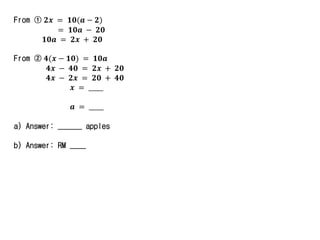
From ① 𝟐𝒙 = 𝟏𝟎(𝒂 − 𝟐)
= 𝟏𝟎𝒂 − 𝟐𝟎
𝟏𝟎𝒂 = 𝟐𝒙 + 𝟐𝟎
From ② 𝟒(𝒙 − 𝟏𝟎) = 𝟏𝟎𝒂
𝟒𝒙 − 𝟒𝟎 = 𝟐𝒙 + 𝟐𝟎
𝟒𝒙 − 𝟐𝒙 = 𝟐𝟎 + 𝟒𝟎
𝒙 = _____
𝒂 = _____
a) Answer: ______ apples
b) Answer: RM ____
Solution 2:
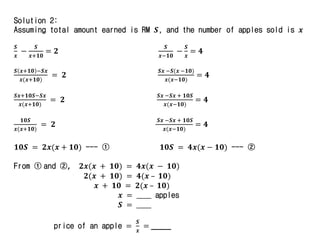
Assuming total amount earned is RM 𝑺, and the number of apples sold is 𝒙
𝑺
𝒙
−
𝑺
𝒙+𝟏𝟎
= 𝟐
𝑺
𝒙−𝟏𝟎
−
𝑺
𝒙
= 𝟒
𝑺 𝒙+𝟏𝟎 −𝑺𝒙
𝒙(𝒙+𝟏𝟎)
= 𝟐
𝑺𝒙 −𝑺(𝒙 −𝟏𝟎)
𝒙(𝒙−𝟏𝟎)
= 𝟒
𝑺𝒙+𝟏𝟎𝑺−𝑺𝒙
𝒙(𝒙+𝟏𝟎)
= 𝟐
𝑺𝒙 −𝑺𝒙 + 𝟏𝟎𝑺
𝒙(𝒙−𝟏𝟎)
= 𝟒
𝟏𝟎𝑺
𝒙(𝒙+𝟏𝟎)
= 𝟐
𝑺𝒙 −𝑺𝒙 + 𝟏𝟎𝑺
𝒙(𝒙−𝟏𝟎)
= 𝟒
𝟏𝟎𝑺 = 𝟐𝒙(𝒙 + 𝟏𝟎) --- ① 𝟏𝟎𝑺 = 𝟒𝒙(𝒙 − 𝟏𝟎) --- ②
From ① and ②, 𝟐𝒙(𝒙 + 𝟏𝟎) = 𝟒𝒙(𝒙 − 𝟏𝟎)
𝟐(𝒙 + 𝟏𝟎) = 𝟒(𝒙 – 𝟏𝟎)
𝒙 + 𝟏𝟎 = 𝟐(𝒙 – 𝟏𝟎)
𝒙 = _____ apples
𝑺 = _____
price of an apple =
𝑺
𝒙
= _____
X is a 2-digit number whose value is 13/4 of the sum of its digits.
If 36 is added to X, the result will contain the same digits but in reverse
order. Find X.
Solution:
X = 13/4 (sum of its digits)
From the above, we know:
 X is a multiple of 13 (and 13 is a prime number)
 (sum of its digits) is a multiple of 4
Multiple of 13 which has 2-digits: 13, 26, 39, 52, 65, 78, 91
And which the sum of digits can be divided by 4: 13, 26, 39, 52, 65, 78, 91
Now add 36 to these 3 numbers: 13, 26, 39
13 + 36 =
26 + 36 =
39 + 36 =
Answer: ____
Calculate the result of
12
- 22
+ 32
− 42
+ . . . + 20012
− 20022
+ 20032
.
Solution:
Using the algebra rule: 𝒂 𝟐 – 𝒃 𝟐 = (𝒂 + 𝒃)(𝒂 – 𝒃)
12
- 22
+ 32
− 42
+ . . . + 20012
− 20022
+ 20032
= (20032 − 20022) + (20012 − 20002) + … + (32 −22) + 12
= 2003 + 2002 2003 − 2002 + 2001 + 2000 2001 – 2000 + …
+ 3 + 2 3 − 2 + 1
= 2003 + 2002 + 2001 + 2000 + … + 3 + 2 + 1
=
1+2003 × 2003
2
= _____
Solution:
a) ① A =
𝟏𝟐𝟓
𝟏𝟎𝟎
B =
𝟓
𝟒
B  A > B
② A =
𝟗𝟎
𝟏𝟎𝟎
C =
𝟗
𝟏𝟎
C  A < C
Therefore: B < A < C
Answer: ___
b) From ① : B =
𝟒
𝟓
A ---③
From ② : C =
𝟏𝟎
𝟗
A ---④
Difference between B and C
= C – B
=
𝟏𝟎
𝟗
A –
𝟒
𝟓
A
= ___ A ---⑤
A + B + C = 52400
From ③ and ④ : A +
𝟒
𝟓
A +
𝟏𝟎
𝟗
A = 52400
A = _______.
Replace A in ⑤
Answer: ____
A, B and C worked together and received a total wage of RM52400.
A received 125% of B’s wage, but 90% of C’s wage.
a) Determine who received more: B or C?
b) What is the difference between the wages of B and C?
Weekly Dose 1 - Maths Olympiad Practice

  • 1.
    M sold someapples and received an amount of money. If M had sold 10 more apples for the same amount of money, the price of one apple would be RM2 less than the original price. If M had sold 10 less apples for the same amount of money, the price of one apple would be RM4 more than the original price. a) How many apples did M sell? b) What was the price of one apple? Solution 1: Assuming the original price is RM 𝒂, and the number of apples sold is 𝒙. Black rectangle shows the original situation. ① Blue lines shows when 10 more apples with RM2 less are sold. Since the amount of money earned is the same, gray area = blue area 𝟐𝒙 = 𝟏𝟎(𝒂 − 𝟐) ---① ② Pink lines shows when 10 less apples with RM4 more are sold. Since the amount of money earned is the same, Gray area = pink area 𝟒(𝒙 − 𝟏𝟎) = 𝟏𝟎𝒂 --- ②
  • 2.
    From ① 𝟐𝒙= 𝟏𝟎(𝒂 − 𝟐) = 𝟏𝟎𝒂 − 𝟐𝟎 𝟏𝟎𝒂 = 𝟐𝒙 + 𝟐𝟎 From ② 𝟒(𝒙 − 𝟏𝟎) = 𝟏𝟎𝒂 𝟒𝒙 − 𝟒𝟎 = 𝟐𝒙 + 𝟐𝟎 𝟒𝒙 − 𝟐𝒙 = 𝟐𝟎 + 𝟒𝟎 𝒙 = _____ 𝒂 = _____ a) Answer: ______ apples b) Answer: RM ____
  • 3.
    Solution 2: Assuming totalamount earned is RM 𝑺, and the number of apples sold is 𝒙 𝑺 𝒙 − 𝑺 𝒙+𝟏𝟎 = 𝟐 𝑺 𝒙−𝟏𝟎 − 𝑺 𝒙 = 𝟒 𝑺 𝒙+𝟏𝟎 −𝑺𝒙 𝒙(𝒙+𝟏𝟎) = 𝟐 𝑺𝒙 −𝑺(𝒙 −𝟏𝟎) 𝒙(𝒙−𝟏𝟎) = 𝟒 𝑺𝒙+𝟏𝟎𝑺−𝑺𝒙 𝒙(𝒙+𝟏𝟎) = 𝟐 𝑺𝒙 −𝑺𝒙 + 𝟏𝟎𝑺 𝒙(𝒙−𝟏𝟎) = 𝟒 𝟏𝟎𝑺 𝒙(𝒙+𝟏𝟎) = 𝟐 𝑺𝒙 −𝑺𝒙 + 𝟏𝟎𝑺 𝒙(𝒙−𝟏𝟎) = 𝟒 𝟏𝟎𝑺 = 𝟐𝒙(𝒙 + 𝟏𝟎) --- ① 𝟏𝟎𝑺 = 𝟒𝒙(𝒙 − 𝟏𝟎) --- ② From ① and ②, 𝟐𝒙(𝒙 + 𝟏𝟎) = 𝟒𝒙(𝒙 − 𝟏𝟎) 𝟐(𝒙 + 𝟏𝟎) = 𝟒(𝒙 – 𝟏𝟎) 𝒙 + 𝟏𝟎 = 𝟐(𝒙 – 𝟏𝟎) 𝒙 = _____ apples 𝑺 = _____ price of an apple = 𝑺 𝒙 = _____
  • 4.
    X is a2-digit number whose value is 13/4 of the sum of its digits. If 36 is added to X, the result will contain the same digits but in reverse order. Find X. Solution: X = 13/4 (sum of its digits) From the above, we know:  X is a multiple of 13 (and 13 is a prime number)  (sum of its digits) is a multiple of 4 Multiple of 13 which has 2-digits: 13, 26, 39, 52, 65, 78, 91 And which the sum of digits can be divided by 4: 13, 26, 39, 52, 65, 78, 91 Now add 36 to these 3 numbers: 13, 26, 39 13 + 36 = 26 + 36 = 39 + 36 = Answer: ____
  • 5.
    Calculate the resultof 12 - 22 + 32 − 42 + . . . + 20012 − 20022 + 20032 . Solution: Using the algebra rule: 𝒂 𝟐 – 𝒃 𝟐 = (𝒂 + 𝒃)(𝒂 – 𝒃) 12 - 22 + 32 − 42 + . . . + 20012 − 20022 + 20032 = (20032 − 20022) + (20012 − 20002) + … + (32 −22) + 12 = 2003 + 2002 2003 − 2002 + 2001 + 2000 2001 – 2000 + … + 3 + 2 3 − 2 + 1 = 2003 + 2002 + 2001 + 2000 + … + 3 + 2 + 1 = 1+2003 × 2003 2 = _____
  • 6.
    Solution: a) ① A= 𝟏𝟐𝟓 𝟏𝟎𝟎 B = 𝟓 𝟒 B  A > B ② A = 𝟗𝟎 𝟏𝟎𝟎 C = 𝟗 𝟏𝟎 C  A < C Therefore: B < A < C Answer: ___ b) From ① : B = 𝟒 𝟓 A ---③ From ② : C = 𝟏𝟎 𝟗 A ---④ Difference between B and C = C – B = 𝟏𝟎 𝟗 A – 𝟒 𝟓 A = ___ A ---⑤ A + B + C = 52400 From ③ and ④ : A + 𝟒 𝟓 A + 𝟏𝟎 𝟗 A = 52400 A = _______. Replace A in ⑤ Answer: ____ A, B and C worked together and received a total wage of RM52400. A received 125% of B’s wage, but 90% of C’s wage. a) Determine who received more: B or C? b) What is the difference between the wages of B and C?