Gaga for Dada
Definition and History of DaDa Art Movement
by Tony Huynh
Angela Penny
Peter Park
It's too idiotic to be schizophrenic.
-Carl Jung on Dada
Dadaism
Largely because of advances in
weapon technology, World War I was
an extremely violent, traumatizing
conflict that played out on European
soil.
Artists, writers, draft dodgers,
musicians and activists from both sides
of the conflict between Allies and the
Central Powers fled to neutral Zurich,
Switzerland.
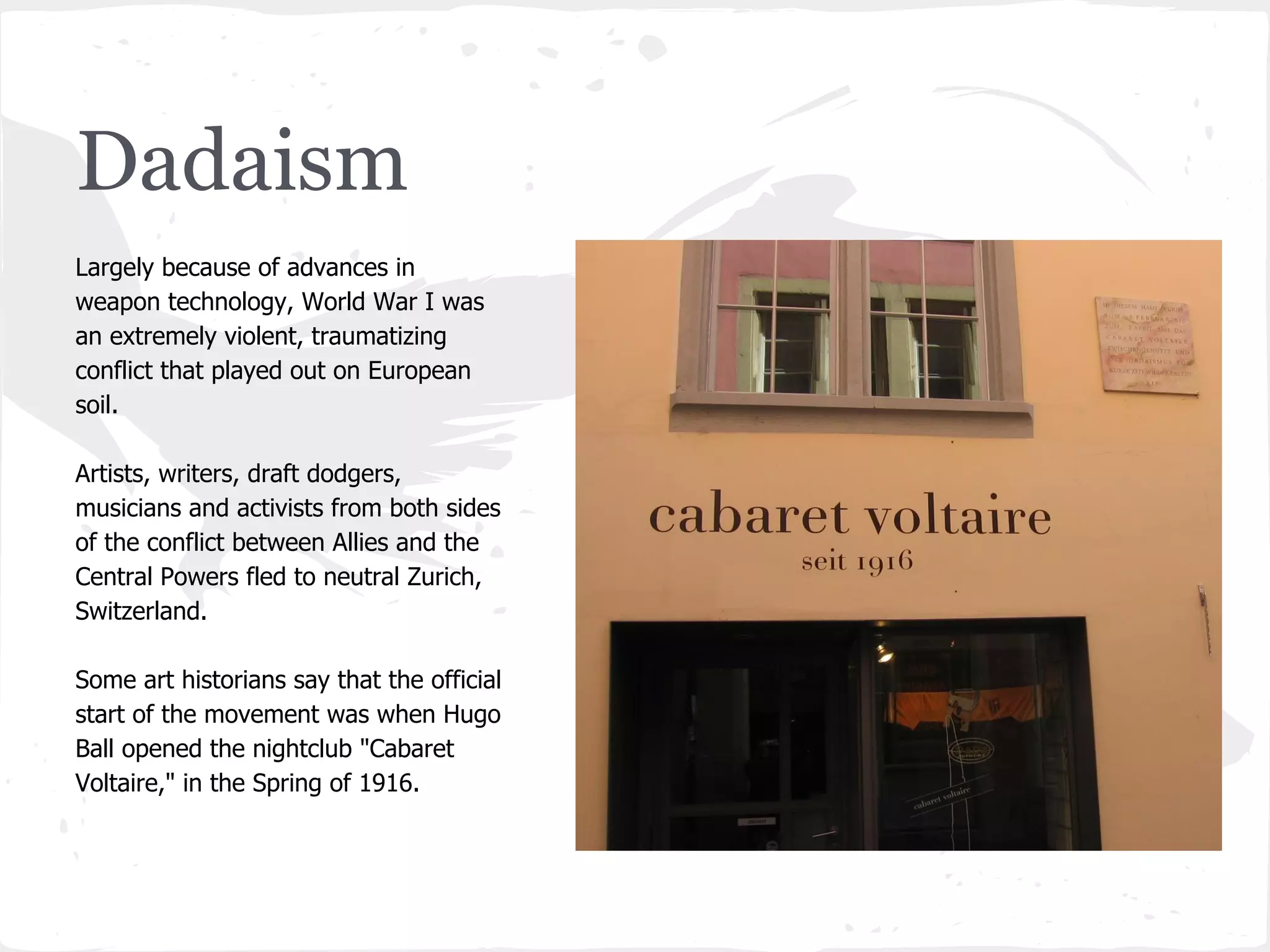
Some art historians say that the official
start of the movement was when Hugo
Ball opened the nightclub "Cabaret
Voltaire," in the Spring of 1916.
the dada manifesto
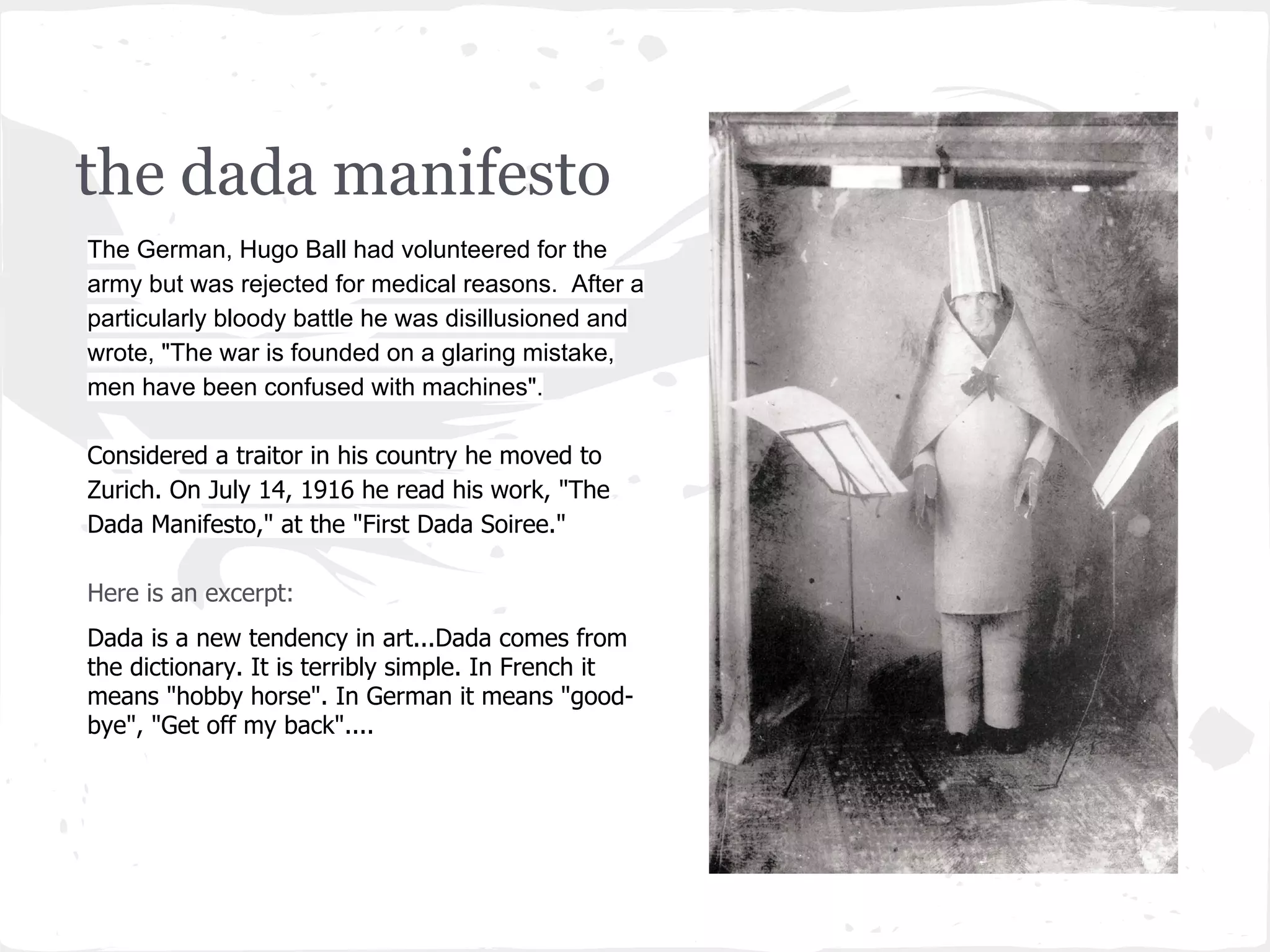
The German, Hugo Ball had volunteered for the
army but was rejected for medical reasons. After a
particularly bloody battle he was disillusioned and
wrote, "The war is founded on a glaring mistake,
men have been confused with machines".
Considered a traitor in his country he moved to
Zurich. On July 14, 1916 he read his work, "The
Dada Manifesto," at the "First Dada Soiree."
Here is an excerpt:
Dada is a new tendency in art...Dada comes from
the dictionary. It is terribly simple. In French it
means "hobby horse". In German it means "good-
bye", "Get off my back"....
Dada
manifesto 2.0
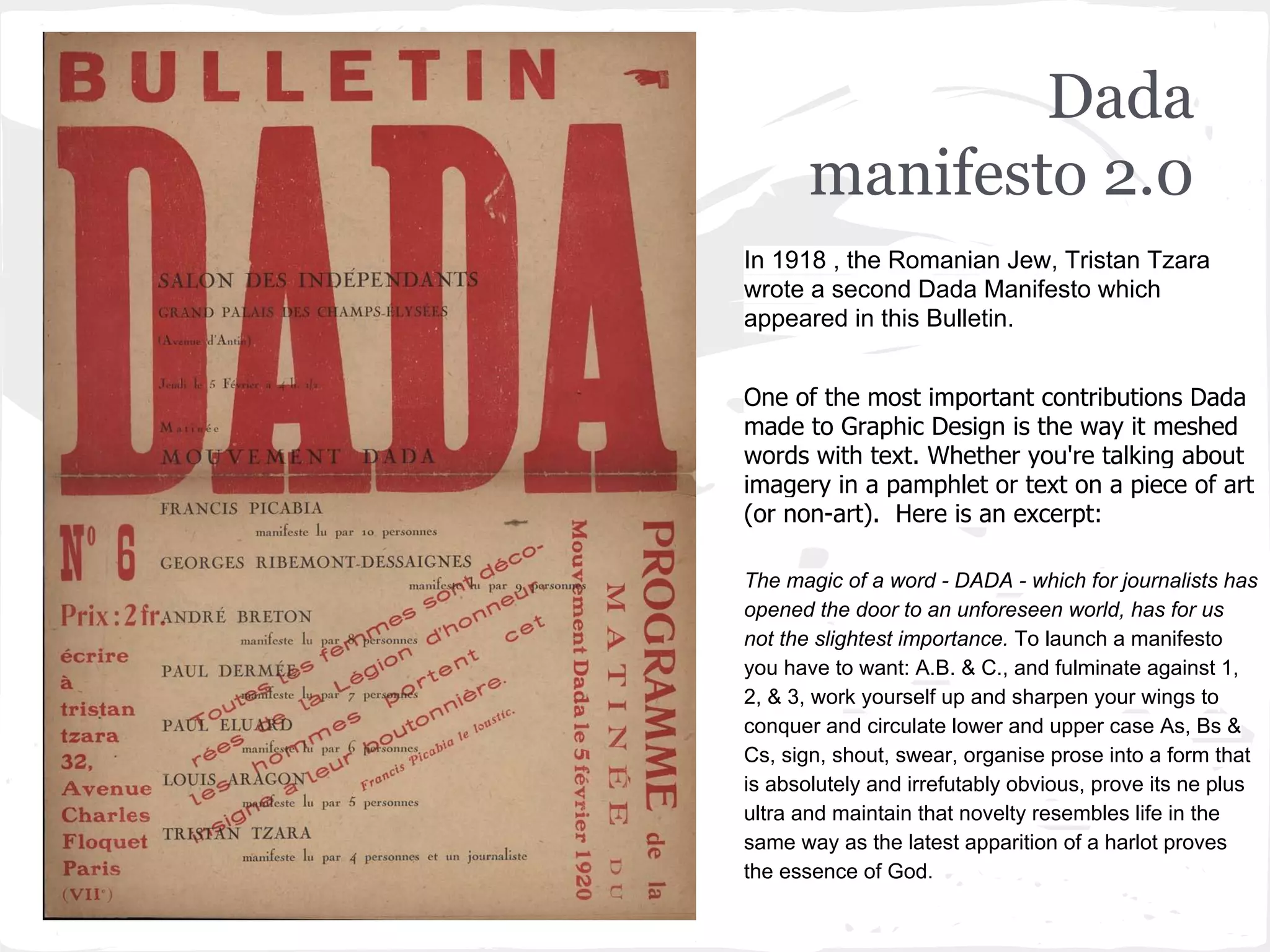
In 1918 , the Romanian Jew, Tristan Tzara
wrote a second Dada Manifesto which
appeared in this Bulletin.
One of the most important contributions Dada
made to Graphic Design is the way it meshed
words with text. Whether you're talking about
imagery in a pamphlet or text on a piece of art
(or non-art). Here is an excerpt:
The magic of a word - DADA - which for journalists has
opened the door to an unforeseen world, has for us
not the slightest importance. To launch a manifesto
you have to want: A.B. & C., and fulminate against 1,
2, & 3, work yourself up and sharpen your wings to
conquer and circulate lower and upper case As, Bs &
Cs, sign, shout, swear, organise prose into a form that
is absolutely and irrefutably obvious, prove its ne plus
ultra and maintain that novelty resembles life in the
same way as the latest apparition of a harlot proves
the essence of God.
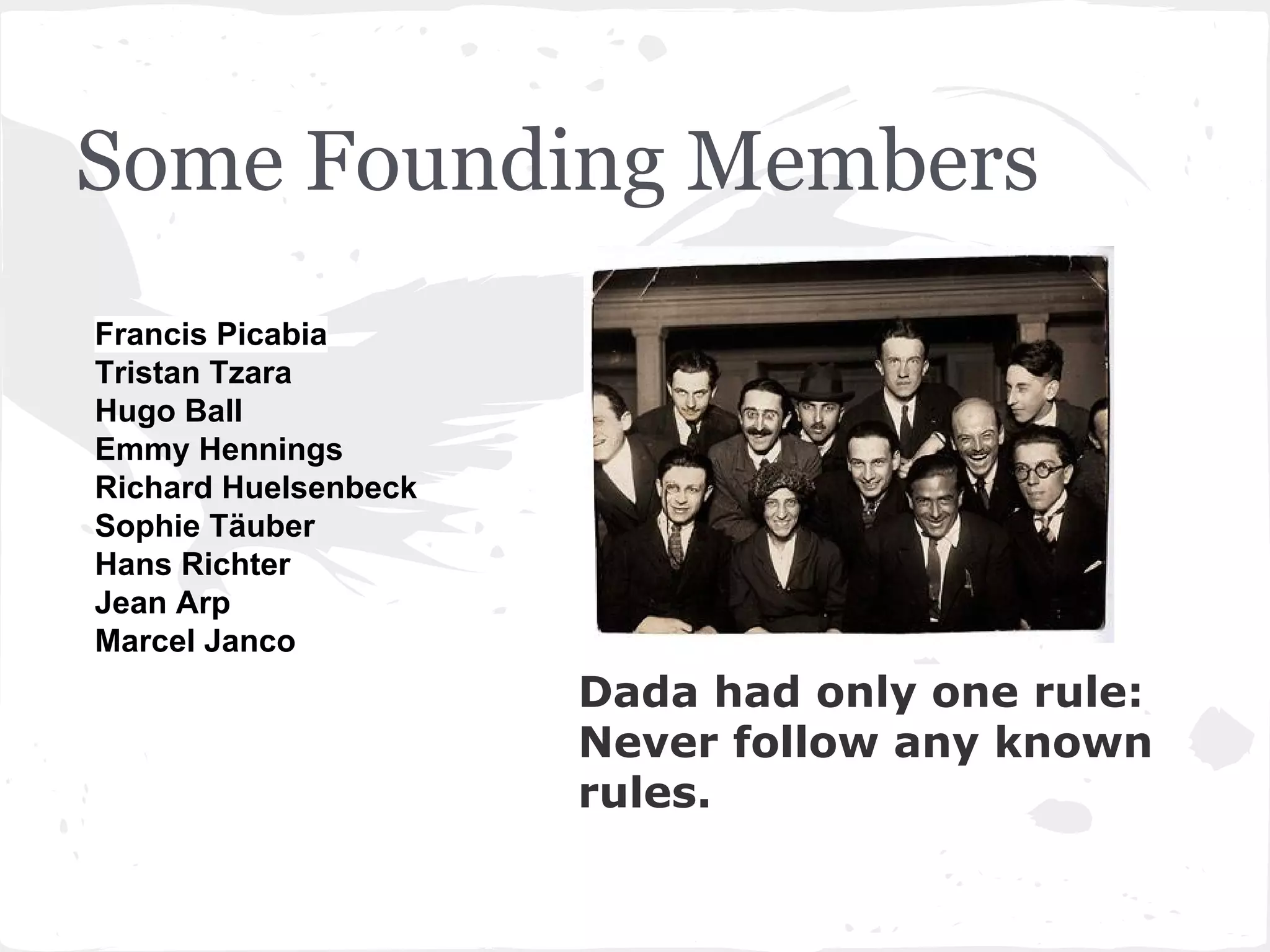
Some Founding Members
Dada had only one rule:
Never follow any known
rules.
Francis Picabia
Tristan Tzara
Hugo Ball
Emmy Hennings
Richard Huelsenbeck
Sophie Täuber
Hans Richter
Jean Arp
Marcel Janco
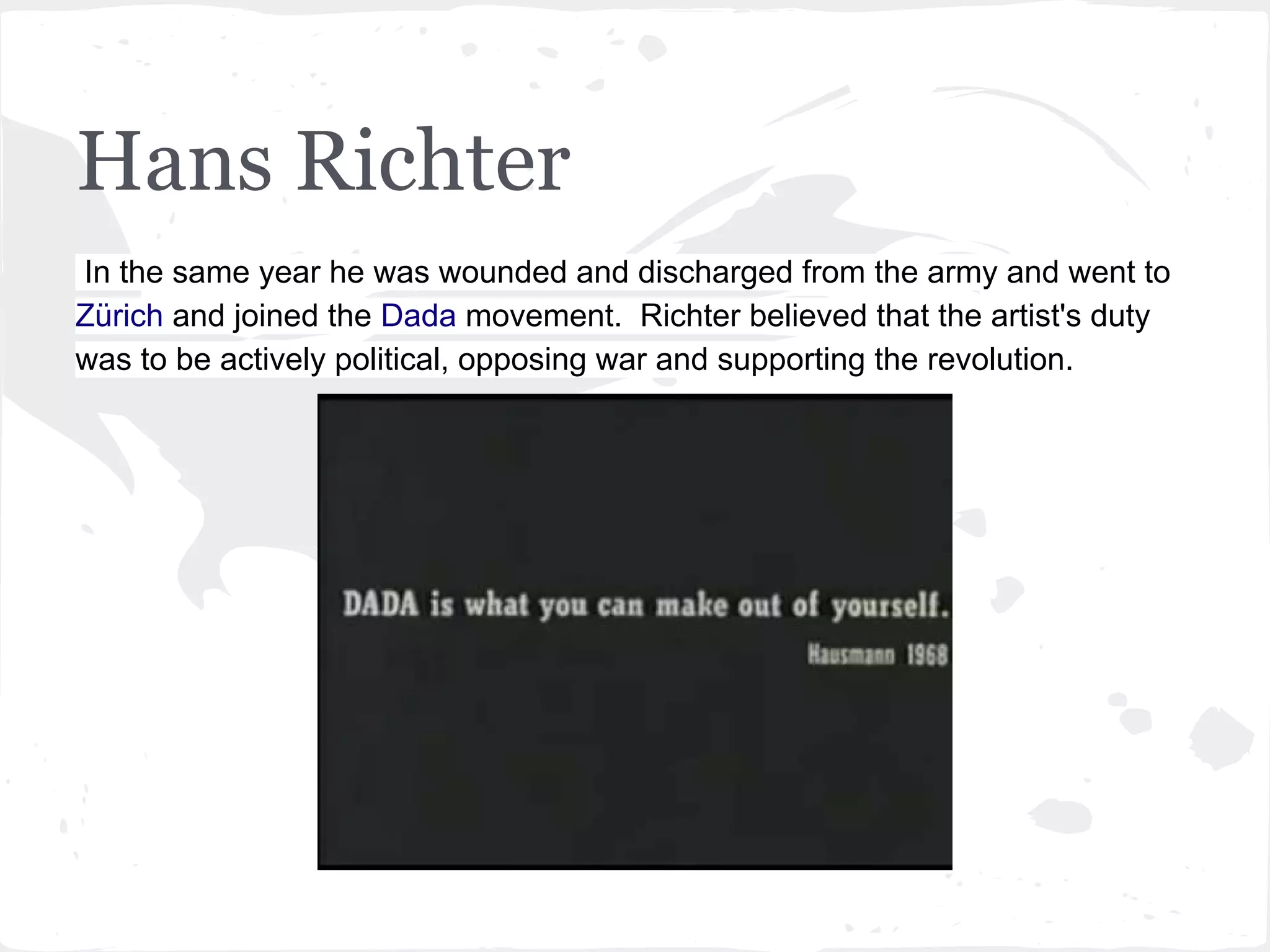
Hans Richter
In the same year he was wounded and discharged from the army and went to
Zürich and joined the Dada movement. Richter believed that the artist's duty
was to be actively political, opposing war and supporting the revolution.
Jean / Hans Arp
Jean Arp was German-French and when he
spoke in French he called himself Jean and
when he spoke in German he called himself
Hans.
He was in Zurich in 1916 and in 1920
started a Dada group in Cologne, Germany
with Max Ernst. In 1925 his work appeared
in the first Surrealist show in Paris.
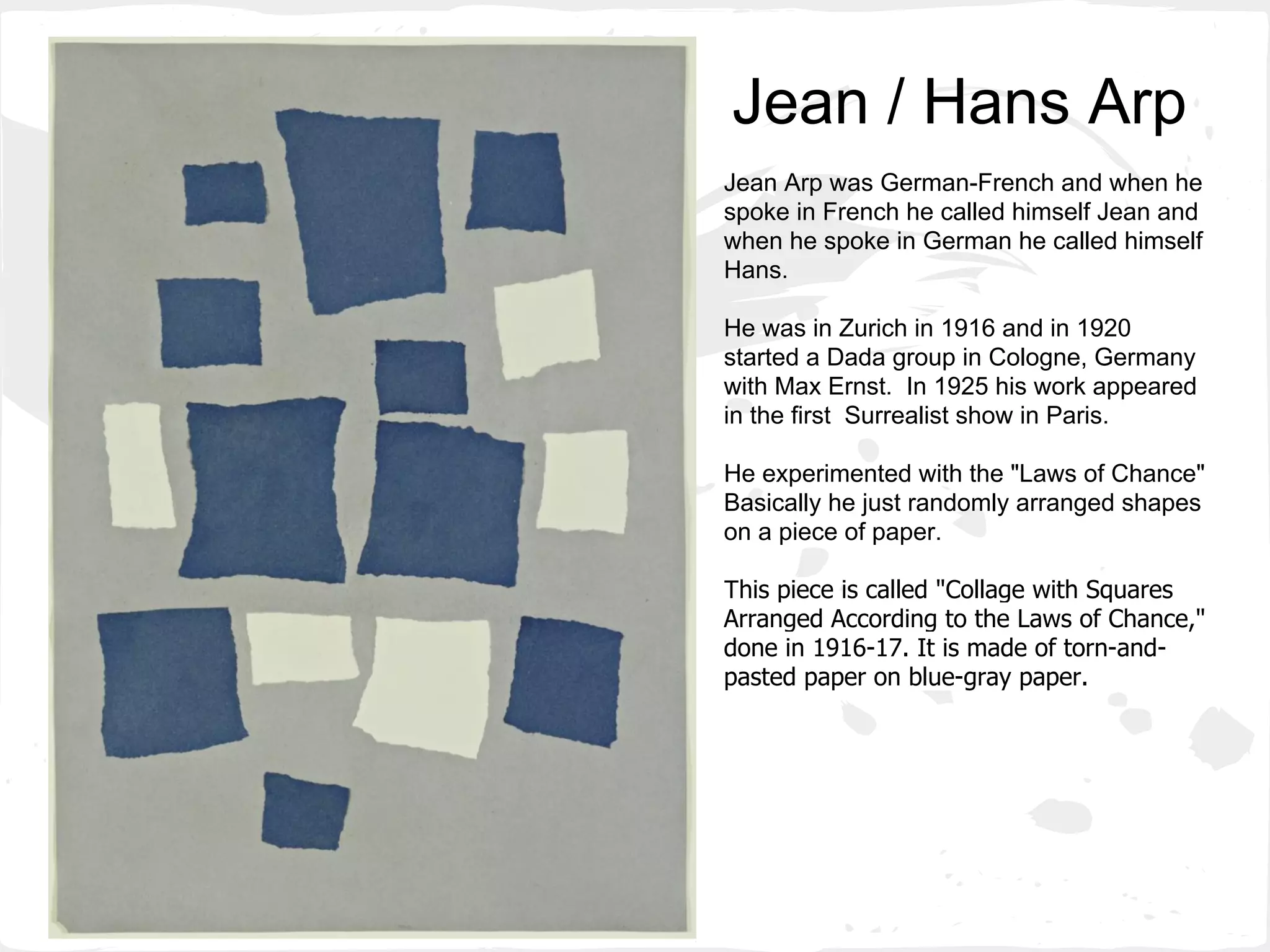
He experimented with the "Laws of Chance"
Basically he just randomly arranged shapes
on a piece of paper.
This piece is called "Collage with Squares
Arranged According to the Laws of Chance,"
done in 1916-17. It is made of torn-and-
pasted paper on blue-gray paper.
Francis Picabia
Picabia had a French mother who died
when he was young and a Spanish father.
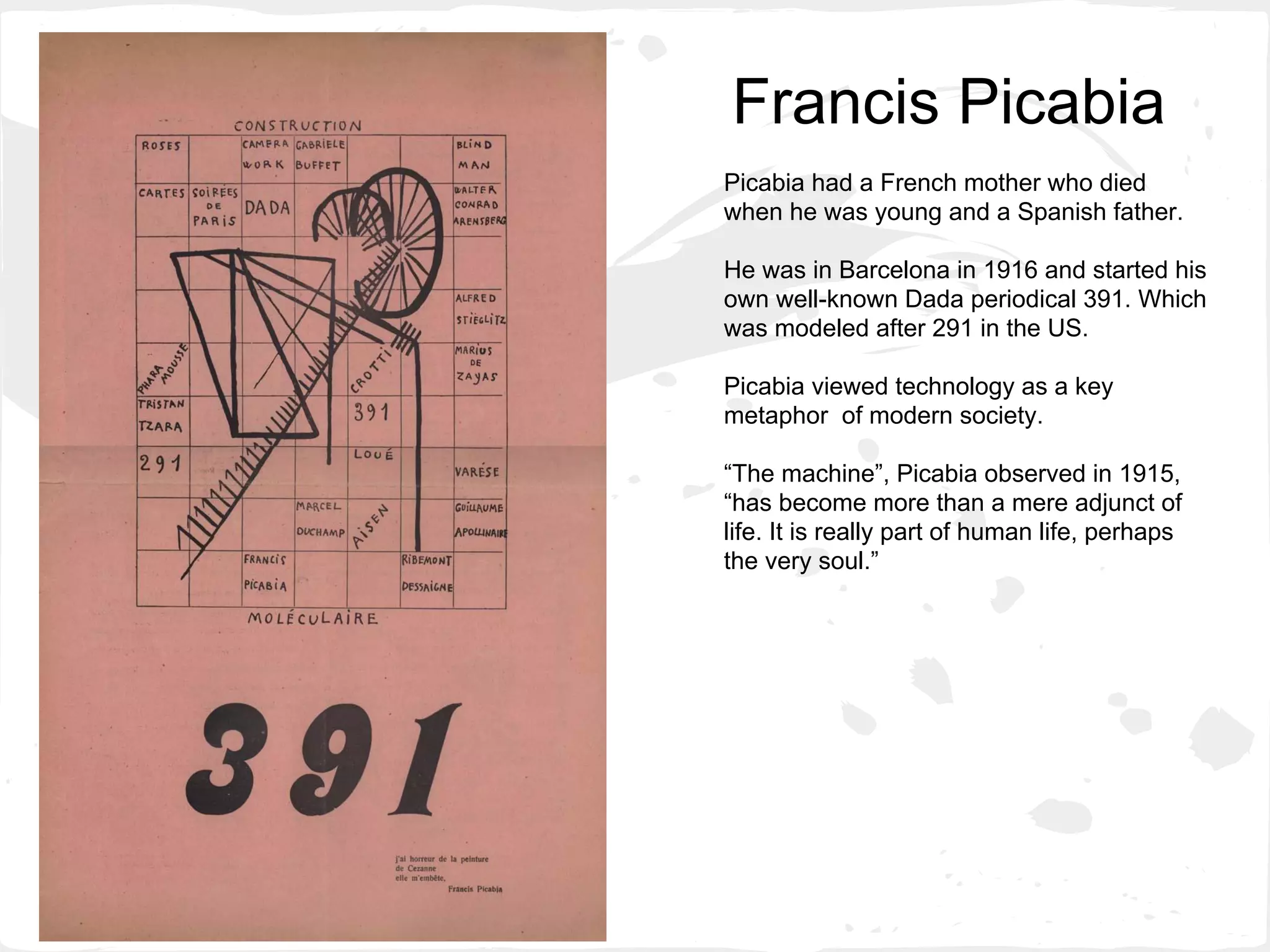
He was in Barcelona in 1916 and started his
own well-known Dada periodical 391. Which
was modeled after 291 in the US.
Picabia viewed technology as a key
metaphor of modern society.
“The machine”, Picabia observed in 1915,
“has become more than a mere adjunct of
life. It is really part of human life, perhaps
the very soul.”
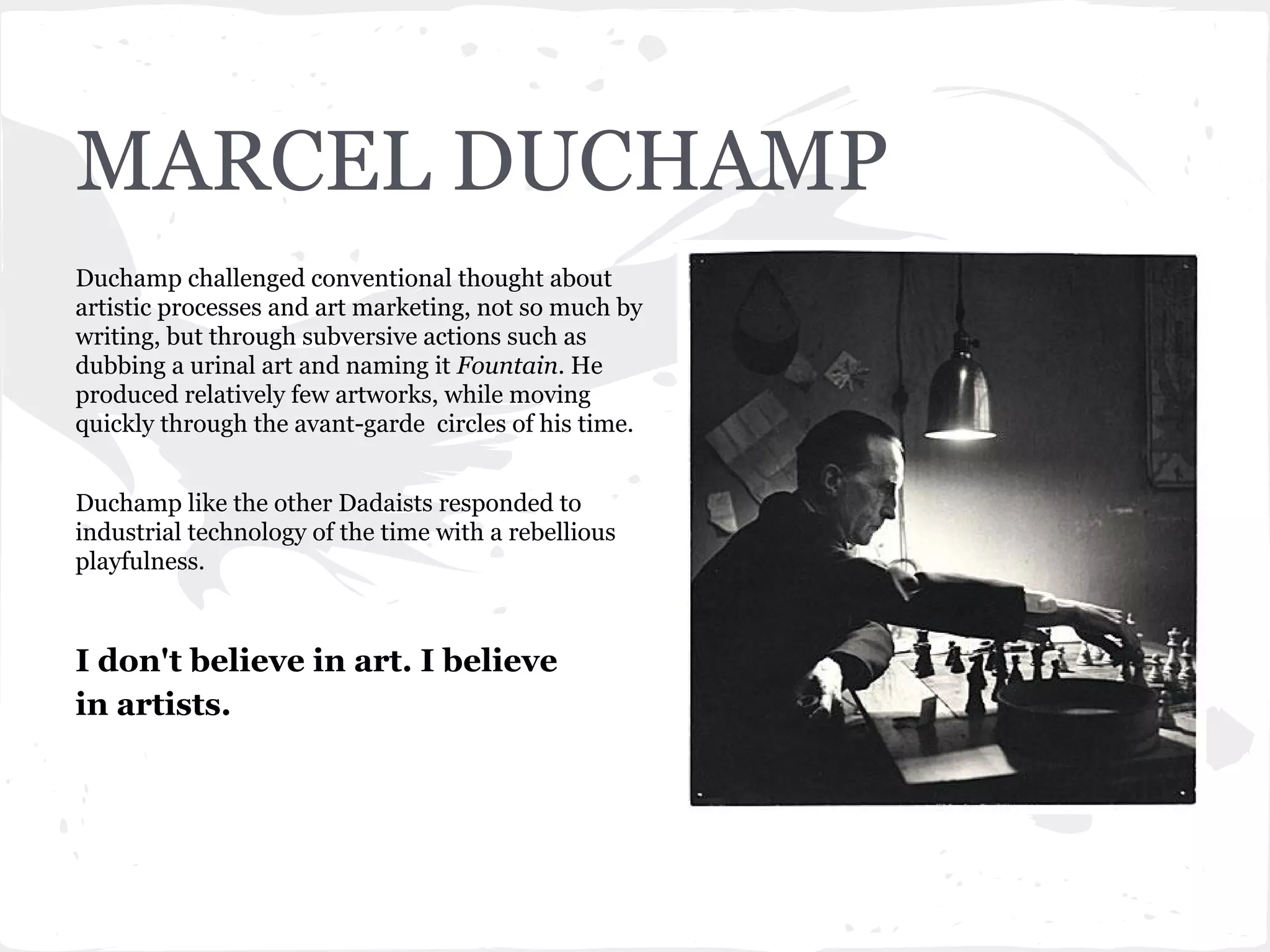
MARCEL DUCHAMP
Duchamp challenged conventional thought about
artistic processes and art marketing, not so much by
writing, but through subversive actions such as
dubbing a urinal art and naming it Fountain. He
produced relatively few artworks, while moving
quickly through the avant-garde circles of his time.
Duchamp like the other Dadaists responded to
industrial technology of the time with a rebellious
playfulness.
I don't believe in art. I believe
in artists.
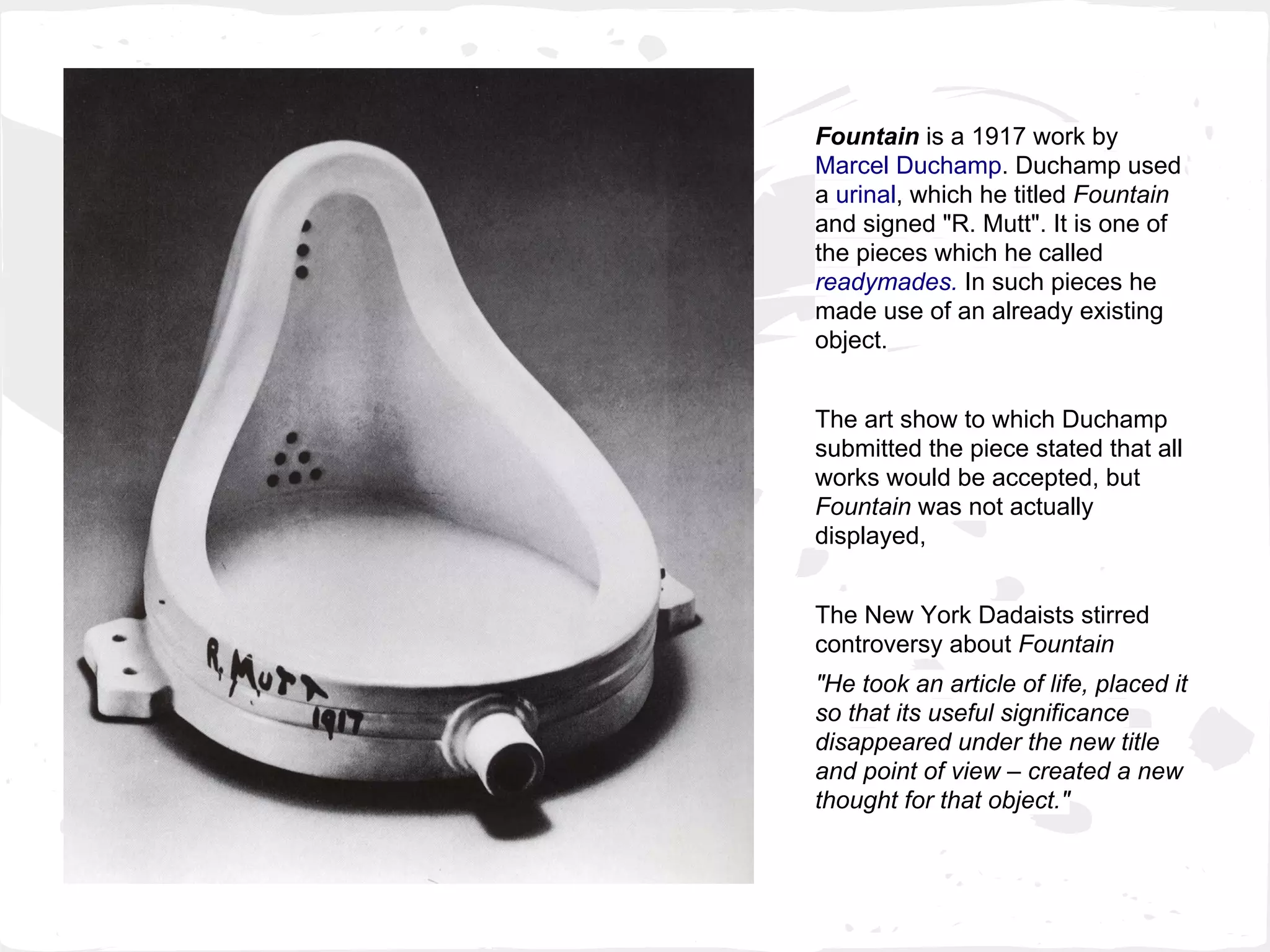
Fountain is a 1917 work by
Marcel Duchamp. Duchamp used
a urinal, which he titled Fountain
and signed "R. Mutt". It is one of
the pieces which he called
readymades. In such pieces he
made use of an already existing
object.
The art show to which Duchamp
submitted the piece stated that all
works would be accepted, but
Fountain was not actually
displayed,
The New York Dadaists stirred
controversy about Fountain
"He took an article of life, placed it
so that its useful significance
disappeared under the new title
and point of view – created a new
thought for that object."
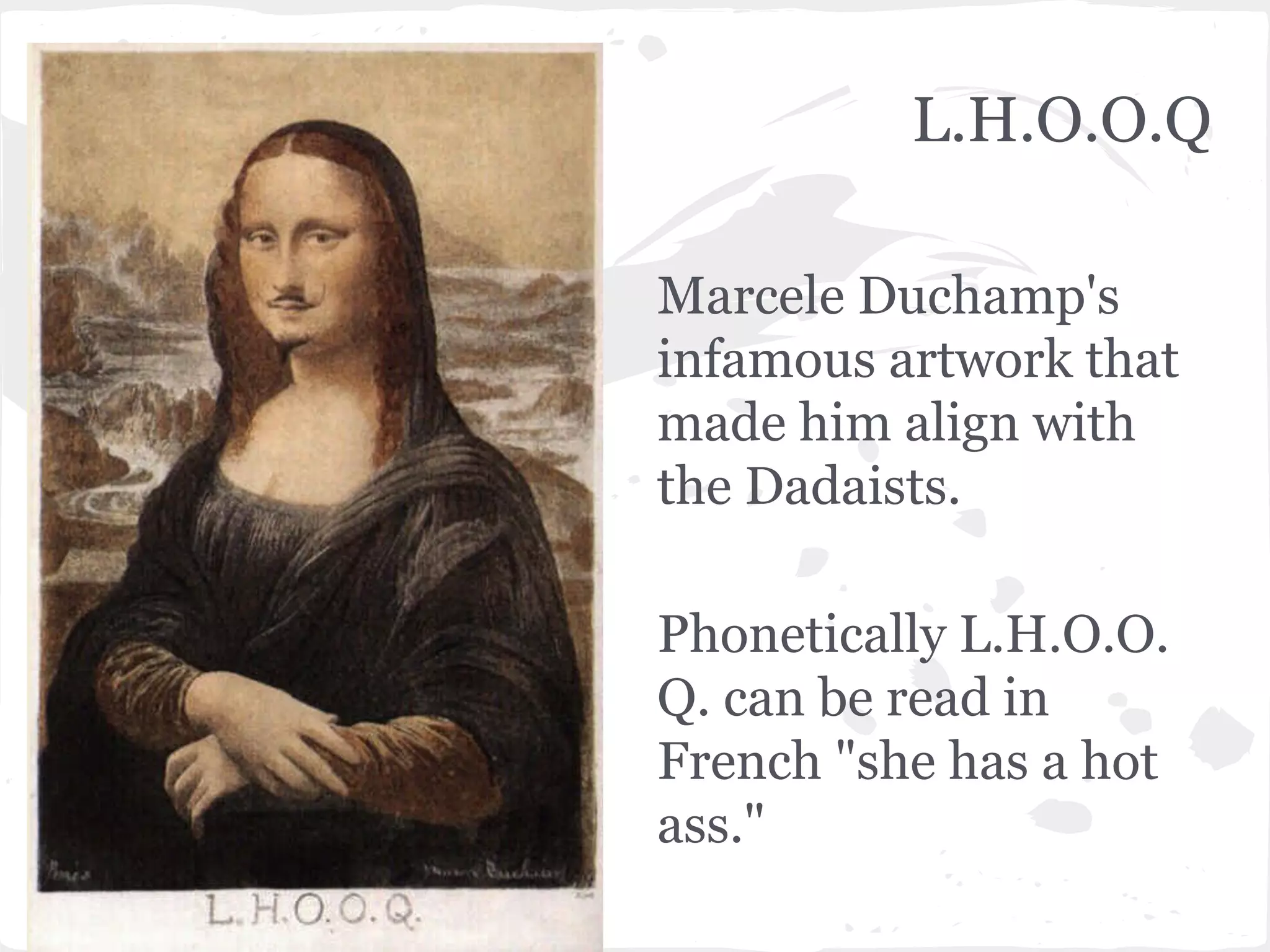
L.L.O.O.Q
Marcele Duchamp's
infamous artwork that
made him align with
the Dadaists.
Phonetically L.H.O.O.
Q. can be read in
French "she has a hot
ass."
L.H.O.O.Q
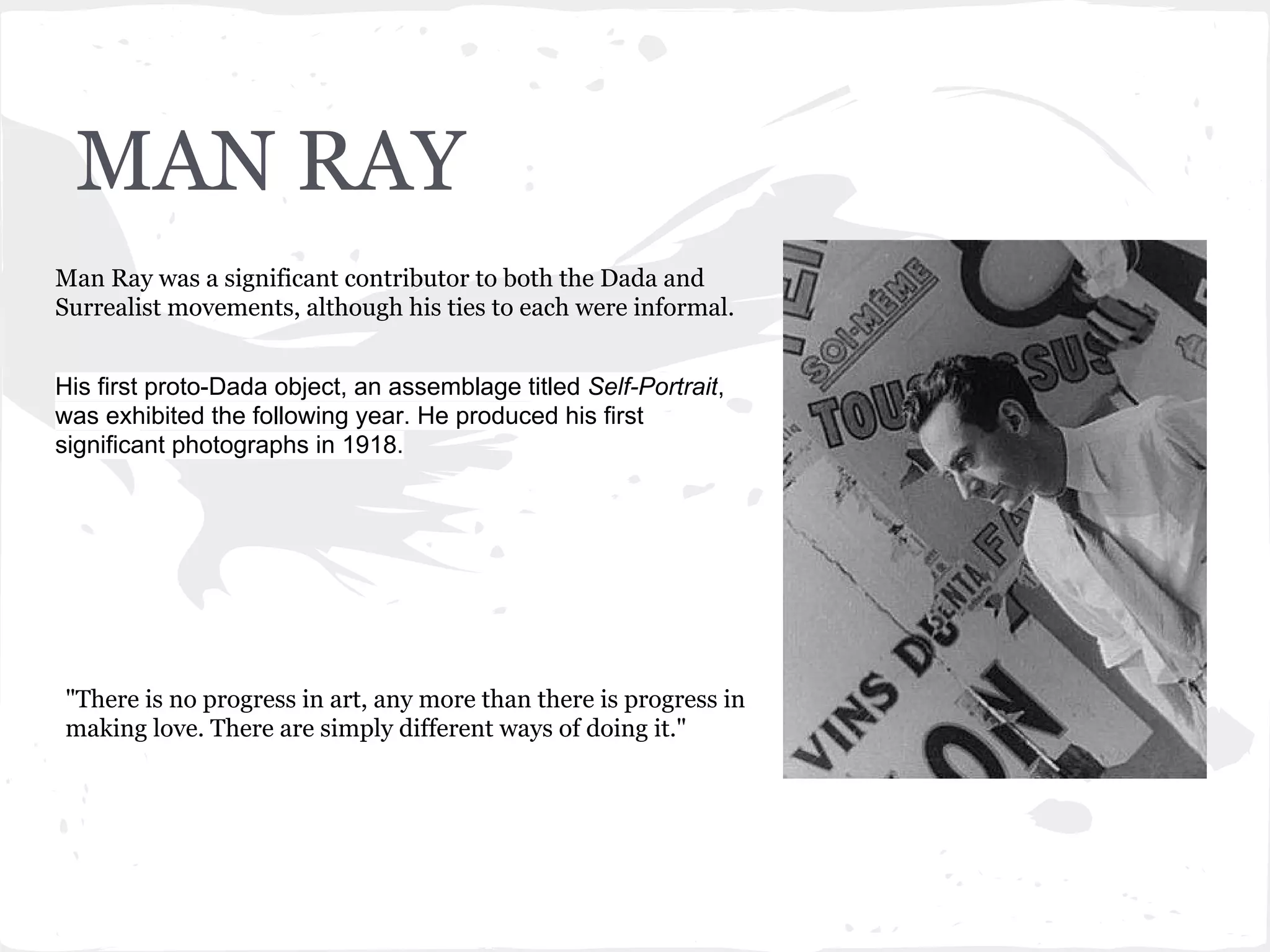
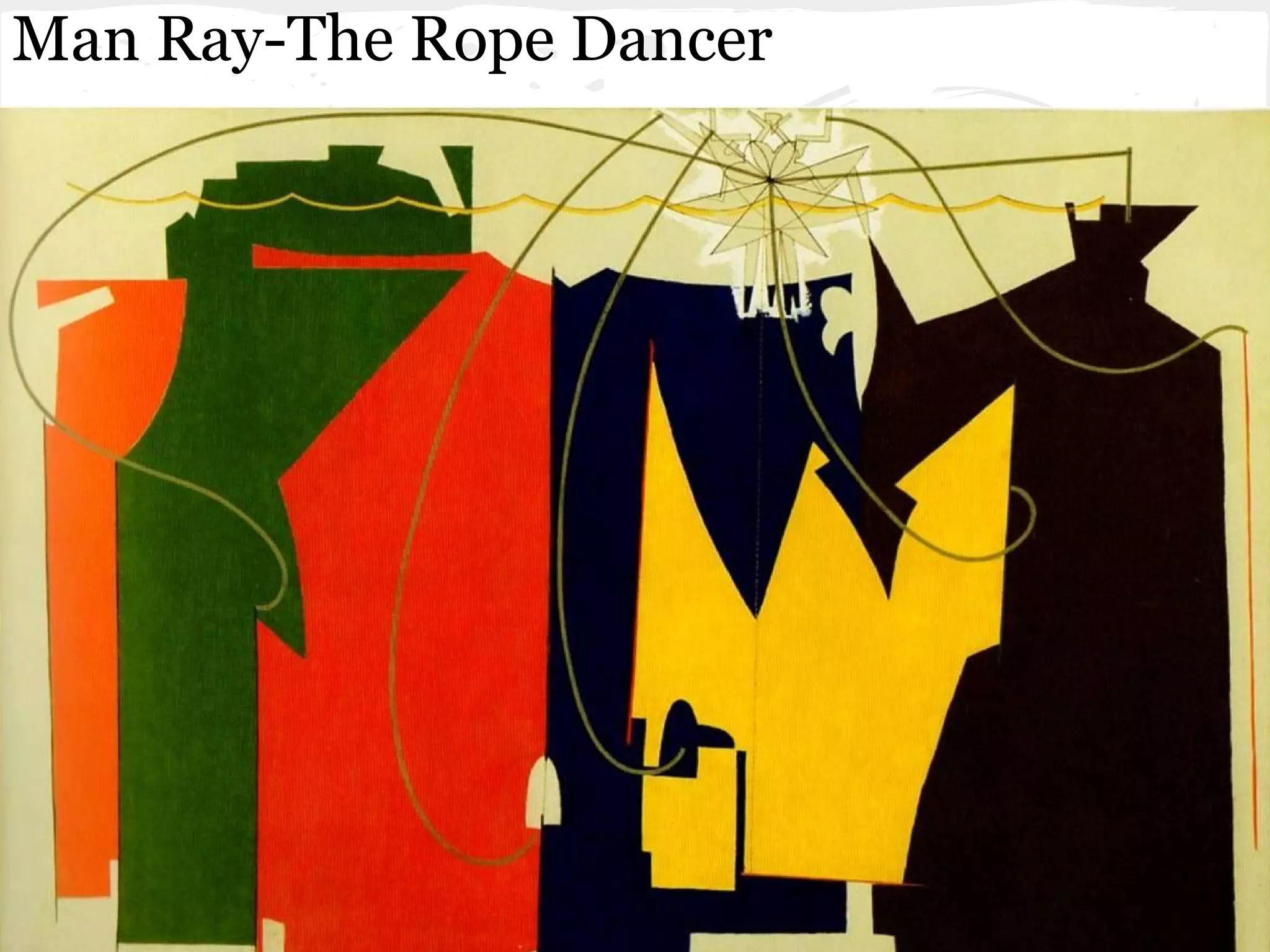
MAN RAY
Man Ray was a significant contributor to both the Dada and
Surrealist movements, although his ties to each were informal.
His first proto-Dada object, an assemblage titled Self-Portrait,
was exhibited the following year. He produced his first
significant photographs in 1918.
"There is no progress in art, any more than there is progress in
making love. There are simply different ways of doing it."
Man Ray-The Rope Dancer
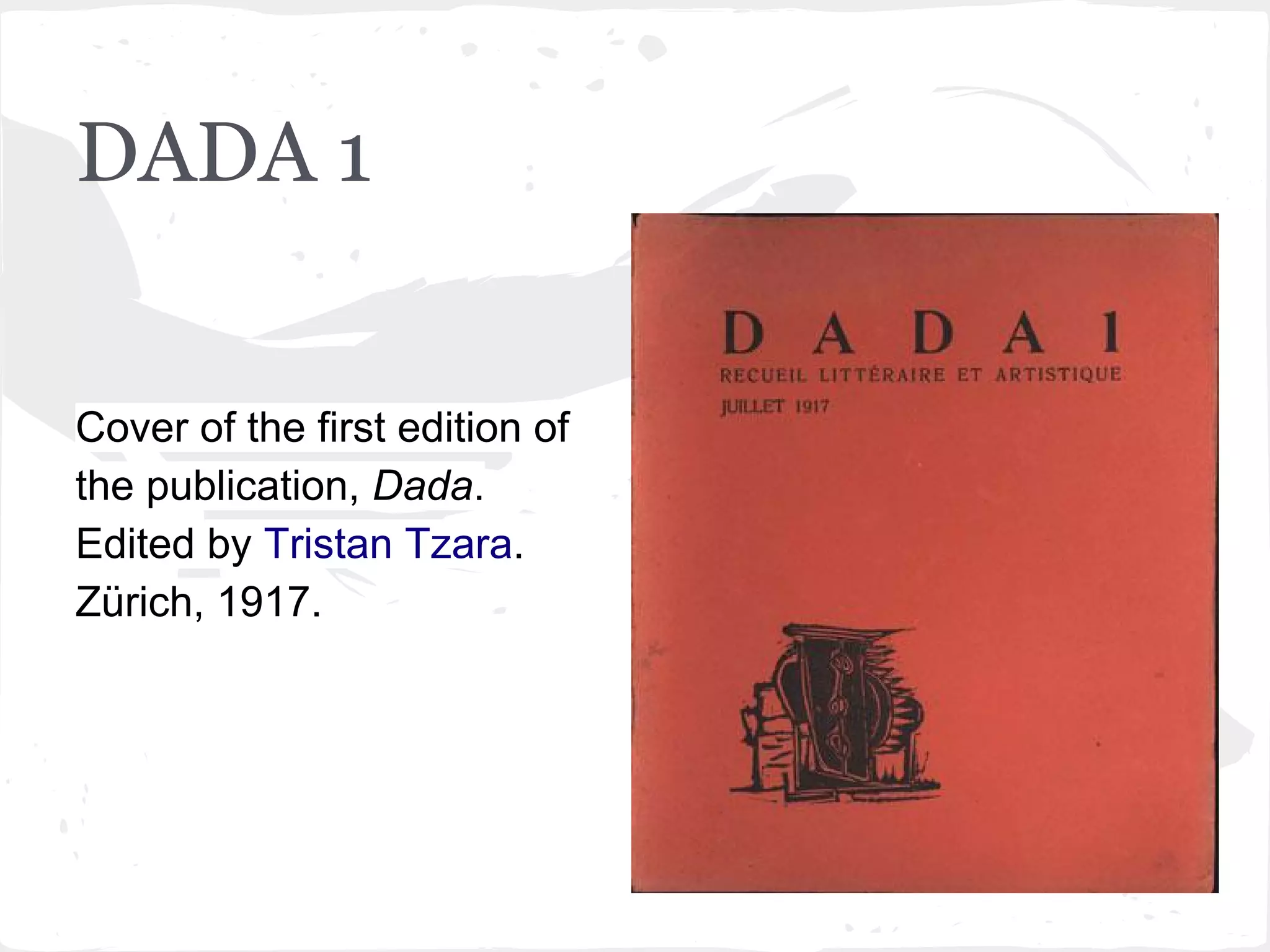
DADA 1
Cover of the first edition of
the publication, Dada.
Edited by Tristan Tzara.
Zürich, 1917.
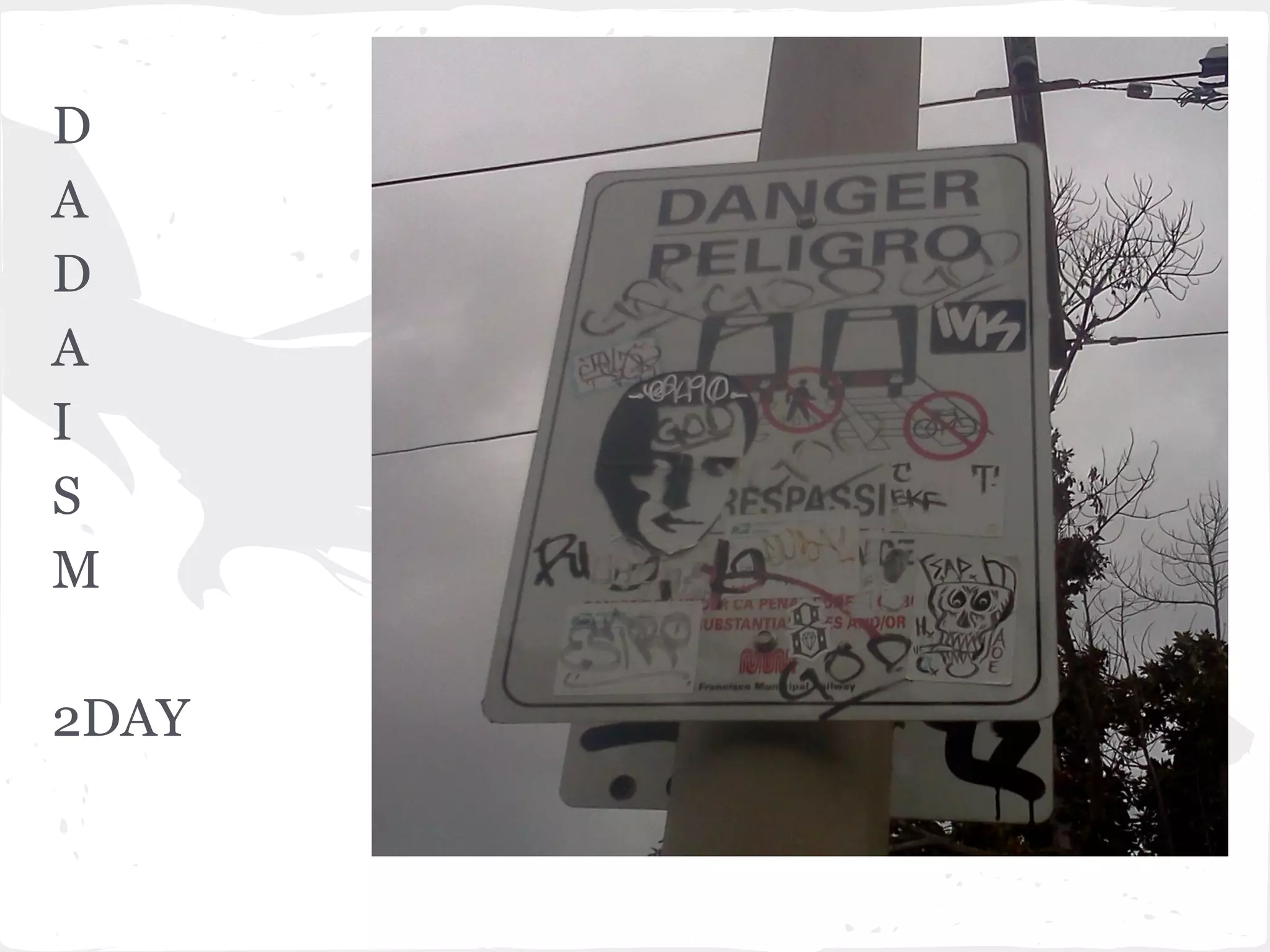
D
A
D
A
I
S
M
2DAY
The Keepsake
I made this newsprint currency to defeat the purpose of wealth. Wealth is meaningless along with
peoples' concern of their status quo attached. The distribution of wealth is a joke therefore the faces
on bills might as well be revered from comic book villans.
What is the status quo? In our modern world it is the newest and expensive things we buy that define
ourselves. Does money make you more meaningful? I don't believe so. The wealthy get wealthier
and they could careless about war as long as it doesn't stand in their way to get more money.
I chose found materials and sources such as newspaper, comics, clippings and images from the
internet. I wanted to talk about wealth by producing a trillion dollar bill on collaged newsprint as an
ironic twist to our perception of the wealthy class. I also wanted to play with the idea that if there was
20 something bills that are each a trillion dollar it will marginalize the whole idea of wealth.
The wealthy class and the system of wealth is all about gluttony and greed and not about the real
issues such as war. War and wealth share a special relationship because they are about greed and
lots of wealth have funded wars. We use presidents for the face our bills and I chose to use a comic
book villian as a satirical way of representing evil, violence, and ridicule.
Stop

Gaga for Dada

  • 1.
    Gaga for Dada Definitionand History of DaDa Art Movement by Tony Huynh Angela Penny Peter Park It's too idiotic to be schizophrenic. -Carl Jung on Dada
  • 2.
    Dadaism Largely because ofadvances in weapon technology, World War I was an extremely violent, traumatizing conflict that played out on European soil. Artists, writers, draft dodgers, musicians and activists from both sides of the conflict between Allies and the Central Powers fled to neutral Zurich, Switzerland. Some art historians say that the official start of the movement was when Hugo Ball opened the nightclub "Cabaret Voltaire," in the Spring of 1916.
  • 3.
    the dada manifesto TheGerman, Hugo Ball had volunteered for the army but was rejected for medical reasons. After a particularly bloody battle he was disillusioned and wrote, "The war is founded on a glaring mistake, men have been confused with machines". Considered a traitor in his country he moved to Zurich. On July 14, 1916 he read his work, "The Dada Manifesto," at the "First Dada Soiree." Here is an excerpt: Dada is a new tendency in art...Dada comes from the dictionary. It is terribly simple. In French it means "hobby horse". In German it means "good- bye", "Get off my back"....
  • 4.
    Dada manifesto 2.0 In 1918, the Romanian Jew, Tristan Tzara wrote a second Dada Manifesto which appeared in this Bulletin. One of the most important contributions Dada made to Graphic Design is the way it meshed words with text. Whether you're talking about imagery in a pamphlet or text on a piece of art (or non-art). Here is an excerpt: The magic of a word - DADA - which for journalists has opened the door to an unforeseen world, has for us not the slightest importance. To launch a manifesto you have to want: A.B. & C., and fulminate against 1, 2, & 3, work yourself up and sharpen your wings to conquer and circulate lower and upper case As, Bs & Cs, sign, shout, swear, organise prose into a form that is absolutely and irrefutably obvious, prove its ne plus ultra and maintain that novelty resembles life in the same way as the latest apparition of a harlot proves the essence of God.
  • 5.
    Some Founding Members Dadahad only one rule: Never follow any known rules. Francis Picabia Tristan Tzara Hugo Ball Emmy Hennings Richard Huelsenbeck Sophie Täuber Hans Richter Jean Arp Marcel Janco
  • 6.
    Hans Richter In thesame year he was wounded and discharged from the army and went to Zürich and joined the Dada movement. Richter believed that the artist's duty was to be actively political, opposing war and supporting the revolution.
  • 7.
    Jean / HansArp Jean Arp was German-French and when he spoke in French he called himself Jean and when he spoke in German he called himself Hans. He was in Zurich in 1916 and in 1920 started a Dada group in Cologne, Germany with Max Ernst. In 1925 his work appeared in the first Surrealist show in Paris. He experimented with the "Laws of Chance" Basically he just randomly arranged shapes on a piece of paper. This piece is called "Collage with Squares Arranged According to the Laws of Chance," done in 1916-17. It is made of torn-and- pasted paper on blue-gray paper.
  • 8.
    Francis Picabia Picabia hada French mother who died when he was young and a Spanish father. He was in Barcelona in 1916 and started his own well-known Dada periodical 391. Which was modeled after 291 in the US. Picabia viewed technology as a key metaphor of modern society. “The machine”, Picabia observed in 1915, “has become more than a mere adjunct of life. It is really part of human life, perhaps the very soul.”
  • 9.
    MARCEL DUCHAMP Duchamp challengedconventional thought about artistic processes and art marketing, not so much by writing, but through subversive actions such as dubbing a urinal art and naming it Fountain. He produced relatively few artworks, while moving quickly through the avant-garde circles of his time. Duchamp like the other Dadaists responded to industrial technology of the time with a rebellious playfulness. I don't believe in art. I believe in artists.
  • 10.
    Fountain is a1917 work by Marcel Duchamp. Duchamp used a urinal, which he titled Fountain and signed "R. Mutt". It is one of the pieces which he called readymades. In such pieces he made use of an already existing object. The art show to which Duchamp submitted the piece stated that all works would be accepted, but Fountain was not actually displayed, The New York Dadaists stirred controversy about Fountain "He took an article of life, placed it so that its useful significance disappeared under the new title and point of view – created a new thought for that object."
  • 11.
    L.L.O.O.Q Marcele Duchamp's infamous artworkthat made him align with the Dadaists. Phonetically L.H.O.O. Q. can be read in French "she has a hot ass." L.H.O.O.Q
  • 12.
    MAN RAY Man Raywas a significant contributor to both the Dada and Surrealist movements, although his ties to each were informal. His first proto-Dada object, an assemblage titled Self-Portrait, was exhibited the following year. He produced his first significant photographs in 1918. "There is no progress in art, any more than there is progress in making love. There are simply different ways of doing it."
  • 13.
  • 14.
    DADA 1 Cover ofthe first edition of the publication, Dada. Edited by Tristan Tzara. Zürich, 1917.
  • 15.
  • 16.
    The Keepsake I madethis newsprint currency to defeat the purpose of wealth. Wealth is meaningless along with peoples' concern of their status quo attached. The distribution of wealth is a joke therefore the faces on bills might as well be revered from comic book villans. What is the status quo? In our modern world it is the newest and expensive things we buy that define ourselves. Does money make you more meaningful? I don't believe so. The wealthy get wealthier and they could careless about war as long as it doesn't stand in their way to get more money. I chose found materials and sources such as newspaper, comics, clippings and images from the internet. I wanted to talk about wealth by producing a trillion dollar bill on collaged newsprint as an ironic twist to our perception of the wealthy class. I also wanted to play with the idea that if there was 20 something bills that are each a trillion dollar it will marginalize the whole idea of wealth. The wealthy class and the system of wealth is all about gluttony and greed and not about the real issues such as war. War and wealth share a special relationship because they are about greed and lots of wealth have funded wars. We use presidents for the face our bills and I chose to use a comic book villian as a satirical way of representing evil, violence, and ridicule.
  • 17.