

“MAZE” Problem
& its Solution
By-Mudit Dholakia(14MTPOS001-MT005)
Guide:-Prof.P.M.Jadav
What is ‘maze’?
• Maze means confusing in nature.
• A network of paths and hedges designed as a puzzle through which
one has to find a way.
• DAZED
What to do with computers?
• It is easy to understand for a matured person.
• But what if we solve it using computer.????
?
Instruct Computer
• Solution is to devise an algorithm for given maze.
DYNAMIC
EFFECTIVE
Available Approaches
• Dynamic Programming
• Backtracking
• Greedy Approach
Backtracking?!
• We will solve this problem using backtracking.
• The reason behind this is we have pre-defined constraints.
• Hence it facilitates some ease for the programmer to choose the best
solutions.
• It also avoids undesired computations.
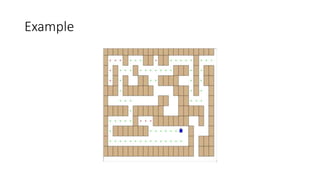
Example
Expected Solution
• 11x22 matrix
• “0”->wall
• “1”->gap
• Source Position (8,15)
• Destination Position(10,18)
Thinking from programmer’s perspective
• Constraints are there
• Array (matrix) is there
• Exploration of the right path is to be done
• “IN GENERAL WE HAVE TO FIND A CLEAR PATH TOWARDS
DESTINATION”
• 1. Consider the VISITED node, if it is ‘eligible’ for exploration.
• 2.Move forward else ‘stop’.
Ideal Algorithm
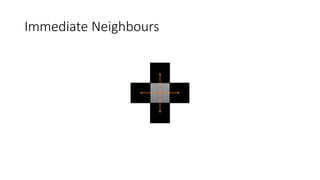
• 1. Consider a diamond neighbourhood of the algorithm.(i.e.
immediate neighbours HORIZONTALY and VERTICALY)
• 2.If ‘eligible’ move ahead having a track of backward knowledge
• 3.Else if not end then find another neighbour and follow step 2.
• 4.else ‘stop’
Tree consideration
• If we consider this problem solution to be an application of the
traditional tree then it is clear that “DFS-Depth First Search” tree
algorithm can solve this.
• Because in DFS we maintain all the visited track globally and move
further. So that visit consistency and order can be preserved.
Check for safe position
• int isSafe(int x,int y,int G[V1][V2],int Sol[V1][V2]) /* to check the safe move */
• {
• if(x>=0 && x<V1 && y>=0&&y<V2 && G[x][y]==1 && !Sol[x][y])
• {
• return 1;
• }
• else
• {
• return 0;
• }
• }
int MazeRecur(int G[V1][V2], int Sol[V1][V2], int x,int y) /* checking for the path to our exit point */
{
if(x==er &&y==ec)
{
Sol[x][y]=1;
return 1;
}
if(isSafe(x,y,G,Sol)==1)
{
printf("->(%d,%d)->",x,y);
Sol[x][y]=1;
if(MazeRecur(G,Sol,x,y-1)==1) /* left move possible */
{
return 1;
}
if(MazeRecur(G,Sol,x,y+1)==1) /* right move possible */
{
return 1;
}
if(MazeRecur(G,Sol,x-1,y)==1) /* up move possible */
{
return 1;
}
if(MazeRecur(G,Sol,x+1,y)==1) /* down move possible */
{
return 1;
}
Sol[x][y]=0;
}
return 0;
}
Immediate Neighbours
Implementing through C language
Time Complexity
• Consider only depth first search
of nodes.
• For mxn matrix to iterate the
search of node it will take
T(n*m/2) in worst case.
• And we add DFS recursive
backtrack algorithm time
T(n)=4T(n-1) for the 4 immediate
neighbours.
• T(n)=4T(nxm)
• Using master’s theorem it will
take 4 𝑛∗𝑚 exponential time.
• If we use backtracking then it
can be reduced to 2 𝑛∗𝑚
.
Improved algorithm can be designed …
• Using stack
• Using some enumerated datatypes
• Using K-connected neighbourhood concept
• Indexed data structures
References
• http://www.geeksforgeeks.org/backttracking-set-2-rat-in-a-maze/
• http://en.wikipedia.org/wiki/Maze_solving_algorithm
• https://www.cs.bu.edu/teaching/alg/maze/
• http://techlanguageworld.blogspot.in/2014/02/c-program-to-solve-
maze-problem.html
Queries?
THANK YOU

Maze Problem Presentation

  • 1.
    “MAZE” Problem & itsSolution By-Mudit Dholakia(14MTPOS001-MT005) Guide:-Prof.P.M.Jadav
  • 2.
    What is ‘maze’? •Maze means confusing in nature. • A network of paths and hedges designed as a puzzle through which one has to find a way. • DAZED
  • 3.
    What to dowith computers? • It is easy to understand for a matured person. • But what if we solve it using computer.???? ?
  • 4.
    Instruct Computer • Solutionis to devise an algorithm for given maze. DYNAMIC EFFECTIVE
  • 5.
    Available Approaches • DynamicProgramming • Backtracking • Greedy Approach
  • 6.
    Backtracking?! • We willsolve this problem using backtracking. • The reason behind this is we have pre-defined constraints. • Hence it facilitates some ease for the programmer to choose the best solutions. • It also avoids undesired computations.
  • 7.
  • 8.
    Expected Solution • 11x22matrix • “0”->wall • “1”->gap • Source Position (8,15) • Destination Position(10,18)
  • 9.
    Thinking from programmer’sperspective • Constraints are there • Array (matrix) is there • Exploration of the right path is to be done • “IN GENERAL WE HAVE TO FIND A CLEAR PATH TOWARDS DESTINATION” • 1. Consider the VISITED node, if it is ‘eligible’ for exploration. • 2.Move forward else ‘stop’.
  • 10.
    Ideal Algorithm • 1.Consider a diamond neighbourhood of the algorithm.(i.e. immediate neighbours HORIZONTALY and VERTICALY) • 2.If ‘eligible’ move ahead having a track of backward knowledge • 3.Else if not end then find another neighbour and follow step 2. • 4.else ‘stop’
  • 11.
    Tree consideration • Ifwe consider this problem solution to be an application of the traditional tree then it is clear that “DFS-Depth First Search” tree algorithm can solve this. • Because in DFS we maintain all the visited track globally and move further. So that visit consistency and order can be preserved.
  • 12.
    Check for safeposition • int isSafe(int x,int y,int G[V1][V2],int Sol[V1][V2]) /* to check the safe move */ • { • if(x>=0 && x<V1 && y>=0&&y<V2 && G[x][y]==1 && !Sol[x][y]) • { • return 1; • } • else • { • return 0; • } • }
  • 13.
    int MazeRecur(int G[V1][V2],int Sol[V1][V2], int x,int y) /* checking for the path to our exit point */ { if(x==er &&y==ec) { Sol[x][y]=1; return 1; } if(isSafe(x,y,G,Sol)==1) { printf("->(%d,%d)->",x,y); Sol[x][y]=1; if(MazeRecur(G,Sol,x,y-1)==1) /* left move possible */ { return 1; } if(MazeRecur(G,Sol,x,y+1)==1) /* right move possible */ { return 1; } if(MazeRecur(G,Sol,x-1,y)==1) /* up move possible */ { return 1; } if(MazeRecur(G,Sol,x+1,y)==1) /* down move possible */ { return 1; } Sol[x][y]=0; } return 0; }
  • 14.
  • 15.
  • 16.
    Time Complexity • Consideronly depth first search of nodes. • For mxn matrix to iterate the search of node it will take T(n*m/2) in worst case. • And we add DFS recursive backtrack algorithm time T(n)=4T(n-1) for the 4 immediate neighbours. • T(n)=4T(nxm) • Using master’s theorem it will take 4 𝑛∗𝑚 exponential time. • If we use backtracking then it can be reduced to 2 𝑛∗𝑚 .
  • 17.
    Improved algorithm canbe designed … • Using stack • Using some enumerated datatypes • Using K-connected neighbourhood concept • Indexed data structures
  • 18.
    References • http://www.geeksforgeeks.org/backttracking-set-2-rat-in-a-maze/ • http://en.wikipedia.org/wiki/Maze_solving_algorithm •https://www.cs.bu.edu/teaching/alg/maze/ • http://techlanguageworld.blogspot.in/2014/02/c-program-to-solve- maze-problem.html
  • 19.
  • 20.