NATIONAL INSTITUTE OF FASHION TECHNOLOGY
DELHI CENTER
CLOTHING PRODUCTION TECHNOLOGY (2015-16)
OVERVIEW OF FASHION INDUSTRY
Da Milano
Da Milanois an integratedluxury brandthat manufactures and retails high
end leather bags and accessories. Sharing its designresource andsensibilities
withthe parent company in Italy, Da Milanohas consistently deliveredluxury
of the highest standards, every season;year after year. FromHandbags,
Portfoliobags, Travel Bags, to Wallets andAccessories, the iconic craft
transpires throughout the range. Sheer elegance, impeccable style andthe
chic appeal are hallmark of every signature product fromDa Milano.
Our products are exportedthroughout the world, andmainly to Europe
where they are showcasedat leading designer outlets anddepartment
stores. Our patrons comprise of people who appreciate premiumleather
craftedtoperfection, andalso value our efforts of carrying out operations
withenvironmentally safe methods andprocedures.
The late 1980’s sawDaMilanoenter the Indian market witha distinct Italian
flavor, and designs that have since thenbeenthe benchmark of the industry.
Da Milano, a hub of luxe Italianaccessories, presentsdefinitiveItalian
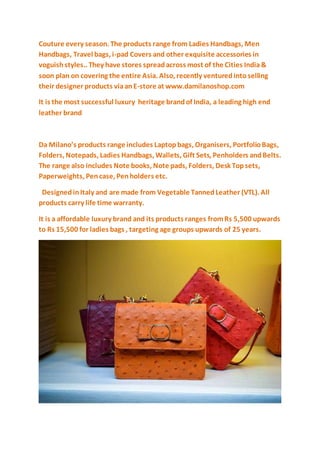
Couture every season. The products range from Ladies Handbags, Men
Handbags, Travel bags, i-pad Covers and other exquisite accessories in
voguishstyles.. They have stores spreadacross most of the Cities India&
soon plan on covering the entire Asia. Also, recently venturedintoselling
their designer products viaanE-store at www.damilanoshop.com
It is the most successful luxury heritage brandof India, a leading high end
leather brand
Da Milano’s products range includes Laptopbags, Organisers, PortfolioBags,
Folders, Notepads, Ladies Handbags, Wallets, Gift Sets, Penholders andBelts.
The range also includes Note books, Note pads, Folders, Desk Topsets,
Paperweights, Pencase, Penholders etc.
DesignedinItaly and are made from Vegetable TannedLeather (VTL). All
products carry life time warranty.
It is a affordable luxury brand and its products ranges fromRs 5,500 upwards
to Rs 15,500 for ladies bags , targeting age groups upwards of 25 years.
TRIMS, ACCESSORIES, FINDINGS AND
CLOUSERS
BUTTONS
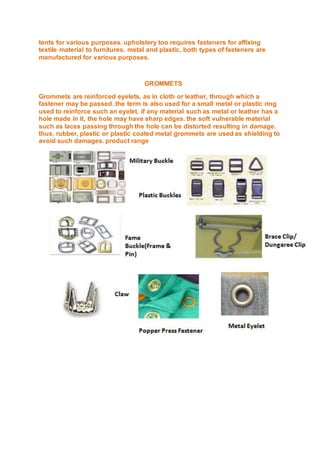
Buttons are small plastic or metal disc shaped, usually round, object. they are
generally attached to an article of clothing for securing its opening. sometimes
they are used for ornamentation too. buttons have to be slipped through a
fabric or a thread loop, or slid through a buttonhole. a wide range of materials
are used for manufacturing buttons although plastic buttons are the most
prevalent ones.
BUCKLES
Buckles are clasps used for holding two things together, such as the ends of a
belt. they are sometimes used to fasten boots and other shoes or sandals.
they can also be found on backpacks, watches and other wrist jewelry, or for
decorative purposes on other objects. buckles are usually made of metal or
plastic. the fashion of custom buckles is on a rise and people mostly like to
have their name or nicknames on buckles. these buckles are prepared with
great care giving them various finishes like chrome, rhinestone, gold color etc.
only high quality brass buckles are used in hidesign products.
FASTENERS
Fasteners are hardware devices that mechanically join or affix two or more
objects together. in textile industry, they are generally used to close a bag or a
box or other similar types of products. they are also essential for setting up
tents for various purposes. upholstery too requires fasteners for affixing
textile material to furnitures. metal and plastic, both types of fasteners are
manufactured for various purposes.
GROMMETS
Grommets are reinforced eyelets, as in cloth or leather, through which a
fastener may be passed. the term is also used for a small metal or plastic ring
used to reinforce such an eyelet. if any material such as metal or leather has a
hole made in it, the hole may have sharp edges. the soft vulnerable material
such as laces passing through the hole can be distorted resulting in damage.
thus, rubber, plastic or plastic coated metal grommets are used as shielding to
avoid such damages. product range
PRODUCT CATEGORIES
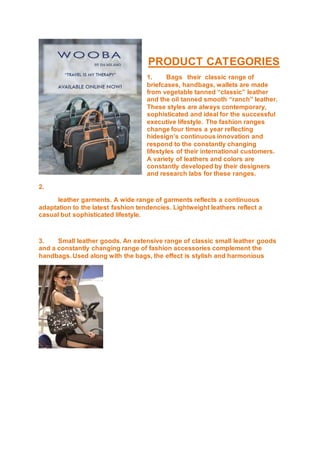
1. Bags their classic range of
briefcases, handbags, wallets are made
from vegetable tanned “classic” leather
and the oil tanned smooth “ranch” leather.
These styles are always contemporary,
sophisticated and ideal for the successful
executive lifestyle. The fashion ranges
change four times a year reflecting
hidesign’s continuous innovation and
respond to the constantly changing
lifestyles of their international customers.
A variety of leathers and colors are
constantly developed by their designers
and research labs for these ranges.
2.
leather garments. A wide range of garments reflects a continuous
adaptation to the latest fashion tendencies. Lightweight leathers reflect a
casual but sophisticated lifestyle.
3. Small leather goods. An extensive range of classic small leather goods
and a constantly changing range of fashion accessories complement the
handbags. Used along with the bags, the effect is stylish and harmonious
STORE LOCATIONS
Head Office
Da Milano Leathers Pvt. Corporate and Communication Office 85, Kapasera Bijwasan Road
New Delhi -110037
MG One Mall
MG One Mall Swami vivekanda Road, Bangalore - 560008, Karnataka,
DELHI & NCR
DELHI & NCR E-14, South Extn, Part-2, New Delhi - 110049,
DELHI & NCR
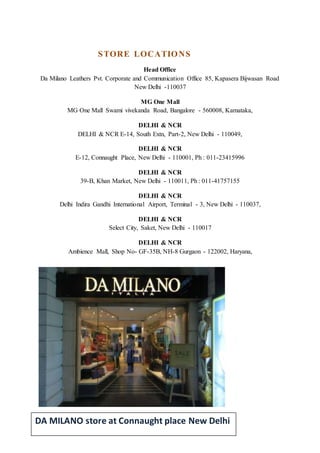
E-12, Connaught Place, New Delhi - 110001, Ph : 011-23415996
DELHI & NCR
39-B, Khan Market, New Delhi - 110011, Ph : 011-41757155
DELHI & NCR
Delhi Indira Gandhi International Airport, Terminal - 3, New Delhi - 110037,
DELHI & NCR
Select City, Saket, New Delhi - 110017
DELHI & NCR
Ambience Mall, Shop No- GF-35B, NH-8 Gurgaon - 122002, Haryana,
DA MILANO store at Connaught place New Delhi
EXPORTS & EXPANSION
Started as a leather goods exporter in 1989, Da
Milano started its retail push in 2000 when a
young Sahil Malik joined his father's business
straight after a fashion design course from the
National Institute of Fashion Technology. Back in
2000, almost 80% of the company's Rs 25-crore
revenues came from exports; last fiscal, 80% of
its Rs 135-crore revenues came from retailing in
the home market. This is very close to rival
Hidesign's revenues of Rs 150 crore with almost
double the number of stores.
Da Milano presently operates 38 stores selling
handbags, wallets, luggage and accessories
across the country. The Da Milano store at Select
City Walk in his mall clocks monthly revenue of
anywhere between Rs 80 lakh and Rs 1crore.
The company plans to increase its store count in
the country to more than 50 by the end of this
fiscal year. The company is also looking to open
standalone stores of its footwear brand, Rosso
Brunello. Earlier this month it opened 3
Da Milano stores, in Chandigarh, Amritsar and
Kolkata airports.
An ambitious Malik is planning to take the brand
overseas, opening about 20 stores in the Middle
East and five stores in Singapore over the next
five years. Europe is also under consideration,
starting with London.. Started as a leather goods
exporter in 1989, Da Milano started its retail
push in 2000 when a young Sahil Malik joined his
father's business straight after a fashion design
course from the National Institute of Fashion
Technology. Back in 2000, almost 80% of the
company's Rs 25-crore revenues came from
exports; last fiscal, 80% of its Rs 135-crore
revenues came from retailing in the home
market. This is very close to rival Hidesign's
revenues of Rs 150 crore with almost double the
number of stores.
Da Milano presently operates 38 stores selling
handbags, wallets, luggage and accessories
across the country. The Da Milano store at Select
City Walk in his mall clocks monthly revenue of
anywhere between Rs 80 lakh and Rs 1crore.
The company plans to increase its store count in
the country to more than 50 by the end of this
fiscal year. The company is also looking to open
standalone stores of its footwear brand, Rosso
Brunello. Earlier this month it opened 3 Da
Milano stores, in Chandigarh, Amritsar and
Kolkata airports.
An ambitious Malik is planning to take the brand
overseas, opening about 20 stores in the Middle
East and five stores in Singapore over the next
five years. Europe is also under consideration,
starting with London.
SUMMARY
Leather is one of the most widely traded commodities in the
world. The leather and leather products industry playsa
prominent role in the world’s economy, with an estimated
global trade value of approximatelyUS$100 billionper year.
World population grew dramaticallyin the 20th century and
it continues to grow at present. This growing populationand
the general increase in wealth have led to increases in the
demand for meat, which in turn have kept the supply of
leather raw material fairly constant.
The current predictionsare that the supply of leather raw
material will continue to grow in step with population
growth, but that higher costs and a decreasing availabilityof
land for raising cattle and for growing grains to feed the
cattle, as well as an increase in pork and poultry consumption
in Asia and Africa, are now becoming apparent. At some
stage, these developmentsmay generate tighter traditional
supplies and raise the importance of such non-mainstream
sources of raw material as camel, kangaroo and deer. Leather
raw materials have increasingly become availablein the
developingworld, while in the developedcountries, a
decliningper capitaconsumption of red meat has reduced
the supply of hides and skins.
Now, more than half of the world supply of leather raw
material comes from the developingworld and, increasingly,
those countries with large supplies are seeking to process
them through to finished leather articles. About 65% of all
leather comes from bovine material.
Climate and adequatehusbandry acount for the fact that the
best bovine raw material generally comes from the
developedcountries. The shift in raw material origins has
prompted the industry to use more hides with surface
defects or other structural deficiencies. Thistrend is
expected to continue. It has already led to changes in
finishing techniques to disguise defects, and to greater
efforts to explainto consumers that some defect types are
natural and should be accepted. The demand for high-quality
hides for products such as automobileupholsteryhas helped,
at least until now, to retain highly efficient upholstery leather
tanning in the developedworld. Pigskin accounts for over
10% of all leather made currently in the world.
Chinais now by far the dominantproducer of pigskinsand
pigskin leather. Althoughthis material may become
important for the industry in the future, the structure and fat
content of pigskin makes it very difficult to process.
Moreover, of all leather raw materials, pigskin is the one
most closely connected with the food industry.
Consequently,for cultural or cost reasons, the skin is often
left on the carcass or used in the productionof gelatine. At
the same time, animalssuch as pigs and poultry are
increasingly bred in factory-like facilities, which entailsa
higher danger of diseases and epidemics, such as the blue-
ear pig disease in China. These issues could have dramatic
effects on supply and demand, as well as on prices.

Da milano

  • 1.
    NATIONAL INSTITUTE OFFASHION TECHNOLOGY DELHI CENTER CLOTHING PRODUCTION TECHNOLOGY (2015-16) OVERVIEW OF FASHION INDUSTRY
  • 2.
    Da Milano Da Milanoisan integratedluxury brandthat manufactures and retails high end leather bags and accessories. Sharing its designresource andsensibilities withthe parent company in Italy, Da Milanohas consistently deliveredluxury of the highest standards, every season;year after year. FromHandbags, Portfoliobags, Travel Bags, to Wallets andAccessories, the iconic craft transpires throughout the range. Sheer elegance, impeccable style andthe chic appeal are hallmark of every signature product fromDa Milano. Our products are exportedthroughout the world, andmainly to Europe where they are showcasedat leading designer outlets anddepartment stores. Our patrons comprise of people who appreciate premiumleather craftedtoperfection, andalso value our efforts of carrying out operations withenvironmentally safe methods andprocedures. The late 1980’s sawDaMilanoenter the Indian market witha distinct Italian flavor, and designs that have since thenbeenthe benchmark of the industry. Da Milano, a hub of luxe Italianaccessories, presentsdefinitiveItalian
  • 3.
    Couture every season.The products range from Ladies Handbags, Men Handbags, Travel bags, i-pad Covers and other exquisite accessories in voguishstyles.. They have stores spreadacross most of the Cities India& soon plan on covering the entire Asia. Also, recently venturedintoselling their designer products viaanE-store at www.damilanoshop.com It is the most successful luxury heritage brandof India, a leading high end leather brand Da Milano’s products range includes Laptopbags, Organisers, PortfolioBags, Folders, Notepads, Ladies Handbags, Wallets, Gift Sets, Penholders andBelts. The range also includes Note books, Note pads, Folders, Desk Topsets, Paperweights, Pencase, Penholders etc. DesignedinItaly and are made from Vegetable TannedLeather (VTL). All products carry life time warranty. It is a affordable luxury brand and its products ranges fromRs 5,500 upwards to Rs 15,500 for ladies bags , targeting age groups upwards of 25 years.
  • 4.
    TRIMS, ACCESSORIES, FINDINGSAND CLOUSERS BUTTONS Buttons are small plastic or metal disc shaped, usually round, object. they are generally attached to an article of clothing for securing its opening. sometimes they are used for ornamentation too. buttons have to be slipped through a fabric or a thread loop, or slid through a buttonhole. a wide range of materials are used for manufacturing buttons although plastic buttons are the most prevalent ones. BUCKLES Buckles are clasps used for holding two things together, such as the ends of a belt. they are sometimes used to fasten boots and other shoes or sandals. they can also be found on backpacks, watches and other wrist jewelry, or for decorative purposes on other objects. buckles are usually made of metal or plastic. the fashion of custom buckles is on a rise and people mostly like to have their name or nicknames on buckles. these buckles are prepared with great care giving them various finishes like chrome, rhinestone, gold color etc. only high quality brass buckles are used in hidesign products. FASTENERS Fasteners are hardware devices that mechanically join or affix two or more objects together. in textile industry, they are generally used to close a bag or a box or other similar types of products. they are also essential for setting up
  • 5.
    tents for variouspurposes. upholstery too requires fasteners for affixing textile material to furnitures. metal and plastic, both types of fasteners are manufactured for various purposes. GROMMETS Grommets are reinforced eyelets, as in cloth or leather, through which a fastener may be passed. the term is also used for a small metal or plastic ring used to reinforce such an eyelet. if any material such as metal or leather has a hole made in it, the hole may have sharp edges. the soft vulnerable material such as laces passing through the hole can be distorted resulting in damage. thus, rubber, plastic or plastic coated metal grommets are used as shielding to avoid such damages. product range
  • 6.
    PRODUCT CATEGORIES 1. Bagstheir classic range of briefcases, handbags, wallets are made from vegetable tanned “classic” leather and the oil tanned smooth “ranch” leather. These styles are always contemporary, sophisticated and ideal for the successful executive lifestyle. The fashion ranges change four times a year reflecting hidesign’s continuous innovation and respond to the constantly changing lifestyles of their international customers. A variety of leathers and colors are constantly developed by their designers and research labs for these ranges. 2. leather garments. A wide range of garments reflects a continuous adaptation to the latest fashion tendencies. Lightweight leathers reflect a casual but sophisticated lifestyle. 3. Small leather goods. An extensive range of classic small leather goods and a constantly changing range of fashion accessories complement the handbags. Used along with the bags, the effect is stylish and harmonious
  • 7.
    STORE LOCATIONS Head Office DaMilano Leathers Pvt. Corporate and Communication Office 85, Kapasera Bijwasan Road New Delhi -110037 MG One Mall MG One Mall Swami vivekanda Road, Bangalore - 560008, Karnataka, DELHI & NCR DELHI & NCR E-14, South Extn, Part-2, New Delhi - 110049, DELHI & NCR E-12, Connaught Place, New Delhi - 110001, Ph : 011-23415996 DELHI & NCR 39-B, Khan Market, New Delhi - 110011, Ph : 011-41757155 DELHI & NCR Delhi Indira Gandhi International Airport, Terminal - 3, New Delhi - 110037, DELHI & NCR Select City, Saket, New Delhi - 110017 DELHI & NCR Ambience Mall, Shop No- GF-35B, NH-8 Gurgaon - 122002, Haryana, DA MILANO store at Connaught place New Delhi
  • 8.
    EXPORTS & EXPANSION Startedas a leather goods exporter in 1989, Da Milano started its retail push in 2000 when a young Sahil Malik joined his father's business straight after a fashion design course from the National Institute of Fashion Technology. Back in 2000, almost 80% of the company's Rs 25-crore revenues came from exports; last fiscal, 80% of its Rs 135-crore revenues came from retailing in the home market. This is very close to rival Hidesign's revenues of Rs 150 crore with almost double the number of stores. Da Milano presently operates 38 stores selling handbags, wallets, luggage and accessories across the country. The Da Milano store at Select City Walk in his mall clocks monthly revenue of anywhere between Rs 80 lakh and Rs 1crore. The company plans to increase its store count in the country to more than 50 by the end of this fiscal year. The company is also looking to open standalone stores of its footwear brand, Rosso Brunello. Earlier this month it opened 3 Da Milano stores, in Chandigarh, Amritsar and Kolkata airports.
  • 9.
    An ambitious Malikis planning to take the brand overseas, opening about 20 stores in the Middle East and five stores in Singapore over the next five years. Europe is also under consideration, starting with London.. Started as a leather goods exporter in 1989, Da Milano started its retail push in 2000 when a young Sahil Malik joined his father's business straight after a fashion design course from the National Institute of Fashion Technology. Back in 2000, almost 80% of the company's Rs 25-crore revenues came from exports; last fiscal, 80% of its Rs 135-crore revenues came from retailing in the home market. This is very close to rival Hidesign's revenues of Rs 150 crore with almost double the number of stores. Da Milano presently operates 38 stores selling handbags, wallets, luggage and accessories across the country. The Da Milano store at Select City Walk in his mall clocks monthly revenue of anywhere between Rs 80 lakh and Rs 1crore. The company plans to increase its store count in the country to more than 50 by the end of this fiscal year. The company is also looking to open
  • 10.
    standalone stores ofits footwear brand, Rosso Brunello. Earlier this month it opened 3 Da Milano stores, in Chandigarh, Amritsar and Kolkata airports. An ambitious Malik is planning to take the brand overseas, opening about 20 stores in the Middle East and five stores in Singapore over the next five years. Europe is also under consideration, starting with London.
  • 11.
    SUMMARY Leather is oneof the most widely traded commodities in the world. The leather and leather products industry playsa prominent role in the world’s economy, with an estimated global trade value of approximatelyUS$100 billionper year. World population grew dramaticallyin the 20th century and it continues to grow at present. This growing populationand the general increase in wealth have led to increases in the demand for meat, which in turn have kept the supply of leather raw material fairly constant. The current predictionsare that the supply of leather raw material will continue to grow in step with population growth, but that higher costs and a decreasing availabilityof land for raising cattle and for growing grains to feed the cattle, as well as an increase in pork and poultry consumption in Asia and Africa, are now becoming apparent. At some stage, these developmentsmay generate tighter traditional supplies and raise the importance of such non-mainstream sources of raw material as camel, kangaroo and deer. Leather raw materials have increasingly become availablein the developingworld, while in the developedcountries, a decliningper capitaconsumption of red meat has reduced the supply of hides and skins.
  • 12.
    Now, more thanhalf of the world supply of leather raw material comes from the developingworld and, increasingly, those countries with large supplies are seeking to process them through to finished leather articles. About 65% of all leather comes from bovine material. Climate and adequatehusbandry acount for the fact that the best bovine raw material generally comes from the developedcountries. The shift in raw material origins has prompted the industry to use more hides with surface defects or other structural deficiencies. Thistrend is expected to continue. It has already led to changes in finishing techniques to disguise defects, and to greater efforts to explainto consumers that some defect types are natural and should be accepted. The demand for high-quality hides for products such as automobileupholsteryhas helped, at least until now, to retain highly efficient upholstery leather tanning in the developedworld. Pigskin accounts for over 10% of all leather made currently in the world. Chinais now by far the dominantproducer of pigskinsand pigskin leather. Althoughthis material may become important for the industry in the future, the structure and fat content of pigskin makes it very difficult to process. Moreover, of all leather raw materials, pigskin is the one most closely connected with the food industry.
  • 13.
    Consequently,for cultural orcost reasons, the skin is often left on the carcass or used in the productionof gelatine. At the same time, animalssuch as pigs and poultry are increasingly bred in factory-like facilities, which entailsa higher danger of diseases and epidemics, such as the blue- ear pig disease in China. These issues could have dramatic effects on supply and demand, as well as on prices.