Research Inventy: International Journal of Engineering And Science
Vol.4, Issue 6 (June 2014), PP 13-17
Issn (e): 2278-4721, Issn (p):2319-6483, www.researchinventy.com
13
Experimental Investigation of a Household Refrigerator using
Air-cooled and Water-cooled Condenser
1
Sreejith K., 2
Sushmitha S., 3
Vipin Das
1
Assistant Professor, 2
Under Graduate Student, 3
Under Graduate Student
Dept.Of Mechanical Engineering,
Jyothi Engineering College, Cheruthuruthy, Thrissur, Kerala-679 531, India.
Abstract :- The objective of this paper was to investigate experimentally the effect of water-cooled condenser in
a household refrigerator. The experiment was done using HFC134a as the refrigerant and Polyol-ester oil
(POE) oil as the lubricant. The performance of the household refrigerator with air-cooled and water-cooled
condenser was compared for different load conditions. The results indicate that the refrigerator performance
had improved when water-cooled condenser was used instead of air-cooled condenser on all load conditions.
Water-cooled condenser reduced the energy consumption when compared with the air-cooled condenser
between 8% and 11% for various load conditions. There was also an enhancement in coefficient of performance
(COP) when water-cooled condenser was used instead of air-cooled condenser. The water-cooled heat
exchanger was designed and the system was modified by retrofitting it, instead of the conventional air-cooled
condenser by making a bypass line and thus the system can be utilized as a waste heat recovery unit. The hot
water obtained can be utilised for household applications like cleaning, dish washing, laundry, bathing etc.
Experimental result shows that about 200 litres of hot water at a temperature of about 58ºC over a day can be
generated and thus the system signifies the economic importance from the energy saving point of view.
Keywords: - Household refrigerator, HFC134a, Air-cooled condenser, Water-cooled condenser
I. INTRODUCTION
A household refrigerator is a common household appliance that consists of a thermally insulated
compartment and which when works, transfers heat from the inside of the compartment to its external
environment so that the inside of the thermally insulated compartment is cooled to a temperature below the
ambient temperature of the room. . Heat rejection may occur directly to the air in the case of a conventional
household refrigerator having air-cooled condenser or to water in the case of a water-cooled condenser.
Tetrafluoroethane (HFC134a) refrigerant was now widely used in most of the domestic refrigerators and
automobile air- conditioners and are using POE oil as the conventional lubricant.
Heat can be recovered by using the water-cooled condenser and the system can work as a waste heat
recovery unit. The recovered heat from the condenser can be used for bathing, cleaning, laundry, dish washing
etc. The modified system can be used both as a refrigerator and also as a water heater. Therefore by retrofitting a
water-cooled condenser it produce hot water and even reduce the utility bill of a small family. In this system the
water-cooled condenser is designed as a tube in tube heat exchanger of overall length of 7m. It consists of an
inlet for the cooling water and an exit for collecting the hot water. The hot water can be used instantly or it can
be stored in a thermal storage tank for later use. The survey of the literature regarding the waste heat recovery in
the household refrigerator and air-conditioners are listed:S.S. Hu, B.J. Huang et al. [1] conducted an
experimental investigation on a split air conditioner having water cooled condenser. They developed a simple
water-cooled air conditioner utilizing a cooling tower with cellulose pad filling material to cool the water for
condensing operation. The experimental investigation verified that the water-cooled condenser and cooling
tower results in decreasing the power consumption of the compressor.
H.I. Abu-Mulaweh [2] designed and developed a thermosyphon heat recovery system which can
recover heat from a window air conditioner. They designed two types of heat exchangers, concentric type heat
exchanger and coiled heat exchanger and then it is retrofitted in to the air conditioning system. They analysed
the performance of the system with these two types of heat exchangers. The circulation of water through the
heat exchanger is done with the themosyphon effect which completely eliminates the need of a pump. For
having that, the heat exchangers are connected to a water storage tank and when the water in the heat exchanger
get heated up by the superheated refrigerant the hot water flow upward through the connecting pipe into the top
of the storage tank and at the same time the cold water from the bottom of the tank will flow into the heat
Experimental Investigation of a….
14
exchanger. The test results show that the concentric heat exchanger produce hot water at a temperature of 45ºC
and the coil type produce d hot water having 40ºC.
Douglas T. Reindl et al. [3] explains the Heat Recovery In Industrial Refrigeration in an article published in
ASHRAE 2007. It explains that recovering heat offers potential for reducing both the direct primary energy
consumption associated with refrigeration system operation as well as the consumption of primary energy used
to meet heating demands directly. M. M. Rahman et al. [4] developed a heat recovery system which can recover
heat from a split air conditioning system. In this case, the 60 litre heating tank is designed in a way that the
copper tube conveying refrigerant is not submerged in water. The heating tank consists of two cylindrical
chambers, the inner chamber, which is filled with water, is coiled with the hot refrigerant conveying tube at the
outer surface. It was found that this heat recovery system improved the compressor efficiency and at the same
time continuously supplied warm water for domestic purposes. This system rejected less heat to the environment
so it is safer in environmental aspects. Romdhane ben slama [5] developed a system that can recover heat from
the condenser of the refrigerator. In this work the air-cooled conventional condenser is replaced by another heat
exchanger to heat the water. The results show that water at a temperature of 60ºC was produced by the system.
This paper also analysed the economic importance of the waste heat recovery system from the energy saving
point of view.
This study aims to compare the performance of a household refrigerator with air-cooled & water-cooled
condenser.
II. EXPERIMENTAL SETUP
II.1. Experimental System
The refrigerator was of 190L capacity, single door, manufactured by Kelvinator. The system was
retrofitted with a water-cooled condenser instead of the conventional air-cooled condenser by making a bypass
line. Water-cooled condenser is a tube in tube heat exchanger having an inlet for the cooling water and an exit
for collecting the hot water. The modified household refrigerator was properly instrumented with temperature
indicators, pressure gauges and digital energymeter.
The temperature at various points was noted using calibrated K-type thermocouples. The calibration of
thermocouple was performed in comparison with the Standard Platinum Resistance Thermometer (SPRT).
Pressure gauges used in this experiment are of bourdon tube type gauges. Dead weight pressure gauge tester
using the principle of Pascal’s law was used as the calibration equipment.
Evaporator and condenser pressure are noted using calibrated pressure gauges. The power consumption of the
domestic refrigerator was measured by using a digital energymeter. Figure 1. shows the experimental test rig.
The retrofitted water-cooled condenser can also been seen. The refrigerator specifications are given in Table1.
Figure 1: Experimental test rig
Experimental Investigation of a….
15
Table 1: Refrigerator Specifications
Gross capacity 190 L
Refrigerant HFC134a
Charged mass 140 g
Compressor type Hermetic
II.2. Experimental Procedure
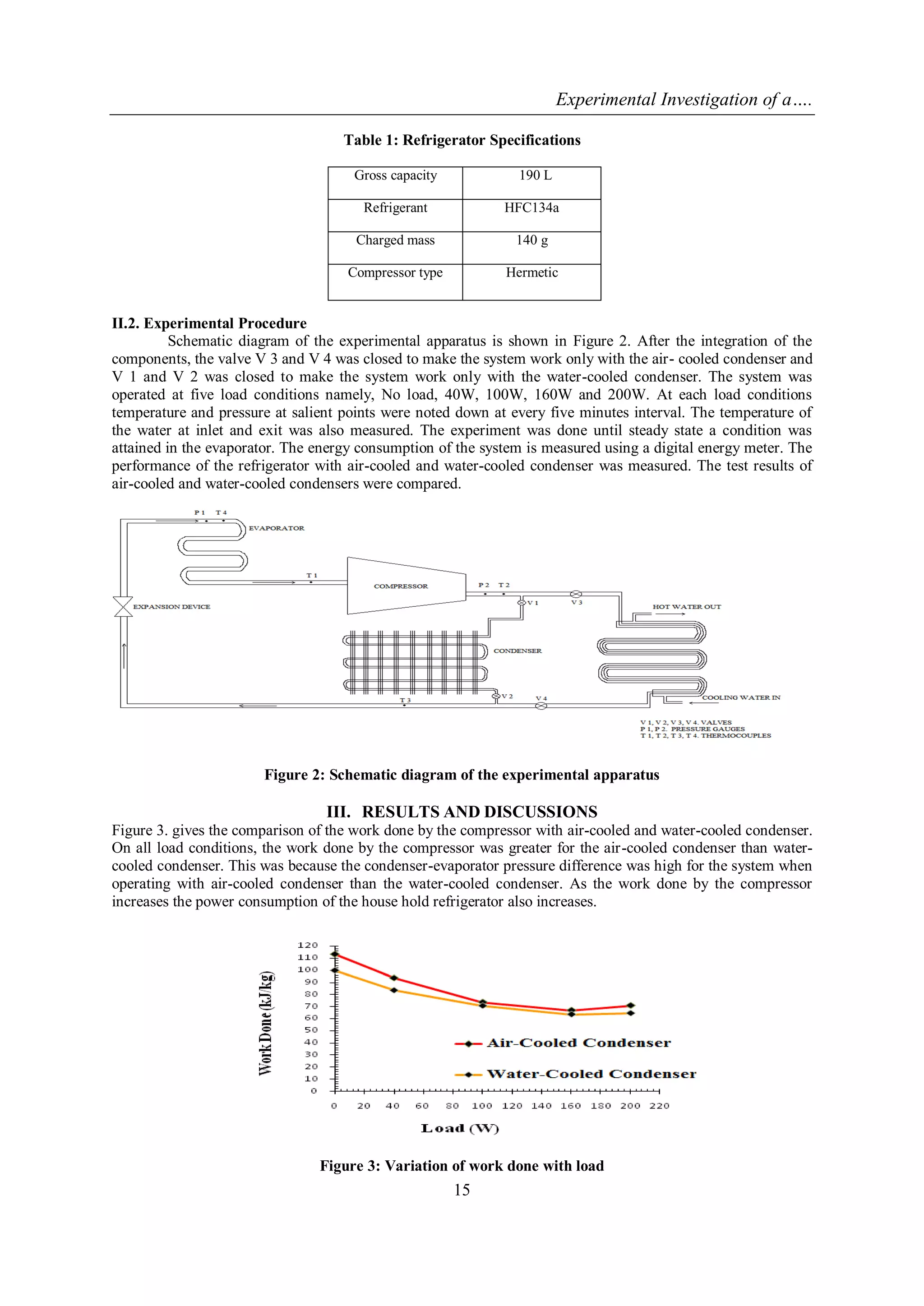
Schematic diagram of the experimental apparatus is shown in Figure 2. After the integration of the
components, the valve V 3 and V 4 was closed to make the system work only with the air- cooled condenser and
V 1 and V 2 was closed to make the system work only with the water-cooled condenser. The system was
operated at five load conditions namely, No load, 40W, 100W, 160W and 200W. At each load conditions
temperature and pressure at salient points were noted down at every five minutes interval. The temperature of
the water at inlet and exit was also measured. The experiment was done until steady state a condition was
attained in the evaporator. The energy consumption of the system is measured using a digital energy meter. The
performance of the refrigerator with air-cooled and water-cooled condenser was measured. The test results of
air-cooled and water-cooled condensers were compared.
Figure 2: Schematic diagram of the experimental apparatus
III. RESULTS AND DISCUSSIONS
Figure 3. gives the comparison of the work done by the compressor with air-cooled and water-cooled condenser.
On all load conditions, the work done by the compressor was greater for the air-cooled condenser than water-
cooled condenser. This was because the condenser-evaporator pressure difference was high for the system when
operating with air-cooled condenser than the water-cooled condenser. As the work done by the compressor
increases the power consumption of the house hold refrigerator also increases.
Figure 3: Variation of work done with load
Experimental Investigation of a….
16
Figure 4. shows the COP variation of air-cooled and water-cooled condenser. The COP was greater for
the water-cooled condenser than the air-cooled condenser. This may be due to the inverse proportionality of
COP to work done on all load conditions. These results confirmed that the performance of household
refrigerator with water-cooled condenser was better than that of the air-cooled condenser.
The experimental result also shows that about 200 litres of hot water at a temperature of about 58ºC
over a day from the outlet of water-cooled condenser and thus analysed the economic importance of this waste
heat recovery system from the energy saving point of view. Table 2. provides the energy consumption of the
system at steady state for a time period of five minutes.
Figure 4: Variation of COP with load
Table 2: Energy Consumption of Air-cooled & Water-cooled Condenser
Load
(W)
Air-cooled condenser
Energy consumption (kWh)
Water-cooled condenser
Energy consumption (kWh)
Energy saving
(%)
No load 0.00906 0.00813 10.26
40 0.01125 0.01031 8.36
100 0.01313 0.01188 9.52
160 0.01406 0.01281 8.89
200 0.01500 0.01344 10.40
IV. CONCLUSIONS
The advantages of using water-cooled condenser were investigated experimentally. The main conclusions are
listed as follows:
[1]. The household refrigerator worked normally and efficiently with water-cooled condenser.
[2]. On using water-cooled condenser the energy consumption of the household refrigerator reduced between
8% and 11% for different loads.
[3]. The results confirmed that the performance of refrigerator with the water-cooled condenser was better than
that of the air-cooled condenser.
[4]. About 200 litres of hot water at a temperature of about 58ºC over a day from the outlet of water cooled
condenser and this modification made the household refrigerator to be work as both refrigerator and water
heater. The hot water which was obtained from the water-cooled condenser can be utilised for household
applications like cleaning, dish washing, laundry, bathing etc.
Experimental Investigation of a….
17
ACKNOWLEDGEMENT
This study was supported by the UG section Department of Mechanical Engineering, Jyothi Engineering
College, Thrissur-679 531, Kerala, India.
REFERENCES
[1] S.S. Hu, B.J. Huang, “Study of a high efficiency residential split water-cooled air conditioner”, Applied
Thermal Engineering 25 (2005) 1599–1613.
[2] H.I. Abu-Mulaweh, “Design and performance of a thermosiphon heat recovery system”, Applied Thermal
Engineering 26 (2006) 471–477.
[3] Douglas T.Reindl, Todd B. Jekel, “Heat Recovery In Industrial Refrigeration”, ASHRAE Journal, August
2007.
[4] M. M. Rahman, Chin Wai Meng, Adrian Ng, “Air Conditioning and Water Heating- An Environmental
Friendly and Cost Effective Way of Waste Heat Recovery”, AEESEAP, Journal of Engineering
Education 2007, Vol. 31, No. 2.
[5] Romdhane Ben Slama, “Water-heater coupled with the refrigerator to develop the heat of the condenser”,
International Renewable Energy Congress November 5-7, 2009 - Sousse Tunisia.
Author
Mr. Sreejith K. is working as Assistant Professor in Dept of Mechanical Engineering
Jyothi Engineering College, Cheruthuruthy, Thrissur-679531, Kerala. He received
B.Tech degree (2009) in Mechanical Engineering from University of Calicut, Kerala,
India. He obtained M.Tech degree (2012) in Industrial Refrigeration and Cryogenic
Engineering from University of Kerala, Kerala, India. He has been teaching for the past
two years. He has attended many International Seminars and Conferences. He has
published three papers in International Journals and presented five papers in International
and National conferences. His research interests are in the areas of Refrigeration,
Thermal, Cryogenics etc.
Co-authors
Ms. Sushmitha S. is doing her B.Tech degree (2012-2016) in Mechanical Engineering at
Jyothi Engineering College, Thrissur-679531, Kerala under University of Calicut,
Kerala, India. She has presented one paper in a National conference.
Mr. Vipin Das is doing his B.Tech degree (2012-2016) in Mechanical Engineering at
Jyothi Engineering College, Thrissur-679531, Kerala under University of Calicut,
Kerala, India. He has presented one paper in a National conference.

Research Inventy : International Journal of Engineering and Science

  • 1.
    Research Inventy: InternationalJournal of Engineering And Science Vol.4, Issue 6 (June 2014), PP 13-17 Issn (e): 2278-4721, Issn (p):2319-6483, www.researchinventy.com 13 Experimental Investigation of a Household Refrigerator using Air-cooled and Water-cooled Condenser 1 Sreejith K., 2 Sushmitha S., 3 Vipin Das 1 Assistant Professor, 2 Under Graduate Student, 3 Under Graduate Student Dept.Of Mechanical Engineering, Jyothi Engineering College, Cheruthuruthy, Thrissur, Kerala-679 531, India. Abstract :- The objective of this paper was to investigate experimentally the effect of water-cooled condenser in a household refrigerator. The experiment was done using HFC134a as the refrigerant and Polyol-ester oil (POE) oil as the lubricant. The performance of the household refrigerator with air-cooled and water-cooled condenser was compared for different load conditions. The results indicate that the refrigerator performance had improved when water-cooled condenser was used instead of air-cooled condenser on all load conditions. Water-cooled condenser reduced the energy consumption when compared with the air-cooled condenser between 8% and 11% for various load conditions. There was also an enhancement in coefficient of performance (COP) when water-cooled condenser was used instead of air-cooled condenser. The water-cooled heat exchanger was designed and the system was modified by retrofitting it, instead of the conventional air-cooled condenser by making a bypass line and thus the system can be utilized as a waste heat recovery unit. The hot water obtained can be utilised for household applications like cleaning, dish washing, laundry, bathing etc. Experimental result shows that about 200 litres of hot water at a temperature of about 58ºC over a day can be generated and thus the system signifies the economic importance from the energy saving point of view. Keywords: - Household refrigerator, HFC134a, Air-cooled condenser, Water-cooled condenser I. INTRODUCTION A household refrigerator is a common household appliance that consists of a thermally insulated compartment and which when works, transfers heat from the inside of the compartment to its external environment so that the inside of the thermally insulated compartment is cooled to a temperature below the ambient temperature of the room. . Heat rejection may occur directly to the air in the case of a conventional household refrigerator having air-cooled condenser or to water in the case of a water-cooled condenser. Tetrafluoroethane (HFC134a) refrigerant was now widely used in most of the domestic refrigerators and automobile air- conditioners and are using POE oil as the conventional lubricant. Heat can be recovered by using the water-cooled condenser and the system can work as a waste heat recovery unit. The recovered heat from the condenser can be used for bathing, cleaning, laundry, dish washing etc. The modified system can be used both as a refrigerator and also as a water heater. Therefore by retrofitting a water-cooled condenser it produce hot water and even reduce the utility bill of a small family. In this system the water-cooled condenser is designed as a tube in tube heat exchanger of overall length of 7m. It consists of an inlet for the cooling water and an exit for collecting the hot water. The hot water can be used instantly or it can be stored in a thermal storage tank for later use. The survey of the literature regarding the waste heat recovery in the household refrigerator and air-conditioners are listed:S.S. Hu, B.J. Huang et al. [1] conducted an experimental investigation on a split air conditioner having water cooled condenser. They developed a simple water-cooled air conditioner utilizing a cooling tower with cellulose pad filling material to cool the water for condensing operation. The experimental investigation verified that the water-cooled condenser and cooling tower results in decreasing the power consumption of the compressor. H.I. Abu-Mulaweh [2] designed and developed a thermosyphon heat recovery system which can recover heat from a window air conditioner. They designed two types of heat exchangers, concentric type heat exchanger and coiled heat exchanger and then it is retrofitted in to the air conditioning system. They analysed the performance of the system with these two types of heat exchangers. The circulation of water through the heat exchanger is done with the themosyphon effect which completely eliminates the need of a pump. For having that, the heat exchangers are connected to a water storage tank and when the water in the heat exchanger get heated up by the superheated refrigerant the hot water flow upward through the connecting pipe into the top of the storage tank and at the same time the cold water from the bottom of the tank will flow into the heat
  • 2.
    Experimental Investigation ofa…. 14 exchanger. The test results show that the concentric heat exchanger produce hot water at a temperature of 45ºC and the coil type produce d hot water having 40ºC. Douglas T. Reindl et al. [3] explains the Heat Recovery In Industrial Refrigeration in an article published in ASHRAE 2007. It explains that recovering heat offers potential for reducing both the direct primary energy consumption associated with refrigeration system operation as well as the consumption of primary energy used to meet heating demands directly. M. M. Rahman et al. [4] developed a heat recovery system which can recover heat from a split air conditioning system. In this case, the 60 litre heating tank is designed in a way that the copper tube conveying refrigerant is not submerged in water. The heating tank consists of two cylindrical chambers, the inner chamber, which is filled with water, is coiled with the hot refrigerant conveying tube at the outer surface. It was found that this heat recovery system improved the compressor efficiency and at the same time continuously supplied warm water for domestic purposes. This system rejected less heat to the environment so it is safer in environmental aspects. Romdhane ben slama [5] developed a system that can recover heat from the condenser of the refrigerator. In this work the air-cooled conventional condenser is replaced by another heat exchanger to heat the water. The results show that water at a temperature of 60ºC was produced by the system. This paper also analysed the economic importance of the waste heat recovery system from the energy saving point of view. This study aims to compare the performance of a household refrigerator with air-cooled & water-cooled condenser. II. EXPERIMENTAL SETUP II.1. Experimental System The refrigerator was of 190L capacity, single door, manufactured by Kelvinator. The system was retrofitted with a water-cooled condenser instead of the conventional air-cooled condenser by making a bypass line. Water-cooled condenser is a tube in tube heat exchanger having an inlet for the cooling water and an exit for collecting the hot water. The modified household refrigerator was properly instrumented with temperature indicators, pressure gauges and digital energymeter. The temperature at various points was noted using calibrated K-type thermocouples. The calibration of thermocouple was performed in comparison with the Standard Platinum Resistance Thermometer (SPRT). Pressure gauges used in this experiment are of bourdon tube type gauges. Dead weight pressure gauge tester using the principle of Pascal’s law was used as the calibration equipment. Evaporator and condenser pressure are noted using calibrated pressure gauges. The power consumption of the domestic refrigerator was measured by using a digital energymeter. Figure 1. shows the experimental test rig. The retrofitted water-cooled condenser can also been seen. The refrigerator specifications are given in Table1. Figure 1: Experimental test rig
  • 3.
    Experimental Investigation ofa…. 15 Table 1: Refrigerator Specifications Gross capacity 190 L Refrigerant HFC134a Charged mass 140 g Compressor type Hermetic II.2. Experimental Procedure Schematic diagram of the experimental apparatus is shown in Figure 2. After the integration of the components, the valve V 3 and V 4 was closed to make the system work only with the air- cooled condenser and V 1 and V 2 was closed to make the system work only with the water-cooled condenser. The system was operated at five load conditions namely, No load, 40W, 100W, 160W and 200W. At each load conditions temperature and pressure at salient points were noted down at every five minutes interval. The temperature of the water at inlet and exit was also measured. The experiment was done until steady state a condition was attained in the evaporator. The energy consumption of the system is measured using a digital energy meter. The performance of the refrigerator with air-cooled and water-cooled condenser was measured. The test results of air-cooled and water-cooled condensers were compared. Figure 2: Schematic diagram of the experimental apparatus III. RESULTS AND DISCUSSIONS Figure 3. gives the comparison of the work done by the compressor with air-cooled and water-cooled condenser. On all load conditions, the work done by the compressor was greater for the air-cooled condenser than water- cooled condenser. This was because the condenser-evaporator pressure difference was high for the system when operating with air-cooled condenser than the water-cooled condenser. As the work done by the compressor increases the power consumption of the house hold refrigerator also increases. Figure 3: Variation of work done with load
  • 4.
    Experimental Investigation ofa…. 16 Figure 4. shows the COP variation of air-cooled and water-cooled condenser. The COP was greater for the water-cooled condenser than the air-cooled condenser. This may be due to the inverse proportionality of COP to work done on all load conditions. These results confirmed that the performance of household refrigerator with water-cooled condenser was better than that of the air-cooled condenser. The experimental result also shows that about 200 litres of hot water at a temperature of about 58ºC over a day from the outlet of water-cooled condenser and thus analysed the economic importance of this waste heat recovery system from the energy saving point of view. Table 2. provides the energy consumption of the system at steady state for a time period of five minutes. Figure 4: Variation of COP with load Table 2: Energy Consumption of Air-cooled & Water-cooled Condenser Load (W) Air-cooled condenser Energy consumption (kWh) Water-cooled condenser Energy consumption (kWh) Energy saving (%) No load 0.00906 0.00813 10.26 40 0.01125 0.01031 8.36 100 0.01313 0.01188 9.52 160 0.01406 0.01281 8.89 200 0.01500 0.01344 10.40 IV. CONCLUSIONS The advantages of using water-cooled condenser were investigated experimentally. The main conclusions are listed as follows: [1]. The household refrigerator worked normally and efficiently with water-cooled condenser. [2]. On using water-cooled condenser the energy consumption of the household refrigerator reduced between 8% and 11% for different loads. [3]. The results confirmed that the performance of refrigerator with the water-cooled condenser was better than that of the air-cooled condenser. [4]. About 200 litres of hot water at a temperature of about 58ºC over a day from the outlet of water cooled condenser and this modification made the household refrigerator to be work as both refrigerator and water heater. The hot water which was obtained from the water-cooled condenser can be utilised for household applications like cleaning, dish washing, laundry, bathing etc.
  • 5.
    Experimental Investigation ofa…. 17 ACKNOWLEDGEMENT This study was supported by the UG section Department of Mechanical Engineering, Jyothi Engineering College, Thrissur-679 531, Kerala, India. REFERENCES [1] S.S. Hu, B.J. Huang, “Study of a high efficiency residential split water-cooled air conditioner”, Applied Thermal Engineering 25 (2005) 1599–1613. [2] H.I. Abu-Mulaweh, “Design and performance of a thermosiphon heat recovery system”, Applied Thermal Engineering 26 (2006) 471–477. [3] Douglas T.Reindl, Todd B. Jekel, “Heat Recovery In Industrial Refrigeration”, ASHRAE Journal, August 2007. [4] M. M. Rahman, Chin Wai Meng, Adrian Ng, “Air Conditioning and Water Heating- An Environmental Friendly and Cost Effective Way of Waste Heat Recovery”, AEESEAP, Journal of Engineering Education 2007, Vol. 31, No. 2. [5] Romdhane Ben Slama, “Water-heater coupled with the refrigerator to develop the heat of the condenser”, International Renewable Energy Congress November 5-7, 2009 - Sousse Tunisia. Author Mr. Sreejith K. is working as Assistant Professor in Dept of Mechanical Engineering Jyothi Engineering College, Cheruthuruthy, Thrissur-679531, Kerala. He received B.Tech degree (2009) in Mechanical Engineering from University of Calicut, Kerala, India. He obtained M.Tech degree (2012) in Industrial Refrigeration and Cryogenic Engineering from University of Kerala, Kerala, India. He has been teaching for the past two years. He has attended many International Seminars and Conferences. He has published three papers in International Journals and presented five papers in International and National conferences. His research interests are in the areas of Refrigeration, Thermal, Cryogenics etc. Co-authors Ms. Sushmitha S. is doing her B.Tech degree (2012-2016) in Mechanical Engineering at Jyothi Engineering College, Thrissur-679531, Kerala under University of Calicut, Kerala, India. She has presented one paper in a National conference. Mr. Vipin Das is doing his B.Tech degree (2012-2016) in Mechanical Engineering at Jyothi Engineering College, Thrissur-679531, Kerala under University of Calicut, Kerala, India. He has presented one paper in a National conference.