International Research Journal of Engineering and Technology (IRJET) e-ISSN: 2395-0056
Volume: 07 Issue: 01 | Jan 2020 www.irjet.net p-ISSN: 2395-0072
© 2020, IRJET | Impact Factor value: 7.34 | ISO 9001:2008 Certified Journal | Page 188
A Review on Developing a Model that Uses Waste Heat from
Condenser in VCR Cycle
TEJAS S. LEUVA 1, PROF. DHANANJAY H. JOSHI2
1PG student, ME THERMAL, LDRP ITR, KSV University, Gandhinagar, India
2Professor, ME THERMAL, LDRP ITR, KSV University, Gandhinagar, India
------------------------------------------------------------------------***-------------------------------------------------------------------------
Abstract - Vapour compression refrigeration system is
generally used for producing refrigeration effect.Itprovides
both refrigeration effect and heat rejection from condenser
due to chemical properties of refrigerant. The Heat rejected
from condenser is high and it goeswastetothe environment.
. We utilize that heat for some domestic purpose like an
Oven. For that we can add a new equipment like hot box. We
collect the waste heat from the condenser through heat into
hot box or hot chamber. We can providing an insulation to
the hot box .we are utilize that hot box as an oven. The
Energy Released from the condenser in the form of thermal
or heat energy is utilized in place of condenser for useful
work. This useful work is made to realization in different
types of uses in industries, Central Malls, Power plants. We
can utilize the thermal energy which is going to be wasteful
in the atmosphere to operate a small oven in small units.
Key words: VCR Cycle, Waste Heat, Hot box, skin condenser
I. INTRODUCTION
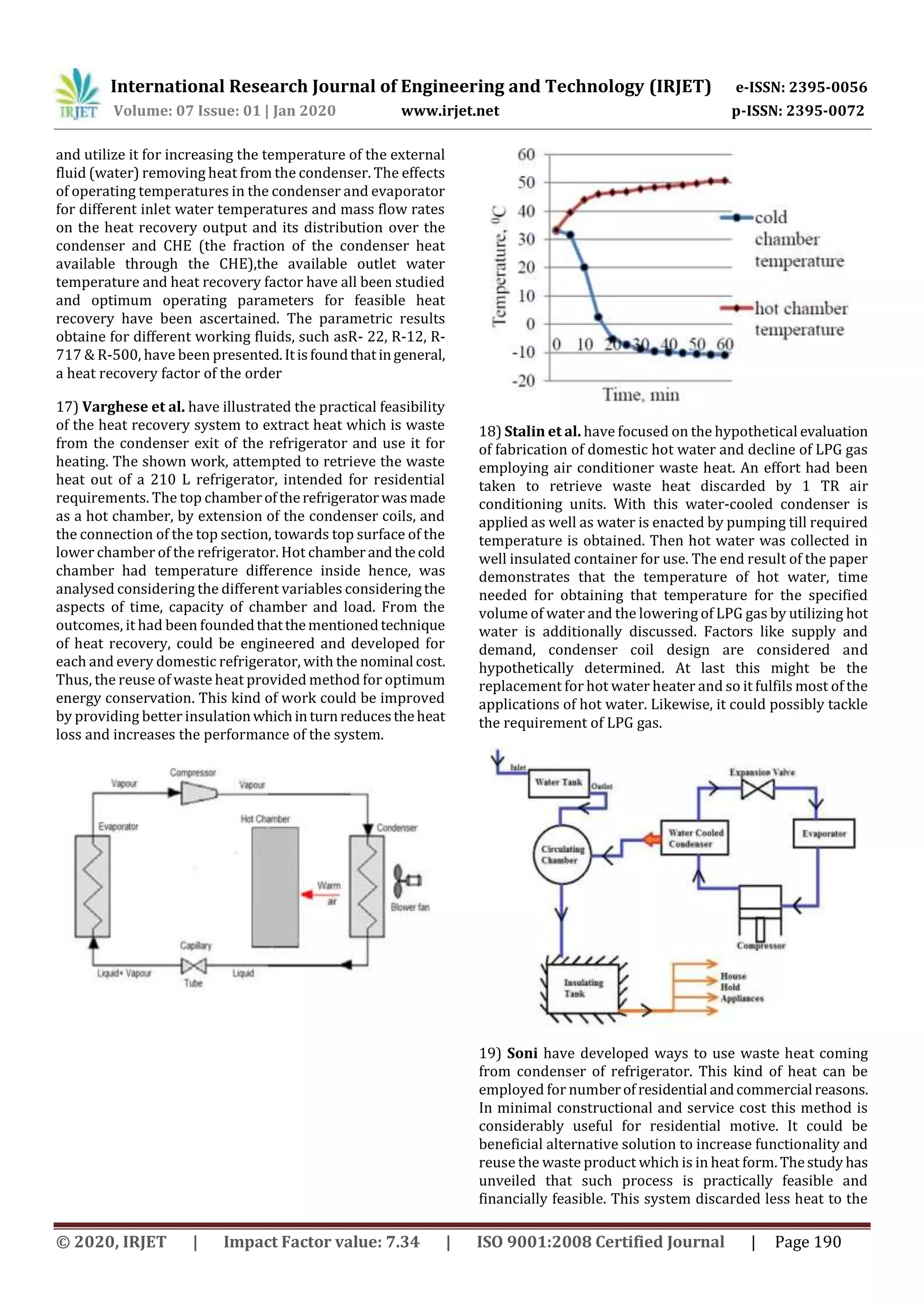
In a basic vapors compressionrefrigerationcycle,thereare4
components. (1)Compressor (2)Condenser (3) Expansion
device (4) Evaporator. First, the refrigerantiscompressedin
the compressor from low temperature to high temperature.
After that the high temperature refrigerant is condensed in
the condenser to low temperatureatconstantpressureAfter
that, it pass through expansion valve where the pressure is
decreases so as that of temperature and then it passthrough
evaporator where we get the refrigeration effect.
Here the heat is continuously rejected to atmosphere,soour
purpose is to utilize the heat and to maintain the cop.
II. LITERATURE SURVEY
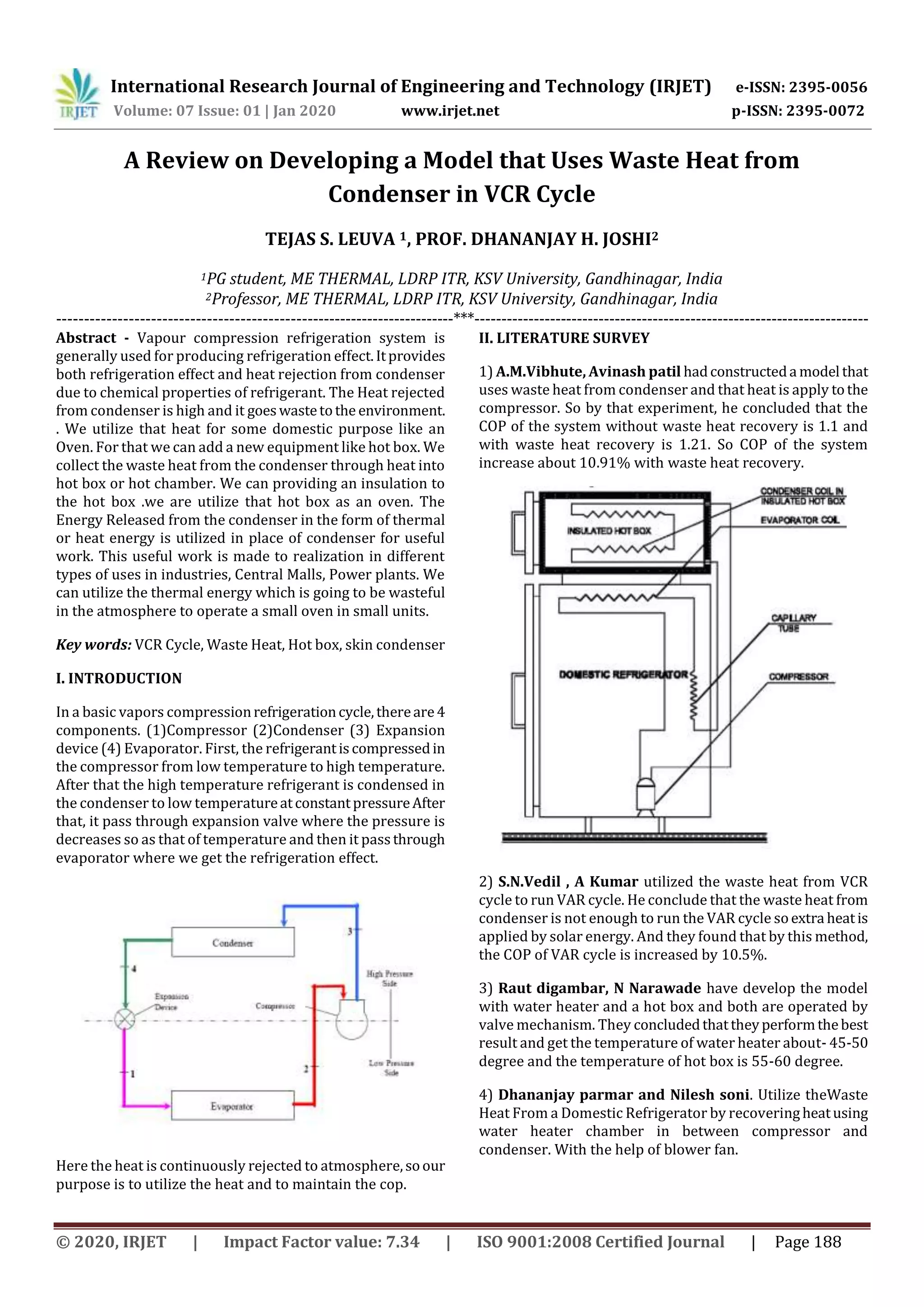
1) A.M.Vibhute, Avinash patil hadconstructeda model that
uses waste heat from condenser and that heat is apply tothe
compressor. So by that experiment, he concluded that the
COP of the system without waste heat recovery is 1.1 and
with waste heat recovery is 1.21. So COP of the system
increase about 10.91% with waste heat recovery.
2) S.N.Vedil , A Kumar utilized the waste heat from VCR
cycle to run VAR cycle. He conclude that the waste heat from
condenser is not enough to run the VAR cycle soextra heatis
applied by solar energy. And they found that by this method,
the COP of VAR cycle is increased by 10.5%.
3) Raut digambar, N Narawade have develop the model
with water heater and a hot box and both are operated by
valve mechanism. They concludedthattheyperformthebest
result and get the temperature of water heater about- 45-50
degree and the temperature of hot box is 55-60 degree.
4) Dhananjay parmar and Nilesh soni. Utilize theWaste
Heat From a Domestic Refrigerator by recoveringheatusing
water heater chamber in between compressor and
condenser. With the help of blower fan.
International Research Journal of Engineering and Technology (IRJET) e-ISSN: 2395-0056
Volume: 07 Issue: 01 | Jan 2020 www.irjet.net p-ISSN: 2395-0072
© 2020, IRJET | Impact Factor value: 7.34 | ISO 9001:2008 Certified Journal | Page 189
5) Muhammad Asima,Micheal K.H.Legunahavepublished
a research paper in which the authors have investigated the
performance of the i-AC-ORC system. They find that the
performance greatly depends on the initial performance of
the AC subsystem. An AC system with better performance
leads to better overall performancewhencombinedwith the
ORC subsystem. R600a is selected as the working fluid for
the AC subsystem when the operationisunderrestrictsafety
control due to its flammability.
6) Nishith Desai, Surendra Singh published a research
paper on waste heat from Rankine cycle to run a cascade
vapour compression-Absorption cycle. They find that the
energy efficiency of the decreases with increaseinoperating
temperature of VCR. However the efficiency of the system
increase with increase in disorber temperature, cascade
condenser temperature and degree of overlap.
7) N.B.Chaudhari and P.N Chaudhari publish a paper on
Heat transfer processes. He utilize heat in real life
applications such as using waste heat from a condenser of a
refrigerator to heat water for residential and commercial
use. Heat recovery from condenser of a refrigerator by
thermo siphon system because it eliminates the need of a
circulating pump. He investigate that the theoretical COP
without heat recovery is 1.88 and COP after the heat
recovery is 2.53. The actual COP of air cooled condenser
system is 1.078 and for water cooled with heat recovery
system practically COP is 3.79.
8) A.S.Katkarand L. Dhale Developed and tested a with
integrated heat recovery system which is designed both to
enhance the performance of a domestic refrigerator and
simultaneously recovers heat using water heat exchanger.
The performance was investigatedandhefoundthatthatthe
cop of the R134a system was improved by 9%. A spiral tube
heat exchanger unit installed in parallel to air cooler
condenser and experimental results are recorded and
analysed.
9) S.C.Walawade, B.R.Barve and P.R. Kulkarni have
attempted to utilize waste heat from condenser of
refrigerator. Two sections of air cooler condenser one at the
bottom and one at the top of insulted cabinaremountedthat
there is improvement of 11.81% in cop of system by
recovering 9.92w of heat by water.
10) S.N.Sapali et al have investigated toutilize wasteheatof
condenser of a bulk milk cooler using shell andcoil typeheat
exchanger. The result shows that complete superheat and
35% of latent heat is recovered and C.O.P. of the system is
increased from 3 to 4.8. This hot water is utilized for
cleaning equipment’s by varying water circulation. The
results are discussed which concludesthat53to65%oftotal
heat lost is recovered in heat exchanger.
11) Romdhane ben slama[1] developed a system that ca
recovers the heat from the condenser in the refrigerator. In
this work air-cooled conventional condenser is replaced by
another heat exchanger to heat water.Bythissystem,wecan
get water at temperature around 60 degree. This paper also
analyzed the economic importance of the waste heat
recovery system from the energy saving point of view.
12) Raman kumar singhandSaifNawazAhmed Developa
system For making this system multifunctional, flexible and
economical Condensing coil is immersed in water to be
heated and a part of cooling coil 1st passed through filled
water tank in which water is to be cooled and then
remaining coil is utilized for cooling of air so that desired
space to be cooled. Hence here cooling of air, water and
heating of water all the three processisdonesimultaneously
in a single unit. The heating unit in the system utilizes heat
lost through the condenser and thereby saving energy, by
the utilization of wastage of heat energy performance of the
system has improved significantly.
13) M. M. Rahman et al. [12] developed a heat recovery
system which can recover heat from a split air conditioning
system. In this case, 60 litre heating tank isdesignedina way
that the copper tube conveying refrigerant isnotsubmerged
in water. The heating recovery tank consists of two
cylindrical chambers, the inner chamber,isfilled withwater,
is coiled with the hot refrigerant carring tube at the outer
surfaces. It was found that this heat recovery system
improved the compressor efficiency and at the same time
continuously supplied warm water for domestic purpose.
This system rejected less heat to the environment so it is
safer in environmental aspects.
14) B.Saleh study the combine OCR(Organic rankine cycle)
and VCR(Vapour compression cycle) in which the VCR cycle
is powered by waste low grade energy from OCR. He study
both energy and exergy analysis if the system.
15) S.B.Lokhande & Dr.S.B.Barvehavedone experimenton
Godrej refrigerator with 165 litre capacity. A hot case on top
side of refrigerator is installed with the system for food or
milk heating purpose.
16) S.C. Kaushik et al presents an investigation of the
feasibility of heat recovery from the condenser of a vapor
compression refrigeration (VCR) system through a Canopus
heat exchanger(CHE) between the compressor and
condenser component. The presence of the CHE makes it
possible to recover the superheat of the discharged vapor
International Research Journal of Engineering and Technology (IRJET) e-ISSN: 2395-0056
Volume: 07 Issue: 01 | Jan 2020 www.irjet.net p-ISSN: 2395-0072
© 2020, IRJET | Impact Factor value: 7.34 | ISO 9001:2008 Certified Journal | Page 190
and utilize it for increasing the temperature of the external
fluid (water) removing heat from the condenser. The effects
of operating temperatures in the condenser and evaporator
for different inlet water temperatures and mass flow rates
on the heat recovery output and its distribution over the
condenser and CHE (the fraction of the condenser heat
available through the CHE),the available outlet water
temperature and heat recovery factor have all been studied
and optimum operating parameters for feasible heat
recovery have been ascertained. The parametric results
obtaine for different working fluids, such asR- 22, R-12, R-
717 & R-500, have been presented.Itisfoundthatingeneral,
a heat recovery factor of the order
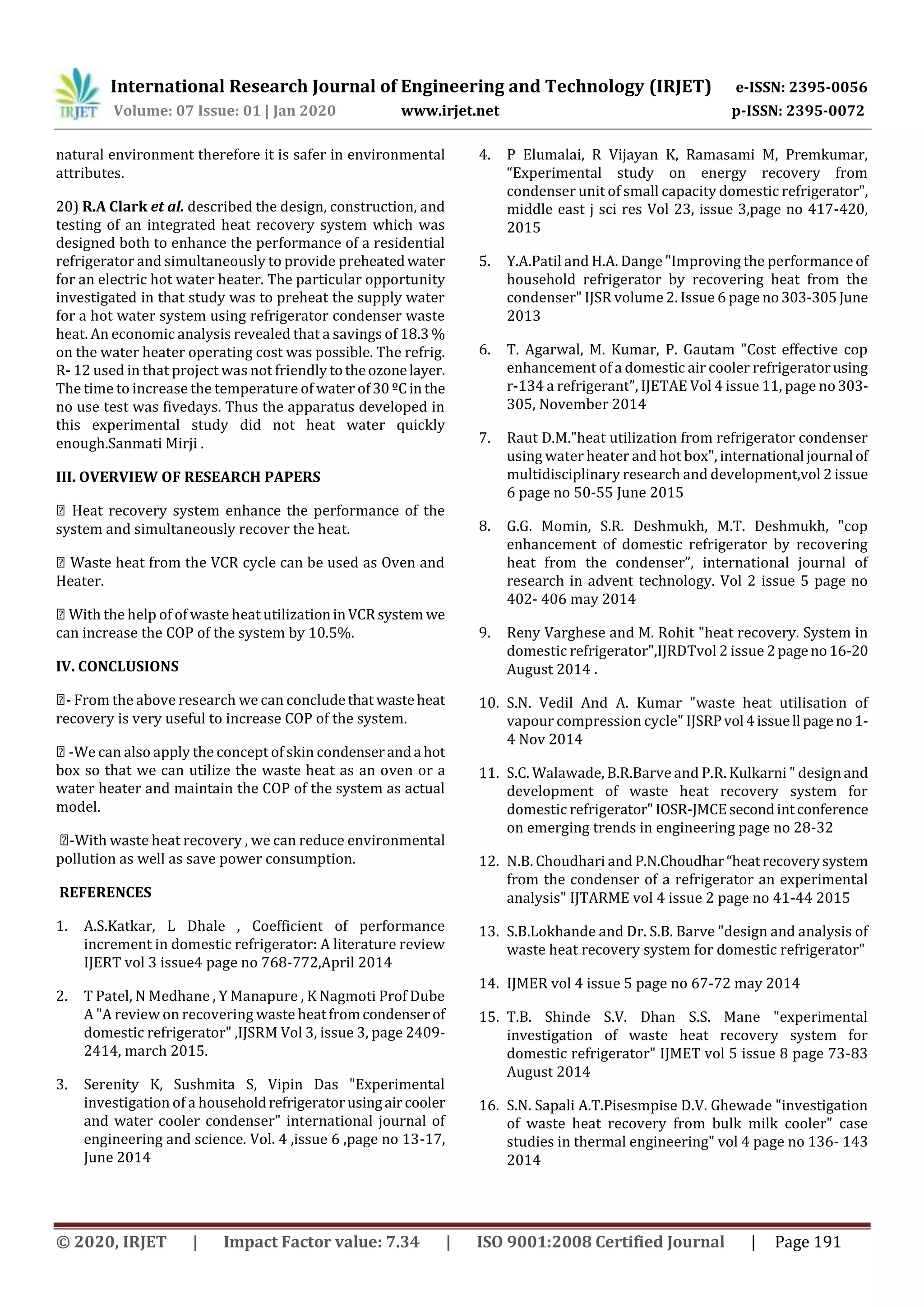
17) Varghese et al. have illustrated the practical feasibility
of the heat recovery system to extract heat which is waste
from the condenser exit of the refrigerator and use it for
heating. The shown work, attempted to retrieve the waste
heat out of a 210 L refrigerator, intended for residential
requirements. The top chamberoftherefrigerator wasmade
as a hot chamber, by extension of the condenser coils, and
the connection of the top section, towards top surface of the
lower chamber of the refrigerator. Hot chamberandthecold
chamber had temperature difference inside hence, was
analysed considering the different variables consideringthe
aspects of time, capacity of chamber and load. From the
outcomes, it had been foundedthatthementionedtechnique
of heat recovery, could be engineered and developed for
each and every domestic refrigerator, with the nominal cost.
Thus, the reuse of waste heat provided method for optimum
energy conservation. This kind of work could be improved
by providing better insulationwhichinturnreducestheheat
loss and increases the performance of the system.
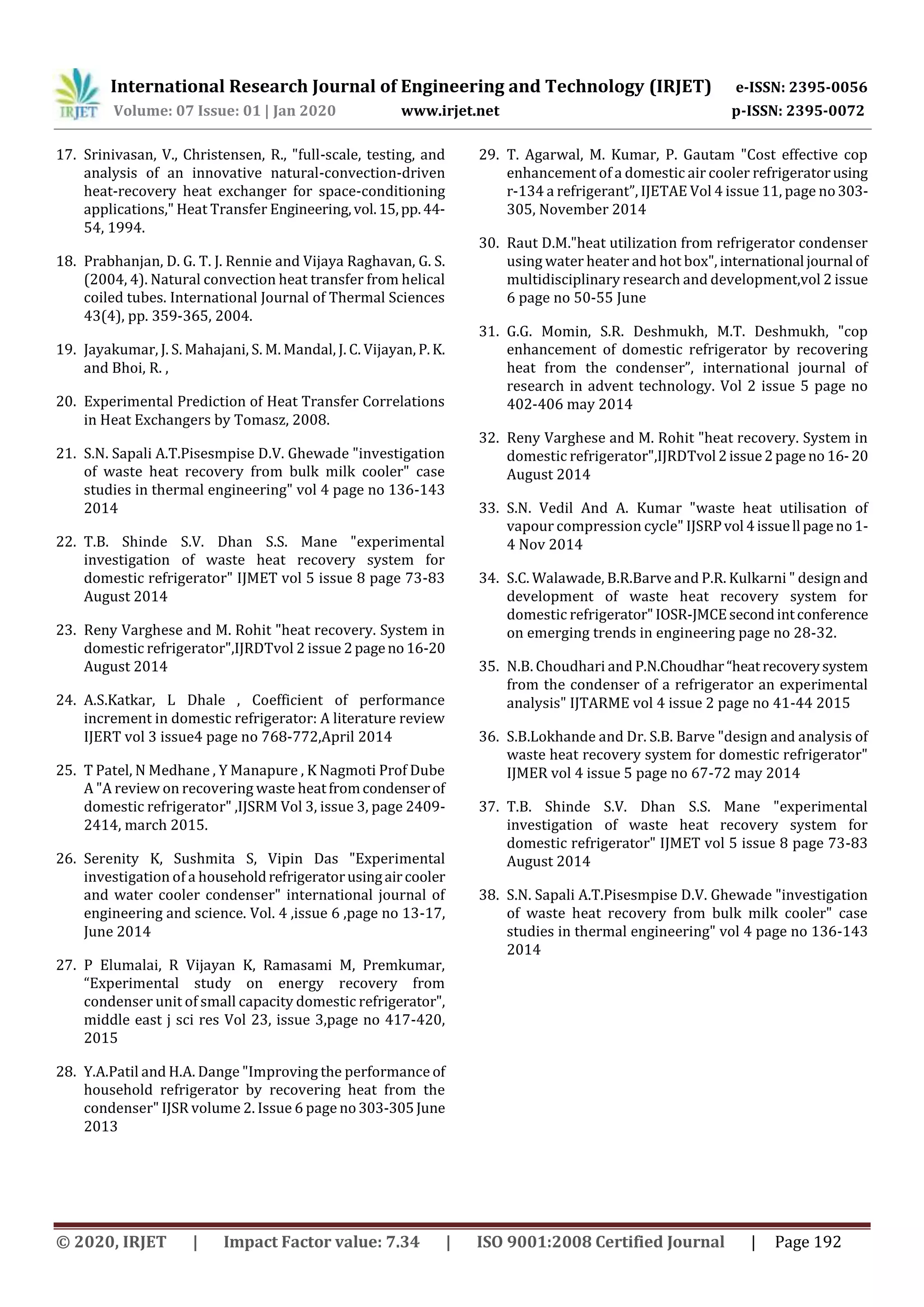
18) Stalin et al. have focused on the hypothetical evaluation
of fabrication of domestic hot water and decline of LPG gas
employing air conditioner waste heat. An effort had been
taken to retrieve waste heat discarded by 1 TR air
conditioning units. With this water-cooled condenser is
applied as well as water is enacted by pumping till required
temperature is obtained. Then hot water was collected in
well insulated container for use. The end result of the paper
demonstrates that the temperature of hot water, time
needed for obtaining that temperature for the specified
volume of water and the lowering of LPG gas by utilizing hot
water is additionally discussed. Factors like supply and
demand, condenser coil design are considered and
hypothetically determined. At last this might be the
replacement for hot water heater and so it fulfils most of the
applications of hot water. Likewise, it could possibly tackle
the requirement of LPG gas.
19) Soni have developed ways to use waste heat coming
from condenser of refrigerator. This kind of heat can be
employed for numberof residential andcommercial reasons.
In minimal constructional and service cost this method is
considerably useful for residential motive. It could be
beneficial alternative solution to increase functionality and
reuse the waste product which is in heat form. Thestudy has
unveiled that such process is practically feasible and
financially feasible. This system discarded less heat to the
International Research Journal of Engineering and Technology (IRJET) e-ISSN: 2395-0056
Volume: 07 Issue: 01 | Jan 2020 www.irjet.net p-ISSN: 2395-0072
© 2020, IRJET | Impact Factor value: 7.34 | ISO 9001:2008 Certified Journal | Page 191
natural environment therefore it is safer in environmental
attributes.
20) R.A Clark et al. described the design, construction, and
testing of an integrated heat recovery system which was
designed both to enhance the performance of a residential
refrigerator and simultaneously to provide preheatedwater
for an electric hot water heater. The particular opportunity
investigated in that study was to preheat the supply water
for a hot water system using refrigerator condenser waste
heat. An economic analysis revealed that a savings of 18.3 %
on the water heater operating cost was possible. The refrig.
R- 12 used in that project was not friendly totheozonelayer.
The time to increase the temperature of water of30ºCin the
no use test was fivedays. Thus the apparatus developed in
this experimental study did not heat water quickly
enough.Sanmati Mirji .
III. OVERVIEW OF RESEARCH PAPERS
Heat recovery system enhance the performance of the
system and simultaneously recover the heat.
Waste heat from the VCR cycle can be used as Oven and
Heater.
With the help of of waste heat utilizationinVCR system we
can increase the COP of the system by 10.5%.
IV. CONCLUSIONS
- From the above research we can concludethat wasteheat
recovery is very useful to increase COP of the system.
-We can also apply the concept of skin condenseranda hot
box so that we can utilize the waste heat as an oven or a
water heater and maintain the COP of the system as actual
model.
-With waste heat recovery , we can reduce environmental
pollution as well as save power consumption.
REFERENCES
1. A.S.Katkar, L Dhale , Coefficient of performance
increment in domestic refrigerator: A literature review
IJERT vol 3 issue4 page no 768-772,April 2014
2. T Patel, N Medhane , Y Manapure , K Nagmoti Prof Dube
A "A review on recovering waste heatfromcondenserof
domestic refrigerator" ,IJSRM Vol 3, issue 3, page 2409-
2414, march 2015.
3. Serenity K, Sushmita S, Vipin Das "Experimental
investigation of a householdrefrigeratorusingaircooler
and water cooler condenser" international journal of
engineering and science. Vol. 4 ,issue 6 ,page no 13-17,
June 2014
4. P Elumalai, R Vijayan K, Ramasami M, Premkumar,
“Experimental study on energy recovery from
condenser unit of small capacity domestic refrigerator",
middle east j sci res Vol 23, issue 3,page no 417-420,
2015
5. Y.A.Patil and H.A. Dange "Improving the performance of
household refrigerator by recovering heat from the
condenser" IJSR volume 2. Issue 6 page no303-305June
2013
6. T. Agarwal, M. Kumar, P. Gautam "Cost effective cop
enhancement of a domestic air cooler refrigeratorusing
r-134 a refrigerant”, IJETAE Vol 4 issue 11, page no303-
305, November 2014
7. Raut D.M."heat utilization from refrigerator condenser
using water heater and hot box", international journal of
multidisciplinary research and development,vol 2 issue
6 page no 50-55 June 2015
8. G.G. Momin, S.R. Deshmukh, M.T. Deshmukh, "cop
enhancement of domestic refrigerator by recovering
heat from the condenser”, international journal of
research in advent technology. Vol 2 issue 5 page no
402- 406 may 2014
9. Reny Varghese and M. Rohit "heat recovery. System in
domestic refrigerator",IJRDTvol 2 issue 2pageno16-20
August 2014 .
10. S.N. Vedil And A. Kumar "waste heat utilisation of
vapour compression cycle" IJSRPvol 4issuell pageno1-
4 Nov 2014
11. S.C. Walawade, B.R.Barve and P.R. Kulkarni " design and
development of waste heat recovery system for
domestic refrigerator"IOSR-JMCEsecondintconference
on emerging trends in engineering page no 28-32
12. N.B. Choudhari and P.N.Choudhar“heatrecoverysystem
from the condenser of a refrigerator an experimental
analysis" IJTARME vol 4 issue 2 page no 41-44 2015
13. S.B.Lokhande and Dr. S.B. Barve "design and analysis of
waste heat recovery system for domestic refrigerator"
14. IJMER vol 4 issue 5 page no 67-72 may 2014
15. T.B. Shinde S.V. Dhan S.S. Mane "experimental
investigation of waste heat recovery system for
domestic refrigerator" IJMET vol 5 issue 8 page 73-83
August 2014
16. S.N. Sapali A.T.Pisesmpise D.V. Ghewade "investigation
of waste heat recovery from bulk milk cooler" case
studies in thermal engineering" vol 4 page no 136- 143
2014
International Research Journal of Engineering and Technology (IRJET) e-ISSN: 2395-0056
Volume: 07 Issue: 01 | Jan 2020 www.irjet.net p-ISSN: 2395-0072
© 2020, IRJET | Impact Factor value: 7.34 | ISO 9001:2008 Certified Journal | Page 192
17. Srinivasan, V., Christensen, R., "full-scale, testing, and
analysis of an innovative natural-convection-driven
heat-recovery heat exchanger for space-conditioning
applications," Heat Transfer Engineering,vol.15,pp.44-
54, 1994.
18. Prabhanjan, D. G. T. J. Rennie and Vijaya Raghavan, G. S.
(2004, 4). Natural convection heat transfer from helical
coiled tubes. International Journal of Thermal Sciences
43(4), pp. 359-365, 2004.
19. Jayakumar, J. S. Mahajani, S. M. Mandal, J. C. Vijayan, P.K.
and Bhoi, R. ,
20. Experimental Prediction of Heat Transfer Correlations
in Heat Exchangers by Tomasz, 2008.
21. S.N. Sapali A.T.Pisesmpise D.V. Ghewade "investigation
of waste heat recovery from bulk milk cooler" case
studies in thermal engineering" vol 4 page no 136-143
2014
22. T.B. Shinde S.V. Dhan S.S. Mane "experimental
investigation of waste heat recovery system for
domestic refrigerator" IJMET vol 5 issue 8 page 73-83
August 2014
23. Reny Varghese and M. Rohit "heat recovery. System in
domestic refrigerator",IJRDTvol 2 issue 2pageno16-20
August 2014
24. A.S.Katkar, L Dhale , Coefficient of performance
increment in domestic refrigerator: A literature review
IJERT vol 3 issue4 page no 768-772,April 2014
25. T Patel, N Medhane , Y Manapure , K Nagmoti Prof Dube
A "A review on recovering waste heatfromcondenserof
domestic refrigerator" ,IJSRM Vol 3, issue 3, page 2409-
2414, march 2015.
26. Serenity K, Sushmita S, Vipin Das "Experimental
investigation of a householdrefrigeratorusingaircooler
and water cooler condenser" international journal of
engineering and science. Vol. 4 ,issue 6 ,page no 13-17,
June 2014
27. P Elumalai, R Vijayan K, Ramasami M, Premkumar,
“Experimental study on energy recovery from
condenser unit of small capacity domestic refrigerator",
middle east j sci res Vol 23, issue 3,page no 417-420,
2015
28. Y.A.Patil and H.A. Dange "Improving the performance of
household refrigerator by recovering heat from the
condenser" IJSR volume 2. Issue 6 page no303-305June
2013
29. T. Agarwal, M. Kumar, P. Gautam "Cost effective cop
enhancement of a domestic air cooler refrigeratorusing
r-134 a refrigerant”, IJETAE Vol 4 issue 11, page no303-
305, November 2014
30. Raut D.M."heat utilization from refrigerator condenser
using water heater and hot box", international journal of
multidisciplinary research and development,vol 2 issue
6 page no 50-55 June
31. G.G. Momin, S.R. Deshmukh, M.T. Deshmukh, "cop
enhancement of domestic refrigerator by recovering
heat from the condenser”, international journal of
research in advent technology. Vol 2 issue 5 page no
402-406 may 2014
32. Reny Varghese and M. Rohit "heat recovery. System in
domestic refrigerator",IJRDTvol 2issue2pageno 16-20
August 2014
33. S.N. Vedil And A. Kumar "waste heat utilisation of
vapour compression cycle" IJSRPvol 4issuell pageno1-
4 Nov 2014
34. S.C. Walawade, B.R.Barve and P.R. Kulkarni " design and
development of waste heat recovery system for
domestic refrigerator"IOSR-JMCEsecondintconference
on emerging trends in engineering page no 28-32.
35. N.B. Choudhari and P.N.Choudhar“heatrecoverysystem
from the condenser of a refrigerator an experimental
analysis" IJTARME vol 4 issue 2 page no 41-44 2015
36. S.B.Lokhande and Dr. S.B. Barve "design and analysis of
waste heat recovery system for domestic refrigerator"
IJMER vol 4 issue 5 page no 67-72 may 2014
37. T.B. Shinde S.V. Dhan S.S. Mane "experimental
investigation of waste heat recovery system for
domestic refrigerator" IJMET vol 5 issue 8 page 73-83
August 2014
38. S.N. Sapali A.T.Pisesmpise D.V. Ghewade "investigation
of waste heat recovery from bulk milk cooler" case
studies in thermal engineering" vol 4 page no 136-143
2014

IRJET- A Review on Developing a Model that Uses Waste Heat from Condenser in VCR Cycle

  • 1.
    International Research Journalof Engineering and Technology (IRJET) e-ISSN: 2395-0056 Volume: 07 Issue: 01 | Jan 2020 www.irjet.net p-ISSN: 2395-0072 © 2020, IRJET | Impact Factor value: 7.34 | ISO 9001:2008 Certified Journal | Page 188 A Review on Developing a Model that Uses Waste Heat from Condenser in VCR Cycle TEJAS S. LEUVA 1, PROF. DHANANJAY H. JOSHI2 1PG student, ME THERMAL, LDRP ITR, KSV University, Gandhinagar, India 2Professor, ME THERMAL, LDRP ITR, KSV University, Gandhinagar, India ------------------------------------------------------------------------***------------------------------------------------------------------------- Abstract - Vapour compression refrigeration system is generally used for producing refrigeration effect.Itprovides both refrigeration effect and heat rejection from condenser due to chemical properties of refrigerant. The Heat rejected from condenser is high and it goeswastetothe environment. . We utilize that heat for some domestic purpose like an Oven. For that we can add a new equipment like hot box. We collect the waste heat from the condenser through heat into hot box or hot chamber. We can providing an insulation to the hot box .we are utilize that hot box as an oven. The Energy Released from the condenser in the form of thermal or heat energy is utilized in place of condenser for useful work. This useful work is made to realization in different types of uses in industries, Central Malls, Power plants. We can utilize the thermal energy which is going to be wasteful in the atmosphere to operate a small oven in small units. Key words: VCR Cycle, Waste Heat, Hot box, skin condenser I. INTRODUCTION In a basic vapors compressionrefrigerationcycle,thereare4 components. (1)Compressor (2)Condenser (3) Expansion device (4) Evaporator. First, the refrigerantiscompressedin the compressor from low temperature to high temperature. After that the high temperature refrigerant is condensed in the condenser to low temperatureatconstantpressureAfter that, it pass through expansion valve where the pressure is decreases so as that of temperature and then it passthrough evaporator where we get the refrigeration effect. Here the heat is continuously rejected to atmosphere,soour purpose is to utilize the heat and to maintain the cop. II. LITERATURE SURVEY 1) A.M.Vibhute, Avinash patil hadconstructeda model that uses waste heat from condenser and that heat is apply tothe compressor. So by that experiment, he concluded that the COP of the system without waste heat recovery is 1.1 and with waste heat recovery is 1.21. So COP of the system increase about 10.91% with waste heat recovery. 2) S.N.Vedil , A Kumar utilized the waste heat from VCR cycle to run VAR cycle. He conclude that the waste heat from condenser is not enough to run the VAR cycle soextra heatis applied by solar energy. And they found that by this method, the COP of VAR cycle is increased by 10.5%. 3) Raut digambar, N Narawade have develop the model with water heater and a hot box and both are operated by valve mechanism. They concludedthattheyperformthebest result and get the temperature of water heater about- 45-50 degree and the temperature of hot box is 55-60 degree. 4) Dhananjay parmar and Nilesh soni. Utilize theWaste Heat From a Domestic Refrigerator by recoveringheatusing water heater chamber in between compressor and condenser. With the help of blower fan.
  • 2.
    International Research Journalof Engineering and Technology (IRJET) e-ISSN: 2395-0056 Volume: 07 Issue: 01 | Jan 2020 www.irjet.net p-ISSN: 2395-0072 © 2020, IRJET | Impact Factor value: 7.34 | ISO 9001:2008 Certified Journal | Page 189 5) Muhammad Asima,Micheal K.H.Legunahavepublished a research paper in which the authors have investigated the performance of the i-AC-ORC system. They find that the performance greatly depends on the initial performance of the AC subsystem. An AC system with better performance leads to better overall performancewhencombinedwith the ORC subsystem. R600a is selected as the working fluid for the AC subsystem when the operationisunderrestrictsafety control due to its flammability. 6) Nishith Desai, Surendra Singh published a research paper on waste heat from Rankine cycle to run a cascade vapour compression-Absorption cycle. They find that the energy efficiency of the decreases with increaseinoperating temperature of VCR. However the efficiency of the system increase with increase in disorber temperature, cascade condenser temperature and degree of overlap. 7) N.B.Chaudhari and P.N Chaudhari publish a paper on Heat transfer processes. He utilize heat in real life applications such as using waste heat from a condenser of a refrigerator to heat water for residential and commercial use. Heat recovery from condenser of a refrigerator by thermo siphon system because it eliminates the need of a circulating pump. He investigate that the theoretical COP without heat recovery is 1.88 and COP after the heat recovery is 2.53. The actual COP of air cooled condenser system is 1.078 and for water cooled with heat recovery system practically COP is 3.79. 8) A.S.Katkarand L. Dhale Developed and tested a with integrated heat recovery system which is designed both to enhance the performance of a domestic refrigerator and simultaneously recovers heat using water heat exchanger. The performance was investigatedandhefoundthatthatthe cop of the R134a system was improved by 9%. A spiral tube heat exchanger unit installed in parallel to air cooler condenser and experimental results are recorded and analysed. 9) S.C.Walawade, B.R.Barve and P.R. Kulkarni have attempted to utilize waste heat from condenser of refrigerator. Two sections of air cooler condenser one at the bottom and one at the top of insulted cabinaremountedthat there is improvement of 11.81% in cop of system by recovering 9.92w of heat by water. 10) S.N.Sapali et al have investigated toutilize wasteheatof condenser of a bulk milk cooler using shell andcoil typeheat exchanger. The result shows that complete superheat and 35% of latent heat is recovered and C.O.P. of the system is increased from 3 to 4.8. This hot water is utilized for cleaning equipment’s by varying water circulation. The results are discussed which concludesthat53to65%oftotal heat lost is recovered in heat exchanger. 11) Romdhane ben slama[1] developed a system that ca recovers the heat from the condenser in the refrigerator. In this work air-cooled conventional condenser is replaced by another heat exchanger to heat water.Bythissystem,wecan get water at temperature around 60 degree. This paper also analyzed the economic importance of the waste heat recovery system from the energy saving point of view. 12) Raman kumar singhandSaifNawazAhmed Developa system For making this system multifunctional, flexible and economical Condensing coil is immersed in water to be heated and a part of cooling coil 1st passed through filled water tank in which water is to be cooled and then remaining coil is utilized for cooling of air so that desired space to be cooled. Hence here cooling of air, water and heating of water all the three processisdonesimultaneously in a single unit. The heating unit in the system utilizes heat lost through the condenser and thereby saving energy, by the utilization of wastage of heat energy performance of the system has improved significantly. 13) M. M. Rahman et al. [12] developed a heat recovery system which can recover heat from a split air conditioning system. In this case, 60 litre heating tank isdesignedina way that the copper tube conveying refrigerant isnotsubmerged in water. The heating recovery tank consists of two cylindrical chambers, the inner chamber,isfilled withwater, is coiled with the hot refrigerant carring tube at the outer surfaces. It was found that this heat recovery system improved the compressor efficiency and at the same time continuously supplied warm water for domestic purpose. This system rejected less heat to the environment so it is safer in environmental aspects. 14) B.Saleh study the combine OCR(Organic rankine cycle) and VCR(Vapour compression cycle) in which the VCR cycle is powered by waste low grade energy from OCR. He study both energy and exergy analysis if the system. 15) S.B.Lokhande & Dr.S.B.Barvehavedone experimenton Godrej refrigerator with 165 litre capacity. A hot case on top side of refrigerator is installed with the system for food or milk heating purpose. 16) S.C. Kaushik et al presents an investigation of the feasibility of heat recovery from the condenser of a vapor compression refrigeration (VCR) system through a Canopus heat exchanger(CHE) between the compressor and condenser component. The presence of the CHE makes it possible to recover the superheat of the discharged vapor
  • 3.
    International Research Journalof Engineering and Technology (IRJET) e-ISSN: 2395-0056 Volume: 07 Issue: 01 | Jan 2020 www.irjet.net p-ISSN: 2395-0072 © 2020, IRJET | Impact Factor value: 7.34 | ISO 9001:2008 Certified Journal | Page 190 and utilize it for increasing the temperature of the external fluid (water) removing heat from the condenser. The effects of operating temperatures in the condenser and evaporator for different inlet water temperatures and mass flow rates on the heat recovery output and its distribution over the condenser and CHE (the fraction of the condenser heat available through the CHE),the available outlet water temperature and heat recovery factor have all been studied and optimum operating parameters for feasible heat recovery have been ascertained. The parametric results obtaine for different working fluids, such asR- 22, R-12, R- 717 & R-500, have been presented.Itisfoundthatingeneral, a heat recovery factor of the order 17) Varghese et al. have illustrated the practical feasibility of the heat recovery system to extract heat which is waste from the condenser exit of the refrigerator and use it for heating. The shown work, attempted to retrieve the waste heat out of a 210 L refrigerator, intended for residential requirements. The top chamberoftherefrigerator wasmade as a hot chamber, by extension of the condenser coils, and the connection of the top section, towards top surface of the lower chamber of the refrigerator. Hot chamberandthecold chamber had temperature difference inside hence, was analysed considering the different variables consideringthe aspects of time, capacity of chamber and load. From the outcomes, it had been foundedthatthementionedtechnique of heat recovery, could be engineered and developed for each and every domestic refrigerator, with the nominal cost. Thus, the reuse of waste heat provided method for optimum energy conservation. This kind of work could be improved by providing better insulationwhichinturnreducestheheat loss and increases the performance of the system. 18) Stalin et al. have focused on the hypothetical evaluation of fabrication of domestic hot water and decline of LPG gas employing air conditioner waste heat. An effort had been taken to retrieve waste heat discarded by 1 TR air conditioning units. With this water-cooled condenser is applied as well as water is enacted by pumping till required temperature is obtained. Then hot water was collected in well insulated container for use. The end result of the paper demonstrates that the temperature of hot water, time needed for obtaining that temperature for the specified volume of water and the lowering of LPG gas by utilizing hot water is additionally discussed. Factors like supply and demand, condenser coil design are considered and hypothetically determined. At last this might be the replacement for hot water heater and so it fulfils most of the applications of hot water. Likewise, it could possibly tackle the requirement of LPG gas. 19) Soni have developed ways to use waste heat coming from condenser of refrigerator. This kind of heat can be employed for numberof residential andcommercial reasons. In minimal constructional and service cost this method is considerably useful for residential motive. It could be beneficial alternative solution to increase functionality and reuse the waste product which is in heat form. Thestudy has unveiled that such process is practically feasible and financially feasible. This system discarded less heat to the
  • 4.
    International Research Journalof Engineering and Technology (IRJET) e-ISSN: 2395-0056 Volume: 07 Issue: 01 | Jan 2020 www.irjet.net p-ISSN: 2395-0072 © 2020, IRJET | Impact Factor value: 7.34 | ISO 9001:2008 Certified Journal | Page 191 natural environment therefore it is safer in environmental attributes. 20) R.A Clark et al. described the design, construction, and testing of an integrated heat recovery system which was designed both to enhance the performance of a residential refrigerator and simultaneously to provide preheatedwater for an electric hot water heater. The particular opportunity investigated in that study was to preheat the supply water for a hot water system using refrigerator condenser waste heat. An economic analysis revealed that a savings of 18.3 % on the water heater operating cost was possible. The refrig. R- 12 used in that project was not friendly totheozonelayer. The time to increase the temperature of water of30ºCin the no use test was fivedays. Thus the apparatus developed in this experimental study did not heat water quickly enough.Sanmati Mirji . III. OVERVIEW OF RESEARCH PAPERS Heat recovery system enhance the performance of the system and simultaneously recover the heat. Waste heat from the VCR cycle can be used as Oven and Heater. With the help of of waste heat utilizationinVCR system we can increase the COP of the system by 10.5%. IV. CONCLUSIONS - From the above research we can concludethat wasteheat recovery is very useful to increase COP of the system. -We can also apply the concept of skin condenseranda hot box so that we can utilize the waste heat as an oven or a water heater and maintain the COP of the system as actual model. -With waste heat recovery , we can reduce environmental pollution as well as save power consumption. REFERENCES 1. A.S.Katkar, L Dhale , Coefficient of performance increment in domestic refrigerator: A literature review IJERT vol 3 issue4 page no 768-772,April 2014 2. T Patel, N Medhane , Y Manapure , K Nagmoti Prof Dube A "A review on recovering waste heatfromcondenserof domestic refrigerator" ,IJSRM Vol 3, issue 3, page 2409- 2414, march 2015. 3. Serenity K, Sushmita S, Vipin Das "Experimental investigation of a householdrefrigeratorusingaircooler and water cooler condenser" international journal of engineering and science. Vol. 4 ,issue 6 ,page no 13-17, June 2014 4. P Elumalai, R Vijayan K, Ramasami M, Premkumar, “Experimental study on energy recovery from condenser unit of small capacity domestic refrigerator", middle east j sci res Vol 23, issue 3,page no 417-420, 2015 5. Y.A.Patil and H.A. Dange "Improving the performance of household refrigerator by recovering heat from the condenser" IJSR volume 2. Issue 6 page no303-305June 2013 6. T. Agarwal, M. Kumar, P. Gautam "Cost effective cop enhancement of a domestic air cooler refrigeratorusing r-134 a refrigerant”, IJETAE Vol 4 issue 11, page no303- 305, November 2014 7. Raut D.M."heat utilization from refrigerator condenser using water heater and hot box", international journal of multidisciplinary research and development,vol 2 issue 6 page no 50-55 June 2015 8. G.G. Momin, S.R. Deshmukh, M.T. Deshmukh, "cop enhancement of domestic refrigerator by recovering heat from the condenser”, international journal of research in advent technology. Vol 2 issue 5 page no 402- 406 may 2014 9. Reny Varghese and M. Rohit "heat recovery. System in domestic refrigerator",IJRDTvol 2 issue 2pageno16-20 August 2014 . 10. S.N. Vedil And A. Kumar "waste heat utilisation of vapour compression cycle" IJSRPvol 4issuell pageno1- 4 Nov 2014 11. S.C. Walawade, B.R.Barve and P.R. Kulkarni " design and development of waste heat recovery system for domestic refrigerator"IOSR-JMCEsecondintconference on emerging trends in engineering page no 28-32 12. N.B. Choudhari and P.N.Choudhar“heatrecoverysystem from the condenser of a refrigerator an experimental analysis" IJTARME vol 4 issue 2 page no 41-44 2015 13. S.B.Lokhande and Dr. S.B. Barve "design and analysis of waste heat recovery system for domestic refrigerator" 14. IJMER vol 4 issue 5 page no 67-72 may 2014 15. T.B. Shinde S.V. Dhan S.S. Mane "experimental investigation of waste heat recovery system for domestic refrigerator" IJMET vol 5 issue 8 page 73-83 August 2014 16. S.N. Sapali A.T.Pisesmpise D.V. Ghewade "investigation of waste heat recovery from bulk milk cooler" case studies in thermal engineering" vol 4 page no 136- 143 2014
  • 5.
    International Research Journalof Engineering and Technology (IRJET) e-ISSN: 2395-0056 Volume: 07 Issue: 01 | Jan 2020 www.irjet.net p-ISSN: 2395-0072 © 2020, IRJET | Impact Factor value: 7.34 | ISO 9001:2008 Certified Journal | Page 192 17. Srinivasan, V., Christensen, R., "full-scale, testing, and analysis of an innovative natural-convection-driven heat-recovery heat exchanger for space-conditioning applications," Heat Transfer Engineering,vol.15,pp.44- 54, 1994. 18. Prabhanjan, D. G. T. J. Rennie and Vijaya Raghavan, G. S. (2004, 4). Natural convection heat transfer from helical coiled tubes. International Journal of Thermal Sciences 43(4), pp. 359-365, 2004. 19. Jayakumar, J. S. Mahajani, S. M. Mandal, J. C. Vijayan, P.K. and Bhoi, R. , 20. Experimental Prediction of Heat Transfer Correlations in Heat Exchangers by Tomasz, 2008. 21. S.N. Sapali A.T.Pisesmpise D.V. Ghewade "investigation of waste heat recovery from bulk milk cooler" case studies in thermal engineering" vol 4 page no 136-143 2014 22. T.B. Shinde S.V. Dhan S.S. Mane "experimental investigation of waste heat recovery system for domestic refrigerator" IJMET vol 5 issue 8 page 73-83 August 2014 23. Reny Varghese and M. Rohit "heat recovery. System in domestic refrigerator",IJRDTvol 2 issue 2pageno16-20 August 2014 24. A.S.Katkar, L Dhale , Coefficient of performance increment in domestic refrigerator: A literature review IJERT vol 3 issue4 page no 768-772,April 2014 25. T Patel, N Medhane , Y Manapure , K Nagmoti Prof Dube A "A review on recovering waste heatfromcondenserof domestic refrigerator" ,IJSRM Vol 3, issue 3, page 2409- 2414, march 2015. 26. Serenity K, Sushmita S, Vipin Das "Experimental investigation of a householdrefrigeratorusingaircooler and water cooler condenser" international journal of engineering and science. Vol. 4 ,issue 6 ,page no 13-17, June 2014 27. P Elumalai, R Vijayan K, Ramasami M, Premkumar, “Experimental study on energy recovery from condenser unit of small capacity domestic refrigerator", middle east j sci res Vol 23, issue 3,page no 417-420, 2015 28. Y.A.Patil and H.A. Dange "Improving the performance of household refrigerator by recovering heat from the condenser" IJSR volume 2. Issue 6 page no303-305June 2013 29. T. Agarwal, M. Kumar, P. Gautam "Cost effective cop enhancement of a domestic air cooler refrigeratorusing r-134 a refrigerant”, IJETAE Vol 4 issue 11, page no303- 305, November 2014 30. Raut D.M."heat utilization from refrigerator condenser using water heater and hot box", international journal of multidisciplinary research and development,vol 2 issue 6 page no 50-55 June 31. G.G. Momin, S.R. Deshmukh, M.T. Deshmukh, "cop enhancement of domestic refrigerator by recovering heat from the condenser”, international journal of research in advent technology. Vol 2 issue 5 page no 402-406 may 2014 32. Reny Varghese and M. Rohit "heat recovery. System in domestic refrigerator",IJRDTvol 2issue2pageno 16-20 August 2014 33. S.N. Vedil And A. Kumar "waste heat utilisation of vapour compression cycle" IJSRPvol 4issuell pageno1- 4 Nov 2014 34. S.C. Walawade, B.R.Barve and P.R. Kulkarni " design and development of waste heat recovery system for domestic refrigerator"IOSR-JMCEsecondintconference on emerging trends in engineering page no 28-32. 35. N.B. Choudhari and P.N.Choudhar“heatrecoverysystem from the condenser of a refrigerator an experimental analysis" IJTARME vol 4 issue 2 page no 41-44 2015 36. S.B.Lokhande and Dr. S.B. Barve "design and analysis of waste heat recovery system for domestic refrigerator" IJMER vol 4 issue 5 page no 67-72 may 2014 37. T.B. Shinde S.V. Dhan S.S. Mane "experimental investigation of waste heat recovery system for domestic refrigerator" IJMET vol 5 issue 8 page 73-83 August 2014 38. S.N. Sapali A.T.Pisesmpise D.V. Ghewade "investigation of waste heat recovery from bulk milk cooler" case studies in thermal engineering" vol 4 page no 136-143 2014