npic.orst.edu
                                                                                                                                   npic@ace.orst.edu
                                                                           1.800.858.7378                                             fax: 541.737.0761


Thank you for visiting the National Pesticide Information Center’s fact sheets.

Some of the information in the following fact sheet (scroll down) is out-of-date. NPIC is planning to
update this fact sheet in the future. In the meantime, updated information is available on the US EPA’s
website.

Some of the information in the following fact sheet (scroll down) is out-of-date. NPIC has started a
NEW set of fact sheets. If you would like to be notified when NPIC releases new publications, send an
email to npicupdates@ace.orst.edu with “subscribe” in the subject line.

Check out our new technical fact sheet on resmethrin!

Please call NPIC with any questions you have about pesticides at 1-800-858-PEST (7378).

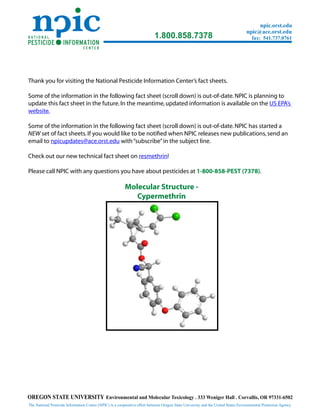
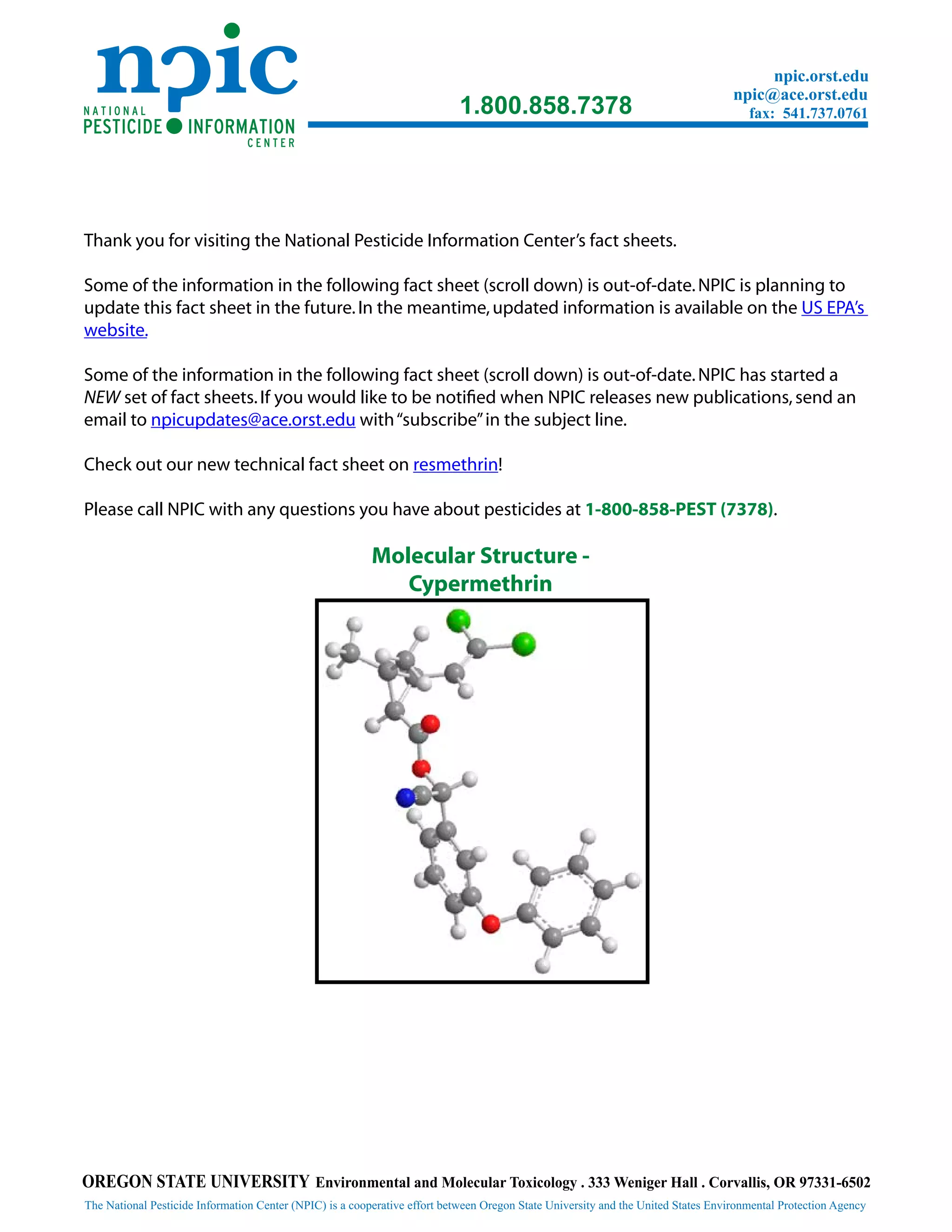
                                                          Molecular Structure -
                                                             Cypermethrin


OREGON STATE UNIVERSITY Environmental and Molecular Toxicology . 333 Weniger Hall . Corvallis, OR 97331-6502
The National Pesticide Information Center (NPIC) is a cooperative effort between Oregon State University and the United States Environmental Protection Agency
NPTN fact sheets are designed to answer questions that are commonly asked by the general public
    about pesticides that are regulated by the U.S. Environmental Protection Agency (US EPA). This
    document is intended to be educational in nature and helpful to consumers for making decisions about
                                                                                                              National
    pesticide use.

                                                                                                              Pesticide
                                                                                                              Telecommunications
Cypermethrin                                                                                                  Network
    The Pesticide Label: Labels provide directions for the proper use of a pesticide product. Be sure to read the entire
    label before using any product. A signal word on each product label indicates the product’s short-term toxicity.

     CAUTION- low toxicity                            WARNING- moderate toxicity                           DANGER- high toxicity


What is cypermethrin?                                                               How toxic is cypermethrin?
Ăż     Cypermethrin is a pyrethroid insecticide. It was first                        Animals
      synthesized in 1974 (1).                                                      • Cockroach brain cells exposed to very small doses (up
Ăż     Cypermethrin is a synthetic chemical similar to the                              to 0.02 micrograms per gram of brain weight or cg/g)
      pyrethrins in pyrethrum extract (which comes from the                            of cypermethrin exhibited a nervous system response,
      chrysanthemum plant).        Pyrethroids, including                              which in cockroaches, would result in restlessness,
      cypermethrin were designed to be effective longer                                incoordination, prostration, and paralysis (3). See box
      than pyrethrins (1).                                                             on laboratory testing.
                                                                                    • Mice exposed to small doses (0.3 to 4.3 cg/g) of
                                                                                       cypermethrin displayed symptoms including writhing,
How does cypermethrin work?                                                            convulsions, and salivation (4).
                                                                                    • Rats exposed to cypermethrin exhibited similar
Ăż     Cypermethrin kills insects that eat or come into
                                                                                       symptoms including tremors, seizures, writhing, and
      contact with it (2).
                                                                                       salivation as well as burrowing behavior (5).
•     Cypermethrin works by quickly affecting the insect’s
                                                                                    Ăż  Cypermethrin may be a weak skin sensitizer in guinea
      central nervous system.
                                                                                       pigs (2, 6).
                                                                                    Ăż  Newborn rats were more sensitive to cypermethrin
What are some products that contain                                                    than adult rats. The liver enzymes that break down
cypermethrin?                                                                          cypermethrin in the body are not completely
                                                                                       developed in the newborn rats (7).
Ăż     termiticides
Ăż     household insecticides                                                        Humans
Ăż     outdoor insecticides                                                          Ăż People handling or working with pyrethrins and
Ăż     AmmoTM                                                                          pyrethroids (including cypermethrin) sometimes
Ăż     CybushR                                                                         developed tingling, burning, dizziness,and itching (1,
•     Cynoff TM                                                                       5).
Ăż     Cyperkill
Ăż     DemonR
Laboratory Testing: Before pesticides are               Is cypermethrin likely to cause cancer?
    registered by the US EPA, they must undergo
    laboratory testing for short-term and long-term         Animals
    health effects. In these tests, laboratory animals      • Mice fed high doses (up to 1600 mg/kg) over a
    are purposely fed a pesticide at high doses to             lifetime did not develop cancer (malignant tumors)
    cause toxic effects. These tests help scientists           (1).
    judge how these chemicals might affect                  Ăż  However, some of the female mice developed benign
    humans, domestic animals, and wildlife in cases            (non-cancerous) lung tumors (1). See box on cancer.
    of overexposure. When pesticide products are
    used according to label directions, toxic effects       Humans
    are not likely to occur because the amount of           Ăż The US EPA has classified cypermethrin as a possible
    pesticide that people and animals may be                  human carcinogen (group C) because there is limited
    exposed to is low compared to the doses fed to            evidence that it causes cancer in animals (6, 8).
    laboratory animals.                                     • Scientists have no data from work-related, accidental
                                                              poisoning, or epidemiological studies that indicate
                                                              whether or not cypermethrin is likely to cause cancer
                                                              in humans.
Does cypermethrin break down and
leave the body?
                                                                Cancer: The U.S. EPA has strict guidelines that
                                                                require testing of pesticides for their potential to
Animals
                                                                cause cancer. These studies involve feeding
Ăż  Both male and female rats excreted 50-65% of
                                                                laboratory animals large daily doses of the
   cypermethrin in their urine within 48 hours. Rats
   excreted 30% of the cypermethrin in their feces within       pesticide for up to 2 years. These animals are
   3 days (1).                                                  compared with a group of animals that did not
                                                                receive the chemical. Animal studies help show
                                                                whether a chemical is a potential human
Humans
                                                                carcinogen. If a pesticide does not cause cancer in
Ăż Humans excrete cypermethrin rapidly. Men who
                                                                animal tests, then the EPA considers it unlikely
  voluntarily ingested low doses of cypermethrin (0.25,
                                                                the pesticide will cause cancer in humans.
  0.5, 1, or 1.5 milligrams per kilogram of body weight
  or mg/kg) in corn oil excreted between 49 to 78
  percent of cypermethrin within 24 hours (1). These
  studies, along with results from animal studies,          Does cypermethrin cause reproductive
  indicate that cypermethrin is unlikely to accumulate in   or birth effects?
  the body.
                                                            Animals
   Effects of cypermethrin on human health and              Ăż  Cypermethrin studies with rats did not show any
   the environment depend on how much                          adverse reproductive effects (1). There was no
   cypermethrin is present and the length and                  evidence of birth defects in rats (1).
   frequency of exposure. Effects also depend on
   the health of a person and/or certain                    Humans
   environmental factors.                                   • Scientists have no data from work-related, accidental
                                                              poisonings, or epidemiological studies that indicate
                                                              whether or not cypermethrin is likely to cause
                                                              reproductive problems or birth defects in humans.
What happens to cypermethrin in the                                            References
                                                                               1. World Health Organization. (1989). Environmental Health
environment?                                                                   Criteria. Cypermethrin. (Vol. 82). Geneva: United Nations
                                                                               Environmental Programme, the International Labour
Ăż    The typical half-life of cypermethrin in the soil is 30                   Organization, and the World Health Organization.
     days, although it can range from two to eight weeks                       2. Tomlin, C. (Ed.). (1994). A World Compendium. The
     (6, 9).       Soil microbes rapidly break down                            Pesticide Manual. Incorporating the agrochemicals handbook.
     cypermethrin (6). See box on half-life.                                   (10th ed.).     Bungay, Suffolk, U.K.:        Crop Protection
                                                                               Publications.
Ăż    Cypermethrin has an extremely low potential to move
                                                                               3. Gammon, D. W. et al. (1981). Two classes of pyrethroid
     in the soil. It is unlikely to contaminate groundwater                    action in the cockroach. Pestic. Biochem. Physiol. 15:181-191.
     because it binds tightly to soil particles (6).                           4. Lawrence, J. L. and Casida, J. E. (1982). Pyrethroid
     Cypermethrin is stable in sunlight.                                       toxicology: mouse intracerebral structure-toxicity relationships.
Ăż    The average half-life of cypermethrin on foliage is 5                     Pestic. Biochem. Physiol. 18:914.
     days (9).                                                                 5. Klaassen, C. D., Amdur, M. O., & Doull, J. (Eds.). (1996).
                                                                               Casarett & Doull’s Toxicology. The Basic Science of Poisons.
                                                                               (5th ed.). Toronto: McGraw-Hill Companies, Inc.
     Half-life is the time required for half of the                            6. United States Environmental Protection Agency. (1989).
     compound to degrade.                                                      Cypermethrin Pesticide Fact Sheet. Washington, D.C.
                                                                               7. Cantalamessa, F. (1993). Acute toxicity of two pyrethroids,
                                                                               permethrin and cypermethrin, in neonatal and adult rats.
            1 half-life  =        50% degraded                                 Archives of Toxicology, 67, 510-513.
            2 half-lives =        75% degraded                                 8. United States Environmental Protection Agency. (1997).
            3 half-lives =        88% degraded                                 Office of Pesticide Programs reference dose tracking report.
            4 half-lives =        94% degraded                                 Washington, D.C. [Online]. http://ace.orst.edu/info/nptn/
            5 half-lives =        97% degraded                                 tracking/tracking.htm
                                                                               9. Knisel, W.G. (Ed.). (1993). Groundwater Loading Effects
     Remember that the amount of chemical                                      of Agricultural Management Systems. (Version 2.10). [Online].
     remaining after a half-life will always depend                            Tifton, Georgia: United States Department of Agriculture-
     on the amount of the chemical originally                                  Agricultural Research Service. [Online].
                                                                               http://www.arsusda.gov/ rsml/ppdb.html


What effects does cypermethrin have on                                         For more information, call or write:
                                                                               NPTN, Oregon State University, 333 Weniger Hall,
wildlife?                                                                      Corvallis, Oregon 97331-6502.
                                                                               Phone: 1-800-858-7378
Ăż    Cypermethrin is highly toxic to fish (6).                                 Fax: 1-541-737-0761
•    Some products for agricultural and commercial
                                                                               Email: nptn@ace.orst.edu
     outdoor applications are limited to use by Certified
     Applicators (6).       Such products bear specific                        Internet: http://ace.orst.edu/info/nptn/ or
     precautions and directions to avoid contamination of                      http://ace.orst.edu/info/extoxnet/
     water (6).
•    When cypermethrin products are used according to the                      Date reviewed: December 1998
     label’s directions applications around the home or
     other residential sites pose little risk to aquatic life.
Ăż    Cypermethrin is highly toxic to bees (6).
Ăż    Cypermethrin is very highly toxic to water insects (6).
Ăż    Cypermethrin is very low in toxicity to birds (6).


    NPTN is sponsored cooperatively by Oregon State University and the U.S. Environmental Protection Agency. Data presented through NPTN
    documents are based on selected authoritative and peer-reviewed literature. The information in this profile does not in any way replace or
    supersede the restrictions, precautions, directions or other information on the pesticide label/ing or other regulatory requirements.

Cypermethrin a pesticide

  • 1.
    npic.orst.edu npic@ace.orst.edu 1.800.858.7378 fax: 541.737.0761 Thank you for visiting the National Pesticide Information Center’s fact sheets. Some of the information in the following fact sheet (scroll down) is out-of-date. NPIC is planning to update this fact sheet in the future. In the meantime, updated information is available on the US EPA’s website. Some of the information in the following fact sheet (scroll down) is out-of-date. NPIC has started a NEW set of fact sheets. If you would like to be notified when NPIC releases new publications, send an email to npicupdates@ace.orst.edu with “subscribe” in the subject line. Check out our new technical fact sheet on resmethrin! Please call NPIC with any questions you have about pesticides at 1-800-858-PEST (7378). Molecular Structure - Cypermethrin OREGON STATE UNIVERSITY Environmental and Molecular Toxicology . 333 Weniger Hall . Corvallis, OR 97331-6502 The National Pesticide Information Center (NPIC) is a cooperative effort between Oregon State University and the United States Environmental Protection Agency
  • 2.
    NPTN fact sheetsare designed to answer questions that are commonly asked by the general public about pesticides that are regulated by the U.S. Environmental Protection Agency (US EPA). This document is intended to be educational in nature and helpful to consumers for making decisions about National pesticide use. Pesticide Telecommunications Cypermethrin Network The Pesticide Label: Labels provide directions for the proper use of a pesticide product. Be sure to read the entire label before using any product. A signal word on each product label indicates the product’s short-term toxicity. CAUTION- low toxicity WARNING- moderate toxicity DANGER- high toxicity What is cypermethrin? How toxic is cypermethrin? ÿ Cypermethrin is a pyrethroid insecticide. It was first Animals synthesized in 1974 (1). • Cockroach brain cells exposed to very small doses (up ÿ Cypermethrin is a synthetic chemical similar to the to 0.02 micrograms per gram of brain weight or cg/g) pyrethrins in pyrethrum extract (which comes from the of cypermethrin exhibited a nervous system response, chrysanthemum plant). Pyrethroids, including which in cockroaches, would result in restlessness, cypermethrin were designed to be effective longer incoordination, prostration, and paralysis (3). See box than pyrethrins (1). on laboratory testing. • Mice exposed to small doses (0.3 to 4.3 cg/g) of cypermethrin displayed symptoms including writhing, How does cypermethrin work? convulsions, and salivation (4). • Rats exposed to cypermethrin exhibited similar ÿ Cypermethrin kills insects that eat or come into symptoms including tremors, seizures, writhing, and contact with it (2). salivation as well as burrowing behavior (5). • Cypermethrin works by quickly affecting the insect’s ÿ Cypermethrin may be a weak skin sensitizer in guinea central nervous system. pigs (2, 6). ÿ Newborn rats were more sensitive to cypermethrin What are some products that contain than adult rats. The liver enzymes that break down cypermethrin? cypermethrin in the body are not completely developed in the newborn rats (7). ÿ termiticides ÿ household insecticides Humans ÿ outdoor insecticides ÿ People handling or working with pyrethrins and ÿ AmmoTM pyrethroids (including cypermethrin) sometimes ÿ CybushR developed tingling, burning, dizziness,and itching (1, • Cynoff TM 5). ÿ Cyperkill ÿ DemonR
  • 3.
    Laboratory Testing: Beforepesticides are Is cypermethrin likely to cause cancer? registered by the US EPA, they must undergo laboratory testing for short-term and long-term Animals health effects. In these tests, laboratory animals • Mice fed high doses (up to 1600 mg/kg) over a are purposely fed a pesticide at high doses to lifetime did not develop cancer (malignant tumors) cause toxic effects. These tests help scientists (1). judge how these chemicals might affect ÿ However, some of the female mice developed benign humans, domestic animals, and wildlife in cases (non-cancerous) lung tumors (1). See box on cancer. of overexposure. When pesticide products are used according to label directions, toxic effects Humans are not likely to occur because the amount of ÿ The US EPA has classified cypermethrin as a possible pesticide that people and animals may be human carcinogen (group C) because there is limited exposed to is low compared to the doses fed to evidence that it causes cancer in animals (6, 8). laboratory animals. • Scientists have no data from work-related, accidental poisoning, or epidemiological studies that indicate whether or not cypermethrin is likely to cause cancer in humans. Does cypermethrin break down and leave the body? Cancer: The U.S. EPA has strict guidelines that require testing of pesticides for their potential to Animals cause cancer. These studies involve feeding ÿ Both male and female rats excreted 50-65% of laboratory animals large daily doses of the cypermethrin in their urine within 48 hours. Rats excreted 30% of the cypermethrin in their feces within pesticide for up to 2 years. These animals are 3 days (1). compared with a group of animals that did not receive the chemical. Animal studies help show whether a chemical is a potential human Humans carcinogen. If a pesticide does not cause cancer in ÿ Humans excrete cypermethrin rapidly. Men who animal tests, then the EPA considers it unlikely voluntarily ingested low doses of cypermethrin (0.25, the pesticide will cause cancer in humans. 0.5, 1, or 1.5 milligrams per kilogram of body weight or mg/kg) in corn oil excreted between 49 to 78 percent of cypermethrin within 24 hours (1). These studies, along with results from animal studies, Does cypermethrin cause reproductive indicate that cypermethrin is unlikely to accumulate in or birth effects? the body. Animals Effects of cypermethrin on human health and ÿ Cypermethrin studies with rats did not show any the environment depend on how much adverse reproductive effects (1). There was no cypermethrin is present and the length and evidence of birth defects in rats (1). frequency of exposure. Effects also depend on the health of a person and/or certain Humans environmental factors. • Scientists have no data from work-related, accidental poisonings, or epidemiological studies that indicate whether or not cypermethrin is likely to cause reproductive problems or birth defects in humans.
  • 4.
    What happens tocypermethrin in the References 1. World Health Organization. (1989). Environmental Health environment? Criteria. Cypermethrin. (Vol. 82). Geneva: United Nations Environmental Programme, the International Labour ÿ The typical half-life of cypermethrin in the soil is 30 Organization, and the World Health Organization. days, although it can range from two to eight weeks 2. Tomlin, C. (Ed.). (1994). A World Compendium. The (6, 9). Soil microbes rapidly break down Pesticide Manual. Incorporating the agrochemicals handbook. cypermethrin (6). See box on half-life. (10th ed.). Bungay, Suffolk, U.K.: Crop Protection Publications. ÿ Cypermethrin has an extremely low potential to move 3. Gammon, D. W. et al. (1981). Two classes of pyrethroid in the soil. It is unlikely to contaminate groundwater action in the cockroach. Pestic. Biochem. Physiol. 15:181-191. because it binds tightly to soil particles (6). 4. Lawrence, J. L. and Casida, J. E. (1982). Pyrethroid Cypermethrin is stable in sunlight. toxicology: mouse intracerebral structure-toxicity relationships. ÿ The average half-life of cypermethrin on foliage is 5 Pestic. Biochem. Physiol. 18:914. days (9). 5. Klaassen, C. D., Amdur, M. O., & Doull, J. (Eds.). (1996). Casarett & Doull’s Toxicology. The Basic Science of Poisons. (5th ed.). Toronto: McGraw-Hill Companies, Inc. Half-life is the time required for half of the 6. United States Environmental Protection Agency. (1989). compound to degrade. Cypermethrin Pesticide Fact Sheet. Washington, D.C. 7. Cantalamessa, F. (1993). Acute toxicity of two pyrethroids, permethrin and cypermethrin, in neonatal and adult rats. 1 half-life = 50% degraded Archives of Toxicology, 67, 510-513. 2 half-lives = 75% degraded 8. United States Environmental Protection Agency. (1997). 3 half-lives = 88% degraded Office of Pesticide Programs reference dose tracking report. 4 half-lives = 94% degraded Washington, D.C. [Online]. http://ace.orst.edu/info/nptn/ 5 half-lives = 97% degraded tracking/tracking.htm 9. Knisel, W.G. (Ed.). (1993). Groundwater Loading Effects Remember that the amount of chemical of Agricultural Management Systems. (Version 2.10). [Online]. remaining after a half-life will always depend Tifton, Georgia: United States Department of Agriculture- on the amount of the chemical originally Agricultural Research Service. [Online]. http://www.arsusda.gov/ rsml/ppdb.html What effects does cypermethrin have on For more information, call or write: NPTN, Oregon State University, 333 Weniger Hall, wildlife? Corvallis, Oregon 97331-6502. Phone: 1-800-858-7378 ÿ Cypermethrin is highly toxic to fish (6). Fax: 1-541-737-0761 • Some products for agricultural and commercial Email: nptn@ace.orst.edu outdoor applications are limited to use by Certified Applicators (6). Such products bear specific Internet: http://ace.orst.edu/info/nptn/ or precautions and directions to avoid contamination of http://ace.orst.edu/info/extoxnet/ water (6). • When cypermethrin products are used according to the Date reviewed: December 1998 label’s directions applications around the home or other residential sites pose little risk to aquatic life. ÿ Cypermethrin is highly toxic to bees (6). ÿ Cypermethrin is very highly toxic to water insects (6). ÿ Cypermethrin is very low in toxicity to birds (6). NPTN is sponsored cooperatively by Oregon State University and the U.S. Environmental Protection Agency. Data presented through NPTN documents are based on selected authoritative and peer-reviewed literature. The information in this profile does not in any way replace or supersede the restrictions, precautions, directions or other information on the pesticide label/ing or other regulatory requirements.