CYCLICAL MODELS OF
CURRICULUM
DEVELOPMENT
CYCLICAL MODELS OF CURRICULUM
DEVELOPMENT
•The cyclical models prescribe a cyclical or
continuous process of curriculum development.
Cyclical models usually start with situational
analysis that serves as the basis for all the
succeeding process.
TYPES OF CYCLICAL MODELS OF CURRICULUM
DEVELOPMENT
• Audrey Nicholls and Howard Nicholls Model for Curriculum
Development
• Wheeler’s Curriculum Development Model
• The Contextual Filters Model of Course Planning
Audrey Nicholls and Howard Nicholls
Model for Curriculum Development
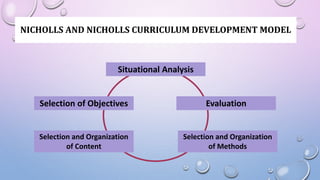
•The model emphasizes the cyclical nature of
curriculum development. According to the
proponents of this model, curriculum
development is a continuous process.
•The model prescribes five logical and interdependent
stages that are in a continuous curriculum
development process. The model starts with a
situational analysis in which curricular decisions are
made, followed by the selection of objectives and the
other succeeding phases.
NICHOLLS AND NICHOLLS CURRICULUM DEVELOPMENT MODEL
Situational Analysis
Selection and Organization
of Content
Selection of Objectives Evaluation
Selection and Organization
of Methods
Wheeler’s Curriculum Development Model
• In his influential book, Curriculum Process, Wheeler (1967)
presented a cyclical process in which each element of the
curriculum is related and interdependent.
• Although this model is also rational in nature, each phase is a
logical development of the preceding one. One cannot proceed
to the next phase unless the preceding phase is done.
• Wheeler also emphasized the importance of starting from the
development of aims, goals, and objectives.
Wheeler’s Curriculum Development Model
4. Organization and Integration of
Learning Experiences and Content
3. Selection of Content
2. Selection of Learning Experiences
5. Evaluation
1. Aims, Goals, and Objectives
The Contextual Filters Model of Course Planning
• The Contextual Filters Model of Course Planning was
developed by Stark, Lowther, Bentley, Ryan, Martens,
Genthon, Wren, and Shaw in 1990 as part of their study
conducted at the University of Michigan National Center for
Research to Improve Postsecondary Teaching and Learning.
This model appeared in the book Shaping the College
Curriculum written by Stark and Latucca and published in
1997.
• Content influences encompass faculty members’
background and associated disciplinary and educational
beliefs.
• Contextual influences refer to the influences outside of the
instructor’s immediate control that cause adjustments in
the course plans such as student characteristics or
instructionl resources.
• Form includes the process that are followed when designing
courses (Stark &Latucca, 1997).
THE CONTEXTUAL FILTERS MODEL OF COURSE PLANNING
Content and Background Considerations (Content)
Influence of Faculty
Background and
Characteristics
Select Content
Arrange Content
Choose Process
Purpose of
Education Espoused
by Faculty Members
Faculty Views of
Their Academic
Fields
Goals
Students
Schedules
Campus Services
Resources
Feedback
Adjustment
Course Decisions (Forms)
Contextual Filters (Context)
DYNAMIC MODELS OF CURRICULUM
DEVELOPMENT
•The dynamic models describe how curriculum
workers develop curricula in various educational
contexts. The dynamic curriculum development
models are usually used in school-based
settings.
TYPES OF DYNAMIC MODELS OF CURRICULUM
DEVELOPMENT
•Walker’s Model of Curriculum Development
•Skillbeck’s Curriculum Development Model
•Eisner’s Artistic Approach to Curriculum Development
•Pawilen’s Model for Developing Curriculum
Walker’s Model of Curriculum Development
• Deck Walker developed a model for curriculum
development and first published it in 1971. walker
contended that curriculum developers do not follow the
prescriptive approach of the rationale-linear sequence of
curriculum element when they develop curricula (Walker,
1971; Marsh &Willis, 2007; Print, 1993).
•In his model, Walker was particularly interested
on how curriculum workers actually do their
task in curriculum development. Walker was
able to identify three phases, which he termed
platform, deliberation, and design.
WALKER’S NATURALISTIC MODEL
(applying them to practical situations, arguing
about, accepting, refusing, changing, adapting)
(Beliefs, Theories, Conceptions, Points of View, Aims, Objectives)
Platform
Deliberation
Curriculum Design
WALKER’S NATURALISTIC MODEL
PLATFORM PHASE
Walker suggested that
curriculum workers bring with
them their individual beliefs,
knowledge, and values.
They have their own ideas about
how to do their task and they are
prepared to discuss and argue
about them.
The first phase is similar to the
idea of Print (1993) of a
curriculum presage.
DELIBERATION PHASE
Involves identifying which facts
are needed for means and ends,
generating alternatives and
considering the consequences of
these alternatives.
This phase is also used in weighing
alternative costs and
consequences , and choosing the
best alternative for the curriculum
task they are about to do.
CURRICULUM DESIGN
Involves planning,
decision-making, and
the actual development
of the curriculum.
Skillbeck’s Curriculum Development Model
•In 1976, Skillbeck came up with a model for
developing a school-based curriculum in
Australia.
•When using this model, curriculum workers
may start from any phase. Each phase is
interrelated and follows a systematics
sequence.
•Skillbecks’s model includes a situational analysis that
involves gathering data from the school, society, and
the learners.
•The results of the situational analysis provide strong
bases for making curricular decisions for all the
succeeding phases of curriculum development.
Skillbeck’s Curriculum Development Model
Situational Analysis
Goal Formulation
Program Building
Interpretation and
Implementation
Monitoring, Feedback,
Assessment, Reconstruction
Eisner’s Artistic Approach to Curriculum Development
• Elliot W. Eisner was a famous curriculum scholar. In 1979, he
published the book The Educational Imagination where he
presented his idea on how curriculum development should
be done.
• Eisner (1979) believed that there is a need to develop a new
theory that recognizes the artistry of teaching that is useful
in helping teachers develop those arts.
Eisner’s Artistic Model to Curriculum Development
1. Goals and their priorities
• The need to consider less, well-defined objectives as well as explicit ones
• The need for deliberation in talking through priorities
2. Content of curriculum
• Options to consider in selecting curriculum
• Caveats about the null curriculum
3. Types of learning opportunities
• Emphasis in transforming goals and content into learning events that will
be of significance to students
4. Organization of learning opportunities
• Emphasis on a nonlinear approach in order to encourage diverse student
outcomes.
5. Organization of content areas
• Emphasis on cross-curricula organization of content
6. Mode of presentation and mode of response
• Use of a number of modes of communication to widen educational
opportunities for students
7. Types of evaluation procedure.
• Use of a comprehensive range of procedures at different stages of the
process of curriculum development.
Pawilen’s Model for Developing Curriculum
•The Author developed this model as one of the major
outputs of his doctoral dissertation in the University
of the Philippines, Diliman. It is intended to help
curriculum workers develop curriculum that is
relevant and appropriate to the Philippine context
(Pawilen, 2011).
PAWILEN’S MODEL FOR DEVELOPING CURRICULUM
5. Developing final curriculum standards
• Curriculum sources are general factors that influence or
affect curriculum development and decision-making in the
macro-level.
• Posner (1995) suggested two levels of curriculum
development: macro level, which includes the general or
overall process of curriculum development, and the micro
level, which focuses on specific phase or phases or on
specific context like school-based curriculum development.
THREE CURRICULUM SOURCES IN THE MODEL
These curriculum sources are based on the
model of Ralph Tyler (1949)
•Learners
•Society
•Discipline
LEARNERS
• The learner as a curriculum source is very important.
Knowing their interests, needs, learning styles, thinking
styles, culture, socio-economic status, gender, and other
variables are significant data for developing curriculum.
• Understanding the nature of learners is helpful for
curriculum workers in making appropriate choices in
curriculum decision-making.
SOCIETY
• Society is also considered as a source of curriculum. Knowledge
about the society provides better understanding of the context
in which the curriculum will be implemented.
• Cultural values, beliefs, attitudes, political and economic
systems, and the physical environment directly or indirectly
affect curriculum development because the learners are an
integral part of the society.
DISCIPLINE
•Understanding the nature of discipline is also
essential in curriculum development. It can provide
data for making decisions as to what contents should
be included in the curriculum and how to organize
the contents of the curriculum.
•Curriculum influences are specific factors that affect
the development of the curriculum and decision-
making in the micro level.
•The idea of curriculum influences was adopted from
the model of Stark and Latucca (1997).
THREE GROUPS OF CURRICULUM INFLUENCES
•External
•Internal
•Organizational
EXTERNAL INFLUENCES
•External influences are social factors that
directly influence curriculum decision-making.
•These factors are society, market demand,
government, disciplinary, associations, and
alumni.
INTERNAL INFLUENCES
•Internal factors are those that are related to the
school like faculty members, students,
disciplines, and program mission.
ORGANIZATIONAL INFLUENCES
•Organizational influences are school factors but they
are more concerned with the governance of the
program and support system like school resources,
leadership, governance, and program relationship
(Stark & Latucca, 1997).
PROCESS FOR DEVELOPING CURRICULUM
UNDER PAWILEN’S MODEL
1. Situational Analysis
2. Selection of Goals and Objectives
3. Development of Curriculum Standards
4. Selection of Content or Subject Areas
5. Selection and Organization of Learning Experiences
6. Implementation
7. Evaluation
Situational Analysis
• The first phase; starts with analyzing the context in which the
curriculum is developed..
• The situational analysis includes a study of the different curriculum
sources ( student, society, and disciplines or subject matter), and
careful examination of the different curriculum influences (internal,
external, and organizational) that affect curriculum development.
Selection of Goals and Objectives
• Results from situational analysis.
• In some cases ,if the government or the university
prescribes the curriculum goals and objectives, such as
features will be considered as part of the internal or
external influences that will be studied in the situational
analysis.
Development of Curriculum Standards
•Takes place after the situational analysis
and selection of goals and objectives.
Development of Curriculum Standards
• The first phase of Glatthorn’s model (1998) was modified to
simplify the task for developing curriculum standards:
1. develop a comprehensive set of content standards by
examining various curriculum sources and influences.
2. align the standards to several criteria
3. secure teacher input the revise and improve the standards
4. ask experts to validate the standards
5. develop the final drafts of standards, divided into content
standards, skill standards, and values, standards.
Selection of Content or Subject Areas
Phase where the developed curriculum standards are
used to select subjects or courses to be included in the
curriculum.
Selection and Organization of Learning
Experiences
Includes selecting learning activities, organizing
instructional plans, and selecting instructional
materials to be used in implementing the
curriculum.
Implementation
•Involves the actual implementation of the
curriculum by faculty members. It is where the
actual teaching and learning take place.
Evaluation
The final phase; phase where the goals and objectives of the
curriculum, including the design and selection of all the
curriculum elements, are evaluated. After the result of
evaluation, the curriculum development process will go back
to situational analysis to reexamine the needs and include
necessary changes and demands from curriculum sources
and influences.
ANALYSIS OF DIFFERENT CURRICULUM
DEVELOPMENT MODELS
Tyler’s Model
Taba’s Grassroots Model
Understanding by design Model
Systematic Design Model
Print’s Model
Contextual Filters Model
Nicholls & Nicholls Model
Pawilen’s Model
Standards-based Model
Wheeler’s Model
Eisner’s Model
Walker’s Model
PRESCRIPTIVE
DESCRIPTIVE
DYNAMIC/
INTERACTION
RATIOANAL/
OBJECTIVES

Cyclical-and-dynamic-models-of-curriculum-development.pptx

  • 1.
  • 2.
    CYCLICAL MODELS OFCURRICULUM DEVELOPMENT •The cyclical models prescribe a cyclical or continuous process of curriculum development. Cyclical models usually start with situational analysis that serves as the basis for all the succeeding process.
  • 3.
    TYPES OF CYCLICALMODELS OF CURRICULUM DEVELOPMENT • Audrey Nicholls and Howard Nicholls Model for Curriculum Development • Wheeler’s Curriculum Development Model • The Contextual Filters Model of Course Planning
  • 4.
    Audrey Nicholls andHoward Nicholls Model for Curriculum Development •The model emphasizes the cyclical nature of curriculum development. According to the proponents of this model, curriculum development is a continuous process.
  • 5.
    •The model prescribesfive logical and interdependent stages that are in a continuous curriculum development process. The model starts with a situational analysis in which curricular decisions are made, followed by the selection of objectives and the other succeeding phases.
  • 6.
    NICHOLLS AND NICHOLLSCURRICULUM DEVELOPMENT MODEL Situational Analysis Selection and Organization of Content Selection of Objectives Evaluation Selection and Organization of Methods
  • 7.
    Wheeler’s Curriculum DevelopmentModel • In his influential book, Curriculum Process, Wheeler (1967) presented a cyclical process in which each element of the curriculum is related and interdependent. • Although this model is also rational in nature, each phase is a logical development of the preceding one. One cannot proceed to the next phase unless the preceding phase is done. • Wheeler also emphasized the importance of starting from the development of aims, goals, and objectives.
  • 8.
    Wheeler’s Curriculum DevelopmentModel 4. Organization and Integration of Learning Experiences and Content 3. Selection of Content 2. Selection of Learning Experiences 5. Evaluation 1. Aims, Goals, and Objectives
  • 9.
    The Contextual FiltersModel of Course Planning • The Contextual Filters Model of Course Planning was developed by Stark, Lowther, Bentley, Ryan, Martens, Genthon, Wren, and Shaw in 1990 as part of their study conducted at the University of Michigan National Center for Research to Improve Postsecondary Teaching and Learning. This model appeared in the book Shaping the College Curriculum written by Stark and Latucca and published in 1997.
  • 10.
    • Content influencesencompass faculty members’ background and associated disciplinary and educational beliefs. • Contextual influences refer to the influences outside of the instructor’s immediate control that cause adjustments in the course plans such as student characteristics or instructionl resources. • Form includes the process that are followed when designing courses (Stark &Latucca, 1997).
  • 11.
    THE CONTEXTUAL FILTERSMODEL OF COURSE PLANNING Content and Background Considerations (Content) Influence of Faculty Background and Characteristics Select Content Arrange Content Choose Process Purpose of Education Espoused by Faculty Members Faculty Views of Their Academic Fields Goals Students Schedules Campus Services Resources Feedback Adjustment Course Decisions (Forms) Contextual Filters (Context)
  • 12.
    DYNAMIC MODELS OFCURRICULUM DEVELOPMENT •The dynamic models describe how curriculum workers develop curricula in various educational contexts. The dynamic curriculum development models are usually used in school-based settings.
  • 13.
    TYPES OF DYNAMICMODELS OF CURRICULUM DEVELOPMENT •Walker’s Model of Curriculum Development •Skillbeck’s Curriculum Development Model •Eisner’s Artistic Approach to Curriculum Development •Pawilen’s Model for Developing Curriculum
  • 14.
    Walker’s Model ofCurriculum Development • Deck Walker developed a model for curriculum development and first published it in 1971. walker contended that curriculum developers do not follow the prescriptive approach of the rationale-linear sequence of curriculum element when they develop curricula (Walker, 1971; Marsh &Willis, 2007; Print, 1993).
  • 15.
    •In his model,Walker was particularly interested on how curriculum workers actually do their task in curriculum development. Walker was able to identify three phases, which he termed platform, deliberation, and design.
  • 16.
    WALKER’S NATURALISTIC MODEL (applyingthem to practical situations, arguing about, accepting, refusing, changing, adapting) (Beliefs, Theories, Conceptions, Points of View, Aims, Objectives) Platform Deliberation Curriculum Design
  • 17.
    WALKER’S NATURALISTIC MODEL PLATFORMPHASE Walker suggested that curriculum workers bring with them their individual beliefs, knowledge, and values. They have their own ideas about how to do their task and they are prepared to discuss and argue about them. The first phase is similar to the idea of Print (1993) of a curriculum presage. DELIBERATION PHASE Involves identifying which facts are needed for means and ends, generating alternatives and considering the consequences of these alternatives. This phase is also used in weighing alternative costs and consequences , and choosing the best alternative for the curriculum task they are about to do. CURRICULUM DESIGN Involves planning, decision-making, and the actual development of the curriculum.
  • 18.
    Skillbeck’s Curriculum DevelopmentModel •In 1976, Skillbeck came up with a model for developing a school-based curriculum in Australia. •When using this model, curriculum workers may start from any phase. Each phase is interrelated and follows a systematics sequence.
  • 19.
    •Skillbecks’s model includesa situational analysis that involves gathering data from the school, society, and the learners. •The results of the situational analysis provide strong bases for making curricular decisions for all the succeeding phases of curriculum development.
  • 20.
    Skillbeck’s Curriculum DevelopmentModel Situational Analysis Goal Formulation Program Building Interpretation and Implementation Monitoring, Feedback, Assessment, Reconstruction
  • 21.
    Eisner’s Artistic Approachto Curriculum Development • Elliot W. Eisner was a famous curriculum scholar. In 1979, he published the book The Educational Imagination where he presented his idea on how curriculum development should be done. • Eisner (1979) believed that there is a need to develop a new theory that recognizes the artistry of teaching that is useful in helping teachers develop those arts.
  • 22.
    Eisner’s Artistic Modelto Curriculum Development 1. Goals and their priorities • The need to consider less, well-defined objectives as well as explicit ones • The need for deliberation in talking through priorities 2. Content of curriculum • Options to consider in selecting curriculum • Caveats about the null curriculum 3. Types of learning opportunities • Emphasis in transforming goals and content into learning events that will be of significance to students
  • 23.
    4. Organization oflearning opportunities • Emphasis on a nonlinear approach in order to encourage diverse student outcomes. 5. Organization of content areas • Emphasis on cross-curricula organization of content 6. Mode of presentation and mode of response • Use of a number of modes of communication to widen educational opportunities for students 7. Types of evaluation procedure. • Use of a comprehensive range of procedures at different stages of the process of curriculum development.
  • 24.
    Pawilen’s Model forDeveloping Curriculum •The Author developed this model as one of the major outputs of his doctoral dissertation in the University of the Philippines, Diliman. It is intended to help curriculum workers develop curriculum that is relevant and appropriate to the Philippine context (Pawilen, 2011).
  • 25.
    PAWILEN’S MODEL FORDEVELOPING CURRICULUM 5. Developing final curriculum standards
  • 26.
    • Curriculum sourcesare general factors that influence or affect curriculum development and decision-making in the macro-level. • Posner (1995) suggested two levels of curriculum development: macro level, which includes the general or overall process of curriculum development, and the micro level, which focuses on specific phase or phases or on specific context like school-based curriculum development.
  • 27.
    THREE CURRICULUM SOURCESIN THE MODEL These curriculum sources are based on the model of Ralph Tyler (1949) •Learners •Society •Discipline
  • 28.
    LEARNERS • The learneras a curriculum source is very important. Knowing their interests, needs, learning styles, thinking styles, culture, socio-economic status, gender, and other variables are significant data for developing curriculum. • Understanding the nature of learners is helpful for curriculum workers in making appropriate choices in curriculum decision-making.
  • 29.
    SOCIETY • Society isalso considered as a source of curriculum. Knowledge about the society provides better understanding of the context in which the curriculum will be implemented. • Cultural values, beliefs, attitudes, political and economic systems, and the physical environment directly or indirectly affect curriculum development because the learners are an integral part of the society.
  • 30.
    DISCIPLINE •Understanding the natureof discipline is also essential in curriculum development. It can provide data for making decisions as to what contents should be included in the curriculum and how to organize the contents of the curriculum.
  • 31.
    •Curriculum influences arespecific factors that affect the development of the curriculum and decision- making in the micro level. •The idea of curriculum influences was adopted from the model of Stark and Latucca (1997).
  • 32.
    THREE GROUPS OFCURRICULUM INFLUENCES •External •Internal •Organizational
  • 33.
    EXTERNAL INFLUENCES •External influencesare social factors that directly influence curriculum decision-making. •These factors are society, market demand, government, disciplinary, associations, and alumni.
  • 34.
    INTERNAL INFLUENCES •Internal factorsare those that are related to the school like faculty members, students, disciplines, and program mission.
  • 35.
    ORGANIZATIONAL INFLUENCES •Organizational influencesare school factors but they are more concerned with the governance of the program and support system like school resources, leadership, governance, and program relationship (Stark & Latucca, 1997).
  • 36.
    PROCESS FOR DEVELOPINGCURRICULUM UNDER PAWILEN’S MODEL 1. Situational Analysis 2. Selection of Goals and Objectives 3. Development of Curriculum Standards 4. Selection of Content or Subject Areas 5. Selection and Organization of Learning Experiences 6. Implementation 7. Evaluation
  • 37.
    Situational Analysis • Thefirst phase; starts with analyzing the context in which the curriculum is developed.. • The situational analysis includes a study of the different curriculum sources ( student, society, and disciplines or subject matter), and careful examination of the different curriculum influences (internal, external, and organizational) that affect curriculum development.
  • 38.
    Selection of Goalsand Objectives • Results from situational analysis. • In some cases ,if the government or the university prescribes the curriculum goals and objectives, such as features will be considered as part of the internal or external influences that will be studied in the situational analysis.
  • 39.
    Development of CurriculumStandards •Takes place after the situational analysis and selection of goals and objectives.
  • 40.
    Development of CurriculumStandards • The first phase of Glatthorn’s model (1998) was modified to simplify the task for developing curriculum standards: 1. develop a comprehensive set of content standards by examining various curriculum sources and influences. 2. align the standards to several criteria 3. secure teacher input the revise and improve the standards 4. ask experts to validate the standards 5. develop the final drafts of standards, divided into content standards, skill standards, and values, standards.
  • 41.
    Selection of Contentor Subject Areas Phase where the developed curriculum standards are used to select subjects or courses to be included in the curriculum.
  • 42.
    Selection and Organizationof Learning Experiences Includes selecting learning activities, organizing instructional plans, and selecting instructional materials to be used in implementing the curriculum.
  • 43.
    Implementation •Involves the actualimplementation of the curriculum by faculty members. It is where the actual teaching and learning take place.
  • 44.
    Evaluation The final phase;phase where the goals and objectives of the curriculum, including the design and selection of all the curriculum elements, are evaluated. After the result of evaluation, the curriculum development process will go back to situational analysis to reexamine the needs and include necessary changes and demands from curriculum sources and influences.
  • 45.
    ANALYSIS OF DIFFERENTCURRICULUM DEVELOPMENT MODELS Tyler’s Model Taba’s Grassroots Model Understanding by design Model Systematic Design Model Print’s Model Contextual Filters Model Nicholls & Nicholls Model Pawilen’s Model Standards-based Model Wheeler’s Model Eisner’s Model Walker’s Model PRESCRIPTIVE DESCRIPTIVE DYNAMIC/ INTERACTION RATIOANAL/ OBJECTIVES