CURRICULUM
DEVELOPMENT
DIFFERENT CURRICULUM DEVELOPMENT MODELS
LINEAR MODELS
•A rational step-by-step procedure
for curriculum development
starting with objectives
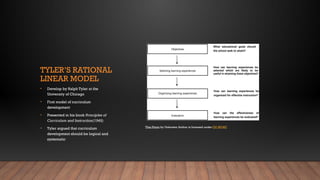
TYLER’S RATIONAL
LINEAR MODEL
• Develop by Ralph Tyler at the
University of Chicago
• First model of curriculum
development
• Presented in his book Principles of
Curriculum and Instruction(1949)
• Tyler argued that curriculum
development should be logical and
systematic
This Photo by Unknown Author is licensed under CC BY-NC
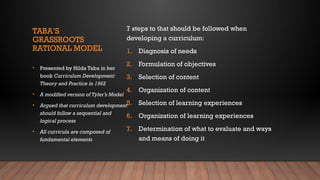
TABA’S
GRASSROOTS
RATIONAL MODEL
7 steps to that should be followed when
developing a curriculum:
1. Diagnosis of needs
2. Formulation of objectives
3. Selection of content
4. Organization of content
5. Selection of learning experiences
6. Organization of learning experiences
7. Determination of what to evaluate and ways
and means of doing it
• Presented by Hilda Taba in her
book Curriculum Development:
Theory and Practice in 1962
• A modified version of Tyler’s Model
• Argued that curriculum development
should follow a sequential and
logical process
• All curricula are composed of
fundamental elements
STANDARDS-BASED CURRICULUM
DEVELOPMENT MODEL
• Developed by Allan Glatthorn
• Intended for developing curriculum standards
• Identified three phases to be followed in developing a standards-based
curriculum
1. Develop standards
2. Develop benchmarks
3. Develop final products
UNDERSTANDING BY DESIGN MODEL
(UBD)
• Developed by Wiggins and McTighe (2002)
• It has become a byword in the Philippine Educational System
• Also called the Backward Design
Three Stages in Backward Design Process
Stage 1: Identify desired results
Stage 2: Determine acceptable evidences
Stage 3: Plan the learning experiences and instruction.
SYSTEMATIC DESIGN MODEL
• Originally developed by Robert Diamond
• Undergone major revisions but its structure is unchanged
• This model is prescriptive and rational
• Has two basic phases
1. Project selection and design
2. Production, implementation, and evaluation
MURRAY PRINT MODEL FOR CURRICULUM
DEVELOPMENT
• Murray print published his model in his book Curriculum Development Design
in 1988
• Prescribes a sequential and logical approach to curriculum development
• Provide a useful and easy-to-understand process
Phase 1: Organization
Phase 2: Development
Phase 3: Appication
CYCLICAL MODELS OF
CURRICULUM DEVELOPMENT
•Prescribe a cyclical or continuous
process of curriculum development
•Usually start with situational analysis
AUDREY NICHOLLS AND HOWARD NICHOLLS
MODEL FOR CURRICULUM DEVELOPMENT
• Emphasizes the cyclical nature of curriculum development
• Curriculum development is a continuous process
• Highly prescriptive and dynamic
• The inclusion of situational analysis as part pf the model is a valuable principle
in curriculum development
• Recognizes the influence and importance of contributing disciplines
• Has the potential to be used in any educational setting
WHEELER’S CURRICULUM DEVELOPMENT
MODEL
• Each element of the curriculum is related and
interdependent
• One cannot proceed to the next phase unless the
preceding phase is done
• Emphasized the importance of starting from the
development of aims, goals, objectives
THE CONTEXTUAL FILTERS MODEL OF
COURSE PLANNING
• Developed by Stark, Lowther, Bentley, Ryan, Martens, Genthon,Wren, and
Shaw in 1990
• Appeared in the book Shaping the College Curriculum
• Presents a cyclical view of curriculum view
• This model is very teacher-centered
• Could have been very useful for faculty members
DYNAMIC MODELS OF CURRICULUM
DEVELOPMENT
•Describe how curriculum workers
develop curricula in various
educational context
•Usually used in school-based settings
WALKER’S MODEL OF CURRICULUM
DEVELOPMENT
• Develop by Decker Walker and first published in 1971
• Identify three phases, which he termed platform, deliberation, and design
Platform Phase
- Curriculum workers bring with them their individual beliefs, knowledge, and values
Deliberation Phase
- Involves identifying which facts are needed for means and ends
Design Phase
- Involves planning, decision-making, and the actual development of the curriculum
• It reflects the realities of how curriculum workers plan and develop a curriculum
SKILBECK’S CURRICULUM DEVELOPMENT
MODEL
• Curriculum workers may start from any phase
• Each phase is interrelated and follows a systematic sequence
• A situational analysis that involves gathering data
EISNER’S ARTISTIC APPROACH TO
CURRICULUM DEVELOPMENT
• Developed by Elliot W. Eisner in 1979 from the book The Educational
Imagination
• Believed that there is a need to develop a new theory that recognizes the
artistry of teaching that is useful in helping teachers develop those arts
1. Goals and their priorities
2. Content of curriculum
3. Types of learning opportunities
4. Organization of learning opportunities
5. Organization of content areas
6. Mode of presentation and mode of response
7. Types of evaluation procedure
Eisner’s Artistic Model of Curriculum
Development
PAWILEN’S MODEL FOR DEVELOPING
CURRICULUM
• Develop curriculum that is relevant and appropriate to the Philippine
context

Curriculum-development-dattboi.ferm.pptx

  • 1.
  • 2.
    LINEAR MODELS •A rationalstep-by-step procedure for curriculum development starting with objectives
  • 3.
    TYLER’S RATIONAL LINEAR MODEL •Develop by Ralph Tyler at the University of Chicago • First model of curriculum development • Presented in his book Principles of Curriculum and Instruction(1949) • Tyler argued that curriculum development should be logical and systematic This Photo by Unknown Author is licensed under CC BY-NC
  • 4.
    TABA’S GRASSROOTS RATIONAL MODEL 7 stepsto that should be followed when developing a curriculum: 1. Diagnosis of needs 2. Formulation of objectives 3. Selection of content 4. Organization of content 5. Selection of learning experiences 6. Organization of learning experiences 7. Determination of what to evaluate and ways and means of doing it • Presented by Hilda Taba in her book Curriculum Development: Theory and Practice in 1962 • A modified version of Tyler’s Model • Argued that curriculum development should follow a sequential and logical process • All curricula are composed of fundamental elements
  • 5.
    STANDARDS-BASED CURRICULUM DEVELOPMENT MODEL •Developed by Allan Glatthorn • Intended for developing curriculum standards • Identified three phases to be followed in developing a standards-based curriculum 1. Develop standards 2. Develop benchmarks 3. Develop final products
  • 6.
    UNDERSTANDING BY DESIGNMODEL (UBD) • Developed by Wiggins and McTighe (2002) • It has become a byword in the Philippine Educational System • Also called the Backward Design Three Stages in Backward Design Process Stage 1: Identify desired results Stage 2: Determine acceptable evidences Stage 3: Plan the learning experiences and instruction.
  • 7.
    SYSTEMATIC DESIGN MODEL •Originally developed by Robert Diamond • Undergone major revisions but its structure is unchanged • This model is prescriptive and rational • Has two basic phases 1. Project selection and design 2. Production, implementation, and evaluation
  • 8.
    MURRAY PRINT MODELFOR CURRICULUM DEVELOPMENT • Murray print published his model in his book Curriculum Development Design in 1988 • Prescribes a sequential and logical approach to curriculum development • Provide a useful and easy-to-understand process Phase 1: Organization Phase 2: Development Phase 3: Appication
  • 9.
    CYCLICAL MODELS OF CURRICULUMDEVELOPMENT •Prescribe a cyclical or continuous process of curriculum development •Usually start with situational analysis
  • 10.
    AUDREY NICHOLLS ANDHOWARD NICHOLLS MODEL FOR CURRICULUM DEVELOPMENT • Emphasizes the cyclical nature of curriculum development • Curriculum development is a continuous process • Highly prescriptive and dynamic • The inclusion of situational analysis as part pf the model is a valuable principle in curriculum development • Recognizes the influence and importance of contributing disciplines • Has the potential to be used in any educational setting
  • 11.
    WHEELER’S CURRICULUM DEVELOPMENT MODEL •Each element of the curriculum is related and interdependent • One cannot proceed to the next phase unless the preceding phase is done • Emphasized the importance of starting from the development of aims, goals, objectives
  • 12.
    THE CONTEXTUAL FILTERSMODEL OF COURSE PLANNING • Developed by Stark, Lowther, Bentley, Ryan, Martens, Genthon,Wren, and Shaw in 1990 • Appeared in the book Shaping the College Curriculum • Presents a cyclical view of curriculum view • This model is very teacher-centered • Could have been very useful for faculty members
  • 13.
    DYNAMIC MODELS OFCURRICULUM DEVELOPMENT •Describe how curriculum workers develop curricula in various educational context •Usually used in school-based settings
  • 14.
    WALKER’S MODEL OFCURRICULUM DEVELOPMENT • Develop by Decker Walker and first published in 1971 • Identify three phases, which he termed platform, deliberation, and design Platform Phase - Curriculum workers bring with them their individual beliefs, knowledge, and values Deliberation Phase - Involves identifying which facts are needed for means and ends Design Phase - Involves planning, decision-making, and the actual development of the curriculum • It reflects the realities of how curriculum workers plan and develop a curriculum
  • 15.
    SKILBECK’S CURRICULUM DEVELOPMENT MODEL •Curriculum workers may start from any phase • Each phase is interrelated and follows a systematic sequence • A situational analysis that involves gathering data
  • 16.
    EISNER’S ARTISTIC APPROACHTO CURRICULUM DEVELOPMENT • Developed by Elliot W. Eisner in 1979 from the book The Educational Imagination • Believed that there is a need to develop a new theory that recognizes the artistry of teaching that is useful in helping teachers develop those arts
  • 17.
    1. Goals andtheir priorities 2. Content of curriculum 3. Types of learning opportunities 4. Organization of learning opportunities 5. Organization of content areas 6. Mode of presentation and mode of response 7. Types of evaluation procedure Eisner’s Artistic Model of Curriculum Development
  • 18.
    PAWILEN’S MODEL FORDEVELOPING CURRICULUM • Develop curriculum that is relevant and appropriate to the Philippine context