

C Y B E R S E C U R I T Y I N S U R A N C E S E M I N A R
Can You Afford NOT To Have
Cybersecurity?
March 4, 2015
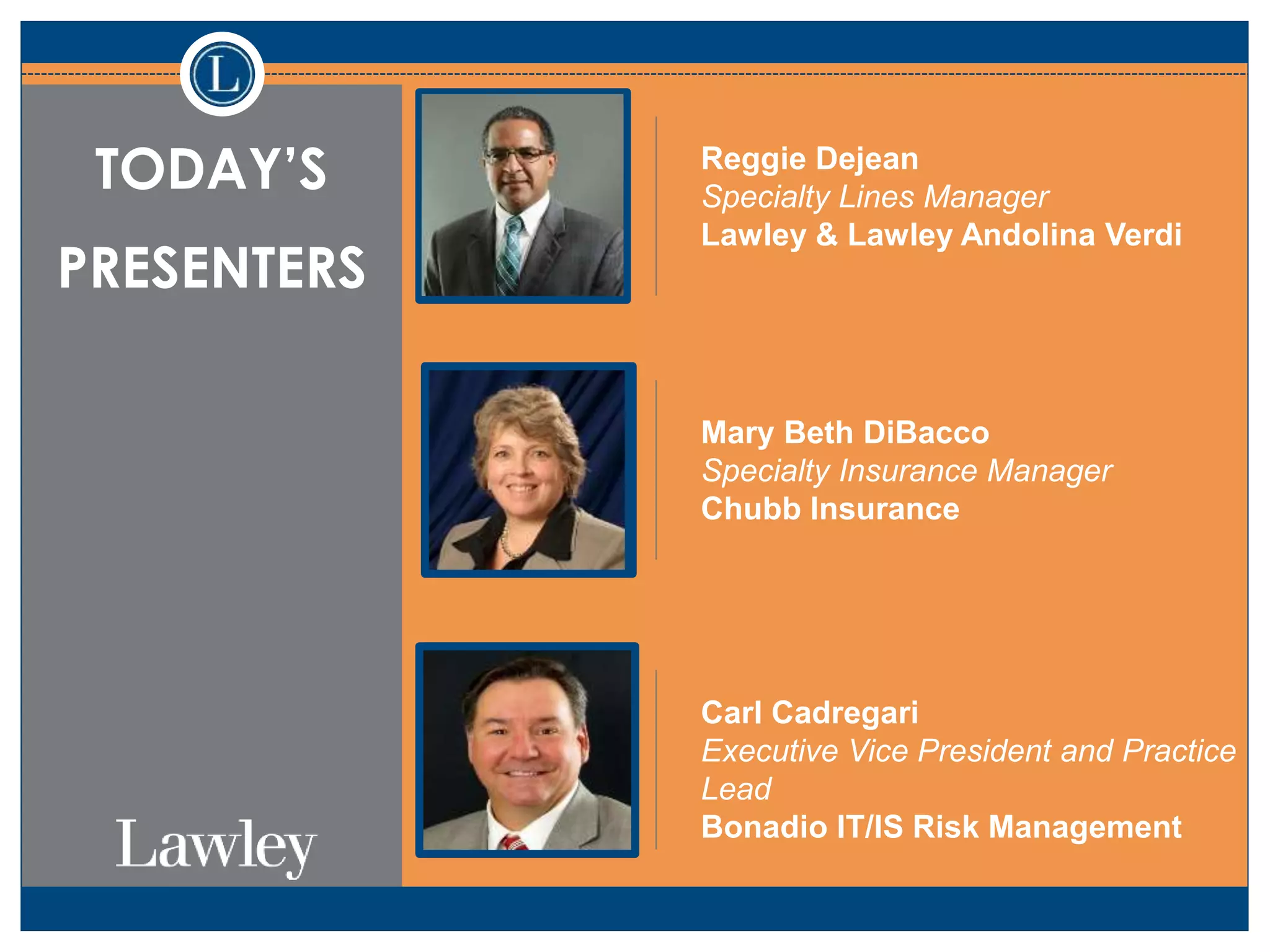
TODAY’S
PRESENTERS
Reggie Dejean
Specialty Lines Manager
Lawley & Lawley Andolina Verdi
Mary Beth DiBacco
Specialty Insurance Manager
Chubb Insurance
Carl Cadregari
Executive Vice President and Practice
Lead
Bonadio IT/IS Risk Management
DIGITAL HACKING
FORENSICS
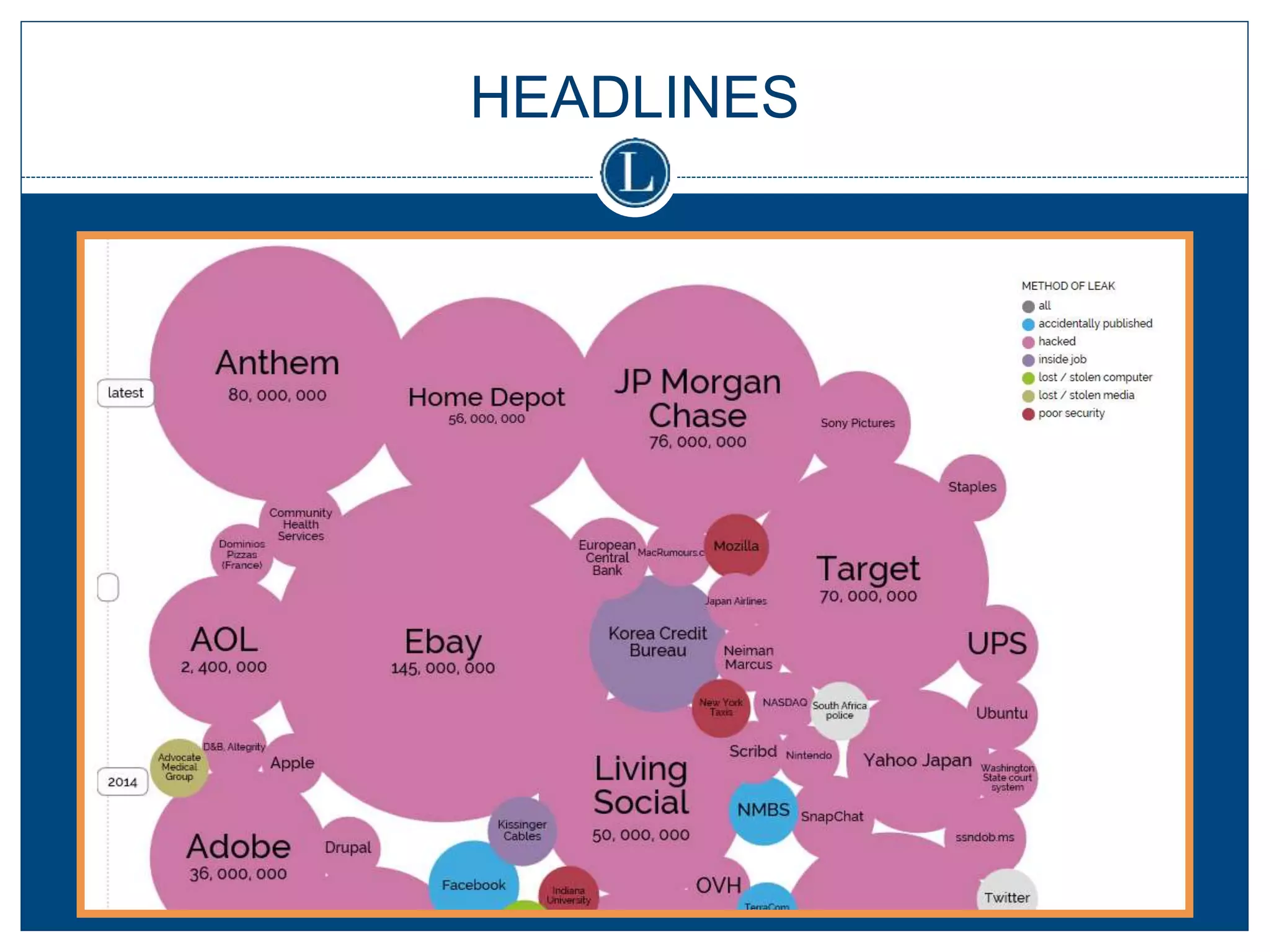
HEADLINES
HEADLINES EXPLAINED
 Identities left exposed in Indiana salvage yards - items
included medical records, bank statements, insurance
cards, employee identification cards, car registrations, a
signature, a child’s name, dates of birth, and an
application for welfare assistance.
 Stolen Pioneer bank laptop contained some customers’
data
 Pioneer Bank over the weekend alerted some of its customers that
an employee’s laptop stolen Jan. 26 contained “secured personal
information of certain customers, including names, social security
numbers, street addresses, and account and debit card
numbers.”
 Harel Chiropractic Clinic notifies 3,000 patients of breach
HEADLINES EXPLAINED CONT.
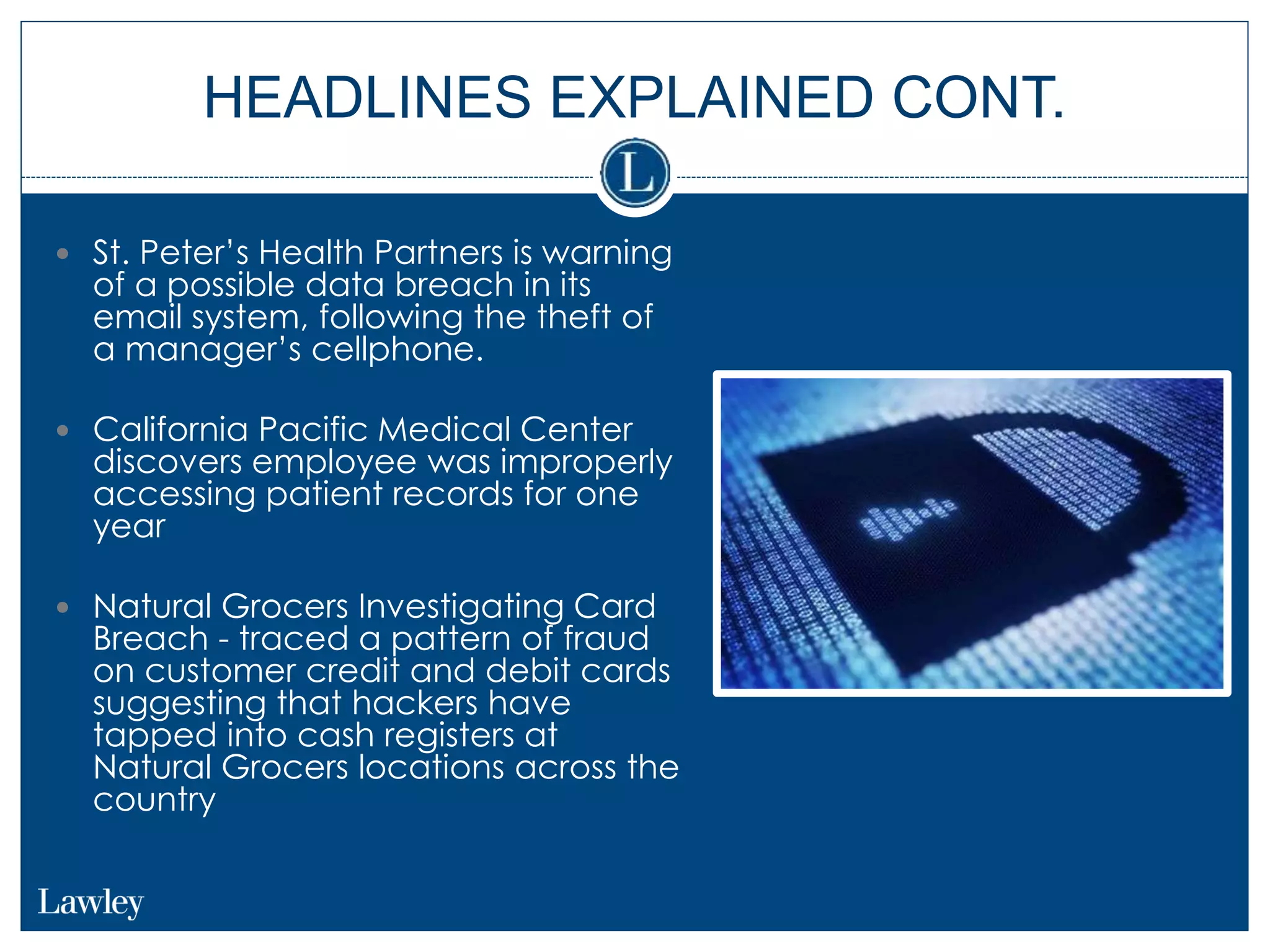
 St. Peter’s Health Partners is warning
of a possible data breach in its
email system, following the theft of
a manager’s cellphone.
 California Pacific Medical Center
discovers employee was improperly
accessing patient records for one
year
 Natural Grocers Investigating Card
Breach - traced a pattern of fraud
on customer credit and debit cards
suggesting that hackers have
tapped into cash registers at
Natural Grocers locations across the
country
HEADLINES EXPLAINED CONT.
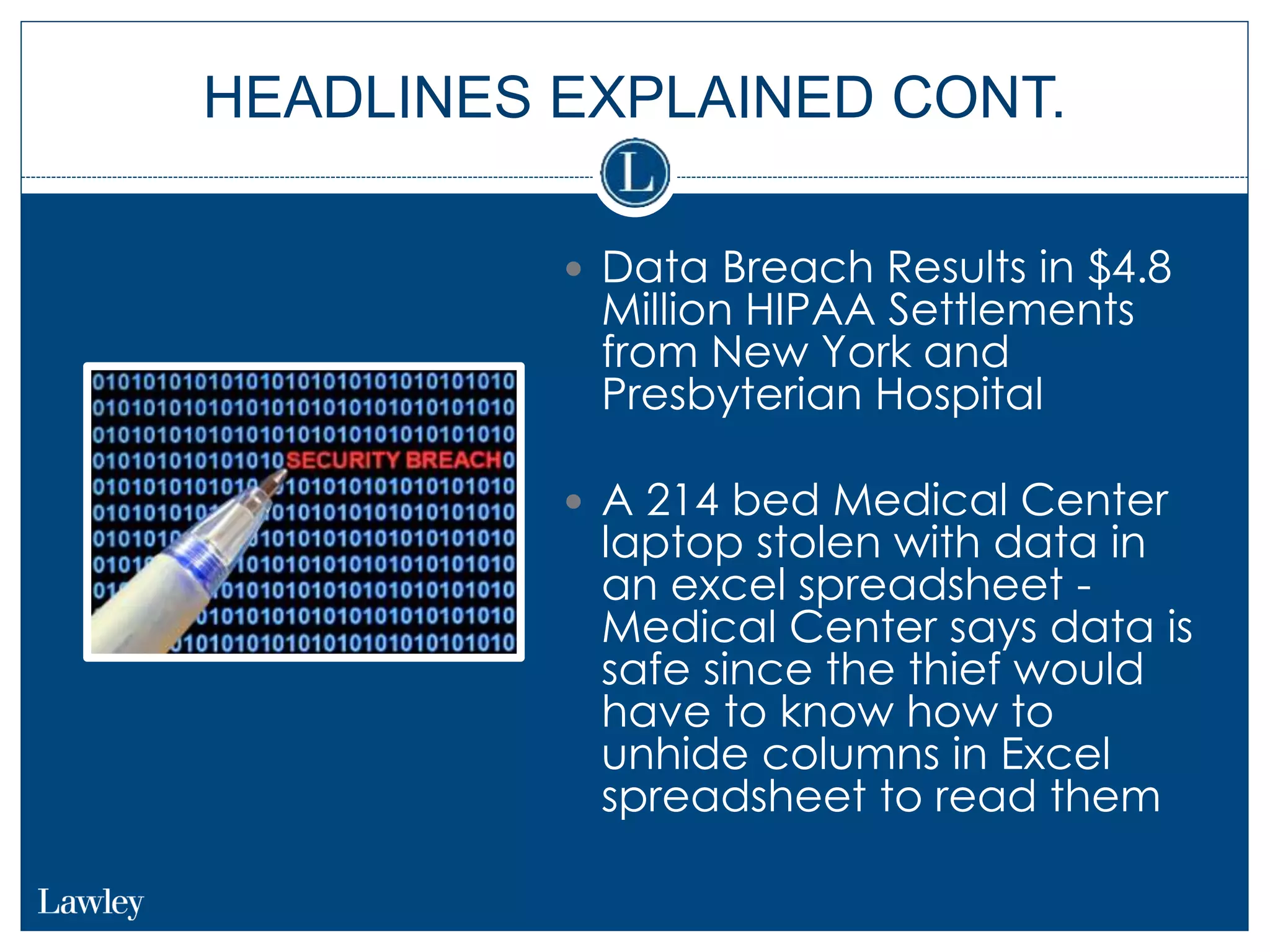
 Data Breach Results in $4.8
Million HIPAA Settlements
from New York and
Presbyterian Hospital
 A 214 bed Medical Center
laptop stolen with data in
an excel spreadsheet -
Medical Center says data is
safe since the thief would
have to know how to
unhide columns in Excel
spreadsheet to read them
THREATS TO DATA
 Internal Threats
 External Threats
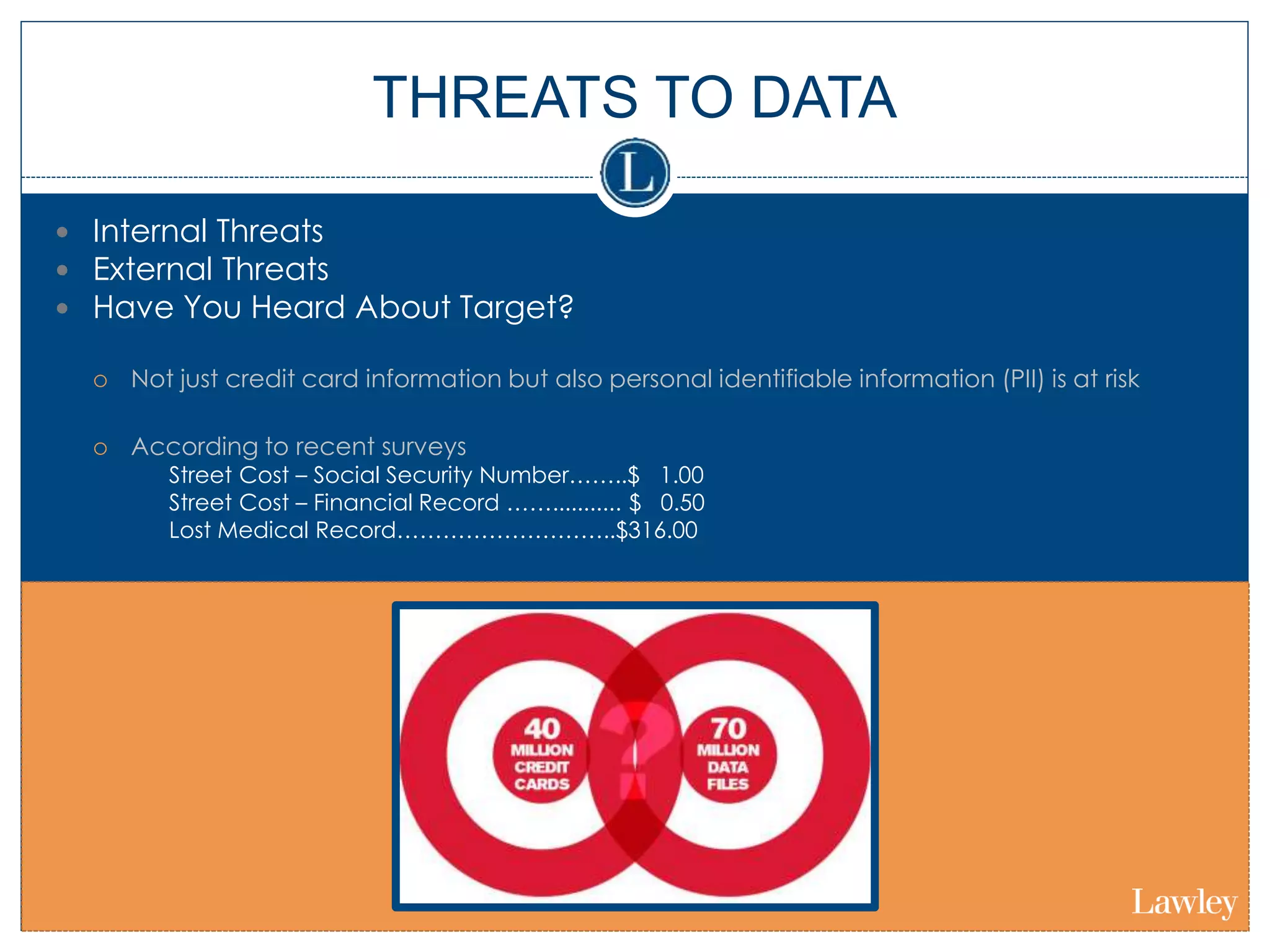
 Have You Heard About Target?
 Not just credit card information but also personal identifiable information (PII) is at risk
 According to recent surveys
 Street Cost – Social Security Number……..$ 1.00
 Street Cost – Financial Record ……........... $ 0.50
 Lost Medical Record………………………..$316.00
CSIRP
Computer Security Incident Response Plan
• Wh a t to d o wh e n y o u “ th i n k o r k n o w” y o u h a v e h a d
a d i s c l o s u r e
• Th e wh o , wh a t wh e r e a n d wh e n to f o l l o w
• S te p b y s te p p r o c e s s
• M a y b e r e q u i r e d b y s o m e l a ws a n d r e g u l a ti o n s
CSIRP
You Need a Breach Notification Policy
1. NY State, HIPAA, PCI, GLBA requires a documented policy that
includes all factors of breach notification including:
• When to alert persons whose data has been breached
• What you have to pay for
• When to send lost data information to the Attorney General
and regulatory bodies
• When you are to place conspicuous notice on your website
• When you are to alert local media and television
CSIRP
You need a plan to follow that includes:
1. What constitutes a breach
2. Who is on the team
3. Who is allowed to talk to any external entity
4. When to involve external crisis management
5. When to trigger your liability policy
CSIRP
1. How to assess the risks (likelihood and severity)
2. Does the breach fall into pre-defined categories
(and what are they)
3. What to do to investigate the breach
4. What to do to minimize the breach
5. What to do to report on the breach
6. What to do to never repeat the breach
7. How to close the incident
AFTER THE INFORMATION
HAS BEEN GATHERED
INFORMATION
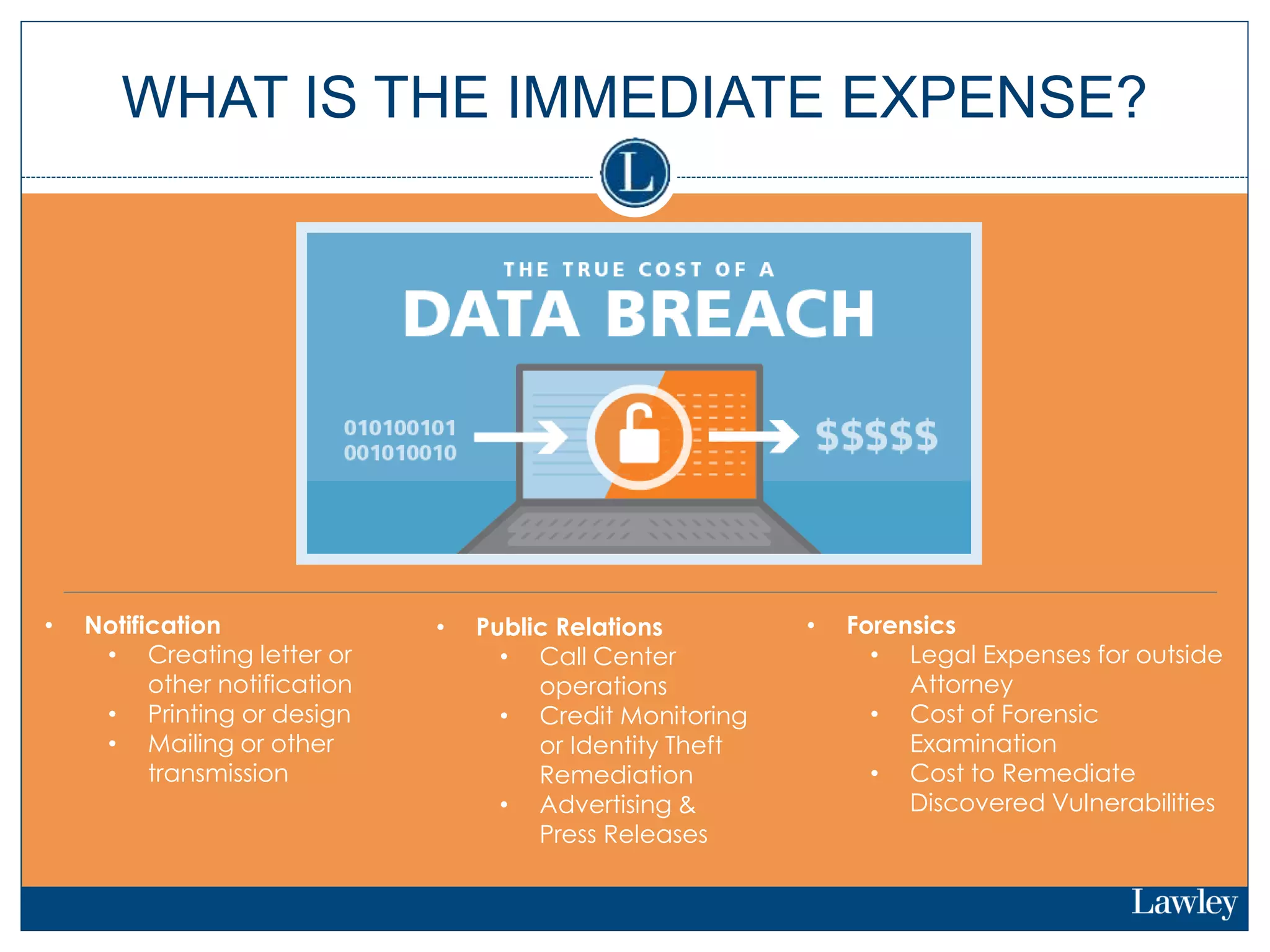
WHAT IS THE IMMEDIATE EXPENSE?
• Notification
• Creating letter or
other notification
• Printing or design
• Mailing or other
transmission
• Public Relations
• Call Center
operations
• Credit Monitoring
or Identity Theft
Remediation
• Advertising &
Press Releases
• Forensics
• Legal Expenses for outside
Attorney
• Cost of Forensic
Examination
• Cost to Remediate
Discovered Vulnerabilities
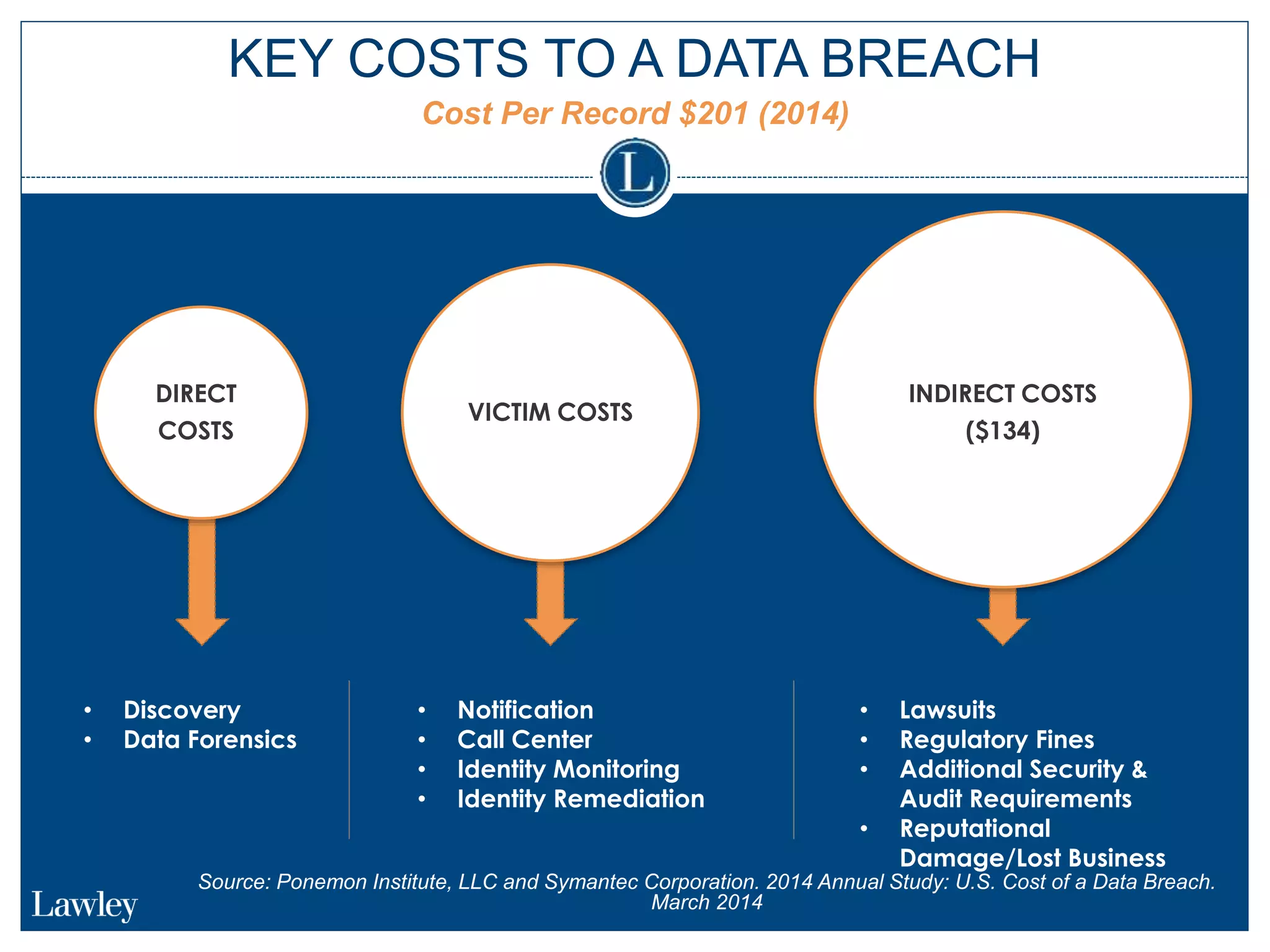
KEY COSTS TO A DATA BREACH
DIRECT
COSTS
VICTIM COSTS
INDIRECT COSTS
($134)
Cost Per Record $201 (2014)
• Discovery
• Data Forensics
• Notification
• Call Center
• Identity Monitoring
• Identity Remediation
• Lawsuits
• Regulatory Fines
• Additional Security &
Audit Requirements
• Reputational
Damage/Lost Business
Source: Ponemon Institute, LLC and Symantec Corporation. 2014 Annual Study: U.S. Cost of a Data Breach.
March 2014
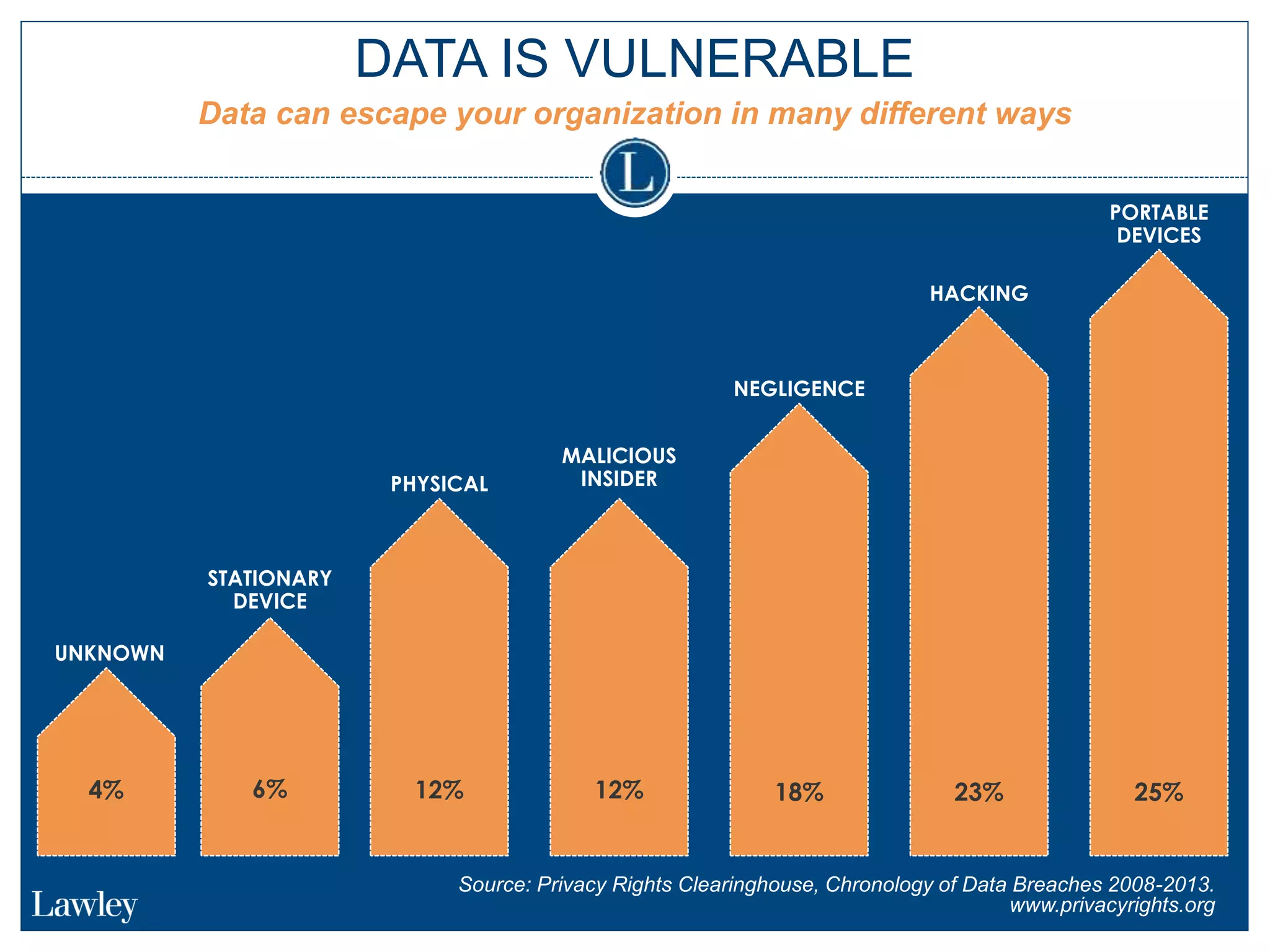
DATA IS VULNERABLE
Data can escape your organization in many different ways
Source: Privacy Rights Clearinghouse, Chronology of Data Breaches 2008-2013.
www.privacyrights.org
4% 6% 12% 12% 18% 23% 25%
STATIONARY
DEVICE
UNKNOWN
PHYSICAL
MALICIOUS
INSIDER
NEGLIGENCE
HACKING
PORTABLE
DEVICES
COMPUTER SECURITY vs. INFORMATION
SECURITY
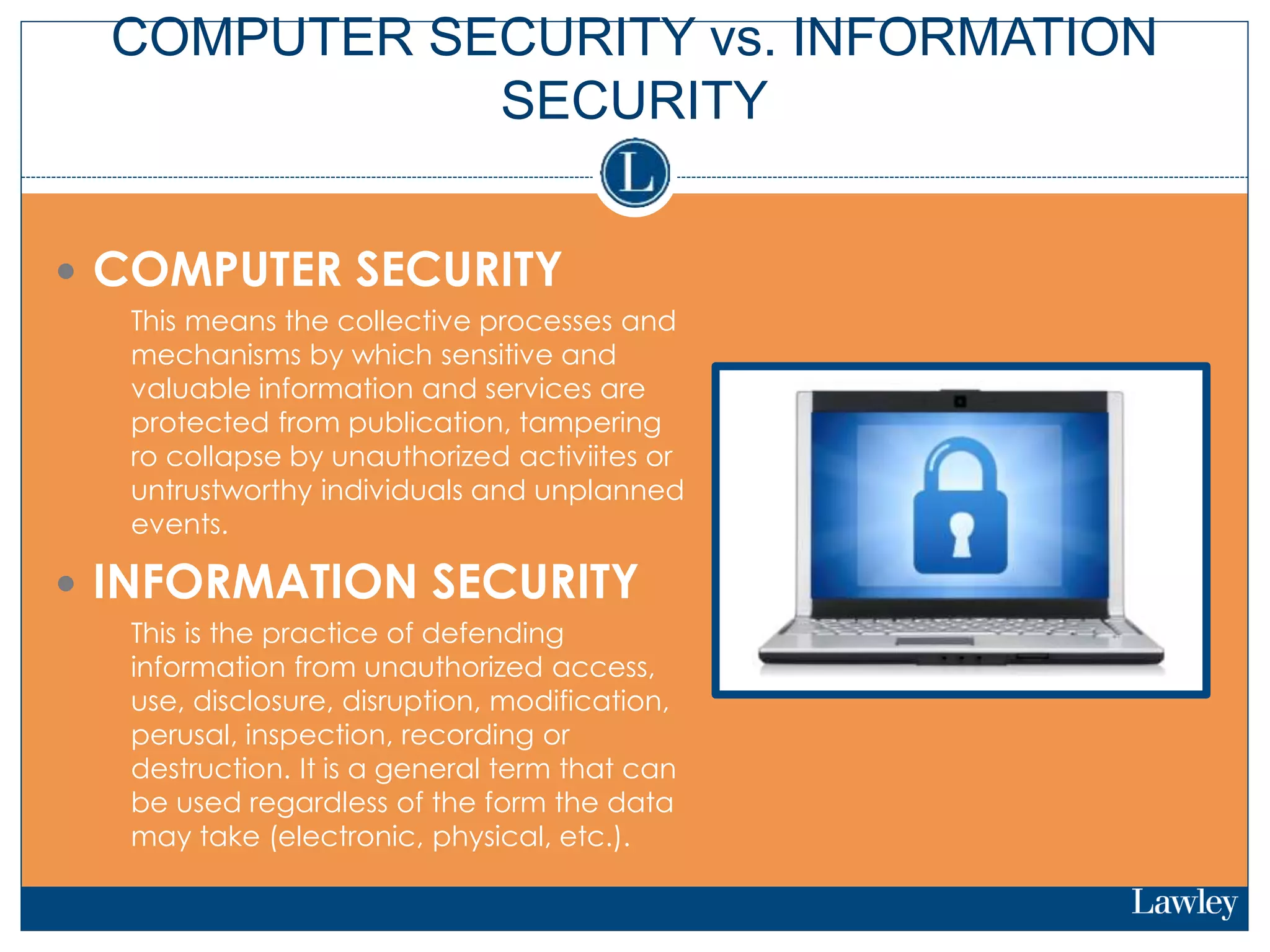
 COMPUTER SECURITY
 This means the collective processes and
mechanisms by which sensitive and
valuable information and services are
protected from publication, tampering
ro collapse by unauthorized activiites or
untrustworthy individuals and unplanned
events.
 INFORMATION SECURITY
 This is the practice of defending
information from unauthorized access,
use, disclosure, disruption, modification,
perusal, inspection, recording or
destruction. It is a general term that can
be used regardless of the form the data
may take (electronic, physical, etc.).
INCIDENT RESPONSE PLAN
1. If a company does not have one they are playing with fire
2. Essential for company to have in place in order to effectively respond to a security
breach
3. IRP’s should be tested at least on an annual basis using various breach scenarios
4. IRP’s typically include:
1. A. IRP Team (Ideally SR Mgmt. in Info Tech, Customer Service, Legal, Privacy & PR
2. B. Clear guidelines categorizing a risk/threat level
3. C. Documentation Instructions
4. D. Guidelines for getting third parties involved
5. E. Notification Process
-- One of the most important practices --
 Sets the security foundation
 First measure that must be taken to
reduce the risk of unacceptable use
of the company’s information
resources
 Companies define which assets are
critical and ways to protect them
 Development and implementation
of a security policy turns employees
into active participants towards
securing company information
(helps prevent human factor)
 Should be tested and reviewed on
an annual basis
INFORMATION SECURITY POLICY
 Key factors to help a company
protect their systems
 Protection starts with firewalls as they
protect resources on a private
network
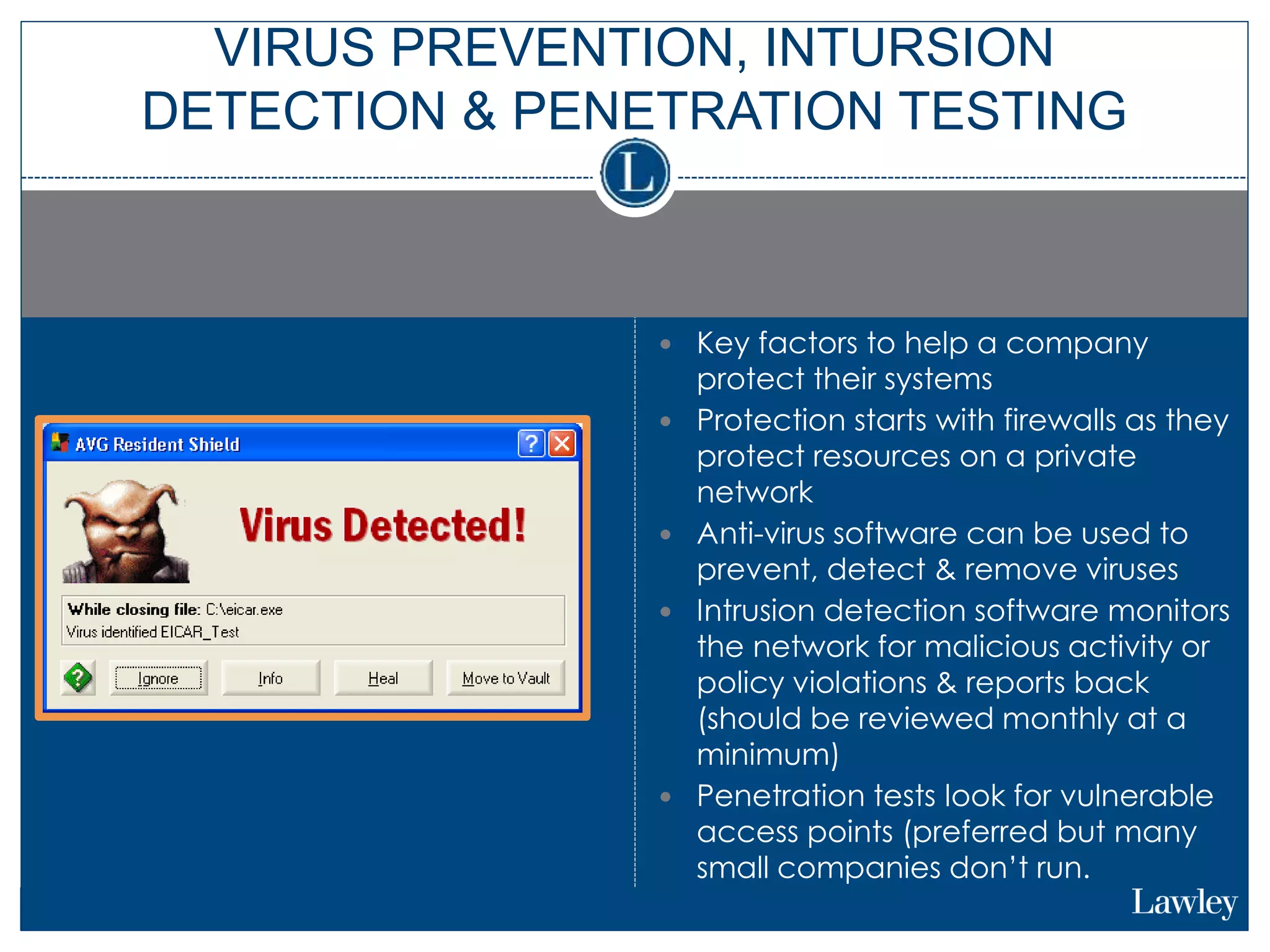
 Anti-virus software can be used to
prevent, detect & remove viruses
 Intrusion detection software monitors
the network for malicious activity or
policy violations & reports back
(should be reviewed monthly at a
minimum)
 Penetration tests look for vulnerable
access points (preferred but many
small companies don’t run.
VIRUS PREVENTION, INTURSION
DETECTION & PENETRATION TESTING
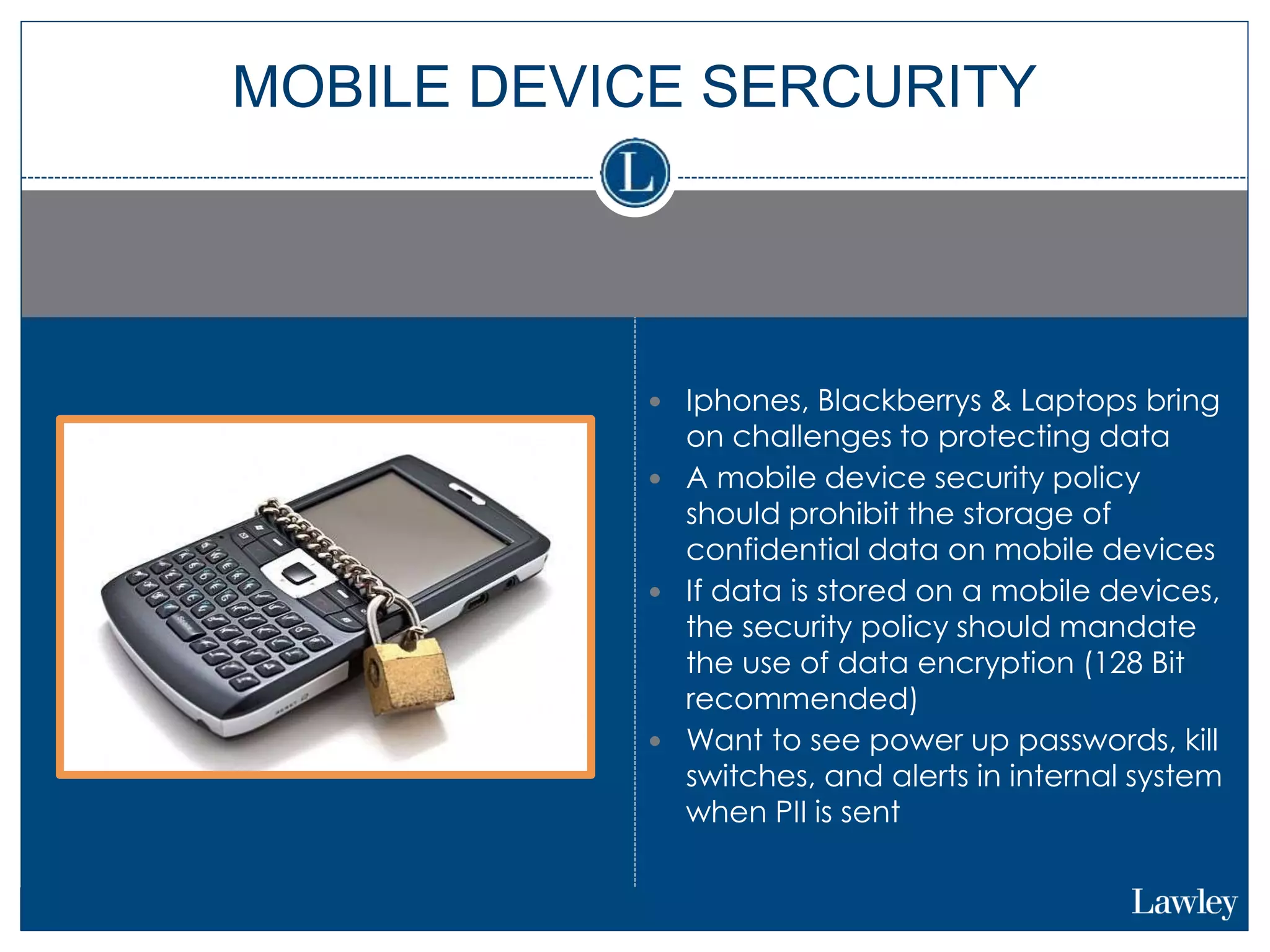
 Iphones, Blackberrys & Laptops bring
on challenges to protecting data
 A mobile device security policy
should prohibit the storage of
confidential data on mobile devices
 If data is stored on a mobile devices,
the security policy should mandate
the use of data encryption (128 Bit
recommended)
 Want to see power up passwords, kill
switches, and alerts in internal system
when PII is sent
MOBILE DEVICE SERCURITY
WHAT WE CAN PROVIDE IN
PROTECTION & PREVENTION
CYBERSECURITY
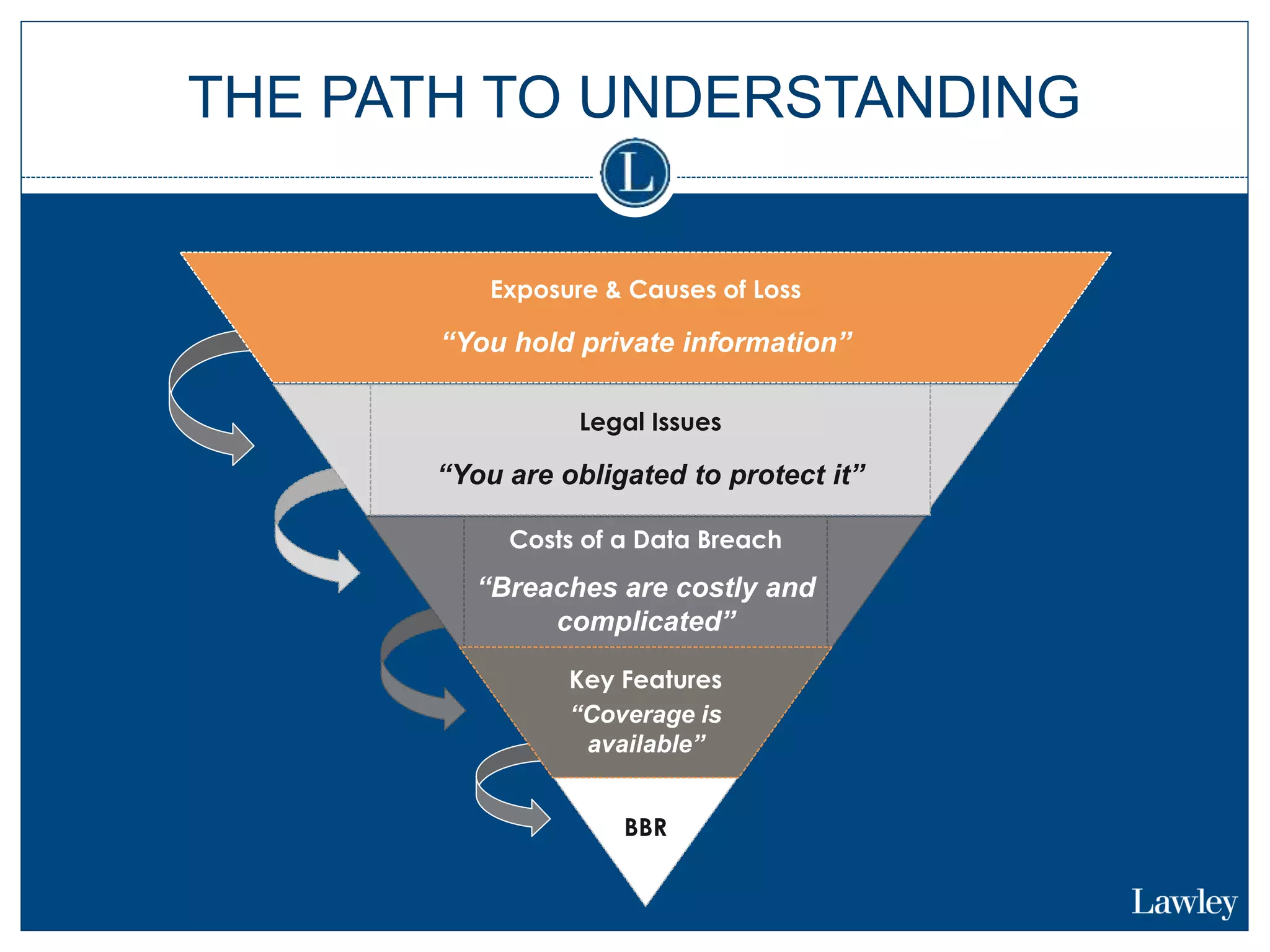
THE PATH TO UNDERSTANDING
Exposure & Causes of Loss
“You hold private information”
Legal Issues
“You are obligated to protect it”
Costs of a Data Breach
“Breaches are costly and
complicated”
BBR
Key Features
“Coverage is
available”
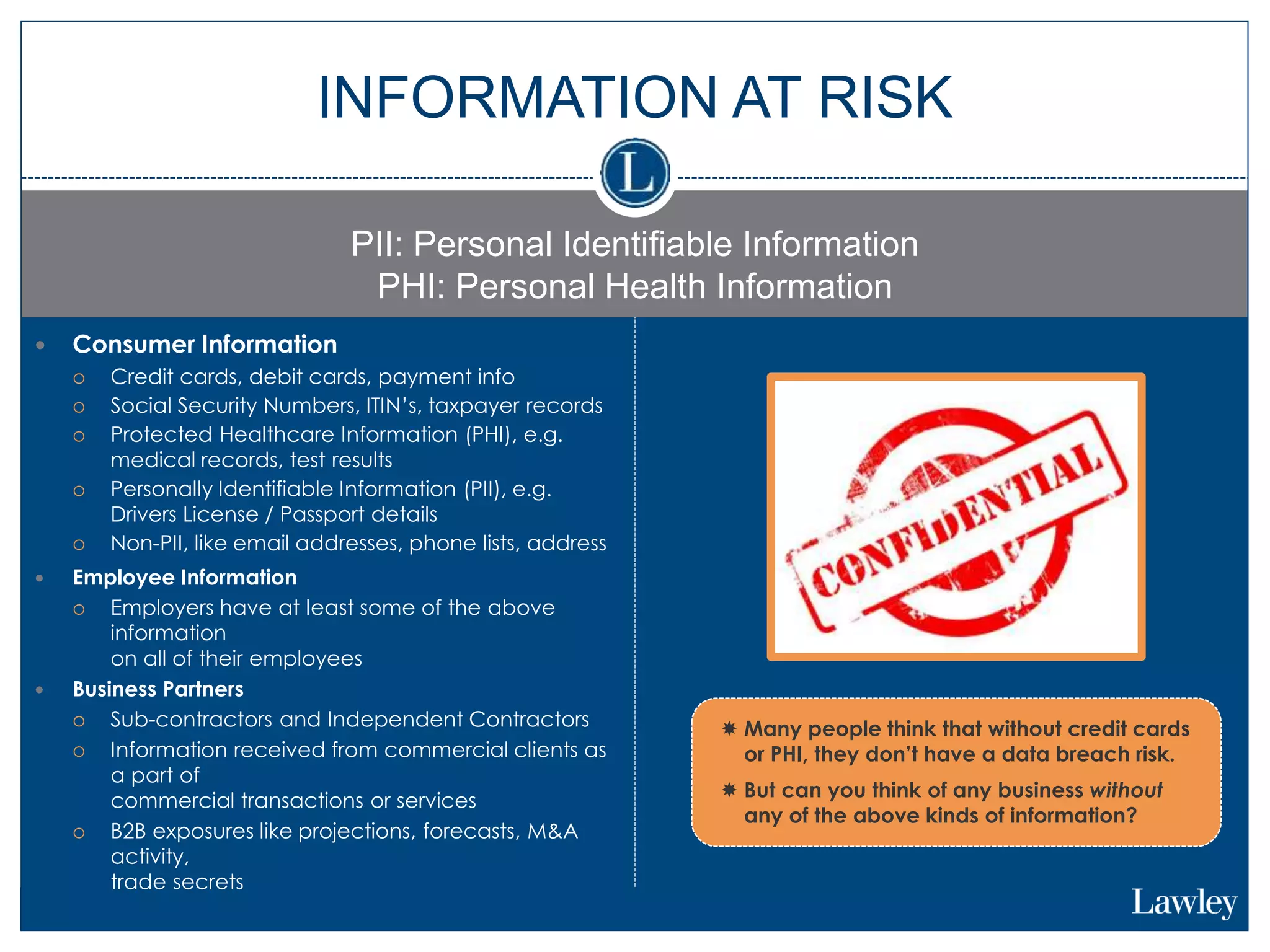
 Consumer Information
 Credit cards, debit cards, payment info
 Social Security Numbers, ITIN’s, taxpayer records
 Protected Healthcare Information (PHI), e.g.
medical records, test results
 Personally Identifiable Information (PII), e.g.
Drivers License / Passport details
 Non-PII, like email addresses, phone lists, address
 Employee Information
 Employers have at least some of the above
information
on all of their employees
 Business Partners
 Sub-contractors and Independent Contractors
 Information received from commercial clients as
a part of
commercial transactions or services
 B2B exposures like projections, forecasts, M&A
activity,
trade secrets
INFORMATION AT RISK
PII: Personal Identifiable Information
PHI: Personal Health Information
 Many people think that without credit cards
or PHI, they don’t have a data breach risk.
 But can you think of any business without
any of the above kinds of information?
WHAT IS A DATA BREACH?
 Actual release or disclosure of information to an unauthorized
individual/entity
that relates to a person and that:
 May cause the person inconvenience or harm (financial/reputational)
 - Personally Identifiable Information (PII)
 - Protected Healthcare Information (PHI)
 May cause your company inconvenience or harm
(financial/reputational)
 - Customer Data, Applicant Data
 - Current/Former Employee Data, Applicant Data
 - Corporate Information/Intellectual Property
 Paper or Electronic
 Potential Security Threats
 - Compromises to the integrity, security or confidentiality of
information
 - Circumstances where a data breach may have happened or could
happen
in the future. (e.g. lost flash drive with PII)
KEY CAUSES OF LOSS
• Lost/Stolen Portable
Computers or Media
• Employee Misuse
• Negligent Release
• Improper Disposal of
Paper Records
• Lost/Stolen Backup
Tapes
• Computer Hacking
• Vendor Negligence
• Improper Disposal of
Computer Equipment
Hackers make the headlines, but almost
half of data breach incidents result from
“insider negligence”.
(Ponemon Institute)
815 MILLION
RECORDS
LEAKED
Since Privacy Rights Clearinghouse began tracking US data breaches
in 2005
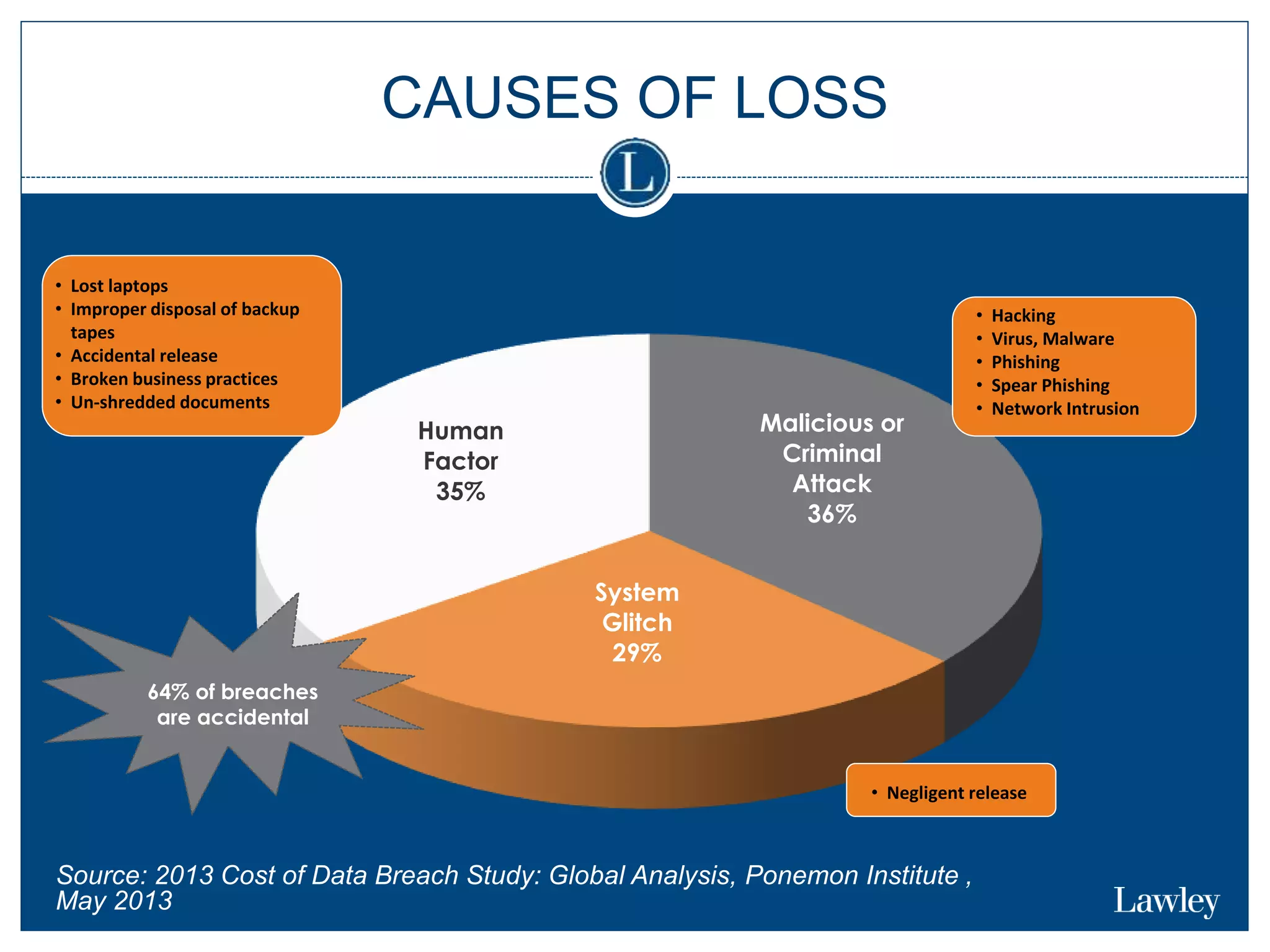
CAUSES OF LOSS
Malicious or
Criminal
Attack
36%
System
Glitch
29%
Human
Factor
35%
• Hacking
• Virus, Malware
• Phishing
• Spear Phishing
• Network Intrusion
• Lost laptops
• Improper disposal of backup
tapes
• Accidental release
• Broken business practices
• Un-shredded documents
• Negligent release
Source: 2013 Cost of Data Breach Study: Global Analysis, Ponemon Institute ,
May 2013
64% of breaches
are accidental
TYPICAL COSTS
• Response costs – sending out notices, call center services, and the offer of
credit monitoring:
o Up to $30 per record
• Forensics, to determine the size and scope of the breach:
o $25,000 to more than $500,000
• Legal Costs:
o Very costly: $200,000 up to the millions
• A retailer with just 10 sales a day would pay $781,000 for a year’s worth of
breached records.
• An MRI facility conducting 15 scans a day would face expenses exceeding
$1 million for every year of patient records compromised.
IT TAKES 20
YEARS TO BUILD
A REPUTATION,
AND FIVE
MINUTES TO
DESTROY IT.
-- Warren
Buffett
“
”
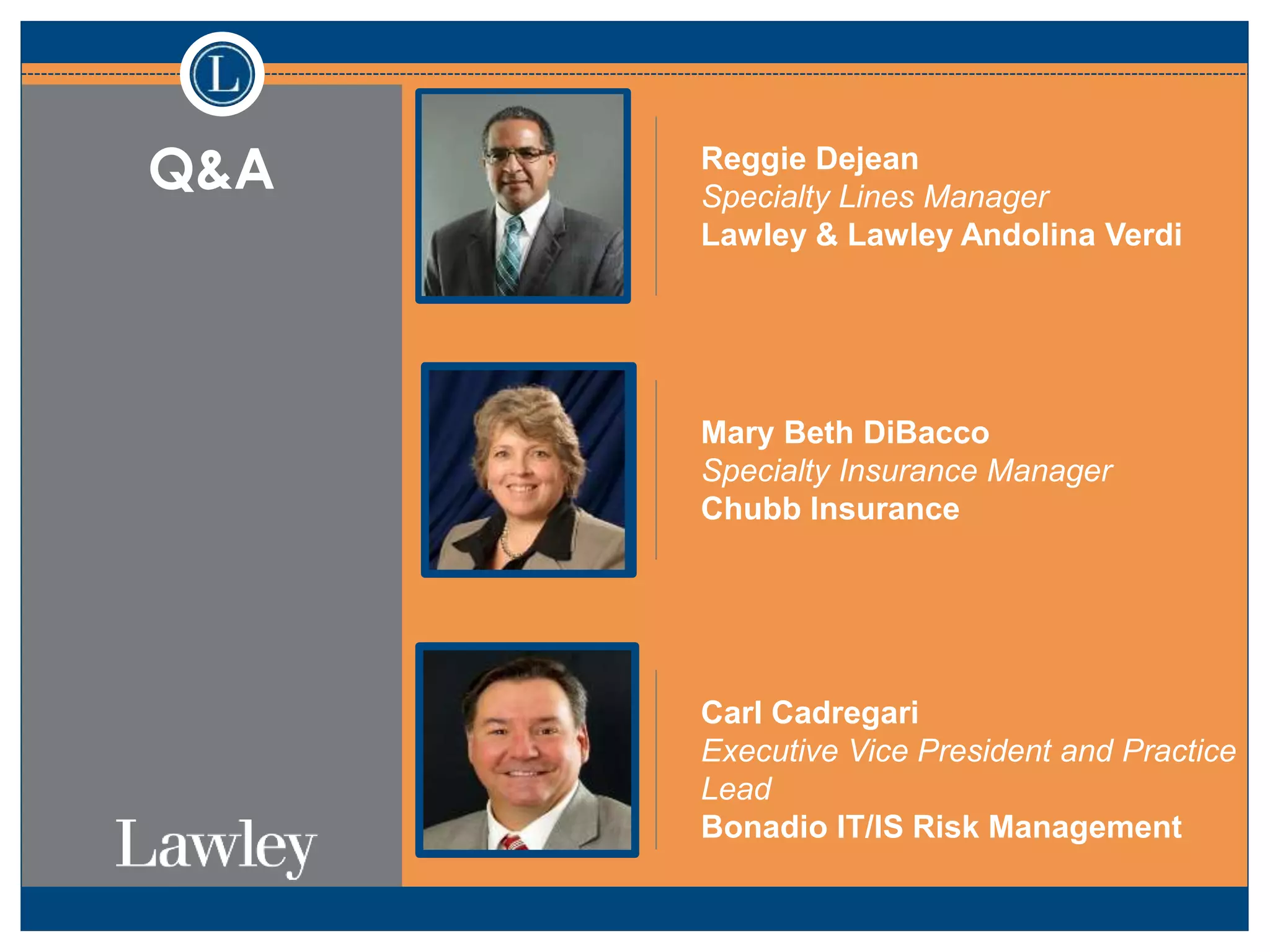
Q&A Reggie Dejean
Specialty Lines Manager
Lawley & Lawley Andolina Verdi
Mary Beth DiBacco
Specialty Insurance Manager
Chubb Insurance
Carl Cadregari
Executive Vice President and Practice
Lead
Bonadio IT/IS Risk Management
THANK YOU
Lawley Insurance

Cybersecurity Seminar March 2015

  • 1.
    C Y BE R S E C U R I T Y I N S U R A N C E S E M I N A R Can You Afford NOT To Have Cybersecurity? March 4, 2015
  • 2.
    TODAY’S PRESENTERS Reggie Dejean Specialty LinesManager Lawley & Lawley Andolina Verdi Mary Beth DiBacco Specialty Insurance Manager Chubb Insurance Carl Cadregari Executive Vice President and Practice Lead Bonadio IT/IS Risk Management
  • 3.
  • 4.
  • 5.
    HEADLINES EXPLAINED  Identitiesleft exposed in Indiana salvage yards - items included medical records, bank statements, insurance cards, employee identification cards, car registrations, a signature, a child’s name, dates of birth, and an application for welfare assistance.  Stolen Pioneer bank laptop contained some customers’ data  Pioneer Bank over the weekend alerted some of its customers that an employee’s laptop stolen Jan. 26 contained “secured personal information of certain customers, including names, social security numbers, street addresses, and account and debit card numbers.”  Harel Chiropractic Clinic notifies 3,000 patients of breach
  • 6.
    HEADLINES EXPLAINED CONT. St. Peter’s Health Partners is warning of a possible data breach in its email system, following the theft of a manager’s cellphone.  California Pacific Medical Center discovers employee was improperly accessing patient records for one year  Natural Grocers Investigating Card Breach - traced a pattern of fraud on customer credit and debit cards suggesting that hackers have tapped into cash registers at Natural Grocers locations across the country
  • 7.
    HEADLINES EXPLAINED CONT. Data Breach Results in $4.8 Million HIPAA Settlements from New York and Presbyterian Hospital  A 214 bed Medical Center laptop stolen with data in an excel spreadsheet - Medical Center says data is safe since the thief would have to know how to unhide columns in Excel spreadsheet to read them
  • 8.
    THREATS TO DATA Internal Threats  External Threats  Have You Heard About Target?  Not just credit card information but also personal identifiable information (PII) is at risk  According to recent surveys  Street Cost – Social Security Number……..$ 1.00  Street Cost – Financial Record ……........... $ 0.50  Lost Medical Record………………………..$316.00
  • 9.
    CSIRP Computer Security IncidentResponse Plan • Wh a t to d o wh e n y o u “ th i n k o r k n o w” y o u h a v e h a d a d i s c l o s u r e • Th e wh o , wh a t wh e r e a n d wh e n to f o l l o w • S te p b y s te p p r o c e s s • M a y b e r e q u i r e d b y s o m e l a ws a n d r e g u l a ti o n s
  • 10.
    CSIRP You Need aBreach Notification Policy 1. NY State, HIPAA, PCI, GLBA requires a documented policy that includes all factors of breach notification including: • When to alert persons whose data has been breached • What you have to pay for • When to send lost data information to the Attorney General and regulatory bodies • When you are to place conspicuous notice on your website • When you are to alert local media and television
  • 11.
    CSIRP You need aplan to follow that includes: 1. What constitutes a breach 2. Who is on the team 3. Who is allowed to talk to any external entity 4. When to involve external crisis management 5. When to trigger your liability policy
  • 12.
    CSIRP 1. How toassess the risks (likelihood and severity) 2. Does the breach fall into pre-defined categories (and what are they) 3. What to do to investigate the breach 4. What to do to minimize the breach 5. What to do to report on the breach 6. What to do to never repeat the breach 7. How to close the incident
  • 13.
    AFTER THE INFORMATION HASBEEN GATHERED INFORMATION
  • 14.
    WHAT IS THEIMMEDIATE EXPENSE? • Notification • Creating letter or other notification • Printing or design • Mailing or other transmission • Public Relations • Call Center operations • Credit Monitoring or Identity Theft Remediation • Advertising & Press Releases • Forensics • Legal Expenses for outside Attorney • Cost of Forensic Examination • Cost to Remediate Discovered Vulnerabilities
  • 15.
    KEY COSTS TOA DATA BREACH DIRECT COSTS VICTIM COSTS INDIRECT COSTS ($134) Cost Per Record $201 (2014) • Discovery • Data Forensics • Notification • Call Center • Identity Monitoring • Identity Remediation • Lawsuits • Regulatory Fines • Additional Security & Audit Requirements • Reputational Damage/Lost Business Source: Ponemon Institute, LLC and Symantec Corporation. 2014 Annual Study: U.S. Cost of a Data Breach. March 2014
  • 16.
    DATA IS VULNERABLE Datacan escape your organization in many different ways Source: Privacy Rights Clearinghouse, Chronology of Data Breaches 2008-2013. www.privacyrights.org 4% 6% 12% 12% 18% 23% 25% STATIONARY DEVICE UNKNOWN PHYSICAL MALICIOUS INSIDER NEGLIGENCE HACKING PORTABLE DEVICES
  • 17.
    COMPUTER SECURITY vs.INFORMATION SECURITY  COMPUTER SECURITY  This means the collective processes and mechanisms by which sensitive and valuable information and services are protected from publication, tampering ro collapse by unauthorized activiites or untrustworthy individuals and unplanned events.  INFORMATION SECURITY  This is the practice of defending information from unauthorized access, use, disclosure, disruption, modification, perusal, inspection, recording or destruction. It is a general term that can be used regardless of the form the data may take (electronic, physical, etc.).
  • 18.
    INCIDENT RESPONSE PLAN 1.If a company does not have one they are playing with fire 2. Essential for company to have in place in order to effectively respond to a security breach 3. IRP’s should be tested at least on an annual basis using various breach scenarios 4. IRP’s typically include: 1. A. IRP Team (Ideally SR Mgmt. in Info Tech, Customer Service, Legal, Privacy & PR 2. B. Clear guidelines categorizing a risk/threat level 3. C. Documentation Instructions 4. D. Guidelines for getting third parties involved 5. E. Notification Process -- One of the most important practices --
  • 19.
     Sets thesecurity foundation  First measure that must be taken to reduce the risk of unacceptable use of the company’s information resources  Companies define which assets are critical and ways to protect them  Development and implementation of a security policy turns employees into active participants towards securing company information (helps prevent human factor)  Should be tested and reviewed on an annual basis INFORMATION SECURITY POLICY
  • 20.
     Key factorsto help a company protect their systems  Protection starts with firewalls as they protect resources on a private network  Anti-virus software can be used to prevent, detect & remove viruses  Intrusion detection software monitors the network for malicious activity or policy violations & reports back (should be reviewed monthly at a minimum)  Penetration tests look for vulnerable access points (preferred but many small companies don’t run. VIRUS PREVENTION, INTURSION DETECTION & PENETRATION TESTING
  • 21.
     Iphones, Blackberrys& Laptops bring on challenges to protecting data  A mobile device security policy should prohibit the storage of confidential data on mobile devices  If data is stored on a mobile devices, the security policy should mandate the use of data encryption (128 Bit recommended)  Want to see power up passwords, kill switches, and alerts in internal system when PII is sent MOBILE DEVICE SERCURITY
  • 22.
    WHAT WE CANPROVIDE IN PROTECTION & PREVENTION CYBERSECURITY
  • 23.
    THE PATH TOUNDERSTANDING Exposure & Causes of Loss “You hold private information” Legal Issues “You are obligated to protect it” Costs of a Data Breach “Breaches are costly and complicated” BBR Key Features “Coverage is available”
  • 24.
     Consumer Information Credit cards, debit cards, payment info  Social Security Numbers, ITIN’s, taxpayer records  Protected Healthcare Information (PHI), e.g. medical records, test results  Personally Identifiable Information (PII), e.g. Drivers License / Passport details  Non-PII, like email addresses, phone lists, address  Employee Information  Employers have at least some of the above information on all of their employees  Business Partners  Sub-contractors and Independent Contractors  Information received from commercial clients as a part of commercial transactions or services  B2B exposures like projections, forecasts, M&A activity, trade secrets INFORMATION AT RISK PII: Personal Identifiable Information PHI: Personal Health Information  Many people think that without credit cards or PHI, they don’t have a data breach risk.  But can you think of any business without any of the above kinds of information?
  • 25.
    WHAT IS ADATA BREACH?  Actual release or disclosure of information to an unauthorized individual/entity that relates to a person and that:  May cause the person inconvenience or harm (financial/reputational)  - Personally Identifiable Information (PII)  - Protected Healthcare Information (PHI)  May cause your company inconvenience or harm (financial/reputational)  - Customer Data, Applicant Data  - Current/Former Employee Data, Applicant Data  - Corporate Information/Intellectual Property  Paper or Electronic  Potential Security Threats  - Compromises to the integrity, security or confidentiality of information  - Circumstances where a data breach may have happened or could happen in the future. (e.g. lost flash drive with PII)
  • 26.
    KEY CAUSES OFLOSS • Lost/Stolen Portable Computers or Media • Employee Misuse • Negligent Release • Improper Disposal of Paper Records • Lost/Stolen Backup Tapes • Computer Hacking • Vendor Negligence • Improper Disposal of Computer Equipment Hackers make the headlines, but almost half of data breach incidents result from “insider negligence”. (Ponemon Institute)
  • 27.
    815 MILLION RECORDS LEAKED Since PrivacyRights Clearinghouse began tracking US data breaches in 2005
  • 28.
    CAUSES OF LOSS Maliciousor Criminal Attack 36% System Glitch 29% Human Factor 35% • Hacking • Virus, Malware • Phishing • Spear Phishing • Network Intrusion • Lost laptops • Improper disposal of backup tapes • Accidental release • Broken business practices • Un-shredded documents • Negligent release Source: 2013 Cost of Data Breach Study: Global Analysis, Ponemon Institute , May 2013 64% of breaches are accidental
  • 29.
    TYPICAL COSTS • Responsecosts – sending out notices, call center services, and the offer of credit monitoring: o Up to $30 per record • Forensics, to determine the size and scope of the breach: o $25,000 to more than $500,000 • Legal Costs: o Very costly: $200,000 up to the millions • A retailer with just 10 sales a day would pay $781,000 for a year’s worth of breached records. • An MRI facility conducting 15 scans a day would face expenses exceeding $1 million for every year of patient records compromised.
  • 30.
    IT TAKES 20 YEARSTO BUILD A REPUTATION, AND FIVE MINUTES TO DESTROY IT. -- Warren Buffett “ ”
  • 31.
    Q&A Reggie Dejean SpecialtyLines Manager Lawley & Lawley Andolina Verdi Mary Beth DiBacco Specialty Insurance Manager Chubb Insurance Carl Cadregari Executive Vice President and Practice Lead Bonadio IT/IS Risk Management
  • 32.