Shawn E. Tuma | Scheef & Stone, LLP
Cybersecurity & Data Privacy Attorney
214.472.2135 |
Shawn.tuma@solidcounsel.com
THE LEGAL CASE FOR
CYBERSECURITY
@shawnetuma
BusinessCyberRisk.com
Cybersecurity
A Legal Issue?
www.solidcounsel.com
Shawn Tuma
(214) 472-2135
Shawn.Tuma@solidcounsel.com
www.shawnetuma.com
@shawnetuma
“Security and IT protect companies’ data;
Legal protects companies from their data.”
www.solidcounsel.com
Shawn Tuma
(214) 472-2135
Shawn.Tuma@solidcounsel.com
www.shawnetuma.com
@shawnetuma
“Cybersecurity is no longer just an IT
issue—it is an overall business risk issue.”
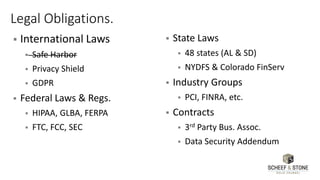
Legal Obligations.
Easily preventable
• 90% in 2014
• 91% in 2015
▪ International Laws
▪ Safe Harbor
▪ Privacy Shield
▪ GDPR
▪ Federal Laws & Regs.
▪ HIPAA, GLBA, FERPA
▪ FTC, FCC, SEC
▪ State Laws
▪ 48 states (AL & SD)
▪ NYDFS & Colorado FinServ
▪ Industry Groups
▪ PCI, FINRA, etc.
▪ Contracts
▪ 3rd Party Bus. Assoc.
▪ Data Security Addendum
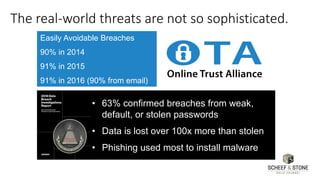
The real-world threats are not so sophisticated.
Easily preventable
• 90% in 2014
• 91% in 2015
• 63% confirmed breaches from weak,
default, or stolen passwords
• Data is lost over 100x more than stolen
• Phishing used most to install malware
Easily Avoidable Breaches
90% in 2014
91% in 2015
91% in 2016 (90% from email)
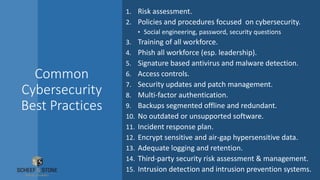
Common
Cybersecurity
Best Practices
1. Risk assessment.
2. Policies and procedures focused on cybersecurity.
• Social engineering, password, security questions
3. Training of all workforce.
4. Phish all workforce (esp. leadership).
5. Signature based antivirus and malware detection.
6. Access controls.
7. Security updates and patch management.
8. Multi-factor authentication.
9. Backups segmented offline and redundant.
10. No outdated or unsupported software.
11. Incident response plan.
12. Encrypt sensitive and air-gap hypersensitive data.
13. Adequate logging and retention.
14. Third-party security risk assessment & management.
15. Intrusion detection and intrusion prevention systems.
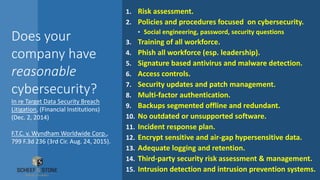
Does your
company have
reasonable
cybersecurity?
In re Target Data Security Breach
Litigation, (Financial Institutions)
(Dec. 2, 2014)
F.T.C. v. Wyndham Worldwide Corp.,
799 F.3d 236 (3rd Cir. Aug. 24, 2015).
1. Risk assessment.
2. Policies and procedures focused on cybersecurity.
• Social engineering, password, security questions
3. Training of all workforce.
4. Phish all workforce (esp. leadership).
5. Signature based antivirus and malware detection.
6. Access controls.
7. Security updates and patch management.
8. Multi-factor authentication.
9. Backups segmented offline and redundant.
10. No outdated or unsupported software.
11. Incident response plan.
12. Encrypt sensitive and air-gap hypersensitive data.
13. Adequate logging and retention.
14. Third-party security risk assessment & management.
15. Intrusion detection and intrusion prevention systems.
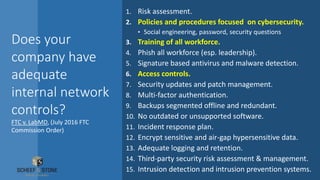
Does your
company have
adequate
internal network
controls?
FTC v. LabMD, (July 2016 FTC
Commission Order)
1. Risk assessment.
2. Policies and procedures focused on cybersecurity.
• Social engineering, password, security questions
3. Training of all workforce.
4. Phish all workforce (esp. leadership).
5. Signature based antivirus and malware detection.
6. Access controls.
7. Security updates and patch management.
8. Multi-factor authentication.
9. Backups segmented offline and redundant.
10. No outdated or unsupported software.
11. Incident response plan.
12. Encrypt sensitive and air-gap hypersensitive data.
13. Adequate logging and retention.
14. Third-party security risk assessment & management.
15. Intrusion detection and intrusion prevention systems.
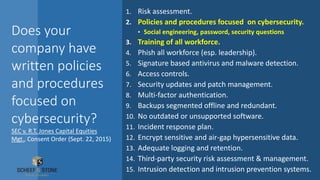
Does your
company have
written policies
and procedures
focused on
cybersecurity?
SEC v. R.T. Jones Capital Equities
Mgt., Consent Order (Sept. 22, 2015)
1. Risk assessment.
2. Policies and procedures focused on cybersecurity.
• Social engineering, password, security questions
3. Training of all workforce.
4. Phish all workforce (esp. leadership).
5. Signature based antivirus and malware detection.
6. Access controls.
7. Security updates and patch management.
8. Multi-factor authentication.
9. Backups segmented offline and redundant.
10. No outdated or unsupported software.
11. Incident response plan.
12. Encrypt sensitive and air-gap hypersensitive data.
13. Adequate logging and retention.
14. Third-party security risk assessment & management.
15. Intrusion detection and intrusion prevention systems.
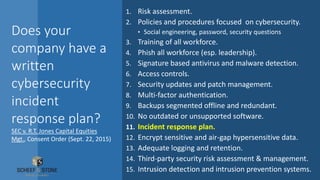
Does your
company have a
written
cybersecurity
incident
response plan?
SEC v. R.T. Jones Capital Equities
Mgt., Consent Order (Sept. 22, 2015)
1. Risk assessment.
2. Policies and procedures focused on cybersecurity.
• Social engineering, password, security questions
3. Training of all workforce.
4. Phish all workforce (esp. leadership).
5. Signature based antivirus and malware detection.
6. Access controls.
7. Security updates and patch management.
8. Multi-factor authentication.
9. Backups segmented offline and redundant.
10. No outdated or unsupported software.
11. Incident response plan.
12. Encrypt sensitive and air-gap hypersensitive data.
13. Adequate logging and retention.
14. Third-party security risk assessment & management.
15. Intrusion detection and intrusion prevention systems.
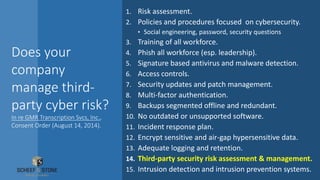
Does your
company
manage third-
party cyber risk?
In re GMR Transcription Svcs, Inc.,
Consent Order (August 14, 2014).
1. Risk assessment.
2. Policies and procedures focused on cybersecurity.
• Social engineering, password, security questions
3. Training of all workforce.
4. Phish all workforce (esp. leadership).
5. Signature based antivirus and malware detection.
6. Access controls.
7. Security updates and patch management.
8. Multi-factor authentication.
9. Backups segmented offline and redundant.
10. No outdated or unsupported software.
11. Incident response plan.
12. Encrypt sensitive and air-gap hypersensitive data.
13. Adequate logging and retention.
14. Third-party security risk assessment & management.
15. Intrusion detection and intrusion prevention systems.
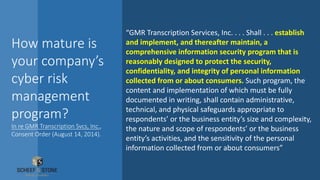
How mature is
your company’s
cyber risk
management
program?
In re GMR Transcription Svcs, Inc.,
Consent Order (August 14, 2014).
“GMR Transcription Services, Inc. . . . Shall . . . establish
and implement, and thereafter maintain, a
comprehensive information security program that is
reasonably designed to protect the security,
confidentiality, and integrity of personal information
collected from or about consumers. Such program, the
content and implementation of which must be fully
documented in writing, shall contain administrative,
technical, and physical safeguards appropriate to
respondents’ or the business entity’s size and complexity,
the nature and scope of respondents’ or the business
entity’s activities, and the sensitivity of the personal
information collected from or about consumers”
www.solidcounsel.com
New York Department of Financial Services Cybersecurity (NYDFS)
Requirements for Financial Services Companies + [fill in]
• All NY “financial institutions” + third party service providers.
• Third party service providers – examine, obligate, audit.
• Establish Cybersecurity Program (w/ specifics):
• Logging, Data Classification, IDS, IPS;
• Pen Testing, Vulnerability Assessments, Risk Assessment; and
• Encryption, Access Controls.
• Adopt Cybersecurity Policies.
• Designate qualified CISO to be responsible.
• Adequate cybersecurity personnel and intelligence.
• Personnel Policies & Procedures, Training, Written IRP.
• Chairman or Senior Officer Certify Compliance.
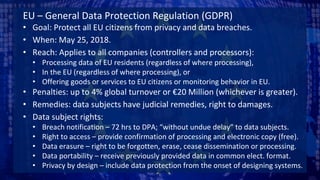
EU – General Data Protection Regulation (GDPR)
• Goal: Protect all EU citizens from privacy and data breaches.
• When: May 25, 2018.
• Reach: Applies to all companies (controllers and processors):
• Processing data of EU residents (regardless of where processing),
• In the EU (regardless of where processing), or
• Offering goods or services to EU citizens or monitoring behavior in EU.
• Penalties: up to 4% global turnover or €20 Million (whichever is greater).
• Remedies: data subjects have judicial remedies, right to damages.
• Data subject rights:
• Breach notification – 72 hrs to DPA; “without undue delay” to data subjects.
• Right to access – provide confirmation of processing and electronic copy (free).
• Data erasure – right to be forgotten, erase, cease dissemination or processing.
• Data portability – receive previously provided data in common elect. format.
• Privacy by design – include data protection from the onset of designing systems.
www.solidcounsel.com
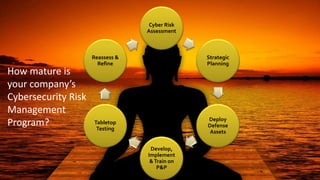
Cyber Risk
Assessment
Strategic
Planning
Deploy
Defense
Assets
Develop,
Implement
&Train on
P&P
Tabletop
Testing
Reassess &
Refine
How mature is
your company’s
Cybersecurity Risk
Management
Program?
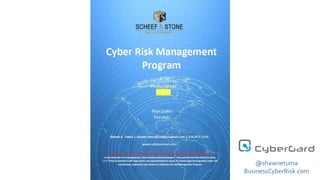
Cyber Risk
Management Program
@shawnetuma
BusinessCyberRisk.com
Cyber Risk
Management Program
@shawnetuma
BusinessCyberRisk.com
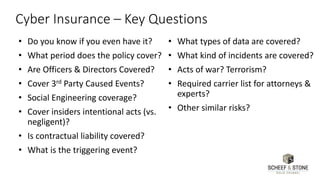
Cyber Insurance
Cyber Insurance – Key Questions
• Do you know if you even have it?
• What period does the policy cover?
• Are Officers & Directors Covered?
• Cover 3rd Party Caused Events?
• Social Engineering coverage?
• Cover insiders intentional acts (vs.
negligent)?
• Is contractual liability covered?
• What is the triggering event?
• What types of data are covered?
• What kind of incidents are covered?
• Acts of war? Terrorism?
• Required carrier list for attorneys &
experts?
• Other similar risks?
www.solidcounsel.com
“You don’t drown by
falling in the water;
You drown by staying
there.” – Edwin Louis Cole
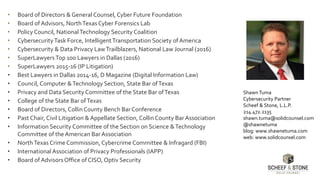
• Board of Directors & General Counsel, Cyber Future Foundation
• Board of Advisors, NorthTexas Cyber Forensics Lab
• Policy Council, NationalTechnology Security Coalition
• CybersecurityTask Force, IntelligentTransportation Society ofAmerica
• Cybersecurity & Data Privacy LawTrailblazers, National Law Journal (2016)
• SuperLawyersTop 100 Lawyers in Dallas (2016)
• SuperLawyers 2015-16 (IP Litigation)
• Best Lawyers in Dallas 2014-16, D Magazine (Digital Information Law)
• Council, Computer &Technology Section, State Bar ofTexas
• Privacy and Data Security Committee of the State Bar ofTexas
• College of the State Bar ofTexas
• Board of Directors, Collin County Bench Bar Conference
• Past Chair, Civil Litigation & Appellate Section, Collin County Bar Association
• Information Security Committee of the Section on Science &Technology
Committee of the American Bar Association
• NorthTexasCrime Commission, Cybercrime Committee & Infragard (FBI)
• International Association of Privacy Professionals (IAPP)
• Board of Advisors Office of CISO, Optiv Security
Shawn Tuma
Cybersecurity Partner
Scheef & Stone, L.L.P.
214.472.2135
shawn.tuma@solidcounsel.com
@shawnetuma
blog: www.shawnetuma.com
web: www.solidcounsel.com

The Legal Case for Cybersecurity

  • 1.
    Shawn E. Tuma| Scheef & Stone, LLP Cybersecurity & Data Privacy Attorney 214.472.2135 | Shawn.tuma@solidcounsel.com THE LEGAL CASE FOR CYBERSECURITY @shawnetuma BusinessCyberRisk.com
  • 4.
  • 5.
    www.solidcounsel.com Shawn Tuma (214) 472-2135 Shawn.Tuma@solidcounsel.com www.shawnetuma.com @shawnetuma “Securityand IT protect companies’ data; Legal protects companies from their data.”
  • 6.
  • 7.
    Legal Obligations. Easily preventable •90% in 2014 • 91% in 2015 ▪ International Laws ▪ Safe Harbor ▪ Privacy Shield ▪ GDPR ▪ Federal Laws & Regs. ▪ HIPAA, GLBA, FERPA ▪ FTC, FCC, SEC ▪ State Laws ▪ 48 states (AL & SD) ▪ NYDFS & Colorado FinServ ▪ Industry Groups ▪ PCI, FINRA, etc. ▪ Contracts ▪ 3rd Party Bus. Assoc. ▪ Data Security Addendum
  • 8.
    The real-world threatsare not so sophisticated. Easily preventable • 90% in 2014 • 91% in 2015 • 63% confirmed breaches from weak, default, or stolen passwords • Data is lost over 100x more than stolen • Phishing used most to install malware Easily Avoidable Breaches 90% in 2014 91% in 2015 91% in 2016 (90% from email)
  • 9.
    Common Cybersecurity Best Practices 1. Riskassessment. 2. Policies and procedures focused on cybersecurity. • Social engineering, password, security questions 3. Training of all workforce. 4. Phish all workforce (esp. leadership). 5. Signature based antivirus and malware detection. 6. Access controls. 7. Security updates and patch management. 8. Multi-factor authentication. 9. Backups segmented offline and redundant. 10. No outdated or unsupported software. 11. Incident response plan. 12. Encrypt sensitive and air-gap hypersensitive data. 13. Adequate logging and retention. 14. Third-party security risk assessment & management. 15. Intrusion detection and intrusion prevention systems.
  • 10.
    Does your company have reasonable cybersecurity? Inre Target Data Security Breach Litigation, (Financial Institutions) (Dec. 2, 2014) F.T.C. v. Wyndham Worldwide Corp., 799 F.3d 236 (3rd Cir. Aug. 24, 2015). 1. Risk assessment. 2. Policies and procedures focused on cybersecurity. • Social engineering, password, security questions 3. Training of all workforce. 4. Phish all workforce (esp. leadership). 5. Signature based antivirus and malware detection. 6. Access controls. 7. Security updates and patch management. 8. Multi-factor authentication. 9. Backups segmented offline and redundant. 10. No outdated or unsupported software. 11. Incident response plan. 12. Encrypt sensitive and air-gap hypersensitive data. 13. Adequate logging and retention. 14. Third-party security risk assessment & management. 15. Intrusion detection and intrusion prevention systems.
  • 11.
    Does your company have adequate internalnetwork controls? FTC v. LabMD, (July 2016 FTC Commission Order) 1. Risk assessment. 2. Policies and procedures focused on cybersecurity. • Social engineering, password, security questions 3. Training of all workforce. 4. Phish all workforce (esp. leadership). 5. Signature based antivirus and malware detection. 6. Access controls. 7. Security updates and patch management. 8. Multi-factor authentication. 9. Backups segmented offline and redundant. 10. No outdated or unsupported software. 11. Incident response plan. 12. Encrypt sensitive and air-gap hypersensitive data. 13. Adequate logging and retention. 14. Third-party security risk assessment & management. 15. Intrusion detection and intrusion prevention systems.
  • 12.
    Does your company have writtenpolicies and procedures focused on cybersecurity? SEC v. R.T. Jones Capital Equities Mgt., Consent Order (Sept. 22, 2015) 1. Risk assessment. 2. Policies and procedures focused on cybersecurity. • Social engineering, password, security questions 3. Training of all workforce. 4. Phish all workforce (esp. leadership). 5. Signature based antivirus and malware detection. 6. Access controls. 7. Security updates and patch management. 8. Multi-factor authentication. 9. Backups segmented offline and redundant. 10. No outdated or unsupported software. 11. Incident response plan. 12. Encrypt sensitive and air-gap hypersensitive data. 13. Adequate logging and retention. 14. Third-party security risk assessment & management. 15. Intrusion detection and intrusion prevention systems.
  • 13.
    Does your company havea written cybersecurity incident response plan? SEC v. R.T. Jones Capital Equities Mgt., Consent Order (Sept. 22, 2015) 1. Risk assessment. 2. Policies and procedures focused on cybersecurity. • Social engineering, password, security questions 3. Training of all workforce. 4. Phish all workforce (esp. leadership). 5. Signature based antivirus and malware detection. 6. Access controls. 7. Security updates and patch management. 8. Multi-factor authentication. 9. Backups segmented offline and redundant. 10. No outdated or unsupported software. 11. Incident response plan. 12. Encrypt sensitive and air-gap hypersensitive data. 13. Adequate logging and retention. 14. Third-party security risk assessment & management. 15. Intrusion detection and intrusion prevention systems.
  • 14.
    Does your company manage third- partycyber risk? In re GMR Transcription Svcs, Inc., Consent Order (August 14, 2014). 1. Risk assessment. 2. Policies and procedures focused on cybersecurity. • Social engineering, password, security questions 3. Training of all workforce. 4. Phish all workforce (esp. leadership). 5. Signature based antivirus and malware detection. 6. Access controls. 7. Security updates and patch management. 8. Multi-factor authentication. 9. Backups segmented offline and redundant. 10. No outdated or unsupported software. 11. Incident response plan. 12. Encrypt sensitive and air-gap hypersensitive data. 13. Adequate logging and retention. 14. Third-party security risk assessment & management. 15. Intrusion detection and intrusion prevention systems.
  • 15.
    How mature is yourcompany’s cyber risk management program? In re GMR Transcription Svcs, Inc., Consent Order (August 14, 2014). “GMR Transcription Services, Inc. . . . Shall . . . establish and implement, and thereafter maintain, a comprehensive information security program that is reasonably designed to protect the security, confidentiality, and integrity of personal information collected from or about consumers. Such program, the content and implementation of which must be fully documented in writing, shall contain administrative, technical, and physical safeguards appropriate to respondents’ or the business entity’s size and complexity, the nature and scope of respondents’ or the business entity’s activities, and the sensitivity of the personal information collected from or about consumers”
  • 16.
    www.solidcounsel.com New York Departmentof Financial Services Cybersecurity (NYDFS) Requirements for Financial Services Companies + [fill in] • All NY “financial institutions” + third party service providers. • Third party service providers – examine, obligate, audit. • Establish Cybersecurity Program (w/ specifics): • Logging, Data Classification, IDS, IPS; • Pen Testing, Vulnerability Assessments, Risk Assessment; and • Encryption, Access Controls. • Adopt Cybersecurity Policies. • Designate qualified CISO to be responsible. • Adequate cybersecurity personnel and intelligence. • Personnel Policies & Procedures, Training, Written IRP. • Chairman or Senior Officer Certify Compliance.
  • 17.
    EU – GeneralData Protection Regulation (GDPR) • Goal: Protect all EU citizens from privacy and data breaches. • When: May 25, 2018. • Reach: Applies to all companies (controllers and processors): • Processing data of EU residents (regardless of where processing), • In the EU (regardless of where processing), or • Offering goods or services to EU citizens or monitoring behavior in EU. • Penalties: up to 4% global turnover or €20 Million (whichever is greater). • Remedies: data subjects have judicial remedies, right to damages. • Data subject rights: • Breach notification – 72 hrs to DPA; “without undue delay” to data subjects. • Right to access – provide confirmation of processing and electronic copy (free). • Data erasure – right to be forgotten, erase, cease dissemination or processing. • Data portability – receive previously provided data in common elect. format. • Privacy by design – include data protection from the onset of designing systems.
  • 18.
  • 19.
  • 20.
  • 21.
  • 22.
    Cyber Insurance –Key Questions • Do you know if you even have it? • What period does the policy cover? • Are Officers & Directors Covered? • Cover 3rd Party Caused Events? • Social Engineering coverage? • Cover insiders intentional acts (vs. negligent)? • Is contractual liability covered? • What is the triggering event? • What types of data are covered? • What kind of incidents are covered? • Acts of war? Terrorism? • Required carrier list for attorneys & experts? • Other similar risks?
  • 23.
    www.solidcounsel.com “You don’t drownby falling in the water; You drown by staying there.” – Edwin Louis Cole
  • 24.
    • Board ofDirectors & General Counsel, Cyber Future Foundation • Board of Advisors, NorthTexas Cyber Forensics Lab • Policy Council, NationalTechnology Security Coalition • CybersecurityTask Force, IntelligentTransportation Society ofAmerica • Cybersecurity & Data Privacy LawTrailblazers, National Law Journal (2016) • SuperLawyersTop 100 Lawyers in Dallas (2016) • SuperLawyers 2015-16 (IP Litigation) • Best Lawyers in Dallas 2014-16, D Magazine (Digital Information Law) • Council, Computer &Technology Section, State Bar ofTexas • Privacy and Data Security Committee of the State Bar ofTexas • College of the State Bar ofTexas • Board of Directors, Collin County Bench Bar Conference • Past Chair, Civil Litigation & Appellate Section, Collin County Bar Association • Information Security Committee of the Section on Science &Technology Committee of the American Bar Association • NorthTexasCrime Commission, Cybercrime Committee & Infragard (FBI) • International Association of Privacy Professionals (IAPP) • Board of Advisors Office of CISO, Optiv Security Shawn Tuma Cybersecurity Partner Scheef & Stone, L.L.P. 214.472.2135 shawn.tuma@solidcounsel.com @shawnetuma blog: www.shawnetuma.com web: www.solidcounsel.com