Cyberinfrastructure at Clemson Dr. D. E. (Steve) Stevenson Institute for Modeling and Simulation School of Computing (SoC), Clemson
Top Four CI Missions at Clemson’s SoC Develop  human-centered   CI  driven by  research   and  education  opportunities. Provide the CI communities  tools  and services. Promote  broadening participation  and  strengthening  the Nation’s workforce. Provide a  sustainable CI  that is essential for conducting science, engineering, and  industrial   research and education.
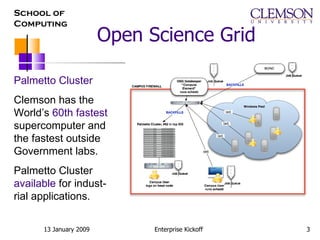
Open Science Grid Palmetto Cluster Clemson has the World’s  60th fastest  supercomputer and the fastest outside Government labs. Palmetto Cluster  available  for indust-rial applications.
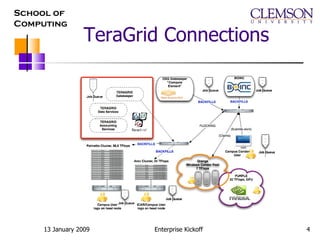
TeraGrid Connections
School of Computing The School of Computing will be a national leader in the development of divisions that integrate computation with the  arts, engineering, humanities, and natural sciences .
Current Strengths High Performance Computing and Cyberinfrastructure Graphics Virtual Environments Theory and Algorithms Software Engineering
Degree Programs Undergraduate B.S in Computer Science B.A in Computer Science B.S. in Computer Information Systems Graduate M.S. in Computer Science M.F.A. in Digital Production Arts Ph.D. in Computer Science
Existing Units Computer Science Study and research in traditional computer science areas of  Theory Systems Algorithms Software Engineering Cyberinfrastructure Visual Computing Study and research in Computer graphics Visualization  Computer vision and image processing  Electronic arts such as game design, special effects, and animation .
Developing Unit Human Center Computing (HCC) HCC is an emerging field focused on understanding how to make computational technologies more useable and how computational technologies affect society.  Human—Computer Interaction Broadening Participation Computing Education Societal Impact of Technology Human Factors User Interface Design
NVIDIA & Supercomputing NVIDIA Corporation has donated a Tesla S1070 supercomputer to the School of Computing for research in modeling photon transport and high-speed rendering.  The S1070 has 960 compute cores with a peak performance of 4 Teraflops in a desktop. This donation continues a strong partnership between NVIDIA and the School of Computing through equipment donations and graduate student support.  Jay Steele (Ph. D. candidate) has received three of the prestigious NVIDIA Fellowship awards, of which only 10 are awarded, world-wide, each year.
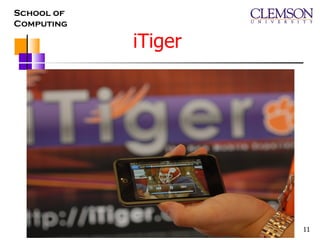
iTiger
CI in Education CI involves people in interdisciplinary virtual organizations. 99.9% need not be programmers.  Everyone must learn to think more creatively and critically. “ From K to Gray” education initiatives supported by NSF and the Supercomputing Education committee.
Questions???
Mission 1 Develop a  human-centered CI  that is driven by science research and education opportunities School of Computing has an HCC division. Several institutes at Clemson research the “human-computer interface.”
Mission II Provide the science communities CI tools and services:  High performance computing ;  data, data analysis and  visualization ;  networked resources  and  virtual organizations ; and  learning and workforce development ;
Mission 3 Promote a CI that serves as an agent for broadening participation and strengthening the Nation’s workforce in all areas of science;
Mission 4 Provide a  sustainable CI  that is  secure, efficient, reliable, accessible, usable, and interoperable, and  that evolves as an essential national infrastructure for conducting science and engineering research and education. Reproducible and recoverable --- i.e., version 237 of acroread reading version 56 files.

Cyberinfrastructure at Clemson University

  • 1.
    Cyberinfrastructure at ClemsonDr. D. E. (Steve) Stevenson Institute for Modeling and Simulation School of Computing (SoC), Clemson
  • 2.
    Top Four CIMissions at Clemson’s SoC Develop human-centered CI driven by research and education opportunities. Provide the CI communities tools and services. Promote broadening participation and strengthening the Nation’s workforce. Provide a sustainable CI that is essential for conducting science, engineering, and industrial research and education.
  • 3.
    Open Science GridPalmetto Cluster Clemson has the World’s 60th fastest supercomputer and the fastest outside Government labs. Palmetto Cluster available for indust-rial applications.
  • 4.
  • 5.
    School of ComputingThe School of Computing will be a national leader in the development of divisions that integrate computation with the arts, engineering, humanities, and natural sciences .
  • 6.
    Current Strengths HighPerformance Computing and Cyberinfrastructure Graphics Virtual Environments Theory and Algorithms Software Engineering
  • 7.
    Degree Programs UndergraduateB.S in Computer Science B.A in Computer Science B.S. in Computer Information Systems Graduate M.S. in Computer Science M.F.A. in Digital Production Arts Ph.D. in Computer Science
  • 8.
    Existing Units ComputerScience Study and research in traditional computer science areas of Theory Systems Algorithms Software Engineering Cyberinfrastructure Visual Computing Study and research in Computer graphics Visualization Computer vision and image processing Electronic arts such as game design, special effects, and animation .
  • 9.
    Developing Unit HumanCenter Computing (HCC) HCC is an emerging field focused on understanding how to make computational technologies more useable and how computational technologies affect society. Human—Computer Interaction Broadening Participation Computing Education Societal Impact of Technology Human Factors User Interface Design
  • 10.
    NVIDIA & SupercomputingNVIDIA Corporation has donated a Tesla S1070 supercomputer to the School of Computing for research in modeling photon transport and high-speed rendering. The S1070 has 960 compute cores with a peak performance of 4 Teraflops in a desktop. This donation continues a strong partnership between NVIDIA and the School of Computing through equipment donations and graduate student support. Jay Steele (Ph. D. candidate) has received three of the prestigious NVIDIA Fellowship awards, of which only 10 are awarded, world-wide, each year.
  • 11.
  • 12.
    CI in EducationCI involves people in interdisciplinary virtual organizations. 99.9% need not be programmers. Everyone must learn to think more creatively and critically. “ From K to Gray” education initiatives supported by NSF and the Supercomputing Education committee.
  • 13.
  • 14.
    Mission 1 Developa human-centered CI that is driven by science research and education opportunities School of Computing has an HCC division. Several institutes at Clemson research the “human-computer interface.”
  • 15.
    Mission II Providethe science communities CI tools and services: High performance computing ; data, data analysis and visualization ; networked resources and virtual organizations ; and learning and workforce development ;
  • 16.
    Mission 3 Promotea CI that serves as an agent for broadening participation and strengthening the Nation’s workforce in all areas of science;
  • 17.
    Mission 4 Providea sustainable CI that is secure, efficient, reliable, accessible, usable, and interoperable, and that evolves as an essential national infrastructure for conducting science and engineering research and education. Reproducible and recoverable --- i.e., version 237 of acroread reading version 56 files.

Editor's Notes

  • #2 Viet Nam vet, 11 yuears at BTL, including early unix, SC educaitoin Carol was right: it’s people A two second definition of CI is needed