Sustainability in Research Computing
Sandra Gesing
sandra.gesing@nd.edu
Virtual Residency Summer Workshop on
Intermediate Research Computing Facilitation
University of Oklahoma
August 6, 2018
Sustainability
https://sustainableunh.unh.edu/whatissustainability
University of New Hampshire:
“We define sustainability as what sustains us as diverse people and communities—
from clean air and water to healthcare, education and art—and making decisions in
our individual and collective lives with this big picture in mind.
Sustainability is both local and global. It requires of us that we consider both the
past and the future in terms of current and best practices.
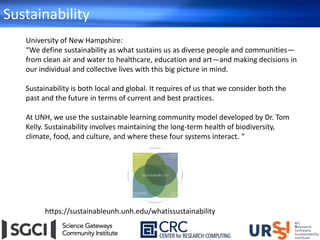
At UNH, we use the sustainable learning community model developed by Dr. Tom
Kelly. Sustainability involves maintaining the long-term health of biodiversity,
climate, food, and culture, and where these four systems interact. “
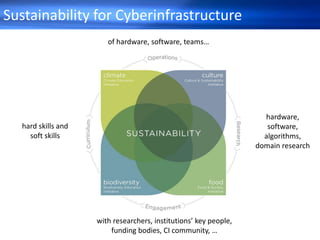
Sustainability for Cyberinfrastructure
with researchers, institutions’ key people,
funding bodies, CI community, …
hardware,
software,
algorithms,
domain research
of hardware, software, teams…
hard skills and
soft skills
Sustainability for Cyberinfrastructure
with researchers, institutions’ key people,
funding bodies, CI community, …
hardware,
software,
algorithms,
domain research
of hardware, software, teams…
hard skills and
soft skills
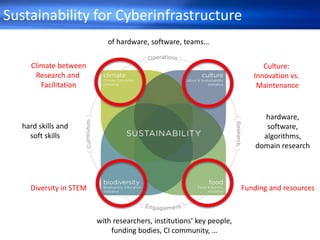
Diversity in STEM
Climate between
Research and
Facilitation
Culture:
Innovation vs.
Maintenance
Funding and resources
Sustainability for Cyberinfrastructure
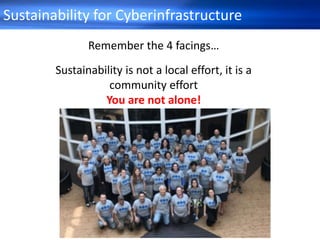
Remember the 4 facings…
Sustainability is not a local effort, it is a
community effort
You are not alone!
Sustainability for Cyberinfrastructure
Get to know your
• users (diverse research domains, faculty, …)
• stakeholders (host institution, funding bodies – NSF,
NIH, DoE, DoD, DARPA, Moore Foundation, etc.)
• partners (projects, initiatives, experienced IT people)
• volunteers (contributors to open-source and/or open
science)
and their challenges as well as their goals – besides
publications and funding.
Often their challenges are your challenges!
• Computing resources
• Data analytics
• Preservation needs
Sustainability for Cyberinfrastructure
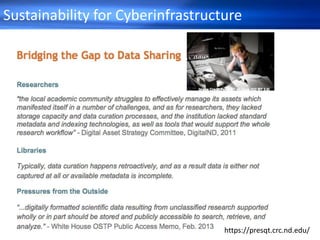
https://presqt.crc.nd.edu/
Sustainability for Cyberinfrastructure
Look at financial and non-financial support (“free”
resources)
• Do you have people such as digital librarians?
They are generally not only serving humanities and
have great knowledge about data preservation, data
lifecycle, programming skills, ..
• Do you have data scientists?
They probably know about machine learning, meta-
data, ontologies, statistics …
• Do you have business scientists?
They know about marketing, financial strategies,
how to build an enterprise, …
They can be partners for you to support CI projects!
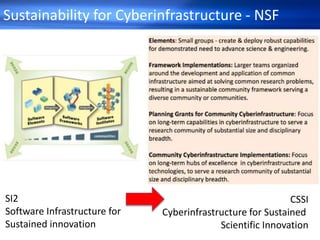
Sustainability for Cyberinfrastructure - NSF
SI2
Software Infrastructure for
Sustained innovation
CSSI
Cyberinfrastructure for Sustained
Scientific Innovation
Sustainability for Cyberinfrastructure - NSF
Sustainability Institutes and Excellence Hubs are funded to
support the CI and research community
Support via implemented institutes is free for you!
Your chance to influence conceptualizations!
Implementations
• Science Gateways Community Institute
• The Molecular Sciences Software Institute
Conceptualizations
• URSSI
• High-Energy Physics
• Geospatial
• …
The CI Professional Ecosystem
• Clemson-led ACI-REF project
• Coalition for Academic Scientific Computation
• Campus Research Computing Consortium (CaRCC)
• Campus Champions
• CyberAmbassadors
• Linux Clusters Institute
• SIGHPC Education Chapter
• Software & Data Carpentry
• Science Gateways Community Institute
• UK Research Software Engineer Association
• US Research Software Engineer Association
• UK Software Sustainability Institute
• Working Toward Sustainable Software for Science Practice
and Experience (WSSSPE)
• US Research Software Sustainability Institute
State of the Art in Research
Increased
complexity of
• research
questions
• hardware
• software
• instruments
• data volume
• data formats
The need for end-to-
end solutions for
accessing data,
software, computing
services, and
equipment specific
to the needs of a
science or
engineering
discipline
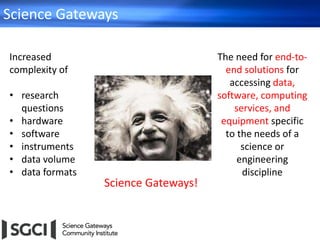
Science Gateways
Increased
complexity of
• research
questions
• hardware
• software
• instruments
• data volume
• data formats
The need for end-to-
end solutions for
accessing data,
software, computing
services, and
equipment specific
to the needs of a
science or
engineering
discipline
Science Gateways!
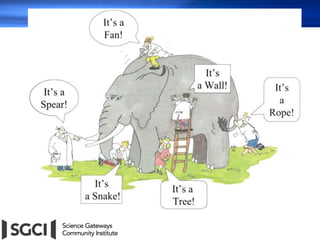
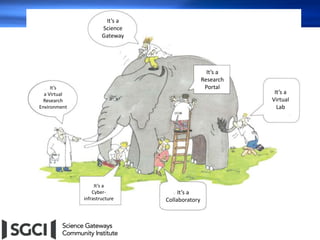
It’s a
Science
Gateway
It’s a
Research
Portal
It’s a
Collaboratory
It’s a
Cyber-
infrastructure
It’s
a Virtual
Research
Environment
It’s a
Virtual
Lab
Science Gateways
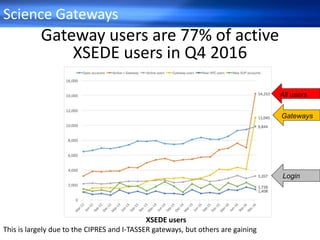
Gateway users are 77% of active
XSEDE users in Q4 2016
This is largely due to the CIPRES and I-TASSER gateways, but others are gaining
All users
Gateways
XSEDE users
Login
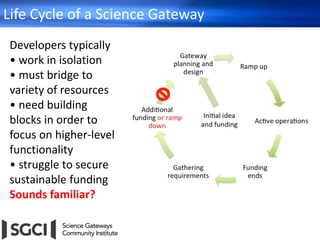
Life Cycle of a Science Gateway
Developers typically
• work in isolation
• must bridge to
variety of resources
• need building
blocks in order to
focus on higher-level
functionality
• struggle to secure
sustainable funding
Sounds familiar?
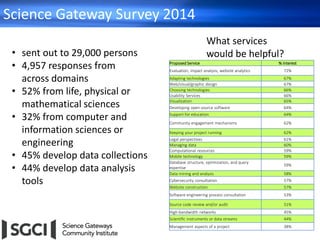
Science Gateway Survey 2014
18
What services
would be helpful?• sent out to 29,000 persons
• 4,957 responses from
across domains
• 52% from life, physical or
mathematical sciences
• 32% from computer and
information sciences or
engineering
• 45% develop data collections
• 44% develop data analysis
tools
Proposed Service % Interest
Evaluation, impact analysis, website analytics 72%
Adapting technologies 67%
Web/visual/graphic design 67%
Choosing technologies 66%
Usability Services 66%
Visualization 65%
Developing open-source software 64%
Support for education 64%
Community engagement mechanisms 62%
Keeping your project running 62%
Legal perspectives 61%
Managing data 60%
Computational resources 59%
Mobile technology 59%
Database structure, optimization, and query
expertise
59%
Data mining and analysis 58%
Cybersecurity consultation 57%
Website construction 57%
Software engineering process consultation 53%
Source code review and/or audit 51%
High-bandwidth networks 45%
Scientific instruments or data streams 44%
Management aspects of a project 38%
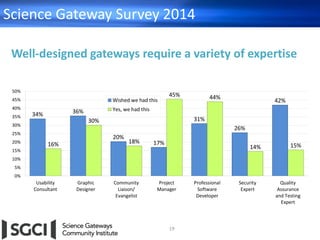
Science Gateway Survey 2014
19
34% 36%
20%
17%
31%
26%
42%
16%
30%
18%
45% 44%
14% 15%
0%
5%
10%
15%
20%
25%
30%
35%
40%
45%
50%
Usability
Consultant
Graphic
Designer
Community
Liaison/
Evangelist
Project
Manager
Professional
Software
Developer
Security
Expert
Quality
Assurance
and Testing
Expert
Wished we had this
Yes, we had this
Well-designed gateways require a variety of expertise
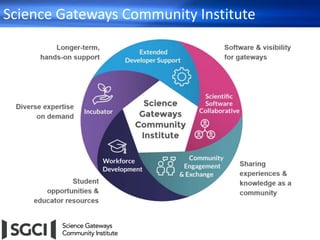
Science Gateways Community Institute
Sustainability for Cyberinfrastructure
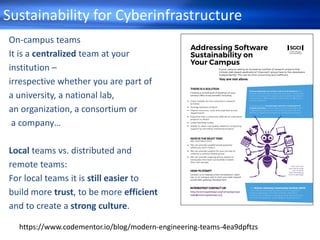
On-campus teams
It is a centralized team at your
institution –
irrespective whether you are part of
a university, a national lab,
an organization, a consortium or
a company…
Local teams vs. distributed and
remote teams:
For local teams it is still easier to
build more trust, to be more efficient
and to create a strong culture.
https://www.codementor.io/blog/modern-engineering-teams-4ea9dpftzs
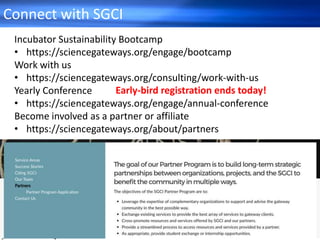
Connect with SGCI
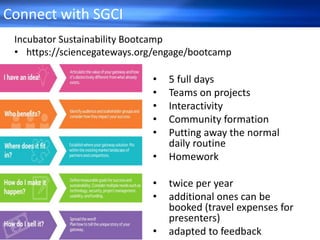
Incubator Sustainability Bootcamp
• https://sciencegateways.org/engage/bootcamp
• 5 full days
• Teams on projects
• Interactivity
• Community formation
• Putting away the normal
daily routine
• Homework
• twice per year
• additional ones can be
booked (travel expenses for
presenters)
• adapted to feedback
Connect with SGCI
Incubator Sustainability Bootcamp
• https://sciencegateways.org/engage/bootcamp
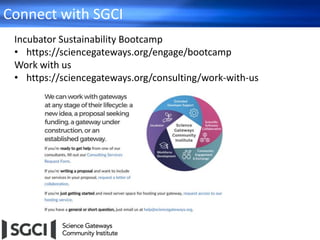
Work with us
• https://sciencegateways.org/consulting/work-with-us
Connect with SGCI
Incubator Sustainability Bootcamp
• https://sciencegateways.org/engage/bootcamp
Work with us
• https://sciencegateways.org/consulting/work-with-us
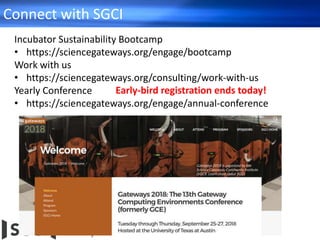
Yearly Conference
• https://sciencegateways.org/engage/annual-conference
Early-bird registration ends today!
Connect with SGCI
Incubator Sustainability Bootcamp
• https://sciencegateways.org/engage/bootcamp
Work with us
• https://sciencegateways.org/consulting/work-with-us
Yearly Conference
• https://sciencegateways.org/engage/annual-conference
Become involved as a partner or affiliate
• https://sciencegateways.org/about/partners
Early-bird registration ends today!
Connect with SGCI
Incubator Sustainability Bootcamp
• https://sciencegateways.org/engage/bootcamp
Work with us
• https://sciencegateways.org/consulting/work-with-us
Yearly Conference
• https://sciencegateways.org/engage/annual-conference
Become involved as a partner or affiliate
• https://sciencegateways.org/about/partners
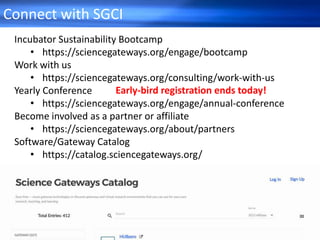
Software/Gateway Catalog
• https://catalog.sciencegateways.org/
Early-bird registration ends today!
Connect with SGCI
Incubator Sustainability Bootcamp
• https://sciencegateways.org/engage/bootcamp
Work with us
• https://sciencegateways.org/consulting/work-with-us
Yearly Conference
• https://sciencegateways.org/engage/annual-conference
Become involved as a partner or affiliate
• https://sciencegateways.org/about/partners
Software/Gateway Catalog
• https://catalog.sciencegateways.org/
Train students in internships
• https://sciencegateways.org/engage/student-focused
Webinars, blogs, newsletter, Twitter, LinkedIn etc.
https://sciencegateways.org
Early-bird registration ends today!
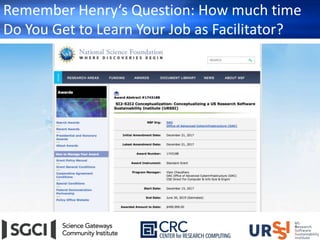
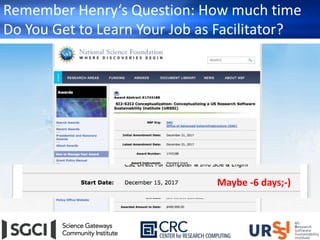
Remember Henry‘s Question: How much time
Do You Get to Learn Your Job as Facilitator?
Remember Henry‘s Question: How much time
Do You Get to Learn Your Job as Facilitator?
Maybe -6 days;-)
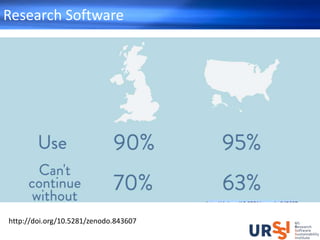
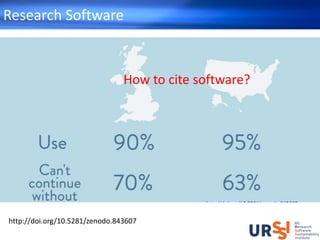
Research Software
http://doi.org/10.5281/zenodo.843607
Research Software
http://doi.org/10.5281/zenodo.843607
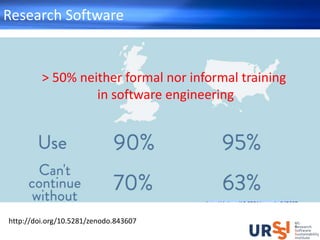
> 50% neither formal nor informal training
in software engineering
Research Software
http://doi.org/10.5281/zenodo.843607
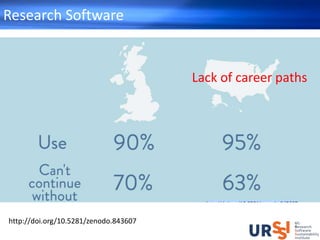
Lack of career paths
Research Software
http://doi.org/10.5281/zenodo.843607
How to cite software?
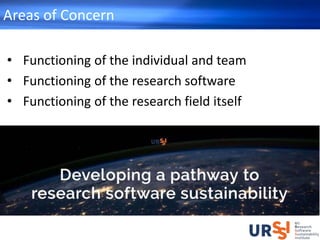
Areas of Concern
• Functioning of the individual and team
• Functioning of the research software
• Functioning of the research field itself
Functioning of the Individual and Team
• Training & education
• Ensuring appropriate credit for software
development
• Enabling publication pathways for research
software
• Fostering satisfactory and rewarding career paths
for people who develop and maintain software
• Increasing the participation of underrepresented
groups in software engineering
Functioning of Research Software
• Supporting sustainability of the software
• Growing community, evolving governance, and
developing relationships between organizations,
both academic and industrial
• Fostering both testing and reproducibility
• Supporting new models and developments (e.g.,
agile web frameworks, Software-as-a-Service)
• Supporting contributions of transient
contributors (e.g., students)
Functioning of the Research Field Itself
• Growing communities around research software
and disparate user requirements
• Cataloging extant and necessary software
• Disseminating new developments
• Training researchers in the usage of software
• Understanding and improving pipelines of diverse
developers and maintainers
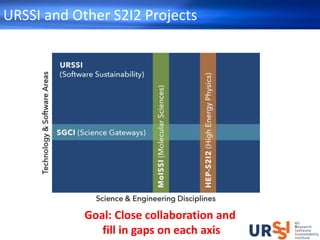
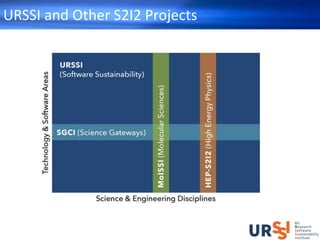
URSSI and Other S2I2 Projects
Goal: Close collaboration and
fill in gaps on each axis
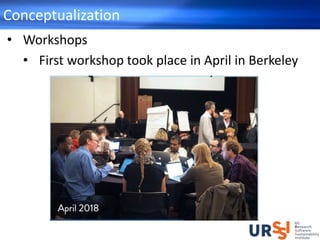
Conceptualization
• Workshops
• First workshop took place in April in Berkeley
Conceptualization
• Workshops
• First workshop took place in April in Berkeley
• Next workshop will take place in October in
Chicago
• Software credit workshop
• Incubator workshop
• Survey
• Ethnographic studies
• Mission and vision working group
How to Connect
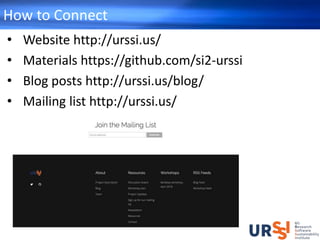
• Website http://urssi.us/
How to Connect
• Website http://urssi.us/
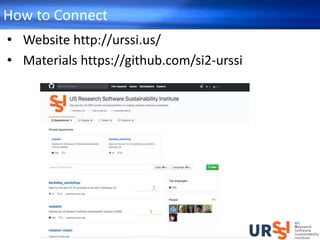
• Materials https://github.com/si2-urssi
How to Connect
• Website http://urssi.us/
• Materials https://github.com/si2-urssi
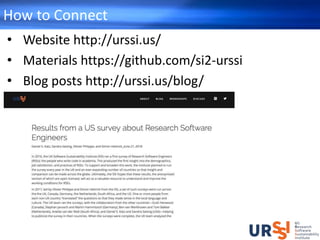
• Blog posts http://urssi.us/blog/
How to Connect
• Website http://urssi.us/
• Materials https://github.com/si2-urssi
• Blog posts http://urssi.us/blog/
• Mailing list http://urssi.us/
How to Connect
• Website http://urssi.us/
• Materials https://github.com/si2-urssi
• Blog posts http://urssi.us/blog/
• Mailing list http://urssi.us/
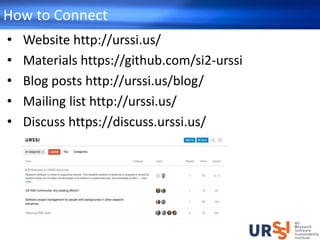
• Discuss https://discuss.urssi.us/
How to Connect
• Website http://urssi.us/
• Materials https://github.com/si2-urssi
• Blog posts http://urssi.us/blog/
• Mailing list http://urssi.us/
• Discuss https://discuss.urssi.us/
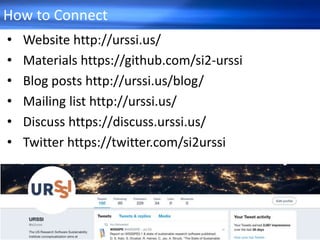
• Twitter https://twitter.com/si2urssi
How to Connect
• Website http://urssi.us/
• Materials https://github.com/si2-urssi
• Blog posts http://urssi.us/blog/
• Mailing list http://urssi.us/
• Discuss https://discuss.urssi.us/
• Twitter https://twitter.com/si2urssi
• Workshops http://urssi.us/workshops/
Join us for our next workshop in Chicago
October 23-24!
Lessons Learned on International Level
UK SSI and UK Research Software Engineer
Association
• Buy-in from universities
• Viable career path
• Large community
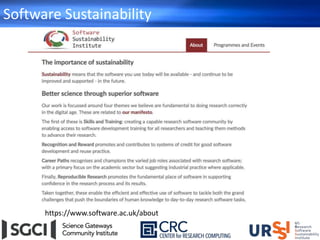
Software Sustainability
https://www.software.ac.uk/about
Sustainability
The Ecosystem offers a lot of opportunities
But
• Another mail list
• Another newsletter
• Another discussion list
• Another slack channel
• Plenty of workshops
• Plenty of surveys
Overwhelming? Too many scattered approaches?
How to sustain knowledge on and collaboration
with sustainability approaches?
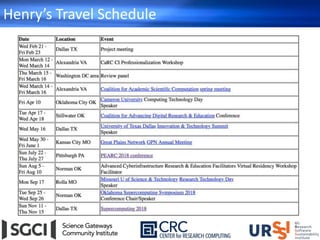
Henry’s Travel Schedule
Lessons Learned on International Level
What is different in the UK?
• It’s a smaller country - not a characteristics
we can change for the US
• The culture between research, software
engineering and facilitation is different (SE
and facilitation are more appreciated by
researchers) – we can work on this, the more
positive examples, white papers, metrics, etc.
the more buy-in…
Lessons Learned from Sustained Teams/Projects
Commonalities
• Evangelist
• Diverse mechanisms of funding
• Community building
• Open source and open science
• Collaboration, collaboration, collaboration
What Are Our Next Steps?
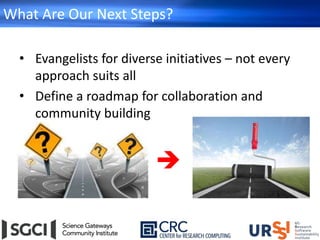
• Evangelists for diverse initiatives – not every
approach suits all
• Define a roadmap for collaboration and
community building

What Are Our Next Steps?
How to make it less scattered and without
duplicating effort? How to change research culture?
• Catalog on sustainability projects?
• Catalog on events?
• Catalog on metrics?
• Catalog on success stories?
• Evangelist and an outreach specialist?
• “Exchange” instructors between events?
• Involve faculty, HR people, stakeholders in
events?
What Are Our Next Steps?
Let’s make the next steps together!
Thanks!
sandra.gesing@nd.edu

SGCI-URSSI-Sustainability in Research Computing

  • 1.
    Sustainability in ResearchComputing Sandra Gesing sandra.gesing@nd.edu Virtual Residency Summer Workshop on Intermediate Research Computing Facilitation University of Oklahoma August 6, 2018
  • 2.
    Sustainability https://sustainableunh.unh.edu/whatissustainability University of NewHampshire: “We define sustainability as what sustains us as diverse people and communities— from clean air and water to healthcare, education and art—and making decisions in our individual and collective lives with this big picture in mind. Sustainability is both local and global. It requires of us that we consider both the past and the future in terms of current and best practices. At UNH, we use the sustainable learning community model developed by Dr. Tom Kelly. Sustainability involves maintaining the long-term health of biodiversity, climate, food, and culture, and where these four systems interact. “
  • 3.
    Sustainability for Cyberinfrastructure withresearchers, institutions’ key people, funding bodies, CI community, … hardware, software, algorithms, domain research of hardware, software, teams… hard skills and soft skills
  • 4.
    Sustainability for Cyberinfrastructure withresearchers, institutions’ key people, funding bodies, CI community, … hardware, software, algorithms, domain research of hardware, software, teams… hard skills and soft skills Diversity in STEM Climate between Research and Facilitation Culture: Innovation vs. Maintenance Funding and resources
  • 5.
    Sustainability for Cyberinfrastructure Rememberthe 4 facings… Sustainability is not a local effort, it is a community effort You are not alone!
  • 6.
    Sustainability for Cyberinfrastructure Getto know your • users (diverse research domains, faculty, …) • stakeholders (host institution, funding bodies – NSF, NIH, DoE, DoD, DARPA, Moore Foundation, etc.) • partners (projects, initiatives, experienced IT people) • volunteers (contributors to open-source and/or open science) and their challenges as well as their goals – besides publications and funding. Often their challenges are your challenges! • Computing resources • Data analytics • Preservation needs
  • 7.
  • 8.
    Sustainability for Cyberinfrastructure Lookat financial and non-financial support (“free” resources) • Do you have people such as digital librarians? They are generally not only serving humanities and have great knowledge about data preservation, data lifecycle, programming skills, .. • Do you have data scientists? They probably know about machine learning, meta- data, ontologies, statistics … • Do you have business scientists? They know about marketing, financial strategies, how to build an enterprise, … They can be partners for you to support CI projects!
  • 9.
    Sustainability for Cyberinfrastructure- NSF SI2 Software Infrastructure for Sustained innovation CSSI Cyberinfrastructure for Sustained Scientific Innovation
  • 10.
    Sustainability for Cyberinfrastructure- NSF Sustainability Institutes and Excellence Hubs are funded to support the CI and research community Support via implemented institutes is free for you! Your chance to influence conceptualizations! Implementations • Science Gateways Community Institute • The Molecular Sciences Software Institute Conceptualizations • URSSI • High-Energy Physics • Geospatial • …
  • 11.
    The CI ProfessionalEcosystem • Clemson-led ACI-REF project • Coalition for Academic Scientific Computation • Campus Research Computing Consortium (CaRCC) • Campus Champions • CyberAmbassadors • Linux Clusters Institute • SIGHPC Education Chapter • Software & Data Carpentry • Science Gateways Community Institute • UK Research Software Engineer Association • US Research Software Engineer Association • UK Software Sustainability Institute • Working Toward Sustainable Software for Science Practice and Experience (WSSSPE) • US Research Software Sustainability Institute
  • 12.
    State of theArt in Research Increased complexity of • research questions • hardware • software • instruments • data volume • data formats The need for end-to- end solutions for accessing data, software, computing services, and equipment specific to the needs of a science or engineering discipline
  • 13.
    Science Gateways Increased complexity of •research questions • hardware • software • instruments • data volume • data formats The need for end-to- end solutions for accessing data, software, computing services, and equipment specific to the needs of a science or engineering discipline Science Gateways!
  • 15.
    It’s a Science Gateway It’s a Research Portal It’sa Collaboratory It’s a Cyber- infrastructure It’s a Virtual Research Environment It’s a Virtual Lab
  • 16.
    Science Gateways Gateway usersare 77% of active XSEDE users in Q4 2016 This is largely due to the CIPRES and I-TASSER gateways, but others are gaining All users Gateways XSEDE users Login
  • 17.
    Life Cycle ofa Science Gateway Developers typically • work in isolation • must bridge to variety of resources • need building blocks in order to focus on higher-level functionality • struggle to secure sustainable funding Sounds familiar?
  • 18.
    Science Gateway Survey2014 18 What services would be helpful?• sent out to 29,000 persons • 4,957 responses from across domains • 52% from life, physical or mathematical sciences • 32% from computer and information sciences or engineering • 45% develop data collections • 44% develop data analysis tools Proposed Service % Interest Evaluation, impact analysis, website analytics 72% Adapting technologies 67% Web/visual/graphic design 67% Choosing technologies 66% Usability Services 66% Visualization 65% Developing open-source software 64% Support for education 64% Community engagement mechanisms 62% Keeping your project running 62% Legal perspectives 61% Managing data 60% Computational resources 59% Mobile technology 59% Database structure, optimization, and query expertise 59% Data mining and analysis 58% Cybersecurity consultation 57% Website construction 57% Software engineering process consultation 53% Source code review and/or audit 51% High-bandwidth networks 45% Scientific instruments or data streams 44% Management aspects of a project 38%
  • 19.
    Science Gateway Survey2014 19 34% 36% 20% 17% 31% 26% 42% 16% 30% 18% 45% 44% 14% 15% 0% 5% 10% 15% 20% 25% 30% 35% 40% 45% 50% Usability Consultant Graphic Designer Community Liaison/ Evangelist Project Manager Professional Software Developer Security Expert Quality Assurance and Testing Expert Wished we had this Yes, we had this Well-designed gateways require a variety of expertise
  • 20.
  • 21.
    Sustainability for Cyberinfrastructure On-campusteams It is a centralized team at your institution – irrespective whether you are part of a university, a national lab, an organization, a consortium or a company… Local teams vs. distributed and remote teams: For local teams it is still easier to build more trust, to be more efficient and to create a strong culture. https://www.codementor.io/blog/modern-engineering-teams-4ea9dpftzs
  • 22.
    Connect with SGCI IncubatorSustainability Bootcamp • https://sciencegateways.org/engage/bootcamp • 5 full days • Teams on projects • Interactivity • Community formation • Putting away the normal daily routine • Homework • twice per year • additional ones can be booked (travel expenses for presenters) • adapted to feedback
  • 23.
    Connect with SGCI IncubatorSustainability Bootcamp • https://sciencegateways.org/engage/bootcamp Work with us • https://sciencegateways.org/consulting/work-with-us
  • 24.
    Connect with SGCI IncubatorSustainability Bootcamp • https://sciencegateways.org/engage/bootcamp Work with us • https://sciencegateways.org/consulting/work-with-us Yearly Conference • https://sciencegateways.org/engage/annual-conference Early-bird registration ends today!
  • 25.
    Connect with SGCI IncubatorSustainability Bootcamp • https://sciencegateways.org/engage/bootcamp Work with us • https://sciencegateways.org/consulting/work-with-us Yearly Conference • https://sciencegateways.org/engage/annual-conference Become involved as a partner or affiliate • https://sciencegateways.org/about/partners Early-bird registration ends today!
  • 26.
    Connect with SGCI IncubatorSustainability Bootcamp • https://sciencegateways.org/engage/bootcamp Work with us • https://sciencegateways.org/consulting/work-with-us Yearly Conference • https://sciencegateways.org/engage/annual-conference Become involved as a partner or affiliate • https://sciencegateways.org/about/partners Software/Gateway Catalog • https://catalog.sciencegateways.org/ Early-bird registration ends today!
  • 27.
    Connect with SGCI IncubatorSustainability Bootcamp • https://sciencegateways.org/engage/bootcamp Work with us • https://sciencegateways.org/consulting/work-with-us Yearly Conference • https://sciencegateways.org/engage/annual-conference Become involved as a partner or affiliate • https://sciencegateways.org/about/partners Software/Gateway Catalog • https://catalog.sciencegateways.org/ Train students in internships • https://sciencegateways.org/engage/student-focused Webinars, blogs, newsletter, Twitter, LinkedIn etc. https://sciencegateways.org Early-bird registration ends today!
  • 28.
    Remember Henry‘s Question:How much time Do You Get to Learn Your Job as Facilitator?
  • 29.
    Remember Henry‘s Question:How much time Do You Get to Learn Your Job as Facilitator? Maybe -6 days;-)
  • 30.
  • 31.
    Research Software http://doi.org/10.5281/zenodo.843607 > 50%neither formal nor informal training in software engineering
  • 32.
  • 33.
  • 34.
    Areas of Concern •Functioning of the individual and team • Functioning of the research software • Functioning of the research field itself
  • 35.
    Functioning of theIndividual and Team • Training & education • Ensuring appropriate credit for software development • Enabling publication pathways for research software • Fostering satisfactory and rewarding career paths for people who develop and maintain software • Increasing the participation of underrepresented groups in software engineering
  • 36.
    Functioning of ResearchSoftware • Supporting sustainability of the software • Growing community, evolving governance, and developing relationships between organizations, both academic and industrial • Fostering both testing and reproducibility • Supporting new models and developments (e.g., agile web frameworks, Software-as-a-Service) • Supporting contributions of transient contributors (e.g., students)
  • 37.
    Functioning of theResearch Field Itself • Growing communities around research software and disparate user requirements • Cataloging extant and necessary software • Disseminating new developments • Training researchers in the usage of software • Understanding and improving pipelines of diverse developers and maintainers
  • 38.
    URSSI and OtherS2I2 Projects
  • 39.
    URSSI and OtherS2I2 Projects Goal: Close collaboration and fill in gaps on each axis
  • 40.
    Conceptualization • Workshops • Firstworkshop took place in April in Berkeley
  • 41.
    Conceptualization • Workshops • Firstworkshop took place in April in Berkeley • Next workshop will take place in October in Chicago • Software credit workshop • Incubator workshop • Survey • Ethnographic studies • Mission and vision working group
  • 42.
    How to Connect •Website http://urssi.us/
  • 43.
    How to Connect •Website http://urssi.us/ • Materials https://github.com/si2-urssi
  • 44.
    How to Connect •Website http://urssi.us/ • Materials https://github.com/si2-urssi • Blog posts http://urssi.us/blog/
  • 45.
    How to Connect •Website http://urssi.us/ • Materials https://github.com/si2-urssi • Blog posts http://urssi.us/blog/ • Mailing list http://urssi.us/
  • 46.
    How to Connect •Website http://urssi.us/ • Materials https://github.com/si2-urssi • Blog posts http://urssi.us/blog/ • Mailing list http://urssi.us/ • Discuss https://discuss.urssi.us/
  • 47.
    How to Connect •Website http://urssi.us/ • Materials https://github.com/si2-urssi • Blog posts http://urssi.us/blog/ • Mailing list http://urssi.us/ • Discuss https://discuss.urssi.us/ • Twitter https://twitter.com/si2urssi
  • 48.
    How to Connect •Website http://urssi.us/ • Materials https://github.com/si2-urssi • Blog posts http://urssi.us/blog/ • Mailing list http://urssi.us/ • Discuss https://discuss.urssi.us/ • Twitter https://twitter.com/si2urssi • Workshops http://urssi.us/workshops/ Join us for our next workshop in Chicago October 23-24!
  • 49.
    Lessons Learned onInternational Level UK SSI and UK Research Software Engineer Association • Buy-in from universities • Viable career path • Large community
  • 50.
  • 51.
    Sustainability The Ecosystem offersa lot of opportunities But • Another mail list • Another newsletter • Another discussion list • Another slack channel • Plenty of workshops • Plenty of surveys Overwhelming? Too many scattered approaches? How to sustain knowledge on and collaboration with sustainability approaches?
  • 52.
  • 53.
    Lessons Learned onInternational Level What is different in the UK? • It’s a smaller country - not a characteristics we can change for the US • The culture between research, software engineering and facilitation is different (SE and facilitation are more appreciated by researchers) – we can work on this, the more positive examples, white papers, metrics, etc. the more buy-in…
  • 54.
    Lessons Learned fromSustained Teams/Projects Commonalities • Evangelist • Diverse mechanisms of funding • Community building • Open source and open science • Collaboration, collaboration, collaboration
  • 55.
    What Are OurNext Steps? • Evangelists for diverse initiatives – not every approach suits all • Define a roadmap for collaboration and community building 
  • 56.
    What Are OurNext Steps? How to make it less scattered and without duplicating effort? How to change research culture? • Catalog on sustainability projects? • Catalog on events? • Catalog on metrics? • Catalog on success stories? • Evangelist and an outreach specialist? • “Exchange” instructors between events? • Involve faculty, HR people, stakeholders in events?
  • 57.
    What Are OurNext Steps? Let’s make the next steps together! Thanks! sandra.gesing@nd.edu