By: Atul S. Jaybhaye
Assistant Professor
Hidayatullah National Law University
Copyright Law - India
 Concept and Meaning of Copyright:
 Copyright Act 1957
 Sec. 13 Works in which Copyright subsists?
 Sec. 14 Meaning of a Copyright.
 Sec. 51 Infringement of a Copyright.
 Sec. 52 Fair use in a Copyright
 Remedies for infringement
Copyright Law - India
 Meaning of Cyberspace:
 Cyberspace is the electronic medium of
computer networks, in which online
communication takes place.
Copyright Law - India
 Definition of Literary Work:
 Section 2(o) of the Copyright Act, 1957:
"'literary work' includes computer programs,
tables and compilation including computer
databases."
Copyright Law - India
 Subject matter of Copyright on Internet:
 computer database,
 computer programmes/software,
 computer layouts design,
 various works on web
 Multimedia works etc.
computer database and Copyright
 Database refers to collection of data, works,
information or other independent material arranged
in a systematic way.
 databases should be given copyright protection as they
are the result of skill and labour employed by the
author in creating the work.
 Ex. The name, employee identification number,
address, telephone number of the Employee
computer database and Copyright
 The compiling author makes his selection of
individual items of the database to include them in an:
1. Orderly manner
2. Arrangement in a effective way for users
3. Direction of compilation is sufficiently original.
Note: Copyright laws are not concerned with the origin of
ideas, but with the expression of thoughts.
computer software as Copyright
 Meaning of a Software:
 For a computer to work, it has to be programmed,
i.e. given a set of instructions in a language that
computers understand. These programs are
referred to as "software", to distinguish them from
"hardware"
computer software as Copyright
 some examples of software:
a. Operating systems, such as Microsoft Windows, and Linux.
b. Software for general, everyday use, such Web browsers, word
processors, spreadsheets, software for making presentations,
etc.
c. More specialized software, such as computer-aided design
software, software for statisticians, software for accountants,
etc.
computer software as Copyright
 In India, the Intellectual Property Rights (IPR) of
computer software is covered under the Copyright
Law.
 Accordingly, the copyright of computer software is
protected under the provisions of Indian Copyright
Act 1957.
 Computer software is protected as literary work
Copyright and Digital Technologies
 All works now can be digitalised whether they compromise
texts, images, sound, animation, photograph.
 The ease with which works in digital form can be
replicated posed a difficult problem for the law to handle.
 Perfect multiple copies can be generated by the same
technology.
 Such copies can be made available and transmitted across
the globe within a second.
Copyright Protection in USA
 The Digital Millennium Copyright Act 1998
 (DMCA) is a United States copyright law that
implements two 1996 treaties of the World Intellectual
Property Organization (WIPO).
 It provides a mechanism for copyright holders to
protect their online content.
 Once an author becomes aware that his work is being
infringed upon it is up to the copyright holder to notify
the Internet Service Provider (ISP)/Online Service
Provider (OSP) that contains the material about the
alleged infringement.
Landmark cases
 Napster Case: A&M Records, Inc. v. Napster,
Inc. External link 239 F.3d 1004 (2001),
 Napster was a company formed by eighteen year old Shawn
Fanning at North eastern University. Napster was the first
user-friendly peer-to-peer file sharing service, which allowed
any user to access other users' MP3 files, which were easily
downloaded.
 Napster also introduced a simple searching ability from
their central server, allowing users to quickly access a list of
available files for which they would be searching.
 Napster quickly rose in popularity to its peak in 2001, as
millions of users continued downloading song files for free
from other computers around the world.
Napster Case:
 This was a landmark intellectual property case in which
the United States Court of Appeals for the Ninth Circuit affirmed
the ruling of the United States District Court for the Northern
District of California, holding that defendant, peer-to-
peer (P2P) file-sharing service Napster, could be held liable for
infringement.
 This was the first major case to address the application of
copyright laws to peer-to-peer file-sharing.
 Direct infringement The Circuit Court agreed with the district court's
determination that Napster users were probably engaging in direct
infringement of plaintiffs' copyrights.
Napster Case:
 Contributory infringement
 In order to prove contributory infringement, a plaintiff must
show that a defendant had knowledge of infringement (here,
that Napster knew that its users were distributing
copyrighted content without permission across its network)
and that defendant supplied material support to that
infringement.
 The Court held that since Napster was aware the specific
infringing files being transmitted through its system it could
be held for contributory liability.
Super Cassettes v. MySpace
 In 2007, Super Cassettes Industries Limited (SCIL) filed a
suit against MySpace, a social networking platform,
alleging copyright infringement against MySpace.
 The platform allowed users to upload and share media
files, inter alia, and it was discovered that users were
sharing SCIL’s copyrighted works.
 SCIL promptly proceeded to file a civil suit against
MySpace for primary infringement under section 51(a)(i)
of the Copyright Act.
Super Cassettes v. MySpace
 On 23rd December 2016, Delhi High Court delivered a
decision overturning the 2012 order in the matter of Super
Cassettes Industries Limited v. MySpace.
 The 2012 order was heavily criticized, for it was agnostic to
the technological complexities of regulating speech on the
Internet and cast unnecesssary burdens on MySpace.
 The latest judgment in the matter of Super Cassettes v.
MySpace is a landmark and progressive ruling, which
strengthens the safe harbor immunity enjoyed by Internet
intermediaries in India.
Super Cassettes v. MySpace
 A safe harbor is a provision of a Statute or a regulation
that specifies that certain conduct will be deemed not to
violate a given rule.
 The Digital Millennium Copyright Act (DMCA) has notable
safe-harbor provisions which protect Internet service
providers from the consequences of their users' actions.
 It interprets the provisions of the IT Act, 2000 and the
Copyright Act, 1957 to restore safe harbor immunity to
intermediaries even in the case of copyright claims.
Super Cassettes v. MySpace
 MySpace Complying with Safe Harbor Requirements Sec. 79
IT Act 2000 & Intermediary Rules, 2011)
 The court held that MySpace's operations were in
compliance with section 79(2)(b). The content
transmission was initiated at the behest of the users, the
recipients were not chosen by MySpace, neither was
there modification of content.
 On the issue of modification, the court reasoned that
since modification was an automated process which
changed the format only, without MySpace's tacit or
expressed control or knowledge, it was in compliance of
the legislative requirement.
Ban on Songs.pk
 The Calcutta High Court has passed an ex-parte injunction restraining a
number of Internet Service Providers (ISPs) from providing access
to www.songs.pk, a website which has gained notoriety for providing the
latest Bollywood music for free downloading to all visitors.
 The lawsuit before the Calcutta High Court has been filed by the
Phonographic Performance Ltd. (PPL), Indian Music Industry (IMI) and
Sagarika Music Pvt. Ltd.
 The defendants named in the suit are various ISPs such as Dishnet Wireless
Ltd, Reliance Wimax Ltd, Hathway Cable & Datacom Pvt Ltd, Hughes
Communications Ltd India, Tata Teleservices (Maharashtra) Ltd, Reliance
Communications Infrastructure Ltd, Wipro Ltd, Sify Technologies Ltd, Bharti
Airtel Ltd, Vodafone India Ltd, and BG Broadband India Pvt Ltd.
John Doe” orders or “John Doe”
injunctions
“John Doe” orders or “John Doe” injunctions are “cease and desist”
orders passed by a court against anonymous entity/entities. These
orders in the recent times have been issued in matters of protecting
copyrights.
Order 7 Rule 1 of the Code of Civil Procedure provides that the plaint
shall contain the name, description and place of residence of the
defendant so far as can be ascertained.
When such identification is unknown, a “John Doe” suit is
maintainable. An U.S. Court held that for entertaining the John Doe
suit, the plaintiff should identify the missing party with sufficient
specificity such that the Court can determine that the defendant is a
real person or entity who could be sued in federal court.
Reliance Pictures v. ‘John Doe’s I.A. No. 13476/2011 in
the Delhi High Court (“Bodyguard” Movie Case)
 In the Bodyguard Movie Case, the Delhi High Court opined that
“defendants and other unnamed and undisclosed persons, are
restrained from communicating or making available or
distributing, or duplicating, or displaying, or releasing, or
showing, or uploading, or downloading, or exhibiting, or playing,
and/or defraying the movie ‘Bodyguard’ in any manner without a
proper license from the plaintiff or in any other manner which
would violate/infringe the plaintiffs copyright in the said
cinematograph film ‘Bodyguard’ through different mediums like
CD, DVD, Blue-ray disc, VCD, Cable TV, DTH, Internet services,
MMS, Tapes, Conditional Access System or in any other like
manner. Plaintiff is permitted to publish the ‘John Doe’
injunction order passed in the local newspapers.”
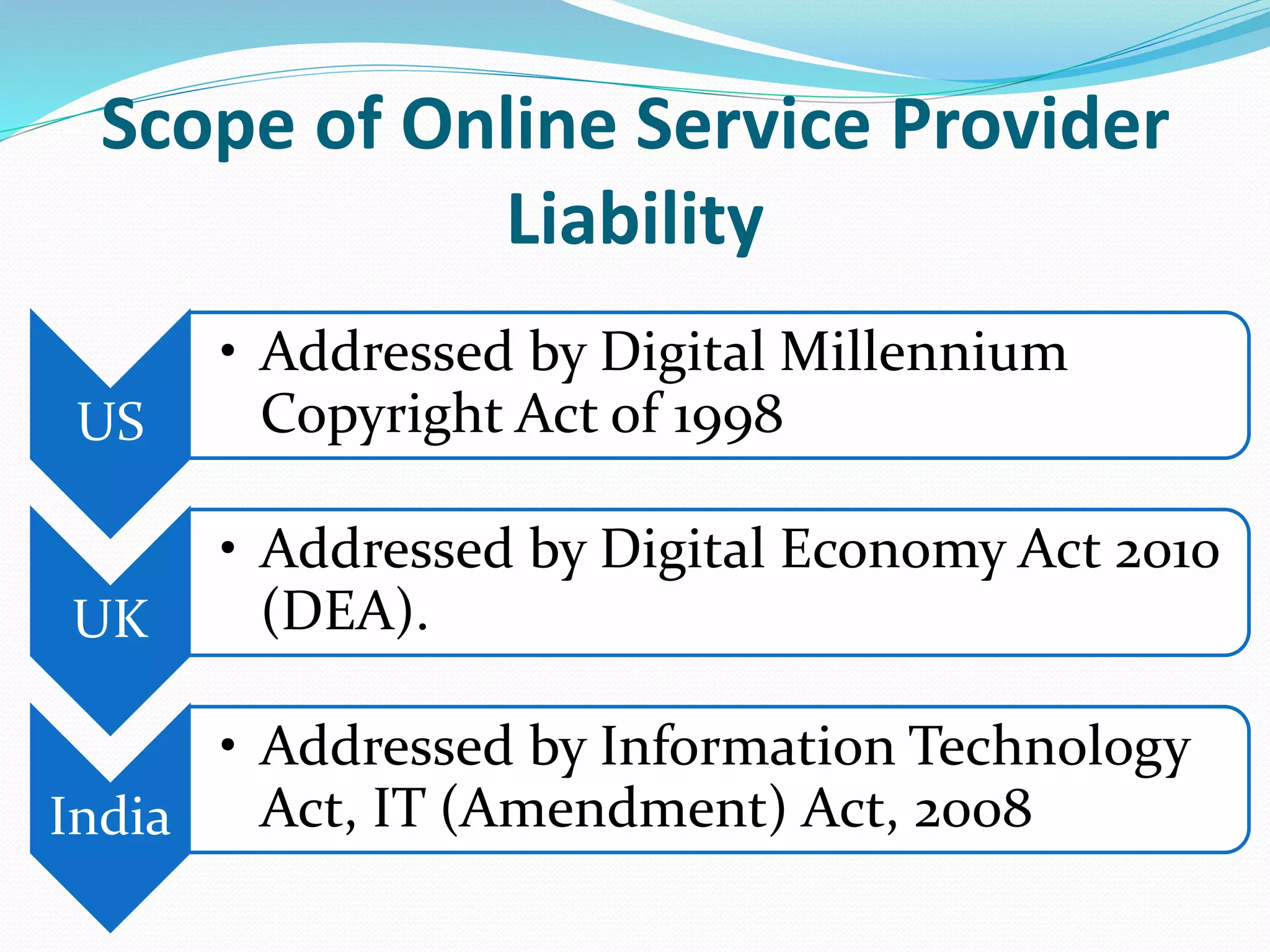
Scope of Online Service Provider
Liability
US
• Addressed by Digital Millennium
Copyright Act of 1998
UK
• Addressed by Digital Economy Act 2010
(DEA).
India
• Addressed by Information Technology
Act, IT (Amendment) Act, 2008
Intermediaries Under IT Act 2000
In India, intermediaries are governed under the IT Act, which
defines an intermediary as “any person who on behalf of
another person receives, stores, or transmits that electronic
record or provides any service with respect to that record”.
This definition is very wide and covers a diverse set of service
providers, ranging from Internet service providers, search
engines, web hosting service providers, to e-commerce
platforms or even social media platforms.
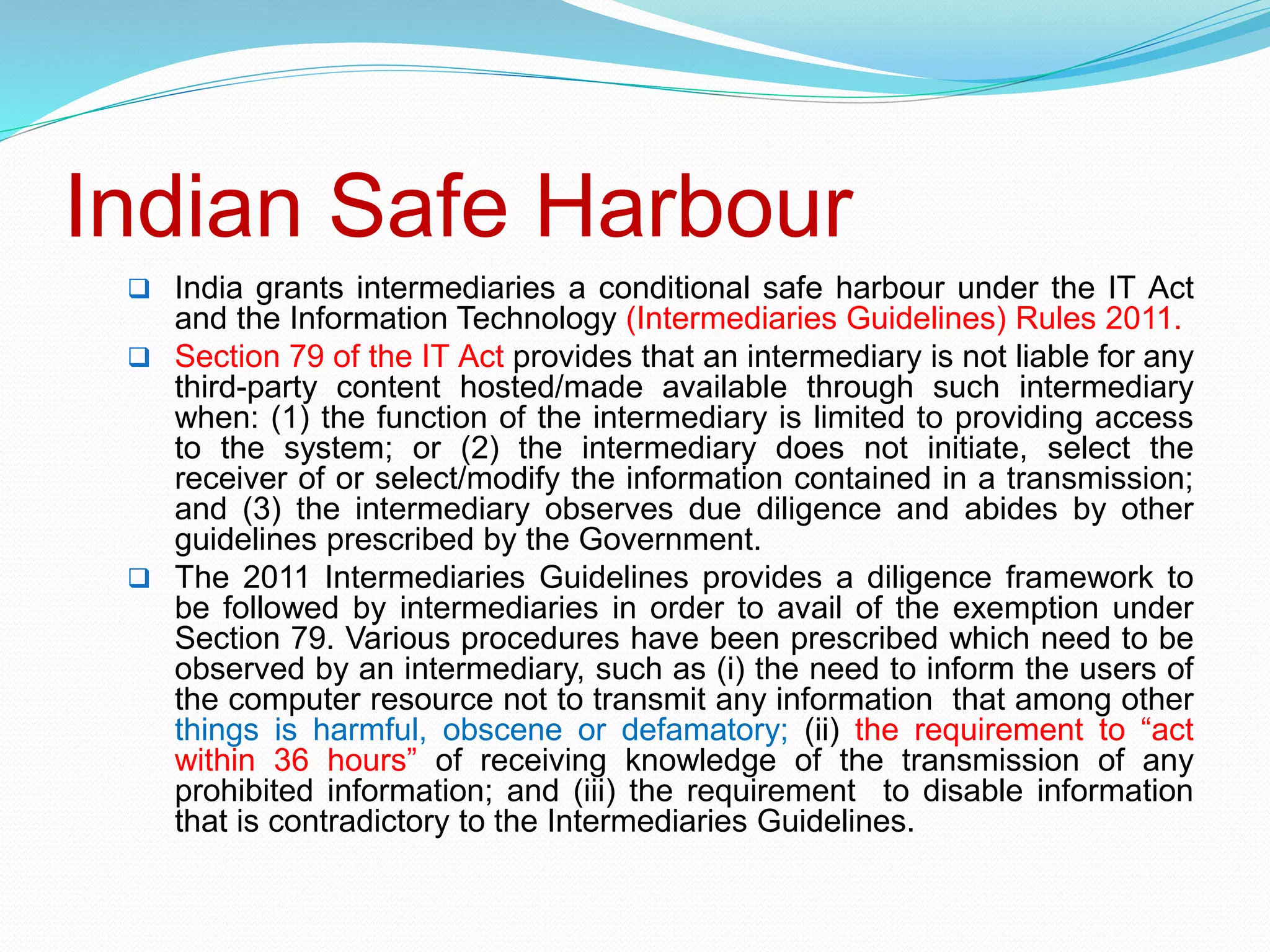
Indian Safe Harbour
 India grants intermediaries a conditional safe harbour under the IT Act
and the Information Technology (Intermediaries Guidelines) Rules 2011.
 Section 79 of the IT Act provides that an intermediary is not liable for any
third-party content hosted/made available through such intermediary
when: (1) the function of the intermediary is limited to providing access
to the system; or (2) the intermediary does not initiate, select the
receiver of or select/modify the information contained in a transmission;
and (3) the intermediary observes due diligence and abides by other
guidelines prescribed by the Government.
 The 2011 Intermediaries Guidelines provides a diligence framework to
be followed by intermediaries in order to avail of the exemption under
Section 79. Various procedures have been prescribed which need to be
observed by an intermediary, such as (i) the need to inform the users of
the computer resource not to transmit any information that among other
things is harmful, obscene or defamatory; (ii) the requirement to “act
within 36 hours” of receiving knowledge of the transmission of any
prohibited information; and (iii) the requirement to disable information
that is contradictory to the Intermediaries Guidelines.
Sega Enterprises Ltd. v. Maphia
857 F. Supp. 679 (N.D. Cal. 1994)
 The defendants owned and operated a computer
bulletin board service. Sega was the copyright owner
of various video games as well as the trademark
Sega.
 With defendants' knowledge and indeed with their
encouragement, users of the bulletin board service
uploaded and downloaded various Sega copyrighted
video games onto the bulletin board.
 The court further found that defendants profited from
Sega Enterprises Ltd. v. Maphia
857 F. Supp. 679 (N.D. Cal. 1994)
 Moreover, the court found that many of the games were located in
files on defendants' computer bearing the name Sega, which also
appeared when a Sega video program downloaded from the bulletin
board was run.
 Sega brought an action against the defendants, charging them, inter
alia, with federal copyright and trademark infringement, unfair
competition and false designation of origin, as well as the violation
of a series of California statutes.
 On Sega's motion, the court issued a preliminary injunction, which
enjoined defendants from continuing to engage in this conduct and
directed the seizure of infringing materials in defendants'
possession.
 The injunction included a provision barring defendants from
making Sega programs available to users of the bulletin board in
question, or storing Sega video programs in files accessible to such
bulletin board users.
Eastern Book Company Limited v D. B
Modak (2008) 1 SCC 1
 The appellants were engaged in business of printing judgements of the
Supreme Court of India through its publication ‘Supreme Court Cases’.
These judgements would be copyedited by them to make these more
user friendly by putting cross references, inputs, paragraph numbers,
formatting and headnotes.
 Appellants contended the work is an original literary work and the
appellants alone had exclusive rights to make hard copies or electronic
copies of the publications under Section 14 of the Copyright Act, 1957.
 It was alleged by the appellant that the respondent had produced a
software called Grand Jurix by scanning, copying and reproducing
portions of the publication of the Appellant which constituted
infringement of copyright as per Section 51 of the Copyright Act.
Eastern Book Company Limited v
D. B Modak (2008) 1 SCC 1
 Judgments delivered by the Supreme Court would
be a government work and in the absence of any
agreement to the contrary, the government shall be
the first owner of the copyright in the judgments of
the Supreme Court.
 For the reasons stated in the aforesaid discussion, the
appeals are partly allowed.
 The respondent-defendants shall be entitled to sell their
CD-ROMS with the text of the judgments of the Supreme
Court along with their own head notes, editorial notes, if
any, they should not in any way copy the head notes of
the plaintiff-appellants;
DRM (Digital Rights Management)
 Digital rights management includes technologies that
control the use, modification, and distribution of
copyrighted works.
 Copyright holders are allowed to use DRM to
safeguard their work being duplicated or utilized by
others.
 However, copyright laws across the world allow fair
use of the copyrighted work.
 Ex. Limitation as to number of copies, limitation as to
copy/install the material / information.
DRM (Digital Rights Management)
 E-content can be locked and it can be used by authorised persons
only.
 Due to this DRM, persons can not use this even for fair use/proper
use.
 WPPT and WCT mandates parties to have adequate and effective
legal remedies to prevent the misuse of online data/ information.
 Though India is not a member of WPPT and WCT, still it has
included the provisions of DRM through Copyright Amendment
Act, 2012.
DRM under Copyright Act 1957
 The new section 65A, introduced technological
protection measures (TPM) used by a copyright owner
to protect his rights on the work, makes circumvention
of it a criminal offence punishable with imprisonment
which may extend to two years and shall also be liable
to fine.
 Section 65B has been introduced to provide protection
of rights management information.
 The introduction of Sections 65A and 65B is expected
to help the film, music and publishing industry in
fighting piracy.
Functions of DRM
It controls number of copies that can be made.
It specifies modifications allowed.
How much of work can be accessed, after its
sale to the user.
DRMs are widely used in e-books, video-games ,
computer softwares etc.
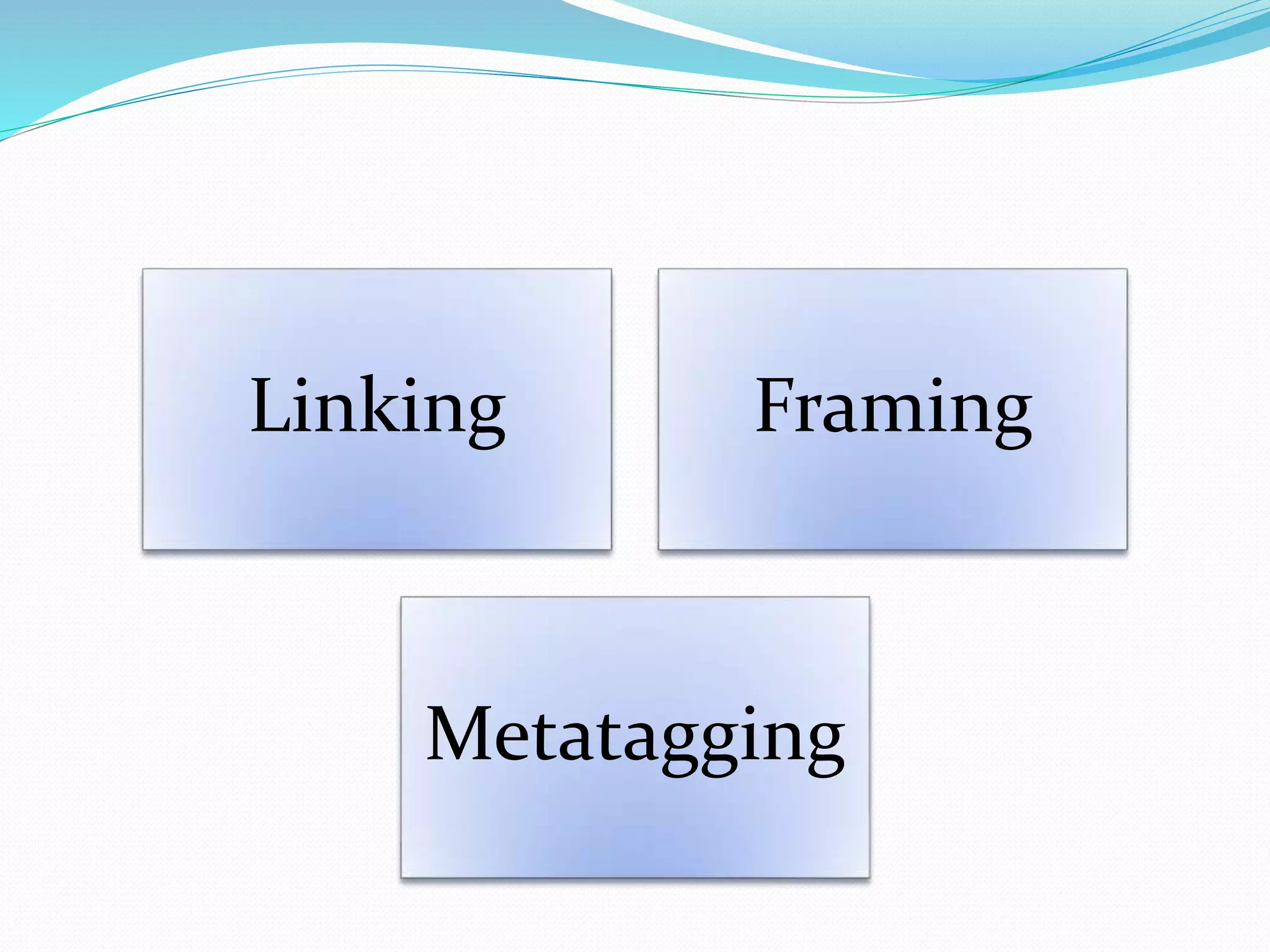
Linking Framing
Metatagging
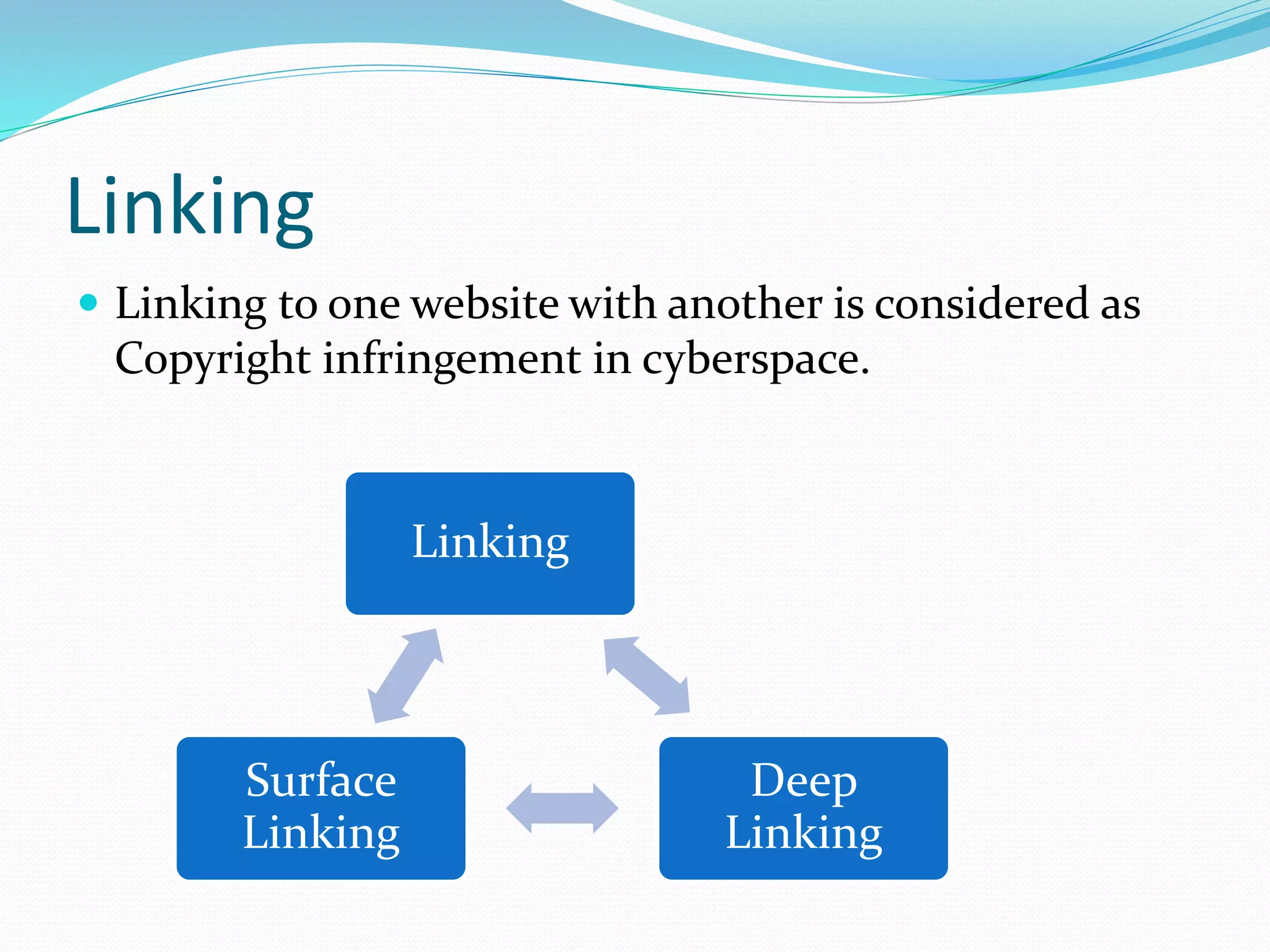
Linking
 Linking to one website with another is considered as
Copyright infringement in cyberspace.
Linking
Deep
Linking
Surface
Linking
Surface Linking:
 Surface linking, where the home page of a
site is linked.
 Surface link transfers the user from the
webpage of one site to the home page of
the linked site.
 A simple link from one Web site to the
home page of another Web site does not
normally raise concern.
Deep Linking:
 Linking to the internal pages of the website
is called as the Deep Linking.
 This takes the user to the internal web
pages without having any look to the
homepage of the website.
 The problem arises only with regard to the
practice of deep linking.
Relevant cases on Linking
 Ticketmaster Corp., et al. v. Tickets.Com, Inc.
 United States District Court for the Central District of
California 2000
 Both the plaintiffs and defendants had websites
providing information about sports events.
 The decision permitted Tickets.com to place deep
links to Ticketmaster
 Tickets.com used to sell the events ticket online.
Tickets.com had created a link to its webpage i.e.
“Buy this ticket from another online ticketing
company.”
 Clicking on this link used to instantly transfer the
customer to the interior webpage of Ticektmaster.
 It was held in this case that deep linking didn’t violate
Shetland Times Ltd v Dr Jonathan Wills and
Zet News Ltd. (1997) FSR 604,
 This is another Scottish case relating to
deep linking.
 The plaintiff owns and publishes The
Shetland Times newspaper.
 The defendant had deliberately reproduced
the headlines of plaintiffs site and were
hyperlinked to the internal pages of the
plaintiffs site.
 The Defendant had bypassed the home
Shetland Times Ltd v Dr Jonathan Wills and
Zet News Ltd. (1997) FSR 604,
 Issue: Whether deep linking to the plaintiffs websites
news headlines was an act of copyright infringement
under the UK’s Copyright Designs and Patents Act
1988.
 The Court rightly granted an interim injunction for
Copyright protection and issued order against
defendant for not involving in such activities.
Ticket Master Corporation vs. Microsoft
Corporation April 28, 1997
 Ticketmaster filed a suit against Microsoft for
practice of deep linking without permission of the
plaintiff.
 The plaintiff i.e. was losing advertising revenue
because of the diversion of the users.
 The plaintiff had entered into contract with other
companies for linking to its website.
 However, Microsoft was availing this service free of
cost by hyper linking.
 The matter was settled down out of the court, deep
links were removed by the defendant.
Thank you….

Copyright issues in cyberspace

  • 1.
    By: Atul S.Jaybhaye Assistant Professor Hidayatullah National Law University
  • 3.
    Copyright Law -India  Concept and Meaning of Copyright:  Copyright Act 1957  Sec. 13 Works in which Copyright subsists?  Sec. 14 Meaning of a Copyright.  Sec. 51 Infringement of a Copyright.  Sec. 52 Fair use in a Copyright  Remedies for infringement
  • 4.
    Copyright Law -India  Meaning of Cyberspace:  Cyberspace is the electronic medium of computer networks, in which online communication takes place.
  • 5.
    Copyright Law -India  Definition of Literary Work:  Section 2(o) of the Copyright Act, 1957: "'literary work' includes computer programs, tables and compilation including computer databases."
  • 6.
    Copyright Law -India  Subject matter of Copyright on Internet:  computer database,  computer programmes/software,  computer layouts design,  various works on web  Multimedia works etc.
  • 7.
    computer database andCopyright  Database refers to collection of data, works, information or other independent material arranged in a systematic way.  databases should be given copyright protection as they are the result of skill and labour employed by the author in creating the work.  Ex. The name, employee identification number, address, telephone number of the Employee
  • 8.
    computer database andCopyright  The compiling author makes his selection of individual items of the database to include them in an: 1. Orderly manner 2. Arrangement in a effective way for users 3. Direction of compilation is sufficiently original. Note: Copyright laws are not concerned with the origin of ideas, but with the expression of thoughts.
  • 9.
    computer software asCopyright  Meaning of a Software:  For a computer to work, it has to be programmed, i.e. given a set of instructions in a language that computers understand. These programs are referred to as "software", to distinguish them from "hardware"
  • 10.
    computer software asCopyright  some examples of software: a. Operating systems, such as Microsoft Windows, and Linux. b. Software for general, everyday use, such Web browsers, word processors, spreadsheets, software for making presentations, etc. c. More specialized software, such as computer-aided design software, software for statisticians, software for accountants, etc.
  • 11.
    computer software asCopyright  In India, the Intellectual Property Rights (IPR) of computer software is covered under the Copyright Law.  Accordingly, the copyright of computer software is protected under the provisions of Indian Copyright Act 1957.  Computer software is protected as literary work
  • 12.
    Copyright and DigitalTechnologies  All works now can be digitalised whether they compromise texts, images, sound, animation, photograph.  The ease with which works in digital form can be replicated posed a difficult problem for the law to handle.  Perfect multiple copies can be generated by the same technology.  Such copies can be made available and transmitted across the globe within a second.
  • 13.
    Copyright Protection inUSA  The Digital Millennium Copyright Act 1998  (DMCA) is a United States copyright law that implements two 1996 treaties of the World Intellectual Property Organization (WIPO).  It provides a mechanism for copyright holders to protect their online content.  Once an author becomes aware that his work is being infringed upon it is up to the copyright holder to notify the Internet Service Provider (ISP)/Online Service Provider (OSP) that contains the material about the alleged infringement.
  • 14.
    Landmark cases  NapsterCase: A&M Records, Inc. v. Napster, Inc. External link 239 F.3d 1004 (2001),  Napster was a company formed by eighteen year old Shawn Fanning at North eastern University. Napster was the first user-friendly peer-to-peer file sharing service, which allowed any user to access other users' MP3 files, which were easily downloaded.  Napster also introduced a simple searching ability from their central server, allowing users to quickly access a list of available files for which they would be searching.  Napster quickly rose in popularity to its peak in 2001, as millions of users continued downloading song files for free from other computers around the world.
  • 15.
    Napster Case:  Thiswas a landmark intellectual property case in which the United States Court of Appeals for the Ninth Circuit affirmed the ruling of the United States District Court for the Northern District of California, holding that defendant, peer-to- peer (P2P) file-sharing service Napster, could be held liable for infringement.  This was the first major case to address the application of copyright laws to peer-to-peer file-sharing.  Direct infringement The Circuit Court agreed with the district court's determination that Napster users were probably engaging in direct infringement of plaintiffs' copyrights.
  • 16.
    Napster Case:  Contributoryinfringement  In order to prove contributory infringement, a plaintiff must show that a defendant had knowledge of infringement (here, that Napster knew that its users were distributing copyrighted content without permission across its network) and that defendant supplied material support to that infringement.  The Court held that since Napster was aware the specific infringing files being transmitted through its system it could be held for contributory liability.
  • 17.
    Super Cassettes v.MySpace  In 2007, Super Cassettes Industries Limited (SCIL) filed a suit against MySpace, a social networking platform, alleging copyright infringement against MySpace.  The platform allowed users to upload and share media files, inter alia, and it was discovered that users were sharing SCIL’s copyrighted works.  SCIL promptly proceeded to file a civil suit against MySpace for primary infringement under section 51(a)(i) of the Copyright Act.
  • 18.
    Super Cassettes v.MySpace  On 23rd December 2016, Delhi High Court delivered a decision overturning the 2012 order in the matter of Super Cassettes Industries Limited v. MySpace.  The 2012 order was heavily criticized, for it was agnostic to the technological complexities of regulating speech on the Internet and cast unnecesssary burdens on MySpace.  The latest judgment in the matter of Super Cassettes v. MySpace is a landmark and progressive ruling, which strengthens the safe harbor immunity enjoyed by Internet intermediaries in India.
  • 19.
    Super Cassettes v.MySpace  A safe harbor is a provision of a Statute or a regulation that specifies that certain conduct will be deemed not to violate a given rule.  The Digital Millennium Copyright Act (DMCA) has notable safe-harbor provisions which protect Internet service providers from the consequences of their users' actions.  It interprets the provisions of the IT Act, 2000 and the Copyright Act, 1957 to restore safe harbor immunity to intermediaries even in the case of copyright claims.
  • 20.
    Super Cassettes v.MySpace  MySpace Complying with Safe Harbor Requirements Sec. 79 IT Act 2000 & Intermediary Rules, 2011)  The court held that MySpace's operations were in compliance with section 79(2)(b). The content transmission was initiated at the behest of the users, the recipients were not chosen by MySpace, neither was there modification of content.  On the issue of modification, the court reasoned that since modification was an automated process which changed the format only, without MySpace's tacit or expressed control or knowledge, it was in compliance of the legislative requirement.
  • 21.
    Ban on Songs.pk The Calcutta High Court has passed an ex-parte injunction restraining a number of Internet Service Providers (ISPs) from providing access to www.songs.pk, a website which has gained notoriety for providing the latest Bollywood music for free downloading to all visitors.  The lawsuit before the Calcutta High Court has been filed by the Phonographic Performance Ltd. (PPL), Indian Music Industry (IMI) and Sagarika Music Pvt. Ltd.  The defendants named in the suit are various ISPs such as Dishnet Wireless Ltd, Reliance Wimax Ltd, Hathway Cable & Datacom Pvt Ltd, Hughes Communications Ltd India, Tata Teleservices (Maharashtra) Ltd, Reliance Communications Infrastructure Ltd, Wipro Ltd, Sify Technologies Ltd, Bharti Airtel Ltd, Vodafone India Ltd, and BG Broadband India Pvt Ltd.
  • 22.
    John Doe” ordersor “John Doe” injunctions “John Doe” orders or “John Doe” injunctions are “cease and desist” orders passed by a court against anonymous entity/entities. These orders in the recent times have been issued in matters of protecting copyrights. Order 7 Rule 1 of the Code of Civil Procedure provides that the plaint shall contain the name, description and place of residence of the defendant so far as can be ascertained. When such identification is unknown, a “John Doe” suit is maintainable. An U.S. Court held that for entertaining the John Doe suit, the plaintiff should identify the missing party with sufficient specificity such that the Court can determine that the defendant is a real person or entity who could be sued in federal court.
  • 23.
    Reliance Pictures v.‘John Doe’s I.A. No. 13476/2011 in the Delhi High Court (“Bodyguard” Movie Case)  In the Bodyguard Movie Case, the Delhi High Court opined that “defendants and other unnamed and undisclosed persons, are restrained from communicating or making available or distributing, or duplicating, or displaying, or releasing, or showing, or uploading, or downloading, or exhibiting, or playing, and/or defraying the movie ‘Bodyguard’ in any manner without a proper license from the plaintiff or in any other manner which would violate/infringe the plaintiffs copyright in the said cinematograph film ‘Bodyguard’ through different mediums like CD, DVD, Blue-ray disc, VCD, Cable TV, DTH, Internet services, MMS, Tapes, Conditional Access System or in any other like manner. Plaintiff is permitted to publish the ‘John Doe’ injunction order passed in the local newspapers.”
  • 24.
    Scope of OnlineService Provider Liability US • Addressed by Digital Millennium Copyright Act of 1998 UK • Addressed by Digital Economy Act 2010 (DEA). India • Addressed by Information Technology Act, IT (Amendment) Act, 2008
  • 25.
    Intermediaries Under ITAct 2000 In India, intermediaries are governed under the IT Act, which defines an intermediary as “any person who on behalf of another person receives, stores, or transmits that electronic record or provides any service with respect to that record”. This definition is very wide and covers a diverse set of service providers, ranging from Internet service providers, search engines, web hosting service providers, to e-commerce platforms or even social media platforms.
  • 26.
    Indian Safe Harbour India grants intermediaries a conditional safe harbour under the IT Act and the Information Technology (Intermediaries Guidelines) Rules 2011.  Section 79 of the IT Act provides that an intermediary is not liable for any third-party content hosted/made available through such intermediary when: (1) the function of the intermediary is limited to providing access to the system; or (2) the intermediary does not initiate, select the receiver of or select/modify the information contained in a transmission; and (3) the intermediary observes due diligence and abides by other guidelines prescribed by the Government.  The 2011 Intermediaries Guidelines provides a diligence framework to be followed by intermediaries in order to avail of the exemption under Section 79. Various procedures have been prescribed which need to be observed by an intermediary, such as (i) the need to inform the users of the computer resource not to transmit any information that among other things is harmful, obscene or defamatory; (ii) the requirement to “act within 36 hours” of receiving knowledge of the transmission of any prohibited information; and (iii) the requirement to disable information that is contradictory to the Intermediaries Guidelines.
  • 27.
    Sega Enterprises Ltd.v. Maphia 857 F. Supp. 679 (N.D. Cal. 1994)  The defendants owned and operated a computer bulletin board service. Sega was the copyright owner of various video games as well as the trademark Sega.  With defendants' knowledge and indeed with their encouragement, users of the bulletin board service uploaded and downloaded various Sega copyrighted video games onto the bulletin board.  The court further found that defendants profited from
  • 28.
    Sega Enterprises Ltd.v. Maphia 857 F. Supp. 679 (N.D. Cal. 1994)  Moreover, the court found that many of the games were located in files on defendants' computer bearing the name Sega, which also appeared when a Sega video program downloaded from the bulletin board was run.  Sega brought an action against the defendants, charging them, inter alia, with federal copyright and trademark infringement, unfair competition and false designation of origin, as well as the violation of a series of California statutes.  On Sega's motion, the court issued a preliminary injunction, which enjoined defendants from continuing to engage in this conduct and directed the seizure of infringing materials in defendants' possession.  The injunction included a provision barring defendants from making Sega programs available to users of the bulletin board in question, or storing Sega video programs in files accessible to such bulletin board users.
  • 29.
    Eastern Book CompanyLimited v D. B Modak (2008) 1 SCC 1  The appellants were engaged in business of printing judgements of the Supreme Court of India through its publication ‘Supreme Court Cases’. These judgements would be copyedited by them to make these more user friendly by putting cross references, inputs, paragraph numbers, formatting and headnotes.  Appellants contended the work is an original literary work and the appellants alone had exclusive rights to make hard copies or electronic copies of the publications under Section 14 of the Copyright Act, 1957.  It was alleged by the appellant that the respondent had produced a software called Grand Jurix by scanning, copying and reproducing portions of the publication of the Appellant which constituted infringement of copyright as per Section 51 of the Copyright Act.
  • 30.
    Eastern Book CompanyLimited v D. B Modak (2008) 1 SCC 1  Judgments delivered by the Supreme Court would be a government work and in the absence of any agreement to the contrary, the government shall be the first owner of the copyright in the judgments of the Supreme Court.  For the reasons stated in the aforesaid discussion, the appeals are partly allowed.  The respondent-defendants shall be entitled to sell their CD-ROMS with the text of the judgments of the Supreme Court along with their own head notes, editorial notes, if any, they should not in any way copy the head notes of the plaintiff-appellants;
  • 31.
    DRM (Digital RightsManagement)  Digital rights management includes technologies that control the use, modification, and distribution of copyrighted works.  Copyright holders are allowed to use DRM to safeguard their work being duplicated or utilized by others.  However, copyright laws across the world allow fair use of the copyrighted work.  Ex. Limitation as to number of copies, limitation as to copy/install the material / information.
  • 32.
    DRM (Digital RightsManagement)  E-content can be locked and it can be used by authorised persons only.  Due to this DRM, persons can not use this even for fair use/proper use.  WPPT and WCT mandates parties to have adequate and effective legal remedies to prevent the misuse of online data/ information.  Though India is not a member of WPPT and WCT, still it has included the provisions of DRM through Copyright Amendment Act, 2012.
  • 33.
    DRM under CopyrightAct 1957  The new section 65A, introduced technological protection measures (TPM) used by a copyright owner to protect his rights on the work, makes circumvention of it a criminal offence punishable with imprisonment which may extend to two years and shall also be liable to fine.  Section 65B has been introduced to provide protection of rights management information.  The introduction of Sections 65A and 65B is expected to help the film, music and publishing industry in fighting piracy.
  • 34.
    Functions of DRM Itcontrols number of copies that can be made. It specifies modifications allowed. How much of work can be accessed, after its sale to the user. DRMs are widely used in e-books, video-games , computer softwares etc.
  • 35.
  • 36.
    Linking  Linking toone website with another is considered as Copyright infringement in cyberspace. Linking Deep Linking Surface Linking
  • 37.
    Surface Linking:  Surfacelinking, where the home page of a site is linked.  Surface link transfers the user from the webpage of one site to the home page of the linked site.  A simple link from one Web site to the home page of another Web site does not normally raise concern.
  • 38.
    Deep Linking:  Linkingto the internal pages of the website is called as the Deep Linking.  This takes the user to the internal web pages without having any look to the homepage of the website.  The problem arises only with regard to the practice of deep linking.
  • 39.
    Relevant cases onLinking  Ticketmaster Corp., et al. v. Tickets.Com, Inc.  United States District Court for the Central District of California 2000  Both the plaintiffs and defendants had websites providing information about sports events.  The decision permitted Tickets.com to place deep links to Ticketmaster  Tickets.com used to sell the events ticket online. Tickets.com had created a link to its webpage i.e. “Buy this ticket from another online ticketing company.”  Clicking on this link used to instantly transfer the customer to the interior webpage of Ticektmaster.  It was held in this case that deep linking didn’t violate
  • 40.
    Shetland Times Ltdv Dr Jonathan Wills and Zet News Ltd. (1997) FSR 604,  This is another Scottish case relating to deep linking.  The plaintiff owns and publishes The Shetland Times newspaper.  The defendant had deliberately reproduced the headlines of plaintiffs site and were hyperlinked to the internal pages of the plaintiffs site.  The Defendant had bypassed the home
  • 41.
    Shetland Times Ltdv Dr Jonathan Wills and Zet News Ltd. (1997) FSR 604,  Issue: Whether deep linking to the plaintiffs websites news headlines was an act of copyright infringement under the UK’s Copyright Designs and Patents Act 1988.  The Court rightly granted an interim injunction for Copyright protection and issued order against defendant for not involving in such activities.
  • 42.
    Ticket Master Corporationvs. Microsoft Corporation April 28, 1997  Ticketmaster filed a suit against Microsoft for practice of deep linking without permission of the plaintiff.  The plaintiff i.e. was losing advertising revenue because of the diversion of the users.  The plaintiff had entered into contract with other companies for linking to its website.  However, Microsoft was availing this service free of cost by hyper linking.  The matter was settled down out of the court, deep links were removed by the defendant.
  • 43.