CYBER CRIME & SECURITY Presented By: S UNNY  K UMAR  A DITYA 12080088 Seminar Guide: Mr. S UDEEP  E LAYIDOM “ Your computer is the crime scene”
Outline HISTORY DEFINITION CLASSIFICATION DETECTION PREVENTION
HISTORY The first recorded cyber crime took place in the year 1820!  The loom allowed the repetition of a series of steps in the weaving of special fabrics.  This resulted in a fear amongst employees that their traditional employment was being threatened.  They committed acts of sabotage to discourage further use of the new technology.     
Introduction   Internet has offered us a much more convenient way to share information across time and place. Cyberspace also opened a new venue for criminal activities.  The  anonymity  of cyberspace makes  identity tracing  a significant problem which hinders investigations. Uninformed and misguided users .
CLASSIFICATION OF CYBERCRIME 1 .Computer as Target 2 .Computer as an instrumentality 3 .Computer as an incidental or other crime 4 .Crime associated with the prevalence of computers.
COMPUTER AS A TARGET OF A CRIME Physical damage Theft or destruction of information (data).  The spread of viruses , Trojans and worms . Software piracy, hacking etc.
Computer as an instrumentality .   Crimes were either computers or their contents bare used in furtherance of crime  Those offences which are committed by manipulating contents of  computer systems.  Include sending e-mails,  ransom notes , credit card frauds, telecommunication frauds or theft.
Computer as Incidental  With the advent of computer the criminal have started using the technology as an aid for its perpetuation.  They include use of computers as an aid for drug trafficking, money laundering, etc Means of coordinating .
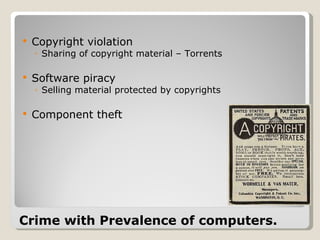
Copyright violation Sharing of copyright material – Torrents  Software piracy Selling material protected by copyrights Component theft  Crime with Prevalence of computers.
Types of cyber crime Financial crimes - cheating, credit card frauds, money laundering  Forgery  etc.  Sale of illegal articles: Online gambling:  Intellectual Property crimes Theft of information contained in electronic form   Email bombing
Types of cyber crime Data Diddling Salami attacks Email spoofing Cyber Defamation Cyber stalking Hacking
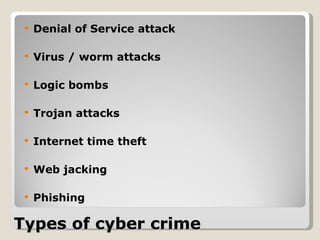
Types of cyber crime Denial of Service attack   Virus / worm attacks   Logic bombs Trojan attacks Internet time theft Web jacking   Phishing
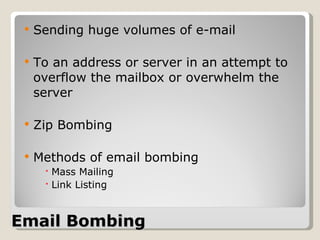
Email Bombing Sending huge volumes of e-mail To an address or server in an attempt to overflow the mailbox or overwhelm the server Zip Bombing Methods of email bombing Mass Mailing Link Listing
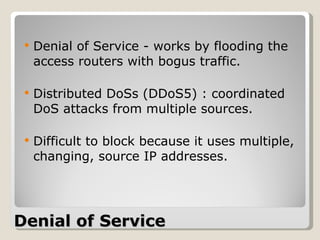
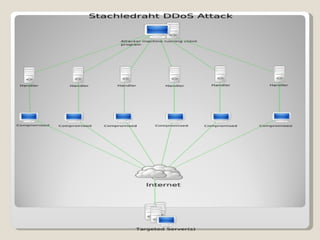
Denial of Service Denial of Service - works by flooding the access routers with bogus traffic. Distributed DoSs (DDoS5) : coordinated DoS attacks from multiple sources.  Difficult to block because it uses multiple, changing, source IP addresses.
 
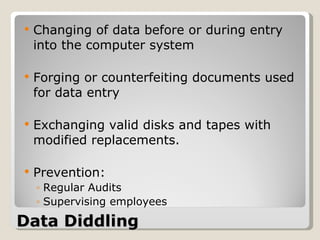
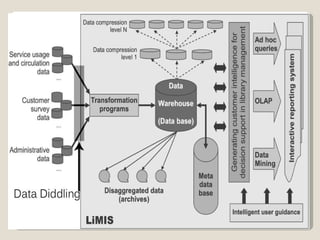
Data Diddling Changing of data before or during entry into the computer system Forging or counterfeiting documents used for data entry Exchanging valid disks and tapes with modified replacements. Prevention: Regular Audits Supervising employees
 
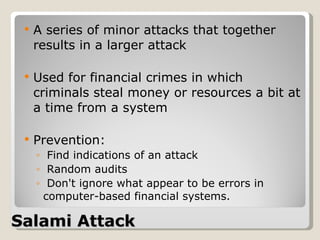
Salami Attack A series of minor attacks that together results in a larger attack Used for financial crimes in which criminals steal money or resources a bit at a time from a system Prevention: Find indications of an attack  Random audits Don't ignore what appear to be errors in computer-based financial systems.
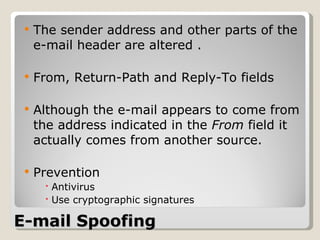
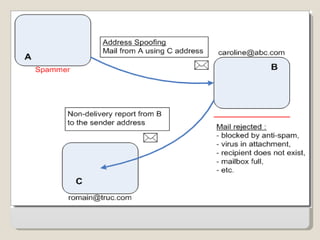
E-mail Spoofing The sender address and other parts of the e-mail header are altered . From, Return-Path and Reply-To fields Although the e-mail appears to come from the address indicated in the  From  field it actually comes from another source. Prevention Antivirus Use cryptographic signatures
 
Logic Bomb Is a piece of code intentionally inserted into a software system  That will set off a malicious function when specified conditions are met Prevention: Monitoring system  Application logs are the keys to identifying unwarranted activity
H4CK1NG Unauthorized remote computer break-ins via a communication networks such as the Internet Categories of hackers White hat or Ethical Hacker Grey hat Blue hat Black hat Elite  Script kiddie
What can I do? It is not possible to eliminate cyber crime from the cyber space.  It is quite possible to check them.  Awareness is the first step in protecting yourself. Invest in Anti-virus, Firewall, and SPAM blocking software for your home PC. Passwords Change passwords on a regular basis  Use complex passwords Do not automatically check boxes before reading the contents of any agreement etc
What can I do? Avoiding use of Unauthorized software Avoid opening of unknown email. Use internet filtering software. Data Level Security Using encrypting softwares


Cyber Crime & Security

  • 1.
    CYBER CRIME &SECURITY Presented By: S UNNY K UMAR A DITYA 12080088 Seminar Guide: Mr. S UDEEP E LAYIDOM “ Your computer is the crime scene”
  • 2.
    Outline HISTORY DEFINITIONCLASSIFICATION DETECTION PREVENTION
  • 3.
    HISTORY The firstrecorded cyber crime took place in the year 1820! The loom allowed the repetition of a series of steps in the weaving of special fabrics. This resulted in a fear amongst employees that their traditional employment was being threatened. They committed acts of sabotage to discourage further use of the new technology.    
  • 4.
    Introduction Internet has offered us a much more convenient way to share information across time and place. Cyberspace also opened a new venue for criminal activities. The anonymity of cyberspace makes identity tracing a significant problem which hinders investigations. Uninformed and misguided users .
  • 5.
    CLASSIFICATION OF CYBERCRIME1 .Computer as Target 2 .Computer as an instrumentality 3 .Computer as an incidental or other crime 4 .Crime associated with the prevalence of computers.
  • 6.
    COMPUTER AS ATARGET OF A CRIME Physical damage Theft or destruction of information (data). The spread of viruses , Trojans and worms . Software piracy, hacking etc.
  • 7.
    Computer as aninstrumentality . Crimes were either computers or their contents bare used in furtherance of crime Those offences which are committed by manipulating contents of computer systems. Include sending e-mails, ransom notes , credit card frauds, telecommunication frauds or theft.
  • 8.
    Computer as Incidental With the advent of computer the criminal have started using the technology as an aid for its perpetuation. They include use of computers as an aid for drug trafficking, money laundering, etc Means of coordinating .
  • 9.
    Copyright violation Sharingof copyright material – Torrents Software piracy Selling material protected by copyrights Component theft Crime with Prevalence of computers.
  • 10.
    Types of cybercrime Financial crimes - cheating, credit card frauds, money laundering Forgery etc. Sale of illegal articles: Online gambling: Intellectual Property crimes Theft of information contained in electronic form Email bombing
  • 11.
    Types of cybercrime Data Diddling Salami attacks Email spoofing Cyber Defamation Cyber stalking Hacking
  • 12.
    Types of cybercrime Denial of Service attack Virus / worm attacks Logic bombs Trojan attacks Internet time theft Web jacking Phishing
  • 13.
    Email Bombing Sendinghuge volumes of e-mail To an address or server in an attempt to overflow the mailbox or overwhelm the server Zip Bombing Methods of email bombing Mass Mailing Link Listing
  • 14.
    Denial of ServiceDenial of Service - works by flooding the access routers with bogus traffic. Distributed DoSs (DDoS5) : coordinated DoS attacks from multiple sources. Difficult to block because it uses multiple, changing, source IP addresses.
  • 15.
  • 16.
    Data Diddling Changingof data before or during entry into the computer system Forging or counterfeiting documents used for data entry Exchanging valid disks and tapes with modified replacements. Prevention: Regular Audits Supervising employees
  • 17.
  • 18.
    Salami Attack Aseries of minor attacks that together results in a larger attack Used for financial crimes in which criminals steal money or resources a bit at a time from a system Prevention: Find indications of an attack Random audits Don't ignore what appear to be errors in computer-based financial systems.
  • 19.
    E-mail Spoofing Thesender address and other parts of the e-mail header are altered . From, Return-Path and Reply-To fields Although the e-mail appears to come from the address indicated in the From field it actually comes from another source. Prevention Antivirus Use cryptographic signatures
  • 20.
  • 21.
    Logic Bomb Isa piece of code intentionally inserted into a software system That will set off a malicious function when specified conditions are met Prevention: Monitoring system Application logs are the keys to identifying unwarranted activity
  • 22.
    H4CK1NG Unauthorized remotecomputer break-ins via a communication networks such as the Internet Categories of hackers White hat or Ethical Hacker Grey hat Blue hat Black hat Elite Script kiddie
  • 23.
    What can Ido? It is not possible to eliminate cyber crime from the cyber space. It is quite possible to check them. Awareness is the first step in protecting yourself. Invest in Anti-virus, Firewall, and SPAM blocking software for your home PC. Passwords Change passwords on a regular basis Use complex passwords Do not automatically check boxes before reading the contents of any agreement etc
  • 24.
    What can Ido? Avoiding use of Unauthorized software Avoid opening of unknown email. Use internet filtering software. Data Level Security Using encrypting softwares
  • 25.
  • 26.