Presented By
 Keshab Nath
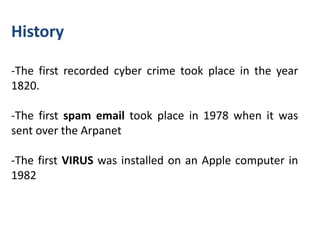
History

-The first recorded cyber crime took place in the year
1820.

-The first spam email took place in 1978 when it was
sent over the Arpanet

-The first VIRUS was installed on an Apple computer in
1982
History
• In 1983, Kevin Mitnick did an intrusion on a Pentagon’s computer
• Robert Tappan Morris created the first worm and sent it from MIT
  to the web and caused $50,000 of damages
• In 1994, Vladimir Levin intruded in an American bank computer and
  stole 10 millions dollars
• Jonathan James “c0mrade”, 16 years old, infiltrated a NASA
  computer in 1999 and had access to data worth 1,7 millions dollars
• Today (CSI Report, 2007):
    – 46% of companies have admitted to suffering financial losses due to
      security incidences. The reported loss amounted to a total of
      approximately $66,930,000.
    – 39% of companies have been unable (or unwilling) to estimate the
      cost of their losses.
• Financial Losses, Personal losses, Privacy losses, Data
  Losses, Computer Malfunction and more…..
Types of Cyber Crime


HACKING                    CREDIT CARD FRAUD
NET EXTORTION              PHISHING
DENIAL OF SERVICE ATTACK   SPOOFING
 VIRUS DISSEMINATION       CYBER STALKING
SOFTWARE PIRACY             CYBER DEFAMATION
 PORNOGRAPHY               THREATENING
 IRC Crime                 SALAMI ATTACK
Hacking
Hacking, in simple terms, means illegal intrusion
into a computer system without permission of the computer
owner / user.


 DENIAL OF SERVICE ATTACK
This is an act by the criminal who floods the bandwidth of the
victim’s network or fills his e-mail box with spam mail
depriving him of the services he is entitled to access or
provide
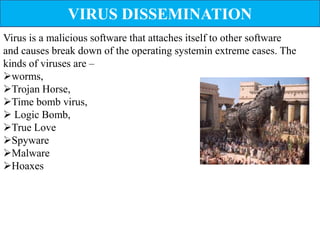
VIRUS DISSEMINATION
Virus is a malicious software that attaches itself to other software
and causes break down of the operating systemin extreme cases. The
kinds of viruses are –
worms,
Trojan Horse,
Time bomb virus,
 Logic Bomb,
True Love
Spyware
Malware
Hoaxes
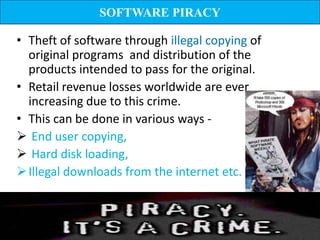
SOFTWARE PIRACY

• Theft of software through illegal copying of
  original programs and distribution of the
  products intended to pass for the original.
• Retail revenue losses worldwide are ever
  increasing due to this crime.
• This can be done in various ways -
 End user copying,
 Hard disk loading,
 Illegal downloads from the internet etc.
PORNOGRAPHY
Pornography is the first consistently successful e-commerce
product.
 Deceptive marketing tactics and mouse trapping technologies
used in Pornographic sites encourage PORNOGRAPHY
customers to access these sites.
Anybody, irrespective of age, can fall prey to the pornographic
sites at a click of mouse.
Publishing, transmitting any material in electronic form
which is lascivious or appeals to the prurient interest is an
offence under the provisions of section 67 of I.T. Act -2000.
IRC CRIME


Internet Relay Chat (IRC) servers have chat rooms in
which people from any corner of the world can come together
and chat with each other.
 Criminals use it for meeting co-conspirators.
Hackers use it for discussing their exploits / sharing the
Techniques
Pedophiles use chat rooms to allure small children
Cyber Stalking - In order to harass a female, her
telephone number is shared pseudonymously with others
as if she craves to befriend males.
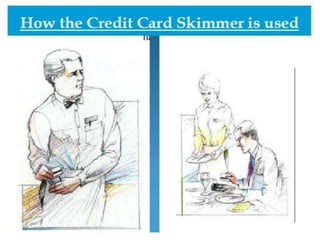
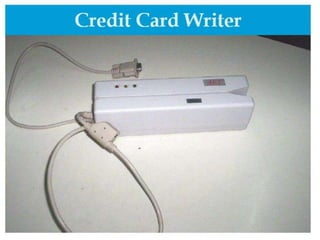
CREDIT CARD FRAUD
You simply have to type credit card
 number into www page of the
 vendor for online transaction.
If electronic transactions are not
 secured, the credit card umbers can
 be stolen by the hackers who can
 misuse this card by impersonating
 the credit card owner.
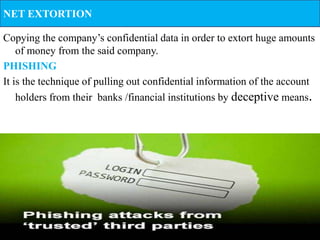
NET EXTORTION

Copying the company’s confidential data in order to extort huge amounts
    of money from the said company.
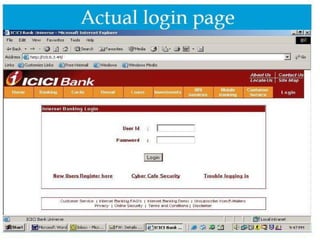
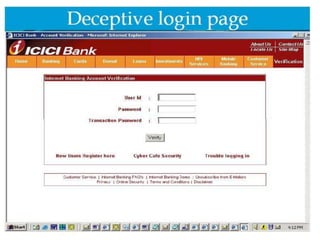
PHISHING
It is the technique of pulling out confidential information of the account
    holders from their banks /financial institutions by deceptive means.
Phishing E-mail
From : ICICI Bank
[mailto:support@icici.com]
Sent : 08 June 2004 03:25
To : India
Subject : Official information from ICICIBank
Dear valued ICICI Bank Customer !
      For security purposes your account has been randomly chosen for verification. To
verify your account information we are asking you to provide us with all the data we are
requesting.Otherwise we will not be able to verify your identity and access to your
account will be denied. Please click on the link below to get to the ICICI secure page and
verify your account details.
Thank you.
https://infinity.icicibank.co.in/Verify.jsp
ICICI Bank Limited
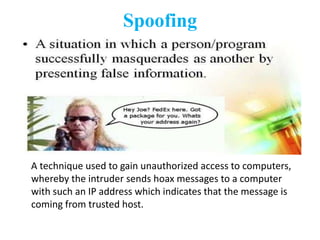
Spoofing


A technique used to gain unauthorized access to computers,
whereby the intruder sends hoax messages to a computer
with such an IP address which indicates that the message is
coming from trusted host.
CYBER DEFAMATION


• Sending defamatory messages through e-mail
   to the victim or his relatives, friends, etc. or
   posting of the defamatory material on a
   website.
---(Disgruntled employee may do this against
   boss, exboyfriends against a girl and divorced
   husband against his wife, to name a few.)
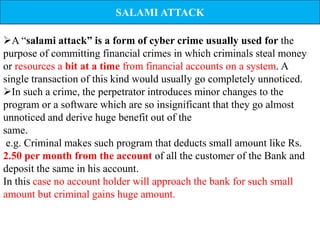
SALAMI ATTACK

A “salami attack” is a form of cyber crime usually used for the
purpose of committing financial crimes in which criminals steal money
or resources a bit at a time from financial accounts on a system. A
single transaction of this kind would usually go completely unnoticed.
In such a crime, the perpetrator introduces minor changes to the
program or a software which are so insignificant that they go almost
unnoticed and derive huge benefit out of the
same.
 e.g. Criminal makes such program that deducts small amount like Rs.
2.50 per month from the account of all the customer of the Bank and
deposit the same in his account.
In this case no account holder will approach the bank for such small
amount but criminal gains huge amount.
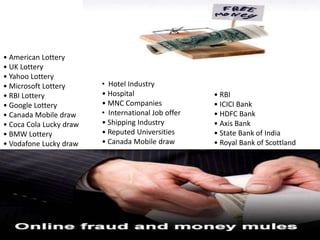
• American Lottery
• UK Lottery
• Yahoo Lottery
• Microsoft Lottery      • Hotel Industry
• RBI Lottery            • Hospital                  • RBI
• Google Lottery         • MNC Companies             • ICICI Bank
• Canada Mobile draw     • International Job offer   • HDFC Bank
• Coca Cola Lucky draw   • Shipping Industry         • Axis Bank
• BMW Lottery            • Reputed Universities      • State Bank of India
• Vodafone Lucky draw    • Canada Mobile draw        • Royal Bank of Scottland
Cyber security

-Involvesprotection of sensitive personal &
business information through prevention,
detection and response to different online
attacks

-Protects from attacks by    detecting   and
preventing
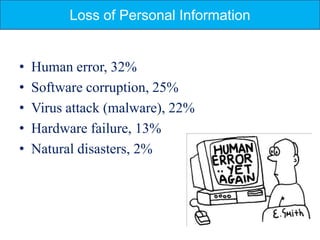
Loss of Personal Information


•   Human error, 32%
•   Software corruption, 25%
•   Virus attack (malware), 22%
•   Hardware failure, 13%
•   Natural disasters, 2%
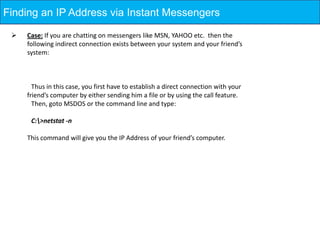
Finding an IP Address via Instant Messengers

    Case: If you are chatting on messengers like MSN, YAHOO etc. then the
     following indirect connection exists between your system and your friend’s
     system:


       Thus in this case, you first have to establish a direct connection with your
     friend’s computer by either sending him a file or by using the call feature.
       Then, goto MSDOS or the command line and type:

      C:>netstat -n

     This command will give you the IP Address of your friend’s computer.
Finding an IP Address via Instant Messengers
Countermeasures

      Do not accept File transfers or calls from unknown people
      Chat online only after logging on through a Proxy Server.

A Proxy Server acts as a buffer between you and the un-trusted network known as
the Internet, hence protecting your identity.


Some good Proxy Servers are:

Wingate (For Windows Platform)
Squid (For Unix Platforms)
Finding an IP Address via your website
   One can easily log the IP Addresses of all visitors to their website by using
    simply JAVA applets or JavaScript code.

Countermeasures

   One should surf the Internet through a Proxy Server.

   One can also make use of the numerous Free Anonymous Surfing Proxy
    Services.

    For Example, www.anonymizer.com
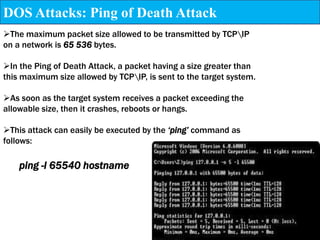
DOS Attacks: Ping of Death Attack
The maximum packet size allowed to be transmitted by TCPIP
on a network is 65 536 bytes.

In the Ping of Death Attack, a packet having a size greater than
this maximum size allowed by TCPIP, is sent to the target system.

As soon as the target system receives a packet exceeding the
allowable size, then it crashes, reboots or hangs.

This attack can easily be executed by the ‘ping’ command as
follows:

    ping -l 65540 hostname
Threats from Sniffers and Key Loggers

   Sniffers: capture all data packets being sent across the
    network in the raw form.

        Commonly Used for:

            Traffic Monitoring
            Network Trouble shooting
            Gathering Information on Attacker.
            For stealing company Secrets and sensitive data.

   Commonly Available Sniffers

            tcpdump
            Ethereal
            Dsniff
Threats From Key Logger

   Key loggers: Record all keystrokes made on that system and store
    them in a log file, which can later automatically be emailed to the
    attacker.
   Countermeasures

     Periodic Detection practices should be made mandatory.

    A Typical Key Logger automatically loads itself into the memory,
     each time the computer boots.

     Thus, the start up script of the Key Logger should be removed.

E.g. 1.SpyAgent
    2.WebWatcher
    3.PC Pandora
Default Settings
            Default Settings
• Many access points arrive with no security
  mechanism in place
• Changing the default settings before
  deployment should be a matter of
  organizational practice
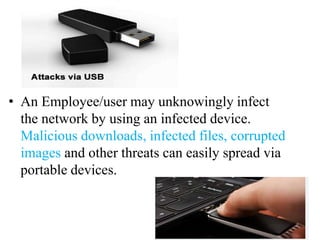
• An Employee/user may unknowingly infect
  the network by using an infected device.
  Malicious downloads, infected files, corrupted
  images and other threats can easily spread via
  portable devices.
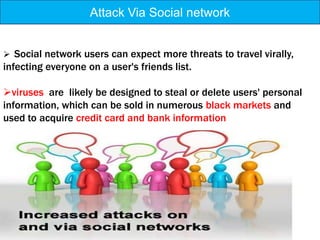
Attack Via Social network


 Social network users can expect more threats to travel virally,
infecting everyone on a user's friends list.

viruses are likely be designed to steal or delete users' personal
information, which can be sold in numerous black markets and
used to acquire credit card and bank information
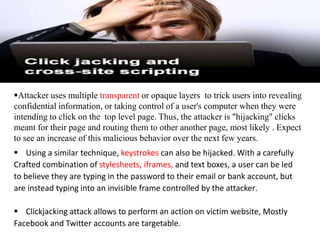
Attacker uses multiple transparent or opaque layers to trick users into revealing
confidential information, or taking control of a user's computer when they were
intending to click on the top level page. Thus, the attacker is "hijacking" clicks
meant for their page and routing them to other another page, most likely . Expect
to see an increase of this malicious behavior over the next few years.
 Using a similar technique, keystrokes can also be hijacked. With a carefully
Crafted combination of stylesheets, iframes, and text boxes, a user can be led
to believe they are typing in the password to their email or bank account, but
are instead typing into an invisible frame controlled by the attacker.

 Clickjacking attack allows to perform an action on victim website, Mostly
Facebook and Twitter accounts are targetable.
Clickjacking is a term first introduced by Jeremiah Grossman and
Robert Hansen in 2008 to describe a technique whereby an attacker
tricks a user into performing certain actions on a website by hiding
clickable elements inside an invisible iframe.


Using a similar technique, keystrokes can also be hijacked. With a
carefully crafted combination of stylesheets, iframes, and text boxes, a
user can be led to believe theyare typing in the password to their
email or bank account, but are instead typing into an invisible frame
controlled by the attacker
One of the more persistent threats of 2010 was fake anti-virus, also
commonly known as “scareware” or “rogueware.

The user receives a warning that their system is infected with some
nasty malware and forced to pay for a “full” version of the software to
remove the threat

In most cases there’s no real danger, and in many cases they’re actually
installing additional malware on the system and taking your credit
card information. With this kind of data handed over so freely, cyber
crooks can drain your bank account or completely take over your
identity.
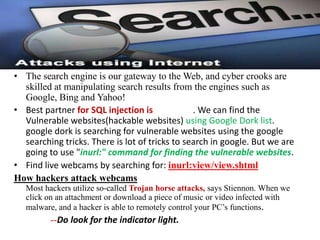
• The search engine is our gateway to the Web, and cyber crooks are
  skilled at manipulating search results from the engines such as
  Google, Bing and Yahoo!
• Best partner for SQL injection is             . We can find the
  Vulnerable websites(hackable websites) using Google Dork list.
  google dork is searching for vulnerable websites using the google
  searching tricks. There is lot of tricks to search in google. But we are
  going to use "inurl:" command for finding the vulnerable websites.
• Find live webcams by searching for: inurl:view/view.shtml
How hackers attack webcams
   Most hackers utilize so-called Trojan horse attacks, says Stiennon. When we
   click on an attachment or download a piece of music or video infected with
   malware, and a hacker is able to remotely control your PC’s functions.
         --Do look for the indicator light.
-Install a firewall , pop-up blocker
-Ensure your virus definitions are up to date
-Use strong passwords , don’t give personal information unless
required(not even phone number)
-Use secure connections
-Disable file sharing , turn off internet when not in use
-Use spam filters , delete spam immediately
-Use various passwords for various accounts
-Don’t believe in everything you read online
-Open attachments carefully
-Beware of promises to make fast profits
-Be smart , don’t act foolish and help in spreading spam

Cyber crime and cyber security

  • 1.
  • 3.
    History -The first recordedcyber crime took place in the year 1820. -The first spam email took place in 1978 when it was sent over the Arpanet -The first VIRUS was installed on an Apple computer in 1982
  • 4.
    History • In 1983,Kevin Mitnick did an intrusion on a Pentagon’s computer • Robert Tappan Morris created the first worm and sent it from MIT to the web and caused $50,000 of damages • In 1994, Vladimir Levin intruded in an American bank computer and stole 10 millions dollars • Jonathan James “c0mrade”, 16 years old, infiltrated a NASA computer in 1999 and had access to data worth 1,7 millions dollars • Today (CSI Report, 2007): – 46% of companies have admitted to suffering financial losses due to security incidences. The reported loss amounted to a total of approximately $66,930,000. – 39% of companies have been unable (or unwilling) to estimate the cost of their losses. • Financial Losses, Personal losses, Privacy losses, Data Losses, Computer Malfunction and more…..
  • 5.
    Types of CyberCrime HACKING CREDIT CARD FRAUD NET EXTORTION PHISHING DENIAL OF SERVICE ATTACK SPOOFING  VIRUS DISSEMINATION CYBER STALKING SOFTWARE PIRACY  CYBER DEFAMATION  PORNOGRAPHY THREATENING  IRC Crime SALAMI ATTACK
  • 6.
    Hacking Hacking, in simpleterms, means illegal intrusion into a computer system without permission of the computer owner / user. DENIAL OF SERVICE ATTACK This is an act by the criminal who floods the bandwidth of the victim’s network or fills his e-mail box with spam mail depriving him of the services he is entitled to access or provide
  • 7.
    VIRUS DISSEMINATION Virus isa malicious software that attaches itself to other software and causes break down of the operating systemin extreme cases. The kinds of viruses are – worms, Trojan Horse, Time bomb virus,  Logic Bomb, True Love Spyware Malware Hoaxes
  • 8.
    SOFTWARE PIRACY • Theftof software through illegal copying of original programs and distribution of the products intended to pass for the original. • Retail revenue losses worldwide are ever increasing due to this crime. • This can be done in various ways -  End user copying,  Hard disk loading,  Illegal downloads from the internet etc.
  • 9.
    PORNOGRAPHY Pornography is thefirst consistently successful e-commerce product.  Deceptive marketing tactics and mouse trapping technologies used in Pornographic sites encourage PORNOGRAPHY customers to access these sites. Anybody, irrespective of age, can fall prey to the pornographic sites at a click of mouse. Publishing, transmitting any material in electronic form which is lascivious or appeals to the prurient interest is an offence under the provisions of section 67 of I.T. Act -2000.
  • 10.
    IRC CRIME Internet RelayChat (IRC) servers have chat rooms in which people from any corner of the world can come together and chat with each other.  Criminals use it for meeting co-conspirators. Hackers use it for discussing their exploits / sharing the Techniques Pedophiles use chat rooms to allure small children Cyber Stalking - In order to harass a female, her telephone number is shared pseudonymously with others as if she craves to befriend males.
  • 11.
    CREDIT CARD FRAUD Yousimply have to type credit card number into www page of the vendor for online transaction. If electronic transactions are not secured, the credit card umbers can be stolen by the hackers who can misuse this card by impersonating the credit card owner.
  • 21.
    NET EXTORTION Copying thecompany’s confidential data in order to extort huge amounts of money from the said company. PHISHING It is the technique of pulling out confidential information of the account holders from their banks /financial institutions by deceptive means.
  • 23.
    Phishing E-mail From :ICICI Bank [mailto:support@icici.com] Sent : 08 June 2004 03:25 To : India Subject : Official information from ICICIBank Dear valued ICICI Bank Customer ! For security purposes your account has been randomly chosen for verification. To verify your account information we are asking you to provide us with all the data we are requesting.Otherwise we will not be able to verify your identity and access to your account will be denied. Please click on the link below to get to the ICICI secure page and verify your account details. Thank you. https://infinity.icicibank.co.in/Verify.jsp ICICI Bank Limited
  • 25.
    Spoofing A technique usedto gain unauthorized access to computers, whereby the intruder sends hoax messages to a computer with such an IP address which indicates that the message is coming from trusted host.
  • 26.
    CYBER DEFAMATION • Sendingdefamatory messages through e-mail to the victim or his relatives, friends, etc. or posting of the defamatory material on a website. ---(Disgruntled employee may do this against boss, exboyfriends against a girl and divorced husband against his wife, to name a few.)
  • 27.
    SALAMI ATTACK A “salamiattack” is a form of cyber crime usually used for the purpose of committing financial crimes in which criminals steal money or resources a bit at a time from financial accounts on a system. A single transaction of this kind would usually go completely unnoticed. In such a crime, the perpetrator introduces minor changes to the program or a software which are so insignificant that they go almost unnoticed and derive huge benefit out of the same. e.g. Criminal makes such program that deducts small amount like Rs. 2.50 per month from the account of all the customer of the Bank and deposit the same in his account. In this case no account holder will approach the bank for such small amount but criminal gains huge amount.
  • 28.
    • American Lottery •UK Lottery • Yahoo Lottery • Microsoft Lottery • Hotel Industry • RBI Lottery • Hospital • RBI • Google Lottery • MNC Companies • ICICI Bank • Canada Mobile draw • International Job offer • HDFC Bank • Coca Cola Lucky draw • Shipping Industry • Axis Bank • BMW Lottery • Reputed Universities • State Bank of India • Vodafone Lucky draw • Canada Mobile draw • Royal Bank of Scottland
  • 33.
    Cyber security -Involvesprotection ofsensitive personal & business information through prevention, detection and response to different online attacks -Protects from attacks by detecting and preventing
  • 35.
    Loss of PersonalInformation • Human error, 32% • Software corruption, 25% • Virus attack (malware), 22% • Hardware failure, 13% • Natural disasters, 2%
  • 36.
    Finding an IPAddress via Instant Messengers  Case: If you are chatting on messengers like MSN, YAHOO etc. then the following indirect connection exists between your system and your friend’s system: Thus in this case, you first have to establish a direct connection with your friend’s computer by either sending him a file or by using the call feature. Then, goto MSDOS or the command line and type: C:>netstat -n This command will give you the IP Address of your friend’s computer.
  • 37.
    Finding an IPAddress via Instant Messengers Countermeasures Do not accept File transfers or calls from unknown people Chat online only after logging on through a Proxy Server. A Proxy Server acts as a buffer between you and the un-trusted network known as the Internet, hence protecting your identity. Some good Proxy Servers are: Wingate (For Windows Platform) Squid (For Unix Platforms)
  • 38.
    Finding an IPAddress via your website  One can easily log the IP Addresses of all visitors to their website by using simply JAVA applets or JavaScript code. Countermeasures  One should surf the Internet through a Proxy Server.  One can also make use of the numerous Free Anonymous Surfing Proxy Services. For Example, www.anonymizer.com
  • 39.
    DOS Attacks: Pingof Death Attack The maximum packet size allowed to be transmitted by TCPIP on a network is 65 536 bytes. In the Ping of Death Attack, a packet having a size greater than this maximum size allowed by TCPIP, is sent to the target system. As soon as the target system receives a packet exceeding the allowable size, then it crashes, reboots or hangs. This attack can easily be executed by the ‘ping’ command as follows: ping -l 65540 hostname
  • 40.
    Threats from Sniffersand Key Loggers  Sniffers: capture all data packets being sent across the network in the raw form. Commonly Used for:  Traffic Monitoring  Network Trouble shooting  Gathering Information on Attacker.  For stealing company Secrets and sensitive data.  Commonly Available Sniffers  tcpdump  Ethereal  Dsniff
  • 41.
    Threats From KeyLogger  Key loggers: Record all keystrokes made on that system and store them in a log file, which can later automatically be emailed to the attacker.  Countermeasures  Periodic Detection practices should be made mandatory. A Typical Key Logger automatically loads itself into the memory, each time the computer boots.  Thus, the start up script of the Key Logger should be removed. E.g. 1.SpyAgent 2.WebWatcher 3.PC Pandora
  • 42.
    Default Settings Default Settings • Many access points arrive with no security mechanism in place • Changing the default settings before deployment should be a matter of organizational practice
  • 43.
    • An Employee/usermay unknowingly infect the network by using an infected device. Malicious downloads, infected files, corrupted images and other threats can easily spread via portable devices.
  • 44.
    Attack Via Socialnetwork  Social network users can expect more threats to travel virally, infecting everyone on a user's friends list. viruses are likely be designed to steal or delete users' personal information, which can be sold in numerous black markets and used to acquire credit card and bank information
  • 46.
    Attacker uses multipletransparent or opaque layers to trick users into revealing confidential information, or taking control of a user's computer when they were intending to click on the top level page. Thus, the attacker is "hijacking" clicks meant for their page and routing them to other another page, most likely . Expect to see an increase of this malicious behavior over the next few years.  Using a similar technique, keystrokes can also be hijacked. With a carefully Crafted combination of stylesheets, iframes, and text boxes, a user can be led to believe they are typing in the password to their email or bank account, but are instead typing into an invisible frame controlled by the attacker.  Clickjacking attack allows to perform an action on victim website, Mostly Facebook and Twitter accounts are targetable.
  • 47.
    Clickjacking is aterm first introduced by Jeremiah Grossman and Robert Hansen in 2008 to describe a technique whereby an attacker tricks a user into performing certain actions on a website by hiding clickable elements inside an invisible iframe. Using a similar technique, keystrokes can also be hijacked. With a carefully crafted combination of stylesheets, iframes, and text boxes, a user can be led to believe theyare typing in the password to their email or bank account, but are instead typing into an invisible frame controlled by the attacker
  • 48.
    One of themore persistent threats of 2010 was fake anti-virus, also commonly known as “scareware” or “rogueware. The user receives a warning that their system is infected with some nasty malware and forced to pay for a “full” version of the software to remove the threat In most cases there’s no real danger, and in many cases they’re actually installing additional malware on the system and taking your credit card information. With this kind of data handed over so freely, cyber crooks can drain your bank account or completely take over your identity.
  • 49.
    • The searchengine is our gateway to the Web, and cyber crooks are skilled at manipulating search results from the engines such as Google, Bing and Yahoo! • Best partner for SQL injection is . We can find the Vulnerable websites(hackable websites) using Google Dork list. google dork is searching for vulnerable websites using the google searching tricks. There is lot of tricks to search in google. But we are going to use "inurl:" command for finding the vulnerable websites. • Find live webcams by searching for: inurl:view/view.shtml How hackers attack webcams Most hackers utilize so-called Trojan horse attacks, says Stiennon. When we click on an attachment or download a piece of music or video infected with malware, and a hacker is able to remotely control your PC’s functions. --Do look for the indicator light.
  • 50.
    -Install a firewall, pop-up blocker -Ensure your virus definitions are up to date -Use strong passwords , don’t give personal information unless required(not even phone number) -Use secure connections -Disable file sharing , turn off internet when not in use -Use spam filters , delete spam immediately -Use various passwords for various accounts -Don’t believe in everything you read online -Open attachments carefully -Beware of promises to make fast profits -Be smart , don’t act foolish and help in spreading spam