DEFINITION
( HOSPITAL ACQUIREDINFECTIONS= NOSOCOMIAL INFECTIONS= HEALTHCARE ASSOCIATED INFECTIONS )
CDC defines HAI as a localized or systemic condition resulting from
an adverse reaction to the presence of an infectious agent(s) or its
toxin(s) without any evidence of its being present or in incubation
at the time of admission.
An infection is attributed as HAI if date of event occurs on
or after 3rd calendar day (CL) of admission where day of
admission is counted as CL 1.
3.
FACTORS AFFECTING HAI
Immune status
Hospital environment
Hospital organisms
Diagnostic or therapeutic interventions
Transfusion
Poor hospital administration
4.
MAJOR TYPES OFHAIS
Catheter-associated urinary tract infection (CAUTI)
Central line-associated blood stream infection (CLABSI)
Ventilator-associated pneumonia (VAP)
Surgical site infection (SSI).
5.
PREVENTION OF DEVICE-ASSOCIATEDINFECTIONS
(DAIS)
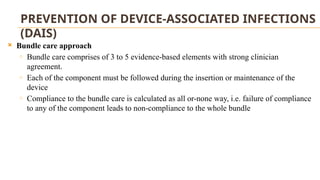
Bundle care approach
o Bundle care comprises of 3 to 5 evidence-based elements with strong clinician
agreement.
o Each of the component must be followed during the insertion or maintenance of the
device
o Compliance to the bundle care is calculated as all or-none way, i.e. failure of compliance
to any of the component leads to non-compliance to the whole bundle
6.
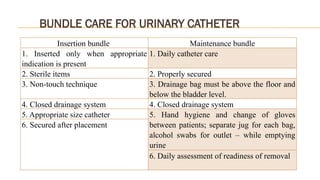
BUNDLE CARE FORURINARY CATHETER
Insertion bundle Maintenance bundle
1. Inserted only when appropriate
indication is present
1. Daily catheter care
2. Sterile items 2. Properly secured
3. Non-touch technique 3. Drainage bag must be above the floor and
below the bladder level.
4. Closed drainage system 4. Closed drainage system
5. Appropriate size catheter 5. Hand hygiene and change of gloves
between patients; separate jug for each bag,
alcohol swabs for outlet – while emptying
urine
6. Secured after placement
6. Daily assessment of readiness of removal
7.
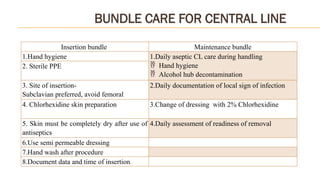
BUNDLE CARE FORCENTRAL LINE
Insertion bundle Maintenance bundle
1.Hand hygiene 1.Daily aseptic CL care during handling
Hand hygiene
Alcohol hub decontamination
2. Sterile PPE
3. Site of insertion-
Subclavian preferred, avoid femoral
2.Daily documentation of local sign of infection
4. Chlorhexidine skin preparation 3.Change of dressing with 2% Chlorhexidine
5. Skin must be completely dry after use of
antiseptics
4.Daily assessment of readiness of removal
6.Use semi permeable dressing
7.Hand wash after procedure
8.Document data and time of insertion
8.
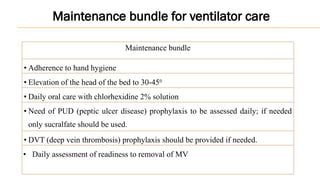
Maintenance bundle
• Adherenceto hand hygiene
• Elevation of the head of the bed to 30-450
• Daily oral care with chlorhexidine 2% solution
• Need of PUD (peptic ulcer disease) prophylaxis to be assessed daily; if needed
only sucralfate should be used.
• DVT (deep vein thrombosis) prophylaxis should be provided if needed.
• Daily assessment of readiness to removal of MV
Maintenance bundle for ventilator care
9.
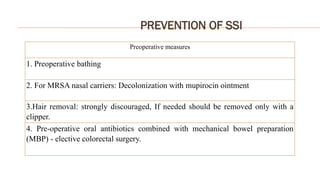
PREVENTION OF SSI
Preoperativemeasures
1. Preoperative bathing
2. For MRSA nasal carriers: Decolonization with mupirocin ointment
3.Hair removal: strongly discouraged, If needed should be removed only with a
clipper.
4. Pre-operative oral antibiotics combined with mechanical bowel preparation
(MBP) - elective colorectal surgery.
10.
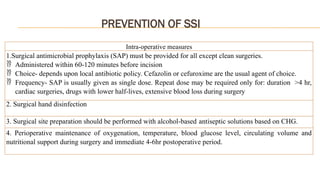
PREVENTION OF SSI
Intra-operativemeasures
1.Surgical antimicrobial prophylaxis (SAP) must be provided for all except clean surgeries.
Administered within 60-120 minutes before incision
Choice- depends upon local antibiotic policy. Cefazolin or cefuroxime are the usual agent of choice.
Frequency- SAP is usually given as single dose. Repeat dose may be required only for: duration >4 hr,
cardiac surgeries, drugs with lower half-lives, extensive blood loss during surgery
2. Surgical hand disinfection
3. Surgical site preparation should be performed with alcohol-based antiseptic solutions based on CHG.
4. Perioperative maintenance of oxygenation, temperature, blood glucose level, circulating volume and
nutritional support during surgery and immediate 4-6hr postoperative period.
11.
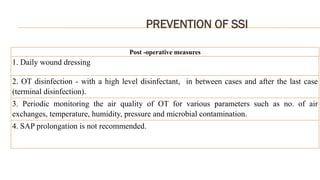
PREVENTION OF SSI
Post-operative measures
1. Daily wound dressing
2. OT disinfection - with a high level disinfectant, in between cases and after the last case
(terminal disinfection).
3. Periodic monitoring the air quality of OT for various parameters such as no. of air
exchanges, temperature, humidity, pressure and microbial contamination.
4. SAP prolongation is not recommended.