Resume/CV/Biodata Preparation
and Interview preparation
for Engineering Students
A presentation By
Dr. Janak Valaki
Associate Professor,
Mechanical Engineering
Government Engineering College, Bhavnagar
janakvalaki@gmail.com, 09913715250
“You don’t hire for skills,
you hire for attitude.
You can always teach skills”
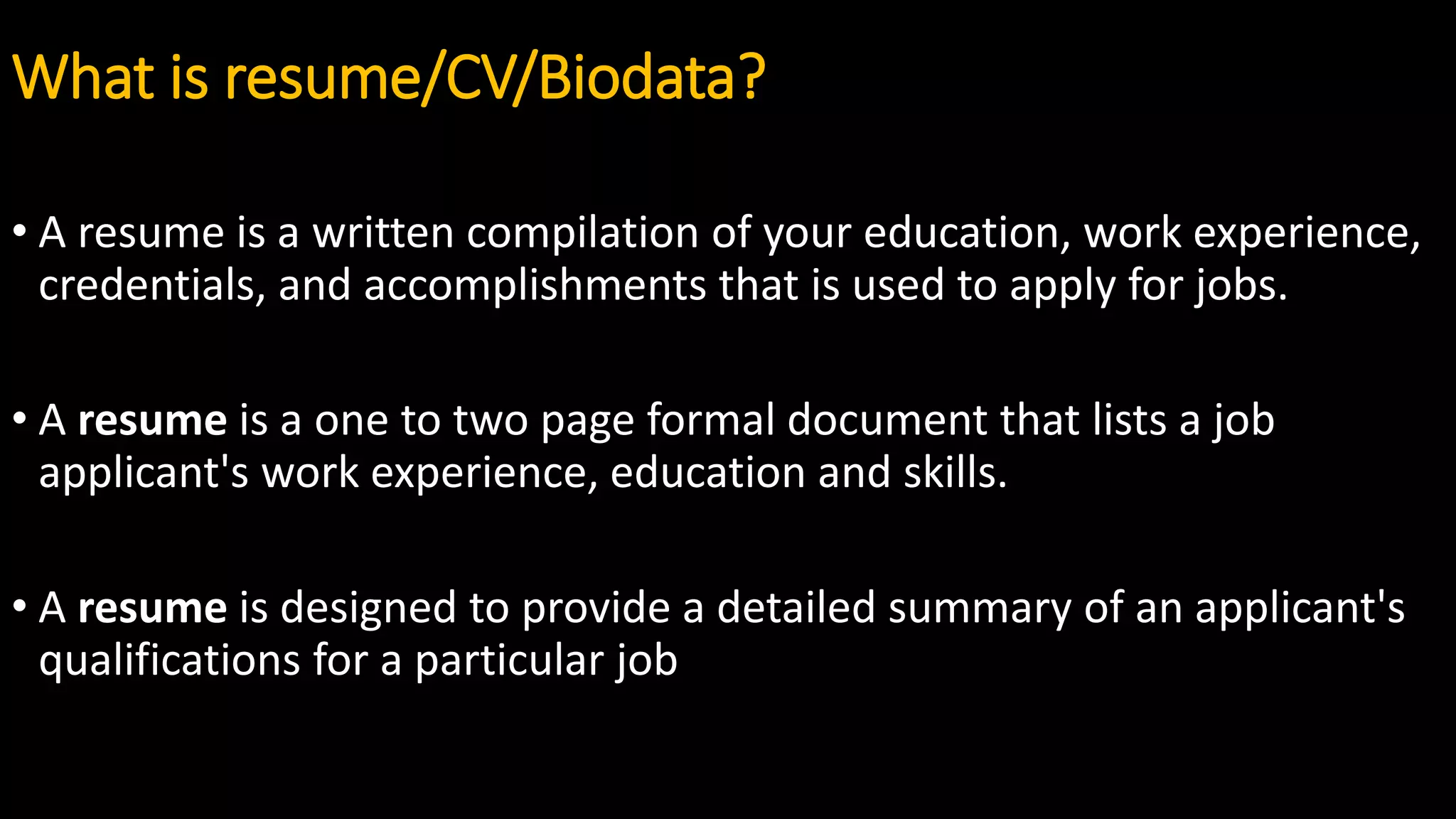
What is resume/CV/Biodata?
• A resume is a written compilation of your education, work experience,
credentials, and accomplishments that is used to apply for jobs.
• A resume is a one to two page formal document that lists a job
applicant's work experience, education and skills.
• A resume is designed to provide a detailed summary of an applicant's
qualifications for a particular job
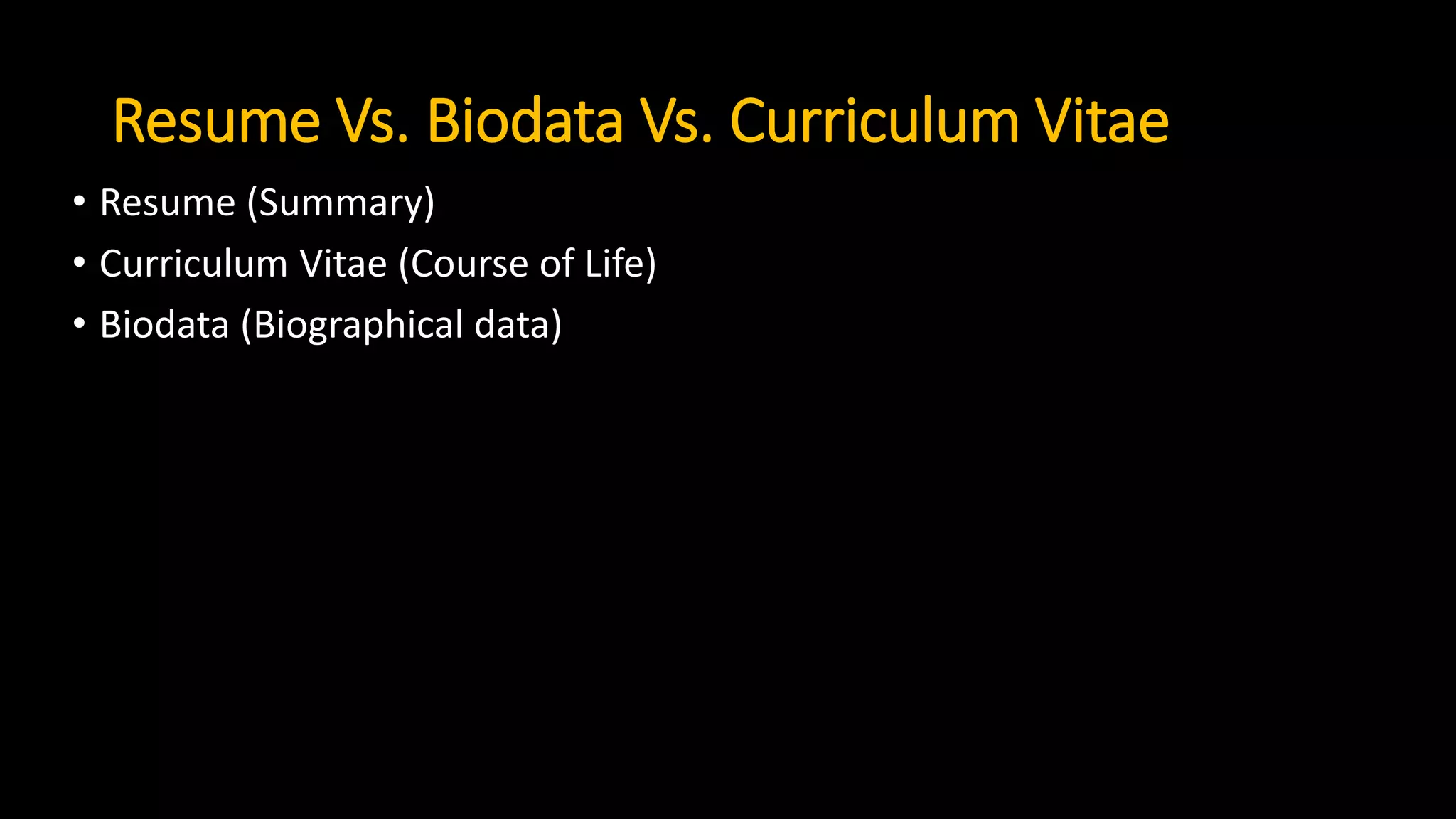
Resume Vs. Biodata Vs. Curriculum Vitae
• Resume (Summary)
• Curriculum Vitae (Course of Life)
• Biodata (Biographical data)
Resume
• Resume is a French word meaning "summary", and true to the word
meaning, signifies a summary of one's employment, education, and other
skills, used in applying for a new position.
• A resume seldom exceeds one side of an A4 sheet, and at the most two sides.
• They do not list out all the education and qualifications, but only highlight
specific skills customized to target the job profile in question.
• A resume is usually broken into bullets and written in the third person to
appear objective and formal.
Resume
• A good resume starts with a brief Summary of Qualifications, followed
by Areas of Strength or Industry Expertise in keywords, followed by
Professional Experience in reverse chronological order.
• Focus is on the most recent experiences, and prior experiences
summarized.
• The content aims at providing the reader a balance of responsibilities
and accomplishments for each position.
• After Work experience come Professional Affiliations, Computer Skills,
and Education.
Curriculum Vitae
• C.V is a Latin word meaning "course of life".
• Curriculum Vitae (C.V.) is therefore a regular or particular course of
study pertaining to education and life.
• A C.V. is more detailed than a resume, usually 2 to 3 pages, but can
run even longer as per the requirement.
• A C.V. generally lists out every skills, jobs, degrees, and professional
affiliations the applicant has acquired, usually in chronological order.
• A C.V. displays general talent rather than specific skills for any specific
positions.
Biodata
• Bio Data the short form for Biographical Data, is the old-fashioned
terminology for Resume or C.V.
• The emphasis in a bio data is on personal particulars like date of birth,
religion, gender, race, nationality, residence, marital status, and the
like.
• Next comes a chronological listing of education and experience.
• The things normally found in a resume, that is specific skills for the
job in question comes last, and are seldom included.
• Bio-data also includes applications made in specified formats as
required by the company.
At a glance summary..
• A resume is ideally suited when applying for middle and senior level
positions, where experience and specific skills rather than education
is important.
• A C.V., on the other hand is the preferred option for fresh graduates,
people looking for a career change, and those applying for academic
positions.
• The term bio-data is mostly used in India while applying to
government jobs, or when applying for research grants and other
situations where one has to submit descriptive essays.
The ideal Resume / Bio Data / C.V. should have . . .
• Name and Contact details
• Objective
• Educational Qualification
• Professional qualification
• List of Soft skills
• Work Experience
• Salary expected
• Reference
Avoid in CV
• Having a resume that is too long
• Using fancy paper
• Using a fancy font
• Filling the resume with extraneous information
• Including outdated information
• Typos and misspellings
• Lying on your resume
• Attachments
• Saying too much
• Leaving out the cover letter
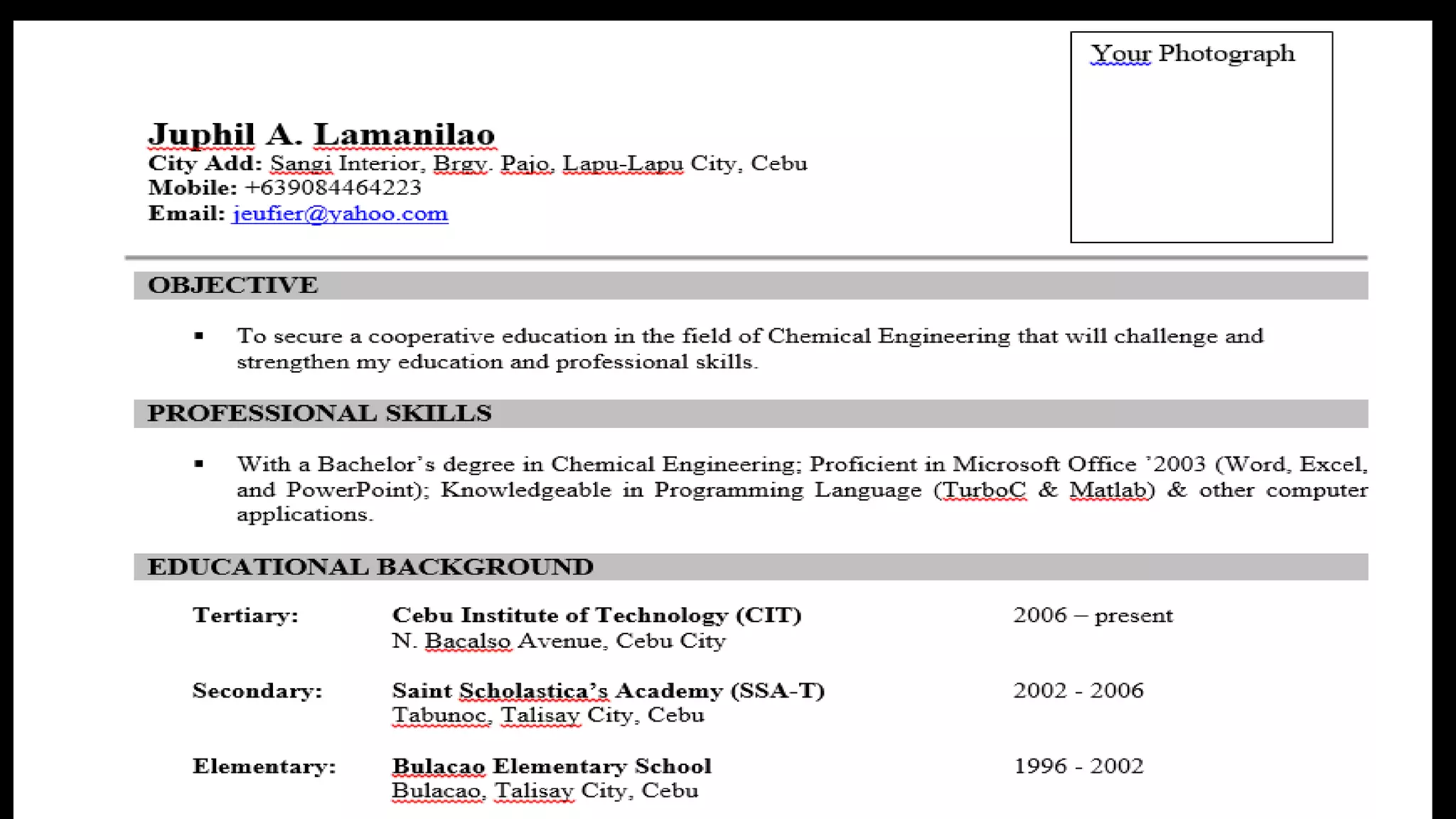
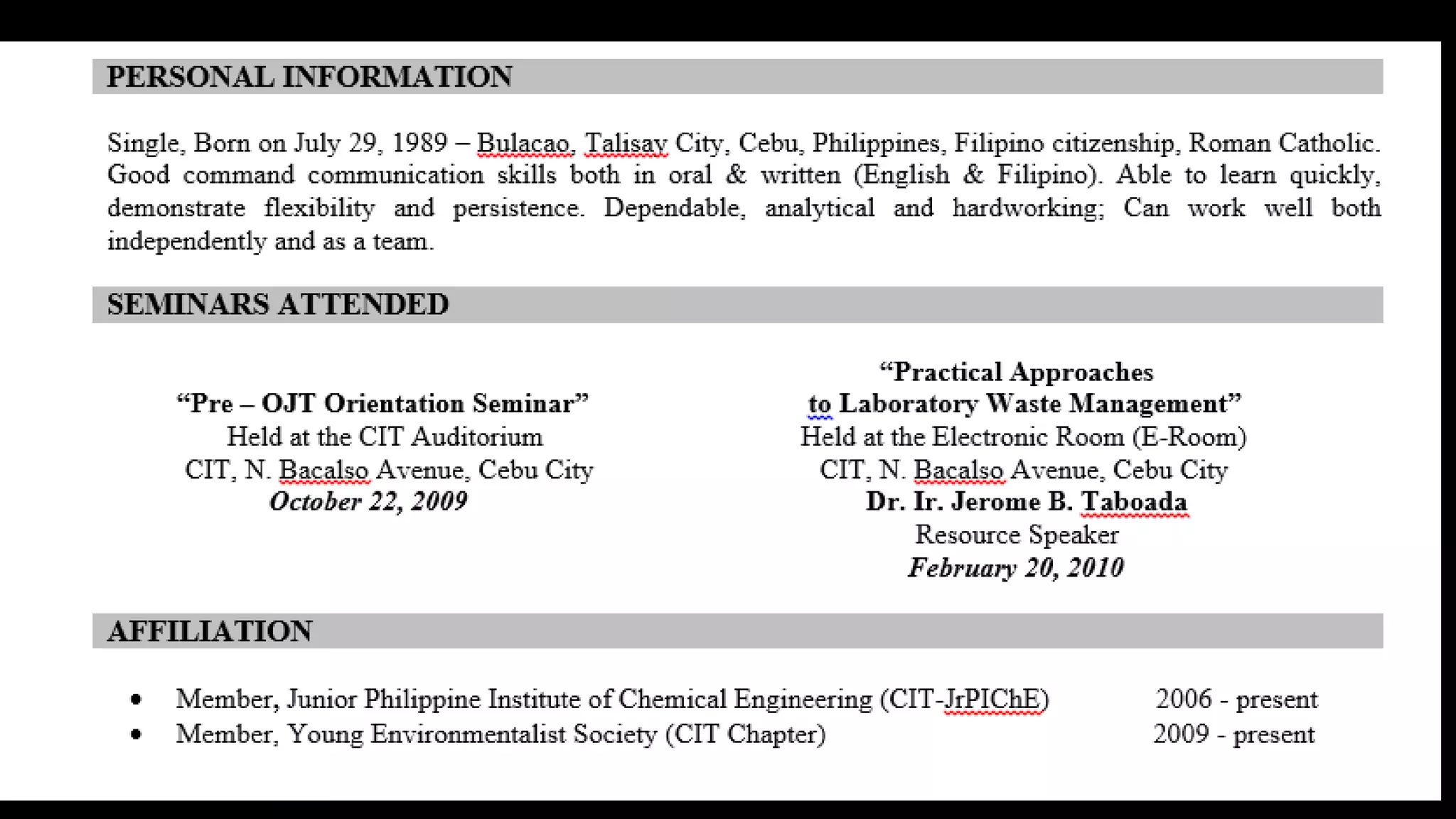
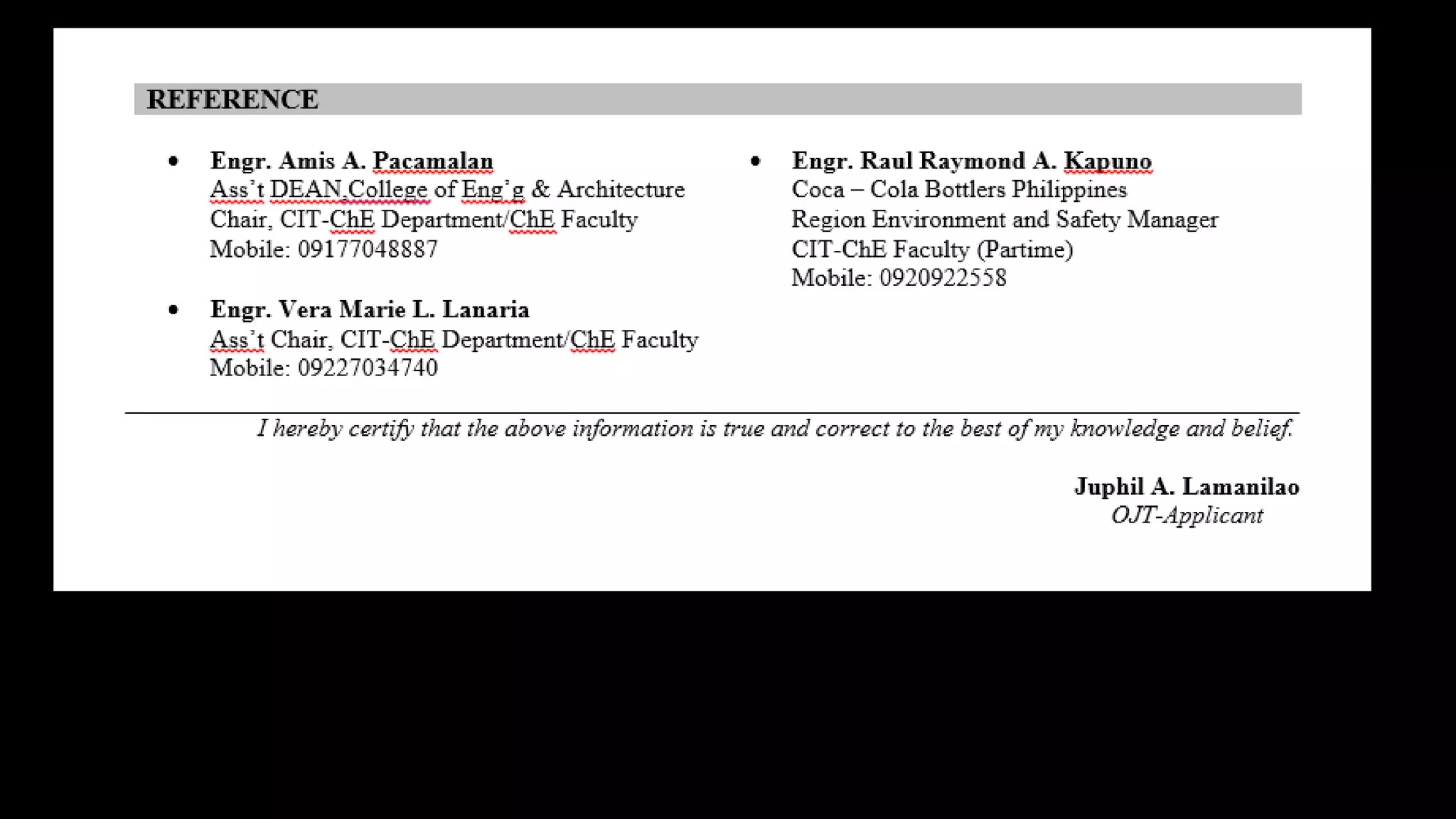
Sample CV
• What's in trends….
• Along with your written CV or Resume, Video CV/Resume.
Interview Preparation
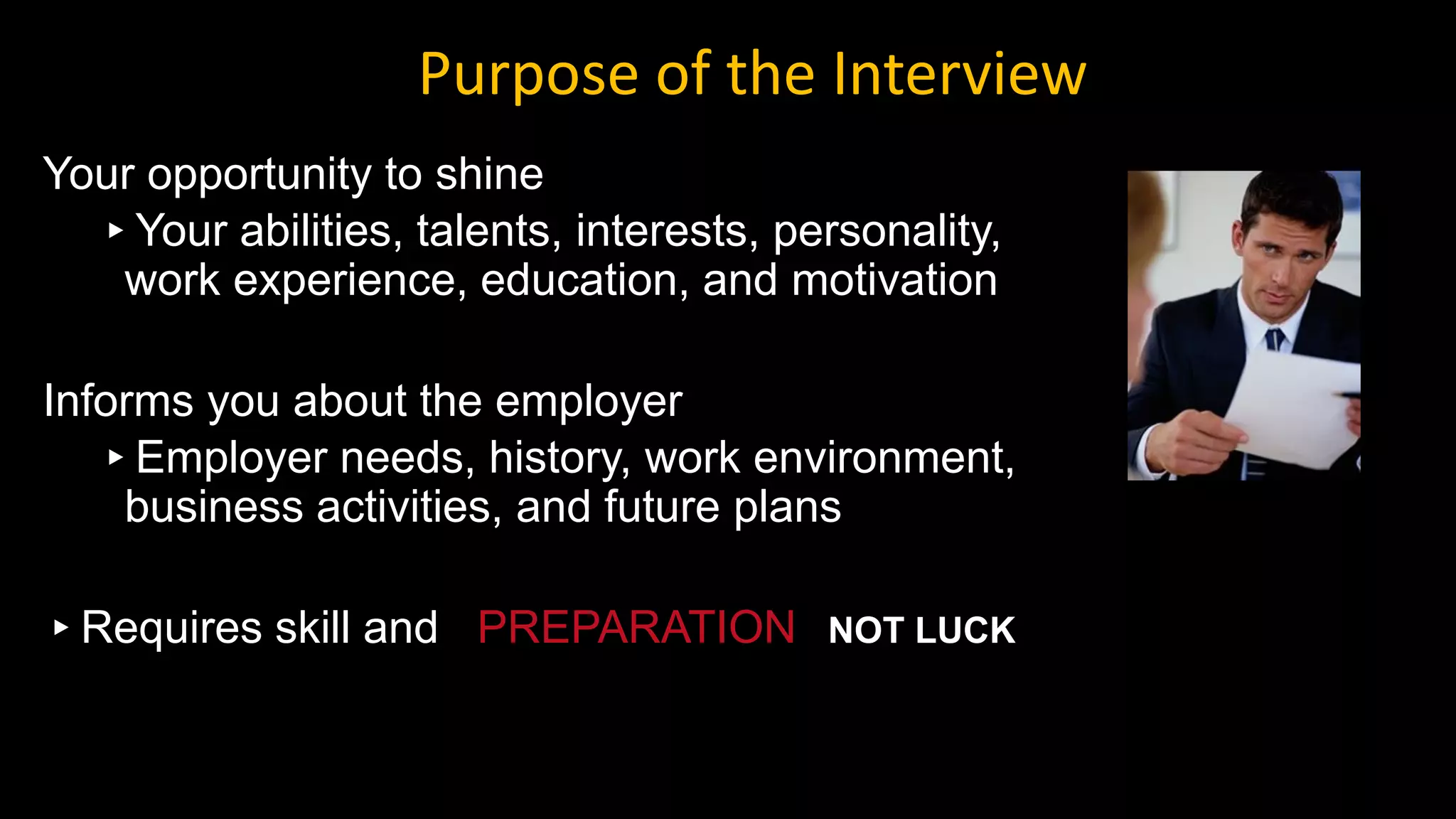
Your opportunity to shine
▸Your abilities, talents, interests, personality,
work experience, education, and motivation
Informs you about the employer
▸Employer needs, history, work environment,
business activities, and future plans
▸Requires skill and PREPARATION NOT LUCK
Purpose of the Interview
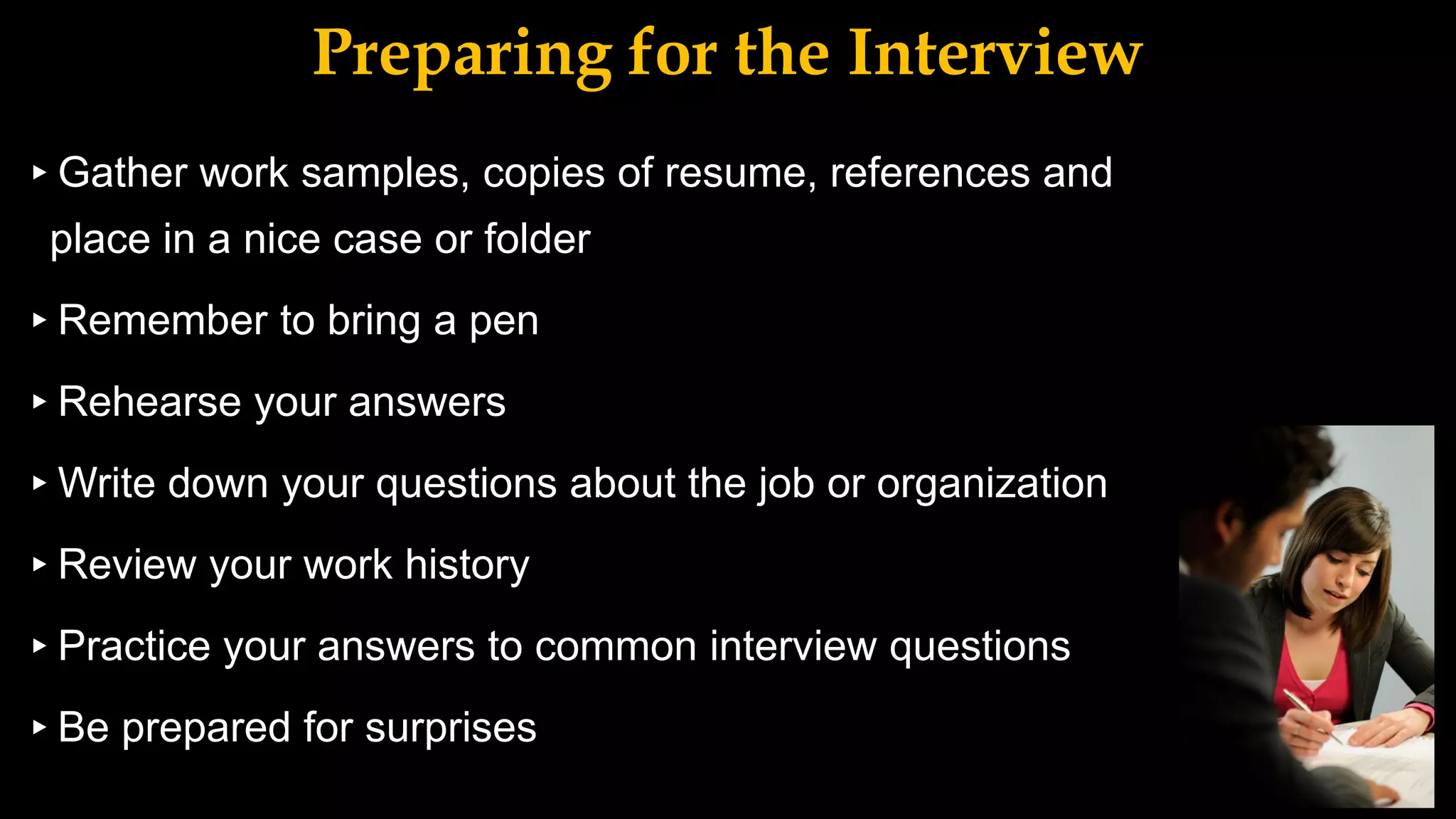
▸Gather work samples, copies of resume, references and
place in a nice case or folder
▸Remember to bring a pen
▸Rehearse your answers
▸Write down your questions about the job or organization
▸Review your work history
▸Practice your answers to common interview questions
▸Be prepared for surprises
Preparing for the Interview
Prepare for the Interview
Research the company
• Check the website and ask around
Update your paperwork
• Most recent employment and education
• Bring several copies to the interview
Anticipate and practice interview questions
Commonly Asked Job Interview Questions
• Tell me something about yourself.
• Why do you want to work for our company?
• What are your future career plans?
• Why did you choose this particular field of work?
• Describe a past work situation where you
encountered a problem and describe how you
solved it.
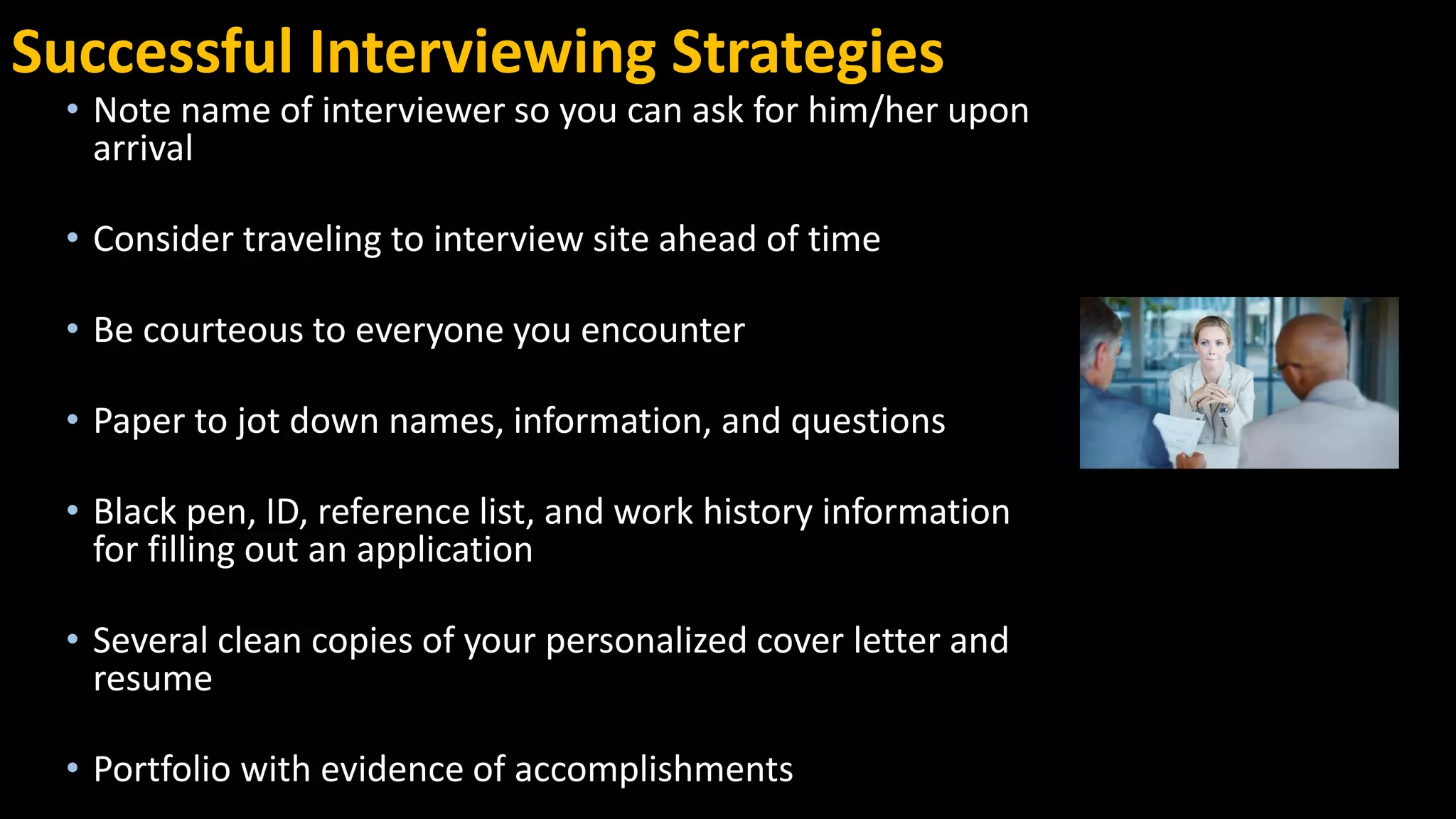
Successful Interviewing Strategies
• Note name of interviewer so you can ask for him/her upon
arrival
• Consider traveling to interview site ahead of time
• Be courteous to everyone you encounter
• Paper to jot down names, information, and questions
• Black pen, ID, reference list, and work history information
for filling out an application
• Several clean copies of your personalized cover letter and
resume
• Portfolio with evidence of accomplishments
Dress for Interview Success
General Dress Guidelines:
• Clean and well-pressed clothes
• Clean-shaven or neatly trimmed hair
• Conceal piercings and tattoos
• Subtle fragrances only
• Clean nails
• Don’t smoke prior or chew gum during
• Turn off your cell phone
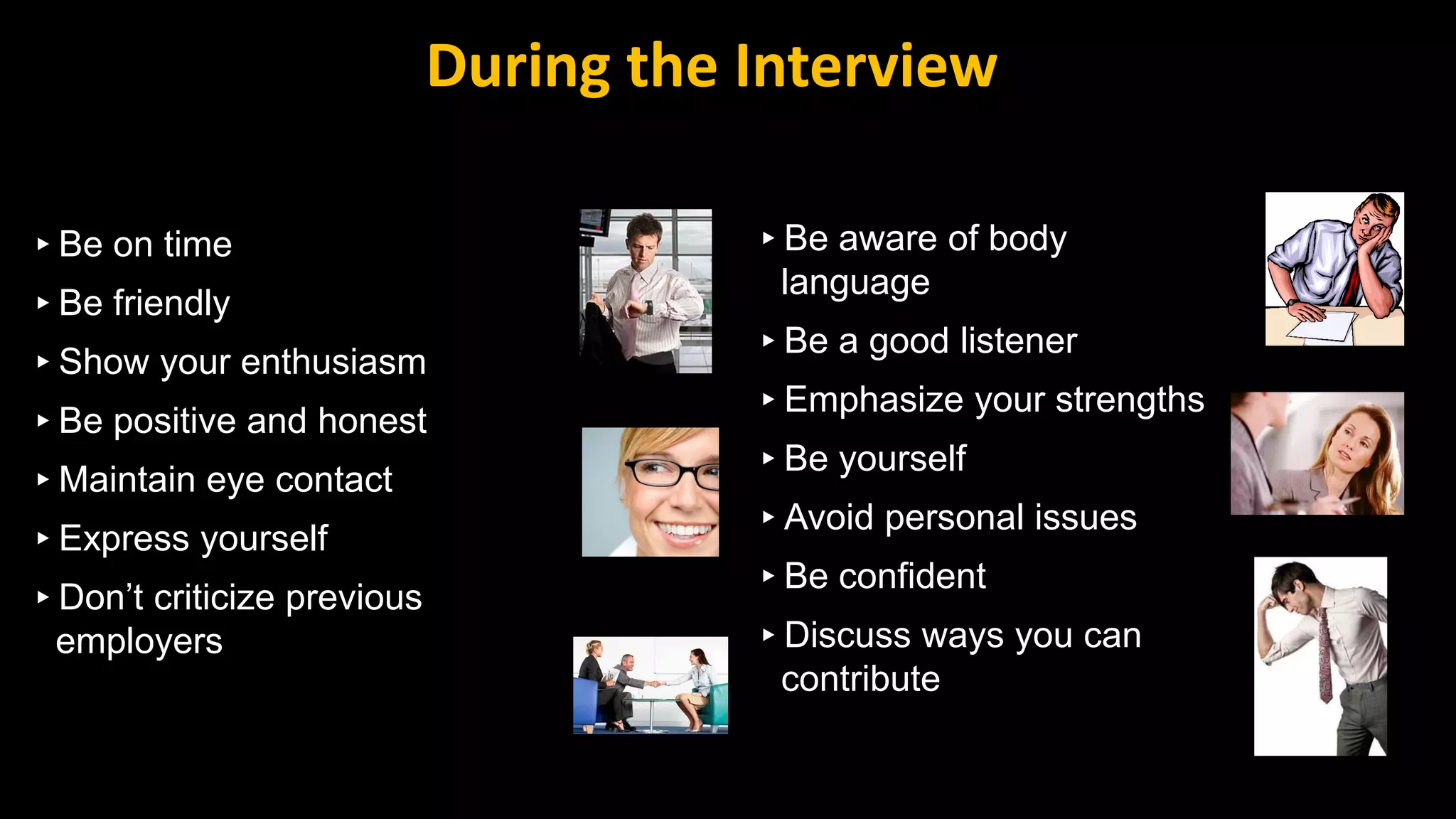
▸Be on time
▸Be friendly
▸Show your enthusiasm
▸Be positive and honest
▸Maintain eye contact
▸Express yourself
▸Don’t criticize previous
employers
▸Be aware of body
language
▸Be a good listener
▸Emphasize your strengths
▸Be yourself
▸Avoid personal issues
▸Be confident
▸Discuss ways you can
contribute
During the Interview
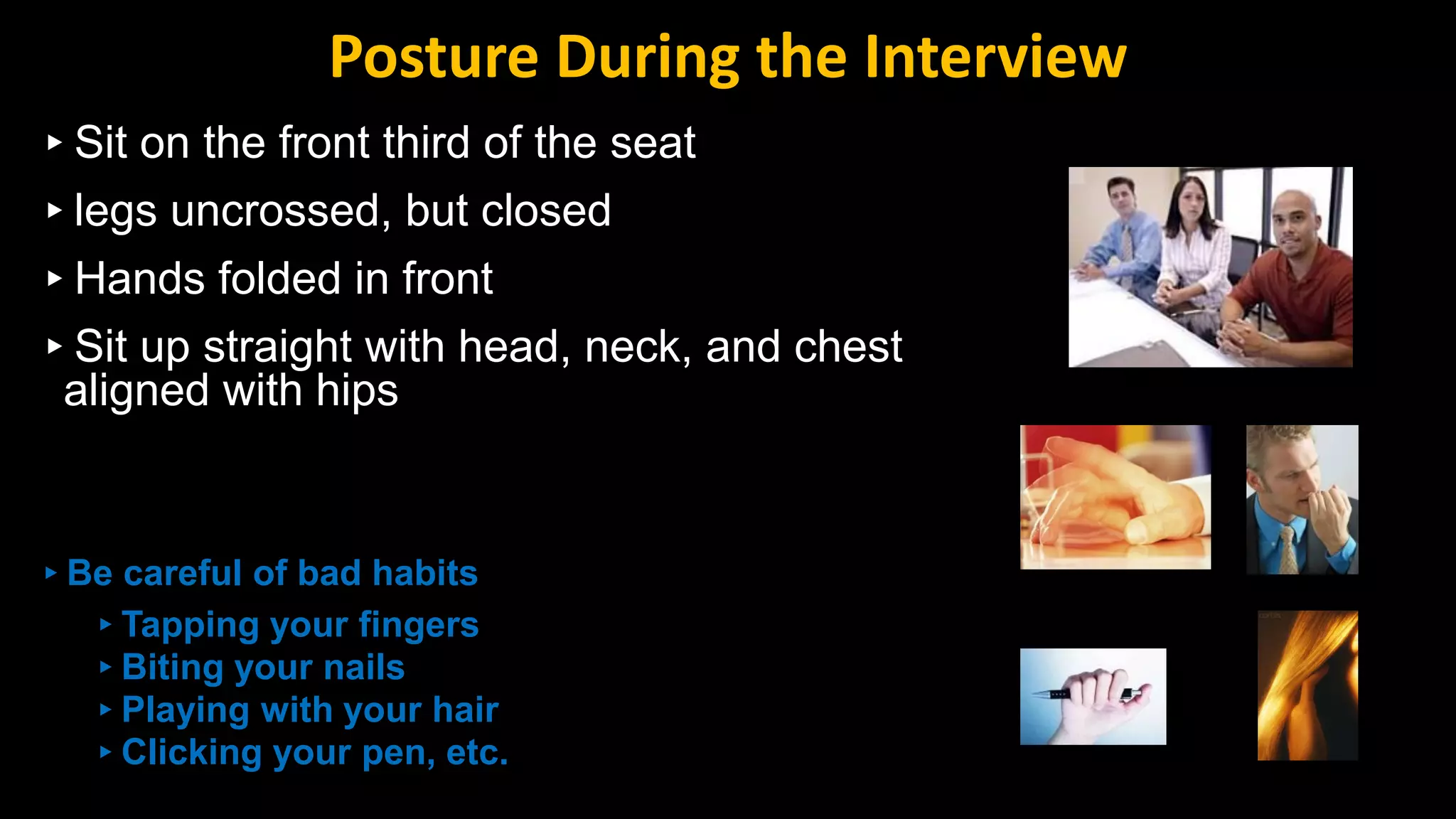
▸Sit on the front third of the seat
▸legs uncrossed, but closed
▸Hands folded in front
▸Sit up straight with head, neck, and chest
aligned with hips
▸Be careful of bad habits
▸Tapping your fingers
▸Biting your nails
▸Playing with your hair
▸Clicking your pen, etc.
Posture During the Interview
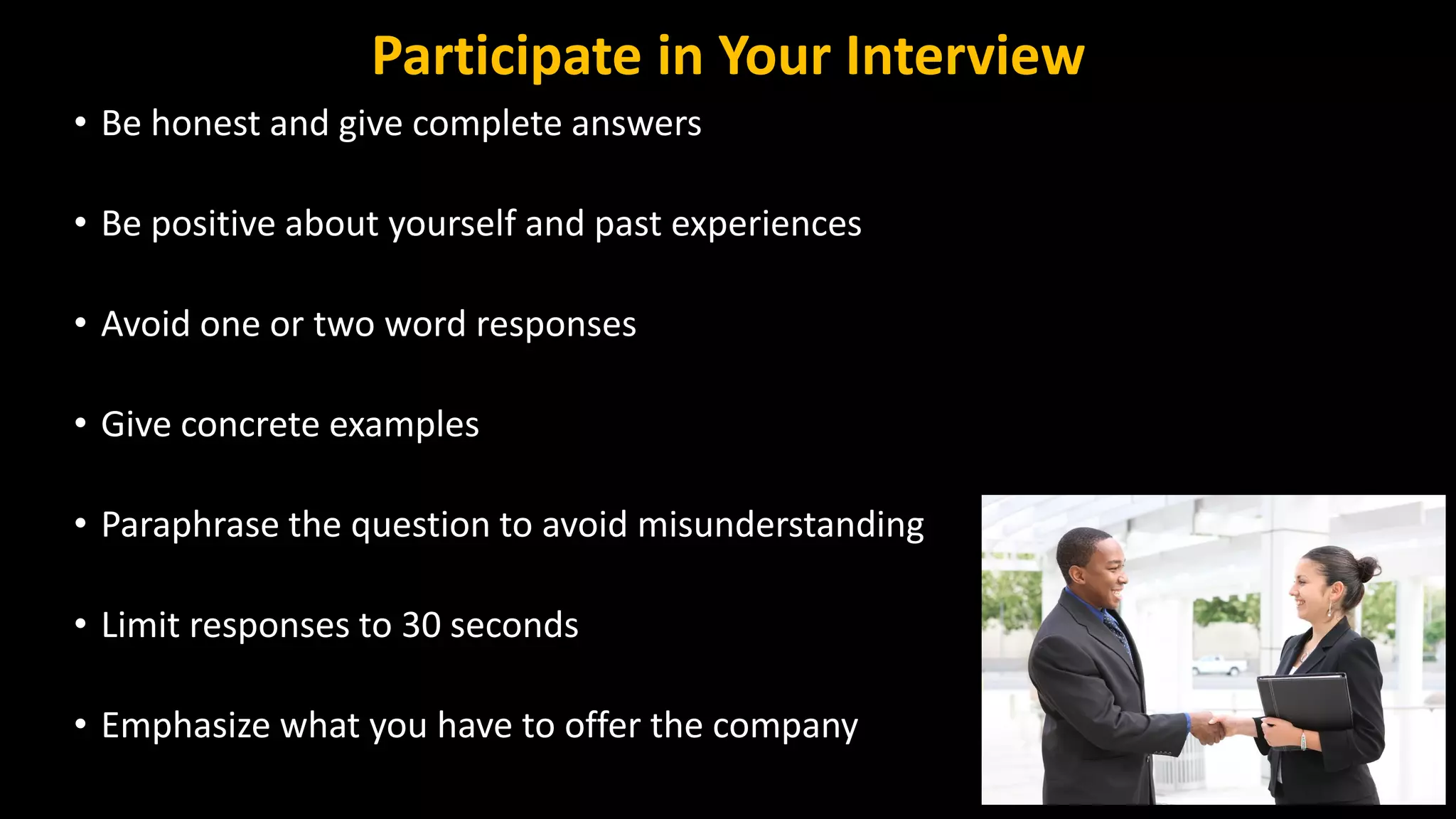
Participate in Your Interview
• Be honest and give complete answers
• Be positive about yourself and past experiences
• Avoid one or two word responses
• Give concrete examples
• Paraphrase the question to avoid misunderstanding
• Limit responses to 30 seconds
• Emphasize what you have to offer the company
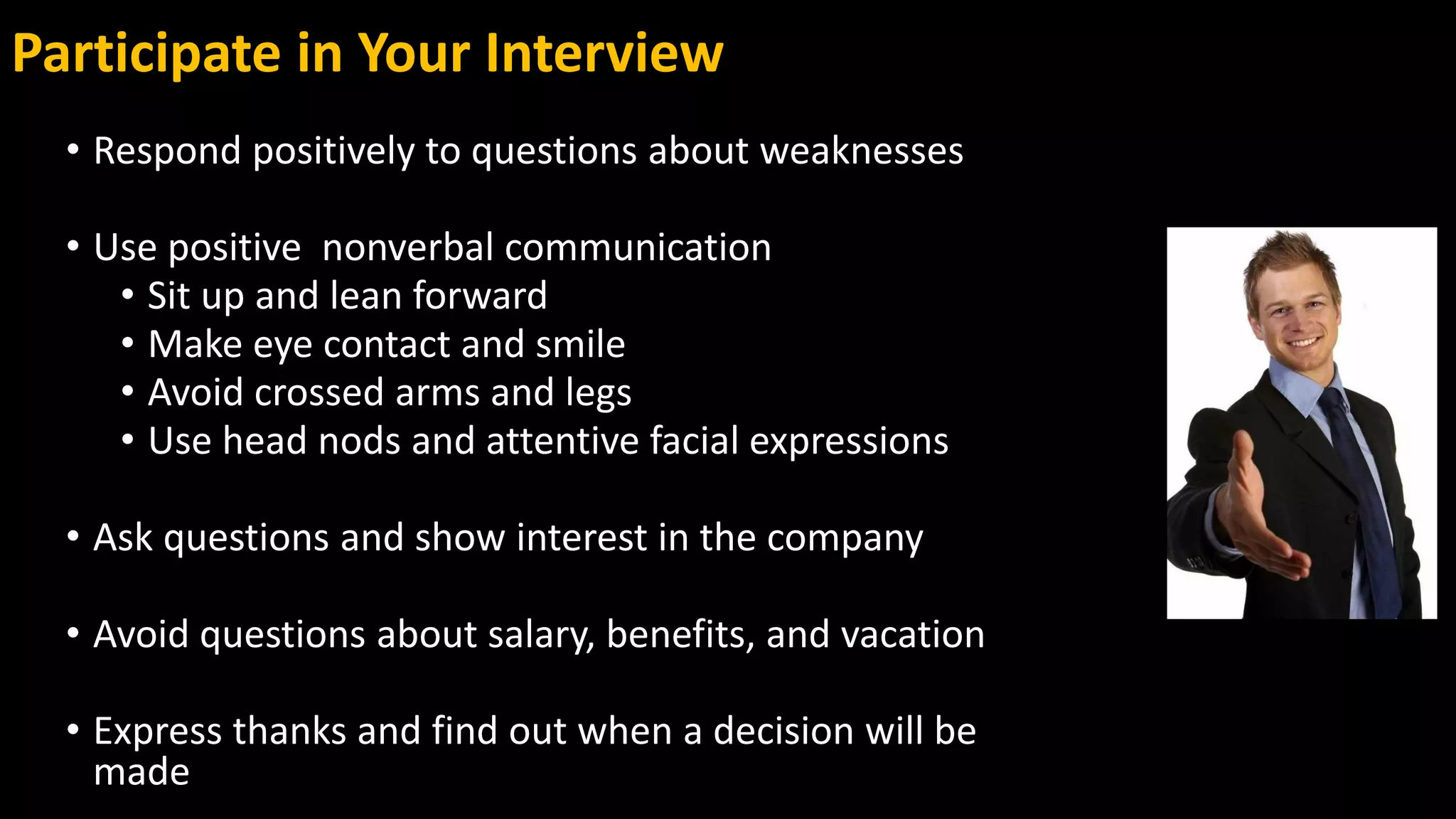
Participate in Your Interview
• Respond positively to questions about weaknesses
• Use positive nonverbal communication
• Sit up and lean forward
• Make eye contact and smile
• Avoid crossed arms and legs
• Use head nods and attentive facial expressions
• Ask questions and show interest in the company
• Avoid questions about salary, benefits, and vacation
• Express thanks and find out when a decision will be
made
Interview Communication Skills
 A good handshake
 Pronounce the interviewer's name PROPERLY.
 Get the interviewer to do a lot of the talking.
 Maintain Good eye contact with your interviewer.
 Smile. Look as if you are enjoying the conversation.
 Have a Confident posture.
 Mirror your interviewer's body language.
 Keep all your answers positive.
 Show ENTHUSIASM.
 LISTEN carefully to the interviewer's question.
 Ask the interviewer questions when the opportunity arises
Summary
 Understand the interview process
 Assemble and consider previous interview experience
 Research the company
 Rehearse your answers before the interview
 Dress professionally and look the part
 Arrive on Time
 Assess the competition
 Prepare for Behavioral Interview questions
 Describe the situation, the tasks, the actions taken and the Result achieved
 Maintain good eye contact and Smile
 Listen carefully to the interviewers questions
 Keep all your answers positive
 Ask the interviewer questions
 Deliver a firm Handshake and smile at the end of the interview
Follow-Up After Your Interview
Fewer than 10% of applicants send a thank you letter
• May be the most important letter you write
• Provides another contact with the employer
• Sets you apart from those who didn’t send one
• Should take place within 24 hours after the interview
Follow-Up Letter Should:
• State your appreciation
• Explain what you liked about the position
• Sound enthusiastic about working for the company
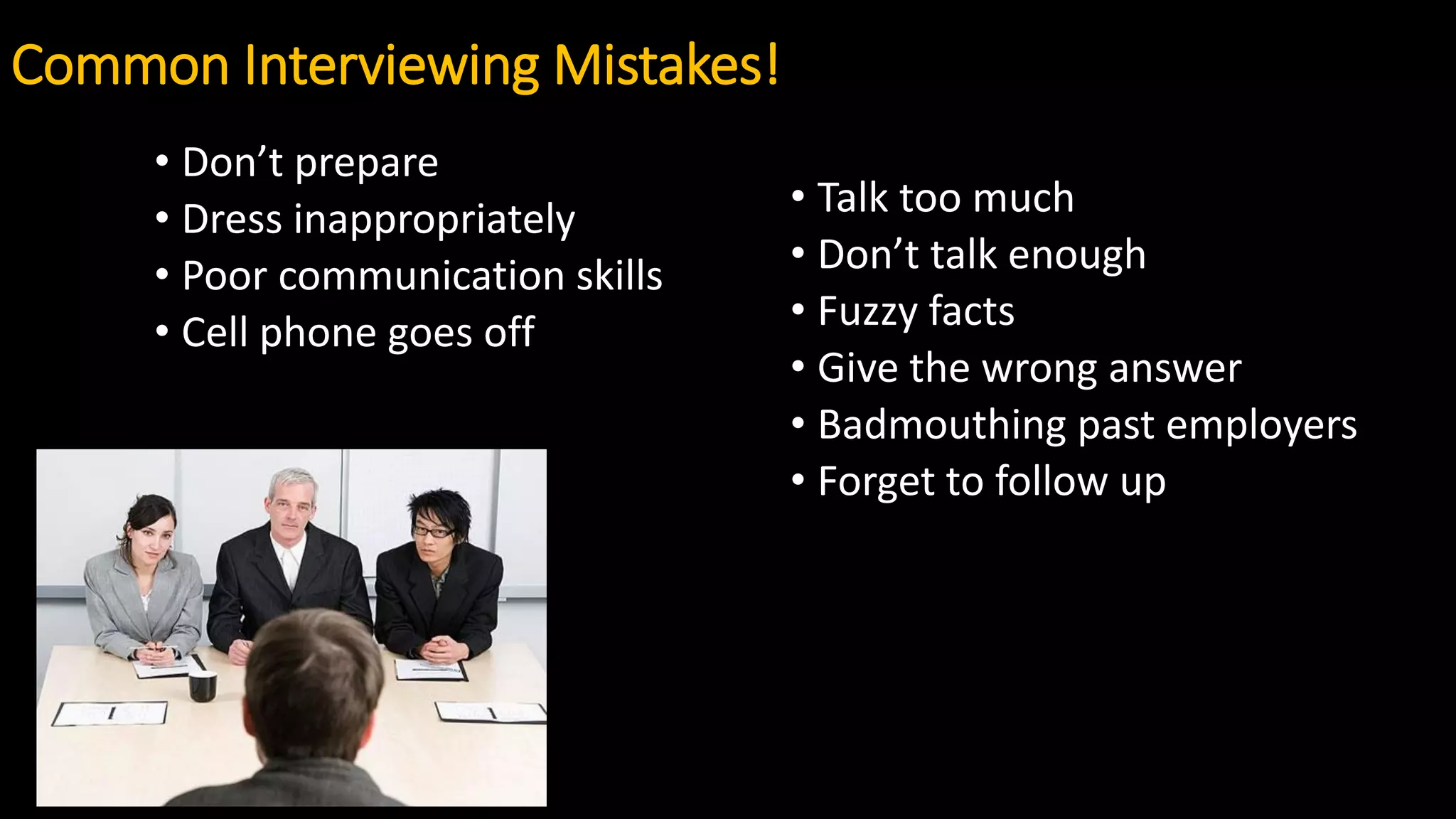
Common Interviewing Mistakes!
• Don’t prepare
• Dress inappropriately
• Poor communication skills
• Cell phone goes off
• Talk too much
• Don’t talk enough
• Fuzzy facts
• Give the wrong answer
• Badmouthing past employers
• Forget to follow up

Resume, CV, Biodata preparation and interview preparation

  • 1.
    Resume/CV/Biodata Preparation and Interviewpreparation for Engineering Students A presentation By Dr. Janak Valaki Associate Professor, Mechanical Engineering Government Engineering College, Bhavnagar janakvalaki@gmail.com, 09913715250
  • 2.
    “You don’t hirefor skills, you hire for attitude. You can always teach skills”
  • 3.
    What is resume/CV/Biodata? •A resume is a written compilation of your education, work experience, credentials, and accomplishments that is used to apply for jobs. • A resume is a one to two page formal document that lists a job applicant's work experience, education and skills. • A resume is designed to provide a detailed summary of an applicant's qualifications for a particular job
  • 4.
    Resume Vs. BiodataVs. Curriculum Vitae • Resume (Summary) • Curriculum Vitae (Course of Life) • Biodata (Biographical data)
  • 5.
    Resume • Resume isa French word meaning "summary", and true to the word meaning, signifies a summary of one's employment, education, and other skills, used in applying for a new position. • A resume seldom exceeds one side of an A4 sheet, and at the most two sides. • They do not list out all the education and qualifications, but only highlight specific skills customized to target the job profile in question. • A resume is usually broken into bullets and written in the third person to appear objective and formal.
  • 6.
    Resume • A goodresume starts with a brief Summary of Qualifications, followed by Areas of Strength or Industry Expertise in keywords, followed by Professional Experience in reverse chronological order. • Focus is on the most recent experiences, and prior experiences summarized. • The content aims at providing the reader a balance of responsibilities and accomplishments for each position. • After Work experience come Professional Affiliations, Computer Skills, and Education.
  • 7.
    Curriculum Vitae • C.Vis a Latin word meaning "course of life". • Curriculum Vitae (C.V.) is therefore a regular or particular course of study pertaining to education and life. • A C.V. is more detailed than a resume, usually 2 to 3 pages, but can run even longer as per the requirement. • A C.V. generally lists out every skills, jobs, degrees, and professional affiliations the applicant has acquired, usually in chronological order. • A C.V. displays general talent rather than specific skills for any specific positions.
  • 8.
    Biodata • Bio Datathe short form for Biographical Data, is the old-fashioned terminology for Resume or C.V. • The emphasis in a bio data is on personal particulars like date of birth, religion, gender, race, nationality, residence, marital status, and the like. • Next comes a chronological listing of education and experience. • The things normally found in a resume, that is specific skills for the job in question comes last, and are seldom included. • Bio-data also includes applications made in specified formats as required by the company.
  • 9.
    At a glancesummary.. • A resume is ideally suited when applying for middle and senior level positions, where experience and specific skills rather than education is important. • A C.V., on the other hand is the preferred option for fresh graduates, people looking for a career change, and those applying for academic positions. • The term bio-data is mostly used in India while applying to government jobs, or when applying for research grants and other situations where one has to submit descriptive essays.
  • 10.
    The ideal Resume/ Bio Data / C.V. should have . . . • Name and Contact details • Objective • Educational Qualification • Professional qualification • List of Soft skills • Work Experience • Salary expected • Reference
  • 11.
    Avoid in CV •Having a resume that is too long • Using fancy paper • Using a fancy font • Filling the resume with extraneous information • Including outdated information • Typos and misspellings • Lying on your resume • Attachments • Saying too much • Leaving out the cover letter
  • 12.
  • 16.
    • What's intrends…. • Along with your written CV or Resume, Video CV/Resume.
  • 17.
  • 18.
    Your opportunity toshine ▸Your abilities, talents, interests, personality, work experience, education, and motivation Informs you about the employer ▸Employer needs, history, work environment, business activities, and future plans ▸Requires skill and PREPARATION NOT LUCK Purpose of the Interview
  • 19.
    ▸Gather work samples,copies of resume, references and place in a nice case or folder ▸Remember to bring a pen ▸Rehearse your answers ▸Write down your questions about the job or organization ▸Review your work history ▸Practice your answers to common interview questions ▸Be prepared for surprises Preparing for the Interview
  • 20.
    Prepare for theInterview Research the company • Check the website and ask around Update your paperwork • Most recent employment and education • Bring several copies to the interview Anticipate and practice interview questions
  • 21.
    Commonly Asked JobInterview Questions • Tell me something about yourself. • Why do you want to work for our company? • What are your future career plans? • Why did you choose this particular field of work? • Describe a past work situation where you encountered a problem and describe how you solved it.
  • 22.
    Successful Interviewing Strategies •Note name of interviewer so you can ask for him/her upon arrival • Consider traveling to interview site ahead of time • Be courteous to everyone you encounter • Paper to jot down names, information, and questions • Black pen, ID, reference list, and work history information for filling out an application • Several clean copies of your personalized cover letter and resume • Portfolio with evidence of accomplishments
  • 23.
    Dress for InterviewSuccess General Dress Guidelines: • Clean and well-pressed clothes • Clean-shaven or neatly trimmed hair • Conceal piercings and tattoos • Subtle fragrances only • Clean nails • Don’t smoke prior or chew gum during • Turn off your cell phone
  • 24.
    ▸Be on time ▸Befriendly ▸Show your enthusiasm ▸Be positive and honest ▸Maintain eye contact ▸Express yourself ▸Don’t criticize previous employers ▸Be aware of body language ▸Be a good listener ▸Emphasize your strengths ▸Be yourself ▸Avoid personal issues ▸Be confident ▸Discuss ways you can contribute During the Interview
  • 25.
    ▸Sit on thefront third of the seat ▸legs uncrossed, but closed ▸Hands folded in front ▸Sit up straight with head, neck, and chest aligned with hips ▸Be careful of bad habits ▸Tapping your fingers ▸Biting your nails ▸Playing with your hair ▸Clicking your pen, etc. Posture During the Interview
  • 26.
    Participate in YourInterview • Be honest and give complete answers • Be positive about yourself and past experiences • Avoid one or two word responses • Give concrete examples • Paraphrase the question to avoid misunderstanding • Limit responses to 30 seconds • Emphasize what you have to offer the company
  • 27.
    Participate in YourInterview • Respond positively to questions about weaknesses • Use positive nonverbal communication • Sit up and lean forward • Make eye contact and smile • Avoid crossed arms and legs • Use head nods and attentive facial expressions • Ask questions and show interest in the company • Avoid questions about salary, benefits, and vacation • Express thanks and find out when a decision will be made
  • 28.
    Interview Communication Skills A good handshake  Pronounce the interviewer's name PROPERLY.  Get the interviewer to do a lot of the talking.  Maintain Good eye contact with your interviewer.  Smile. Look as if you are enjoying the conversation.  Have a Confident posture.  Mirror your interviewer's body language.  Keep all your answers positive.  Show ENTHUSIASM.  LISTEN carefully to the interviewer's question.  Ask the interviewer questions when the opportunity arises
  • 29.
    Summary  Understand theinterview process  Assemble and consider previous interview experience  Research the company  Rehearse your answers before the interview  Dress professionally and look the part  Arrive on Time  Assess the competition  Prepare for Behavioral Interview questions  Describe the situation, the tasks, the actions taken and the Result achieved  Maintain good eye contact and Smile  Listen carefully to the interviewers questions  Keep all your answers positive  Ask the interviewer questions  Deliver a firm Handshake and smile at the end of the interview
  • 30.
    Follow-Up After YourInterview Fewer than 10% of applicants send a thank you letter • May be the most important letter you write • Provides another contact with the employer • Sets you apart from those who didn’t send one • Should take place within 24 hours after the interview Follow-Up Letter Should: • State your appreciation • Explain what you liked about the position • Sound enthusiastic about working for the company
  • 31.
    Common Interviewing Mistakes! •Don’t prepare • Dress inappropriately • Poor communication skills • Cell phone goes off • Talk too much • Don’t talk enough • Fuzzy facts • Give the wrong answer • Badmouthing past employers • Forget to follow up