How to write the
perfect CV
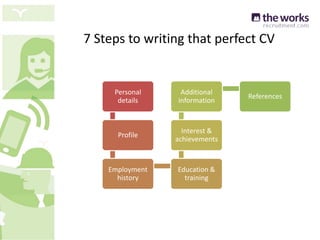
7 Steps to writing that perfect CV
Personal
details
Profile
Employment
history
Education &
training
Interest &
achievements
Additional
information
References
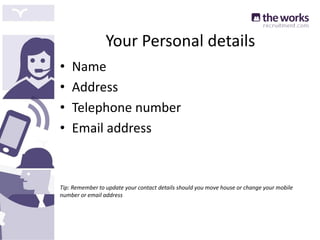
Your Personal details
• Name
• Address
• Telephone number
• Email address
Tip: Remember to update your contact details should you move house or change your mobile
number or email address
Personal Profile
• This is a mini advert of you and should
summarise the following:
- Skills
- Qualities
- Work background
- Achievements and career aims
Employment History & Work
Experience
• Start with you most recent job or work
experience first
• Include:
- Company name
- Your job title
- When you were employed from and to
- You may want to include a sentence about the company
Tip For each job and particularly the most recent roles, include 3 or 4 bullet points of your
achievements. Demonstrate what makes you stand out from other applicants
Education & Training
• Start with your most recent
qualification first
or
• qualification or training relevant to the
position you are applying for
Interest & Achievements
• Include
- Your hobbies
- Interests and achievements relevant
to the job
Additional Information
• This section can be used if there is any
information relevant to the position
which is not covered anywhere else in
your CV.
References
• Remember to ask the person you
would like a reference from whether it
is ok for you to put them down as a
referee.
10 Tips
• You cv should be
1. Maximum of 2 pages long
2. First page should contain personal details
3. Neat and to the point
4. Always be typed
5. Printed on good quality white paper
6. Emphasise your skills
7. Emphasise your achievements
8. Include a cover letter
9. Proof-read it and get someone else to proof-
read it too
10. Be honest at all times
The 10 Don'ts
1. Don’t use bright coloured papers, patterns or graphics
2. Don’t use weird type styles
3. Don’t use a font smaller than 11pt or larger than 14pt
for headings
4. Don’t include irrelevant or negative information
5. Don’t lie about your skills and achievements
6. Don’t use acronyms, text language or abbreviations
7. Don’t use long paragraphs
8. Don’t muddle up your employment history
9. Don’t forget to tell your referees about using them for a
reference
10. Don’t give up!
If you need any
further help or advice email
itsworking@theworksrecruitment.com

How to write the perfect CV

  • 1.
    How to writethe perfect CV
  • 2.
    7 Steps towriting that perfect CV Personal details Profile Employment history Education & training Interest & achievements Additional information References
  • 3.
    Your Personal details •Name • Address • Telephone number • Email address Tip: Remember to update your contact details should you move house or change your mobile number or email address
  • 4.
    Personal Profile • Thisis a mini advert of you and should summarise the following: - Skills - Qualities - Work background - Achievements and career aims
  • 5.
    Employment History &Work Experience • Start with you most recent job or work experience first • Include: - Company name - Your job title - When you were employed from and to - You may want to include a sentence about the company Tip For each job and particularly the most recent roles, include 3 or 4 bullet points of your achievements. Demonstrate what makes you stand out from other applicants
  • 6.
    Education & Training •Start with your most recent qualification first or • qualification or training relevant to the position you are applying for
  • 7.
    Interest & Achievements •Include - Your hobbies - Interests and achievements relevant to the job
  • 8.
    Additional Information • Thissection can be used if there is any information relevant to the position which is not covered anywhere else in your CV.
  • 9.
    References • Remember toask the person you would like a reference from whether it is ok for you to put them down as a referee.
  • 10.
    10 Tips • Youcv should be 1. Maximum of 2 pages long 2. First page should contain personal details 3. Neat and to the point 4. Always be typed 5. Printed on good quality white paper 6. Emphasise your skills 7. Emphasise your achievements 8. Include a cover letter 9. Proof-read it and get someone else to proof- read it too 10. Be honest at all times
  • 11.
    The 10 Don'ts 1.Don’t use bright coloured papers, patterns or graphics 2. Don’t use weird type styles 3. Don’t use a font smaller than 11pt or larger than 14pt for headings 4. Don’t include irrelevant or negative information 5. Don’t lie about your skills and achievements 6. Don’t use acronyms, text language or abbreviations 7. Don’t use long paragraphs 8. Don’t muddle up your employment history 9. Don’t forget to tell your referees about using them for a reference 10. Don’t give up!
  • 12.
    If you needany further help or advice email itsworking@theworksrecruitment.com