Customs Issues
and
Procedure
Course
Material
Referenc
e
Important Dates
▶ Assignment 3/21/2024
▶ Midterm 3/27/2024
▶ Final 4/5/2024
This Photo by Unknown Author is licensed under CC BY-SA-NC
Terminal Learning
Objectives
▶ Describe the purpose of the
ACROSS release systems.
▶ Differentiate among the various
release options: RMD, PARS,
IID, CSA, and FAST.
▶ Differentiate among the various
release options: RMD, PARS, IID,
CSA, and FAST.
▶ Correct errors made on a Form
B3.
▶ Describe the requirements for
casual importations.
▶ Understand when goods are
seized and placed in a Queen’s
warehouse.
RELEASE AND
ACCOUNTING OF
IMPORTED
COMMERCIAL
GOODS
▶ The five steps in the importation
of commercial goods were
outlined previously. The release
and accounting of goods are the
fourth and fifth steps in that
process. After release data have
been sent to CBSA, a release
recommendation (if the goods
have not yet arrived) or a
release decision (if the goods
are on hand) is made.
ACCELERATED
COMMERCIAL
RELEASE
OPERATIONS
SUPPORT SYSTEM
▶ Accelerated Commercial
Release Operations Support
System (ACROSS) is the
system that CBSA uses to
receive electronically
transmitted release and invoice
data from customs brokers and
importers. Goods released
through ACROSS must be
confirmed (accounted for)
electronically, using either
Customs Automated Data
Exchange (CADEX) or
Customs Declaration
(CUSDEC)—an international
format that operates in a
ACCELERATED
COMMERCIAL
RELEASE
OPERATIONS
SUPPORT SYSTEM
▶ The benefits of ACROSS include:
• the ability to exchange information
24 hours a day, during business
and non-business hours;
• the ability to exchange information
without having to rekey data;
• the ability to exchange most permit
data electronically;
• a decrease in paper and related
handling costs; and
• the ability to request the release of
goods located at any port in
Canada, regardless of where the
customs broker or importer is
located.
MACHINE RELEASE
SYSTEM
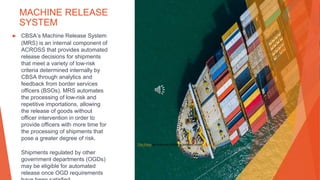
▶ CBSA’s Machine Release System
(MRS) is an internal component of
ACROSS that provides automated
release decisions for shipments
that meet a variety of low-risk
criteria determined internally by
CBSA through analytics and
feedback from border services
officers (BSOs). MRS automates
the processing of low-risk and
repetitive importations, allowing
the release of goods without
officer intervention in order to
provide officers with more time for
the processing of shipments that
pose a greater degree of risk.
Shipments regulated by other
government departments (OGDs)
may be eligible for automated
release once OGD requirements
This Photo by Unknown Author is licensed under CC BY-SA
RELEASE OF GOODS
▶ The term "release of goods" refers to the
process by which goods are made
available for shipment or distribution. This
process can vary depending on the
context, whether it's in the context of
international trade, warehousing, or other
logistical operations.
International Trade:
Customs Clearance: In international
trade, when goods arrive at a port or
border, they often need to go through
customs clearance. This involves
submitting necessary documents, paying
import duties and taxes, and complying
with customs regulations. Once customs
clearance is completed, the goods are
released for entry into the destination
country.
Bill of Lading: The release of goods can
also refer to the transfer of control over
goods from the exporter to the importer,
typically when a bill of lading is issued. A
bill of lading is a legal document that
confirms the receipt of goods by the
This Photo by Unknown Author is licensed under CC BY
RELEASE OF GOODS
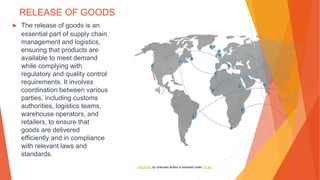
▶ The release of goods is an
essential part of supply chain
management and logistics,
ensuring that products are
available to meet demand
while complying with
regulatory and quality control
requirements. It involves
coordination between various
parties, including customs
authorities, logistics teams,
warehouse operators, and
retailers, to ensure that
goods are delivered
efficiently and in compliance
with relevant laws and
standards.
This Photo by Unknown Author is licensed under CC BY
RELEASE
PROCEDURES
▶ Released goods are those that
CBSA has authorized to continue
their journey to their final
destination—that is, they have
been reported by the carrier to
CBSA and have met all import
requirements.
Once the goods are released,
they must be accounted for, and
any applicable duties and taxes
must be paid. These three
steps—release, accounting, and
payment—are often performed
separately. However, in order for
goods to be released before any
duties and taxes are paid, the
customs broker or importer must
post security with CBSA. When
these steps are performed
separately, the release function is
This Photo by Unknown Author is licensed under CC BY-ND
RELEASE
PROCEDURES
▶ Requests for the release of
commercial goods may be made
in one of the following ways:
• Presentation of a Release on
Minimum Documentation (RMD)
package accompanied by a
completed Form B3 accounting
document Type C that releases
and accounts for goods at the
same time. If security has not
been posted, duty and taxes are
paid immediately.
• Presentation of an ex-
warehouse Form B3 accounting
document Type 20, with duty
and taxes paid immediately, or
later if security has been posted.
This Photo by Unknown Author is licensed under CC BY
RELEASE
PROCEDURES
▶ Requests for the release of
commercial goods may be made in
one of the following ways:
• Presentation of an RMD package,
provided security has been posted,
since the goods are released with a
promise to pay duty and taxes at a
later date.
• Presentation of a Pre-Arrival Review
System (PARS) package, provided
security has been posted, since the
goods are released with a promise
to pay duty and taxes at a later date.
• Transmission of an Integrated
Import Declaration (IID), provided
security has been posted, since the
goods are released with a promise
to pay duty and taxes at a later date.
This Photo by Unknown Author is licensed under CC BY
RELEASE
PROCEDURES
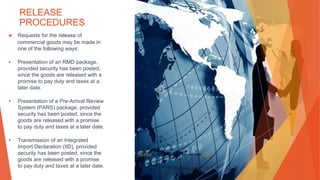
▶ The difference between an RMD
and a PARS is that an RMD is
used when the goods are on
hand and a PARS is submitted
before the goods arrive at the
border. An IID may be
presented pre-or post-arrival of
the goods.
Release data must be sent
electronically, unless there is a
specific reason why it cannot be
done. When an exception to
Electronic Data Interchange
(EDI) exists, the release request
is made by submitting a paper
entry and providing the reason.
The reason is noted on a form
that is included with the paper
RMD or PARS.
This Photo by Unknown Author is licensed under CC BY-SA-NC
SECURITY
▶ In order to have goods
released before duties and
taxes are paid, either the
customs broker or importer
must post security. Posting
security assures CBSA that
duties and taxes will be paid
at a later date.
Security can be in the form
of:
1. cash,
2. a certified cheque,
3. a transferable bond issued
by the Government of
Canada, or
4. a bond issued by a party
approved by the Canada
Revenue Agency.
SECURITY
▶ In order to have goods released before
duties and taxes are paid, either the
customs broker or importer must post
security. Posting security assures CBSA
that duties and taxes will be paid at a later
date.
Security can be in the form of:
1. cash,
2. a certified cheque,
3. a transferable bond issued by the
Government of Canada, or
4. a bond issued by a party approved by
the Canada Revenue Agency.
For customs brokers, security is based on
their average monthly duties and taxes
(including GST), up to a maximum of $10
million.
For resident importers, security is based
on their average monthly duties and taxes
(less the GST), up to a maximum of $10
million. For non-resident importers,
security is based on their average
monthly duties and taxes (including GST),
up to a maximum of $10 million.
This Photo by Unknown Author is licensed under CC BY-NC-ND
RELEASE ON
MINIMUM
DOCUMENTATION
▶ RMD information may not be presented
until the physical arrival of the goods.
When transmitting RMD data using EDI, a
distinction is made between the
presentation of Appraisal Quality (AQ)
data and non-Appraisal Quality (non-
AQ) data. For AQ data, the invoice
information provided to CBSA mirrors the
commercial invoice and all information
required to make a release determination is
included. Most goods are released using
AQ, or full data. For non-AQ, the data are
recapped according to the vendor, country
of origin, and/or tariff classification under
the Harmonized Commodity Description
and Coding System (HS). That is, all items
from the same vendor, that have the same
country of origin, or that have the same HS
classification can be consolidated on one
line. Detailed data must be transmitted to
CBSA before final accounting data are
sent. A non-AQ release request may not be
used for goods that are regulated by any
government department other than CBSA.
This Photo by Unknown Author is licensed under CC BY
RELEASE ON
MINIMUM
DOCUMENTATION
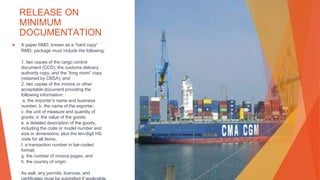
▶ A paper RMD, known as a “hard copy”
RMD, package must include the following:
1. two copies of the cargo control
document (CCD), the customs delivery
authority copy, and the “long room” copy
(retained by CBSA); and
2. two copies of the invoice or other
acceptable document providing the
following information:
a. the importer’s name and business
number; b. the name of the exporter;
c. the unit of measure and quantity of
goods; d. the value of the goods;
e. a detailed description of the goods,
including the code or model number and
size or dimensions, plus the ten-digit HS
code for all items;
f. a transaction number in bar-coded
format;
g. the number of invoice pages; and
h. the country of origin.
As well, any permits, licences, and
This Photo by Unknown Author is licensed under CC BY-SA
PRE-ARRIVAL
REVIEW SYSTEM
▶ Pre-Arrival Review System (PARS)
allows for the submission of release
data prior to the arrival of goods.
Depending on the carrier and mode
of transportation, there are other
terms used to describe PARS. For
example, where goods arrive by rail,
the term RAILPARS is used. Marine
freight uses the term MARINEPARS
and airfreight uses AIRPARS. At
inland highway sufferance
warehouses, the term used is
INPARS.
PARS works by having the exporter
or carrier provide all information
about the goods to the customs
broker or importer who will be
preparing the PARS package in
advance of the shipment’s arrival.
The information must include a bar-
coded cargo control number.
This Photo by Unknown Author is licensed under CC BY-ND
PRE-ARRIVAL
REVIEW SYSTEM
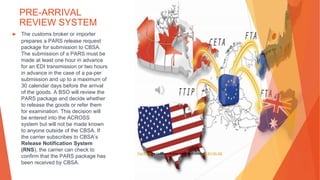
▶ The customs broker or importer
prepares a PARS release request
package for submission to CBSA.
The submission of a PARS must be
made at least one hour in advance
for an EDI transmission or two hours
in advance in the case of a pa-per
submission and up to a maximum of
30 calendar days before the arrival
of the goods. A BSO will review the
PARS package and decide whether
to release the goods or refer them
for examination. This decision will
be entered into the ACROSS
system but will not be made known
to anyone outside of the CBSA. If
the carrier subscribes to CBSA’s
Release Notification System
(RNS), the carrier can check to
confirm that the PARS package has
been received by CBSA.
This Photo by Unknown Author is licensed under CC BY-NC-ND
PRE-ARRIVAL
REVIEW SYSTEM
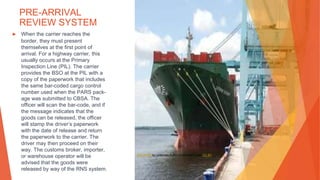
▶ When the carrier reaches the
border, they must present
themselves at the first point of
arrival. For a highway carrier, this
usually occurs at the Primary
Inspection Line (PIL). The carrier
provides the BSO at the PIL with a
copy of the paperwork that includes
the same bar-coded cargo control
number used when the PARS pack-
age was submitted to CBSA. The
officer will scan the bar-code, and if
the message indicates that the
goods can be released, the officer
will stamp the driver’s paperwork
with the date of release and return
the paperwork to the carrier. The
driver may then proceed on their
way. The customs broker, importer,
or warehouse operator will be
advised that the goods were
released by way of the RNS system.
This Photo by Unknown Author is licensed under CC BY
INTEGRATED
IMPORT
DECLARATION
▶ The Integrated Import Declaration (IID)
is part of the Single Window Initiative
(SWI). With a single window, all data
are sent to CBSA, who in turn sends
them to other government agencies
who regulate the goods. Other
government departments (OGDs) and
agencies who participate in the SWI
are called participating government
agencies (PGAs). This is intended to
reduce the number of documents
required, since information required by
PGAs and CBSA is included on one
IID.
In most cases, the IID can be
transmitted to CBSA up to 90 days
prior to the arrival of the goods and it
may also be used if the goods have
already arrived. The use of the IID is
not restricted to regulated goods, and
it is CBSA’s intention to decommission
all other EDI release options in favour
This Photo by Unknown Author is licensed under CC BY
CUSTOMS SELF-
ASSESSMENT
▶ The Customs Self-
Assessment (CSA) program is
designed for low-risk, pre-
approved importers, carriers,
and registered drivers. Under
the CSA program, ap-proved
importers will be allowed a
streamlined release,
accounting, and payment
process for all imported
goods. CSA importers use
their own business systems
and processes, which must
meet CBSA’s requirements, to
forward trade data and to
report and remit payment of
duties and taxes once a month
to their own financial
institutions.
This Photo by Unknown Author is licensed under CC BY
THE CSA PROCESS
▶ CSA-approved importers who use CSA-
approved carriers and registered drivers and
who are importing eligible goods can use a
streamlined process to enter their goods into
Canada. The CSA process at the border
requires registered drivers to present their
commercial driver registration card, the CSA-
approved carrier code, and the CSA-
approved importer business number. These
bar-coded data elements are captured in the
automated system by the BSO to verify that
the driver is registered, and that the carrier
and importer are both CSA approved.
Once these data have been verified by
CBSA, the carrier will be authorized to
deliver the goods. The CSA carrier who
reports goods to CBSA for authorization to
deliver is liable for the payment of duties and
taxes until the goods are delivered to the
place of business of the importer, owner, or
consignee. To remove this liability, the
reporting carrier must ensure that proof of
delivery is obtained and kept on hand for
CBSA verification. Under the CSA process,
goods are not released until they have been
received at their destination. Once the CSA-
approved importer receives the goods, they
will calculate and remit duties and taxes
through a unique process available only to
This Photo by Unknown Author is licensed under CC BY
CSA-ELIGIBLE
GOODS
▶ CSA-eligible goods are
commercial goods that have
been shipped directly from
the United States (US) or
Mexico, as long as the goods
do not require, under any act
of Parliament or of the
legislature of a province or
territory, a permit, licence, or
other similar document to be
presented to CBSA at the
time of report.
FREE AND SECURE
TRADE
▶ The Free and Secure Trade (FAST)
program is a joint Canada – US initiative
involving CBSA and its US counterpart,
the Customs and Border Protection (CBP)
agency. FAST supports moving pre-
approved eligible goods across the border
quickly and verifying trade compliance
away from the border. Information about
the goods that is not required at the time
of release can be supplied once the
goods have moved away from the border.
FAST is a commercial process offered to
pre-approved importers, carriers, and
registered drivers. Shipments for
approved companies, transported by
approved carriers using registered
drivers, will be cleared into either country
with greater speed and certainty and at a
reduced cost of compliance.
In Canada, FAST builds on the CSA
program and its principles of pre-approval
and self-assessment as well as on the
increased security measures under the
Partners in Protection (PIP) program.
This Photo by Unknown Author is licensed under CC BY
FREE AND SECURE
TRADE
▶ PIP is a Canadian program
designed to enlist the
cooperation of the trade
community and the
transportation industry in the
fight against contraband
smuggling. PIP provides a
framework for joint efforts and
outlines the commitments of
both signatories in a
memorandum of understanding
that focuses on three areas of
cooperation:
1. intelligence and the exchange
of information,
2. security, and
3. joint training/information
initiatives.
This Photo by Unknown Author is licensed under CC BY-NC-ND
FREE AND SECURE
TRADE
▶ Importers and carriers must be approved
in the CSA program and participants in
the PIP program to be eligible for FAST.
There is a designated FAST lane at some
highway border points. In order for a
carrier to use the FAST lane, the following
must apply:
1. goods must be designated CSA-
eligible;
2. the importer must be FAST approved—
that is, both CSA and PIP approved;
3. the carrier must be a FAST-authorized
carrier—that is, authorized under both
CSA and PIP; and
4. the driver must be authorized under the
FAST driver program.
The process for authority to deliver is the
same as that described under the CSA.
The only difference between CSA and
FAST is that if both the importer and the
carrier are both CSA and PIP approved,
they may use the designated FAST lanes.
This Photo by Unknown Author is licensed under CC BY-NC
How and Why World Trade Organisation was
formed? | Important International bodies
SUB-AGENCY
CLEARANCES
▶ A sub-agent is a customs broker
that acts on behalf of another
customs broker. Since most
release requests take place
electronically and a customs
broker can request release of
goods at any EDI customs port,
the use of a sub-agent is
generally restricted to occasions
when a customs broker must
submit a paper release request
at a port where they are not
located.
This Photo by Unknown Author is licensed under CC BY
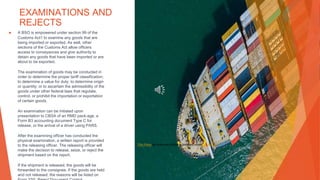
EXAMINATIONS AND
REJECTS
▶ A BSO is empowered under section 99 of the
Customs Act1 to examine any goods that are
being imported or exported. As well, other
sections of the Customs Act allow officers
access to conveyances and give authority to
detain any goods that have been imported or are
about to be exported.
The examination of goods may be conducted in
order to determine the proper tariff classification;
to determine a value for duty; to determine origin
or quantity; or to ascertain the admissibility of the
goods under other federal laws that regulate,
control, or prohibit the importation or exportation
of certain goods.
An examination can be initiated upon
presentation to CBSA of an RMD pack-age, a
Form B3 accounting document Type C for
release, or the arrival of a driver using PARS.
After the examining officer has conducted the
physical examination, a written report is provided
to the releasing officer. The releasing officer will
make the decision to release, seize, or reject the
shipment based on the report.
If the shipment is released, the goods will be
forwarded to the consignee. If the goods are held
and not released, the reasons will be listed on
This Photo by Unknown Author is licensed under CC BY-SA
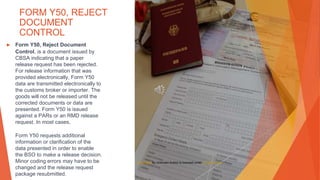
FORM Y50, REJECT
DOCUMENT
CONTROL
▶ Form Y50, Reject Document
Control, is a document issued by
CBSA indicating that a paper
release request has been rejected.
For release information that was
provided electronically, Form Y50
data are transmitted electronically to
the customs broker or importer. The
goods will not be released until the
corrected documents or data are
presented. Form Y50 is issued
against a PARs or an RMD release
request. In most cases,
Form Y50 requests additional
information or clarification of the
data presented in order to enable
the BSO to make a release decision.
Minor coding errors may have to be
changed and the release request
package resubmitted.
This Photo by Unknown Author is licensed under CC BY-SA-NC
SEIZURES
▶ A seizure takes place when goods
and/or, in cases of serious
infractions, the conveyance or
vehicle, are confiscated.
When a seizure does take place,
CBSA will issue a Form K19,
Customs Seizure Receipt. Form
K19 describes the goods, the
reason for the seizure, the
conveyance used, the value of the
goods, the amount required for
return of the goods, and any
deposit taken with respect to the
goods.
In some cases, seized goods may
be returned to the carrier or their
owner upon payment of any
duties, taxes, and/or penalties.
However, drugs, firearms,
weapons, pornography, tobacco,
alcohol, or vehicles modified for
This Photo by Unknown Author is licensed under CC BY-SA-NC
THE
ADMINISTRATIVE
MONETARY
PENALTY SYSTEM
▶ The Administrative Monetary Penalty
System (AMPS) is a system of civil penal-
ties applied against those who contravene
the Customs Act, the Customs Tariff,2 the
Special Import Measures Act,3 or their
associated regulations. These penalties
are used by the CBSA as a means to
encourage compliance by commercial
traders.
In cases of non-compliance, the penalties
that are applied are based on the type,
frequency, and severity of the infraction.
AMPS largely replaces the use of seizure
provisions for technical infractions;
typically, an officer will take seizure action
only for serious offences.
Officers will issue penalties under AMPS
by use of a Notice of Penalty
Assessment (NPA). Contravention
C001, an example of a penalty related to
keeping records.
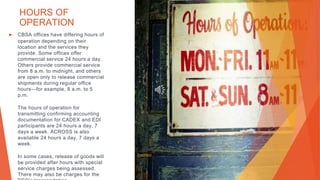
HOURS OF
OPERATION
▶ CBSA offices have differing hours of
operation depending on their
location and the services they
provide. Some offices offer
commercial service 24 hours a day.
Others provide commercial service
from 8 a.m. to midnight, and others
are open only to release commercial
shipments during regular office
hours—for example, 8 a.m. to 5
p.m.
The hours of operation for
transmitting confirming accounting
documentation for CADEX and EDI
participants are 24 hours a day, 7
days a week. ACROSS is also
available 24 hours a day, 7 days a
week.
In some cases, release of goods will
be provided after hours with special
service charges being assessed.
There may also be charges for the
This Photo by Unknown Author is licensed under CC BY
ACCOUNTING FOR
GOODS
▶ CBSA needs information in
order to verify the value,
classification, country of
origin, tariff treatment, and
exchange rate of imported
goods. These data, as well as
the total amount of duty and
taxes, must be submitted
within five business days from
the date that the goods are
released. Failure to confirm an
RMD by presenting the final
accounting documentation
within the stipulated time limit
will result in a penalty under
AMPS. Accounting information
may be presented in hard
copy or electronic format;
however, EDI is most
common.
CUSTOMS
AUTOMATED DATA
EXCHANGE
▶ The Customs Automated Data
Exchange (CADEX) system
electronically links the importer
or customs broker with CBSA.
Using CADEX, a customs
broker or importer can receive
notification that goods have
been released and send ac-
counting data to CBSA. Daily
Notices and Statements of
Account are also sent via EDI
in CADEX formats to EDI-
enabled commercial clients.
Because of its age and
limitations, CADEX is being
phased out. Those wishing to
exchange data electronically
with the CBSA must start to
CUSTOMS
AUTOMATED DATA
EXCHANGE
▶ Alternatives to CADEX include:
• Value Added Network (VAN). A public
network that allows the exchange of data
with a large number of trading partners
using a single communication interface.
• Third-party service providers. Many
CBSA-approved third-party service
providers currently transmit data to the
CBSA, using a variety of communication
modes, on behalf of importers and
customs brokers.
• Customs Internet Gateway (CIG). The
CBSA developed the CIG to provide
clients with a method of transmitting and
receiving data over the Internet. Clients
are required to purchase specific
software for encryption and decryption
and to develop, or purchase, the protocol
software to connect to the CIG. Clients
must transmit the data from a Canadian
office because the certificate is only
assigned to a device in Canada.
• Connection made directly to the CBSA.
The direct-connect option provides
clients with a direct connection to the
FORM B3
ACCOUNTING
DOCUMENT
▶ The Form B3 is a customs accounting
document used in Canada for the
reporting and payment of duties and
taxes on imported goods. It is part of
the Canada Border Services Agency's
(CBSA) reporting and accounting
process. The Form B3 is also known
as the "Canada Customs Coding
Form" and is used by importers,
customs brokers, and carriers to
declare imported goods to CBSA.
It's important to note that the specific
format and requirements of the Form
B3 may change over time due to
updates in customs regulations.
Therefore, it's essential to refer to the
latest guidance and resources
provided by the Canada Border
Services Agency or consult with a
customs expert or customs broker
when completing this form for
importing goods into Canada.
FORM B3
ACCOUNTING
DOCUMENT
▶ Here is a general overview of the
information typically included on a Form
B3 accounting document:
• Importer Information: This section
includes details about the importer, such
as the name, address, and contact
information.
• Consignee Information: If the consignee
is different from the importer, their
information is included here.
• Exporter Information: Details about the
exporter of the goods, including their
name and address.
• Vendor Information: Information about
the vendor who sold the goods, including
their name and address.
• Carrier Information: Details about the
carrier responsible for transporting the
goods, including their name and address.
FORM B3
ACCOUNTING
DOCUMENT
▶ Here is a general overview of the information
typically included on a Form B3 accounting
document:
• Transaction Information: This section
contains details about the transaction,
including the invoice number, date, and
currency of the transaction.
• Description of Goods: A detailed
description of the imported goods, including
their quantity, unit of measure, and value.
• Country of Origin: Information about the
country of origin of the goods.
• Harmonized System (HS) Code: The HS
code is used to classify the goods for
customs purposes.
• Duties and Taxes: The Form B3 includes a
breakdown of the duties and taxes payable
on the imported goods. This may include
customs duties, excise taxes, and goods and
services tax (GST).
FORM B3
ACCOUNTING
DOCUMENT
▶ Here is a general overview of the
information typically included on a
Form B3 accounting document:
• Payment Information: Details about
how the duties and taxes are being
paid, such as by cash, check, or
electronic funds transfer.
• Customs Broker Information: If a
customs broker is involved in the
importation, their information is
provided here.
• Authorized Signature: The form
typically requires an authorized
signature to certify the accuracy of
the information provided.
• CBSA Release: This section is used
by CBSA to record the release of the
This Photo by Unknown Author is licensed under CC BY-SA-NC
FORM B3
ACCOUNTING
DOCUMENT TYPE C
(PAYING ALL DUTIES
AND TAXES)
▶ At times, goods may be released
at the same time that duties and
taxes are paid. This usually
occurs in cases where security
has not been posted although a
Type C can be presented with
duty and taxes paid later if
security has been posted. The
following documents must be
submitted with the completed
Form B3:
• any commercial or customs
invoices;
• the cargo control document; and
• any permits, certificates, or
licenses.
EX-WAREHOUSE
FORM B3
ACCOUNTING
DOCUMENT
▶ It is not until goods are
removed from a bonded
warehouse that they are
considered released and
accounted for. Form B3 Type
20 is most often used to
remove goods from the
bonded warehouse and to pay
duty and taxes at the same
time. Form B3 Type 20 entries
may also be submitted
electronically, in which case
the duties and taxes are paid
at a later date.
DETAILED CODING
STATEMENTS
▶ The DCS and the accounting package
are then returned to the customs broker
or importer for correction.
The three reasons a DCS may be issued
are:
• Notification of Rejection. Generated
when CBSA’s system encounters an
error while processing Form B3 input
data. The DCS displays the original Form
B3 input data as well as CBSA’s
calculations. At the end of the DCS, there
is a list of the error(s).
• Notification of Adjustment. Generated
when the total revenue payable
calculated by CBSA does not agree with
the total indicated on Form B3 but the
discrepancy is less than $2.00. In this
case, Form B3 is accepted, and the
adjusted amount is payable and indicated
on the Daily Notice.
• Notification of Acceptance. Generated
when Form B3 is a “cash type”—that is,
the goods are being duty paid at time of
release. In this case the DCS is stamped
“duty paid” and returned to the importer
or customs broker after payment is
received.
CHANGES PRIOR TO
FINAL ACCOUNTING
▶ Before final accounting and after
the release of the goods, changes
may be made to information
provided on an RMD package by
using Form A48, RMD Correction.
In addition to changes to the
business number and transaction
number, changes can be made to
the Cargo Control Number,
container number(s), sub-location
code, or customs office.
The completed form is presented
to CBSA where the goods were
released and must be presented
within a time frame that allows the
goods to be accounted for, or
confirmed, within the required
time limits.
CHANGES BETWEEN
TIME OF FINAL
ACCOUNTING AND
PAYMENT OF
DUTIES AND TAXES
▶ In order to change the importer name
and/or number after final accounting,
the importer or customs broker must
submit a letter to CBSA client services
in the region in which the goods were
released requesting the change and
providing the reason for doing so. If
the letter is presented by the customs
broker or other agent, the letter must
indicate that a copy of the letter was
sent to the party named as the
importer on the original
documentation. The record will then be
corrected, and the customs
commercial system (CCS) will be
updated to reflect this change. The
customs broker or importer will be sent
a Detailed Adjustment Statement
(DAS) indicating that the change has
been made.
This Photo by Unknown Author is licensed under CC BY-SA
QUEEN’S
WAREHOUSE
▶ Queen’s warehouses are operated by
CBSA and are used to store seized,
forfeited, detained, abandoned, and
unclaimed goods before they are
released or disposed of by CBSA.
The importer or customs broker has 40
days from the date the carrier presents a
CCD to CBSA in which to present a
release or accounting package. If the
goods are still on hand after 40 days,
CBSA will issue a Form E44, Notice—
Unclaimed Goods. At this point, the
goods are deemed to be placed in the
Queen’s warehouse.
The importer or customs broker has an
additional 30 days from the date of issue
of Form E44 to have the goods released.
If the goods are not released within this
time, they are deemed to be forfeited to
the Crown. There is no recourse at this
point for the importer to claim the goods.
The goods will now be sold by the CBSA
at its next public auction. If the goods
cannot be sold, they will be destroyed by
CBSA. It is important to monitor time
limits on shipments that have not been
The Netherlands is Controlling China, And Trying To
Takeover The World Economy...
Break Time!
Terminal Learning
Objectives
▶ Describe the procedure for
importing goods into
Canada temporarily
▶ Explain the procedure for
importing returned goods
into Canada.
▶ Give examples of prohibited
goods.
▶ Explain how to deal with
short shipments
RETURNED GOODS,
TEMPORARY
ENTRIES, AND
OTHER SPECIAL
CIRCUMSTANCES
▶ When goods are imported
into Canada, there are often
unique circumstances
surrounding their entry. This
chapter discusses these
unique circumstances and
the decisions that must be
made before releasing and
accounting for these goods.
TEMPORARY
ENTRIES
▶ There are often times when an
importer will choose to import goods
temporarily. In most cases of
temporary importation, the payment
of full duties and taxes is not
required. However, the goods must
still be documented at the time of
importation to ensure that they
remain under customs control while
in Canada.
A few examples of goods that are
not subject to the payment of duties
and taxes when imported
temporarily are:
• goods for display,
• goods for emergency use,
• commercial samples,
• goods for demonstration,
• goods for trial use,
• goods requiring repair, and
TEMPORARY
ENTRIES
▶ Goods imported temporarily into
Canada may be documented on
Form E29B, Temporary
Admission Permit; Form B3,
Canada Customs Coding Form; or
on an ATA Carnet (Admission
Temporaire/Temporary
Admission Carnet). some cases,
both Form E29B and Form B3 are
required.
But first, they must be classified in
one of the tariff items found in
chapters 1 to 97 of the Customs
Tariff Schedule.
Once classified, chapter 99 can be
checked to see if the goods qualify
for temporary importation under
tariff item 9993.00.00. If they
qualify, the first four digits of tariff
9993.00.00.00 (9993) are quoted
on the import accounting document
to indicate a temporary importation.
Tariff classification
9993.00.00.00
▶ Tariff classification 9993.00.00.00
states:
Goods, not including conveyances,
containers or baggage of Tariff item
No 9801.10.10, 9801.10.20,
9801.10.30 or 9801.20.00, or of
Chapter 89 (except when imported for
the purpose of repair, overhaul,
alteration, adjustment, storage, display
at an exhibition of similar
manufacturers, racing, testing,
certification by an accredited
organization, or to be employed in the
production of films or commercials, or
in response to an emergency or
emergency response training exercise,
or for in-transit movement through
Canada, or as a commercial sample,
or when imported by non-resident
teams or athletes, or their support
personnel, for their use in professional
or organized amateur sports activities,
or when im-ported by non-residents for
This Photo by Unknown Author is licensed under CC BY-SA
Tariff classification
9993.00.00.00
▶ Tariff classification code
9993.00.00.00 is a specific code
used in the Harmonized System
(HS) for the classification of
goods for customs and
international trade purposes.
The HS is a standardized
system for classifying products
traded internationally, and it
uses a hierarchical structure of
codes to categorize goods.
In this specific code, "9993" is
the chapter or heading number
in the HS, which relates to
"Temporary Importation for
Returned Goods." This code is
used when goods are
temporarily imported into a
country for a specific purpose,
This Photo by Unknown Author is licensed under CC BY
Tariff classification
9993.00.00.00
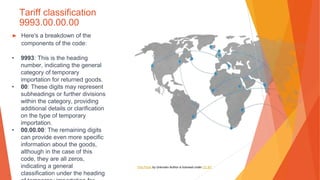
▶ Here's a breakdown of the
components of the code:
• 9993: This is the heading
number, indicating the general
category of temporary
importation for returned goods.
• 00: These digits may represent
subheadings or further divisions
within the category, providing
additional details or clarification
on the type of temporary
importation.
• 00.00.00: The remaining digits
can provide even more specific
information about the goods,
although in the case of this
code, they are all zeros,
indicating a general
classification under the heading
This Photo by Unknown Author is licensed under CC BY
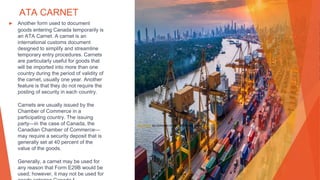
ATA CARNET
▶ Another form used to document
goods entering Canada temporarily is
an ATA Carnet. A carnet is an
international customs document
designed to simplify and streamline
temporary entry procedures. Carnets
are particularly useful for goods that
will be imported into more than one
country during the period of validity of
the carnet, usually one year. Another
feature is that they do not require the
posting of security in each country.
Carnets are usually issued by the
Chamber of Commerce in a
participating country. The issuing
party—in the case of Canada, the
Canadian Chamber of Commerce—
may require a security deposit that is
generally set at 40 percent of the
value of the goods.
Generally, a carnet may be used for
any reason that Form E29B would be
used; however, it may not be used for
This Photo by Unknown Author is licensed under CC BY-ND
CANADIAN GOODS
ABROAD
▶ The Canadian Goods Abroad
Program (CGAP) provides for relief
from the payment of duty on the
Canadian portion of goods that are
returning to Canada after having
been exported for repairs,
additions, or further processing,
providing that certain conditions are
met. The program is outlined in
greater detail in D8-2-14 on
CBSA’s website. Relief from the
payment of duties will be granted if
the minister is satisfied that:
• the repairs could not be made in
Canada where the goods were
located or within a reasonable
distance,
• the equipment added to the goods
was not available in Canada or is of
a class or kind not made in
Canada, or
This Photo by Unknown Author is licensed under CC BY
RELEASE
PROCEDURES
▶ In addition, in order to qualify for relief, no
duty drawback may be claimed or paid on
the exported goods and the goods must be
returned to Canada within one year. A
drawback is a refund of duty paid on
imported goods that are subsequently ex-
ported from Canada. Note that if a drawback
is claimed when goods are exported from
Canada for repair, they are subject to duty
on their return.
Essentially, the CGAP provides relief on the
Canadian portion of goods being returned
after repair and provides full relief of duty
and taxes on emergency re-pairs. In order to
qualify, the goods must be returned to
Canada within one year of being exported for
repair or further processing.
In order to take advantage of this CGAP, the
Canadian shipper must make a formal
request to CBSA for permission. When the
repaired goods are returned, the foreign
exporter must provide an invoice that
includes the cost of repairs, labour, and any
parts that were incorporated into the
repaired good. Goods repaired in one of
Canada’s free trade partner countries can be
This Photo by Unknown Author is licensed under CC BY
TARIFF ITEM
9992.00.00
▶ Goods, regardless of their country of
origin or tariff treatment that have
been sent to Chile, Colombia, Costa
Rica, a CPTPP country, an EU
country or other CETA beneficiary,
Honduras, Iceland, Israel or another
CIFTA beneficiary, Jordan, Korea,
Liechtenstein, Mexico, Norway,
Panama, Peru, Switzerland, or the
US for repair, may be brought back
into Canada duty free under tariff item
9992.00.00. In order to use this tariff
item, the goods must first be
classified under a tariff found in
chapters 1 to 97 of the Customs Tariff
Schedule. This tariff item, as well as
the first four digits of tariff 9992.00.00
(9992), must be quoted on the import
document.
Although the tariff code is duty free,
tax is payable. If the goods were
repaired under warranty, the value for
This Photo by Unknown Author is licensed under CC BY-SA-NC
EMERGENCY
REPAIRS
▶ Aircraft and vehicles that have
undergone emergency repairs
outside Canada are not only
allowed relief of any duty and
taxes when they return, but also
allowed relief of duty on the
value of the repairs. In order to
be relieved of duty on the cost of
emergency repairs, the importer
must immediately advise CBSA
at the port of en-try that the
aircraft or vehicle has been
repaired while abroad. If CBSA
is satisfied that the repairs were
necessary as a result of an
accident or some other
unforeseen problem, or if the
repairs were necessary for the
safe return of the vehicle, duty
relief will be granted.
ADDITION
▶ Goods that have been exported
for the purpose of having
additions made may be granted
relief from the payment of duties
if:
• it would not be practicable to do
the work in Canada, and
• the importer obtains
authorization from CBSA prior to
exporting the goods to claim the
benefits of paragraph 101(1)(b) of
the Customs Tariff.
The application must be submitted
at least three months prior to the
exportation of the goods. CBSA
officials must have sufficient time
to review the material pro-vided
and, where necessary, contact
other government departments.
The application is to be submitted
to the closest CBSA office.
This Photo by Unknown Author is licensed under CC BY-NC-ND
WORK DONE
▶ Goods that have been exported
for the purpose of having work
done may be granted relief from
the payment of duties if:
• the goods to be exported are a
product of Canada and the work
to be done, generally a phase of
production, cannot practicably
have been done in Canada; and
• the importer obtains
authorization from the CBSA
prior to exporting the goods to
claim the benefits of this
provision.
The application must be
submitted in writing at least
three months prior to the
exportation of the goods.
This Photo by Unknown Author is licensed under CC BY
THE BREXIT EFFECT
SHORTAGES AND
ENTERED-TO-
ARRIVE SHIPMENTS
▶ The vendor should be advised of the
shortage. If the shortage is discovered
after release but before final
accounting, the importer or customs
broker has two options:
1. Account for the total quantity and
have the balance of the goods
released as Entered to Arrive (ETA) or
Value Included (VI) when they arrive.
An ETA is prepared if the total number
of packages reported did not match
the number of packages received, and
a VI entry is prepared if the package
contents were incomplete.
2. Provide CBSA with evidence of the
shortage with the final accounting
document and account for the goods
on hand only. When the remaining
goods arrive, they should not be
reported as a shortage. Instead,
This Photo by Unknown Author is licensed under CC BY
CANADIAN GOODS
AND DUTY PAID
GOODS RETURNED
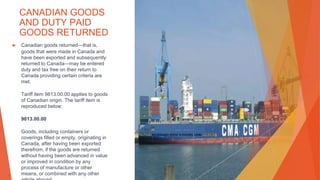
▶ Canadian goods returned—that is,
goods that were made in Canada and
have been exported and subsequently
returned to Canada—may be entered
duty and tax free on their return to
Canada providing certain criteria are
met.
Tariff item 9813.00.00 applies to goods
of Canadian origin. The tariff item is
reproduced below:
9813.00.00
Goods, including containers or
coverings filled or empty, originating in
Canada, after having been exported
therefrom, if the goods are returned
without having been advanced in value
or improved in condition by any
process of manufacture or other
means, or combined with any other
This Photo by Unknown Author is licensed under CC BY-SA
9813.00.00
▶ For the purpose of this tariff
item:
(a) goods on which a refund of
customs duty or drawback of
customs duty has been made
shall not be classified under
this tariff item except upon
payment of the customs duty
equal to the refund or
drawback allowed; and
(b) goods manufactured in
bond or under excise
regulations in Canada and
exported shall not be
classified under this tariff item
except upon payment of the
customs duty to which they
would have been liable had
This Photo by Unknown Author is licensed under CC BY-ND
9814.00.00
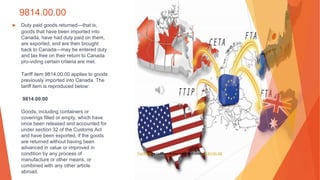
▶ Duty paid goods returned—that is,
goods that have been imported into
Canada, have had duty paid on them,
are exported, and are then brought
back to Canada—may be entered duty
and tax free on their return to Canada
pro-viding certain criteria are met.
Tariff item 9814.00.00 applies to goods
previously imported into Canada. The
tariff item is reproduced below:
9814.00.00
Goods, including containers or
coverings filled or empty, which have
once been released and accounted for
under section 32 of the Customs Act
and have been exported, if the goods
are returned without having been
advanced in value or improved in
condition by any process of
manufacture or other means, or
combined with any other article
abroad.
This Photo by Unknown Author is licensed under CC BY-NC-ND
9814.00.00
▶ For the purpose of this tariff item:
(a) goods on which a refund of
customs duty or drawback of customs
duty has been made shall not be
classified under this tariff item except
upon payment of the customs duty
equal to the refund or drawback
allowed; and
(b) goods manufactured in bond or
under excise regulations in Canada
and exported shall not be classified
under this tariff item except upon
payment of the customs duty to which
they would have been liable had they
not been exported from Canada.
In order to be imported under the
provisions of tariff item 9813.00.00 or
9814.00.00, the importer must be
able to prove that the goods were in
Canada at one time. A copy of the
export bill of lading and the sales
invoice are usually acceptable proof
This Photo by Unknown Author is licensed under CC BY
How do goods qualify
as Canadian goods or
duty paid goods
returned?
▶ 1. Goods must be returned to
Canada without having been
advanced in value or improved
in condition by any process of
manufacture or other means.
2. Goods that were exported
from Canada and are returning
to Canada must be described in
sufficient detail on any
commercial documents to
enable verification that the
goods exported are the same as
those returning to Canada. This Photo by Unknown Author is licensed under CC BY
How do goods qualify
as Canadian goods or
duty paid goods
returned?
▶ Should CBSA request proof
of export and an export
report is not available, they
may accept the following:
a. validated CBSA
documents, such as Form B3
or Form BSF715, Casual
Goods Accounting
Document;
b. transportation company
documents;
c. customs accounting
documents from the foreign
country;
This Photo by Unknown Author is licensed under CC BY
How do goods qualify
as Canadian goods or
duty paid goods
returned?
▶ Should CBSA request proof of export
and an export report is not available,
they may accept the following:
d. a declaration made by the exporter
or importer of the goods from or into
Canada identifying the goods as
having originated in Canada or as
having been previously released and
accounted for and supported by sales
invoices to the foreign purchaser,
purchase orders, shipping or delivery
instructions, foreign registration of
exported goods (e.g., state registration
of an automobile), or invoices from
customs brokers that relate to the
exported goods or shipments; or
e. primarily for non-commercial goods,
a sales invoice from the Canadian
owner showing the purchase of the
goods in Canada.
This Photo by Unknown Author is licensed under CC BY
WAREHOUSING AND
EX-WAREHOUSIN
▶ Customs bonded warehouses
are regulated and licensed by
CBSA and operated by the
private sector. An importer may
choose to put goods into a
bonded warehouse for several
reasons, including:
• the deferral of payment of
duties (for up to four years) until
the goods are released by
CBSA;
• to consolidate imported and
domestic goods for export; • to
perform certain operations on
the goods while in the bonded
warehouse; or
• to display goods temporarily at
conventions, exhibitions or trade
shows.
WAREHOUSING AND
EX-WAREHOUSIN
▶ Goods that enter a bonded warehouse
are documented on Form B3 Type 10
and in hard copy only. When preparing
the import document to enter goods
into a warehouse, only similar goods
with the same value may be shown on
one classification line. Therefore, if
goods are classified under the same
tariff classification but have different
values, they must be documented on
two separate lines on the Form B3
warehouse entry. When removing the
goods from the warehouse, Form B3
Type 20 is prepared, EDI or paper.
The amount of duty payable will be
listed on the Daily Notice (DN) and
Statement of Account (SOA)
Strict control must be kept on goods
warehoused and ex-warehoused, and
record keeping systems must be able
to track the movement of all goods. As
the goods are ex-warehoused, the
quantity must be documented.
This Photo by Unknown Author is licensed under CC BY
PROHIBITED GOODS
▶ For various reasons, certain
goods are prohibited entry into
Canada. Prohibited goods are
listed in tariff items 9897.00.00,
9898.00.00, and 9899.00.00,
and include members of an
endangered species; goods that
are mined, manufactured, or
produced wholly or in part by
forced labour; used mattresses;
certain used vehicles; weapons;
and books, printed paper,
drawings, paintings, prints,
photographs, or representations
of any kind that are deemed to
be obscene, constitute hate
propaganda, or are treasonable
or seditious in nature. More
information on prohibited goods
can be found in the D9 series of
the customs D-memos.
This Photo by Unknown Author is licensed under CC BY-NC-ND
SHORTAGES AND
ENTERED-TO-
ARRIVE SHIPMENTS
▶ An importer unpacking their
shipment may find that some goods
have not been shipped; this is
commonly referred to as a
shortage. There are two types of
shortage situations:
1. The total number of packages
reported does not match the
number of packages received. For
example, the carrier reports that it
has 100 boxes, but, when the
boxes are counted, there are only
99.
2. Package contents are
incomplete. For example, the
carrier reports 100 boxes, 100
boxes are delivered, but two of
them are empty. In both cases, it is
This Photo by Unknown Author is licensed under CC BY-NC
EXAMINATIONS AND
REJECTS
▶ If the shortage is discovered
after final accounting, either the
balance of the short-shipped
goods may be released as an
ETA or VI, or a claim may be
made for a refund if the importer
does not expect the goods to be
delivered at a later date.
If duty has been paid before the
shortage was noted, the vendor
can provide a corrected invoice
and a credit note. The importer
or customs broker, using Form
B2, Canada Customs
Adjustment Request can apply
for a refund of duty on the goods
that were not shipped.
This Photo by Unknown Author is licensed under CC BY-SA
EXAMINATIONS AND
REJECTS
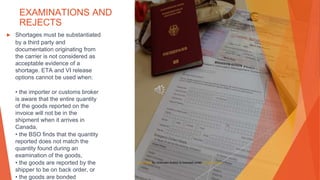
▶ Shortages must be substantiated
by a third party and
documentation originating from
the carrier is not considered as
acceptable evidence of a
shortage. ETA and VI release
options cannot be used when:
• the importer or customs broker
is aware that the entire quantity
of the goods reported on the
invoice will not be in the
shipment when it arrives in
Canada,
• the BSO finds that the quantity
reported does not match the
quantity found during an
examination of the goods,
• the goods are reported by the
shipper to be on back order, or
• the goods are bonded
This Photo by Unknown Author is licensed under CC BY-SA-NC
EXAMINATIONS AND
REJECTS
▶ ETA and VI shipments cannot
be submitted using EDI and
must be presented in hard copy.
A shortage might also be
discovered when:
• the number of pieces on the
cargo control document does
not correspond to that on the
invoice,
• the weight on the cargo control
document does not correspond
to that on the invoice,
• the description on the cargo
control document does not
correspond to that on the
invoice, or
• the client advises its customs
broker that all goods were not
received
This Photo by Unknown Author is licensed under CC BY-SA-NC
EXAMINATIONS AND
REJECTS
▶ There are many factors that can
affect a release decision. Many of
the shipments released will be
given very little thought because
they are for your usual clients and
the goods are repetitive. Many
importers import the same goods
on a continuous basis and clearing
these shipments becomes a matter
of routine. However, what about
shipments that are not routine?
Besides the usual questions
including:
• Who is the importer?
• Who is the exporter?
• What are the goods?
• What is their value?
• What is the date of direct
shipment?
• What is the country of origin?
• Where are the goods going?
• Is all the necessary paperwork
Re-examining trade with Africa under the Continental
Free Trade Agreement

Customs Issues and Procedure Part 7.pptx

  • 1.
  • 2.
  • 3.
    Important Dates ▶ Assignment3/21/2024 ▶ Midterm 3/27/2024 ▶ Final 4/5/2024 This Photo by Unknown Author is licensed under CC BY-SA-NC
  • 4.
    Terminal Learning Objectives ▶ Describethe purpose of the ACROSS release systems. ▶ Differentiate among the various release options: RMD, PARS, IID, CSA, and FAST. ▶ Differentiate among the various release options: RMD, PARS, IID, CSA, and FAST. ▶ Correct errors made on a Form B3. ▶ Describe the requirements for casual importations. ▶ Understand when goods are seized and placed in a Queen’s warehouse.
  • 5.
    RELEASE AND ACCOUNTING OF IMPORTED COMMERCIAL GOODS ▶The five steps in the importation of commercial goods were outlined previously. The release and accounting of goods are the fourth and fifth steps in that process. After release data have been sent to CBSA, a release recommendation (if the goods have not yet arrived) or a release decision (if the goods are on hand) is made.
  • 6.
    ACCELERATED COMMERCIAL RELEASE OPERATIONS SUPPORT SYSTEM ▶ AcceleratedCommercial Release Operations Support System (ACROSS) is the system that CBSA uses to receive electronically transmitted release and invoice data from customs brokers and importers. Goods released through ACROSS must be confirmed (accounted for) electronically, using either Customs Automated Data Exchange (CADEX) or Customs Declaration (CUSDEC)—an international format that operates in a
  • 7.
    ACCELERATED COMMERCIAL RELEASE OPERATIONS SUPPORT SYSTEM ▶ Thebenefits of ACROSS include: • the ability to exchange information 24 hours a day, during business and non-business hours; • the ability to exchange information without having to rekey data; • the ability to exchange most permit data electronically; • a decrease in paper and related handling costs; and • the ability to request the release of goods located at any port in Canada, regardless of where the customs broker or importer is located.
  • 8.
    MACHINE RELEASE SYSTEM ▶ CBSA’sMachine Release System (MRS) is an internal component of ACROSS that provides automated release decisions for shipments that meet a variety of low-risk criteria determined internally by CBSA through analytics and feedback from border services officers (BSOs). MRS automates the processing of low-risk and repetitive importations, allowing the release of goods without officer intervention in order to provide officers with more time for the processing of shipments that pose a greater degree of risk. Shipments regulated by other government departments (OGDs) may be eligible for automated release once OGD requirements This Photo by Unknown Author is licensed under CC BY-SA
  • 9.
    RELEASE OF GOODS ▶The term "release of goods" refers to the process by which goods are made available for shipment or distribution. This process can vary depending on the context, whether it's in the context of international trade, warehousing, or other logistical operations. International Trade: Customs Clearance: In international trade, when goods arrive at a port or border, they often need to go through customs clearance. This involves submitting necessary documents, paying import duties and taxes, and complying with customs regulations. Once customs clearance is completed, the goods are released for entry into the destination country. Bill of Lading: The release of goods can also refer to the transfer of control over goods from the exporter to the importer, typically when a bill of lading is issued. A bill of lading is a legal document that confirms the receipt of goods by the This Photo by Unknown Author is licensed under CC BY
  • 10.
    RELEASE OF GOODS ▶The release of goods is an essential part of supply chain management and logistics, ensuring that products are available to meet demand while complying with regulatory and quality control requirements. It involves coordination between various parties, including customs authorities, logistics teams, warehouse operators, and retailers, to ensure that goods are delivered efficiently and in compliance with relevant laws and standards. This Photo by Unknown Author is licensed under CC BY
  • 11.
    RELEASE PROCEDURES ▶ Released goodsare those that CBSA has authorized to continue their journey to their final destination—that is, they have been reported by the carrier to CBSA and have met all import requirements. Once the goods are released, they must be accounted for, and any applicable duties and taxes must be paid. These three steps—release, accounting, and payment—are often performed separately. However, in order for goods to be released before any duties and taxes are paid, the customs broker or importer must post security with CBSA. When these steps are performed separately, the release function is This Photo by Unknown Author is licensed under CC BY-ND
  • 12.
    RELEASE PROCEDURES ▶ Requests forthe release of commercial goods may be made in one of the following ways: • Presentation of a Release on Minimum Documentation (RMD) package accompanied by a completed Form B3 accounting document Type C that releases and accounts for goods at the same time. If security has not been posted, duty and taxes are paid immediately. • Presentation of an ex- warehouse Form B3 accounting document Type 20, with duty and taxes paid immediately, or later if security has been posted. This Photo by Unknown Author is licensed under CC BY
  • 13.
    RELEASE PROCEDURES ▶ Requests forthe release of commercial goods may be made in one of the following ways: • Presentation of an RMD package, provided security has been posted, since the goods are released with a promise to pay duty and taxes at a later date. • Presentation of a Pre-Arrival Review System (PARS) package, provided security has been posted, since the goods are released with a promise to pay duty and taxes at a later date. • Transmission of an Integrated Import Declaration (IID), provided security has been posted, since the goods are released with a promise to pay duty and taxes at a later date. This Photo by Unknown Author is licensed under CC BY
  • 14.
    RELEASE PROCEDURES ▶ The differencebetween an RMD and a PARS is that an RMD is used when the goods are on hand and a PARS is submitted before the goods arrive at the border. An IID may be presented pre-or post-arrival of the goods. Release data must be sent electronically, unless there is a specific reason why it cannot be done. When an exception to Electronic Data Interchange (EDI) exists, the release request is made by submitting a paper entry and providing the reason. The reason is noted on a form that is included with the paper RMD or PARS. This Photo by Unknown Author is licensed under CC BY-SA-NC
  • 15.
    SECURITY ▶ In orderto have goods released before duties and taxes are paid, either the customs broker or importer must post security. Posting security assures CBSA that duties and taxes will be paid at a later date. Security can be in the form of: 1. cash, 2. a certified cheque, 3. a transferable bond issued by the Government of Canada, or 4. a bond issued by a party approved by the Canada Revenue Agency.
  • 16.
    SECURITY ▶ In orderto have goods released before duties and taxes are paid, either the customs broker or importer must post security. Posting security assures CBSA that duties and taxes will be paid at a later date. Security can be in the form of: 1. cash, 2. a certified cheque, 3. a transferable bond issued by the Government of Canada, or 4. a bond issued by a party approved by the Canada Revenue Agency. For customs brokers, security is based on their average monthly duties and taxes (including GST), up to a maximum of $10 million. For resident importers, security is based on their average monthly duties and taxes (less the GST), up to a maximum of $10 million. For non-resident importers, security is based on their average monthly duties and taxes (including GST), up to a maximum of $10 million. This Photo by Unknown Author is licensed under CC BY-NC-ND
  • 17.
    RELEASE ON MINIMUM DOCUMENTATION ▶ RMDinformation may not be presented until the physical arrival of the goods. When transmitting RMD data using EDI, a distinction is made between the presentation of Appraisal Quality (AQ) data and non-Appraisal Quality (non- AQ) data. For AQ data, the invoice information provided to CBSA mirrors the commercial invoice and all information required to make a release determination is included. Most goods are released using AQ, or full data. For non-AQ, the data are recapped according to the vendor, country of origin, and/or tariff classification under the Harmonized Commodity Description and Coding System (HS). That is, all items from the same vendor, that have the same country of origin, or that have the same HS classification can be consolidated on one line. Detailed data must be transmitted to CBSA before final accounting data are sent. A non-AQ release request may not be used for goods that are regulated by any government department other than CBSA. This Photo by Unknown Author is licensed under CC BY
  • 18.
    RELEASE ON MINIMUM DOCUMENTATION ▶ Apaper RMD, known as a “hard copy” RMD, package must include the following: 1. two copies of the cargo control document (CCD), the customs delivery authority copy, and the “long room” copy (retained by CBSA); and 2. two copies of the invoice or other acceptable document providing the following information: a. the importer’s name and business number; b. the name of the exporter; c. the unit of measure and quantity of goods; d. the value of the goods; e. a detailed description of the goods, including the code or model number and size or dimensions, plus the ten-digit HS code for all items; f. a transaction number in bar-coded format; g. the number of invoice pages; and h. the country of origin. As well, any permits, licences, and This Photo by Unknown Author is licensed under CC BY-SA
  • 19.
    PRE-ARRIVAL REVIEW SYSTEM ▶ Pre-ArrivalReview System (PARS) allows for the submission of release data prior to the arrival of goods. Depending on the carrier and mode of transportation, there are other terms used to describe PARS. For example, where goods arrive by rail, the term RAILPARS is used. Marine freight uses the term MARINEPARS and airfreight uses AIRPARS. At inland highway sufferance warehouses, the term used is INPARS. PARS works by having the exporter or carrier provide all information about the goods to the customs broker or importer who will be preparing the PARS package in advance of the shipment’s arrival. The information must include a bar- coded cargo control number. This Photo by Unknown Author is licensed under CC BY-ND
  • 20.
    PRE-ARRIVAL REVIEW SYSTEM ▶ Thecustoms broker or importer prepares a PARS release request package for submission to CBSA. The submission of a PARS must be made at least one hour in advance for an EDI transmission or two hours in advance in the case of a pa-per submission and up to a maximum of 30 calendar days before the arrival of the goods. A BSO will review the PARS package and decide whether to release the goods or refer them for examination. This decision will be entered into the ACROSS system but will not be made known to anyone outside of the CBSA. If the carrier subscribes to CBSA’s Release Notification System (RNS), the carrier can check to confirm that the PARS package has been received by CBSA. This Photo by Unknown Author is licensed under CC BY-NC-ND
  • 21.
    PRE-ARRIVAL REVIEW SYSTEM ▶ Whenthe carrier reaches the border, they must present themselves at the first point of arrival. For a highway carrier, this usually occurs at the Primary Inspection Line (PIL). The carrier provides the BSO at the PIL with a copy of the paperwork that includes the same bar-coded cargo control number used when the PARS pack- age was submitted to CBSA. The officer will scan the bar-code, and if the message indicates that the goods can be released, the officer will stamp the driver’s paperwork with the date of release and return the paperwork to the carrier. The driver may then proceed on their way. The customs broker, importer, or warehouse operator will be advised that the goods were released by way of the RNS system. This Photo by Unknown Author is licensed under CC BY
  • 22.
    INTEGRATED IMPORT DECLARATION ▶ The IntegratedImport Declaration (IID) is part of the Single Window Initiative (SWI). With a single window, all data are sent to CBSA, who in turn sends them to other government agencies who regulate the goods. Other government departments (OGDs) and agencies who participate in the SWI are called participating government agencies (PGAs). This is intended to reduce the number of documents required, since information required by PGAs and CBSA is included on one IID. In most cases, the IID can be transmitted to CBSA up to 90 days prior to the arrival of the goods and it may also be used if the goods have already arrived. The use of the IID is not restricted to regulated goods, and it is CBSA’s intention to decommission all other EDI release options in favour This Photo by Unknown Author is licensed under CC BY
  • 23.
    CUSTOMS SELF- ASSESSMENT ▶ TheCustoms Self- Assessment (CSA) program is designed for low-risk, pre- approved importers, carriers, and registered drivers. Under the CSA program, ap-proved importers will be allowed a streamlined release, accounting, and payment process for all imported goods. CSA importers use their own business systems and processes, which must meet CBSA’s requirements, to forward trade data and to report and remit payment of duties and taxes once a month to their own financial institutions. This Photo by Unknown Author is licensed under CC BY
  • 24.
    THE CSA PROCESS ▶CSA-approved importers who use CSA- approved carriers and registered drivers and who are importing eligible goods can use a streamlined process to enter their goods into Canada. The CSA process at the border requires registered drivers to present their commercial driver registration card, the CSA- approved carrier code, and the CSA- approved importer business number. These bar-coded data elements are captured in the automated system by the BSO to verify that the driver is registered, and that the carrier and importer are both CSA approved. Once these data have been verified by CBSA, the carrier will be authorized to deliver the goods. The CSA carrier who reports goods to CBSA for authorization to deliver is liable for the payment of duties and taxes until the goods are delivered to the place of business of the importer, owner, or consignee. To remove this liability, the reporting carrier must ensure that proof of delivery is obtained and kept on hand for CBSA verification. Under the CSA process, goods are not released until they have been received at their destination. Once the CSA- approved importer receives the goods, they will calculate and remit duties and taxes through a unique process available only to This Photo by Unknown Author is licensed under CC BY
  • 25.
    CSA-ELIGIBLE GOODS ▶ CSA-eligible goodsare commercial goods that have been shipped directly from the United States (US) or Mexico, as long as the goods do not require, under any act of Parliament or of the legislature of a province or territory, a permit, licence, or other similar document to be presented to CBSA at the time of report.
  • 26.
    FREE AND SECURE TRADE ▶The Free and Secure Trade (FAST) program is a joint Canada – US initiative involving CBSA and its US counterpart, the Customs and Border Protection (CBP) agency. FAST supports moving pre- approved eligible goods across the border quickly and verifying trade compliance away from the border. Information about the goods that is not required at the time of release can be supplied once the goods have moved away from the border. FAST is a commercial process offered to pre-approved importers, carriers, and registered drivers. Shipments for approved companies, transported by approved carriers using registered drivers, will be cleared into either country with greater speed and certainty and at a reduced cost of compliance. In Canada, FAST builds on the CSA program and its principles of pre-approval and self-assessment as well as on the increased security measures under the Partners in Protection (PIP) program. This Photo by Unknown Author is licensed under CC BY
  • 27.
    FREE AND SECURE TRADE ▶PIP is a Canadian program designed to enlist the cooperation of the trade community and the transportation industry in the fight against contraband smuggling. PIP provides a framework for joint efforts and outlines the commitments of both signatories in a memorandum of understanding that focuses on three areas of cooperation: 1. intelligence and the exchange of information, 2. security, and 3. joint training/information initiatives. This Photo by Unknown Author is licensed under CC BY-NC-ND
  • 28.
    FREE AND SECURE TRADE ▶Importers and carriers must be approved in the CSA program and participants in the PIP program to be eligible for FAST. There is a designated FAST lane at some highway border points. In order for a carrier to use the FAST lane, the following must apply: 1. goods must be designated CSA- eligible; 2. the importer must be FAST approved— that is, both CSA and PIP approved; 3. the carrier must be a FAST-authorized carrier—that is, authorized under both CSA and PIP; and 4. the driver must be authorized under the FAST driver program. The process for authority to deliver is the same as that described under the CSA. The only difference between CSA and FAST is that if both the importer and the carrier are both CSA and PIP approved, they may use the designated FAST lanes. This Photo by Unknown Author is licensed under CC BY-NC
  • 29.
    How and WhyWorld Trade Organisation was formed? | Important International bodies
  • 30.
    SUB-AGENCY CLEARANCES ▶ A sub-agentis a customs broker that acts on behalf of another customs broker. Since most release requests take place electronically and a customs broker can request release of goods at any EDI customs port, the use of a sub-agent is generally restricted to occasions when a customs broker must submit a paper release request at a port where they are not located. This Photo by Unknown Author is licensed under CC BY
  • 31.
    EXAMINATIONS AND REJECTS ▶ ABSO is empowered under section 99 of the Customs Act1 to examine any goods that are being imported or exported. As well, other sections of the Customs Act allow officers access to conveyances and give authority to detain any goods that have been imported or are about to be exported. The examination of goods may be conducted in order to determine the proper tariff classification; to determine a value for duty; to determine origin or quantity; or to ascertain the admissibility of the goods under other federal laws that regulate, control, or prohibit the importation or exportation of certain goods. An examination can be initiated upon presentation to CBSA of an RMD pack-age, a Form B3 accounting document Type C for release, or the arrival of a driver using PARS. After the examining officer has conducted the physical examination, a written report is provided to the releasing officer. The releasing officer will make the decision to release, seize, or reject the shipment based on the report. If the shipment is released, the goods will be forwarded to the consignee. If the goods are held and not released, the reasons will be listed on This Photo by Unknown Author is licensed under CC BY-SA
  • 32.
    FORM Y50, REJECT DOCUMENT CONTROL ▶Form Y50, Reject Document Control, is a document issued by CBSA indicating that a paper release request has been rejected. For release information that was provided electronically, Form Y50 data are transmitted electronically to the customs broker or importer. The goods will not be released until the corrected documents or data are presented. Form Y50 is issued against a PARs or an RMD release request. In most cases, Form Y50 requests additional information or clarification of the data presented in order to enable the BSO to make a release decision. Minor coding errors may have to be changed and the release request package resubmitted. This Photo by Unknown Author is licensed under CC BY-SA-NC
  • 33.
    SEIZURES ▶ A seizuretakes place when goods and/or, in cases of serious infractions, the conveyance or vehicle, are confiscated. When a seizure does take place, CBSA will issue a Form K19, Customs Seizure Receipt. Form K19 describes the goods, the reason for the seizure, the conveyance used, the value of the goods, the amount required for return of the goods, and any deposit taken with respect to the goods. In some cases, seized goods may be returned to the carrier or their owner upon payment of any duties, taxes, and/or penalties. However, drugs, firearms, weapons, pornography, tobacco, alcohol, or vehicles modified for This Photo by Unknown Author is licensed under CC BY-SA-NC
  • 34.
    THE ADMINISTRATIVE MONETARY PENALTY SYSTEM ▶ TheAdministrative Monetary Penalty System (AMPS) is a system of civil penal- ties applied against those who contravene the Customs Act, the Customs Tariff,2 the Special Import Measures Act,3 or their associated regulations. These penalties are used by the CBSA as a means to encourage compliance by commercial traders. In cases of non-compliance, the penalties that are applied are based on the type, frequency, and severity of the infraction. AMPS largely replaces the use of seizure provisions for technical infractions; typically, an officer will take seizure action only for serious offences. Officers will issue penalties under AMPS by use of a Notice of Penalty Assessment (NPA). Contravention C001, an example of a penalty related to keeping records.
  • 35.
    HOURS OF OPERATION ▶ CBSAoffices have differing hours of operation depending on their location and the services they provide. Some offices offer commercial service 24 hours a day. Others provide commercial service from 8 a.m. to midnight, and others are open only to release commercial shipments during regular office hours—for example, 8 a.m. to 5 p.m. The hours of operation for transmitting confirming accounting documentation for CADEX and EDI participants are 24 hours a day, 7 days a week. ACROSS is also available 24 hours a day, 7 days a week. In some cases, release of goods will be provided after hours with special service charges being assessed. There may also be charges for the This Photo by Unknown Author is licensed under CC BY
  • 36.
    ACCOUNTING FOR GOODS ▶ CBSAneeds information in order to verify the value, classification, country of origin, tariff treatment, and exchange rate of imported goods. These data, as well as the total amount of duty and taxes, must be submitted within five business days from the date that the goods are released. Failure to confirm an RMD by presenting the final accounting documentation within the stipulated time limit will result in a penalty under AMPS. Accounting information may be presented in hard copy or electronic format; however, EDI is most common.
  • 37.
    CUSTOMS AUTOMATED DATA EXCHANGE ▶ TheCustoms Automated Data Exchange (CADEX) system electronically links the importer or customs broker with CBSA. Using CADEX, a customs broker or importer can receive notification that goods have been released and send ac- counting data to CBSA. Daily Notices and Statements of Account are also sent via EDI in CADEX formats to EDI- enabled commercial clients. Because of its age and limitations, CADEX is being phased out. Those wishing to exchange data electronically with the CBSA must start to
  • 38.
    CUSTOMS AUTOMATED DATA EXCHANGE ▶ Alternativesto CADEX include: • Value Added Network (VAN). A public network that allows the exchange of data with a large number of trading partners using a single communication interface. • Third-party service providers. Many CBSA-approved third-party service providers currently transmit data to the CBSA, using a variety of communication modes, on behalf of importers and customs brokers. • Customs Internet Gateway (CIG). The CBSA developed the CIG to provide clients with a method of transmitting and receiving data over the Internet. Clients are required to purchase specific software for encryption and decryption and to develop, or purchase, the protocol software to connect to the CIG. Clients must transmit the data from a Canadian office because the certificate is only assigned to a device in Canada. • Connection made directly to the CBSA. The direct-connect option provides clients with a direct connection to the
  • 39.
    FORM B3 ACCOUNTING DOCUMENT ▶ TheForm B3 is a customs accounting document used in Canada for the reporting and payment of duties and taxes on imported goods. It is part of the Canada Border Services Agency's (CBSA) reporting and accounting process. The Form B3 is also known as the "Canada Customs Coding Form" and is used by importers, customs brokers, and carriers to declare imported goods to CBSA. It's important to note that the specific format and requirements of the Form B3 may change over time due to updates in customs regulations. Therefore, it's essential to refer to the latest guidance and resources provided by the Canada Border Services Agency or consult with a customs expert or customs broker when completing this form for importing goods into Canada.
  • 40.
    FORM B3 ACCOUNTING DOCUMENT ▶ Hereis a general overview of the information typically included on a Form B3 accounting document: • Importer Information: This section includes details about the importer, such as the name, address, and contact information. • Consignee Information: If the consignee is different from the importer, their information is included here. • Exporter Information: Details about the exporter of the goods, including their name and address. • Vendor Information: Information about the vendor who sold the goods, including their name and address. • Carrier Information: Details about the carrier responsible for transporting the goods, including their name and address.
  • 41.
    FORM B3 ACCOUNTING DOCUMENT ▶ Hereis a general overview of the information typically included on a Form B3 accounting document: • Transaction Information: This section contains details about the transaction, including the invoice number, date, and currency of the transaction. • Description of Goods: A detailed description of the imported goods, including their quantity, unit of measure, and value. • Country of Origin: Information about the country of origin of the goods. • Harmonized System (HS) Code: The HS code is used to classify the goods for customs purposes. • Duties and Taxes: The Form B3 includes a breakdown of the duties and taxes payable on the imported goods. This may include customs duties, excise taxes, and goods and services tax (GST).
  • 42.
    FORM B3 ACCOUNTING DOCUMENT ▶ Hereis a general overview of the information typically included on a Form B3 accounting document: • Payment Information: Details about how the duties and taxes are being paid, such as by cash, check, or electronic funds transfer. • Customs Broker Information: If a customs broker is involved in the importation, their information is provided here. • Authorized Signature: The form typically requires an authorized signature to certify the accuracy of the information provided. • CBSA Release: This section is used by CBSA to record the release of the This Photo by Unknown Author is licensed under CC BY-SA-NC
  • 43.
    FORM B3 ACCOUNTING DOCUMENT TYPEC (PAYING ALL DUTIES AND TAXES) ▶ At times, goods may be released at the same time that duties and taxes are paid. This usually occurs in cases where security has not been posted although a Type C can be presented with duty and taxes paid later if security has been posted. The following documents must be submitted with the completed Form B3: • any commercial or customs invoices; • the cargo control document; and • any permits, certificates, or licenses.
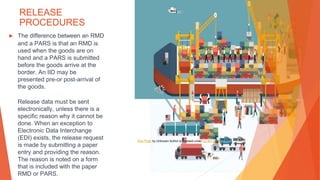


  • 44.
    EX-WAREHOUSE FORM B3 ACCOUNTING DOCUMENT ▶ Itis not until goods are removed from a bonded warehouse that they are considered released and accounted for. Form B3 Type 20 is most often used to remove goods from the bonded warehouse and to pay duty and taxes at the same time. Form B3 Type 20 entries may also be submitted electronically, in which case the duties and taxes are paid at a later date.
  • 45.
    DETAILED CODING STATEMENTS ▶ TheDCS and the accounting package are then returned to the customs broker or importer for correction. The three reasons a DCS may be issued are: • Notification of Rejection. Generated when CBSA’s system encounters an error while processing Form B3 input data. The DCS displays the original Form B3 input data as well as CBSA’s calculations. At the end of the DCS, there is a list of the error(s). • Notification of Adjustment. Generated when the total revenue payable calculated by CBSA does not agree with the total indicated on Form B3 but the discrepancy is less than $2.00. In this case, Form B3 is accepted, and the adjusted amount is payable and indicated on the Daily Notice. • Notification of Acceptance. Generated when Form B3 is a “cash type”—that is, the goods are being duty paid at time of release. In this case the DCS is stamped “duty paid” and returned to the importer or customs broker after payment is received.
  • 46.
    CHANGES PRIOR TO FINALACCOUNTING ▶ Before final accounting and after the release of the goods, changes may be made to information provided on an RMD package by using Form A48, RMD Correction. In addition to changes to the business number and transaction number, changes can be made to the Cargo Control Number, container number(s), sub-location code, or customs office. The completed form is presented to CBSA where the goods were released and must be presented within a time frame that allows the goods to be accounted for, or confirmed, within the required time limits.
  • 47.
    CHANGES BETWEEN TIME OFFINAL ACCOUNTING AND PAYMENT OF DUTIES AND TAXES ▶ In order to change the importer name and/or number after final accounting, the importer or customs broker must submit a letter to CBSA client services in the region in which the goods were released requesting the change and providing the reason for doing so. If the letter is presented by the customs broker or other agent, the letter must indicate that a copy of the letter was sent to the party named as the importer on the original documentation. The record will then be corrected, and the customs commercial system (CCS) will be updated to reflect this change. The customs broker or importer will be sent a Detailed Adjustment Statement (DAS) indicating that the change has been made. This Photo by Unknown Author is licensed under CC BY-SA
  • 48.
    QUEEN’S WAREHOUSE ▶ Queen’s warehousesare operated by CBSA and are used to store seized, forfeited, detained, abandoned, and unclaimed goods before they are released or disposed of by CBSA. The importer or customs broker has 40 days from the date the carrier presents a CCD to CBSA in which to present a release or accounting package. If the goods are still on hand after 40 days, CBSA will issue a Form E44, Notice— Unclaimed Goods. At this point, the goods are deemed to be placed in the Queen’s warehouse. The importer or customs broker has an additional 30 days from the date of issue of Form E44 to have the goods released. If the goods are not released within this time, they are deemed to be forfeited to the Crown. There is no recourse at this point for the importer to claim the goods. The goods will now be sold by the CBSA at its next public auction. If the goods cannot be sold, they will be destroyed by CBSA. It is important to monitor time limits on shipments that have not been
  • 49.
    The Netherlands isControlling China, And Trying To Takeover The World Economy...
  • 50.
  • 51.
    Terminal Learning Objectives ▶ Describethe procedure for importing goods into Canada temporarily ▶ Explain the procedure for importing returned goods into Canada. ▶ Give examples of prohibited goods. ▶ Explain how to deal with short shipments
  • 52.
    RETURNED GOODS, TEMPORARY ENTRIES, AND OTHERSPECIAL CIRCUMSTANCES ▶ When goods are imported into Canada, there are often unique circumstances surrounding their entry. This chapter discusses these unique circumstances and the decisions that must be made before releasing and accounting for these goods.
  • 53.
    TEMPORARY ENTRIES ▶ There areoften times when an importer will choose to import goods temporarily. In most cases of temporary importation, the payment of full duties and taxes is not required. However, the goods must still be documented at the time of importation to ensure that they remain under customs control while in Canada. A few examples of goods that are not subject to the payment of duties and taxes when imported temporarily are: • goods for display, • goods for emergency use, • commercial samples, • goods for demonstration, • goods for trial use, • goods requiring repair, and
  • 54.
    TEMPORARY ENTRIES ▶ Goods importedtemporarily into Canada may be documented on Form E29B, Temporary Admission Permit; Form B3, Canada Customs Coding Form; or on an ATA Carnet (Admission Temporaire/Temporary Admission Carnet). some cases, both Form E29B and Form B3 are required. But first, they must be classified in one of the tariff items found in chapters 1 to 97 of the Customs Tariff Schedule. Once classified, chapter 99 can be checked to see if the goods qualify for temporary importation under tariff item 9993.00.00. If they qualify, the first four digits of tariff 9993.00.00.00 (9993) are quoted on the import accounting document to indicate a temporary importation.
  • 55.
    Tariff classification 9993.00.00.00 ▶ Tariffclassification 9993.00.00.00 states: Goods, not including conveyances, containers or baggage of Tariff item No 9801.10.10, 9801.10.20, 9801.10.30 or 9801.20.00, or of Chapter 89 (except when imported for the purpose of repair, overhaul, alteration, adjustment, storage, display at an exhibition of similar manufacturers, racing, testing, certification by an accredited organization, or to be employed in the production of films or commercials, or in response to an emergency or emergency response training exercise, or for in-transit movement through Canada, or as a commercial sample, or when imported by non-resident teams or athletes, or their support personnel, for their use in professional or organized amateur sports activities, or when im-ported by non-residents for This Photo by Unknown Author is licensed under CC BY-SA
  • 56.
    Tariff classification 9993.00.00.00 ▶ Tariffclassification code 9993.00.00.00 is a specific code used in the Harmonized System (HS) for the classification of goods for customs and international trade purposes. The HS is a standardized system for classifying products traded internationally, and it uses a hierarchical structure of codes to categorize goods. In this specific code, "9993" is the chapter or heading number in the HS, which relates to "Temporary Importation for Returned Goods." This code is used when goods are temporarily imported into a country for a specific purpose, This Photo by Unknown Author is licensed under CC BY
  • 57.
    Tariff classification 9993.00.00.00 ▶ Here'sa breakdown of the components of the code: • 9993: This is the heading number, indicating the general category of temporary importation for returned goods. • 00: These digits may represent subheadings or further divisions within the category, providing additional details or clarification on the type of temporary importation. • 00.00.00: The remaining digits can provide even more specific information about the goods, although in the case of this code, they are all zeros, indicating a general classification under the heading This Photo by Unknown Author is licensed under CC BY
  • 58.
    ATA CARNET ▶ Anotherform used to document goods entering Canada temporarily is an ATA Carnet. A carnet is an international customs document designed to simplify and streamline temporary entry procedures. Carnets are particularly useful for goods that will be imported into more than one country during the period of validity of the carnet, usually one year. Another feature is that they do not require the posting of security in each country. Carnets are usually issued by the Chamber of Commerce in a participating country. The issuing party—in the case of Canada, the Canadian Chamber of Commerce— may require a security deposit that is generally set at 40 percent of the value of the goods. Generally, a carnet may be used for any reason that Form E29B would be used; however, it may not be used for This Photo by Unknown Author is licensed under CC BY-ND
  • 59.
    CANADIAN GOODS ABROAD ▶ TheCanadian Goods Abroad Program (CGAP) provides for relief from the payment of duty on the Canadian portion of goods that are returning to Canada after having been exported for repairs, additions, or further processing, providing that certain conditions are met. The program is outlined in greater detail in D8-2-14 on CBSA’s website. Relief from the payment of duties will be granted if the minister is satisfied that: • the repairs could not be made in Canada where the goods were located or within a reasonable distance, • the equipment added to the goods was not available in Canada or is of a class or kind not made in Canada, or This Photo by Unknown Author is licensed under CC BY
  • 60.
    RELEASE PROCEDURES ▶ In addition,in order to qualify for relief, no duty drawback may be claimed or paid on the exported goods and the goods must be returned to Canada within one year. A drawback is a refund of duty paid on imported goods that are subsequently ex- ported from Canada. Note that if a drawback is claimed when goods are exported from Canada for repair, they are subject to duty on their return. Essentially, the CGAP provides relief on the Canadian portion of goods being returned after repair and provides full relief of duty and taxes on emergency re-pairs. In order to qualify, the goods must be returned to Canada within one year of being exported for repair or further processing. In order to take advantage of this CGAP, the Canadian shipper must make a formal request to CBSA for permission. When the repaired goods are returned, the foreign exporter must provide an invoice that includes the cost of repairs, labour, and any parts that were incorporated into the repaired good. Goods repaired in one of Canada’s free trade partner countries can be This Photo by Unknown Author is licensed under CC BY
  • 61.
    TARIFF ITEM 9992.00.00 ▶ Goods,regardless of their country of origin or tariff treatment that have been sent to Chile, Colombia, Costa Rica, a CPTPP country, an EU country or other CETA beneficiary, Honduras, Iceland, Israel or another CIFTA beneficiary, Jordan, Korea, Liechtenstein, Mexico, Norway, Panama, Peru, Switzerland, or the US for repair, may be brought back into Canada duty free under tariff item 9992.00.00. In order to use this tariff item, the goods must first be classified under a tariff found in chapters 1 to 97 of the Customs Tariff Schedule. This tariff item, as well as the first four digits of tariff 9992.00.00 (9992), must be quoted on the import document. Although the tariff code is duty free, tax is payable. If the goods were repaired under warranty, the value for This Photo by Unknown Author is licensed under CC BY-SA-NC
  • 62.
    EMERGENCY REPAIRS ▶ Aircraft andvehicles that have undergone emergency repairs outside Canada are not only allowed relief of any duty and taxes when they return, but also allowed relief of duty on the value of the repairs. In order to be relieved of duty on the cost of emergency repairs, the importer must immediately advise CBSA at the port of en-try that the aircraft or vehicle has been repaired while abroad. If CBSA is satisfied that the repairs were necessary as a result of an accident or some other unforeseen problem, or if the repairs were necessary for the safe return of the vehicle, duty relief will be granted.
  • 63.
    ADDITION ▶ Goods thathave been exported for the purpose of having additions made may be granted relief from the payment of duties if: • it would not be practicable to do the work in Canada, and • the importer obtains authorization from CBSA prior to exporting the goods to claim the benefits of paragraph 101(1)(b) of the Customs Tariff. The application must be submitted at least three months prior to the exportation of the goods. CBSA officials must have sufficient time to review the material pro-vided and, where necessary, contact other government departments. The application is to be submitted to the closest CBSA office. This Photo by Unknown Author is licensed under CC BY-NC-ND
  • 64.
    WORK DONE ▶ Goodsthat have been exported for the purpose of having work done may be granted relief from the payment of duties if: • the goods to be exported are a product of Canada and the work to be done, generally a phase of production, cannot practicably have been done in Canada; and • the importer obtains authorization from the CBSA prior to exporting the goods to claim the benefits of this provision. The application must be submitted in writing at least three months prior to the exportation of the goods. This Photo by Unknown Author is licensed under CC BY
  • 65.
  • 66.
    SHORTAGES AND ENTERED-TO- ARRIVE SHIPMENTS ▶The vendor should be advised of the shortage. If the shortage is discovered after release but before final accounting, the importer or customs broker has two options: 1. Account for the total quantity and have the balance of the goods released as Entered to Arrive (ETA) or Value Included (VI) when they arrive. An ETA is prepared if the total number of packages reported did not match the number of packages received, and a VI entry is prepared if the package contents were incomplete. 2. Provide CBSA with evidence of the shortage with the final accounting document and account for the goods on hand only. When the remaining goods arrive, they should not be reported as a shortage. Instead, This Photo by Unknown Author is licensed under CC BY
  • 67.
    CANADIAN GOODS AND DUTYPAID GOODS RETURNED ▶ Canadian goods returned—that is, goods that were made in Canada and have been exported and subsequently returned to Canada—may be entered duty and tax free on their return to Canada providing certain criteria are met. Tariff item 9813.00.00 applies to goods of Canadian origin. The tariff item is reproduced below: 9813.00.00 Goods, including containers or coverings filled or empty, originating in Canada, after having been exported therefrom, if the goods are returned without having been advanced in value or improved in condition by any process of manufacture or other means, or combined with any other This Photo by Unknown Author is licensed under CC BY-SA
  • 68.
    9813.00.00 ▶ For thepurpose of this tariff item: (a) goods on which a refund of customs duty or drawback of customs duty has been made shall not be classified under this tariff item except upon payment of the customs duty equal to the refund or drawback allowed; and (b) goods manufactured in bond or under excise regulations in Canada and exported shall not be classified under this tariff item except upon payment of the customs duty to which they would have been liable had This Photo by Unknown Author is licensed under CC BY-ND
  • 69.
    9814.00.00 ▶ Duty paidgoods returned—that is, goods that have been imported into Canada, have had duty paid on them, are exported, and are then brought back to Canada—may be entered duty and tax free on their return to Canada pro-viding certain criteria are met. Tariff item 9814.00.00 applies to goods previously imported into Canada. The tariff item is reproduced below: 9814.00.00 Goods, including containers or coverings filled or empty, which have once been released and accounted for under section 32 of the Customs Act and have been exported, if the goods are returned without having been advanced in value or improved in condition by any process of manufacture or other means, or combined with any other article abroad. This Photo by Unknown Author is licensed under CC BY-NC-ND
  • 70.
    9814.00.00 ▶ For thepurpose of this tariff item: (a) goods on which a refund of customs duty or drawback of customs duty has been made shall not be classified under this tariff item except upon payment of the customs duty equal to the refund or drawback allowed; and (b) goods manufactured in bond or under excise regulations in Canada and exported shall not be classified under this tariff item except upon payment of the customs duty to which they would have been liable had they not been exported from Canada. In order to be imported under the provisions of tariff item 9813.00.00 or 9814.00.00, the importer must be able to prove that the goods were in Canada at one time. A copy of the export bill of lading and the sales invoice are usually acceptable proof This Photo by Unknown Author is licensed under CC BY
  • 71.
    How do goodsqualify as Canadian goods or duty paid goods returned? ▶ 1. Goods must be returned to Canada without having been advanced in value or improved in condition by any process of manufacture or other means. 2. Goods that were exported from Canada and are returning to Canada must be described in sufficient detail on any commercial documents to enable verification that the goods exported are the same as those returning to Canada. This Photo by Unknown Author is licensed under CC BY
  • 72.
    How do goodsqualify as Canadian goods or duty paid goods returned? ▶ Should CBSA request proof of export and an export report is not available, they may accept the following: a. validated CBSA documents, such as Form B3 or Form BSF715, Casual Goods Accounting Document; b. transportation company documents; c. customs accounting documents from the foreign country; This Photo by Unknown Author is licensed under CC BY
  • 73.
    How do goodsqualify as Canadian goods or duty paid goods returned? ▶ Should CBSA request proof of export and an export report is not available, they may accept the following: d. a declaration made by the exporter or importer of the goods from or into Canada identifying the goods as having originated in Canada or as having been previously released and accounted for and supported by sales invoices to the foreign purchaser, purchase orders, shipping or delivery instructions, foreign registration of exported goods (e.g., state registration of an automobile), or invoices from customs brokers that relate to the exported goods or shipments; or e. primarily for non-commercial goods, a sales invoice from the Canadian owner showing the purchase of the goods in Canada. This Photo by Unknown Author is licensed under CC BY
  • 74.
    WAREHOUSING AND EX-WAREHOUSIN ▶ Customsbonded warehouses are regulated and licensed by CBSA and operated by the private sector. An importer may choose to put goods into a bonded warehouse for several reasons, including: • the deferral of payment of duties (for up to four years) until the goods are released by CBSA; • to consolidate imported and domestic goods for export; • to perform certain operations on the goods while in the bonded warehouse; or • to display goods temporarily at conventions, exhibitions or trade shows.
  • 75.
    WAREHOUSING AND EX-WAREHOUSIN ▶ Goodsthat enter a bonded warehouse are documented on Form B3 Type 10 and in hard copy only. When preparing the import document to enter goods into a warehouse, only similar goods with the same value may be shown on one classification line. Therefore, if goods are classified under the same tariff classification but have different values, they must be documented on two separate lines on the Form B3 warehouse entry. When removing the goods from the warehouse, Form B3 Type 20 is prepared, EDI or paper. The amount of duty payable will be listed on the Daily Notice (DN) and Statement of Account (SOA) Strict control must be kept on goods warehoused and ex-warehoused, and record keeping systems must be able to track the movement of all goods. As the goods are ex-warehoused, the quantity must be documented. This Photo by Unknown Author is licensed under CC BY
  • 76.
    PROHIBITED GOODS ▶ Forvarious reasons, certain goods are prohibited entry into Canada. Prohibited goods are listed in tariff items 9897.00.00, 9898.00.00, and 9899.00.00, and include members of an endangered species; goods that are mined, manufactured, or produced wholly or in part by forced labour; used mattresses; certain used vehicles; weapons; and books, printed paper, drawings, paintings, prints, photographs, or representations of any kind that are deemed to be obscene, constitute hate propaganda, or are treasonable or seditious in nature. More information on prohibited goods can be found in the D9 series of the customs D-memos. This Photo by Unknown Author is licensed under CC BY-NC-ND
  • 77.
    SHORTAGES AND ENTERED-TO- ARRIVE SHIPMENTS ▶An importer unpacking their shipment may find that some goods have not been shipped; this is commonly referred to as a shortage. There are two types of shortage situations: 1. The total number of packages reported does not match the number of packages received. For example, the carrier reports that it has 100 boxes, but, when the boxes are counted, there are only 99. 2. Package contents are incomplete. For example, the carrier reports 100 boxes, 100 boxes are delivered, but two of them are empty. In both cases, it is This Photo by Unknown Author is licensed under CC BY-NC
  • 78.
    EXAMINATIONS AND REJECTS ▶ Ifthe shortage is discovered after final accounting, either the balance of the short-shipped goods may be released as an ETA or VI, or a claim may be made for a refund if the importer does not expect the goods to be delivered at a later date. If duty has been paid before the shortage was noted, the vendor can provide a corrected invoice and a credit note. The importer or customs broker, using Form B2, Canada Customs Adjustment Request can apply for a refund of duty on the goods that were not shipped. This Photo by Unknown Author is licensed under CC BY-SA
  • 79.
    EXAMINATIONS AND REJECTS ▶ Shortagesmust be substantiated by a third party and documentation originating from the carrier is not considered as acceptable evidence of a shortage. ETA and VI release options cannot be used when: • the importer or customs broker is aware that the entire quantity of the goods reported on the invoice will not be in the shipment when it arrives in Canada, • the BSO finds that the quantity reported does not match the quantity found during an examination of the goods, • the goods are reported by the shipper to be on back order, or • the goods are bonded This Photo by Unknown Author is licensed under CC BY-SA-NC
  • 80.
    EXAMINATIONS AND REJECTS ▶ ETAand VI shipments cannot be submitted using EDI and must be presented in hard copy. A shortage might also be discovered when: • the number of pieces on the cargo control document does not correspond to that on the invoice, • the weight on the cargo control document does not correspond to that on the invoice, • the description on the cargo control document does not correspond to that on the invoice, or • the client advises its customs broker that all goods were not received This Photo by Unknown Author is licensed under CC BY-SA-NC
  • 81.
    EXAMINATIONS AND REJECTS ▶ Thereare many factors that can affect a release decision. Many of the shipments released will be given very little thought because they are for your usual clients and the goods are repetitive. Many importers import the same goods on a continuous basis and clearing these shipments becomes a matter of routine. However, what about shipments that are not routine? Besides the usual questions including: • Who is the importer? • Who is the exporter? • What are the goods? • What is their value? • What is the date of direct shipment? • What is the country of origin? • Where are the goods going? • Is all the necessary paperwork
  • 82.
    Re-examining trade withAfrica under the Continental Free Trade Agreement