Important Dates
▶ Midterm 8/16/2024
▶ Assignment 8/23/2024
▶ Final 8/27/2024
This Photo by Unknown Author is licensed under CC BY-SA-NC
Understanding
Supply Chain and
Air Transportation
Terminal Learning
Objectives
▶ Understand the fundamentals
of air transportation logistics.
▶ Identify key stakeholders in the
air logistics industry.
▶ Explain the process and
challenges of air cargo
operations.
▶ Discuss the role of air
transportation in global supply
chains.
The Role of Ocean
Transportation
▶Air transportation plays a crucial role in
logistics for several reasons:
1. Speed: Air transport is the fastest mode of
transportation, making it ideal for time-
sensitive shipments like perishable goods,
emergency supplies, and high-value items.
2. Global Reach: Air transport enables global
trade by connecting distant regions quickly,
allowing businesses to expand their
markets internationally.
3. Reliability: Airlines often have strict
schedules, providing predictable and
consistent delivery times, which is vital for
supply chain management.
4. Security: Air transport is generally more
secure, with lower risks of theft and damage
due to the shorter transit times and strict
security measures at airports.
5. Inventory Reduction: Faster delivery times
allow companies to maintain lower
inventory levels, reducing warehousing
costs and enhancing cash flow.
Overall, air transportation is essential for
efficient and effective logistics, especially when
speed, reliability, and global connectivity are
critical.
History and Evolution of Air
Transportation
▶The early developments in aviation are marked by
a series of pioneering efforts that laid the foundation
for modern flight. Key milestones include:
1. Ancient Concepts: The idea of human flight has
fascinated people for centuries, with legends like
Icarus in Greek mythology and Leonardo da
Vinci's 15th-century designs for flying machines.
2. Hot Air Balloons (1783): The Montgolfier
brothers launched the first manned hot air
balloon in France, marking the first successful
flight by humans.
3. Gliders (Late 19th Century): Otto Lilienthal, a
German engineer, made significant progress in
controlled glider flights, studying the principles of
lift and control surfaces, which influenced later
aircraft designs.
4. Wright Brothers (1903): Orville and Wilbur
Wright achieved the first powered, controlled, and
sustained flight in Kitty Hawk, North Carolina,
with their aircraft, the Wright Flyer. This event is
widely regarded as the birth of modern aviation.
5. Early 20th Century Developments: Following
the Wright Brothers' success, aviation rapidly
advanced. Aircraft designs improved, with
stronger engines, better aerodynamics, and more
reliable controls. World War I further accelerated
aviation technology due to the military demand
for reconnaissance and combat planes.
These early developments set the stage for the rapid
growth of aviation, transforming it into the global
History and Evolution of Air
Transportation
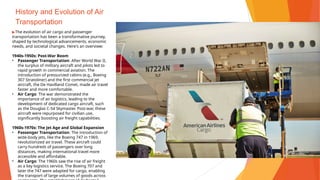
▶The evolution of air cargo and passenger
transportation has been a transformative journey,
shaped by technological advancements, economic
needs, and societal changes. Here's an overview:
Early 20th Century: Pioneering Flights
• Passenger Transportation: The first recorded
passenger flight took place in 1914, when Tony
Jannus piloted a biplane from St. Petersburg to
Tampa, Florida. However, early air travel was
limited, uncomfortable, and accessible only to
the wealthy.
• Air Cargo: The first cargo flight occurred in
1910, transporting a bolt of silk from Dayton to
Columbus, Ohio. Initially, air cargo was used
mainly for mail and high-value items.
1920s-1930s: Commercial Aviation Takes Off
• Passenger Transportation: The 1920s saw the
birth of commercial airlines. The introduction of
larger aircraft, like the Boeing 247 and Douglas
DC-3, made air travel more reliable and
comfortable. The DC-3, in particular,
revolutionized passenger travel with its ability
to carry more passengers over longer distances
at a lower cost.
• Air Cargo: Airmail became a major focus during
this period, with dedicated routes established
for postal services. Companies like Pan Am and
Lufthansa started offering limited cargo
services alongside passenger flights.
History and Evolution of Air
Transportation
▶The evolution of air cargo and passenger
transportation has been a transformative journey,
shaped by technological advancements, economic
needs, and societal changes. Here's an overview:
1940s-1950s: Post-War Boom
• Passenger Transportation: After World War II,
the surplus of military aircraft and pilots led to
rapid growth in commercial aviation. The
introduction of pressurized cabins (e.g., Boeing
307 Stratoliner) and the first commercial jet
aircraft, the De Havilland Comet, made air travel
faster and more comfortable.
• Air Cargo: The war demonstrated the
importance of air logistics, leading to the
development of dedicated cargo aircraft, such
as the Douglas C-54 Skymaster. Post-war, these
aircraft were repurposed for civilian use,
significantly boosting air freight capabilities.
1960s-1970s: The Jet Age and Global Expansion
• Passenger Transportation: The introduction of
wide-body jets, like the Boeing 747 in 1969,
revolutionized air travel. These aircraft could
carry hundreds of passengers over long
distances, making international travel more
accessible and affordable.
• Air Cargo: The 1960s saw the rise of air freight
as a key logistics service. The Boeing 707 and
later the 747 were adapted for cargo, enabling
the transport of large volumes of goods across
History and Evolution of Air
Transportation
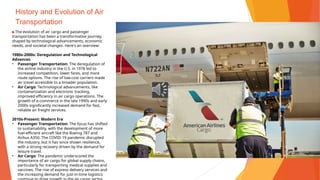
▶The evolution of air cargo and passenger
transportation has been a transformative journey,
shaped by technological advancements, economic
needs, and societal changes. Here's an overview:
1980s-2000s: Deregulation and Technological
Advances
• Passenger Transportation: The deregulation of
the airline industry in the U.S. in 1978 led to
increased competition, lower fares, and more
route options. The rise of low-cost carriers made
air travel accessible to a broader population.
• Air Cargo: Technological advancements, like
containerization and electronic tracking,
improved efficiency in air cargo operations. The
growth of e-commerce in the late 1990s and early
2000s significantly increased demand for fast,
reliable air freight services.
2010s-Present: Modern Era
• Passenger Transportation: The focus has shifted
to sustainability, with the development of more
fuel-efficient aircraft like the Boeing 787 and
Airbus A350. The COVID-19 pandemic disrupted
the industry, but it has since shown resilience,
with a strong recovery driven by the demand for
leisure travel.
• Air Cargo: The pandemic underscored the
importance of air cargo for global supply chains,
particularly for transporting medical supplies and
vaccines. The rise of express delivery services and
the increasing demand for just-in-time logistics
History and Evolution of Air
Transportation
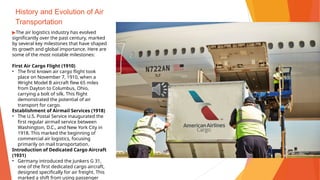
▶The air logistics industry has evolved
significantly over the past century, marked
by several key milestones that have shaped
its growth and global importance. Here are
some of the most notable milestones:
First Air Cargo Flight (1910)
• The first known air cargo flight took
place on November 7, 1910, when a
Wright Model B aircraft flew 65 miles
from Dayton to Columbus, Ohio,
carrying a bolt of silk. This flight
demonstrated the potential of air
transport for cargo.
Establishment of Airmail Services (1918)
• The U.S. Postal Service inaugurated the
first regular airmail service between
Washington, D.C., and New York City in
1918. This marked the beginning of
commercial air logistics, focusing
primarily on mail transportation.
Introduction of Dedicated Cargo Aircraft
(1931)
• Germany introduced the Junkers G 31,
one of the first dedicated cargo aircraft,
designed specifically for air freight. This
marked a shift from using passenger
History and Evolution of Air
Transportation
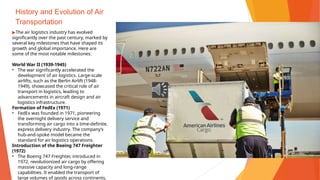
▶The air logistics industry has evolved
significantly over the past century, marked by
several key milestones that have shaped its
growth and global importance. Here are
some of the most notable milestones:
World War II (1939-1945)
• The war significantly accelerated the
development of air logistics. Large-scale
airlifts, such as the Berlin Airlift (1948-
1949), showcased the critical role of air
transport in logistics, leading to
advancements in aircraft design and air
logistics infrastructure.
Formation of FedEx (1971)
• FedEx was founded in 1971, pioneering
the overnight delivery service and
transforming air cargo into a time-definite,
express delivery industry. The company’s
hub-and-spoke model became the
standard for air logistics operations.
Introduction of the Boeing 747 Freighter
(1972)
• The Boeing 747 Freighter, introduced in
1972, revolutionized air cargo by offering
massive capacity and long-range
capabilities. It enabled the transport of
large volumes of goods across continents,
History and Evolution of Air
Transportation
▶The air logistics industry has evolved
significantly over the past century, marked by
several key milestones that have shaped its
growth and global importance. Here are some
of the most notable milestones:
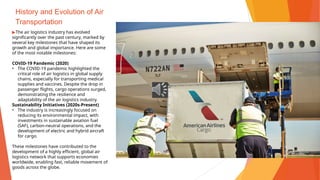
COVID-19 Pandemic (2020)
• The COVID-19 pandemic highlighted the
critical role of air logistics in global supply
chains, especially for transporting medical
supplies and vaccines. Despite the drop in
passenger flights, cargo operations surged,
demonstrating the resilience and
adaptability of the air logistics industry.
Sustainability Initiatives (2020s-Present)
• The industry is increasingly focused on
reducing its environmental impact, with
investments in sustainable aviation fuel
(SAF), carbon-neutral operations, and the
development of electric and hybrid aircraft
for cargo.
These milestones have contributed to the
development of a highly efficient, global air
logistics network that supports economies
worldwide, enabling fast, reliable movement of
goods across the globe.
Key Components of Air
Transportation Logistics
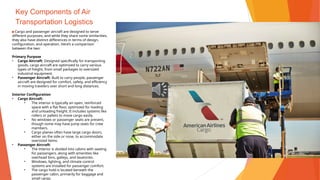
▶Cargo and passenger aircraft are designed to serve
different purposes, and while they share some similarities,
they also have distinct differences in terms of design,
configuration, and operation. Here’s a comparison
between the two:
Primary Purpose
• Cargo Aircraft: Designed specifically for transporting
goods, cargo aircraft are optimized to carry various
types of freight, from small packages to oversized
industrial equipment.
• Passenger Aircraft: Built to carry people, passenger
aircraft are designed for comfort, safety, and efficiency
in moving travelers over short and long distances.
Interior Configuration
• Cargo Aircraft:
• The interior is typically an open, reinforced
space with a flat floor, optimized for loading
and unloading freight. It includes systems like
rollers or pallets to move cargo easily.
• No windows or passenger seats are present,
though some may have jump seats for crew
members.
• Cargo planes often have large cargo doors,
either on the side or nose, to accommodate
oversized items.
• Passenger Aircraft:
• The interior is divided into cabins with seating
for passengers, along with amenities like
overhead bins, galleys, and lavatories.
• Windows, lighting, and climate control
systems are installed for passenger comfort.
• The cargo hold is located beneath the
passenger cabin, primarily for baggage and
small cargo.
Key Components of Air
Transportation Logistics
▶Cargo and passenger aircraft are designed to serve different
purposes, and while they share some similarities, they also have
distinct differences in terms of design, configuration, and
operation. Here’s a comparison between the two:
Structure and Design
• Cargo Aircraft:
• Heavier-duty landing gear and reinforced floors to
handle higher weights.
• Lack of windows and different fuselage structures
to maximize cargo space.
• Equipped with specialized loading equipment, such
as cargo ramps and cranes.
• Passenger Aircraft:
• Designed with a focus on aerodynamics, comfort,
and safety features for passengers.
• Often include multiple class configurations
(economy, business, first class) with varying levels
of comfort and services.
Examples of Cargo and Passenger Aircraft
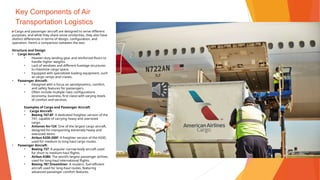
• Cargo Aircraft:
• Boeing 747-8F: A dedicated freighter version of the
747, capable of carrying heavy and oversized
cargo.
• Antonov An-124: One of the largest cargo aircraft,
designed for transporting extremely heavy and
oversized items.
• Airbus A330-200F: A freighter version of the A330,
used for medium to long-haul cargo routes.
• Passenger Aircraft:
• Boeing 737: A popular narrow-body aircraft used
for short to medium-haul flights.
• Airbus A380: The world’s largest passenger airliner,
used for long-haul international flights.
• Boeing 787 Dreamliner: A modern, fuel-efficient
aircraft used for long-haul routes, featuring
advanced passenger comfort features.
Key Components of Air
Transportation Logistics
▶Cargo and passenger aircraft are designed to
serve different purposes, and while they share
some similarities, they also have distinct
differences in terms of design, configuration, and
operation. Here’s a comparison between the two:
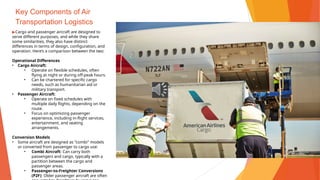
Operational Differences
• Cargo Aircraft:
• Operate on flexible schedules, often
flying at night or during off-peak hours.
• Can be chartered for specific cargo
needs, such as humanitarian aid or
military transport.
• Passenger Aircraft:
• Operate on fixed schedules with
multiple daily flights, depending on the
route.
• Focus on optimizing passenger
experience, including in-flight services,
entertainment, and seating
arrangements.
Conversion Models
• Some aircraft are designed as "combi" models
or converted from passenger to cargo use:
• Combi Aircraft: Can carry both
passengers and cargo, typically with a
partition between the cargo and
passenger areas.
• Passenger-to-Freighter Conversions
(P2F): Older passenger aircraft are often
Key Components of Air
Transportation Logistics
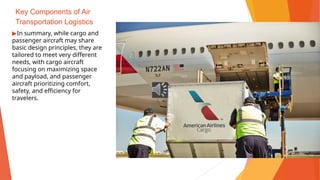
▶In summary, while cargo and
passenger aircraft may share
basic design principles, they are
tailored to meet very different
needs, with cargo aircraft
focusing on maximizing space
and payload, and passenger
aircraft prioritizing comfort,
safety, and efficiency for
travelers.
Key Components of Air
Transportation Logistics
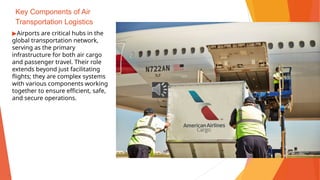
▶Airports are critical hubs in the
global transportation network,
serving as the primary
infrastructure for both air cargo
and passenger travel. Their role
extends beyond just facilitating
flights; they are complex systems
with various components working
together to ensure efficient, safe,
and secure operations.
Key Components of Air
Transportation Logistics
▶Roles of Airports
Transportation Hub
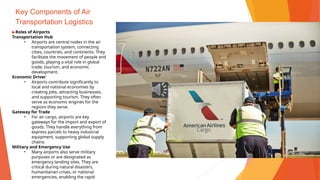
• Airports are central nodes in the air
transportation system, connecting
cities, countries, and continents. They
facilitate the movement of people and
goods, playing a vital role in global
trade, tourism, and economic
development.
Economic Driver
• Airports contribute significantly to
local and national economies by
creating jobs, attracting businesses,
and supporting tourism. They often
serve as economic engines for the
regions they serve.
Gateway for Trade
• For air cargo, airports are key
gateways for the import and export of
goods. They handle everything from
express parcels to heavy industrial
equipment, supporting global supply
chains.
Military and Emergency Use
• Many airports also serve military
purposes or are designated as
emergency landing sites. They are
critical during natural disasters,
humanitarian crises, or national
emergencies, enabling the rapid
Key Components of Air
Transportation Logistics
▶Key Infrastructure Components
Runways and Taxiways
• Runways: The most essential part of an
airport, runways are where aircraft take
off and land. Their length, width, and
surface material vary depending on the
types of aircraft they accommodate.
• Taxiways: These are the paths that
aircraft use to move between runways,
terminals, and other facilities. Efficient
taxiway design minimizes ground delays
and enhances safety.
Terminals
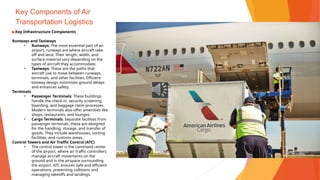
• Passenger Terminals: These buildings
handle the check-in, security screening,
boarding, and baggage claim processes.
Modern terminals also offer amenities like
shops, restaurants, and lounges.
• Cargo Terminals: Separate facilities from
passenger terminals, these are designed
for the handling, storage, and transfer of
goods. They include warehouses, sorting
facilities, and customs areas.
Control Towers and Air Traffic Control (ATC)
• The control tower is the command center
of the airport, where air traffic controllers
manage aircraft movements on the
ground and in the airspace surrounding
the airport. ATC ensures safe and efficient
operations, preventing collisions and
managing takeoffs and landings.
Key Components of Air
Transportation Logistics
▶Key Infrastructure Components
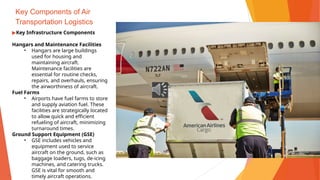
Hangars and Maintenance Facilities
• Hangars are large buildings
used for housing and
maintaining aircraft.
Maintenance facilities are
essential for routine checks,
repairs, and overhauls, ensuring
the airworthiness of aircraft.
Fuel Farms
• Airports have fuel farms to store
and supply aviation fuel. These
facilities are strategically located
to allow quick and efficient
refueling of aircraft, minimizing
turnaround times.
Ground Support Equipment (GSE)
• GSE includes vehicles and
equipment used to service
aircraft on the ground, such as
baggage loaders, tugs, de-icing
machines, and catering trucks.
GSE is vital for smooth and
timely aircraft operations.
Key Components of Air
Transportation Logistics
▶Key Infrastructure Components
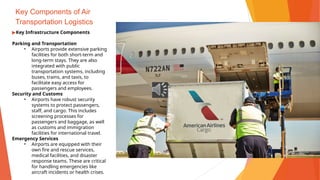
Parking and Transportation
• Airports provide extensive parking
facilities for both short-term and
long-term stays. They are also
integrated with public
transportation systems, including
buses, trains, and taxis, to
facilitate easy access for
passengers and employees.
Security and Customs
• Airports have robust security
systems to protect passengers,
staff, and cargo. This includes
screening processes for
passengers and baggage, as well
as customs and immigration
facilities for international travel.
Emergency Services
• Airports are equipped with their
own fire and rescue services,
medical facilities, and disaster
response teams. These are critical
for handling emergencies like
aircraft incidents or health crises.
Key Components of Air
Transportation Logistics
▶Operational Roles
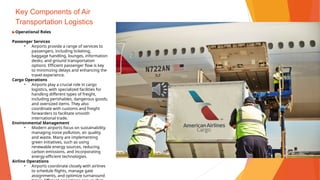
Passenger Services
• Airports provide a range of services to
passengers, including ticketing,
baggage handling, lounges, information
desks, and ground transportation
options. Efficient passenger flow is key
to minimizing delays and enhancing the
travel experience.
Cargo Operations
• Airports play a crucial role in cargo
logistics, with specialized facilities for
handling different types of freight,
including perishables, dangerous goods,
and oversized items. They also
coordinate with customs and freight
forwarders to facilitate smooth
international trade.
Environmental Management
• Modern airports focus on sustainability,
managing noise pollution, air quality,
and waste. Many are implementing
green initiatives, such as using
renewable energy sources, reducing
carbon emissions, and incorporating
energy-efficient technologies.
Airline Operations
• Airports coordinate closely with airlines
to schedule flights, manage gate
assignments, and optimize turnaround
Key Components of Air
Transportation Logistics
▶Challenges
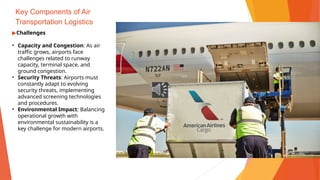
• Capacity and Congestion: As air
traffic grows, airports face
challenges related to runway
capacity, terminal space, and
ground congestion.
• Security Threats: Airports must
constantly adapt to evolving
security threats, implementing
advanced screening technologies
and procedures.
• Environmental Impact: Balancing
operational growth with
environmental sustainability is a
key challenge for modern airports.
Key Components of Air
Transportation Logistics
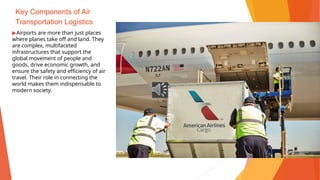
▶Airports are more than just places
where planes take off and land. They
are complex, multifaceted
infrastructures that support the
global movement of people and
goods, drive economic growth, and
ensure the safety and efficiency of air
travel. Their role in connecting the
world makes them indispensable to
modern society.
Key Components of Air
Transportation Logistics
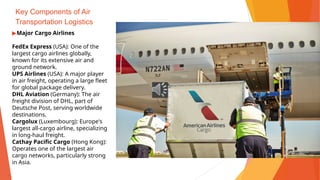
▶Major Cargo Airlines
FedEx Express (USA): One of the
largest cargo airlines globally,
known for its extensive air and
ground network.
UPS Airlines (USA): A major player
in air freight, operating a large fleet
for global package delivery.
DHL Aviation (Germany): The air
freight division of DHL, part of
Deutsche Post, serving worldwide
destinations.
Cargolux (Luxembourg): Europe's
largest all-cargo airline, specializing
in long-haul freight.
Cathay Pacific Cargo (Hong Kong):
Operates one of the largest air
cargo networks, particularly strong
in Asia.
Key Components of Air
Transportation Logistics
▶Major Cargo Airlines
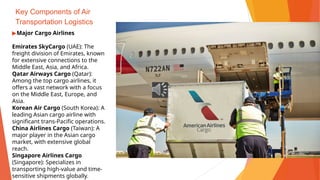
Emirates SkyCargo (UAE): The
freight division of Emirates, known
for extensive connections to the
Middle East, Asia, and Africa.
Qatar Airways Cargo (Qatar):
Among the top cargo airlines, it
offers a vast network with a focus
on the Middle East, Europe, and
Asia.
Korean Air Cargo (South Korea): A
leading Asian cargo airline with
significant trans-Pacific operations.
China Airlines Cargo (Taiwan): A
major player in the Asian cargo
market, with extensive global
reach.
Singapore Airlines Cargo
(Singapore): Specializes in
transporting high-value and time-
sensitive shipments globally.
Key Components of Air
Transportation Logistics
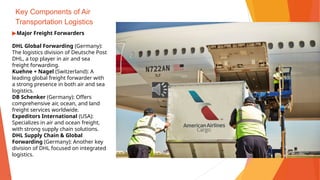
▶Major Freight Forwarders
DHL Global Forwarding (Germany):
The logistics division of Deutsche Post
DHL, a top player in air and sea
freight forwarding.
Kuehne + Nagel (Switzerland): A
leading global freight forwarder with
a strong presence in both air and sea
logistics.
DB Schenker (Germany): Offers
comprehensive air, ocean, and land
freight services worldwide.
Expeditors International (USA):
Specializes in air and ocean freight,
with strong supply chain solutions.
DHL Supply Chain & Global
Forwarding (Germany): Another key
division of DHL focused on integrated
logistics.
Key Components of Air
Transportation Logistics
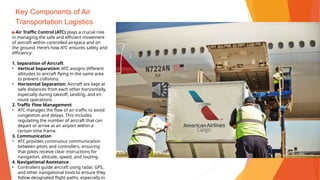
▶Air Traffic Control (ATC) plays a crucial role
in managing the safe and efficient movement
of aircraft within controlled airspace and on
the ground. Here’s how ATC ensures safety and
efficiency:
1. Separation of Aircraft
• Vertical Separation: ATC assigns different
altitudes to aircraft flying in the same area
to prevent collisions.
• Horizontal Separation: Aircraft are kept at
safe distances from each other horizontally,
especially during takeoff, landing, and en
route operations.
2. Traffic Flow Management
• ATC manages the flow of air traffic to avoid
congestion and delays. This includes
regulating the number of aircraft that can
depart or arrive at an airport within a
certain time frame.
3. Communication
• ATC provides continuous communication
between pilots and controllers, ensuring
that pilots receive clear instructions for
navigation, altitude, speed, and routing.
4. Navigational Assistance
• Controllers guide aircraft using radar, GPS,
and other navigational tools to ensure they
follow designated flight paths, especially in
Key Components of Air
Transportation Logistics
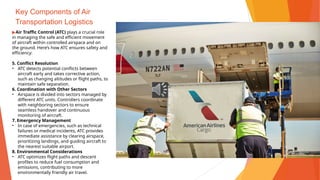
▶Air Traffic Control (ATC) plays a crucial role
in managing the safe and efficient movement
of aircraft within controlled airspace and on
the ground. Here’s how ATC ensures safety and
efficiency:
5. Conflict Resolution
• ATC detects potential conflicts between
aircraft early and takes corrective action,
such as changing altitudes or flight paths, to
maintain safe separation.
6. Coordination with Other Sectors
• Airspace is divided into sectors managed by
different ATC units. Controllers coordinate
with neighboring sectors to ensure
seamless handover and continuous
monitoring of aircraft.
7. Emergency Management
• In case of emergencies, such as technical
failures or medical incidents, ATC provides
immediate assistance by clearing airspace,
prioritizing landings, and guiding aircraft to
the nearest suitable airport.
8. Environmental Considerations
• ATC optimizes flight paths and descent
profiles to reduce fuel consumption and
emissions, contributing to more
environmentally friendly air travel.
Air Cargo Operations
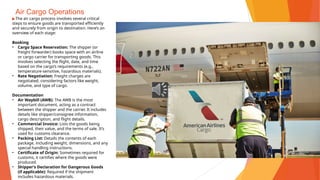
▶The air cargo process involves several critical
steps to ensure goods are transported efficiently
and securely from origin to destination. Here’s an
overview of each stage:
Booking
• Cargo Space Reservation: The shipper (or
freight forwarder) books space with an airline
or cargo carrier for transporting goods. This
involves selecting the flight, date, and time
based on the cargo’s requirements (e.g.,
temperature-sensitive, hazardous materials).
• Rate Negotiation: Freight charges are
negotiated, considering factors like weight,
volume, and type of cargo.
Documentation
• Air Waybill (AWB): The AWB is the most
important document, acting as a contract
between the shipper and the carrier. It includes
details like shipper/consignee information,
cargo description, and flight details.
• Commercial Invoice: Lists the goods being
shipped, their value, and the terms of sale. It’s
used for customs clearance.
• Packing List: Details the contents of each
package, including weight, dimensions, and any
special handling instructions.
• Certificate of Origin: Sometimes required for
customs, it certifies where the goods were
produced.
• Shipper’s Declaration for Dangerous Goods
(if applicable): Required if the shipment
includes hazardous materials.
Air Cargo Operations
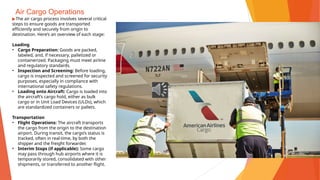
▶The air cargo process involves several critical
steps to ensure goods are transported
efficiently and securely from origin to
destination. Here’s an overview of each stage:
Loading
• Cargo Preparation: Goods are packed,
labeled, and, if necessary, palletized or
containerized. Packaging must meet airline
and regulatory standards.
• Inspection and Screening: Before loading,
cargo is inspected and screened for security
purposes, especially in compliance with
international safety regulations.
• Loading onto Aircraft: Cargo is loaded into
the aircraft’s cargo hold, either as bulk
cargo or in Unit Load Devices (ULDs), which
are standardized containers or pallets.
Transportation
• Flight Operations: The aircraft transports
the cargo from the origin to the destination
airport. During transit, the cargo’s status is
tracked, often in real-time, by both the
shipper and the freight forwarder.
• Interim Stops (if applicable): Some cargo
may pass through hub airports where it is
temporarily stored, consolidated with other
shipments, or transferred to another flight.
Air Cargo Operations
▶The air cargo process involves several
critical steps to ensure goods are
transported efficiently and securely from
origin to destination. Here’s an overview of
each stage:
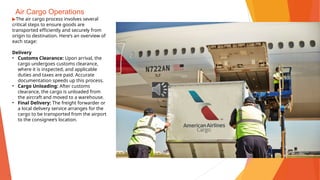
Delivery
• Customs Clearance: Upon arrival, the
cargo undergoes customs clearance,
where it is inspected, and applicable
duties and taxes are paid. Accurate
documentation speeds up this process.
• Cargo Unloading: After customs
clearance, the cargo is unloaded from
the aircraft and moved to a warehouse.
• Final Delivery: The freight forwarder or
a local delivery service arranges for the
cargo to be transported from the airport
to the consignee’s location.
Air Cargo Operations
▶Air cargo encompasses various types of
shipments, each with specific handling requirements
and considerations. Here’s an overview of the main
types of cargo:
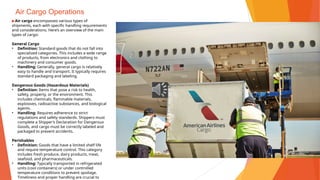
General Cargo
• Definition: Standard goods that do not fall into
specialized categories. This includes a wide range
of products, from electronics and clothing to
machinery and consumer goods.
• Handling: Generally, general cargo is relatively
easy to handle and transport. It typically requires
standard packaging and labeling.
Dangerous Goods (Hazardous Materials)
• Definition: Items that pose a risk to health,
safety, property, or the environment. This
includes chemicals, flammable materials,
explosives, radioactive substances, and biological
agents.
• Handling: Requires adherence to strict
regulations and safety standards. Shippers must
complete a Shipper’s Declaration for Dangerous
Goods, and cargo must be correctly labeled and
packaged to prevent accidents.
Perishables
• Definition: Goods that have a limited shelf life
and require temperature control. This category
includes fresh produce, dairy products, meat,
seafood, and pharmaceuticals.
• Handling: Typically transported in refrigerated
units (cool containers) or under controlled
temperature conditions to prevent spoilage.
Timeliness and proper handling are crucial to
Air Cargo Operations
▶Air cargo encompasses various types of
shipments, each with specific handling
requirements and considerations. Here’s an
overview of the main types of cargo:
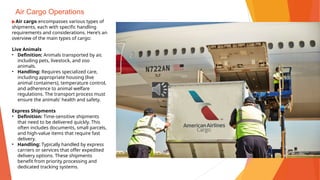
Live Animals
• Definition: Animals transported by air,
including pets, livestock, and zoo
animals.
• Handling: Requires specialized care,
including appropriate housing (live
animal containers), temperature control,
and adherence to animal welfare
regulations. The transport process must
ensure the animals' health and safety.
Express Shipments
• Definition: Time-sensitive shipments
that need to be delivered quickly. This
often includes documents, small parcels,
and high-value items that require fast
delivery.
• Handling: Typically handled by express
carriers or services that offer expedited
delivery options. These shipments
benefit from priority processing and
dedicated tracking systems.
Air Cargo Operations
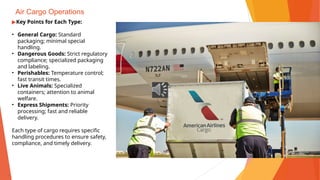
▶Key Points for Each Type:
• General Cargo: Standard
packaging; minimal special
handling.
• Dangerous Goods: Strict regulatory
compliance; specialized packaging
and labeling.
• Perishables: Temperature control;
fast transit times.
• Live Animals: Specialized
containers; attention to animal
welfare.
• Express Shipments: Priority
processing; fast and reliable
delivery.
Each type of cargo requires specific
handling procedures to ensure safety,
compliance, and timely delivery.
Air Cargo Operations
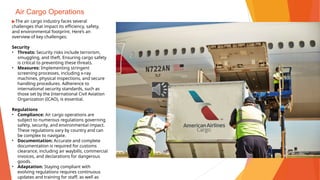
▶The air cargo industry faces several
challenges that impact its efficiency, safety,
and environmental footprint. Here’s an
overview of key challenges:
Security
• Threats: Security risks include terrorism,
smuggling, and theft. Ensuring cargo safety
is critical to preventing these threats.
• Measures: Implementing stringent
screening processes, including x-ray
machines, physical inspections, and secure
handling procedures. Adherence to
international security standards, such as
those set by the International Civil Aviation
Organization (ICAO), is essential.
Regulations
• Compliance: Air cargo operations are
subject to numerous regulations governing
safety, security, and environmental impact.
These regulations vary by country and can
be complex to navigate.
• Documentation: Accurate and complete
documentation is required for customs
clearance, including air waybills, commercial
invoices, and declarations for dangerous
goods.
• Adaptation: Staying compliant with
evolving regulations requires continuous
updates and training for staff, as well as
Air Cargo Operations
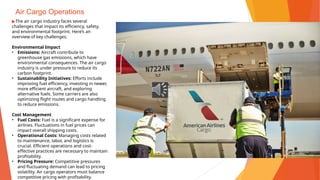
▶The air cargo industry faces several
challenges that impact its efficiency, safety,
and environmental footprint. Here’s an
overview of key challenges:
Environmental Impact
• Emissions: Aircraft contribute to
greenhouse gas emissions, which have
environmental consequences. The air cargo
industry is under pressure to reduce its
carbon footprint.
• Sustainability Initiatives: Efforts include
improving fuel efficiency, investing in newer,
more efficient aircraft, and exploring
alternative fuels. Some carriers are also
optimizing flight routes and cargo handling
to reduce emissions.
Cost Management
• Fuel Costs: Fuel is a significant expense for
airlines. Fluctuations in fuel prices can
impact overall shipping costs.
• Operational Costs: Managing costs related
to maintenance, labor, and logistics is
crucial. Efficient operations and cost-
effective practices are necessary to maintain
profitability.
• Pricing Pressure: Competitive pressures
and fluctuating demand can lead to pricing
volatility. Air cargo operators must balance
competitive pricing with profitability.
Air Cargo Operations
▶Technology plays a crucial role in
enhancing the efficiency, accuracy, and
visibility of air logistics. Here’s how key
technologies are shaping the industry:
RFID (Radio Frequency Identification)
• Overview: RFID uses radio waves to
automatically identify and track
objects. RFID tags, which contain
information about the cargo, are
attached to shipments or pallets.
• Benefits:
• Real-time Tracking: Provides
real-time updates on the
location and status of cargo,
improving visibility and reducing
the risk of loss or theft.
• Improved Accuracy: Reduces
manual data entry errors and
speeds up the process of
scanning and handling
shipments.
• Enhanced Inventory
Management: Facilitates better
inventory control by allowing for
automated stocktaking and
monitoring.
Air Cargo Operations
▶Technology plays a crucial role in
enhancing the efficiency, accuracy, and
visibility of air logistics. Here’s how key
technologies are shaping the industry:
Cargo Tracking Systems
• Overview: These systems use a
combination of GPS, RFID, and other
technologies to monitor the movement of
cargo throughout its journey.
• Benefits:
• Real-time Visibility: Offers live
tracking of cargo from origin to
destination, providing updates on
location, temperature (for
perishables), and other conditions.
• Improved Communication:
Enables better coordination
between shippers, carriers, and
consignees by providing accurate
and timely information.
• Exception Management: Alerts
stakeholders to delays or issues in
transit, allowing for prompt
resolution and minimizing
disruptions.
Air Cargo Operations
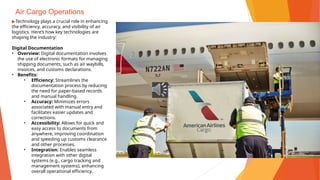
▶Technology plays a crucial role in enhancing
the efficiency, accuracy, and visibility of air
logistics. Here’s how key technologies are
shaping the industry:
Digital Documentation
• Overview: Digital documentation involves
the use of electronic formats for managing
shipping documents, such as air waybills,
invoices, and customs declarations.
• Benefits:
• Efficiency: Streamlines the
documentation process by reducing
the need for paper-based records
and manual handling.
• Accuracy: Minimizes errors
associated with manual entry and
facilitates easier updates and
corrections.
• Accessibility: Allows for quick and
easy access to documents from
anywhere, improving coordination
and speeding up customs clearance
and other processes.
• Integration: Enables seamless
integration with other digital
systems (e.g., cargo tracking and
management systems), enhancing
overall operational efficiency.
Air Cargo Operations
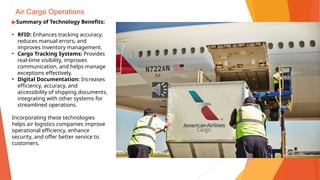
▶Summary of Technology Benefits:
• RFID: Enhances tracking accuracy,
reduces manual errors, and
improves inventory management.
• Cargo Tracking Systems: Provides
real-time visibility, improves
communication, and helps manage
exceptions effectively.
• Digital Documentation: Increases
efficiency, accuracy, and
accessibility of shipping documents,
integrating with other systems for
streamlined operations.
Incorporating these technologies
helps air logistics companies improve
operational efficiency, enhance
security, and offer better service to
customers.
Role of Air Transportation in
Global Supply Chains
▶The growth of e-commerce has
led to a substantial increase in air
freight demand, driven by the need
for fast, reliable delivery of small
parcels. This shift has resulted in
expanded fulfillment networks,
technological advancements, and
new challenges in capacity and cost
management. Air cargo remains a
critical component of the e-
commerce ecosystem, enabling
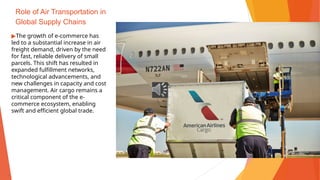
swift and efficient global trade.
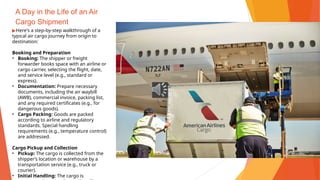
A Day in the Life of an Air
Cargo Shipment
▶Here's a step-by-step walkthrough of a
typical air cargo journey from origin to
destination:
Booking and Preparation
• Booking: The shipper or freight
forwarder books space with an airline or
cargo carrier, selecting the flight, date,
and service level (e.g., standard or
express).
• Documentation: Prepare necessary
documents, including the air waybill
(AWB), commercial invoice, packing list,
and any required certificates (e.g., for
dangerous goods).
• Cargo Packing: Goods are packed
according to airline and regulatory
standards. Special handling
requirements (e.g., temperature control)
are addressed.
Cargo Pickup and Collection
• Pickup: The cargo is collected from the
shipper’s location or warehouse by a
transportation service (e.g., truck or
courier).
• Initial Handling: The cargo is
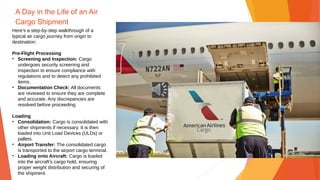
A Day in the Life of an Air
Cargo Shipment
Here's a step-by-step walkthrough of a
typical air cargo journey from origin to
destination:
Pre-Flight Processing
• Screening and Inspection: Cargo
undergoes security screening and
inspection to ensure compliance with
regulations and to detect any prohibited
items.
• Documentation Check: All documents
are reviewed to ensure they are complete
and accurate. Any discrepancies are
resolved before proceeding.
Loading
• Consolidation: Cargo is consolidated with
other shipments if necessary. It is then
loaded into Unit Load Devices (ULDs) or
pallets.
• Airport Transfer: The consolidated cargo
is transported to the airport cargo terminal.
• Loading onto Aircraft: Cargo is loaded
into the aircraft’s cargo hold, ensuring
proper weight distribution and securing of
the shipment.
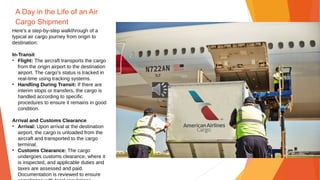
A Day in the Life of an Air
Cargo Shipment
Here's a step-by-step walkthrough of a
typical air cargo journey from origin to
destination:
In-Transit
• Flight: The aircraft transports the cargo
from the origin airport to the destination
airport. The cargo’s status is tracked in
real-time using tracking systems.
• Handling During Transit: If there are
interim stops or transfers, the cargo is
handled according to specific
procedures to ensure it remains in good
condition.
Arrival and Customs Clearance
• Arrival: Upon arrival at the destination
airport, the cargo is unloaded from the
aircraft and transported to the cargo
terminal.
• Customs Clearance: The cargo
undergoes customs clearance, where it
is inspected, and applicable duties and
taxes are assessed and paid.
Documentation is reviewed to ensure
A Day in the Life of an Air
Cargo Shipment
Here's a step-by-step walkthrough of a
typical air cargo journey from origin to
destination:
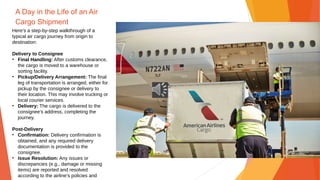
Delivery to Consignee
• Final Handling: After customs clearance,
the cargo is moved to a warehouse or
sorting facility.
• Pickup/Delivery Arrangement: The final
leg of transportation is arranged, either for
pickup by the consignee or delivery to
their location. This may involve trucking or
local courier services.
• Delivery: The cargo is delivered to the
consignee's address, completing the
journey.
Post-Delivery
• Confirmation: Delivery confirmation is
obtained, and any required delivery
documentation is provided to the
consignee.
• Issue Resolution: Any issues or
discrepancies (e.g., damage or missing
items) are reported and resolved
according to the airline’s policies and
A Day in the Life of an Air
Cargo Shipment
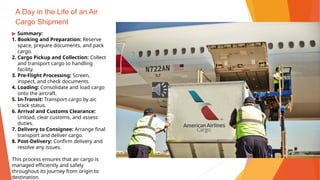
▶ Summary:
1. Booking and Preparation: Reserve
space, prepare documents, and pack
cargo.
2. Cargo Pickup and Collection: Collect
and transport cargo to handling
facility.
3. Pre-Flight Processing: Screen,
inspect, and check documents.
4. Loading: Consolidate and load cargo
onto the aircraft.
5. In-Transit: Transport cargo by air,
track status.
6. Arrival and Customs Clearance:
Unload, clear customs, and assess
duties.
7. Delivery to Consignee: Arrange final
transport and deliver cargo.
8. Post-Delivery: Confirm delivery and
resolve any issues.
This process ensures that air cargo is
managed efficiently and safely
throughout its journey from origin to
destination.
A Day in the Life of an Air
Cargo Shipment
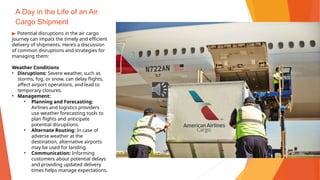
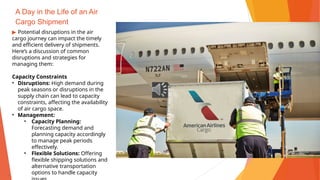
▶ Potential disruptions in the air cargo
journey can impact the timely and efficient
delivery of shipments. Here’s a discussion
of common disruptions and strategies for
managing them:
Weather Conditions
• Disruptions: Severe weather, such as
storms, fog, or snow, can delay flights,
affect airport operations, and lead to
temporary closures.
• Management:
• Planning and Forecasting:
Airlines and logistics providers
use weather forecasting tools to
plan flights and anticipate
potential disruptions.
• Alternate Routing: In case of
adverse weather at the
destination, alternative airports
may be used for landing.
• Communication: Informing
customers about potential delays
and providing updated delivery
times helps manage expectations.
A Day in the Life of an Air
Cargo Shipment
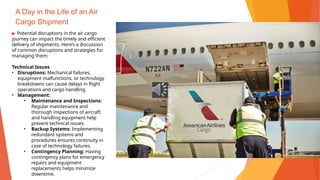
▶ Potential disruptions in the air cargo
journey can impact the timely and efficient
delivery of shipments. Here’s a discussion
of common disruptions and strategies for
managing them:
Technical Issues
• Disruptions: Mechanical failures,
equipment malfunctions, or technology
breakdowns can cause delays in flight
operations and cargo handling.
• Management:
• Maintenance and Inspections:
Regular maintenance and
thorough inspections of aircraft
and handling equipment help
prevent technical issues.
• Backup Systems: Implementing
redundant systems and
procedures ensures continuity in
case of technology failures.
• Contingency Planning: Having
contingency plans for emergency
repairs and equipment
replacements helps minimize
downtime.
A Day in the Life of an Air
Cargo Shipment
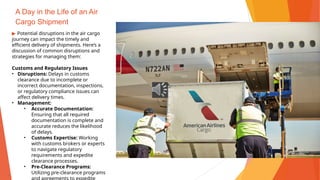
▶ Potential disruptions in the air cargo
journey can impact the timely and
efficient delivery of shipments. Here’s a
discussion of common disruptions and
strategies for managing them:
Customs and Regulatory Issues
• Disruptions: Delays in customs
clearance due to incomplete or
incorrect documentation, inspections,
or regulatory compliance issues can
affect delivery times.
• Management:
• Accurate Documentation:
Ensuring that all required
documentation is complete and
accurate reduces the likelihood
of delays.
• Customs Expertise: Working
with customs brokers or experts
to navigate regulatory
requirements and expedite
clearance processes.
• Pre-Clearance Programs:
Utilizing pre-clearance programs
A Day in the Life of an Air
Cargo Shipment
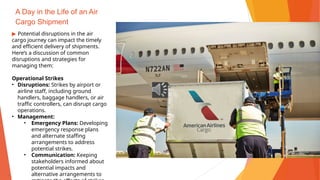
▶ Potential disruptions in the air
cargo journey can impact the timely
and efficient delivery of shipments.
Here’s a discussion of common
disruptions and strategies for
managing them:
Operational Strikes
• Disruptions: Strikes by airport or
airline staff, including ground
handlers, baggage handlers, or air
traffic controllers, can disrupt cargo
operations.
• Management:
• Emergency Plans: Developing
emergency response plans
and alternate staffing
arrangements to address
potential strikes.
• Communication: Keeping
stakeholders informed about
potential impacts and
alternative arrangements to
A Day in the Life of an Air
Cargo Shipment
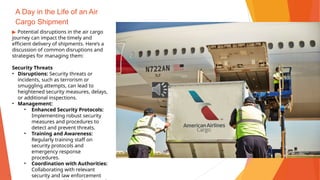
▶ Potential disruptions in the air cargo
journey can impact the timely and
efficient delivery of shipments. Here’s a
discussion of common disruptions and
strategies for managing them:
Security Threats
• Disruptions: Security threats or
incidents, such as terrorism or
smuggling attempts, can lead to
heightened security measures, delays,
or additional inspections.
• Management:
• Enhanced Security Protocols:
Implementing robust security
measures and procedures to
detect and prevent threats.
• Training and Awareness:
Regularly training staff on
security protocols and
emergency response
procedures.
• Coordination with Authorities:
Collaborating with relevant
security and law enforcement
A Day in the Life of an Air
Cargo Shipment
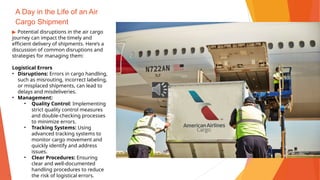
▶ Potential disruptions in the air cargo
journey can impact the timely and
efficient delivery of shipments. Here’s a
discussion of common disruptions and
strategies for managing them:
Logistical Errors
• Disruptions: Errors in cargo handling,
such as misrouting, incorrect labeling,
or misplaced shipments, can lead to
delays and misdeliveries.
• Management:
• Quality Control: Implementing
strict quality control measures
and double-checking processes
to minimize errors.
• Tracking Systems: Using
advanced tracking systems to
monitor cargo movement and
quickly identify and address
issues.
• Clear Procedures: Ensuring
clear and well-documented
handling procedures to reduce
the risk of logistical errors.
A Day in the Life of an Air
Cargo Shipment
▶ Potential disruptions in the air
cargo journey can impact the timely
and efficient delivery of shipments.
Here’s a discussion of common
disruptions and strategies for
managing them:
Capacity Constraints
• Disruptions: High demand during
peak seasons or disruptions in the
supply chain can lead to capacity
constraints, affecting the availability
of air cargo space.
• Management:
• Capacity Planning:
Forecasting demand and
planning capacity accordingly
to manage peak periods
effectively.
• Flexible Solutions: Offering
flexible shipping solutions and
alternative transportation
options to handle capacity
A Day in the Life of an Air
Cargo Shipment
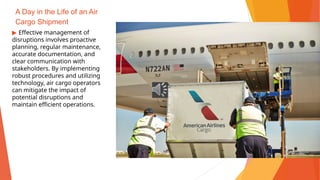
▶ Effective management of
disruptions involves proactive
planning, regular maintenance,
accurate documentation, and
clear communication with
stakeholders. By implementing
robust procedures and utilizing
technology, air cargo operators
can mitigate the impact of
potential disruptions and
maintain efficient operations.
A Day in Life of World’s
Largest Cargo Aircraft

logisticsandtransportationpart17BBB.pptx

  • 1.
    Important Dates ▶ Midterm8/16/2024 ▶ Assignment 8/23/2024 ▶ Final 8/27/2024 This Photo by Unknown Author is licensed under CC BY-SA-NC
  • 2.
  • 3.
    Terminal Learning Objectives ▶ Understandthe fundamentals of air transportation logistics. ▶ Identify key stakeholders in the air logistics industry. ▶ Explain the process and challenges of air cargo operations. ▶ Discuss the role of air transportation in global supply chains.
  • 4.
    The Role ofOcean Transportation ▶Air transportation plays a crucial role in logistics for several reasons: 1. Speed: Air transport is the fastest mode of transportation, making it ideal for time- sensitive shipments like perishable goods, emergency supplies, and high-value items. 2. Global Reach: Air transport enables global trade by connecting distant regions quickly, allowing businesses to expand their markets internationally. 3. Reliability: Airlines often have strict schedules, providing predictable and consistent delivery times, which is vital for supply chain management. 4. Security: Air transport is generally more secure, with lower risks of theft and damage due to the shorter transit times and strict security measures at airports. 5. Inventory Reduction: Faster delivery times allow companies to maintain lower inventory levels, reducing warehousing costs and enhancing cash flow. Overall, air transportation is essential for efficient and effective logistics, especially when speed, reliability, and global connectivity are critical.
  • 5.
    History and Evolutionof Air Transportation ▶The early developments in aviation are marked by a series of pioneering efforts that laid the foundation for modern flight. Key milestones include: 1. Ancient Concepts: The idea of human flight has fascinated people for centuries, with legends like Icarus in Greek mythology and Leonardo da Vinci's 15th-century designs for flying machines. 2. Hot Air Balloons (1783): The Montgolfier brothers launched the first manned hot air balloon in France, marking the first successful flight by humans. 3. Gliders (Late 19th Century): Otto Lilienthal, a German engineer, made significant progress in controlled glider flights, studying the principles of lift and control surfaces, which influenced later aircraft designs. 4. Wright Brothers (1903): Orville and Wilbur Wright achieved the first powered, controlled, and sustained flight in Kitty Hawk, North Carolina, with their aircraft, the Wright Flyer. This event is widely regarded as the birth of modern aviation. 5. Early 20th Century Developments: Following the Wright Brothers' success, aviation rapidly advanced. Aircraft designs improved, with stronger engines, better aerodynamics, and more reliable controls. World War I further accelerated aviation technology due to the military demand for reconnaissance and combat planes. These early developments set the stage for the rapid growth of aviation, transforming it into the global
  • 6.
    History and Evolutionof Air Transportation ▶The evolution of air cargo and passenger transportation has been a transformative journey, shaped by technological advancements, economic needs, and societal changes. Here's an overview: Early 20th Century: Pioneering Flights • Passenger Transportation: The first recorded passenger flight took place in 1914, when Tony Jannus piloted a biplane from St. Petersburg to Tampa, Florida. However, early air travel was limited, uncomfortable, and accessible only to the wealthy. • Air Cargo: The first cargo flight occurred in 1910, transporting a bolt of silk from Dayton to Columbus, Ohio. Initially, air cargo was used mainly for mail and high-value items. 1920s-1930s: Commercial Aviation Takes Off • Passenger Transportation: The 1920s saw the birth of commercial airlines. The introduction of larger aircraft, like the Boeing 247 and Douglas DC-3, made air travel more reliable and comfortable. The DC-3, in particular, revolutionized passenger travel with its ability to carry more passengers over longer distances at a lower cost. • Air Cargo: Airmail became a major focus during this period, with dedicated routes established for postal services. Companies like Pan Am and Lufthansa started offering limited cargo services alongside passenger flights.
  • 7.
    History and Evolutionof Air Transportation ▶The evolution of air cargo and passenger transportation has been a transformative journey, shaped by technological advancements, economic needs, and societal changes. Here's an overview: 1940s-1950s: Post-War Boom • Passenger Transportation: After World War II, the surplus of military aircraft and pilots led to rapid growth in commercial aviation. The introduction of pressurized cabins (e.g., Boeing 307 Stratoliner) and the first commercial jet aircraft, the De Havilland Comet, made air travel faster and more comfortable. • Air Cargo: The war demonstrated the importance of air logistics, leading to the development of dedicated cargo aircraft, such as the Douglas C-54 Skymaster. Post-war, these aircraft were repurposed for civilian use, significantly boosting air freight capabilities. 1960s-1970s: The Jet Age and Global Expansion • Passenger Transportation: The introduction of wide-body jets, like the Boeing 747 in 1969, revolutionized air travel. These aircraft could carry hundreds of passengers over long distances, making international travel more accessible and affordable. • Air Cargo: The 1960s saw the rise of air freight as a key logistics service. The Boeing 707 and later the 747 were adapted for cargo, enabling the transport of large volumes of goods across
  • 8.
    History and Evolutionof Air Transportation ▶The evolution of air cargo and passenger transportation has been a transformative journey, shaped by technological advancements, economic needs, and societal changes. Here's an overview: 1980s-2000s: Deregulation and Technological Advances • Passenger Transportation: The deregulation of the airline industry in the U.S. in 1978 led to increased competition, lower fares, and more route options. The rise of low-cost carriers made air travel accessible to a broader population. • Air Cargo: Technological advancements, like containerization and electronic tracking, improved efficiency in air cargo operations. The growth of e-commerce in the late 1990s and early 2000s significantly increased demand for fast, reliable air freight services. 2010s-Present: Modern Era • Passenger Transportation: The focus has shifted to sustainability, with the development of more fuel-efficient aircraft like the Boeing 787 and Airbus A350. The COVID-19 pandemic disrupted the industry, but it has since shown resilience, with a strong recovery driven by the demand for leisure travel. • Air Cargo: The pandemic underscored the importance of air cargo for global supply chains, particularly for transporting medical supplies and vaccines. The rise of express delivery services and the increasing demand for just-in-time logistics
  • 9.
    History and Evolutionof Air Transportation ▶The air logistics industry has evolved significantly over the past century, marked by several key milestones that have shaped its growth and global importance. Here are some of the most notable milestones: First Air Cargo Flight (1910) • The first known air cargo flight took place on November 7, 1910, when a Wright Model B aircraft flew 65 miles from Dayton to Columbus, Ohio, carrying a bolt of silk. This flight demonstrated the potential of air transport for cargo. Establishment of Airmail Services (1918) • The U.S. Postal Service inaugurated the first regular airmail service between Washington, D.C., and New York City in 1918. This marked the beginning of commercial air logistics, focusing primarily on mail transportation. Introduction of Dedicated Cargo Aircraft (1931) • Germany introduced the Junkers G 31, one of the first dedicated cargo aircraft, designed specifically for air freight. This marked a shift from using passenger
  • 10.
    History and Evolutionof Air Transportation ▶The air logistics industry has evolved significantly over the past century, marked by several key milestones that have shaped its growth and global importance. Here are some of the most notable milestones: World War II (1939-1945) • The war significantly accelerated the development of air logistics. Large-scale airlifts, such as the Berlin Airlift (1948- 1949), showcased the critical role of air transport in logistics, leading to advancements in aircraft design and air logistics infrastructure. Formation of FedEx (1971) • FedEx was founded in 1971, pioneering the overnight delivery service and transforming air cargo into a time-definite, express delivery industry. The company’s hub-and-spoke model became the standard for air logistics operations. Introduction of the Boeing 747 Freighter (1972) • The Boeing 747 Freighter, introduced in 1972, revolutionized air cargo by offering massive capacity and long-range capabilities. It enabled the transport of large volumes of goods across continents,
  • 11.
    History and Evolutionof Air Transportation ▶The air logistics industry has evolved significantly over the past century, marked by several key milestones that have shaped its growth and global importance. Here are some of the most notable milestones: COVID-19 Pandemic (2020) • The COVID-19 pandemic highlighted the critical role of air logistics in global supply chains, especially for transporting medical supplies and vaccines. Despite the drop in passenger flights, cargo operations surged, demonstrating the resilience and adaptability of the air logistics industry. Sustainability Initiatives (2020s-Present) • The industry is increasingly focused on reducing its environmental impact, with investments in sustainable aviation fuel (SAF), carbon-neutral operations, and the development of electric and hybrid aircraft for cargo. These milestones have contributed to the development of a highly efficient, global air logistics network that supports economies worldwide, enabling fast, reliable movement of goods across the globe.
  • 12.
    Key Components ofAir Transportation Logistics ▶Cargo and passenger aircraft are designed to serve different purposes, and while they share some similarities, they also have distinct differences in terms of design, configuration, and operation. Here’s a comparison between the two: Primary Purpose • Cargo Aircraft: Designed specifically for transporting goods, cargo aircraft are optimized to carry various types of freight, from small packages to oversized industrial equipment. • Passenger Aircraft: Built to carry people, passenger aircraft are designed for comfort, safety, and efficiency in moving travelers over short and long distances. Interior Configuration • Cargo Aircraft: • The interior is typically an open, reinforced space with a flat floor, optimized for loading and unloading freight. It includes systems like rollers or pallets to move cargo easily. • No windows or passenger seats are present, though some may have jump seats for crew members. • Cargo planes often have large cargo doors, either on the side or nose, to accommodate oversized items. • Passenger Aircraft: • The interior is divided into cabins with seating for passengers, along with amenities like overhead bins, galleys, and lavatories. • Windows, lighting, and climate control systems are installed for passenger comfort. • The cargo hold is located beneath the passenger cabin, primarily for baggage and small cargo.
  • 13.
    Key Components ofAir Transportation Logistics ▶Cargo and passenger aircraft are designed to serve different purposes, and while they share some similarities, they also have distinct differences in terms of design, configuration, and operation. Here’s a comparison between the two: Structure and Design • Cargo Aircraft: • Heavier-duty landing gear and reinforced floors to handle higher weights. • Lack of windows and different fuselage structures to maximize cargo space. • Equipped with specialized loading equipment, such as cargo ramps and cranes. • Passenger Aircraft: • Designed with a focus on aerodynamics, comfort, and safety features for passengers. • Often include multiple class configurations (economy, business, first class) with varying levels of comfort and services. Examples of Cargo and Passenger Aircraft • Cargo Aircraft: • Boeing 747-8F: A dedicated freighter version of the 747, capable of carrying heavy and oversized cargo. • Antonov An-124: One of the largest cargo aircraft, designed for transporting extremely heavy and oversized items. • Airbus A330-200F: A freighter version of the A330, used for medium to long-haul cargo routes. • Passenger Aircraft: • Boeing 737: A popular narrow-body aircraft used for short to medium-haul flights. • Airbus A380: The world’s largest passenger airliner, used for long-haul international flights. • Boeing 787 Dreamliner: A modern, fuel-efficient aircraft used for long-haul routes, featuring advanced passenger comfort features.
  • 14.
    Key Components ofAir Transportation Logistics ▶Cargo and passenger aircraft are designed to serve different purposes, and while they share some similarities, they also have distinct differences in terms of design, configuration, and operation. Here’s a comparison between the two: Operational Differences • Cargo Aircraft: • Operate on flexible schedules, often flying at night or during off-peak hours. • Can be chartered for specific cargo needs, such as humanitarian aid or military transport. • Passenger Aircraft: • Operate on fixed schedules with multiple daily flights, depending on the route. • Focus on optimizing passenger experience, including in-flight services, entertainment, and seating arrangements. Conversion Models • Some aircraft are designed as "combi" models or converted from passenger to cargo use: • Combi Aircraft: Can carry both passengers and cargo, typically with a partition between the cargo and passenger areas. • Passenger-to-Freighter Conversions (P2F): Older passenger aircraft are often
  • 15.
    Key Components ofAir Transportation Logistics ▶In summary, while cargo and passenger aircraft may share basic design principles, they are tailored to meet very different needs, with cargo aircraft focusing on maximizing space and payload, and passenger aircraft prioritizing comfort, safety, and efficiency for travelers.
  • 16.
    Key Components ofAir Transportation Logistics ▶Airports are critical hubs in the global transportation network, serving as the primary infrastructure for both air cargo and passenger travel. Their role extends beyond just facilitating flights; they are complex systems with various components working together to ensure efficient, safe, and secure operations.
  • 17.
    Key Components ofAir Transportation Logistics ▶Roles of Airports Transportation Hub • Airports are central nodes in the air transportation system, connecting cities, countries, and continents. They facilitate the movement of people and goods, playing a vital role in global trade, tourism, and economic development. Economic Driver • Airports contribute significantly to local and national economies by creating jobs, attracting businesses, and supporting tourism. They often serve as economic engines for the regions they serve. Gateway for Trade • For air cargo, airports are key gateways for the import and export of goods. They handle everything from express parcels to heavy industrial equipment, supporting global supply chains. Military and Emergency Use • Many airports also serve military purposes or are designated as emergency landing sites. They are critical during natural disasters, humanitarian crises, or national emergencies, enabling the rapid
  • 18.
    Key Components ofAir Transportation Logistics ▶Key Infrastructure Components Runways and Taxiways • Runways: The most essential part of an airport, runways are where aircraft take off and land. Their length, width, and surface material vary depending on the types of aircraft they accommodate. • Taxiways: These are the paths that aircraft use to move between runways, terminals, and other facilities. Efficient taxiway design minimizes ground delays and enhances safety. Terminals • Passenger Terminals: These buildings handle the check-in, security screening, boarding, and baggage claim processes. Modern terminals also offer amenities like shops, restaurants, and lounges. • Cargo Terminals: Separate facilities from passenger terminals, these are designed for the handling, storage, and transfer of goods. They include warehouses, sorting facilities, and customs areas. Control Towers and Air Traffic Control (ATC) • The control tower is the command center of the airport, where air traffic controllers manage aircraft movements on the ground and in the airspace surrounding the airport. ATC ensures safe and efficient operations, preventing collisions and managing takeoffs and landings.
  • 19.
    Key Components ofAir Transportation Logistics ▶Key Infrastructure Components Hangars and Maintenance Facilities • Hangars are large buildings used for housing and maintaining aircraft. Maintenance facilities are essential for routine checks, repairs, and overhauls, ensuring the airworthiness of aircraft. Fuel Farms • Airports have fuel farms to store and supply aviation fuel. These facilities are strategically located to allow quick and efficient refueling of aircraft, minimizing turnaround times. Ground Support Equipment (GSE) • GSE includes vehicles and equipment used to service aircraft on the ground, such as baggage loaders, tugs, de-icing machines, and catering trucks. GSE is vital for smooth and timely aircraft operations.
  • 20.
    Key Components ofAir Transportation Logistics ▶Key Infrastructure Components Parking and Transportation • Airports provide extensive parking facilities for both short-term and long-term stays. They are also integrated with public transportation systems, including buses, trains, and taxis, to facilitate easy access for passengers and employees. Security and Customs • Airports have robust security systems to protect passengers, staff, and cargo. This includes screening processes for passengers and baggage, as well as customs and immigration facilities for international travel. Emergency Services • Airports are equipped with their own fire and rescue services, medical facilities, and disaster response teams. These are critical for handling emergencies like aircraft incidents or health crises.
  • 21.
    Key Components ofAir Transportation Logistics ▶Operational Roles Passenger Services • Airports provide a range of services to passengers, including ticketing, baggage handling, lounges, information desks, and ground transportation options. Efficient passenger flow is key to minimizing delays and enhancing the travel experience. Cargo Operations • Airports play a crucial role in cargo logistics, with specialized facilities for handling different types of freight, including perishables, dangerous goods, and oversized items. They also coordinate with customs and freight forwarders to facilitate smooth international trade. Environmental Management • Modern airports focus on sustainability, managing noise pollution, air quality, and waste. Many are implementing green initiatives, such as using renewable energy sources, reducing carbon emissions, and incorporating energy-efficient technologies. Airline Operations • Airports coordinate closely with airlines to schedule flights, manage gate assignments, and optimize turnaround
  • 22.
    Key Components ofAir Transportation Logistics ▶Challenges • Capacity and Congestion: As air traffic grows, airports face challenges related to runway capacity, terminal space, and ground congestion. • Security Threats: Airports must constantly adapt to evolving security threats, implementing advanced screening technologies and procedures. • Environmental Impact: Balancing operational growth with environmental sustainability is a key challenge for modern airports.
  • 23.
    Key Components ofAir Transportation Logistics ▶Airports are more than just places where planes take off and land. They are complex, multifaceted infrastructures that support the global movement of people and goods, drive economic growth, and ensure the safety and efficiency of air travel. Their role in connecting the world makes them indispensable to modern society.
  • 24.
    Key Components ofAir Transportation Logistics ▶Major Cargo Airlines FedEx Express (USA): One of the largest cargo airlines globally, known for its extensive air and ground network. UPS Airlines (USA): A major player in air freight, operating a large fleet for global package delivery. DHL Aviation (Germany): The air freight division of DHL, part of Deutsche Post, serving worldwide destinations. Cargolux (Luxembourg): Europe's largest all-cargo airline, specializing in long-haul freight. Cathay Pacific Cargo (Hong Kong): Operates one of the largest air cargo networks, particularly strong in Asia.
  • 25.
    Key Components ofAir Transportation Logistics ▶Major Cargo Airlines Emirates SkyCargo (UAE): The freight division of Emirates, known for extensive connections to the Middle East, Asia, and Africa. Qatar Airways Cargo (Qatar): Among the top cargo airlines, it offers a vast network with a focus on the Middle East, Europe, and Asia. Korean Air Cargo (South Korea): A leading Asian cargo airline with significant trans-Pacific operations. China Airlines Cargo (Taiwan): A major player in the Asian cargo market, with extensive global reach. Singapore Airlines Cargo (Singapore): Specializes in transporting high-value and time- sensitive shipments globally.
  • 26.
    Key Components ofAir Transportation Logistics ▶Major Freight Forwarders DHL Global Forwarding (Germany): The logistics division of Deutsche Post DHL, a top player in air and sea freight forwarding. Kuehne + Nagel (Switzerland): A leading global freight forwarder with a strong presence in both air and sea logistics. DB Schenker (Germany): Offers comprehensive air, ocean, and land freight services worldwide. Expeditors International (USA): Specializes in air and ocean freight, with strong supply chain solutions. DHL Supply Chain & Global Forwarding (Germany): Another key division of DHL focused on integrated logistics.
  • 27.
    Key Components ofAir Transportation Logistics ▶Air Traffic Control (ATC) plays a crucial role in managing the safe and efficient movement of aircraft within controlled airspace and on the ground. Here’s how ATC ensures safety and efficiency: 1. Separation of Aircraft • Vertical Separation: ATC assigns different altitudes to aircraft flying in the same area to prevent collisions. • Horizontal Separation: Aircraft are kept at safe distances from each other horizontally, especially during takeoff, landing, and en route operations. 2. Traffic Flow Management • ATC manages the flow of air traffic to avoid congestion and delays. This includes regulating the number of aircraft that can depart or arrive at an airport within a certain time frame. 3. Communication • ATC provides continuous communication between pilots and controllers, ensuring that pilots receive clear instructions for navigation, altitude, speed, and routing. 4. Navigational Assistance • Controllers guide aircraft using radar, GPS, and other navigational tools to ensure they follow designated flight paths, especially in
  • 28.
    Key Components ofAir Transportation Logistics ▶Air Traffic Control (ATC) plays a crucial role in managing the safe and efficient movement of aircraft within controlled airspace and on the ground. Here’s how ATC ensures safety and efficiency: 5. Conflict Resolution • ATC detects potential conflicts between aircraft early and takes corrective action, such as changing altitudes or flight paths, to maintain safe separation. 6. Coordination with Other Sectors • Airspace is divided into sectors managed by different ATC units. Controllers coordinate with neighboring sectors to ensure seamless handover and continuous monitoring of aircraft. 7. Emergency Management • In case of emergencies, such as technical failures or medical incidents, ATC provides immediate assistance by clearing airspace, prioritizing landings, and guiding aircraft to the nearest suitable airport. 8. Environmental Considerations • ATC optimizes flight paths and descent profiles to reduce fuel consumption and emissions, contributing to more environmentally friendly air travel.
  • 29.
    Air Cargo Operations ▶Theair cargo process involves several critical steps to ensure goods are transported efficiently and securely from origin to destination. Here’s an overview of each stage: Booking • Cargo Space Reservation: The shipper (or freight forwarder) books space with an airline or cargo carrier for transporting goods. This involves selecting the flight, date, and time based on the cargo’s requirements (e.g., temperature-sensitive, hazardous materials). • Rate Negotiation: Freight charges are negotiated, considering factors like weight, volume, and type of cargo. Documentation • Air Waybill (AWB): The AWB is the most important document, acting as a contract between the shipper and the carrier. It includes details like shipper/consignee information, cargo description, and flight details. • Commercial Invoice: Lists the goods being shipped, their value, and the terms of sale. It’s used for customs clearance. • Packing List: Details the contents of each package, including weight, dimensions, and any special handling instructions. • Certificate of Origin: Sometimes required for customs, it certifies where the goods were produced. • Shipper’s Declaration for Dangerous Goods (if applicable): Required if the shipment includes hazardous materials.
  • 30.
    Air Cargo Operations ▶Theair cargo process involves several critical steps to ensure goods are transported efficiently and securely from origin to destination. Here’s an overview of each stage: Loading • Cargo Preparation: Goods are packed, labeled, and, if necessary, palletized or containerized. Packaging must meet airline and regulatory standards. • Inspection and Screening: Before loading, cargo is inspected and screened for security purposes, especially in compliance with international safety regulations. • Loading onto Aircraft: Cargo is loaded into the aircraft’s cargo hold, either as bulk cargo or in Unit Load Devices (ULDs), which are standardized containers or pallets. Transportation • Flight Operations: The aircraft transports the cargo from the origin to the destination airport. During transit, the cargo’s status is tracked, often in real-time, by both the shipper and the freight forwarder. • Interim Stops (if applicable): Some cargo may pass through hub airports where it is temporarily stored, consolidated with other shipments, or transferred to another flight.
  • 31.
    Air Cargo Operations ▶Theair cargo process involves several critical steps to ensure goods are transported efficiently and securely from origin to destination. Here’s an overview of each stage: Delivery • Customs Clearance: Upon arrival, the cargo undergoes customs clearance, where it is inspected, and applicable duties and taxes are paid. Accurate documentation speeds up this process. • Cargo Unloading: After customs clearance, the cargo is unloaded from the aircraft and moved to a warehouse. • Final Delivery: The freight forwarder or a local delivery service arranges for the cargo to be transported from the airport to the consignee’s location.
  • 32.
    Air Cargo Operations ▶Aircargo encompasses various types of shipments, each with specific handling requirements and considerations. Here’s an overview of the main types of cargo: General Cargo • Definition: Standard goods that do not fall into specialized categories. This includes a wide range of products, from electronics and clothing to machinery and consumer goods. • Handling: Generally, general cargo is relatively easy to handle and transport. It typically requires standard packaging and labeling. Dangerous Goods (Hazardous Materials) • Definition: Items that pose a risk to health, safety, property, or the environment. This includes chemicals, flammable materials, explosives, radioactive substances, and biological agents. • Handling: Requires adherence to strict regulations and safety standards. Shippers must complete a Shipper’s Declaration for Dangerous Goods, and cargo must be correctly labeled and packaged to prevent accidents. Perishables • Definition: Goods that have a limited shelf life and require temperature control. This category includes fresh produce, dairy products, meat, seafood, and pharmaceuticals. • Handling: Typically transported in refrigerated units (cool containers) or under controlled temperature conditions to prevent spoilage. Timeliness and proper handling are crucial to
  • 33.
    Air Cargo Operations ▶Aircargo encompasses various types of shipments, each with specific handling requirements and considerations. Here’s an overview of the main types of cargo: Live Animals • Definition: Animals transported by air, including pets, livestock, and zoo animals. • Handling: Requires specialized care, including appropriate housing (live animal containers), temperature control, and adherence to animal welfare regulations. The transport process must ensure the animals' health and safety. Express Shipments • Definition: Time-sensitive shipments that need to be delivered quickly. This often includes documents, small parcels, and high-value items that require fast delivery. • Handling: Typically handled by express carriers or services that offer expedited delivery options. These shipments benefit from priority processing and dedicated tracking systems.
  • 34.
    Air Cargo Operations ▶KeyPoints for Each Type: • General Cargo: Standard packaging; minimal special handling. • Dangerous Goods: Strict regulatory compliance; specialized packaging and labeling. • Perishables: Temperature control; fast transit times. • Live Animals: Specialized containers; attention to animal welfare. • Express Shipments: Priority processing; fast and reliable delivery. Each type of cargo requires specific handling procedures to ensure safety, compliance, and timely delivery.
  • 35.
    Air Cargo Operations ▶Theair cargo industry faces several challenges that impact its efficiency, safety, and environmental footprint. Here’s an overview of key challenges: Security • Threats: Security risks include terrorism, smuggling, and theft. Ensuring cargo safety is critical to preventing these threats. • Measures: Implementing stringent screening processes, including x-ray machines, physical inspections, and secure handling procedures. Adherence to international security standards, such as those set by the International Civil Aviation Organization (ICAO), is essential. Regulations • Compliance: Air cargo operations are subject to numerous regulations governing safety, security, and environmental impact. These regulations vary by country and can be complex to navigate. • Documentation: Accurate and complete documentation is required for customs clearance, including air waybills, commercial invoices, and declarations for dangerous goods. • Adaptation: Staying compliant with evolving regulations requires continuous updates and training for staff, as well as

  • 36.
    Air Cargo Operations ▶Theair cargo industry faces several challenges that impact its efficiency, safety, and environmental footprint. Here’s an overview of key challenges: Environmental Impact • Emissions: Aircraft contribute to greenhouse gas emissions, which have environmental consequences. The air cargo industry is under pressure to reduce its carbon footprint. • Sustainability Initiatives: Efforts include improving fuel efficiency, investing in newer, more efficient aircraft, and exploring alternative fuels. Some carriers are also optimizing flight routes and cargo handling to reduce emissions. Cost Management • Fuel Costs: Fuel is a significant expense for airlines. Fluctuations in fuel prices can impact overall shipping costs. • Operational Costs: Managing costs related to maintenance, labor, and logistics is crucial. Efficient operations and cost- effective practices are necessary to maintain profitability. • Pricing Pressure: Competitive pressures and fluctuating demand can lead to pricing volatility. Air cargo operators must balance competitive pricing with profitability.
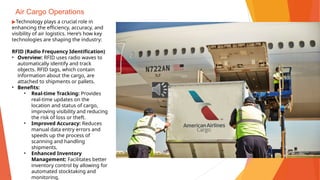
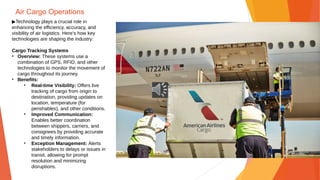
  • 37.
    Air Cargo Operations ▶Technologyplays a crucial role in enhancing the efficiency, accuracy, and visibility of air logistics. Here’s how key technologies are shaping the industry: RFID (Radio Frequency Identification) • Overview: RFID uses radio waves to automatically identify and track objects. RFID tags, which contain information about the cargo, are attached to shipments or pallets. • Benefits: • Real-time Tracking: Provides real-time updates on the location and status of cargo, improving visibility and reducing the risk of loss or theft. • Improved Accuracy: Reduces manual data entry errors and speeds up the process of scanning and handling shipments. • Enhanced Inventory Management: Facilitates better inventory control by allowing for automated stocktaking and monitoring.
  • 38.
    Air Cargo Operations ▶Technologyplays a crucial role in enhancing the efficiency, accuracy, and visibility of air logistics. Here’s how key technologies are shaping the industry: Cargo Tracking Systems • Overview: These systems use a combination of GPS, RFID, and other technologies to monitor the movement of cargo throughout its journey. • Benefits: • Real-time Visibility: Offers live tracking of cargo from origin to destination, providing updates on location, temperature (for perishables), and other conditions. • Improved Communication: Enables better coordination between shippers, carriers, and consignees by providing accurate and timely information. • Exception Management: Alerts stakeholders to delays or issues in transit, allowing for prompt resolution and minimizing disruptions.
  • 39.
    Air Cargo Operations ▶Technologyplays a crucial role in enhancing the efficiency, accuracy, and visibility of air logistics. Here’s how key technologies are shaping the industry: Digital Documentation • Overview: Digital documentation involves the use of electronic formats for managing shipping documents, such as air waybills, invoices, and customs declarations. • Benefits: • Efficiency: Streamlines the documentation process by reducing the need for paper-based records and manual handling. • Accuracy: Minimizes errors associated with manual entry and facilitates easier updates and corrections. • Accessibility: Allows for quick and easy access to documents from anywhere, improving coordination and speeding up customs clearance and other processes. • Integration: Enables seamless integration with other digital systems (e.g., cargo tracking and management systems), enhancing overall operational efficiency.
  • 40.
    Air Cargo Operations ▶Summaryof Technology Benefits: • RFID: Enhances tracking accuracy, reduces manual errors, and improves inventory management. • Cargo Tracking Systems: Provides real-time visibility, improves communication, and helps manage exceptions effectively. • Digital Documentation: Increases efficiency, accuracy, and accessibility of shipping documents, integrating with other systems for streamlined operations. Incorporating these technologies helps air logistics companies improve operational efficiency, enhance security, and offer better service to customers.
  • 41.
    Role of AirTransportation in Global Supply Chains ▶The growth of e-commerce has led to a substantial increase in air freight demand, driven by the need for fast, reliable delivery of small parcels. This shift has resulted in expanded fulfillment networks, technological advancements, and new challenges in capacity and cost management. Air cargo remains a critical component of the e- commerce ecosystem, enabling swift and efficient global trade.
  • 42.
    A Day inthe Life of an Air Cargo Shipment ▶Here's a step-by-step walkthrough of a typical air cargo journey from origin to destination: Booking and Preparation • Booking: The shipper or freight forwarder books space with an airline or cargo carrier, selecting the flight, date, and service level (e.g., standard or express). • Documentation: Prepare necessary documents, including the air waybill (AWB), commercial invoice, packing list, and any required certificates (e.g., for dangerous goods). • Cargo Packing: Goods are packed according to airline and regulatory standards. Special handling requirements (e.g., temperature control) are addressed. Cargo Pickup and Collection • Pickup: The cargo is collected from the shipper’s location or warehouse by a transportation service (e.g., truck or courier). • Initial Handling: The cargo is
  • 43.
    A Day inthe Life of an Air Cargo Shipment Here's a step-by-step walkthrough of a typical air cargo journey from origin to destination: Pre-Flight Processing • Screening and Inspection: Cargo undergoes security screening and inspection to ensure compliance with regulations and to detect any prohibited items. • Documentation Check: All documents are reviewed to ensure they are complete and accurate. Any discrepancies are resolved before proceeding. Loading • Consolidation: Cargo is consolidated with other shipments if necessary. It is then loaded into Unit Load Devices (ULDs) or pallets. • Airport Transfer: The consolidated cargo is transported to the airport cargo terminal. • Loading onto Aircraft: Cargo is loaded into the aircraft’s cargo hold, ensuring proper weight distribution and securing of the shipment.
  • 44.
    A Day inthe Life of an Air Cargo Shipment Here's a step-by-step walkthrough of a typical air cargo journey from origin to destination: In-Transit • Flight: The aircraft transports the cargo from the origin airport to the destination airport. The cargo’s status is tracked in real-time using tracking systems. • Handling During Transit: If there are interim stops or transfers, the cargo is handled according to specific procedures to ensure it remains in good condition. Arrival and Customs Clearance • Arrival: Upon arrival at the destination airport, the cargo is unloaded from the aircraft and transported to the cargo terminal. • Customs Clearance: The cargo undergoes customs clearance, where it is inspected, and applicable duties and taxes are assessed and paid. Documentation is reviewed to ensure
  • 45.
    A Day inthe Life of an Air Cargo Shipment Here's a step-by-step walkthrough of a typical air cargo journey from origin to destination: Delivery to Consignee • Final Handling: After customs clearance, the cargo is moved to a warehouse or sorting facility. • Pickup/Delivery Arrangement: The final leg of transportation is arranged, either for pickup by the consignee or delivery to their location. This may involve trucking or local courier services. • Delivery: The cargo is delivered to the consignee's address, completing the journey. Post-Delivery • Confirmation: Delivery confirmation is obtained, and any required delivery documentation is provided to the consignee. • Issue Resolution: Any issues or discrepancies (e.g., damage or missing items) are reported and resolved according to the airline’s policies and
  • 46.
    A Day inthe Life of an Air Cargo Shipment ▶ Summary: 1. Booking and Preparation: Reserve space, prepare documents, and pack cargo. 2. Cargo Pickup and Collection: Collect and transport cargo to handling facility. 3. Pre-Flight Processing: Screen, inspect, and check documents. 4. Loading: Consolidate and load cargo onto the aircraft. 5. In-Transit: Transport cargo by air, track status. 6. Arrival and Customs Clearance: Unload, clear customs, and assess duties. 7. Delivery to Consignee: Arrange final transport and deliver cargo. 8. Post-Delivery: Confirm delivery and resolve any issues. This process ensures that air cargo is managed efficiently and safely throughout its journey from origin to destination.
  • 47.
    A Day inthe Life of an Air Cargo Shipment ▶ Potential disruptions in the air cargo journey can impact the timely and efficient delivery of shipments. Here’s a discussion of common disruptions and strategies for managing them: Weather Conditions • Disruptions: Severe weather, such as storms, fog, or snow, can delay flights, affect airport operations, and lead to temporary closures. • Management: • Planning and Forecasting: Airlines and logistics providers use weather forecasting tools to plan flights and anticipate potential disruptions. • Alternate Routing: In case of adverse weather at the destination, alternative airports may be used for landing. • Communication: Informing customers about potential delays and providing updated delivery times helps manage expectations.
  • 48.
    A Day inthe Life of an Air Cargo Shipment ▶ Potential disruptions in the air cargo journey can impact the timely and efficient delivery of shipments. Here’s a discussion of common disruptions and strategies for managing them: Technical Issues • Disruptions: Mechanical failures, equipment malfunctions, or technology breakdowns can cause delays in flight operations and cargo handling. • Management: • Maintenance and Inspections: Regular maintenance and thorough inspections of aircraft and handling equipment help prevent technical issues. • Backup Systems: Implementing redundant systems and procedures ensures continuity in case of technology failures. • Contingency Planning: Having contingency plans for emergency repairs and equipment replacements helps minimize downtime.
  • 49.
    A Day inthe Life of an Air Cargo Shipment ▶ Potential disruptions in the air cargo journey can impact the timely and efficient delivery of shipments. Here’s a discussion of common disruptions and strategies for managing them: Customs and Regulatory Issues • Disruptions: Delays in customs clearance due to incomplete or incorrect documentation, inspections, or regulatory compliance issues can affect delivery times. • Management: • Accurate Documentation: Ensuring that all required documentation is complete and accurate reduces the likelihood of delays. • Customs Expertise: Working with customs brokers or experts to navigate regulatory requirements and expedite clearance processes. • Pre-Clearance Programs: Utilizing pre-clearance programs
  • 50.
    A Day inthe Life of an Air Cargo Shipment ▶ Potential disruptions in the air cargo journey can impact the timely and efficient delivery of shipments. Here’s a discussion of common disruptions and strategies for managing them: Operational Strikes • Disruptions: Strikes by airport or airline staff, including ground handlers, baggage handlers, or air traffic controllers, can disrupt cargo operations. • Management: • Emergency Plans: Developing emergency response plans and alternate staffing arrangements to address potential strikes. • Communication: Keeping stakeholders informed about potential impacts and alternative arrangements to
  • 51.
    A Day inthe Life of an Air Cargo Shipment ▶ Potential disruptions in the air cargo journey can impact the timely and efficient delivery of shipments. Here’s a discussion of common disruptions and strategies for managing them: Security Threats • Disruptions: Security threats or incidents, such as terrorism or smuggling attempts, can lead to heightened security measures, delays, or additional inspections. • Management: • Enhanced Security Protocols: Implementing robust security measures and procedures to detect and prevent threats. • Training and Awareness: Regularly training staff on security protocols and emergency response procedures. • Coordination with Authorities: Collaborating with relevant security and law enforcement
  • 52.
    A Day inthe Life of an Air Cargo Shipment ▶ Potential disruptions in the air cargo journey can impact the timely and efficient delivery of shipments. Here’s a discussion of common disruptions and strategies for managing them: Logistical Errors • Disruptions: Errors in cargo handling, such as misrouting, incorrect labeling, or misplaced shipments, can lead to delays and misdeliveries. • Management: • Quality Control: Implementing strict quality control measures and double-checking processes to minimize errors. • Tracking Systems: Using advanced tracking systems to monitor cargo movement and quickly identify and address issues. • Clear Procedures: Ensuring clear and well-documented handling procedures to reduce the risk of logistical errors.
  • 53.
    A Day inthe Life of an Air Cargo Shipment ▶ Potential disruptions in the air cargo journey can impact the timely and efficient delivery of shipments. Here’s a discussion of common disruptions and strategies for managing them: Capacity Constraints • Disruptions: High demand during peak seasons or disruptions in the supply chain can lead to capacity constraints, affecting the availability of air cargo space. • Management: • Capacity Planning: Forecasting demand and planning capacity accordingly to manage peak periods effectively. • Flexible Solutions: Offering flexible shipping solutions and alternative transportation options to handle capacity
  • 54.
    A Day inthe Life of an Air Cargo Shipment ▶ Effective management of disruptions involves proactive planning, regular maintenance, accurate documentation, and clear communication with stakeholders. By implementing robust procedures and utilizing technology, air cargo operators can mitigate the impact of potential disruptions and maintain efficient operations.
  • 55.
    A Day inLife of World’s Largest Cargo Aircraft