Customs Issues
and
Procedure
Course
Material
Referenc
e
Important Dates
▶ Assignment 9/23/2024
▶ Midterm 9/26/2024
▶ Final 10/3/2024
This Photo by Unknown Author is licensed under CC BY-SA-NC
Terminal Learning
Objectives
▶ Understand the role of customs in
international trade.
▶ Identify key customs procedures
and documentation required for
imports and exports.
▶ Analyze common issues and
challenges related to customs
compliance.
▶ Explore strategies for ensuring
smooth customs operations and
avoiding delays or penalties.
Overview
▶ Overview of Customs
Regulations, Procedures, and
Their Impact on Supply Chain
Operations
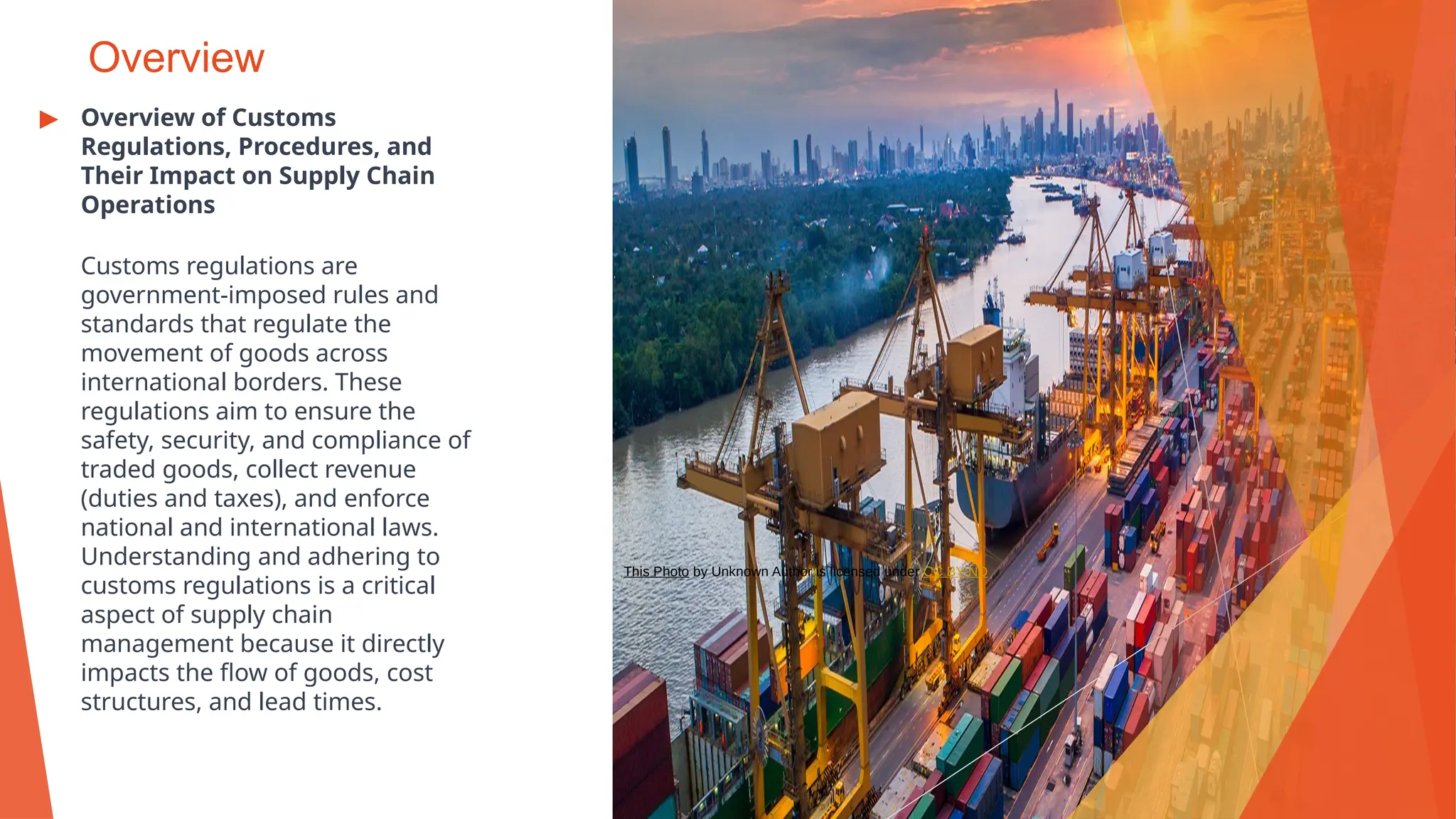
Customs regulations are
government-imposed rules and
standards that regulate the
movement of goods across
international borders. These
regulations aim to ensure the
safety, security, and compliance of
traded goods, collect revenue
(duties and taxes), and enforce
national and international laws.
Understanding and adhering to
customs regulations is a critical
aspect of supply chain
management because it directly
impacts the flow of goods, cost
structures, and lead times.
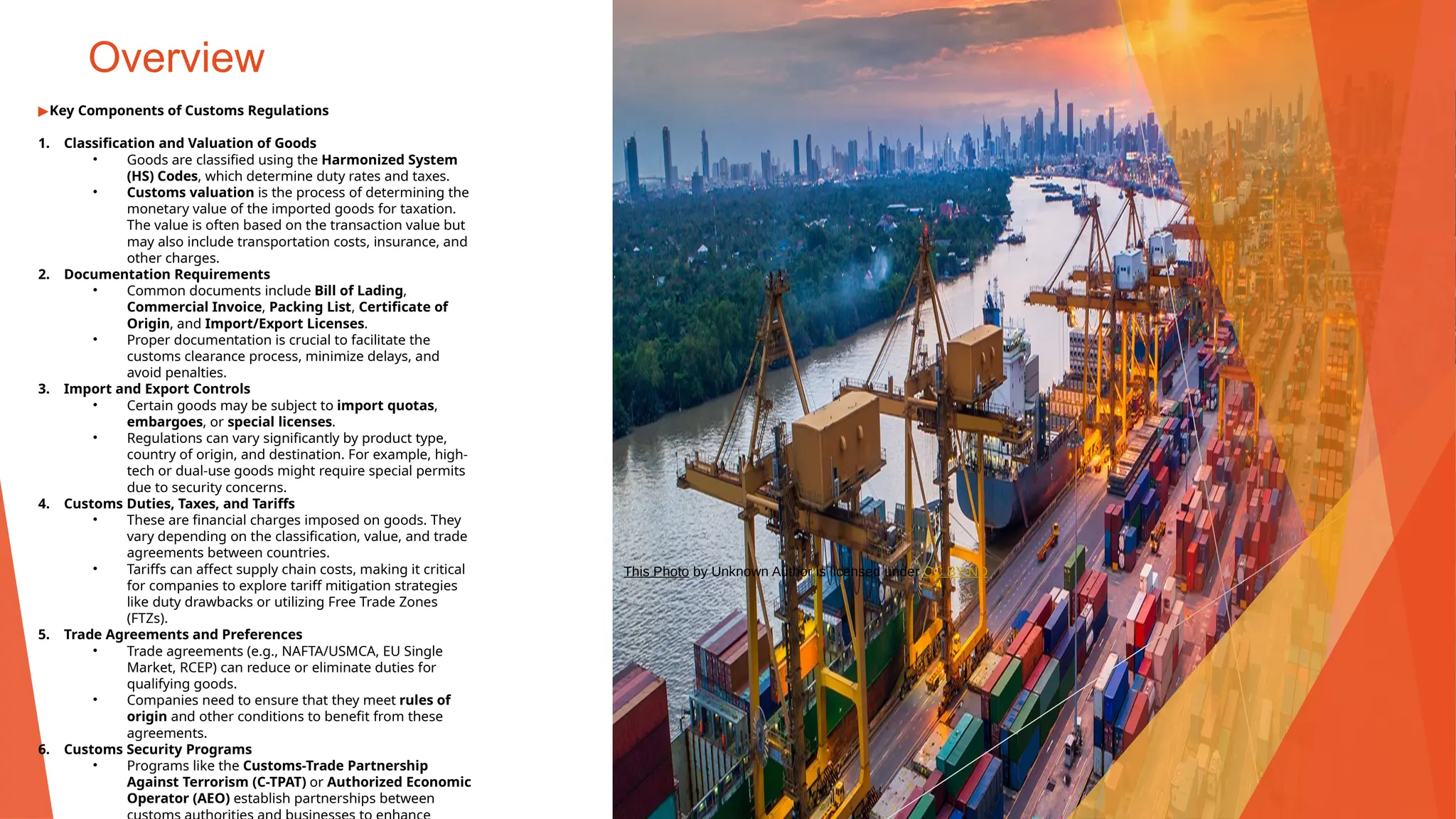
This Photo by Unknown Author is licensed under CC BY-ND
Overview
▶Key Components of Customs Regulations
1. Classification and Valuation of Goods
• Goods are classified using the Harmonized System
(HS) Codes, which determine duty rates and taxes.
• Customs valuation is the process of determining the
monetary value of the imported goods for taxation.
The value is often based on the transaction value but
may also include transportation costs, insurance, and
other charges.
2. Documentation Requirements
• Common documents include Bill of Lading,
Commercial Invoice, Packing List, Certificate of
Origin, and Import/Export Licenses.
• Proper documentation is crucial to facilitate the
customs clearance process, minimize delays, and
avoid penalties.
3. Import and Export Controls
• Certain goods may be subject to import quotas,
embargoes, or special licenses.
• Regulations can vary significantly by product type,
country of origin, and destination. For example, high-
tech or dual-use goods might require special permits
due to security concerns.
4. Customs Duties, Taxes, and Tariffs
• These are financial charges imposed on goods. They
vary depending on the classification, value, and trade
agreements between countries.
• Tariffs can affect supply chain costs, making it critical
for companies to explore tariff mitigation strategies
like duty drawbacks or utilizing Free Trade Zones
(FTZs).
5. Trade Agreements and Preferences
• Trade agreements (e.g., NAFTA/USMCA, EU Single
Market, RCEP) can reduce or eliminate duties for
qualifying goods.
• Companies need to ensure that they meet rules of
origin and other conditions to benefit from these
agreements.
6. Customs Security Programs
• Programs like the Customs-Trade Partnership
Against Terrorism (C-TPAT) or Authorized Economic
Operator (AEO) establish partnerships between
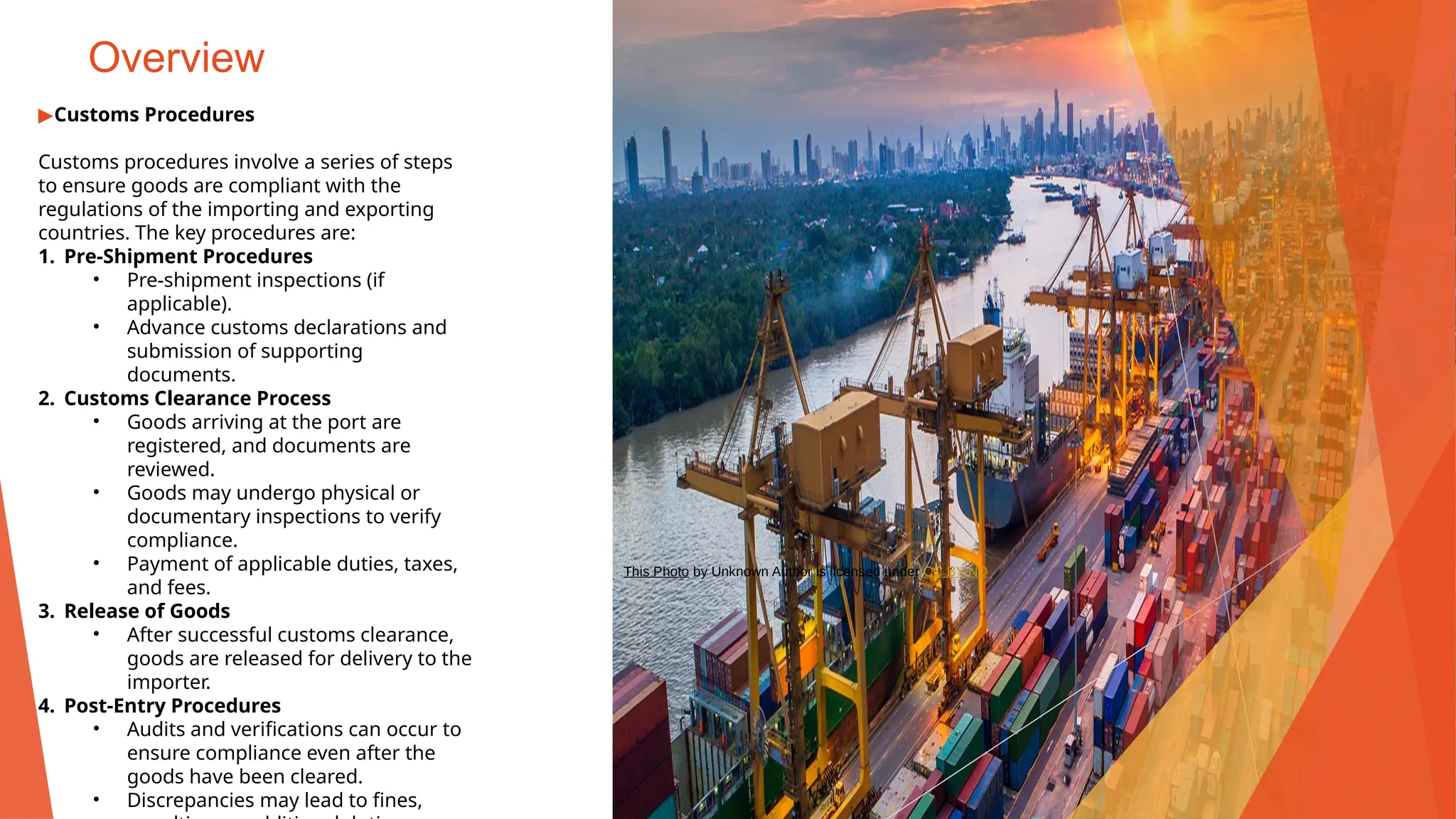
This Photo by Unknown Author is licensed under CC BY-ND
Overview
▶Customs Procedures
Customs procedures involve a series of steps
to ensure goods are compliant with the
regulations of the importing and exporting
countries. The key procedures are:
1. Pre-Shipment Procedures
• Pre-shipment inspections (if
applicable).
• Advance customs declarations and
submission of supporting
documents.
2. Customs Clearance Process
• Goods arriving at the port are
registered, and documents are
reviewed.
• Goods may undergo physical or
documentary inspections to verify
compliance.
• Payment of applicable duties, taxes,
and fees.
3. Release of Goods
• After successful customs clearance,
goods are released for delivery to the
importer.
4. Post-Entry Procedures
• Audits and verifications can occur to
ensure compliance even after the
goods have been cleared.
• Discrepancies may lead to fines,
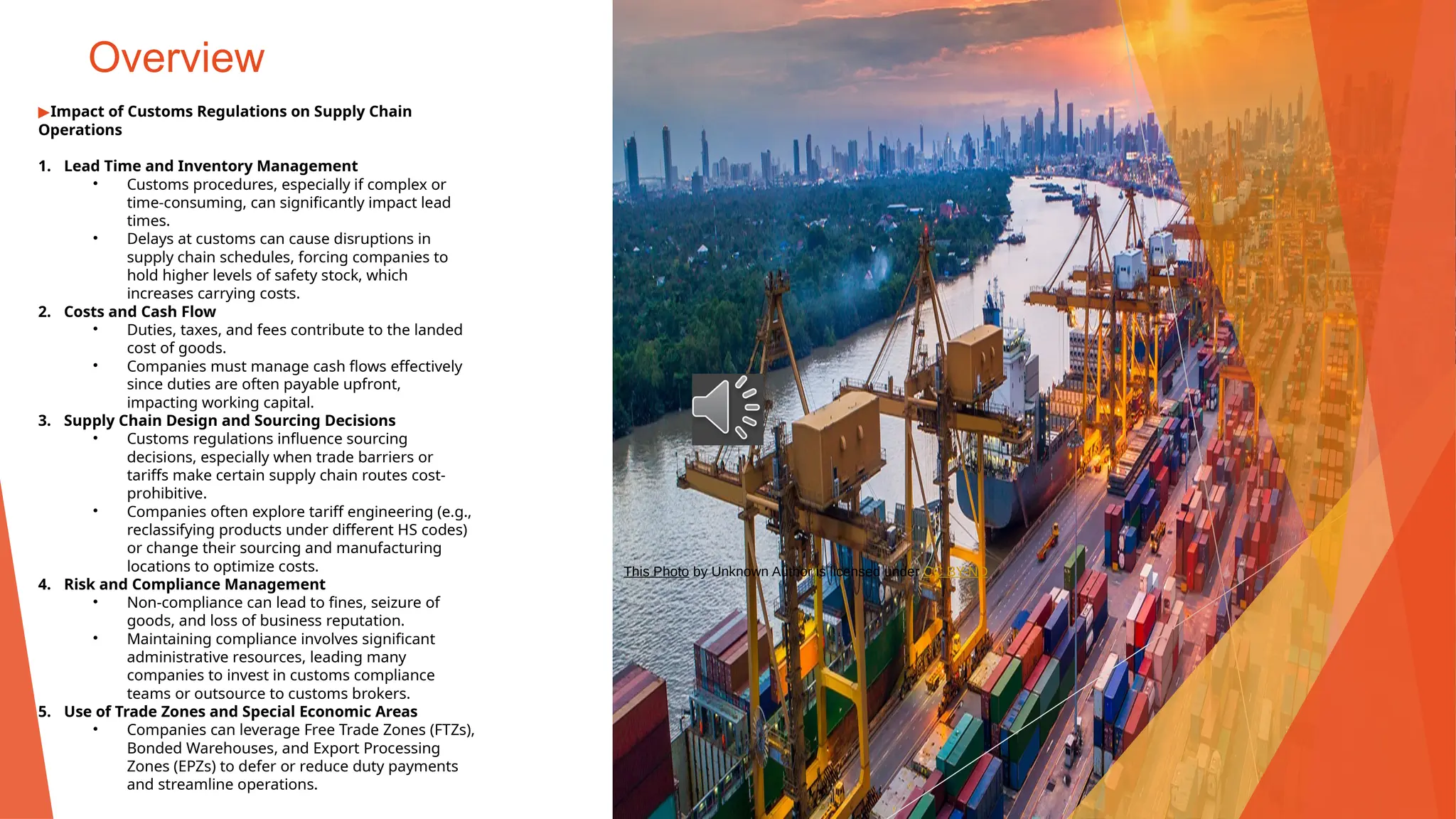
This Photo by Unknown Author is licensed under CC BY-ND
Overview
▶Impact of Customs Regulations on Supply Chain
Operations
1. Lead Time and Inventory Management
• Customs procedures, especially if complex or
time-consuming, can significantly impact lead
times.
• Delays at customs can cause disruptions in
supply chain schedules, forcing companies to
hold higher levels of safety stock, which
increases carrying costs.
2. Costs and Cash Flow
• Duties, taxes, and fees contribute to the landed
cost of goods.
• Companies must manage cash flows effectively
since duties are often payable upfront,
impacting working capital.
3. Supply Chain Design and Sourcing Decisions
• Customs regulations influence sourcing
decisions, especially when trade barriers or
tariffs make certain supply chain routes cost-
prohibitive.
• Companies often explore tariff engineering (e.g.,
reclassifying products under different HS codes)
or change their sourcing and manufacturing
locations to optimize costs.
4. Risk and Compliance Management
• Non-compliance can lead to fines, seizure of
goods, and loss of business reputation.
• Maintaining compliance involves significant
administrative resources, leading many
companies to invest in customs compliance
teams or outsource to customs brokers.
5. Use of Trade Zones and Special Economic Areas
• Companies can leverage Free Trade Zones (FTZs),
Bonded Warehouses, and Export Processing
Zones (EPZs) to defer or reduce duty payments
and streamline operations.
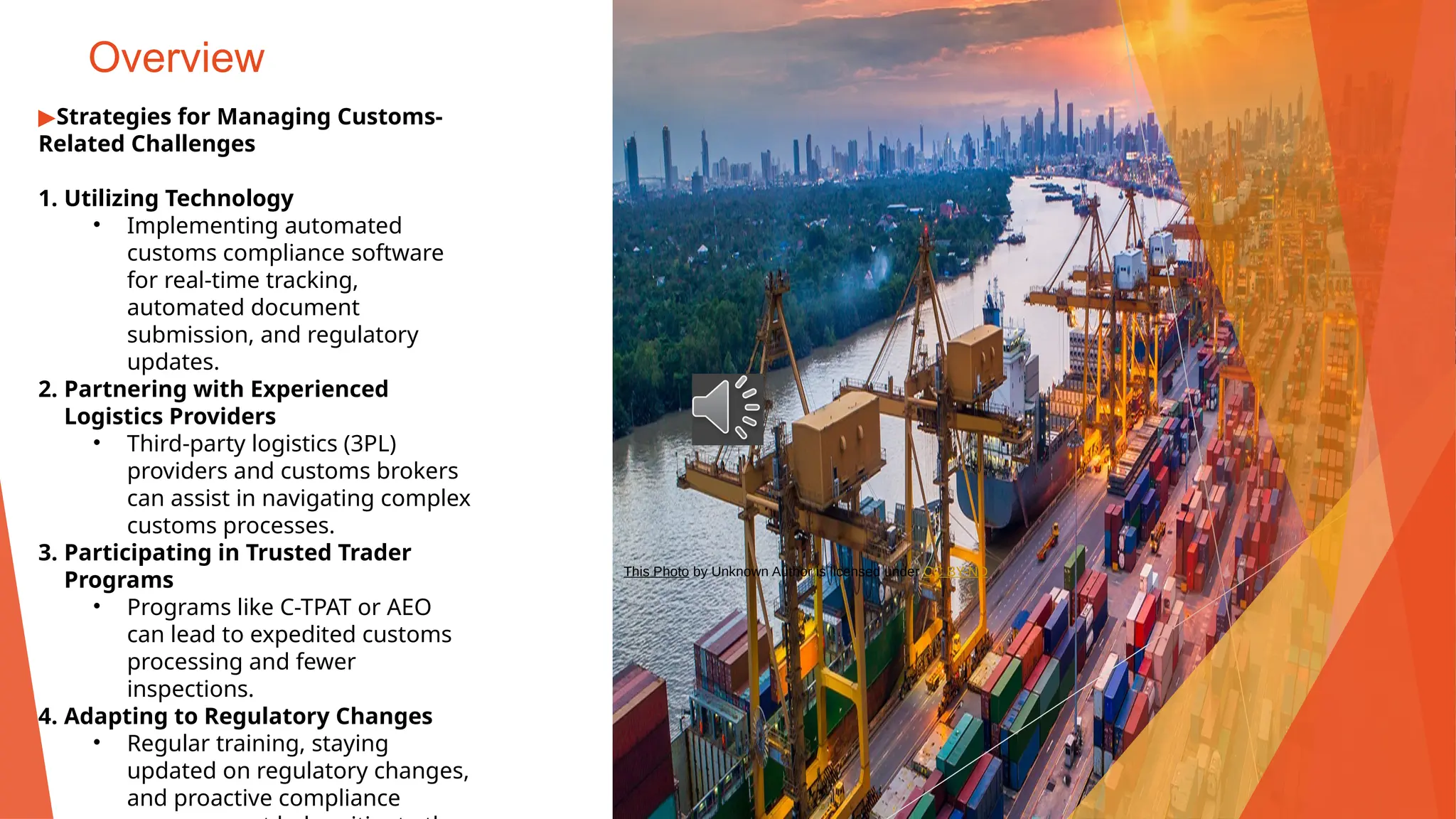
This Photo by Unknown Author is licensed under CC BY-ND
Overview
▶Strategies for Managing Customs-
Related Challenges
1. Utilizing Technology
• Implementing automated
customs compliance software
for real-time tracking,
automated document
submission, and regulatory
updates.
2. Partnering with Experienced
Logistics Providers
• Third-party logistics (3PL)
providers and customs brokers
can assist in navigating complex
customs processes.
3. Participating in Trusted Trader
Programs
• Programs like C-TPAT or AEO
can lead to expedited customs
processing and fewer
inspections.
4. Adapting to Regulatory Changes
• Regular training, staying
updated on regulatory changes,
and proactive compliance
This Photo by Unknown Author is licensed under CC BY-ND
Overview
How Customs Regulations Affect the
Efficiency and Cost of a Global
Supply Chain
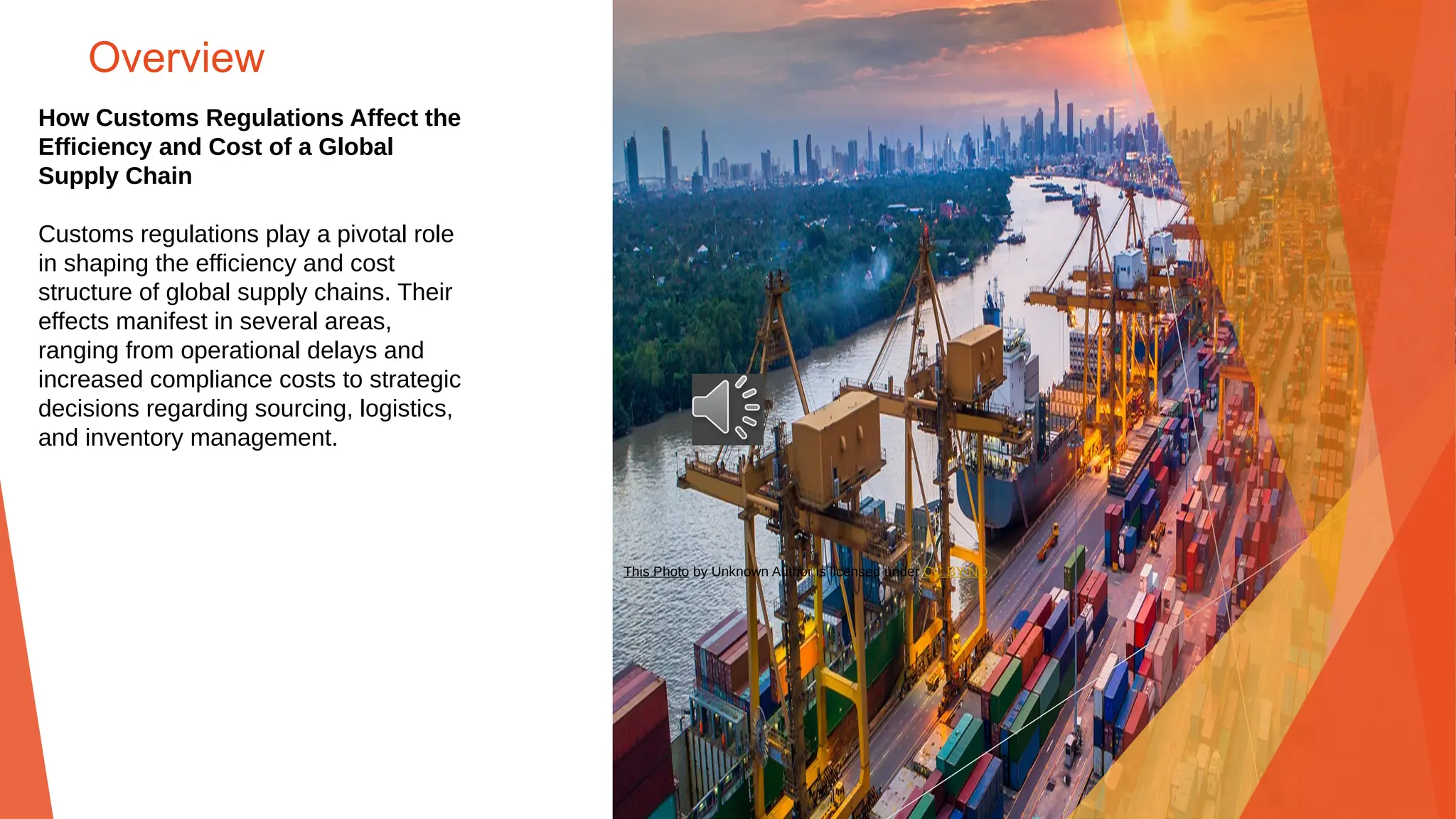
Customs regulations play a pivotal role
in shaping the efficiency and cost
structure of global supply chains. Their
effects manifest in several areas,
ranging from operational delays and
increased compliance costs to strategic
decisions regarding sourcing, logistics,
and inventory management.
This Photo by Unknown Author is licensed under CC BY-ND
Overview
Impact on Efficiency
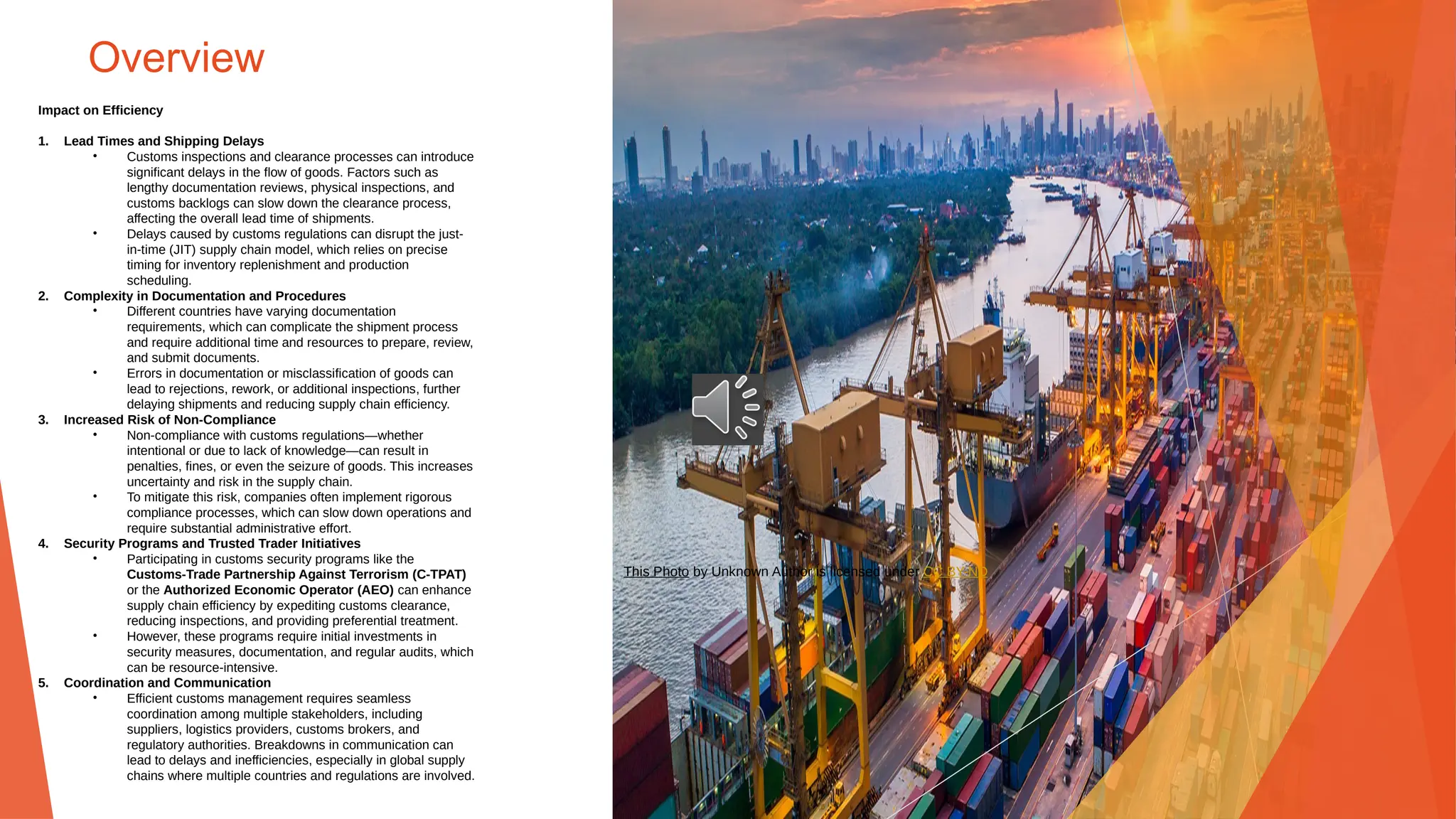
1. Lead Times and Shipping Delays
• Customs inspections and clearance processes can introduce
significant delays in the flow of goods. Factors such as
lengthy documentation reviews, physical inspections, and
customs backlogs can slow down the clearance process,
affecting the overall lead time of shipments.
• Delays caused by customs regulations can disrupt the just-
in-time (JIT) supply chain model, which relies on precise
timing for inventory replenishment and production
scheduling.
2. Complexity in Documentation and Procedures
• Different countries have varying documentation
requirements, which can complicate the shipment process
and require additional time and resources to prepare, review,
and submit documents.
• Errors in documentation or misclassification of goods can
lead to rejections, rework, or additional inspections, further
delaying shipments and reducing supply chain efficiency.
3. Increased Risk of Non-Compliance
• Non-compliance with customs regulations—whether
intentional or due to lack of knowledge—can result in
penalties, fines, or even the seizure of goods. This increases
uncertainty and risk in the supply chain.
• To mitigate this risk, companies often implement rigorous
compliance processes, which can slow down operations and
require substantial administrative effort.
4. Security Programs and Trusted Trader Initiatives
• Participating in customs security programs like the
Customs-Trade Partnership Against Terrorism (C-TPAT)
or the Authorized Economic Operator (AEO) can enhance
supply chain efficiency by expediting customs clearance,
reducing inspections, and providing preferential treatment.
• However, these programs require initial investments in
security measures, documentation, and regular audits, which
can be resource-intensive.
5. Coordination and Communication
• Efficient customs management requires seamless
coordination among multiple stakeholders, including
suppliers, logistics providers, customs brokers, and
regulatory authorities. Breakdowns in communication can
lead to delays and inefficiencies, especially in global supply
chains where multiple countries and regulations are involved.
This Photo by Unknown Author is licensed under CC BY-ND
Overview
Impact on Cost
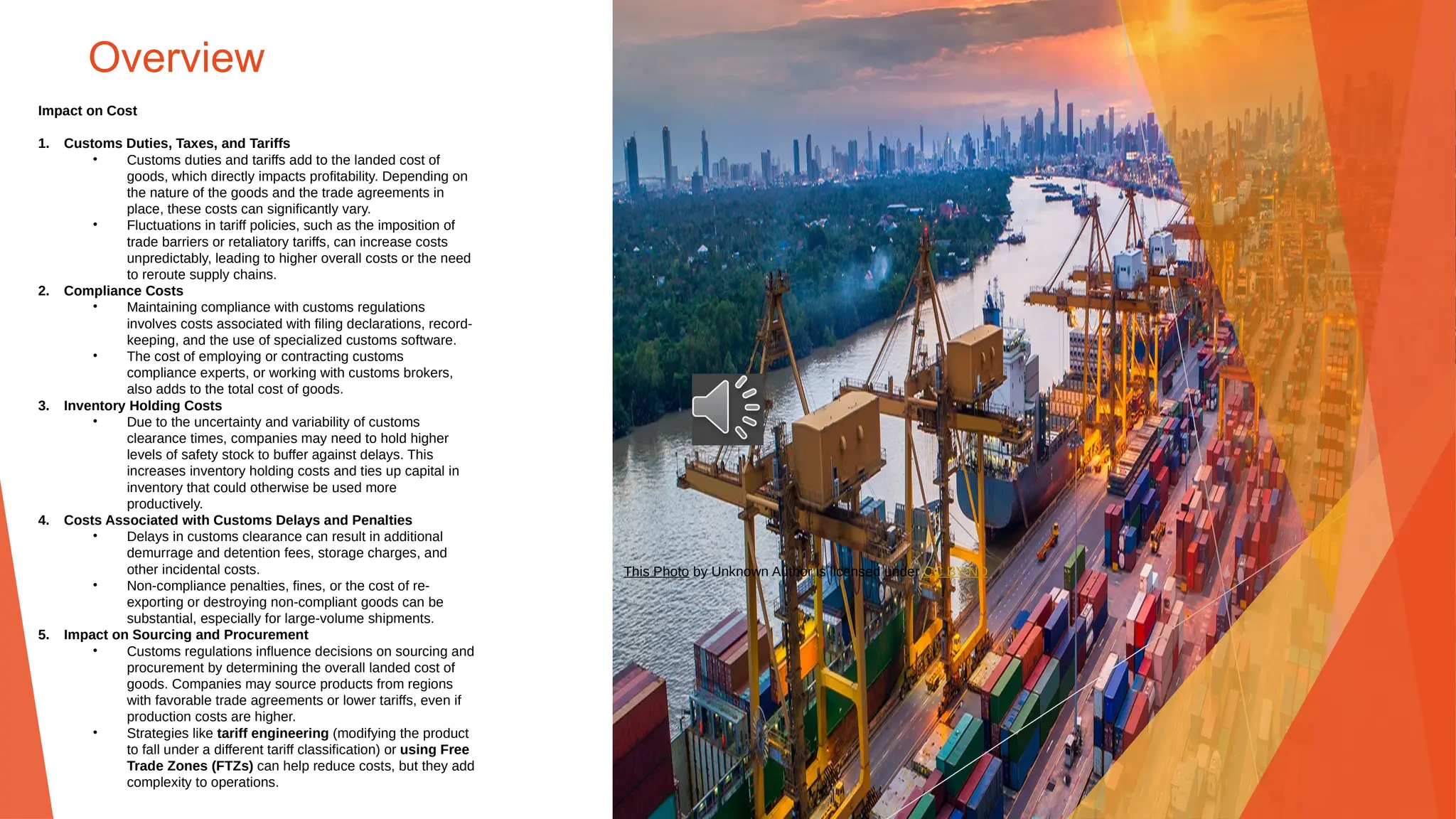
1. Customs Duties, Taxes, and Tariffs
• Customs duties and tariffs add to the landed cost of
goods, which directly impacts profitability. Depending on
the nature of the goods and the trade agreements in
place, these costs can significantly vary.
• Fluctuations in tariff policies, such as the imposition of
trade barriers or retaliatory tariffs, can increase costs
unpredictably, leading to higher overall costs or the need
to reroute supply chains.
2. Compliance Costs
• Maintaining compliance with customs regulations
involves costs associated with filing declarations, record-
keeping, and the use of specialized customs software.
• The cost of employing or contracting customs
compliance experts, or working with customs brokers,
also adds to the total cost of goods.
3. Inventory Holding Costs
• Due to the uncertainty and variability of customs
clearance times, companies may need to hold higher
levels of safety stock to buffer against delays. This
increases inventory holding costs and ties up capital in
inventory that could otherwise be used more
productively.
4. Costs Associated with Customs Delays and Penalties
• Delays in customs clearance can result in additional
demurrage and detention fees, storage charges, and
other incidental costs.
• Non-compliance penalties, fines, or the cost of re-
exporting or destroying non-compliant goods can be
substantial, especially for large-volume shipments.
5. Impact on Sourcing and Procurement
• Customs regulations influence decisions on sourcing and
procurement by determining the overall landed cost of
goods. Companies may source products from regions
with favorable trade agreements or lower tariffs, even if
production costs are higher.
• Strategies like tariff engineering (modifying the product
to fall under a different tariff classification) or using Free
Trade Zones (FTZs) can help reduce costs, but they add
complexity to operations.
This Photo by Unknown Author is licensed under CC BY-ND
Overview
Strategic Considerations and Long-Term Impact
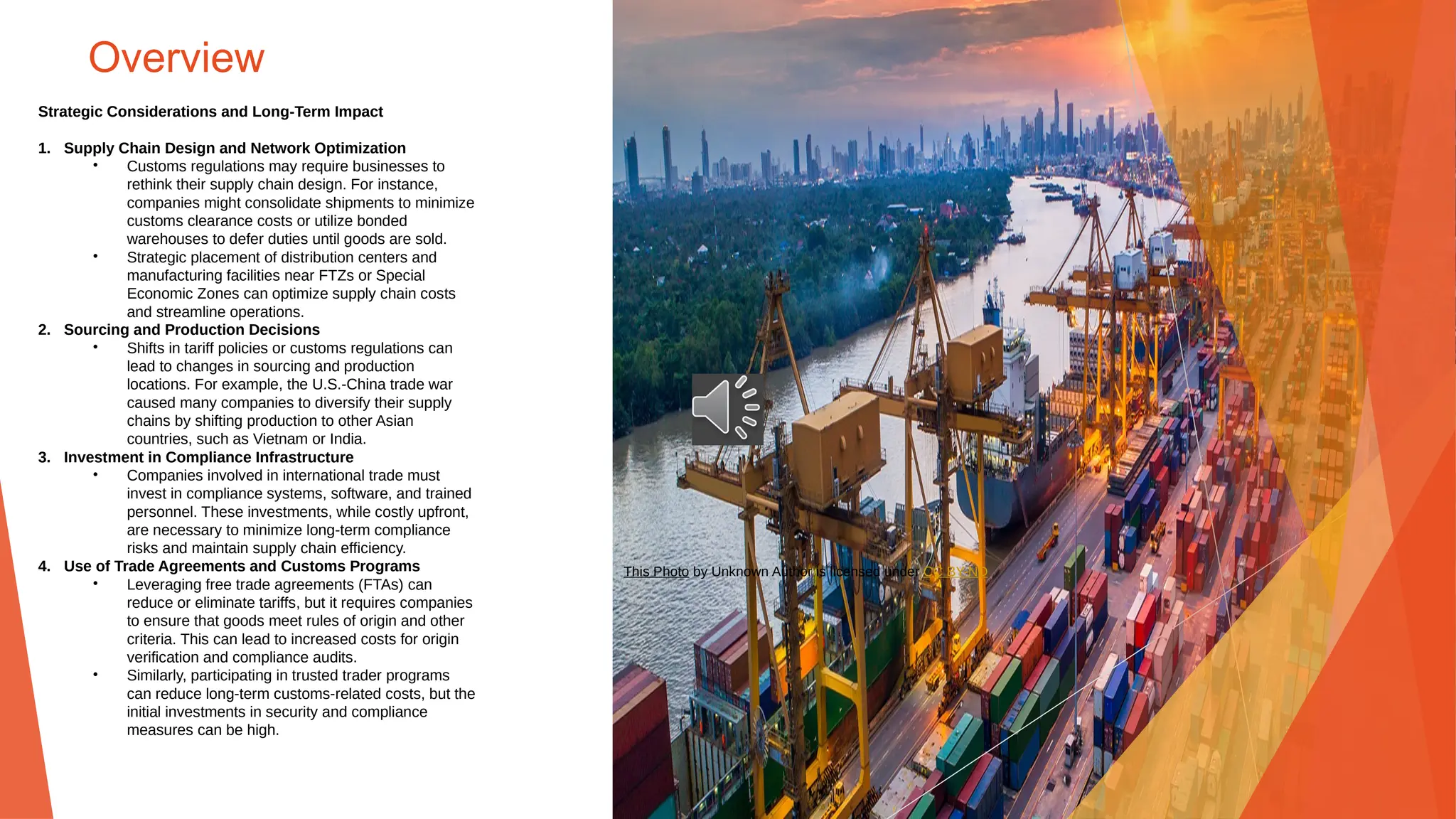
1. Supply Chain Design and Network Optimization
• Customs regulations may require businesses to
rethink their supply chain design. For instance,
companies might consolidate shipments to minimize
customs clearance costs or utilize bonded
warehouses to defer duties until goods are sold.
• Strategic placement of distribution centers and
manufacturing facilities near FTZs or Special
Economic Zones can optimize supply chain costs
and streamline operations.
2. Sourcing and Production Decisions
• Shifts in tariff policies or customs regulations can
lead to changes in sourcing and production
locations. For example, the U.S.-China trade war
caused many companies to diversify their supply
chains by shifting production to other Asian
countries, such as Vietnam or India.
3. Investment in Compliance Infrastructure
• Companies involved in international trade must
invest in compliance systems, software, and trained
personnel. These investments, while costly upfront,
are necessary to minimize long-term compliance
risks and maintain supply chain efficiency.
4. Use of Trade Agreements and Customs Programs
• Leveraging free trade agreements (FTAs) can
reduce or eliminate tariffs, but it requires companies
to ensure that goods meet rules of origin and other
criteria. This can lead to increased costs for origin
verification and compliance audits.
• Similarly, participating in trusted trader programs
can reduce long-term customs-related costs, but the
initial investments in security and compliance
measures can be high.
This Photo by Unknown Author is licensed under CC BY-ND
Overview
Customs regulations have a
profound impact on the efficiency
and cost of global supply chains.
While they introduce complexities
and costs related to compliance,
documentation, and duties, they
also offer opportunities for
companies to optimize their
operations through strategic
planning, the use of trade
agreements, and participation in
customs programs. Businesses
that successfully navigate customs
regulations can gain a competitive
advantage by minimizing delays,
reducing costs, and ensuring a
reliable supply chain flow.
This Photo by Unknown Author is licensed under CC BY-ND
Key Custom
Procedures and
Compliance
The Harmonized System (HS) is an
internationally standardized system
used to classify traded products.
Developed and maintained by the World
Customs Organization (WCO), it
serves as the foundation for tariff
classification, statistical data collection,
and the regulation of international trade.
Understanding the HS is critical for
companies involved in importing and
exporting, as it directly impacts customs
duties, taxes, and compliance.
This Photo by Unknown Author is licensed under CC BY-ND
Key Custom
Procedures and
Compliance
Structure of the Harmonized System
The HS is a hierarchical classification system that
organizes products using a coding structure. It is
designed to identify all goods traded internationally
with a unique number called an HS Code. The
system is structured into a series of chapters,
headings, and subheadings:
1. Chapters: There are 99 chapters in the HS, each
corresponding to a broad category of goods (e.g.,
Chapter 84: Machinery and Mechanical
Appliances).
2. Headings: Within each chapter, there are specific
headings that further classify goods (e.g., 84.29:
Self-propelled bulldozers).
3. Subheadings: Headings are broken down into
subheadings for a more precise description (e.g.,
8429.52: Machinery for leveling).
The complete HS Code is a six-digit number,
structured as follows:
• First two digits: Identify the chapter.
• Next two digits: Identify the heading within that
chapter.
• Last two digits: Identify the subheading within
that heading.
For example, an HS code of 8429.52 translates to
Chapter 84 (Machinery), Heading 29 (Bulldozers),
and Subheading 52 (Leveling machinery).
This Photo by Unknown Author is licensed under CC BY-ND
Key Custom
Procedures and
Compliance
Purpose and Functions of the HS
The Harmonized System serves several critical functions in
international trade:
1. Determining Customs Duties and Taxes
• HS codes are used by customs authorities
worldwide to apply the appropriate tariff rates to
imported goods. This ensures consistency and
transparency in the application of duties and
taxes.
2. Trade Agreements and Preferential Tariffs
• HS codes are used to determine eligibility for
preferential tariff rates under trade agreements.
For instance, under the USMCA (formerly
NAFTA), specific HS codes may be eligible for
duty-free treatment, provided they meet the rules
of origin.
3. Data Collection and Statistical Analysis
• Governments and organizations use HS codes to
collect and analyze trade statistics. These
statistics help track trade flows, monitor economic
performance, and inform trade policy decisions.
4. Compliance and Trade Regulation
• The HS helps ensure compliance with
international trade regulations, including
prohibitions and restrictions on certain goods
(e.g., dual-use goods, hazardous materials).
5. Facilitation of International Trade
• By providing a standardized classification system,
the HS reduces ambiguity and discrepancies in
product classification, thereby facilitating
smoother customs procedures and reducing the
risk of errors.
This Photo by Unknown Author is licensed under CC BY-ND
Key Custom
Procedures and
Compliance
Harmonized System and National Tariff
Schedules
While the HS provides a globally standardized
six-digit code, individual countries often
expand this classification system with
additional digits to create their own national
tariff schedules. These national codes
include:
• Harmonized Tariff Schedule (HTS) for the
United States.
• Integrated Tariff of the European
Communities (TARIC) for the European
Union.
• Customs Tariff Schedule (HS Code) for
Canada.
National schedules may add four or more
digits to the basic six-digit HS code for a total
of 8–10 digits or more, allowing countries to
further specify product categories based on
their own regulations or economic interests.
This Photo by Unknown Author is licensed under CC BY-ND
Key Custom
Procedures and
Compliance
Rules for Classifying Goods under the HS
The classification of goods under the HS is governed by six
General Interpretative Rules (GIRs):
1. Rule 1: Titles of Sections, Chapters, and Subheadings
• Classification is based on the legal text of
headings, chapter notes, and section notes,
rather than just the titles of the chapters or
sections.
2. Rule 2: Incomplete, Unfinished, or Unassembled
Goods
• Incomplete or unfinished goods are classified as if
they were complete or finished, provided they
have the essential character of the finished
product.
3. Rule 3: Classification of Mixed or Composite Goods
• If goods could be classified under two or more
headings, preference is given based on the
heading that provides the most specific
description, the essential character, or the order
in which the headings appear.
4. Rule 4: Classification Based on Most Similar Goods
• Goods that cannot be classified under any
heading are classified under the heading for
goods that they most closely resemble.
5. Rule 5: Packaging and Containers
• Special containers or packaging that are intended
to be reused and are suitable for long-term use
are classified with the goods they accompany.
6. Rule 6: Subheading Classification
• When classifying under a subheading, the
classification is based on the specific subheading
descriptions and any additional subheading
notes.
This Photo by Unknown Author is licensed under CC BY-ND
Key Custom
Procedures and
Compliance
Challenges and Best Practices in Using the
HS
While the HS is a widely adopted system, using
it accurately can be challenging due to:
• Complexity in Product Classification
• Some goods may fit into multiple
categories or require additional
interpretation based on technical
specifications, making classification a
subjective process.
• Frequent Updates and Changes
• The HS is updated every five years to
reflect changes in technology, trade
patterns, and new product innovations.
Companies must stay up-to-date with
these changes to ensure compliance.
• Penalties for Misclassification
• Misclassification can lead to
underpayment or overpayment of
duties, fines, penalties, or seizure of
goods by customs authorities.
Therefore, it is crucial for companies
to have robust classification
procedures and skilled personnel.
This Photo by Unknown Author is licensed under CC BY-ND
Key Custom
Procedures and
Compliance
Best Practices:
1.Use Customs Brokers and
Consultants: Utilize experts for
complex classifications or when
entering new markets.
2.Automated Systems: Implement
classification software that uses
artificial intelligence or machine
learning to improve accuracy.
3.Training and Education:
Regular training for compliance
teams to stay informed about HS
updates and changes.
This Photo by Unknown Author is licensed under CC BY-ND
Key Custom
Procedures and
Compliance
The Harmonized System is a critical
tool for international trade, enabling
standardized product classification,
efficient customs processing, and
accurate tariff application. Mastering
the HS and ensuring correct
classification not only reduces
compliance risks but also optimizes
cost management and supports
smoother global supply chain
operations.
This Photo by Unknown Author is licensed under CC BY-ND
Key Custom
Procedures and
Compliance
Customs valuation is the process by
which customs authorities
determine the monetary value of
imported goods. This value is
crucial because it serves as the
basis for calculating customs duties,
taxes, and other charges. Different
pricing terms, such as Free on
Board (FOB) and Cost, Insurance,
and Freight (CIF), play a key role in
determining the value of goods for
customs purposes. Understanding
these terms and their impact on
customs valuation is essential for
accurate duty calculation and
compliance.
This Photo by Unknown Author is licensed under CC BY-ND
Key Custom
Procedures and
Compliance
What Are FOB and CIF?
1. Free on Board (FOB)
• FOB is an international shipping term that indicates when
the ownership and risk of goods transfer from the seller
to the buyer. Under FOB, the seller is responsible for all
costs and risks up to the point where the goods are
loaded onto the shipping vessel at the port of origin.
• In an FOB agreement, the buyer is responsible for the
transportation costs, insurance, and any risks that occur
once the goods are on board the vessel.
2. Customs Valuation Using FOB:
• When calculating the customs value using the FOB
method, only the value of the goods and the costs up to
the loading point (e.g., manufacturing cost, packaging,
and inland transportation to the port) are considered.
• This excludes international freight and insurance costs,
making the customs value lower than under CIF pricing.
3. Cost, Insurance, and Freight (CIF)
• CIF is another international shipping term that reflects
the total cost of the goods, including shipping and
insurance, up to the destination port. Under a CIF
agreement, the seller assumes responsibility for the cost
of goods, insurance, and freight charges until the goods
reach the buyer’s port.
• The buyer assumes the risks and costs associated with
unloading and transportation beyond the destination port.
4. Customs Valuation Using CIF:
• When calculating customs value under CIF terms, the
valuation includes the cost of the goods, insurance, and
international freight charges.
• This results in a higher customs value compared to FOB
pricing, as it accounts for additional costs incurred in
transporting the goods to the buyer’s port.
This Photo by Unknown Author is licensed under CC BY-ND
Key Custom
Procedures and
Compliance
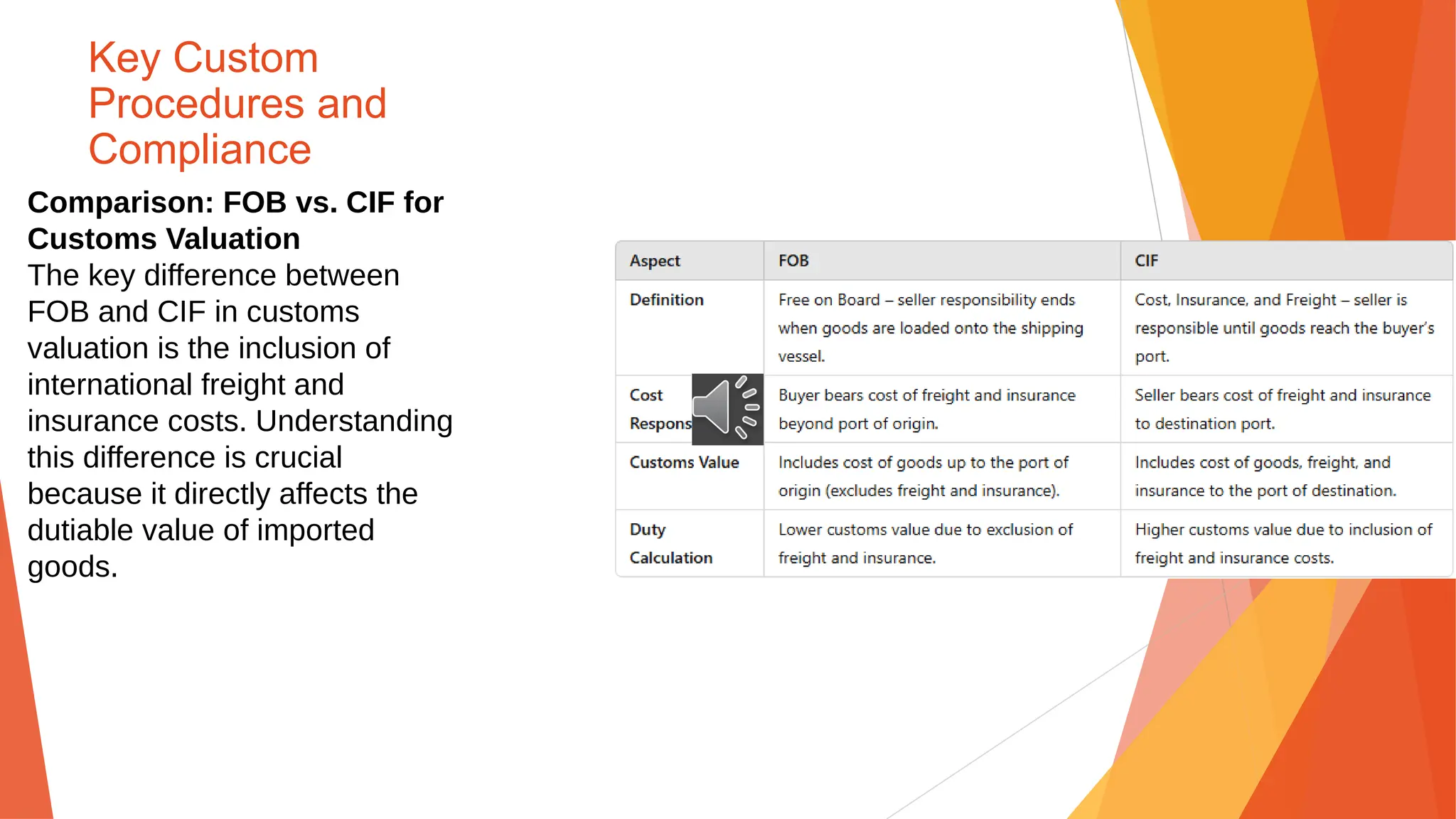
Comparison: FOB vs. CIF for
Customs Valuation
The key difference between
FOB and CIF in customs
valuation is the inclusion of
international freight and
insurance costs. Understanding
this difference is crucial
because it directly affects the
dutiable value of imported
goods.
Key Custom
Procedures and
Compliance
Impact on Customs Valuation and Duty Calculation
1. Customs Value Determination
• Customs authorities generally seek to use the CIF
value for customs valuation, as it represents the full
landed cost of the goods, including all costs
incurred until the goods arrive at the destination
port.
• In cases where FOB pricing is used, customs
authorities will typically add the value of
international freight and insurance to determine the
customs value, thereby arriving at a value similar to
the CIF pricing.
2. Impact on Duties and Taxes
• Since duties and taxes are calculated as a
percentage of the customs value, using the CIF
value often results in higher duties compared to
FOB, as the CIF value includes additional cost
elements.
• For example, if the duty rate is 10% and the FOB
value of goods is $10,000, while the CIF value is
$12,000, the duty payable under FOB pricing would
be $1,000 (10% of $10,000), whereas under CIF
pricing, it would be $1,200 (10% of $12,000).
3. Selection of Pricing Terms for Cost Optimization
• Importers often choose FOB terms when they want
to control freight and insurance costs and have a
clearer understanding of the customs valuation
basis.
• Exporters might prefer CIF terms if they can
negotiate favorable shipping and insurance rates
and include these costs in the sale price, thereby
minimizing perceived costs for the buyer.
This Photo by Unknown Author is licensed under CC BY-ND
Key Custom
Procedures and
Compliance
Customs Regulations and Requirements
1. Customs Valuation Methods
• Under the WTO Customs Valuation
Agreement, the primary basis for
customs valuation is the transaction
value of the goods, which is the price
actually paid or payable for the goods
when sold for export, adjusted as
necessary.
• If FOB pricing is declared, customs
authorities may require supporting
documentation to justify the exclusion of
international freight and insurance costs
and may request these costs to be added
for valuation purposes.
2. Documentation Requirements
• Importers and exporters must provide
clear documentation, such as the
Commercial Invoice, Bill of Lading,
and Insurance Certificates, to
demonstrate the terms of sale and
accurately determine the customs value.
• Any discrepancies between declared
values and documentation can lead to
delays, reassessments, or penalties.
This Photo by Unknown Author is licensed under CC BY-ND
Key Custom
Procedures and
Compliance
Implications for Supply Chain and Compliance
1. Strategic Considerations
• Choosing between FOB and CIF terms can
have strategic implications for supply chain
management, cost control, and cash flow.
For example, using FOB pricing allows the
buyer to negotiate their own shipping and
insurance rates, potentially reducing overall
costs.
• On the other hand, CIF terms simplify the
purchasing process for the buyer, as all costs
up to the port of destination are covered by
the seller.
2. Compliance and Risk Management
• Companies must ensure that the declared
customs value accurately reflects the
agreed-upon pricing terms. Overvaluing or
undervaluing goods can lead to compliance
issues, potential penalties, and delays in
customs clearance.
3. Trade Agreements and Duty Mitigation
• Importers should also consider how trade
agreements and preferential tariff treatments
may affect duty rates under different
valuation scenarios. For example, the use of
FTAs often requires the use of specific
customs valuation methods to demonstrate
compliance with rules of origin.
This Photo by Unknown Author is licensed under CC BY-ND
Key Custom
Procedures and
Compliance
FOB and CIF pricing play a
crucial role in determining
customs value, which in turn
affects the calculation of duties,
taxes, and overall landed costs.
Importers and exporters must
carefully select and document
their pricing terms to optimize
costs and ensure compliance
with customs regulations.
Understanding the nuances of
FOB and CIF helps companies
navigate international trade
more effectively and achieve
better control over their supply
chain costs.
This Photo by Unknown Author is licensed under CC BY-ND
Key Custom
Procedures and
Compliance
Documentation is a fundamental
aspect of import/export operations
and customs procedures. Each
document serves a specific purpose
and is required by customs
authorities, financial institutions, or
other stakeholders to ensure
compliance, legal ownership, and
the smooth movement of goods
across borders. Below is an
overview of the most common
documents used in international
trade:
1.Commercial Invoice
2.Packing List
3.Bill of Lading (B/L)
4.Certificate of Origin (COO)
5.Insurance Certificate
This Photo by Unknown Author is licensed under CC BY-ND
Key Custom
Procedures and
Compliance
Commercial Invoice
Purpose: The Commercial Invoice is the
primary document used in international trade.
It serves as a record of the sale transaction
between the seller (exporter) and the buyer
(importer) and is used by customs authorities
to determine the value of the goods for the
assessment of duties and taxes.
Contents:
• Names and addresses of the buyer and
seller
• Invoice number and date
• Description of the goods (including HS
codes, quantity, weight, and value)
• Unit price and total price
• Currency of transaction
• Payment terms (e.g., cash in advance,
open account, letters of credit)
• Shipping terms (Incoterms) (e.g., FOB,
CIF)
• Country of origin
• Signature of the exporter or authorized
person
This Photo by Unknown Author is licensed under CC BY-ND
Key Custom
Procedures and
Compliance
Importance:
• Customs authorities use the commercial
invoice to assess the customs value,
determine duty and tax rates, and
confirm the legality of the transaction.
• Financial institutions use it to facilitate
payments, particularly when the
transaction is secured by a letter of
credit.
• Errors or discrepancies in the
commercial invoice can lead to customs
delays, fines, or additional inspections.
Best Practices:
• Ensure all information is accurate,
especially product descriptions,
quantities, and values.
• Use standardized product codes, such
as the Harmonized System (HS) codes,
for easy identification and classification
of goods.
This Photo by Unknown Author is licensed under CC BY-ND
Key Custom
Procedures and
Compliance
Packing List
Purpose: The Packing List provides
detailed information on how the goods are
packed, including the number of packages,
dimensions, weight, and contents of each
package. It is used by logistics providers,
customs authorities, and the importer to
verify the contents of the shipment.
Contents:
• Invoice reference number (to link the
packing list to the commercial invoice)
• Description of goods (as per the
commercial invoice)
• Packaging details (e.g., number of
boxes, crates, pallets)
• Dimensions and weight of each
package
• Marks and numbers on each package
for identification
• Special handling instructions, if
applicable
This Photo by Unknown Author is licensed under CC BY-ND
Key Custom
Procedures and
Compliance
Importance:
• Customs authorities use the packing
list to verify the contents of the
shipment and match it with the
commercial invoice.
• Carriers and logistics providers use it
to confirm the number of items, check
weight and volume, and plan for
efficient loading and unloading.
• Any discrepancies between the
packing list and other documents can
cause delays and result in additional
inspections or rejections.
Best Practices:
• Provide clear, concise, and consistent
descriptions of goods that match the
commercial invoice.
• Use standardized units of
measurement and include both metric
and imperial units where applicable.
This Photo by Unknown Author is licensed under CC BY-ND
Key Custom
Procedures and
Compliance
Bill of Lading (B/L)
Purpose: The Bill of Lading (B/L) is a legal
document issued by the carrier (e.g., shipping
line, airline, trucking company) to the shipper,
acknowledging receipt of goods and serving as a
contract of carriage and a document of title.
Types of Bills of Lading:
• Straight Bill of Lading: Non-negotiable;
goods are delivered to the named consignee
only.
• Negotiable Bill of Lading (Order B/L): Can
be endorsed and transferred to third parties,
serving as a document of title for the goods.
Contents:
• Names and addresses of the shipper and
consignee
• Port of loading and port of discharge
• Description of goods (including weight,
dimensions, and number of packages)
• Shipping terms and conditions
• Freight charges (whether prepaid or collect)
• Vessel and voyage number (for ocean
shipments)
• Signature of the carrier or agent
This Photo by Unknown Author is licensed under CC BY-ND
Key Custom
Procedures and
Compliance
Importance:
• The B/L acts as a contract of carriage
between the shipper and the carrier,
outlining terms and responsibilities.
• It serves as a receipt of goods from the
carrier, confirming that goods have been
received in good condition and are ready
for shipment.
• As a document of title, it allows the holder
of the B/L to take ownership of the goods. It
is often used in financing transactions,
where the importer cannot take possession
of the goods until payment has been made.
Best Practices:
• Ensure the information on the B/L matches
the commercial invoice and packing list.
• Use the correct Incoterm to define the
responsibilities of the shipper and the
consignee.
This Photo by Unknown Author is licensed under CC BY-ND
Key Custom
Procedures and
Compliance
Importance:
• Customs authorities use the COO to
verify eligibility for preferential tariff
treatment and ensure compliance with
trade agreements.
• It helps importers and exporters
reduce duty costs by proving
compliance with the rules of origin for
specific agreements.
Best Practices:
• Obtain the COO from an authorized
body, such as a Chamber of
Commerce, to ensure authenticity.
• Keep a record of the COO for audit
purposes, as customs authorities may
request it for verification even after
goods have been cleared.
This Photo by Unknown Author is licensed under CC BY-ND
Key Custom
Procedures and
Compliance
Insurance Certificate
Purpose: The Insurance Certificate
provides proof that the goods are
insured against loss, damage, or other
risks during transit. It is often required
when shipping under terms like CIF or
CIP (Carriage and Insurance Paid to).
Contents:
• Policy number and insurance
company
• Insured party’s name and address
• Description of goods (as per the
commercial invoice)
• Insured value and currency
• Coverage details (e.g., "All Risks" or
specific exclusions)
• Effective dates of coverage
This Photo by Unknown Author is licensed under CC BY-ND
Key Custom
Procedures and
Compliance
Importance:
• The Insurance Certificate protects the
buyer and seller against financial loss
in the event of damage or loss during
transit.
• It is essential for customs clearance in
some countries, especially when the
customs valuation includes insurance
costs.
Best Practices:
• Ensure that the insurance coverage
matches the agreed terms in the sales
contract.
• Include clear information on
exclusions or special conditions that
may affect coverage.
This Photo by Unknown Author is licensed under CC BY-ND
Key Custom
Procedures and
Compliance
Each document in the
import/export process serves a
unique and vital role in ensuring
the legal and compliant
movement of goods across
borders. Understanding and
preparing accurate
documentation is essential for
minimizing delays, avoiding
penalties, and ensuring smooth
customs clearance. Traders
must ensure consistency across
all documents to reduce
discrepancies and the risk of
customs rejections or delays.
This Photo by Unknown Author is licensed under CC BY-ND
Key Custom
Procedures and
Compliance
Compliance Requirements: Country-
Specific Import/Export Restrictions,
Embargoes, and Sanctions
In international trade, compliance with
import and export regulations is critical
to ensure the smooth flow of goods
across borders and to avoid legal and
financial repercussions. Many countries
have specific restrictions, embargoes,
and sanctions that govern the
movement of goods, technology, and
services. These measures are often
enforced to achieve economic, political,
and security objectives, and non-
compliance can result in severe
penalties, including fines, imprisonment,
or the loss of export privileges.
This Photo by Unknown Author is licensed under CC BY-ND
Key Custom
Procedures and
Compliance
Country-Specific Import/Export Restrictions
Import and export restrictions are rules and regulations imposed by countries
to control the entry and exit of certain goods. These restrictions can be motivated
by health and safety concerns, environmental protection, cultural preservation, or
political considerations.
1. Restricted and Controlled Goods
1. Countries often maintain lists of restricted or controlled goods
that require special permits or licenses to import or export.
Examples include:
• Pharmaceuticals and Chemicals: Require special
permits to ensure they are not misused or diverted for
illegal activities.
• Dual-Use Goods: Items that can be used for both
civilian and military purposes (e.g., advanced
electronics, encryption software) often require
additional export licenses.
• Agricultural Products: Many countries impose
phytosanitary regulations to prevent the spread of pests
or diseases.
• Textiles and Clothing: Subject to quotas, tariffs, and
country-specific labeling requirements.
2. Technical Standards and Certification Requirements
1. Imported goods may need to comply with technical standards or
certification requirements. Examples include:
• CE Marking in the European Union.
• FCC Compliance for electronics in the United States.
• CCC Certification for certain products in China.
3. Product Labeling and Marking
• Countries may require specific labeling and marking
requirements for imported goods, including language
requirements, country of origin markings, and safety warnings.
4. Licensing and Permits
• Import and export of certain goods may require obtaining
licenses or permits from relevant authorities. For instance:
1. Export licenses for controlled goods from the U.S.
Bureau of Industry and Security (BIS).
2. Import licenses for agricultural products regulated by
the U.S. Department of Agriculture (USDA).
5. Health, Safety, and Environmental Compliance
• Compliance with health, safety, and environmental regulations is
mandatory for certain categories of goods, such as chemicals,
food products, and hazardous materials.
This Photo by Unknown Author is licensed under CC BY-ND
Key Custom
Procedures and
Compliance
Example: U.S. Export Administration
Regulations (EAR)
• The U.S. EAR, enforced by the BIS,
controls the export of goods, software,
and technology for reasons of national
security, foreign policy, and non-
proliferation. Companies must check
whether their products are listed on
the Commerce Control List (CCL) and
determine if an export license is
required.
Example: EU Dual-Use Regulation
• The EU regulates the export of dual-
use items (goods that can be used for
both civilian and military applications)
to ensure they are not used for
military purposes or human rights
violations. Exporters must comply with
these regulations and apply for
licenses if required.
This Photo by Unknown Author is licensed under CC BY-ND
Key Custom
Procedures and
Compliance
Embargoes
Embargoes are government-imposed restrictions that completely
or partially prohibit trade or the movement of goods to or from
specific countries. They are often used as a tool for foreign policy
or to achieve political objectives.
1. Types of Embargoes
• Comprehensive Embargoes: Complete bans on
all forms of trade with a particular country (e.g.,
North Korea, Syria).
• Partial Embargoes: Restrictions on specific types
of goods, services, or technology (e.g., arms
embargo on Myanmar).
• Sectoral Embargoes: Target specific sectors or
industries, such as oil, financial services, or
technology.
2. Impact on Trade
• Embargoes can disrupt existing supply chains, force
companies to source from alternative markets, and
result in loss of business opportunities.
• Violating an embargo can lead to severe penalties,
including fines, asset seizure, and loss of trading
rights.
3. Examples of Embargoes
• United States Embargo on Cuba: The U.S.
restricts trade with Cuba, except for certain
humanitarian and informational goods. Businesses
must obtain specific licenses to export goods to
Cuba.
• European Union Arms Embargo on Iran: The EU
has an embargo on the sale of military equipment
and technology to Iran, which is enforced alongside
restrictions on financial transactions.
This Photo by Unknown Author is licensed under CC BY-ND
Key Custom
Procedures and
Compliance
Sanctions
Sanctions are restrictions imposed by one or more countries
against a targeted country, entity, or individual. Sanctions are used
to achieve foreign policy goals, promote human rights, or prevent
the spread of weapons of mass destruction.
1. Types of Sanctions
1. Economic Sanctions: Restrictions on financial
transactions, trade, or access to markets (e.g.,
blocking the financial assets of individuals or entities).
2. Trade Sanctions: Prohibitions on the export or import
of certain goods (e.g., sanctions on oil exports from
Iran).
3. Individual or Entity Sanctions: Restrictions on doing
business with specific individuals, companies, or
organizations (e.g., the U.S. Office of Foreign Assets
Control (OFAC) Specially Designated Nationals (SDN)
List).
2. Compliance Requirements
1. Companies must conduct due diligence to ensure they
do not engage in transactions with sanctioned
individuals, entities, or countries. This involves
screening business partners, customers, and financial
transactions against sanction lists.
2. Financial institutions often have strict compliance
programs to identify and block transactions involving
sanctioned parties.
3. Penalties for Non-Compliance
1. Non-compliance with sanctions can lead to severe
penalties, including fines, criminal charges, loss of
export privileges, and reputational damage.
2. Violations can also result in the seizure of goods,
revocation of export licenses, and restrictions on
future trade activities.
This Photo by Unknown Author is licensed under CC BY-ND
Key Custom
Procedures and
Compliance
Example: U.S. OFAC Sanctions
• The U.S. OFAC administers and
enforces economic and trade
sanctions against targeted countries
and individuals. Companies must
comply with OFAC regulations and
avoid transactions involving
individuals or entities on the SDN List.
Example: United Nations (UN)
Sanctions
• The UN imposes sanctions to
maintain international peace and
security. Member states are obligated
to implement these sanctions, which
may include arms embargoes, travel
bans, or asset freezes.
This Photo by Unknown Author is licensed under CC BY-ND
Key Custom
Procedures and
Compliance
Best Practices for Compliance
1. Know Your Customer (KYC) and Partner Due Diligence
1. Conduct thorough due diligence on all customers,
suppliers, and partners to ensure compliance with
sanctions and embargoes.
2. Use compliance software to screen business
partners against global watchlists (e.g., OFAC SDN
List, EU Sanctions List, UN Sanctions List).
2. Implement a Compliance Program
1. Develop an internal compliance program that
includes regular training, risk assessments, and
internal audits to ensure compliance with country-
specific import/export regulations.
2. Establish clear processes for obtaining licenses and
permits, record-keeping, and reporting any potential
violations.
3. Use Automated Tools for Screening and Classification
1. Utilize automated tools and software to screen
transactions, products, and parties against relevant
sanction and embargo lists.
2. Implement product classification tools to ensure
accurate export classification and licensing
determinations.
4. Stay Updated on Regulatory Changes
1. Sanctions, embargoes, and trade regulations are
subject to change based on political developments
and international relations. Staying informed about
regulatory changes is crucial for ongoing
compliance.
5. Consult with Experts
1. Engage legal and compliance experts to navigate
complex regulations, especially when dealing with
high-risk countries, controlled goods, or sanctioned
entities.
This Photo by Unknown Author is licensed under CC BY-ND
Key Custom
Procedures and
Compliance
Compliance with country-specific
import/export restrictions, embargoes,
and sanctions is essential for any
business involved in international trade.
Violating these regulations can lead to
significant financial penalties, legal
consequences, and damage to business
reputation. Implementing a robust
compliance program, conducting due
diligence, and staying informed of
regulatory changes are critical steps to
ensuring compliance and mitigating risks
in global supply chain operations.
This Photo by Unknown Author is licensed under CC BY-ND
Key Custom
Procedures and
Compliance
Potential Penalties for Non-
Compliance and Their Impact on
Operations
Non-compliance with import/export
regulations, trade restrictions,
embargoes, and sanctions can have
severe legal, financial, and operational
consequences. These penalties not only
impact the immediate transaction but
can also disrupt long-term business
operations, affect market access, and
damage a company’s reputation. Below
is an overview of the potential penalties
for non-compliance and their broader
impact on business operations:
This Photo by Unknown Author is licensed under CC BY-ND
Key Custom
Procedures and
Compliance
Potential Penalties for Non-Compliance
1. Fines and Monetary Penalties
1. Monetary penalties are one of the most common
consequences of non-compliance and can be
substantial. The amount of the fine varies depending on
the severity of the violation, the value of the goods
involved, and whether the violation was intentional or
accidental.
2. Examples:
1. The U.S. Bureau of Industry and Security
(BIS) can impose fines of up to $1,000,000 per
violation for intentional breaches of export
controls.
2. The U.S. Office of Foreign Assets Control
(OFAC) can levy civil penalties of up to $311,562
per violation or twice the value of the transaction,
whichever is greater.
2. Seizure of Goods
1. Customs authorities may seize or detain goods that are
not compliant with import/export regulations. Seizure can
occur due to reasons such as misclassification,
undervaluation, lack of proper documentation, or
violations of restrictions and sanctions.
2. Seized goods may be held indefinitely, forfeited to the
government, or even destroyed, resulting in the total loss
of the shipment and potential disruption to the supply
chain.
3. Revocation of Export/Import Privileges
1. Government authorities may suspend or revoke a
company’s export or import licenses, preventing the firm
from conducting international trade activities. This can be
devastating, especially for companies that rely heavily on
cross-border sales or procurement.
2. Revocation of export privileges may apply to specific
product lines, all goods from a particular facility, or even
all export activities of a company.
This Photo by Unknown Author is licensed under CC BY-ND
Key Custom
Procedures and
Compliance
Potential Penalties for Non-Compliance
4. Criminal Charges
1. Severe violations, such as exporting controlled
goods to embargoed countries or sanctioned
entities, can result in criminal charges against the
company and its executives. Penalties can
include imprisonment for individuals found guilty
of willful violations.
2. For example, under the International Traffic in
Arms Regulations (ITAR), individuals found
guilty of violating export controls can face up to
20 years in prison.
5. Civil Penalties and Lawsuits
1. Civil penalties can include restitution, the cost of
investigation, and legal fees. Additionally,
companies may face lawsuits from affected
parties, including competitors, partners, or
customers, if non-compliance results in business
disruptions or damages.
6. Debarment from Government Contracts
1. Companies that violate trade regulations may be
barred from participating in government contracts
or receiving federal funding. This can be
particularly damaging for defense contractors,
technology firms, or companies that supply goods
or services to government agencies.
7. Reputational Damage
1. Even when no criminal charges are involved, non-
compliance can severely damage a company’s
reputation, leading to loss of customers, market
share, and the inability to attract business
partners or investors.
This Photo by Unknown Author is licensed under CC BY-ND
Key Custom
Procedures and
Compliance
Impact of Non-Compliance on Business Operations
1. Supply Chain Disruptions
1. Seizure of goods or delays due to investigations can
disrupt supply chain continuity, leading to stockouts,
production delays, or missed delivery deadlines.
2. Supply chain disruptions can force companies to find
alternative suppliers or logistics routes, increasing
lead times and costs.
2. Increased Compliance and Operational Costs
1. After a compliance violation, companies may need to
invest significantly in compliance measures, such as
implementing new compliance programs, hiring
compliance officers, and enhancing internal audits.
2. The costs of corrective actions, legal counsel, and
regulatory filings can strain financial resources,
especially for small and medium-sized enterprises.
3. Loss of Market Access
1. Non-compliance can result in the loss of access to key
markets due to revocation of licenses or being placed
on denied party lists. This can lead to a decline in
sales and revenue, particularly for companies that rely
on exports or imports for their business.
2. Companies may also lose eligibility for preferential
tariff treatments under free trade agreements if they
fail to comply with rules of origin or other regulatory
requirements.
4. Operational Inefficiencies
1. Non-compliance can necessitate significant changes
to operational processes, such as rerouting
shipments, switching suppliers, or modifying product
components to meet regulatory standards.
2. This can lead to increased lead times, higher costs,
and inefficiencies in production and logistics.
This Photo by Unknown Author is licensed under CC BY-ND
Key Custom
Procedures and
Compliance
Impact of Non-Compliance on Business Operations
5. Impact on Strategic Relationships
1. Non-compliance can damage relationships with key
stakeholders, including suppliers, customers, logistics
providers, and financial institutions. For example:
1. Banks and financial institutions may refuse to
process transactions involving companies with
a history of non-compliance due to the risk of
violating sanctions or anti-money laundering
laws.
2. Suppliers and customers may seek alternative
partners if they perceive a high risk of business
disruption due to compliance issues.
6. Long-Term Financial Impact
1. Fines, penalties, and legal fees can have a significant
impact on a company’s financial health, reducing
profitability and cash flow.
2. In some cases, companies may have to write off the
value of seized goods or pay compensation to
customers for undelivered products, affecting overall
financial stability.
7. Increased Scrutiny and Monitoring
1. Once a company is found non-compliant, it may be
subject to increased scrutiny by customs authorities
and regulators. This can lead to more frequent audits,
inspections, and monitoring of shipments, which can
slow down operations and increase compliance costs.
8. Insurance and Financial Risks
1. Non-compliance can lead to higher insurance
premiums or even loss of coverage if an insurance
provider deems the company’s activities too risky.
2. The company’s credit rating may also be affected,
impacting its ability to secure loans or attract
investment.
This Photo by Unknown Author is licensed under CC BY-ND
Key Custom
Procedures and
Compliance
Examples of High-Profile Non-Compliance Cases
1. ZTE Corporation (2018)
1. Chinese telecommunications company ZTE
was fined $1.4 billion by the U.S. Department
of Commerce for violating U.S. export controls
by shipping goods containing U.S. components
to Iran and North Korea.
2. The penalty included a suspension of ZTE’s
export privileges, which effectively shut down
its operations, as it was unable to procure
critical U.S.-made components.
2. Siemens (2008)
1. Siemens was fined $1.6 billion for violations of
the Foreign Corrupt Practices Act (FCPA) and
anti-corruption laws in multiple countries.
2. The scandal led to significant reputational
damage, loss of business, and the need for
extensive corporate restructuring and
compliance improvements.
3. Ericsson (2019)
1. Swedish telecommunications company
Ericsson agreed to pay over $1 billion to
resolve allegations that it violated the FCPA by
engaging in a scheme to bribe government
officials in multiple countries.
2. The settlement included a requirement to
implement enhanced compliance measures
and submit to monitoring by U.S. authorities
for several years.
This Photo by Unknown Author is licensed under CC BY-ND
Key Custom
Procedures and
Compliance
Best Practices for Avoiding Non-Compliance
1. Establish a Robust Compliance Program
1. Develop a comprehensive compliance
program that includes policies, procedures,
and controls to ensure adherence to
import/export regulations, sanctions, and
trade restrictions.
2. Appoint a compliance officer or team
responsible for overseeing and enforcing
compliance measures.
2. Regular Training and Awareness
1. Conduct regular training sessions for
employees to educate them on compliance
requirements, potential risks, and best
practices.
2. Include specific training for departments
most involved in compliance, such as
sales, logistics, finance, and legal.
3. Implement Automated Screening and
Classification Tools
1. Use automated tools to screen customers,
suppliers, and transactions against global
watchlists and denied party lists (e.g.,
OFAC’s SDN List).
2. Implement product classification tools to
ensure correct classification and licensing
determinations.
This Photo by Unknown Author is licensed under CC BY-ND
Key Custom
Procedures and
Compliance
Best Practices for Avoiding Non-Compliance
4. Regular Internal Audits and Compliance
Reviews
1. Conduct regular internal audits to identify
potential compliance gaps and take
corrective actions before violations occur.
2. Review compliance policies and
procedures annually to keep up with
changes in regulations.
5. Engage External Experts and Consultants
1. Consult with legal and compliance experts
to navigate complex regulations, especially
when dealing with high-risk countries,
controlled goods, or sanctioned entities.
2. Seek advice on developing strategies to
mitigate compliance risks, such as
structuring transactions to avoid
unnecessary exposure.
6. Establish Clear Record-Keeping and
Documentation Practices
1. Maintain detailed records of all
import/export transactions, licenses,
permits, and communications with
regulatory authorities.
2. Ensure that all documentation is complete,
accurate, and readily accessible for audits
and compliance checks.
This Photo by Unknown Author is licensed under CC BY-ND
Key Custom
Procedures and
Compliance
Non-compliance with import/export
regulations and trade restrictions can
lead to severe penalties, ranging from
fines and seizure of goods to criminal
charges and loss of market access. The
impact of non-compliance extends
beyond financial losses to include
operational disruptions, damage to
strategic relationships, and long-term
reputational harm. By implementing
robust compliance programs, conducting
regular audits, and staying informed
about regulatory changes, companies
can mitigate these risks and ensure
smooth global trade operations.
This Photo by Unknown Author is licensed under CC BY-ND
Key Custom
Procedures and
Compliance
Case Study: Compliance Issue Due to
Incorrect HS Classification – Ford
Motor Company (2019)
Background: In 2019, Ford Motor
Company faced a significant compliance
issue when U.S. Customs and Border
Protection (CBP) determined that the
company had incorrectly classified
imported automotive parts under the
Harmonized System (HS) code. Ford
imported automotive repair parts, such
as parts for transit vans, using HS codes
that CBP later deemed inapplicable for
the items, resulting in the underpayment
of customs duties over a period of
several years.
This Photo by Unknown Author is licensed under CC BY-ND
Key Custom
Procedures and
Compliance
Details of the Compliance Issue
1. Incorrect HS Classification:
1. Ford imported repair and replacement parts for its vehicles and
classified these parts under HS codes that attracted lower tariffs.
2. The classification used by Ford did not reflect the correct
descriptions under the Harmonized Tariff Schedule of the United
States (HTSUS), leading to underpayment of customs duties.
2. CBP Audit and Investigation:
1. U.S. Customs and Border Protection conducted an audit and
determined that the parts should have been classified under a
different HS code that imposed a higher duty rate.
2. The misclassification spanned multiple years and involved a
large volume of imports, resulting in a substantial duty shortfall.
3. Financial Consequences:
1. Ford was assessed a $181 million penalty for underpaid
duties. The penalty included back duties owed, interest, and
additional fines for the incorrect classification.
2. The penalty amount represented not only the lost revenue for
CBP but also punitive damages for non-compliance with
customs regulations.
3. The financial impact extended beyond the penalty itself, as Ford
had to allocate additional resources for compliance review, legal
consultation, and administrative processes to rectify the
misclassification.
4. Reputational Consequences:
1. The incident received widespread media attention, highlighting
Ford’s failure to comply with U.S. customs regulations.
2. The compliance issue raised concerns about the company’s
internal controls and compliance procedures, potentially
affecting Ford’s relationships with regulators and trade partners.
3. Reputational damage from the incident could have long-term
effects on Ford’s brand image, especially as the automotive
industry is highly scrutinized for compliance with trade and
environmental regulations.
5. Operational and Strategic Consequences:
1. Ford was required to implement corrective measures, including
reviewing and updating its HS classification processes,
retraining its import/export compliance teams, and enhancing its
internal audit mechanisms.
2. The company’s supply chain and logistics operations were
temporarily disrupted as it worked to reconcile past imports and
ensure that all future shipments were correctly classified.
This Photo by Unknown Author is licensed under CC BY-ND
Key Custom
Procedures and
Compliance
Key Lessons and Takeaways
1. Importance of Accurate HS Classification:
1. HS classification is a complex but critical aspect of
import/export compliance. Misclassification can result
in significant financial penalties and operational
disruptions.
2. Companies must ensure that all personnel involved in
product classification are well-trained and that
classification decisions are supported by a thorough
understanding of customs regulations.
2. Need for Regular Compliance Audits:
1. Conducting regular internal audits can help identify
potential issues before they escalate into costly
compliance violations.
2. Automated classification tools and consulting services
can help mitigate risks, especially when dealing with
large volumes of imports/exports or complex product
categories.
3. Collaboration with Customs Authorities:
1. Establishing good communication and collaboration
with customs authorities can help companies address
potential issues proactively and avoid punitive
measures.
2. When disputes arise, utilizing customs rulings and
advance tariff classifications can provide clarity and
ensure that the correct HS codes are applied.
4. Financial and Reputational Impact:
1. Non-compliance not only results in financial penalties
but also exposes the company to reputational
damage, which can affect customer trust, business
partnerships, and investor confidence.
2. The aftermath of a compliance violation may require
significant investments in compliance programs and
damage control measures to restore the company’s
reputation.
This Photo by Unknown Author is licensed under CC BY-ND
Key Custom
Procedures and
Compliance
The case of Ford Motor Company
highlights the critical importance of
accurate HS classification in
international trade. The financial
penalty of $181 million and the
subsequent reputational fallout
underscore the need for robust
compliance programs, regular audits,
and proactive engagement with
customs authorities. Companies
engaged in global trade must
prioritize compliance to avoid similar
costly and damaging outcomes.
This Photo by Unknown Author is licensed under CC BY-ND
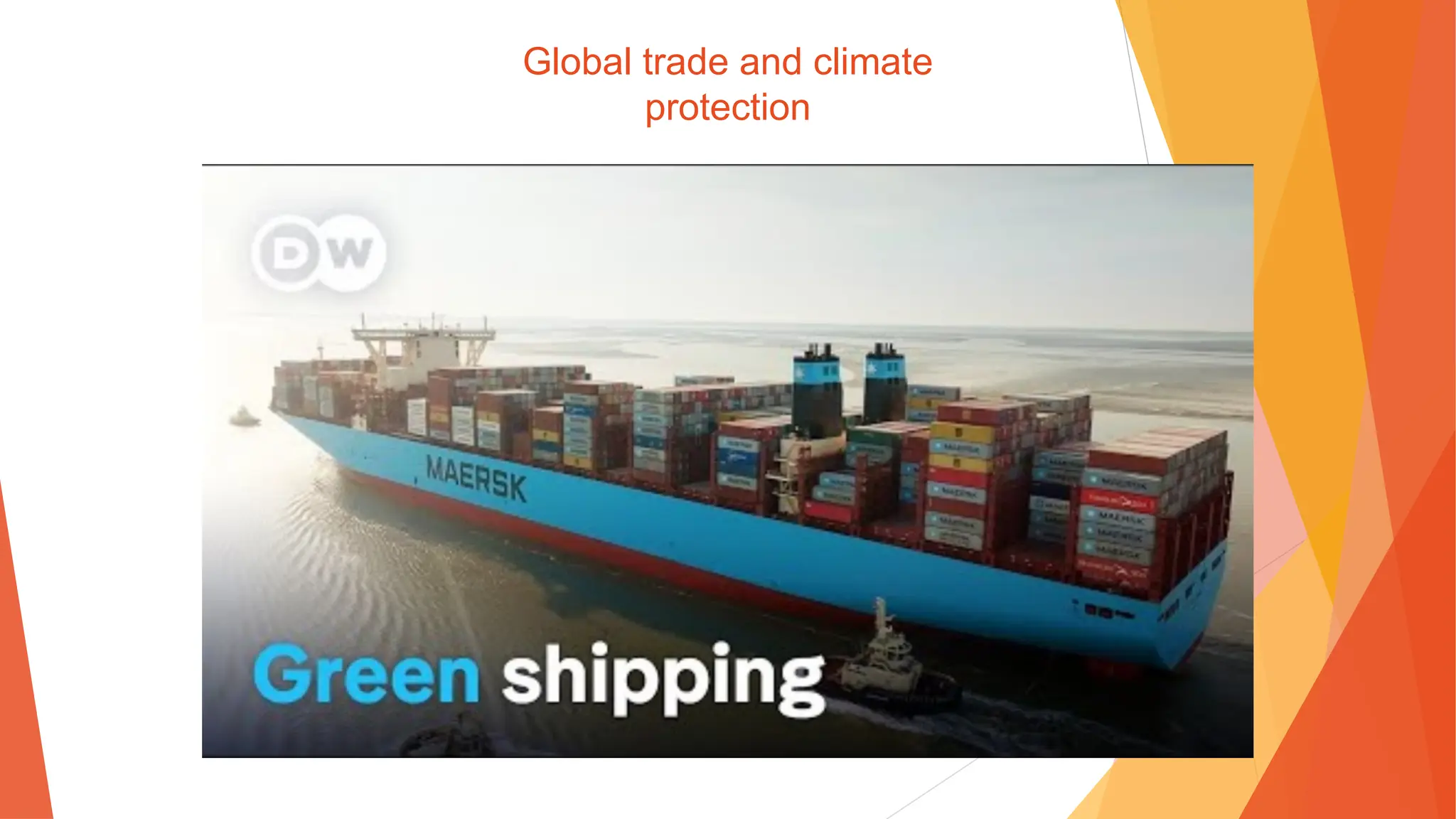
Global trade and
climate protection
Eighty per cent of all goods come to us by sea. But
this form of transportation’s carbon footprint is
woefully bad. Ships are responsible for almost three
per cent of global CO2 emissions. Shipping
companies know their boats need a serious green
boost.
Without ships, there’s no global trade. New legal
requirements and environmentally aware clients are
putting increasing pressure on shipping companies to
provide CO2-neutral transport. If these companies
want to continue to play a key role, they must act. In
response to this situation, a few pioneers are taking
the first difficult steps. They want to switch their ships
to climate-neutral fuels. It’s a bold step.
Whereas an energy transition has long been underway
in other transport sectors, up to now little attention
has been paid to climate protection in international
shipping. But now, the industry is under pressure.
Legal requirements have either been passed or are
about to be passed on both national and international
levels.
The film accompanies shipowners, engineers and
researchers as they navigate an energy revolution on
the water. The sector needs to be reorganized in such
a way that the climate and the environment are
protected - while ensuring that international maritime
transport remains profitable. Can this change succeed
in time?
This Photo by Unknown Author is licensed under CC BY-ND
Global trade and climate
protection

customsissuesandprocedure part 12.pptx customsissuesandprocedure part 12.pptx

  • 1.
  • 2.
  • 3.
    Important Dates ▶ Assignment9/23/2024 ▶ Midterm 9/26/2024 ▶ Final 10/3/2024 This Photo by Unknown Author is licensed under CC BY-SA-NC
  • 4.
    Terminal Learning Objectives ▶ Understandthe role of customs in international trade. ▶ Identify key customs procedures and documentation required for imports and exports. ▶ Analyze common issues and challenges related to customs compliance. ▶ Explore strategies for ensuring smooth customs operations and avoiding delays or penalties.
  • 5.
    Overview ▶ Overview ofCustoms Regulations, Procedures, and Their Impact on Supply Chain Operations Customs regulations are government-imposed rules and standards that regulate the movement of goods across international borders. These regulations aim to ensure the safety, security, and compliance of traded goods, collect revenue (duties and taxes), and enforce national and international laws. Understanding and adhering to customs regulations is a critical aspect of supply chain management because it directly impacts the flow of goods, cost structures, and lead times. This Photo by Unknown Author is licensed under CC BY-ND
  • 6.
    Overview ▶Key Components ofCustoms Regulations 1. Classification and Valuation of Goods • Goods are classified using the Harmonized System (HS) Codes, which determine duty rates and taxes. • Customs valuation is the process of determining the monetary value of the imported goods for taxation. The value is often based on the transaction value but may also include transportation costs, insurance, and other charges. 2. Documentation Requirements • Common documents include Bill of Lading, Commercial Invoice, Packing List, Certificate of Origin, and Import/Export Licenses. • Proper documentation is crucial to facilitate the customs clearance process, minimize delays, and avoid penalties. 3. Import and Export Controls • Certain goods may be subject to import quotas, embargoes, or special licenses. • Regulations can vary significantly by product type, country of origin, and destination. For example, high- tech or dual-use goods might require special permits due to security concerns. 4. Customs Duties, Taxes, and Tariffs • These are financial charges imposed on goods. They vary depending on the classification, value, and trade agreements between countries. • Tariffs can affect supply chain costs, making it critical for companies to explore tariff mitigation strategies like duty drawbacks or utilizing Free Trade Zones (FTZs). 5. Trade Agreements and Preferences • Trade agreements (e.g., NAFTA/USMCA, EU Single Market, RCEP) can reduce or eliminate duties for qualifying goods. • Companies need to ensure that they meet rules of origin and other conditions to benefit from these agreements. 6. Customs Security Programs • Programs like the Customs-Trade Partnership Against Terrorism (C-TPAT) or Authorized Economic Operator (AEO) establish partnerships between This Photo by Unknown Author is licensed under CC BY-ND
  • 7.
    Overview ▶Customs Procedures Customs proceduresinvolve a series of steps to ensure goods are compliant with the regulations of the importing and exporting countries. The key procedures are: 1. Pre-Shipment Procedures • Pre-shipment inspections (if applicable). • Advance customs declarations and submission of supporting documents. 2. Customs Clearance Process • Goods arriving at the port are registered, and documents are reviewed. • Goods may undergo physical or documentary inspections to verify compliance. • Payment of applicable duties, taxes, and fees. 3. Release of Goods • After successful customs clearance, goods are released for delivery to the importer. 4. Post-Entry Procedures • Audits and verifications can occur to ensure compliance even after the goods have been cleared. • Discrepancies may lead to fines, This Photo by Unknown Author is licensed under CC BY-ND
  • 8.
    Overview ▶Impact of CustomsRegulations on Supply Chain Operations 1. Lead Time and Inventory Management • Customs procedures, especially if complex or time-consuming, can significantly impact lead times. • Delays at customs can cause disruptions in supply chain schedules, forcing companies to hold higher levels of safety stock, which increases carrying costs. 2. Costs and Cash Flow • Duties, taxes, and fees contribute to the landed cost of goods. • Companies must manage cash flows effectively since duties are often payable upfront, impacting working capital. 3. Supply Chain Design and Sourcing Decisions • Customs regulations influence sourcing decisions, especially when trade barriers or tariffs make certain supply chain routes cost- prohibitive. • Companies often explore tariff engineering (e.g., reclassifying products under different HS codes) or change their sourcing and manufacturing locations to optimize costs. 4. Risk and Compliance Management • Non-compliance can lead to fines, seizure of goods, and loss of business reputation. • Maintaining compliance involves significant administrative resources, leading many companies to invest in customs compliance teams or outsource to customs brokers. 5. Use of Trade Zones and Special Economic Areas • Companies can leverage Free Trade Zones (FTZs), Bonded Warehouses, and Export Processing Zones (EPZs) to defer or reduce duty payments and streamline operations. This Photo by Unknown Author is licensed under CC BY-ND
  • 9.
    Overview ▶Strategies for ManagingCustoms- Related Challenges 1. Utilizing Technology • Implementing automated customs compliance software for real-time tracking, automated document submission, and regulatory updates. 2. Partnering with Experienced Logistics Providers • Third-party logistics (3PL) providers and customs brokers can assist in navigating complex customs processes. 3. Participating in Trusted Trader Programs • Programs like C-TPAT or AEO can lead to expedited customs processing and fewer inspections. 4. Adapting to Regulatory Changes • Regular training, staying updated on regulatory changes, and proactive compliance This Photo by Unknown Author is licensed under CC BY-ND
  • 10.
    Overview How Customs RegulationsAffect the Efficiency and Cost of a Global Supply Chain Customs regulations play a pivotal role in shaping the efficiency and cost structure of global supply chains. Their effects manifest in several areas, ranging from operational delays and increased compliance costs to strategic decisions regarding sourcing, logistics, and inventory management. This Photo by Unknown Author is licensed under CC BY-ND
  • 11.
    Overview Impact on Efficiency 1.Lead Times and Shipping Delays • Customs inspections and clearance processes can introduce significant delays in the flow of goods. Factors such as lengthy documentation reviews, physical inspections, and customs backlogs can slow down the clearance process, affecting the overall lead time of shipments. • Delays caused by customs regulations can disrupt the just- in-time (JIT) supply chain model, which relies on precise timing for inventory replenishment and production scheduling. 2. Complexity in Documentation and Procedures • Different countries have varying documentation requirements, which can complicate the shipment process and require additional time and resources to prepare, review, and submit documents. • Errors in documentation or misclassification of goods can lead to rejections, rework, or additional inspections, further delaying shipments and reducing supply chain efficiency. 3. Increased Risk of Non-Compliance • Non-compliance with customs regulations—whether intentional or due to lack of knowledge—can result in penalties, fines, or even the seizure of goods. This increases uncertainty and risk in the supply chain. • To mitigate this risk, companies often implement rigorous compliance processes, which can slow down operations and require substantial administrative effort. 4. Security Programs and Trusted Trader Initiatives • Participating in customs security programs like the Customs-Trade Partnership Against Terrorism (C-TPAT) or the Authorized Economic Operator (AEO) can enhance supply chain efficiency by expediting customs clearance, reducing inspections, and providing preferential treatment. • However, these programs require initial investments in security measures, documentation, and regular audits, which can be resource-intensive. 5. Coordination and Communication • Efficient customs management requires seamless coordination among multiple stakeholders, including suppliers, logistics providers, customs brokers, and regulatory authorities. Breakdowns in communication can lead to delays and inefficiencies, especially in global supply chains where multiple countries and regulations are involved. This Photo by Unknown Author is licensed under CC BY-ND
  • 12.
    Overview Impact on Cost 1.Customs Duties, Taxes, and Tariffs • Customs duties and tariffs add to the landed cost of goods, which directly impacts profitability. Depending on the nature of the goods and the trade agreements in place, these costs can significantly vary. • Fluctuations in tariff policies, such as the imposition of trade barriers or retaliatory tariffs, can increase costs unpredictably, leading to higher overall costs or the need to reroute supply chains. 2. Compliance Costs • Maintaining compliance with customs regulations involves costs associated with filing declarations, record- keeping, and the use of specialized customs software. • The cost of employing or contracting customs compliance experts, or working with customs brokers, also adds to the total cost of goods. 3. Inventory Holding Costs • Due to the uncertainty and variability of customs clearance times, companies may need to hold higher levels of safety stock to buffer against delays. This increases inventory holding costs and ties up capital in inventory that could otherwise be used more productively. 4. Costs Associated with Customs Delays and Penalties • Delays in customs clearance can result in additional demurrage and detention fees, storage charges, and other incidental costs. • Non-compliance penalties, fines, or the cost of re- exporting or destroying non-compliant goods can be substantial, especially for large-volume shipments. 5. Impact on Sourcing and Procurement • Customs regulations influence decisions on sourcing and procurement by determining the overall landed cost of goods. Companies may source products from regions with favorable trade agreements or lower tariffs, even if production costs are higher. • Strategies like tariff engineering (modifying the product to fall under a different tariff classification) or using Free Trade Zones (FTZs) can help reduce costs, but they add complexity to operations. This Photo by Unknown Author is licensed under CC BY-ND
  • 13.
    Overview Strategic Considerations andLong-Term Impact 1. Supply Chain Design and Network Optimization • Customs regulations may require businesses to rethink their supply chain design. For instance, companies might consolidate shipments to minimize customs clearance costs or utilize bonded warehouses to defer duties until goods are sold. • Strategic placement of distribution centers and manufacturing facilities near FTZs or Special Economic Zones can optimize supply chain costs and streamline operations. 2. Sourcing and Production Decisions • Shifts in tariff policies or customs regulations can lead to changes in sourcing and production locations. For example, the U.S.-China trade war caused many companies to diversify their supply chains by shifting production to other Asian countries, such as Vietnam or India. 3. Investment in Compliance Infrastructure • Companies involved in international trade must invest in compliance systems, software, and trained personnel. These investments, while costly upfront, are necessary to minimize long-term compliance risks and maintain supply chain efficiency. 4. Use of Trade Agreements and Customs Programs • Leveraging free trade agreements (FTAs) can reduce or eliminate tariffs, but it requires companies to ensure that goods meet rules of origin and other criteria. This can lead to increased costs for origin verification and compliance audits. • Similarly, participating in trusted trader programs can reduce long-term customs-related costs, but the initial investments in security and compliance measures can be high. This Photo by Unknown Author is licensed under CC BY-ND
  • 14.
    Overview Customs regulations havea profound impact on the efficiency and cost of global supply chains. While they introduce complexities and costs related to compliance, documentation, and duties, they also offer opportunities for companies to optimize their operations through strategic planning, the use of trade agreements, and participation in customs programs. Businesses that successfully navigate customs regulations can gain a competitive advantage by minimizing delays, reducing costs, and ensuring a reliable supply chain flow. This Photo by Unknown Author is licensed under CC BY-ND
  • 15.
    Key Custom Procedures and Compliance TheHarmonized System (HS) is an internationally standardized system used to classify traded products. Developed and maintained by the World Customs Organization (WCO), it serves as the foundation for tariff classification, statistical data collection, and the regulation of international trade. Understanding the HS is critical for companies involved in importing and exporting, as it directly impacts customs duties, taxes, and compliance. This Photo by Unknown Author is licensed under CC BY-ND
  • 16.
    Key Custom Procedures and Compliance Structureof the Harmonized System The HS is a hierarchical classification system that organizes products using a coding structure. It is designed to identify all goods traded internationally with a unique number called an HS Code. The system is structured into a series of chapters, headings, and subheadings: 1. Chapters: There are 99 chapters in the HS, each corresponding to a broad category of goods (e.g., Chapter 84: Machinery and Mechanical Appliances). 2. Headings: Within each chapter, there are specific headings that further classify goods (e.g., 84.29: Self-propelled bulldozers). 3. Subheadings: Headings are broken down into subheadings for a more precise description (e.g., 8429.52: Machinery for leveling). The complete HS Code is a six-digit number, structured as follows: • First two digits: Identify the chapter. • Next two digits: Identify the heading within that chapter. • Last two digits: Identify the subheading within that heading. For example, an HS code of 8429.52 translates to Chapter 84 (Machinery), Heading 29 (Bulldozers), and Subheading 52 (Leveling machinery). This Photo by Unknown Author is licensed under CC BY-ND
  • 17.
    Key Custom Procedures and Compliance Purposeand Functions of the HS The Harmonized System serves several critical functions in international trade: 1. Determining Customs Duties and Taxes • HS codes are used by customs authorities worldwide to apply the appropriate tariff rates to imported goods. This ensures consistency and transparency in the application of duties and taxes. 2. Trade Agreements and Preferential Tariffs • HS codes are used to determine eligibility for preferential tariff rates under trade agreements. For instance, under the USMCA (formerly NAFTA), specific HS codes may be eligible for duty-free treatment, provided they meet the rules of origin. 3. Data Collection and Statistical Analysis • Governments and organizations use HS codes to collect and analyze trade statistics. These statistics help track trade flows, monitor economic performance, and inform trade policy decisions. 4. Compliance and Trade Regulation • The HS helps ensure compliance with international trade regulations, including prohibitions and restrictions on certain goods (e.g., dual-use goods, hazardous materials). 5. Facilitation of International Trade • By providing a standardized classification system, the HS reduces ambiguity and discrepancies in product classification, thereby facilitating smoother customs procedures and reducing the risk of errors. This Photo by Unknown Author is licensed under CC BY-ND
  • 18.
    Key Custom Procedures and Compliance HarmonizedSystem and National Tariff Schedules While the HS provides a globally standardized six-digit code, individual countries often expand this classification system with additional digits to create their own national tariff schedules. These national codes include: • Harmonized Tariff Schedule (HTS) for the United States. • Integrated Tariff of the European Communities (TARIC) for the European Union. • Customs Tariff Schedule (HS Code) for Canada. National schedules may add four or more digits to the basic six-digit HS code for a total of 8–10 digits or more, allowing countries to further specify product categories based on their own regulations or economic interests. This Photo by Unknown Author is licensed under CC BY-ND
  • 19.
    Key Custom Procedures and Compliance Rulesfor Classifying Goods under the HS The classification of goods under the HS is governed by six General Interpretative Rules (GIRs): 1. Rule 1: Titles of Sections, Chapters, and Subheadings • Classification is based on the legal text of headings, chapter notes, and section notes, rather than just the titles of the chapters or sections. 2. Rule 2: Incomplete, Unfinished, or Unassembled Goods • Incomplete or unfinished goods are classified as if they were complete or finished, provided they have the essential character of the finished product. 3. Rule 3: Classification of Mixed or Composite Goods • If goods could be classified under two or more headings, preference is given based on the heading that provides the most specific description, the essential character, or the order in which the headings appear. 4. Rule 4: Classification Based on Most Similar Goods • Goods that cannot be classified under any heading are classified under the heading for goods that they most closely resemble. 5. Rule 5: Packaging and Containers • Special containers or packaging that are intended to be reused and are suitable for long-term use are classified with the goods they accompany. 6. Rule 6: Subheading Classification • When classifying under a subheading, the classification is based on the specific subheading descriptions and any additional subheading notes. This Photo by Unknown Author is licensed under CC BY-ND
  • 20.
    Key Custom Procedures and Compliance Challengesand Best Practices in Using the HS While the HS is a widely adopted system, using it accurately can be challenging due to: • Complexity in Product Classification • Some goods may fit into multiple categories or require additional interpretation based on technical specifications, making classification a subjective process. • Frequent Updates and Changes • The HS is updated every five years to reflect changes in technology, trade patterns, and new product innovations. Companies must stay up-to-date with these changes to ensure compliance. • Penalties for Misclassification • Misclassification can lead to underpayment or overpayment of duties, fines, penalties, or seizure of goods by customs authorities. Therefore, it is crucial for companies to have robust classification procedures and skilled personnel. This Photo by Unknown Author is licensed under CC BY-ND
  • 21.
    Key Custom Procedures and Compliance BestPractices: 1.Use Customs Brokers and Consultants: Utilize experts for complex classifications or when entering new markets. 2.Automated Systems: Implement classification software that uses artificial intelligence or machine learning to improve accuracy. 3.Training and Education: Regular training for compliance teams to stay informed about HS updates and changes. This Photo by Unknown Author is licensed under CC BY-ND
  • 22.
    Key Custom Procedures and Compliance TheHarmonized System is a critical tool for international trade, enabling standardized product classification, efficient customs processing, and accurate tariff application. Mastering the HS and ensuring correct classification not only reduces compliance risks but also optimizes cost management and supports smoother global supply chain operations. This Photo by Unknown Author is licensed under CC BY-ND
  • 23.
    Key Custom Procedures and Compliance Customsvaluation is the process by which customs authorities determine the monetary value of imported goods. This value is crucial because it serves as the basis for calculating customs duties, taxes, and other charges. Different pricing terms, such as Free on Board (FOB) and Cost, Insurance, and Freight (CIF), play a key role in determining the value of goods for customs purposes. Understanding these terms and their impact on customs valuation is essential for accurate duty calculation and compliance. This Photo by Unknown Author is licensed under CC BY-ND
  • 24.
    Key Custom Procedures and Compliance WhatAre FOB and CIF? 1. Free on Board (FOB) • FOB is an international shipping term that indicates when the ownership and risk of goods transfer from the seller to the buyer. Under FOB, the seller is responsible for all costs and risks up to the point where the goods are loaded onto the shipping vessel at the port of origin. • In an FOB agreement, the buyer is responsible for the transportation costs, insurance, and any risks that occur once the goods are on board the vessel. 2. Customs Valuation Using FOB: • When calculating the customs value using the FOB method, only the value of the goods and the costs up to the loading point (e.g., manufacturing cost, packaging, and inland transportation to the port) are considered. • This excludes international freight and insurance costs, making the customs value lower than under CIF pricing. 3. Cost, Insurance, and Freight (CIF) • CIF is another international shipping term that reflects the total cost of the goods, including shipping and insurance, up to the destination port. Under a CIF agreement, the seller assumes responsibility for the cost of goods, insurance, and freight charges until the goods reach the buyer’s port. • The buyer assumes the risks and costs associated with unloading and transportation beyond the destination port. 4. Customs Valuation Using CIF: • When calculating customs value under CIF terms, the valuation includes the cost of the goods, insurance, and international freight charges. • This results in a higher customs value compared to FOB pricing, as it accounts for additional costs incurred in transporting the goods to the buyer’s port. This Photo by Unknown Author is licensed under CC BY-ND
  • 25.
    Key Custom Procedures and Compliance Comparison:FOB vs. CIF for Customs Valuation The key difference between FOB and CIF in customs valuation is the inclusion of international freight and insurance costs. Understanding this difference is crucial because it directly affects the dutiable value of imported goods.
  • 26.
    Key Custom Procedures and Compliance Impacton Customs Valuation and Duty Calculation 1. Customs Value Determination • Customs authorities generally seek to use the CIF value for customs valuation, as it represents the full landed cost of the goods, including all costs incurred until the goods arrive at the destination port. • In cases where FOB pricing is used, customs authorities will typically add the value of international freight and insurance to determine the customs value, thereby arriving at a value similar to the CIF pricing. 2. Impact on Duties and Taxes • Since duties and taxes are calculated as a percentage of the customs value, using the CIF value often results in higher duties compared to FOB, as the CIF value includes additional cost elements. • For example, if the duty rate is 10% and the FOB value of goods is $10,000, while the CIF value is $12,000, the duty payable under FOB pricing would be $1,000 (10% of $10,000), whereas under CIF pricing, it would be $1,200 (10% of $12,000). 3. Selection of Pricing Terms for Cost Optimization • Importers often choose FOB terms when they want to control freight and insurance costs and have a clearer understanding of the customs valuation basis. • Exporters might prefer CIF terms if they can negotiate favorable shipping and insurance rates and include these costs in the sale price, thereby minimizing perceived costs for the buyer. This Photo by Unknown Author is licensed under CC BY-ND
  • 27.
    Key Custom Procedures and Compliance CustomsRegulations and Requirements 1. Customs Valuation Methods • Under the WTO Customs Valuation Agreement, the primary basis for customs valuation is the transaction value of the goods, which is the price actually paid or payable for the goods when sold for export, adjusted as necessary. • If FOB pricing is declared, customs authorities may require supporting documentation to justify the exclusion of international freight and insurance costs and may request these costs to be added for valuation purposes. 2. Documentation Requirements • Importers and exporters must provide clear documentation, such as the Commercial Invoice, Bill of Lading, and Insurance Certificates, to demonstrate the terms of sale and accurately determine the customs value. • Any discrepancies between declared values and documentation can lead to delays, reassessments, or penalties. This Photo by Unknown Author is licensed under CC BY-ND
  • 28.
    Key Custom Procedures and Compliance Implicationsfor Supply Chain and Compliance 1. Strategic Considerations • Choosing between FOB and CIF terms can have strategic implications for supply chain management, cost control, and cash flow. For example, using FOB pricing allows the buyer to negotiate their own shipping and insurance rates, potentially reducing overall costs. • On the other hand, CIF terms simplify the purchasing process for the buyer, as all costs up to the port of destination are covered by the seller. 2. Compliance and Risk Management • Companies must ensure that the declared customs value accurately reflects the agreed-upon pricing terms. Overvaluing or undervaluing goods can lead to compliance issues, potential penalties, and delays in customs clearance. 3. Trade Agreements and Duty Mitigation • Importers should also consider how trade agreements and preferential tariff treatments may affect duty rates under different valuation scenarios. For example, the use of FTAs often requires the use of specific customs valuation methods to demonstrate compliance with rules of origin. This Photo by Unknown Author is licensed under CC BY-ND
  • 29.
    Key Custom Procedures and Compliance FOBand CIF pricing play a crucial role in determining customs value, which in turn affects the calculation of duties, taxes, and overall landed costs. Importers and exporters must carefully select and document their pricing terms to optimize costs and ensure compliance with customs regulations. Understanding the nuances of FOB and CIF helps companies navigate international trade more effectively and achieve better control over their supply chain costs. This Photo by Unknown Author is licensed under CC BY-ND
  • 30.
    Key Custom Procedures and Compliance Documentationis a fundamental aspect of import/export operations and customs procedures. Each document serves a specific purpose and is required by customs authorities, financial institutions, or other stakeholders to ensure compliance, legal ownership, and the smooth movement of goods across borders. Below is an overview of the most common documents used in international trade: 1.Commercial Invoice 2.Packing List 3.Bill of Lading (B/L) 4.Certificate of Origin (COO) 5.Insurance Certificate This Photo by Unknown Author is licensed under CC BY-ND
  • 31.
    Key Custom Procedures and Compliance CommercialInvoice Purpose: The Commercial Invoice is the primary document used in international trade. It serves as a record of the sale transaction between the seller (exporter) and the buyer (importer) and is used by customs authorities to determine the value of the goods for the assessment of duties and taxes. Contents: • Names and addresses of the buyer and seller • Invoice number and date • Description of the goods (including HS codes, quantity, weight, and value) • Unit price and total price • Currency of transaction • Payment terms (e.g., cash in advance, open account, letters of credit) • Shipping terms (Incoterms) (e.g., FOB, CIF) • Country of origin • Signature of the exporter or authorized person This Photo by Unknown Author is licensed under CC BY-ND
  • 32.
    Key Custom Procedures and Compliance Importance: •Customs authorities use the commercial invoice to assess the customs value, determine duty and tax rates, and confirm the legality of the transaction. • Financial institutions use it to facilitate payments, particularly when the transaction is secured by a letter of credit. • Errors or discrepancies in the commercial invoice can lead to customs delays, fines, or additional inspections. Best Practices: • Ensure all information is accurate, especially product descriptions, quantities, and values. • Use standardized product codes, such as the Harmonized System (HS) codes, for easy identification and classification of goods. This Photo by Unknown Author is licensed under CC BY-ND
  • 33.
    Key Custom Procedures and Compliance PackingList Purpose: The Packing List provides detailed information on how the goods are packed, including the number of packages, dimensions, weight, and contents of each package. It is used by logistics providers, customs authorities, and the importer to verify the contents of the shipment. Contents: • Invoice reference number (to link the packing list to the commercial invoice) • Description of goods (as per the commercial invoice) • Packaging details (e.g., number of boxes, crates, pallets) • Dimensions and weight of each package • Marks and numbers on each package for identification • Special handling instructions, if applicable This Photo by Unknown Author is licensed under CC BY-ND
  • 34.
    Key Custom Procedures and Compliance Importance: •Customs authorities use the packing list to verify the contents of the shipment and match it with the commercial invoice. • Carriers and logistics providers use it to confirm the number of items, check weight and volume, and plan for efficient loading and unloading. • Any discrepancies between the packing list and other documents can cause delays and result in additional inspections or rejections. Best Practices: • Provide clear, concise, and consistent descriptions of goods that match the commercial invoice. • Use standardized units of measurement and include both metric and imperial units where applicable. This Photo by Unknown Author is licensed under CC BY-ND
  • 35.
    Key Custom Procedures and Compliance Billof Lading (B/L) Purpose: The Bill of Lading (B/L) is a legal document issued by the carrier (e.g., shipping line, airline, trucking company) to the shipper, acknowledging receipt of goods and serving as a contract of carriage and a document of title. Types of Bills of Lading: • Straight Bill of Lading: Non-negotiable; goods are delivered to the named consignee only. • Negotiable Bill of Lading (Order B/L): Can be endorsed and transferred to third parties, serving as a document of title for the goods. Contents: • Names and addresses of the shipper and consignee • Port of loading and port of discharge • Description of goods (including weight, dimensions, and number of packages) • Shipping terms and conditions • Freight charges (whether prepaid or collect) • Vessel and voyage number (for ocean shipments) • Signature of the carrier or agent This Photo by Unknown Author is licensed under CC BY-ND
  • 36.
    Key Custom Procedures and Compliance Importance: •The B/L acts as a contract of carriage between the shipper and the carrier, outlining terms and responsibilities. • It serves as a receipt of goods from the carrier, confirming that goods have been received in good condition and are ready for shipment. • As a document of title, it allows the holder of the B/L to take ownership of the goods. It is often used in financing transactions, where the importer cannot take possession of the goods until payment has been made. Best Practices: • Ensure the information on the B/L matches the commercial invoice and packing list. • Use the correct Incoterm to define the responsibilities of the shipper and the consignee. This Photo by Unknown Author is licensed under CC BY-ND
  • 37.
    Key Custom Procedures and Compliance Importance: •Customs authorities use the COO to verify eligibility for preferential tariff treatment and ensure compliance with trade agreements. • It helps importers and exporters reduce duty costs by proving compliance with the rules of origin for specific agreements. Best Practices: • Obtain the COO from an authorized body, such as a Chamber of Commerce, to ensure authenticity. • Keep a record of the COO for audit purposes, as customs authorities may request it for verification even after goods have been cleared. This Photo by Unknown Author is licensed under CC BY-ND
  • 38.
    Key Custom Procedures and Compliance InsuranceCertificate Purpose: The Insurance Certificate provides proof that the goods are insured against loss, damage, or other risks during transit. It is often required when shipping under terms like CIF or CIP (Carriage and Insurance Paid to). Contents: • Policy number and insurance company • Insured party’s name and address • Description of goods (as per the commercial invoice) • Insured value and currency • Coverage details (e.g., "All Risks" or specific exclusions) • Effective dates of coverage This Photo by Unknown Author is licensed under CC BY-ND
  • 39.
    Key Custom Procedures and Compliance Importance: •The Insurance Certificate protects the buyer and seller against financial loss in the event of damage or loss during transit. • It is essential for customs clearance in some countries, especially when the customs valuation includes insurance costs. Best Practices: • Ensure that the insurance coverage matches the agreed terms in the sales contract. • Include clear information on exclusions or special conditions that may affect coverage. This Photo by Unknown Author is licensed under CC BY-ND
  • 40.
    Key Custom Procedures and Compliance Eachdocument in the import/export process serves a unique and vital role in ensuring the legal and compliant movement of goods across borders. Understanding and preparing accurate documentation is essential for minimizing delays, avoiding penalties, and ensuring smooth customs clearance. Traders must ensure consistency across all documents to reduce discrepancies and the risk of customs rejections or delays. This Photo by Unknown Author is licensed under CC BY-ND
  • 41.
    Key Custom Procedures and Compliance ComplianceRequirements: Country- Specific Import/Export Restrictions, Embargoes, and Sanctions In international trade, compliance with import and export regulations is critical to ensure the smooth flow of goods across borders and to avoid legal and financial repercussions. Many countries have specific restrictions, embargoes, and sanctions that govern the movement of goods, technology, and services. These measures are often enforced to achieve economic, political, and security objectives, and non- compliance can result in severe penalties, including fines, imprisonment, or the loss of export privileges. This Photo by Unknown Author is licensed under CC BY-ND
  • 42.
    Key Custom Procedures and Compliance Country-SpecificImport/Export Restrictions Import and export restrictions are rules and regulations imposed by countries to control the entry and exit of certain goods. These restrictions can be motivated by health and safety concerns, environmental protection, cultural preservation, or political considerations. 1. Restricted and Controlled Goods 1. Countries often maintain lists of restricted or controlled goods that require special permits or licenses to import or export. Examples include: • Pharmaceuticals and Chemicals: Require special permits to ensure they are not misused or diverted for illegal activities. • Dual-Use Goods: Items that can be used for both civilian and military purposes (e.g., advanced electronics, encryption software) often require additional export licenses. • Agricultural Products: Many countries impose phytosanitary regulations to prevent the spread of pests or diseases. • Textiles and Clothing: Subject to quotas, tariffs, and country-specific labeling requirements. 2. Technical Standards and Certification Requirements 1. Imported goods may need to comply with technical standards or certification requirements. Examples include: • CE Marking in the European Union. • FCC Compliance for electronics in the United States. • CCC Certification for certain products in China. 3. Product Labeling and Marking • Countries may require specific labeling and marking requirements for imported goods, including language requirements, country of origin markings, and safety warnings. 4. Licensing and Permits • Import and export of certain goods may require obtaining licenses or permits from relevant authorities. For instance: 1. Export licenses for controlled goods from the U.S. Bureau of Industry and Security (BIS). 2. Import licenses for agricultural products regulated by the U.S. Department of Agriculture (USDA). 5. Health, Safety, and Environmental Compliance • Compliance with health, safety, and environmental regulations is mandatory for certain categories of goods, such as chemicals, food products, and hazardous materials. This Photo by Unknown Author is licensed under CC BY-ND
  • 43.
    Key Custom Procedures and Compliance Example:U.S. Export Administration Regulations (EAR) • The U.S. EAR, enforced by the BIS, controls the export of goods, software, and technology for reasons of national security, foreign policy, and non- proliferation. Companies must check whether their products are listed on the Commerce Control List (CCL) and determine if an export license is required. Example: EU Dual-Use Regulation • The EU regulates the export of dual- use items (goods that can be used for both civilian and military applications) to ensure they are not used for military purposes or human rights violations. Exporters must comply with these regulations and apply for licenses if required. This Photo by Unknown Author is licensed under CC BY-ND
  • 44.
    Key Custom Procedures and Compliance Embargoes Embargoesare government-imposed restrictions that completely or partially prohibit trade or the movement of goods to or from specific countries. They are often used as a tool for foreign policy or to achieve political objectives. 1. Types of Embargoes • Comprehensive Embargoes: Complete bans on all forms of trade with a particular country (e.g., North Korea, Syria). • Partial Embargoes: Restrictions on specific types of goods, services, or technology (e.g., arms embargo on Myanmar). • Sectoral Embargoes: Target specific sectors or industries, such as oil, financial services, or technology. 2. Impact on Trade • Embargoes can disrupt existing supply chains, force companies to source from alternative markets, and result in loss of business opportunities. • Violating an embargo can lead to severe penalties, including fines, asset seizure, and loss of trading rights. 3. Examples of Embargoes • United States Embargo on Cuba: The U.S. restricts trade with Cuba, except for certain humanitarian and informational goods. Businesses must obtain specific licenses to export goods to Cuba. • European Union Arms Embargo on Iran: The EU has an embargo on the sale of military equipment and technology to Iran, which is enforced alongside restrictions on financial transactions. This Photo by Unknown Author is licensed under CC BY-ND
  • 45.
    Key Custom Procedures and Compliance Sanctions Sanctionsare restrictions imposed by one or more countries against a targeted country, entity, or individual. Sanctions are used to achieve foreign policy goals, promote human rights, or prevent the spread of weapons of mass destruction. 1. Types of Sanctions 1. Economic Sanctions: Restrictions on financial transactions, trade, or access to markets (e.g., blocking the financial assets of individuals or entities). 2. Trade Sanctions: Prohibitions on the export or import of certain goods (e.g., sanctions on oil exports from Iran). 3. Individual or Entity Sanctions: Restrictions on doing business with specific individuals, companies, or organizations (e.g., the U.S. Office of Foreign Assets Control (OFAC) Specially Designated Nationals (SDN) List). 2. Compliance Requirements 1. Companies must conduct due diligence to ensure they do not engage in transactions with sanctioned individuals, entities, or countries. This involves screening business partners, customers, and financial transactions against sanction lists. 2. Financial institutions often have strict compliance programs to identify and block transactions involving sanctioned parties. 3. Penalties for Non-Compliance 1. Non-compliance with sanctions can lead to severe penalties, including fines, criminal charges, loss of export privileges, and reputational damage. 2. Violations can also result in the seizure of goods, revocation of export licenses, and restrictions on future trade activities. This Photo by Unknown Author is licensed under CC BY-ND
  • 46.
    Key Custom Procedures and Compliance Example:U.S. OFAC Sanctions • The U.S. OFAC administers and enforces economic and trade sanctions against targeted countries and individuals. Companies must comply with OFAC regulations and avoid transactions involving individuals or entities on the SDN List. Example: United Nations (UN) Sanctions • The UN imposes sanctions to maintain international peace and security. Member states are obligated to implement these sanctions, which may include arms embargoes, travel bans, or asset freezes. This Photo by Unknown Author is licensed under CC BY-ND
  • 47.
    Key Custom Procedures and Compliance BestPractices for Compliance 1. Know Your Customer (KYC) and Partner Due Diligence 1. Conduct thorough due diligence on all customers, suppliers, and partners to ensure compliance with sanctions and embargoes. 2. Use compliance software to screen business partners against global watchlists (e.g., OFAC SDN List, EU Sanctions List, UN Sanctions List). 2. Implement a Compliance Program 1. Develop an internal compliance program that includes regular training, risk assessments, and internal audits to ensure compliance with country- specific import/export regulations. 2. Establish clear processes for obtaining licenses and permits, record-keeping, and reporting any potential violations. 3. Use Automated Tools for Screening and Classification 1. Utilize automated tools and software to screen transactions, products, and parties against relevant sanction and embargo lists. 2. Implement product classification tools to ensure accurate export classification and licensing determinations. 4. Stay Updated on Regulatory Changes 1. Sanctions, embargoes, and trade regulations are subject to change based on political developments and international relations. Staying informed about regulatory changes is crucial for ongoing compliance. 5. Consult with Experts 1. Engage legal and compliance experts to navigate complex regulations, especially when dealing with high-risk countries, controlled goods, or sanctioned entities. This Photo by Unknown Author is licensed under CC BY-ND
  • 48.
    Key Custom Procedures and Compliance Compliancewith country-specific import/export restrictions, embargoes, and sanctions is essential for any business involved in international trade. Violating these regulations can lead to significant financial penalties, legal consequences, and damage to business reputation. Implementing a robust compliance program, conducting due diligence, and staying informed of regulatory changes are critical steps to ensuring compliance and mitigating risks in global supply chain operations. This Photo by Unknown Author is licensed under CC BY-ND
  • 49.
    Key Custom Procedures and Compliance PotentialPenalties for Non- Compliance and Their Impact on Operations Non-compliance with import/export regulations, trade restrictions, embargoes, and sanctions can have severe legal, financial, and operational consequences. These penalties not only impact the immediate transaction but can also disrupt long-term business operations, affect market access, and damage a company’s reputation. Below is an overview of the potential penalties for non-compliance and their broader impact on business operations: This Photo by Unknown Author is licensed under CC BY-ND
  • 50.
    Key Custom Procedures and Compliance PotentialPenalties for Non-Compliance 1. Fines and Monetary Penalties 1. Monetary penalties are one of the most common consequences of non-compliance and can be substantial. The amount of the fine varies depending on the severity of the violation, the value of the goods involved, and whether the violation was intentional or accidental. 2. Examples: 1. The U.S. Bureau of Industry and Security (BIS) can impose fines of up to $1,000,000 per violation for intentional breaches of export controls. 2. The U.S. Office of Foreign Assets Control (OFAC) can levy civil penalties of up to $311,562 per violation or twice the value of the transaction, whichever is greater. 2. Seizure of Goods 1. Customs authorities may seize or detain goods that are not compliant with import/export regulations. Seizure can occur due to reasons such as misclassification, undervaluation, lack of proper documentation, or violations of restrictions and sanctions. 2. Seized goods may be held indefinitely, forfeited to the government, or even destroyed, resulting in the total loss of the shipment and potential disruption to the supply chain. 3. Revocation of Export/Import Privileges 1. Government authorities may suspend or revoke a company’s export or import licenses, preventing the firm from conducting international trade activities. This can be devastating, especially for companies that rely heavily on cross-border sales or procurement. 2. Revocation of export privileges may apply to specific product lines, all goods from a particular facility, or even all export activities of a company. This Photo by Unknown Author is licensed under CC BY-ND
  • 51.
    Key Custom Procedures and Compliance PotentialPenalties for Non-Compliance 4. Criminal Charges 1. Severe violations, such as exporting controlled goods to embargoed countries or sanctioned entities, can result in criminal charges against the company and its executives. Penalties can include imprisonment for individuals found guilty of willful violations. 2. For example, under the International Traffic in Arms Regulations (ITAR), individuals found guilty of violating export controls can face up to 20 years in prison. 5. Civil Penalties and Lawsuits 1. Civil penalties can include restitution, the cost of investigation, and legal fees. Additionally, companies may face lawsuits from affected parties, including competitors, partners, or customers, if non-compliance results in business disruptions or damages. 6. Debarment from Government Contracts 1. Companies that violate trade regulations may be barred from participating in government contracts or receiving federal funding. This can be particularly damaging for defense contractors, technology firms, or companies that supply goods or services to government agencies. 7. Reputational Damage 1. Even when no criminal charges are involved, non- compliance can severely damage a company’s reputation, leading to loss of customers, market share, and the inability to attract business partners or investors. This Photo by Unknown Author is licensed under CC BY-ND
  • 52.
    Key Custom Procedures and Compliance Impactof Non-Compliance on Business Operations 1. Supply Chain Disruptions 1. Seizure of goods or delays due to investigations can disrupt supply chain continuity, leading to stockouts, production delays, or missed delivery deadlines. 2. Supply chain disruptions can force companies to find alternative suppliers or logistics routes, increasing lead times and costs. 2. Increased Compliance and Operational Costs 1. After a compliance violation, companies may need to invest significantly in compliance measures, such as implementing new compliance programs, hiring compliance officers, and enhancing internal audits. 2. The costs of corrective actions, legal counsel, and regulatory filings can strain financial resources, especially for small and medium-sized enterprises. 3. Loss of Market Access 1. Non-compliance can result in the loss of access to key markets due to revocation of licenses or being placed on denied party lists. This can lead to a decline in sales and revenue, particularly for companies that rely on exports or imports for their business. 2. Companies may also lose eligibility for preferential tariff treatments under free trade agreements if they fail to comply with rules of origin or other regulatory requirements. 4. Operational Inefficiencies 1. Non-compliance can necessitate significant changes to operational processes, such as rerouting shipments, switching suppliers, or modifying product components to meet regulatory standards. 2. This can lead to increased lead times, higher costs, and inefficiencies in production and logistics. This Photo by Unknown Author is licensed under CC BY-ND
  • 53.
    Key Custom Procedures and Compliance Impactof Non-Compliance on Business Operations 5. Impact on Strategic Relationships 1. Non-compliance can damage relationships with key stakeholders, including suppliers, customers, logistics providers, and financial institutions. For example: 1. Banks and financial institutions may refuse to process transactions involving companies with a history of non-compliance due to the risk of violating sanctions or anti-money laundering laws. 2. Suppliers and customers may seek alternative partners if they perceive a high risk of business disruption due to compliance issues. 6. Long-Term Financial Impact 1. Fines, penalties, and legal fees can have a significant impact on a company’s financial health, reducing profitability and cash flow. 2. In some cases, companies may have to write off the value of seized goods or pay compensation to customers for undelivered products, affecting overall financial stability. 7. Increased Scrutiny and Monitoring 1. Once a company is found non-compliant, it may be subject to increased scrutiny by customs authorities and regulators. This can lead to more frequent audits, inspections, and monitoring of shipments, which can slow down operations and increase compliance costs. 8. Insurance and Financial Risks 1. Non-compliance can lead to higher insurance premiums or even loss of coverage if an insurance provider deems the company’s activities too risky. 2. The company’s credit rating may also be affected, impacting its ability to secure loans or attract investment. This Photo by Unknown Author is licensed under CC BY-ND
  • 54.
    Key Custom Procedures and Compliance Examplesof High-Profile Non-Compliance Cases 1. ZTE Corporation (2018) 1. Chinese telecommunications company ZTE was fined $1.4 billion by the U.S. Department of Commerce for violating U.S. export controls by shipping goods containing U.S. components to Iran and North Korea. 2. The penalty included a suspension of ZTE’s export privileges, which effectively shut down its operations, as it was unable to procure critical U.S.-made components. 2. Siemens (2008) 1. Siemens was fined $1.6 billion for violations of the Foreign Corrupt Practices Act (FCPA) and anti-corruption laws in multiple countries. 2. The scandal led to significant reputational damage, loss of business, and the need for extensive corporate restructuring and compliance improvements. 3. Ericsson (2019) 1. Swedish telecommunications company Ericsson agreed to pay over $1 billion to resolve allegations that it violated the FCPA by engaging in a scheme to bribe government officials in multiple countries. 2. The settlement included a requirement to implement enhanced compliance measures and submit to monitoring by U.S. authorities for several years. This Photo by Unknown Author is licensed under CC BY-ND
  • 55.
    Key Custom Procedures and Compliance BestPractices for Avoiding Non-Compliance 1. Establish a Robust Compliance Program 1. Develop a comprehensive compliance program that includes policies, procedures, and controls to ensure adherence to import/export regulations, sanctions, and trade restrictions. 2. Appoint a compliance officer or team responsible for overseeing and enforcing compliance measures. 2. Regular Training and Awareness 1. Conduct regular training sessions for employees to educate them on compliance requirements, potential risks, and best practices. 2. Include specific training for departments most involved in compliance, such as sales, logistics, finance, and legal. 3. Implement Automated Screening and Classification Tools 1. Use automated tools to screen customers, suppliers, and transactions against global watchlists and denied party lists (e.g., OFAC’s SDN List). 2. Implement product classification tools to ensure correct classification and licensing determinations. This Photo by Unknown Author is licensed under CC BY-ND
  • 56.
    Key Custom Procedures and Compliance BestPractices for Avoiding Non-Compliance 4. Regular Internal Audits and Compliance Reviews 1. Conduct regular internal audits to identify potential compliance gaps and take corrective actions before violations occur. 2. Review compliance policies and procedures annually to keep up with changes in regulations. 5. Engage External Experts and Consultants 1. Consult with legal and compliance experts to navigate complex regulations, especially when dealing with high-risk countries, controlled goods, or sanctioned entities. 2. Seek advice on developing strategies to mitigate compliance risks, such as structuring transactions to avoid unnecessary exposure. 6. Establish Clear Record-Keeping and Documentation Practices 1. Maintain detailed records of all import/export transactions, licenses, permits, and communications with regulatory authorities. 2. Ensure that all documentation is complete, accurate, and readily accessible for audits and compliance checks. This Photo by Unknown Author is licensed under CC BY-ND
  • 57.
    Key Custom Procedures and Compliance Non-compliancewith import/export regulations and trade restrictions can lead to severe penalties, ranging from fines and seizure of goods to criminal charges and loss of market access. The impact of non-compliance extends beyond financial losses to include operational disruptions, damage to strategic relationships, and long-term reputational harm. By implementing robust compliance programs, conducting regular audits, and staying informed about regulatory changes, companies can mitigate these risks and ensure smooth global trade operations. This Photo by Unknown Author is licensed under CC BY-ND
  • 58.
    Key Custom Procedures and Compliance CaseStudy: Compliance Issue Due to Incorrect HS Classification – Ford Motor Company (2019) Background: In 2019, Ford Motor Company faced a significant compliance issue when U.S. Customs and Border Protection (CBP) determined that the company had incorrectly classified imported automotive parts under the Harmonized System (HS) code. Ford imported automotive repair parts, such as parts for transit vans, using HS codes that CBP later deemed inapplicable for the items, resulting in the underpayment of customs duties over a period of several years. This Photo by Unknown Author is licensed under CC BY-ND
  • 59.
    Key Custom Procedures and Compliance Detailsof the Compliance Issue 1. Incorrect HS Classification: 1. Ford imported repair and replacement parts for its vehicles and classified these parts under HS codes that attracted lower tariffs. 2. The classification used by Ford did not reflect the correct descriptions under the Harmonized Tariff Schedule of the United States (HTSUS), leading to underpayment of customs duties. 2. CBP Audit and Investigation: 1. U.S. Customs and Border Protection conducted an audit and determined that the parts should have been classified under a different HS code that imposed a higher duty rate. 2. The misclassification spanned multiple years and involved a large volume of imports, resulting in a substantial duty shortfall. 3. Financial Consequences: 1. Ford was assessed a $181 million penalty for underpaid duties. The penalty included back duties owed, interest, and additional fines for the incorrect classification. 2. The penalty amount represented not only the lost revenue for CBP but also punitive damages for non-compliance with customs regulations. 3. The financial impact extended beyond the penalty itself, as Ford had to allocate additional resources for compliance review, legal consultation, and administrative processes to rectify the misclassification. 4. Reputational Consequences: 1. The incident received widespread media attention, highlighting Ford’s failure to comply with U.S. customs regulations. 2. The compliance issue raised concerns about the company’s internal controls and compliance procedures, potentially affecting Ford’s relationships with regulators and trade partners. 3. Reputational damage from the incident could have long-term effects on Ford’s brand image, especially as the automotive industry is highly scrutinized for compliance with trade and environmental regulations. 5. Operational and Strategic Consequences: 1. Ford was required to implement corrective measures, including reviewing and updating its HS classification processes, retraining its import/export compliance teams, and enhancing its internal audit mechanisms. 2. The company’s supply chain and logistics operations were temporarily disrupted as it worked to reconcile past imports and ensure that all future shipments were correctly classified. This Photo by Unknown Author is licensed under CC BY-ND
  • 60.
    Key Custom Procedures and Compliance KeyLessons and Takeaways 1. Importance of Accurate HS Classification: 1. HS classification is a complex but critical aspect of import/export compliance. Misclassification can result in significant financial penalties and operational disruptions. 2. Companies must ensure that all personnel involved in product classification are well-trained and that classification decisions are supported by a thorough understanding of customs regulations. 2. Need for Regular Compliance Audits: 1. Conducting regular internal audits can help identify potential issues before they escalate into costly compliance violations. 2. Automated classification tools and consulting services can help mitigate risks, especially when dealing with large volumes of imports/exports or complex product categories. 3. Collaboration with Customs Authorities: 1. Establishing good communication and collaboration with customs authorities can help companies address potential issues proactively and avoid punitive measures. 2. When disputes arise, utilizing customs rulings and advance tariff classifications can provide clarity and ensure that the correct HS codes are applied. 4. Financial and Reputational Impact: 1. Non-compliance not only results in financial penalties but also exposes the company to reputational damage, which can affect customer trust, business partnerships, and investor confidence. 2. The aftermath of a compliance violation may require significant investments in compliance programs and damage control measures to restore the company’s reputation. This Photo by Unknown Author is licensed under CC BY-ND
  • 61.
    Key Custom Procedures and Compliance Thecase of Ford Motor Company highlights the critical importance of accurate HS classification in international trade. The financial penalty of $181 million and the subsequent reputational fallout underscore the need for robust compliance programs, regular audits, and proactive engagement with customs authorities. Companies engaged in global trade must prioritize compliance to avoid similar costly and damaging outcomes. This Photo by Unknown Author is licensed under CC BY-ND
  • 62.
    Global trade and climateprotection Eighty per cent of all goods come to us by sea. But this form of transportation’s carbon footprint is woefully bad. Ships are responsible for almost three per cent of global CO2 emissions. Shipping companies know their boats need a serious green boost. Without ships, there’s no global trade. New legal requirements and environmentally aware clients are putting increasing pressure on shipping companies to provide CO2-neutral transport. If these companies want to continue to play a key role, they must act. In response to this situation, a few pioneers are taking the first difficult steps. They want to switch their ships to climate-neutral fuels. It’s a bold step. Whereas an energy transition has long been underway in other transport sectors, up to now little attention has been paid to climate protection in international shipping. But now, the industry is under pressure. Legal requirements have either been passed or are about to be passed on both national and international levels. The film accompanies shipowners, engineers and researchers as they navigate an energy revolution on the water. The sector needs to be reorganized in such a way that the climate and the environment are protected - while ensuring that international maritime transport remains profitable. Can this change succeed in time? This Photo by Unknown Author is licensed under CC BY-ND
  • 63.
    Global trade andclimate protection