International Trade Training  Prepared by:  Suzanne M. Cascanette, CITP Updated March 3, 2012
Agenda HS (Harmonized System) Codes Valuation of Goods imported/exported Importing to Canada Canadian Goods Returned Exporting to USA NAFTA Exporting to International Countries CAED Program Export Control Program CARNET Migra  AMPS Trade Security Programs  History of INCO Terms What INCO Terms Define INCO Terms 2010 in Detail
HS (Harmonized System) Codes Originally developed by the CCC – Customs Cooperation Council now known as WCO -  World Customs Organization  WCO is an international Customs organization headquartered in Brussels Approximately 5000 Headings 99 Chapters with 22 sections Total of 10 digits that should be provided by an expert/consultant HS Code Ruling can be obtained by CBSA (Canada Border Services Agency) First 6 digits used internationally Last 4 digits are country specific for statistical purposes  For more information:  http://www.cbsa-asfc.gc.ca/eservices/ogd-amg/hs-sh-eng.html
Valuation of Goods for Import/Export Shipments crossing borders must always have a value declared.  If goods are sent with zero value they will be stopped and held at Customs. Shipments entering Canada with a value of less than $20cad do not require entry. Shipments entering USA with a value of less than $200usd do not require entry.  When goods are samples, sent for repair, trade show items etc – a fair and reasonable value must be declared for customs clearance.  If there is a transaction between the companies – Transaction value is used.  The value declared must be the exact value that was remitted. Other types of valuation rules exist when there is not an actual sale of goods: Transaction of Like or Similar Goods, Deductive, Computed or Residual For more information:  http://www.cbsa-asfc.gc.ca/import/valuation-valeur/menu-eng.html
Importing Goods to Canada Name and Address of:  Seller, Purchaser, Consignee and Shipper  Research HS code before making purchase to ensure duty (if applicable) is added to actual costs Total Pieces and Weight of Shipment Clear description of goods being imported including  Country of Origin/Manufacture Value of sale – if no sale – a value must be noted for Customs clearance and reason why goods are being exported (repair, trade show etc)  Under $20cad no entry required for Customs - currency of sale of must be noted Purchase Order number for shipment reference  Reason for Import (if not for purchase) as goods may qualify for temporary entry on E29B  or  require additional information for valuation or clearance purposes NAFTA or Certificate of Origin for reduced duties based on Country of Manufacture
Canadian Goods Returned When an importer accounts for goods, including containers or coverings under tariff item No. 9813.00.00 or 9814.00.00 of the Customs Tariff the importer shall: (a) attach to the customs accounting document relating to the goods a copy of the export report relating to those goods (b) insert on the customs accounting document relating to the goods  Where a copy of an export report is not available and there is a reasonable explanation for its unavailability, the following documents may be accepted in lieu of the copy of the export report: (a) validated Canada customs documents; (b) transportation company documents; (c) customs accounting documents of a foreign country; or (d) a declaration made by the exporter or importer of the goods from or into Canada identifying the goods as having originated in Canada or as having been previously
Exporting of Goods to USA Name and Address of:  Seller, Purchaser, Consignee and Shipper For shipments to USA the  10 digit IRS number  must be noted for the Purchaser and or/Consignee   on shipments value over $200.usd Total Pieces and Weight of Shipment Clear description of goods including  Country of Origin/Manufacture If goods qualify country of origin Canada, a  NAFTA  certificate should be on file with USA Customs Broker clearing noted shipment. Suggest the description of goods match exactly to NAFTA certificate to ensure correct customs entry Value of sale – if no sale – a value must be noted for Customs clearance  Reason why goods are being exported (repair, trade show etc).  Shipments to the USA under $200.usd do not require Customs entry.  Currency of sale must be noted. Purchase Order number for shipment reference
NAFTA North American Free Trade Agreement (NAFTA) established a free-trade zone in North America. Signed in 1992 by Canada, Mexico, and the United States and took effect on January 1, 1994. NAFTA immediately lifted tariffs on the majority of goods produced by the signatory nations.  It also calls for the gradual elimination, over a period of 15 years, of most remaining barriers to cross-border investment and to the movement of goods and services among the three countries.  NAFTA certificate must be prepared by the exporter or manufacturer – cannot be prepared by a customs broker or freight forwarder.  For more information:  http://www.cbsa-asfc.gc.ca/trade-commerce/ta-ac-eng.html#nafta
Exporting Goods to International Countries Name and Address of:  Seller, Purchaser, Consignee and Shipper Total Pieces and Weight of Shipment Clear description of goods being exported from Canada including HS Code if available and Country of Origin/Manufacture Value of sale – if no sale – a value must be noted for Customs clearance and reason why goods are being exported (repair, trade show etc).  Currency of sale must be noted  INCO Terms 2010 used on the transaction Purchase Order number for shipment reference B13 must be prepared for shipments valued over $2000.cad
CAED Program On January 1st, 1998, Statistics Canada and Canada Border Services Agency (CBSA) launched the national implementation of the Canadian Automated Export Declaration (CAED) program  This program gives registered exporters and agents the opportunity to report goods electronically to the Federal Government of Canada instead of via the paper-based reporting method Form B13A can be prepared on CAED only – hard copy not accepted as of March 2012  For more information:  http://www.cbsa-asfc.gc.ca/export/ed-de-eng.html
Export Control Export Controls Online (EXCOL) The Export Controls Division (TIE) has developed an electronic business solution to replace the current permit tracking system developed in 1988. Export Controls On-Line (EXCOL) is a user friendly web-based application. Exporters are able to submit applications for export permits and certificates, as well as request amendments. EXCOL also offers the functionality to submit online, quarterly utilisation reports for military goods, as well as the ability to print selected permits in your office. EXCOL Help Desk (613) 944-1265 or toll free 1-877-808-8838 Email:  [email_address] Mailing Address: EXCOL Registration Export Import Controls Bureau (TIE) Department of Foreign Affairs and International Trade  125 Sussex Drive, Ottawa, Ontario K1A 0G2
Carnet The ATA Carnet is an international, unified customs document which simplifies customs procedures for the temporary duty free admission of three main categories of goods traded internationally:  commercial samples, goods for presentation or use at trade fairs, shows, exhibitions or similar events and professional equipment.  Essentially the carnet is a merchandise passport that facilitates travel with goods, into foreign countries, making travelling abroad easy and hassle-free. The ATA Carnet can be used for unlimited entries and exits from foreign countries and Canada for up to one year. An ATA Carnet saves time, effort and money as it facilitates international business by eliminating extensive customs procedures, the payment of duties and/or value added taxes and the purchase of temporary import bonds. The carnet is recognized in over 58 countries and territories worldwide.   Carnet and Document Certification Services c/o Canadian Chamber of Commerce 360 Albert Street, Suite 420 Ottawa, Ontario K1R 7X7 Tel: (613) 238-4000  Fax: (613) 238-7643 To obtain a Carnet:  [email_address]
Migra Export Documentation to over 180   countries   Addresses & Contacts Canadian   Embassies   Export Controls   Customs Invoices   Board of Trade   Marine Insurance   Foreign Exchange Regulations   Carnets   Letters of Credit and Export Financing   Foreign Embassies and Consulates   International Documentation   Certificates of Origin  Web site:  www.migraexport.ca   Telephone:  906 238 9772 Cost for on line subscription $489 one year or $699 two year
AMPS  The Administrative Monetary Penalty System (AMPS) is a civil penalty regime that secures compliance with CBSA legislation through the application of graduated monetary penalties. AMPS largely replaces the use of seizure and forfeiture provisions for technical infractions.  Seizures and ascertained forfeiture will only be used for the most serious offences. AMPS applies to all areas of import and export reporting and accounting commercial operations. For more information:  http://www.cbsa-asfc.gc.ca/publications/pub/bsf5013-eng.html
Trade Security Programs  FAST - Free and Secure Trade Program C-TPAT (US Customs Service Program) - Customs-Trade Partnership Against Terrorism PIP (Canada Border Services Agency) - Partners In Protection AEO (European Union) – Authorized Economic Operators  Program Benefits include:  Access to dedicated lanes (where available) for faster and more efficient border clearance  A streamlined process that reduces delivery times and landed costs of imports  No need to transmit transactional data for every transaction  Minimal documentation required to clear the border  Increased certainty at the border resulting in fewer delays and examinations  A unified, ongoing partnership with the CBSA Canada Border Services Agency  Promotion of Canadian competitiveness  Advancement of voluntary compliance and self-assessment Web site for further information:  http://cbsa-asfc.gc.ca/prog/fast-expres/menu-eng.html
History of INCO Terms INCO Terms originated in 1936  Defined as International Commercial Terms  Created by International Chamber of Commerce (ICC) ICC located in Paris, France  Updated regularly by the ICC  Current version is INCO Terms 2010  Used on international sales contracts and purchase orders Hold same importance as agreed cost of goods  Define responsibilities, costs, risks and transfer of ownership  Address freight, customs, insurance, documentation  Used to clarify and standardize conditions of trade  Ensure uniform interpretation of contract obligations
INCO Terms define responsibility of: Export packing to include shipping sensors Export Customs examination fees  Inland transportation Export documentation to include consular documents Export clearance including export permit  Vessel, plane or truck loading Actual transport cost to destination Vessel, plane or truck unloading  Cargo insurance Customs entry fees Import Customs examination fees Customs duties and/or value added taxes (VAT) Risk of loss or damage in transit
INCO Terms 2010 EXW – Ex Works (Place) Used for all modes of transport including multi-modal. The exporter’s minimum responsibility is to make the goods available at  the specified location (usually at the exporter’s dock - purchaser must load). The purchaser accepts all other risks and costs. FCA – Free Carrier (Place) Used for all modes of transport including multi-modal. The exporter ensures the goods are made available for the buyer’s named carrier at a specific named location (usually at the exporters dock – seller loads). The purchaser then assumes all risks and   costs. FAS – Free Alongside Ship (Port) Used for ocean or inland waterway transport only. The exporter’s obligations are fulfilled when the goods have been placed alongside the principal ship at the dock or specified port.  The purchaser then assumes all risks  and costs.
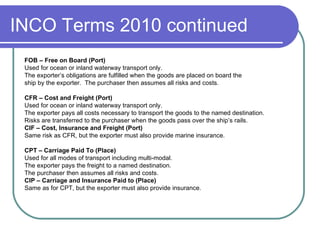
INCO Terms 2010 continued FOB – Free on Board (Port) Used for ocean or inland waterway transport only. The exporter’s obligations are fulfilled when the goods are placed on board the ship by the exporter.  The purchaser then assumes all risks and costs.   CFR – Cost and Freight (Port) Used for ocean or inland waterway transport only. The exporter pays all costs necessary to transport the goods to the named destination.  Risks are transferred to the purchaser when the goods pass over the ship’s rails. CIF – Cost, Insurance and Freight (Port) Same risk as CFR, but the exporter must also provide marine insurance. CPT – Carriage Paid To (Place) Used for all modes of transport including multi-modal. The exporter pays the freight to a named destination. The purchaser then assumes all risks and costs. CIP – Carriage and Insurance Paid to (Place) Same as for CPT, but the exporter must also provide insurance.
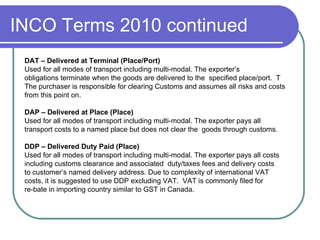
INCO Terms 2010 continued DAT – Delivered at Terminal (Place/Port) Used for all modes of transport including multi-modal. The exporter’s  obligations terminate when the goods are delivered to the  specified place/port.  T The purchaser is responsible for clearing Customs and assumes all risks and costs  from this point on. DAP – Delivered at Place (Place) Used for all modes of transport including multi-modal. The exporter pays all  transport costs to a named place but does not clear the  goods through customs.  DDP – Delivered Duty Paid (Place) Used for all modes of transport including multi-modal. The exporter pays all costs  including customs clearance and associated  duty/taxes fees and delivery costs  to customer’s named delivery address. Due to complexity of international VAT  costs, it is suggested to use DDP excluding VAT.  VAT is commonly filed for  re-bate in importing country similar to GST in Canada.

International Trade Training March 2012

  • 1.
    International Trade Training Prepared by: Suzanne M. Cascanette, CITP Updated March 3, 2012
  • 2.
    Agenda HS (HarmonizedSystem) Codes Valuation of Goods imported/exported Importing to Canada Canadian Goods Returned Exporting to USA NAFTA Exporting to International Countries CAED Program Export Control Program CARNET Migra AMPS Trade Security Programs History of INCO Terms What INCO Terms Define INCO Terms 2010 in Detail
  • 3.
    HS (Harmonized System)Codes Originally developed by the CCC – Customs Cooperation Council now known as WCO - World Customs Organization WCO is an international Customs organization headquartered in Brussels Approximately 5000 Headings 99 Chapters with 22 sections Total of 10 digits that should be provided by an expert/consultant HS Code Ruling can be obtained by CBSA (Canada Border Services Agency) First 6 digits used internationally Last 4 digits are country specific for statistical purposes For more information: http://www.cbsa-asfc.gc.ca/eservices/ogd-amg/hs-sh-eng.html
  • 4.
    Valuation of Goodsfor Import/Export Shipments crossing borders must always have a value declared. If goods are sent with zero value they will be stopped and held at Customs. Shipments entering Canada with a value of less than $20cad do not require entry. Shipments entering USA with a value of less than $200usd do not require entry. When goods are samples, sent for repair, trade show items etc – a fair and reasonable value must be declared for customs clearance. If there is a transaction between the companies – Transaction value is used. The value declared must be the exact value that was remitted. Other types of valuation rules exist when there is not an actual sale of goods: Transaction of Like or Similar Goods, Deductive, Computed or Residual For more information: http://www.cbsa-asfc.gc.ca/import/valuation-valeur/menu-eng.html
  • 5.
    Importing Goods toCanada Name and Address of: Seller, Purchaser, Consignee and Shipper Research HS code before making purchase to ensure duty (if applicable) is added to actual costs Total Pieces and Weight of Shipment Clear description of goods being imported including Country of Origin/Manufacture Value of sale – if no sale – a value must be noted for Customs clearance and reason why goods are being exported (repair, trade show etc) Under $20cad no entry required for Customs - currency of sale of must be noted Purchase Order number for shipment reference Reason for Import (if not for purchase) as goods may qualify for temporary entry on E29B or require additional information for valuation or clearance purposes NAFTA or Certificate of Origin for reduced duties based on Country of Manufacture
  • 6.
    Canadian Goods ReturnedWhen an importer accounts for goods, including containers or coverings under tariff item No. 9813.00.00 or 9814.00.00 of the Customs Tariff the importer shall: (a) attach to the customs accounting document relating to the goods a copy of the export report relating to those goods (b) insert on the customs accounting document relating to the goods Where a copy of an export report is not available and there is a reasonable explanation for its unavailability, the following documents may be accepted in lieu of the copy of the export report: (a) validated Canada customs documents; (b) transportation company documents; (c) customs accounting documents of a foreign country; or (d) a declaration made by the exporter or importer of the goods from or into Canada identifying the goods as having originated in Canada or as having been previously
  • 7.
    Exporting of Goodsto USA Name and Address of: Seller, Purchaser, Consignee and Shipper For shipments to USA the 10 digit IRS number must be noted for the Purchaser and or/Consignee on shipments value over $200.usd Total Pieces and Weight of Shipment Clear description of goods including Country of Origin/Manufacture If goods qualify country of origin Canada, a NAFTA certificate should be on file with USA Customs Broker clearing noted shipment. Suggest the description of goods match exactly to NAFTA certificate to ensure correct customs entry Value of sale – if no sale – a value must be noted for Customs clearance Reason why goods are being exported (repair, trade show etc). Shipments to the USA under $200.usd do not require Customs entry. Currency of sale must be noted. Purchase Order number for shipment reference
  • 8.
    NAFTA North AmericanFree Trade Agreement (NAFTA) established a free-trade zone in North America. Signed in 1992 by Canada, Mexico, and the United States and took effect on January 1, 1994. NAFTA immediately lifted tariffs on the majority of goods produced by the signatory nations. It also calls for the gradual elimination, over a period of 15 years, of most remaining barriers to cross-border investment and to the movement of goods and services among the three countries. NAFTA certificate must be prepared by the exporter or manufacturer – cannot be prepared by a customs broker or freight forwarder. For more information: http://www.cbsa-asfc.gc.ca/trade-commerce/ta-ac-eng.html#nafta
  • 9.
    Exporting Goods toInternational Countries Name and Address of: Seller, Purchaser, Consignee and Shipper Total Pieces and Weight of Shipment Clear description of goods being exported from Canada including HS Code if available and Country of Origin/Manufacture Value of sale – if no sale – a value must be noted for Customs clearance and reason why goods are being exported (repair, trade show etc). Currency of sale must be noted INCO Terms 2010 used on the transaction Purchase Order number for shipment reference B13 must be prepared for shipments valued over $2000.cad
  • 10.
    CAED Program OnJanuary 1st, 1998, Statistics Canada and Canada Border Services Agency (CBSA) launched the national implementation of the Canadian Automated Export Declaration (CAED) program This program gives registered exporters and agents the opportunity to report goods electronically to the Federal Government of Canada instead of via the paper-based reporting method Form B13A can be prepared on CAED only – hard copy not accepted as of March 2012 For more information: http://www.cbsa-asfc.gc.ca/export/ed-de-eng.html
  • 11.
    Export Control ExportControls Online (EXCOL) The Export Controls Division (TIE) has developed an electronic business solution to replace the current permit tracking system developed in 1988. Export Controls On-Line (EXCOL) is a user friendly web-based application. Exporters are able to submit applications for export permits and certificates, as well as request amendments. EXCOL also offers the functionality to submit online, quarterly utilisation reports for military goods, as well as the ability to print selected permits in your office. EXCOL Help Desk (613) 944-1265 or toll free 1-877-808-8838 Email: [email_address] Mailing Address: EXCOL Registration Export Import Controls Bureau (TIE) Department of Foreign Affairs and International Trade 125 Sussex Drive, Ottawa, Ontario K1A 0G2
  • 12.
    Carnet The ATACarnet is an international, unified customs document which simplifies customs procedures for the temporary duty free admission of three main categories of goods traded internationally: commercial samples, goods for presentation or use at trade fairs, shows, exhibitions or similar events and professional equipment. Essentially the carnet is a merchandise passport that facilitates travel with goods, into foreign countries, making travelling abroad easy and hassle-free. The ATA Carnet can be used for unlimited entries and exits from foreign countries and Canada for up to one year. An ATA Carnet saves time, effort and money as it facilitates international business by eliminating extensive customs procedures, the payment of duties and/or value added taxes and the purchase of temporary import bonds. The carnet is recognized in over 58 countries and territories worldwide. Carnet and Document Certification Services c/o Canadian Chamber of Commerce 360 Albert Street, Suite 420 Ottawa, Ontario K1R 7X7 Tel: (613) 238-4000 Fax: (613) 238-7643 To obtain a Carnet: [email_address]
  • 13.
    Migra Export Documentationto over 180   countries  Addresses & Contacts Canadian   Embassies  Export Controls  Customs Invoices  Board of Trade  Marine Insurance  Foreign Exchange Regulations  Carnets  Letters of Credit and Export Financing  Foreign Embassies and Consulates  International Documentation  Certificates of Origin Web site: www.migraexport.ca Telephone: 906 238 9772 Cost for on line subscription $489 one year or $699 two year
  • 14.
    AMPS TheAdministrative Monetary Penalty System (AMPS) is a civil penalty regime that secures compliance with CBSA legislation through the application of graduated monetary penalties. AMPS largely replaces the use of seizure and forfeiture provisions for technical infractions. Seizures and ascertained forfeiture will only be used for the most serious offences. AMPS applies to all areas of import and export reporting and accounting commercial operations. For more information: http://www.cbsa-asfc.gc.ca/publications/pub/bsf5013-eng.html
  • 15.
    Trade Security Programs FAST - Free and Secure Trade Program C-TPAT (US Customs Service Program) - Customs-Trade Partnership Against Terrorism PIP (Canada Border Services Agency) - Partners In Protection AEO (European Union) – Authorized Economic Operators Program Benefits include: Access to dedicated lanes (where available) for faster and more efficient border clearance A streamlined process that reduces delivery times and landed costs of imports No need to transmit transactional data for every transaction Minimal documentation required to clear the border Increased certainty at the border resulting in fewer delays and examinations A unified, ongoing partnership with the CBSA Canada Border Services Agency Promotion of Canadian competitiveness Advancement of voluntary compliance and self-assessment Web site for further information: http://cbsa-asfc.gc.ca/prog/fast-expres/menu-eng.html
  • 16.
    History of INCOTerms INCO Terms originated in 1936 Defined as International Commercial Terms Created by International Chamber of Commerce (ICC) ICC located in Paris, France Updated regularly by the ICC Current version is INCO Terms 2010 Used on international sales contracts and purchase orders Hold same importance as agreed cost of goods Define responsibilities, costs, risks and transfer of ownership Address freight, customs, insurance, documentation Used to clarify and standardize conditions of trade Ensure uniform interpretation of contract obligations
  • 17.
    INCO Terms defineresponsibility of: Export packing to include shipping sensors Export Customs examination fees Inland transportation Export documentation to include consular documents Export clearance including export permit Vessel, plane or truck loading Actual transport cost to destination Vessel, plane or truck unloading Cargo insurance Customs entry fees Import Customs examination fees Customs duties and/or value added taxes (VAT) Risk of loss or damage in transit
  • 18.
    INCO Terms 2010EXW – Ex Works (Place) Used for all modes of transport including multi-modal. The exporter’s minimum responsibility is to make the goods available at the specified location (usually at the exporter’s dock - purchaser must load). The purchaser accepts all other risks and costs. FCA – Free Carrier (Place) Used for all modes of transport including multi-modal. The exporter ensures the goods are made available for the buyer’s named carrier at a specific named location (usually at the exporters dock – seller loads). The purchaser then assumes all risks and costs. FAS – Free Alongside Ship (Port) Used for ocean or inland waterway transport only. The exporter’s obligations are fulfilled when the goods have been placed alongside the principal ship at the dock or specified port. The purchaser then assumes all risks and costs.
  • 19.
    INCO Terms 2010continued FOB – Free on Board (Port) Used for ocean or inland waterway transport only. The exporter’s obligations are fulfilled when the goods are placed on board the ship by the exporter. The purchaser then assumes all risks and costs. CFR – Cost and Freight (Port) Used for ocean or inland waterway transport only. The exporter pays all costs necessary to transport the goods to the named destination. Risks are transferred to the purchaser when the goods pass over the ship’s rails. CIF – Cost, Insurance and Freight (Port) Same risk as CFR, but the exporter must also provide marine insurance. CPT – Carriage Paid To (Place) Used for all modes of transport including multi-modal. The exporter pays the freight to a named destination. The purchaser then assumes all risks and costs. CIP – Carriage and Insurance Paid to (Place) Same as for CPT, but the exporter must also provide insurance.
  • 20.
    INCO Terms 2010continued DAT – Delivered at Terminal (Place/Port) Used for all modes of transport including multi-modal. The exporter’s obligations terminate when the goods are delivered to the specified place/port. T The purchaser is responsible for clearing Customs and assumes all risks and costs from this point on. DAP – Delivered at Place (Place) Used for all modes of transport including multi-modal. The exporter pays all transport costs to a named place but does not clear the goods through customs. DDP – Delivered Duty Paid (Place) Used for all modes of transport including multi-modal. The exporter pays all costs including customs clearance and associated duty/taxes fees and delivery costs to customer’s named delivery address. Due to complexity of international VAT costs, it is suggested to use DDP excluding VAT. VAT is commonly filed for re-bate in importing country similar to GST in Canada.