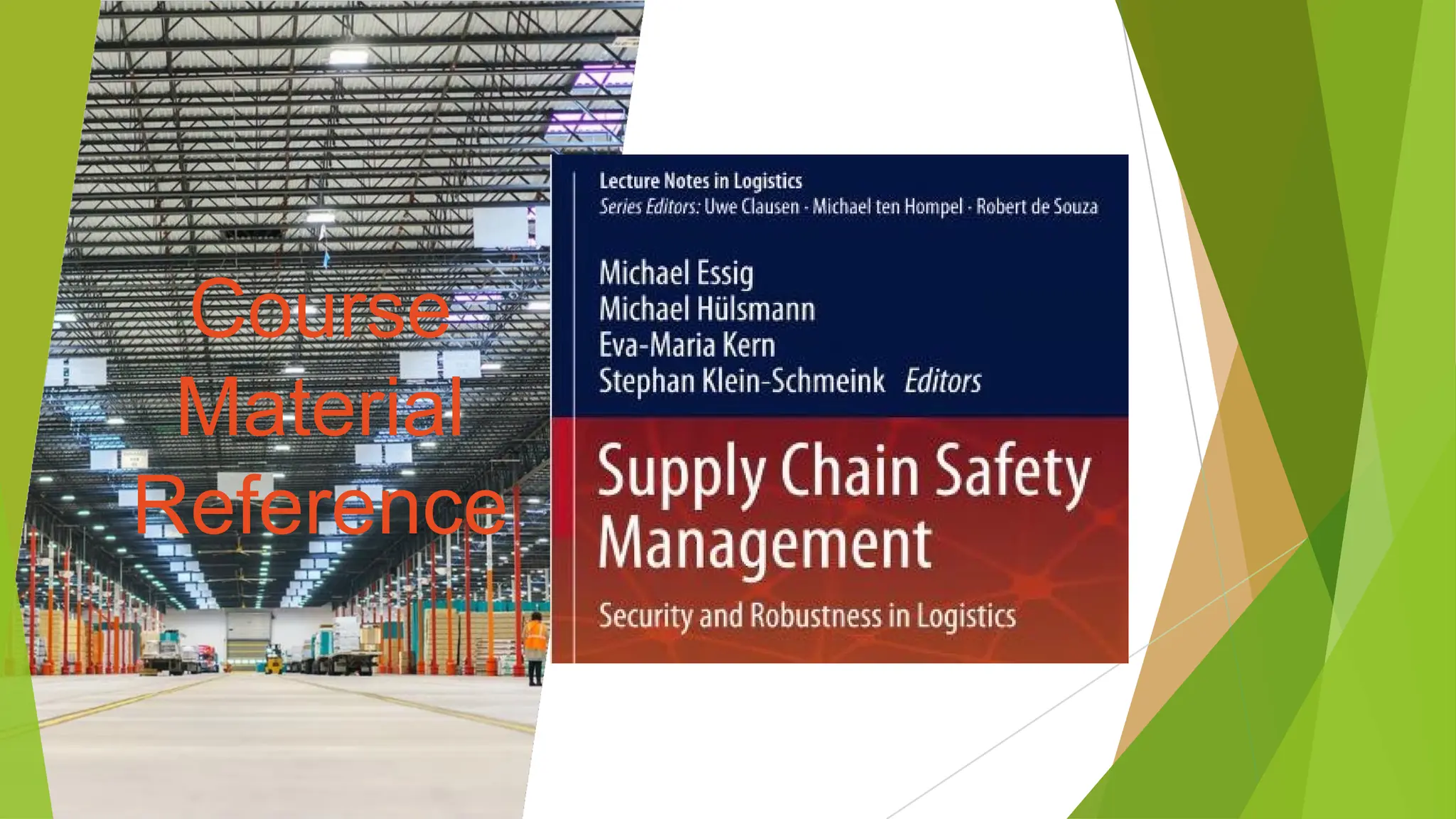
Course
Material
Reference
Important Dates
▶ Midterm 9/6/2024
▶ Assignment 9/13/2024
▶ Final 9/17 /2024
This Photo by Unknown Author is licensed under CC BY-SA-NC
Security,
Compliance
& Loss
Prevention
Mitigating Safety Risks in Supply Chains
Mitigating safety risks in supply chains is crucial for ensuring the well-being of workers,
the security of goods, and the reliability of operations. Safety risks can arise at various
stages, including manufacturing, transportation, warehousing, and distribution. Effective
mitigation strategies involve proactive identification, assessment, and management of
these risks through a combination of policies, training, technology, and continuous
improvement.
By implementing these comprehensive strategies, companies can significantly mitigate
safety risks in their supply chains. This not only protects employees and products but
also ensures the smooth and reliable operation of the supply chain, contributing to overall
business continuity and success. This lesson aims to provide you with a comprehensive
understanding of how a major company like Amazon manages its supply chain's safety,
security, and robustness, integrating both theoretical and practical learning experiences.
Safety Controls and Protocols
Preventive measures in supply chain safety focus on identifying and mitigating
potential risks before they lead to incidents. By proactively implementing these
measures, companies can create a safer work environment, protect
employees, and ensure smooth operations. A proactive approach helps create
a safer work environment, enhances operational efficiency, and contributes to
the overall success and sustainability of the supply chain.
Developing Safety Policies
Standard Operating Procedures (SOPs) are detailed, written instructions that outline the
steps and guidelines for performing specific tasks or processes in a consistent and safe
manner. In the context of supply chains, SOPs play a crucial role in ensuring operational
efficiency, safety, and compliance with regulatory requirements. They provide a clear
framework for employees to follow, reducing variability and minimizing the risk of errors or
accidents.
Developing and implementing well-crafted SOPs, companies can ensure that their supply
chain operations are consistent, safe, and efficient. SOPs provide a foundation for quality
control, regulatory compliance, and continuous improvement, ultimately contributing to
the overall success of the supply chain.
Safety Equipment and Technologies
Personal Protective Equipment (PPE)
PPE refers to the equipment worn by employees to minimize exposure to workplace hazards that can cause injuries or
illnesses. In supply chain operations, PPE is essential for protecting workers from physical, chemical, and biological hazards
present in environments such as warehouses, fulfillment centers, and manufacturing sites.
Types of PPE in Supply Chains
• Head Protection: Hard hats or helmets protect against head injuries caused by falling objects, bumps, or electrical
hazards.
• Eye and Face Protection: Safety glasses, goggles, and face shields protect against flying particles, chemical splashes,
and hazardous light sources.
• Hearing Protection: Earplugs and earmuffs help prevent hearing loss due to exposure to high noise levels, common in
environments with heavy machinery or equipment.
• Respiratory Protection: Respirators and masks protect against inhaling hazardous substances such as dust, fumes, or
chemical vapors.
• Hand Protection: Gloves protect hands from cuts, abrasions, chemical burns, and thermal hazards. Types include cut-
resistant gloves, chemical-resistant gloves, and heat-resistant gloves.
• Body Protection: High-visibility vests, coveralls, and aprons protect against chemical splashes, contaminants, and
enhance visibility in high-traffic areas.
• Foot Protection: Safety shoes or boots with reinforced toes protect against impacts, punctures, and slips. Anti-static or
conductive footwear may be required in areas with flammable materials.
Safety Equipment and Technologies
Personal Protective Equipment (PPE)
PPE refers to the equipment worn by employees to minimize exposure to workplace hazards that
can cause injuries or illnesses. In supply chain operations, PPE is essential for protecting workers
from physical, chemical, and biological hazards present in environments such as warehouses,
fulfillment centers, and manufacturing sites.
Implementing PPE in Supply Chains
• Risk Assessment: Conduct a thorough risk assessment to identify hazards and determine the
appropriate PPE for each task or environment.
• Training and Fit Testing: Provide training on the correct use, care, and maintenance of PPE.
Ensure proper fit testing, especially for respirators, to maximize protection.
• Maintenance and Replacement: Regularly inspect PPE for wear and damage. Replace PPE
as needed to maintain effectiveness and ensure worker safety.
• Enforcement and Compliance: Establish policies to enforce the use of PPE where required.
Monitor compliance and provide corrective actions if necessary.
Safety Equipment and Technologies
Robotics
Robotics play a significant role in modern supply chains by automating tasks that are repetitive, physically
demanding, or hazardous. The use of robotics can improve efficiency, accuracy, and safety in various aspects of
supply chain operations.
Types of Robotics in Supply Chains
• Automated Guided Vehicles (AGVs): AGVs are used to transport materials within warehouses and factories.
They follow predefined paths and can carry goods from one location to another, reducing the need for manual
handling.
• Robotic Arms: These are used for tasks such as picking, packing, sorting, and palletizing. Robotic arms can
handle a wide range of products with precision and speed, improving accuracy and reducing labor costs.
• Collaborative Robots (Cobots): Cobots are designed to work alongside humans, assisting with tasks that
require flexibility and dexterity. They can enhance productivity by taking on repetitive tasks, allowing human
workers to focus on more complex activities.
• Autonomous Mobile Robots (AMRs): AMRs use sensors and navigation systems to move independently
within a facility, adapting to their environment in real time. They are used for tasks such as order picking,
inventory management, and delivery.

• Drones: Drones can be used for inventory management, such as conducting cycle counts and monitoring stock
levels. In large warehouses, they can quickly and efficiently scan barcodes and capture data.
Safety Equipment and Technologies
Robotics
Robotics play a significant role in modern supply chains by automating tasks that are
repetitive, physically demanding, or hazardous. The use of robotics can improve efficiency,
accuracy, and safety in various aspects of supply chain operations.
Benefits of Robotics in Supply Chains
• Increased Efficiency: Robots can operate continuously without breaks, significantly
increasing productivity and throughput in supply chain operations.
• Improved Accuracy: Robotics reduce human error in tasks such as order picking and
inventory management, enhancing accuracy and reducing the need for rework.
• Enhanced Safety: By taking on hazardous or physically demanding tasks, robots reduce
the risk of workplace injuries and improve overall safety.
• Scalability: Robotics systems can be easily scaled up or down based on demand,
providing flexibility during peak seasons or fluctuating order volumes.
Safety Equipment and Technologies
Robotics
Robotics play a significant role in modern supply chains by automating tasks that are
repetitive, physically demanding, or hazardous. The use of robotics can improve efficiency,
accuracy, and safety in various aspects of supply chain operations.
Challenges and Considerations
• Initial Investment: Implementing robotics requires a significant initial investment in
equipment, software, and infrastructure. Companies must consider the long-term return
on investment (ROI).
• Training and Integration: Employees need training to work alongside robots and
manage robotic systems. Integration with existing processes and systems is also crucial
for success.
• Maintenance and Upkeep: Regular maintenance is necessary to ensure the reliability
and performance of robotic systems. This includes software updates, repairs, and
hardware servicing.
Safety Equipment and Technologies
Sensors
Sensors are used in supply chain operations to monitor various conditions, gather data, and provide real-
time feedback. They are essential for enhancing visibility, improving decision-making, and ensuring safety
and efficiency in the supply chain.
Types of Sensors in Supply Chains
• Temperature and Humidity Sensors: Used in cold chain logistics to monitor the environmental
conditions of temperature-sensitive products such as food, pharmaceuticals, and chemicals.
• Proximity Sensors: Detect the presence or absence of objects and are commonly used in robotics and
automated systems to prevent collisions and ensure safe operations.
• Motion Sensors: Monitor movement within a facility, such as the movement of AGVs or AMRs. They
help optimize traffic flow and improve safety by preventing collisions.
• Barcode and RFID Sensors: Used for tracking inventory and assets throughout the supply chain.
Barcode scanners and RFID readers provide real-time data on the location and status of products.
• Load Sensors: Measure the weight or force applied to equipment such as conveyor belts, forklifts, and
pallet jacks. They ensure that loads are within safe limits and help prevent overloading.
• Gas and Chemical Sensors: Detect the presence of hazardous gases or chemicals in the
environment, providing early warning of leaks or spills and enhancing workplace safety.
Safety Equipment and Technologies
Sensors
Sensors are used in supply chain operations to monitor various conditions, gather data, and provide
real-time feedback. They are essential for enhancing visibility, improving decision-making, and
ensuring safety and efficiency in the supply chain.
Applications of Sensors in Supply Chains
• Inventory Management: Sensors enable real-time tracking of inventory levels, locations, and
movements. This improves inventory accuracy, reduces stockouts, and enhances order
fulfillment.
• Quality Control: Sensors monitor environmental conditions and product quality, ensuring that
products meet safety and quality standards throughout the supply chain.
• Predictive Maintenance: Sensors collect data on the performance and condition of equipment,
enabling predictive maintenance. This helps prevent equipment failures, reduce downtime, and
extend the lifespan of machinery.
• Safety Monitoring: Sensors enhance safety by monitoring conditions such as temperature,
humidity, and gas levels. They provide alerts in case of deviations from safe operating
conditions.
Safety Equipment and Technologies
Sensors
Sensors are used in supply chain operations to monitor various conditions, gather data, and provide
real-time feedback. They are essential for enhancing visibility, improving decision-making, and
ensuring safety and efficiency in the supply chain.
Challenges and Implementation
• Integration: Integrating sensors into existing systems and processes can be complex.
Companies need to ensure that sensor data is compatible with their information systems for
effective use.
• Data Management: Sensors generate large volumes of data that need to be collected, stored,
and analyzed. Implementing effective data management and analytics tools is essential to
derive actionable insights.
• Cost and Maintenance: The cost of deploying and maintaining sensors can be significant.
Companies must weigh the benefits of improved visibility and control against the investment
required.
Safety Equipment and Technologies
By incorporating PPE, robotics, and sensors into supply chain operations,
companies can significantly enhance safety, efficiency, and productivity. These
technologies work together to create a more resilient and adaptable supply
chain that can respond to challenges and changing demands effectively.
Transportation Safety Measures
Ensuring safe transit
Hazardous materials
Cold chain
Transportation Safety Measures
Ensuring the safe transit of goods is crucial in supply chain operations to
protect products from damage, theft, and spoilage during transportation. It
involves implementing a series of measures and technologies that safeguard
the integrity of shipments as they move through various stages of the supply
chain.
By implementing strategies, companies can significantly reduce the risks
associated with the transit of goods, ensuring that products reach their
destination safely and in good condition. Those measures not only protect the
physical integrity of the shipments but also contribute to customer satisfaction,
regulatory compliance, and the overall efficiency of the supply chain.
Transportation Safety Measures
Handling hazardous materials in the supply chain requires strict adherence to
safety protocols, regulatory compliance, and specialized training to prevent
accidents, protect workers, and safeguard the environment. Hazardous
materials (hazmat) include substances that are flammable, toxic, corrosive,
explosive, or otherwise dangerous if not managed properly.
Implementing comprehensive safety measures, can effectively manage the
risks associated with hazardous materials in the supply chain. This ensures the
safety of employees, protects the environment, and ensures compliance with
regulatory requirements.
Transportation Safety Measures
A cold chain is a temperature-controlled supply chain that is crucial for
transporting and storing temperature-sensitive products such as perishable
foods, pharmaceuticals, vaccines, and certain chemicals. Maintaining the
integrity of the cold chain is essential to ensure product safety, quality, and
efficiency.
Maintaining an effective cold chain is essential for ensuring the safety, quality,
and efficiency of temperature-sensitive products. By implementing robust
temperature management practices, leveraging advanced technologies, and
adhering to regulatory standards, companies can ensure that their products
reach their destination in optimal condition, minimizing waste and maximizing
customer satisfaction.
Supplier and Vendor Management
Vetting and collaborating with suppliers is a critical process in supply chain management
that ensures a reliable, high-quality, and ethically responsible supply network. Effective
supplier management involves thorough evaluation, ongoing collaboration, and
continuous monitoring to maintain a strong, secure, and efficient supply chain.
By effectively vetting and collaborating with suppliers, companies can build a resilient,
ethical, and efficient supply chain that supports quality, reliability, and sustainability.
Strong supplier relationships not only enhance operational performance but also
contribute to long-term success and competitive advantage in the market.
Reducing Cybersecurity Threats
Mitigating data breaches is critical for protecting sensitive information, maintaining customer
trust, and ensuring compliance with regulations. Data breaches can lead to financial losses,
reputational damage, and legal consequences. Implementing best practices for data security
helps minimize the risk of breaches and enhances the overall security posture of an
organization.
By implementing best practices, organizations can significantly reduce the risk of data
breaches and protect sensitive information from unauthorized access, loss, or theft. A
proactive approach to data security, combined with a strong security culture, is essential for
mitigating risks and maintaining the trust of customers and stakeholders.
Collaborative Safety in Global Supply Chains
Partnering with NGOs (Non-Governmental Organizations) and industry consortia can greatly enhance
a company's supply chain operations, sustainability efforts, and ethical practices. These partnerships
bring valuable expertise, resources, and collaborative opportunities to address complex challenges
such as environmental sustainability, human rights, and supply chain transparency.
By partnering with NGOs and industry consortia, companies can leverage collective expertise,
resources, and influence to address complex supply chain challenges. These collaborations
contribute to the development of more ethical, sustainable, and transparent supply chains, ultimately
driving positive change and enhancing long-term business success.
Safety Certifications and Standards
ISO 45001
TAPA
Safety Certifications and Standards
ISO 45001 is an international standard for occupational health and safety
(OH&S) management systems, designed to help organizations improve
employee safety, reduce workplace risks, and create safer working conditions.
It provides a framework that organizations can use to identify, control, and
reduce the risks associated with health and safety in the workplace. This
standard is applicable to organizations of all sizes, industries, and sectors. By
implementing ISO 45001, organizations can systematically manage
occupational health and safety risks, protect their workforce, and create a safer,
more compliant, and efficient working environment.
Safety Certifications and Standards
TAPA (Transported Asset Protection Association) is a globally recognized association that
focuses on reducing cargo theft and increasing security within the supply chain. It provides
standards, certification programs, and best practices to protect transported goods against
theft, tampering, and other security risks. TAPA is particularly relevant for industries that
handle high-value or sensitive cargo, such as electronics, pharmaceuticals, and luxury goods.
By adopting TAPA standards and working collaboratively with other industry members,
companies can enhance their supply chain security, reduce the risk of cargo theft, and improve
overall operational efficiency. TAPA’s focus on setting and maintaining high security standards
provides a valuable framework for safeguarding goods and building trust in the global supply
chain.
Continuous Monitoring and Audits
Real-time data
Frequent audits
Continuous Monitoring and Audits
Continuous monitoring and audits using real-time data are essential practices for maintaining supply
chain security, efficiency, and compliance. They enable organizations to proactively identify and
address issues, mitigate risks, and ensure adherence to standards and regulations. By leveraging
technology and real-time data, companies can gain greater visibility into their operations and make
informed decisions to improve performance.
By leveraging continuous monitoring and real-time data, organizations can enhance their supply
chain's visibility, security, and efficiency. This proactive approach enables companies to quickly
identify and address issues, optimize operations, and maintain compliance with industry standards
and regulations, ultimately leading to a more resilient and agile supply chain.
Continuous Monitoring and Audits
Frequent audits and continuous monitoring are key components of a robust supply chain
management strategy. They help ensure compliance, enhance security, maintain quality, and identify
opportunities for improvement. By regularly assessing processes and using real-time data,
organizations can quickly detect and address issues, thereby reducing risks and maintaining high
standards.
By implementing frequent audits and leveraging continuous monitoring with real-time data,
organizations can maintain high standards of quality, compliance, and security in their supply chains.
This proactive approach helps prevent issues before they escalate, ensures ongoing adherence to
regulations and standards, and drives continuous improvement across the supply chain.
Case Study: Amazon
Amazon's supply chain operations are a complex and highly integrated system
designed to ensure fast and efficient delivery of products to customers
worldwide. Here's an overview of the key components:
Procurement and Supplier Management
• Amazon sources products from a vast network of suppliers globally,
including manufacturers, wholesalers, and third-party sellers on its
marketplace.
• It uses data analytics and forecasting to manage inventory levels, ensuring
high-demand items are always in stock while minimizing overstock
situations.
Case Study: Amazon
Amazon's supply chain operations are a complex and highly integrated system
designed to ensure fast and efficient delivery of products to customers
worldwide. Here's an overview of the key components:
Fulfillment Centers (Warehouses)
• Amazon operates a network of fulfillment centers strategically located
across the globe. These centers store a vast array of products and use
advanced technology, including robotics and automation, to manage
inventory and order fulfillment efficiently.
• The fulfillment process involves picking, packing, and shipping products,
which is streamlined to reduce handling time and costs.
Case Study: Amazon
Amazon's supply chain operations are a complex and highly integrated system
designed to ensure fast and efficient delivery of products to customers
worldwide. Here's an overview of the key components:
Inventory Management
• Amazon uses sophisticated algorithms and machine learning to predict
demand and optimize inventory levels. This helps in minimizing stockouts
and reducing the holding costs of inventory.
• The company employs a "just-in-time" approach for certain products,
ensuring they are stocked in fulfillment centers only when needed.
Case Study: Amazon
Amazon's supply chain operations are a complex and highly integrated system
designed to ensure fast and efficient delivery of products to customers
worldwide. Here's an overview of the key components:
Order Processing and Management
• Once an order is placed, Amazon's system automatically selects the
fulfillment center closest to the customer that has the item in stock.
• The order is then processed quickly, with the goal of getting it out for
delivery as soon as possible.
Case Study: Amazon
Amazon's supply chain operations are a complex and highly integrated system
designed to ensure fast and efficient delivery of products to customers
worldwide. Here's an overview of the key components:
Last-Mile Delivery
• Amazon has developed an extensive last-mile delivery network, including
its own delivery service (Amazon Logistics), third-party carriers, and
partnerships with local delivery companies.
• The company also uses innovative delivery methods such as Amazon
Prime Air (drones), Amazon Flex (independent drivers), and Amazon
Lockers for convenient pick-up locations.
Case Study: Amazon
Amazon's supply chain operations are a complex and highly integrated system
designed to ensure fast and efficient delivery of products to customers
worldwide. Here's an overview of the key components:
Technology and Automation
• Amazon employs a high level of automation and technology throughout its
supply chain. This includes the use of robots in fulfillment centers, machine
learning for demand forecasting, and cloud computing for data
management.
• Its proprietary software systems optimize routing, inventory management,
and delivery scheduling, improving efficiency and reducing costs.
Case Study: Amazon
Amazon's supply chain operations are a complex and highly integrated system
designed to ensure fast and efficient delivery of products to customers
worldwide. Here's an overview of the key components:
Global Network and Logistics
• Amazon operates a global logistics network that includes air, sea, and
ground transportation. It has its own cargo planes (Amazon Air) and
partners with major logistics providers for international shipping.
• The company also manages customs and import/export regulations to
facilitate smooth cross-border trade.
Case Study: Amazon
Amazon's supply chain operations are a complex and highly integrated system
designed to ensure fast and efficient delivery of products to customers
worldwide. Here's an overview of the key components:
Sustainability Initiatives
• Amazon has been investing in sustainability efforts within its supply chain,
such as using electric delivery vehicles, optimizing packaging to reduce
waste, and aiming for net-zero carbon emissions.
Case Study: Amazon
Amazon's global network is a cornerstone of its supply chain, enabling it to provide quick and reliable
delivery services to customers worldwide. This network consists of strategically located warehouses,
advanced fulfillment centers, and an extensive last-mile delivery system. Here's an introduction to each
component:
Global Network of Warehouses
• Storage and Distribution: Amazon operates a vast network of warehouses across the globe, serving
as storage hubs for its enormous inventory. These warehouses are strategically located near major
cities and transportation hubs to facilitate quick distribution.
• Inventory Management: The warehouses use advanced inventory management systems that rely on
algorithms and machine learning to ensure optimal stock levels. This helps Amazon predict demand,
reduce holding costs, and minimize stockouts.
• Types of Warehouses: Amazon's warehouses vary in function, including standard storage warehouses,
specialty centers for oversized items, and sortation centers that help streamline the delivery process by
sorting packages by their final destination.
Case Study: Amazon
Fulfillment Centers
• Role in Order Processing: Fulfillment centers are the core of Amazon’s operations, where
products are picked, packed, and prepared for shipment. They handle millions of products and
manage the entire order fulfillment process from the moment a customer places an order.
• Advanced Technology and Automation: These centers are equipped with advanced
technologies, including robotics, automated conveyor systems, and machine learning. For
example, Amazon's Kiva robots transport shelves to human pickers, reducing the time it takes
to locate and pick items.
• Different Types of Fulfillment Centers: Amazon operates various types of fulfillment centers,
including standard centers for most products, specialty centers for hazardous or perishable
goods, and Prime Now hubs designed for rapid delivery of high-demand items.
Case Study: Amazon
Last-Mile Delivery
• Direct Delivery Network: Amazon has developed its own delivery network, Amazon Logistics, to
handle the last-mile delivery to customers' doorsteps. This network includes thousands of delivery vans,
trucks, and Amazon-branded planes (Amazon Air) for air transport.
• Amazon Flex and Delivery Service Partners (DSP): Amazon Flex employs independent drivers who
use their vehicles to deliver packages, providing flexibility and scalability. Additionally, the DSP program
partners with small delivery businesses to ensure reliable last-mile delivery.
• Innovative Delivery Solutions: To enhance delivery efficiency and customer convenience, Amazon
has introduced innovative solutions such as Amazon Lockers for secure package pickup, Amazon Key
for in-home deliveries, and is experimenting with drone deliveries through Amazon Prime Air.
• Route Optimization and Real-Time Tracking: The company uses sophisticated routing algorithms and
real-time tracking systems to optimize delivery routes, reduce delivery times, and provide customers
with accurate delivery updates.
Case Study: Amazon
Integration of the Network
• Seamless Coordination: Amazon's warehouse, fulfillment, and last-mile delivery systems are
seamlessly integrated using advanced software and data analytics. This integration allows for
real-time inventory management, efficient order processing, and rapid delivery execution.
• Global Reach: With a presence in major markets worldwide, Amazon's network is designed to
provide quick delivery options such as same-day, one-day, and two-day shipping. This global
reach is crucial for Amazon to maintain its competitive edge in e-commerce.
By leveraging this comprehensive and technologically advanced network, Amazon can meet high
customer expectations for fast, reliable, and convenient delivery, solidifying its position as a leader
in the e-commerce industry.
Case Study: Amazon
Amazon's use of technology and automation is a critical factor in its ability to
efficiently manage a vast supply chain and meet high customer expectations
for fast delivery. The company has invested heavily in advanced technologies
such as Kiva robots, drones, and sophisticated warehouse management
systems to optimize its operations. Here’s a closer look at these innovations:
Case Study: Amazon
Kiva Robots (Amazon Robotics)
• Role in Fulfillment Centers: Amazon acquired Kiva Systems in 2012 and has since
integrated these robots into its fulfillment centers. Now known as Amazon Robotics,
these robots revolutionize the way products are picked and packed.
• Functionality: The Kiva robots are designed to transport entire shelves of products
directly to human pickers at packing stations. This "goods-to-person" model significantly
reduces the time and effort required to locate and pick items, increasing efficiency and
reducing the need for large walking distances within warehouses.
• Impact on Efficiency: By using Kiva robots, Amazon has reduced the time it takes to
fulfill orders, allowing the company to handle high volumes of orders during peak times
like holidays. The robots help streamline inventory management, improve accuracy, and
optimize warehouse space.
Case Study: Amazon
Drones (Amazon Prime Air)
• Innovative Delivery Solution: Amazon is experimenting with using drones for last-
mile delivery through its Amazon Prime Air program. The goal is to deliver packages
to customers within 30 minutes of ordering, particularly in densely populated areas.
• How It Works: These drones are designed to fly autonomously and deliver small
packages directly to customers' doorsteps. They use sensors and advanced
algorithms to navigate safely, avoid obstacles, and ensure precise delivery
locations.
• Current Status: While still in the testing phase, Amazon has conducted pilot
programs in select regions and is working with regulators to address safety and
privacy concerns. Once fully implemented, drone delivery could significantly reduce
delivery times and costs, especially for urgent and small-sized deliveries.
Case Study: Amazon
Advanced Warehouse Management Systems
• Inventory Management: Amazon employs sophisticated warehouse management systems
(WMS) that use algorithms and machine learning to manage inventory efficiently. These
systems optimize the placement of products within fulfillment centers, ensuring that high-
demand items are easily accessible.
• Real-Time Data and Analytics: The WMS provides real-time data on inventory levels, order
status, and product location, allowing Amazon to quickly adapt to changes in demand and
streamline the order fulfillment process. This real-time visibility helps prevent stockouts and
ensures that orders are processed as quickly as possible.
• Automation and Robotics Integration: The WMS seamlessly integrates with robotics and
other automation technologies within the fulfillment centers. For example, it coordinates the
movement of Kiva robots and other automated systems to ensure smooth operations and
minimize human intervention.
Case Study: Amazon
Benefits and Future Outlook
• Efficiency and Cost Reduction: By integrating technology and automation, Amazon has
significantly reduced labor costs, minimized errors, and improved the speed of its supply chain
operations. This has allowed the company to offer faster shipping options like same-day and
one-day delivery.
• Scalability: The use of automation enables Amazon to scale its operations during peak
seasons, such as holidays, without compromising on efficiency or customer satisfaction.
• Continuous Innovation: Amazon continues to explore new technologies and automation
solutions to enhance its supply chain. This includes ongoing research into more advanced
drones, autonomous delivery vehicles, and further integration of AI and machine learning.
Amazon's commitment to technology and automation not only enhances its operational efficiency
but also sets industry standards, driving innovation in the e-commerce and logistics sectors.
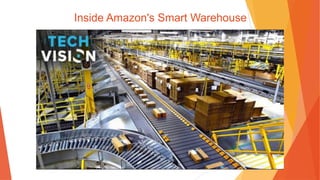
Inside Amazon's Smart Warehouse
Amazon is the world’s biggest retailer, and its CEO Jeff Bezos the world’s richest man, for one very
good reason. His company is better than anyone else, ever, at giving people what they want, quickly.
Amazon acquired its undisputed status as heavyweight champion of the retail universe thanks largely to
its lightning-fast delivery times. The astonishing feat of ferrying hundreds of millions of items, from guitar
strings to saucepans to car parts, directly to your door, inside 24 hours, is nothing short of a modern
logistical miracle.
So how does Amazon do it? A super-smart army of slave robots, for one. Ingenious, if occasionally
unscrupulous, management practices are part of the answer too. And the modern-day voodoo of deep-
learning AI – all of which are made flesh in the most advanced stockrooms the world has ever seen. So,
join us today, as we button up our hi-vis jacket and journey inside Amazon’s smart warehouses.
Inside Amazon's Smart Warehouse
Case Study: Amazon
Amazon places a high priority on safety across its supply chain to protect its
employees, customers, and products. The company employs a range of
strategies and technologies to ensure safety, from its fulfillment centers to the
delivery process. Here’s an overview of how Amazon ensures safety across its
supply chain:
Case Study: Amazon
Fulfillment Center Safety
• Employee Training and Education: Amazon provides comprehensive training for its employees, including
orientation programs and ongoing safety education. This training covers proper lifting techniques, equipment
handling, and emergency procedures to minimize workplace injuries.
• Safety Protocols and Procedures: The company has established stringent safety protocols in its fulfillment
centers. These include regular safety drills, emergency response plans, and guidelines for safely operating
machinery and handling hazardous materials.
• Ergonomics and Health: Amazon focuses on ergonomic design to reduce the risk of repetitive strain injuries.
Workstations are designed to minimize physical strain, and employees are encouraged to take regular breaks
and stretch to reduce fatigue.
• Advanced Monitoring Systems: Amazon uses advanced monitoring systems to track safety compliance and
identify potential hazards. For example, it employs cameras and sensors to monitor work areas for unsafe
conditions and uses data analytics to identify trends in workplace incidents.
• Robotics and Automation: By using robots for tasks like transporting goods within the warehouse, Amazon
reduces the need for employees to perform physically demanding and potentially hazardous tasks. This
minimizes the risk of injuries related to heavy lifting or repetitive movements.
Case Study: Amazon
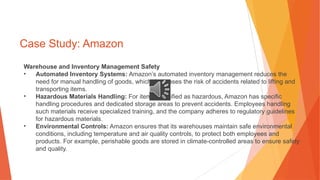
Warehouse and Inventory Management Safety
• Automated Inventory Systems: Amazon’s automated inventory management reduces the
need for manual handling of goods, which decreases the risk of accidents related to lifting and
transporting items.
• Hazardous Materials Handling: For items classified as hazardous, Amazon has specific
handling procedures and dedicated storage areas to prevent accidents. Employees handling
such materials receive specialized training, and the company adheres to regulatory guidelines
for hazardous materials.
• Environmental Controls: Amazon ensures that its warehouses maintain safe environmental
conditions, including temperature and air quality controls, to protect both employees and
products. For example, perishable goods are stored in climate-controlled areas to ensure safety
and quality.
Case Study: Amazon
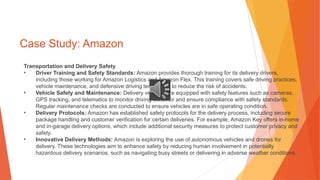
Transportation and Delivery Safety
• Driver Training and Safety Standards: Amazon provides thorough training for its delivery drivers,
including those working for Amazon Logistics and Amazon Flex. This training covers safe driving practices,
vehicle maintenance, and defensive driving techniques to reduce the risk of accidents.
• Vehicle Safety and Maintenance: Delivery vehicles are equipped with safety features such as cameras,
GPS tracking, and telematics to monitor driving behavior and ensure compliance with safety standards.
Regular maintenance checks are conducted to ensure vehicles are in safe operating condition.
• Delivery Protocols: Amazon has established safety protocols for the delivery process, including secure
package handling and customer verification for certain deliveries. For example, Amazon Key offers in-home
and in-garage delivery options, which include additional security measures to protect customer privacy and
safety.
• Innovative Delivery Methods: Amazon is exploring the use of autonomous vehicles and drones for
delivery. These technologies aim to enhance safety by reducing human involvement in potentially
hazardous delivery scenarios, such as navigating busy streets or delivering in adverse weather conditions.
Case Study: Amazon
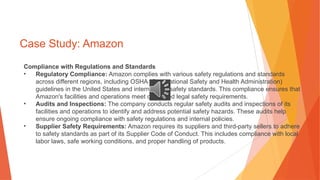
Compliance with Regulations and Standards
• Regulatory Compliance: Amazon complies with various safety regulations and standards
across different regions, including OSHA (Occupational Safety and Health Administration)
guidelines in the United States and international safety standards. This compliance ensures that
Amazon's facilities and operations meet or exceed legal safety requirements.
• Audits and Inspections: The company conducts regular safety audits and inspections of its
facilities and operations to identify and address potential safety hazards. These audits help
ensure ongoing compliance with safety regulations and internal policies.
• Supplier Safety Requirements: Amazon requires its suppliers and third-party sellers to adhere
to safety standards as part of its Supplier Code of Conduct. This includes compliance with local
labor laws, safe working conditions, and proper handling of products.
Case Study: Amazon
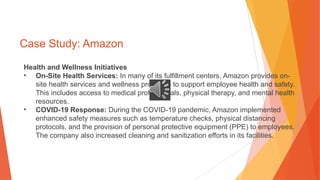
Health and Wellness Initiatives
• On-Site Health Services: In many of its fulfillment centers, Amazon provides on-
site health services and wellness programs to support employee health and safety.
This includes access to medical professionals, physical therapy, and mental health
resources.
• COVID-19 Response: During the COVID-19 pandemic, Amazon implemented
enhanced safety measures such as temperature checks, physical distancing
protocols, and the provision of personal protective equipment (PPE) to employees.
The company also increased cleaning and sanitization efforts in its facilities.
Case Study: Amazon
Technology and Data-Driven Safety
• Wearable Technology: Amazon has explored the use of wearable technology to
enhance worker safety. For example, wearable devices can monitor employee
movements to ensure proper ergonomic practices and alert them to potential
hazards.
• Data Analytics and Machine Learning: Amazon uses data analytics and machine
learning to analyze safety incidents and identify patterns. This helps the company
proactively address potential safety issues and implement preventative measures.
• Real-Time Alerts: Advanced monitoring systems provide real-time alerts for safety
violations or hazardous conditions, enabling quick response to mitigate risks.
Case Study: Amazon
Continuous Improvement and Safety Culture
• Feedback and Reporting: Amazon encourages employees to report safety
concerns and provides channels for anonymous feedback. This fosters a culture of
safety and continuous improvement, where issues can be addressed promptly.
• Continuous Innovation: The company is continuously innovating to enhance
safety, including exploring new technologies and practices that can further reduce
risks across its supply chain.
By integrating these safety measures into its supply chain operations, Amazon aims to
create a safe working environment, minimize risks, and ensure the well-being of its
employees and customers.
Case Study: Amazon
Workplace safety in Amazon's fulfillment centers is a top priority, given the
fast-paced and physically demanding nature of the environment. The company
employs a variety of protocols and initiatives to ensure the safety and well-
being of its employees. These include ergonomic designs, comprehensive
safety training, and a range of accident prevention measures. Here's a
detailed look at these safety protocols:
Case Study: Amazon
Ergonomic Designs
• Workstation Design: Amazon's fulfillment centers are designed with ergonomics in mind to
reduce the risk of strain and injury. Workstations are set up to minimize repetitive motions,
excessive reaching, or awkward postures. For example, adjustable workbenches and anti-
fatigue mats are provided to help workers maintain comfortable and safe positions while
working.
• Automated Systems: The use of automation, such as Kiva robots, reduces the need for
employees to manually move heavy items or walk long distances within the warehouse. Robots
bring shelves of products to workers, who can then pick and pack items with minimal physical
exertion.
• Lifting Aids and Tools: For tasks that require manual lifting, Amazon provides equipment such
as lift-assist devices, pallet jacks, and conveyor belts to help reduce the strain on employees'
bodies. These tools aid in the safe handling of heavy or bulky items, reducing the risk of
musculoskeletal injuries.
Case Study: Amazon
Safety Training
• Comprehensive Onboarding: New employees undergo extensive safety training during
the onboarding process. This training includes instruction on proper lifting techniques,
safe operation of equipment, emergency procedures, and the correct use of personal
protective equipment (PPE).
• Ongoing Safety Education: In addition to initial training, Amazon provides ongoing
safety education for all employees. This includes regular safety briefings, refresher
courses, and hands-on practice sessions. Employees are kept up to date on the latest
safety protocols and best practices.
• Specialized Training: Workers assigned to specific tasks, such as operating forklifts or
handling hazardous materials, receive specialized training tailored to those
responsibilities. This ensures that employees have the necessary knowledge and skills to
perform their tasks safely.
Case Study: Amazon
Accident Prevention Measures
• Safety Protocols and Guidelines: Amazon has established a set of safety protocols and guidelines that all
employees must follow. These protocols cover a wide range of activities, from handling equipment and materials
to navigating the warehouse environment. Employees are required to adhere to these guidelines to minimize
the risk of accidents.
• Regular Safety Audits and Inspections: To ensure compliance with safety protocols, Amazon conducts
regular audits and inspections of its fulfillment centers. These audits help identify potential hazards, assess
adherence to safety standards, and ensure that corrective actions are taken when necessary.
• Emergency Response Plans: Each fulfillment center has a comprehensive emergency response plan in place
to address incidents such as fires, chemical spills, or medical emergencies. Employees are trained on how to
respond to emergencies, including evacuation procedures and the use of fire extinguishers.
• Incident Reporting and Analysis: Amazon encourages employees to report safety incidents, near-misses, and
hazards through its incident reporting system. This system allows the company to analyze data, identify trends,
and implement corrective measures to prevent future accidents. The focus on proactive reporting helps foster a
culture of safety and continuous improvement.
Case Study: Amazon
Health and Wellness Initiatives
• Stretching and Breaks: To reduce the risk of repetitive strain injuries and fatigue,
Amazon encourages employees to take regular breaks and engage in stretching
exercises. These activities are integrated into the daily work schedule to promote
physical well-being.
• On-Site Health Services: Many fulfillment centers offer on-site health services,
including access to medical professionals and physical therapists. These services
provide immediate care for minor injuries and support employees' overall health and
wellness.
• Wellness Programs: Amazon also promotes wellness programs aimed at
improving employees' physical and mental health. These programs may include
fitness challenges, nutrition education, and stress management resources.
Case Study: Amazon
Technology and Safety Monitoring
• Advanced Monitoring Systems: Amazon uses advanced monitoring systems, including
cameras and sensors, to track safety compliance and identify potential hazards in real
time. These systems alert supervisors to unsafe conditions or behaviors, enabling prompt
intervention to prevent accidents.
• Wearable Technology: In some fulfillment centers, Amazon has experimented with
wearable technology to monitor employees' movements and ensure they are using
proper ergonomic techniques. These wearables can provide feedback to workers on their
posture and movements, helping to reduce the risk of strain or injury.
• Data Analytics for Safety Improvement: Amazon leverages data analytics to track
safety incidents and analyze trends. This data-driven approach helps the company
identify areas for improvement, develop targeted safety initiatives, and measure the
effectiveness of safety interventions.
Case Study: Amazon
Engagement and Safety Culture
• Employee Involvement: Amazon actively involves employees in safety initiatives by
encouraging them to participate in safety committees and provide feedback on workplace
safety. This involvement fosters a culture of safety and accountability, where employees are
empowered to take an active role in maintaining a safe work environment.
• Safety Incentive Programs: To reinforce the importance of safety, Amazon has implemented
incentive programs that recognize and reward employees for safe behaviors and contributions
to workplace safety. These programs help motivate employees to prioritize safety in their daily
activities.
By integrating ergonomic designs, comprehensive training, accident prevention measures, and
advanced technology, Amazon strives to maintain a safe working environment in its fulfillment
centers. These efforts not only protect employees but also contribute to the overall efficiency and
effectiveness of Amazon's supply chain operations.
Case Study: Amazon
During peak seasons, such as the holiday shopping period, Amazon
experiences a significant increase in order volumes, which can add pressure
to its fulfillment centers and delivery operations. To ensure the safety and well-
being of its workforce during these high-demand times, Amazon implements a
series of enhanced health and safety measures. These measures include
increasing staffing levels, conducting safety drills, and enhancing monitoring
practices. Here’s how Amazon manages health and safety during peak
seasons:
Case Study: Amazon
Increased Staffing and Support
• Temporary Hiring: To handle the surge in orders, Amazon hires additional temporary workers
to supplement its existing staff. This helps distribute the workload more evenly and reduces the
strain on regular employees. The additional staff are provided with the same safety training and
resources as full-time employees.
• Flexible Shift Management: Amazon implements flexible shift scheduling during peak seasons
to avoid overworking employees. By staggering shifts and offering overtime options with
adequate rest periods, the company aims to maintain a balanced workload and prevent fatigue-
related incidents.
• Support Staff and Safety Specialists: During peak times, Amazon deploys additional support
staff, including safety specialists, to monitor operations and provide immediate assistance.
These specialists are trained to identify and address potential safety issues and offer guidance
on safe work practices.
Case Study: Amazon
Enhanced Safety Training and Drills
• Refresher Training Sessions: To prepare for the increased pace of work, Amazon conducts
refresher training sessions focusing on key safety protocols and best practices. These sessions
reinforce the importance of proper lifting techniques, equipment handling, and adherence to
safety guidelines.
• Emergency Response Drills: Amazon conducts emergency response drills more frequently
during peak seasons to ensure that employees are well-prepared for potential incidents. These
drills cover scenarios such as fire evacuations, equipment malfunctions, and medical
emergencies, helping employees respond quickly and safely in case of an actual event.
• Specialized Training for Temporary Workers: Temporary workers brought in for peak
seasons receive specialized training that covers not only standard safety protocols but also any
unique aspects of the fulfillment center’s operations during high-demand periods. This ensures
that all workers, regardless of tenure, understand and can adhere to safety standards.
Case Study: Amazon
Monitoring and Supervision
• Increased Safety Monitoring: Amazon enhances its safety monitoring efforts during peak
seasons by increasing the presence of safety supervisors and using advanced monitoring
technologies. Supervisors conduct frequent walk-throughs and inspections to ensure
compliance with safety protocols and identify potential hazards.
• Use of Technology: The company uses technology such as cameras, sensors, and wearable
devices to monitor employee movements and detect unsafe behaviors in real-time. These
technologies help prevent accidents by providing immediate feedback and alerting supervisors
to potential risks.
• Data Analytics for Risk Assessment: Amazon uses data analytics to monitor safety
performance metrics, such as the rate of incidents or near-misses. By analyzing this data, the
company can identify trends, pinpoint high-risk areas, and implement targeted interventions to
enhance safety during peak periods.
Case Study: Amazon
Accident Prevention and Ergonomics
• Ergonomic Support: Given the increased physical demands during peak seasons,
Amazon places extra emphasis on ergonomic support. This includes providing additional
lifting aids, adjusting workstations to minimize strain, and encouraging the use of proper
lifting techniques to reduce the risk of musculoskeletal injuries.
• Regular Breaks and Stretching: To prevent fatigue and repetitive strain injuries,
Amazon encourages employees to take regular breaks and participate in stretching
exercises. This practice is especially important during peak times when the pace of work
is accelerated.
• Limiting Overtime Hours: Amazon monitors and manages overtime hours to prevent
overexertion. Employees are given the option to work additional hours, but there are
limits in place to ensure they get adequate rest and recovery time between shifts.
Case Study: Amazon
Health and Wellness Initiatives
• On-Site Health Services: During peak seasons, Amazon enhances its on-site health services
to provide immediate care for any injuries or health concerns that arise. This includes having
medical staff available to address minor injuries, conduct health assessments, and provide
guidance on maintaining physical well-being.
• Mental Health Support: Recognizing the potential stress and pressure of peak season work,
Amazon offers mental health resources and support services to employees. This includes
access to counseling, stress management programs, and wellness activities designed to
support overall mental health.
• COVID-19 Precautions: During the COVID-19 pandemic, Amazon implemented additional
health and safety measures such as social distancing protocols, temperature checks, and the
provision of personal protective equipment (PPE) to minimize the risk of virus transmission.
These precautions are maintained and enhanced during peak seasons to protect employees'
health.
Case Study: Amazon
Continuous Feedback and Improvement
• Employee Feedback Channels: Amazon encourages employees to provide feedback on
safety conditions and any concerns they may have during peak seasons. This feedback is used
to make real-time adjustments and improvements to safety protocols.
• Safety Committees and Meetings: The company holds regular safety meetings and involves
employee safety committees in the discussion of safety issues and the development of
solutions. This collaborative approach helps ensure that safety measures are practical and
effective.
• Recognition and Incentives: To motivate adherence to safety practices, Amazon may
implement recognition programs that reward employees for maintaining high safety standards
and contributing to a safe work environment.
By implementing these enhanced health and safety measures during peak seasons, Amazon aims
to maintain a safe and supportive environment for its workforce, ensuring that both the increased
demand and employee well-being are effectively managed.
Case Study: Amazon
During the COVID-19 pandemic, Amazon implemented a range of specific measures to protect the health and safety
of its employees, customers, and partners. These measures were designed to reduce the risk of virus transmission
within fulfillment centers, during delivery operations, and in other areas of the supply chain. Here’s a detailed look at
Amazon’s COVID-19 specific safety measures:
Sanitation Practices
• Enhanced Cleaning Protocols: Amazon increased the frequency and thoroughness of cleaning and
disinfecting in all its facilities, including fulfillment centers, delivery stations, and offices. High-touch surfaces
such as doorknobs, handrails, workstations, and equipment are cleaned and disinfected regularly throughout
the day.
• Use of Disinfectant Fogging: In some facilities, Amazon introduced disinfectant fogging, a process that
involves using a fine mist of disinfectant to sanitize large areas. This method allows for the efficient and
comprehensive disinfection of spaces where manual cleaning may be challenging.
• Sanitizing Stations: Amazon installed additional hand sanitizing stations throughout its facilities, ensuring that
employees have easy access to hand sanitizer and disinfectant wipes. Employees are encouraged to sanitize
their hands frequently, especially before and after using shared equipment or touching common surfaces.
Case Study: Amazon
Personal Protective Equipment (PPE) Usage
• Mandatory Mask Policy: Amazon mandated the use of face masks for all employees and visitors in its
facilities. The company provided masks and other PPE to its workforce, ensuring that everyone had the
necessary equipment to protect themselves and others.
• Gloves and Other PPE: In addition to masks, employees handling certain tasks or working in high-risk
areas were provided with gloves and other PPE such as face shields or goggles. These additional
protective measures were implemented to further reduce the risk of contamination.
• PPE Distribution and Training: Amazon ensured that PPE was readily available to all employees and
provided training on the proper use and disposal of PPE. This training emphasized the importance of
wearing PPE correctly to maximize its effectiveness in preventing virus transmission.
Case Study: Amazon
Social Distancing Protocols
• Facility Layout Modifications: To facilitate social distancing, Amazon reconfigured the layout
of its facilities. Workstations were spaced further apart, and barriers were installed where
necessary to create physical separation between employees. In areas where maintaining
distance was challenging, the company implemented one-way walking paths to minimize close
contact.
• Capacity Limits: Amazon reduced the number of employees allowed in common areas such as
break rooms, restrooms, and meeting rooms at any given time. This was managed by
staggering break times and implementing scheduling adjustments to avoid crowding.
• Contactless Interactions: The company promoted contactless interactions wherever possible.
For example, delivery drivers were instructed to use contactless delivery methods, such as
leaving packages at customers' doors and avoiding direct contact. Within fulfillment centers,
processes were adjusted to minimize hand-to-hand transfers of items.
Case Study: Amazon
Health Monitoring and Screening
• Temperature Checks: Amazon implemented temperature checks for all employees and visitors
entering its facilities. Anyone with a temperature above a certain threshold was not permitted to
enter and was provided with guidance on seeking medical care.
• Symptom Screening: Employees were required to complete health questionnaires before
starting their shifts, reporting any symptoms of COVID-19 or recent contact with someone who
tested positive. Those who reported symptoms were advised to stay home and seek medical
advice.
• Testing and Contact Tracing: Amazon established on-site COVID-19 testing facilities in some
locations to provide regular testing for employees. The company also implemented contact
tracing procedures to quickly identify and notify employees who may have been exposed to the
virus, helping to contain potential outbreaks.
Case Study: Amazon
Operational Adjustments
• Shift and Workforce Adjustments: Amazon adjusted shift patterns and schedules to reduce
the number of employees on-site at any given time. This included staggering shift start times
and extending breaks to reduce congestion in common areas.
• Remote Work for Eligible Employees: For roles that could be performed remotely, Amazon
encouraged employees to work from home to reduce the number of people in its facilities. The
company provided resources and support to facilitate remote work, including access to virtual
collaboration tools.
• Enhanced Delivery Protocols: Delivery drivers were trained on enhanced safety protocols,
including contactless delivery procedures and regular sanitation of delivery vehicles. Amazon
also temporarily suspended some delivery practices, such as customer signatures, to minimize
physical contact.
Case Study: Amazon
Communication and Training
• Regular Safety Communications: Amazon maintained clear and frequent communication with
its employees regarding COVID-19 safety measures, updates, and best practices. This included
signage throughout facilities, regular email updates, and training sessions.
• Employee Support and Resources: The company provided resources and support to help
employees stay informed and safe, including access to health and wellness information, mental
health resources, and guidance on COVID-19 prevention.
• Feedback and Adaptation: Amazon encouraged employees to provide feedback on safety
measures and reported concerns. The company used this feedback to continually assess and
adapt its practices, ensuring that safety protocols remained effective and responsive to
changing conditions.
Case Study: Amazon
Support for Affected Employees
• Quarantine and Sick Leave Policies: Amazon offered paid leave for employees diagnosed
with COVID-19 or those required to quarantine due to exposure. This policy aimed to ensure
that employees could take the necessary time off to recover or self-isolate without financial
concerns.
• Mental Health and Wellness Programs: Recognizing the stress and uncertainty caused by
the pandemic, Amazon provided additional mental health and wellness support for its
employees. This included access to counseling services, mental health hotlines, and wellness
programs designed to support emotional well-being.
By implementing these comprehensive COVID-19 safety measures, Amazon aimed to protect its
workforce, maintain safe operations, and continue serving customers during the challenging
circumstances of the pandemic. These efforts helped minimize the risk of virus transmission while
allowing the company to adapt to the evolving situation.
Case Study: Amazon
Amazon employs a multi-layered security strategy to protect its supply chain,
encompassing physical security, digital security, and risk management
practices. These measures are designed to safeguard products, data, and
operational integrity at every stage of the supply chain, from procurement and
warehousing to delivery. Here’s an overview of Amazon’s key security
strategies:
Case Study: Amazon
Physical Security in Facilities
• Access Control: Amazon uses strict access control measures to secure its fulfillment centers,
warehouses, and other facilities. This includes requiring employees and visitors to use ID badges and
biometric scanning (such as fingerprint or facial recognition) to gain entry to secure areas. Only
authorized personnel have access to sensitive zones, such as inventory storage or IT rooms.
• Surveillance Systems: The company employs a network of surveillance cameras throughout its
facilities to monitor activities in real-time. These cameras help deter theft, identify security breaches, and
ensure compliance with safety protocols. Surveillance footage is monitored by security personnel and
can be reviewed in the event of an incident.
• Security Personnel: Amazon has dedicated security teams responsible for overseeing the physical
security of its facilities. These teams conduct regular patrols, monitor surveillance systems, and respond
to any security incidents or breaches. They are trained to handle a range of situations, from theft to
emergency evacuations.
Case Study: Amazon
Inventory and Product Security
• Inventory Tracking and Management: Amazon uses advanced inventory management systems that
track products from the moment they arrive at a facility until they are shipped to customers. This tracking
helps prevent theft and loss, ensuring that every item is accounted for at all times. The system provides
real-time visibility into inventory levels and locations, making it easier to detect discrepancies.
• Product Authentication and Anti-Counterfeiting Measures: To combat counterfeit goods, Amazon
has implemented product authentication programs, such as the Transparency program, which uses
unique codes on products to verify their authenticity. Customers can scan these codes to confirm that
they have received genuine products. Additionally, Amazon works with brands and suppliers to monitor
and remove counterfeit listings from its marketplace.
• Secure Packaging and Shipping: Amazon employs secure packaging methods to protect products
during transit. This includes tamper-evident packaging for high-value or sensitive items. The company
also uses secure shipping methods, such as trackable shipments and signature-required deliveries, to
ensure that products reach customers safely.
Case Study: Amazon
Digital Security and Data Protection
• Cybersecurity Measures: Amazon invests heavily in cybersecurity to protect its digital
infrastructure from threats such as hacking, malware, and data breaches. The company uses
firewalls, encryption, intrusion detection systems, and multi-factor authentication to secure its
networks and systems.
• Data Privacy and Protection: Amazon is committed to protecting customer and business data
across its supply chain. It adheres to data privacy regulations, such as GDPR and CCPA, and
implements robust data encryption to secure sensitive information. Access to customer and
operational data is restricted to authorized personnel only.
• Secure E-Commerce Platform: The Amazon e-commerce platform is designed with security
features such as secure payment processing, fraud detection, and customer data encryption.
These measures protect both buyers and sellers from fraudulent activities and data breaches.
Case Study: Amazon
Supplier and Partner Security
• Supplier Vetting and Compliance: Amazon conducts thorough vetting and due diligence on its
suppliers and partners to ensure they meet the company’s security and quality standards. This
includes verifying the legitimacy of suppliers, assessing their compliance with regulations, and
ensuring they adhere to Amazon’s Supplier Code of Conduct.
• Contractual Security Requirements: Suppliers and partners are required to comply with
contractual security requirements that cover areas such as data protection, product quality, and
ethical business practices. Amazon conducts regular audits and assessments to ensure
ongoing compliance with these requirements.
• Supply Chain Risk Management: Amazon employs a risk management framework to identify,
assess, and mitigate risks within its supply chain. This includes monitoring geopolitical risks,
natural disasters, and potential disruptions that could impact supply chain security. The
company also works to establish contingency plans and diversify its supplier base to reduce
dependency on any single source.
Case Study: Amazon
Employee Security Awareness and Training
• Security Training Programs: Amazon provides comprehensive security training to its
employees, covering topics such as physical security protocols, data protection practices, and
how to identify and report potential security threats. This training is part of the onboarding
process and is reinforced with regular updates and refresher courses.
• Awareness Campaigns: To maintain a strong security culture, Amazon runs ongoing
awareness campaigns that educate employees about current security risks and best practices.
These campaigns encourage vigilance and reinforce the importance of security in everyday
operations.
• Incident Reporting and Response: Employees are encouraged to report any security
incidents or suspicious activities immediately. Amazon has established clear incident response
procedures to ensure that reported issues are investigated and addressed promptly. This
proactive approach helps prevent minor issues from escalating into major security breaches.
Case Study: Amazon
Delivery and Last-Mile Security
• Secure Delivery Processes: Amazon has implemented secure delivery processes to protect
packages during the last mile. This includes requiring delivery drivers to verify the delivery
address and customer information, using secure drop-off points like Amazon Lockers, and
offering in-home delivery options through Amazon Key, which includes additional security
measures like real-time monitoring and verification.
• Driver Background Checks and Training: Delivery drivers, whether they are part of Amazon
Logistics or independent contractors through Amazon Flex, undergo background checks and
receive training on secure delivery practices. This training includes how to handle packages
securely, protect customer privacy, and respond to security incidents.
• Real-Time Tracking and Monitoring: Amazon uses real-time tracking and monitoring systems
to oversee its delivery operations. Customers can track their packages in real-time, and
Amazon monitors delivery vehicles to ensure that packages are delivered securely and on time.
Any deviations from expected delivery patterns are flagged for investigation.
Case Study: Amazon
Incident Management and Continuous Improvement
• Incident Response Teams: Amazon has dedicated incident response teams that are trained to handle a range
of security incidents, from data breaches to theft and product tampering. These teams work to quickly identify
the source of an incident, contain any damage, and implement corrective actions to prevent recurrence.
• Continuous Improvement and Audits: Amazon regularly reviews and updates its security practices to adapt to
emerging threats and vulnerabilities. This includes conducting internal and external security audits,
benchmarking against industry standards, and investing in new security technologies and strategies.
• Collaboration with Law Enforcement and Regulatory Bodies: Amazon collaborates with law enforcement
agencies and regulatory bodies to address security threats and enforce legal actions against counterfeiters,
fraudsters, and other malicious actors. This collaboration helps strengthen the overall security of the supply
chain and protects the interests of customers and partners.
By employing these comprehensive security strategies, Amazon aims to safeguard its supply chain against a wide
range of risks, ensuring the integrity and reliability of its operations while protecting customer trust and safety.
Agility, Resilience, and Innovation in the Digital Supply Chain - Amazon
Business Reshape 2023
Today’s dynamic, global, technology-driven business landscape demands more of
procurement teams than ever before. To stay competitive, organizations can
leverage digital technologies and foster collaboration across the entire supply
chain ecosystem.
In this Amazon Business Reshape 2023 fireside chat, Dina Fifadra, director of
business and technology at Amazon Business and Mamar Gelaye, vice president of
ops tech solutions, robotics at Amazon, explore how large-scale organizations can
navigate ever-changing market dynamics by embracing new strategies and
technology to transform procurement for heightened agility and resilience.
Agility, Resilience, and Innovation in the Digital Supply Chain - Amazon
Business Reshape
The conversation in the following video covers:
- Supply Chain Resilience: Consider how organizations can rise above disruption like the COVID-19 pandemic. Gelaye
shares how their team’s multi-pronged approach to supply chain resilience leverages technology to diversify and pivot
operations and ensure 100% delivery reliability.
- Adopt and Integrate Digital Technologies: Gelaye shares how to adopt and integrate transformative technologies like
AI and machine learning and a Digital Supply Chain system (DSCS) to improve data-driven decision-making.
- Sustainability and Automation: Discover how machine learning algorithms optimize routing and transportation
decisions to minimize costs, optimize routes, and reduce fuel consumption to meet organizational ESG goals.
- Opportunities to Optimize: Gain insight into how predictive technology can empower teams to overcome future
challenges. Learn how to address data governance, human resistance to change, and training.
At the end of the session, Gelaye emphasizes that teams have the opportunity to design a more efficient tomorrow
today. There are so many opportunities to apply technology, innovate, and revolutionize our supply chain capabilities
and performance—and to better prepare for the unpredictable. Working together—and working hard—can make that
future a reality.
Agility, Resilience, and Innovation in the Digital Supply Chain - Amazon
Business Reshape 2023

securitysupplychain18.pptx securitysupplychain18.pptx

  • 1.
  • 2.
    Important Dates ▶ Midterm9/6/2024 ▶ Assignment 9/13/2024 ▶ Final 9/17 /2024 This Photo by Unknown Author is licensed under CC BY-SA-NC
  • 3.
  • 4.
    Mitigating Safety Risksin Supply Chains Mitigating safety risks in supply chains is crucial for ensuring the well-being of workers, the security of goods, and the reliability of operations. Safety risks can arise at various stages, including manufacturing, transportation, warehousing, and distribution. Effective mitigation strategies involve proactive identification, assessment, and management of these risks through a combination of policies, training, technology, and continuous improvement. By implementing these comprehensive strategies, companies can significantly mitigate safety risks in their supply chains. This not only protects employees and products but also ensures the smooth and reliable operation of the supply chain, contributing to overall business continuity and success. This lesson aims to provide you with a comprehensive understanding of how a major company like Amazon manages its supply chain's safety, security, and robustness, integrating both theoretical and practical learning experiences.
  • 5.
    Safety Controls andProtocols Preventive measures in supply chain safety focus on identifying and mitigating potential risks before they lead to incidents. By proactively implementing these measures, companies can create a safer work environment, protect employees, and ensure smooth operations. A proactive approach helps create a safer work environment, enhances operational efficiency, and contributes to the overall success and sustainability of the supply chain.
  • 6.
    Developing Safety Policies StandardOperating Procedures (SOPs) are detailed, written instructions that outline the steps and guidelines for performing specific tasks or processes in a consistent and safe manner. In the context of supply chains, SOPs play a crucial role in ensuring operational efficiency, safety, and compliance with regulatory requirements. They provide a clear framework for employees to follow, reducing variability and minimizing the risk of errors or accidents. Developing and implementing well-crafted SOPs, companies can ensure that their supply chain operations are consistent, safe, and efficient. SOPs provide a foundation for quality control, regulatory compliance, and continuous improvement, ultimately contributing to the overall success of the supply chain.
  • 7.
    Safety Equipment andTechnologies Personal Protective Equipment (PPE) PPE refers to the equipment worn by employees to minimize exposure to workplace hazards that can cause injuries or illnesses. In supply chain operations, PPE is essential for protecting workers from physical, chemical, and biological hazards present in environments such as warehouses, fulfillment centers, and manufacturing sites. Types of PPE in Supply Chains • Head Protection: Hard hats or helmets protect against head injuries caused by falling objects, bumps, or electrical hazards. • Eye and Face Protection: Safety glasses, goggles, and face shields protect against flying particles, chemical splashes, and hazardous light sources. • Hearing Protection: Earplugs and earmuffs help prevent hearing loss due to exposure to high noise levels, common in environments with heavy machinery or equipment. • Respiratory Protection: Respirators and masks protect against inhaling hazardous substances such as dust, fumes, or chemical vapors. • Hand Protection: Gloves protect hands from cuts, abrasions, chemical burns, and thermal hazards. Types include cut- resistant gloves, chemical-resistant gloves, and heat-resistant gloves. • Body Protection: High-visibility vests, coveralls, and aprons protect against chemical splashes, contaminants, and enhance visibility in high-traffic areas. • Foot Protection: Safety shoes or boots with reinforced toes protect against impacts, punctures, and slips. Anti-static or conductive footwear may be required in areas with flammable materials.
  • 8.
    Safety Equipment andTechnologies Personal Protective Equipment (PPE) PPE refers to the equipment worn by employees to minimize exposure to workplace hazards that can cause injuries or illnesses. In supply chain operations, PPE is essential for protecting workers from physical, chemical, and biological hazards present in environments such as warehouses, fulfillment centers, and manufacturing sites. Implementing PPE in Supply Chains • Risk Assessment: Conduct a thorough risk assessment to identify hazards and determine the appropriate PPE for each task or environment. • Training and Fit Testing: Provide training on the correct use, care, and maintenance of PPE. Ensure proper fit testing, especially for respirators, to maximize protection. • Maintenance and Replacement: Regularly inspect PPE for wear and damage. Replace PPE as needed to maintain effectiveness and ensure worker safety. • Enforcement and Compliance: Establish policies to enforce the use of PPE where required. Monitor compliance and provide corrective actions if necessary.
  • 9.
    Safety Equipment andTechnologies Robotics Robotics play a significant role in modern supply chains by automating tasks that are repetitive, physically demanding, or hazardous. The use of robotics can improve efficiency, accuracy, and safety in various aspects of supply chain operations. Types of Robotics in Supply Chains • Automated Guided Vehicles (AGVs): AGVs are used to transport materials within warehouses and factories. They follow predefined paths and can carry goods from one location to another, reducing the need for manual handling. • Robotic Arms: These are used for tasks such as picking, packing, sorting, and palletizing. Robotic arms can handle a wide range of products with precision and speed, improving accuracy and reducing labor costs. • Collaborative Robots (Cobots): Cobots are designed to work alongside humans, assisting with tasks that require flexibility and dexterity. They can enhance productivity by taking on repetitive tasks, allowing human workers to focus on more complex activities. • Autonomous Mobile Robots (AMRs): AMRs use sensors and navigation systems to move independently within a facility, adapting to their environment in real time. They are used for tasks such as order picking, inventory management, and delivery. • Drones: Drones can be used for inventory management, such as conducting cycle counts and monitoring stock levels. In large warehouses, they can quickly and efficiently scan barcodes and capture data.
  • 10.
    Safety Equipment andTechnologies Robotics Robotics play a significant role in modern supply chains by automating tasks that are repetitive, physically demanding, or hazardous. The use of robotics can improve efficiency, accuracy, and safety in various aspects of supply chain operations. Benefits of Robotics in Supply Chains • Increased Efficiency: Robots can operate continuously without breaks, significantly increasing productivity and throughput in supply chain operations. • Improved Accuracy: Robotics reduce human error in tasks such as order picking and inventory management, enhancing accuracy and reducing the need for rework. • Enhanced Safety: By taking on hazardous or physically demanding tasks, robots reduce the risk of workplace injuries and improve overall safety. • Scalability: Robotics systems can be easily scaled up or down based on demand, providing flexibility during peak seasons or fluctuating order volumes.
  • 11.
    Safety Equipment andTechnologies Robotics Robotics play a significant role in modern supply chains by automating tasks that are repetitive, physically demanding, or hazardous. The use of robotics can improve efficiency, accuracy, and safety in various aspects of supply chain operations. Challenges and Considerations • Initial Investment: Implementing robotics requires a significant initial investment in equipment, software, and infrastructure. Companies must consider the long-term return on investment (ROI). • Training and Integration: Employees need training to work alongside robots and manage robotic systems. Integration with existing processes and systems is also crucial for success. • Maintenance and Upkeep: Regular maintenance is necessary to ensure the reliability and performance of robotic systems. This includes software updates, repairs, and hardware servicing.
  • 12.
    Safety Equipment andTechnologies Sensors Sensors are used in supply chain operations to monitor various conditions, gather data, and provide real- time feedback. They are essential for enhancing visibility, improving decision-making, and ensuring safety and efficiency in the supply chain. Types of Sensors in Supply Chains • Temperature and Humidity Sensors: Used in cold chain logistics to monitor the environmental conditions of temperature-sensitive products such as food, pharmaceuticals, and chemicals. • Proximity Sensors: Detect the presence or absence of objects and are commonly used in robotics and automated systems to prevent collisions and ensure safe operations. • Motion Sensors: Monitor movement within a facility, such as the movement of AGVs or AMRs. They help optimize traffic flow and improve safety by preventing collisions. • Barcode and RFID Sensors: Used for tracking inventory and assets throughout the supply chain. Barcode scanners and RFID readers provide real-time data on the location and status of products. • Load Sensors: Measure the weight or force applied to equipment such as conveyor belts, forklifts, and pallet jacks. They ensure that loads are within safe limits and help prevent overloading. • Gas and Chemical Sensors: Detect the presence of hazardous gases or chemicals in the environment, providing early warning of leaks or spills and enhancing workplace safety.
  • 13.
    Safety Equipment andTechnologies Sensors Sensors are used in supply chain operations to monitor various conditions, gather data, and provide real-time feedback. They are essential for enhancing visibility, improving decision-making, and ensuring safety and efficiency in the supply chain. Applications of Sensors in Supply Chains • Inventory Management: Sensors enable real-time tracking of inventory levels, locations, and movements. This improves inventory accuracy, reduces stockouts, and enhances order fulfillment. • Quality Control: Sensors monitor environmental conditions and product quality, ensuring that products meet safety and quality standards throughout the supply chain. • Predictive Maintenance: Sensors collect data on the performance and condition of equipment, enabling predictive maintenance. This helps prevent equipment failures, reduce downtime, and extend the lifespan of machinery. • Safety Monitoring: Sensors enhance safety by monitoring conditions such as temperature, humidity, and gas levels. They provide alerts in case of deviations from safe operating conditions.
  • 14.
    Safety Equipment andTechnologies Sensors Sensors are used in supply chain operations to monitor various conditions, gather data, and provide real-time feedback. They are essential for enhancing visibility, improving decision-making, and ensuring safety and efficiency in the supply chain. Challenges and Implementation • Integration: Integrating sensors into existing systems and processes can be complex. Companies need to ensure that sensor data is compatible with their information systems for effective use. • Data Management: Sensors generate large volumes of data that need to be collected, stored, and analyzed. Implementing effective data management and analytics tools is essential to derive actionable insights. • Cost and Maintenance: The cost of deploying and maintaining sensors can be significant. Companies must weigh the benefits of improved visibility and control against the investment required.
  • 15.
    Safety Equipment andTechnologies By incorporating PPE, robotics, and sensors into supply chain operations, companies can significantly enhance safety, efficiency, and productivity. These technologies work together to create a more resilient and adaptable supply chain that can respond to challenges and changing demands effectively.
  • 16.
    Transportation Safety Measures Ensuringsafe transit Hazardous materials Cold chain
  • 17.
    Transportation Safety Measures Ensuringthe safe transit of goods is crucial in supply chain operations to protect products from damage, theft, and spoilage during transportation. It involves implementing a series of measures and technologies that safeguard the integrity of shipments as they move through various stages of the supply chain. By implementing strategies, companies can significantly reduce the risks associated with the transit of goods, ensuring that products reach their destination safely and in good condition. Those measures not only protect the physical integrity of the shipments but also contribute to customer satisfaction, regulatory compliance, and the overall efficiency of the supply chain.
  • 18.
    Transportation Safety Measures Handlinghazardous materials in the supply chain requires strict adherence to safety protocols, regulatory compliance, and specialized training to prevent accidents, protect workers, and safeguard the environment. Hazardous materials (hazmat) include substances that are flammable, toxic, corrosive, explosive, or otherwise dangerous if not managed properly. Implementing comprehensive safety measures, can effectively manage the risks associated with hazardous materials in the supply chain. This ensures the safety of employees, protects the environment, and ensures compliance with regulatory requirements.
  • 19.
    Transportation Safety Measures Acold chain is a temperature-controlled supply chain that is crucial for transporting and storing temperature-sensitive products such as perishable foods, pharmaceuticals, vaccines, and certain chemicals. Maintaining the integrity of the cold chain is essential to ensure product safety, quality, and efficiency. Maintaining an effective cold chain is essential for ensuring the safety, quality, and efficiency of temperature-sensitive products. By implementing robust temperature management practices, leveraging advanced technologies, and adhering to regulatory standards, companies can ensure that their products reach their destination in optimal condition, minimizing waste and maximizing customer satisfaction.
  • 20.
    Supplier and VendorManagement Vetting and collaborating with suppliers is a critical process in supply chain management that ensures a reliable, high-quality, and ethically responsible supply network. Effective supplier management involves thorough evaluation, ongoing collaboration, and continuous monitoring to maintain a strong, secure, and efficient supply chain. By effectively vetting and collaborating with suppliers, companies can build a resilient, ethical, and efficient supply chain that supports quality, reliability, and sustainability. Strong supplier relationships not only enhance operational performance but also contribute to long-term success and competitive advantage in the market.
  • 21.
    Reducing Cybersecurity Threats Mitigatingdata breaches is critical for protecting sensitive information, maintaining customer trust, and ensuring compliance with regulations. Data breaches can lead to financial losses, reputational damage, and legal consequences. Implementing best practices for data security helps minimize the risk of breaches and enhances the overall security posture of an organization. By implementing best practices, organizations can significantly reduce the risk of data breaches and protect sensitive information from unauthorized access, loss, or theft. A proactive approach to data security, combined with a strong security culture, is essential for mitigating risks and maintaining the trust of customers and stakeholders.
  • 22.
    Collaborative Safety inGlobal Supply Chains Partnering with NGOs (Non-Governmental Organizations) and industry consortia can greatly enhance a company's supply chain operations, sustainability efforts, and ethical practices. These partnerships bring valuable expertise, resources, and collaborative opportunities to address complex challenges such as environmental sustainability, human rights, and supply chain transparency. By partnering with NGOs and industry consortia, companies can leverage collective expertise, resources, and influence to address complex supply chain challenges. These collaborations contribute to the development of more ethical, sustainable, and transparent supply chains, ultimately driving positive change and enhancing long-term business success.
  • 23.
    Safety Certifications andStandards ISO 45001 TAPA
  • 24.
    Safety Certifications andStandards ISO 45001 is an international standard for occupational health and safety (OH&S) management systems, designed to help organizations improve employee safety, reduce workplace risks, and create safer working conditions. It provides a framework that organizations can use to identify, control, and reduce the risks associated with health and safety in the workplace. This standard is applicable to organizations of all sizes, industries, and sectors. By implementing ISO 45001, organizations can systematically manage occupational health and safety risks, protect their workforce, and create a safer, more compliant, and efficient working environment.
  • 25.
    Safety Certifications andStandards TAPA (Transported Asset Protection Association) is a globally recognized association that focuses on reducing cargo theft and increasing security within the supply chain. It provides standards, certification programs, and best practices to protect transported goods against theft, tampering, and other security risks. TAPA is particularly relevant for industries that handle high-value or sensitive cargo, such as electronics, pharmaceuticals, and luxury goods. By adopting TAPA standards and working collaboratively with other industry members, companies can enhance their supply chain security, reduce the risk of cargo theft, and improve overall operational efficiency. TAPA’s focus on setting and maintaining high security standards provides a valuable framework for safeguarding goods and building trust in the global supply chain.
  • 26.
    Continuous Monitoring andAudits Real-time data Frequent audits
  • 27.
    Continuous Monitoring andAudits Continuous monitoring and audits using real-time data are essential practices for maintaining supply chain security, efficiency, and compliance. They enable organizations to proactively identify and address issues, mitigate risks, and ensure adherence to standards and regulations. By leveraging technology and real-time data, companies can gain greater visibility into their operations and make informed decisions to improve performance. By leveraging continuous monitoring and real-time data, organizations can enhance their supply chain's visibility, security, and efficiency. This proactive approach enables companies to quickly identify and address issues, optimize operations, and maintain compliance with industry standards and regulations, ultimately leading to a more resilient and agile supply chain.
  • 28.
    Continuous Monitoring andAudits Frequent audits and continuous monitoring are key components of a robust supply chain management strategy. They help ensure compliance, enhance security, maintain quality, and identify opportunities for improvement. By regularly assessing processes and using real-time data, organizations can quickly detect and address issues, thereby reducing risks and maintaining high standards. By implementing frequent audits and leveraging continuous monitoring with real-time data, organizations can maintain high standards of quality, compliance, and security in their supply chains. This proactive approach helps prevent issues before they escalate, ensures ongoing adherence to regulations and standards, and drives continuous improvement across the supply chain.
  • 29.
    Case Study: Amazon Amazon'ssupply chain operations are a complex and highly integrated system designed to ensure fast and efficient delivery of products to customers worldwide. Here's an overview of the key components: Procurement and Supplier Management • Amazon sources products from a vast network of suppliers globally, including manufacturers, wholesalers, and third-party sellers on its marketplace. • It uses data analytics and forecasting to manage inventory levels, ensuring high-demand items are always in stock while minimizing overstock situations.
  • 30.
    Case Study: Amazon Amazon'ssupply chain operations are a complex and highly integrated system designed to ensure fast and efficient delivery of products to customers worldwide. Here's an overview of the key components: Fulfillment Centers (Warehouses) • Amazon operates a network of fulfillment centers strategically located across the globe. These centers store a vast array of products and use advanced technology, including robotics and automation, to manage inventory and order fulfillment efficiently. • The fulfillment process involves picking, packing, and shipping products, which is streamlined to reduce handling time and costs.
  • 31.
    Case Study: Amazon Amazon'ssupply chain operations are a complex and highly integrated system designed to ensure fast and efficient delivery of products to customers worldwide. Here's an overview of the key components: Inventory Management • Amazon uses sophisticated algorithms and machine learning to predict demand and optimize inventory levels. This helps in minimizing stockouts and reducing the holding costs of inventory. • The company employs a "just-in-time" approach for certain products, ensuring they are stocked in fulfillment centers only when needed.
  • 32.
    Case Study: Amazon Amazon'ssupply chain operations are a complex and highly integrated system designed to ensure fast and efficient delivery of products to customers worldwide. Here's an overview of the key components: Order Processing and Management • Once an order is placed, Amazon's system automatically selects the fulfillment center closest to the customer that has the item in stock. • The order is then processed quickly, with the goal of getting it out for delivery as soon as possible.
  • 33.
    Case Study: Amazon Amazon'ssupply chain operations are a complex and highly integrated system designed to ensure fast and efficient delivery of products to customers worldwide. Here's an overview of the key components: Last-Mile Delivery • Amazon has developed an extensive last-mile delivery network, including its own delivery service (Amazon Logistics), third-party carriers, and partnerships with local delivery companies. • The company also uses innovative delivery methods such as Amazon Prime Air (drones), Amazon Flex (independent drivers), and Amazon Lockers for convenient pick-up locations.
  • 34.
    Case Study: Amazon Amazon'ssupply chain operations are a complex and highly integrated system designed to ensure fast and efficient delivery of products to customers worldwide. Here's an overview of the key components: Technology and Automation • Amazon employs a high level of automation and technology throughout its supply chain. This includes the use of robots in fulfillment centers, machine learning for demand forecasting, and cloud computing for data management. • Its proprietary software systems optimize routing, inventory management, and delivery scheduling, improving efficiency and reducing costs.
  • 35.
    Case Study: Amazon Amazon'ssupply chain operations are a complex and highly integrated system designed to ensure fast and efficient delivery of products to customers worldwide. Here's an overview of the key components: Global Network and Logistics • Amazon operates a global logistics network that includes air, sea, and ground transportation. It has its own cargo planes (Amazon Air) and partners with major logistics providers for international shipping. • The company also manages customs and import/export regulations to facilitate smooth cross-border trade.
  • 36.
    Case Study: Amazon Amazon'ssupply chain operations are a complex and highly integrated system designed to ensure fast and efficient delivery of products to customers worldwide. Here's an overview of the key components: Sustainability Initiatives • Amazon has been investing in sustainability efforts within its supply chain, such as using electric delivery vehicles, optimizing packaging to reduce waste, and aiming for net-zero carbon emissions.
  • 37.
    Case Study: Amazon Amazon'sglobal network is a cornerstone of its supply chain, enabling it to provide quick and reliable delivery services to customers worldwide. This network consists of strategically located warehouses, advanced fulfillment centers, and an extensive last-mile delivery system. Here's an introduction to each component: Global Network of Warehouses • Storage and Distribution: Amazon operates a vast network of warehouses across the globe, serving as storage hubs for its enormous inventory. These warehouses are strategically located near major cities and transportation hubs to facilitate quick distribution. • Inventory Management: The warehouses use advanced inventory management systems that rely on algorithms and machine learning to ensure optimal stock levels. This helps Amazon predict demand, reduce holding costs, and minimize stockouts. • Types of Warehouses: Amazon's warehouses vary in function, including standard storage warehouses, specialty centers for oversized items, and sortation centers that help streamline the delivery process by sorting packages by their final destination.
  • 38.
    Case Study: Amazon FulfillmentCenters • Role in Order Processing: Fulfillment centers are the core of Amazon’s operations, where products are picked, packed, and prepared for shipment. They handle millions of products and manage the entire order fulfillment process from the moment a customer places an order. • Advanced Technology and Automation: These centers are equipped with advanced technologies, including robotics, automated conveyor systems, and machine learning. For example, Amazon's Kiva robots transport shelves to human pickers, reducing the time it takes to locate and pick items. • Different Types of Fulfillment Centers: Amazon operates various types of fulfillment centers, including standard centers for most products, specialty centers for hazardous or perishable goods, and Prime Now hubs designed for rapid delivery of high-demand items.
  • 39.
    Case Study: Amazon Last-MileDelivery • Direct Delivery Network: Amazon has developed its own delivery network, Amazon Logistics, to handle the last-mile delivery to customers' doorsteps. This network includes thousands of delivery vans, trucks, and Amazon-branded planes (Amazon Air) for air transport. • Amazon Flex and Delivery Service Partners (DSP): Amazon Flex employs independent drivers who use their vehicles to deliver packages, providing flexibility and scalability. Additionally, the DSP program partners with small delivery businesses to ensure reliable last-mile delivery. • Innovative Delivery Solutions: To enhance delivery efficiency and customer convenience, Amazon has introduced innovative solutions such as Amazon Lockers for secure package pickup, Amazon Key for in-home deliveries, and is experimenting with drone deliveries through Amazon Prime Air. • Route Optimization and Real-Time Tracking: The company uses sophisticated routing algorithms and real-time tracking systems to optimize delivery routes, reduce delivery times, and provide customers with accurate delivery updates.
  • 40.
    Case Study: Amazon Integrationof the Network • Seamless Coordination: Amazon's warehouse, fulfillment, and last-mile delivery systems are seamlessly integrated using advanced software and data analytics. This integration allows for real-time inventory management, efficient order processing, and rapid delivery execution. • Global Reach: With a presence in major markets worldwide, Amazon's network is designed to provide quick delivery options such as same-day, one-day, and two-day shipping. This global reach is crucial for Amazon to maintain its competitive edge in e-commerce. By leveraging this comprehensive and technologically advanced network, Amazon can meet high customer expectations for fast, reliable, and convenient delivery, solidifying its position as a leader in the e-commerce industry.
  • 41.
    Case Study: Amazon Amazon'suse of technology and automation is a critical factor in its ability to efficiently manage a vast supply chain and meet high customer expectations for fast delivery. The company has invested heavily in advanced technologies such as Kiva robots, drones, and sophisticated warehouse management systems to optimize its operations. Here’s a closer look at these innovations:
  • 42.
    Case Study: Amazon KivaRobots (Amazon Robotics) • Role in Fulfillment Centers: Amazon acquired Kiva Systems in 2012 and has since integrated these robots into its fulfillment centers. Now known as Amazon Robotics, these robots revolutionize the way products are picked and packed. • Functionality: The Kiva robots are designed to transport entire shelves of products directly to human pickers at packing stations. This "goods-to-person" model significantly reduces the time and effort required to locate and pick items, increasing efficiency and reducing the need for large walking distances within warehouses. • Impact on Efficiency: By using Kiva robots, Amazon has reduced the time it takes to fulfill orders, allowing the company to handle high volumes of orders during peak times like holidays. The robots help streamline inventory management, improve accuracy, and optimize warehouse space.
  • 43.
    Case Study: Amazon Drones(Amazon Prime Air) • Innovative Delivery Solution: Amazon is experimenting with using drones for last- mile delivery through its Amazon Prime Air program. The goal is to deliver packages to customers within 30 minutes of ordering, particularly in densely populated areas. • How It Works: These drones are designed to fly autonomously and deliver small packages directly to customers' doorsteps. They use sensors and advanced algorithms to navigate safely, avoid obstacles, and ensure precise delivery locations. • Current Status: While still in the testing phase, Amazon has conducted pilot programs in select regions and is working with regulators to address safety and privacy concerns. Once fully implemented, drone delivery could significantly reduce delivery times and costs, especially for urgent and small-sized deliveries.
  • 44.
    Case Study: Amazon AdvancedWarehouse Management Systems • Inventory Management: Amazon employs sophisticated warehouse management systems (WMS) that use algorithms and machine learning to manage inventory efficiently. These systems optimize the placement of products within fulfillment centers, ensuring that high- demand items are easily accessible. • Real-Time Data and Analytics: The WMS provides real-time data on inventory levels, order status, and product location, allowing Amazon to quickly adapt to changes in demand and streamline the order fulfillment process. This real-time visibility helps prevent stockouts and ensures that orders are processed as quickly as possible. • Automation and Robotics Integration: The WMS seamlessly integrates with robotics and other automation technologies within the fulfillment centers. For example, it coordinates the movement of Kiva robots and other automated systems to ensure smooth operations and minimize human intervention.
  • 45.
    Case Study: Amazon Benefitsand Future Outlook • Efficiency and Cost Reduction: By integrating technology and automation, Amazon has significantly reduced labor costs, minimized errors, and improved the speed of its supply chain operations. This has allowed the company to offer faster shipping options like same-day and one-day delivery. • Scalability: The use of automation enables Amazon to scale its operations during peak seasons, such as holidays, without compromising on efficiency or customer satisfaction. • Continuous Innovation: Amazon continues to explore new technologies and automation solutions to enhance its supply chain. This includes ongoing research into more advanced drones, autonomous delivery vehicles, and further integration of AI and machine learning. Amazon's commitment to technology and automation not only enhances its operational efficiency but also sets industry standards, driving innovation in the e-commerce and logistics sectors.
  • 46.
    Inside Amazon's SmartWarehouse Amazon is the world’s biggest retailer, and its CEO Jeff Bezos the world’s richest man, for one very good reason. His company is better than anyone else, ever, at giving people what they want, quickly. Amazon acquired its undisputed status as heavyweight champion of the retail universe thanks largely to its lightning-fast delivery times. The astonishing feat of ferrying hundreds of millions of items, from guitar strings to saucepans to car parts, directly to your door, inside 24 hours, is nothing short of a modern logistical miracle. So how does Amazon do it? A super-smart army of slave robots, for one. Ingenious, if occasionally unscrupulous, management practices are part of the answer too. And the modern-day voodoo of deep- learning AI – all of which are made flesh in the most advanced stockrooms the world has ever seen. So, join us today, as we button up our hi-vis jacket and journey inside Amazon’s smart warehouses.
  • 47.
  • 48.
    Case Study: Amazon Amazonplaces a high priority on safety across its supply chain to protect its employees, customers, and products. The company employs a range of strategies and technologies to ensure safety, from its fulfillment centers to the delivery process. Here’s an overview of how Amazon ensures safety across its supply chain:
  • 49.
    Case Study: Amazon FulfillmentCenter Safety • Employee Training and Education: Amazon provides comprehensive training for its employees, including orientation programs and ongoing safety education. This training covers proper lifting techniques, equipment handling, and emergency procedures to minimize workplace injuries. • Safety Protocols and Procedures: The company has established stringent safety protocols in its fulfillment centers. These include regular safety drills, emergency response plans, and guidelines for safely operating machinery and handling hazardous materials. • Ergonomics and Health: Amazon focuses on ergonomic design to reduce the risk of repetitive strain injuries. Workstations are designed to minimize physical strain, and employees are encouraged to take regular breaks and stretch to reduce fatigue. • Advanced Monitoring Systems: Amazon uses advanced monitoring systems to track safety compliance and identify potential hazards. For example, it employs cameras and sensors to monitor work areas for unsafe conditions and uses data analytics to identify trends in workplace incidents. • Robotics and Automation: By using robots for tasks like transporting goods within the warehouse, Amazon reduces the need for employees to perform physically demanding and potentially hazardous tasks. This minimizes the risk of injuries related to heavy lifting or repetitive movements.
  • 50.
    Case Study: Amazon Warehouseand Inventory Management Safety • Automated Inventory Systems: Amazon’s automated inventory management reduces the need for manual handling of goods, which decreases the risk of accidents related to lifting and transporting items. • Hazardous Materials Handling: For items classified as hazardous, Amazon has specific handling procedures and dedicated storage areas to prevent accidents. Employees handling such materials receive specialized training, and the company adheres to regulatory guidelines for hazardous materials. • Environmental Controls: Amazon ensures that its warehouses maintain safe environmental conditions, including temperature and air quality controls, to protect both employees and products. For example, perishable goods are stored in climate-controlled areas to ensure safety and quality.
  • 51.
    Case Study: Amazon Transportationand Delivery Safety • Driver Training and Safety Standards: Amazon provides thorough training for its delivery drivers, including those working for Amazon Logistics and Amazon Flex. This training covers safe driving practices, vehicle maintenance, and defensive driving techniques to reduce the risk of accidents. • Vehicle Safety and Maintenance: Delivery vehicles are equipped with safety features such as cameras, GPS tracking, and telematics to monitor driving behavior and ensure compliance with safety standards. Regular maintenance checks are conducted to ensure vehicles are in safe operating condition. • Delivery Protocols: Amazon has established safety protocols for the delivery process, including secure package handling and customer verification for certain deliveries. For example, Amazon Key offers in-home and in-garage delivery options, which include additional security measures to protect customer privacy and safety. • Innovative Delivery Methods: Amazon is exploring the use of autonomous vehicles and drones for delivery. These technologies aim to enhance safety by reducing human involvement in potentially hazardous delivery scenarios, such as navigating busy streets or delivering in adverse weather conditions.
  • 52.
    Case Study: Amazon Compliancewith Regulations and Standards • Regulatory Compliance: Amazon complies with various safety regulations and standards across different regions, including OSHA (Occupational Safety and Health Administration) guidelines in the United States and international safety standards. This compliance ensures that Amazon's facilities and operations meet or exceed legal safety requirements. • Audits and Inspections: The company conducts regular safety audits and inspections of its facilities and operations to identify and address potential safety hazards. These audits help ensure ongoing compliance with safety regulations and internal policies. • Supplier Safety Requirements: Amazon requires its suppliers and third-party sellers to adhere to safety standards as part of its Supplier Code of Conduct. This includes compliance with local labor laws, safe working conditions, and proper handling of products.
  • 53.
    Case Study: Amazon Healthand Wellness Initiatives • On-Site Health Services: In many of its fulfillment centers, Amazon provides on- site health services and wellness programs to support employee health and safety. This includes access to medical professionals, physical therapy, and mental health resources. • COVID-19 Response: During the COVID-19 pandemic, Amazon implemented enhanced safety measures such as temperature checks, physical distancing protocols, and the provision of personal protective equipment (PPE) to employees. The company also increased cleaning and sanitization efforts in its facilities.
  • 54.
    Case Study: Amazon Technologyand Data-Driven Safety • Wearable Technology: Amazon has explored the use of wearable technology to enhance worker safety. For example, wearable devices can monitor employee movements to ensure proper ergonomic practices and alert them to potential hazards. • Data Analytics and Machine Learning: Amazon uses data analytics and machine learning to analyze safety incidents and identify patterns. This helps the company proactively address potential safety issues and implement preventative measures. • Real-Time Alerts: Advanced monitoring systems provide real-time alerts for safety violations or hazardous conditions, enabling quick response to mitigate risks.
  • 55.
    Case Study: Amazon ContinuousImprovement and Safety Culture • Feedback and Reporting: Amazon encourages employees to report safety concerns and provides channels for anonymous feedback. This fosters a culture of safety and continuous improvement, where issues can be addressed promptly. • Continuous Innovation: The company is continuously innovating to enhance safety, including exploring new technologies and practices that can further reduce risks across its supply chain. By integrating these safety measures into its supply chain operations, Amazon aims to create a safe working environment, minimize risks, and ensure the well-being of its employees and customers.
  • 56.
    Case Study: Amazon Workplacesafety in Amazon's fulfillment centers is a top priority, given the fast-paced and physically demanding nature of the environment. The company employs a variety of protocols and initiatives to ensure the safety and well- being of its employees. These include ergonomic designs, comprehensive safety training, and a range of accident prevention measures. Here's a detailed look at these safety protocols:
  • 57.
    Case Study: Amazon ErgonomicDesigns • Workstation Design: Amazon's fulfillment centers are designed with ergonomics in mind to reduce the risk of strain and injury. Workstations are set up to minimize repetitive motions, excessive reaching, or awkward postures. For example, adjustable workbenches and anti- fatigue mats are provided to help workers maintain comfortable and safe positions while working. • Automated Systems: The use of automation, such as Kiva robots, reduces the need for employees to manually move heavy items or walk long distances within the warehouse. Robots bring shelves of products to workers, who can then pick and pack items with minimal physical exertion. • Lifting Aids and Tools: For tasks that require manual lifting, Amazon provides equipment such as lift-assist devices, pallet jacks, and conveyor belts to help reduce the strain on employees' bodies. These tools aid in the safe handling of heavy or bulky items, reducing the risk of musculoskeletal injuries.
  • 58.
    Case Study: Amazon SafetyTraining • Comprehensive Onboarding: New employees undergo extensive safety training during the onboarding process. This training includes instruction on proper lifting techniques, safe operation of equipment, emergency procedures, and the correct use of personal protective equipment (PPE). • Ongoing Safety Education: In addition to initial training, Amazon provides ongoing safety education for all employees. This includes regular safety briefings, refresher courses, and hands-on practice sessions. Employees are kept up to date on the latest safety protocols and best practices. • Specialized Training: Workers assigned to specific tasks, such as operating forklifts or handling hazardous materials, receive specialized training tailored to those responsibilities. This ensures that employees have the necessary knowledge and skills to perform their tasks safely.
  • 59.
    Case Study: Amazon AccidentPrevention Measures • Safety Protocols and Guidelines: Amazon has established a set of safety protocols and guidelines that all employees must follow. These protocols cover a wide range of activities, from handling equipment and materials to navigating the warehouse environment. Employees are required to adhere to these guidelines to minimize the risk of accidents. • Regular Safety Audits and Inspections: To ensure compliance with safety protocols, Amazon conducts regular audits and inspections of its fulfillment centers. These audits help identify potential hazards, assess adherence to safety standards, and ensure that corrective actions are taken when necessary. • Emergency Response Plans: Each fulfillment center has a comprehensive emergency response plan in place to address incidents such as fires, chemical spills, or medical emergencies. Employees are trained on how to respond to emergencies, including evacuation procedures and the use of fire extinguishers. • Incident Reporting and Analysis: Amazon encourages employees to report safety incidents, near-misses, and hazards through its incident reporting system. This system allows the company to analyze data, identify trends, and implement corrective measures to prevent future accidents. The focus on proactive reporting helps foster a culture of safety and continuous improvement.
  • 60.
    Case Study: Amazon Healthand Wellness Initiatives • Stretching and Breaks: To reduce the risk of repetitive strain injuries and fatigue, Amazon encourages employees to take regular breaks and engage in stretching exercises. These activities are integrated into the daily work schedule to promote physical well-being. • On-Site Health Services: Many fulfillment centers offer on-site health services, including access to medical professionals and physical therapists. These services provide immediate care for minor injuries and support employees' overall health and wellness. • Wellness Programs: Amazon also promotes wellness programs aimed at improving employees' physical and mental health. These programs may include fitness challenges, nutrition education, and stress management resources.
  • 61.
    Case Study: Amazon Technologyand Safety Monitoring • Advanced Monitoring Systems: Amazon uses advanced monitoring systems, including cameras and sensors, to track safety compliance and identify potential hazards in real time. These systems alert supervisors to unsafe conditions or behaviors, enabling prompt intervention to prevent accidents. • Wearable Technology: In some fulfillment centers, Amazon has experimented with wearable technology to monitor employees' movements and ensure they are using proper ergonomic techniques. These wearables can provide feedback to workers on their posture and movements, helping to reduce the risk of strain or injury. • Data Analytics for Safety Improvement: Amazon leverages data analytics to track safety incidents and analyze trends. This data-driven approach helps the company identify areas for improvement, develop targeted safety initiatives, and measure the effectiveness of safety interventions.
  • 62.
    Case Study: Amazon Engagementand Safety Culture • Employee Involvement: Amazon actively involves employees in safety initiatives by encouraging them to participate in safety committees and provide feedback on workplace safety. This involvement fosters a culture of safety and accountability, where employees are empowered to take an active role in maintaining a safe work environment. • Safety Incentive Programs: To reinforce the importance of safety, Amazon has implemented incentive programs that recognize and reward employees for safe behaviors and contributions to workplace safety. These programs help motivate employees to prioritize safety in their daily activities. By integrating ergonomic designs, comprehensive training, accident prevention measures, and advanced technology, Amazon strives to maintain a safe working environment in its fulfillment centers. These efforts not only protect employees but also contribute to the overall efficiency and effectiveness of Amazon's supply chain operations.
  • 63.
    Case Study: Amazon Duringpeak seasons, such as the holiday shopping period, Amazon experiences a significant increase in order volumes, which can add pressure to its fulfillment centers and delivery operations. To ensure the safety and well- being of its workforce during these high-demand times, Amazon implements a series of enhanced health and safety measures. These measures include increasing staffing levels, conducting safety drills, and enhancing monitoring practices. Here’s how Amazon manages health and safety during peak seasons:
  • 64.
    Case Study: Amazon IncreasedStaffing and Support • Temporary Hiring: To handle the surge in orders, Amazon hires additional temporary workers to supplement its existing staff. This helps distribute the workload more evenly and reduces the strain on regular employees. The additional staff are provided with the same safety training and resources as full-time employees. • Flexible Shift Management: Amazon implements flexible shift scheduling during peak seasons to avoid overworking employees. By staggering shifts and offering overtime options with adequate rest periods, the company aims to maintain a balanced workload and prevent fatigue- related incidents. • Support Staff and Safety Specialists: During peak times, Amazon deploys additional support staff, including safety specialists, to monitor operations and provide immediate assistance. These specialists are trained to identify and address potential safety issues and offer guidance on safe work practices.
  • 65.
    Case Study: Amazon EnhancedSafety Training and Drills • Refresher Training Sessions: To prepare for the increased pace of work, Amazon conducts refresher training sessions focusing on key safety protocols and best practices. These sessions reinforce the importance of proper lifting techniques, equipment handling, and adherence to safety guidelines. • Emergency Response Drills: Amazon conducts emergency response drills more frequently during peak seasons to ensure that employees are well-prepared for potential incidents. These drills cover scenarios such as fire evacuations, equipment malfunctions, and medical emergencies, helping employees respond quickly and safely in case of an actual event. • Specialized Training for Temporary Workers: Temporary workers brought in for peak seasons receive specialized training that covers not only standard safety protocols but also any unique aspects of the fulfillment center’s operations during high-demand periods. This ensures that all workers, regardless of tenure, understand and can adhere to safety standards.
  • 66.
    Case Study: Amazon Monitoringand Supervision • Increased Safety Monitoring: Amazon enhances its safety monitoring efforts during peak seasons by increasing the presence of safety supervisors and using advanced monitoring technologies. Supervisors conduct frequent walk-throughs and inspections to ensure compliance with safety protocols and identify potential hazards. • Use of Technology: The company uses technology such as cameras, sensors, and wearable devices to monitor employee movements and detect unsafe behaviors in real-time. These technologies help prevent accidents by providing immediate feedback and alerting supervisors to potential risks. • Data Analytics for Risk Assessment: Amazon uses data analytics to monitor safety performance metrics, such as the rate of incidents or near-misses. By analyzing this data, the company can identify trends, pinpoint high-risk areas, and implement targeted interventions to enhance safety during peak periods.
  • 67.
    Case Study: Amazon AccidentPrevention and Ergonomics • Ergonomic Support: Given the increased physical demands during peak seasons, Amazon places extra emphasis on ergonomic support. This includes providing additional lifting aids, adjusting workstations to minimize strain, and encouraging the use of proper lifting techniques to reduce the risk of musculoskeletal injuries. • Regular Breaks and Stretching: To prevent fatigue and repetitive strain injuries, Amazon encourages employees to take regular breaks and participate in stretching exercises. This practice is especially important during peak times when the pace of work is accelerated. • Limiting Overtime Hours: Amazon monitors and manages overtime hours to prevent overexertion. Employees are given the option to work additional hours, but there are limits in place to ensure they get adequate rest and recovery time between shifts.
  • 68.
    Case Study: Amazon Healthand Wellness Initiatives • On-Site Health Services: During peak seasons, Amazon enhances its on-site health services to provide immediate care for any injuries or health concerns that arise. This includes having medical staff available to address minor injuries, conduct health assessments, and provide guidance on maintaining physical well-being. • Mental Health Support: Recognizing the potential stress and pressure of peak season work, Amazon offers mental health resources and support services to employees. This includes access to counseling, stress management programs, and wellness activities designed to support overall mental health. • COVID-19 Precautions: During the COVID-19 pandemic, Amazon implemented additional health and safety measures such as social distancing protocols, temperature checks, and the provision of personal protective equipment (PPE) to minimize the risk of virus transmission. These precautions are maintained and enhanced during peak seasons to protect employees' health.
  • 69.
    Case Study: Amazon ContinuousFeedback and Improvement • Employee Feedback Channels: Amazon encourages employees to provide feedback on safety conditions and any concerns they may have during peak seasons. This feedback is used to make real-time adjustments and improvements to safety protocols. • Safety Committees and Meetings: The company holds regular safety meetings and involves employee safety committees in the discussion of safety issues and the development of solutions. This collaborative approach helps ensure that safety measures are practical and effective. • Recognition and Incentives: To motivate adherence to safety practices, Amazon may implement recognition programs that reward employees for maintaining high safety standards and contributing to a safe work environment. By implementing these enhanced health and safety measures during peak seasons, Amazon aims to maintain a safe and supportive environment for its workforce, ensuring that both the increased demand and employee well-being are effectively managed.
  • 70.
    Case Study: Amazon Duringthe COVID-19 pandemic, Amazon implemented a range of specific measures to protect the health and safety of its employees, customers, and partners. These measures were designed to reduce the risk of virus transmission within fulfillment centers, during delivery operations, and in other areas of the supply chain. Here’s a detailed look at Amazon’s COVID-19 specific safety measures: Sanitation Practices • Enhanced Cleaning Protocols: Amazon increased the frequency and thoroughness of cleaning and disinfecting in all its facilities, including fulfillment centers, delivery stations, and offices. High-touch surfaces such as doorknobs, handrails, workstations, and equipment are cleaned and disinfected regularly throughout the day. • Use of Disinfectant Fogging: In some facilities, Amazon introduced disinfectant fogging, a process that involves using a fine mist of disinfectant to sanitize large areas. This method allows for the efficient and comprehensive disinfection of spaces where manual cleaning may be challenging. • Sanitizing Stations: Amazon installed additional hand sanitizing stations throughout its facilities, ensuring that employees have easy access to hand sanitizer and disinfectant wipes. Employees are encouraged to sanitize their hands frequently, especially before and after using shared equipment or touching common surfaces.
  • 71.
    Case Study: Amazon PersonalProtective Equipment (PPE) Usage • Mandatory Mask Policy: Amazon mandated the use of face masks for all employees and visitors in its facilities. The company provided masks and other PPE to its workforce, ensuring that everyone had the necessary equipment to protect themselves and others. • Gloves and Other PPE: In addition to masks, employees handling certain tasks or working in high-risk areas were provided with gloves and other PPE such as face shields or goggles. These additional protective measures were implemented to further reduce the risk of contamination. • PPE Distribution and Training: Amazon ensured that PPE was readily available to all employees and provided training on the proper use and disposal of PPE. This training emphasized the importance of wearing PPE correctly to maximize its effectiveness in preventing virus transmission.
  • 72.
    Case Study: Amazon SocialDistancing Protocols • Facility Layout Modifications: To facilitate social distancing, Amazon reconfigured the layout of its facilities. Workstations were spaced further apart, and barriers were installed where necessary to create physical separation between employees. In areas where maintaining distance was challenging, the company implemented one-way walking paths to minimize close contact. • Capacity Limits: Amazon reduced the number of employees allowed in common areas such as break rooms, restrooms, and meeting rooms at any given time. This was managed by staggering break times and implementing scheduling adjustments to avoid crowding. • Contactless Interactions: The company promoted contactless interactions wherever possible. For example, delivery drivers were instructed to use contactless delivery methods, such as leaving packages at customers' doors and avoiding direct contact. Within fulfillment centers, processes were adjusted to minimize hand-to-hand transfers of items.
  • 73.
    Case Study: Amazon HealthMonitoring and Screening • Temperature Checks: Amazon implemented temperature checks for all employees and visitors entering its facilities. Anyone with a temperature above a certain threshold was not permitted to enter and was provided with guidance on seeking medical care. • Symptom Screening: Employees were required to complete health questionnaires before starting their shifts, reporting any symptoms of COVID-19 or recent contact with someone who tested positive. Those who reported symptoms were advised to stay home and seek medical advice. • Testing and Contact Tracing: Amazon established on-site COVID-19 testing facilities in some locations to provide regular testing for employees. The company also implemented contact tracing procedures to quickly identify and notify employees who may have been exposed to the virus, helping to contain potential outbreaks.
  • 74.
    Case Study: Amazon OperationalAdjustments • Shift and Workforce Adjustments: Amazon adjusted shift patterns and schedules to reduce the number of employees on-site at any given time. This included staggering shift start times and extending breaks to reduce congestion in common areas. • Remote Work for Eligible Employees: For roles that could be performed remotely, Amazon encouraged employees to work from home to reduce the number of people in its facilities. The company provided resources and support to facilitate remote work, including access to virtual collaboration tools. • Enhanced Delivery Protocols: Delivery drivers were trained on enhanced safety protocols, including contactless delivery procedures and regular sanitation of delivery vehicles. Amazon also temporarily suspended some delivery practices, such as customer signatures, to minimize physical contact.
  • 75.
    Case Study: Amazon Communicationand Training • Regular Safety Communications: Amazon maintained clear and frequent communication with its employees regarding COVID-19 safety measures, updates, and best practices. This included signage throughout facilities, regular email updates, and training sessions. • Employee Support and Resources: The company provided resources and support to help employees stay informed and safe, including access to health and wellness information, mental health resources, and guidance on COVID-19 prevention. • Feedback and Adaptation: Amazon encouraged employees to provide feedback on safety measures and reported concerns. The company used this feedback to continually assess and adapt its practices, ensuring that safety protocols remained effective and responsive to changing conditions.
  • 76.
    Case Study: Amazon Supportfor Affected Employees • Quarantine and Sick Leave Policies: Amazon offered paid leave for employees diagnosed with COVID-19 or those required to quarantine due to exposure. This policy aimed to ensure that employees could take the necessary time off to recover or self-isolate without financial concerns. • Mental Health and Wellness Programs: Recognizing the stress and uncertainty caused by the pandemic, Amazon provided additional mental health and wellness support for its employees. This included access to counseling services, mental health hotlines, and wellness programs designed to support emotional well-being. By implementing these comprehensive COVID-19 safety measures, Amazon aimed to protect its workforce, maintain safe operations, and continue serving customers during the challenging circumstances of the pandemic. These efforts helped minimize the risk of virus transmission while allowing the company to adapt to the evolving situation.
  • 77.
    Case Study: Amazon Amazonemploys a multi-layered security strategy to protect its supply chain, encompassing physical security, digital security, and risk management practices. These measures are designed to safeguard products, data, and operational integrity at every stage of the supply chain, from procurement and warehousing to delivery. Here’s an overview of Amazon’s key security strategies:
  • 78.
    Case Study: Amazon PhysicalSecurity in Facilities • Access Control: Amazon uses strict access control measures to secure its fulfillment centers, warehouses, and other facilities. This includes requiring employees and visitors to use ID badges and biometric scanning (such as fingerprint or facial recognition) to gain entry to secure areas. Only authorized personnel have access to sensitive zones, such as inventory storage or IT rooms. • Surveillance Systems: The company employs a network of surveillance cameras throughout its facilities to monitor activities in real-time. These cameras help deter theft, identify security breaches, and ensure compliance with safety protocols. Surveillance footage is monitored by security personnel and can be reviewed in the event of an incident. • Security Personnel: Amazon has dedicated security teams responsible for overseeing the physical security of its facilities. These teams conduct regular patrols, monitor surveillance systems, and respond to any security incidents or breaches. They are trained to handle a range of situations, from theft to emergency evacuations.
  • 79.
    Case Study: Amazon Inventoryand Product Security • Inventory Tracking and Management: Amazon uses advanced inventory management systems that track products from the moment they arrive at a facility until they are shipped to customers. This tracking helps prevent theft and loss, ensuring that every item is accounted for at all times. The system provides real-time visibility into inventory levels and locations, making it easier to detect discrepancies. • Product Authentication and Anti-Counterfeiting Measures: To combat counterfeit goods, Amazon has implemented product authentication programs, such as the Transparency program, which uses unique codes on products to verify their authenticity. Customers can scan these codes to confirm that they have received genuine products. Additionally, Amazon works with brands and suppliers to monitor and remove counterfeit listings from its marketplace. • Secure Packaging and Shipping: Amazon employs secure packaging methods to protect products during transit. This includes tamper-evident packaging for high-value or sensitive items. The company also uses secure shipping methods, such as trackable shipments and signature-required deliveries, to ensure that products reach customers safely.
  • 80.
    Case Study: Amazon DigitalSecurity and Data Protection • Cybersecurity Measures: Amazon invests heavily in cybersecurity to protect its digital infrastructure from threats such as hacking, malware, and data breaches. The company uses firewalls, encryption, intrusion detection systems, and multi-factor authentication to secure its networks and systems. • Data Privacy and Protection: Amazon is committed to protecting customer and business data across its supply chain. It adheres to data privacy regulations, such as GDPR and CCPA, and implements robust data encryption to secure sensitive information. Access to customer and operational data is restricted to authorized personnel only. • Secure E-Commerce Platform: The Amazon e-commerce platform is designed with security features such as secure payment processing, fraud detection, and customer data encryption. These measures protect both buyers and sellers from fraudulent activities and data breaches.
  • 81.
    Case Study: Amazon Supplierand Partner Security • Supplier Vetting and Compliance: Amazon conducts thorough vetting and due diligence on its suppliers and partners to ensure they meet the company’s security and quality standards. This includes verifying the legitimacy of suppliers, assessing their compliance with regulations, and ensuring they adhere to Amazon’s Supplier Code of Conduct. • Contractual Security Requirements: Suppliers and partners are required to comply with contractual security requirements that cover areas such as data protection, product quality, and ethical business practices. Amazon conducts regular audits and assessments to ensure ongoing compliance with these requirements. • Supply Chain Risk Management: Amazon employs a risk management framework to identify, assess, and mitigate risks within its supply chain. This includes monitoring geopolitical risks, natural disasters, and potential disruptions that could impact supply chain security. The company also works to establish contingency plans and diversify its supplier base to reduce dependency on any single source.
  • 82.
    Case Study: Amazon EmployeeSecurity Awareness and Training • Security Training Programs: Amazon provides comprehensive security training to its employees, covering topics such as physical security protocols, data protection practices, and how to identify and report potential security threats. This training is part of the onboarding process and is reinforced with regular updates and refresher courses. • Awareness Campaigns: To maintain a strong security culture, Amazon runs ongoing awareness campaigns that educate employees about current security risks and best practices. These campaigns encourage vigilance and reinforce the importance of security in everyday operations. • Incident Reporting and Response: Employees are encouraged to report any security incidents or suspicious activities immediately. Amazon has established clear incident response procedures to ensure that reported issues are investigated and addressed promptly. This proactive approach helps prevent minor issues from escalating into major security breaches.
  • 83.
    Case Study: Amazon Deliveryand Last-Mile Security • Secure Delivery Processes: Amazon has implemented secure delivery processes to protect packages during the last mile. This includes requiring delivery drivers to verify the delivery address and customer information, using secure drop-off points like Amazon Lockers, and offering in-home delivery options through Amazon Key, which includes additional security measures like real-time monitoring and verification. • Driver Background Checks and Training: Delivery drivers, whether they are part of Amazon Logistics or independent contractors through Amazon Flex, undergo background checks and receive training on secure delivery practices. This training includes how to handle packages securely, protect customer privacy, and respond to security incidents. • Real-Time Tracking and Monitoring: Amazon uses real-time tracking and monitoring systems to oversee its delivery operations. Customers can track their packages in real-time, and Amazon monitors delivery vehicles to ensure that packages are delivered securely and on time. Any deviations from expected delivery patterns are flagged for investigation.
  • 84.
    Case Study: Amazon IncidentManagement and Continuous Improvement • Incident Response Teams: Amazon has dedicated incident response teams that are trained to handle a range of security incidents, from data breaches to theft and product tampering. These teams work to quickly identify the source of an incident, contain any damage, and implement corrective actions to prevent recurrence. • Continuous Improvement and Audits: Amazon regularly reviews and updates its security practices to adapt to emerging threats and vulnerabilities. This includes conducting internal and external security audits, benchmarking against industry standards, and investing in new security technologies and strategies. • Collaboration with Law Enforcement and Regulatory Bodies: Amazon collaborates with law enforcement agencies and regulatory bodies to address security threats and enforce legal actions against counterfeiters, fraudsters, and other malicious actors. This collaboration helps strengthen the overall security of the supply chain and protects the interests of customers and partners. By employing these comprehensive security strategies, Amazon aims to safeguard its supply chain against a wide range of risks, ensuring the integrity and reliability of its operations while protecting customer trust and safety.
  • 85.
    Agility, Resilience, andInnovation in the Digital Supply Chain - Amazon Business Reshape 2023 Today’s dynamic, global, technology-driven business landscape demands more of procurement teams than ever before. To stay competitive, organizations can leverage digital technologies and foster collaboration across the entire supply chain ecosystem. In this Amazon Business Reshape 2023 fireside chat, Dina Fifadra, director of business and technology at Amazon Business and Mamar Gelaye, vice president of ops tech solutions, robotics at Amazon, explore how large-scale organizations can navigate ever-changing market dynamics by embracing new strategies and technology to transform procurement for heightened agility and resilience.
  • 86.
    Agility, Resilience, andInnovation in the Digital Supply Chain - Amazon Business Reshape The conversation in the following video covers: - Supply Chain Resilience: Consider how organizations can rise above disruption like the COVID-19 pandemic. Gelaye shares how their team’s multi-pronged approach to supply chain resilience leverages technology to diversify and pivot operations and ensure 100% delivery reliability. - Adopt and Integrate Digital Technologies: Gelaye shares how to adopt and integrate transformative technologies like AI and machine learning and a Digital Supply Chain system (DSCS) to improve data-driven decision-making. - Sustainability and Automation: Discover how machine learning algorithms optimize routing and transportation decisions to minimize costs, optimize routes, and reduce fuel consumption to meet organizational ESG goals. - Opportunities to Optimize: Gain insight into how predictive technology can empower teams to overcome future challenges. Learn how to address data governance, human resistance to change, and training. At the end of the session, Gelaye emphasizes that teams have the opportunity to design a more efficient tomorrow today. There are so many opportunities to apply technology, innovate, and revolutionize our supply chain capabilities and performance—and to better prepare for the unpredictable. Working together—and working hard—can make that future a reality.
  • 87.
    Agility, Resilience, andInnovation in the Digital Supply Chain - Amazon Business Reshape 2023