Definition of International
Logistics
The negotiating, planning,
and implementation of
supporting logistic
arrangements between
nations, their forces, and
agencies.
It includes planning and
actions related to the utilization
logistic policies, systems, and/or
procedures to meet
requirements of one or more
foreign governments,
international organizations, or
forces.
3.
Government Influences
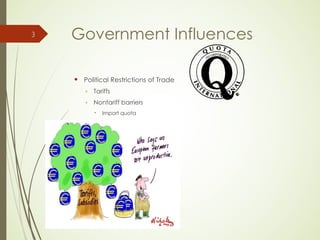
PoliticalRestrictions of Trade
◦ Tariffs
◦ Nontariff barriers
Import quota
◦ Embargoes
As of October, 2007, the
United States has sanctions
against: China, Ivory Coast,
Cuba, Democratic Republic
of the Congo , Iran,
Myanmar, Sudan, Syria,
Venezuela, and Zimbabwe
International Transport
◦ Cargo preference rules
3
4.
Challenges
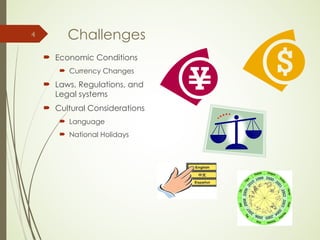
Economic Conditions
Currency Changes
Laws, Regulations, and
Legal systems
Cultural Considerations
Language
National Holidays
4
5.
Exporting Requirements
Shippinga product overseas
Packing
Labeling
Documentation
Insurance requirements
Note: Most exporters rely on an international freight
forwarder to perform these services because of the
multitude of considerations involved in physically
exporting goods
5
6.
Packing
Reasons
Move goodseasily through
customs
Protect Products
Used Guidelines
Pack in strong containers,
adequately sealed and filled
when possible.
Make sure the weight is evenly
distributed.
Goods should be palletized and
when possible containerized.
Packages and packing filler
should be made of moisture-
resistant material.
To avoid pilferage, avoid writing
contents or brand names on
packages. Other safeguards
include using straps, seals, and
shrink wrapping.
Observe any product-specific
hazardous materials packing
requirements.
6
7.
Labeling
Reasons
Meet shipping
regulations
Ensure proper handling
Conceal the identity of
the contents
Help receivers identify
shipments
Insure compliance with
environmental and
safety standards
Markings on cartons to be
shipped
Shipper's mark
Country of origin
Weight marking
Number of packages and size of
cases
Handling marks
Cautionary markings, such as
"This Side Up" or "Use No Hooks"
Port of entry
Labels for hazardous materials
7
8.
Documentation
Air waybills
Bill of lading
Commercial invoice
Consular invoice
Certificate of origin
NAFTA certificate of
origin
Inspection certification
Dock receipt and a
warehouse receipt
Destination control
statement
Shipper's Export
Declaration(SED)
Export license
Export packing list
Insurance certificate
8
9.
Insurance
Reasons
Damaging weatherconditions
Rough handling by carriers,
Other common hazards to
cargo
Type of covers
Marine cargo insurance
Cargo insurance
9
10.
Schedule B andHS Numbers
The Harmonized System (HS)
◦ Assigns 6 digit number
◦ 4 additional numbers (by country)
◦ 10 Digits total
US use Schedule B system
◦ Based on the international HS system
http://www.census.gov/foreign-trade/aes/
exporttraining/videos/uscs_videos/
Classifying_your_commodity/index.html
10
11.
Schedule B andHS Numbers
Reasons
To determine applicable import tariff rates and
whether a product qualifies for a preferential tariff
under a Free Trade Agreement;
The Schedule B number is needed to complete the
Shipper’s Export Declaration, Certificates of Origin and
other shipping documents; and
The HS Number may be needed on shipping
documents, such as certificates of origin
11
12.
Incoterms 2000
(International Commercial
Terms)
What are they?
◦ A series of international sales terms published in 2000 by
the International Chamber of Commerce (ICC)
◦ From the seller’s viewpoint: the different locations for
quoting a price to an overseas buyer
How are they useful?
◦ Widely used in international commercial transactions
◦ Used to divide transaction costs & responsibilities between
buyer & seller
◦ Reflect state-of-the-art transportation practices
12
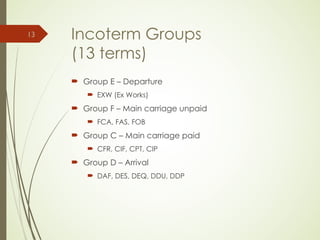
13.
Incoterm Groups
(13 terms)
Group E – Departure
EXW (Ex Works)
Group F – Main carriage unpaid
FCA, FAS, FOB
Group C – Main carriage paid
CFR, CIF, CPT, CIP
Group D – Arrival
DAF, DES, DEQ, DDU, DDP
13
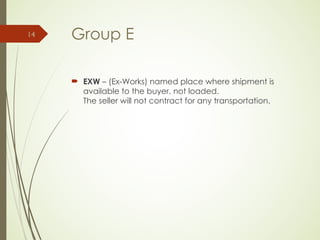
14.
Group E
EXW– (Ex-Works) named place where shipment is
available to the buyer, not loaded.
The seller will not contract for any transportation.
14
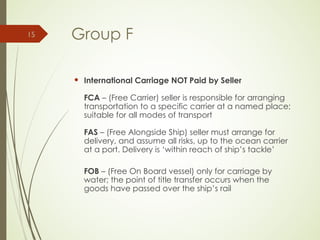
15.
Group F
InternationalCarriage NOT Paid by Seller
FCA – (Free Carrier) seller is responsible for arranging
transportation to a specific carrier at a named place;
suitable for all modes of transport
FAS – (Free Alongside Ship) seller must arrange for
delivery, and assume all risks, up to the ocean carrier
at a port. Delivery is ‘within reach of ship’s tackle’
FOB – (Free On Board vessel) only for carriage by
water; the point of title transfer occurs when the
goods have passed over the ship’s rail
15
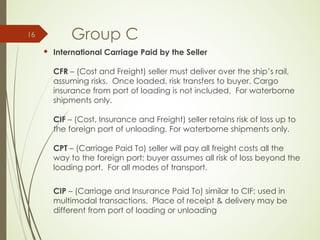
16.
Group C
InternationalCarriage Paid by the Seller
CFR – (Cost and Freight) seller must deliver over the ship’s rail,
assuming risks. Once loaded, risk transfers to buyer. Cargo
insurance from port of loading is not included. For waterborne
shipments only.
CIF – (Cost, Insurance and Freight) seller retains risk of loss up to
the foreign port of unloading. For waterborne shipments only.
CPT – (Carriage Paid To) seller will pay all freight costs all the
way to the foreign port; buyer assumes all risk of loss beyond the
loading port. For all modes of transport.
CIP – (Carriage and Insurance Paid To) similar to CIF; used in
multimodal transactions. Place of receipt & delivery may be
different from port of loading or unloading
16
17.
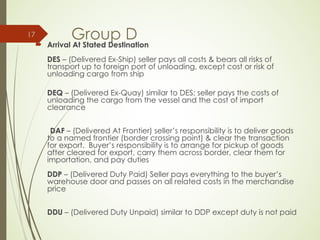
Group D
ArrivalAt Stated Destination
DES – (Delivered Ex-Ship) seller pays all costs & bears all risks of
transport up to foreign port of unloading, except cost or risk of
unloading cargo from ship
DEQ – (Delivered Ex-Quay) similar to DES; seller pays the costs of
unloading the cargo from the vessel and the cost of import
clearance
DAF – (Delivered At Frontier) seller’s responsibility is to deliver goods
to a named frontier (border crossing point) & clear the transaction
for export. Buyer’s responsibility is to arrange for pickup of goods
after cleared for export, carry them across border, clear them for
importation, and pay duties
DDP – (Delivered Duty Paid) Seller pays everything to the buyer’s
warehouse door and passes on all related costs in the merchandise
price
DDU – (Delivered Duty Unpaid) similar to DDP except duty is not paid
17
18.
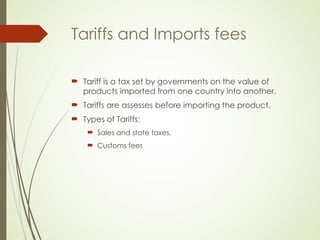
Tariffs and Importsfees
Tariff is a tax set by governments on the value of
products imported from one country into another.
Tariffs are assesses before importing the product.
Types of Tariffs:
Sales and state taxes,
Customs fees
19.
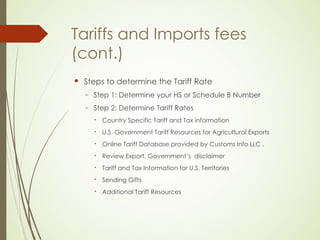
Tariffs and Importsfees
(cont.)
Steps to determine the Tariff Rate
◦ Step 1: Determine your HS or Schedule B Number
◦ Step 2: Determine Tariff Rates
Country Specific Tariff and Tax information
U.S. Government Tariff Resources for Agricultural Exports
Online Tariff Database provided by Customs Info LLC .
Review Export. Government’s disclaimer
Tariff and Tax Information for U.S. Territories
Sending Gifts
Additional Tariff Resources
20.
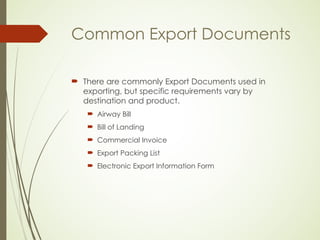
Common Export Documents
There are commonly Export Documents used in
exporting, but specific requirements vary by
destination and product.
Airway Bill
Bill of Landing
Commercial Invoice
Export Packing List
Electronic Export Information Form
21.
Certificate Of Origin
The Certificate of Origin (CO) is required by some
countries for all or only certain products.
The exporter should verify whether a CO is required
with the buyer and/or an experienced shipper/freight
forwarder or the Trade Information center.
Most common are Certificate of Origin for claiming
benefits under Free Trade Agreements
22.
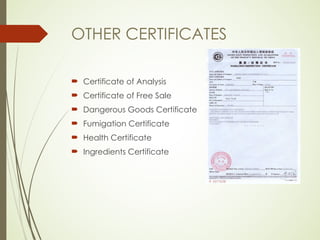
OTHER CERTIFICATES
Certificateof Analysis
Certificate of Free Sale
Dangerous Goods Certificate
Fumigation Certificate
Health Certificate
Ingredients Certificate
23.
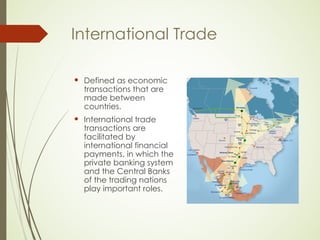
International Trade
Definedas economic
transactions that are
made between
countries.
International trade
transactions are
facilitated by
international financial
payments, in which the
private banking system
and the Central Banks
of the trading nations
play important roles.
24.
Trade Agreements
Thepurpose of US Trade Agreements is to
create opportunities for Americans and
help to grow the U.S. economy.
Administering trade agreements involves:
Monitoring the trading partners’
implementation.
Negotiating and signing trade agreements
that advance the President's trade policy
An important type of trade agreement is
the Trade and Investment Framework
Agreement (TIFAs)
25.
International Logistics
Agencies Examples
World Courier:
◦ Private Company handling Specialty & Custom Shipment
USPS:
◦ Government Agency handling mail and parcel
FedEx:
◦ Public Company handling a variety of shipping needs
25
26.
World Courier
Largestmost successful specialty courier in the world
Areas of Service:
◦ Clinical trial logistics
◦ Clinical trial supply storage
◦ Cold Chain Solutions
◦ Courier services:
Advertising & media
Aircraft on Ground
Automotive
Biopharm
Food
HighTech
Serve in 50 Countries, 140 offices
26
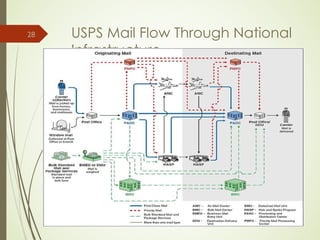
27.
USPS
(United States PostalService)
Independent agency of the U.S. Government
Responsible for providing postal service in U.S.
Second largest civilian employer in U.S. after Wal-Mart
Has contractual agreement with AmTrak and various airlines for
mail and package delivery
Offers international services to over 190 countries, including ship
letters and packages with the aid of FedEx
International Parcel Shipments:
◦ Maximum weight: 70 pounds
◦ Maximum length + girth: 130 inches
◦ Costs almost triple for Parcel Post shipments that are "oversized" (Length +
girth is greater that 108 but less than 130 inches)
27
FedEx
Headquartered inMemphis, Tennessee
Offers international services to over 220 countries
Strong ties to the White House and members of Congress allow access to international
trade and tax cut debates as well as the rules of the business practices of the United
States Postal Service
In 2001, FedEx sealed a $9 billion deal with the USPS to transport all of the post office's
overnight and express deliveries
International Next Flight Urgent shipments:
◦ Up to 2,200 lbs. per piece (or more with prior
approval). Unlimited total shipment weight
Other International parcel shipments:
◦ Up to 150 lbs. each (unlimited total shipment
weight), 108" in length, 130" in length plus girth
(L+2W+2H)
29
#2 The negotiating, planning, and implementation of supporting logistic arrangements between nations, their forces, and agencies.
It includes furnishing logistic support (major end items, materiel, and/or services) to, or receiving logistic support from, one or more friendly foreign governments, international organizations, or military forces, with or without reimbursement
It also includes planning and actions related to the intermeshing of a significant element, activity, or component of the military logistic systems or procedures of the United States with those of one or more foreign governments, international organizations, or military forces on a temporary or permanent basis.
It includes planning and actions related to the utilization of United States logistic policies, systems, and/or procedures to meet requirements of one or more foreign governments, international organizations, or forces.
Source: Dictionary of Military and Associated Terms. US Department of Defense 2005, http://www.thefreedictionary.com/international+logistics
#3 As of October, 2007, the United States has sanctions against:
Countries:
China, no arms-related exports, since 1989 (see Sino-American relations)
Côte d'Ivoire/Ivory Coast (see Côte d'Ivoire – United States relations)
Cuba, since 1962 (see United States embargo against Cuba)
Democratic Republic of the Congo (see Democratic Republic of the Congo – United States relations)
Iran, since 1979 (see Sanctions against Iran)
Myanmar, since 1997 (see Burma – United States relations)
North Korea, since 1950 (see North Korea – United States relations)
Sudan (see Sudan – United States relations)
Syria (see Syria – United States relations)
Venezuela, no defense article exports since 2006 (see United States – Venezuela relations)
Zimbabwe (leadership and humanitarian aid, but not general trade; see United States – Zimbabwe relations)
#5 When shipping a product overseas, the exporter must be aware of packing, labeling, documentation, and insurance requirements.
Most exporters rely on an international freight forwarder to perform these services because of the multitude of considerations involved in physically exporting goods.
An international freight forwarder is an agent for the exporter in moving cargo to an overseas destination. Whether an exporter is large or small, the weight of the cargo light or heavy, a freight forwarder can take care of cargo from “dock to door,” thus freeing the exporter from dealing with many logistics-related details.
http://www.export.gov/logistics/index.asp
#6 Packing: Exporters should be aware of the demands that international shipping puts on packaged goods. Exporters should jeep four potential problems in mind when designing an export shipping crate: breakage, moisture, pilferage and excess weight
Pack in strong containers, adequately sealed and filled when possible.
To provide proper bracing in the container, regardless of size, make sure the weight is evenly distributed.
Goods should be palletized and when possible containerized.
Packages and packing filler should be made of moisture-resistant material.
To avoid pilferage, avoid writing contents or brand names on packages. Other safeguards include using straps, seals, and shrink wrapping.
Observe any product-specific hazardous materials packing requirements.
#7 Labeling: The overseas buyer usually specifies which export marks should appear on the cargo for easy identification by receivers. Products can require many markings for shipment. For example, exporters need to put the following markings on cartons to be shipped:
Shipper's mark;
Country of origin (U.S.A.);
Weight marking (in pounds and in kilograms);
Number of packages and size of cases (in inches and centimeters);
Handling marks (international pictorial symbols);
Cautionary markings, such as "This Side Up" or "Use No Hooks" (in English and in the language of the country of destination);
Port of entry;
Labels for hazardous materials (universal symbols adapted by the International Airi Transport Association and the International Maritime Organization); and;
Ingredients (if applicable, also included in the language of the destination country).
#8 Exporters should seriously consider having the freight forwarder handle the formidable amount of documentation that exporting requires as forwarders are specialists in this process. The following documents are commonly used in exporting; but which of them are necessary in a particular transaction depends on the requirements of the U.S. government and the government of the importing country.
Air freight shipments are handled by air waybills, which can never be made in negotiable form (see figure 1).
A bill of lading is a contract between the owner of the goods and the carrier (as with domestic shipments). For vessels, there are two types: a straight bill of lading which is nonnegotiable and a negotiable or shipper's order bill of lading. The latter can be bought, sold, or traded while the goods are in transit. The customer usually needs an original as proof of ownership to take possession of the goods (see figure 3 for a Short Form Straight Bill of Lading and figure 8 for a Liner Bill of Lading).
A commercial invoice is a bill for the goods from the seller to the buyer. These invoices are often used by governments to determine the true value of goods when assessing customs duties. Governments that use the commercial invoice to control imports will often specify its form, content, number of copies, language to be used, and other characteristics (see figure 2).
A consular invoice is a document that is required in some countries. It describes the shipment of goods and shows information such as the consignor, consignee, and value of the shipment. Certified by the consular official of the foreign country stationed here, it is used by the country's customs officials to verify the value, quantity, and nature of the shipment.
A certificate of origin is a document that is required in certain nations. It is a signed statement as to the origin of the export item. Certificate of origin are usually signed through a semiofficial organization, such as a local chamber of commerce. A certificate may still be required even if the commercial invoice contains the information (see figure 4).
A NAFTA certificate of origin is required for products traded among the NAFTA countries (Canada, the United States, and Mexico).
Inspection certification is required by some purchasers and countries in order to attest to the specifications of the goods shipped. This is usually performed by a third party and often obtained from independent testing organizations.
A dock receipt and a warehouse receipt are used to transfer accountability when the export item is moved by the domestic carrier to the port of embarkation and left with the ship line for export.
A destination control statement appears on the commercial invoice, and ocean or air waybill of lading to notify the carrier and all foreign parties that the item can be exported only to certain destinations.
A Shipper's Export Declaration(SED) is used to control exports and act as a source document for official U.S. export statistics. SEDs must be prepared for shipments through the U.S. Postal Service when the shipment is valued over $500. SEDs are required for shipments not using the U.S. Postal Service when the value of the commodities, classified under any single Schedule B number, is over $2,500. SEDs must be prepared, regardless of value, for all shipments requiring an export license or destined for countries restricted by the Export Administration Regulations (see Chapter 9). SEDs are prepared by the exporter or the exporter's agent and delivered to the exporting carrier (for example, the post office, airline, or vessel line). The exporting carrier will present the required number of copies to the U.S. Customs Service at the port of export (see
figure 5). Often, the SED is prepared as a by-product of another document, the Shipper's Letter of Instructions, as shown in figure 6.
An export license is a government document that authorizes the export of specific goods in specific quantities to a particular destination. This document may be required for most or all exports to some countries or for other countries only under special circumstances.
An export packing list considerably more detailed and informative than a standard domestic packing list. It an itemizes the material in each individual package and indicates the type of package, such as a box, crate, drum, or carton. It also shows the individual net, legal, tare, and gross weights and measurements for each package (in both U.S. and metric systems). Package markings should be shown along with the shipper's and buyer's references. The list is used by the shipper or forwarding agent to determine the total shipment weight and volume and whether the correct cargo is being shipped. In addition, U.S. and foreign customs officials may use the list to check the cargo (see figure 7).
An insurance certificate is used to assure the consignee that insurance will cover the loss of or damage to the cargo during transit (see figure 7).
Documentation must be precise because slight discrepancies or omissions may prevent merchandise from being exported, result in nonpayment, or even result in the seizure of the exporter's goods by U.S. or foreign government customs. Collection documents are subject to precise time limits and may not be honored by a bank if the time has expired. Most documentation is routine for freight forwarders and customs brokers, but the exporter is ultimately responsible for the accuracy of its documents.
The number and kind of documents the exporter must deal with varies depending on the destination of the shipment. Because each country has different import regulations, the exporter must be careful to provide all proper documentation. The following sources also provide information pertaining to foreign import restrictions:
#9 Insurance
Damaging weather conditions, rough handling by carriers, and other common hazards to cargo make insurance an important protection for U.S. exporters. If the terms of sale make the exporter responsible for insurance, the exporter should either obtain its own policy or insure the cargo under a freight forwarder's policy for a fee. If the terms of sale make the foreign buyer responsible, the exporter should not assume (or even take the buyer's word) that adequate insurance has been obtained. If the buyer neglects to obtain adequate coverage, damage to the cargo may cause a major financial loss to the exporter.
Shipments by sea are covered by marine cargo insurance (see figure 9).
Air shipments may also be covered by marine cargo insurance or insurance may be purchased from the air carrier.
Export shipments are usually insured against loss, damage, and delay in transit by cargo insurance. Carrier liability is frequently limited by international agreements. Additionally, the coverage is substantially different from domestic coverage. Arrangements for insurance may be made by either the buyer or the seller, in accordance with the terms of sale. Exporters are advised to consult with international insurance carriers or freight forwarders for more information.
Although sellers and buyers can agree to different components, coverage is usually placed at 110 percent of the CIF (cost, insurance, freight) or CIP (carriage and insurance paid to) value.
#10 Schedule B and HS Numbers
The Harmonized System (HS) assigns a 6 digit number to each product that is traded internationally. Each country can assign, on its own, four additional numbers, making the entire number 10 digits. The United States does this with its Schedule B system.
#14 -Origin Term
-Most basic transaction
-Seller transfers all risk of loss and all responsibility for expenses to the buyer at the seller’s loading dock (e.g. goods available for pickup at seller’s factory or warehouse)
#15 -FCA: seller hands over the goods, cleared for export, into the custody of the first carrier (named by the seller) at the named place. The goods are ‘delivered’ when they are received by the buyer’s carrier
-FAS: Freight costs up to alongside vessel, risk of loss, and costs of export clearance are borne by the seller
-FOB: Freight to a vessel, loading aboard, and export clearance are the seller’s responsibilities. Once goods are loaded, the risk of loss and costs of transport revert to buyer
#16 -CFR: ‘Cost’ refers to merchandise. ‘Freight’ refers to all the freight, including export clearance, up to the foreign port of unloading.
-CIF: includes costs of freight and the costs of insurance
#17 -DES: in case of large pieces of equipment, or bulk cargoes, the costs of unloading can exceed the cost of the main freight.
-DDP: seller undertakes all risks & costs from origin to the buyer’s warehouse door, including export and import clearance and import customs duties; for intermodal transactions
-DDU: for intermodal transactions
#18 - Tariffs or duties are a tax levied by governments on the value of products imported from one country into another. Before you export to any country, you need to determine what the tariff rate is on your product(s) as well as any import fees for that country.
- A tariff (or duty, the words are used interchangeably) is a tax levied by governments on the value of imported products. Sales and state taxes, and in some instances customs fees, will often be levied as well. The tariff is assessed at the time of importation along with any other applicable taxes/fees. Tariffs raise the prices of imported goods, thus making them less competitive within the market of the importing country. Before you export to any country, you need to determine what the tariff rate is on your product(s) as well as any import fees for that country. The following information will help you make this determination.
Source: http://www.export.gov/logistics/eg_main_018130.asp
#19 Step 1: Determine your HS or Schedule B Number
The first step in determining duty and tax information is to identify the Harmonized System or Schedule B number for your product(s).
The Census Bureau sponsors a free online tool called the Schedule B Search Engine and an instructional video to help you classify your products.
Step 2: Determine Tariff Rates
Once you know your product’s Schedule B or HS number, you will be able to determine the applicable tariff and tax rates in a particular foreign country. The links below provide resources for looking up specific foreign tariff and tax rates for your product. This video explains how to find tariff rates using the first link below, Country Specific Tariff and Tax Information.
Country Specific Tariff and Tax Information: Tariff and tax information for exporting overseas.
U.S. Government Tariff Resources for Agricultural Exports
Online Tariff Database provided by Customs Info LLC (please note that this service is provided for your convenience and we suggest that you review Export.gov’s disclaimer statement.)
Tariff and Tax Information for U.S. Territories
Sending Gifts
Additional Tariff Resources (including information for importing into the U.S.)
For Assistance
Once the Schedule B is determined, please call the Trade Information Center at 1-800-USA-TRADE and an international trade specialist will assist you in obtaining foreign import fee, duty, and tax information. You may also email a tariff inquiry (requesting duty and tax information) with HS number(s) to the Trade Information Center at tic@ita.doc.gov or fax us at (202) 482-4473.
Source: http://www.export.gov/logistics/eg_main_018130.asp
#20 The Section covers to documents that are commonly used in exporting, but specific requirements vary by destination and product.
COMMON EXPORT DOCUMENTS
Airway Bill
Air freight shipments require Airway bills, which can never be made in negotiable form (see sample). Airway bills are shipper-specific (i.e. USPS, Fed-Ex,UPS, DHL, etc).
Bill of Lading
A contract between the owner of the goods and the carrier (as with domestic shipments). For vessels, there are two types: a straight bill of lading, which is non-negotiable, and a negotiable or shipper's order bill of lading. The latter can be bought, sold, or traded while the goods are in transit. The customer usually needs an original as proof of ownership to take possession of the goods (see Sample Short Form Bill of Lading and Sample Liner Bill of Lading).
Commercial Invoice
A bill for the goods from the seller to the buyer. These invoices are often used by governments to determine the true value of goods when assessing customs duties. Governments that use the commercial invoice to control imports will often specify its form, content, number of copies, language to be used, and other characteristics (see Sample).
Export Packing List
Considerably more detailed and informative than a standard domestic packing list, it lists seller, buyer, shipper, invoice number, date of shipment, mode of transport, carrier, and itemizes quantity, description, the type of package, such as a box, crate, drum, or carton, the quantity of packages, total net and gross weight (in kilograms), package marks, and dimensions, if appropriate. Both commercial stationers and freight forwarders carry packing list forms. A packing list may serve as conforming document. It is not a substitute for a commercial invoice.
Electronic Export Information Form (Shippers Export Declaration)
The EEI is the most common of all export documents. Required for shipments above $2,500* and for shipments of any value requiring an export license. SED has to be electronically filed via AES Direct (free service from Census and Customs) online system.
*Note: EEI is required for shipments to Puerto Rico, the U.S. Virgin Islands and the former Pacific Trust Territories even though they are not considered exports (unless each “Schedule B” item in the shipment is under $2,500).
Shipments to Canada do not require an SED except in cases where an export license is required. (Shipments to third countries passing through Canada do need an SED.)
Source http://www.export.gov/logistics/eg_main_018121.asp#P10_641
#21 CERTIFICATES OF ORGIN
Generic Certificate of Origin
The Certificate of Origin (CO) is required by some countries for all or only certain products. In many cases, a statement of origin printed on company letterhead will suffice (download generic certificate or see sample with explanation). The exporter should verify whether a CO is required with the buyer and/or an experienced shipper/freight forwarder or the Trade Information center.
Note: Some countries (i.e. Middle East) require that certificate of origin be notarized, certified by local chamber of commerce and legalized by the commercial section of the consulate of the destination country.
For textile products, an importing country may require a certificate of origin issued by the manufacturer. The number of required copies and language may vary from country to country.
Certificate of Origin for claiming benefits under Free Trade Agreements
Special certificates may be required for countries with which the United States has free trade agreements (FTAs). Some certificate of origin including those required by the North American Free Trade Agreement (NAFTA), and the FTA’s with Israel and Jordan, are prepared by the exporter. Others including those required by the FTA’s with Australia, CAFTA countries, Chile and Morocco, are importer’s responsibility). Click on a specific country below to learn details on how to document origin.
Australia (CO samples)
Bahrain (importer to check with Govt. of Bahrain on format/information)
CAFTA (Costa Rica, Dominican Republic, El Salvador, Guatemala, Honduras CO sample)
Chile (CO sample)
Israel (sample Note: Green form needs to be purchased from Vendor or US-Israel Chamber of Commerce or a publishing house )
Jordan (notarized generic certificate of origin required)
Morocco (importer makes a claim on the basis of supporting evidence)
NAFTA (Mexican, Canada, sample)
Singapore (no certificate of origin is required. However, the importer is required to produce the necessary permits together with an invoice, at the time of cargo clearance.)
Source http://www.export.gov/logistics/eg_main_018121.asp#P10_641
#22 OTHER CERTIFICATES FOR SHIPMENTS OF SPECIFIC GOODS
ATA CARNET/Temporary shipment certificate
An ATA Carnet a. k. a. "Merchandise Passport" is a document that facilitates the temporary importation of products into foreign countries by eliminating tariffs and value-added taxes (VAT) or the posting of a security deposit normally required at the time of importation. Apply for an ATA Carnet.
Certificate of Analysis:
A certificate of analysis is required for seeds, grain, health foods, dietary supplements, fruits and vegetables, and pharmaceutical products.
Certificate of Free Sale
Certificate of free sale may be issued for biologics, food, drugs, medical devices and veterinary medicine. More information is available from the Food and Drug Administration. Health authorities in some states as well as some trade associations also issue Certificates of Free Sale.
Dangerous Goods Certificate
Exports submitted for handling by air carriers and air freight forwarders classified as dangerous goods need to be accompanied by the Shipper’s Declaration for Dangerous Goods (sample) required by the International Air Transport Association (IATA). The exporter is responsible for accuracy of the form and ensuring that requirements related to packaging, marking, and other required information by IATA have been met.
For shipment of dangerous goods it is critical to identify goods by proper name, comply with packaging and labeling requirements (they vary depending upon type of product shipper and country shipped to). More information on labeling/regulations is available from the International Air Transportation Association or Department of Transportation - HAZMAT websites.
Fisheries Certificate
The National Marine Fisheries Service conducts inspections and analyses of fishery commodities for export.
Fumigation Certificate
The Fumigation Certificate provides evidence of the fumigation of exported goods (esp. agricultural products, used clothing, etc). This form assists in quarantine clearance of any goods of plant or animal origin. The seller to fumigate commodity at their expense a maximum of fifteen (15) days prior to loading.
Halal Certificate
Required by most countries in the Middle East, this certificate states that the fresh or frozen meat or poultry products were slaughtered in accordance with Islamic law. Certification by an appropriate chamber and legalization by the consulate of the destination country is usually required.
Health Certificate
For shipment of live animals and animal products (processed foodstuffs, poultry, meat, fish seafood, dairy products, and eggs and egg products). Note: Some countries require that health certificates be notarized or certified by a chamber and legalized by a consulate. Health certificates are issued by the U.S. Department of Agriculture’s Animal and Plant Health Inspection Service (APHIS).
Ingredients Certificate
A certificate of ingredients may be requested for food products with labels that are inadequate or incomplete. The certificate may be issued by the manufacturer and must give a description of the product, contents and percentage of each ingredient, chemical data, microbiological standards, storage instructions, shelf life, and date of manufacture. If animal fats are used, the certificate must state the type of fat used and that the product contains no pork, artificial pork flavor, or pork fat. All foodstuffs are subject to analysis by Ministry of Health laboratories to establish their fitness for use.
Inspection Certificate
Weight and Quality certificates should be provided in accordance with governing USDA/GIPSA regulations for loading at port and loading at source/mill site as appropriate. A certificate of origin certified by local chamber of commerce at load port and a Phytosanitary certificate issued by APHIS/USDA and Fumigation certificate are to be provided to buyer. Costs of all inspection, certificates/ documents at the load port are usually the responsibility of the seller.
Insurance Certificate
Used to assure the consignee that insurance will cover the loss of or damage to the cargo during transit (Sample). These can be obtained from your freight forwarder or publishing house. Note: an airway bill can serve as an insurance certificate for a shipment by air. Some countries may require certification or notification.
Phytosanitary Certificate
All shipments of fresh fruits and vegetables, seeds, nuts, flour, rice, grains, lumber, plants, and plant materials require a federal phytosanitary certificate. The certificate must verify that the product is free from specified epidemics and/or agricultural diseases. Additional information and forms are available from Animal and Plant Health Inspection Service (APHIS).
Radiation Certificate
Some counties including Saudi Arabia may require this certificate for some plant and animal imports. The certificate is statement that the products are not contaminated by radioactivity.
Steamship or Airline Company Certificate
A declaration attached to a bill of lading or airway bill stating that the shipper will not stop at an unscheduled port, attesting to the accuracy of the shipping route and providing other shipping information such as name of vessel/plane, nationality of vessel/plane, owner of vessel/plane, names of ports of call including port of leading and discharge.
Other (product-specific) certificates
Shaving brushes and articles made of raw hair must be accompanied by a recognized official certificate showing the consignment to be free from anthrax germs. Used clothing requires a disinfection certificate. Grain requires a fumigation certificate, and grain and seeds require a certificate of weight. Many countries in the Middle East require special certificates for imports of animal fodder additives, livestock, pets, and horses.
Weight certificate
Certificate of weight is a document issued by customs, certifying gross weight of the exported goods.
Source http://www.export.gov/logistics/eg_main_018121.asp#P10_641
#23 International Trade: economic transactions that are made between countries. Among the items commonly traded are consumer goods, such as television sets and clothing; capital goods, such as machinery; and raw materials and food. Other transactions involve services, such as travel services and payments for foreign patents (see service industry). International trade transactions are facilitated by international financial payments, in which the private banking system and the central banks of the trading nations play important roles.
Source: http://www.britannica.com/EBchecked/topic/291349/international-trade
#24 Trade Agreements can create opportunities for Americans and help to grow the U.S. economy.
USTR has principal responsibility for administering U.S. trade agreements. This involves monitoring our trading partners' implementation of trade agreements with the United States, enforcing America's rights under those agreements, and negotiating and signing trade agreements that advance the President's trade policy.
The United States is Member of the World Trade Organization (WTO), and the Marrakesh Agreement Establishing the World Trade Organization (WTO Agreement) sets out rules governing trade among the WTO's 154 members. The United States and other WTO Members are currently engaged in Doha Development Round of world trade talks, and a strong, market-opening Doha agreement for both goods and services would be an important contribution to addressing the global economic crisis and helping to restore trade's role in leading economic growth and development.
The United States has free trade agreements (FTAs) in effect with 17 countries. These FTAs build on the foundation of the WTO Agreement, with more comprehensive and stronger disciplines than the WTO Agreement. Many of our FTAs are bilateral agreements between two governments. But some, like the North American Free Trade Agreement and the Dominican Republic-Central America-United States Free Trade Agreement, are mulilateral agreements among several parties.
Another important type of trade agreement is the Trade and Investment Framework Agreement. TIFAs provide frameworks for governments to discuss and resolve trade and investment issues at an early stage. These agreements are also a means to identify and work on capacity-building where appropriate.
The United States also has a series of Bilateral Investment Treaties (BITs) help protect private investment, develop market-oriented policies in partner countries, and promote U.S. exports.
Detailed descriptions and the texts of many U.S. trade agreements can be accessed through the Resource Center on the left.
Source: http://www.ustr.gov/trade-agreements