Supply Chain
Planning &
Operations
Part 12
2
Logistics and Distribution Management
Logistics is the process of planning, implementing, and controlling the
efficient flow and storage of goods, services, and information from the point of
origin to the point of consumption. The primary goal of logistics is to meet
customer requirements effectively and efficiently. Here are the key logistics
functions and activities:
Transportation Management
•Description: The planning, execution, and management of the movement of
goods.
•Key Activities:
• Mode Selection: Choosing the appropriate mode of transportation (e.g.,
road, rail, air, sea) based on cost, speed, and reliability.
• Carrier Selection: Selecting and negotiating with carriers to move goods.
• Route Planning: Optimizing routes to reduce transit time and cost.
• Freight Consolidation: Combining smaller shipments into larger ones to
reduce transportation costs.
• Tracking and Tracing: Monitoring the movement of goods in real-time to
ensure timely delivery.
3
Logistics and Distribution Management
Warehouse and Storage Management
•Description: The storage, handling, and management of inventory within
warehouses.
•Key Activities:
• Warehouse Layout Design: Organizing storage space to maximize efficiency
and accessibility.
• Inventory Management: Tracking and managing inventory levels to ensure
availability while minimizing holding costs.
• Order Picking and Packing: Selecting and packing items for shipment based
on customer orders.
• Cross-Docking: Transferring goods directly from incoming to outgoing
transportation with minimal storage time.
• Returns Management: Handling returned goods, including inspection,
restocking, and disposal.
4
Logistics and Distribution Management
Inventory Management
•Description: The process of ordering, storing, and using a company's
inventory.
•Key Activities:
• Demand Forecasting: Predicting future customer demand to determine
appropriate inventory levels.
• Replenishment Planning: Planning and ordering inventory to ensure
adequate supply.
• Safety Stock Management: Maintaining buffer stock to account for demand
variability and supply disruptions.
• Inventory Auditing: Regularly checking inventory levels to ensure accuracy.
5
Logistics and Distribution Management
Order Processing
•Description: The handling of customer orders from receipt to delivery.
•Key Activities:
• Order Entry: Recording customer orders into the system.
• Order Fulfillment: Picking, packing, and shipping products to customers.
• Order Status Tracking: Monitoring and updating the status of orders
throughout the fulfillment process.
• Customer Communication: Keeping customers informed about order status,
delivery schedules, and any issues.
6
Logistics and Distribution Management
Logistics Information Systems
•Description: The use of technology and systems to manage logistics
operations.
•Key Activities:
• Transportation Management Systems (TMS): Software to plan, execute,
and optimize the transportation of goods.
• Warehouse Management Systems (WMS): Software to manage warehouse
operations, including inventory tracking and order fulfillment.
• Enterprise Resource Planning (ERP): Integrated systems to manage business
processes, including logistics.
• Real-Time Data Collection: Using technologies like RFID and IoT to collect
and analyze data in real time.
7
Logistics and Distribution Management
Supply Chain Coordination
•Description: Ensuring coordination and collaboration across the entire
supply chain.
•Key Activities:
• Supplier Relationship Management: Managing interactions and
relationships with suppliers.
• Customer Relationship Management: Managing interactions and
relationships with customers.
• Collaborative Planning, Forecasting, and Replenishment (CPFR): Working
with supply chain partners to align plans and forecasts.
• Supply Chain Visibility: Ensuring transparency and real-time information
sharing across the supply chain.
8
Logistics and Distribution Management
Packaging and Material Handling
•Description: The protection and movement of goods within the warehouse
and during transportation.
•Key Activities:
• Packaging Design: Designing packaging to protect goods and optimize
space.
• Labeling: Applying labels for identification and tracking.
• Material Handling Equipment: Using equipment like forklifts, conveyors,
and pallet jacks to move goods.
• Load Planning: Arranging goods in transportation vehicles to maximize
space and minimize damage.
9
Logistics and Distribution Management
Reverse Logistics
•Description: The process of moving goods from their final destination for
return, repair, remanufacture, or recycling.
•Key Activities:
• Returns Processing: Handling customer returns, including inspection,
restocking, and credit issuance.
• Refurbishing and Repair: Repairing and refurbishing returned goods for
resale.
• Recycling and Disposal: Managing the disposal or recycling of obsolete or
end-of-life products.
• Warranty Management: Handling warranty claims and repairs.
10
Logistics and Distribution Management
Compliance and Risk Management
•Description: Ensuring logistics operations comply with regulations and
managing risks.
•Key Activities:
• Regulatory Compliance: Adhering to regulations related to transportation,
safety, and environmental impact.
• Customs Management: Managing the import and export processes to
comply with customs regulations.
• Risk Assessment and Mitigation: Identifying potential risks in the logistics
process and implementing strategies to mitigate them.
• Security Management: Ensuring the security of goods throughout the
supply chain.
11
Logistics and Distribution Management
Sustainability and Green Logistics
•Description: Implementing environmentally friendly logistics practices.
•Key Activities:
• Carbon Footprint Reduction: Implementing measures to reduce carbon
emissions.
• Energy Efficiency: Using energy-efficient vehicles and equipment.
• Waste Reduction: Minimizing waste through recycling and efficient
packaging.
• Sustainable Sourcing: Procuring materials from sustainable sources.
Effective logistics management involves a wide range of functions and
activities, from transportation and inventory management to order processing
and reverse logistics. By optimizing these activities, businesses can improve
efficiency, reduce costs, and enhance customer satisfaction.
12
Logistics and Distribution Management
Distribution channels and strategies are vital components of a company's
overall marketing and logistics plan, determining how products or services
reach end customers. Selecting the right distribution channels and strategies
ensures that products are available to consumers when and where they need
them, in a cost-effective manner.
Choosing the right distribution channels and strategies is crucial for reaching
customers effectively and efficiently. Companies must carefully consider their
product, market, and business goals to develop a distribution plan that
maximizes reach, controls costs, and maintains brand integrity. By integrating
various channels and leveraging modern technologies, businesses can
create a flexible and responsive distribution network that meets the demands
of today's dynamic market environment.
13
Logistics and Distribution Management
Distribution Channels
Distribution channels refer to the pathways through which products move
from the manufacturer to the end consumer. They can be direct or indirect,
with multiple intermediaries involved.
Direct Distribution Channels
•Manufacturer to Consumer
• Description: The manufacturer sells directly to the consumer without any
intermediaries.
• Examples: Company-owned stores, online sales through the company's
website, direct mail, telemarketing.
• Advantages: Greater control over brand image, customer experience, and
pricing; direct customer feedback; higher profit margins.
• Disadvantages: Higher costs related to sales, distribution, and customer
service; limited
14
Logistics and Distribution Management
Indirect Distribution Channels
•Manufacturer to Retailer to Consumer
• Description: The manufacturer sells products to retailers, who then sell them to
consumers.
• Examples: Department stores, specialty shops, e-commerce platforms like Amazon.
• Advantages: Wider market reach; reduced distribution costs for the manufacturer.
• Disadvantages: Less control over customer experience and brand presentation; lower
profit margins due to retailer markups.
•Manufacturer to Wholesaler to Retailer to Consumer
• Description: The manufacturer sells products to wholesalers, who then sell them to
retailers, who finally sell them to consumers.
• Examples: Consumer goods, electronics, and grocery products.
• Advantages: Efficient for distributing large quantities; wholesalers handle bulk
breaking, warehousing, and logistics.
• Disadvantages: Less control over distribution process; additional intermediary
reduces profit margins.
•Manufacturer to Agent/Broker to Wholesaler to Retailer to Consumer
• Description: The manufacturer uses agents or brokers to connect with wholesalers,
who then sell to retailers, who finally sell to consumers.
• Examples: Agricultural products, industrial goods.
• Advantages: Agents/brokers can provide market knowledge and connect
manufacturers with multiple wholesalers.
• Disadvantages: Multiple intermediaries can complicate the distribution process and
reduce profit margins.
15
Logistics and Distribution Management
Distribution Strategies
Distribution strategies define how a company plans to deliver its
products to the market. The choice of strategy depends on factors
such as the nature of the product, target market, competition, and
overall business objectives.
Intensive Distribution
•Description: A strategy where products are stocked in as many
outlets as possible.
•Examples: Convenience products like snacks, soft drinks, and
everyday household items.
•Advantages: Maximizes product availability and exposure;
increases chances of impulse purchases.
•Disadvantages: Requires significant resources and logistics; higher
costs due to widespread distribution.
16
Logistics and Distribution Management
Selective Distribution
•Description: A strategy where products are distributed through a
limited number of intermediaries.
•Examples: Electronics, home appliances, and high-end fashion.
•Advantages: Better control over brand image and customer
experience; intermediaries more motivated to sell the product.
•Disadvantages: Limited market reach compared to intensive
distribution; potential for higher per-unit distribution costs.
Exclusive Distribution
•Description: A strategy where products are sold through a single or
very few intermediaries in a particular geographic area.
•Examples: Luxury brands, high-end automobiles, and designer
clothing.
•Advantages: Strong control over brand image and pricing; close
relationships with intermediaries; enhanced customer experience.
•Disadvantages: Limited market reach; higher dependency on a few
intermediaries.
17
Logistics and Distribution Management
Franchising
•Description: A strategy where a company (franchisor) grants a third
party (franchisee) the rights to operate a business under the
company's brand and business model.
•Examples: Fast-food chains, retail stores, and service providers.
•Advantages: Rapid expansion with lower capital investment;
franchisees invest in and manage local operations.
•Disadvantages: Less control over individual franchise operations;
potential for brand inconsistency.
E-Commerce
•Description: Selling products directly to consumers through online
platforms.
•Examples: Company websites, online marketplaces like Amazon
and eBay.
•Advantages: Global reach; lower overhead costs; direct customer
interaction and data collection.
•Disadvantages: High competition; logistics and fulfillment
challenges; dependence on technology infrastructure.
18
Logistics and Distribution Management
Omnichannel Distribution
•Description: A strategy that integrates multiple channels (physical
stores, online platforms, mobile apps) to provide a seamless
customer experience.
•Examples: Retailers that offer in-store pickup for online orders,
unified loyalty programs across channels.
•Advantages: Enhanced customer experience; flexibility for
customers to choose their preferred shopping method; increased
sales opportunities.
•Disadvantages: Requires significant investment in technology and
logistics integration; complex to manage and coordinate.
19
Logistics and Distribution Management
Factors Influencing Distribution Channel and Strategy Selection
1.Product Characteristics
1. Perishability, size, weight, and complexity of the product influence
the choice of distribution channels.
2.Market Characteristics
1. Geographic dispersion, customer preferences, and buying behavior
of the target market.
3.Company Objectives and Resources
1. Strategic goals, financial resources, and operational capabilities.
4.Competition
1. Competitor strategies and the need to differentiate in the
marketplace.
5.Legal and Regulatory Environment
1. Compliance with local laws and regulations governing distribution
and trade.
20
Logistics and Distribution Management
Transportation management is a key component of supply chain and
logistics management, focusing on the efficient and effective
movement of goods from one location to another. It involves planning,
execution, and control of transportation operations to ensure timely
delivery, cost-efficiency, and customer satisfaction.
Effective transportation management is critical for ensuring that
goods are delivered on time, within budget, and in good condition. By
leveraging technology, collaborating with partners, adopting
sustainable practices, managing risks, and continuously improving
performance, companies can optimize their transportation operations,
reduce costs, and enhance customer satisfaction.
21
Logistics and Distribution Management
Here are the main elements and strategies involved in transportation
management:
Key Elements of Transportation Management
Transportation Planning
1. Route Optimization: Determining the most efficient routes to minimize
travel time, fuel consumption, and costs.
2. Mode Selection: Choosing the appropriate mode of transportation (e.g.,
road, rail, air, sea) based on factors such as cost, speed, distance, and the
nature of the goods.
3. Carrier Selection: Selecting reliable carriers and negotiating favorable terms
and rates.
4. Load Planning: Consolidating shipments to optimize vehicle utilization and
reduce transportation costs.
22
Logistics and Distribution Management
Transportation Execution
1. Shipment Scheduling: Coordinating pickup and delivery times to meet
customer requirements and optimize resource utilization.
2. Dispatching: Assigning vehicles and drivers to specific routes and
shipments.
3. Tracking and Monitoring: Using GPS and other technologies to monitor the
real-time location and status of shipments.
4. Freight Documentation: Managing the necessary paperwork, including bills
of lading, packing lists, and customs documentation.
Transportation Control
1. Performance Monitoring: Tracking key performance indicators (KPIs) such
as on-time delivery rates, transit times, and transportation costs.
2. Risk Management: Identifying and mitigating risks such as delays, damage,
theft, and regulatory non-compliance.
3. Cost Management: Monitoring and controlling transportation expenses to
stay within budget.
4. Compliance Management: Ensuring adherence to local, national, and
international transportation regulations.
23
Logistics and Distribution Management
Strategies for Effective Transportation Management
Leveraging Technology
1. Transportation Management Systems (TMS): Implementing TMS software
to plan, execute, and optimize transportation operations. TMS can help with
route planning, carrier selection, load optimization, and real-time tracking.
2. Internet of Things (IoT): Using IoT devices to collect and analyze real-time
data on vehicle location, driver behavior, and shipment conditions.
3. Automation: Automating routine tasks such as dispatching, documentation,
and billing to improve efficiency and reduce errors.
Collaborative Logistics
1. Partnering with Carriers: Building strong relationships with carriers to
improve service levels and negotiate better rates.
2. Shipper Collaboration: Collaborating with other shippers to consolidate
shipments and share transportation resources, reducing costs and
improving efficiency.
3. 3PL and 4PL Services: Outsourcing transportation management to third-
party logistics (3PL) or fourth-party logistics (4PL) providers who have
expertise and resources to handle complex logistics operations.
24
Logistics and Distribution Management
Sustainability Practices
1. Green Transportation: Adopting eco-friendly practices such as using fuel-efficient
vehicles, optimizing routes to reduce emissions, and exploring alternative fuels.
2. Carbon Footprint Reduction: Implementing strategies to measure and reduce the
carbon footprint of transportation activities.
3. Sustainable Packaging: Using lightweight and recyclable packaging materials to
reduce transportation weight and volume.
Risk Management
1. Insurance: Securing appropriate insurance coverage to protect against risks such as
damage, theft, and loss of goods.
2. Contingency Planning: Developing contingency plans for handling disruptions such as
natural disasters, strikes, and geopolitical issues.
3. Compliance: Staying updated with regulatory changes and ensuring compliance with
transportation laws and regulations.
Performance Improvement
1. Continuous Improvement: Regularly reviewing transportation processes and
performance metrics to identify areas for improvement.
2. Driver Training: Providing training and development programs for drivers to improve
safety, efficiency, and customer service.
3. Data Analytics: Using data analytics to gain insights into transportation performance
and make data-driven decisions.
25
Logistics and Distribution Management
Key Performance Indicators (KPIs) in Transportation
Management
1.On-Time Delivery Rate: The percentage of shipments delivered on
or before the scheduled delivery date.
2.Transportation Cost per Unit: The total transportation cost divided
by the number of units shipped.
3.Transit Time: The time taken from the pickup of goods to their
delivery.
4.Freight Bill Accuracy: The percentage of accurate and error-free
freight bills.
5.Load Utilization: The percentage of vehicle capacity utilized for
each shipment.
6.Shipment Damage Rate: The percentage of shipments that arrive
damaged.
26
Case Study: Challenges in Global Logistics - Apple
Inc.
Company Background: Apple Inc. is one of the world's leading
technology companies, known for its innovative products such as the
iPhone, iPad, Mac computers, and various other electronics. Apple's
global supply chain is highly complex, with components sourced from
multiple countries and final assembly taking place in various locations
worldwide.
27
Case Study: Challenges in Global Logistics - Apple
Inc.
Supply Chain Disruptions
•Problem: The COVID-19 pandemic caused unprecedented
disruptions in Apple's supply chain. Lockdowns and factory closures
in China, where a significant portion of Apple's components are
manufactured, led to severe delays.
•Impact: Production delays affected the timely launch and availability
of new products, resulting in potential revenue loss and customer
dissatisfaction.
•Response: Apple diversified its supplier base by expanding into
other regions such as Vietnam and India. They also increased
inventory levels of critical components to buffer against future
disruptions.
28
Case Study: Challenges in Global Logistics - Apple
Inc.
Regulatory Compliance and Trade Policies
•Problem: The US-China trade war introduced tariffs and trade
barriers, complicating the import and export of components and
finished products.
•Impact: Increased costs due to tariffs and potential delays in
customs clearance.
•Response: Apple negotiated with suppliers to share the tariff burden
and explored alternate manufacturing locations outside of China to
mitigate the impact of trade policies.
29
Case Study: Challenges in Global Logistics - Apple
Inc.
Transportation and Shipping Costs
•Problem: Rising fuel prices and limited availability of air and sea
freight capacity led to increased transportation costs.
•Impact: Higher logistics costs reduced overall profit margins.
•Response: Apple optimized its logistics network by increasing
reliance on more cost-effective sea freight for non-urgent shipments
and used air freight strategically for high-priority products. They also
implemented advanced logistics software to improve route planning
and load optimization.
30
Case Study: Challenges in Global Logistics - Apple
Inc.
Inventory Management
•Problem: Balancing inventory to avoid both stockouts and excess
inventory amid fluctuating demand, particularly during product
launches and holiday seasons.
•Impact: Stockouts could lead to lost sales and customer
dissatisfaction, while excess inventory would increase holding costs.
•Response: Apple employed sophisticated demand forecasting
models using AI and machine learning to better predict demand. They
also used just-in-time (JIT) inventory practices for components to
minimize holding costs while ensuring sufficient stock for production.
31
Case Study: Challenges in Global Logistics - Apple
Inc.
Sustainability and Environmental Impact
•Problem: Increasing pressure from consumers and regulators to
reduce the environmental impact of logistics operations.
•Impact: Need to balance sustainability goals with cost and efficiency
considerations.
•Response: Apple invested in renewable energy sources for its
manufacturing plants and optimized its logistics network to reduce
carbon emissions. They also collaborated with suppliers to ensure
sustainable practices throughout the supply chain.
32
Case Study: Challenges in Global Logistics - Apple
Inc.
Apple Inc.'s global logistics challenges highlight the complexity and
dynamic nature of managing a global supply chain. By diversifying its
supplier base, leveraging advanced technologies, and strategically
managing transportation and inventory, Apple has been able to
navigate these challenges effectively. Continuous improvement and
adaptation are key to maintaining resilience and efficiency in global
logistics operations.
33
Quality Control and Continuous Improvement
Quality control (QC) methods are essential in ensuring that products
and services meet or exceed customer expectations and comply with
regulatory standards. Two of the most widely used methods are
Statistical Process Control (SPC) and Six Sigma. Both methodologies
aim to reduce defects and variability in processes, but they have
different approaches and tools.
34
Quality Control and Continuous Improvement
Statistical Process Control (SPC)
Overview:
Statistical Process Control (SPC) uses statistical methods to monitor and control
a process. This method helps to identify and eliminate variation in the process,
ensuring that it operates at its full potential.
Key Concepts:
1.Control Charts:
1. Purpose: To monitor process variability and detect unusual variations.
2. Types:
1. X-bar and R Charts: Used for monitoring the mean and range of a process.
2. P Charts: Used for monitoring the proportion of defective items in a
process.
3. C Charts: Used for monitoring the number of defects per unit.
2.Process Capability:
1. Purpose: To assess how well a process can produce output within specification
limits.
2. Indices:
1. Cp and Cpk: Measure the capability of a process to produce output within
specification limits.
3.Pareto Analysis:
1. Purpose: To identify the most significant factors contributing to a problem.
2. 80/20 Rule: 80% of problems are often due to 20% of the causes.
35
Quality Control and Continuous Improvement
Steps in SPC:
1.Identify Key Processes: Select the processes that significantly
impact product quality.
2.Collect Data: Gather data on the selected processes.
3.Analyze Data: Use control charts and other statistical tools to
analyze the data.
4.Implement Control: Apply control measures based on the analysis
to reduce variability.
5.Monitor and Improve: Continuously monitor the processes and
make improvements as needed.
36
Quality Control and Continuous Improvement
Six Sigma
Overview:
Six Sigma is a data-driven methodology that seeks to improve the quality of a
process by identifying and removing the causes of defects and minimizing
variability. It uses a set of quality management methods, mainly empirical and
statistical, and creates a special infrastructure of people within the
organization ("Black Belts", "Green Belts", etc.) who are experts in these
methods.
Key Concepts:
1.DMAIC Framework:
1. Define: Identify the problem and define the project goals.
2. Measure: Collect data and measure the current process performance.
3. Analyze: Analyze the data to identify root causes of defects.
4. Improve: Develop and implement solutions to improve the process.
5. Control: Monitor the improved process to ensure sustained performance.
2.DMADV Framework (for new processes):
1. Define: Define the project goals and customer deliverables.
2. Measure: Measure and determine customer needs and specifications.
3. Analyze: Analyze process options to meet customer needs.
4. Design: Design the process to meet customer requirements.
5. Verify: Verify the design performance and ability to meet customer needs.
37
Quality Control and Continuous Improvement
Six Sigma
Overview:
Six Sigma is a data-driven methodology that seeks to improve the quality of a
process by identifying and removing the causes of defects and minimizing
variability. It uses a set of quality management methods, mainly empirical and
statistical, and creates a special infrastructure of people within the
organization ("Black Belts", "Green Belts", etc.) who are experts in these
methods.
Key Concepts:
3. Six Sigma Tools:
1. SIPOC Diagrams: Used to identify the Suppliers, Inputs, Process, Outputs,
and Customers of a process.
2. Fishbone Diagrams: Used to identify potential causes of problems.
3. Failure Mode and Effects Analysis (FMEA): Used to identify and prioritize
potential failure modes and their impact.
4. Control Charts: Used to monitor process stability.
4. Sigma Level:
1. Purpose: Measure the capability of a process to produce defect-free output.
2. Calculation: Higher sigma levels indicate fewer defects (e.g., Six Sigma
corresponds to 3.4 defects per million opportunities).
38
Quality Control and Continuous Improvement
Benefits of Six Sigma:
•Reduced Defects: Significant reduction in defects and variability.
•Cost Savings: Lower costs due to reduced waste and rework.
•Customer Satisfaction: Improved product quality leading to higher
customer satisfaction.
•Employee Involvement: Encourages employee involvement and
development through training and project participation.
39
Quality Control and Continuous Improvement
Comparison of SPC and Six Sigma
•Approach:
• SPC focuses on monitoring and controlling the process using statistical
methods.
• Six Sigma is a comprehensive methodology that aims at improving the
entire process by reducing defects and variability.
•Tools:
• SPC primarily uses control charts and process capability analysis.
• Six Sigma uses a wider range of tools and techniques, including the DMAIC
framework, SIPOC diagrams, and FMEA.
•Implementation:
• SPC can be implemented as part of routine quality control practices.
• Six Sigma typically requires a more structured approach with dedicated
teams and projects.
40
Quality Control and Continuous Improvement
Both SPC and Six Sigma are powerful quality control methods that
can significantly improve process performance and product quality.
While SPC focuses on real-time monitoring and control, Six Sigma
provides a structured framework for identifying and eliminating
defects and variability. Implementing these methodologies can help
organizations achieve higher efficiency, lower costs, and greater
customer satisfaction.
41
Quality Control and Continuous Improvement
Continuous improvement is a key concept in operations management
and supply chain management, aimed at constantly enhancing
processes, products, and services. Two prominent methodologies
associated with continuous improvement are Kaizen and Lean.
Both Kaizen and Lean are powerful methodologies for continuous
improvement, each with its own unique approach. Kaizen fosters a
culture of continuous, incremental improvements through employee
involvement, while Lean aims to deliver maximum value by
eliminating waste and optimizing processes. Organizations can
benefit from combining these methodologies to create a
comprehensive continuous improvement strategy that enhances
efficiency, reduces costs, and delivers superior value to customers.
42
Quality Control and Continuous Improvement
Kaizen
Overview:
Kaizen is a Japanese term meaning "change for better" or "continuous
improvement." It involves all employees, from top management to frontline
workers, in a collective effort to improve processes. The focus is on small,
incremental changes rather than major innovations.
Key Principles:
1.Continuous Improvement:
1. Ongoing efforts to improve products, services, or processes.
2. Emphasis on small, incremental changes over time.
2.Employee Involvement:
1. Encourages participation from all employees.
2. Utilizes suggestions and ideas from workers who are directly involved in the
processes.
3.Standardization:
1. Establishing standard procedures as a foundation for improvements.
2. Ensuring that improvements become part of the standard work processes.
4.Teamwork:
1. Collaborative approach to problem-solving and process improvement.
2. Use of cross-functional teams to address specific issues.
43
Quality Control and Continuous Improvement
Kaizen Events:
•Kaizen Blitz:
• A short-term, focused effort to improve a specific area or process.
• Typically lasts from a few days to a week.
• Involves intense analysis and implementation of improvements.
•Gemba Walk:
• Managers and supervisors visit the actual place where work is done
(Gemba) to observe processes and gather insights.
• Helps in understanding real issues and identifying opportunities for
improvement.
44
Quality Control and Continuous Improvement
Lean
Overview:
Lean is a systematic approach to eliminating waste (non-value-added activities) and
optimizing processes to deliver maximum value to customers. Originating from the
Toyota Production System, Lean focuses on creating more value with fewer resources.
Key Principles:
1.Value:
1. Defining value from the customer's perspective.
2. Ensuring that all activities contribute to delivering value to the customer.
2.Value Stream Mapping:
1. Mapping the entire process flow to identify and eliminate waste.
2. Visualizing the current state and designing a future state with improved efficiency.
3.Flow:
1. Ensuring that processes flow smoothly without interruptions, delays, or bottlenecks.
2. Striving for a continuous flow of materials and information.
4.Pull:
1. Producing only what is needed when it is needed, based on customer demand.
2. Reducing excess inventory and overproduction.
5.Perfection:
1. Continuously striving for perfection by eliminating waste and improving processes.
2. Encouraging a culture of ongoing improvement and innovation.
45
Quality Control and Continuous Improvement
Lean Tools and Techniques:
1.5S:
1. Sort: Removing unnecessary items from the workplace.
2. Set in Order: Organizing items for easy access and retrieval.
3. Shine: Keeping the workplace clean and orderly.
4. Standardize: Establishing standards and best practices.
5. Sustain: Maintaining and improving the 5S standards.
2.Kanban:
1. A visual tool for managing workflow and inventory.
2. Uses cards or signals to indicate when more materials or products are
needed.
3.Poka-Yoke:
1. Mistake-proofing techniques to prevent errors and defects.
2. Designing processes and systems to make it difficult to make mistakes.
4.Just-in-Time (JIT):
1. Producing and delivering products just in time to meet customer demand.
2. Minimizing inventory and reducing lead times.
46
Quality Control and Continuous Improvement
Comparison of Kaizen and Lean
•Scope:
• Kaizen: Focuses on small, incremental changes and involves all
employees.
• Lean: Emphasizes a systematic approach to eliminating waste and
optimizing processes.
•Implementation:
• Kaizen: Can be implemented as part of daily routines and through
specific Kaizen events.
• Lean: Requires a more structured approach with tools and
techniques like Value Stream Mapping and 5S.
•Focus:
• Kaizen: Encourages a culture of continuous improvement and
employee involvement.
• Lean: Focuses on creating value for the customer by eliminating
waste and improving process flow.
47
Quality Control and Continuous Improvement
Implementing quality improvement initiatives involves systematic
planning, execution, monitoring, and continuous refinement of
processes to enhance product quality and operational efficiency.
Implementing quality improvement initiatives requires a structured
approach involving clear objectives, cross-functional collaboration,
detailed analysis, and continuous monitoring. By following these
steps, organizations can systematically enhance their processes,
reduce defects, improve customer satisfaction, and achieve long-term
operational excellence.
48
Quality Control and Continuous Improvement
1. Define Objectives and Scope
a. Establish Clear Goals
•Define the specific quality improvement objectives (e.g., reducing
defects, improving customer satisfaction, reducing process variability).
•Ensure goals are SMART (Specific, Measurable, Achievable, Relevant,
Time-bound).
b. Identify Scope
•Determine the processes, products, or services to be improved.
•Define the boundaries and limitations of the improvement initiatives.
2. Form a Quality Improvement Team
a. Select Team Members
•Include members from various functions such as production, quality
control, supply chain, and customer service.
•Ensure the team has a mix of skills and expertise relevant to the
improvement initiative.
b. Define Roles and Responsibilities
•Assign specific roles such as team leader, process analyst, data analyst,
and improvement implementer.
•Clearly outline the responsibilities of each team member.
49
Quality Control and Continuous Improvement
3. Analyze Current Processes
a. Map Existing Processes
•Use tools like flowcharts, Value Stream Mapping (VSM), or SIPOC diagrams
to visualize current processes.
•Identify key process steps, inputs, outputs, and stakeholders.
b. Collect and Analyze Data
•Gather quantitative and qualitative data related to process performance,
defects, customer feedback, etc.
•Use statistical tools and techniques such as Pareto analysis, cause-and-
effect diagrams, and control charts to analyze data.
4. Identify Improvement Opportunities
a. Root Cause Analysis
•Conduct root cause analysis to identify the underlying causes of defects or
inefficiencies.
•Use tools such as Fishbone diagrams, 5 Whys, and Failure Mode and
Effects Analysis (FMEA).
b. Prioritize Improvement Areas
•Evaluate potential improvement areas based on impact, feasibility, and
alignment with business goals.
•Prioritize areas that offer the most significant potential for improvement.
50
Quality Control and Continuous Improvement
5. Develop Improvement Plans
a. Design Solutions
•Brainstorm and design potential solutions to address identified root causes
and improvement areas.
•Consider both short-term quick wins and long-term strategic changes.
b. Create an Implementation Plan
•Develop a detailed plan outlining the steps, resources, timeline, and
responsible personnel for each improvement initiative.
•Ensure the plan includes metrics for measuring success and milestones for
tracking progress.
6. Implement Improvements
a. Pilot Testing
•Conduct pilot tests to evaluate the effectiveness of proposed solutions on a
small scale.
•Collect data and feedback to refine and adjust solutions as needed.
b. Full-Scale Implementation
•Roll out the improvements across the entire process or organization based
on successful pilot tests.
•Ensure proper communication and training for all affected employees.
51
Quality Control and Continuous Improvement
7. Monitor and Control
a. Establish Monitoring Systems
•Set up monitoring systems to track the performance of implemented
improvements.
•Use control charts, dashboards, and key performance indicators (KPIs) to
monitor progress.
b. Regular Audits and Reviews
•Conduct regular audits and reviews to ensure that improvements are
sustained.
•Address any deviations from expected performance promptly.
8. Continuous Improvement
a. Foster a Continuous Improvement Culture
•Encourage a culture where employees at all levels are empowered to
suggest and implement improvements.
•Use techniques such as Kaizen events and Gemba walks to maintain
momentum.
b. Iterate and Refine
•Continuously review and refine processes based on performance data and
feedback.
•Implement ongoing training and development programs to enhance skills
and knowledge.
52
Quality Control and Continuous Improvement
9. Communicate and Celebrate Success
a. Communicate Achievements
•Share the successes and benefits of quality improvement initiatives with all
stakeholders.
•Use internal communications, meetings, and reports to highlight
improvements.
b. Recognize and Reward Contributions
•Recognize and reward teams and individuals who contributed significantly to
the quality improvement initiatives.
•Use incentives, awards, and public recognition to motivate continuous
improvement.
53
Quality Control and Continuous Improvement
Example of Implementation: Six Sigma DMAIC Framework
Define: Identify a critical process with high defect rates and define the
problem (e.g., reduce product defects by 50% in six months).
Measure: Collect data on current defect rates and process
performance.
Analyze: Use statistical tools to analyze data and identify root causes
of defects.
Improve: Develop and implement solutions to eliminate root causes
(e.g., update machinery, enhance training programs).
Control: Monitor the improved process using control charts and
regular audits to ensure sustained performance.
54
Case Study: Continuous Improvement in
Manufacturing - Toyota Motor Corporation
Company Background: Toyota Motor Corporation is a global leader
in the automotive industry, renowned for its high-quality vehicles and
innovative manufacturing processes. Toyota is often cited as a
benchmark in continuous improvement and lean manufacturing
practices.
Problem Statement
In the early 2000s, Toyota faced several challenges, including rising
production costs, increasing competition, and the need to maintain
high-quality standards while expanding globally. The company
needed to enhance its production efficiency and product quality to
sustain its competitive edge.
Continuous Improvement Approach
Toyota adopted the principles of the Toyota Production System
(TPS), which emphasizes continuous improvement (Kaizen), waste
reduction, and efficiency. Here’s how Toyota implemented continuous
improvement:
55
Case Study: Continuous Improvement in
Manufacturing - Toyota Motor Corporation
1. Identify and Define Objectives
Goal: To improve production efficiency, reduce waste, and maintain high-quality
standards across all manufacturing plants globally.
2. Form a Quality Improvement Team
Team Composition:
•Cross-functional teams comprising engineers, production managers, quality
control experts, and line workers.
•Inclusion of Kaizen leaders and lean manufacturing experts to guide the
improvement initiatives.
3. Analyze Current Processes
Value Stream Mapping (VSM):
•Toyota used VSM to map out the entire production process, from raw material
intake to finished vehicle delivery.
•Identified non-value-added activities and areas with high defect rates or
inefficiencies.
Data Collection:
•Extensive data was collected on cycle times, defect rates, inventory levels, and
production delays.
•Statistical analysis tools like Pareto charts and control charts were used to
identify key problem areas.
56
Case Study: Continuous Improvement in
Manufacturing - Toyota Motor Corporation
4. Identify Improvement Opportunities
Root Cause Analysis:
•Toyota conducted thorough root cause analysis using Fishbone diagrams and the 5 Whys
technique.
•Identified major causes of waste (Muda), including overproduction, waiting times, excess inventory,
unnecessary motion, defects, overprocessing, and transport inefficiencies.
5. Develop Improvement Plans
Kaizen Events:
•Regular Kaizen events were organized, where teams brainstormed and developed solutions for
identified issues.
•Focus on small, incremental changes that could be rapidly implemented and tested.
Lean Tools and Techniques:
•Just-in-Time (JIT): Implemented to reduce inventory levels and ensure parts are delivered as
needed.
•Kanban System: Used to manage workflow and signal when more materials or parts were
required.
•Poka-Yoke: Applied mistake-proofing techniques to prevent defects at the source.
6. Implement Improvements
Pilot Testing:
•Solutions were pilot tested on a small scale before full implementation.
•Feedback was collected, and necessary adjustments were made to refine the improvements.
Full-Scale Implementation:
•Successful solutions were rolled out across all manufacturing plants.
•Comprehensive training programs were conducted to ensure all employees understood the new
processes.
57
Case Study: Continuous Improvement in
Manufacturing - Toyota Motor Corporation
7. Monitor and Control
Control Charts:
•Used to monitor process stability and performance.
•Ensured that the improvements were sustained, and any deviations were
promptly addressed.
Regular Audits and Reviews:
•Continuous monitoring through regular audits and performance reviews.
•Kaizen teams conducted follow-up assessments to ensure the improvements
were effectively integrated into standard operations.’
8. Continuous Improvement
Kaizen Culture:
•Toyota fostered a culture of continuous improvement where all employees were
encouraged to contribute ideas.
•Regular Gemba walks were conducted by managers to observe processes
firsthand and gather insights for further improvements.
Iterate and Refine:
•Continuous refinement of processes based on performance data and employee
feedback.
•Ongoing training and development programs to enhance skills and knowledge in
lean manufacturing.
58
Case Study: Continuous Improvement in
Manufacturing - Toyota Motor Corporation
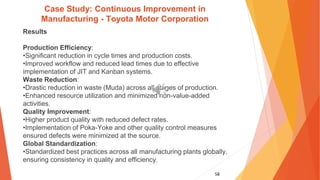
Results
Production Efficiency:
•Significant reduction in cycle times and production costs.
•Improved workflow and reduced lead times due to effective
implementation of JIT and Kanban systems.
Waste Reduction:
•Drastic reduction in waste (Muda) across all stages of production.
•Enhanced resource utilization and minimized non-value-added
activities.
Quality Improvement:
•Higher product quality with reduced defect rates.
•Implementation of Poka-Yoke and other quality control measures
ensured defects were minimized at the source.
Global Standardization:
•Standardized best practices across all manufacturing plants globally,
ensuring consistency in quality and efficiency.
The Rise Of Toyota
60
Risk Management in Supply Chains
Supply chain risks are potential disruptions or threats that can impact
the smooth operation of the supply chain. These risks can affect the
ability to deliver products or services on time, at the desired quality,
and at the expected cost. Understanding and managing these risks is
crucial for maintaining an efficient and resilient supply chain.
Understanding the various types of supply chain risks and
implementing effective risk management strategies are crucial for
maintaining the stability and efficiency of supply chain operations. By
proactively identifying, assessing, and addressing these risks,
organizations can enhance their resilience and better manage
potential disruptions.
61
Risk Management in Supply Chains
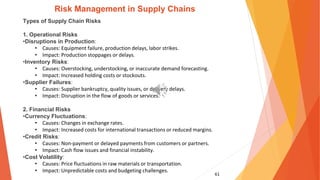
Types of Supply Chain Risks
1. Operational Risks
•Disruptions in Production:
• Causes: Equipment failure, production delays, labor strikes.
• Impact: Production stoppages or delays.
•Inventory Risks:
• Causes: Overstocking, understocking, or inaccurate demand forecasting.
• Impact: Increased holding costs or stockouts.
•Supplier Failures:
• Causes: Supplier bankruptcy, quality issues, or delivery delays.
• Impact: Disruption in the flow of goods or services.
2. Financial Risks
•Currency Fluctuations:
• Causes: Changes in exchange rates.
• Impact: Increased costs for international transactions or reduced margins.
•Credit Risks:
• Causes: Non-payment or delayed payments from customers or partners.
• Impact: Cash flow issues and financial instability.
•Cost Volatility:
• Causes: Price fluctuations in raw materials or transportation.
• Impact: Unpredictable costs and budgeting challenges.
62
Risk Management in Supply Chains
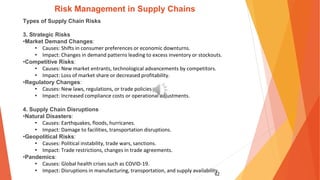
Types of Supply Chain Risks
3. Strategic Risks
•Market Demand Changes:
• Causes: Shifts in consumer preferences or economic downturns.
• Impact: Changes in demand patterns leading to excess inventory or stockouts.
•Competitive Risks:
• Causes: New market entrants, technological advancements by competitors.
• Impact: Loss of market share or decreased profitability.
•Regulatory Changes:
• Causes: New laws, regulations, or trade policies.
• Impact: Increased compliance costs or operational adjustments.
4. Supply Chain Disruptions
•Natural Disasters:
• Causes: Earthquakes, floods, hurricanes.
• Impact: Damage to facilities, transportation disruptions.
•Geopolitical Risks:
• Causes: Political instability, trade wars, sanctions.
• Impact: Trade restrictions, changes in trade agreements.
•Pandemics:
• Causes: Global health crises such as COVID-19.
• Impact: Disruptions in manufacturing, transportation, and supply availability.
63
Risk Management in Supply Chains
Types of Supply Chain Risks
5. Cybersecurity Risks
•Data Breaches:
• Causes: Hacking, phishing, malware attacks.
• Impact: Loss of sensitive information, financial losses, reputational
damage.
•System Failures:
• Causes: IT system outages, software malfunctions.
• Impact: Disruptions in order processing, inventory management.
6. Compliance Risks
•Regulatory Non-Compliance:
• Causes: Failure to adhere to local, national, or international regulations.
• Impact: Legal penalties, fines, or operational restrictions.
•Environmental and Social Responsibility:
• Causes: Non-compliance with environmental regulations or ethical
standards.
• Impact: Legal actions, reputational damage, and increased scrutiny.
64
Risk Management in Supply Chains
Types of Supply Chain Risks
7. Logistical Risks
•Transportation Disruptions:
• Causes: Traffic congestion, accidents, shipping delays.
• Impact: Delays in product delivery, increased transportation costs.
•Warehousing Issues:
• Causes: Facility closures, storage capacity problems.
• Impact: Inefficiencies in order fulfillment, increased holding costs.
8. Human Resource Risks
•Labor Shortages:
• Causes: Recruitment challenges, high employee turnover.
• Impact: Production delays, increased labor costs.
•Skill Gaps:
• Causes: Lack of skilled workers or training deficiencies.
• Impact: Reduced productivity, quality issues.
65
Risk Management in Supply Chains
Mitigation Strategies
1.Diversify Suppliers: Reduce dependency on a single supplier by
sourcing from multiple suppliers.
2.Implement Risk Management Plans: Develop contingency plans
for different types of risks.
3.Invest in Technology: Use technology for real-time monitoring,
data analytics, and risk assessment.
4.Regularly Review and Update Plans: Continuously assess and
update risk management strategies to adapt to new risks.
5.Enhance Collaboration: Foster strong relationships with suppliers,
customers, and partners to improve communication and response
times.
66
Risk Management in Supply Chains
Risk assessment and mitigation are essential components of effective
risk management in any organization. They help identify potential
risks, evaluate their impact, and develop strategies to manage or
reduce these risks.
Effective risk assessment and mitigation are critical for managing
potential disruptions and ensuring organizational resilience. By
systematically identifying, analyzing, and addressing risks,
organizations can better prepare for uncertainties and minimize their
impact. Regular monitoring, employee training, and the use of
technology further enhance the ability to manage risks effectively.
67
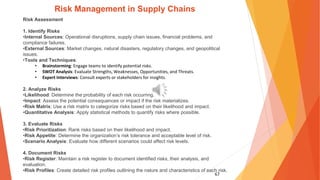
Risk Management in Supply Chains
Risk Assessment
1. Identify Risks
•Internal Sources: Operational disruptions, supply chain issues, financial problems, and
compliance failures.
•External Sources: Market changes, natural disasters, regulatory changes, and geopolitical
issues.
•Tools and Techniques:
• Brainstorming: Engage teams to identify potential risks.
• SWOT Analysis: Evaluate Strengths, Weaknesses, Opportunities, and Threats.
• Expert Interviews: Consult experts or stakeholders for insights.
2. Analyze Risks
•Likelihood: Determine the probability of each risk occurring.
•Impact: Assess the potential consequences or impact if the risk materializes.
•Risk Matrix: Use a risk matrix to categorize risks based on their likelihood and impact.
•Quantitative Analysis: Apply statistical methods to quantify risks where possible.
3. Evaluate Risks
•Risk Prioritization: Rank risks based on their likelihood and impact.
•Risk Appetite: Determine the organization’s risk tolerance and acceptable level of risk.
•Scenario Analysis: Evaluate how different scenarios could affect risk levels.
4. Document Risks
•Risk Register: Maintain a risk register to document identified risks, their analysis, and
evaluation.
•Risk Profiles: Create detailed risk profiles outlining the nature and characteristics of each risk.
68
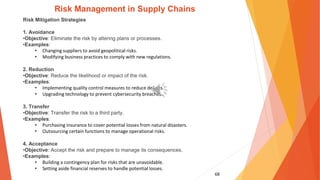
Risk Management in Supply Chains
Risk Mitigation Strategies
1. Avoidance
•Objective: Eliminate the risk by altering plans or processes.
•Examples:
• Changing suppliers to avoid geopolitical risks.
• Modifying business practices to comply with new regulations.
2. Reduction
•Objective: Reduce the likelihood or impact of the risk.
•Examples:
• Implementing quality control measures to reduce defects.
• Upgrading technology to prevent cybersecurity breaches.
3. Transfer
•Objective: Transfer the risk to a third party.
•Examples:
• Purchasing insurance to cover potential losses from natural disasters.
• Outsourcing certain functions to manage operational risks.
4. Acceptance
•Objective: Accept the risk and prepare to manage its consequences.
•Examples:
• Building a contingency plan for risks that are unavoidable.
• Setting aside financial reserves to handle potential losses.
69
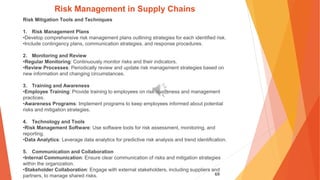
Risk Management in Supply Chains
Risk Mitigation Tools and Techniques
1. Risk Management Plans
•Develop comprehensive risk management plans outlining strategies for each identified risk.
•Include contingency plans, communication strategies, and response procedures.
2. Monitoring and Review
•Regular Monitoring: Continuously monitor risks and their indicators.
•Review Processes: Periodically review and update risk management strategies based on
new information and changing circumstances.
3. Training and Awareness
•Employee Training: Provide training to employees on risk awareness and management
practices.
•Awareness Programs: Implement programs to keep employees informed about potential
risks and mitigation strategies.
4. Technology and Tools
•Risk Management Software: Use software tools for risk assessment, monitoring, and
reporting.
•Data Analytics: Leverage data analytics for predictive risk analysis and trend identification.
5. Communication and Collaboration
•Internal Communication: Ensure clear communication of risks and mitigation strategies
within the organization.
•Stakeholder Collaboration: Engage with external stakeholders, including suppliers and
partners, to manage shared risks.
70
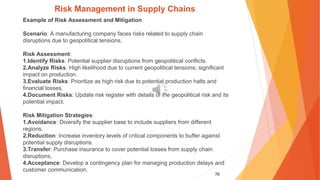
Risk Management in Supply Chains
Example of Risk Assessment and Mitigation
Scenario: A manufacturing company faces risks related to supply chain
disruptions due to geopolitical tensions.
Risk Assessment:
1.Identify Risks: Potential supplier disruptions from geopolitical conflicts.
2.Analyze Risks: High likelihood due to current geopolitical tensions; significant
impact on production.
3.Evaluate Risks: Prioritize as high risk due to potential production halts and
financial losses.
4.Document Risks: Update risk register with details of the geopolitical risk and its
potential impact.
Risk Mitigation Strategies:
1.Avoidance: Diversify the supplier base to include suppliers from different
regions.
2.Reduction: Increase inventory levels of critical components to buffer against
potential supply disruptions.
3.Transfer: Purchase insurance to cover potential losses from supply chain
disruptions.
4.Acceptance: Develop a contingency plan for managing production delays and
customer communication.
71
Risk Management in Supply Chains
Building a resilient supply chain involves designing and managing the
supply chain to withstand and recover from disruptions while
continuing to deliver value to customers. Resilience is about
anticipating, preparing for, and responding effectively to disruptions,
ensuring that the supply chain remains robust and adaptable.
Building a resilient supply chain requires a proactive and
comprehensive approach that includes assessing vulnerabilities,
developing effective strategies, enhancing visibility, and fostering a
culture of continuous improvement. By implementing these practices,
organizations can better withstand and recover from disruptions,
ensuring that their supply chains remain robust and adaptable in the
face of challenges.
72
Risk Management in Supply Chains
Here’s a structured approach to building resilient supply chains:
Assess Current Supply Chain Vulnerabilities
a. Risk Assessment:
•Identify Risks: Conduct a comprehensive risk assessment to identify potential threats (e.g.,
natural disasters, geopolitical issues, supply disruptions).
•Evaluate Impact: Assess the likelihood and impact of each risk on the supply chain.
•Create a Risk Register: Document risks and their potential effects on supply chain operations.
b. Vulnerability Analysis:
•Map Supply Chain: Create a detailed map of your supply chain, including suppliers,
manufacturers, logistics providers, and distribution centers.
•Identify Weak Points: Pinpoint critical areas that are most susceptible to disruptions.
Develop a Resilience Strategy
a. Diversification:
•Supplier Diversification: Source materials from multiple suppliers to reduce dependency on a
single supplier or region.
•Geographic Diversification: Spread operations across different regions to minimize the impact of
regional disruptions.
b. Flexibility and Agility:
•Flexible Sourcing: Develop flexible sourcing strategies that allow for quick changes in suppliers or
materials.
•Agile Production: Implement flexible manufacturing processes that can be easily adjusted to
respond to changes in demand or supply.
c. Inventory Management:
•Safety Stock: Maintain safety stock or buffer inventory for critical components to mitigate supply
disruptions.
•Just-in-Case (JIC): Consider adopting JIC strategies in addition to Just-in-Time (JIT) to build
resilience.
73
Risk Management in Supply Chains
Enhance Visibility and Transparency
a. Supply Chain Visibility:
•Real-Time Monitoring: Use technology like IoT and blockchain to gain real-time visibility
into supply chain operations.
•Data Integration: Integrate data from suppliers, logistics providers, and internal systems for
a comprehensive view of the supply chain.
b. Transparency:
•Information Sharing: Foster transparency by sharing relevant information with suppliers
and partners to enhance collaboration and responsiveness.
•Performance Metrics: Establish and monitor key performance indicators (KPIs) to track
supply chain performance and identify potential issues early.
Implement Risk Mitigation Measures
a. Contingency Planning:
•Develop Plans: Create detailed contingency plans for various risk scenarios (e.g., supplier
failure, transportation disruptions).
•Test Plans: Regularly test and update contingency plans through simulations and drills.
b. Supplier Relationship Management:
•Build Strong Relationships: Develop strong relationships with key suppliers to improve
collaboration and communication.
•Evaluate Suppliers: Regularly assess supplier performance and reliability and maintain a
list of backup suppliers.
c. Technology Integration:
•Advanced Analytics: Use data analytics to predict and respond to potential disruptions.
•Automation: Implement automation to increase efficiency and reduce reliance on manual
processes.
74
Risk Management in Supply Chains
Strengthen Organizational Capabilities
a. Training and Development:
•Employee Training: Train employees on risk management, contingency
planning, and resilience strategies.
•Skill Development: Develop skills related to supply chain management, crisis
management, and problem-solving.
b. Leadership and Governance:
•Executive Support: Ensure strong support from top management for resilience
initiatives.
•Governance Structure: Establish a governance structure to oversee risk
management and resilience efforts.
Foster a Culture of Resilience
a. Promote Continuous Improvement:
•Kaizen: Encourage continuous improvement practices to enhance supply chain
processes.
•Feedback Mechanism: Implement feedback mechanisms to learn from
disruptions and improve resilience.
b. Encourage Innovation:
•Innovation Culture: Foster a culture that encourages innovation and creativity in
addressing supply chain challenges.
•R&D Investment: Invest in research and development to explore new
technologies and practices that enhance resilience.
75
Risk Management in Supply Chains
Monitor and Adapt
a. Continuous Monitoring:
•Risk Monitoring: Continuously monitor risks and supply chain
performance to detect potential issues early.
•Adapt Strategies: Adapt strategies based on monitoring results and
changing conditions.
b. Review and Revise:
•Periodic Reviews: Conduct regular reviews of resilience strategies
and risk management plans.
•Revise Plans: Revise plans and strategies based on lessons
learned and evolving risks.
76
Risk Management in Supply Chains
Example of Building Resilience: COVID-19 Pandemic
Context: During the COVID-19 pandemic, many companies faced
significant disruptions due to supply chain interruptions, transportation
delays, and shifts in demand.
Actions Taken:
1.Diversified Suppliers: Companies diversified their supplier base and
sourced from multiple regions to reduce dependency on a single
supplier.
2.Enhanced Visibility: Implemented real-time tracking systems and
improved visibility across the supply chain to monitor disruptions.
3.Increased Inventory: Built up safety stock for critical components to
buffer against supply disruptions.
4.Adapted Processes: Modified production processes to quickly adapt
to changing demand and supply conditions.
Results:
•Improved ability to manage disruptions and maintain operations during
the pandemic.
•Enhanced flexibility and responsiveness to changing market conditions.
Mastering global supply
chain risks
78
Understand the roles and importance of SCM and
OM in business.
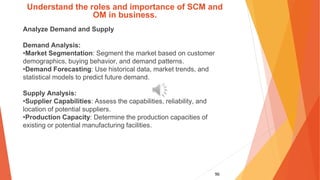
Supply Chain Management (SCM) and Operations Management (OM) are crucial
functions in business that focus on the efficient production, movement, and delivery
of goods and services. Here’s an in-depth look at their roles and importance:
Roles of Supply Chain Management (SCM)
1.Procurement: SCM involves sourcing and purchasing raw materials, components, and
services needed for production. Effective procurement strategies ensure the right quality at
the best cost.
2.Logistics: This encompasses the transportation, warehousing, and distribution of
products. Efficient logistics ensure that goods are moved in a timely and cost-effective
manner.
3.Inventory Management: Managing inventory levels to balance supply and demand is
critical. SCM aims to minimize holding costs while preventing stockouts and overstock
situations.
4.Supplier Relationship Management: Building strong relationships with suppliers ensures
reliability and quality of inputs, as well as potential cost savings through better negotiation
and collaboration.
5.Demand Planning and Forecasting: Predicting customer demand to plan production and
procurement activities accurately. This helps in optimizing inventory levels and reducing
waste.
6.Production Planning: Coordinating the production schedule with supply chain activities to
ensure materials are available when needed and products are manufactured efficiently.
79
Understand the roles and importance of SCM and
OM in business.
Importance of Supply Chain Management
1.Cost Reduction: Effective SCM can significantly reduce costs by
optimizing procurement, inventory, and logistics processes.
2.Efficiency and Productivity: Streamlined supply chain processes
enhance overall operational efficiency and productivity, leading to
faster turnaround times and higher output.
3.Customer Satisfaction: Ensuring timely delivery of quality
products improves customer satisfaction and loyalty, which is crucial
for business success.
4.Risk Management: SCM helps in identifying and mitigating risks
related to supply chain disruptions, ensuring business continuity.
5.Competitive Advantage: A well-managed supply chain can
provide a competitive edge by enabling faster response to market
changes and customer demands.
80
Understand the roles and importance of SCM and
OM in business.
Roles of Operations Management (OM)
1.Process Design and Improvement: OM focuses on designing
efficient processes for producing goods and services, and continuously
improving these processes for better performance.
2.Capacity Planning: Determining the production capacity needed to
meet changing demands, ensuring that resources are utilized optimally.
3.Quality Management: Implementing quality control and assurance
processes to maintain high standards in production and service delivery.
4.Workforce Management: Managing human resources involved in
production, including scheduling, training, and performance
management.
5.Production Scheduling: Planning and controlling the production
schedule to ensure that goods and services are produced on time and
meet quality standards.
6.Facility Management: Managing physical facilities, including
maintenance, layout, and equipment to ensure a safe and efficient
working environment.
81
Understand the roles and importance of SCM and
OM in business.
Importance of Operations Management
1.Efficiency and Productivity: OM ensures that business operations
are efficient, maximizing output while minimizing waste and costs.
2.Quality and Consistency: Maintaining high quality and
consistency in products and services builds brand reputation and
customer trust.
3.Cost Management: Effective operations management helps in
controlling costs related to production, labor, and facilities,
contributing to overall profitability.
4.Flexibility and Adaptability: OM enables businesses to be flexible
and adaptable to changes in market demand and operational
challenges.
5.Innovation and Improvement: Continuous process improvement
and innovation in operations lead to better products, services, and
business practices.
82
Understand the roles and importance of SCM and
OM in business.
Integration of SCM and OM
SCM and OM are closely linked and often overlap in their functions. Effective
integration of these two areas is essential for:
1.Seamless Flow of Information and Materials: Ensuring that information
and materials flow smoothly across the supply chain and production
processes, reducing delays and inefficiencies.
2.Holistic Optimization: Looking at the supply chain and operations as a
whole allows for better optimization of resources, processes, and costs.
3.Improved Responsiveness: An integrated approach enhances the
business’s ability to respond quickly to market changes and customer needs.
4.Enhanced Collaboration: Collaboration between SCM and OM functions
leads to better planning, execution, and problem-solving capabilities.
In summary, SCM and OM play vital roles in ensuring that businesses
operate efficiently, meet customer demands, and maintain competitive
advantage. Their importance lies in cost management, quality assurance, risk
mitigation, and overall operational effectiveness. Effective management of
these functions contributes significantly to the success and sustainability of a
business.
83
Understand the roles and importance of SCM and
OM in business.
The supply chain encompasses all the activities, organizations, and resources involved
in moving a product from the supplier to the customer. It can be divided into several
components and stages, each playing a crucial role in the overall process. Here's a
detailed breakdown:
Components of a Supply Chain
1.Suppliers: Provide the raw materials, components, and other inputs required for
production.
2.Manufacturers/Producers: Convert raw materials and components into finished
products.
3.Warehouses: Store raw materials, work-in-progress items, and finished goods until
they are needed.
4.Distribution Centers: Focus on efficiently shipping products to customers and retail
locations.
5.Retailers: Sell finished products to the end customers.
6.Customers: The final consumers who purchase and use the finished products.
7.Logistics Providers: Manage the transportation and delivery of goods between
different components of the supply chain.
8.Service Providers: Include entities that provide ancillary services such as
packaging, quality control, and maintenance.
84
Understand the roles and importance of SCM and
OM in business.
Stages of a Supply Chain
1.Planning:
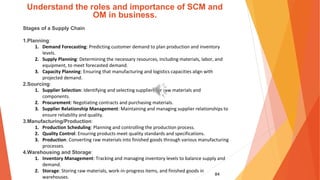
1. Demand Forecasting: Predicting customer demand to plan production and inventory
levels.
2. Supply Planning: Determining the necessary resources, including materials, labor, and
equipment, to meet forecasted demand.
3. Capacity Planning: Ensuring that manufacturing and logistics capacities align with
projected demand.
2.Sourcing:
1. Supplier Selection: Identifying and selecting suppliers for raw materials and
components.
2. Procurement: Negotiating contracts and purchasing materials.
3. Supplier Relationship Management: Maintaining and managing supplier relationships to
ensure reliability and quality.
3.Manufacturing/Production:
1. Production Scheduling: Planning and controlling the production process.
2. Quality Control: Ensuring products meet quality standards and specifications.
3. Production: Converting raw materials into finished goods through various manufacturing
processes.
4.Warehousing and Storage:
1. Inventory Management: Tracking and managing inventory levels to balance supply and
demand.
2. Storage: Storing raw materials, work-in-progress items, and finished goods in
warehouses.
85
Understand the roles and importance of SCM and
OM in business.
Stages of a Supply Chain
5. Distribution and Logistics:
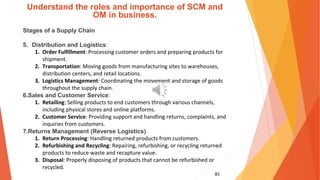
1. Order Fulfillment: Processing customer orders and preparing products for
shipment.
2. Transportation: Moving goods from manufacturing sites to warehouses,
distribution centers, and retail locations.
3. Logistics Management: Coordinating the movement and storage of goods
throughout the supply chain.
6.Sales and Customer Service:
1. Retailing: Selling products to end customers through various channels,
including physical stores and online platforms.
2. Customer Service: Providing support and handling returns, complaints, and
inquiries from customers.
7.Returns Management (Reverse Logistics):
1. Return Processing: Handling returned products from customers.
2. Refurbishing and Recycling: Repairing, refurbishing, or recycling returned
products to reduce waste and recapture value.
3. Disposal: Properly disposing of products that cannot be refurbished or
recycled.
86
Understand the roles and importance of SCM and
OM in business.
Additional Key Elements
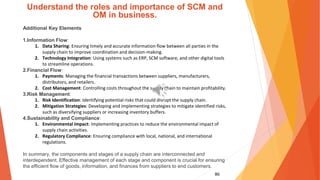
1.Information Flow:
1. Data Sharing: Ensuring timely and accurate information flow between all parties in the
supply chain to improve coordination and decision-making.
2. Technology Integration: Using systems such as ERP, SCM software, and other digital tools
to streamline operations.
2.Financial Flow:
1. Payments: Managing the financial transactions between suppliers, manufacturers,
distributors, and retailers.
2. Cost Management: Controlling costs throughout the supply chain to maintain profitability.
3.Risk Management:
1. Risk Identification: Identifying potential risks that could disrupt the supply chain.
2. Mitigation Strategies: Developing and implementing strategies to mitigate identified risks,
such as diversifying suppliers or increasing inventory buffers.
4.Sustainability and Compliance:
1. Environmental Impact: Implementing practices to reduce the environmental impact of
supply chain activities.
2. Regulatory Compliance: Ensuring compliance with local, national, and international
regulations.
In summary, the components and stages of a supply chain are interconnected and
interdependent. Effective management of each stage and component is crucial for ensuring
the efficient flow of goods, information, and finances from suppliers to end customers.
87
Understand the roles and importance of SCM and
OM in business.
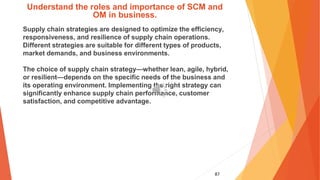
Supply chain strategies are designed to optimize the efficiency,
responsiveness, and resilience of supply chain operations.
Different strategies are suitable for different types of products,
market demands, and business environments.
The choice of supply chain strategy—whether lean, agile, hybrid,
or resilient—depends on the specific needs of the business and
its operating environment. Implementing the right strategy can
significantly enhance supply chain performance, customer
satisfaction, and competitive advantage.
88
Understand the roles and importance of SCM and
OM in business.
Lean Supply Chain Strategy
Overview:
•The lean supply chain strategy focuses on minimizing waste and maximizing
efficiency. This involves eliminating non-value-added activities, reducing inventory
levels, and improving process flows.
Key Characteristics:
•Efficiency Focus: Emphasis on streamlining processes to reduce costs and improve
productivity.
•Just-in-Time (JIT): Producing and delivering products just in time to meet customer
demand, reducing inventory costs.
•Standardization: Use of standardized processes and components to reduce
complexity.
•Continuous Improvement: Ongoing efforts to improve processes through techniques
such as Kaizen and Six Sigma.
Suitable For:
•Stable and predictable demand.
•Long product life cycles.
•Cost-sensitive markets.
Examples:
•Automotive manufacturing.
•Consumer electronics with predictable sales patterns.
89
Understand the roles and importance of SCM and
OM in business.
Agile Supply Chain Strategy
Overview:
•The agile supply chain strategy emphasizes flexibility and responsiveness to quickly
adapt to changing market conditions and customer demands. It focuses on speed and
adaptability.
Key Characteristics:
•Flexibility: Ability to quickly adjust production and supply chain activities in response
to changes in demand.
•Customer-Centric: Focus on meeting specific customer needs and providing
customized solutions.
•Collaboration: Strong collaboration with suppliers and partners to enhance
responsiveness.
•Real-Time Information: Use of real-time data and analytics to make quick and
informed decisions.
Suitable For:
•Unpredictable and volatile demand.
•Short product life cycles.
•Markets requiring customization and fast response.
Examples:
•Fashion and apparel industry.
•High-tech products and electronics.
90
Understand the roles and importance of SCM and
OM in business.
Hybrid (Leagile) Supply Chain Strategy
Overview:
•The hybrid supply chain strategy, also known as leagile, combines elements of both
lean and agile strategies. It aims to achieve a balance between efficiency and
responsiveness.
Key Characteristics:
•Decoupling Point: Identifying a strategic point in the supply chain where lean
principles are applied upstream and agile principles downstream.
•Postponement: Delaying final production or customization until customer demand is
better understood.
•Flexibility and Efficiency: Balancing cost-efficiency in stable parts of the supply
chain with flexibility in volatile parts.
Suitable For:
•Products with some stable and some unpredictable demand components.
•Industries with a mix of standard and customizable products.
Examples:
•Electronics where standard components are produced in a lean manner, and final
assembly/customization is done in an agile manner.
•Automotive industry with modular production allowing customization closer to the
customer.
91
Understand the roles and importance of SCM and
OM in business.
Resilient Supply Chain Strategy
Overview:
•The resilient supply chain strategy focuses on building robustness and the ability to
recover quickly from disruptions. This strategy is increasingly important in a world with
frequent disruptions.
Key Characteristics:
•Risk Management: Identifying, assessing, and mitigating risks throughout the supply
chain.
•Redundancy: Maintaining excess capacity, inventory buffers, and alternative
suppliers to handle disruptions.
•Visibility: Enhancing visibility across the supply chain to quickly identify and respond
to issues.
•Adaptability: Developing the capability to adapt supply chain operations to new
conditions or disruptions.
Suitable For:
•High-risk environments with frequent disruptions.
•Critical industries where continuity is essential.
Examples:
•Healthcare and pharmaceuticals.
•Food and beverage industry.
92
Understand the roles and importance of SCM and
OM in business.
Choosing the Right Strategy
Selecting the appropriate supply chain strategy depends on various
factors including:
•Market Characteristics: Demand variability, market growth, and
competition.
•Product Characteristics: Product lifecycle, customization
requirements, and shelf life.
•Business Goals: Cost leadership, customer service, flexibility, and
risk tolerance.
•Environmental Factors: Regulatory requirements, geopolitical risks,
and technological advancements.
93
Understand the roles and importance of SCM and
OM in business.
Implementation
1.Assess Current State: Analyze current supply chain operations,
identify inefficiencies, and understand market dynamics.
2.Define Objectives: Set clear objectives based on business goals,
such as cost reduction, increased flexibility, or improved resilience.
3.Select Strategy: Choose the strategy that aligns with the objectives
and market conditions.
4.Develop Implementation Plan: Create a detailed plan including
process changes, technology adoption, and performance metrics.
5.Monitor and Improve: Continuously monitor performance and
make adjustments to refine the strategy and address any issues.
In summary, the choice of supply chain strategy—whether lean, agile,
hybrid, or resilient—depends on the specific needs of the business
and its operating environment. Implementing the right strategy can
significantly enhance supply chain performance, customer
satisfaction, and competitive advantage.
94
Understand the roles and importance of SCM and
OM in business.
Designing a supply chain network involves planning and structuring
the interconnected nodes and processes required to produce and
deliver goods or services from suppliers to customers. Effective
supply chain network design can significantly impact cost efficiency,
service levels, and overall business performance.
Designing a supply chain network involves a strategic approach that
considers objectives, demand and supply analysis, network structure,
optimization, risk management, implementation, and continuous
improvement. Leveraging advanced tools and technologies can
further enhance the efficiency and effectiveness of the supply chain
network.
95
Understand the roles and importance of SCM and
OM in business.
Define Objectives and Scope
Objectives:
•Cost Reduction: Minimize costs related to production,
transportation, and inventory.
•Service Level Improvement: Ensure timely delivery and high
service quality.
•Flexibility and Scalability: Design a network that can adapt to
changing market conditions and demand variations.
•Risk Management: Mitigate risks associated with supply chain
disruptions.
Scope:
•Geographic Coverage: Determine the regions or countries where
the supply chain will operate.
•Product Range: Identify the products or services included in the
supply chain network design.
•Time Horizon: Establish the planning horizon for the design, such as
short-term (1-2 years), mid-term (3-5 years), or long-term (5+ years).
96
Understand the roles and importance of SCM and
OM in business.
Analyze Demand and Supply
Demand Analysis:
•Market Segmentation: Segment the market based on customer
demographics, buying behavior, and demand patterns.
•Demand Forecasting: Use historical data, market trends, and
statistical models to predict future demand.
Supply Analysis:
•Supplier Capabilities: Assess the capabilities, reliability, and
location of potential suppliers.
•Production Capacity: Determine the production capacities of
existing or potential manufacturing facilities.
97
Understand the roles and importance of SCM and
OM in business.
Determine Network Structure
Nodes:
•Suppliers: Select strategic suppliers for raw materials and components.
•Manufacturing Facilities: Choose optimal locations for factories based
on factors such as cost, proximity to suppliers, and labor availability.
•Warehouses and Distribution Centers: Identify locations for
warehouses and distribution centers to balance inventory levels and
minimize transportation costs.
•Retail Outlets: Decide on the placement of retail outlets or customer
service centers.
Links:
•Transportation Modes: Select appropriate transportation modes (e.g.,
road, rail, air, sea) based on cost, speed, and reliability.
•Transportation Routes: Plan optimal transportation routes to minimize
travel time and cost.
•Information Flow: Ensure efficient information flow across the supply
chain to support coordination and decision-making.
98
Understand the roles and importance of SCM and
OM in business.
Optimize Network Design
Cost-Benefit Analysis:
•Fixed and Variable Costs: Analyze fixed costs (e.g., facility setup,
equipment) and variable costs (e.g., transportation, labor).
•Trade-Offs: Evaluate trade-offs between different cost elements,
such as transportation costs versus inventory holding costs.
Mathematical Modeling:
•Linear Programming: Use linear programming models to optimize
the allocation of resources and minimize costs.
•Simulation: Simulate different network scenarios to assess
performance under various conditions and identify potential
bottlenecks.
99
Understand the roles and importance of SCM and
OM in business.
Implement the Network Design
Project Planning:
•Timeline: Develop a detailed implementation timeline with
milestones and deadlines.
•Resources: Allocate resources, including budget, personnel, and
technology, for the implementation phase.
Change Management:
•Stakeholder Engagement: Engage stakeholders throughout the
process to ensure buy-in and support.
•Training and Communication: Provide training for employees and
communicate the benefits and changes associated with the new
network design.
100
Understand the roles and importance of SCM and
OM in business.
Tools and Technologies
Supply Chain Management Software:
•ERP Systems: Enterprise Resource Planning (ERP) systems
integrate various supply chain functions and provide real-time data.
•Advanced Planning and Scheduling (APS) Systems: APS
systems help in optimizing production schedules and inventory levels.
Data Analytics and AI:
•Predictive Analytics: Use predictive analytics to forecast demand
and optimize inventory.
•Artificial Intelligence: Implement AI for decision support, such as
route optimization and demand forecasting.
IoT and Blockchain:
•IoT: Internet of Things (IoT) devices provide real-time tracking and
monitoring of assets and shipments.
•Blockchain: Blockchain technology ensures transparency and
security in supply chain transactions.
101
Understand the roles and importance of SCM and
OM in business.
Designing and managing a supply chain involves balancing three key
factors: cost, service, and flexibility. Each of these elements has
trade-offs that can impact the overall performance and efficiency of
the supply chain. Managing trade-offs in cost, service, and flexibility is
essential for optimizing supply chain performance. Businesses must
evaluate their specific needs, market conditions, and strategic goals
to find the right balance that maximizes overall efficiency, customer
satisfaction, and competitive advantage.
102
Understand the roles and importance of SCM and
OM in business.
Cost
High-Cost Supply Chain:
•Pros:
• Higher investments in technology and infrastructure can lead to more
efficient operations.
• Premium logistics services can ensure faster and more reliable delivery.
• Greater inventory levels can improve service levels and reduce stockouts.
•Cons:
• Higher operational and capital expenditures.
• Increased carrying costs for inventory.
• Potential for decreased competitiveness due to higher prices.
Low-Cost Supply Chain:
•Pros:
• Lower operational and capital expenditures.
• Reduced inventory holding costs.
• Potential for increased competitiveness due to lower prices.
•Cons:
• Potential for lower service levels due to cost-cutting measures.
• Increased risk of stockouts or delays.
• Possible compromises in quality and customer satisfaction.
103
Understand the roles and importance of SCM and
OM in business.
Service
High-Service Level:
•Pros:
• Enhanced customer satisfaction and loyalty.
• Increased sales and market share due to better service.
• Ability to charge premium prices for superior service.
•Cons:
• Higher costs associated with maintaining high service levels (e.g., expedited
shipping, higher inventory levels).
• Increased complexity in managing service expectations.
• Potential for overstocking and increased inventory carrying costs.
Low-Service Level:
•Pros:
• Reduced costs in logistics, warehousing, and inventory management.
• Simpler operations with less complexity.
• Lower risk of overstocking and reduced inventory carrying costs.
•Cons:
• Decreased customer satisfaction and potential loss of business.
• Increased likelihood of stockouts and delayed deliveries.
• Reduced competitive advantage in markets where service quality is a key
differentiator.
104
Understand the roles and importance of SCM and
OM in business.
Flexibility
High Flexibility:
•Pros:
• Ability to quickly respond to changes in demand and market conditions.
• Increased resilience to supply chain disruptions.
• Enhanced ability to customize products and services to meet specific customer
needs.
•Cons:
• Higher costs associated with maintaining flexible operations (e.g., multiple
suppliers, adaptable manufacturing processes).
• Potential inefficiencies due to frequent changes and adjustments.
• Complexity in managing flexible supply chain processes.
Low Flexibility:
•Pros:
• Streamlined and efficient operations with standardized processes.
• Lower costs due to economies of scale and reduced variability.
• Simpler management and fewer changes to operations.
•Cons:
• Inability to quickly adapt to market changes and disruptions.
• Increased risk of stockouts or excess inventory during demand fluctuations.
• Reduced capability to meet specific customer requirements and preferences.
105
Understand the roles and importance of SCM and
OM in business.
Balancing Trade-Offs
1.Cost vs. Service:
1. Investing in higher service levels (e.g., faster shipping, higher inventory
levels) can increase costs but may lead to higher customer satisfaction and
sales.
2. Reducing costs (e.g., minimizing inventory, choosing cost-effective logistics)
can lower service levels and potentially impact customer satisfaction.
2.Cost vs. Flexibility:
1. Maintaining flexibility (e.g., multiple suppliers, adaptable manufacturing)
can increase costs but enhances the ability to respond to changes and
disruptions.
2. Focusing on cost efficiency (e.g., single-source suppliers, standardized
processes) can reduce flexibility and increase vulnerability to disruptions.
3.Service vs. Flexibility:
1. High service levels often require flexibility to meet varying customer
demands and preferences, which can increase complexity and costs.
2. Standardized service levels can streamline operations and reduce costs but
may limit the ability to adapt to specific customer needs and market
changes.
106
Understand the roles and importance of SCM and
OM in business.
Strategies for Managing Trade-Offs
1.Segmentation:
• Segment the supply chain based on product types, customer segments, or
markets to tailor strategies for cost, service, and flexibility accordingly.
2.Postponement:
• Delay final production or customization until customer demand is better
understood to balance service and flexibility while controlling costs.
3.Collaboration:
• Collaborate with suppliers and logistics partners to share information and
resources, improving overall supply chain performance and balancing trade-
offs.
4.Technology and Innovation:
• Invest in technologies such as data analytics, IoT, and AI to enhance
visibility, predictability, and decision-making, helping to manage trade-offs
more effectively.
5.Risk Management:
• Develop risk management strategies to mitigate the impact of disruptions
and maintain a balance between cost, service, and flexibility.
107
Understand the roles and importance of SCM and
OM in business.
Demand forecasting is crucial for effective supply chain management
and helps businesses plan inventory, production, and distribution.
There are several methods for forecasting demand, each with its
strengths and weaknesses. These methods can be broadly
categorized into qualitative and quantitative approaches.
Effective demand forecasting involves selecting and applying the
appropriate methods to predict future demand accurately. By
understanding the strengths and weaknesses of various qualitative
and quantitative techniques, businesses can improve their forecasting
accuracy and make more informed supply chain decisions.
Combining multiple methods can further enhance the robustness of
forecasts and help manage uncertainty in demand planning.
108
Understand the roles and importance of SCM and
OM in business.
Qualitative Methods
1. Expert Opinion
•Description: Gathers insights from experienced individuals within the organization, such as
sales managers, marketing experts, and industry analysts.
•Strengths: Utilizes knowledge from experienced personnel; useful for new products or
markets without historical data.
•Weaknesses: Subjective and may be biased; depends heavily on the expertise of the
individuals.
2. Market Research
•Description: Involves conducting surveys, focus groups, and interviews with potential
customers to understand their preferences and purchasing intentions.
•Strengths: Provides direct feedback from customers; can uncover trends and preferences.
•Weaknesses: Time-consuming and expensive; may not be representative of the entire
market.
3. Delphi Method
•Description: A structured approach where a panel of experts provides forecasts, which are
then aggregated and refined through multiple rounds of anonymous feedback.
•Strengths: Reduces individual bias through group consensus; useful for long-term
forecasting.
•Weaknesses: Can be time-consuming; depends on the availability and cooperation of
experts.
109
Understand the roles and importance of SCM and
OM in business.
Quantitative Methods
Time Series Analysis
•Description: Uses historical data to identify patterns and trends,
which are then used to forecast future demand.
•Techniques:
• Moving Average: Averages a set number of past data points to
smooth out fluctuations.
• Exponential Smoothing: Weights recent data more heavily than
older data to adjust quickly to changes.
• Seasonal Decomposition: Separates data into trend, seasonal, and
random components for more detailed analysis.
•Strengths: Based on historical data; relatively simple and easy to
implement.
•Weaknesses: Assumes past patterns will continue; less effective for
new products or when trends change rapidly.
110
Understand the roles and importance of SCM and
OM in business.
Quantitative Methods
Causal Models
•Description: Identifies relationships between demand and other
variables (e.g., price, economic indicators, advertising spend).
•Techniques:
• Regression Analysis: Determines the impact of one or more
independent variables on demand.
• Econometric Models: Uses economic theories and statistical
methods to forecast demand based on various economic factors.
•Strengths: Can identify and quantify relationships between
variables; useful for understanding the impact of external factors.
•Weaknesses: Requires accurate and relevant data; complex and
may require advanced statistical skills.
111
Understand the roles and importance of SCM and
OM in business.
Quantitative Methods
Machine Learning and AI
•Description: Uses algorithms and computational models to analyze
large datasets and identify complex patterns for forecasting.
•Techniques:
• Neural Networks: Mimic the human brain to identify non-linear
relationships in data.
• Decision Trees: Use tree-like models of decisions and their possible
consequences.
• Support Vector Machines (SVM): Analyze data for classification and
regression analysis.
•Strengths: Can handle large volumes of data; adapts to changing
patterns; highly accurate.
•Weaknesses: Requires significant computational resources; may be
difficult to interpret and explain results.
112
Understand the roles and importance of SCM and
OM in business.
Hybrid Methods
1. Combination Forecasting
•Description: Combines multiple forecasting methods to leverage
their respective strengths and mitigate their weaknesses.
•Approach: Integrate qualitative insights with quantitative data or
combine different quantitative techniques (e.g., averaging forecasts
from time series and causal models).
•Strengths: Provides more robust and accurate forecasts; balances
the limitations of individual methods.
•Weaknesses: More complex to implement and manage; may require
sophisticated software and expertise.
113
Understand the roles and importance of SCM and
OM in business.
Selecting the Right Method
When choosing a demand forecasting method, consider the following
factors:
•Data Availability: The availability and quality of historical data can
significantly influence the choice of forecasting method.
•Product Lifecycle: Different methods may be more suitable for
products at different stages of their lifecycle (e.g., new products vs.
mature products).
•Market Conditions: Rapidly changing markets may require more
flexible and adaptive forecasting methods.
•Accuracy Requirements: The level of accuracy needed for
decision-making can dictate the choice of method.
•Resource Availability: The expertise, time, and computational
resources available can also impact the feasibility of different
methods.
114
Understand the roles and importance of SCM and
OM in business.
Balancing supply and demand is crucial for maintaining efficiency and
customer satisfaction in any supply chain. It involves aligning
production, inventory, and distribution capabilities with customer
demand to ensure that products are available when and where they
are needed, without overproducing or underproducing.
Balancing supply and demand is a dynamic process requiring
accurate forecasting, efficient inventory management, flexible
production planning, effective supplier and distribution management,
integrated S&OP processes, demand shaping strategies, and the use
of advanced technology and data analytics. By implementing these
strategies, businesses can achieve a balance that maximizes
efficiency, minimizes costs, and enhances customer satisfaction.
115
Understand the roles and importance of SCM and
OM in business.
Demand Forecasting
Accurate demand forecasting is the foundation of balancing supply
and demand. Using advanced forecasting techniques and tools,
businesses can predict future demand more accurately.
Methods:
•Quantitative Methods: Time series analysis, regression analysis,
machine learning models.
•Qualitative Methods: Expert opinion, market research, Delphi
method.
•Hybrid Methods: Combining multiple forecasting techniques to
improve accuracy.
116
Understand the roles and importance of SCM and
OM in business.
Inventory Management
Efficient inventory management ensures that sufficient stock is
available to meet demand without excessive overstocking.
Strategies:
•Just-in-Time (JIT): Minimize inventory levels by producing or
ordering goods only as needed.
•Safety Stock: Maintain a buffer stock to account for demand
variability and lead time uncertainty.
•ABC Analysis: Prioritize inventory management efforts based on the
value and turnover rate of items (A-items being the most valuable and
requiring the most attention).
117
Understand the roles and importance of SCM and
OM in business.
Production Planning
Aligning production schedules with demand forecasts helps prevent
overproduction and underproduction.
Techniques:
•Master Production Schedule (MPS): A detailed plan that specifies
what is to be produced and when.
•Capacity Planning: Ensuring that production capacity meets
forecasted demand.
•Production Flexibility: Adopting flexible manufacturing systems that
can quickly adjust to changes in demand.
118
Understand the roles and importance of SCM and
OM in business.
Supplier Management
Effective supplier management ensures a steady and reliable flow of
materials and components necessary for production.
Approaches:
•Supplier Collaboration: Work closely with suppliers to align their
production schedules with your demand forecasts.
•Multi-Sourcing: Using multiple suppliers to mitigate risks and
ensure supply continuity.
•Supplier Lead Time Reduction: Collaborate with suppliers to
reduce lead times and improve responsiveness.
119
Understand the roles and importance of SCM and
OM in business.
Distribution and Logistics
Optimizing distribution and logistics ensures that products are
delivered to customers efficiently and cost-effectively.
Strategies:
•Demand-Driven Distribution: Align distribution plans with real-time
demand data.
•Cross-Docking: Reduce inventory holding by transferring products
directly from inbound to outbound transportation.
•Efficient Transportation Planning: Optimize transportation routes
and modes to balance cost and service levels.
120
Understand the roles and importance of SCM and
OM in business.
Sales and Operations Planning (S&OP)
S&OP is a cross-functional process that aligns supply chain plans
with business goals and market demand.
Process:
•Integrated Planning: Involve sales, marketing, finance, and
operations in a collaborative planning process.
•Monthly Review: Conduct regular S&OP meetings to review
demand forecasts, supply plans, and financial targets.
•Scenario Planning: Develop and analyze different scenarios to
understand the impact of various demand and supply changes.
121
Understand the roles and importance of SCM and
OM in business.
Demand Shaping
Influencing customer demand through marketing and sales strategies
can help balance supply and demand.
Techniques:
•Promotions and Discounts: Use pricing strategies to increase
demand during low periods or to move excess inventory.
•Product Bundling: Offer complementary products together to boost
demand for slower-moving items.
•Demand Substitution: Encourage customers to switch to alternative
products when certain items are out of stock.
122
Understand the roles and importance of SCM and
OM in business.
Technology and Data Analytics
Leveraging technology and data analytics enhances visibility and
decision-making in balancing supply and demand.
Tools:
•Advanced Analytics: Use data analytics and machine learning to
analyze demand patterns and predict future demand more accurately.
•Real-Time Data: Implement IoT and other technologies to gather
real-time data on inventory levels, production status, and customer
orders.
•Supply Chain Management Software: Use integrated software
solutions to manage and synchronize supply chain activities.
123
Understand the roles and importance of SCM and
OM in business.
Supplier Relationship Management (SRM) involves managing and
optimizing the relationships between a company and its suppliers to
maximize mutual value. Effective SRM ensures that suppliers
contribute to the company’s overall strategic goals, fostering
collaboration, innovation, and efficiency.
Effective Supplier Relationship Management is essential for
optimizing supply chain performance and achieving strategic goals.
By adhering to these principles—strategic alignment, clear
communication, collaborative partnership, performance management,
risk management, value creation, supplier development, contract
management, mutual respect and trust, and innovation—companies
can build strong, productive relationships with their suppliers and
drive mutual success.
124
Understand the roles and importance of SCM and
OM in business.
Strategic Alignment
•Description: Align supplier relationships with the company’s
strategic goals and objectives.
•Key Actions:
• Identify and prioritize key suppliers that are critical to achieving
business goals.
• Develop SRM strategies that support overall business strategy and
objectives.
• Ensure that supplier performance metrics align with strategic
objectives.
125
Understand the roles and importance of SCM and
OM in business.
Clear Communication
•Description: Maintain open, transparent, and frequent
communication with suppliers.
•Key Actions:
• Establish regular communication channels and schedules (e.g.,
meetings, reports).
• Share relevant information about business needs, changes, and
expectations.
• Address issues and feedback promptly to maintain a healthy
relationship.
126
Understand the roles and importance of SCM and
OM in business.
Collaborative Partnership
•Description: Foster a collaborative and mutually beneficial
relationship with suppliers.
•Key Actions:
• Work together on joint projects, innovations, and problem-solving.
• Engage in collaborative planning and forecasting to align supply and
demand.
• Develop joint strategies for continuous improvement and value
creation.
127
Understand the roles and importance of SCM and
OM in business.
Performance Management
•Description: Regularly assess and manage supplier performance
based on agreed-upon metrics.
•Key Actions:
• Define clear performance metrics and expectations (e.g., quality,
delivery, cost).
• Conduct regular performance reviews and provide constructive
feedback.
• Implement performance improvement plans for underperforming
suppliers.
128
Understand the roles and importance of SCM and
OM in business.
Risk Management
•Description: Identify, assess, and mitigate risks associated with
suppliers.
•Key Actions:
• Conduct risk assessments to identify potential risks in the supply
chain.
• Develop contingency plans and risk mitigation strategies.
• Monitor and address emerging risks proactively.
129
Understand the roles and importance of SCM and
OM in business.
Value Creation
•Description: Focus on creating value for both the company and its
suppliers.
•Key Actions:
• Explore opportunities for cost reduction, efficiency improvements,
and innovation.
• Recognize and reward suppliers for exceptional performance and
contributions.
• Share value created through the relationship with suppliers to
strengthen partnership.
130
Understand the roles and importance of SCM and
OM in business.
Supplier Development
•Description: Invest in the development and improvement of
suppliers.
•Key Actions:
• Provide training and support to help suppliers meet performance
standards.
• Collaborate on capability-building initiatives and technology
enhancements.
• Share best practices and provide resources to help suppliers
improve their operations.
131
Understand the roles and importance of SCM and
OM in business.
Contract Management
•Description: Develop and manage contracts that define the terms
and expectations of the supplier relationship.
•Key Actions:
• Draft clear, comprehensive contracts that outline terms, conditions,
and performance metrics.
• Regularly review and update contracts to reflect changes in business
needs or market conditions.
• Ensure compliance with contractual obligations and address any
issues promptly.
132
Understand the roles and importance of SCM and
OM in business.
Mutual Respect and Trust
•Description: Build and maintain a relationship based on mutual
respect and trust.
•Key Actions:
• Treat suppliers as partners and respect their contributions to the
supply chain.
• Foster a culture of trust by honoring commitments and being
transparent.
• Address conflicts and issues professionally and constructively.
133
Understand the roles and importance of SCM and
OM in business.
Innovation and Continuous Improvement
•Description: Encourage and support innovation and continuous
improvement in the supplier relationship.
•Key Actions:
• Engage suppliers in innovation efforts and explore new technologies
and processes.
• Foster a culture of continuous improvement by setting joint goals
and reviewing performance.
• Share successes and lessons learned to drive ongoing enhancement
of the relationship.
134
Understand the roles and importance of SCM and
OM in business.
Implementing SRM Principles
1.Assess and Segment Suppliers: Identify key suppliers and
segment them based on their strategic importance and potential
impact on the business.
2.Develop SRM Plans: Create detailed SRM plans for each supplier
segment, including strategies for collaboration, performance
management, and risk mitigation.
3.Use Technology: Implement SRM software and tools to facilitate
communication, performance tracking, and data analysis.
4.Train and Engage Teams: Ensure that internal teams are trained
in SRM principles and engage them in managing supplier
relationships effectively.
135
Companies recognized for their excellence in
supply chain planning and operations
management.
Loblaw Companies Limited
Overview:
•Industry: Retail
•Key Practices:
• Advanced Supply Chain Technologies: Loblaw leverages sophisticated
supply chain management software and technologies to streamline
inventory management and logistics.
• Vendor-Managed Inventory (VMI): Utilizes VMI to improve stock levels and
reduce costs.
• Efficient Distribution Network: Operates a well-integrated distribution
network that supports its extensive retail operations across Canada.
Loblaw Companies Limited, one of Canada’s largest food retailers, relies
heavily on effective supply chain planning and operations management to
ensure the smooth and efficient delivery of products to its stores. Here’s an
overview of their approach:
136
Companies recognized for their excellence in
supply chain planning and operations
management.
Supply Chain Planning
1.Demand Forecasting: Loblaw uses advanced analytics and historical
sales data to predict customer demand accurately. This helps in maintaining
optimal inventory levels and reducing stockouts or overstocks.
2.Supplier Relationships: Maintaining strong relationships with suppliers is
crucial. Loblaw collaborates closely with its suppliers to ensure timely delivery
of products and to address any potential disruptions in the supply chain.
3.Inventory Management: Loblaw employs sophisticated inventory
management systems to track stock levels in real-time, manage reorder
points, and optimize storage. This reduces carrying costs and ensures
product availability.
4.Distribution Network: The company operates a network of distribution
centers strategically located to facilitate efficient delivery to its stores. These
centers are equipped with advanced technology to streamline the sorting and
shipping processes.
137
Companies recognized for their excellence in
supply chain planning and operations
management.
Operations Management
1.Logistics Optimization: Efficient logistics are critical for timely delivery and
cost management. Loblaw focuses on optimizing transportation routes,
reducing delivery times, and managing transportation costs effectively.
2.Technology Integration: Loblaw leverages technology such as RFID for
tracking inventory, automation in warehouses for improved efficiency, and
advanced software for supply chain visibility.
3.Sustainability: The company is committed to sustainability and works on
initiatives to reduce the environmental impact of its supply chain. This
includes efforts to minimize waste, improve energy efficiency, and source
products responsibly.
4.Continuous Improvement: Loblaw continually assesses and refines its
supply chain processes. This involves regular performance reviews, feedback
loops, and adopting best practices to enhance efficiency and responsiveness.
138
Companies recognized for their excellence in
supply chain planning and operations
management.
Canadian Tire Corporation
Overview:
•Industry: Retail and Automotive
•Key Practices:
• Integrated Supply Chain: Canadian Tire has a highly integrated supply chain
with a focus on optimizing inventory levels and distribution efficiency.
• Data Analytics: Uses advanced data analytics to forecast demand and
manage supply chain operations.
• Warehouse Automation: Implements automation technologies in its
warehouses to enhance efficiency and accuracy.
Canadian Tire Corporation (CTC) is a major Canadian retail and financial
services company known for its extensive network of stores and diverse
product offerings. Here’s an overview of their supply chain planning and
operations management strategies:
139
Companies recognized for their excellence in
supply chain planning and operations
management.
Supply Chain Planning
1.Demand Forecasting: CTC uses data analytics to forecast demand for a
wide range of products across its retail stores. This helps in optimizing
inventory levels and ensuring product availability.
2.Supplier Coordination: The company works closely with its suppliers to
streamline procurement and manage lead times. Effective supplier
coordination is crucial for maintaining product availability and minimizing
supply chain disruptions.
3.Inventory Management: Canadian Tire employs advanced inventory
management systems to keep track of stock levels, optimize reorder points,
and manage inventory across multiple channels. This includes both physical
stores and e-commerce platforms.
4.Distribution Network: CTC operates a network of distribution centers that
are strategically located to serve its retail stores efficiently. The distribution
centers use modern technologies to enhance the efficiency of sorting and
shipping processes.
140
Companies recognized for their excellence in
supply chain planning and operations
management.
Operations Management
1.Logistics Efficiency: CTC focuses on optimizing logistics operations to
reduce transportation costs and delivery times. This includes route
optimization and efficient fleet management.
2.Technology Integration: The company integrates various technologies,
such as warehouse management systems (WMS) and enterprise resource
planning (ERP) systems, to enhance supply chain visibility and operational
efficiency.
3.Customer Experience: Canadian Tire places a strong emphasis on
improving the customer experience through efficient order fulfillment,
accurate delivery tracking, and responsive customer service.
4.Sustainability Initiatives: CTC is committed to sustainability and works on
initiatives to reduce its environmental footprint. This includes efforts to
minimize waste, improve energy efficiency, and implement sustainable
sourcing practices.
5.Continuous Improvement: The company regularly reviews its supply
chain processes to identify areas for improvement. This involves adopting
new technologies, refining processes, and staying current with industry best
practices.
141
Companies recognized for their excellence in
supply chain planning and operations
management.
Shopify
Overview:
•Industry: E-commerce
•Key Practices:
• Cloud-Based Platforms: Shopify provides a robust platform for merchants
to manage their e-commerce supply chains, integrating with various
logistics and fulfillment partners.
• Flexibility and Scalability: Offers flexible solutions that scale with business
growth, enabling effective supply chain management for businesses of all
sizes.
Shopify, a leading e-commerce platform, supports a wide range of businesses
with its online store solutions. While Shopify itself is not a traditional retailer
with physical products, it provides tools and services that help businesses
manage their supply chains and operations effectively. Here’s an overview of
how Shopify’s supply chain planning and operations management can impact
its users:
142
Companies recognized for their excellence in
supply chain planning and operations
management.
Supply Chain Planning
1.Inventory Management: Shopify offers integrated inventory management
features that allow merchants to track stock levels, manage product variants,
and automate inventory updates. This helps businesses maintain optimal
inventory levels and reduce the risk of stockouts or overstocking.
2.Order Fulfillment: Shopify provides various fulfillment options, including its
own Shopify Fulfillment Network (SFN). This service helps merchants store
inventory in Shopify-managed warehouses and fulfill orders efficiently.
Shopify also integrates with third-party fulfillment providers for additional
flexibility.
3.Supplier Management: Through the Shopify App Store, merchants can
access various tools for managing supplier relationships, including platforms
for dropshipping and sourcing products. These tools help streamline
procurement and manage supplier interactions.
4.Demand Forecasting: While Shopify itself does not directly provide
demand forecasting tools, many third-party apps available in the Shopify App
Store offer advanced analytics and forecasting capabilities to help merchants
predict demand and plan inventory accordingly.
143
Companies recognized for their excellence in
supply chain planning and operations
management.
Operations Management
1.Logistics and Shipping: Shopify offers robust shipping integrations, allowing
merchants to connect with various carriers and manage shipping rates, label printing,
and tracking. This integration helps streamline the logistics process and improve
delivery efficiency.
2.Technology Integration: Shopify provides a comprehensive suite of technology
tools, including automation features for order processing, customer management, and
marketing. Merchants can integrate with various third-party apps and services to
enhance their operational capabilities.
3.Customer Experience: Shopify emphasizes enhancing the customer experience
through features like personalized recommendations, easy checkout processes, and
responsive customer support tools. These features help merchants deliver a seamless
shopping experience to their customers.
4.Data Analytics: Shopify offers analytics and reporting tools that provide insights into
sales performance, customer behavior, and inventory levels. This data helps
merchants make informed decisions and optimize their operations.
5.Scalability and Flexibility: Shopify’s platform is designed to scale with businesses
as they grow. Whether a merchant is running a small online store or managing a large-
scale operation, Shopify provides the tools and infrastructure needed to support
various business sizes and models.
144
Companies recognized for their excellence in
supply chain planning and operations
management.
Support for Merchants
•Shopify Plus: For larger enterprises, Shopify Plus offers advanced features and
support, including customized solutions for complex supply chain and operations
management needs.
•Shopify Experts: Merchants can access a network of Shopify Experts for consulting
and implementation services, including supply chain optimization and operational
improvements.
Overall, Shopify supports its users in managing their supply chain and operations
through a combination of integrated tools, third-party app integrations, and robust
fulfillment and shipping solutions.
145
Companies recognized for their excellence in
supply chain planning and operations
management.
Bombardier Inc.
Overview:
•Industry: Aerospace and Transportation
•Key Practices:
• Complex Supply Chain Management: Bombardier manages a complex
global supply chain for its aerospace and rail products, focusing on precision
and efficiency.
• Supplier Collaboration: Works closely with suppliers to ensure timely
delivery and quality of components.
• Lean Manufacturing: Implements lean manufacturing principles to optimize
production and reduce waste.
Bombardier Inc., a leading manufacturer of aircraft and trains, operates in a
highly complex and global supply chain environment. Effective supply chain
planning and operations management are crucial for Bombardier to maintain
its competitive edge and deliver high-quality products. Here’s an overview of
Bombardier’s approach to these areas:
146
Companies recognized for their excellence in
supply chain planning and operations
management.
Supply Chain Planning
1.Demand Forecasting and Planning: Bombardier employs sophisticated
forecasting models and analytics to predict demand for its aircraft and trains.
Accurate demand forecasting is essential for managing production schedules
and aligning supply chain activities with market needs.
2.Supplier Management: Bombardier collaborates closely with a vast
network of global suppliers. Effective supplier management involves rigorous
quality control, performance monitoring, and coordination to ensure the timely
delivery of components and materials. The company also focuses on building
strong relationships with key suppliers to enhance reliability and performance.
3.Inventory Management: Managing inventory efficiently is critical for
Bombardier. The company uses advanced inventory management systems to
balance stock levels, manage parts and components, and reduce holding
costs. This is particularly important given the long lead times for many
aerospace and rail components.
4.Production Planning: Bombardier integrates its supply chain planning with
production planning to ensure smooth manufacturing processes. This
involves coordinating supply chain activities with production schedules and
managing resources effectively.
147
Companies recognized for their excellence in
supply chain planning and operations
management.
Operations Management
1.Logistics and Transportation: Bombardier’s operations require the transportation of large
and complex components. The company focuses on optimizing logistics to ensure timely
delivery while managing costs and minimizing disruptions. This includes coordinating the
movement of parts between suppliers, production facilities, and customers.
2.Technology and Innovation: Bombardier invests in technology and innovation to enhance
its operations. This includes using advanced manufacturing technologies, automation, and
digital tools to improve efficiency and precision in production.
3.Quality Control and Compliance: Given the critical nature of its products, Bombardier
places a strong emphasis on quality control and regulatory compliance. The company
implements rigorous testing and inspection processes to ensure that its products meet
industry standards and customer expectations.
4.Risk Management: Bombardier actively manages risks in its supply chain and operations,
including geopolitical risks, supply disruptions, and market fluctuations. The company
develops contingency plans and diversifies its supplier base to mitigate potential risks.
5.Sustainability: Bombardier is committed to sustainability and incorporates environmental
considerations into its operations. This includes efforts to reduce emissions, improve energy
efficiency, and minimize waste throughout the supply chain.
6.Continuous Improvement: The company is focused on continuous improvement in its
supply chain and operations. This involves regularly reviewing processes, adopting best
practices, and implementing lean manufacturing principles to enhance efficiency and reduce
costs.
148
Companies recognized for their excellence in
supply chain planning and operations
management.
Integration with Global Operations
•Global Supply Chain Coordination: Bombardier operates in multiple countries, and
effective global supply chain coordination is essential. This involves managing cross-
border logistics, aligning with international regulations, and integrating global suppliers
and manufacturing facilities.
•Customer Integration: Bombardier works closely with customers to understand their
needs and ensure that its supply chain and operations align with customer
requirements. This includes providing support throughout the product lifecycle and
addressing any issues that may arise.
Overall, Bombardier’s approach to supply chain planning and operations management
is designed to support its complex manufacturing processes, ensure high-quality
product delivery, and maintain a competitive position in the aerospace and rail
industries.
149
Companies recognized for their excellence in
supply chain planning and operations
management.
Weston Foods
Overview:
•Industry: Food Manufacturing
•Key Practices:
• Supply Chain Optimization: Focuses on optimizing its supply chain to ensure
product quality and timely delivery.
• Sustainable Practices: Incorporates sustainable practices in its supply chain
to reduce environmental impact.
• Quality Control: Maintains rigorous quality control processes throughout its
supply chain.
Weston Foods, a leading North American baked goods manufacturer, focuses
on efficient supply chain planning and operations management to ensure the
consistent delivery of high-quality products. Here’s an overview of their
approach in these areas:
150
Companies recognized for their excellence in
supply chain planning and operations
management.
Supply Chain Planning
1.Demand Forecasting: Weston Foods uses data analytics and forecasting
models to predict consumer demand for its wide range of baked goods.
Accurate forecasting helps the company plan production schedules, manage
inventory levels, and align supply chain activities with market needs.
2.Supplier Management: The company maintains strong relationships with
suppliers of raw materials such as flour, sugar, and other ingredients.
Effective supplier management involves selecting reliable suppliers,
negotiating contracts, and ensuring consistent quality and timely delivery of
materials.
3.Inventory Management: Weston Foods employs inventory management
systems to monitor and control stock levels of raw materials and finished
products. This includes managing inventory across multiple production
facilities and distribution centers to balance supply and demand efficiently.
4.Production Planning: Coordinating production schedules with supply
chain activities is crucial for Weston Foods. The company integrates its
production planning with supply chain operations to optimize manufacturing
processes, minimize downtime, and ensure timely product delivery.
151
Companies recognized for their excellence in
supply chain planning and operations
management.
Operations Management
1.Logistics and Distribution: Weston Foods focuses on efficient logistics and distribution to
deliver products to retailers and other customers. This involves optimizing transportation
routes, managing distribution centers, and coordinating with third-party logistics providers to
ensure timely and cost-effective delivery.
2.Technology Integration: The company leverages technology to enhance operational
efficiency. This includes using automated systems for inventory tracking, production
monitoring, and quality control. Technology helps streamline operations and improve
accuracy and efficiency.
3.Quality Control: Given the importance of product quality in the food industry, Weston
Foods implements rigorous quality control measures. This includes regular testing of
ingredients and finished products, adherence to food safety standards, and continuous
improvement initiatives to maintain high product quality.
4.Sustainability Initiatives: Weston Foods is committed to sustainability and incorporates
environmental considerations into its operations. This includes efforts to reduce waste,
improve energy efficiency, and implement sustainable sourcing practices.
5.Risk Management: The company actively manages risks associated with supply chain
disruptions, fluctuating ingredient costs, and regulatory changes. Weston Foods develops
contingency plans and diversifies its supply base to mitigate potential risks and ensure
business continuity.
6.Continuous Improvement: Weston Foods focuses on continuous improvement in its
supply chain and operations. This involves regularly reviewing and refining processes,
adopting best practices, and seeking ways to enhance efficiency and reduce costs.
152
Companies recognized for their excellence in
supply chain planning and operations
management.
Integration with Global Operations
•Global Supply Chain Coordination: Although primarily focused on North America,
Weston Foods may also engage in global sourcing and supply chain coordination to
access a diverse range of ingredients and materials. Effective management of global
suppliers and logistics is important for maintaining product consistency and quality.
•Customer Collaboration: The company works closely with customers to understand
their needs and ensure that supply chain and operational processes align with
customer requirements. This includes managing product availability, addressing
feedback, and adapting to market trends.
Overall, Weston Foods’ approach to supply chain planning and operations
management is designed to support its manufacturing processes, ensure high-quality
product delivery, and maintain a competitive position in the baked goods industry.
153
Companies recognized for their excellence in
supply chain planning and operations
management.
Teck Resources Limited
Overview:
•Industry: Mining and Metals
•Key Practices:
• Integrated Supply Chain: Manages a global supply chain for mining and
metals, including logistics, procurement, and production.
• Technology Integration: Utilizes technology for real-time monitoring and
management of supply chain operations.
• Sustainability: Focuses on sustainable supply chain practices and
environmental responsibility.
Teck Resources Limited, a major global mining company based in Canada,
specializes in the extraction and processing of minerals and metals, including
copper, zinc, coal, and more. Given the complexity and scale of its operations,
effective supply chain planning and operations management are crucial. Here’s
an overview of Teck Resources' approach in these areas:
154
Companies recognized for their excellence in
supply chain planning and operations
management.
Supply Chain Planning
1.Demand Forecasting: Teck Resources utilizes data analytics and market
analysis to forecast demand for its minerals and metals. This helps in
planning production schedules, managing inventory, and aligning supply
chain activities with market needs.
2.Supplier Management: The company maintains relationships with a
diverse network of suppliers for equipment, materials, and services. Effective
supplier management involves ensuring the reliability and quality of suppliers,
negotiating contracts, and managing supply chain risks related to
procurement.
3.Inventory Management: Managing inventory is critical in mining operations
due to the high value and logistical complexity of raw materials and finished
products. Teck Resources uses inventory management systems to track
stock levels, manage spare parts, and coordinate with storage facilities.
4.Production Planning: Coordinating production schedules with supply
chain operations is essential for Teck Resources. This involves aligning
mining operations with processing and refining schedules, managing
resource allocation, and optimizing production efficiency.
155
Companies recognized for their excellence in
supply chain planning and operations
management.
Operations Management
1.Logistics and Transportation: Teck Resources deals with the logistics of transporting large
volumes of raw materials and finished products. Efficient logistics and transportation are crucial for
reducing costs and ensuring timely delivery. The company optimizes transportation routes and
manages its fleet to enhance logistics performance.
2.Technology Integration: The company invests in technology to improve operational efficiency.
This includes automation in mining operations, digital tools for monitoring and control, and
advanced analytics for decision-making. Technology helps in optimizing processes and improving
safety and productivity.
3.Quality Control: Quality control is a critical aspect of Teck Resources' operations. The company
implements rigorous testing and quality assurance processes to ensure that its products meet
industry standards and customer requirements. This includes monitoring the quality of ore and
processed materials.
4.Environmental Management: Teck Resources places a strong emphasis on environmental
management and sustainability. The company implements practices to minimize environmental
impact, manage waste, reduce emissions, and rehabilitate mining sites. Compliance with
environmental regulations is a key aspect of operations management.
5.Risk Management: Managing risks associated with mining operations, including environmental
risks, operational hazards, and market fluctuations, is crucial. Teck Resources develops risk
management strategies, including contingency planning and risk mitigation measures, to address
potential challenges.
6.Continuous Improvement: The company is committed to continuous improvement in its supply
chain and operations. This involves regularly reviewing processes, adopting best practices, and
seeking innovations to enhance efficiency, reduce costs, and improve safety.
156
Companies recognized for their excellence in
supply chain planning and operations
management.
Integration with Global Operations
•Global Supply Chain Coordination: Teck Resources operates mines and
facilities across various countries. Coordinating a global supply chain involves
managing cross-border logistics, adhering to international regulations, and
integrating global suppliers and partners.
•Customer Collaboration: The company works closely with customers to
understand their needs and ensure that supply chain and operational
processes align with customer requirements. This includes managing product
specifications, delivery schedules, and quality expectations.
Overall, Teck Resources’ approach to supply chain planning and operations
management is designed to support its complex mining and processing
activities, ensure the efficient delivery of products, and maintain a strong
position in the global mining industry.
157
Companies recognized for their excellence in
supply chain planning and operations
management.
SNC-Lavalin
Overview:
•Industry: Engineering and Construction
•Key Practices:
• Project Management: Employs advanced project management techniques
to ensure efficient and effective supply chain operations.
• Global Sourcing: Manages a global supply chain to support large-scale
engineering and construction projects.
• Risk Management: Implements comprehensive risk management strategies
to handle supply chain disruptions.
SNC-Lavalin, a global engineering and construction firm based in Canada,
provides a wide range of services including engineering, procurement,
construction, and project management across various sectors such as
infrastructure, mining, oil and gas, and power. Given the complexity and scale
of its projects, effective supply chain planning and operations management are
crucial for SNC-Lavalin. Here’s an overview of their approach:
158
Companies recognized for their excellence in
supply chain planning and operations
management.
Supply Chain Planning
1.Project-Specific Procurement: SNC-Lavalin’s projects often require
specialized materials and equipment. The company focuses on project-specific
procurement strategies to source and manage the necessary resources
efficiently. This includes identifying suppliers, negotiating contracts, and ensuring
timely delivery of materials.
2.Supplier Management: Managing relationships with a diverse network of
suppliers and subcontractors is key. SNC-Lavalin emphasizes building strong
partnerships, ensuring compliance with quality and safety standards, and
managing supplier performance to mitigate risks and ensure project success.
3.Inventory and Materials Management: For large-scale projects, efficient
inventory management is essential. SNC-Lavalin uses systems to track and
manage inventory, including critical materials and equipment. This helps in
minimizing delays, reducing costs, and ensuring that materials are available when
needed.
4.Logistics Planning: Coordinating logistics is crucial, especially for large and
complex projects. SNC-Lavalin plans and manages logistics to ensure the
efficient transportation of materials and equipment to project sites. This includes
optimizing transportation routes and managing customs and regulatory
requirements.
159
Companies recognized for their excellence in
supply chain planning and operations
management.
Operations Management
1.Project Management: Effective project management is at the core of SNC-Lavalin’s operations.
The company uses project management methodologies and tools to plan, execute, and monitor
projects. This includes managing schedules, budgets, resources, and risks to ensure successful
project delivery.
2.Technology Integration: SNC-Lavalin leverages technology to enhance operational efficiency.
This includes using advanced project management software, building information modeling (BIM)
tools, and other digital solutions to improve project planning, execution, and monitoring.
3.Quality Assurance and Control: Ensuring high quality in engineering and construction projects
is critical. SNC-Lavalin implements rigorous quality assurance and control processes to meet
industry standards and client expectations. This includes regular inspections, testing, and
compliance with safety regulations.
4.Risk Management: Managing risks associated with large-scale projects involves identifying
potential issues, assessing their impact, and developing mitigation strategies. SNC-Lavalin focuses
on proactive risk management to address challenges related to project scope, schedule, and cost.
5.Sustainability and Environmental Management: The company is committed to sustainability
and incorporates environmental considerations into its operations. This includes implementing
practices to reduce environmental impact, manage waste, and promote sustainable construction
practices.
6.Continuous Improvement: SNC-Lavalin is focused on continuous improvement in its operations.
This involves regularly reviewing and refining processes, adopting best practices, and seeking
innovative solutions to enhance project efficiency and effectiveness.
160
Companies recognized for their excellence in
supply chain planning and operations
management.
Integration with Global Operations
• Global Coordination: With projects around the world, SNC-
Lavalin manages a global supply chain and operations network.
This involves coordinating across different regions, managing
cross-border logistics, and ensuring compliance with international
regulations and standards.
• Client Collaboration: The company works closely with clients to
understand their requirements and ensure that supply chain and
operational processes align with project goals. This includes
managing client expectations, addressing feedback, and adapting
to changing project needs.
Overall, SNC-Lavalin’s approach to supply chain planning and
operations management is designed to support the successful
delivery of complex engineering and construction projects, ensure
high-quality outcomes, and maintain a competitive edge in the global
market.
161
Companies recognized for their excellence in
supply chain planning and operations
management.
Certain companies in Canada exemplify best practices in supply
chain planning and operations management due to a combination of
factors that include strategic focus, technological adoption, effective
management practices, and a commitment to continuous
improvement. Companies in Canada that exemplify best practices in
supply chain planning and operations management do so by
combining strategic focus, technological innovation, effective supplier
management, robust risk management, commitment to quality and
sustainability, and a customer-centric approach. These factors help
them achieve efficiency, reliability, and competitive advantage in their
supply chain operations.
The companies we examined exemplify best practices in supply chain
planning and operations management in Canada. They leverage
advanced technologies, efficient processes, and strategic
collaborations to achieve operational excellence and maintain a
competitive edge in their respective industries.
Assignment Review
163
Assignment Review
Supply chain coordination is a critical aspect of supply chain
management that focuses on aligning the activities, plans, and
objectives of all parties involved in the supply chain to improve
overall performance. Effective coordination ensures that all
entities within the supply chain work towards common goals,
resulting in increased efficiency, reduced costs, and enhanced
customer satisfaction.
It is essential for achieving optimal performance and
competitiveness in today’s dynamic business environment. By
aligning objectives, improving information sharing, and
fostering collaboration among supply chain partners,
organizations can enhance efficiency, reduce costs, and deliver
superior value to customers. Continuous improvement and
adaptation are key to maintaining effective supply chain
coordination in the face of evolving challenges and
opportunities.
164
Assignment Review
Just-In-Time (JIT) inventory is a strategy in supply chain and
operations management designed to improve efficiency and
reduce waste by receiving goods only as they are needed in the
production process. This approach minimizes the costs
associated with holding and managing excess inventory.
It is a powerful strategy for reducing costs and increasing
efficiency by aligning production closely with demand. While it
offers significant benefits, it also requires careful planning,
reliable supply chain partners, and robust risk management
strategies to address potential challenges. By leveraging JIT
effectively, organizations can enhance their competitiveness and
responsiveness in today’s dynamic business environment.
165
Assignment Review
Vendor-Managed Inventory (VMI) is a supply chain strategy
where the supplier is responsible for managing and replenishing
inventory levels for their customer, typically a retailer or
manufacturer. This system helps streamline inventory
management, enhance collaboration between suppliers and
customers, and improve overall supply chain efficiency.
It is an effective strategy for optimizing inventory management,
reducing costs, and enhancing supply chain collaboration. By
allowing suppliers to take responsibility for inventory
management, companies can focus on their core operations and
improve efficiency. However, successful implementation
requires strong relationships, accurate data sharing, and the
right technology infrastructure. By addressing these challenges,
organizations can leverage VMI to achieve greater
competitiveness and responsiveness in the marketplace.
166
Assignment Review
Supply chain distribution is a crucial aspect of supply chain
management that encompasses all the processes and activities
involved in delivering a product from the manufacturer or
producer to the end consumer. This process involves several
key components and functions, which work together to ensure
that products are delivered efficiently, cost-effectively, and in a
timely manner.
It is a vital component of delivering products to consumers
efficiently and effectively. By optimizing warehousing,
transportation, and order fulfillment processes, companies can
achieve cost savings, improve customer satisfaction, and gain a
competitive advantage. Addressing challenges such as demand
variability, globalization, and sustainability requires strategic
planning, collaboration, and the adoption of innovative
technologies. Successful supply chain distribution enhances the
overall performance of the supply chain and contributes to
business growth and success.
167
Assignment Review
Supplier Relationship Management (SRM) is a strategic
approach to managing interactions and relationships with
suppliers to optimize the value and performance of the supply
chain. SRM focuses on creating mutually beneficial partnerships
with key suppliers, enhancing collaboration, and improving
communication to achieve better outcomes for both parties.
It is a strategic approach that enhances collaboration,
communication, and value creation with key suppliers. By
focusing on optimizing supplier performance, reducing costs,
and driving innovation, organizations can achieve a more
resilient and competitive supply chain. Despite the challenges,
effective SRM leads to stronger supplier partnerships, improved
efficiency, and greater overall supply chain performance.
168
Assignment Review
Demand sensing is an advanced technique in supply chain
management that leverages real-time data and analytics to better
understand and predict consumer demand. By using
sophisticated algorithms and technology, demand sensing aims
to improve the accuracy of demand forecasts, enabling
companies to adjust inventory levels more dynamically. This
helps in reducing excess inventory, minimizing stockouts, and
improving overall supply chain responsiveness.
It is a powerful tool that enhances supply chain management by
providing more accurate and timely demand forecasts. By
leveraging real-time data and advanced analytics, companies
can optimize inventory levels, reduce costs, and improve
customer satisfaction. Despite the challenges of implementation
and data management, the benefits of demand sensing make it a
valuable strategy for achieving a more responsive and efficient
supply chain.
169
Assignment Review
Effective coordination is crucial for enhancing supply chain
performance, as it involves aligning the activities, processes,
and objectives of various stakeholders within the supply chain.
Coordination helps in minimizing inefficiencies and costs,
enhancing customer service and satisfaction, and improving
overall supply chain performance.
Coordination is a vital element of supply chain management that
directly impacts efficiency, cost-effectiveness, and customer
satisfaction. By aligning activities and fostering collaboration
among supply chain partners, organizations can minimize
inefficiencies, reduce costs, and enhance service levels.
Improved coordination not only strengthens the overall
performance of the supply chain but also enhances its ability to
adapt to changes and drive innovation. Emphasizing
coordination and collaboration is essential for achieving a
competitive advantage in today’s dynamic and complex
business environment.
170
Assignment Review
Examples of how IT and communication are used in supply
chain management includes Enterprise Resource Planning
(ERP) Systems, Supply Chain Management Software and
Electronic Data Interchange (EDI). Information technology (IT)
and communication play critical roles in modern supply chain
management by enhancing efficiency, visibility, and
collaboration across the entire supply chain network.
IT and communication technologies are integral to modern
supply chain management, providing the tools and capabilities
needed to enhance efficiency, visibility, and collaboration across
the supply chain. By leveraging ERP systems, supply chain
management software, EDI, IoT, and cloud computing,
organizations can optimize their supply chain operations, reduce
costs, and improve customer satisfaction. These technologies
enable supply chain managers to make informed decisions,
anticipate changes in demand, and respond quickly to market
conditions, ultimately driving business success in a competitive
environment.
171
Assignment Review
Some common integrated issues include Communication and
Collaboration, Demand Forecasting, Risk Management.
Integrated supply chain management involves coordinating and
aligning various activities and processes across the supply
chain to improve efficiency, reduce costs, and enhance overall
performance. However, achieving integration often comes with
several challenges and issues that need to be addressed.
Integrated supply chain management offers significant benefits,
such as improved efficiency, reduced costs, and enhanced
customer satisfaction. However, addressing common challenges
related to communication and collaboration, demand
forecasting, risk management, inventory management, and
technology integration is crucial for achieving successful
integration. By adopting strategic approaches and leveraging
advanced technologies, organizations can overcome these
challenges and enhance their supply chain performance.
172
Assignment Review
Some examples of inventory management include ABC Analysis,
Safety Stock Management and Just-in-Time (JIT) Inventory
Management. Inventory management is a critical component of
supply chain management that involves overseeing the ordering,
storing, and using of a company's inventory. Effective inventory
management ensures that the right amount of inventory is
available at the right time to meet customer demand while
minimizing costs.
Effective inventory management is essential for optimizing
supply chain operations and meeting customer demand while
minimizing costs. Techniques such as ABC analysis, safety
stock management, JIT inventory management, EOQ, and VMI
provide businesses with tools to improve inventory control and
enhance overall supply chain efficiency. By choosing the right
inventory management strategy and leveraging technology,
organizations can achieve better inventory visibility, reduce
costs, and improve service levels.
173
Assignment Review
Risk management in the supply chain is crucial for maintaining
stability and resilience in the face of various uncertainties and
disruptions. It involves identifying potential risks, assessing
their impact, and implementing strategies to mitigate or respond
to them effectively.
Effective risk management in the supply chain involves a
systematic approach to identifying, assessing, and mitigating
potential risks. By implementing preventive measures,
developing contingency plans, and continuously monitoring and
responding to risks, organizations can enhance their resilience
and minimize the impact of disruptions. Collaboration,
communication, and ongoing improvement are key components
of a robust risk management strategy, ensuring that the supply
chain remains agile and capable of adapting to changing
conditions.
174
Assignment Review
Logistics and transportation are critical components of the
supply chain, responsible for moving goods from suppliers to
customers efficiently and cost-effectively.
Logistics and transportation activities are integral to the supply
chain, encompassing a wide range of functions from freight
transportation to warehousing, inventory management, and
customs compliance. Effective management of these activities is
essential for optimizing supply chain performance, reducing
costs, and ensuring timely and accurate delivery of goods. By
leveraging technology and best practices, organizations can
enhance their logistics and transportation operations and
achieve greater efficiency and customer satisfaction.
175
Assignment Review
In a wholesale distribution model, the wholesaler acts as an
intermediary between the manufacturer and the retailers or other
businesses. This model involves several key activities and
processes, each contributing to the overall efficiency and
effectiveness of the supply chain.
In the model, wholesalers play a crucial role in bridging the gap
between manufacturers and retailers or other businesses. By
purchasing goods in bulk, managing inventory, and handling
distribution, they facilitate the efficient flow of products through
the supply chain. Their activities encompass procurement,
warehousing, order fulfillment, sales, customer relationship
management, and financial management, all of which contribute
to the effectiveness of the overall supply chain.
176
Assignment Review
Broker warehouse distribution is a distribution model where a
broker plays a key role in facilitating the movement of goods
from warehouses to retail store locations. This model involves
several steps and components to ensure efficient and effective
distribution.
In a broker warehouse distribution model, brokers play a crucial
role in facilitating the movement of goods from warehouses to
retail store locations. They act as intermediaries, managing
logistics, coordinating transportation, and ensuring efficient
order fulfillment. By handling communication, documentation,
and customer service, brokers help streamline the distribution
process and ensure that retail stores receive the goods they
need in a timely manner. This model can offer flexibility and
efficiency, particularly for businesses that require specialized
distribution services or want to focus on core operations while
outsourcing logistics functions.
177
Assignment Review
Direct sales refer to a distribution model where products are
sold directly from the manufacturer or producer to the end
customer, bypassing intermediaries such as wholesalers,
distributors, or retailers. This model provides a direct link
between the producer and the buyer, and it has several key
characteristics and benefits
It is a distribution model where products or services are sold
directly from the producer or manufacturer to the end customer,
bypassing intermediaries. This approach offers several benefits,
including increased profit margins, enhanced customer
relationships, and greater control over the brand and customer
experience. However, it also presents challenges such as higher
operational costs and scalability issues. By implementing
effective direct sales strategies and leveraging various sales
channels, companies can successfully reach and engage with
customers while maintaining control over their sales process.
178
Assignment Review
In the context of modern supply chain management, the "new"
supply chain and distribution channels encompass several key
components that are integral to achieving efficiency,
responsiveness, and value creation. These components are
often seen as falling under the broader supply chain
management umbrella.
The "new" supply chain and distribution channels involve a
holistic approach to managing distribution, inventory, and
customer relationships. By focusing on these key components
and leveraging modern trends and technologies, organizations
can enhance supply chain efficiency, improve customer
satisfaction, and achieve a competitive edge in the market.
Integrating these components effectively ensures that the
supply chain is agile, responsive, and capable of meeting
evolving customer demands.
179
Assignment Review
Logistics is a critical component of the supply chain
management process, focusing on the movement and
management of products from their origin (such as the point of
production or sourcing) to the final destination where customers
make their purchases. It encompasses the planning,
implementation, and control of the flow and storage of goods,
services, and information from the point of origin to the point of
consumption. The primary goal is to ensure that products are
delivered to customers efficiently, effectively, and at the right
time.
Logistics plays a vital role in ensuring that products move
efficiently from their origin to the point of sale. By focusing on
transportation, warehousing, inventory management, and order
fulfillment, logistics helps organizations meet customer
expectations, optimize costs, and gain a competitive edge in the
market. Effective logistics management involves planning,
execution, and continuous improvement to enhance overall
supply chain performance.
180
Assignment Review
Distribution issues in supply chain management can
significantly impact the efficiency and effectiveness of moving
goods and services from the point of origin to the end
consumer. These challenges can affect various aspects of the
supply chain, including cost, customer satisfaction, and overall
operational performance.
Distribution issues in supply chain management encompass a
range of challenges related to transportation, warehousing,
inventory management, customer service, cost management,
regulatory compliance, risk management, and sustainability.
Addressing these issues requires a comprehensive approach,
including effective planning, technology integration, and
continuous improvement efforts. By identifying and mitigating
distribution challenges, organizations can enhance their supply
chain performance, improve customer satisfaction, and achieve
operational excellence.
181
Assignment Review
Maintaining an optimal level of inventory is indeed crucial for
ensuring smooth distribution in the supply chain. Effective
inventory management directly impacts the efficiency of
distribution processes, customer satisfaction, and overall
operational performance.
Effective inventory management is crucial for smooth
distribution and overall supply chain performance. By
implementing strategies such as demand forecasting, safety
stock management, JIT inventory, and leveraging technology,
businesses can maintain optimal inventory levels, reduce costs,
and improve customer satisfaction. Addressing challenges and
continuously optimizing inventory management practices are
key to achieving operational efficiency and maintaining a
competitive edge.
182
Assignment Review
The bullwhip effect is a well-known phenomenon in supply chain
management where small changes in consumer demand at the
retail level cause increasingly larger fluctuations in demand up
the supply chain, leading to inefficiencies and disruptions.
The effect highlights the challenges of managing demand
fluctuations across the supply chain. By improving demand
forecasting, reducing order batching, enhancing information
sharing, and adopting strategies like JIT inventory, companies
can mitigate the bullwhip effect, improve supply chain efficiency,
and better align supply with actual demand. Effective
management of the bullwhip effect helps reduce costs, enhance
customer satisfaction, and achieve more stable and predictable
supply chain operations.
183
Assignment Review
Supply chain coordination is crucial for ensuring that each stage
of the supply chain operates harmoniously and efficiently. It
involves sharing information and aligning actions across
various stages to optimize overall supply chain performance.
It is essential for optimizing performance and achieving efficient,
effective, and responsive supply chain operations. By sharing
information, aligning objectives, and synchronizing actions,
supply chain partners can enhance efficiency, reduce costs,
improve customer satisfaction, and manage risks more
effectively. Implementing tools and techniques for coordination
and addressing challenges proactively helps ensure a smooth
and successful supply chain.
184
Assignment Review
In supply chain management (SCM), the value chain
encompasses the entire sequence of activities that an
organization performs to deliver a product or service from its
initial conception to its final consumption or disposal. The
concept of the value chain, introduced by Michael Porter in his
book Competitive Advantage, provides a framework for
analyzing the activities that create value and competitive
advantage within an organization.
The value chain in supply chain management provides a
comprehensive framework for analyzing and optimizing the full
range of activities involved in creating and delivering a product
or service. By focusing on each component of the value chain,
organizations can enhance efficiency, reduce costs, improve
customer satisfaction, and gain a competitive advantage.
Implementing and optimizing the value chain requires
continuous improvement, collaboration, and strategic planning
to ensure that each stage adds value and contributes to overall
supply chain success.
185
Assignment Review
In the context of supply chain management and business
strategy, strategic fit refers to how well an organization's internal
capabilities, resources, and objectives align with the demands
and opportunities presented by its external environment.
Achieving strategic fit is crucial for ensuring that the
organization can effectively meet market demands while
leveraging its strengths and mitigating its weaknesses.
Achieving strategic fit is essential for organizations to effectively
meet market demands, leverage their strengths, and maintain a
competitive advantage. By aligning internal capabilities with the
external environment, organizations can optimize their
operations, enhance customer satisfaction, and achieve their
strategic goals. Continuous monitoring, resource allocation, and
process optimization are key to maintaining strategic fit and
adapting to evolving market conditions.
186
Assignment Review
Manufacturing Flexibility refers to a manufacturing system's
capability to adapt to changes in demand, product design, or
production processes quickly and efficiently. It involves the
ability to modify production operations, switch between different
products, or adjust production volumes in response to varying
market conditions or disruptions.
It is crucial for responding to dynamic market conditions,
meeting customer demands, and maintaining a competitive
advantage. By implementing strategies such as modular
production, advanced technologies, and flexible supply chain
management, organizations can enhance their ability to adapt
quickly and efficiently. While achieving manufacturing flexibility
presents challenges, the benefits of improved customer
satisfaction, market responsiveness, and cost efficiency make it
a valuable capability for modern manufacturing operations.

supplychainplanningoperation 12.pptx supplychainplanningoperation

  • 1.
  • 2.
    2 Logistics and DistributionManagement Logistics is the process of planning, implementing, and controlling the efficient flow and storage of goods, services, and information from the point of origin to the point of consumption. The primary goal of logistics is to meet customer requirements effectively and efficiently. Here are the key logistics functions and activities: Transportation Management •Description: The planning, execution, and management of the movement of goods. •Key Activities: • Mode Selection: Choosing the appropriate mode of transportation (e.g., road, rail, air, sea) based on cost, speed, and reliability. • Carrier Selection: Selecting and negotiating with carriers to move goods. • Route Planning: Optimizing routes to reduce transit time and cost. • Freight Consolidation: Combining smaller shipments into larger ones to reduce transportation costs. • Tracking and Tracing: Monitoring the movement of goods in real-time to ensure timely delivery.
  • 3.
    3 Logistics and DistributionManagement Warehouse and Storage Management •Description: The storage, handling, and management of inventory within warehouses. •Key Activities: • Warehouse Layout Design: Organizing storage space to maximize efficiency and accessibility. • Inventory Management: Tracking and managing inventory levels to ensure availability while minimizing holding costs. • Order Picking and Packing: Selecting and packing items for shipment based on customer orders. • Cross-Docking: Transferring goods directly from incoming to outgoing transportation with minimal storage time. • Returns Management: Handling returned goods, including inspection, restocking, and disposal.
  • 4.
    4 Logistics and DistributionManagement Inventory Management •Description: The process of ordering, storing, and using a company's inventory. •Key Activities: • Demand Forecasting: Predicting future customer demand to determine appropriate inventory levels. • Replenishment Planning: Planning and ordering inventory to ensure adequate supply. • Safety Stock Management: Maintaining buffer stock to account for demand variability and supply disruptions. • Inventory Auditing: Regularly checking inventory levels to ensure accuracy.
  • 5.
    5 Logistics and DistributionManagement Order Processing •Description: The handling of customer orders from receipt to delivery. •Key Activities: • Order Entry: Recording customer orders into the system. • Order Fulfillment: Picking, packing, and shipping products to customers. • Order Status Tracking: Monitoring and updating the status of orders throughout the fulfillment process. • Customer Communication: Keeping customers informed about order status, delivery schedules, and any issues.
  • 6.
    6 Logistics and DistributionManagement Logistics Information Systems •Description: The use of technology and systems to manage logistics operations. •Key Activities: • Transportation Management Systems (TMS): Software to plan, execute, and optimize the transportation of goods. • Warehouse Management Systems (WMS): Software to manage warehouse operations, including inventory tracking and order fulfillment. • Enterprise Resource Planning (ERP): Integrated systems to manage business processes, including logistics. • Real-Time Data Collection: Using technologies like RFID and IoT to collect and analyze data in real time.
  • 7.
    7 Logistics and DistributionManagement Supply Chain Coordination •Description: Ensuring coordination and collaboration across the entire supply chain. •Key Activities: • Supplier Relationship Management: Managing interactions and relationships with suppliers. • Customer Relationship Management: Managing interactions and relationships with customers. • Collaborative Planning, Forecasting, and Replenishment (CPFR): Working with supply chain partners to align plans and forecasts. • Supply Chain Visibility: Ensuring transparency and real-time information sharing across the supply chain.
  • 8.
    8 Logistics and DistributionManagement Packaging and Material Handling •Description: The protection and movement of goods within the warehouse and during transportation. •Key Activities: • Packaging Design: Designing packaging to protect goods and optimize space. • Labeling: Applying labels for identification and tracking. • Material Handling Equipment: Using equipment like forklifts, conveyors, and pallet jacks to move goods. • Load Planning: Arranging goods in transportation vehicles to maximize space and minimize damage.
  • 9.
    9 Logistics and DistributionManagement Reverse Logistics •Description: The process of moving goods from their final destination for return, repair, remanufacture, or recycling. •Key Activities: • Returns Processing: Handling customer returns, including inspection, restocking, and credit issuance. • Refurbishing and Repair: Repairing and refurbishing returned goods for resale. • Recycling and Disposal: Managing the disposal or recycling of obsolete or end-of-life products. • Warranty Management: Handling warranty claims and repairs.
  • 10.
    10 Logistics and DistributionManagement Compliance and Risk Management •Description: Ensuring logistics operations comply with regulations and managing risks. •Key Activities: • Regulatory Compliance: Adhering to regulations related to transportation, safety, and environmental impact. • Customs Management: Managing the import and export processes to comply with customs regulations. • Risk Assessment and Mitigation: Identifying potential risks in the logistics process and implementing strategies to mitigate them. • Security Management: Ensuring the security of goods throughout the supply chain.
  • 11.
    11 Logistics and DistributionManagement Sustainability and Green Logistics •Description: Implementing environmentally friendly logistics practices. •Key Activities: • Carbon Footprint Reduction: Implementing measures to reduce carbon emissions. • Energy Efficiency: Using energy-efficient vehicles and equipment. • Waste Reduction: Minimizing waste through recycling and efficient packaging. • Sustainable Sourcing: Procuring materials from sustainable sources. Effective logistics management involves a wide range of functions and activities, from transportation and inventory management to order processing and reverse logistics. By optimizing these activities, businesses can improve efficiency, reduce costs, and enhance customer satisfaction.
  • 12.
    12 Logistics and DistributionManagement Distribution channels and strategies are vital components of a company's overall marketing and logistics plan, determining how products or services reach end customers. Selecting the right distribution channels and strategies ensures that products are available to consumers when and where they need them, in a cost-effective manner. Choosing the right distribution channels and strategies is crucial for reaching customers effectively and efficiently. Companies must carefully consider their product, market, and business goals to develop a distribution plan that maximizes reach, controls costs, and maintains brand integrity. By integrating various channels and leveraging modern technologies, businesses can create a flexible and responsive distribution network that meets the demands of today's dynamic market environment.
  • 13.
    13 Logistics and DistributionManagement Distribution Channels Distribution channels refer to the pathways through which products move from the manufacturer to the end consumer. They can be direct or indirect, with multiple intermediaries involved. Direct Distribution Channels •Manufacturer to Consumer • Description: The manufacturer sells directly to the consumer without any intermediaries. • Examples: Company-owned stores, online sales through the company's website, direct mail, telemarketing. • Advantages: Greater control over brand image, customer experience, and pricing; direct customer feedback; higher profit margins. • Disadvantages: Higher costs related to sales, distribution, and customer service; limited
  • 14.
    14 Logistics and DistributionManagement Indirect Distribution Channels •Manufacturer to Retailer to Consumer • Description: The manufacturer sells products to retailers, who then sell them to consumers. • Examples: Department stores, specialty shops, e-commerce platforms like Amazon. • Advantages: Wider market reach; reduced distribution costs for the manufacturer. • Disadvantages: Less control over customer experience and brand presentation; lower profit margins due to retailer markups. •Manufacturer to Wholesaler to Retailer to Consumer • Description: The manufacturer sells products to wholesalers, who then sell them to retailers, who finally sell them to consumers. • Examples: Consumer goods, electronics, and grocery products. • Advantages: Efficient for distributing large quantities; wholesalers handle bulk breaking, warehousing, and logistics. • Disadvantages: Less control over distribution process; additional intermediary reduces profit margins. •Manufacturer to Agent/Broker to Wholesaler to Retailer to Consumer • Description: The manufacturer uses agents or brokers to connect with wholesalers, who then sell to retailers, who finally sell to consumers. • Examples: Agricultural products, industrial goods. • Advantages: Agents/brokers can provide market knowledge and connect manufacturers with multiple wholesalers. • Disadvantages: Multiple intermediaries can complicate the distribution process and reduce profit margins.
  • 15.
    15 Logistics and DistributionManagement Distribution Strategies Distribution strategies define how a company plans to deliver its products to the market. The choice of strategy depends on factors such as the nature of the product, target market, competition, and overall business objectives. Intensive Distribution •Description: A strategy where products are stocked in as many outlets as possible. •Examples: Convenience products like snacks, soft drinks, and everyday household items. •Advantages: Maximizes product availability and exposure; increases chances of impulse purchases. •Disadvantages: Requires significant resources and logistics; higher costs due to widespread distribution.
  • 16.
    16 Logistics and DistributionManagement Selective Distribution •Description: A strategy where products are distributed through a limited number of intermediaries. •Examples: Electronics, home appliances, and high-end fashion. •Advantages: Better control over brand image and customer experience; intermediaries more motivated to sell the product. •Disadvantages: Limited market reach compared to intensive distribution; potential for higher per-unit distribution costs. Exclusive Distribution •Description: A strategy where products are sold through a single or very few intermediaries in a particular geographic area. •Examples: Luxury brands, high-end automobiles, and designer clothing. •Advantages: Strong control over brand image and pricing; close relationships with intermediaries; enhanced customer experience. •Disadvantages: Limited market reach; higher dependency on a few intermediaries.
  • 17.
    17 Logistics and DistributionManagement Franchising •Description: A strategy where a company (franchisor) grants a third party (franchisee) the rights to operate a business under the company's brand and business model. •Examples: Fast-food chains, retail stores, and service providers. •Advantages: Rapid expansion with lower capital investment; franchisees invest in and manage local operations. •Disadvantages: Less control over individual franchise operations; potential for brand inconsistency. E-Commerce •Description: Selling products directly to consumers through online platforms. •Examples: Company websites, online marketplaces like Amazon and eBay. •Advantages: Global reach; lower overhead costs; direct customer interaction and data collection. •Disadvantages: High competition; logistics and fulfillment challenges; dependence on technology infrastructure.
  • 18.
    18 Logistics and DistributionManagement Omnichannel Distribution •Description: A strategy that integrates multiple channels (physical stores, online platforms, mobile apps) to provide a seamless customer experience. •Examples: Retailers that offer in-store pickup for online orders, unified loyalty programs across channels. •Advantages: Enhanced customer experience; flexibility for customers to choose their preferred shopping method; increased sales opportunities. •Disadvantages: Requires significant investment in technology and logistics integration; complex to manage and coordinate.
  • 19.
    19 Logistics and DistributionManagement Factors Influencing Distribution Channel and Strategy Selection 1.Product Characteristics 1. Perishability, size, weight, and complexity of the product influence the choice of distribution channels. 2.Market Characteristics 1. Geographic dispersion, customer preferences, and buying behavior of the target market. 3.Company Objectives and Resources 1. Strategic goals, financial resources, and operational capabilities. 4.Competition 1. Competitor strategies and the need to differentiate in the marketplace. 5.Legal and Regulatory Environment 1. Compliance with local laws and regulations governing distribution and trade.
  • 20.
    20 Logistics and DistributionManagement Transportation management is a key component of supply chain and logistics management, focusing on the efficient and effective movement of goods from one location to another. It involves planning, execution, and control of transportation operations to ensure timely delivery, cost-efficiency, and customer satisfaction. Effective transportation management is critical for ensuring that goods are delivered on time, within budget, and in good condition. By leveraging technology, collaborating with partners, adopting sustainable practices, managing risks, and continuously improving performance, companies can optimize their transportation operations, reduce costs, and enhance customer satisfaction.
  • 21.
    21 Logistics and DistributionManagement Here are the main elements and strategies involved in transportation management: Key Elements of Transportation Management Transportation Planning 1. Route Optimization: Determining the most efficient routes to minimize travel time, fuel consumption, and costs. 2. Mode Selection: Choosing the appropriate mode of transportation (e.g., road, rail, air, sea) based on factors such as cost, speed, distance, and the nature of the goods. 3. Carrier Selection: Selecting reliable carriers and negotiating favorable terms and rates. 4. Load Planning: Consolidating shipments to optimize vehicle utilization and reduce transportation costs.
  • 22.
    22 Logistics and DistributionManagement Transportation Execution 1. Shipment Scheduling: Coordinating pickup and delivery times to meet customer requirements and optimize resource utilization. 2. Dispatching: Assigning vehicles and drivers to specific routes and shipments. 3. Tracking and Monitoring: Using GPS and other technologies to monitor the real-time location and status of shipments. 4. Freight Documentation: Managing the necessary paperwork, including bills of lading, packing lists, and customs documentation. Transportation Control 1. Performance Monitoring: Tracking key performance indicators (KPIs) such as on-time delivery rates, transit times, and transportation costs. 2. Risk Management: Identifying and mitigating risks such as delays, damage, theft, and regulatory non-compliance. 3. Cost Management: Monitoring and controlling transportation expenses to stay within budget. 4. Compliance Management: Ensuring adherence to local, national, and international transportation regulations.
  • 23.
    23 Logistics and DistributionManagement Strategies for Effective Transportation Management Leveraging Technology 1. Transportation Management Systems (TMS): Implementing TMS software to plan, execute, and optimize transportation operations. TMS can help with route planning, carrier selection, load optimization, and real-time tracking. 2. Internet of Things (IoT): Using IoT devices to collect and analyze real-time data on vehicle location, driver behavior, and shipment conditions. 3. Automation: Automating routine tasks such as dispatching, documentation, and billing to improve efficiency and reduce errors. Collaborative Logistics 1. Partnering with Carriers: Building strong relationships with carriers to improve service levels and negotiate better rates. 2. Shipper Collaboration: Collaborating with other shippers to consolidate shipments and share transportation resources, reducing costs and improving efficiency. 3. 3PL and 4PL Services: Outsourcing transportation management to third- party logistics (3PL) or fourth-party logistics (4PL) providers who have expertise and resources to handle complex logistics operations.
  • 24.
    24 Logistics and DistributionManagement Sustainability Practices 1. Green Transportation: Adopting eco-friendly practices such as using fuel-efficient vehicles, optimizing routes to reduce emissions, and exploring alternative fuels. 2. Carbon Footprint Reduction: Implementing strategies to measure and reduce the carbon footprint of transportation activities. 3. Sustainable Packaging: Using lightweight and recyclable packaging materials to reduce transportation weight and volume. Risk Management 1. Insurance: Securing appropriate insurance coverage to protect against risks such as damage, theft, and loss of goods. 2. Contingency Planning: Developing contingency plans for handling disruptions such as natural disasters, strikes, and geopolitical issues. 3. Compliance: Staying updated with regulatory changes and ensuring compliance with transportation laws and regulations. Performance Improvement 1. Continuous Improvement: Regularly reviewing transportation processes and performance metrics to identify areas for improvement. 2. Driver Training: Providing training and development programs for drivers to improve safety, efficiency, and customer service. 3. Data Analytics: Using data analytics to gain insights into transportation performance and make data-driven decisions.
  • 25.
    25 Logistics and DistributionManagement Key Performance Indicators (KPIs) in Transportation Management 1.On-Time Delivery Rate: The percentage of shipments delivered on or before the scheduled delivery date. 2.Transportation Cost per Unit: The total transportation cost divided by the number of units shipped. 3.Transit Time: The time taken from the pickup of goods to their delivery. 4.Freight Bill Accuracy: The percentage of accurate and error-free freight bills. 5.Load Utilization: The percentage of vehicle capacity utilized for each shipment. 6.Shipment Damage Rate: The percentage of shipments that arrive damaged.
  • 26.
    26 Case Study: Challengesin Global Logistics - Apple Inc. Company Background: Apple Inc. is one of the world's leading technology companies, known for its innovative products such as the iPhone, iPad, Mac computers, and various other electronics. Apple's global supply chain is highly complex, with components sourced from multiple countries and final assembly taking place in various locations worldwide.
  • 27.
    27 Case Study: Challengesin Global Logistics - Apple Inc. Supply Chain Disruptions •Problem: The COVID-19 pandemic caused unprecedented disruptions in Apple's supply chain. Lockdowns and factory closures in China, where a significant portion of Apple's components are manufactured, led to severe delays. •Impact: Production delays affected the timely launch and availability of new products, resulting in potential revenue loss and customer dissatisfaction. •Response: Apple diversified its supplier base by expanding into other regions such as Vietnam and India. They also increased inventory levels of critical components to buffer against future disruptions.
  • 28.
    28 Case Study: Challengesin Global Logistics - Apple Inc. Regulatory Compliance and Trade Policies •Problem: The US-China trade war introduced tariffs and trade barriers, complicating the import and export of components and finished products. •Impact: Increased costs due to tariffs and potential delays in customs clearance. •Response: Apple negotiated with suppliers to share the tariff burden and explored alternate manufacturing locations outside of China to mitigate the impact of trade policies.
  • 29.
    29 Case Study: Challengesin Global Logistics - Apple Inc. Transportation and Shipping Costs •Problem: Rising fuel prices and limited availability of air and sea freight capacity led to increased transportation costs. •Impact: Higher logistics costs reduced overall profit margins. •Response: Apple optimized its logistics network by increasing reliance on more cost-effective sea freight for non-urgent shipments and used air freight strategically for high-priority products. They also implemented advanced logistics software to improve route planning and load optimization.
  • 30.
    30 Case Study: Challengesin Global Logistics - Apple Inc. Inventory Management •Problem: Balancing inventory to avoid both stockouts and excess inventory amid fluctuating demand, particularly during product launches and holiday seasons. •Impact: Stockouts could lead to lost sales and customer dissatisfaction, while excess inventory would increase holding costs. •Response: Apple employed sophisticated demand forecasting models using AI and machine learning to better predict demand. They also used just-in-time (JIT) inventory practices for components to minimize holding costs while ensuring sufficient stock for production.
  • 31.
    31 Case Study: Challengesin Global Logistics - Apple Inc. Sustainability and Environmental Impact •Problem: Increasing pressure from consumers and regulators to reduce the environmental impact of logistics operations. •Impact: Need to balance sustainability goals with cost and efficiency considerations. •Response: Apple invested in renewable energy sources for its manufacturing plants and optimized its logistics network to reduce carbon emissions. They also collaborated with suppliers to ensure sustainable practices throughout the supply chain.
  • 32.
    32 Case Study: Challengesin Global Logistics - Apple Inc. Apple Inc.'s global logistics challenges highlight the complexity and dynamic nature of managing a global supply chain. By diversifying its supplier base, leveraging advanced technologies, and strategically managing transportation and inventory, Apple has been able to navigate these challenges effectively. Continuous improvement and adaptation are key to maintaining resilience and efficiency in global logistics operations.
  • 33.
    33 Quality Control andContinuous Improvement Quality control (QC) methods are essential in ensuring that products and services meet or exceed customer expectations and comply with regulatory standards. Two of the most widely used methods are Statistical Process Control (SPC) and Six Sigma. Both methodologies aim to reduce defects and variability in processes, but they have different approaches and tools.
  • 34.
    34 Quality Control andContinuous Improvement Statistical Process Control (SPC) Overview: Statistical Process Control (SPC) uses statistical methods to monitor and control a process. This method helps to identify and eliminate variation in the process, ensuring that it operates at its full potential. Key Concepts: 1.Control Charts: 1. Purpose: To monitor process variability and detect unusual variations. 2. Types: 1. X-bar and R Charts: Used for monitoring the mean and range of a process. 2. P Charts: Used for monitoring the proportion of defective items in a process. 3. C Charts: Used for monitoring the number of defects per unit. 2.Process Capability: 1. Purpose: To assess how well a process can produce output within specification limits. 2. Indices: 1. Cp and Cpk: Measure the capability of a process to produce output within specification limits. 3.Pareto Analysis: 1. Purpose: To identify the most significant factors contributing to a problem. 2. 80/20 Rule: 80% of problems are often due to 20% of the causes.
  • 35.
    35 Quality Control andContinuous Improvement Steps in SPC: 1.Identify Key Processes: Select the processes that significantly impact product quality. 2.Collect Data: Gather data on the selected processes. 3.Analyze Data: Use control charts and other statistical tools to analyze the data. 4.Implement Control: Apply control measures based on the analysis to reduce variability. 5.Monitor and Improve: Continuously monitor the processes and make improvements as needed.
  • 36.
    36 Quality Control andContinuous Improvement Six Sigma Overview: Six Sigma is a data-driven methodology that seeks to improve the quality of a process by identifying and removing the causes of defects and minimizing variability. It uses a set of quality management methods, mainly empirical and statistical, and creates a special infrastructure of people within the organization ("Black Belts", "Green Belts", etc.) who are experts in these methods. Key Concepts: 1.DMAIC Framework: 1. Define: Identify the problem and define the project goals. 2. Measure: Collect data and measure the current process performance. 3. Analyze: Analyze the data to identify root causes of defects. 4. Improve: Develop and implement solutions to improve the process. 5. Control: Monitor the improved process to ensure sustained performance. 2.DMADV Framework (for new processes): 1. Define: Define the project goals and customer deliverables. 2. Measure: Measure and determine customer needs and specifications. 3. Analyze: Analyze process options to meet customer needs. 4. Design: Design the process to meet customer requirements. 5. Verify: Verify the design performance and ability to meet customer needs.
  • 37.
    37 Quality Control andContinuous Improvement Six Sigma Overview: Six Sigma is a data-driven methodology that seeks to improve the quality of a process by identifying and removing the causes of defects and minimizing variability. It uses a set of quality management methods, mainly empirical and statistical, and creates a special infrastructure of people within the organization ("Black Belts", "Green Belts", etc.) who are experts in these methods. Key Concepts: 3. Six Sigma Tools: 1. SIPOC Diagrams: Used to identify the Suppliers, Inputs, Process, Outputs, and Customers of a process. 2. Fishbone Diagrams: Used to identify potential causes of problems. 3. Failure Mode and Effects Analysis (FMEA): Used to identify and prioritize potential failure modes and their impact. 4. Control Charts: Used to monitor process stability. 4. Sigma Level: 1. Purpose: Measure the capability of a process to produce defect-free output. 2. Calculation: Higher sigma levels indicate fewer defects (e.g., Six Sigma corresponds to 3.4 defects per million opportunities).
  • 38.
    38 Quality Control andContinuous Improvement Benefits of Six Sigma: •Reduced Defects: Significant reduction in defects and variability. •Cost Savings: Lower costs due to reduced waste and rework. •Customer Satisfaction: Improved product quality leading to higher customer satisfaction. •Employee Involvement: Encourages employee involvement and development through training and project participation.
  • 39.
    39 Quality Control andContinuous Improvement Comparison of SPC and Six Sigma •Approach: • SPC focuses on monitoring and controlling the process using statistical methods. • Six Sigma is a comprehensive methodology that aims at improving the entire process by reducing defects and variability. •Tools: • SPC primarily uses control charts and process capability analysis. • Six Sigma uses a wider range of tools and techniques, including the DMAIC framework, SIPOC diagrams, and FMEA. •Implementation: • SPC can be implemented as part of routine quality control practices. • Six Sigma typically requires a more structured approach with dedicated teams and projects.
  • 40.
    40 Quality Control andContinuous Improvement Both SPC and Six Sigma are powerful quality control methods that can significantly improve process performance and product quality. While SPC focuses on real-time monitoring and control, Six Sigma provides a structured framework for identifying and eliminating defects and variability. Implementing these methodologies can help organizations achieve higher efficiency, lower costs, and greater customer satisfaction.
  • 41.
    41 Quality Control andContinuous Improvement Continuous improvement is a key concept in operations management and supply chain management, aimed at constantly enhancing processes, products, and services. Two prominent methodologies associated with continuous improvement are Kaizen and Lean. Both Kaizen and Lean are powerful methodologies for continuous improvement, each with its own unique approach. Kaizen fosters a culture of continuous, incremental improvements through employee involvement, while Lean aims to deliver maximum value by eliminating waste and optimizing processes. Organizations can benefit from combining these methodologies to create a comprehensive continuous improvement strategy that enhances efficiency, reduces costs, and delivers superior value to customers.
  • 42.
    42 Quality Control andContinuous Improvement Kaizen Overview: Kaizen is a Japanese term meaning "change for better" or "continuous improvement." It involves all employees, from top management to frontline workers, in a collective effort to improve processes. The focus is on small, incremental changes rather than major innovations. Key Principles: 1.Continuous Improvement: 1. Ongoing efforts to improve products, services, or processes. 2. Emphasis on small, incremental changes over time. 2.Employee Involvement: 1. Encourages participation from all employees. 2. Utilizes suggestions and ideas from workers who are directly involved in the processes. 3.Standardization: 1. Establishing standard procedures as a foundation for improvements. 2. Ensuring that improvements become part of the standard work processes. 4.Teamwork: 1. Collaborative approach to problem-solving and process improvement. 2. Use of cross-functional teams to address specific issues.
  • 43.
    43 Quality Control andContinuous Improvement Kaizen Events: •Kaizen Blitz: • A short-term, focused effort to improve a specific area or process. • Typically lasts from a few days to a week. • Involves intense analysis and implementation of improvements. •Gemba Walk: • Managers and supervisors visit the actual place where work is done (Gemba) to observe processes and gather insights. • Helps in understanding real issues and identifying opportunities for improvement.
  • 44.
    44 Quality Control andContinuous Improvement Lean Overview: Lean is a systematic approach to eliminating waste (non-value-added activities) and optimizing processes to deliver maximum value to customers. Originating from the Toyota Production System, Lean focuses on creating more value with fewer resources. Key Principles: 1.Value: 1. Defining value from the customer's perspective. 2. Ensuring that all activities contribute to delivering value to the customer. 2.Value Stream Mapping: 1. Mapping the entire process flow to identify and eliminate waste. 2. Visualizing the current state and designing a future state with improved efficiency. 3.Flow: 1. Ensuring that processes flow smoothly without interruptions, delays, or bottlenecks. 2. Striving for a continuous flow of materials and information. 4.Pull: 1. Producing only what is needed when it is needed, based on customer demand. 2. Reducing excess inventory and overproduction. 5.Perfection: 1. Continuously striving for perfection by eliminating waste and improving processes. 2. Encouraging a culture of ongoing improvement and innovation.
  • 45.
    45 Quality Control andContinuous Improvement Lean Tools and Techniques: 1.5S: 1. Sort: Removing unnecessary items from the workplace. 2. Set in Order: Organizing items for easy access and retrieval. 3. Shine: Keeping the workplace clean and orderly. 4. Standardize: Establishing standards and best practices. 5. Sustain: Maintaining and improving the 5S standards. 2.Kanban: 1. A visual tool for managing workflow and inventory. 2. Uses cards or signals to indicate when more materials or products are needed. 3.Poka-Yoke: 1. Mistake-proofing techniques to prevent errors and defects. 2. Designing processes and systems to make it difficult to make mistakes. 4.Just-in-Time (JIT): 1. Producing and delivering products just in time to meet customer demand. 2. Minimizing inventory and reducing lead times.
  • 46.
    46 Quality Control andContinuous Improvement Comparison of Kaizen and Lean •Scope: • Kaizen: Focuses on small, incremental changes and involves all employees. • Lean: Emphasizes a systematic approach to eliminating waste and optimizing processes. •Implementation: • Kaizen: Can be implemented as part of daily routines and through specific Kaizen events. • Lean: Requires a more structured approach with tools and techniques like Value Stream Mapping and 5S. •Focus: • Kaizen: Encourages a culture of continuous improvement and employee involvement. • Lean: Focuses on creating value for the customer by eliminating waste and improving process flow.
  • 47.
    47 Quality Control andContinuous Improvement Implementing quality improvement initiatives involves systematic planning, execution, monitoring, and continuous refinement of processes to enhance product quality and operational efficiency. Implementing quality improvement initiatives requires a structured approach involving clear objectives, cross-functional collaboration, detailed analysis, and continuous monitoring. By following these steps, organizations can systematically enhance their processes, reduce defects, improve customer satisfaction, and achieve long-term operational excellence.
  • 48.
    48 Quality Control andContinuous Improvement 1. Define Objectives and Scope a. Establish Clear Goals •Define the specific quality improvement objectives (e.g., reducing defects, improving customer satisfaction, reducing process variability). •Ensure goals are SMART (Specific, Measurable, Achievable, Relevant, Time-bound). b. Identify Scope •Determine the processes, products, or services to be improved. •Define the boundaries and limitations of the improvement initiatives. 2. Form a Quality Improvement Team a. Select Team Members •Include members from various functions such as production, quality control, supply chain, and customer service. •Ensure the team has a mix of skills and expertise relevant to the improvement initiative. b. Define Roles and Responsibilities •Assign specific roles such as team leader, process analyst, data analyst, and improvement implementer. •Clearly outline the responsibilities of each team member.
  • 49.
    49 Quality Control andContinuous Improvement 3. Analyze Current Processes a. Map Existing Processes •Use tools like flowcharts, Value Stream Mapping (VSM), or SIPOC diagrams to visualize current processes. •Identify key process steps, inputs, outputs, and stakeholders. b. Collect and Analyze Data •Gather quantitative and qualitative data related to process performance, defects, customer feedback, etc. •Use statistical tools and techniques such as Pareto analysis, cause-and- effect diagrams, and control charts to analyze data. 4. Identify Improvement Opportunities a. Root Cause Analysis •Conduct root cause analysis to identify the underlying causes of defects or inefficiencies. •Use tools such as Fishbone diagrams, 5 Whys, and Failure Mode and Effects Analysis (FMEA). b. Prioritize Improvement Areas •Evaluate potential improvement areas based on impact, feasibility, and alignment with business goals. •Prioritize areas that offer the most significant potential for improvement.
  • 50.
    50 Quality Control andContinuous Improvement 5. Develop Improvement Plans a. Design Solutions •Brainstorm and design potential solutions to address identified root causes and improvement areas. •Consider both short-term quick wins and long-term strategic changes. b. Create an Implementation Plan •Develop a detailed plan outlining the steps, resources, timeline, and responsible personnel for each improvement initiative. •Ensure the plan includes metrics for measuring success and milestones for tracking progress. 6. Implement Improvements a. Pilot Testing •Conduct pilot tests to evaluate the effectiveness of proposed solutions on a small scale. •Collect data and feedback to refine and adjust solutions as needed. b. Full-Scale Implementation •Roll out the improvements across the entire process or organization based on successful pilot tests. •Ensure proper communication and training for all affected employees.
  • 51.
    51 Quality Control andContinuous Improvement 7. Monitor and Control a. Establish Monitoring Systems •Set up monitoring systems to track the performance of implemented improvements. •Use control charts, dashboards, and key performance indicators (KPIs) to monitor progress. b. Regular Audits and Reviews •Conduct regular audits and reviews to ensure that improvements are sustained. •Address any deviations from expected performance promptly. 8. Continuous Improvement a. Foster a Continuous Improvement Culture •Encourage a culture where employees at all levels are empowered to suggest and implement improvements. •Use techniques such as Kaizen events and Gemba walks to maintain momentum. b. Iterate and Refine •Continuously review and refine processes based on performance data and feedback. •Implement ongoing training and development programs to enhance skills and knowledge.
  • 52.
    52 Quality Control andContinuous Improvement 9. Communicate and Celebrate Success a. Communicate Achievements •Share the successes and benefits of quality improvement initiatives with all stakeholders. •Use internal communications, meetings, and reports to highlight improvements. b. Recognize and Reward Contributions •Recognize and reward teams and individuals who contributed significantly to the quality improvement initiatives. •Use incentives, awards, and public recognition to motivate continuous improvement.
  • 53.
    53 Quality Control andContinuous Improvement Example of Implementation: Six Sigma DMAIC Framework Define: Identify a critical process with high defect rates and define the problem (e.g., reduce product defects by 50% in six months). Measure: Collect data on current defect rates and process performance. Analyze: Use statistical tools to analyze data and identify root causes of defects. Improve: Develop and implement solutions to eliminate root causes (e.g., update machinery, enhance training programs). Control: Monitor the improved process using control charts and regular audits to ensure sustained performance.
  • 54.
    54 Case Study: ContinuousImprovement in Manufacturing - Toyota Motor Corporation Company Background: Toyota Motor Corporation is a global leader in the automotive industry, renowned for its high-quality vehicles and innovative manufacturing processes. Toyota is often cited as a benchmark in continuous improvement and lean manufacturing practices. Problem Statement In the early 2000s, Toyota faced several challenges, including rising production costs, increasing competition, and the need to maintain high-quality standards while expanding globally. The company needed to enhance its production efficiency and product quality to sustain its competitive edge. Continuous Improvement Approach Toyota adopted the principles of the Toyota Production System (TPS), which emphasizes continuous improvement (Kaizen), waste reduction, and efficiency. Here’s how Toyota implemented continuous improvement:
  • 55.
    55 Case Study: ContinuousImprovement in Manufacturing - Toyota Motor Corporation 1. Identify and Define Objectives Goal: To improve production efficiency, reduce waste, and maintain high-quality standards across all manufacturing plants globally. 2. Form a Quality Improvement Team Team Composition: •Cross-functional teams comprising engineers, production managers, quality control experts, and line workers. •Inclusion of Kaizen leaders and lean manufacturing experts to guide the improvement initiatives. 3. Analyze Current Processes Value Stream Mapping (VSM): •Toyota used VSM to map out the entire production process, from raw material intake to finished vehicle delivery. •Identified non-value-added activities and areas with high defect rates or inefficiencies. Data Collection: •Extensive data was collected on cycle times, defect rates, inventory levels, and production delays. •Statistical analysis tools like Pareto charts and control charts were used to identify key problem areas.
  • 56.
    56 Case Study: ContinuousImprovement in Manufacturing - Toyota Motor Corporation 4. Identify Improvement Opportunities Root Cause Analysis: •Toyota conducted thorough root cause analysis using Fishbone diagrams and the 5 Whys technique. •Identified major causes of waste (Muda), including overproduction, waiting times, excess inventory, unnecessary motion, defects, overprocessing, and transport inefficiencies. 5. Develop Improvement Plans Kaizen Events: •Regular Kaizen events were organized, where teams brainstormed and developed solutions for identified issues. •Focus on small, incremental changes that could be rapidly implemented and tested. Lean Tools and Techniques: •Just-in-Time (JIT): Implemented to reduce inventory levels and ensure parts are delivered as needed. •Kanban System: Used to manage workflow and signal when more materials or parts were required. •Poka-Yoke: Applied mistake-proofing techniques to prevent defects at the source. 6. Implement Improvements Pilot Testing: •Solutions were pilot tested on a small scale before full implementation. •Feedback was collected, and necessary adjustments were made to refine the improvements. Full-Scale Implementation: •Successful solutions were rolled out across all manufacturing plants. •Comprehensive training programs were conducted to ensure all employees understood the new processes.
  • 57.
    57 Case Study: ContinuousImprovement in Manufacturing - Toyota Motor Corporation 7. Monitor and Control Control Charts: •Used to monitor process stability and performance. •Ensured that the improvements were sustained, and any deviations were promptly addressed. Regular Audits and Reviews: •Continuous monitoring through regular audits and performance reviews. •Kaizen teams conducted follow-up assessments to ensure the improvements were effectively integrated into standard operations.’ 8. Continuous Improvement Kaizen Culture: •Toyota fostered a culture of continuous improvement where all employees were encouraged to contribute ideas. •Regular Gemba walks were conducted by managers to observe processes firsthand and gather insights for further improvements. Iterate and Refine: •Continuous refinement of processes based on performance data and employee feedback. •Ongoing training and development programs to enhance skills and knowledge in lean manufacturing.
  • 58.
    58 Case Study: ContinuousImprovement in Manufacturing - Toyota Motor Corporation Results Production Efficiency: •Significant reduction in cycle times and production costs. •Improved workflow and reduced lead times due to effective implementation of JIT and Kanban systems. Waste Reduction: •Drastic reduction in waste (Muda) across all stages of production. •Enhanced resource utilization and minimized non-value-added activities. Quality Improvement: •Higher product quality with reduced defect rates. •Implementation of Poka-Yoke and other quality control measures ensured defects were minimized at the source. Global Standardization: •Standardized best practices across all manufacturing plants globally, ensuring consistency in quality and efficiency.
  • 59.
  • 60.
    60 Risk Management inSupply Chains Supply chain risks are potential disruptions or threats that can impact the smooth operation of the supply chain. These risks can affect the ability to deliver products or services on time, at the desired quality, and at the expected cost. Understanding and managing these risks is crucial for maintaining an efficient and resilient supply chain. Understanding the various types of supply chain risks and implementing effective risk management strategies are crucial for maintaining the stability and efficiency of supply chain operations. By proactively identifying, assessing, and addressing these risks, organizations can enhance their resilience and better manage potential disruptions.
  • 61.
    61 Risk Management inSupply Chains Types of Supply Chain Risks 1. Operational Risks •Disruptions in Production: • Causes: Equipment failure, production delays, labor strikes. • Impact: Production stoppages or delays. •Inventory Risks: • Causes: Overstocking, understocking, or inaccurate demand forecasting. • Impact: Increased holding costs or stockouts. •Supplier Failures: • Causes: Supplier bankruptcy, quality issues, or delivery delays. • Impact: Disruption in the flow of goods or services. 2. Financial Risks •Currency Fluctuations: • Causes: Changes in exchange rates. • Impact: Increased costs for international transactions or reduced margins. •Credit Risks: • Causes: Non-payment or delayed payments from customers or partners. • Impact: Cash flow issues and financial instability. •Cost Volatility: • Causes: Price fluctuations in raw materials or transportation. • Impact: Unpredictable costs and budgeting challenges.
  • 62.
    62 Risk Management inSupply Chains Types of Supply Chain Risks 3. Strategic Risks •Market Demand Changes: • Causes: Shifts in consumer preferences or economic downturns. • Impact: Changes in demand patterns leading to excess inventory or stockouts. •Competitive Risks: • Causes: New market entrants, technological advancements by competitors. • Impact: Loss of market share or decreased profitability. •Regulatory Changes: • Causes: New laws, regulations, or trade policies. • Impact: Increased compliance costs or operational adjustments. 4. Supply Chain Disruptions •Natural Disasters: • Causes: Earthquakes, floods, hurricanes. • Impact: Damage to facilities, transportation disruptions. •Geopolitical Risks: • Causes: Political instability, trade wars, sanctions. • Impact: Trade restrictions, changes in trade agreements. •Pandemics: • Causes: Global health crises such as COVID-19. • Impact: Disruptions in manufacturing, transportation, and supply availability.
  • 63.
    63 Risk Management inSupply Chains Types of Supply Chain Risks 5. Cybersecurity Risks •Data Breaches: • Causes: Hacking, phishing, malware attacks. • Impact: Loss of sensitive information, financial losses, reputational damage. •System Failures: • Causes: IT system outages, software malfunctions. • Impact: Disruptions in order processing, inventory management. 6. Compliance Risks •Regulatory Non-Compliance: • Causes: Failure to adhere to local, national, or international regulations. • Impact: Legal penalties, fines, or operational restrictions. •Environmental and Social Responsibility: • Causes: Non-compliance with environmental regulations or ethical standards. • Impact: Legal actions, reputational damage, and increased scrutiny.
  • 64.
    64 Risk Management inSupply Chains Types of Supply Chain Risks 7. Logistical Risks •Transportation Disruptions: • Causes: Traffic congestion, accidents, shipping delays. • Impact: Delays in product delivery, increased transportation costs. •Warehousing Issues: • Causes: Facility closures, storage capacity problems. • Impact: Inefficiencies in order fulfillment, increased holding costs. 8. Human Resource Risks •Labor Shortages: • Causes: Recruitment challenges, high employee turnover. • Impact: Production delays, increased labor costs. •Skill Gaps: • Causes: Lack of skilled workers or training deficiencies. • Impact: Reduced productivity, quality issues.
  • 65.
    65 Risk Management inSupply Chains Mitigation Strategies 1.Diversify Suppliers: Reduce dependency on a single supplier by sourcing from multiple suppliers. 2.Implement Risk Management Plans: Develop contingency plans for different types of risks. 3.Invest in Technology: Use technology for real-time monitoring, data analytics, and risk assessment. 4.Regularly Review and Update Plans: Continuously assess and update risk management strategies to adapt to new risks. 5.Enhance Collaboration: Foster strong relationships with suppliers, customers, and partners to improve communication and response times.
  • 66.
    66 Risk Management inSupply Chains Risk assessment and mitigation are essential components of effective risk management in any organization. They help identify potential risks, evaluate their impact, and develop strategies to manage or reduce these risks. Effective risk assessment and mitigation are critical for managing potential disruptions and ensuring organizational resilience. By systematically identifying, analyzing, and addressing risks, organizations can better prepare for uncertainties and minimize their impact. Regular monitoring, employee training, and the use of technology further enhance the ability to manage risks effectively.
  • 67.
    67 Risk Management inSupply Chains Risk Assessment 1. Identify Risks •Internal Sources: Operational disruptions, supply chain issues, financial problems, and compliance failures. •External Sources: Market changes, natural disasters, regulatory changes, and geopolitical issues. •Tools and Techniques: • Brainstorming: Engage teams to identify potential risks. • SWOT Analysis: Evaluate Strengths, Weaknesses, Opportunities, and Threats. • Expert Interviews: Consult experts or stakeholders for insights. 2. Analyze Risks •Likelihood: Determine the probability of each risk occurring. •Impact: Assess the potential consequences or impact if the risk materializes. •Risk Matrix: Use a risk matrix to categorize risks based on their likelihood and impact. •Quantitative Analysis: Apply statistical methods to quantify risks where possible. 3. Evaluate Risks •Risk Prioritization: Rank risks based on their likelihood and impact. •Risk Appetite: Determine the organization’s risk tolerance and acceptable level of risk. •Scenario Analysis: Evaluate how different scenarios could affect risk levels. 4. Document Risks •Risk Register: Maintain a risk register to document identified risks, their analysis, and evaluation. •Risk Profiles: Create detailed risk profiles outlining the nature and characteristics of each risk.
  • 68.
    68 Risk Management inSupply Chains Risk Mitigation Strategies 1. Avoidance •Objective: Eliminate the risk by altering plans or processes. •Examples: • Changing suppliers to avoid geopolitical risks. • Modifying business practices to comply with new regulations. 2. Reduction •Objective: Reduce the likelihood or impact of the risk. •Examples: • Implementing quality control measures to reduce defects. • Upgrading technology to prevent cybersecurity breaches. 3. Transfer •Objective: Transfer the risk to a third party. •Examples: • Purchasing insurance to cover potential losses from natural disasters. • Outsourcing certain functions to manage operational risks. 4. Acceptance •Objective: Accept the risk and prepare to manage its consequences. •Examples: • Building a contingency plan for risks that are unavoidable. • Setting aside financial reserves to handle potential losses.
  • 69.
    69 Risk Management inSupply Chains Risk Mitigation Tools and Techniques 1. Risk Management Plans •Develop comprehensive risk management plans outlining strategies for each identified risk. •Include contingency plans, communication strategies, and response procedures. 2. Monitoring and Review •Regular Monitoring: Continuously monitor risks and their indicators. •Review Processes: Periodically review and update risk management strategies based on new information and changing circumstances. 3. Training and Awareness •Employee Training: Provide training to employees on risk awareness and management practices. •Awareness Programs: Implement programs to keep employees informed about potential risks and mitigation strategies. 4. Technology and Tools •Risk Management Software: Use software tools for risk assessment, monitoring, and reporting. •Data Analytics: Leverage data analytics for predictive risk analysis and trend identification. 5. Communication and Collaboration •Internal Communication: Ensure clear communication of risks and mitigation strategies within the organization. •Stakeholder Collaboration: Engage with external stakeholders, including suppliers and partners, to manage shared risks.
  • 70.
    70 Risk Management inSupply Chains Example of Risk Assessment and Mitigation Scenario: A manufacturing company faces risks related to supply chain disruptions due to geopolitical tensions. Risk Assessment: 1.Identify Risks: Potential supplier disruptions from geopolitical conflicts. 2.Analyze Risks: High likelihood due to current geopolitical tensions; significant impact on production. 3.Evaluate Risks: Prioritize as high risk due to potential production halts and financial losses. 4.Document Risks: Update risk register with details of the geopolitical risk and its potential impact. Risk Mitigation Strategies: 1.Avoidance: Diversify the supplier base to include suppliers from different regions. 2.Reduction: Increase inventory levels of critical components to buffer against potential supply disruptions. 3.Transfer: Purchase insurance to cover potential losses from supply chain disruptions. 4.Acceptance: Develop a contingency plan for managing production delays and customer communication.
  • 71.
    71 Risk Management inSupply Chains Building a resilient supply chain involves designing and managing the supply chain to withstand and recover from disruptions while continuing to deliver value to customers. Resilience is about anticipating, preparing for, and responding effectively to disruptions, ensuring that the supply chain remains robust and adaptable. Building a resilient supply chain requires a proactive and comprehensive approach that includes assessing vulnerabilities, developing effective strategies, enhancing visibility, and fostering a culture of continuous improvement. By implementing these practices, organizations can better withstand and recover from disruptions, ensuring that their supply chains remain robust and adaptable in the face of challenges.
  • 72.
    72 Risk Management inSupply Chains Here’s a structured approach to building resilient supply chains: Assess Current Supply Chain Vulnerabilities a. Risk Assessment: •Identify Risks: Conduct a comprehensive risk assessment to identify potential threats (e.g., natural disasters, geopolitical issues, supply disruptions). •Evaluate Impact: Assess the likelihood and impact of each risk on the supply chain. •Create a Risk Register: Document risks and their potential effects on supply chain operations. b. Vulnerability Analysis: •Map Supply Chain: Create a detailed map of your supply chain, including suppliers, manufacturers, logistics providers, and distribution centers. •Identify Weak Points: Pinpoint critical areas that are most susceptible to disruptions. Develop a Resilience Strategy a. Diversification: •Supplier Diversification: Source materials from multiple suppliers to reduce dependency on a single supplier or region. •Geographic Diversification: Spread operations across different regions to minimize the impact of regional disruptions. b. Flexibility and Agility: •Flexible Sourcing: Develop flexible sourcing strategies that allow for quick changes in suppliers or materials. •Agile Production: Implement flexible manufacturing processes that can be easily adjusted to respond to changes in demand or supply. c. Inventory Management: •Safety Stock: Maintain safety stock or buffer inventory for critical components to mitigate supply disruptions. •Just-in-Case (JIC): Consider adopting JIC strategies in addition to Just-in-Time (JIT) to build resilience.
  • 73.
    73 Risk Management inSupply Chains Enhance Visibility and Transparency a. Supply Chain Visibility: •Real-Time Monitoring: Use technology like IoT and blockchain to gain real-time visibility into supply chain operations. •Data Integration: Integrate data from suppliers, logistics providers, and internal systems for a comprehensive view of the supply chain. b. Transparency: •Information Sharing: Foster transparency by sharing relevant information with suppliers and partners to enhance collaboration and responsiveness. •Performance Metrics: Establish and monitor key performance indicators (KPIs) to track supply chain performance and identify potential issues early. Implement Risk Mitigation Measures a. Contingency Planning: •Develop Plans: Create detailed contingency plans for various risk scenarios (e.g., supplier failure, transportation disruptions). •Test Plans: Regularly test and update contingency plans through simulations and drills. b. Supplier Relationship Management: •Build Strong Relationships: Develop strong relationships with key suppliers to improve collaboration and communication. •Evaluate Suppliers: Regularly assess supplier performance and reliability and maintain a list of backup suppliers. c. Technology Integration: •Advanced Analytics: Use data analytics to predict and respond to potential disruptions. •Automation: Implement automation to increase efficiency and reduce reliance on manual processes.
  • 74.
    74 Risk Management inSupply Chains Strengthen Organizational Capabilities a. Training and Development: •Employee Training: Train employees on risk management, contingency planning, and resilience strategies. •Skill Development: Develop skills related to supply chain management, crisis management, and problem-solving. b. Leadership and Governance: •Executive Support: Ensure strong support from top management for resilience initiatives. •Governance Structure: Establish a governance structure to oversee risk management and resilience efforts. Foster a Culture of Resilience a. Promote Continuous Improvement: •Kaizen: Encourage continuous improvement practices to enhance supply chain processes. •Feedback Mechanism: Implement feedback mechanisms to learn from disruptions and improve resilience. b. Encourage Innovation: •Innovation Culture: Foster a culture that encourages innovation and creativity in addressing supply chain challenges. •R&D Investment: Invest in research and development to explore new technologies and practices that enhance resilience.
  • 75.
    75 Risk Management inSupply Chains Monitor and Adapt a. Continuous Monitoring: •Risk Monitoring: Continuously monitor risks and supply chain performance to detect potential issues early. •Adapt Strategies: Adapt strategies based on monitoring results and changing conditions. b. Review and Revise: •Periodic Reviews: Conduct regular reviews of resilience strategies and risk management plans. •Revise Plans: Revise plans and strategies based on lessons learned and evolving risks.
  • 76.
    76 Risk Management inSupply Chains Example of Building Resilience: COVID-19 Pandemic Context: During the COVID-19 pandemic, many companies faced significant disruptions due to supply chain interruptions, transportation delays, and shifts in demand. Actions Taken: 1.Diversified Suppliers: Companies diversified their supplier base and sourced from multiple regions to reduce dependency on a single supplier. 2.Enhanced Visibility: Implemented real-time tracking systems and improved visibility across the supply chain to monitor disruptions. 3.Increased Inventory: Built up safety stock for critical components to buffer against supply disruptions. 4.Adapted Processes: Modified production processes to quickly adapt to changing demand and supply conditions. Results: •Improved ability to manage disruptions and maintain operations during the pandemic. •Enhanced flexibility and responsiveness to changing market conditions.
  • 77.
  • 78.
    78 Understand the rolesand importance of SCM and OM in business. Supply Chain Management (SCM) and Operations Management (OM) are crucial functions in business that focus on the efficient production, movement, and delivery of goods and services. Here’s an in-depth look at their roles and importance: Roles of Supply Chain Management (SCM) 1.Procurement: SCM involves sourcing and purchasing raw materials, components, and services needed for production. Effective procurement strategies ensure the right quality at the best cost. 2.Logistics: This encompasses the transportation, warehousing, and distribution of products. Efficient logistics ensure that goods are moved in a timely and cost-effective manner. 3.Inventory Management: Managing inventory levels to balance supply and demand is critical. SCM aims to minimize holding costs while preventing stockouts and overstock situations. 4.Supplier Relationship Management: Building strong relationships with suppliers ensures reliability and quality of inputs, as well as potential cost savings through better negotiation and collaboration. 5.Demand Planning and Forecasting: Predicting customer demand to plan production and procurement activities accurately. This helps in optimizing inventory levels and reducing waste. 6.Production Planning: Coordinating the production schedule with supply chain activities to ensure materials are available when needed and products are manufactured efficiently.
  • 79.
    79 Understand the rolesand importance of SCM and OM in business. Importance of Supply Chain Management 1.Cost Reduction: Effective SCM can significantly reduce costs by optimizing procurement, inventory, and logistics processes. 2.Efficiency and Productivity: Streamlined supply chain processes enhance overall operational efficiency and productivity, leading to faster turnaround times and higher output. 3.Customer Satisfaction: Ensuring timely delivery of quality products improves customer satisfaction and loyalty, which is crucial for business success. 4.Risk Management: SCM helps in identifying and mitigating risks related to supply chain disruptions, ensuring business continuity. 5.Competitive Advantage: A well-managed supply chain can provide a competitive edge by enabling faster response to market changes and customer demands.
  • 80.
    80 Understand the rolesand importance of SCM and OM in business. Roles of Operations Management (OM) 1.Process Design and Improvement: OM focuses on designing efficient processes for producing goods and services, and continuously improving these processes for better performance. 2.Capacity Planning: Determining the production capacity needed to meet changing demands, ensuring that resources are utilized optimally. 3.Quality Management: Implementing quality control and assurance processes to maintain high standards in production and service delivery. 4.Workforce Management: Managing human resources involved in production, including scheduling, training, and performance management. 5.Production Scheduling: Planning and controlling the production schedule to ensure that goods and services are produced on time and meet quality standards. 6.Facility Management: Managing physical facilities, including maintenance, layout, and equipment to ensure a safe and efficient working environment.
  • 81.
    81 Understand the rolesand importance of SCM and OM in business. Importance of Operations Management 1.Efficiency and Productivity: OM ensures that business operations are efficient, maximizing output while minimizing waste and costs. 2.Quality and Consistency: Maintaining high quality and consistency in products and services builds brand reputation and customer trust. 3.Cost Management: Effective operations management helps in controlling costs related to production, labor, and facilities, contributing to overall profitability. 4.Flexibility and Adaptability: OM enables businesses to be flexible and adaptable to changes in market demand and operational challenges. 5.Innovation and Improvement: Continuous process improvement and innovation in operations lead to better products, services, and business practices.
  • 82.
    82 Understand the rolesand importance of SCM and OM in business. Integration of SCM and OM SCM and OM are closely linked and often overlap in their functions. Effective integration of these two areas is essential for: 1.Seamless Flow of Information and Materials: Ensuring that information and materials flow smoothly across the supply chain and production processes, reducing delays and inefficiencies. 2.Holistic Optimization: Looking at the supply chain and operations as a whole allows for better optimization of resources, processes, and costs. 3.Improved Responsiveness: An integrated approach enhances the business’s ability to respond quickly to market changes and customer needs. 4.Enhanced Collaboration: Collaboration between SCM and OM functions leads to better planning, execution, and problem-solving capabilities. In summary, SCM and OM play vital roles in ensuring that businesses operate efficiently, meet customer demands, and maintain competitive advantage. Their importance lies in cost management, quality assurance, risk mitigation, and overall operational effectiveness. Effective management of these functions contributes significantly to the success and sustainability of a business.
  • 83.
    83 Understand the rolesand importance of SCM and OM in business. The supply chain encompasses all the activities, organizations, and resources involved in moving a product from the supplier to the customer. It can be divided into several components and stages, each playing a crucial role in the overall process. Here's a detailed breakdown: Components of a Supply Chain 1.Suppliers: Provide the raw materials, components, and other inputs required for production. 2.Manufacturers/Producers: Convert raw materials and components into finished products. 3.Warehouses: Store raw materials, work-in-progress items, and finished goods until they are needed. 4.Distribution Centers: Focus on efficiently shipping products to customers and retail locations. 5.Retailers: Sell finished products to the end customers. 6.Customers: The final consumers who purchase and use the finished products. 7.Logistics Providers: Manage the transportation and delivery of goods between different components of the supply chain. 8.Service Providers: Include entities that provide ancillary services such as packaging, quality control, and maintenance.
  • 84.
    84 Understand the rolesand importance of SCM and OM in business. Stages of a Supply Chain 1.Planning: 1. Demand Forecasting: Predicting customer demand to plan production and inventory levels. 2. Supply Planning: Determining the necessary resources, including materials, labor, and equipment, to meet forecasted demand. 3. Capacity Planning: Ensuring that manufacturing and logistics capacities align with projected demand. 2.Sourcing: 1. Supplier Selection: Identifying and selecting suppliers for raw materials and components. 2. Procurement: Negotiating contracts and purchasing materials. 3. Supplier Relationship Management: Maintaining and managing supplier relationships to ensure reliability and quality. 3.Manufacturing/Production: 1. Production Scheduling: Planning and controlling the production process. 2. Quality Control: Ensuring products meet quality standards and specifications. 3. Production: Converting raw materials into finished goods through various manufacturing processes. 4.Warehousing and Storage: 1. Inventory Management: Tracking and managing inventory levels to balance supply and demand. 2. Storage: Storing raw materials, work-in-progress items, and finished goods in warehouses.
  • 85.
    85 Understand the rolesand importance of SCM and OM in business. Stages of a Supply Chain 5. Distribution and Logistics: 1. Order Fulfillment: Processing customer orders and preparing products for shipment. 2. Transportation: Moving goods from manufacturing sites to warehouses, distribution centers, and retail locations. 3. Logistics Management: Coordinating the movement and storage of goods throughout the supply chain. 6.Sales and Customer Service: 1. Retailing: Selling products to end customers through various channels, including physical stores and online platforms. 2. Customer Service: Providing support and handling returns, complaints, and inquiries from customers. 7.Returns Management (Reverse Logistics): 1. Return Processing: Handling returned products from customers. 2. Refurbishing and Recycling: Repairing, refurbishing, or recycling returned products to reduce waste and recapture value. 3. Disposal: Properly disposing of products that cannot be refurbished or recycled.
  • 86.
    86 Understand the rolesand importance of SCM and OM in business. Additional Key Elements 1.Information Flow: 1. Data Sharing: Ensuring timely and accurate information flow between all parties in the supply chain to improve coordination and decision-making. 2. Technology Integration: Using systems such as ERP, SCM software, and other digital tools to streamline operations. 2.Financial Flow: 1. Payments: Managing the financial transactions between suppliers, manufacturers, distributors, and retailers. 2. Cost Management: Controlling costs throughout the supply chain to maintain profitability. 3.Risk Management: 1. Risk Identification: Identifying potential risks that could disrupt the supply chain. 2. Mitigation Strategies: Developing and implementing strategies to mitigate identified risks, such as diversifying suppliers or increasing inventory buffers. 4.Sustainability and Compliance: 1. Environmental Impact: Implementing practices to reduce the environmental impact of supply chain activities. 2. Regulatory Compliance: Ensuring compliance with local, national, and international regulations. In summary, the components and stages of a supply chain are interconnected and interdependent. Effective management of each stage and component is crucial for ensuring the efficient flow of goods, information, and finances from suppliers to end customers.
  • 87.
    87 Understand the rolesand importance of SCM and OM in business. Supply chain strategies are designed to optimize the efficiency, responsiveness, and resilience of supply chain operations. Different strategies are suitable for different types of products, market demands, and business environments. The choice of supply chain strategy—whether lean, agile, hybrid, or resilient—depends on the specific needs of the business and its operating environment. Implementing the right strategy can significantly enhance supply chain performance, customer satisfaction, and competitive advantage.
  • 88.
    88 Understand the rolesand importance of SCM and OM in business. Lean Supply Chain Strategy Overview: •The lean supply chain strategy focuses on minimizing waste and maximizing efficiency. This involves eliminating non-value-added activities, reducing inventory levels, and improving process flows. Key Characteristics: •Efficiency Focus: Emphasis on streamlining processes to reduce costs and improve productivity. •Just-in-Time (JIT): Producing and delivering products just in time to meet customer demand, reducing inventory costs. •Standardization: Use of standardized processes and components to reduce complexity. •Continuous Improvement: Ongoing efforts to improve processes through techniques such as Kaizen and Six Sigma. Suitable For: •Stable and predictable demand. •Long product life cycles. •Cost-sensitive markets. Examples: •Automotive manufacturing. •Consumer electronics with predictable sales patterns.
  • 89.
    89 Understand the rolesand importance of SCM and OM in business. Agile Supply Chain Strategy Overview: •The agile supply chain strategy emphasizes flexibility and responsiveness to quickly adapt to changing market conditions and customer demands. It focuses on speed and adaptability. Key Characteristics: •Flexibility: Ability to quickly adjust production and supply chain activities in response to changes in demand. •Customer-Centric: Focus on meeting specific customer needs and providing customized solutions. •Collaboration: Strong collaboration with suppliers and partners to enhance responsiveness. •Real-Time Information: Use of real-time data and analytics to make quick and informed decisions. Suitable For: •Unpredictable and volatile demand. •Short product life cycles. •Markets requiring customization and fast response. Examples: •Fashion and apparel industry. •High-tech products and electronics.
  • 90.
    90 Understand the rolesand importance of SCM and OM in business. Hybrid (Leagile) Supply Chain Strategy Overview: •The hybrid supply chain strategy, also known as leagile, combines elements of both lean and agile strategies. It aims to achieve a balance between efficiency and responsiveness. Key Characteristics: •Decoupling Point: Identifying a strategic point in the supply chain where lean principles are applied upstream and agile principles downstream. •Postponement: Delaying final production or customization until customer demand is better understood. •Flexibility and Efficiency: Balancing cost-efficiency in stable parts of the supply chain with flexibility in volatile parts. Suitable For: •Products with some stable and some unpredictable demand components. •Industries with a mix of standard and customizable products. Examples: •Electronics where standard components are produced in a lean manner, and final assembly/customization is done in an agile manner. •Automotive industry with modular production allowing customization closer to the customer.
  • 91.
    91 Understand the rolesand importance of SCM and OM in business. Resilient Supply Chain Strategy Overview: •The resilient supply chain strategy focuses on building robustness and the ability to recover quickly from disruptions. This strategy is increasingly important in a world with frequent disruptions. Key Characteristics: •Risk Management: Identifying, assessing, and mitigating risks throughout the supply chain. •Redundancy: Maintaining excess capacity, inventory buffers, and alternative suppliers to handle disruptions. •Visibility: Enhancing visibility across the supply chain to quickly identify and respond to issues. •Adaptability: Developing the capability to adapt supply chain operations to new conditions or disruptions. Suitable For: •High-risk environments with frequent disruptions. •Critical industries where continuity is essential. Examples: •Healthcare and pharmaceuticals. •Food and beverage industry.
  • 92.
    92 Understand the rolesand importance of SCM and OM in business. Choosing the Right Strategy Selecting the appropriate supply chain strategy depends on various factors including: •Market Characteristics: Demand variability, market growth, and competition. •Product Characteristics: Product lifecycle, customization requirements, and shelf life. •Business Goals: Cost leadership, customer service, flexibility, and risk tolerance. •Environmental Factors: Regulatory requirements, geopolitical risks, and technological advancements.
  • 93.
    93 Understand the rolesand importance of SCM and OM in business. Implementation 1.Assess Current State: Analyze current supply chain operations, identify inefficiencies, and understand market dynamics. 2.Define Objectives: Set clear objectives based on business goals, such as cost reduction, increased flexibility, or improved resilience. 3.Select Strategy: Choose the strategy that aligns with the objectives and market conditions. 4.Develop Implementation Plan: Create a detailed plan including process changes, technology adoption, and performance metrics. 5.Monitor and Improve: Continuously monitor performance and make adjustments to refine the strategy and address any issues. In summary, the choice of supply chain strategy—whether lean, agile, hybrid, or resilient—depends on the specific needs of the business and its operating environment. Implementing the right strategy can significantly enhance supply chain performance, customer satisfaction, and competitive advantage.
  • 94.
    94 Understand the rolesand importance of SCM and OM in business. Designing a supply chain network involves planning and structuring the interconnected nodes and processes required to produce and deliver goods or services from suppliers to customers. Effective supply chain network design can significantly impact cost efficiency, service levels, and overall business performance. Designing a supply chain network involves a strategic approach that considers objectives, demand and supply analysis, network structure, optimization, risk management, implementation, and continuous improvement. Leveraging advanced tools and technologies can further enhance the efficiency and effectiveness of the supply chain network.
  • 95.
    95 Understand the rolesand importance of SCM and OM in business. Define Objectives and Scope Objectives: •Cost Reduction: Minimize costs related to production, transportation, and inventory. •Service Level Improvement: Ensure timely delivery and high service quality. •Flexibility and Scalability: Design a network that can adapt to changing market conditions and demand variations. •Risk Management: Mitigate risks associated with supply chain disruptions. Scope: •Geographic Coverage: Determine the regions or countries where the supply chain will operate. •Product Range: Identify the products or services included in the supply chain network design. •Time Horizon: Establish the planning horizon for the design, such as short-term (1-2 years), mid-term (3-5 years), or long-term (5+ years).
  • 96.
    96 Understand the rolesand importance of SCM and OM in business. Analyze Demand and Supply Demand Analysis: •Market Segmentation: Segment the market based on customer demographics, buying behavior, and demand patterns. •Demand Forecasting: Use historical data, market trends, and statistical models to predict future demand. Supply Analysis: •Supplier Capabilities: Assess the capabilities, reliability, and location of potential suppliers. •Production Capacity: Determine the production capacities of existing or potential manufacturing facilities.
  • 97.
    97 Understand the rolesand importance of SCM and OM in business. Determine Network Structure Nodes: •Suppliers: Select strategic suppliers for raw materials and components. •Manufacturing Facilities: Choose optimal locations for factories based on factors such as cost, proximity to suppliers, and labor availability. •Warehouses and Distribution Centers: Identify locations for warehouses and distribution centers to balance inventory levels and minimize transportation costs. •Retail Outlets: Decide on the placement of retail outlets or customer service centers. Links: •Transportation Modes: Select appropriate transportation modes (e.g., road, rail, air, sea) based on cost, speed, and reliability. •Transportation Routes: Plan optimal transportation routes to minimize travel time and cost. •Information Flow: Ensure efficient information flow across the supply chain to support coordination and decision-making.
  • 98.
    98 Understand the rolesand importance of SCM and OM in business. Optimize Network Design Cost-Benefit Analysis: •Fixed and Variable Costs: Analyze fixed costs (e.g., facility setup, equipment) and variable costs (e.g., transportation, labor). •Trade-Offs: Evaluate trade-offs between different cost elements, such as transportation costs versus inventory holding costs. Mathematical Modeling: •Linear Programming: Use linear programming models to optimize the allocation of resources and minimize costs. •Simulation: Simulate different network scenarios to assess performance under various conditions and identify potential bottlenecks.
  • 99.
    99 Understand the rolesand importance of SCM and OM in business. Implement the Network Design Project Planning: •Timeline: Develop a detailed implementation timeline with milestones and deadlines. •Resources: Allocate resources, including budget, personnel, and technology, for the implementation phase. Change Management: •Stakeholder Engagement: Engage stakeholders throughout the process to ensure buy-in and support. •Training and Communication: Provide training for employees and communicate the benefits and changes associated with the new network design.
  • 100.
    100 Understand the rolesand importance of SCM and OM in business. Tools and Technologies Supply Chain Management Software: •ERP Systems: Enterprise Resource Planning (ERP) systems integrate various supply chain functions and provide real-time data. •Advanced Planning and Scheduling (APS) Systems: APS systems help in optimizing production schedules and inventory levels. Data Analytics and AI: •Predictive Analytics: Use predictive analytics to forecast demand and optimize inventory. •Artificial Intelligence: Implement AI for decision support, such as route optimization and demand forecasting. IoT and Blockchain: •IoT: Internet of Things (IoT) devices provide real-time tracking and monitoring of assets and shipments. •Blockchain: Blockchain technology ensures transparency and security in supply chain transactions.
  • 101.
    101 Understand the rolesand importance of SCM and OM in business. Designing and managing a supply chain involves balancing three key factors: cost, service, and flexibility. Each of these elements has trade-offs that can impact the overall performance and efficiency of the supply chain. Managing trade-offs in cost, service, and flexibility is essential for optimizing supply chain performance. Businesses must evaluate their specific needs, market conditions, and strategic goals to find the right balance that maximizes overall efficiency, customer satisfaction, and competitive advantage.
  • 102.
    102 Understand the rolesand importance of SCM and OM in business. Cost High-Cost Supply Chain: •Pros: • Higher investments in technology and infrastructure can lead to more efficient operations. • Premium logistics services can ensure faster and more reliable delivery. • Greater inventory levels can improve service levels and reduce stockouts. •Cons: • Higher operational and capital expenditures. • Increased carrying costs for inventory. • Potential for decreased competitiveness due to higher prices. Low-Cost Supply Chain: •Pros: • Lower operational and capital expenditures. • Reduced inventory holding costs. • Potential for increased competitiveness due to lower prices. •Cons: • Potential for lower service levels due to cost-cutting measures. • Increased risk of stockouts or delays. • Possible compromises in quality and customer satisfaction.
  • 103.
    103 Understand the rolesand importance of SCM and OM in business. Service High-Service Level: •Pros: • Enhanced customer satisfaction and loyalty. • Increased sales and market share due to better service. • Ability to charge premium prices for superior service. •Cons: • Higher costs associated with maintaining high service levels (e.g., expedited shipping, higher inventory levels). • Increased complexity in managing service expectations. • Potential for overstocking and increased inventory carrying costs. Low-Service Level: •Pros: • Reduced costs in logistics, warehousing, and inventory management. • Simpler operations with less complexity. • Lower risk of overstocking and reduced inventory carrying costs. •Cons: • Decreased customer satisfaction and potential loss of business. • Increased likelihood of stockouts and delayed deliveries. • Reduced competitive advantage in markets where service quality is a key differentiator.
  • 104.
    104 Understand the rolesand importance of SCM and OM in business. Flexibility High Flexibility: •Pros: • Ability to quickly respond to changes in demand and market conditions. • Increased resilience to supply chain disruptions. • Enhanced ability to customize products and services to meet specific customer needs. •Cons: • Higher costs associated with maintaining flexible operations (e.g., multiple suppliers, adaptable manufacturing processes). • Potential inefficiencies due to frequent changes and adjustments. • Complexity in managing flexible supply chain processes. Low Flexibility: •Pros: • Streamlined and efficient operations with standardized processes. • Lower costs due to economies of scale and reduced variability. • Simpler management and fewer changes to operations. •Cons: • Inability to quickly adapt to market changes and disruptions. • Increased risk of stockouts or excess inventory during demand fluctuations. • Reduced capability to meet specific customer requirements and preferences.
  • 105.
    105 Understand the rolesand importance of SCM and OM in business. Balancing Trade-Offs 1.Cost vs. Service: 1. Investing in higher service levels (e.g., faster shipping, higher inventory levels) can increase costs but may lead to higher customer satisfaction and sales. 2. Reducing costs (e.g., minimizing inventory, choosing cost-effective logistics) can lower service levels and potentially impact customer satisfaction. 2.Cost vs. Flexibility: 1. Maintaining flexibility (e.g., multiple suppliers, adaptable manufacturing) can increase costs but enhances the ability to respond to changes and disruptions. 2. Focusing on cost efficiency (e.g., single-source suppliers, standardized processes) can reduce flexibility and increase vulnerability to disruptions. 3.Service vs. Flexibility: 1. High service levels often require flexibility to meet varying customer demands and preferences, which can increase complexity and costs. 2. Standardized service levels can streamline operations and reduce costs but may limit the ability to adapt to specific customer needs and market changes.
  • 106.
    106 Understand the rolesand importance of SCM and OM in business. Strategies for Managing Trade-Offs 1.Segmentation: • Segment the supply chain based on product types, customer segments, or markets to tailor strategies for cost, service, and flexibility accordingly. 2.Postponement: • Delay final production or customization until customer demand is better understood to balance service and flexibility while controlling costs. 3.Collaboration: • Collaborate with suppliers and logistics partners to share information and resources, improving overall supply chain performance and balancing trade- offs. 4.Technology and Innovation: • Invest in technologies such as data analytics, IoT, and AI to enhance visibility, predictability, and decision-making, helping to manage trade-offs more effectively. 5.Risk Management: • Develop risk management strategies to mitigate the impact of disruptions and maintain a balance between cost, service, and flexibility.
  • 107.
    107 Understand the rolesand importance of SCM and OM in business. Demand forecasting is crucial for effective supply chain management and helps businesses plan inventory, production, and distribution. There are several methods for forecasting demand, each with its strengths and weaknesses. These methods can be broadly categorized into qualitative and quantitative approaches. Effective demand forecasting involves selecting and applying the appropriate methods to predict future demand accurately. By understanding the strengths and weaknesses of various qualitative and quantitative techniques, businesses can improve their forecasting accuracy and make more informed supply chain decisions. Combining multiple methods can further enhance the robustness of forecasts and help manage uncertainty in demand planning.
  • 108.
    108 Understand the rolesand importance of SCM and OM in business. Qualitative Methods 1. Expert Opinion •Description: Gathers insights from experienced individuals within the organization, such as sales managers, marketing experts, and industry analysts. •Strengths: Utilizes knowledge from experienced personnel; useful for new products or markets without historical data. •Weaknesses: Subjective and may be biased; depends heavily on the expertise of the individuals. 2. Market Research •Description: Involves conducting surveys, focus groups, and interviews with potential customers to understand their preferences and purchasing intentions. •Strengths: Provides direct feedback from customers; can uncover trends and preferences. •Weaknesses: Time-consuming and expensive; may not be representative of the entire market. 3. Delphi Method •Description: A structured approach where a panel of experts provides forecasts, which are then aggregated and refined through multiple rounds of anonymous feedback. •Strengths: Reduces individual bias through group consensus; useful for long-term forecasting. •Weaknesses: Can be time-consuming; depends on the availability and cooperation of experts.
  • 109.
    109 Understand the rolesand importance of SCM and OM in business. Quantitative Methods Time Series Analysis •Description: Uses historical data to identify patterns and trends, which are then used to forecast future demand. •Techniques: • Moving Average: Averages a set number of past data points to smooth out fluctuations. • Exponential Smoothing: Weights recent data more heavily than older data to adjust quickly to changes. • Seasonal Decomposition: Separates data into trend, seasonal, and random components for more detailed analysis. •Strengths: Based on historical data; relatively simple and easy to implement. •Weaknesses: Assumes past patterns will continue; less effective for new products or when trends change rapidly.
  • 110.
    110 Understand the rolesand importance of SCM and OM in business. Quantitative Methods Causal Models •Description: Identifies relationships between demand and other variables (e.g., price, economic indicators, advertising spend). •Techniques: • Regression Analysis: Determines the impact of one or more independent variables on demand. • Econometric Models: Uses economic theories and statistical methods to forecast demand based on various economic factors. •Strengths: Can identify and quantify relationships between variables; useful for understanding the impact of external factors. •Weaknesses: Requires accurate and relevant data; complex and may require advanced statistical skills.
  • 111.
    111 Understand the rolesand importance of SCM and OM in business. Quantitative Methods Machine Learning and AI •Description: Uses algorithms and computational models to analyze large datasets and identify complex patterns for forecasting. •Techniques: • Neural Networks: Mimic the human brain to identify non-linear relationships in data. • Decision Trees: Use tree-like models of decisions and their possible consequences. • Support Vector Machines (SVM): Analyze data for classification and regression analysis. •Strengths: Can handle large volumes of data; adapts to changing patterns; highly accurate. •Weaknesses: Requires significant computational resources; may be difficult to interpret and explain results.
  • 112.
    112 Understand the rolesand importance of SCM and OM in business. Hybrid Methods 1. Combination Forecasting •Description: Combines multiple forecasting methods to leverage their respective strengths and mitigate their weaknesses. •Approach: Integrate qualitative insights with quantitative data or combine different quantitative techniques (e.g., averaging forecasts from time series and causal models). •Strengths: Provides more robust and accurate forecasts; balances the limitations of individual methods. •Weaknesses: More complex to implement and manage; may require sophisticated software and expertise.
  • 113.
    113 Understand the rolesand importance of SCM and OM in business. Selecting the Right Method When choosing a demand forecasting method, consider the following factors: •Data Availability: The availability and quality of historical data can significantly influence the choice of forecasting method. •Product Lifecycle: Different methods may be more suitable for products at different stages of their lifecycle (e.g., new products vs. mature products). •Market Conditions: Rapidly changing markets may require more flexible and adaptive forecasting methods. •Accuracy Requirements: The level of accuracy needed for decision-making can dictate the choice of method. •Resource Availability: The expertise, time, and computational resources available can also impact the feasibility of different methods.
  • 114.
    114 Understand the rolesand importance of SCM and OM in business. Balancing supply and demand is crucial for maintaining efficiency and customer satisfaction in any supply chain. It involves aligning production, inventory, and distribution capabilities with customer demand to ensure that products are available when and where they are needed, without overproducing or underproducing. Balancing supply and demand is a dynamic process requiring accurate forecasting, efficient inventory management, flexible production planning, effective supplier and distribution management, integrated S&OP processes, demand shaping strategies, and the use of advanced technology and data analytics. By implementing these strategies, businesses can achieve a balance that maximizes efficiency, minimizes costs, and enhances customer satisfaction.
  • 115.
    115 Understand the rolesand importance of SCM and OM in business. Demand Forecasting Accurate demand forecasting is the foundation of balancing supply and demand. Using advanced forecasting techniques and tools, businesses can predict future demand more accurately. Methods: •Quantitative Methods: Time series analysis, regression analysis, machine learning models. •Qualitative Methods: Expert opinion, market research, Delphi method. •Hybrid Methods: Combining multiple forecasting techniques to improve accuracy.
  • 116.
    116 Understand the rolesand importance of SCM and OM in business. Inventory Management Efficient inventory management ensures that sufficient stock is available to meet demand without excessive overstocking. Strategies: •Just-in-Time (JIT): Minimize inventory levels by producing or ordering goods only as needed. •Safety Stock: Maintain a buffer stock to account for demand variability and lead time uncertainty. •ABC Analysis: Prioritize inventory management efforts based on the value and turnover rate of items (A-items being the most valuable and requiring the most attention).
  • 117.
    117 Understand the rolesand importance of SCM and OM in business. Production Planning Aligning production schedules with demand forecasts helps prevent overproduction and underproduction. Techniques: •Master Production Schedule (MPS): A detailed plan that specifies what is to be produced and when. •Capacity Planning: Ensuring that production capacity meets forecasted demand. •Production Flexibility: Adopting flexible manufacturing systems that can quickly adjust to changes in demand.
  • 118.
    118 Understand the rolesand importance of SCM and OM in business. Supplier Management Effective supplier management ensures a steady and reliable flow of materials and components necessary for production. Approaches: •Supplier Collaboration: Work closely with suppliers to align their production schedules with your demand forecasts. •Multi-Sourcing: Using multiple suppliers to mitigate risks and ensure supply continuity. •Supplier Lead Time Reduction: Collaborate with suppliers to reduce lead times and improve responsiveness.
  • 119.
    119 Understand the rolesand importance of SCM and OM in business. Distribution and Logistics Optimizing distribution and logistics ensures that products are delivered to customers efficiently and cost-effectively. Strategies: •Demand-Driven Distribution: Align distribution plans with real-time demand data. •Cross-Docking: Reduce inventory holding by transferring products directly from inbound to outbound transportation. •Efficient Transportation Planning: Optimize transportation routes and modes to balance cost and service levels.
  • 120.
    120 Understand the rolesand importance of SCM and OM in business. Sales and Operations Planning (S&OP) S&OP is a cross-functional process that aligns supply chain plans with business goals and market demand. Process: •Integrated Planning: Involve sales, marketing, finance, and operations in a collaborative planning process. •Monthly Review: Conduct regular S&OP meetings to review demand forecasts, supply plans, and financial targets. •Scenario Planning: Develop and analyze different scenarios to understand the impact of various demand and supply changes.
  • 121.
    121 Understand the rolesand importance of SCM and OM in business. Demand Shaping Influencing customer demand through marketing and sales strategies can help balance supply and demand. Techniques: •Promotions and Discounts: Use pricing strategies to increase demand during low periods or to move excess inventory. •Product Bundling: Offer complementary products together to boost demand for slower-moving items. •Demand Substitution: Encourage customers to switch to alternative products when certain items are out of stock.
  • 122.
    122 Understand the rolesand importance of SCM and OM in business. Technology and Data Analytics Leveraging technology and data analytics enhances visibility and decision-making in balancing supply and demand. Tools: •Advanced Analytics: Use data analytics and machine learning to analyze demand patterns and predict future demand more accurately. •Real-Time Data: Implement IoT and other technologies to gather real-time data on inventory levels, production status, and customer orders. •Supply Chain Management Software: Use integrated software solutions to manage and synchronize supply chain activities.
  • 123.
    123 Understand the rolesand importance of SCM and OM in business. Supplier Relationship Management (SRM) involves managing and optimizing the relationships between a company and its suppliers to maximize mutual value. Effective SRM ensures that suppliers contribute to the company’s overall strategic goals, fostering collaboration, innovation, and efficiency. Effective Supplier Relationship Management is essential for optimizing supply chain performance and achieving strategic goals. By adhering to these principles—strategic alignment, clear communication, collaborative partnership, performance management, risk management, value creation, supplier development, contract management, mutual respect and trust, and innovation—companies can build strong, productive relationships with their suppliers and drive mutual success.
  • 124.
    124 Understand the rolesand importance of SCM and OM in business. Strategic Alignment •Description: Align supplier relationships with the company’s strategic goals and objectives. •Key Actions: • Identify and prioritize key suppliers that are critical to achieving business goals. • Develop SRM strategies that support overall business strategy and objectives. • Ensure that supplier performance metrics align with strategic objectives.
  • 125.
    125 Understand the rolesand importance of SCM and OM in business. Clear Communication •Description: Maintain open, transparent, and frequent communication with suppliers. •Key Actions: • Establish regular communication channels and schedules (e.g., meetings, reports). • Share relevant information about business needs, changes, and expectations. • Address issues and feedback promptly to maintain a healthy relationship.
  • 126.
    126 Understand the rolesand importance of SCM and OM in business. Collaborative Partnership •Description: Foster a collaborative and mutually beneficial relationship with suppliers. •Key Actions: • Work together on joint projects, innovations, and problem-solving. • Engage in collaborative planning and forecasting to align supply and demand. • Develop joint strategies for continuous improvement and value creation.
  • 127.
    127 Understand the rolesand importance of SCM and OM in business. Performance Management •Description: Regularly assess and manage supplier performance based on agreed-upon metrics. •Key Actions: • Define clear performance metrics and expectations (e.g., quality, delivery, cost). • Conduct regular performance reviews and provide constructive feedback. • Implement performance improvement plans for underperforming suppliers.
  • 128.
    128 Understand the rolesand importance of SCM and OM in business. Risk Management •Description: Identify, assess, and mitigate risks associated with suppliers. •Key Actions: • Conduct risk assessments to identify potential risks in the supply chain. • Develop contingency plans and risk mitigation strategies. • Monitor and address emerging risks proactively.
  • 129.
    129 Understand the rolesand importance of SCM and OM in business. Value Creation •Description: Focus on creating value for both the company and its suppliers. •Key Actions: • Explore opportunities for cost reduction, efficiency improvements, and innovation. • Recognize and reward suppliers for exceptional performance and contributions. • Share value created through the relationship with suppliers to strengthen partnership.
  • 130.
    130 Understand the rolesand importance of SCM and OM in business. Supplier Development •Description: Invest in the development and improvement of suppliers. •Key Actions: • Provide training and support to help suppliers meet performance standards. • Collaborate on capability-building initiatives and technology enhancements. • Share best practices and provide resources to help suppliers improve their operations.
  • 131.
    131 Understand the rolesand importance of SCM and OM in business. Contract Management •Description: Develop and manage contracts that define the terms and expectations of the supplier relationship. •Key Actions: • Draft clear, comprehensive contracts that outline terms, conditions, and performance metrics. • Regularly review and update contracts to reflect changes in business needs or market conditions. • Ensure compliance with contractual obligations and address any issues promptly.
  • 132.
    132 Understand the rolesand importance of SCM and OM in business. Mutual Respect and Trust •Description: Build and maintain a relationship based on mutual respect and trust. •Key Actions: • Treat suppliers as partners and respect their contributions to the supply chain. • Foster a culture of trust by honoring commitments and being transparent. • Address conflicts and issues professionally and constructively.
  • 133.
    133 Understand the rolesand importance of SCM and OM in business. Innovation and Continuous Improvement •Description: Encourage and support innovation and continuous improvement in the supplier relationship. •Key Actions: • Engage suppliers in innovation efforts and explore new technologies and processes. • Foster a culture of continuous improvement by setting joint goals and reviewing performance. • Share successes and lessons learned to drive ongoing enhancement of the relationship.
  • 134.
    134 Understand the rolesand importance of SCM and OM in business. Implementing SRM Principles 1.Assess and Segment Suppliers: Identify key suppliers and segment them based on their strategic importance and potential impact on the business. 2.Develop SRM Plans: Create detailed SRM plans for each supplier segment, including strategies for collaboration, performance management, and risk mitigation. 3.Use Technology: Implement SRM software and tools to facilitate communication, performance tracking, and data analysis. 4.Train and Engage Teams: Ensure that internal teams are trained in SRM principles and engage them in managing supplier relationships effectively.
  • 135.
    135 Companies recognized fortheir excellence in supply chain planning and operations management. Loblaw Companies Limited Overview: •Industry: Retail •Key Practices: • Advanced Supply Chain Technologies: Loblaw leverages sophisticated supply chain management software and technologies to streamline inventory management and logistics. • Vendor-Managed Inventory (VMI): Utilizes VMI to improve stock levels and reduce costs. • Efficient Distribution Network: Operates a well-integrated distribution network that supports its extensive retail operations across Canada. Loblaw Companies Limited, one of Canada’s largest food retailers, relies heavily on effective supply chain planning and operations management to ensure the smooth and efficient delivery of products to its stores. Here’s an overview of their approach:
  • 136.
    136 Companies recognized fortheir excellence in supply chain planning and operations management. Supply Chain Planning 1.Demand Forecasting: Loblaw uses advanced analytics and historical sales data to predict customer demand accurately. This helps in maintaining optimal inventory levels and reducing stockouts or overstocks. 2.Supplier Relationships: Maintaining strong relationships with suppliers is crucial. Loblaw collaborates closely with its suppliers to ensure timely delivery of products and to address any potential disruptions in the supply chain. 3.Inventory Management: Loblaw employs sophisticated inventory management systems to track stock levels in real-time, manage reorder points, and optimize storage. This reduces carrying costs and ensures product availability. 4.Distribution Network: The company operates a network of distribution centers strategically located to facilitate efficient delivery to its stores. These centers are equipped with advanced technology to streamline the sorting and shipping processes.
  • 137.
    137 Companies recognized fortheir excellence in supply chain planning and operations management. Operations Management 1.Logistics Optimization: Efficient logistics are critical for timely delivery and cost management. Loblaw focuses on optimizing transportation routes, reducing delivery times, and managing transportation costs effectively. 2.Technology Integration: Loblaw leverages technology such as RFID for tracking inventory, automation in warehouses for improved efficiency, and advanced software for supply chain visibility. 3.Sustainability: The company is committed to sustainability and works on initiatives to reduce the environmental impact of its supply chain. This includes efforts to minimize waste, improve energy efficiency, and source products responsibly. 4.Continuous Improvement: Loblaw continually assesses and refines its supply chain processes. This involves regular performance reviews, feedback loops, and adopting best practices to enhance efficiency and responsiveness.
  • 138.
    138 Companies recognized fortheir excellence in supply chain planning and operations management. Canadian Tire Corporation Overview: •Industry: Retail and Automotive •Key Practices: • Integrated Supply Chain: Canadian Tire has a highly integrated supply chain with a focus on optimizing inventory levels and distribution efficiency. • Data Analytics: Uses advanced data analytics to forecast demand and manage supply chain operations. • Warehouse Automation: Implements automation technologies in its warehouses to enhance efficiency and accuracy. Canadian Tire Corporation (CTC) is a major Canadian retail and financial services company known for its extensive network of stores and diverse product offerings. Here’s an overview of their supply chain planning and operations management strategies:
  • 139.
    139 Companies recognized fortheir excellence in supply chain planning and operations management. Supply Chain Planning 1.Demand Forecasting: CTC uses data analytics to forecast demand for a wide range of products across its retail stores. This helps in optimizing inventory levels and ensuring product availability. 2.Supplier Coordination: The company works closely with its suppliers to streamline procurement and manage lead times. Effective supplier coordination is crucial for maintaining product availability and minimizing supply chain disruptions. 3.Inventory Management: Canadian Tire employs advanced inventory management systems to keep track of stock levels, optimize reorder points, and manage inventory across multiple channels. This includes both physical stores and e-commerce platforms. 4.Distribution Network: CTC operates a network of distribution centers that are strategically located to serve its retail stores efficiently. The distribution centers use modern technologies to enhance the efficiency of sorting and shipping processes.
  • 140.
    140 Companies recognized fortheir excellence in supply chain planning and operations management. Operations Management 1.Logistics Efficiency: CTC focuses on optimizing logistics operations to reduce transportation costs and delivery times. This includes route optimization and efficient fleet management. 2.Technology Integration: The company integrates various technologies, such as warehouse management systems (WMS) and enterprise resource planning (ERP) systems, to enhance supply chain visibility and operational efficiency. 3.Customer Experience: Canadian Tire places a strong emphasis on improving the customer experience through efficient order fulfillment, accurate delivery tracking, and responsive customer service. 4.Sustainability Initiatives: CTC is committed to sustainability and works on initiatives to reduce its environmental footprint. This includes efforts to minimize waste, improve energy efficiency, and implement sustainable sourcing practices. 5.Continuous Improvement: The company regularly reviews its supply chain processes to identify areas for improvement. This involves adopting new technologies, refining processes, and staying current with industry best practices.
  • 141.
    141 Companies recognized fortheir excellence in supply chain planning and operations management. Shopify Overview: •Industry: E-commerce •Key Practices: • Cloud-Based Platforms: Shopify provides a robust platform for merchants to manage their e-commerce supply chains, integrating with various logistics and fulfillment partners. • Flexibility and Scalability: Offers flexible solutions that scale with business growth, enabling effective supply chain management for businesses of all sizes. Shopify, a leading e-commerce platform, supports a wide range of businesses with its online store solutions. While Shopify itself is not a traditional retailer with physical products, it provides tools and services that help businesses manage their supply chains and operations effectively. Here’s an overview of how Shopify’s supply chain planning and operations management can impact its users:
  • 142.
    142 Companies recognized fortheir excellence in supply chain planning and operations management. Supply Chain Planning 1.Inventory Management: Shopify offers integrated inventory management features that allow merchants to track stock levels, manage product variants, and automate inventory updates. This helps businesses maintain optimal inventory levels and reduce the risk of stockouts or overstocking. 2.Order Fulfillment: Shopify provides various fulfillment options, including its own Shopify Fulfillment Network (SFN). This service helps merchants store inventory in Shopify-managed warehouses and fulfill orders efficiently. Shopify also integrates with third-party fulfillment providers for additional flexibility. 3.Supplier Management: Through the Shopify App Store, merchants can access various tools for managing supplier relationships, including platforms for dropshipping and sourcing products. These tools help streamline procurement and manage supplier interactions. 4.Demand Forecasting: While Shopify itself does not directly provide demand forecasting tools, many third-party apps available in the Shopify App Store offer advanced analytics and forecasting capabilities to help merchants predict demand and plan inventory accordingly.
  • 143.
    143 Companies recognized fortheir excellence in supply chain planning and operations management. Operations Management 1.Logistics and Shipping: Shopify offers robust shipping integrations, allowing merchants to connect with various carriers and manage shipping rates, label printing, and tracking. This integration helps streamline the logistics process and improve delivery efficiency. 2.Technology Integration: Shopify provides a comprehensive suite of technology tools, including automation features for order processing, customer management, and marketing. Merchants can integrate with various third-party apps and services to enhance their operational capabilities. 3.Customer Experience: Shopify emphasizes enhancing the customer experience through features like personalized recommendations, easy checkout processes, and responsive customer support tools. These features help merchants deliver a seamless shopping experience to their customers. 4.Data Analytics: Shopify offers analytics and reporting tools that provide insights into sales performance, customer behavior, and inventory levels. This data helps merchants make informed decisions and optimize their operations. 5.Scalability and Flexibility: Shopify’s platform is designed to scale with businesses as they grow. Whether a merchant is running a small online store or managing a large- scale operation, Shopify provides the tools and infrastructure needed to support various business sizes and models.
  • 144.
    144 Companies recognized fortheir excellence in supply chain planning and operations management. Support for Merchants •Shopify Plus: For larger enterprises, Shopify Plus offers advanced features and support, including customized solutions for complex supply chain and operations management needs. •Shopify Experts: Merchants can access a network of Shopify Experts for consulting and implementation services, including supply chain optimization and operational improvements. Overall, Shopify supports its users in managing their supply chain and operations through a combination of integrated tools, third-party app integrations, and robust fulfillment and shipping solutions.
  • 145.
    145 Companies recognized fortheir excellence in supply chain planning and operations management. Bombardier Inc. Overview: •Industry: Aerospace and Transportation •Key Practices: • Complex Supply Chain Management: Bombardier manages a complex global supply chain for its aerospace and rail products, focusing on precision and efficiency. • Supplier Collaboration: Works closely with suppliers to ensure timely delivery and quality of components. • Lean Manufacturing: Implements lean manufacturing principles to optimize production and reduce waste. Bombardier Inc., a leading manufacturer of aircraft and trains, operates in a highly complex and global supply chain environment. Effective supply chain planning and operations management are crucial for Bombardier to maintain its competitive edge and deliver high-quality products. Here’s an overview of Bombardier’s approach to these areas:
  • 146.
    146 Companies recognized fortheir excellence in supply chain planning and operations management. Supply Chain Planning 1.Demand Forecasting and Planning: Bombardier employs sophisticated forecasting models and analytics to predict demand for its aircraft and trains. Accurate demand forecasting is essential for managing production schedules and aligning supply chain activities with market needs. 2.Supplier Management: Bombardier collaborates closely with a vast network of global suppliers. Effective supplier management involves rigorous quality control, performance monitoring, and coordination to ensure the timely delivery of components and materials. The company also focuses on building strong relationships with key suppliers to enhance reliability and performance. 3.Inventory Management: Managing inventory efficiently is critical for Bombardier. The company uses advanced inventory management systems to balance stock levels, manage parts and components, and reduce holding costs. This is particularly important given the long lead times for many aerospace and rail components. 4.Production Planning: Bombardier integrates its supply chain planning with production planning to ensure smooth manufacturing processes. This involves coordinating supply chain activities with production schedules and managing resources effectively.
  • 147.
    147 Companies recognized fortheir excellence in supply chain planning and operations management. Operations Management 1.Logistics and Transportation: Bombardier’s operations require the transportation of large and complex components. The company focuses on optimizing logistics to ensure timely delivery while managing costs and minimizing disruptions. This includes coordinating the movement of parts between suppliers, production facilities, and customers. 2.Technology and Innovation: Bombardier invests in technology and innovation to enhance its operations. This includes using advanced manufacturing technologies, automation, and digital tools to improve efficiency and precision in production. 3.Quality Control and Compliance: Given the critical nature of its products, Bombardier places a strong emphasis on quality control and regulatory compliance. The company implements rigorous testing and inspection processes to ensure that its products meet industry standards and customer expectations. 4.Risk Management: Bombardier actively manages risks in its supply chain and operations, including geopolitical risks, supply disruptions, and market fluctuations. The company develops contingency plans and diversifies its supplier base to mitigate potential risks. 5.Sustainability: Bombardier is committed to sustainability and incorporates environmental considerations into its operations. This includes efforts to reduce emissions, improve energy efficiency, and minimize waste throughout the supply chain. 6.Continuous Improvement: The company is focused on continuous improvement in its supply chain and operations. This involves regularly reviewing processes, adopting best practices, and implementing lean manufacturing principles to enhance efficiency and reduce costs.
  • 148.
    148 Companies recognized fortheir excellence in supply chain planning and operations management. Integration with Global Operations •Global Supply Chain Coordination: Bombardier operates in multiple countries, and effective global supply chain coordination is essential. This involves managing cross- border logistics, aligning with international regulations, and integrating global suppliers and manufacturing facilities. •Customer Integration: Bombardier works closely with customers to understand their needs and ensure that its supply chain and operations align with customer requirements. This includes providing support throughout the product lifecycle and addressing any issues that may arise. Overall, Bombardier’s approach to supply chain planning and operations management is designed to support its complex manufacturing processes, ensure high-quality product delivery, and maintain a competitive position in the aerospace and rail industries.
  • 149.
    149 Companies recognized fortheir excellence in supply chain planning and operations management. Weston Foods Overview: •Industry: Food Manufacturing •Key Practices: • Supply Chain Optimization: Focuses on optimizing its supply chain to ensure product quality and timely delivery. • Sustainable Practices: Incorporates sustainable practices in its supply chain to reduce environmental impact. • Quality Control: Maintains rigorous quality control processes throughout its supply chain. Weston Foods, a leading North American baked goods manufacturer, focuses on efficient supply chain planning and operations management to ensure the consistent delivery of high-quality products. Here’s an overview of their approach in these areas:
  • 150.
    150 Companies recognized fortheir excellence in supply chain planning and operations management. Supply Chain Planning 1.Demand Forecasting: Weston Foods uses data analytics and forecasting models to predict consumer demand for its wide range of baked goods. Accurate forecasting helps the company plan production schedules, manage inventory levels, and align supply chain activities with market needs. 2.Supplier Management: The company maintains strong relationships with suppliers of raw materials such as flour, sugar, and other ingredients. Effective supplier management involves selecting reliable suppliers, negotiating contracts, and ensuring consistent quality and timely delivery of materials. 3.Inventory Management: Weston Foods employs inventory management systems to monitor and control stock levels of raw materials and finished products. This includes managing inventory across multiple production facilities and distribution centers to balance supply and demand efficiently. 4.Production Planning: Coordinating production schedules with supply chain activities is crucial for Weston Foods. The company integrates its production planning with supply chain operations to optimize manufacturing processes, minimize downtime, and ensure timely product delivery.
  • 151.
    151 Companies recognized fortheir excellence in supply chain planning and operations management. Operations Management 1.Logistics and Distribution: Weston Foods focuses on efficient logistics and distribution to deliver products to retailers and other customers. This involves optimizing transportation routes, managing distribution centers, and coordinating with third-party logistics providers to ensure timely and cost-effective delivery. 2.Technology Integration: The company leverages technology to enhance operational efficiency. This includes using automated systems for inventory tracking, production monitoring, and quality control. Technology helps streamline operations and improve accuracy and efficiency. 3.Quality Control: Given the importance of product quality in the food industry, Weston Foods implements rigorous quality control measures. This includes regular testing of ingredients and finished products, adherence to food safety standards, and continuous improvement initiatives to maintain high product quality. 4.Sustainability Initiatives: Weston Foods is committed to sustainability and incorporates environmental considerations into its operations. This includes efforts to reduce waste, improve energy efficiency, and implement sustainable sourcing practices. 5.Risk Management: The company actively manages risks associated with supply chain disruptions, fluctuating ingredient costs, and regulatory changes. Weston Foods develops contingency plans and diversifies its supply base to mitigate potential risks and ensure business continuity. 6.Continuous Improvement: Weston Foods focuses on continuous improvement in its supply chain and operations. This involves regularly reviewing and refining processes, adopting best practices, and seeking ways to enhance efficiency and reduce costs.
  • 152.
    152 Companies recognized fortheir excellence in supply chain planning and operations management. Integration with Global Operations •Global Supply Chain Coordination: Although primarily focused on North America, Weston Foods may also engage in global sourcing and supply chain coordination to access a diverse range of ingredients and materials. Effective management of global suppliers and logistics is important for maintaining product consistency and quality. •Customer Collaboration: The company works closely with customers to understand their needs and ensure that supply chain and operational processes align with customer requirements. This includes managing product availability, addressing feedback, and adapting to market trends. Overall, Weston Foods’ approach to supply chain planning and operations management is designed to support its manufacturing processes, ensure high-quality product delivery, and maintain a competitive position in the baked goods industry.
  • 153.
    153 Companies recognized fortheir excellence in supply chain planning and operations management. Teck Resources Limited Overview: •Industry: Mining and Metals •Key Practices: • Integrated Supply Chain: Manages a global supply chain for mining and metals, including logistics, procurement, and production. • Technology Integration: Utilizes technology for real-time monitoring and management of supply chain operations. • Sustainability: Focuses on sustainable supply chain practices and environmental responsibility. Teck Resources Limited, a major global mining company based in Canada, specializes in the extraction and processing of minerals and metals, including copper, zinc, coal, and more. Given the complexity and scale of its operations, effective supply chain planning and operations management are crucial. Here’s an overview of Teck Resources' approach in these areas:
  • 154.
    154 Companies recognized fortheir excellence in supply chain planning and operations management. Supply Chain Planning 1.Demand Forecasting: Teck Resources utilizes data analytics and market analysis to forecast demand for its minerals and metals. This helps in planning production schedules, managing inventory, and aligning supply chain activities with market needs. 2.Supplier Management: The company maintains relationships with a diverse network of suppliers for equipment, materials, and services. Effective supplier management involves ensuring the reliability and quality of suppliers, negotiating contracts, and managing supply chain risks related to procurement. 3.Inventory Management: Managing inventory is critical in mining operations due to the high value and logistical complexity of raw materials and finished products. Teck Resources uses inventory management systems to track stock levels, manage spare parts, and coordinate with storage facilities. 4.Production Planning: Coordinating production schedules with supply chain operations is essential for Teck Resources. This involves aligning mining operations with processing and refining schedules, managing resource allocation, and optimizing production efficiency.
  • 155.
    155 Companies recognized fortheir excellence in supply chain planning and operations management. Operations Management 1.Logistics and Transportation: Teck Resources deals with the logistics of transporting large volumes of raw materials and finished products. Efficient logistics and transportation are crucial for reducing costs and ensuring timely delivery. The company optimizes transportation routes and manages its fleet to enhance logistics performance. 2.Technology Integration: The company invests in technology to improve operational efficiency. This includes automation in mining operations, digital tools for monitoring and control, and advanced analytics for decision-making. Technology helps in optimizing processes and improving safety and productivity. 3.Quality Control: Quality control is a critical aspect of Teck Resources' operations. The company implements rigorous testing and quality assurance processes to ensure that its products meet industry standards and customer requirements. This includes monitoring the quality of ore and processed materials. 4.Environmental Management: Teck Resources places a strong emphasis on environmental management and sustainability. The company implements practices to minimize environmental impact, manage waste, reduce emissions, and rehabilitate mining sites. Compliance with environmental regulations is a key aspect of operations management. 5.Risk Management: Managing risks associated with mining operations, including environmental risks, operational hazards, and market fluctuations, is crucial. Teck Resources develops risk management strategies, including contingency planning and risk mitigation measures, to address potential challenges. 6.Continuous Improvement: The company is committed to continuous improvement in its supply chain and operations. This involves regularly reviewing processes, adopting best practices, and seeking innovations to enhance efficiency, reduce costs, and improve safety.
  • 156.
    156 Companies recognized fortheir excellence in supply chain planning and operations management. Integration with Global Operations •Global Supply Chain Coordination: Teck Resources operates mines and facilities across various countries. Coordinating a global supply chain involves managing cross-border logistics, adhering to international regulations, and integrating global suppliers and partners. •Customer Collaboration: The company works closely with customers to understand their needs and ensure that supply chain and operational processes align with customer requirements. This includes managing product specifications, delivery schedules, and quality expectations. Overall, Teck Resources’ approach to supply chain planning and operations management is designed to support its complex mining and processing activities, ensure the efficient delivery of products, and maintain a strong position in the global mining industry.
  • 157.
    157 Companies recognized fortheir excellence in supply chain planning and operations management. SNC-Lavalin Overview: •Industry: Engineering and Construction •Key Practices: • Project Management: Employs advanced project management techniques to ensure efficient and effective supply chain operations. • Global Sourcing: Manages a global supply chain to support large-scale engineering and construction projects. • Risk Management: Implements comprehensive risk management strategies to handle supply chain disruptions. SNC-Lavalin, a global engineering and construction firm based in Canada, provides a wide range of services including engineering, procurement, construction, and project management across various sectors such as infrastructure, mining, oil and gas, and power. Given the complexity and scale of its projects, effective supply chain planning and operations management are crucial for SNC-Lavalin. Here’s an overview of their approach:
  • 158.
    158 Companies recognized fortheir excellence in supply chain planning and operations management. Supply Chain Planning 1.Project-Specific Procurement: SNC-Lavalin’s projects often require specialized materials and equipment. The company focuses on project-specific procurement strategies to source and manage the necessary resources efficiently. This includes identifying suppliers, negotiating contracts, and ensuring timely delivery of materials. 2.Supplier Management: Managing relationships with a diverse network of suppliers and subcontractors is key. SNC-Lavalin emphasizes building strong partnerships, ensuring compliance with quality and safety standards, and managing supplier performance to mitigate risks and ensure project success. 3.Inventory and Materials Management: For large-scale projects, efficient inventory management is essential. SNC-Lavalin uses systems to track and manage inventory, including critical materials and equipment. This helps in minimizing delays, reducing costs, and ensuring that materials are available when needed. 4.Logistics Planning: Coordinating logistics is crucial, especially for large and complex projects. SNC-Lavalin plans and manages logistics to ensure the efficient transportation of materials and equipment to project sites. This includes optimizing transportation routes and managing customs and regulatory requirements.
  • 159.
    159 Companies recognized fortheir excellence in supply chain planning and operations management. Operations Management 1.Project Management: Effective project management is at the core of SNC-Lavalin’s operations. The company uses project management methodologies and tools to plan, execute, and monitor projects. This includes managing schedules, budgets, resources, and risks to ensure successful project delivery. 2.Technology Integration: SNC-Lavalin leverages technology to enhance operational efficiency. This includes using advanced project management software, building information modeling (BIM) tools, and other digital solutions to improve project planning, execution, and monitoring. 3.Quality Assurance and Control: Ensuring high quality in engineering and construction projects is critical. SNC-Lavalin implements rigorous quality assurance and control processes to meet industry standards and client expectations. This includes regular inspections, testing, and compliance with safety regulations. 4.Risk Management: Managing risks associated with large-scale projects involves identifying potential issues, assessing their impact, and developing mitigation strategies. SNC-Lavalin focuses on proactive risk management to address challenges related to project scope, schedule, and cost. 5.Sustainability and Environmental Management: The company is committed to sustainability and incorporates environmental considerations into its operations. This includes implementing practices to reduce environmental impact, manage waste, and promote sustainable construction practices. 6.Continuous Improvement: SNC-Lavalin is focused on continuous improvement in its operations. This involves regularly reviewing and refining processes, adopting best practices, and seeking innovative solutions to enhance project efficiency and effectiveness.
  • 160.
    160 Companies recognized fortheir excellence in supply chain planning and operations management. Integration with Global Operations • Global Coordination: With projects around the world, SNC- Lavalin manages a global supply chain and operations network. This involves coordinating across different regions, managing cross-border logistics, and ensuring compliance with international regulations and standards. • Client Collaboration: The company works closely with clients to understand their requirements and ensure that supply chain and operational processes align with project goals. This includes managing client expectations, addressing feedback, and adapting to changing project needs. Overall, SNC-Lavalin’s approach to supply chain planning and operations management is designed to support the successful delivery of complex engineering and construction projects, ensure high-quality outcomes, and maintain a competitive edge in the global market.
  • 161.
    161 Companies recognized fortheir excellence in supply chain planning and operations management. Certain companies in Canada exemplify best practices in supply chain planning and operations management due to a combination of factors that include strategic focus, technological adoption, effective management practices, and a commitment to continuous improvement. Companies in Canada that exemplify best practices in supply chain planning and operations management do so by combining strategic focus, technological innovation, effective supplier management, robust risk management, commitment to quality and sustainability, and a customer-centric approach. These factors help them achieve efficiency, reliability, and competitive advantage in their supply chain operations. The companies we examined exemplify best practices in supply chain planning and operations management in Canada. They leverage advanced technologies, efficient processes, and strategic collaborations to achieve operational excellence and maintain a competitive edge in their respective industries.
  • 162.
  • 163.
    163 Assignment Review Supply chaincoordination is a critical aspect of supply chain management that focuses on aligning the activities, plans, and objectives of all parties involved in the supply chain to improve overall performance. Effective coordination ensures that all entities within the supply chain work towards common goals, resulting in increased efficiency, reduced costs, and enhanced customer satisfaction. It is essential for achieving optimal performance and competitiveness in today’s dynamic business environment. By aligning objectives, improving information sharing, and fostering collaboration among supply chain partners, organizations can enhance efficiency, reduce costs, and deliver superior value to customers. Continuous improvement and adaptation are key to maintaining effective supply chain coordination in the face of evolving challenges and opportunities.
  • 164.
    164 Assignment Review Just-In-Time (JIT)inventory is a strategy in supply chain and operations management designed to improve efficiency and reduce waste by receiving goods only as they are needed in the production process. This approach minimizes the costs associated with holding and managing excess inventory. It is a powerful strategy for reducing costs and increasing efficiency by aligning production closely with demand. While it offers significant benefits, it also requires careful planning, reliable supply chain partners, and robust risk management strategies to address potential challenges. By leveraging JIT effectively, organizations can enhance their competitiveness and responsiveness in today’s dynamic business environment.
  • 165.
    165 Assignment Review Vendor-Managed Inventory(VMI) is a supply chain strategy where the supplier is responsible for managing and replenishing inventory levels for their customer, typically a retailer or manufacturer. This system helps streamline inventory management, enhance collaboration between suppliers and customers, and improve overall supply chain efficiency. It is an effective strategy for optimizing inventory management, reducing costs, and enhancing supply chain collaboration. By allowing suppliers to take responsibility for inventory management, companies can focus on their core operations and improve efficiency. However, successful implementation requires strong relationships, accurate data sharing, and the right technology infrastructure. By addressing these challenges, organizations can leverage VMI to achieve greater competitiveness and responsiveness in the marketplace.
  • 166.
    166 Assignment Review Supply chaindistribution is a crucial aspect of supply chain management that encompasses all the processes and activities involved in delivering a product from the manufacturer or producer to the end consumer. This process involves several key components and functions, which work together to ensure that products are delivered efficiently, cost-effectively, and in a timely manner. It is a vital component of delivering products to consumers efficiently and effectively. By optimizing warehousing, transportation, and order fulfillment processes, companies can achieve cost savings, improve customer satisfaction, and gain a competitive advantage. Addressing challenges such as demand variability, globalization, and sustainability requires strategic planning, collaboration, and the adoption of innovative technologies. Successful supply chain distribution enhances the overall performance of the supply chain and contributes to business growth and success.
  • 167.
    167 Assignment Review Supplier RelationshipManagement (SRM) is a strategic approach to managing interactions and relationships with suppliers to optimize the value and performance of the supply chain. SRM focuses on creating mutually beneficial partnerships with key suppliers, enhancing collaboration, and improving communication to achieve better outcomes for both parties. It is a strategic approach that enhances collaboration, communication, and value creation with key suppliers. By focusing on optimizing supplier performance, reducing costs, and driving innovation, organizations can achieve a more resilient and competitive supply chain. Despite the challenges, effective SRM leads to stronger supplier partnerships, improved efficiency, and greater overall supply chain performance.
  • 168.
    168 Assignment Review Demand sensingis an advanced technique in supply chain management that leverages real-time data and analytics to better understand and predict consumer demand. By using sophisticated algorithms and technology, demand sensing aims to improve the accuracy of demand forecasts, enabling companies to adjust inventory levels more dynamically. This helps in reducing excess inventory, minimizing stockouts, and improving overall supply chain responsiveness. It is a powerful tool that enhances supply chain management by providing more accurate and timely demand forecasts. By leveraging real-time data and advanced analytics, companies can optimize inventory levels, reduce costs, and improve customer satisfaction. Despite the challenges of implementation and data management, the benefits of demand sensing make it a valuable strategy for achieving a more responsive and efficient supply chain.
  • 169.
    169 Assignment Review Effective coordinationis crucial for enhancing supply chain performance, as it involves aligning the activities, processes, and objectives of various stakeholders within the supply chain. Coordination helps in minimizing inefficiencies and costs, enhancing customer service and satisfaction, and improving overall supply chain performance. Coordination is a vital element of supply chain management that directly impacts efficiency, cost-effectiveness, and customer satisfaction. By aligning activities and fostering collaboration among supply chain partners, organizations can minimize inefficiencies, reduce costs, and enhance service levels. Improved coordination not only strengthens the overall performance of the supply chain but also enhances its ability to adapt to changes and drive innovation. Emphasizing coordination and collaboration is essential for achieving a competitive advantage in today’s dynamic and complex business environment.
  • 170.
    170 Assignment Review Examples ofhow IT and communication are used in supply chain management includes Enterprise Resource Planning (ERP) Systems, Supply Chain Management Software and Electronic Data Interchange (EDI). Information technology (IT) and communication play critical roles in modern supply chain management by enhancing efficiency, visibility, and collaboration across the entire supply chain network. IT and communication technologies are integral to modern supply chain management, providing the tools and capabilities needed to enhance efficiency, visibility, and collaboration across the supply chain. By leveraging ERP systems, supply chain management software, EDI, IoT, and cloud computing, organizations can optimize their supply chain operations, reduce costs, and improve customer satisfaction. These technologies enable supply chain managers to make informed decisions, anticipate changes in demand, and respond quickly to market conditions, ultimately driving business success in a competitive environment.
  • 171.
    171 Assignment Review Some commonintegrated issues include Communication and Collaboration, Demand Forecasting, Risk Management. Integrated supply chain management involves coordinating and aligning various activities and processes across the supply chain to improve efficiency, reduce costs, and enhance overall performance. However, achieving integration often comes with several challenges and issues that need to be addressed. Integrated supply chain management offers significant benefits, such as improved efficiency, reduced costs, and enhanced customer satisfaction. However, addressing common challenges related to communication and collaboration, demand forecasting, risk management, inventory management, and technology integration is crucial for achieving successful integration. By adopting strategic approaches and leveraging advanced technologies, organizations can overcome these challenges and enhance their supply chain performance.
  • 172.
    172 Assignment Review Some examplesof inventory management include ABC Analysis, Safety Stock Management and Just-in-Time (JIT) Inventory Management. Inventory management is a critical component of supply chain management that involves overseeing the ordering, storing, and using of a company's inventory. Effective inventory management ensures that the right amount of inventory is available at the right time to meet customer demand while minimizing costs. Effective inventory management is essential for optimizing supply chain operations and meeting customer demand while minimizing costs. Techniques such as ABC analysis, safety stock management, JIT inventory management, EOQ, and VMI provide businesses with tools to improve inventory control and enhance overall supply chain efficiency. By choosing the right inventory management strategy and leveraging technology, organizations can achieve better inventory visibility, reduce costs, and improve service levels.
  • 173.
    173 Assignment Review Risk managementin the supply chain is crucial for maintaining stability and resilience in the face of various uncertainties and disruptions. It involves identifying potential risks, assessing their impact, and implementing strategies to mitigate or respond to them effectively. Effective risk management in the supply chain involves a systematic approach to identifying, assessing, and mitigating potential risks. By implementing preventive measures, developing contingency plans, and continuously monitoring and responding to risks, organizations can enhance their resilience and minimize the impact of disruptions. Collaboration, communication, and ongoing improvement are key components of a robust risk management strategy, ensuring that the supply chain remains agile and capable of adapting to changing conditions.
  • 174.
    174 Assignment Review Logistics andtransportation are critical components of the supply chain, responsible for moving goods from suppliers to customers efficiently and cost-effectively. Logistics and transportation activities are integral to the supply chain, encompassing a wide range of functions from freight transportation to warehousing, inventory management, and customs compliance. Effective management of these activities is essential for optimizing supply chain performance, reducing costs, and ensuring timely and accurate delivery of goods. By leveraging technology and best practices, organizations can enhance their logistics and transportation operations and achieve greater efficiency and customer satisfaction.
  • 175.
    175 Assignment Review In awholesale distribution model, the wholesaler acts as an intermediary between the manufacturer and the retailers or other businesses. This model involves several key activities and processes, each contributing to the overall efficiency and effectiveness of the supply chain. In the model, wholesalers play a crucial role in bridging the gap between manufacturers and retailers or other businesses. By purchasing goods in bulk, managing inventory, and handling distribution, they facilitate the efficient flow of products through the supply chain. Their activities encompass procurement, warehousing, order fulfillment, sales, customer relationship management, and financial management, all of which contribute to the effectiveness of the overall supply chain.
  • 176.
    176 Assignment Review Broker warehousedistribution is a distribution model where a broker plays a key role in facilitating the movement of goods from warehouses to retail store locations. This model involves several steps and components to ensure efficient and effective distribution. In a broker warehouse distribution model, brokers play a crucial role in facilitating the movement of goods from warehouses to retail store locations. They act as intermediaries, managing logistics, coordinating transportation, and ensuring efficient order fulfillment. By handling communication, documentation, and customer service, brokers help streamline the distribution process and ensure that retail stores receive the goods they need in a timely manner. This model can offer flexibility and efficiency, particularly for businesses that require specialized distribution services or want to focus on core operations while outsourcing logistics functions.
  • 177.
    177 Assignment Review Direct salesrefer to a distribution model where products are sold directly from the manufacturer or producer to the end customer, bypassing intermediaries such as wholesalers, distributors, or retailers. This model provides a direct link between the producer and the buyer, and it has several key characteristics and benefits It is a distribution model where products or services are sold directly from the producer or manufacturer to the end customer, bypassing intermediaries. This approach offers several benefits, including increased profit margins, enhanced customer relationships, and greater control over the brand and customer experience. However, it also presents challenges such as higher operational costs and scalability issues. By implementing effective direct sales strategies and leveraging various sales channels, companies can successfully reach and engage with customers while maintaining control over their sales process.
  • 178.
    178 Assignment Review In thecontext of modern supply chain management, the "new" supply chain and distribution channels encompass several key components that are integral to achieving efficiency, responsiveness, and value creation. These components are often seen as falling under the broader supply chain management umbrella. The "new" supply chain and distribution channels involve a holistic approach to managing distribution, inventory, and customer relationships. By focusing on these key components and leveraging modern trends and technologies, organizations can enhance supply chain efficiency, improve customer satisfaction, and achieve a competitive edge in the market. Integrating these components effectively ensures that the supply chain is agile, responsive, and capable of meeting evolving customer demands.
  • 179.
    179 Assignment Review Logistics isa critical component of the supply chain management process, focusing on the movement and management of products from their origin (such as the point of production or sourcing) to the final destination where customers make their purchases. It encompasses the planning, implementation, and control of the flow and storage of goods, services, and information from the point of origin to the point of consumption. The primary goal is to ensure that products are delivered to customers efficiently, effectively, and at the right time. Logistics plays a vital role in ensuring that products move efficiently from their origin to the point of sale. By focusing on transportation, warehousing, inventory management, and order fulfillment, logistics helps organizations meet customer expectations, optimize costs, and gain a competitive edge in the market. Effective logistics management involves planning, execution, and continuous improvement to enhance overall supply chain performance.
  • 180.
    180 Assignment Review Distribution issuesin supply chain management can significantly impact the efficiency and effectiveness of moving goods and services from the point of origin to the end consumer. These challenges can affect various aspects of the supply chain, including cost, customer satisfaction, and overall operational performance. Distribution issues in supply chain management encompass a range of challenges related to transportation, warehousing, inventory management, customer service, cost management, regulatory compliance, risk management, and sustainability. Addressing these issues requires a comprehensive approach, including effective planning, technology integration, and continuous improvement efforts. By identifying and mitigating distribution challenges, organizations can enhance their supply chain performance, improve customer satisfaction, and achieve operational excellence.
  • 181.
    181 Assignment Review Maintaining anoptimal level of inventory is indeed crucial for ensuring smooth distribution in the supply chain. Effective inventory management directly impacts the efficiency of distribution processes, customer satisfaction, and overall operational performance. Effective inventory management is crucial for smooth distribution and overall supply chain performance. By implementing strategies such as demand forecasting, safety stock management, JIT inventory, and leveraging technology, businesses can maintain optimal inventory levels, reduce costs, and improve customer satisfaction. Addressing challenges and continuously optimizing inventory management practices are key to achieving operational efficiency and maintaining a competitive edge.
  • 182.
    182 Assignment Review The bullwhipeffect is a well-known phenomenon in supply chain management where small changes in consumer demand at the retail level cause increasingly larger fluctuations in demand up the supply chain, leading to inefficiencies and disruptions. The effect highlights the challenges of managing demand fluctuations across the supply chain. By improving demand forecasting, reducing order batching, enhancing information sharing, and adopting strategies like JIT inventory, companies can mitigate the bullwhip effect, improve supply chain efficiency, and better align supply with actual demand. Effective management of the bullwhip effect helps reduce costs, enhance customer satisfaction, and achieve more stable and predictable supply chain operations.
  • 183.
    183 Assignment Review Supply chaincoordination is crucial for ensuring that each stage of the supply chain operates harmoniously and efficiently. It involves sharing information and aligning actions across various stages to optimize overall supply chain performance. It is essential for optimizing performance and achieving efficient, effective, and responsive supply chain operations. By sharing information, aligning objectives, and synchronizing actions, supply chain partners can enhance efficiency, reduce costs, improve customer satisfaction, and manage risks more effectively. Implementing tools and techniques for coordination and addressing challenges proactively helps ensure a smooth and successful supply chain.
  • 184.
    184 Assignment Review In supplychain management (SCM), the value chain encompasses the entire sequence of activities that an organization performs to deliver a product or service from its initial conception to its final consumption or disposal. The concept of the value chain, introduced by Michael Porter in his book Competitive Advantage, provides a framework for analyzing the activities that create value and competitive advantage within an organization. The value chain in supply chain management provides a comprehensive framework for analyzing and optimizing the full range of activities involved in creating and delivering a product or service. By focusing on each component of the value chain, organizations can enhance efficiency, reduce costs, improve customer satisfaction, and gain a competitive advantage. Implementing and optimizing the value chain requires continuous improvement, collaboration, and strategic planning to ensure that each stage adds value and contributes to overall supply chain success.
  • 185.
    185 Assignment Review In thecontext of supply chain management and business strategy, strategic fit refers to how well an organization's internal capabilities, resources, and objectives align with the demands and opportunities presented by its external environment. Achieving strategic fit is crucial for ensuring that the organization can effectively meet market demands while leveraging its strengths and mitigating its weaknesses. Achieving strategic fit is essential for organizations to effectively meet market demands, leverage their strengths, and maintain a competitive advantage. By aligning internal capabilities with the external environment, organizations can optimize their operations, enhance customer satisfaction, and achieve their strategic goals. Continuous monitoring, resource allocation, and process optimization are key to maintaining strategic fit and adapting to evolving market conditions.
  • 186.
    186 Assignment Review Manufacturing Flexibilityrefers to a manufacturing system's capability to adapt to changes in demand, product design, or production processes quickly and efficiently. It involves the ability to modify production operations, switch between different products, or adjust production volumes in response to varying market conditions or disruptions. It is crucial for responding to dynamic market conditions, meeting customer demands, and maintaining a competitive advantage. By implementing strategies such as modular production, advanced technologies, and flexible supply chain management, organizations can enhance their ability to adapt quickly and efficiently. While achieving manufacturing flexibility presents challenges, the benefits of improved customer satisfaction, market responsiveness, and cost efficiency make it a valuable capability for modern manufacturing operations.