Important Dates
▶ Midterm 8/16/2024
▶ Assignment 8/23/2023
▶ Final 8/27/2023
This Photo by Unknown Author is licensed under CC BY-SA-NC
Facility Location
Terminal Learning
Objectives
▶ To examine the strategic importance of
facility location
▶ To explain the general process of
determining the optimum number of
facilities
▶ To describe the major factors that
influence facility location
▶ To examine a site’s specialized location
characteristics
▶ To explain location decisions using
simple grid systems
▶ To learn about facility relocation and
facility closing
The Strategic
Importance of Facility
Location
▶ Logistics managers face a
marketplace that is dynamic and
ever-changing. This dynamism and
change are two reasons why facility
location has evolved from a tactical to
a strategic consideration. Facilities
such as manufacturing plants and
warehousing represent fixed points
where goods are produced,
processed, assembled, or stored.
Because these facilities can be very
expensive to lease or build,
companies are often hesitant to close
them. However, poorly located
facilities can negatively impact
logistical effectiveness (e.g., due to
longer and less reliable delivery
times) and efficiency (e.g., due to
increased delivery costs).
This Photo by Unknown Author is licensed under CC BY
The Strategic
Importance of Facility
Location
▶Facility location is crucial for a variety of
reasons, impacting both operational efficiency
and strategic positioning. Here are some key
aspects of its strategic importance:
• Cost Efficiency: Proximity to suppliers and
customers can reduce transportation costs
and improve delivery times. Choosing a
location with favorable labor costs and utility
rates can also impact overall cost efficiency.
• Market Access: Being close to key markets
can enhance customer service and
responsiveness. It can also help in
understanding local market trends and
preferences better.
• Supply Chain Optimization: Strategic
locations can optimize the supply chain by
minimizing lead times and enhancing
inventory management. This can lead to
better coordination and reduced disruptions.
• Competitive Advantage: A well-chosen
location can provide a competitive edge by
positioning a business closer to strategic
partners, key customers, or in a region with
business-friendly regulations and incentives.
This Photo by Unknown Author is licensed under CC BY
The Strategic
Importance of Facility
Location
• Talent Acquisition: The availability of
skilled labor is a critical factor. Locating in an
area with a strong talent pool can improve
recruitment and retention.
• Regulatory and Tax Considerations:
Different locations have varying regulatory
requirements and tax implications. Choosing
a location with favorable conditions can
reduce operational burdens and costs.
• Infrastructure and Connectivity: Access to
robust infrastructure, such as transportation
networks, utilities, and communication
systems, is essential for smooth operations
and scalability.
• Risk Management: Considering factors like
natural disasters, political stability, and
environmental risks can help in selecting a
location that minimizes potential disruptions.
In summary, strategic facility location decisions
can drive cost savings, enhance market reach,
and improve overall operational efficiency, all of
which are critical for long-term success.

This Photo by Unknown Author is licensed under CC BY
Cost Considerations
▶ Cost considerations are hardly new to
logistics managers. Today’s cost
considerations arise because many
consumers have become sensitized to
buy products only when prices are low,
due in part to lingering effects from the
2007–2009 recession. Businesses have
also contributed to consumer fixation
with low prices, as illustrated by the
following quote: “Price cuts are like
management heroin. They’re addictive.
Customers develop a craving for big
discounts and an aversion to full prices.”
If retailers offer consistently low prices,
then their costs must also be
consistently low for organizations to be
profitable. For many years, this low
price/low-cost framework led many
companies to manufacture in countries
characterized by plentiful and low-cost
labor. In recent years, however, some
organizations, particularly those with
more than $1 billion (U.S. dollars) in
sales, are reexamining the low-cost
labor paradigm.
Cost Considerations
▶ As a result, organizations are
reconfiguring their network designs. The
rising labor costs in China have caused
some companies to move production to
lower-cost Asian-Pacific countries such
as Vietnam and Laos.4 Alternatively,
some organizations have adopted near
sourcing, in which companies
reconfigure their logistics networks to
bring some production facilities closer to
key consumer markets. For example,
Mexico is the most popular location for
near sourcing among companies that do
business in North America.
This Photo by Unknown Author is licensed under CC BY-SA
Cost Considerations
▶ When considering the cost implications
of facility location on the supply chain, several key
factors should be evaluated:
• Transportation Costs: Proximity to suppliers and
customers can significantly affect transportation
expenses. Shorter distances can reduce shipping
costs and improve delivery times. However, it's
also important to consider the quality and cost of
transportation infrastructure (e.g., roads, ports,
railways).
• Inventory Costs: The location of the facility
impacts inventory management. Facilities closer
to suppliers or markets might require lower
inventory levels, reducing holding costs and
minimizing stockouts or overstock situations.
• Supply Chain Complexity: A location that is
strategically placed can simplify the supply chain
by reducing the number of links between
suppliers, manufacturers, and customers. This can
lead to cost savings through improved
coordination and reduced lead times.
• Supplier Proximity: Being close to key suppliers
can reduce procurement costs and lead times,
improve supply chain reliability, and enable better
collaboration. Conversely, reliance on suppliers in
distant locations might increase costs and risks.
• Demand Variability: Locations closer to high-
demand regions can help in responding quickly to
changes in customer preferences and market
conditions, potentially reducing costs related to
demand fluctuations and stock management.
This Photo by Unknown Author is licensed under CC BY-SA
Cost Considerations
• Customs and Import/Export Duties: If the facility
is located near international borders, customs
procedures and import/export duties can impact
costs. Understanding local trade regulations and
potential tariffs is essential for cost management.
• Risk Management: Locations prone to natural
disasters, political instability, or other risks might
lead to higher insurance premiums and
contingency costs. Evaluating the risk profile of a
location helps in managing these potential costs.
• Labor Availability and Costs: Labor costs and
availability can influence supply chain efficiency.
Areas with skilled labor at competitive rates can
enhance operational performance and reduce
costs related to recruitment and training.
• Regulatory Compliance: Different regions have
varying regulations that can affect the cost of
compliance. This includes environmental
regulations, safety standards, and other legal
requirements that could impact supply chain
operations.
• Infrastructure Quality: The quality of local
infrastructure, such as roads, ports, and
warehouses, can affect supply chain efficiency and
costs. Poor infrastructure might lead to delays and
increased operational costs.
By thoroughly assessing these factors, businesses
can optimize their facility location decisions to
enhance supply chain efficiency and minimize
associated costs.
This Photo by Unknown Author is licensed under CC BY-SA
Customer Service
Expectations
▶ One point that has been repeatedly
emphasized in this text is that customer
service expectations continue to
increase over time. We know, for
example, that today’s customers are
looking for faster and more reliable
order cycles, but how are faster and
more reliable order cycles
operationalized from a facility location
perspective? Should an organization
rely on one or two facilities to serve its
customers, or should it rely on multiple
facilities to serve them? The former
alternative leads to fewer facilities and
lower inventory costs, but higher
transportation costs; the latter leads to
more facilities and higher inventory
costs, but lower transportation costs.
When the online retailer Amazon began
operations in the mid-1990s, it serviced
orders from only one facility located in
the United States. Today, by contrast,
Amazon services orders from more than
120 fulfillment centers located in the
United States, Europe, and Asia.
Customer Service
Expectations
▶Customer service expectations in the supply chain
are critical for maintaining customer satisfaction and
loyalty. Here’s how facility location can impact these
expectations:
• Delivery Speed and Reliability: Customers expect
timely and reliable delivery. A strategically located
facility can help meet these expectations by
reducing shipping times and ensuring more
accurate delivery windows. Proximity to key
markets allows for faster fulfillment and lower risk
of delays.
• Order Accuracy: Effective facility location can
enhance order accuracy by positioning the facility
closer to key suppliers or customers, reducing the
complexity of the order fulfillment process and
minimizing errors.
• Inventory Availability: Adequate inventory levels
are crucial for meeting customer demand. A
facility located near major markets can help
maintain optimal stock levels and quickly respond
to changes in customer demand, reducing
instances of stockouts or backorders.
• Customer Support and Service: Proximity to
customers can improve the ability to provide high-
quality customer support. Facilities closer to
customers can better understand and address
local preferences and issues, leading to more
personalized and effective service.
• Returns Management: Efficient handling of
returns is an important aspect of customer
service. A strategically placed facility can facilitate
easier and quicker returns processing, enhancing
Customer Service
Expectations
• Cost Efficiency: While reducing costs is important,
it's also crucial to balance cost savings with customer
service expectations. Facilities that optimize both cost
and service levels can provide better value to
customers.
• Communication and Transparency: Customers
expect clear communication regarding order status,
shipping updates, and any issues that arise. A well-
placed facility with efficient systems in place can
ensure timely and accurate communication.
• Flexibility and Responsiveness: The ability to
quickly adapt to changes in demand or unforeseen
disruptions is key to meeting customer expectations.
A strategically located facility can enhance flexibility
and responsiveness, improving overall service levels.
• Quality of Service: Beyond delivery and accuracy,
the overall quality of service includes handling
inquiries, complaints, and providing support. Facilities
in locations with strong service infrastructure and
trained personnel can better meet these expectations.
• Local Preferences and Regulations: Understanding
and catering to local customer preferences and
adhering to regional regulations can enhance service
quality. A facility located in or near the target market is
better positioned to address these local factors
effectively.
In summary, aligning facility location with customer
service expectations involves balancing operational
efficiency with the ability to meet customer demands for
speed, accuracy, and responsiveness.
Location of Customer
or Supply Markets
▶ Improvements in transportation and
technology (e.g., air conditioning) allow
consumers to migrate relatively easily
from one region or country to another.
Economic growth is another variable
that influences the location of customer
markets; organizations sometimes
expand their geographic scope to serve
new customers. For example,
Starbucks, which at the beginning of
2016 operated approximately 2,000
stores in China, plans to open 500 new
stores per year there through 2020. The
sustainability concept is another
strategic consideration that can
potentially impact the location of supply
markets.
Location of Customer
or Supply Markets
▶Starbucks has been actively expanding its
presence in China, which is one of its most
significant markets outside the United States.
The expansion involves several key aspects
related to the supply chain:
• Local Sourcing: To improve supply chain
efficiency and support local economies,
Starbucks sources more of its ingredients
from local suppliers in China. This includes
coffee beans, dairy products, and other
ingredients that can be sourced locally.
• Partnerships and Joint Ventures:
Starbucks has entered into partnerships
with local companies to enhance its supply
chain capabilities. For example, Starbucks
formed a joint venture with Alibaba to
leverage Alibaba's delivery network and
digital infrastructure.
• Supply Chain Technology: The company
invests in technology to streamline its
supply chain operations. This includes
advanced inventory management systems,
logistics solutions, and data analytics to
optimize supply chain processes.
Location of Customer
or Supply Markets
• Distribution Centers: Starbucks has
established distribution centers in key
regions to ensure efficient delivery of
products to its stores. These centers help
manage inventory and reduce lead times.
• Sustainability: Starbucks focuses on
sustainability in its supply chain by
sourcing ethically and working on reducing
its environmental impact. This includes
initiatives like reducing plastic waste and
promoting recycling.
• Training and Development: To maintain
high standards, Starbucks invests in
training local suppliers and employees to
ensure quality and consistency in its
products and services.
Overall, Starbucks' expansion in China
involves a comprehensive approach to
building a robust and efficient supply chain
that supports its growth and ensures high-
quality service for its customers.
Starbucks
▶ A Starbucks opens every nine hours
in China. Since the coffee giant
opened its first store in China in
1999, it has launched 6,000 stores
around the mainly tea-drinking
nation and plans to increase its
number of stores to 9,000 by 2025.
Competitors such as Luckin Coffee
and Hey Tea have attempted to
outpace Starbucks’ success;
however, they’ve come up short.
Although sales took a hit due to
zero-Covid lockdowns, analysts are
confident the chain will bounce back
with the strong fourth-quarter sales
in 2022. How did the Seattle-based
coffee giant find such massive
success in a country known for its
love of tea?
How Starbucks Was Able
To Win Over China
Magnitude of Inventory
Costs
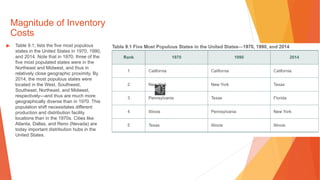
▶ Table 9.1, lists the five most populous
states in the United States in 1970, 1990,
and 2014. Note that in 1970, three of the
five most populated states were in the
Northeast and Midwest, and thus in
relatively close geographic proximity. By
2014, the most populous states were
located in the West, Southwest,
Southeast, Northeast, and Midwest,
respectively—and thus are much more
geographically diverse than in 1970. This
population shift necessitates different
production and distribution facility
locations than in the 1970s. Cities like
Atlanta, Dallas, and Reno (Nevada) are
today important distribution hubs in the
United States.
Determining the
Number of Facilities
▶ Few firms start business on one day
and have a need for large-scale
production and distribution the next
day. Rather, distribution and
production facilities tend to be added
(or subtracted) over time, as needed.
Most analytical procedures for
determining the number of facilities
are computerized because of the vast
number of permutations involved and
the complementary relationships
between current facilities in a
distribution network. Fortunately, a
number of software packages are
available that help organizations
determine both the number and
location of facilities in their logistics
networks.
This Photo by Unknown Author is licensed under CC BY
Determining the
Number of Facilities
▶Determining the number of facilities needed in a
supply chain involves several factors. Here’s a
framework to help with this decision:
• Demand Forecasting: Analyze current and
projected demand for your products in
different regions. This helps determine where
to place facilities to ensure products are
available where they are needed most.
• Geographic Coverage: Assess the geographic
spread of your customer base. Facilities should
be strategically located to minimize
transportation costs and delivery times.
• Supply Chain Strategy: Consider whether
you’re using a centralized or decentralized
supply chain strategy. Centralized systems
might have fewer, larger facilities, while
decentralized systems may have more, smaller
facilities to better serve regional markets.
• Transportation and Logistics: Evaluate
transportation costs and logistics constraints.
More facilities might reduce transportation
distances but increase overall logistics
complexity.
• Cost Analysis: Analyze the cost of establishing
and operating facilities. This includes real
estate, labor, utilities, and maintenance.
Compare these costs with the potential
savings from reduced transportation and
improved service levels.
This Photo by Unknown Author is licensed under CC BY
Determining the
Number of Facilities
• Production and Storage Needs: Determine
the production capacities and storage needs for
your products. Ensure that facilities are sized
appropriately to handle these requirements
without excess capacity.
• Supplier and Vendor Locations: Consider the
locations of your suppliers and vendors.
Proximity to key suppliers can reduce lead
times and transportation costs.
• Regulatory and Compliance Issues: Take into
account any local regulations or compliance
requirements that might affect where you can or
should build facilities.
• Risk Management: Assess risks like natural
disasters, political instability, or supply chain
disruptions. Diversifying the location of facilities
can help mitigate these risks.
• Technological Integration: Ensure that your
facilities are equipped with the necessary
technology for efficient operations and
integration with your overall supply chain
management system.
By carefully evaluating these factors, you can
determine the optimal number and location of
facilities needed to support your supply chain
effectively.
This Photo by Unknown Author is licensed under CC BY
General Factors
Influencing Facility
Location
▶ Tangible products are the
combination of raw materials,
component parts, and labor—with the
mixture varying from product to
product—made for sale in various
markets. Thus, raw materials,
component parts, labor, and markets
all influence where to locate a
manufacturing, processing, or
assembly facility. Warehouses,
distribution centers, and cross-
docking facilities exist to facilitate the
distribution of products. Their
locations are in turn influenced by the
locations of plants whose products
they handle and the markets they
serve. This Photo by Unknown Author is licensed under CC BY-NC
General Factors
Influencing Facility
Location
▶Choosing the location for a facility involves
considering a range of factors to ensure
operational efficiency and cost-effectiveness.
Here are some general factors that influence
facility location decisions:
• Proximity to Market: Being close to key
markets helps reduce transportation
costs and delivery times, improving
customer service and responsiveness.
• Transportation and Logistics:
Accessibility to major transportation
routes, ports, airports, and railways is
crucial for efficient distribution and
supply chain operations.
• Labor Availability and Costs: The
availability of skilled labor and the cost of
labor in the region can impact operational
efficiency and overall costs.
• Real Estate and Facility Costs: The cost
of land, building construction, and facility
maintenance can vary significantly by
location. Economic incentives or tax
benefits offered by local governments
may also influence the decision.
This Photo by Unknown Author is licensed under CC BY-NC
General Factors
Influencing Facility
Location
• Utility Costs and Infrastructure: The
availability and cost of essential utilities (e.g.,
electricity, water, natural gas) and
infrastructure (e.g., telecommunications,
waste management) are critical for facility
operations.
• Regulatory Environment: Local
regulations, zoning laws, environmental
regulations, and compliance requirements
can affect the feasibility and cost of operating
a facility.
• Economic Stability: The economic stability
of a region influences the long-term viability
of the facility. Areas with stable economies
are often preferred for long-term
investments.
• Quality of Life: The quality of life in the
area, including factors like safety, healthcare,
education, and overall living conditions, can
impact employee satisfaction and retention.
• Supply Chain and Vendor Proximity:
Being close to key suppliers and vendors
can reduce lead times and transportation
costs, improving supply chain efficiency.
This Photo by Unknown Author is licensed under CC BY-NC
General Factors
Influencing Facility
Location
• Risk Factors: Consider risks such as natural
disasters (e.g., floods, earthquakes), political
instability, and social unrest. A diverse location
strategy can mitigate some of these risks.
• Market Growth Potential: Evaluate the
potential for market growth in the region. Areas
with strong economic growth and increasing
demand can offer future business opportunities.
• Environmental Impact: Assess the
environmental impact of the facility and
compliance with sustainability practices. Some
regions have stricter environmental regulations
and incentives for green initiatives.
• Competitive Landscape: Consider the
presence of competitors in the region. Being in
a competitive market might offer advantages in
terms of visibility and market presence but
could also present challenges.
• Local Support and Incentives: Look into local
government incentives, grants, or support
programs that might be available to businesses
setting up facilities in the area.
By carefully evaluating these factors, businesses
can make informed decisions about facility locations
that align with their strategic goals and operational
needs.
This Photo by Unknown Author is licensed under CC BY-NC
Natural Resources
▶ The materials used to make a
product must be extracted directly
from the ground or sea (as in the
case of mining or fishing) or indirectly
(as in the case of farm products). In
some instances, these resources
may be located great distances from
the point where the materials or their
products will be consumed. For
materials that lose no weight in
processing, known as pure materials,
the processing point can be
anywhere near the raw material
source and the market. However, if
the materials must be processed at
some point between where they are
gathered and where they are needed,
their weight-losing or weight-gaining
characteristics become important for
facility location. This Photo by Unknown Author is licensed under CC BY
Natural Resources
▶ If the materials lose considerable
weight in processing, known as
weight-losing products, then the
processing point should be near the
point where they are mined or
harvested, largely to avoid the
payment of unnecessary
transportation charges. If the raw
materials gain weight in processing,
known as weight-gaining products,
then the processing point should be
close to the market. Sugar derived
from sugar beets provides an
example of a weight-losing product (a
yield of roughly 1 pound of sugar
from 6 pounds of sugar beets),
whereas bottled soft drinks are an
example of a weight-gaining product.
Natural Resources
▶ In addition to its use for bottling,
water (of one type or another) is a
requirement for the location of many
facilities. Land requirements are
another natural resource
consideration in facility location, and
distribution and production facilities
may require large parcels of land to
facilitate effective and efficient
operations. Historically, the
relationship between natural
resources and facility location
revolved around how the natural
resources would be incorporated into
products making their way toward
consumers.
Population
Characteristics—
Market for Goods
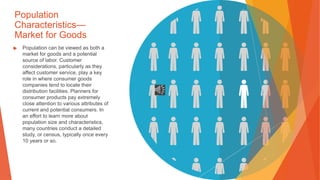
▶ Population can be viewed as both a
market for goods and a potential
source of labor. Customer
considerations, particularly as they
affect customer service, play a key
role in where consumer goods
companies tend to locate their
distribution facilities. Planners for
consumer products pay extremely
close attention to various attributes of
current and potential consumers. In
an effort to learn more about
population size and characteristics,
many countries conduct a detailed
study, or census, typically once every
10 years or so.
Population
Characteristics—Labor
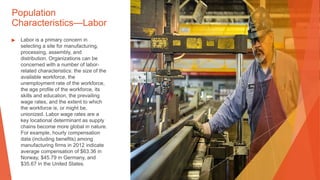
▶ Labor is a primary concern in
selecting a site for manufacturing,
processing, assembly, and
distribution. Organizations can be
concerned with a number of labor-
related characteristics: the size of the
available workforce, the
unemployment rate of the workforce,
the age profile of the workforce, its
skills and education, the prevailing
wage rates, and the extent to which
the workforce is, or might be,
unionized. Labor wage rates are a
key locational determinant as supply
chains become more global in nature.
For example, hourly compensation
data (including benefits) among
manufacturing firms in 2012 indicate
average compensation of $63.36 in
Norway, $45.79 in Germany, and
$35.67 in the United States.
Population
Characteristics—Labor
▶ In relative terms, a company could
have approximately similar
compensation costs by hiring either
six Mexican workers or one U.S.
worker. This wage differential at least
partly explains the popularity of the
maquiladora plants, assembly plants
located just south of the U.S.–
Mexican border. These plants, which
began in the mid-1960s, provided
much needed jobs to Mexican
workers and allowed for low-cost,
duty-free production so long as all the
goods were exported from Mexico.
Maquiladoras continue to be popular
today in part because of a substantial
narrowing of the wage gap between
Mexico and China in recent years.
This Photo by Unknown Author is licensed under CC BY-ND
Population
Characteristics—Labor
▶ Companies interested in locating in countries
with low-cost labor should recognize that
there are sometimes limits to the number of
supervisory personnel that can be brought in
from other countries. The host country’s
government may also insist that its own
nationals be trained for and employed in
many supervisory posts. In addition,
countries with low-cost labor may house a
multitude of sweatshops, which can be
viewed as organizations that exploit workers
and that do not comply with fiscal and legal
obligations toward employees. A workforce’s
union status is also a key locational
determinant for some organizations. From
management’s perspective, unions tend to
result in increased labor costs, due to higher
wages, and less flexibility in terms of job
assignments, which often forces companies
to hire additional workers. As a result, some
organizations prefer geographic areas in
which unions are not strong; in the United
States, for example, some states have right-
to-work laws, which mean that an individual
cannot be compelled to join a union as a
condition of employment. This Photo by Unknown Author is licensed under CC BY-NC-ND
Population
Characteristics—Labor
▶ Racial, ethnic, and cultural
considerations may also be
important population characteristics
that factor into facility location
decisions. Organizations are
sometimes hesitant to establish
facilities in areas that are not
racially, ethnically, or culturally
diverse because of the difficulty in
attracting workers to transfer to such
locations. Employees who are sent
to other countries for extended
periods of time are known as
expatriate workers. These workers
often present unique managerial
challenges. For example, expatriate
assignments can be costly, ranging
up to $1 million per assignment, and
turnover rates can run between 20
and 40 percent.
Taxes and Incentives
▶ Although labor considerations are
important for location decisions,
taxes can also be important,
particularly with respect to
warehousing facilities. Of particular
interest to logisticians and supply
chain managers is the inventory tax,
analogous to personal property taxes
paid by individuals. Fewer than 15
U.S. states currently assess
inventory taxes. As if business taxes
are not difficult enough to
understand, they represent only one
side of the coin; the other side is to
know the value of services being
received in exchange for the taxes. A
general rule of thumb is that the
services received represent only
about 50 percent of the taxes paid,
and this imbalance may cause
businesses to invest more money to
receive the required level of service.
To further complicate matters,
governments may offer incentive
packages as an inducement for firms
This Photo by Unknown Author is licensed under CC BY
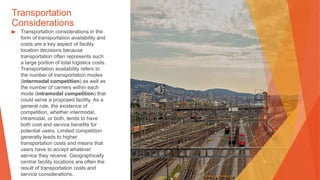
Transportation
Considerations
▶ Transportation considerations in the
form of transportation availability and
costs are a key aspect of facility
location decisions because
transportation often represents such
a large portion of total logistics costs.
Transportation availability refers to
the number of transportation modes
(intermodal competition) as well as
the number of carriers within each
mode (intramodal competition) that
could serve a proposed facility. As a
general rule, the existence of
competition, whether intermodal,
intramodal, or both, tends to have
both cost and service benefits for
potential users. Limited competition
generally leads to higher
transportation costs and means that
users have to accept whatever
service they receive. Geographically
central facility locations are often the
result of transportation costs and
service considerations.
Truck Distances from
Nebraska
▶ With respect to transportation costs,
centralized facilities tend to minimize
the total transit distances, which likely
results in minimum transportation
costs. A centralized location can also
maximize a facility’s service area, as
shown in Figure 9.2, which illustrates
truck distances from the state of
Nebraska. Note how many states are
located within 1,000 miles (generally
considered two-day service by truck)
of Nebraska.
Proximity to Industry
Clusters
▶ When looking at facility location
considerations, early business
logistics textbooks discussed the
agglomeration concept, which “refers
to the net advantages which can be
gained by a sharing of common
locations by various enterprises.”18
Although agglomeration continues to
be a key factor in facility location, it is
better known today as the industry
cluster concept. Industry clusters
differ in size and shape and, not
surprisingly, one type is focused on a
particular industry. Silicon Valley, a
collection of high-technology firms
located in the southern part of San
Francisco, California, is a well-known
cluster based on a particular industry.
Proximity to Industry
Clusters
▶ Another type of cluster offers
organizations proximity to key
suppliers. Proximity to key suppliers
has been the catalyst in the
development of supplier parks, a
concept that developed around
automakers and their suppliers in
Europe and has spread to other
continents, including North America.
Key suppliers locate on the site of, or
adjacent to, automobile assembly
plants, which helps reduce shipping
costs and inventory carrying costs.
Industry clusters can provide
potential advantages to prospective
participants in terms of facility and
transportation considerations.
Trade Patterns
▶ As pointed out earlier in this chapter,
firms producing consumer goods
follow changes in population to better
orient their distribution systems—and
there are shifts in the markets for
industrial goods as well. With respect
to commodity flows, logisticians are
especially interested in (1) how much
is being produced and (2) where it is
being shipped. The development and
implementation of multicountry trade
agreements have generated profound
impacts on trade patterns. Trade
patterns have also been influenced
among those countries that are
members of the European Union (EU).
When the EU consisted of 15
countries, the central location and
strong transportation infrastructures of
the so-called “Benelux” countries
(Belgium, the Netherlands, and
Luxembourg) were a favored location
for distribution facilities to serve EU
countries, and many companies
operated only one distribution facility
to serve their EU customers.
Trade Patterns
▶Trade patterns have a significant impact on supply
chains, influencing how companies' source,
manufacture, and distribute goods. Here’s how trade
patterns intersect with and affect supply chain
management:
Sourcing and Procurement:
1. Global Sourcing: Companies often source
raw materials, components, or finished
products from different countries based
on trade patterns. Shifts in trade policies
or tariffs can prompt businesses to adjust
their sourcing strategies to minimize costs
or avoid trade barriers.
2. Supplier Relationships: Trade patterns
can impact supplier relationships and
selection. Changes in trade agreements or
economic conditions may lead companies
to establish new supplier relationships or
diversify their supplier base.
Manufacturing and Production:
3. Production Locations: Trade patterns
influence decisions on where to locate
manufacturing facilities. Companies
might set up production in countries with
favorable trade agreements or lower
production costs.
4. Global Supply Chains: Manufacturers
often operate within global supply chains
that span multiple countries. Trade
patterns affect the flow of materials and
components between suppliers and
production facilities.
Trade Patterns
Logistics and Transportation:
1. Shipping Routes: Trade patterns
determine major shipping routes and
logistics networks. Changes in trade
flows can lead to adjustments in
transportation routes and logistics
planning.
2. Transportation Costs: Variations in
trade patterns, such as new tariffs or
changes in fuel prices, can impact
transportation costs, influencing
decisions on logistics and
distribution strategies.
Inventory Management:
3. Stock Levels: Trade patterns can
affect inventory levels and
management strategies. For
instance, disruptions in trade routes
or changes in demand patterns may
require adjustments in inventory
holdings to maintain supply chain
continuity.
4. Lead Times: The time it takes to
transport goods across borders can
impact lead times. Trade patterns
influence the predictability and
reliability of these lead times.
Trade Patterns
Compliance and Risk Management:
1. Regulatory Compliance: Changes
in trade regulations and tariffs
require companies to adapt their
compliance strategies and ensure
that their supply chains adhere to
new rules and standards.
2. Risk Mitigation: Trade patterns can
introduce risks related to geopolitical
instability, trade disputes, or
changes in trade policies.
Companies need to develop risk
management strategies to mitigate
these impacts.
Demand and Supply Dynamics:
3. Market Access: Trade patterns
affect market access and demand
for products. Companies may need
to adapt their supply chains to
respond to shifts in demand
resulting from changes in trade
relationships or consumer
preferences.
4. Regional Demand: Understanding
regional trade patterns helps
companies align their supply chains
with regional demand, optimizing
Trade Patterns
Cost Structure:
1. Tariffs and Duties: Trade patterns,
including tariffs and trade
agreements, impact the cost
structure of goods. Companies may
need to adjust their pricing
strategies or cost management
practices in response to these
changes.
2. Economies of Scale: Trade
patterns can influence economies of
scale by affecting the volume of
goods traded and the efficiency of
supply chain operations.
Strategic Planning:
3. Long-term Strategy: Companies
need to incorporate trade patterns
into their long-term supply chain
strategies, considering potential
changes in trade policies, economic
conditions, and geopolitical factors.
4. Adaptability: Supply chains must
be adaptable to shifting trade
patterns to maintain competitiveness
and resilience in the face of global
trade dynamics.
Quality-of-Life
Considerations
▶ An increasingly important locational
factor is what can broadly be called
quality-of-life considerations, which
incorporate nonbusiness factors into
the business decision of where to
locate a plant or distribution facility.
There are a number of reasons for
including quality-of-life considerations
as a factor in facility location. First,
employees who are able to live a
reasonable lifestyle tend to be happier
and more loyal; happy and loyal
employees are less likely to leave their
jobs and less likely to offend
prospective customers. Second,
because many organizations now
compete nationally and internationally
for talent, less-than-desirable
geographic locations might hinder the
recruiting process. Quite simply, the
quality of life in a region—is it a nice
place to live?—impacts both employee
retention and the ability to attract new
employees.
This Photo by Unknown Author is licensed under CC BY-NC-ND
Locating in Other
Countries
▶ The general factors (e.g., population,
transportation, quality of life, etc.) that
we’ve looked at also apply when
companies are thinking of locating
facilities in non-domestic countries.
For example, the Middle East has
been a hotbed of widespread political
instability in recent years; a short list
of Middle Eastern countries impacted
by political turmoil in recent years
includes Iraq, Libya, Syria, and
Yemen. One challenge of this political
instability is that alternative systems
of governance have been slow to
emerge, and this uncertainty is
causing many organizations to delay,
or even cancel, expansion into this
region.
Locating in Other
Countries
▶Locating facilities in other countries is a strategic
decision that can offer various benefits and
challenges for a company's supply chain. Here’s a
breakdown of key considerations and steps
involved in this process:
Benefits of International Location
1. Cost Reduction: Lower labor costs, reduced
manufacturing expenses, and cheaper raw
materials can improve cost efficiency. Many
companies move production to countries where
they can take advantage of lower operational
costs.
2. Market Access: Establishing facilities in
different countries can provide better access to
local and regional markets, helping companies
meet local demand more effectively and
respond to market opportunities.
3. Diversification: Geographic diversification can
reduce risk by spreading operations across
different regions, which can mitigate the impact
of local disruptions such as political instability,
natural disasters, or economic downturns.
4. Tax Incentives: Some countries offer tax
breaks, grants, or other incentives to attract
foreign investment, which can lower overall
operational costs.
5. Proximity to Suppliers: Being closer to key
suppliers can streamline supply chain
Locating in Other
Countries
Key Considerations
• Market Research: Conduct thorough
research on the target country’s market
conditions, including demand for your
products, competition, and consumer
preferences. This helps in assessing the
potential success of your operations.
• Regulatory and Legal Environment:
Understand the local regulations, including
labor laws, environmental regulations, and
industry standards. Compliance with these
regulations is crucial to avoid legal issues
and fines.
• Infrastructure and Logistics: Evaluate the
country’s infrastructure, including
transportation networks, utilities, and
technology. Efficient logistics and
infrastructure are critical for smooth
operations and supply chain efficiency.
• Cost Factors: Analyze all cost factors,
including real estate, labor, utilities, taxes,
and customs duties. Consider the total cost
of ownership rather than just the initial
investment.
Locating in Other
Countries
• Political and Economic Stability:
Assess the political and economic
stability of the country. Political unrest,
economic instability, or changes in
trade policies can affect operations and
profitability.
• Cultural and Language Differences:
Be aware of cultural differences and
language barriers that can impact
business operations and employee
interactions. Local expertise or
partnerships can help bridge these
gaps.
• Talent Availability: Consider the
availability of skilled labor in the target
country. Ensure there is a sufficient
talent pool for the roles you need to fill.
• Intellectual Property Protection:
Investigate the strength of intellectual
property laws in the country to protect
your innovations and proprietary
information.
Locating in Other
Countries
Steps to Establish Facilities in Other
Countries
• Feasibility Study: Conduct a feasibility
study to assess the viability of locating
a facility in the target country. This
includes financial analysis, market
research, and risk assessment.
• Location Selection: Choose a specific
location within the country based on
factors such as proximity to suppliers,
access to transportation networks, and
availability of skilled labor.
• Legal and Regulatory Compliance:
Register your business, obtain
necessary permits, and comply with
local regulations. This may involve
working with local legal and business
experts.
• Facility Design and Setup: Plan and
design your facility according to
operational needs and local standards.
Set up the necessary infrastructure,
equipment, and technology.
Locating in Other
Countries
Steps to Establish Facilities in Other
Countries
• Hiring and Training: Recruit local
talent and provide training to ensure
that employees are aligned with
company standards and practices.
• Supply Chain Integration: Integrate
the new facility into your existing supply
chain. Establish relationships with local
suppliers, distributors, and logistics
providers.
• Quality Control and Monitoring:
Implement quality control measures
and monitor operations to ensure that
the new facility meets company
standards and regulatory requirements.
• Continuous Improvement: Regularly
review and assess the performance of
the new facility. Make adjustments as
needed to improve efficiency, reduce
costs, and enhance overall operations.
Specialized Location
Characteristics
▶ Land may be zoned, which means that
there are limits on how the land can be
used. For example, a warehouse might
be allowed only in areas set aside for
wholesale or other specified commercial
operations. Union locals have areas of
jurisdiction, and a firm’s labor relations
manager may have distinct preferences
for the locals with which he or she is
willing to deal. Even though an
individual union may ratify national labor
agreements, local supplemental
agreements often reflect the unique
characteristics of a particular area.
Another specialized characteristic
involves the weather, and location
decisions can be influenced by the
potential for tornadoes, floods, and
hurricanes, among others. The twenty-
first century has been characterized by
tremendous weather extremes and
there is little indication that these
extremes will diminish going forward in
time.
Free Trade Zones
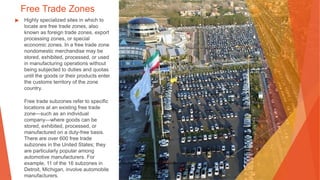
▶ Highly specialized sites in which to
locate are free trade zones, also
known as foreign trade zones, export
processing zones, or special
economic zones. In a free trade zone
nondomestic merchandise may be
stored, exhibited, processed, or used
in manufacturing operations without
being subjected to duties and quotas
until the goods or their products enter
the customs territory of the zone
country.
Free trade subzones refer to specific
locations at an existing free trade
zone—such as an individual
company—where goods can be
stored, exhibited, processed, or
manufactured on a duty-free basis.
There are over 600 free trade
subzones in the United States; they
are particularly popular among
automotive manufacturers. For
example, 11 of the 16 subzones in
Detroit, Michigan, involve automobile
manufacturers.
This Photo by Unknown Author is licensed under CC BY
Free Trade Zones
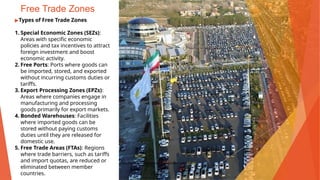
▶Types of Free Trade Zones
1. Special Economic Zones (SEZs):
Areas with specific economic
policies and tax incentives to attract
foreign investment and boost
economic activity.
2. Free Ports: Ports where goods can
be imported, stored, and exported
without incurring customs duties or
tariffs.
3. Export Processing Zones (EPZs):
Areas where companies engage in
manufacturing and processing
goods primarily for export markets.
4. Bonded Warehouses: Facilities
where imported goods can be
stored without paying customs
duties until they are released for
domestic use.
5. Free Trade Areas (FTAs): Regions
where trade barriers, such as tariffs
and import quotas, are reduced or
eliminated between member
countries.
This Photo by Unknown Author is licensed under CC BY
Free Trade Zones
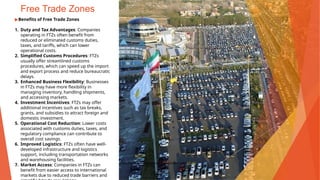
▶Benefits of Free Trade Zones
1. Duty and Tax Advantages: Companies
operating in FTZs often benefit from
reduced or eliminated customs duties,
taxes, and tariffs, which can lower
operational costs.
2. Simplified Customs Procedures: FTZs
usually offer streamlined customs
procedures, which can speed up the import
and export process and reduce bureaucratic
delays.
3. Enhanced Business Flexibility: Businesses
in FTZs may have more flexibility in
managing inventory, handling shipments,
and accessing markets.
4. Investment Incentives: FTZs may offer
additional incentives such as tax breaks,
grants, and subsidies to attract foreign and
domestic investment.
5. Operational Cost Reduction: Lower costs
associated with customs duties, taxes, and
regulatory compliance can contribute to
overall cost savings.
6. Improved Logistics: FTZs often have well-
developed infrastructure and logistics
support, including transportation networks
and warehousing facilities.
7. Market Access: Companies in FTZs can
benefit from easier access to international
markets due to reduced trade barriers and
This Photo by Unknown Author is licensed under CC BY
Free Trade Zones
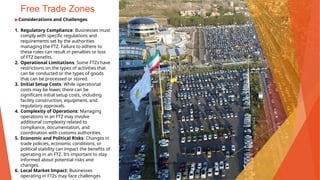
▶Considerations and Challenges
1. Regulatory Compliance: Businesses must
comply with specific regulations and
requirements set by the authorities
managing the FTZ. Failure to adhere to
these rules can result in penalties or loss
of FTZ benefits.
2. Operational Limitations: Some FTZs have
restrictions on the types of activities that
can be conducted or the types of goods
that can be processed or stored.
3. Initial Setup Costs: While operational
costs may be lower, there can be
significant initial setup costs, including
facility construction, equipment, and
regulatory approvals.
4. Complexity of Operations: Managing
operations in an FTZ may involve
additional complexity related to
compliance, documentation, and
coordination with customs authorities.
5. Economic and Political Risks: Changes in
trade policies, economic conditions, or
political stability can impact the benefits of
operating in an FTZ. It’s important to stay
informed about potential risks and
changes.
6. Local Market Impact: Businesses
operating in FTZs may face challenges
This Photo by Unknown Author is licensed under CC BY
Free Trade Zones
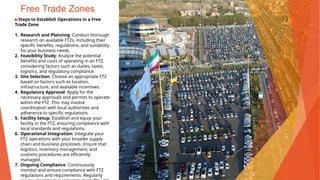
▶Steps to Establish Operations in a Free
Trade Zone
1. Research and Planning: Conduct thorough
research on available FTZs, including their
specific benefits, regulations, and suitability
for your business needs.
2. Feasibility Study: Analyze the potential
benefits and costs of operating in an FTZ,
considering factors such as duties, taxes,
logistics, and regulatory compliance.
3. Site Selection: Choose an appropriate FTZ
based on factors such as location,
infrastructure, and available incentives.
4. Regulatory Approval: Apply for the
necessary approvals and permits to operate
within the FTZ. This may involve
coordination with local authorities and
adherence to specific regulations.
5. Facility Setup: Establish and equip your
facility in the FTZ, ensuring compliance with
local standards and regulations.
6. Operational Integration: Integrate your
FTZ operations with your broader supply
chain and business processes. Ensure that
logistics, inventory management, and
customs procedures are efficiently
managed.
7. Ongoing Compliance: Continuously
monitor and ensure compliance with FTZ
regulations and requirements. Regularly
This Photo by Unknown Author is licensed under CC BY
Finding the Lowest-
Cost Location Using
Grid Systems
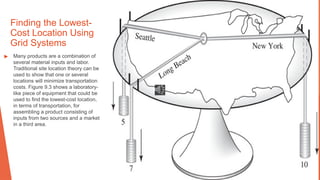
▶ Many products are a combination of
several material inputs and labor.
Traditional site location theory can be
used to show that one or several
locations will minimize transportation
costs. Figure 9.3 shows a laboratory-
like piece of equipment that could be
used to find the lowest-cost location,
in terms of transportation, for
assembling a product consisting of
inputs from two sources and a market
in a third area.
Grid Systems
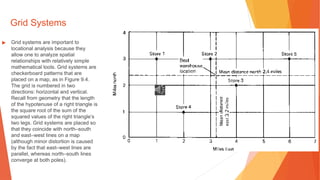
▶ Grid systems are important to
locational analysis because they
allow one to analyze spatial
relationships with relatively simple
mathematical tools. Grid systems are
checkerboard patterns that are
placed on a map, as in Figure 9.4.
The grid is numbered in two
directions: horizontal and vertical.
Recall from geometry that the length
of the hypotenuse of a right triangle is
the square root of the sum of the
squared values of the right triangle’s
two legs. Grid systems are placed so
that they coincide with north–south
and east–west lines on a map
(although minor distortion is caused
by the fact that east–west lines are
parallel, whereas north–south lines
converge at both poles).
Facility Relocation and
Facility Closing
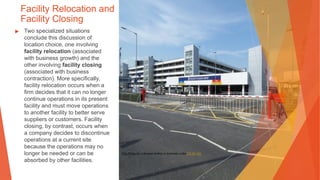
▶ Two specialized situations
conclude this discussion of
location choice, one involving
facility relocation (associated
with business growth) and the
other involving facility closing
(associated with business
contraction). More specifically,
facility relocation occurs when a
firm decides that it can no longer
continue operations in its present
facility and must move operations
to another facility to better serve
suppliers or customers. Facility
closing, by contrast, occurs when
a company decides to discontinue
operations at a current site
because the operations may no
longer be needed or can be
absorbed by other facilities.
This Photo by Unknown Author is licensed under CC BY-SA
Conclusion
▶ This chapter discussed several issues
associated with the location of
warehousing, manufacturing, and assembly
facilities. Facility location has moved from a
tactical to a strategic consideration at many
organizations; this chapter analyzed the
strategic importance of facility location.
General factors in facility location were
reviewed, including population
characteristics and trade patterns.
Population characteristics are a double-
edged sword in facility location in that a
population serves both as a market for
goods as well as a source of labor.
Changing trade patterns, spurred in part by
multicountry trade alliances, have had a
profound influence on the location of
distribution facilities.
This chapter also discussed specialized
location characteristics and presented
several examples of how grid systems can
be useful for determining the lowest-cost
location for a facility. The chapter concluded
with a look at facility relocation and facility
closing; companies should be cognizant of
the human dimension associated with both
relocation and closing.
Warehouses
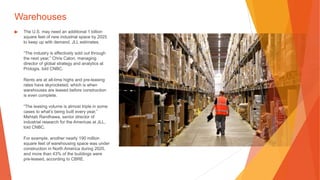
▶ The U.S. is facing a warehouse shortage,
with 1 billion square feet of new industrial
space needed by 2025 to keep up with
demand, according to commercial real
estate services company JLL. More e-
commerce activity and faster delivery is
driving up demand and shifting local
economies, like in the Lehigh Valley
region of Pennsylvania. Now, open land
is scarce, forcing real estate developers
to find unconventional spots, like a scuba
diving center, if they want to keep
building.
For every Cyber Monday purchase, there
is a warehouse employee packing up
those soon-to-be presents.
The big online shopping holiday comes
amid a warehouse shortage across the
United States as distribution center
vacancy rates are at all-time lows. Nearly
96% of existing industrial space is in use,
according to commercial real estate
services company JLL.
Warehouses
▶ The U.S. may need an additional 1 billion
square feet of new industrial space by 2025
to keep up with demand, JLL estimates.
“The industry is effectively sold out through
the next year,” Chris Caton, managing
director of global strategy and analytics at
Prologis, told CNBC.
Rents are at all-time highs and pre-leasing
rates have skyrocketed, which is when
warehouses are leased before construction
is even complete.
“The leasing volume is almost triple in some
cases to what’s being built every year,”
Mehtab Randhawa, senior director of
industrial research for the Americas at JLL,
told CNBC.
For example, another nearly 190 million
square feet of warehousing space was under
construction in North America during 2020,
and more than 43% of the buildings were
pre-leased, according to CBRE.
Warehouses
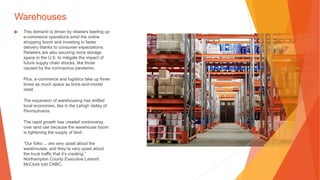
▶ This demand is driven by retailers beefing up
e-commerce operations amid the online
shopping boom and investing in faster
delivery thanks to consumer expectations.
Retailers are also securing more storage
space in the U.S. to mitigate the impact of
future supply chain shocks, like those
caused by the coronavirus pandemic.
Plus, e-commerce and logistics take up three
times as much space as brick-and-mortar
retail.
The expansion of warehousing has shifted
local economies, like in the Lehigh Valley of
Pennsylvania.
The rapid growth has created controversy
over land use because the warehouse boom
is tightening the supply of land.
“Our folks ... are very upset about the
warehouses, and they’re very upset about
the truck traffic that it’s creating,”
Northampton County Executive Lamont
McClure told CNBC.
Warehouses
▶ This demand is driven by retailers beefing up
e-commerce operations amid the online
shopping boom and investing in faster
delivery thanks to consumer expectations.
Retailers are also securing more storage
space in the U.S. to mitigate the impact of
future supply chain shocks, like those
caused by the coronavirus pandemic.
Plus, e-commerce and logistics take up three
times as much space as brick-and-mortar
retail.
The expansion of warehousing has shifted
local economies, like in the Lehigh Valley of
Pennsylvania.
The rapid growth has created controversy
over land use because the warehouse boom
is tightening the supply of land.
“Our folks ... are very upset about the
warehouses, and they’re very upset about
the truck traffic that it’s creating,”
Northampton County Executive Lamont
McClure told CNBC.
Warehouses
▶ That’s pushing industrial
developers to get creative and
find more unconventional spots,
like a Lehigh Valley aqua park and
scuba diving center if they want to
keep building.
Lehigh Valley native Stuart
Schooley told CNBC that he and
some friends tried to stop the
construction of the first warehouse
on their street.
“We realized we couldn’t stop it ...
[and it] just started a progression
of one warehouse after the other.
We were the last property,”
Schooley, owner of Dutch
Springs, a diving center and aqua
park in the Lehigh Valley, told
CNBC.
Warehouses
▶ Now, Schooley is selling the land so
he and his wife Jane can retire.
Real estate developer Trammell
Crow is purchasing the property and
looking to build two warehouses on
the land.
“We used to be quite welcome, and
the worm has definitely turned,
especially in places like the Lehigh
Valley, where I think people feel like
when is enough, enough?” Andrew
Mele, managing director in Trammell
Crow’s Northeast metro division,
told CNBC.
So, what do all these warehouses
mean for American consumers and
businesspeople from Wall Street to
Main Street?
Why Warehouses Are
Taking Over The U.S.

logisticsandtransportationpart9.pptxlogisticsandtransportationpart9

  • 1.
    Important Dates ▶ Midterm8/16/2024 ▶ Assignment 8/23/2023 ▶ Final 8/27/2023 This Photo by Unknown Author is licensed under CC BY-SA-NC
  • 2.
  • 3.
    Terminal Learning Objectives ▶ Toexamine the strategic importance of facility location ▶ To explain the general process of determining the optimum number of facilities ▶ To describe the major factors that influence facility location ▶ To examine a site’s specialized location characteristics ▶ To explain location decisions using simple grid systems ▶ To learn about facility relocation and facility closing
  • 4.
    The Strategic Importance ofFacility Location ▶ Logistics managers face a marketplace that is dynamic and ever-changing. This dynamism and change are two reasons why facility location has evolved from a tactical to a strategic consideration. Facilities such as manufacturing plants and warehousing represent fixed points where goods are produced, processed, assembled, or stored. Because these facilities can be very expensive to lease or build, companies are often hesitant to close them. However, poorly located facilities can negatively impact logistical effectiveness (e.g., due to longer and less reliable delivery times) and efficiency (e.g., due to increased delivery costs). This Photo by Unknown Author is licensed under CC BY
  • 5.
    The Strategic Importance ofFacility Location ▶Facility location is crucial for a variety of reasons, impacting both operational efficiency and strategic positioning. Here are some key aspects of its strategic importance: • Cost Efficiency: Proximity to suppliers and customers can reduce transportation costs and improve delivery times. Choosing a location with favorable labor costs and utility rates can also impact overall cost efficiency. • Market Access: Being close to key markets can enhance customer service and responsiveness. It can also help in understanding local market trends and preferences better. • Supply Chain Optimization: Strategic locations can optimize the supply chain by minimizing lead times and enhancing inventory management. This can lead to better coordination and reduced disruptions. • Competitive Advantage: A well-chosen location can provide a competitive edge by positioning a business closer to strategic partners, key customers, or in a region with business-friendly regulations and incentives. This Photo by Unknown Author is licensed under CC BY
  • 6.
    The Strategic Importance ofFacility Location • Talent Acquisition: The availability of skilled labor is a critical factor. Locating in an area with a strong talent pool can improve recruitment and retention. • Regulatory and Tax Considerations: Different locations have varying regulatory requirements and tax implications. Choosing a location with favorable conditions can reduce operational burdens and costs. • Infrastructure and Connectivity: Access to robust infrastructure, such as transportation networks, utilities, and communication systems, is essential for smooth operations and scalability. • Risk Management: Considering factors like natural disasters, political stability, and environmental risks can help in selecting a location that minimizes potential disruptions. In summary, strategic facility location decisions can drive cost savings, enhance market reach, and improve overall operational efficiency, all of which are critical for long-term success. This Photo by Unknown Author is licensed under CC BY

  • 7.
    Cost Considerations ▶ Costconsiderations are hardly new to logistics managers. Today’s cost considerations arise because many consumers have become sensitized to buy products only when prices are low, due in part to lingering effects from the 2007–2009 recession. Businesses have also contributed to consumer fixation with low prices, as illustrated by the following quote: “Price cuts are like management heroin. They’re addictive. Customers develop a craving for big discounts and an aversion to full prices.” If retailers offer consistently low prices, then their costs must also be consistently low for organizations to be profitable. For many years, this low price/low-cost framework led many companies to manufacture in countries characterized by plentiful and low-cost labor. In recent years, however, some organizations, particularly those with more than $1 billion (U.S. dollars) in sales, are reexamining the low-cost labor paradigm.
  • 8.
    Cost Considerations ▶ Asa result, organizations are reconfiguring their network designs. The rising labor costs in China have caused some companies to move production to lower-cost Asian-Pacific countries such as Vietnam and Laos.4 Alternatively, some organizations have adopted near sourcing, in which companies reconfigure their logistics networks to bring some production facilities closer to key consumer markets. For example, Mexico is the most popular location for near sourcing among companies that do business in North America. This Photo by Unknown Author is licensed under CC BY-SA
  • 9.
    Cost Considerations ▶ Whenconsidering the cost implications of facility location on the supply chain, several key factors should be evaluated: • Transportation Costs: Proximity to suppliers and customers can significantly affect transportation expenses. Shorter distances can reduce shipping costs and improve delivery times. However, it's also important to consider the quality and cost of transportation infrastructure (e.g., roads, ports, railways). • Inventory Costs: The location of the facility impacts inventory management. Facilities closer to suppliers or markets might require lower inventory levels, reducing holding costs and minimizing stockouts or overstock situations. • Supply Chain Complexity: A location that is strategically placed can simplify the supply chain by reducing the number of links between suppliers, manufacturers, and customers. This can lead to cost savings through improved coordination and reduced lead times. • Supplier Proximity: Being close to key suppliers can reduce procurement costs and lead times, improve supply chain reliability, and enable better collaboration. Conversely, reliance on suppliers in distant locations might increase costs and risks. • Demand Variability: Locations closer to high- demand regions can help in responding quickly to changes in customer preferences and market conditions, potentially reducing costs related to demand fluctuations and stock management. This Photo by Unknown Author is licensed under CC BY-SA
  • 10.
    Cost Considerations • Customsand Import/Export Duties: If the facility is located near international borders, customs procedures and import/export duties can impact costs. Understanding local trade regulations and potential tariffs is essential for cost management. • Risk Management: Locations prone to natural disasters, political instability, or other risks might lead to higher insurance premiums and contingency costs. Evaluating the risk profile of a location helps in managing these potential costs. • Labor Availability and Costs: Labor costs and availability can influence supply chain efficiency. Areas with skilled labor at competitive rates can enhance operational performance and reduce costs related to recruitment and training. • Regulatory Compliance: Different regions have varying regulations that can affect the cost of compliance. This includes environmental regulations, safety standards, and other legal requirements that could impact supply chain operations. • Infrastructure Quality: The quality of local infrastructure, such as roads, ports, and warehouses, can affect supply chain efficiency and costs. Poor infrastructure might lead to delays and increased operational costs. By thoroughly assessing these factors, businesses can optimize their facility location decisions to enhance supply chain efficiency and minimize associated costs. This Photo by Unknown Author is licensed under CC BY-SA
  • 11.
    Customer Service Expectations ▶ Onepoint that has been repeatedly emphasized in this text is that customer service expectations continue to increase over time. We know, for example, that today’s customers are looking for faster and more reliable order cycles, but how are faster and more reliable order cycles operationalized from a facility location perspective? Should an organization rely on one or two facilities to serve its customers, or should it rely on multiple facilities to serve them? The former alternative leads to fewer facilities and lower inventory costs, but higher transportation costs; the latter leads to more facilities and higher inventory costs, but lower transportation costs. When the online retailer Amazon began operations in the mid-1990s, it serviced orders from only one facility located in the United States. Today, by contrast, Amazon services orders from more than 120 fulfillment centers located in the United States, Europe, and Asia.
  • 12.
    Customer Service Expectations ▶Customer serviceexpectations in the supply chain are critical for maintaining customer satisfaction and loyalty. Here’s how facility location can impact these expectations: • Delivery Speed and Reliability: Customers expect timely and reliable delivery. A strategically located facility can help meet these expectations by reducing shipping times and ensuring more accurate delivery windows. Proximity to key markets allows for faster fulfillment and lower risk of delays. • Order Accuracy: Effective facility location can enhance order accuracy by positioning the facility closer to key suppliers or customers, reducing the complexity of the order fulfillment process and minimizing errors. • Inventory Availability: Adequate inventory levels are crucial for meeting customer demand. A facility located near major markets can help maintain optimal stock levels and quickly respond to changes in customer demand, reducing instances of stockouts or backorders. • Customer Support and Service: Proximity to customers can improve the ability to provide high- quality customer support. Facilities closer to customers can better understand and address local preferences and issues, leading to more personalized and effective service. • Returns Management: Efficient handling of returns is an important aspect of customer service. A strategically placed facility can facilitate easier and quicker returns processing, enhancing
  • 13.
    Customer Service Expectations • CostEfficiency: While reducing costs is important, it's also crucial to balance cost savings with customer service expectations. Facilities that optimize both cost and service levels can provide better value to customers. • Communication and Transparency: Customers expect clear communication regarding order status, shipping updates, and any issues that arise. A well- placed facility with efficient systems in place can ensure timely and accurate communication. • Flexibility and Responsiveness: The ability to quickly adapt to changes in demand or unforeseen disruptions is key to meeting customer expectations. A strategically located facility can enhance flexibility and responsiveness, improving overall service levels. • Quality of Service: Beyond delivery and accuracy, the overall quality of service includes handling inquiries, complaints, and providing support. Facilities in locations with strong service infrastructure and trained personnel can better meet these expectations. • Local Preferences and Regulations: Understanding and catering to local customer preferences and adhering to regional regulations can enhance service quality. A facility located in or near the target market is better positioned to address these local factors effectively. In summary, aligning facility location with customer service expectations involves balancing operational efficiency with the ability to meet customer demands for speed, accuracy, and responsiveness.
  • 14.
    Location of Customer orSupply Markets ▶ Improvements in transportation and technology (e.g., air conditioning) allow consumers to migrate relatively easily from one region or country to another. Economic growth is another variable that influences the location of customer markets; organizations sometimes expand their geographic scope to serve new customers. For example, Starbucks, which at the beginning of 2016 operated approximately 2,000 stores in China, plans to open 500 new stores per year there through 2020. The sustainability concept is another strategic consideration that can potentially impact the location of supply markets.
  • 15.
    Location of Customer orSupply Markets ▶Starbucks has been actively expanding its presence in China, which is one of its most significant markets outside the United States. The expansion involves several key aspects related to the supply chain: • Local Sourcing: To improve supply chain efficiency and support local economies, Starbucks sources more of its ingredients from local suppliers in China. This includes coffee beans, dairy products, and other ingredients that can be sourced locally. • Partnerships and Joint Ventures: Starbucks has entered into partnerships with local companies to enhance its supply chain capabilities. For example, Starbucks formed a joint venture with Alibaba to leverage Alibaba's delivery network and digital infrastructure. • Supply Chain Technology: The company invests in technology to streamline its supply chain operations. This includes advanced inventory management systems, logistics solutions, and data analytics to optimize supply chain processes.
  • 16.
    Location of Customer orSupply Markets • Distribution Centers: Starbucks has established distribution centers in key regions to ensure efficient delivery of products to its stores. These centers help manage inventory and reduce lead times. • Sustainability: Starbucks focuses on sustainability in its supply chain by sourcing ethically and working on reducing its environmental impact. This includes initiatives like reducing plastic waste and promoting recycling. • Training and Development: To maintain high standards, Starbucks invests in training local suppliers and employees to ensure quality and consistency in its products and services. Overall, Starbucks' expansion in China involves a comprehensive approach to building a robust and efficient supply chain that supports its growth and ensures high- quality service for its customers.
  • 17.
    Starbucks ▶ A Starbucksopens every nine hours in China. Since the coffee giant opened its first store in China in 1999, it has launched 6,000 stores around the mainly tea-drinking nation and plans to increase its number of stores to 9,000 by 2025. Competitors such as Luckin Coffee and Hey Tea have attempted to outpace Starbucks’ success; however, they’ve come up short. Although sales took a hit due to zero-Covid lockdowns, analysts are confident the chain will bounce back with the strong fourth-quarter sales in 2022. How did the Seattle-based coffee giant find such massive success in a country known for its love of tea?
  • 18.
    How Starbucks WasAble To Win Over China
  • 19.
    Magnitude of Inventory Costs ▶Table 9.1, lists the five most populous states in the United States in 1970, 1990, and 2014. Note that in 1970, three of the five most populated states were in the Northeast and Midwest, and thus in relatively close geographic proximity. By 2014, the most populous states were located in the West, Southwest, Southeast, Northeast, and Midwest, respectively—and thus are much more geographically diverse than in 1970. This population shift necessitates different production and distribution facility locations than in the 1970s. Cities like Atlanta, Dallas, and Reno (Nevada) are today important distribution hubs in the United States.
  • 20.
    Determining the Number ofFacilities ▶ Few firms start business on one day and have a need for large-scale production and distribution the next day. Rather, distribution and production facilities tend to be added (or subtracted) over time, as needed. Most analytical procedures for determining the number of facilities are computerized because of the vast number of permutations involved and the complementary relationships between current facilities in a distribution network. Fortunately, a number of software packages are available that help organizations determine both the number and location of facilities in their logistics networks. This Photo by Unknown Author is licensed under CC BY
  • 21.
    Determining the Number ofFacilities ▶Determining the number of facilities needed in a supply chain involves several factors. Here’s a framework to help with this decision: • Demand Forecasting: Analyze current and projected demand for your products in different regions. This helps determine where to place facilities to ensure products are available where they are needed most. • Geographic Coverage: Assess the geographic spread of your customer base. Facilities should be strategically located to minimize transportation costs and delivery times. • Supply Chain Strategy: Consider whether you’re using a centralized or decentralized supply chain strategy. Centralized systems might have fewer, larger facilities, while decentralized systems may have more, smaller facilities to better serve regional markets. • Transportation and Logistics: Evaluate transportation costs and logistics constraints. More facilities might reduce transportation distances but increase overall logistics complexity. • Cost Analysis: Analyze the cost of establishing and operating facilities. This includes real estate, labor, utilities, and maintenance. Compare these costs with the potential savings from reduced transportation and improved service levels. This Photo by Unknown Author is licensed under CC BY
  • 22.
    Determining the Number ofFacilities • Production and Storage Needs: Determine the production capacities and storage needs for your products. Ensure that facilities are sized appropriately to handle these requirements without excess capacity. • Supplier and Vendor Locations: Consider the locations of your suppliers and vendors. Proximity to key suppliers can reduce lead times and transportation costs. • Regulatory and Compliance Issues: Take into account any local regulations or compliance requirements that might affect where you can or should build facilities. • Risk Management: Assess risks like natural disasters, political instability, or supply chain disruptions. Diversifying the location of facilities can help mitigate these risks. • Technological Integration: Ensure that your facilities are equipped with the necessary technology for efficient operations and integration with your overall supply chain management system. By carefully evaluating these factors, you can determine the optimal number and location of facilities needed to support your supply chain effectively. This Photo by Unknown Author is licensed under CC BY
  • 23.
    General Factors Influencing Facility Location ▶Tangible products are the combination of raw materials, component parts, and labor—with the mixture varying from product to product—made for sale in various markets. Thus, raw materials, component parts, labor, and markets all influence where to locate a manufacturing, processing, or assembly facility. Warehouses, distribution centers, and cross- docking facilities exist to facilitate the distribution of products. Their locations are in turn influenced by the locations of plants whose products they handle and the markets they serve. This Photo by Unknown Author is licensed under CC BY-NC
  • 24.
    General Factors Influencing Facility Location ▶Choosingthe location for a facility involves considering a range of factors to ensure operational efficiency and cost-effectiveness. Here are some general factors that influence facility location decisions: • Proximity to Market: Being close to key markets helps reduce transportation costs and delivery times, improving customer service and responsiveness. • Transportation and Logistics: Accessibility to major transportation routes, ports, airports, and railways is crucial for efficient distribution and supply chain operations. • Labor Availability and Costs: The availability of skilled labor and the cost of labor in the region can impact operational efficiency and overall costs. • Real Estate and Facility Costs: The cost of land, building construction, and facility maintenance can vary significantly by location. Economic incentives or tax benefits offered by local governments may also influence the decision. This Photo by Unknown Author is licensed under CC BY-NC
  • 25.
    General Factors Influencing Facility Location •Utility Costs and Infrastructure: The availability and cost of essential utilities (e.g., electricity, water, natural gas) and infrastructure (e.g., telecommunications, waste management) are critical for facility operations. • Regulatory Environment: Local regulations, zoning laws, environmental regulations, and compliance requirements can affect the feasibility and cost of operating a facility. • Economic Stability: The economic stability of a region influences the long-term viability of the facility. Areas with stable economies are often preferred for long-term investments. • Quality of Life: The quality of life in the area, including factors like safety, healthcare, education, and overall living conditions, can impact employee satisfaction and retention. • Supply Chain and Vendor Proximity: Being close to key suppliers and vendors can reduce lead times and transportation costs, improving supply chain efficiency. This Photo by Unknown Author is licensed under CC BY-NC
  • 26.
    General Factors Influencing Facility Location •Risk Factors: Consider risks such as natural disasters (e.g., floods, earthquakes), political instability, and social unrest. A diverse location strategy can mitigate some of these risks. • Market Growth Potential: Evaluate the potential for market growth in the region. Areas with strong economic growth and increasing demand can offer future business opportunities. • Environmental Impact: Assess the environmental impact of the facility and compliance with sustainability practices. Some regions have stricter environmental regulations and incentives for green initiatives. • Competitive Landscape: Consider the presence of competitors in the region. Being in a competitive market might offer advantages in terms of visibility and market presence but could also present challenges. • Local Support and Incentives: Look into local government incentives, grants, or support programs that might be available to businesses setting up facilities in the area. By carefully evaluating these factors, businesses can make informed decisions about facility locations that align with their strategic goals and operational needs. This Photo by Unknown Author is licensed under CC BY-NC
  • 27.
    Natural Resources ▶ Thematerials used to make a product must be extracted directly from the ground or sea (as in the case of mining or fishing) or indirectly (as in the case of farm products). In some instances, these resources may be located great distances from the point where the materials or their products will be consumed. For materials that lose no weight in processing, known as pure materials, the processing point can be anywhere near the raw material source and the market. However, if the materials must be processed at some point between where they are gathered and where they are needed, their weight-losing or weight-gaining characteristics become important for facility location. This Photo by Unknown Author is licensed under CC BY
  • 28.
    Natural Resources ▶ Ifthe materials lose considerable weight in processing, known as weight-losing products, then the processing point should be near the point where they are mined or harvested, largely to avoid the payment of unnecessary transportation charges. If the raw materials gain weight in processing, known as weight-gaining products, then the processing point should be close to the market. Sugar derived from sugar beets provides an example of a weight-losing product (a yield of roughly 1 pound of sugar from 6 pounds of sugar beets), whereas bottled soft drinks are an example of a weight-gaining product.
  • 29.
    Natural Resources ▶ Inaddition to its use for bottling, water (of one type or another) is a requirement for the location of many facilities. Land requirements are another natural resource consideration in facility location, and distribution and production facilities may require large parcels of land to facilitate effective and efficient operations. Historically, the relationship between natural resources and facility location revolved around how the natural resources would be incorporated into products making their way toward consumers.
  • 30.
    Population Characteristics— Market for Goods ▶Population can be viewed as both a market for goods and a potential source of labor. Customer considerations, particularly as they affect customer service, play a key role in where consumer goods companies tend to locate their distribution facilities. Planners for consumer products pay extremely close attention to various attributes of current and potential consumers. In an effort to learn more about population size and characteristics, many countries conduct a detailed study, or census, typically once every 10 years or so.
  • 31.
    Population Characteristics—Labor ▶ Labor isa primary concern in selecting a site for manufacturing, processing, assembly, and distribution. Organizations can be concerned with a number of labor- related characteristics: the size of the available workforce, the unemployment rate of the workforce, the age profile of the workforce, its skills and education, the prevailing wage rates, and the extent to which the workforce is, or might be, unionized. Labor wage rates are a key locational determinant as supply chains become more global in nature. For example, hourly compensation data (including benefits) among manufacturing firms in 2012 indicate average compensation of $63.36 in Norway, $45.79 in Germany, and $35.67 in the United States.
  • 32.
    Population Characteristics—Labor ▶ In relativeterms, a company could have approximately similar compensation costs by hiring either six Mexican workers or one U.S. worker. This wage differential at least partly explains the popularity of the maquiladora plants, assembly plants located just south of the U.S.– Mexican border. These plants, which began in the mid-1960s, provided much needed jobs to Mexican workers and allowed for low-cost, duty-free production so long as all the goods were exported from Mexico. Maquiladoras continue to be popular today in part because of a substantial narrowing of the wage gap between Mexico and China in recent years. This Photo by Unknown Author is licensed under CC BY-ND
  • 33.
    Population Characteristics—Labor ▶ Companies interestedin locating in countries with low-cost labor should recognize that there are sometimes limits to the number of supervisory personnel that can be brought in from other countries. The host country’s government may also insist that its own nationals be trained for and employed in many supervisory posts. In addition, countries with low-cost labor may house a multitude of sweatshops, which can be viewed as organizations that exploit workers and that do not comply with fiscal and legal obligations toward employees. A workforce’s union status is also a key locational determinant for some organizations. From management’s perspective, unions tend to result in increased labor costs, due to higher wages, and less flexibility in terms of job assignments, which often forces companies to hire additional workers. As a result, some organizations prefer geographic areas in which unions are not strong; in the United States, for example, some states have right- to-work laws, which mean that an individual cannot be compelled to join a union as a condition of employment. This Photo by Unknown Author is licensed under CC BY-NC-ND
  • 34.
    Population Characteristics—Labor ▶ Racial, ethnic,and cultural considerations may also be important population characteristics that factor into facility location decisions. Organizations are sometimes hesitant to establish facilities in areas that are not racially, ethnically, or culturally diverse because of the difficulty in attracting workers to transfer to such locations. Employees who are sent to other countries for extended periods of time are known as expatriate workers. These workers often present unique managerial challenges. For example, expatriate assignments can be costly, ranging up to $1 million per assignment, and turnover rates can run between 20 and 40 percent.
  • 35.
    Taxes and Incentives ▶Although labor considerations are important for location decisions, taxes can also be important, particularly with respect to warehousing facilities. Of particular interest to logisticians and supply chain managers is the inventory tax, analogous to personal property taxes paid by individuals. Fewer than 15 U.S. states currently assess inventory taxes. As if business taxes are not difficult enough to understand, they represent only one side of the coin; the other side is to know the value of services being received in exchange for the taxes. A general rule of thumb is that the services received represent only about 50 percent of the taxes paid, and this imbalance may cause businesses to invest more money to receive the required level of service. To further complicate matters, governments may offer incentive packages as an inducement for firms This Photo by Unknown Author is licensed under CC BY
  • 36.
    Transportation Considerations ▶ Transportation considerationsin the form of transportation availability and costs are a key aspect of facility location decisions because transportation often represents such a large portion of total logistics costs. Transportation availability refers to the number of transportation modes (intermodal competition) as well as the number of carriers within each mode (intramodal competition) that could serve a proposed facility. As a general rule, the existence of competition, whether intermodal, intramodal, or both, tends to have both cost and service benefits for potential users. Limited competition generally leads to higher transportation costs and means that users have to accept whatever service they receive. Geographically central facility locations are often the result of transportation costs and service considerations.
  • 37.
    Truck Distances from Nebraska ▶With respect to transportation costs, centralized facilities tend to minimize the total transit distances, which likely results in minimum transportation costs. A centralized location can also maximize a facility’s service area, as shown in Figure 9.2, which illustrates truck distances from the state of Nebraska. Note how many states are located within 1,000 miles (generally considered two-day service by truck) of Nebraska.
  • 38.
    Proximity to Industry Clusters ▶When looking at facility location considerations, early business logistics textbooks discussed the agglomeration concept, which “refers to the net advantages which can be gained by a sharing of common locations by various enterprises.”18 Although agglomeration continues to be a key factor in facility location, it is better known today as the industry cluster concept. Industry clusters differ in size and shape and, not surprisingly, one type is focused on a particular industry. Silicon Valley, a collection of high-technology firms located in the southern part of San Francisco, California, is a well-known cluster based on a particular industry.
  • 39.
    Proximity to Industry Clusters ▶Another type of cluster offers organizations proximity to key suppliers. Proximity to key suppliers has been the catalyst in the development of supplier parks, a concept that developed around automakers and their suppliers in Europe and has spread to other continents, including North America. Key suppliers locate on the site of, or adjacent to, automobile assembly plants, which helps reduce shipping costs and inventory carrying costs. Industry clusters can provide potential advantages to prospective participants in terms of facility and transportation considerations.
  • 40.
    Trade Patterns ▶ Aspointed out earlier in this chapter, firms producing consumer goods follow changes in population to better orient their distribution systems—and there are shifts in the markets for industrial goods as well. With respect to commodity flows, logisticians are especially interested in (1) how much is being produced and (2) where it is being shipped. The development and implementation of multicountry trade agreements have generated profound impacts on trade patterns. Trade patterns have also been influenced among those countries that are members of the European Union (EU). When the EU consisted of 15 countries, the central location and strong transportation infrastructures of the so-called “Benelux” countries (Belgium, the Netherlands, and Luxembourg) were a favored location for distribution facilities to serve EU countries, and many companies operated only one distribution facility to serve their EU customers.
  • 41.
    Trade Patterns ▶Trade patternshave a significant impact on supply chains, influencing how companies' source, manufacture, and distribute goods. Here’s how trade patterns intersect with and affect supply chain management: Sourcing and Procurement: 1. Global Sourcing: Companies often source raw materials, components, or finished products from different countries based on trade patterns. Shifts in trade policies or tariffs can prompt businesses to adjust their sourcing strategies to minimize costs or avoid trade barriers. 2. Supplier Relationships: Trade patterns can impact supplier relationships and selection. Changes in trade agreements or economic conditions may lead companies to establish new supplier relationships or diversify their supplier base. Manufacturing and Production: 3. Production Locations: Trade patterns influence decisions on where to locate manufacturing facilities. Companies might set up production in countries with favorable trade agreements or lower production costs. 4. Global Supply Chains: Manufacturers often operate within global supply chains that span multiple countries. Trade patterns affect the flow of materials and components between suppliers and production facilities.
  • 42.
    Trade Patterns Logistics andTransportation: 1. Shipping Routes: Trade patterns determine major shipping routes and logistics networks. Changes in trade flows can lead to adjustments in transportation routes and logistics planning. 2. Transportation Costs: Variations in trade patterns, such as new tariffs or changes in fuel prices, can impact transportation costs, influencing decisions on logistics and distribution strategies. Inventory Management: 3. Stock Levels: Trade patterns can affect inventory levels and management strategies. For instance, disruptions in trade routes or changes in demand patterns may require adjustments in inventory holdings to maintain supply chain continuity. 4. Lead Times: The time it takes to transport goods across borders can impact lead times. Trade patterns influence the predictability and reliability of these lead times.
  • 43.
    Trade Patterns Compliance andRisk Management: 1. Regulatory Compliance: Changes in trade regulations and tariffs require companies to adapt their compliance strategies and ensure that their supply chains adhere to new rules and standards. 2. Risk Mitigation: Trade patterns can introduce risks related to geopolitical instability, trade disputes, or changes in trade policies. Companies need to develop risk management strategies to mitigate these impacts. Demand and Supply Dynamics: 3. Market Access: Trade patterns affect market access and demand for products. Companies may need to adapt their supply chains to respond to shifts in demand resulting from changes in trade relationships or consumer preferences. 4. Regional Demand: Understanding regional trade patterns helps companies align their supply chains with regional demand, optimizing
  • 44.
    Trade Patterns Cost Structure: 1.Tariffs and Duties: Trade patterns, including tariffs and trade agreements, impact the cost structure of goods. Companies may need to adjust their pricing strategies or cost management practices in response to these changes. 2. Economies of Scale: Trade patterns can influence economies of scale by affecting the volume of goods traded and the efficiency of supply chain operations. Strategic Planning: 3. Long-term Strategy: Companies need to incorporate trade patterns into their long-term supply chain strategies, considering potential changes in trade policies, economic conditions, and geopolitical factors. 4. Adaptability: Supply chains must be adaptable to shifting trade patterns to maintain competitiveness and resilience in the face of global trade dynamics.
  • 45.
    Quality-of-Life Considerations ▶ An increasinglyimportant locational factor is what can broadly be called quality-of-life considerations, which incorporate nonbusiness factors into the business decision of where to locate a plant or distribution facility. There are a number of reasons for including quality-of-life considerations as a factor in facility location. First, employees who are able to live a reasonable lifestyle tend to be happier and more loyal; happy and loyal employees are less likely to leave their jobs and less likely to offend prospective customers. Second, because many organizations now compete nationally and internationally for talent, less-than-desirable geographic locations might hinder the recruiting process. Quite simply, the quality of life in a region—is it a nice place to live?—impacts both employee retention and the ability to attract new employees. This Photo by Unknown Author is licensed under CC BY-NC-ND

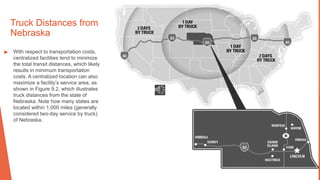
  • 46.

    Locating in Other Countries ▶The general factors (e.g., population, transportation, quality of life, etc.) that we’ve looked at also apply when companies are thinking of locating facilities in non-domestic countries. For example, the Middle East has been a hotbed of widespread political instability in recent years; a short list of Middle Eastern countries impacted by political turmoil in recent years includes Iraq, Libya, Syria, and Yemen. One challenge of this political instability is that alternative systems of governance have been slow to emerge, and this uncertainty is causing many organizations to delay, or even cancel, expansion into this region.
  • 47.
    Locating in Other Countries ▶Locatingfacilities in other countries is a strategic decision that can offer various benefits and challenges for a company's supply chain. Here’s a breakdown of key considerations and steps involved in this process: Benefits of International Location 1. Cost Reduction: Lower labor costs, reduced manufacturing expenses, and cheaper raw materials can improve cost efficiency. Many companies move production to countries where they can take advantage of lower operational costs. 2. Market Access: Establishing facilities in different countries can provide better access to local and regional markets, helping companies meet local demand more effectively and respond to market opportunities. 3. Diversification: Geographic diversification can reduce risk by spreading operations across different regions, which can mitigate the impact of local disruptions such as political instability, natural disasters, or economic downturns. 4. Tax Incentives: Some countries offer tax breaks, grants, or other incentives to attract foreign investment, which can lower overall operational costs. 5. Proximity to Suppliers: Being closer to key suppliers can streamline supply chain
  • 48.
    Locating in Other Countries KeyConsiderations • Market Research: Conduct thorough research on the target country’s market conditions, including demand for your products, competition, and consumer preferences. This helps in assessing the potential success of your operations. • Regulatory and Legal Environment: Understand the local regulations, including labor laws, environmental regulations, and industry standards. Compliance with these regulations is crucial to avoid legal issues and fines. • Infrastructure and Logistics: Evaluate the country’s infrastructure, including transportation networks, utilities, and technology. Efficient logistics and infrastructure are critical for smooth operations and supply chain efficiency. • Cost Factors: Analyze all cost factors, including real estate, labor, utilities, taxes, and customs duties. Consider the total cost of ownership rather than just the initial investment.
  • 49.
    Locating in Other Countries •Political and Economic Stability: Assess the political and economic stability of the country. Political unrest, economic instability, or changes in trade policies can affect operations and profitability. • Cultural and Language Differences: Be aware of cultural differences and language barriers that can impact business operations and employee interactions. Local expertise or partnerships can help bridge these gaps. • Talent Availability: Consider the availability of skilled labor in the target country. Ensure there is a sufficient talent pool for the roles you need to fill. • Intellectual Property Protection: Investigate the strength of intellectual property laws in the country to protect your innovations and proprietary information.
  • 50.
    Locating in Other Countries Stepsto Establish Facilities in Other Countries • Feasibility Study: Conduct a feasibility study to assess the viability of locating a facility in the target country. This includes financial analysis, market research, and risk assessment. • Location Selection: Choose a specific location within the country based on factors such as proximity to suppliers, access to transportation networks, and availability of skilled labor. • Legal and Regulatory Compliance: Register your business, obtain necessary permits, and comply with local regulations. This may involve working with local legal and business experts. • Facility Design and Setup: Plan and design your facility according to operational needs and local standards. Set up the necessary infrastructure, equipment, and technology.
  • 51.
    Locating in Other Countries Stepsto Establish Facilities in Other Countries • Hiring and Training: Recruit local talent and provide training to ensure that employees are aligned with company standards and practices. • Supply Chain Integration: Integrate the new facility into your existing supply chain. Establish relationships with local suppliers, distributors, and logistics providers. • Quality Control and Monitoring: Implement quality control measures and monitor operations to ensure that the new facility meets company standards and regulatory requirements. • Continuous Improvement: Regularly review and assess the performance of the new facility. Make adjustments as needed to improve efficiency, reduce costs, and enhance overall operations.
  • 52.
    Specialized Location Characteristics ▶ Landmay be zoned, which means that there are limits on how the land can be used. For example, a warehouse might be allowed only in areas set aside for wholesale or other specified commercial operations. Union locals have areas of jurisdiction, and a firm’s labor relations manager may have distinct preferences for the locals with which he or she is willing to deal. Even though an individual union may ratify national labor agreements, local supplemental agreements often reflect the unique characteristics of a particular area. Another specialized characteristic involves the weather, and location decisions can be influenced by the potential for tornadoes, floods, and hurricanes, among others. The twenty- first century has been characterized by tremendous weather extremes and there is little indication that these extremes will diminish going forward in time.
  • 53.
    Free Trade Zones ▶Highly specialized sites in which to locate are free trade zones, also known as foreign trade zones, export processing zones, or special economic zones. In a free trade zone nondomestic merchandise may be stored, exhibited, processed, or used in manufacturing operations without being subjected to duties and quotas until the goods or their products enter the customs territory of the zone country. Free trade subzones refer to specific locations at an existing free trade zone—such as an individual company—where goods can be stored, exhibited, processed, or manufactured on a duty-free basis. There are over 600 free trade subzones in the United States; they are particularly popular among automotive manufacturers. For example, 11 of the 16 subzones in Detroit, Michigan, involve automobile manufacturers. This Photo by Unknown Author is licensed under CC BY
  • 54.
    Free Trade Zones ▶Typesof Free Trade Zones 1. Special Economic Zones (SEZs): Areas with specific economic policies and tax incentives to attract foreign investment and boost economic activity. 2. Free Ports: Ports where goods can be imported, stored, and exported without incurring customs duties or tariffs. 3. Export Processing Zones (EPZs): Areas where companies engage in manufacturing and processing goods primarily for export markets. 4. Bonded Warehouses: Facilities where imported goods can be stored without paying customs duties until they are released for domestic use. 5. Free Trade Areas (FTAs): Regions where trade barriers, such as tariffs and import quotas, are reduced or eliminated between member countries. This Photo by Unknown Author is licensed under CC BY
  • 55.
    Free Trade Zones ▶Benefitsof Free Trade Zones 1. Duty and Tax Advantages: Companies operating in FTZs often benefit from reduced or eliminated customs duties, taxes, and tariffs, which can lower operational costs. 2. Simplified Customs Procedures: FTZs usually offer streamlined customs procedures, which can speed up the import and export process and reduce bureaucratic delays. 3. Enhanced Business Flexibility: Businesses in FTZs may have more flexibility in managing inventory, handling shipments, and accessing markets. 4. Investment Incentives: FTZs may offer additional incentives such as tax breaks, grants, and subsidies to attract foreign and domestic investment. 5. Operational Cost Reduction: Lower costs associated with customs duties, taxes, and regulatory compliance can contribute to overall cost savings. 6. Improved Logistics: FTZs often have well- developed infrastructure and logistics support, including transportation networks and warehousing facilities. 7. Market Access: Companies in FTZs can benefit from easier access to international markets due to reduced trade barriers and This Photo by Unknown Author is licensed under CC BY
  • 56.
    Free Trade Zones ▶Considerationsand Challenges 1. Regulatory Compliance: Businesses must comply with specific regulations and requirements set by the authorities managing the FTZ. Failure to adhere to these rules can result in penalties or loss of FTZ benefits. 2. Operational Limitations: Some FTZs have restrictions on the types of activities that can be conducted or the types of goods that can be processed or stored. 3. Initial Setup Costs: While operational costs may be lower, there can be significant initial setup costs, including facility construction, equipment, and regulatory approvals. 4. Complexity of Operations: Managing operations in an FTZ may involve additional complexity related to compliance, documentation, and coordination with customs authorities. 5. Economic and Political Risks: Changes in trade policies, economic conditions, or political stability can impact the benefits of operating in an FTZ. It’s important to stay informed about potential risks and changes. 6. Local Market Impact: Businesses operating in FTZs may face challenges This Photo by Unknown Author is licensed under CC BY
  • 57.
    Free Trade Zones ▶Stepsto Establish Operations in a Free Trade Zone 1. Research and Planning: Conduct thorough research on available FTZs, including their specific benefits, regulations, and suitability for your business needs. 2. Feasibility Study: Analyze the potential benefits and costs of operating in an FTZ, considering factors such as duties, taxes, logistics, and regulatory compliance. 3. Site Selection: Choose an appropriate FTZ based on factors such as location, infrastructure, and available incentives. 4. Regulatory Approval: Apply for the necessary approvals and permits to operate within the FTZ. This may involve coordination with local authorities and adherence to specific regulations. 5. Facility Setup: Establish and equip your facility in the FTZ, ensuring compliance with local standards and regulations. 6. Operational Integration: Integrate your FTZ operations with your broader supply chain and business processes. Ensure that logistics, inventory management, and customs procedures are efficiently managed. 7. Ongoing Compliance: Continuously monitor and ensure compliance with FTZ regulations and requirements. Regularly This Photo by Unknown Author is licensed under CC BY
  • 58.
    Finding the Lowest- CostLocation Using Grid Systems ▶ Many products are a combination of several material inputs and labor. Traditional site location theory can be used to show that one or several locations will minimize transportation costs. Figure 9.3 shows a laboratory- like piece of equipment that could be used to find the lowest-cost location, in terms of transportation, for assembling a product consisting of inputs from two sources and a market in a third area.
  • 59.
    Grid Systems ▶ Gridsystems are important to locational analysis because they allow one to analyze spatial relationships with relatively simple mathematical tools. Grid systems are checkerboard patterns that are placed on a map, as in Figure 9.4. The grid is numbered in two directions: horizontal and vertical. Recall from geometry that the length of the hypotenuse of a right triangle is the square root of the sum of the squared values of the right triangle’s two legs. Grid systems are placed so that they coincide with north–south and east–west lines on a map (although minor distortion is caused by the fact that east–west lines are parallel, whereas north–south lines converge at both poles).
  • 60.
    Facility Relocation and FacilityClosing ▶ Two specialized situations conclude this discussion of location choice, one involving facility relocation (associated with business growth) and the other involving facility closing (associated with business contraction). More specifically, facility relocation occurs when a firm decides that it can no longer continue operations in its present facility and must move operations to another facility to better serve suppliers or customers. Facility closing, by contrast, occurs when a company decides to discontinue operations at a current site because the operations may no longer be needed or can be absorbed by other facilities. This Photo by Unknown Author is licensed under CC BY-SA
  • 61.
    Conclusion ▶ This chapterdiscussed several issues associated with the location of warehousing, manufacturing, and assembly facilities. Facility location has moved from a tactical to a strategic consideration at many organizations; this chapter analyzed the strategic importance of facility location. General factors in facility location were reviewed, including population characteristics and trade patterns. Population characteristics are a double- edged sword in facility location in that a population serves both as a market for goods as well as a source of labor. Changing trade patterns, spurred in part by multicountry trade alliances, have had a profound influence on the location of distribution facilities. This chapter also discussed specialized location characteristics and presented several examples of how grid systems can be useful for determining the lowest-cost location for a facility. The chapter concluded with a look at facility relocation and facility closing; companies should be cognizant of the human dimension associated with both relocation and closing.
  • 62.
    Warehouses ▶ The U.S.is facing a warehouse shortage, with 1 billion square feet of new industrial space needed by 2025 to keep up with demand, according to commercial real estate services company JLL. More e- commerce activity and faster delivery is driving up demand and shifting local economies, like in the Lehigh Valley region of Pennsylvania. Now, open land is scarce, forcing real estate developers to find unconventional spots, like a scuba diving center, if they want to keep building. For every Cyber Monday purchase, there is a warehouse employee packing up those soon-to-be presents. The big online shopping holiday comes amid a warehouse shortage across the United States as distribution center vacancy rates are at all-time lows. Nearly 96% of existing industrial space is in use, according to commercial real estate services company JLL.
  • 63.
    Warehouses ▶ The U.S.may need an additional 1 billion square feet of new industrial space by 2025 to keep up with demand, JLL estimates. “The industry is effectively sold out through the next year,” Chris Caton, managing director of global strategy and analytics at Prologis, told CNBC. Rents are at all-time highs and pre-leasing rates have skyrocketed, which is when warehouses are leased before construction is even complete. “The leasing volume is almost triple in some cases to what’s being built every year,” Mehtab Randhawa, senior director of industrial research for the Americas at JLL, told CNBC. For example, another nearly 190 million square feet of warehousing space was under construction in North America during 2020, and more than 43% of the buildings were pre-leased, according to CBRE.
  • 64.
    Warehouses ▶ This demandis driven by retailers beefing up e-commerce operations amid the online shopping boom and investing in faster delivery thanks to consumer expectations. Retailers are also securing more storage space in the U.S. to mitigate the impact of future supply chain shocks, like those caused by the coronavirus pandemic. Plus, e-commerce and logistics take up three times as much space as brick-and-mortar retail. The expansion of warehousing has shifted local economies, like in the Lehigh Valley of Pennsylvania. The rapid growth has created controversy over land use because the warehouse boom is tightening the supply of land. “Our folks ... are very upset about the warehouses, and they’re very upset about the truck traffic that it’s creating,” Northampton County Executive Lamont McClure told CNBC.
  • 65.
    Warehouses ▶ This demandis driven by retailers beefing up e-commerce operations amid the online shopping boom and investing in faster delivery thanks to consumer expectations. Retailers are also securing more storage space in the U.S. to mitigate the impact of future supply chain shocks, like those caused by the coronavirus pandemic. Plus, e-commerce and logistics take up three times as much space as brick-and-mortar retail. The expansion of warehousing has shifted local economies, like in the Lehigh Valley of Pennsylvania. The rapid growth has created controversy over land use because the warehouse boom is tightening the supply of land. “Our folks ... are very upset about the warehouses, and they’re very upset about the truck traffic that it’s creating,” Northampton County Executive Lamont McClure told CNBC.
  • 66.
    Warehouses ▶ That’s pushingindustrial developers to get creative and find more unconventional spots, like a Lehigh Valley aqua park and scuba diving center if they want to keep building. Lehigh Valley native Stuart Schooley told CNBC that he and some friends tried to stop the construction of the first warehouse on their street. “We realized we couldn’t stop it ... [and it] just started a progression of one warehouse after the other. We were the last property,” Schooley, owner of Dutch Springs, a diving center and aqua park in the Lehigh Valley, told CNBC.
  • 67.
    Warehouses ▶ Now, Schooleyis selling the land so he and his wife Jane can retire. Real estate developer Trammell Crow is purchasing the property and looking to build two warehouses on the land. “We used to be quite welcome, and the worm has definitely turned, especially in places like the Lehigh Valley, where I think people feel like when is enough, enough?” Andrew Mele, managing director in Trammell Crow’s Northeast metro division, told CNBC. So, what do all these warehouses mean for American consumers and businesspeople from Wall Street to Main Street?
  • 68.