Welcome to class. We will
begin at 4:30 PM
Sheldon Byron
Welcome to Fundamentals of
Contract Law & Administration
Week 1: Fundamentals of Contract Law & Administration
CCBST Logistics & Supply Chain Management
Instructor
IMPORTANT
DATES
ASSSIGNMENTS – November
10 (Fri)
MIDTERM – November 17
(Fri)
FINAL EXAM: NOVEMBER 23
(Thurs)
INTRODUCTION TO THE
LAW OF CONTRACTS
CHAPTER 1 |
A Brief History of Administrative
Law
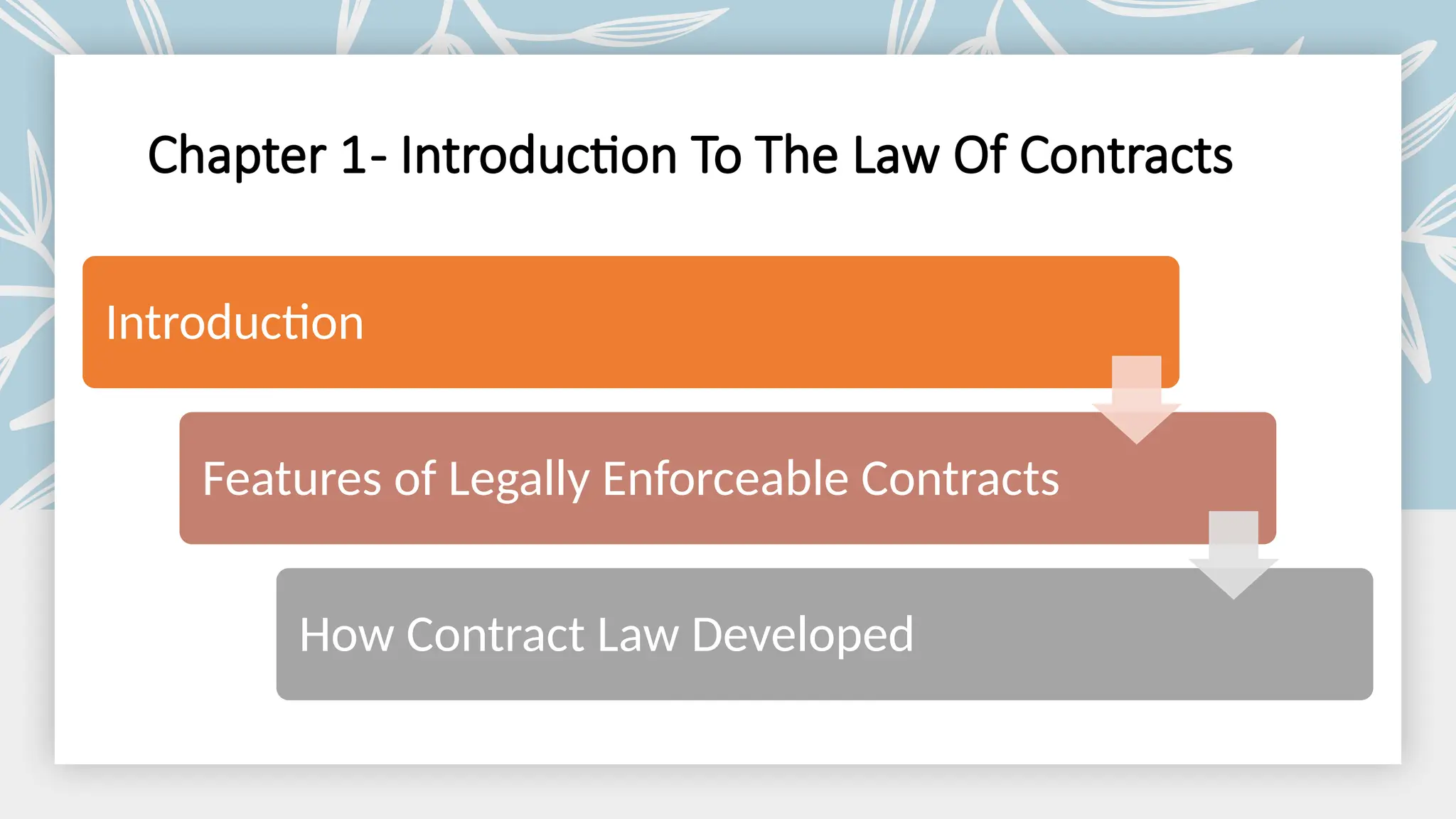
Chapter 1- Introduction To The Law Of Contracts
Introduction
Features of Legally Enforceable Contracts
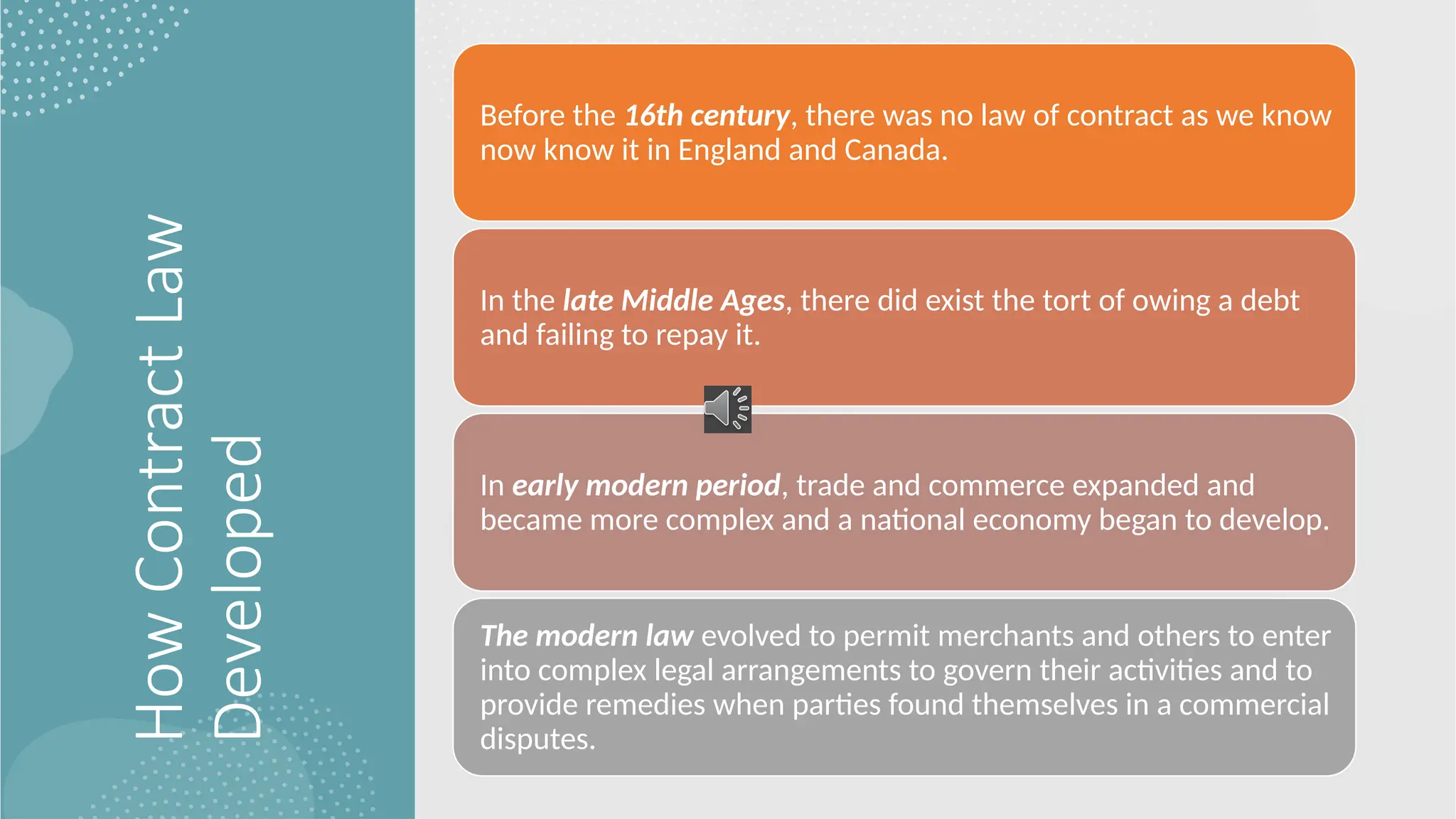
How Contract Law Developed
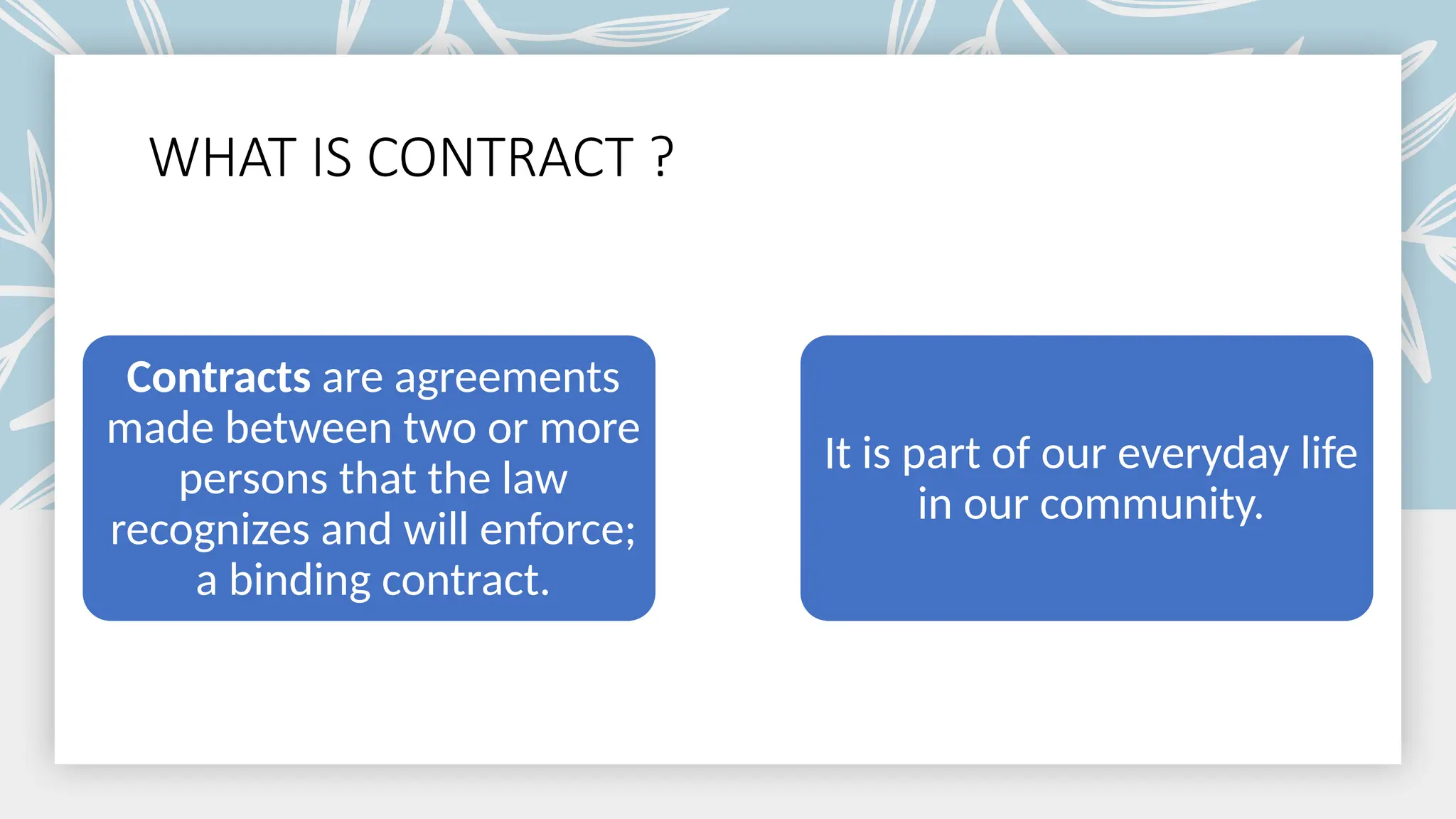
WHAT IS CONTRACT ?
Contracts are agreements
made between two or more
persons that the law
recognizes and will enforce;
a binding contract.
It is part of our everyday life
in our community.
CONTRACT
EXAMPLES
• Contracts are part of our everyday life in
our community.
• For example: buying tea or office, using
credit card to make a purchase, leasing an
apartment or owning a house.
• All involves agreement between you and
someone else. Whether written or oral.
Not all agreements
are recognized by
the law as contract.
If Tom invited Jerry to dinner, and Jerry
agreed to come but then fail to show up,
have Jerry breached the rules of the law?
Discussion question
Features of legally enforceable contracts
Jerry breached the rules of good manners but not the
law.
The law would define Tom & Jerry agreement as a social
agreement rather than as an enforceable contract.
Tom & Jerry agreement is a promise.
The terms contract and
agreement are used
interchangeably to refer to
the same thing: a binding
contract.
SOME BASIC TERMS
• Promisor: The part to a contract who
undertakes to do something
• Promisee: The party to a contract who receives
the benefit of a promise made by another party
to the contract
• Offeror: a person who, during the bargaining
process that precedes making a contract, agrees
to do something for the other party; once the
offer is accepted, the bargain is concluded, and
the parties have made an agreement
• Offeree: a person to whom an offer is made
during the bargaining process.
AGREEMENTS THAT THE LAW
RECOGNIZES AS CONTRACTS HAVE
CERTAIN FEATURES IN COMMON.
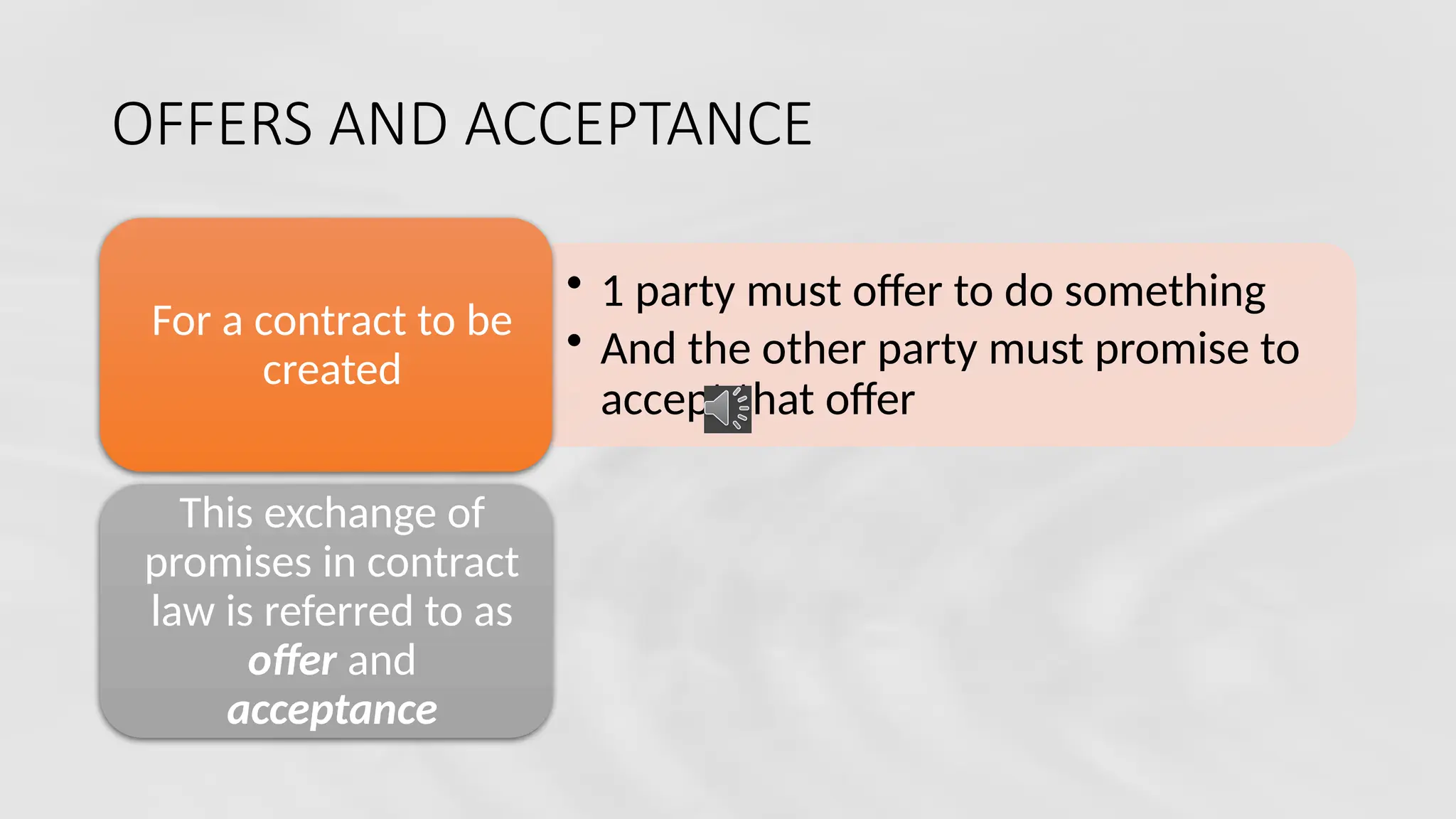
OFFERS AND ACCEPTANCE
• 1 party must offer to do something
• And the other party must promise to
accept that offer
For a contract to be
created
This exchange of
promises in contract
law is referred to as
offer and
acceptance
WHAT IS AN OFFER?
• OFFER is a promise to do something or give something of value to
another person; if the other person accepts the offer a binding
contract exists.
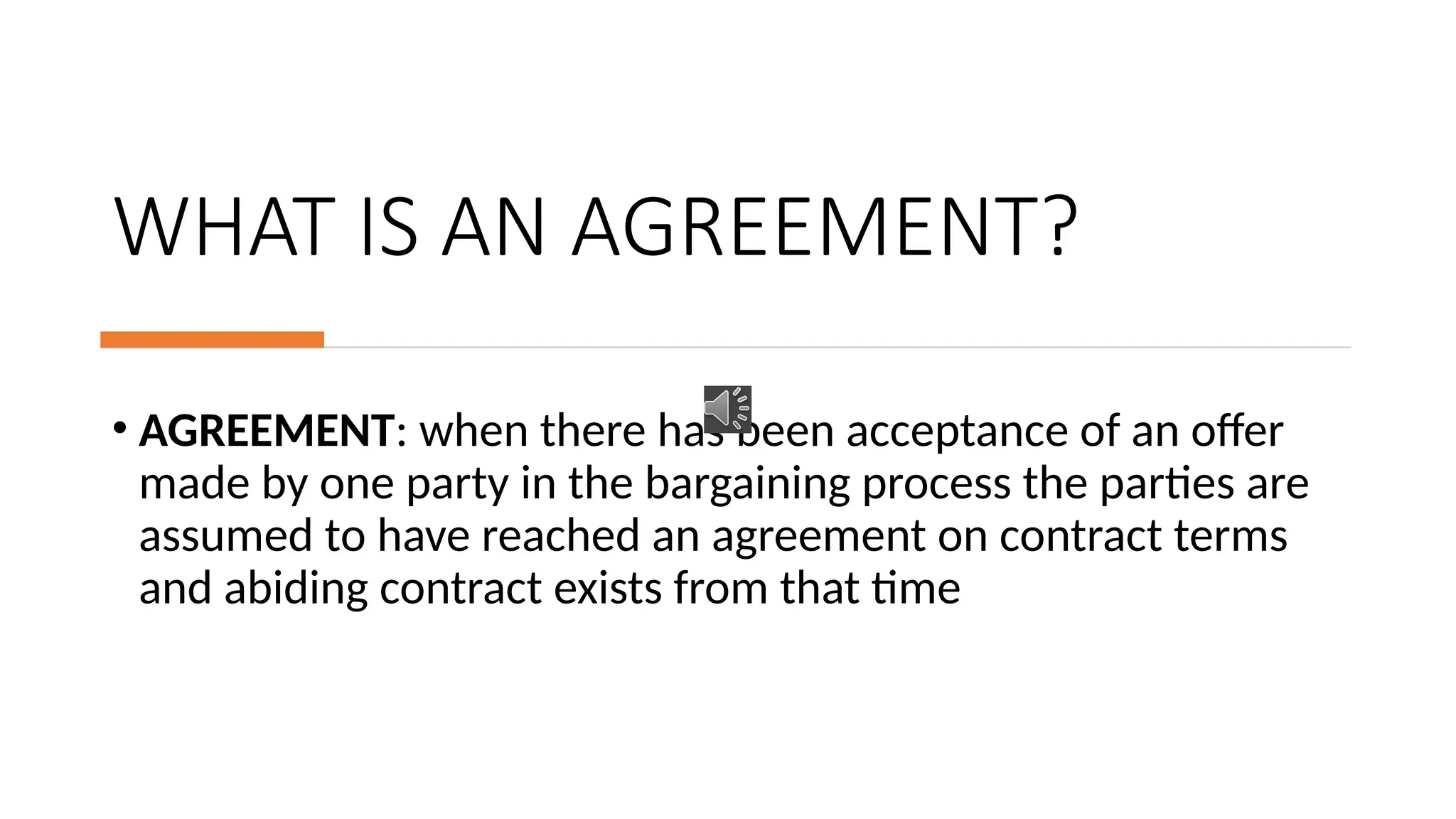
WHAT IS AN AGREEMENT?
• AGREEMENT: when there has been acceptance of an offer
made by one party in the bargaining process the parties are
assumed to have reached an agreement on contract terms
and abiding contract exists from that time
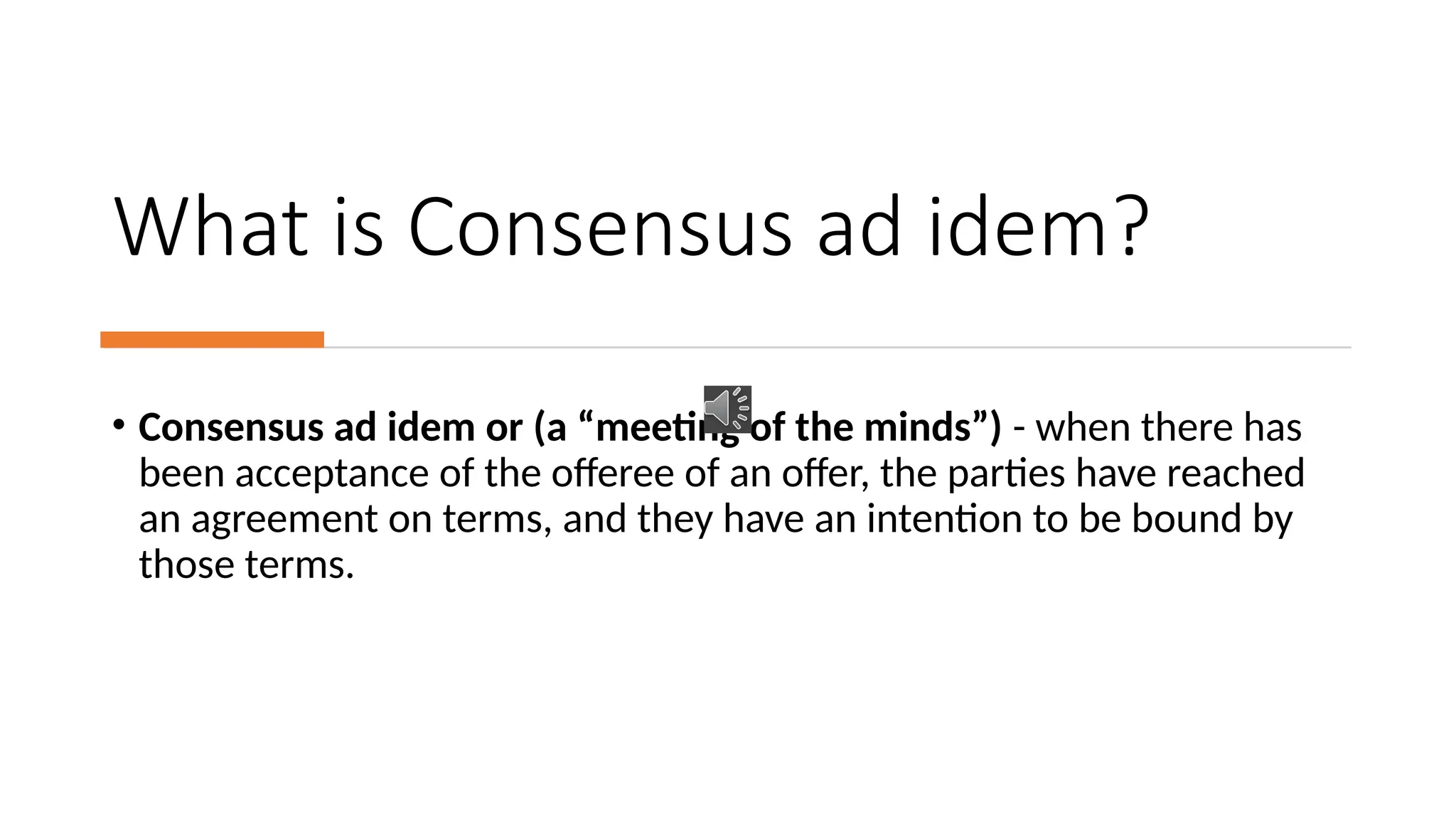
What is Consensus ad idem?
• Consensus ad idem or (a “meeting of the minds”) - when there has
been acceptance of the offeree of an offer, the parties have reached
an agreement on terms, and they have an intention to be bound by
those terms.
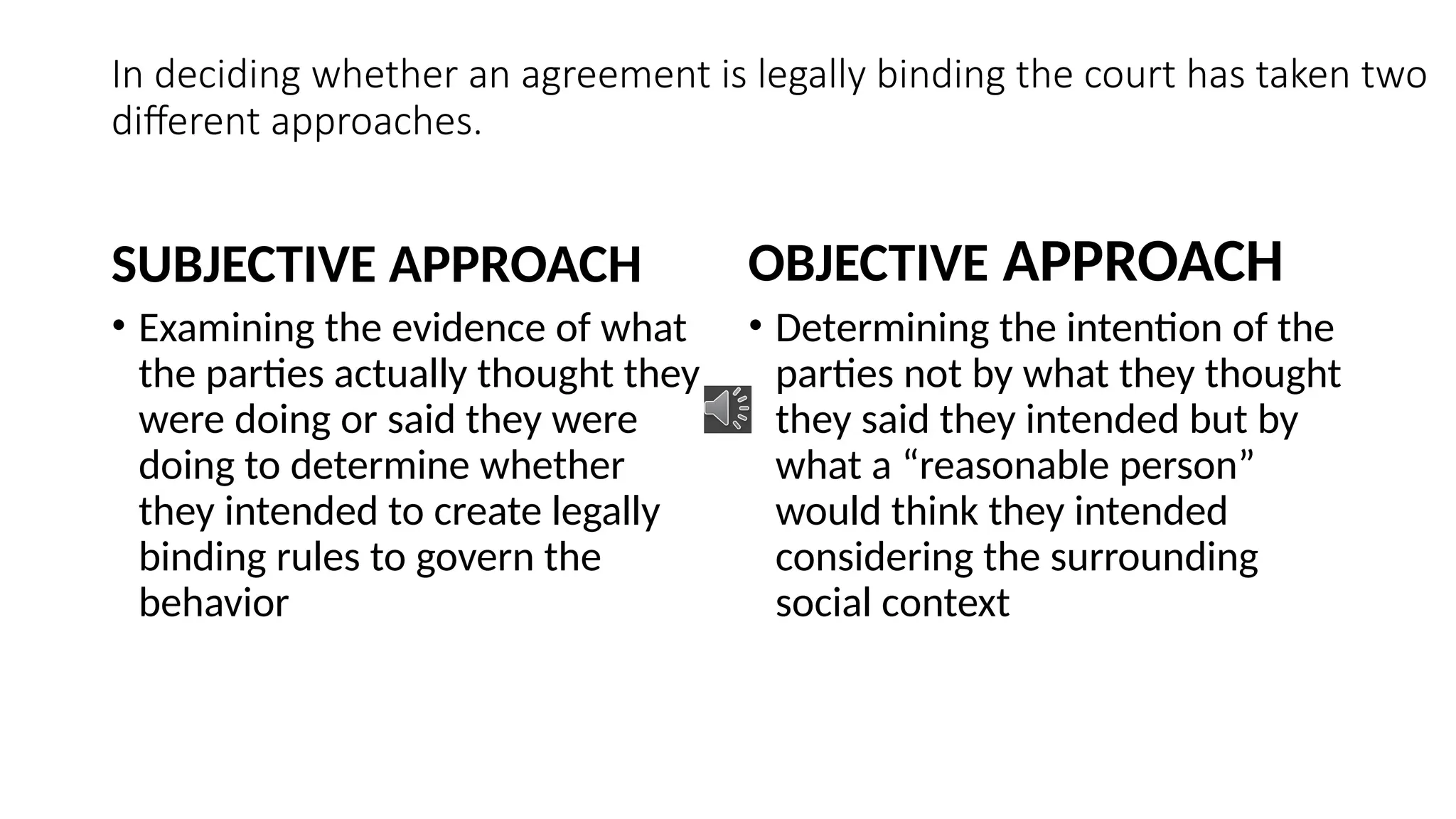
In deciding whether an agreement is legally binding the court has taken two
different approaches.
SUBJECTIVE APPROACH
• Examining the evidence of what
the parties actually thought they
were doing or said they were
doing to determine whether
they intended to create legally
binding rules to govern the
behavior
OBJECTIVE APPROACH
• Determining the intention of the
parties not by what they thought
they said they intended but by
what a “reasonable person”
would think they intended
considering the surrounding
social context
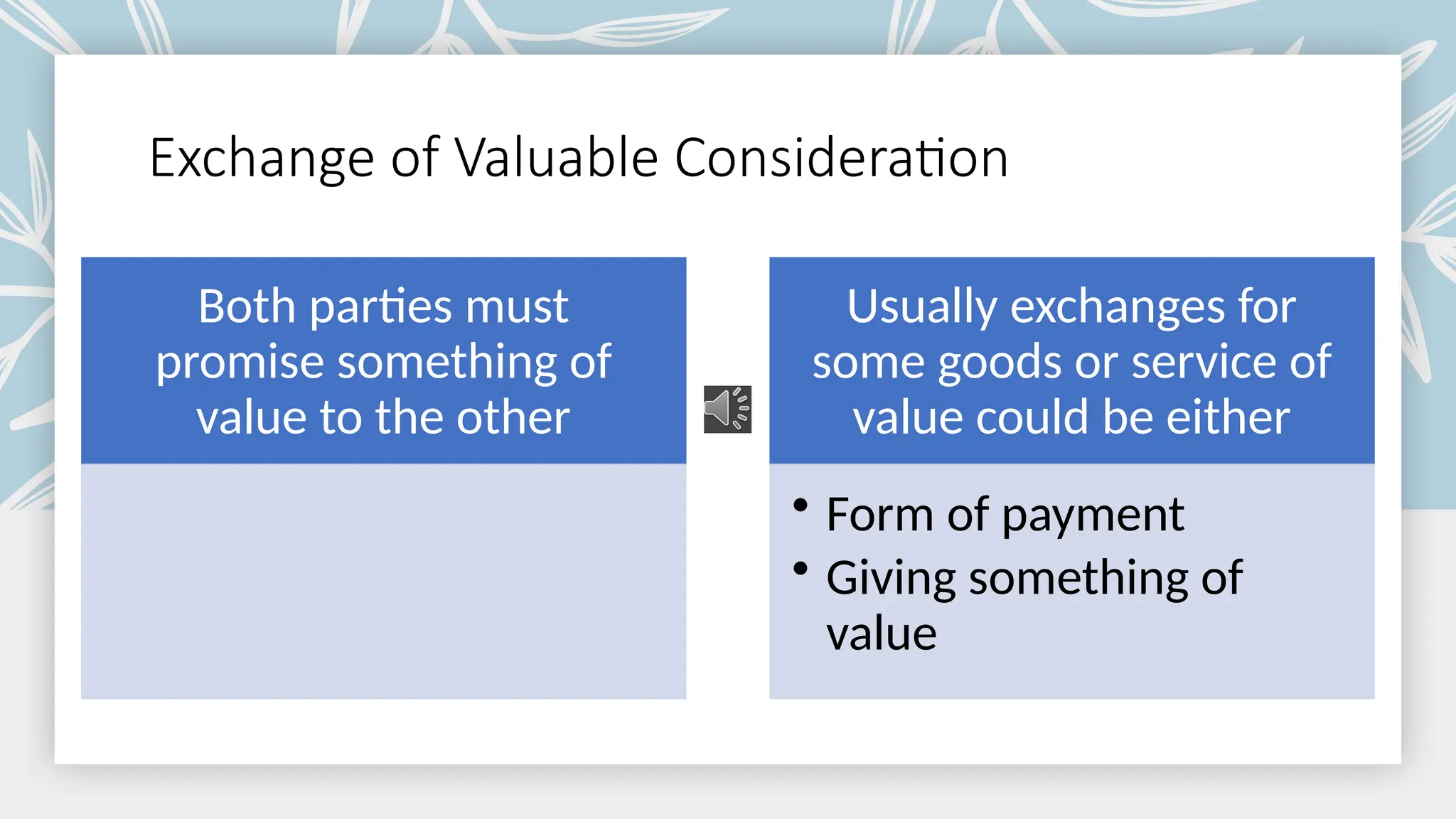
Exchange of Valuable Consideration
Both parties must
promise something of
value to the other
Usually exchanges for
some goods or service of
value could be either
• Form of payment
• Giving something of
value
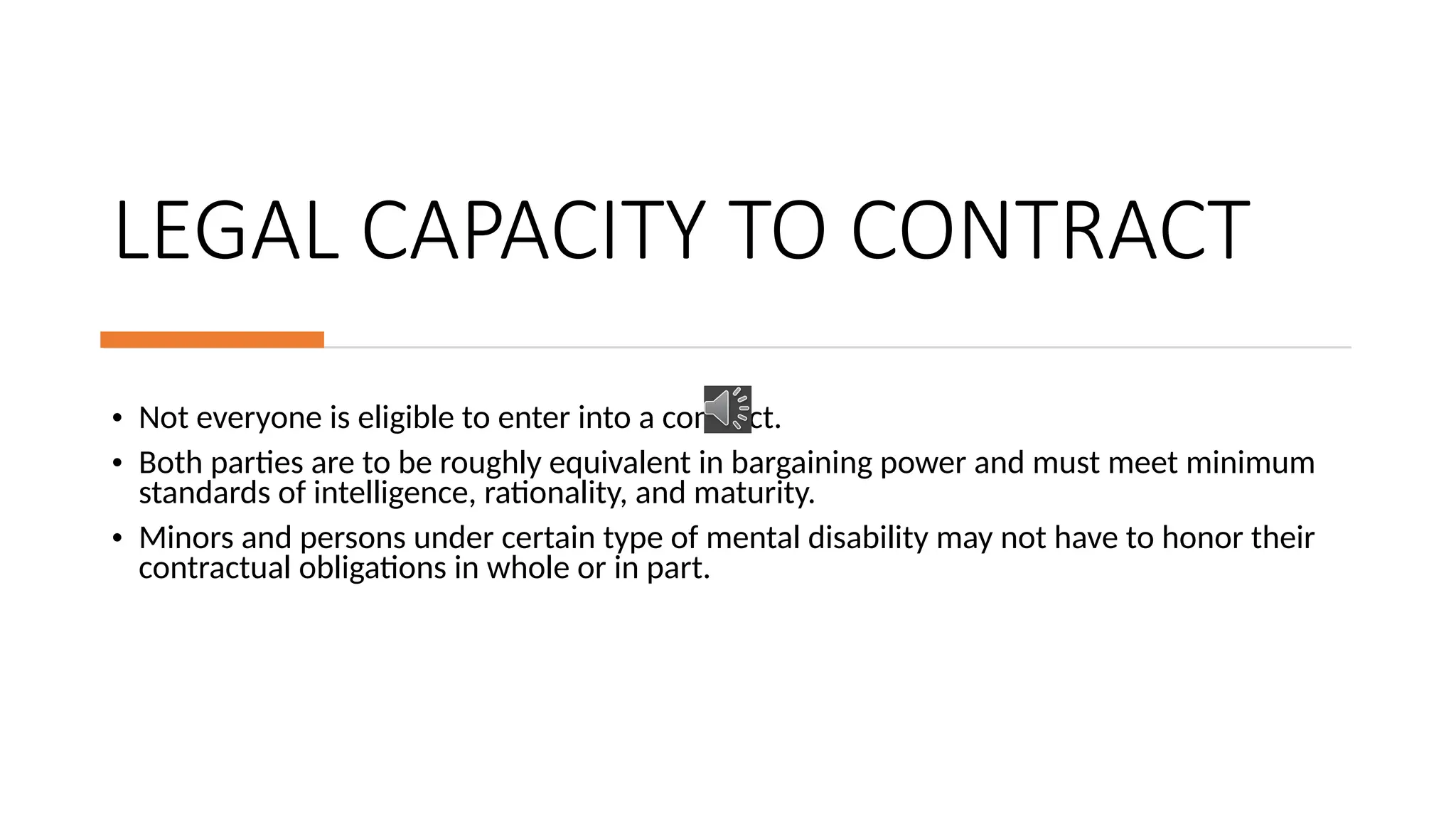
LEGAL CAPACITY TO CONTRACT
• Not everyone is eligible to enter into a contract.
• Both parties are to be roughly equivalent in bargaining power and must meet minimum
standards of intelligence, rationality, and maturity.
• Minors and persons under certain type of mental disability may not have to honor their
contractual obligations in whole or in part.
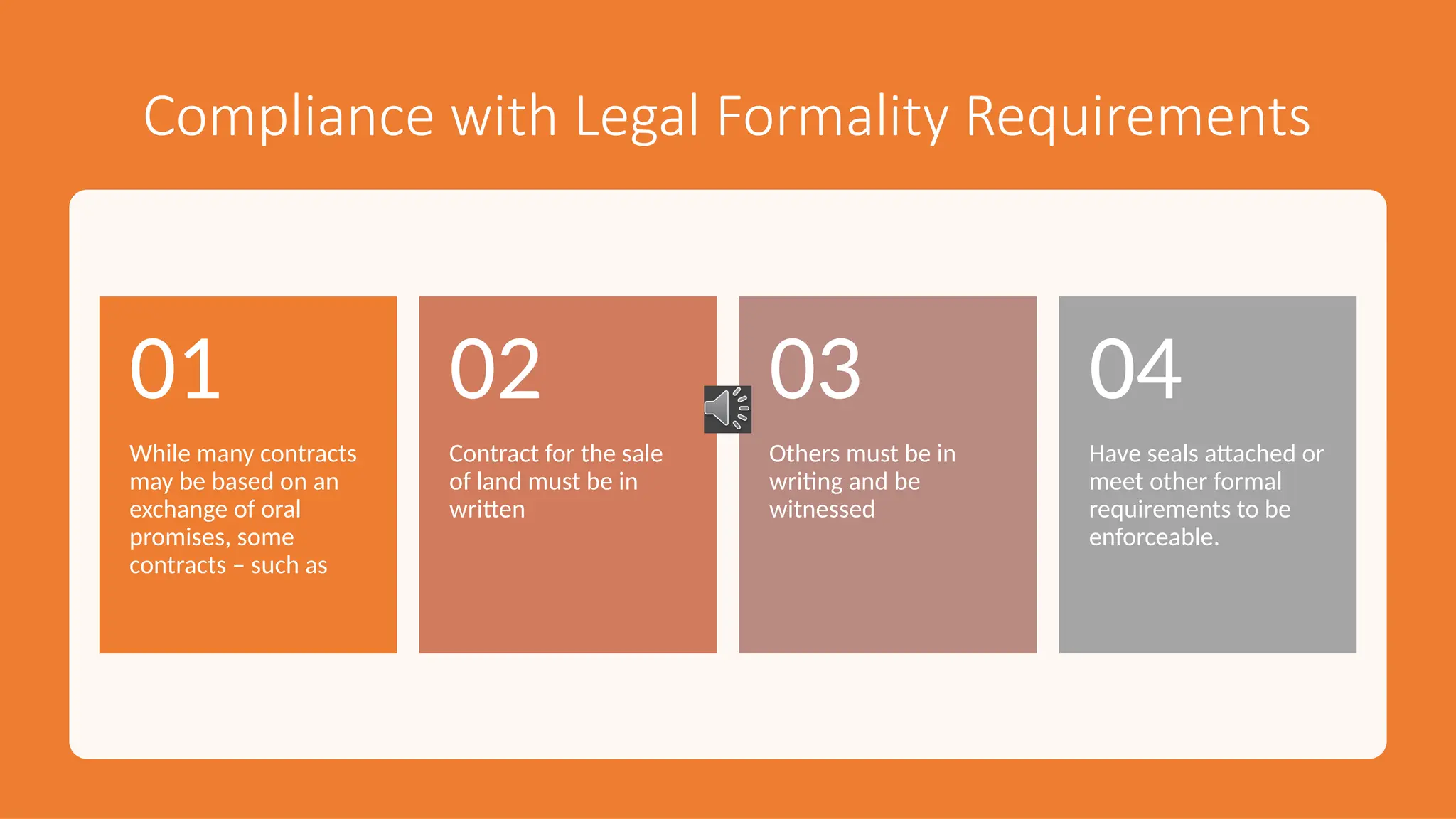
Compliance with Legal Formality Requirements
While many contracts
may be based on an
exchange of oral
promises, some
contracts – such as
01
Contract for the sale
of land must be in
written
02
Others must be in
writing and be
witnessed
03
Have seals attached or
meet other formal
requirements to be
enforceable.
04
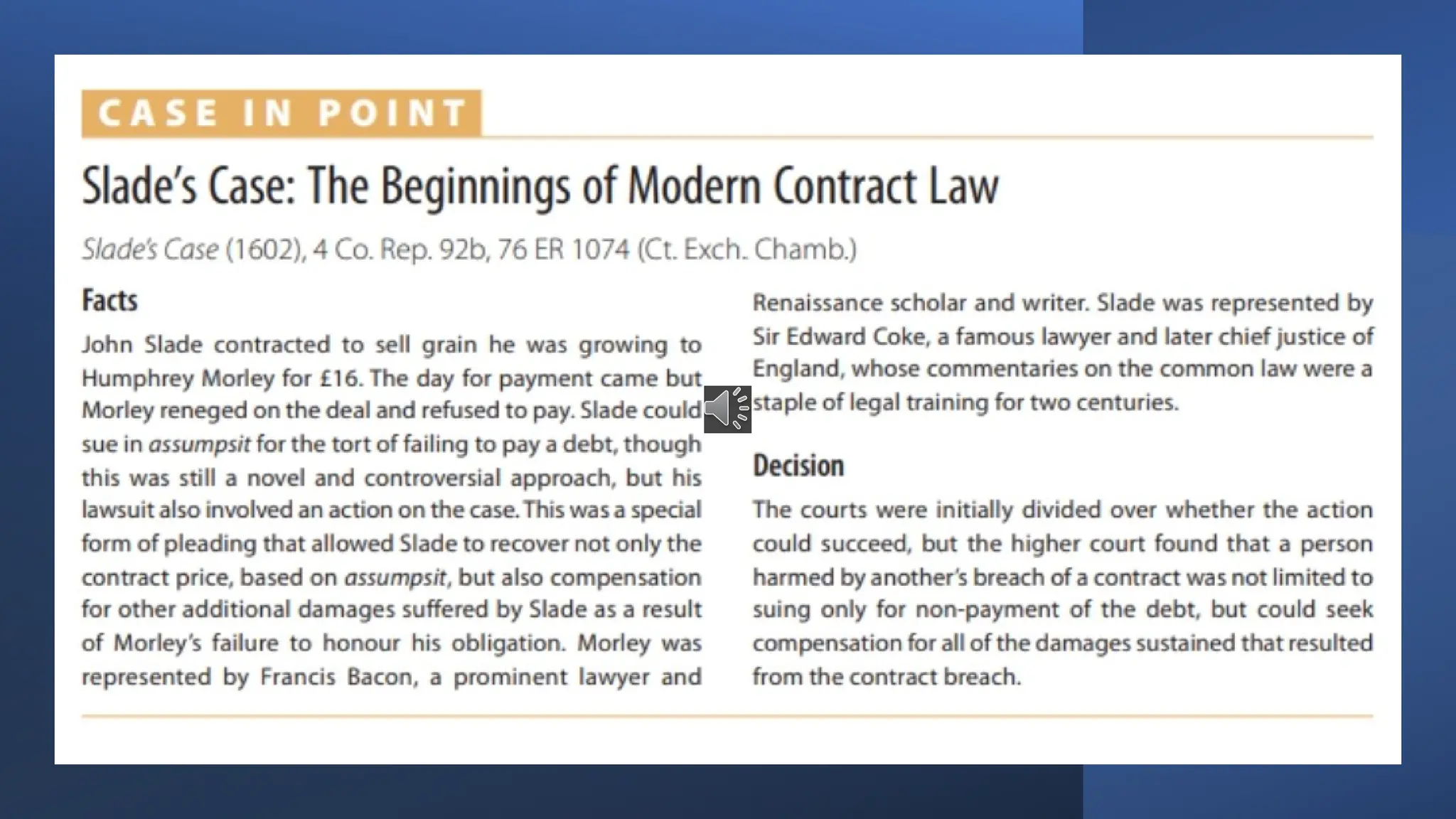
Hamer v Sidway
Break Time
How
Contract
Law
Developed
Before the 16th century, there was no law of contract as we know
now know it in England and Canada.
In the late Middle Ages, there did exist the tort of owing a debt
and failing to repay it.
In early modern period, trade and commerce expanded and
became more complex and a national economy began to develop.
The modern law evolved to permit merchants and others to enter
into complex legal arrangements to govern their activities and to
provide remedies when parties found themselves in a commercial
disputes.
Tort Law and How It's Tied to Our
Culture
CASE LAW & STATUTE
LAW
• Contract law arose from attempt by judges to
solve individual commercial disputes brought
before them on a case to case basis.
• Very little contract law came from statute law.
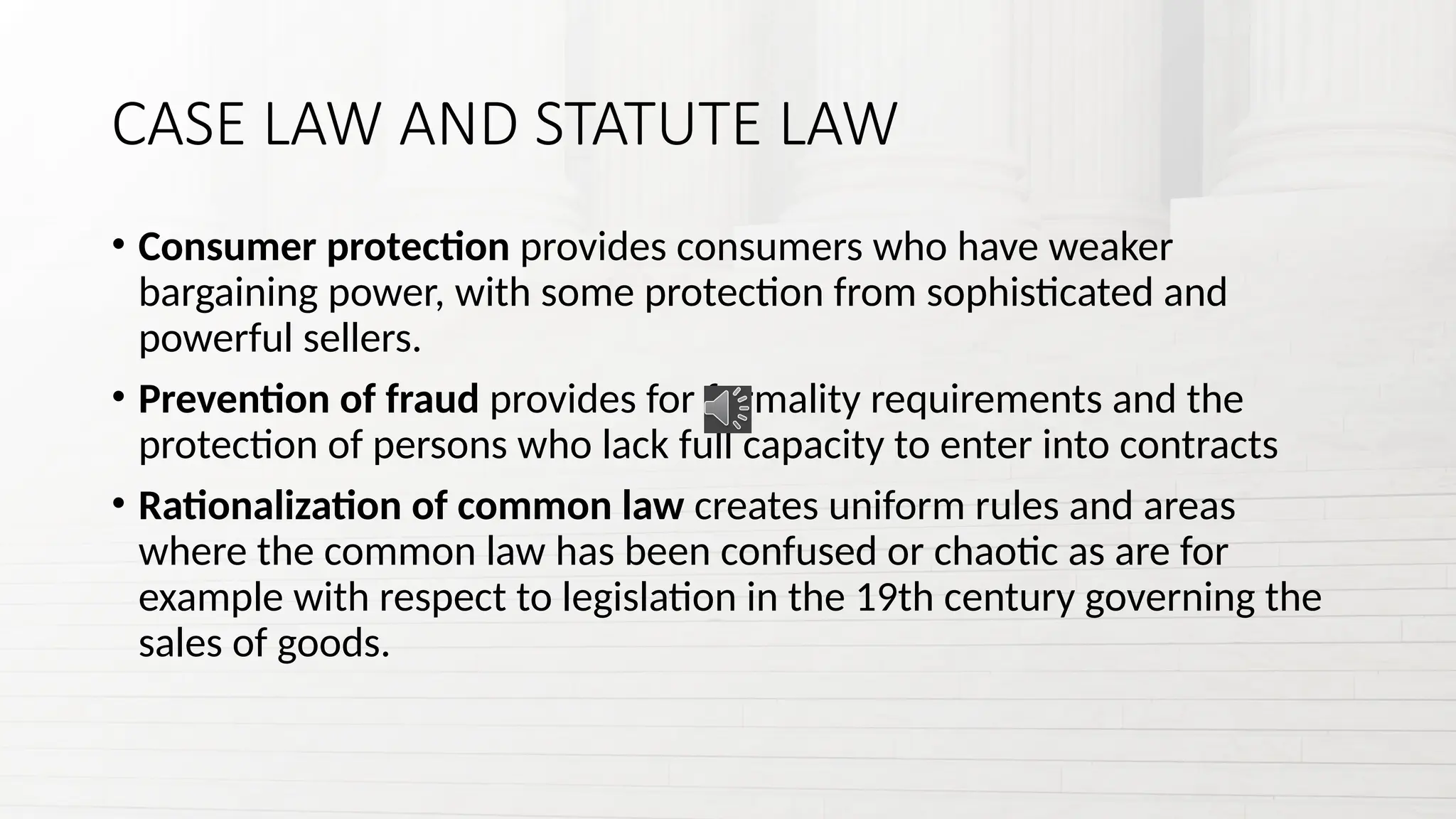
CASE LAW AND STATUTE LAW
• Consumer protection provides consumers who have weaker
bargaining power, with some protection from sophisticated and
powerful sellers.
• Prevention of fraud provides for formality requirements and the
protection of persons who lack full capacity to enter into contracts
• Rationalization of common law creates uniform rules and areas
where the common law has been confused or chaotic as are for
example with respect to legislation in the 19th century governing the
sales of goods.
WHAT IS A PRECEDENT?
• Precedent: is an essential your doctrine of common law that requires
judges to follow the rule in the previously decided case when that
case deals with similar facts or issues to the case currently being
decided.
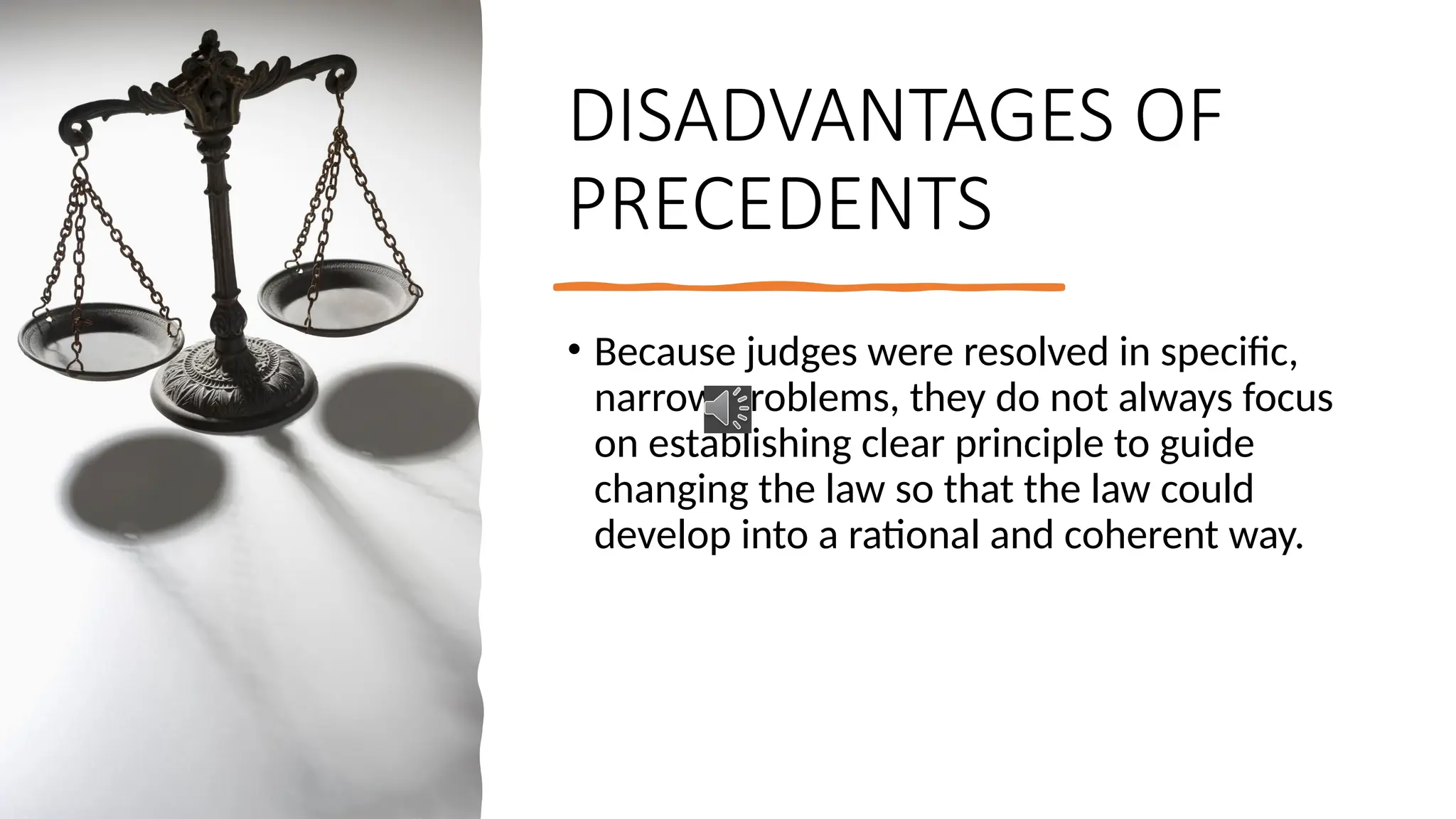
DISADVANTAGES OF
PRECEDENTS
• Because judges were resolved in specific,
narrow problems, they do not always focus
on establishing clear principle to guide
changing the law so that the law could
develop into a rational and coherent way.
Positivism Vs Judicial Interventionism
POSITIVISM
• An approach to the
interpretation of law that states
that the meaning to be given to
the words in legal rules should
be the ordinary, dictionary
meaning without resorting to
social, economics, or political
values to aid in interpretations.
JUDICAL INTERVENTIONISM
• An approach to interpretation of
law that draws on social
economic and political values in
interpreting the meaning and
application of legal rules and
principles.
Modern Positivism:
Hart, Exclusive
Positivism and
Inclusive Positivism
REFERENCE
Olivo, L. M., & Fitzgerald, J. (2013). Fundamentals of Contract Law (3rd ed.).
Emond Montgomery.

chapter1contract-231106195302-7fc91f2ccc

  • 1.
    Welcome to class.We will begin at 4:30 PM
  • 2.
    Sheldon Byron Welcome toFundamentals of Contract Law & Administration Week 1: Fundamentals of Contract Law & Administration CCBST Logistics & Supply Chain Management Instructor
  • 3.
    IMPORTANT DATES ASSSIGNMENTS – November 10(Fri) MIDTERM – November 17 (Fri) FINAL EXAM: NOVEMBER 23 (Thurs)
  • 4.
    INTRODUCTION TO THE LAWOF CONTRACTS CHAPTER 1 |
  • 5.
    A Brief Historyof Administrative Law
  • 6.
    Chapter 1- IntroductionTo The Law Of Contracts Introduction Features of Legally Enforceable Contracts How Contract Law Developed
  • 7.
    WHAT IS CONTRACT? Contracts are agreements made between two or more persons that the law recognizes and will enforce; a binding contract. It is part of our everyday life in our community.
  • 8.
    CONTRACT EXAMPLES • Contracts arepart of our everyday life in our community. • For example: buying tea or office, using credit card to make a purchase, leasing an apartment or owning a house. • All involves agreement between you and someone else. Whether written or oral.
  • 9.
    Not all agreements arerecognized by the law as contract.
  • 10.
    If Tom invitedJerry to dinner, and Jerry agreed to come but then fail to show up, have Jerry breached the rules of the law? Discussion question
  • 11.
    Features of legallyenforceable contracts Jerry breached the rules of good manners but not the law. The law would define Tom & Jerry agreement as a social agreement rather than as an enforceable contract. Tom & Jerry agreement is a promise.
  • 12.
    The terms contractand agreement are used interchangeably to refer to the same thing: a binding contract.
  • 13.
    SOME BASIC TERMS •Promisor: The part to a contract who undertakes to do something • Promisee: The party to a contract who receives the benefit of a promise made by another party to the contract • Offeror: a person who, during the bargaining process that precedes making a contract, agrees to do something for the other party; once the offer is accepted, the bargain is concluded, and the parties have made an agreement • Offeree: a person to whom an offer is made during the bargaining process.
  • 14.
    AGREEMENTS THAT THELAW RECOGNIZES AS CONTRACTS HAVE CERTAIN FEATURES IN COMMON.
  • 15.
    OFFERS AND ACCEPTANCE •1 party must offer to do something • And the other party must promise to accept that offer For a contract to be created This exchange of promises in contract law is referred to as offer and acceptance
  • 16.
    WHAT IS ANOFFER? • OFFER is a promise to do something or give something of value to another person; if the other person accepts the offer a binding contract exists.
  • 17.
    WHAT IS ANAGREEMENT? • AGREEMENT: when there has been acceptance of an offer made by one party in the bargaining process the parties are assumed to have reached an agreement on contract terms and abiding contract exists from that time
  • 18.
    What is Consensusad idem? • Consensus ad idem or (a “meeting of the minds”) - when there has been acceptance of the offeree of an offer, the parties have reached an agreement on terms, and they have an intention to be bound by those terms.
  • 19.
    In deciding whetheran agreement is legally binding the court has taken two different approaches. SUBJECTIVE APPROACH • Examining the evidence of what the parties actually thought they were doing or said they were doing to determine whether they intended to create legally binding rules to govern the behavior OBJECTIVE APPROACH • Determining the intention of the parties not by what they thought they said they intended but by what a “reasonable person” would think they intended considering the surrounding social context
  • 20.
    Exchange of ValuableConsideration Both parties must promise something of value to the other Usually exchanges for some goods or service of value could be either • Form of payment • Giving something of value
  • 22.
    LEGAL CAPACITY TOCONTRACT • Not everyone is eligible to enter into a contract. • Both parties are to be roughly equivalent in bargaining power and must meet minimum standards of intelligence, rationality, and maturity. • Minors and persons under certain type of mental disability may not have to honor their contractual obligations in whole or in part.
  • 23.
    Compliance with LegalFormality Requirements While many contracts may be based on an exchange of oral promises, some contracts – such as 01 Contract for the sale of land must be in written 02 Others must be in writing and be witnessed 03 Have seals attached or meet other formal requirements to be enforceable. 04
  • 24.
  • 25.
  • 26.
    How Contract Law Developed Before the 16thcentury, there was no law of contract as we know now know it in England and Canada. In the late Middle Ages, there did exist the tort of owing a debt and failing to repay it. In early modern period, trade and commerce expanded and became more complex and a national economy began to develop. The modern law evolved to permit merchants and others to enter into complex legal arrangements to govern their activities and to provide remedies when parties found themselves in a commercial disputes.
  • 27.
    Tort Law andHow It's Tied to Our Culture
  • 29.
    CASE LAW &STATUTE LAW • Contract law arose from attempt by judges to solve individual commercial disputes brought before them on a case to case basis. • Very little contract law came from statute law.
  • 30.
    CASE LAW ANDSTATUTE LAW • Consumer protection provides consumers who have weaker bargaining power, with some protection from sophisticated and powerful sellers. • Prevention of fraud provides for formality requirements and the protection of persons who lack full capacity to enter into contracts • Rationalization of common law creates uniform rules and areas where the common law has been confused or chaotic as are for example with respect to legislation in the 19th century governing the sales of goods.
  • 31.
    WHAT IS APRECEDENT? • Precedent: is an essential your doctrine of common law that requires judges to follow the rule in the previously decided case when that case deals with similar facts or issues to the case currently being decided.
  • 32.
    DISADVANTAGES OF PRECEDENTS • Becausejudges were resolved in specific, narrow problems, they do not always focus on establishing clear principle to guide changing the law so that the law could develop into a rational and coherent way.
  • 33.
    Positivism Vs JudicialInterventionism POSITIVISM • An approach to the interpretation of law that states that the meaning to be given to the words in legal rules should be the ordinary, dictionary meaning without resorting to social, economics, or political values to aid in interpretations. JUDICAL INTERVENTIONISM • An approach to interpretation of law that draws on social economic and political values in interpreting the meaning and application of legal rules and principles.
  • 34.
  • 35.
    REFERENCE Olivo, L. M.,& Fitzgerald, J. (2013). Fundamentals of Contract Law (3rd ed.). Emond Montgomery.