Principles of Marketing
by
Philip Kotler
Chapter 1
Marketing: Managing Profitable
Customer Relationship
Marketing
customer.
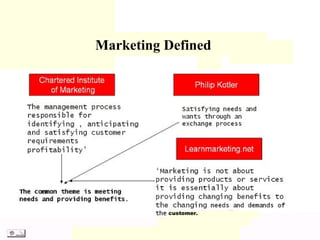
Marketing Defined
What is Marketing?
 Marketing is the process by which companies
create value for customers & build strong
customer relationships in order to capture value
from customers in return.
 Marketing is all about” satisfying customer
needs”
Goal of Marketing:
 To attract new customers by promising
superior value.
 To keep & grow current customers by
delivering satisfaction
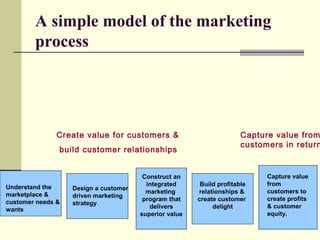
A simple model of the marketing
process
Understand the
marketplace &
customer needs &
wants
Design a customer
driven marketing
strategy
Create value for customers &
build customer relationships
Capture value from
customers in return
Construct an
integrated
marketing
program that
delivers
superior value
Build profitable
relationships &
create customer
delight
Capture value
from
customers to
create profits
& customer
equity.
Core definitions
 Needs: Needs are the basic human requirements
e.g food, water, air, shelter.
 Wants: Are the form human needs take as shaped
by culture and individual responsibility.
 Demands: Human wants that are backed by buying power.
 Market offering: Some combination of products, services,
information, or experiences offered to a market to satisfy a
need or want. Eg, banks, airlines.
 Marketing Myopia: The mistake of paying more
attention to the specific products a company offers
than to the benefits & experiences produced by these
products.
 Exchange: Process of obtaining a desired product
from someone by offering something in return.
 Market: The set of all actual & potential buyers of a
product or service.
 Marketing Management: The art & science
of choosing target markets & building
profitable relationships with them.
 Value Proposition: A company’s value
proposition is the set of benefits or values it
promises to deliver to consumers to satisfy
their needs.
Winning Marketing Strategy
 What customers will we serve?
(what’s our target market)
- Divide the market into customer segments.
- Select which segments will it go after.
 How can we serve these customers best?
(what’s our value proposition)
- Differentiating & positioning the product in minds
of consumers.
Five Organizational Concepts
1. Production Concept
2. Product Concept
3. Selling Concept
4. Marketing Concept
5. Societal Marketing Concept
Production Concept
 The idea that consumers will favor products that
are available & highly affordable & that the
organization should therefore focus on improving
production & distribution efficiency.
Product Concept
 The idea that consumers will favor products that
offer the most quality, performance, & features
thereby devoting a company’s energy to making
continuous product improvements.
 Make & sell concept
 Focus on making superior products
 No customer input
 Less competitor product examination.
 “ Marketing Myopia”
Selling Concept
 The idea that consumers will not buy enough of
the firms products unless it undertakes a large
scale selling & promotion effort.
 Practiced most aggressively with unsought
goods eg, insurance, encyclopedias.
 Focuses on creating sales-transactions rather
than long term profitable relationships.
 “Political Relationships”
Marketing Concept
 The marketing management philosophy that
achieving organizational goals depends on
knowing the needs & wants of target markets
& delivering the desired satisfactions better
than competitors.
 Sense & respond philosophy.
 Finding right products for customers
 Customer-driving marketing – understanding
customer needs even better than the customers
themselves.
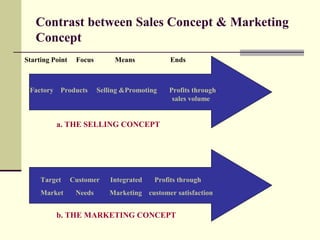
Contrast between Sales Concept & Marketing
Concept
Factory Products Selling &Promoting Profits through
sales volume
a. THE SELLING CONCEPT
b. THE MARKETING CONCEPT
Target Customer Integrated Profits through
Market Needs Marketing customer satisfaction
Starting Point Focus Means Ends
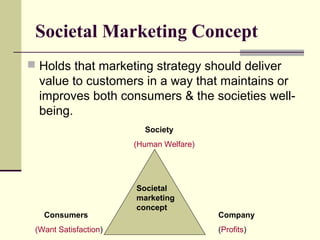
Societal Marketing Concept
 Holds that marketing strategy should deliver
value to customers in a way that maintains or
improves both consumers & the societies well-
being.
Societal
marketing
concept
Society
(Human Welfare)
Consumers
(Want Satisfaction)
Company
(Profits)
Customer Relationship
Management
 CRM is the process of building & maintaining
profitable customer relationships by delivering
superior customer value & satisfaction.
 Customer Perceived Value: The customers
evaluation of the difference between all the
benefits & all the costs of a market offering
relative to those of competing products.
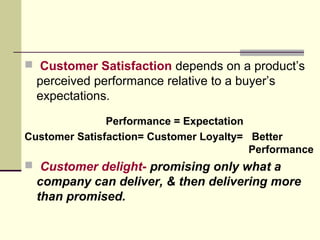
 Customer Satisfaction depends on a product’s
perceived performance relative to a buyer’s
expectations.
Performance = Expectation
Customer Satisfaction= Customer Loyalty= Better
Performance
 Customer delight- promising only what a
company can deliver, & then delivering more
than promised.
Changing Nature of Customer
Relationships
 Relating with More Carefully selected Customers:
- Selective Relationship Management
Weeding out losing customers &
targeting & pampering winning ones
 Relating for the Long term:
Using CRM to retain current customers & building
profitable long-term relationships with them.
 Relating Directly: Using direct marketing tools such
as telephone, mail order catalogs & kiosks. Eg Dell &
Amazon.
Creating Customer Loyalty &
Retention
“ losing customers does not mean losing a single
sale but in fact losing the entire stream of
purchases that the customer would make over a
lifetime”.
 Customer lifetime value: The value of the
entire stream of purchases that a customer
would make over a lifetime of patronage.
Customer Equity
 Companies should not just acquire customers, but keep &
grow them as well.
 The ultimate aim of customer relationship management is
to produce high customer equity.
 Customer Equity is the combined discounted customer
lifetime values of all the company’s current & potential
customers.
 It is a better measure of a firms performance than current
sales or market share.
More Loyal firm’s = Higher firm’s
Profitable customers Customer Equity
Building Right relationships with
Right customers
Which customers should the company
acquire & retain?
 The company can classify customers according
to their potential profitability & projected
loyalty manage its relationships with them
accordingly.
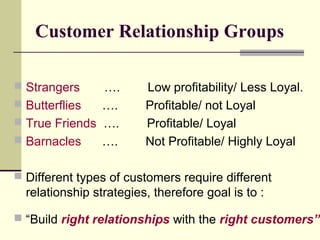
Customer Relationship Groups
 Strangers …. Low profitability/ Less Loyal.
 Butterflies …. Profitable/ not Loyal
 True Friends …. Profitable/ Loyal
 Barnacles …. Not Profitable/ Highly Loyal
 Different types of customers require different
relationship strategies, therefore goal is to :
 “Build right relationships with the right customers”
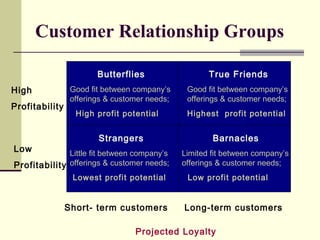
Customer Relationship Groups
Butterflies
Good fit between company’s
offerings & customer needs;
High profit potential
True Friends
Good fit between company’s
offerings & customer needs;
Highest profit potential
Strangers
Little fit between company’s
offerings & customer needs;
Lowest profit potential
Barnacles
Limited fit between company’s
offerings & customer needs;
Low profit potential
High
Profitability
Low
Profitability
Short- term customers Long-term customers
Projected Loyalty

philipkotler

  • 1.
  • 2.
    Chapter 1 Marketing: ManagingProfitable Customer Relationship
  • 3.
  • 4.
    What is Marketing? Marketing is the process by which companies create value for customers & build strong customer relationships in order to capture value from customers in return.  Marketing is all about” satisfying customer needs”
  • 5.
    Goal of Marketing: To attract new customers by promising superior value.  To keep & grow current customers by delivering satisfaction
  • 6.
    A simple modelof the marketing process Understand the marketplace & customer needs & wants Design a customer driven marketing strategy Create value for customers & build customer relationships Capture value from customers in return Construct an integrated marketing program that delivers superior value Build profitable relationships & create customer delight Capture value from customers to create profits & customer equity.
  • 7.
    Core definitions  Needs:Needs are the basic human requirements e.g food, water, air, shelter.  Wants: Are the form human needs take as shaped by culture and individual responsibility.  Demands: Human wants that are backed by buying power.  Market offering: Some combination of products, services, information, or experiences offered to a market to satisfy a need or want. Eg, banks, airlines.
  • 8.
     Marketing Myopia:The mistake of paying more attention to the specific products a company offers than to the benefits & experiences produced by these products.  Exchange: Process of obtaining a desired product from someone by offering something in return.  Market: The set of all actual & potential buyers of a product or service.
  • 9.
     Marketing Management:The art & science of choosing target markets & building profitable relationships with them.  Value Proposition: A company’s value proposition is the set of benefits or values it promises to deliver to consumers to satisfy their needs.
  • 10.
    Winning Marketing Strategy What customers will we serve? (what’s our target market) - Divide the market into customer segments. - Select which segments will it go after.  How can we serve these customers best? (what’s our value proposition) - Differentiating & positioning the product in minds of consumers.
  • 11.
    Five Organizational Concepts 1.Production Concept 2. Product Concept 3. Selling Concept 4. Marketing Concept 5. Societal Marketing Concept
  • 12.
    Production Concept  Theidea that consumers will favor products that are available & highly affordable & that the organization should therefore focus on improving production & distribution efficiency.
  • 13.
    Product Concept  Theidea that consumers will favor products that offer the most quality, performance, & features thereby devoting a company’s energy to making continuous product improvements.  Make & sell concept  Focus on making superior products  No customer input  Less competitor product examination.  “ Marketing Myopia”
  • 14.
    Selling Concept  Theidea that consumers will not buy enough of the firms products unless it undertakes a large scale selling & promotion effort.  Practiced most aggressively with unsought goods eg, insurance, encyclopedias.  Focuses on creating sales-transactions rather than long term profitable relationships.  “Political Relationships”
  • 15.
    Marketing Concept  Themarketing management philosophy that achieving organizational goals depends on knowing the needs & wants of target markets & delivering the desired satisfactions better than competitors.  Sense & respond philosophy.  Finding right products for customers  Customer-driving marketing – understanding customer needs even better than the customers themselves.
  • 16.
    Contrast between SalesConcept & Marketing Concept Factory Products Selling &Promoting Profits through sales volume a. THE SELLING CONCEPT b. THE MARKETING CONCEPT Target Customer Integrated Profits through Market Needs Marketing customer satisfaction Starting Point Focus Means Ends
  • 17.
    Societal Marketing Concept Holds that marketing strategy should deliver value to customers in a way that maintains or improves both consumers & the societies well- being. Societal marketing concept Society (Human Welfare) Consumers (Want Satisfaction) Company (Profits)
  • 18.
    Customer Relationship Management  CRMis the process of building & maintaining profitable customer relationships by delivering superior customer value & satisfaction.  Customer Perceived Value: The customers evaluation of the difference between all the benefits & all the costs of a market offering relative to those of competing products.
  • 19.
     Customer Satisfactiondepends on a product’s perceived performance relative to a buyer’s expectations. Performance = Expectation Customer Satisfaction= Customer Loyalty= Better Performance  Customer delight- promising only what a company can deliver, & then delivering more than promised.
  • 20.
    Changing Nature ofCustomer Relationships  Relating with More Carefully selected Customers: - Selective Relationship Management Weeding out losing customers & targeting & pampering winning ones  Relating for the Long term: Using CRM to retain current customers & building profitable long-term relationships with them.  Relating Directly: Using direct marketing tools such as telephone, mail order catalogs & kiosks. Eg Dell & Amazon.
  • 21.
    Creating Customer Loyalty& Retention “ losing customers does not mean losing a single sale but in fact losing the entire stream of purchases that the customer would make over a lifetime”.  Customer lifetime value: The value of the entire stream of purchases that a customer would make over a lifetime of patronage.
  • 22.
    Customer Equity  Companiesshould not just acquire customers, but keep & grow them as well.  The ultimate aim of customer relationship management is to produce high customer equity.  Customer Equity is the combined discounted customer lifetime values of all the company’s current & potential customers.  It is a better measure of a firms performance than current sales or market share. More Loyal firm’s = Higher firm’s Profitable customers Customer Equity
  • 23.
    Building Right relationshipswith Right customers Which customers should the company acquire & retain?  The company can classify customers according to their potential profitability & projected loyalty manage its relationships with them accordingly.
  • 24.
    Customer Relationship Groups Strangers …. Low profitability/ Less Loyal.  Butterflies …. Profitable/ not Loyal  True Friends …. Profitable/ Loyal  Barnacles …. Not Profitable/ Highly Loyal  Different types of customers require different relationship strategies, therefore goal is to :  “Build right relationships with the right customers”
  • 25.
    Customer Relationship Groups Butterflies Goodfit between company’s offerings & customer needs; High profit potential True Friends Good fit between company’s offerings & customer needs; Highest profit potential Strangers Little fit between company’s offerings & customer needs; Lowest profit potential Barnacles Limited fit between company’s offerings & customer needs; Low profit potential High Profitability Low Profitability Short- term customers Long-term customers Projected Loyalty

Editor's Notes

  • #4 Marketing is the act of connecting customers to products & services