
Customer Development:  Kool-Aid, Case Studies and a Book Patrick Vlaskovits  @vlaskovits, CustDev.com Los Angeles Lean Startup Circle Meetup at Coloft in Santa Monica May 18, 2010 Hashtags:  #LeanStartup #CustDev #LeanLA
A Few of the (many) Insights from  The Four Steps to the Epiphany  and Steve Blank Most startups don’t fail because they haven’t developed a product – they fail because they haven’t developed customers/markets. A startup’s goal is to find a repeatable and scalable business model.  Full stop.  Customer Development is the process of founders “getting out of the building” and searching for that model. It is designed so that the founder gathers first hand experience about customer and market needs.
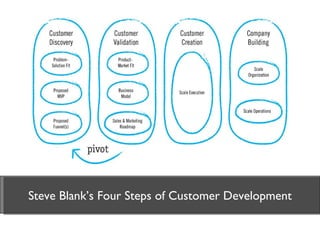
Steve Blank’s Four Steps of Customer Development
Customer Development = “Nor Cal Kool-Aid”?
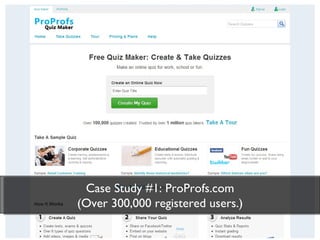
Case Study #1: ProProfs.com (Over 300,000 registered users.)
“ Paper is the enemy.”  ProProfs online quizzes replace paper quizzes.
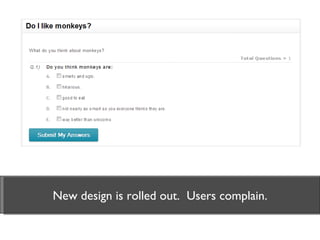
New design is rolled out.  Users complain.
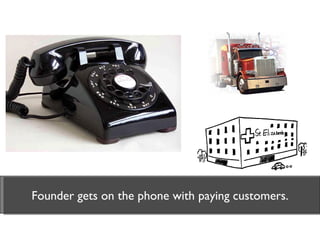
Founder gets on the phone with paying customers.
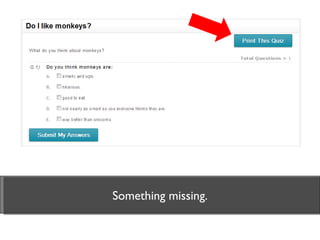
Something missing.
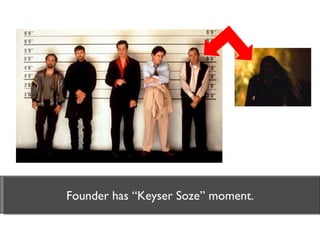
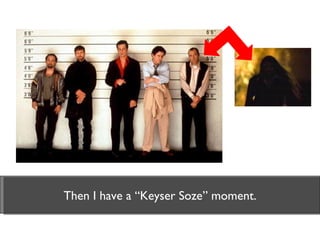
Founder has “Keyser Soze” moment.
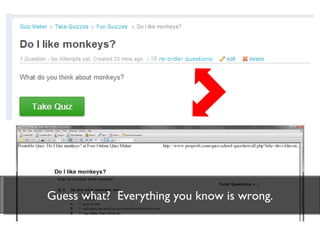
Guess what?  Everything you know is wrong.
Results?! Value proposition and use cases for  paying customers  are revealed.  Changed features, positioning/marketing, pricing and copy.
Case Study #2 My startup:  event-specific business/social networking web app.  (Conferences, conventions, and trade-shows) Value prop:  Event attendees can find each other  before, during and after  an event.
Assumed Pain(s) Event Organizer Attendance and sponsorship is down for foreseeable future. Event Attendees Want to know who will be attending and not rely on chance to meet relevant attendees.
Assumed Benefits/Solutions Event Organizer Provide more value/reason to attend or sponsor event.  Unlock value within event.  Charge more for event and increase sponsorships.  Event Attendees Give them reason to attend.  See who is attending and get in contact with them.
Validation & Testing (before coding) Is there a problem?  If so, is our app the solution? Will people pay us for this? If so, how much? Who are these people, anyway?  And how do we sell to them? My original (anonymous) case study on LSC can be found here:  http://bit.ly/CustDevCaseStudy
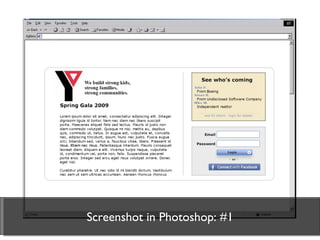
Screenshot in Photoshop: #1
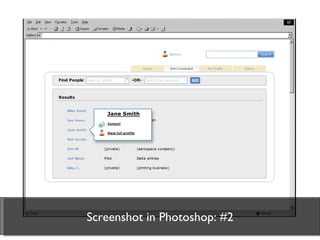
Screenshot in Photoshop: #2
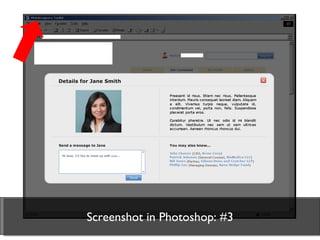
Screenshot in Photoshop: #3
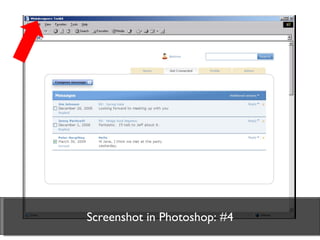
Screenshot in Photoshop: #4
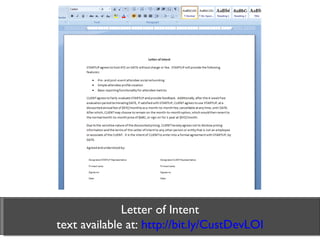
Letter of Intent text available at:  http://bit.ly/CustDevLOI
Discovery and Learning Pricing and price discovery. Intention discovery.  Do they actually want to buy our product? Terms.  Can we sign them up for 18 months?  24 months?  3 months?  Month-to-month?  Per usage?
And we’re off…. Had 2 signed LOIs in hand before coding started. Building something that people will use and intend to pay for. Sales cycle underway.  Found some early adopters. Learning about positioning/marketing and channels.  (e.g. “web app” means nothing to our target clients.)
I continue drinking the “Nor Cal Kool-Aid”.
Then I have a “Keyser Soze” moment.
Out of a CustDev conversation: “ I love the idea, but you are missing one big thing.  We don’t care about event attendees, we care about sponsors.  Make that product and name your price.” -Event Organizer
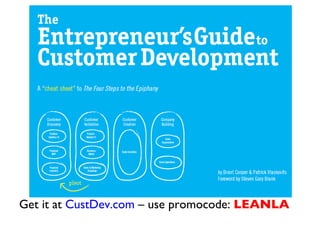
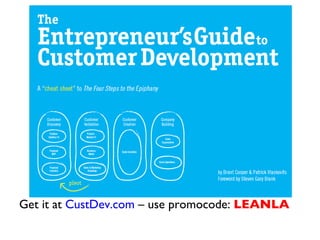
Get it at  CustDev.com  – use promocode:  LEANLA
Blogs you should be reading Steve Blank SteveBlank.com Eric Ries StartupLessonsLearned.com Sean Ellis Startup-Marketing.com Dave McClure 500hats.typepad.com VentureHacks VentureHacks.com Brant Cooper  MarketByNumbers.com Mine? Vlaskovits.com (Not a blog, but very useful): Rich Collins Lean Startup Circle on Google Groups
How to get a hold of me Email:  [email_address] Twitter:  @vlaskovits Blog at  vlaskovits.com
Get it at  CustDev.com  – use promocode:  LEANLA
Key Concepts Get out of the building Engage customers not for “feature mongering,” but to test if particular segment has pain and will pay for resolution MVP (Minimum Viable Product) Build minimum functionality that resolves problem to degree such that customer will pay Product-Market Fit 40-50% of customers would be “very disappointed” if product no longer available Learn before burn – achieve P-M fit before scaling
Key Concepts (cont) Sales and Marketing Roadmap Identifying, testing, prioritizing, measuring, and optimizing customer segment acquisition and conversion funnels Market Type How you scale depends on your market position Existing markets (fighting incumbents directly) & New markets (brand new product  type ) requires Millions in marketing spend Re-segmented markets (low cost or niche functionality) require less money, but careful positioning Pivot Disciplined change to business model based on market facts
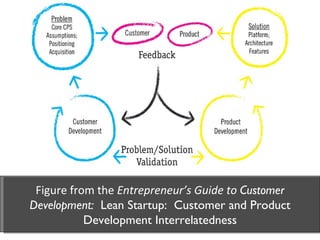
Figure from the  Entrepreneur’s Guide to  Customer Development:  Lean Startup:  Customer and Product Development Interrelatedness

Customer Development and Keyser Soze

  • 1.
    Customer Development: Kool-Aid, Case Studies and a Book Patrick Vlaskovits @vlaskovits, CustDev.com Los Angeles Lean Startup Circle Meetup at Coloft in Santa Monica May 18, 2010 Hashtags: #LeanStartup #CustDev #LeanLA
  • 2.
    A Few ofthe (many) Insights from The Four Steps to the Epiphany and Steve Blank Most startups don’t fail because they haven’t developed a product – they fail because they haven’t developed customers/markets. A startup’s goal is to find a repeatable and scalable business model. Full stop. Customer Development is the process of founders “getting out of the building” and searching for that model. It is designed so that the founder gathers first hand experience about customer and market needs.
  • 3.
    Steve Blank’s FourSteps of Customer Development
  • 4.
    Customer Development =“Nor Cal Kool-Aid”?
  • 5.
    Case Study #1:ProProfs.com (Over 300,000 registered users.)
  • 6.
    “ Paper isthe enemy.” ProProfs online quizzes replace paper quizzes.
  • 7.
    New design isrolled out. Users complain.
  • 8.
    Founder gets onthe phone with paying customers.
  • 9.
  • 10.
    Founder has “KeyserSoze” moment.
  • 11.
    Guess what? Everything you know is wrong.
  • 12.
    Results?! Value propositionand use cases for paying customers are revealed. Changed features, positioning/marketing, pricing and copy.
  • 13.
    Case Study #2My startup: event-specific business/social networking web app. (Conferences, conventions, and trade-shows) Value prop: Event attendees can find each other before, during and after an event.
  • 14.
    Assumed Pain(s) EventOrganizer Attendance and sponsorship is down for foreseeable future. Event Attendees Want to know who will be attending and not rely on chance to meet relevant attendees.
  • 15.
    Assumed Benefits/Solutions EventOrganizer Provide more value/reason to attend or sponsor event. Unlock value within event. Charge more for event and increase sponsorships. Event Attendees Give them reason to attend. See who is attending and get in contact with them.
  • 16.
    Validation & Testing(before coding) Is there a problem? If so, is our app the solution? Will people pay us for this? If so, how much? Who are these people, anyway? And how do we sell to them? My original (anonymous) case study on LSC can be found here: http://bit.ly/CustDevCaseStudy
  • 17.
  • 18.
  • 19.
  • 20.
  • 21.
    Letter of Intenttext available at: http://bit.ly/CustDevLOI
  • 22.
    Discovery and LearningPricing and price discovery. Intention discovery.  Do they actually want to buy our product? Terms.  Can we sign them up for 18 months?  24 months?  3 months?  Month-to-month?  Per usage?
  • 23.
    And we’re off….Had 2 signed LOIs in hand before coding started. Building something that people will use and intend to pay for. Sales cycle underway. Found some early adopters. Learning about positioning/marketing and channels. (e.g. “web app” means nothing to our target clients.)
  • 24.
    I continue drinkingthe “Nor Cal Kool-Aid”.
  • 25.
    Then I havea “Keyser Soze” moment.
  • 26.
    Out of aCustDev conversation: “ I love the idea, but you are missing one big thing. We don’t care about event attendees, we care about sponsors. Make that product and name your price.” -Event Organizer
  • 27.
    Get it at CustDev.com – use promocode: LEANLA
  • 28.
    Blogs you shouldbe reading Steve Blank SteveBlank.com Eric Ries StartupLessonsLearned.com Sean Ellis Startup-Marketing.com Dave McClure 500hats.typepad.com VentureHacks VentureHacks.com Brant Cooper MarketByNumbers.com Mine? Vlaskovits.com (Not a blog, but very useful): Rich Collins Lean Startup Circle on Google Groups
  • 29.
    How to geta hold of me Email: [email_address] Twitter: @vlaskovits Blog at vlaskovits.com
  • 30.
    Get it at CustDev.com – use promocode: LEANLA
  • 31.
    Key Concepts Getout of the building Engage customers not for “feature mongering,” but to test if particular segment has pain and will pay for resolution MVP (Minimum Viable Product) Build minimum functionality that resolves problem to degree such that customer will pay Product-Market Fit 40-50% of customers would be “very disappointed” if product no longer available Learn before burn – achieve P-M fit before scaling
  • 32.
    Key Concepts (cont)Sales and Marketing Roadmap Identifying, testing, prioritizing, measuring, and optimizing customer segment acquisition and conversion funnels Market Type How you scale depends on your market position Existing markets (fighting incumbents directly) & New markets (brand new product type ) requires Millions in marketing spend Re-segmented markets (low cost or niche functionality) require less money, but careful positioning Pivot Disciplined change to business model based on market facts
  • 33.
    Figure from the Entrepreneur’s Guide to Customer Development: Lean Startup: Customer and Product Development Interrelatedness