Buddhism An introductory exploration
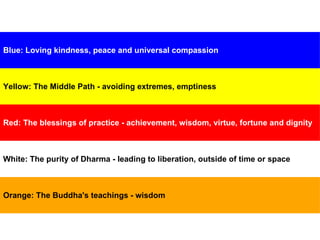
Orange: The Buddha's teachings - wisdom White: The purity of Dharma - leading to liberation, outside of time or space Red: The blessings of practice - achievement, wisdom, virtue, fortune and dignity Yellow: The Middle Path - avoiding extremes, emptiness Blue: Loving kindness, peace and universal compassion
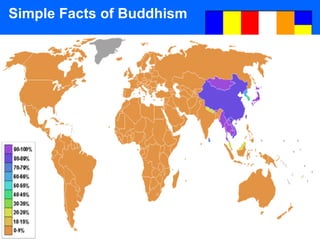
Simple Facts of Buddhism Flag of Buddhism  World population: ~350 million  believers worldwide Theraveda Buddhist Scriptures: Pali Canon (Tipitaka) Geographical divisions of Buddhism share original teachings of Buddha, but have developed into three distinctions within Buddhism: Theraveda Buddhism oldest surviving Mahayana Buddhism dominant Buddhist school, ~150 million East Asian Buddhism Tibetian Buddhism
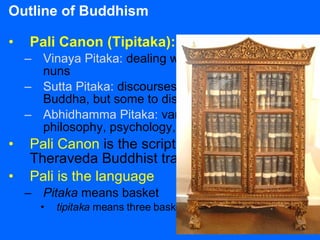
Outline of Buddhism Pali Canon (Tipitaka):   Vinaya Pitaka:  dealing with rules for monks and nuns  Sutta Pitaka:  discourses, mostly ascribed to the Buddha, but some to disciples  Abhidhamma Pitaka:  variously described as philosophy, psychology, metaphysics.  Pali Canon  is the scripture collection of the Theraveda Buddhist tradition. Pali is the language Pitaka  means basket tipitaka  means three basket
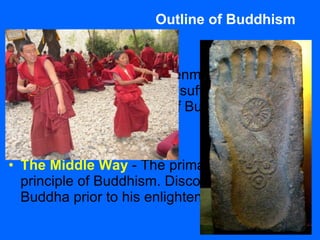
Outline of Buddhism Bodhi  – to attain enlightenment or awakening, release from suffering by following the teachings of Buddha. The Middle Way  - The primary guiding principle of Buddhism. Discovered by the Buddha prior to his enlightenment (bodhi).
Outline of Buddhism Refuge in the Three Jewels three things that Buddhists give themselves to, and in return look toward for guidance, in the process known as  taking refuge. Buddha  – example of Buddha Or more loosely, the  wisdom  that understands Dharma, and in this regard the Buddha represents the perfect wisdom that sees reality in its true form  Dharma   – teachings/laws as expounded by Buddha Sangha   – community of those who will help others attain  bodhi  (enlightenment).
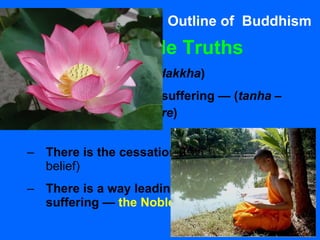
Outline of  Buddhism Four Noble Truths   There is suffering ( dakkha ) There is a cause of suffering — ( tanha –  selfish craving/desire ) There is the cessation of suffering  (hope, belief) There is a way leading to the cessation of suffering —  the Noble Eightfold Path
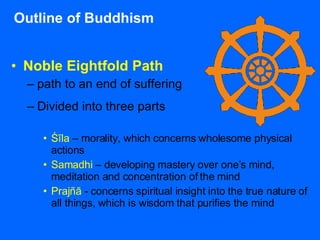
Outline of Buddhism Noble Eightfold Path   path to an end of suffering Divided into three parts   Śīla  – morality, which concerns wholesome physical actions Samadhi  – developing mastery over one’s mind, meditation and concentration of the mind  Prajñā  - concerns spiritual insight into the true nature of all things, which is wisdom that purifies the mind
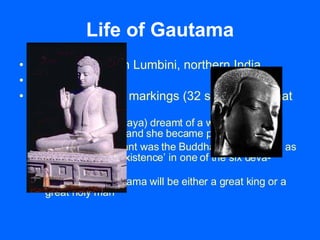
Life of Gautama Born: ~ 563 BC in Lumbini, northern India Born to a king Born with special markings (32 signs of a Great Man) Mother (Queen Maya) dreamt of a white elephant entering her side and she became pregnant  The White Elephant was the Buddha-to-be, resided as an ‘enlightened existence’ in one of the six deva-heavens Soothsayer: Gautama will be either a great king or a great holy man
Father  –  wanted Gautama to become a great king Protected Gautama from the ugliness, suffering of the world by keeping him in the castle Enticed and tempted Gautama with pleasurable things of the world As Gautama got older he begged to go out of the castle to see the world Father swept the outside world of all ugliness in order to protect his son from seeing suffering
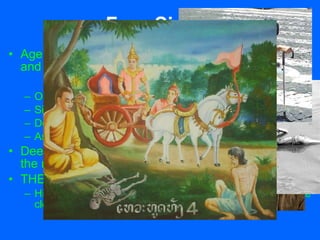
Four Sights Age 29, Gautama goes on four trips out of the castle and sees four sights that change his worldview Old man – suffering Sick man – disease Dead man – death Ascetic man – quest for Truth, release from suffering Deeply depressed Gautama escapes the castle in the night to seek deeper meaning of life.  THE GREAT GOING FORTH His spiritual quest begins, exchanges rich clothes for simple clothes and becomes a mendicant ascetic.
Wandering Ascetic Asceticism believed to be a powerful practice to overcome weakness of body.   Asceticism seeks moksha by overcoming the weakness of the body.  Pleasure is bad Extreme fasting Holding one’s breath Exposure to bodily pain Gautama nearly starves himself to death without getting any closer to enlightenment
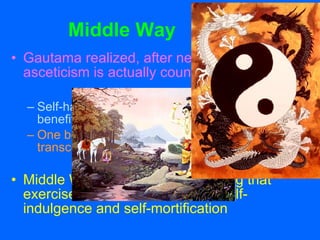
Middle Way Gautama realized, after nearly dying, that asceticism is actually counter productive. Self-hating practices that brought little spiritual benefit One becomes stuck on self while the goal is to transcend one’s self. Middle Way is a way of proceeding that exercises moderation between self-indulgence and self-mortification
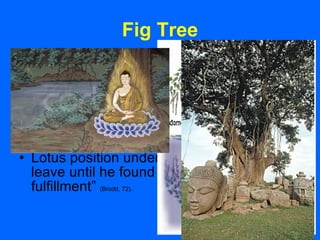
Fig Tree Revived from near-death by young girl, dedicates himself to meditation. Mindfulness of breathing to purify oneself of defilements and as a way to nirvana Lotus position under fig tree, vows not to leave until he found “complete and perfect fulfillment”  (Brodd, 72).
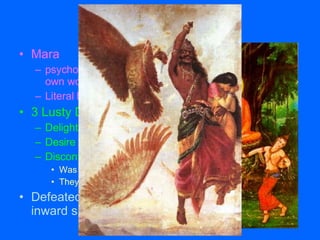
Battle with Mara Mara  psychological darkness within each of us to make our own worst fears real Literal belief that Mara was a demon 3 Lusty Daughters of Mara Delight Desire Discontent Was neither attracted nor disgusted by these three things They remained powerless over Gautama Defeated Mara, Gautama enters deeply into an inward spiritual journey
Three Watches under the Fig Tree First Watch  –  “Gautama perceived his own previous lifetimes…[his] continuous journey of suffering”   (Brodd, 73)  . Second Watch  – “acquired the divine eye, the ability to perceive the deaths/rebirths of all living things”   (Brodd, 73)  . Third Watch  – Discovers Four Noble Truths With this Gautama attained enlightenment – reached spiritual perfection and had thus won his salvation Became the Awakened or Enlightened One
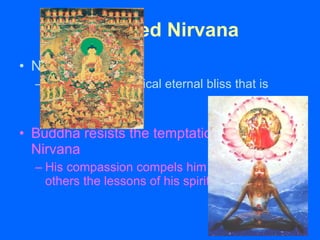
Deferred Nirvana Nirvana State of non-physical eternal bliss that is ultimate salvation Buddha resists the temptation to pass into Nirvana His compassion compels him to stay to teach others the lessons of his spiritual journey

Buddhism

  • 1.
  • 2.
    Orange: The Buddha'steachings - wisdom White: The purity of Dharma - leading to liberation, outside of time or space Red: The blessings of practice - achievement, wisdom, virtue, fortune and dignity Yellow: The Middle Path - avoiding extremes, emptiness Blue: Loving kindness, peace and universal compassion
  • 3.
    Simple Facts ofBuddhism Flag of Buddhism World population: ~350 million believers worldwide Theraveda Buddhist Scriptures: Pali Canon (Tipitaka) Geographical divisions of Buddhism share original teachings of Buddha, but have developed into three distinctions within Buddhism: Theraveda Buddhism oldest surviving Mahayana Buddhism dominant Buddhist school, ~150 million East Asian Buddhism Tibetian Buddhism
  • 4.
    Outline of BuddhismPali Canon (Tipitaka): Vinaya Pitaka: dealing with rules for monks and nuns Sutta Pitaka: discourses, mostly ascribed to the Buddha, but some to disciples Abhidhamma Pitaka: variously described as philosophy, psychology, metaphysics. Pali Canon is the scripture collection of the Theraveda Buddhist tradition. Pali is the language Pitaka means basket tipitaka means three basket
  • 5.
    Outline of BuddhismBodhi – to attain enlightenment or awakening, release from suffering by following the teachings of Buddha. The Middle Way - The primary guiding principle of Buddhism. Discovered by the Buddha prior to his enlightenment (bodhi).
  • 6.
    Outline of BuddhismRefuge in the Three Jewels three things that Buddhists give themselves to, and in return look toward for guidance, in the process known as taking refuge. Buddha – example of Buddha Or more loosely, the wisdom that understands Dharma, and in this regard the Buddha represents the perfect wisdom that sees reality in its true form Dharma – teachings/laws as expounded by Buddha Sangha – community of those who will help others attain bodhi (enlightenment).
  • 7.
    Outline of Buddhism Four Noble Truths There is suffering ( dakkha ) There is a cause of suffering — ( tanha – selfish craving/desire ) There is the cessation of suffering (hope, belief) There is a way leading to the cessation of suffering — the Noble Eightfold Path
  • 8.
    Outline of BuddhismNoble Eightfold Path path to an end of suffering Divided into three parts Śīla – morality, which concerns wholesome physical actions Samadhi – developing mastery over one’s mind, meditation and concentration of the mind Prajñā - concerns spiritual insight into the true nature of all things, which is wisdom that purifies the mind
  • 9.
    Life of GautamaBorn: ~ 563 BC in Lumbini, northern India Born to a king Born with special markings (32 signs of a Great Man) Mother (Queen Maya) dreamt of a white elephant entering her side and she became pregnant The White Elephant was the Buddha-to-be, resided as an ‘enlightened existence’ in one of the six deva-heavens Soothsayer: Gautama will be either a great king or a great holy man
  • 10.
    Father – wanted Gautama to become a great king Protected Gautama from the ugliness, suffering of the world by keeping him in the castle Enticed and tempted Gautama with pleasurable things of the world As Gautama got older he begged to go out of the castle to see the world Father swept the outside world of all ugliness in order to protect his son from seeing suffering
  • 11.
    Four Sights Age29, Gautama goes on four trips out of the castle and sees four sights that change his worldview Old man – suffering Sick man – disease Dead man – death Ascetic man – quest for Truth, release from suffering Deeply depressed Gautama escapes the castle in the night to seek deeper meaning of life. THE GREAT GOING FORTH His spiritual quest begins, exchanges rich clothes for simple clothes and becomes a mendicant ascetic.
  • 12.
    Wandering Ascetic Asceticismbelieved to be a powerful practice to overcome weakness of body. Asceticism seeks moksha by overcoming the weakness of the body. Pleasure is bad Extreme fasting Holding one’s breath Exposure to bodily pain Gautama nearly starves himself to death without getting any closer to enlightenment
  • 13.
    Middle Way Gautamarealized, after nearly dying, that asceticism is actually counter productive. Self-hating practices that brought little spiritual benefit One becomes stuck on self while the goal is to transcend one’s self. Middle Way is a way of proceeding that exercises moderation between self-indulgence and self-mortification
  • 14.
    Fig Tree Revivedfrom near-death by young girl, dedicates himself to meditation. Mindfulness of breathing to purify oneself of defilements and as a way to nirvana Lotus position under fig tree, vows not to leave until he found “complete and perfect fulfillment” (Brodd, 72).
  • 15.
    Battle with MaraMara psychological darkness within each of us to make our own worst fears real Literal belief that Mara was a demon 3 Lusty Daughters of Mara Delight Desire Discontent Was neither attracted nor disgusted by these three things They remained powerless over Gautama Defeated Mara, Gautama enters deeply into an inward spiritual journey
  • 16.
    Three Watches underthe Fig Tree First Watch – “Gautama perceived his own previous lifetimes…[his] continuous journey of suffering” (Brodd, 73) . Second Watch – “acquired the divine eye, the ability to perceive the deaths/rebirths of all living things” (Brodd, 73) . Third Watch – Discovers Four Noble Truths With this Gautama attained enlightenment – reached spiritual perfection and had thus won his salvation Became the Awakened or Enlightened One
  • 17.
    Deferred Nirvana NirvanaState of non-physical eternal bliss that is ultimate salvation Buddha resists the temptation to pass into Nirvana His compassion compels him to stay to teach others the lessons of his spiritual journey