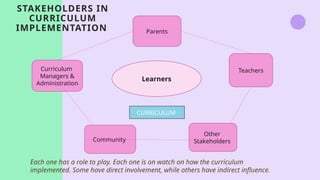
CURRICULUM
IMPLEMENTATION
SUB-TOPICS:
•THE ROLE OFSTAKEHOLDERS IN CURRICULUM
PLANNING AND IMPLEMENTATION
•THE ROLE OF TECHNOLOGY IN CURRICULUM
DELIVERY
•IMPLEMENTING THE DESIGNED CURRICULUM
•FORCES DRIVEN CURRICULUM CHANGE
1. Learners atthe center of the
curriculum
▪️
The learners are the very reason
curriculum is developed.
▪️
They are the ones who are directly
influenced by it.
▪️
Primary stakeholders.
▪️
The direct beneficiary of the
curriculum implementation. Upon
them lie the process success or
failure of the curriculum.
7.
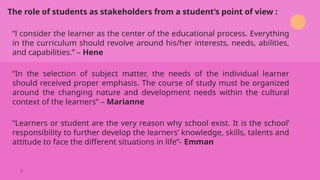
“l consider thelearner as the center of the educational process. Everything
in the curriculum should revolve around his/her interests, needs, abilities,
and capabilities.” – Hene
“In the selection of subject matter, the needs of the individual learner
should received proper emphasis. The course of study must be organized
around the changing nature and development needs within the cultural
context of the learners” – Marianne
“Learners or student are the very reason why school exist. It is the school’
responsibility to further develop the learners’ knowledge, skills, talents and
attitude to face the different situations in life”- Emman
The role of students as stakeholders from a student’s point of view :
7
8.
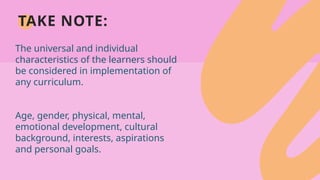
TAKE NOTE:
The universaland individual
characteristics of the learners should
be considered in implementation of
any curriculum.
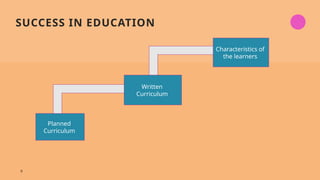
Age, gender, physical, mental,
emotional development, cultural
background, interests, aspirations
and personal goals.
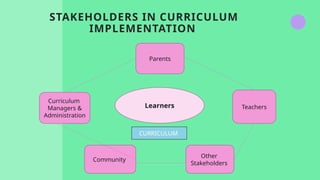
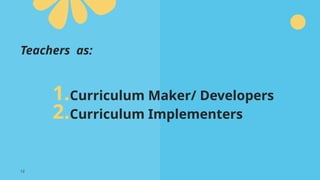
2. Teachers asCurriculum Developers and Implementers
11
▪️ Planning and writing the curriculum are the
primary roles of the the teacher.
▪️
The person who directly implements the
curriculum, in whose hands, direction and
guidance are provided for successful
implementation.
▪️
Prepares and implements the day to day
activities in school.
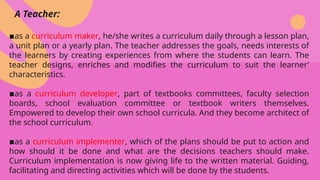
A Teacher:
▪️
as acurriculum maker, he/she writes a curriculum daily through a lesson plan,
a unit plan or a yearly plan. The teacher addresses the goals, needs interests of
the learners by creating experiences from where the students can learn. The
teacher designs, enriches and modifies the curriculum to suit the learner’
characteristics.
▪️
as a curriculum developer, part of textbooks committees, faculty selection
boards, school evaluation committee or textbook writers themselves.
Empowered to develop their own school curricula. And they become architect of
the school curriculum.
▪️
as a curriculum implementer, which of the plans should be put to action and
how should it be done and what are the decisions teachers should make.
Curriculum implementation is now giving life to the written material. Guiding,
facilitating and directing activities which will be done by the students.
14.
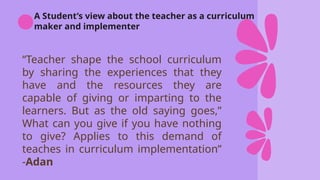
A Student’s viewabout the teacher as a curriculum
maker and implementer
“Teacher shape the school curriculum
by sharing the experiences that they
have and the resources they are
capable of giving or imparting to the
learners. But as the old saying goes,”
What can you give if you have nothing
to give? Applies to this demand of
teaches in curriculum implementation”
-Adan
16
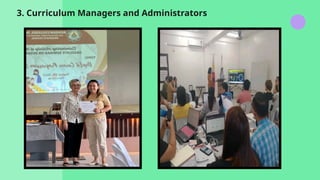
Functions of theschool principal as a curriculum manager:
• Supervise curriculum implementation,
• Select and recruit new teachers,
• Admit students,
• Procure equipment and materials needed for effective learning.
• Plan for the improvement of school facilities and physical plants.
3. Curriculum Managers and Administrators
17.
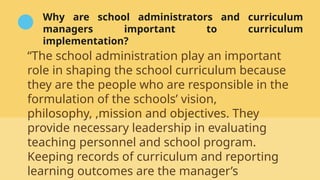
Why are schooladministrators and curriculum
managers important to curriculum
implementation?
“The school administration play an important
role in shaping the school curriculum because
they are the people who are responsible in the
formulation of the schools’ vision,
philosophy, ,mission and objectives. They
provide necessary leadership in evaluating
teaching personnel and school program.
Keeping records of curriculum and reporting
learning outcomes are the manager’s
18.
18
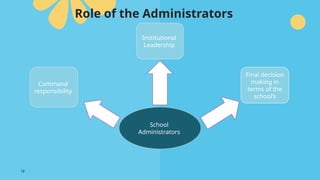
Role of theAdministrators
School
Administrators
Command
responsibility
Institutional
Leadership
Final decision
making in
terms of the
school’s
4. Parents assupporters to the curriculum
“My child and my money goes to this school”, reads a car sticker.
What is the implication of this statement to the school
curriculum?
-It simply means that the parents are the best supporters of the
school, especially because they are the ones paying for their
child’s education. Parents would be willing to pay the cost of
educating their child for as long as their children get the best
learning or schooling experiences.
21.
How do parentsshape the curriculum and why are they considered
stakeholders? Here some observations:
1. Effective parental involvement in school affairs may be linked to
parent educational programs which is central to high quality
educational experiences of the children.
2. The parents involvement extends from the confine of the school to
the homes. The parents become part of the environment of learning
at home.
3. In cost school the Parent Association is organized. This organization
is provided by law.
5. Community Membersas Curriculum Resources
The success in the implementation of the curriculum
requires resources. However, most often teachers complain
that resources are very scarce. There are no books,
materials nor facilities available. These are the usual
complaints of the teachers. The community members and
materials in the local community can very well substitute
for what are needed to implement
24.
24
6. Other Stakeholdersin Curriculum Implementation
• Professional organizations have shown great influence
in school curriculum. They are being asked by
curriculum specialist to contribute in curriculum review
because they have a voice in licensure examinations and
curriculum enhancement i.e teachers organization,
lawyers organization etc.
25.
6. Other Stakeholdersin Curriculum
Implementation (Continuation)
Government has a great stake since
all schools are under the regulation
of the National Government under
the Philippine Constitution.
Government represented by the
following:
26.
6. Other Stakeholdersin Curriculum
Implementation (Continuation)
Department of Education (DepEd)
27.
6. Other Stakeholdersin Curriculum
Implementation (Continuation)
Commission on Higher Education (CHED)
(R.A 772- Higher Education Act of 1994
28.
28
6. Other Stakeholdersin Curriculum Implementation
(Continuation)
Professional Regulation Commission (PRC)
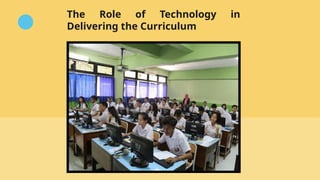
The Role ofTechnology in
Delivering the Curriculum
31.
31
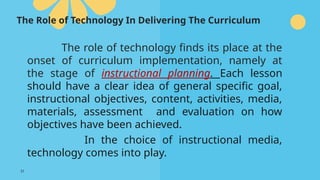
The Role ofTechnology In Delivering The Curriculum
The role of technology finds its place at the
onset of curriculum implementation, namely at
the stage of instructional planning. Each lesson
should have a clear idea of general specific goal,
instructional objectives, content, activities, media,
materials, assessment and evaluation on how
objectives have been achieved.
In the choice of instructional media,
technology comes into play.
32.
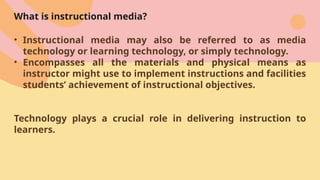
What is instructionalmedia?
• Instructional media may also be referred to as media
technology or learning technology, or simply technology.
• Encompasses all the materials and physical means as
instructor might use to implement instructions and facilities
students’ achievement of instructional objectives.
Technology plays a crucial role in delivering instruction to
learners.
33.
33
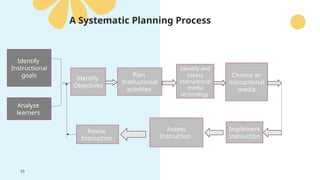
A Systematic PlanningProcess
Identify
Instructional
goals
Analyze
learners
Identify
Objectives
Plan
Instructional
activities
Identify and
assess
instructional
media
technology
Choose an
instructional
media
Implement
Instruction
Assess
Instruction
Revise
Instruction
34.
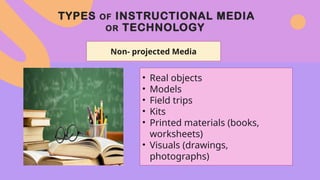
TYPES OF INSTRUCTIONALMEDIA
OR TECHNOLOGY
Non- projected Media
• Real objects
• Models
• Field trips
• Kits
• Printed materials (books,
worksheets)
• Visuals (drawings,
photographs)
35.
TYPES OF INSTRUCTIONALMEDIA
OR TECHNOLOGY
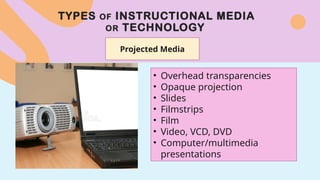
Projected Media
• Overhead transparencies
• Opaque projection
• Slides
• Filmstrips
• Film
• Video, VCD, DVD
• Computer/multimedia
presentations
36.
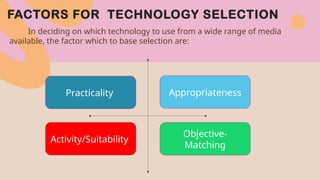
FACTORS FOR TECHNOLOGYSELECTION
In deciding on which technology to use from a wide range of media
available, the factor which to base selection are:
Practicality
Activity/Suitability
Appropriateness
Objective-
Matching
37.
37
The Role ofTechnology in Curriculum Delivery
Technological changes in education will its
impact on the delivery of more effective,
efficient and humanizing teaching-and-
learning.
38.
The Role ofTechnology in Curriculum
Three current trends that could carry on to the nature of education
in the future.
1. Paradigm shift from teacher-centered to student-centered
approach to learning.
2. Educative process of cultivating the cognitive, affective,
psychomotor and much more the contemplative intelligence
of the learners of a new age.
3. Increase in the use of new information and communication
technology or ICT.
39.
39
The Role ofTechnology in Curriculum Delivery
The primary roles of educational technology in delivering the
school curriculum’s instructional program have been
identified
1. Upgrading the quality of teaching-and-learning in schools.
2. Increasing the capability of the teacher to effectively inculcate
learning, and for students to gain mastery of lessons and
courses.
3. Broadening the delivery of eduction outside schools through
non-traditional approaches to formal and informal learning
such as Open Universities and lifelong learning to adult
learners.
4. Revolutionizing the use of technology to boost educational
paradigm shift that give importance to student-centered and
40.
Curriculum Implementation
• Puttinginto practice the written curriculum that
has been designed the syllabi, course of study,
curricular guides, and subjects. It’s a process
wherein the learners acquire the planned or
intended knowledge, skills and attitudes that
are aimed at enabling the same learners to
functions effectively in the society.
41.
Ornstein and Hunkins-as the interaction between the curricula that has
been written a planned and the persons (teachers) who are in charged to
deliver it. It implies the following:
• Shift from what is the current to a new or enhanced curriculum
• Chang knowledge, actions attitudes of the person involved
• Change behavior using new strategies and resources.
• Change which requires effort hence goals should be achievable
Loucks and Lieberman- they defined it as the trying out of a new practice
and what it looks like when actually used in school system. It simply
means that implementation should bring desired change and
improvement.
Classroom Context- it means teaching what has been written in the lesson
plan. Implementing means using the plan as a guide to engage with the
learners in the teacher-learning process with the end in the view learning
42.
42
Forces Driving CurriculumChange
• National
• Local need
• Staff dissatisfaction
• Parental Demands
• Standards: they can be maintained in the view of the
challenges of new course.
• Leadership: meaningful change and curriculum
development