Study Planner SCIENCE - Semester 2 for EMG program grade 9
1.
SCIENCE
Lesson
Titles
&
Lesson
Objectives
Semester 2 StudyPlan
checklist
Grade 9
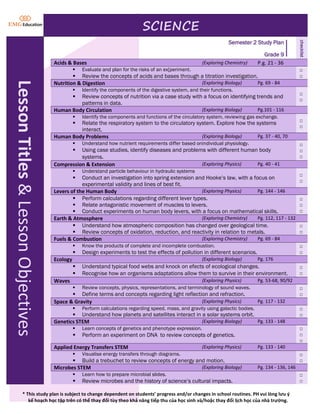
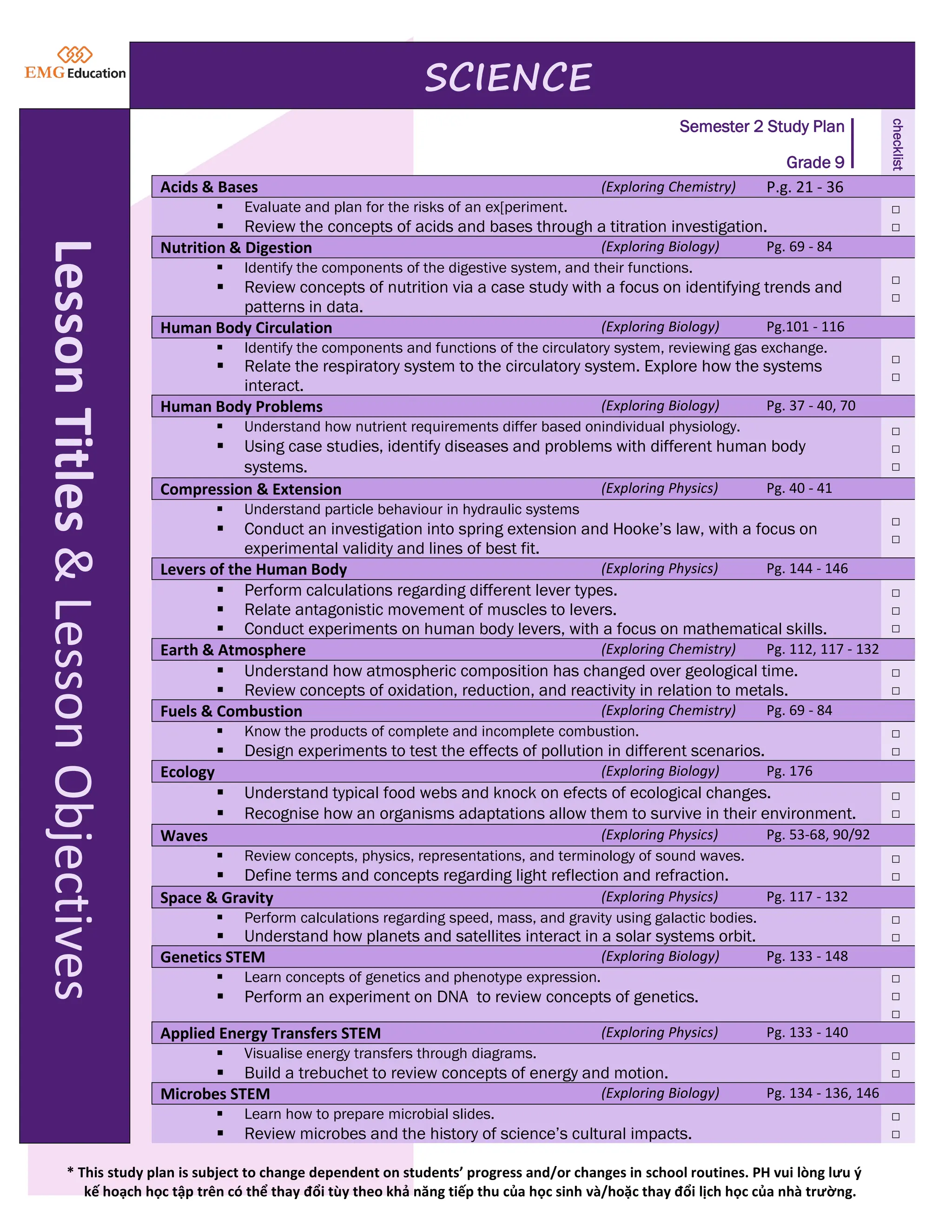
Acids & Bases (Exploring Chemistry) P.g. 21 - 36
Evaluate and plan for the risks of an ex[periment.
Review the concepts of acids and bases through a titration investigation.
□
□
Nutrition & Digestion (Exploring Biology) Pg. 69 - 84
Identify the components of the digestive system, and their functions.
Review concepts of nutrition via a case study with a focus on identifying trends and
patterns in data.
□
□
Human Body Circulation (Exploring Biology) Pg.101 - 116
Identify the components and functions of the circulatory system, reviewing gas exchange.
Relate the respiratory system to the circulatory system. Explore how the systems
interact.
□
□
Human Body Problems (Exploring Biology) Pg. 37 - 40, 70
Understand how nutrient requirements differ based onindividual physiology.
Using case studies, identify diseases and problems with different human body
systems.
□
□
□
Compression & Extension (Exploring Physics) Pg. 40 - 41
Understand particle behaviour in hydraulic systems
Conduct an investigation into spring extension and Hooke’s law, with a focus on
experimental validity and lines of best fit.
□
□
Levers of the Human Body (Exploring Physics) Pg. 144 - 146
Perform calculations regarding different lever types.
Relate antagonistic movement of muscles to levers.
Conduct experiments on human body levers, with a focus on mathematical skills.
□
□
□
Earth & Atmosphere (Exploring Chemistry) Pg. 112, 117 - 132
Understand how atmospheric composition has changed over geological time.
Review concepts of oxidation, reduction, and reactivity in relation to metals.
□
□
Fuels & Combustion (Exploring Chemistry) Pg. 69 - 84
Know the products of complete and incomplete combustion.
Design experiments to test the effects of pollution in different scenarios.
□
□
Ecology (Exploring Biology) Pg. 176
Understand typical food webs and knock on efects of ecological changes.
Recognise how an organisms adaptations allow them to survive in their environment.
□
□
Waves (Exploring Physics) Pg. 53-68, 90/92
Review concepts, physics, representations, and terminology of sound waves.
Define terms and concepts regarding light reflection and refraction.
□
□
Space & Gravity (Exploring Physics) Pg. 117 - 132
Perform calculations regarding speed, mass, and gravity using galactic bodies.
Understand how planets and satellites interact in a solar systems orbit.
□
□
Genetics STEM (Exploring Biology) Pg. 133 - 148
Learn concepts of genetics and phenotype expression.
Perform an experiment on DNA to review concepts of genetics.
□
□
□
Applied Energy Transfers STEM (Exploring Physics) Pg. 133 - 140
Visualise energy transfers through diagrams.
Build a trebuchet to review concepts of energy and motion.
□
□
Microbes STEM (Exploring Biology) Pg. 134 - 136, 146
Learn how to prepare microbial slides.
Review microbes and the history of science’s cultural impacts.
□
□
* This study plan is subject to change dependent on students’ progress and/or changes in school routines. PH vui lòng lưu ý
kế hoạch học tập trên có thể thay đổi tùy theo khả năng tiếp thu của học sinh và/hoặc thay đổi lịch học của nhà trường.