Don Mariano Marcos Memorial State University 
South La Union Campus 
Agoo, La Union 
Where teachers grow
Lilibeth 
Felix 
Jeric 
Grace 
Jennilyn
As mentioned in the paper of 
Director Esperanza A. Gonzales 
of the Bureau of Secondary 
Education, Department of 
Education, Culture and Sports, 
entitled “THE 1989 
SECONDARY EDUCATION 
CURRICULUM”, when the first 
graduates of the New Elementary 
School Curriculum (NESC) come 
to the high schools in 1989… 
“basic intellectual 
skills and learning 
tools to continue 
learning and the 
values for 
successfully living 
lives in the 
society”.
PRIMARY EDUCATION 
On February 2, 1987, a new Constitution for the 
Philippines was ratified. Section 3, Article XIV of the 
1987 Constitution contains the ten fundamental aims 
of education in the Philippines. It is also seen that 
under the 1987 Constitution (under Section 2 (2), 
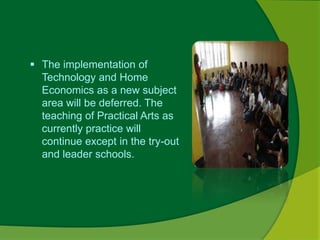
Article XIV), only elementary school was made 
compulsory.
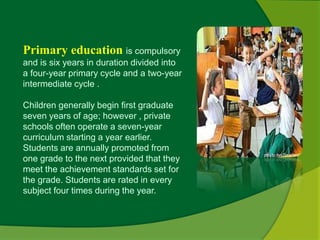
Primary education is compulsory 
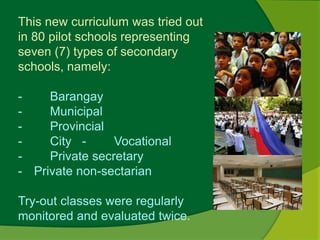
and is six years in duration divided into 
a four-year primary cycle and a two-year 
intermediate cycle . 
Children generally begin first graduate 
seven years of age; however , private 
schools often operate a seven-year 
curriculum starting a year earlier. 
Students are annually promoted from 
one grade to the next provided that they 
meet the achievement standards set for 
the grade. Students are rated in every 
subject four times during the year.
A cumulative rating system is 
used as the basis for promotion. 
The passing grade is 75 
percent. In grades I & II the 
medium of instruction is 
generally in the local dialect, of 
which there are more than 170 
nationally, with English and 
Filipino taught as second 
languages . From grade III 
onwards mathematics and 
science are taught in English 
with the social sciences and 
humanities taught in Filipino.
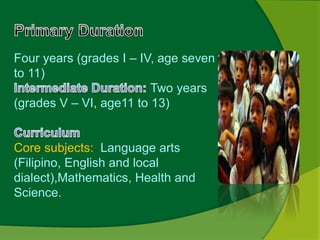
Four years (grades I – IV, age seven 
to 11) 
Two years 
(grades V – VI, age11 to 13) 
Core subjects: Language arts 
(Filipino, English and local 
dialect),Mathematics, Health and 
Science.
Makabayan subjects: 
In grades I – III 
Students study civics and culture. 
Grades IV– VI 
Students study music, arts and physical education; home 
economics and livelihood ; and social studies. 
Values education and good manners and right conduct are 
integrated in all learning areas. 
Makabayan is described by the ministry as a learning area 
that serves as a practice environment for holistic learning to 
develop a healthy personal and national self-identity . Ideally, it 
entails the adoption of modes of integrative teaching that will 
enable the student to process and synthesize a wide range of 
skills and values (cultural, aesthetic, athletic , vocational, 
politico-economic, and ethical.
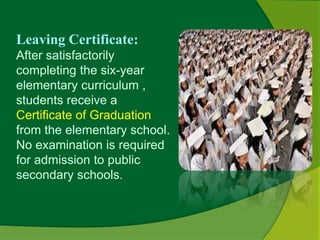
Leaving Certificate: 
After satisfactorily 
completing the six-year 
elementary curriculum , 
students receive a 
Certificate of Graduation 
from the elementary school. 
No examination is required 
for admission to public 
secondary schools.
The multi-disciplinary and inter-disciplinary 
approaches which were 
good features of the 1973 revised 
curriculum were not reflected in the 
instructional materials or in the 
classroom processes.
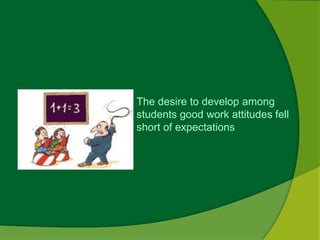
The desire to develop among 
students good work attitudes fell 
short of expectations
The conceptual approach to 
problem solving in the social 
sciences proved ineffective for 
learning the content of social 
science subjects, etc.
The 1987 Constitution in Article XIV 
Sec. 1 states that “The State shall 
protect and promote the right of all 
citizens to quality education at all 
levels and shall take appropriate steps 
to make such education accessible to 
all.” Sec. 3 (1), (2), Sections 14, 19 
and Art. XV Sec.1 which were cited in 
the previous chapters expressly stated 
education-related constitutional 
requirements serving as the primary 
legal bases of the 1989 SEDP.
D No. 6-A and Batas Pambansa Blg. 232 
otherwise known as Education Act of 1982 
clearly spells the need for the kind of the 
education that will continue general 
education stared in the elementary grades; 
prepare learners for college and prepare 
learners for the world of work. 
This curriculum is supportive of the Medium 
Term Development Plan targets and the 
values development thrusts in accordance 
with the Values Education Framework of the 
DECS
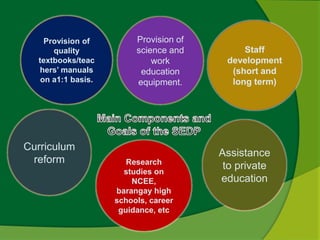
Provision of 
quality 
textbooks/teac 
hers’ manuals 
on a1:1 basis. 
Curriculum 
reform 
Assistance 
to private 
education 
Research 
studies on 
NCEE, 
barangay high 
schools, career 
guidance, etc 
Staff 
development 
(short and 
long term) 
Provision of 
science and 
work 
education 
equipment.
In addition to this, SEDP will also undertake or 
expand the school building program, service 
contracting scheme and other alternative delivery 
system.
 Develop an enlightened 
commitment to the national 
ideals by cherishing, 
reserving, and developing 
moral, spiritual and socio-cultural 
values, as well as 
other desirable aspects of the 
Filipino heritage;
 Obtain knowledge and form 
desirable attitudes for 
understanding the nature and 
purpose of man and therefore, 
of one’s self, one’s own 
people, and other races, 
places and times, thereby, 
promoting a keen sense of 
self, of family and of national 
and international 
communities;
 Acquire works skills, 
Knowledge and information 
and work ethic essential for 
making an intelligent choice of 
an occupation or career, and 
for specialized training in 
specific occupations;
Develop skills inn higher 
intellectual operations and 
more complex comprehension 
and expression activities and 
in thinking, intelligently and 
critically and creatively in life 
situations;
 Broaden and heighten their 
abilities in the appreciation for 
the arts, science and 
technology as means for 
maximizing their potentials 
foe self-fulfillment and for 
promoting the welfare of 
others.
. 
 English 
 Filipino 
 Mathematics 
 Science and Technology 
 Araling Panlipunan 
 Edukasyon, Pangkatawan, Kalusugan at 
Musika 
 Technology and Home Economics 
 Edukasyon sa Pagpapahalaga(Values 
Education)
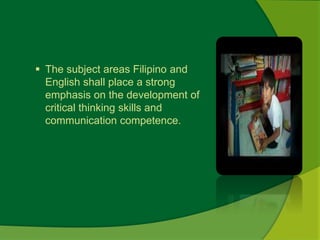
 The subject areas Filipino and 
English shall place a strong 
emphasis on the development of 
critical thinking skills and 
communication competence.
 Araling Panlipunan (Social 
Studies) shall be taught 
from the Philippines 
perspective. The area of 
study for the first year is 
Philippine History, Asian 
History in the second year. 
Economics in the third year 
and World History in the 
fourth year.
 Mathematics will include 
higher level of 
competencies in 
preparation for 
technology course 
introduced at the tertiary 
level.
 In Science; the focus in the 
first year shall be General 
Science, Biology in the 
second year, Chemistry in 
the third year and Physics 
in the fourth year.
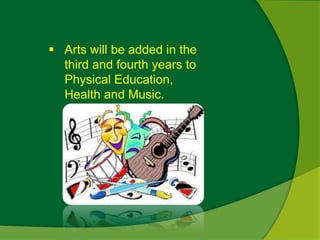
 Arts will be added in the 
third and fourth years to 
Physical Education, 
Health and Music.
 The implementation of 
Technology and Home 
Economics as a new subject 
area will be deferred. The 
teaching of Practical Arts as 
currently practice will 
continue except in the try-out 
and leader schools.
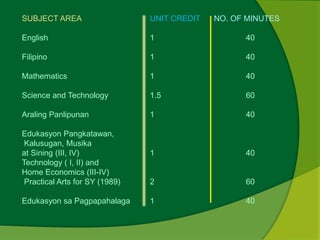
SUBJECT AREA UNIT CREDIT NO. OF MINUTES 
English 1 40 
Filipino 1 40 
Mathematics 1 40 
Science and Technology 1.5 60 
Araling Panlipunan 1 40 
Edukasyon Pangkatawan, 
Kalusugan, Musika 
at Sining (III, IV) 1 40 
Technology ( I, II) and 
Home Economics (III-IV) 
Practical Arts for SY (1989) 2 60 
Edukasyon sa Pagpapahalaga 1 40
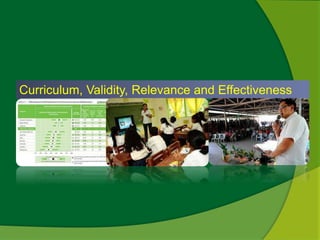
Curriculum, Validity, Relevance and Effectiveness
This new curriculum was tried out 
in 80 pilot schools representing 
seven (7) types of secondary 
schools, namely: 
- Barangay 
- Municipal 
- Provincial 
- City - Vocational 
- Private secretary 
- Private non-sectarian 
Try-out classes were regularly 
monitored and evaluated twice.
Studies to determine the effectiveness of 
teaching and learning were conducted. 
These studies included surveys of 
students’, teachers’, and administrators 
perceptions on the new textbooks, 
medium of instruction, time allotment and 
new subject areas.
To be prepared for the effective implementation 
of the new curriculum 
Staff development programs were undertaken, 
including the training by selected centers of public 
and private school regional trainers; leadership 
training for secondary school 
principals/administrators for both public and private 
schools; and there will be mass training of first year 
teachers for both public and private schools in April- 
May, 1989. 
Among the Centrex's are the Philippine Normal College for English, 
Filipino and Values education; UP College of Education for Social 
Studies, Health and Music; UP ISMED for Science and Mathematics; 
TUP for Technology and Home Economics and Work Experience; UP 
SPEAR FOR Physical Education; and Maryknoll College for Values 
Education.
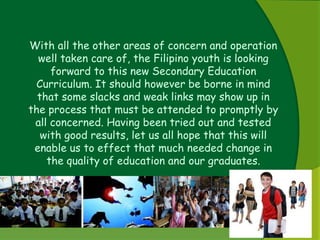
With all the other areas of concern and operation 
well taken care of, the Filipino youth is looking 
forward to this new Secondary Education 
Curriculum. It should however be borne in mind 
that some slacks and weak links may show up in 
the process that must be attended to promptly by 
all concerned. Having been tried out and tested 
with good results, let us all hope that this will 
enable us to effect that much needed change in 
the quality of education and our graduates.
*****References***** 
Andres, Francisco. Curriculum Development in Philippine 
Setting: National Book Store Inc. 1989. 
Bauzon, Prisciliano. Foundations of Curriculum 
Development and 
Management. Manila: National Book Store Inc. 2001.
Curriculum Development-SEDP

Curriculum Development-SEDP

  • 1.
    Don Mariano MarcosMemorial State University South La Union Campus Agoo, La Union Where teachers grow
  • 2.
    Lilibeth Felix Jeric Grace Jennilyn
  • 5.
    As mentioned inthe paper of Director Esperanza A. Gonzales of the Bureau of Secondary Education, Department of Education, Culture and Sports, entitled “THE 1989 SECONDARY EDUCATION CURRICULUM”, when the first graduates of the New Elementary School Curriculum (NESC) come to the high schools in 1989… “basic intellectual skills and learning tools to continue learning and the values for successfully living lives in the society”.
  • 6.
    PRIMARY EDUCATION OnFebruary 2, 1987, a new Constitution for the Philippines was ratified. Section 3, Article XIV of the 1987 Constitution contains the ten fundamental aims of education in the Philippines. It is also seen that under the 1987 Constitution (under Section 2 (2), Article XIV), only elementary school was made compulsory.
  • 7.
    Primary education iscompulsory and is six years in duration divided into a four-year primary cycle and a two-year intermediate cycle . Children generally begin first graduate seven years of age; however , private schools often operate a seven-year curriculum starting a year earlier. Students are annually promoted from one grade to the next provided that they meet the achievement standards set for the grade. Students are rated in every subject four times during the year.
  • 8.
    A cumulative ratingsystem is used as the basis for promotion. The passing grade is 75 percent. In grades I & II the medium of instruction is generally in the local dialect, of which there are more than 170 nationally, with English and Filipino taught as second languages . From grade III onwards mathematics and science are taught in English with the social sciences and humanities taught in Filipino.
  • 9.
    Four years (gradesI – IV, age seven to 11) Two years (grades V – VI, age11 to 13) Core subjects: Language arts (Filipino, English and local dialect),Mathematics, Health and Science.
  • 10.
    Makabayan subjects: Ingrades I – III Students study civics and culture. Grades IV– VI Students study music, arts and physical education; home economics and livelihood ; and social studies. Values education and good manners and right conduct are integrated in all learning areas. Makabayan is described by the ministry as a learning area that serves as a practice environment for holistic learning to develop a healthy personal and national self-identity . Ideally, it entails the adoption of modes of integrative teaching that will enable the student to process and synthesize a wide range of skills and values (cultural, aesthetic, athletic , vocational, politico-economic, and ethical.
  • 11.
    Leaving Certificate: Aftersatisfactorily completing the six-year elementary curriculum , students receive a Certificate of Graduation from the elementary school. No examination is required for admission to public secondary schools.
  • 13.
    The multi-disciplinary andinter-disciplinary approaches which were good features of the 1973 revised curriculum were not reflected in the instructional materials or in the classroom processes.
  • 14.
    The desire todevelop among students good work attitudes fell short of expectations
  • 15.
    The conceptual approachto problem solving in the social sciences proved ineffective for learning the content of social science subjects, etc.
  • 17.
    The 1987 Constitutionin Article XIV Sec. 1 states that “The State shall protect and promote the right of all citizens to quality education at all levels and shall take appropriate steps to make such education accessible to all.” Sec. 3 (1), (2), Sections 14, 19 and Art. XV Sec.1 which were cited in the previous chapters expressly stated education-related constitutional requirements serving as the primary legal bases of the 1989 SEDP.
  • 18.
    D No. 6-Aand Batas Pambansa Blg. 232 otherwise known as Education Act of 1982 clearly spells the need for the kind of the education that will continue general education stared in the elementary grades; prepare learners for college and prepare learners for the world of work. This curriculum is supportive of the Medium Term Development Plan targets and the values development thrusts in accordance with the Values Education Framework of the DECS
  • 19.
    Provision of quality textbooks/teac hers’ manuals on a1:1 basis. Curriculum reform Assistance to private education Research studies on NCEE, barangay high schools, career guidance, etc Staff development (short and long term) Provision of science and work education equipment.
  • 20.
    In addition tothis, SEDP will also undertake or expand the school building program, service contracting scheme and other alternative delivery system.
  • 21.
     Develop anenlightened commitment to the national ideals by cherishing, reserving, and developing moral, spiritual and socio-cultural values, as well as other desirable aspects of the Filipino heritage;
  • 22.
     Obtain knowledgeand form desirable attitudes for understanding the nature and purpose of man and therefore, of one’s self, one’s own people, and other races, places and times, thereby, promoting a keen sense of self, of family and of national and international communities;
  • 23.
     Acquire worksskills, Knowledge and information and work ethic essential for making an intelligent choice of an occupation or career, and for specialized training in specific occupations;
  • 24.
    Develop skills innhigher intellectual operations and more complex comprehension and expression activities and in thinking, intelligently and critically and creatively in life situations;
  • 25.
     Broaden andheighten their abilities in the appreciation for the arts, science and technology as means for maximizing their potentials foe self-fulfillment and for promoting the welfare of others.
  • 27.
    .  English  Filipino  Mathematics  Science and Technology  Araling Panlipunan  Edukasyon, Pangkatawan, Kalusugan at Musika  Technology and Home Economics  Edukasyon sa Pagpapahalaga(Values Education)
  • 29.
     The subjectareas Filipino and English shall place a strong emphasis on the development of critical thinking skills and communication competence.
  • 30.
     Araling Panlipunan(Social Studies) shall be taught from the Philippines perspective. The area of study for the first year is Philippine History, Asian History in the second year. Economics in the third year and World History in the fourth year.
  • 31.
     Mathematics willinclude higher level of competencies in preparation for technology course introduced at the tertiary level.
  • 32.
     In Science;the focus in the first year shall be General Science, Biology in the second year, Chemistry in the third year and Physics in the fourth year.
  • 33.
     Arts willbe added in the third and fourth years to Physical Education, Health and Music.
  • 34.
     The implementationof Technology and Home Economics as a new subject area will be deferred. The teaching of Practical Arts as currently practice will continue except in the try-out and leader schools.
  • 35.
    SUBJECT AREA UNITCREDIT NO. OF MINUTES English 1 40 Filipino 1 40 Mathematics 1 40 Science and Technology 1.5 60 Araling Panlipunan 1 40 Edukasyon Pangkatawan, Kalusugan, Musika at Sining (III, IV) 1 40 Technology ( I, II) and Home Economics (III-IV) Practical Arts for SY (1989) 2 60 Edukasyon sa Pagpapahalaga 1 40
  • 36.
  • 37.
    This new curriculumwas tried out in 80 pilot schools representing seven (7) types of secondary schools, namely: - Barangay - Municipal - Provincial - City - Vocational - Private secretary - Private non-sectarian Try-out classes were regularly monitored and evaluated twice.
  • 38.
    Studies to determinethe effectiveness of teaching and learning were conducted. These studies included surveys of students’, teachers’, and administrators perceptions on the new textbooks, medium of instruction, time allotment and new subject areas.
  • 39.
    To be preparedfor the effective implementation of the new curriculum Staff development programs were undertaken, including the training by selected centers of public and private school regional trainers; leadership training for secondary school principals/administrators for both public and private schools; and there will be mass training of first year teachers for both public and private schools in April- May, 1989. Among the Centrex's are the Philippine Normal College for English, Filipino and Values education; UP College of Education for Social Studies, Health and Music; UP ISMED for Science and Mathematics; TUP for Technology and Home Economics and Work Experience; UP SPEAR FOR Physical Education; and Maryknoll College for Values Education.
  • 40.
    With all theother areas of concern and operation well taken care of, the Filipino youth is looking forward to this new Secondary Education Curriculum. It should however be borne in mind that some slacks and weak links may show up in the process that must be attended to promptly by all concerned. Having been tried out and tested with good results, let us all hope that this will enable us to effect that much needed change in the quality of education and our graduates.
  • 41.
    *****References***** Andres, Francisco.Curriculum Development in Philippine Setting: National Book Store Inc. 1989. Bauzon, Prisciliano. Foundations of Curriculum Development and Management. Manila: National Book Store Inc. 2001.