Current Trends and Innovations in
Rides to Wellness and Human
Services Transportation
Human Services Transportation Symposium
Chattanooga, TN
April 2017
2
Talking Points
• Current Trends
• 5310 Program Overview
• Highlight Changes in the 5310 Program
Authorized by the FAST Act
• Questions and Answers
• Brief Overview of the Mobility on Demand
Program
3
Current Trends
• Expand Bikeshare System with accessible
bikes
• Crossing Jurisdictional Boundaries
• First Mile/Last Mile Solutions
Source: 2016 Trends Report, published by the National
Aging and Disability Transportation Center (NADTC)
4
Accessible Bike Share Programs
• Benefits to Older Adults and Individuals
with Disabilities:
1) Increase access to community
services and resources
2) Solution to first mile / last mile issues
3) Increases overall transportation
options and greater independence
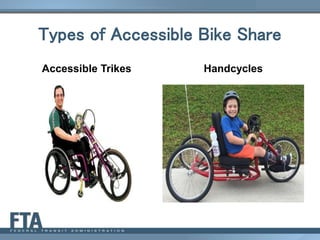
Types of Accessible Bike Share
Accessible Trikes Handcycles
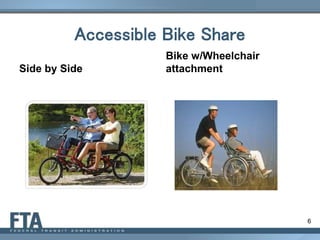
Accessible Bike Share
Side by Side
Bike w/Wheelchair
attachment
6
7
Accessible Bike Share Programs
• City of Detroit, MI
– Launches summer 2017
– Range of accessible bikes
• Westminster, Colorado
– Launched June 2016
– 32 cruisers bikes, 3 handcycles, 5 trikes
8
Crossing Jurisdictional Boundaries
• Call-n-Ride, Montgomery County, MD
– Taxi Voucher Program for Low income,
Elderly, and Individuals with Disabilities
– Fully subsidized by the County
– Allow trips to Out of County medical
appointments, but not return trips presents
challenges
8
9
Crossing Jurisdictional Boundaries
• Grand Gateway Economic Development –
Pelivan Transit
– Coordination among multi-county, multi tribal, and
multi-agencies and organizations
– Allows access to services throughout the large
territory, which otherwise may be limited
– Utilize diverse range of federal funding to include
5311, 5310, 5309
– Demand Response, Deviated Fixed Route, NEMT,
Nutrition
10
First Mile/Last Mile
• Opportunities for Improving
– Improving Pedestrian Access
– Technology Apps and Mobile Reservations
– Alternate Modes i.e. Bikeshare
– Increase Coordination and Partnerships
11
Quick overview
5310 Program
• Examples of Eligible Projects
• FAST Act changes
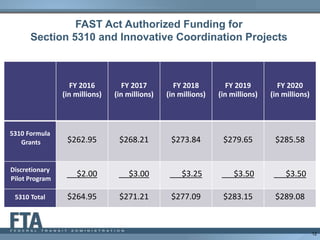
FAST Act Authorized Funding for
Section 5310 and Innovative Coordination Projects
12
FY 2016
(in millions)
FY 2017
(in millions)
FY 2018
(in millions)
FY 2019
(in millions)
FY 2020
(in millions)
5310 Formula
Grants $262.95 $268.21 $273.84 $279.65 $285.58
Discretionary
Pilot Program
$2.00 $3.00 $3.25 $3.50 $3.50
5310 Total $264.95 $271.21 $277.09 $283.15 $289.08
13
Examples of Capital
Section 5310 Projects
Capital Purchases
• Vehicles (i.e., buses, vans, or accessible taxis)
• Approved Vehicle Rehabilitation or Overhaul
• Related Vehicle Equipment (i.e., lifts, ramps,
securement devices; etc.)
• Other Capital Equipment Purchases (i.e.,
communications equipment such as Mobile Data
Terminals or Computers; security equipment such as
camera systems for vehicles; fare collection systems;
etc.)
• Mobility Management
• Cost of Leased or Contracted Services
14
Examples of “Other” Section 5310 Projects
• Mobility Management
• Travel Training
• Curb Cuts
• Sidewalks
• Pedestrian Signals or Other Accessible Features
• Volunteer Driver Programs (Mileage Reimbursement)
15
Examples of “Other” Projects (continued)
• Costs Directly Tied to Transit Operations
• Administrative Expenses
• Operation of Transportation Brokerages to Coordinate
Providers, Funding Agencies, and Passengers
• Development and Operation of One-Call/One-Click Call
Centers
• Voucher Programs
FAST Act Changes to the Section 5310
Program
• A State or local governmental entity that
operates a public transportation service and that
is eligible to receive direct grants under 5311 or
5307 is now an eligible direct recipient
• There is now a requirement for the collection of
best practices for dissemination to public
transportation on innovation, program models,
new services delivery options, performance
measure findings, and transit cooperative
research program reports
16
FAST Act Changes to the Section 5310
Program, Cont.
• Section 3006(b): a discretionary pilot program
for innovative coordinated access and mobility -
open to 5310 recipients and subrecipients - to
assist in financing innovative projects for the
transportation disadvantaged that improve the
coordination of transportation services and non-
emergency medical transportation services;
such as: the deployment of coordination
technology, projects that create or increase
access to community (i.e. One-Call/One-Click
Centers, etc.)
17
FAST Act Changes to the Section 5310
Program, Cont.
• Section 3006(c): Coordinated Mobility which
requires following through on recommendations
made by the Interagency Transportation
Coordination Council on Access and Mobility
(CCAM) 2005 Report to the President relating to
the implementation of Executive Order No.
13330 (49 U.S.S. 101 note) including
publicizing an updated strategic plan and
developing a cost-sharing policy
18
19
Resources
• FTA Resources
– 5310 ProgramWebpage:
https://www.transit.dot.gov/funding/grants/enhanced-mobility-seniors-
individuals-disabilities-section-5310
– Rides to Wellness Webpage:
https://www.transit.dot.gov/ccam/about/initiatives
• National Aging and Disability
Transportation Center Resources
– “2016 Transporation Trends Report: A Look at the Year’s Top
Mobility Challenges and Opportunities”
– http://www.nadtc.org/resourcespublications/2016transportation-trends-
a-look-at-the-years-top-mobility-challenges-opportunities/
19
Contact Information
20
Kelly A. Tyler, Program Manager
Enhanced Mobility for Seniors And Individuals with Disabilities
Program (Section 5310)
U.S. DOT | Federal Transit Administration
1200 New Jersey Avenue, S.E.
Washington, D.C. 20590
202-366-3102 (phone)
Mobility On Demand (MOD) Program
April 2017
22
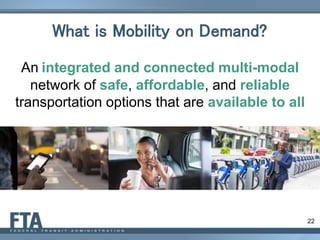
What is Mobility on Demand?
An integrated and connected multi-modal
network of safe, affordable, and reliable
transportation options that are available to all
23
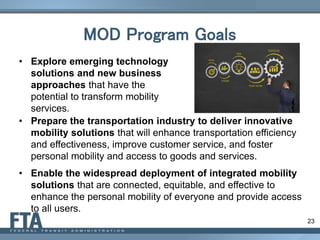
MOD Program Goals
• Explore emerging technology
solutions and new business
approaches that have the
potential to transform mobility
services.
• Prepare the transportation industry to deliver innovative
mobility solutions that will enhance transportation efficiency
and effectiveness, improve customer service, and foster
personal mobility and access to goods and services.
• Enable the widespread deployment of integrated mobility
solutions that are connected, equitable, and effective to
enhance the personal mobility of everyone and provide access
to all users.
24
Mobility on Demand Program at DOT
• Joint initiative led by the Federal
Transit Information (FTA) and the ITS
Joint Program Office (JPO)
• Efforts are underway including:
 MOD Foundational Research
 MOD Performance Metrics
 MOD Innovation & Knowledge
Accelerator
 MOD Sandbox Demonstrations
 MOD Sandbox Evaluations
 Stakeholder Engagement &
Outreach
 Policies and Practices
25
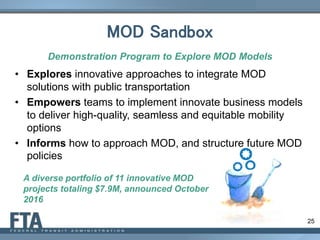
MOD Sandbox
Demonstration Program to Explore MOD Models
• Explores innovative approaches to integrate MOD
solutions with public transportation
• Empowers teams to implement innovate business models
to deliver high-quality, seamless and equitable mobility
options
• Informs how to approach MOD, and structure future MOD
policies
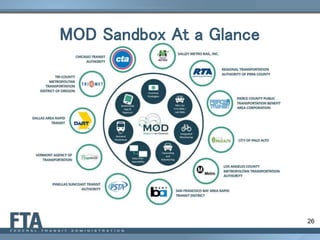
A diverse portfolio of 11 innovative MOD
projects totaling $7.9M, announced October
2016
26
MOD Sandbox At a Glance
Contact Information
27
Hendrik (Rik) Opstelton, Program Manager for Mobility on Demand (MOD)
Transit Research and Innovation (TRI) Unit
Email: hendrik.opstelten@dot.gov
Telephone: 202-366-8094
Website: Research and Innovation Webpage
https://www.transit.dot.gov/about/research-innovation
Current trends and innovations 5310 program and mod sandbox overview

Current trends and innovations 5310 program and mod sandbox overview

  • 1.
    Current Trends andInnovations in Rides to Wellness and Human Services Transportation Human Services Transportation Symposium Chattanooga, TN April 2017
  • 2.
    2 Talking Points • CurrentTrends • 5310 Program Overview • Highlight Changes in the 5310 Program Authorized by the FAST Act • Questions and Answers • Brief Overview of the Mobility on Demand Program
  • 3.
    3 Current Trends • ExpandBikeshare System with accessible bikes • Crossing Jurisdictional Boundaries • First Mile/Last Mile Solutions Source: 2016 Trends Report, published by the National Aging and Disability Transportation Center (NADTC)
  • 4.
    4 Accessible Bike SharePrograms • Benefits to Older Adults and Individuals with Disabilities: 1) Increase access to community services and resources 2) Solution to first mile / last mile issues 3) Increases overall transportation options and greater independence
  • 5.
    Types of AccessibleBike Share Accessible Trikes Handcycles
  • 6.
    Accessible Bike Share Sideby Side Bike w/Wheelchair attachment 6
  • 7.
    7 Accessible Bike SharePrograms • City of Detroit, MI – Launches summer 2017 – Range of accessible bikes • Westminster, Colorado – Launched June 2016 – 32 cruisers bikes, 3 handcycles, 5 trikes
  • 8.
    8 Crossing Jurisdictional Boundaries •Call-n-Ride, Montgomery County, MD – Taxi Voucher Program for Low income, Elderly, and Individuals with Disabilities – Fully subsidized by the County – Allow trips to Out of County medical appointments, but not return trips presents challenges 8
  • 9.
    9 Crossing Jurisdictional Boundaries •Grand Gateway Economic Development – Pelivan Transit – Coordination among multi-county, multi tribal, and multi-agencies and organizations – Allows access to services throughout the large territory, which otherwise may be limited – Utilize diverse range of federal funding to include 5311, 5310, 5309 – Demand Response, Deviated Fixed Route, NEMT, Nutrition
  • 10.
    10 First Mile/Last Mile •Opportunities for Improving – Improving Pedestrian Access – Technology Apps and Mobile Reservations – Alternate Modes i.e. Bikeshare – Increase Coordination and Partnerships
  • 11.
    11 Quick overview 5310 Program •Examples of Eligible Projects • FAST Act changes
  • 12.
    FAST Act AuthorizedFunding for Section 5310 and Innovative Coordination Projects 12 FY 2016 (in millions) FY 2017 (in millions) FY 2018 (in millions) FY 2019 (in millions) FY 2020 (in millions) 5310 Formula Grants $262.95 $268.21 $273.84 $279.65 $285.58 Discretionary Pilot Program $2.00 $3.00 $3.25 $3.50 $3.50 5310 Total $264.95 $271.21 $277.09 $283.15 $289.08
  • 13.
    13 Examples of Capital Section5310 Projects Capital Purchases • Vehicles (i.e., buses, vans, or accessible taxis) • Approved Vehicle Rehabilitation or Overhaul • Related Vehicle Equipment (i.e., lifts, ramps, securement devices; etc.) • Other Capital Equipment Purchases (i.e., communications equipment such as Mobile Data Terminals or Computers; security equipment such as camera systems for vehicles; fare collection systems; etc.) • Mobility Management • Cost of Leased or Contracted Services
  • 14.
    14 Examples of “Other”Section 5310 Projects • Mobility Management • Travel Training • Curb Cuts • Sidewalks • Pedestrian Signals or Other Accessible Features • Volunteer Driver Programs (Mileage Reimbursement)
  • 15.
    15 Examples of “Other”Projects (continued) • Costs Directly Tied to Transit Operations • Administrative Expenses • Operation of Transportation Brokerages to Coordinate Providers, Funding Agencies, and Passengers • Development and Operation of One-Call/One-Click Call Centers • Voucher Programs
  • 16.
    FAST Act Changesto the Section 5310 Program • A State or local governmental entity that operates a public transportation service and that is eligible to receive direct grants under 5311 or 5307 is now an eligible direct recipient • There is now a requirement for the collection of best practices for dissemination to public transportation on innovation, program models, new services delivery options, performance measure findings, and transit cooperative research program reports 16
  • 17.
    FAST Act Changesto the Section 5310 Program, Cont. • Section 3006(b): a discretionary pilot program for innovative coordinated access and mobility - open to 5310 recipients and subrecipients - to assist in financing innovative projects for the transportation disadvantaged that improve the coordination of transportation services and non- emergency medical transportation services; such as: the deployment of coordination technology, projects that create or increase access to community (i.e. One-Call/One-Click Centers, etc.) 17
  • 18.
    FAST Act Changesto the Section 5310 Program, Cont. • Section 3006(c): Coordinated Mobility which requires following through on recommendations made by the Interagency Transportation Coordination Council on Access and Mobility (CCAM) 2005 Report to the President relating to the implementation of Executive Order No. 13330 (49 U.S.S. 101 note) including publicizing an updated strategic plan and developing a cost-sharing policy 18
  • 19.
    19 Resources • FTA Resources –5310 ProgramWebpage: https://www.transit.dot.gov/funding/grants/enhanced-mobility-seniors- individuals-disabilities-section-5310 – Rides to Wellness Webpage: https://www.transit.dot.gov/ccam/about/initiatives • National Aging and Disability Transportation Center Resources – “2016 Transporation Trends Report: A Look at the Year’s Top Mobility Challenges and Opportunities” – http://www.nadtc.org/resourcespublications/2016transportation-trends- a-look-at-the-years-top-mobility-challenges-opportunities/ 19
  • 20.
    Contact Information 20 Kelly A.Tyler, Program Manager Enhanced Mobility for Seniors And Individuals with Disabilities Program (Section 5310) U.S. DOT | Federal Transit Administration 1200 New Jersey Avenue, S.E. Washington, D.C. 20590 202-366-3102 (phone)
  • 21.
    Mobility On Demand(MOD) Program April 2017
  • 22.
    22 What is Mobilityon Demand? An integrated and connected multi-modal network of safe, affordable, and reliable transportation options that are available to all
  • 23.
    23 MOD Program Goals •Explore emerging technology solutions and new business approaches that have the potential to transform mobility services. • Prepare the transportation industry to deliver innovative mobility solutions that will enhance transportation efficiency and effectiveness, improve customer service, and foster personal mobility and access to goods and services. • Enable the widespread deployment of integrated mobility solutions that are connected, equitable, and effective to enhance the personal mobility of everyone and provide access to all users.
  • 24.
    24 Mobility on DemandProgram at DOT • Joint initiative led by the Federal Transit Information (FTA) and the ITS Joint Program Office (JPO) • Efforts are underway including:  MOD Foundational Research  MOD Performance Metrics  MOD Innovation & Knowledge Accelerator  MOD Sandbox Demonstrations  MOD Sandbox Evaluations  Stakeholder Engagement & Outreach  Policies and Practices
  • 25.
    25 MOD Sandbox Demonstration Programto Explore MOD Models • Explores innovative approaches to integrate MOD solutions with public transportation • Empowers teams to implement innovate business models to deliver high-quality, seamless and equitable mobility options • Informs how to approach MOD, and structure future MOD policies A diverse portfolio of 11 innovative MOD projects totaling $7.9M, announced October 2016
  • 26.
  • 27.
    Contact Information 27 Hendrik (Rik)Opstelton, Program Manager for Mobility on Demand (MOD) Transit Research and Innovation (TRI) Unit Email: hendrik.opstelten@dot.gov Telephone: 202-366-8094 Website: Research and Innovation Webpage https://www.transit.dot.gov/about/research-innovation