Next Generation Intelligent Transportation
Solutions for Smart Cities
Dr. Raj Bridgelall & Dr. Denver Tolliver
March 2, 2016
2
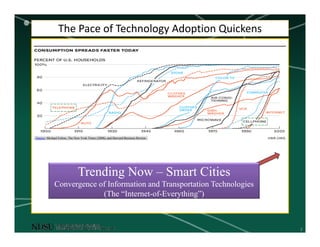
The Pace of Technology Adoption Quickens
Trending Now – Smart Cities
Convergence of Information and Transportation Technologies
(The “Internet-of-Everything”)
Source: Michael Felton, The New York Times (2008), and Harvard Business Review
3
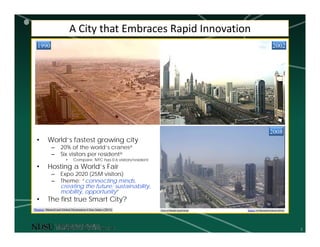
A City that Embraces Rapid Innovation
Source: Al Mawakeb Schools (2016)View of Sheikh Zayed Road
1990 2002
2008
• World’s fastest growing city
– 20% of the world’s cranesa
– Six visitors per residenta
• Compare: NYC has 0.6 visitors/resident
• Hosting a World’s Fair
– Expo 2020 (25M visitors)
– Theme: “connecting minds,
creating the future: sustainability,
mobility, opportunity”
• The first true Smart City?
aSource: MasterCard Global Destination Cities Index (2015)
4
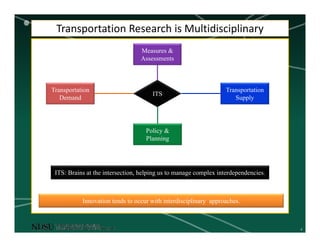
Transportation Research is Multidisciplinary
Transportation
Demand
Transportation
Supply
Measures &
Assessments
Policy &
Planning
ITS
Innovation tends to occur with interdisciplinary approaches.
ITS: Brains at the intersection, helping us to manage complex interdependencies.
5
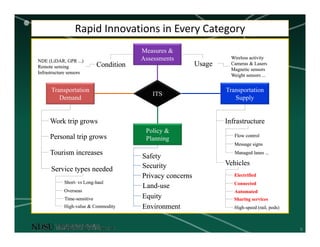
Rapid Innovations in Every Category
Transportation
Demand
Transportation
Supply
Measures &
Assessments
Policy &
Planning
ITS
Work trip growsWork trip grows
Service types neededService types needed
Personal trip growsPersonal trip grows
InfrastructureInfrastructure
VehiclesVehicles
Flow controlFlow control
Message signsMessage signs
ElectrifiedElectrified
ConnectedConnected
AutomatedAutomated
SafetySafety
Privacy concernsPrivacy concerns
SecuritySecurity
Land-useLand-use
ConditionCondition
Tourism increasesTourism increases
UsageUsage
Sharing servicesSharing services
High-speed (rail, pods)High-speed (rail, pods)
Managed lanes ...Managed lanes ...
EquityEquity
EnvironmentEnvironment
Short- vs Long-haulShort- vs Long-haul
OverseasOverseas
Time-sensitiveTime-sensitive
High-value & CommodityHigh-value & Commodity
Wireless activity
Cameras & Lasers
Magnetic sensors
Weight sensors ...
Wireless activity
Cameras & Lasers
Magnetic sensors
Weight sensors ...
NDE (LiDAR, GPR ...)
Remote sensing
Infrastructure sensors
NDE (LiDAR, GPR ...)
Remote sensing
Infrastructure sensors
6
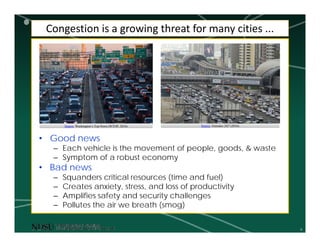
• Good news
– Each vehicle is the movement of people, goods, & waste
– Symptom of a robust economy
• Bad news
– Squanders critical resources (time and fuel)
– Creates anxiety, stress, and loss of productivity
– Amplifies safety and security challenges
– Pollutes the air we breath (smog)
Congestion is a growing threat for many cities ...
Source: Emirates 24|7 (2016)Source: Washington’s Top News (WTOP, 2016)
7
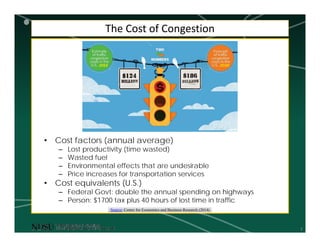
The Cost of Congestion
• Cost factors (annual average)
– Lost productivity (time wasted)
– Wasted fuel
– Environmental effects that are undesirable
– Price increases for transportation services
• Cost equivalents (U.S.)
– Federal Govt: double the annual spending on highways
– Person: $1700 tax plus 40 hours of lost time in traffic
Source: Center for Economics and Business Research (2014)
8
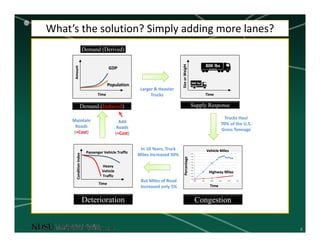
What’s the solution? Simply adding more lanes?
GDPGDP
PopulationPopulation
TimeTime
AmountAmount
TimeTime
Size or WeightSize or Weight
30K lbs30K lbs
80K lbs80K lbs
Larger & Heavier
Trucks
Larger & Heavier
Trucks
Trucks Haul
70% of the U.S.
Gross Tonnage
Trucks Haul
70% of the U.S.
Gross Tonnage
1.00
1.05
1.10
1.15
1.20
1.25
1.30
1.35
1.40
1.45
1990 1995 2000 2005 2010 2015
TimeTimePercentagePercentage
Vehicle MilesVehicle Miles
Highway MilesHighway Miles
In 10 Years, Truck
Miles Increased 50%
In 10 Years, Truck
Miles Increased 50%
Passenger Vehicle TrafficPassenger Vehicle Traffic
Heavy
Vehicle
Traffic
Heavy
Vehicle
Traffic
TimeTime
Condition IndexCondition Index
But Miles of Road
Increased only 5%
But Miles of Road
Increased only 5%
Add
Roads
(+Cost)
Add
Roads
(+Cost)
Maintain
Roads
(+Cost)
Maintain
Roads
(+Cost)
CongestionDeterioration
Demand (Induced) Supply Response
Demand (Derived)
9
The Vision for Smart Cities
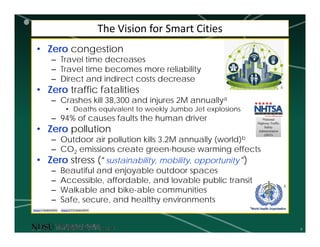
• Zero congestion
– Travel time decreases
– Travel time becomes more reliability
– Direct and indirect costs decrease
• Zero traffic fatalities
– Crashes kill 38,300 and injures 2M annuallya
• Deaths equivalent to weekly Jumbo Jet explosions
– 94% of causes faults the human driver
• Zero pollution
– Outdoor air pollution kills 3.2M annually (world)b
– CO2 emissions create green-house warming effects
• Zero stress (“sustainability, mobility, opportunity”)
– Beautiful and enjoyable outdoor spaces
– Accessible, affordable, and lovable public transit
– Walkable and bike-able communities
– Safe, secure, and healthy environments
1
Source 1: Siradel (2016)
aNational
Highway Traffic
Safety
Administration
(2015)
Source 2: UT Austin (2015)
2
bb
10
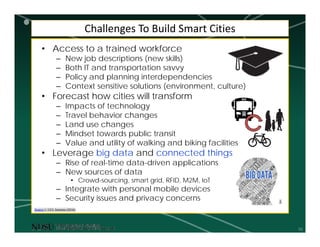
Challenges To Build Smart Cities
• Access to a trained workforce
– New job descriptions (new skills)
– Both IT and transportation savvy
– Policy and planning interdependencies
– Context sensitive solutions (environment, culture)
• Forecast how cities will transform
– Impacts of technology
– Travel behavior changes
– Land use changes
– Mindset towards public transit
– Value and utility of walking and biking facilities
• Leverage big data and connected things
– Rise of real-time data-driven applications
– New sources of data
• Crowd-sourcing, smart grid, RFID, M2M, IoT
– Integrate with personal mobile devices
– Security issues and privacy concerns
Source 1: UCL Institute (2016)
1
11
Disruptive Innovations: Opportunities & Challenges
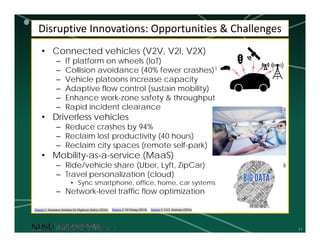
• Connected vehicles (V2V, V2I, V2X)
– IT platform on wheels (IoT)
– Collision avoidance (40% fewer crashes)1
– Vehicle platoons increase capacity
– Adaptive flow control (sustain mobility)
– Enhance work-zone safety & throughput
– Rapid incident clearance
• Driverless vehicles
– Reduce crashes by 94%
– Reclaim lost productivity (40 hours)
– Reclaim city spaces (remote self-park)
• Mobility-as-a-service (MaaS)
– Ride/vehicle share (Uber, Lyft, ZipCar)
– Travel personalization (cloud)
• Sync smartphone, office, home, car systems
– Network-level traffic flow optimization
Source 2: ECNmag (2014)
2
3
Source 3: UCL Institute (2016)Source 1: Insurance Institute for Highway Safety (2016)
12
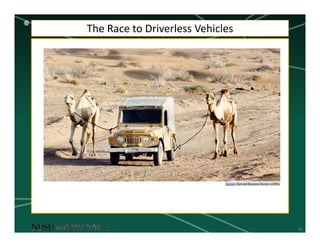
The Race to Driverless Vehicles
Source: Harvard Business Review (2006)
13
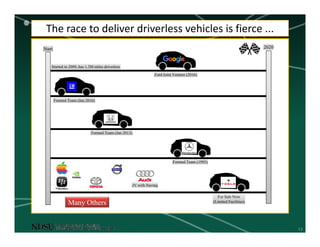
The race to deliver driverless vehicles is fierce ...
Ford Joint Venture (2016)
2020Start
Started in 2009, has 1.3M miles driverless
Formed Team (Jan 2016)
Formed Team (Jan 2013)
Formed Team (1995)
For Sale Now
(Limited Facilities)Many Others
JV with Navteq
14
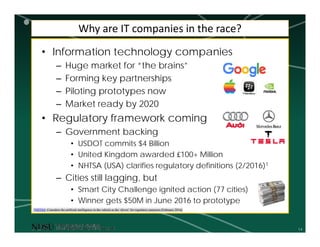
Why are IT companies in the race?
• Information technology companies
– Huge market for “the brains”
– Forming key partnerships
– Piloting prototypes now
– Market ready by 2020
• Regulatory framework coming
– Government backing
• USDOT commits $4 Billion
• United Kingdom awarded £100+ Million
• NHTSA (USA) clarifies regulatory definitions (2/2016)1
– Cities still lagging, but
• Smart City Challenge ignited action (77 cities)
• Winner gets $50M in June 2016 to prototype
1NHTSA: Considers the artificial intelligence in the vehicle as the ‘driver’ for regulatory purposes (February 2016)
15
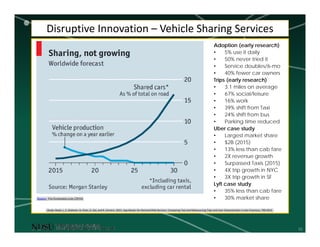
Disruptive Innovation – Vehicle Sharing Services
Source: Via Economist.com (2016)
Adoption (early research)
• 5% use it daily
• 50% never tried it
• Service doubles/6-mo
• 40% fewer car owners
Trips (early research)
• 3.1 miles on average
• 67% social/leisure
• 16% work
• 39% shift from Taxi
• 24% shift from bus
• Parking time reduced
Uber case study
• Largest market share
• $2B (2015)
• 13% less than cab fare
• 2X revenue growth
• Surpassed Taxis (2015)
• 4X trip growth in NYC
• 3X trip growth in SF
Lyft case study
• 35% less than cab fare
• 30% market share
Study: Rayle, L, S. Shaheen, N. Chan, D. Dai, and R. Cervero. 2015. App‐Based, On‐Demand Ride Services: Comparing Taxi and Ridesourcing Trips and User Characteristics in San Francisco, TRB 2015
16
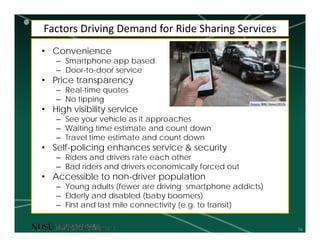
Factors Driving Demand for Ride Sharing Services
• Convenience
– Smartphone app based
– Door-to-door service
• Price transparency
– Real-time quotes
– No tipping
• High visibility service
– See your vehicle as it approaches
– Waiting time estimate and count down
– Travel time estimate and count down
• Self-policing enhances service & security
– Riders and drivers rate each other
– Bad riders and drivers economically forced out
• Accessible to non-driver population
– Young adults (fewer are driving; smartphone addicts)
– Elderly and disabled (baby boomers)
– First and last mile connectivity (e.g. to transit)
Source: BBC News (2015)
17
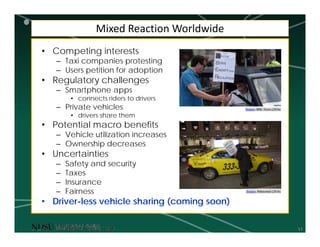
Mixed Reaction Worldwide
• Competing interests
– Taxi companies protesting
– Users petition for adoption
• Regulatory challenges
– Smartphone apps
• connects riders to drivers
– Private vehicles
• drivers share them
• Potential macro benefits
– Vehicle utilization increases
– Ownership decreases
• Uncertainties
– Safety and security
– Taxes
– Insurance
– Fairness
• Driver-less vehicle sharing (coming soon)
Source: BBC News (2016)
Source: Malaymail (2016)
18
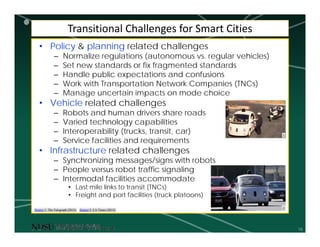
Transitional Challenges for Smart Cities
• Policy & planning related challenges
– Normalize regulations (autonomous vs. regular vehicles)
– Set new standards or fix fragmented standards
– Handle public expectations and confusions
– Work with Transportation Network Companies (TNCs)
– Manage uncertain impacts on mode choice
• Vehicle related challenges
– Robots and human drivers share roads
– Varied technology capabilities
– Interoperability (trucks, transit, car)
– Service facilities and requirements
• Infrastructure related challenges
– Synchronizing messages/signs with robots
– People versus robot traffic signaling
– Intermodal facilities accommodate
• Last mile links to transit (TNCs)
• Freight and port facilities (truck platoons)
Source 2: LA Times (2015)Source 1: The Telegraph (2015)
2
1
19
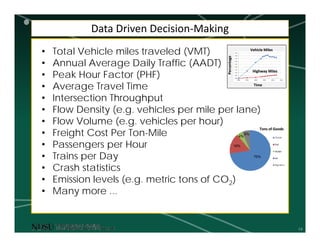
Data Driven Decision‐Making
• Total Vehicle miles traveled (VMT)
• Annual Average Daily Traffic (AADT)
• Peak Hour Factor (PHF)
• Average Travel Time
• Intersection Throughput
• Flow Density (e.g. vehicles per mile per lane)
• Flow Volume (e.g. vehicles per hour)
• Freight Cost Per Ton-Mile
• Passengers per Hour
• Trains per Day
• Crash statistics
• Emission levels (e.g. metric tons of CO2)
• Many more ...
1.00
1.05
1.10
1.15
1.20
1.25
1.30
1.35
1.40
1.45
1990 1995 2000 2005 2010 2015
TimeTime
PercentagePercentage
Vehicle MilesVehicle Miles
Highway MilesHighway Miles
Tons of GoodsTons of Goods
20
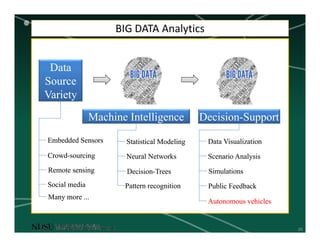
BIG DATA Analytics
Data
Source
Variety
Machine Intelligence Decision-Support
Statistical ModelingStatistical Modeling
Neural NetworksNeural Networks
Decision-TreesDecision-Trees
Pattern recognitionPattern recognition
Data VisualizationData Visualization
Scenario AnalysisScenario Analysis
SimulationsSimulations
Public FeedbackPublic Feedback
Embedded SensorsEmbedded Sensors
Crowd-sourcingCrowd-sourcing
Remote sensingRemote sensing
Social mediaSocial media
Many more ...Many more ...
Autonomous vehiclesAutonomous vehicles
21
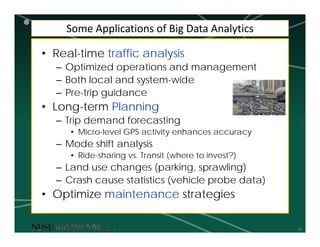
Some Applications of Big Data Analytics
• Real-time traffic analysis
– Optimized operations and management
– Both local and system-wide
– Pre-trip guidance
• Long-term Planning
– Trip demand forecasting
• Micro-level GPS activity enhances accuracy
– Mode shift analysis
• Ride-sharing vs. Transit (where to invest?)
– Land use changes (parking, sprawling)
– Crash cause statistics (vehicle probe data)
• Optimize maintenance strategies
22
Research Questions?
Lots
?
23
Research Questions (Benefits and Costs)
• Benefits Analysis
– Congestion reduction
– Crash reduction
– Pollution reduction
• Cost Analysis
– Technology acquisition and deployment
– Training to deploy new technologies
– Multimodal facility modifications
– Intermodal facility modifications
• Economic impacts
– Enhanced trucking capacity
– Enhanced rail capacity
– Vehicle electrification
?
24
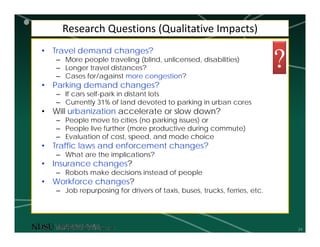
Research Questions (Qualitative Impacts)
• Travel demand changes?
– More people traveling (blind, unlicensed, disabilities)
– Longer travel distances?
– Cases for/against more congestion?
• Parking demand changes?
– If cars self-park in distant lots
– Currently 31% of land devoted to parking in urban cores
• Will urbanization accelerate or slow down?
– People move to cities (no parking issues) or
– People live further (more productive during commute)
– Evaluation of cost, speed, and mode choice
• Traffic laws and enforcement changes?
– What are the implications?
• Insurance changes?
– Robots make decisions instead of people
• Workforce changes?
– Job repurposing for drivers of taxis, buses, trucks, ferries, etc.
?
25
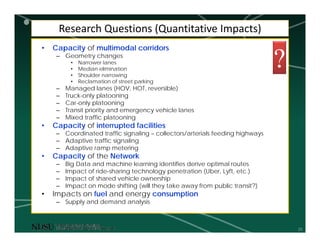
Research Questions (Quantitative Impacts)
• Capacity of multimodal corridors
– Geometry changes
• Narrower lanes
• Median elimination
• Shoulder narrowing
• Reclamation of street parking
– Managed lanes (HOV, HOT, reversible)
– Truck-only platooning
– Car-only platooning
– Transit priority and emergency vehicle lanes
– Mixed traffic platooning
• Capacity of interrupted facilities
– Coordinated traffic signaling – collectors/arterials feeding highways
– Adaptive traffic signaling
– Adaptive ramp metering
• Capacity of the Network
– Big Data and machine learning identifies derive optimal routes
– Impact of ride-sharing technology penetration (Uber, Lyft, etc.)
– Impact of shared vehicle ownership
– Impact on mode shifting (will they take away from public transit?)
• Impacts on fuel and energy consumption
– Supply and demand analysis
?
26
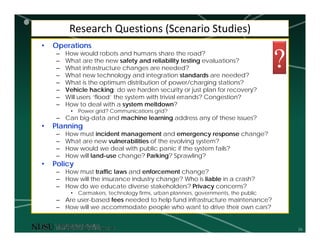
Research Questions (Scenario Studies)
• Operations
– How would robots and humans share the road?
– What are the new safety and reliability testing evaluations?
– What infrastructure changes are needed?
– What new technology and integration standards are needed?
– What is the optimum distribution of power/charging stations?
– Vehicle hacking: do we harden security or just plan for recovery?
– Will users ‘flood’ the system with trivial errands? Congestion?
– How to deal with a system meltdown?
• Power grid? Communications grid?
– Can big-data and machine learning address any of these issues?
• Planning
– How must incident management and emergency response change?
– What are new vulnerabilities of the evolving system?
– How would we deal with public panic if the system fails?
– How will land-use change? Parking? Sprawling?
• Policy
– How must traffic laws and enforcement change?
– How will the insurance industry change? Who is liable in a crash?
– How do we educate diverse stakeholders? Privacy concerns?
• Carmakers, technology firms, urban planners, governments, the public
– Are user-based fees needed to help fund infrastructure maintenance?
– How will we accommodate people who want to drive their own cars?
?
27
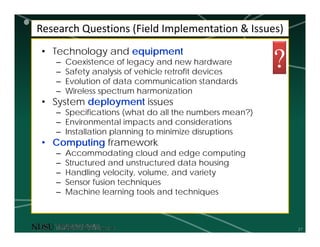
Research Questions (Field Implementation & Issues)
• Technology and equipment
– Coexistence of legacy and new hardware
– Safety analysis of vehicle retrofit devices
– Evolution of data communication standards
– Wireless spectrum harmonization
• System deployment issues
– Specifications (what do all the numbers mean?)
– Environmental impacts and considerations
– Installation planning to minimize disruptions
• Computing framework
– Accommodating cloud and edge computing
– Structured and unstructured data housing
– Handling velocity, volume, and variety
– Sensor fusion techniques
– Machine learning tools and techniques
?
28
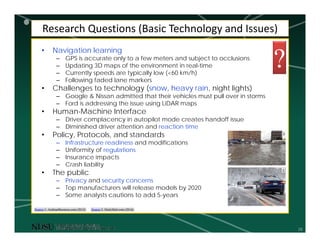
Research Questions (Basic Technology and Issues)
• Navigation learning
– GPS is accurate only to a few meters and subject to occlusions
– Updating 3D maps of the environment in real-time
– Currently speeds are typically low (<60 km/h)
– Following faded lane markers
• Challenges to technology (snow, heavy rain, night lights)
– Google & Nissan admitted that their vehicles must pull over in storms
– Ford is addressing the issue using LiDAR maps
• Human-Machine Interface
– Driver complacency in autopilot mode creates handoff issue
– Diminished driver attention and reaction time
• Policy, Protocols, and standards
– Infrastructure readiness and modifications
– Uniformity of regulations
– Insurance impacts
– Crash liability
• The public
– Privacy and security concerns
– Top manufacturers will release models by 2020
– Some analysts cautions to add 5-years
Source 2: DailyMail.com (2016)Source 1: ArabianBusiness.com (2015)
1
2
?
29
Research Questions (Advanced Technology/Issues)
• GIS system with real-time 3D mapping
– Map localization performance and issues
– Path planning performance and issues
• Cameras and Image Processing
– Object detection performance
– Object classification performance
– Object segmentation performance
• See through fog and dark
– RADAR (proximity detection)
– Ultrasonic (proximity detection)
– LiDAR (360-degree vision)
• Dedicated low-cost supercomputers
– NVIDIA DRIVE™ PX 2 capable of 24 Trillion ‘deep learning’ operations per second
(equivalent of 150 MacBook Pros), supporting 12 simultaneous camera streams, plus
LiDAR, RADAR, and Ultrasonic sensors [html] used by Audi, BMW, Daimler, Ford
– Google, Apple, Blackberry, Samsung, etc.
• Machine learning software
– Accumulate more driving wisdom than humans over time
– Never distract and never repeat a mistake (unlike humans)
– Sensor calibration, data synchronization, sensor fusion
– Establish vehicle position relative to static and dynamic objects
– Calculate optimal path for safe travel
– ‘Deep’ neural network learning from successes, failures, and other vehicles
– Shared learning network from effective driving behaviors
Source 1: NVIDIA (2016)
1
?
30
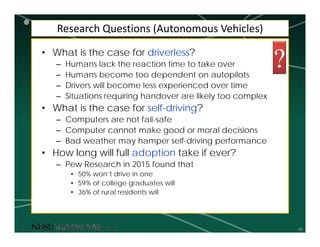
Research Questions (Autonomous Vehicles)
• What is the case for driverless?
– Humans lack the reaction time to take over
– Humans become too dependent on autopilots
– Drivers will become less experienced over time
– Situations requiring handover are likely too complex
• What is the case for self-driving?
– Computers are not fail-safe
– Computer cannot make good or moral decisions
– Bad weather may hamper self-driving performance
• How long will full adoption take if ever?
– Pew Research in 2015 found that
• 50% won’t drive in one
• 59% of college graduates will
• 36% of rural residents will
?
31
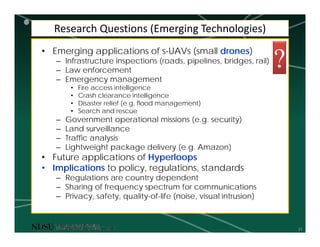
Research Questions (Emerging Technologies)
• Emerging applications of s-UAVs (small drones)
– Infrastructure inspections (roads, pipelines, bridges, rail)
– Law enforcement
– Emergency management
• Fire access intelligence
• Crash clearance intelligence
• Disaster relief (e.g. flood management)
• Search and rescue
– Government operational missions (e.g. security)
– Land surveillance
– Traffic analysis
– Lightweight package delivery (e.g. Amazon)
• Future applications of Hyperloops
• Implications to policy, regulations, standards
– Regulations are country dependent
– Sharing of frequency spectrum for communications
– Privacy, safety, quality-of-life (noise, visual intrusion)
?
32
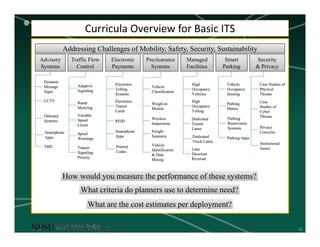
Curricula Overview for Basic ITS
Addressing Challenges of Mobility, Safety, Security, Sustainability
Advisory
Systems
Traffic Flow
Control
Electronic
Payments
Preclearance
Systems
Managed
Facilities
Smart
Parking
Security
& Privacy
Dynamic
Message
Signs
Dynamic
Message
Signs
Onboard
Systems
Onboard
Systems
Smartphone
Apps
Smartphone
Apps
TBDTBD
How would you measure the performance of these systems?
Adaptive
Signaling
Adaptive
Signaling
Ramp
Metering
Ramp
Metering
Variable
Speed
Limits
Variable
Speed
Limits
Speed
Warnings
Speed
Warnings
Transit
Signaling
Priority
Transit
Signaling
Priority
Electronic
Tolling
Systems
Electronic
Tolling
Systems
Electronic
Transit
Cards
Electronic
Transit
Cards
RFIDRFID
Smartphone
Apps
Smartphone
Apps
Vehicle
Classification
Vehicle
Classification
Weigh-in-
Motion
Weigh-in-
Motion
Wireless
Inspections
Wireless
Inspections
Freight
Scanners
Freight
Scanners
Vehicle
Identification
& Data
Mining
Vehicle
Identification
& Data
Mining
High
Occupancy
Vehicles
High
Occupancy
Vehicles
High
Occupancy
Tolling
High
Occupancy
Tolling
Dedicated
Transit
Lanes
Dedicated
Transit
Lanes
Dedicated
Truck Lanes
Dedicated
Truck Lanes
Lane
Direction
Reversal
Lane
Direction
Reversal
Vehicle
Occupancy
Sensing
Vehicle
Occupancy
Sensing
Parking
Meters
Parking
Meters
Parking
Reservation
Systems
Parking
Reservation
Systems
Parking AppsParking Apps
Case Studies of
Physical
Threats
Case Studies of
Physical
Threats
Case
Studies of
Cyber
Threats
Case
Studies of
Cyber
Threats
Privacy
Concerns
Privacy
Concerns
What criteria do planners use to determine need?
What are the cost estimates per deployment?
Institutional
Issues
Institutional
Issues
CCTVCCTV
Printed
Codes
Printed
Codes
33
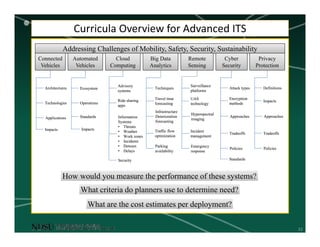
Curricula Overview for Advanced ITS
Addressing Challenges of Mobility, Safety, Security, Sustainability
Connected
Vehicles
Automated
Vehicles
Cloud
Computing
Big Data
Analytics
Remote
Sensing
Cyber
Security
Privacy
Protection
How would you measure the performance of these systems?
What criteria do planners use to determine need?
What are the cost estimates per deployment?
ArchitecturesArchitectures
TechnologiesTechnologies
ApplicationsApplications
ImpactsImpacts
EcosystemEcosystem
OperationsOperations
StandardsStandards
ImpactsImpacts
Advisory
systems
Advisory
systems
Ride sharing
apps
Ride sharing
apps
Information
Systems
• Threats
• Weather
• Work zones
• Incidents
• Detours
• Delays
Information
Systems
• Threats
• Weather
• Work zones
• Incidents
• Detours
• Delays
SecuritySecurity
TechniquesTechniques
Travel time
forecasting
Travel time
forecasting
Infrastructure
Deterioration
forecasting
Infrastructure
Deterioration
forecasting
Traffic flow
optimization
Traffic flow
optimization
Parking
availability
Parking
availability
Surveillance
platforms
Surveillance
platforms
UAS
technology
UAS
technology
Hyperspectral
imaging
Hyperspectral
imaging
Incident
management
Incident
management
Emergency
response
Emergency
response
Attack typesAttack types
Encryption
methods
Encryption
methods
ApproachesApproaches
TradeoffsTradeoffs
PoliciesPolicies
DefinitionsDefinitions
ImpactsImpacts
ApproachesApproaches
TradeoffsTradeoffs
PoliciesPolicies
StandardsStandards
34
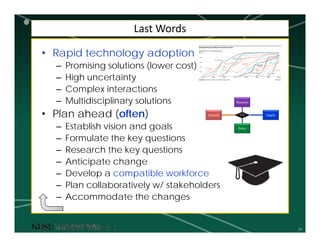
Last Words
• Rapid technology adoption
– Promising solutions (lower cost)
– High uncertainty
– Complex interactions
– Multidisciplinary solutions
• Plan ahead (often)
– Establish vision and goals
– Formulate the key questions
– Research the key questions
– Anticipate change
– Develop a compatible workforce
– Plan collaboratively w/ stakeholders
– Accommodate the changes
Demand Supply
Measures
Policy
ITS

Next Generation Intelligent Transportation: Solutions for Smart Cities

  • 1.
    Next Generation IntelligentTransportation Solutions for Smart Cities Dr. Raj Bridgelall & Dr. Denver Tolliver March 2, 2016
  • 2.
    2 The Pace of Technology Adoption Quickens Trending Now –Smart Cities Convergence of Information and Transportation Technologies (The “Internet-of-Everything”) Source: Michael Felton, The New York Times (2008), and Harvard Business Review
  • 3.
    3 A City that Embraces Rapid Innovation Source: Al MawakebSchools (2016)View of Sheikh Zayed Road 1990 2002 2008 • World’s fastest growing city – 20% of the world’s cranesa – Six visitors per residenta • Compare: NYC has 0.6 visitors/resident • Hosting a World’s Fair – Expo 2020 (25M visitors) – Theme: “connecting minds, creating the future: sustainability, mobility, opportunity” • The first true Smart City? aSource: MasterCard Global Destination Cities Index (2015)
  • 4.
    4 Transportation Research is Multidisciplinary Transportation Demand Transportation Supply Measures & Assessments Policy & Planning ITS Innovationtends to occur with interdisciplinary approaches. ITS: Brains at the intersection, helping us to manage complex interdependencies.
  • 5.
    5 Rapid Innovations in Every Category Transportation Demand Transportation Supply Measures & Assessments Policy & Planning ITS Worktrip growsWork trip grows Service types neededService types needed Personal trip growsPersonal trip grows InfrastructureInfrastructure VehiclesVehicles Flow controlFlow control Message signsMessage signs ElectrifiedElectrified ConnectedConnected AutomatedAutomated SafetySafety Privacy concernsPrivacy concerns SecuritySecurity Land-useLand-use ConditionCondition Tourism increasesTourism increases UsageUsage Sharing servicesSharing services High-speed (rail, pods)High-speed (rail, pods) Managed lanes ...Managed lanes ... EquityEquity EnvironmentEnvironment Short- vs Long-haulShort- vs Long-haul OverseasOverseas Time-sensitiveTime-sensitive High-value & CommodityHigh-value & Commodity Wireless activity Cameras & Lasers Magnetic sensors Weight sensors ... Wireless activity Cameras & Lasers Magnetic sensors Weight sensors ... NDE (LiDAR, GPR ...) Remote sensing Infrastructure sensors NDE (LiDAR, GPR ...) Remote sensing Infrastructure sensors
  • 6.
    6 • Good news –Each vehicle is the movement of people, goods, & waste – Symptom of a robust economy • Bad news – Squanders critical resources (time and fuel) – Creates anxiety, stress, and loss of productivity – Amplifies safety and security challenges – Pollutes the air we breath (smog) Congestion is a growing threat for many cities ... Source: Emirates 24|7 (2016)Source: Washington’s Top News (WTOP, 2016)
  • 7.
    7 The Cost of Congestion • Cost factors(annual average) – Lost productivity (time wasted) – Wasted fuel – Environmental effects that are undesirable – Price increases for transportation services • Cost equivalents (U.S.) – Federal Govt: double the annual spending on highways – Person: $1700 tax plus 40 hours of lost time in traffic Source: Center for Economics and Business Research (2014)
  • 8.
    8 What’s the solution? Simply adding more lanes? GDPGDP PopulationPopulation TimeTime AmountAmount TimeTime Size or WeightSize or Weight 30K lbs30K lbs 80K lbs80K lbs Larger & Heavier Trucks Larger & Heavier Trucks Trucks Haul 70% of the U.S. Gross Tonnage Trucks Haul 70% of the U.S. Gross Tonnage 1.00 1.05 1.10 1.15 1.20 1.25 1.30 1.35 1.40 1.45 1990 1995 20002005 2010 2015 TimeTimePercentagePercentage Vehicle MilesVehicle Miles Highway MilesHighway Miles In 10 Years, Truck Miles Increased 50% In 10 Years, Truck Miles Increased 50% Passenger Vehicle TrafficPassenger Vehicle Traffic Heavy Vehicle Traffic Heavy Vehicle Traffic TimeTime Condition IndexCondition Index But Miles of Road Increased only 5% But Miles of Road Increased only 5% Add Roads (+Cost) Add Roads (+Cost) Maintain Roads (+Cost) Maintain Roads (+Cost) CongestionDeterioration Demand (Induced) Supply Response Demand (Derived)
  • 9.
    9 The Vision for Smart Cities • Zero congestion –Travel time decreases – Travel time becomes more reliability – Direct and indirect costs decrease • Zero traffic fatalities – Crashes kill 38,300 and injures 2M annuallya • Deaths equivalent to weekly Jumbo Jet explosions – 94% of causes faults the human driver • Zero pollution – Outdoor air pollution kills 3.2M annually (world)b – CO2 emissions create green-house warming effects • Zero stress (“sustainability, mobility, opportunity”) – Beautiful and enjoyable outdoor spaces – Accessible, affordable, and lovable public transit – Walkable and bike-able communities – Safe, secure, and healthy environments 1 Source 1: Siradel (2016) aNational Highway Traffic Safety Administration (2015) Source 2: UT Austin (2015) 2 bb
  • 10.
    10 Challenges To Build Smart Cities • Access toa trained workforce – New job descriptions (new skills) – Both IT and transportation savvy – Policy and planning interdependencies – Context sensitive solutions (environment, culture) • Forecast how cities will transform – Impacts of technology – Travel behavior changes – Land use changes – Mindset towards public transit – Value and utility of walking and biking facilities • Leverage big data and connected things – Rise of real-time data-driven applications – New sources of data • Crowd-sourcing, smart grid, RFID, M2M, IoT – Integrate with personal mobile devices – Security issues and privacy concerns Source 1: UCL Institute (2016) 1
  • 11.
    11 Disruptive Innovations: Opportunities & Challenges • Connected vehicles(V2V, V2I, V2X) – IT platform on wheels (IoT) – Collision avoidance (40% fewer crashes)1 – Vehicle platoons increase capacity – Adaptive flow control (sustain mobility) – Enhance work-zone safety & throughput – Rapid incident clearance • Driverless vehicles – Reduce crashes by 94% – Reclaim lost productivity (40 hours) – Reclaim city spaces (remote self-park) • Mobility-as-a-service (MaaS) – Ride/vehicle share (Uber, Lyft, ZipCar) – Travel personalization (cloud) • Sync smartphone, office, home, car systems – Network-level traffic flow optimization Source 2: ECNmag (2014) 2 3 Source 3: UCL Institute (2016)Source 1: Insurance Institute for Highway Safety (2016)
  • 12.
  • 13.
    13 The race to deliver driverless vehicles is fierce ... Ford Joint Venture(2016) 2020Start Started in 2009, has 1.3M miles driverless Formed Team (Jan 2016) Formed Team (Jan 2013) Formed Team (1995) For Sale Now (Limited Facilities)Many Others JV with Navteq
  • 14.
    14 Why are IT companies in the race? • Information technologycompanies – Huge market for “the brains” – Forming key partnerships – Piloting prototypes now – Market ready by 2020 • Regulatory framework coming – Government backing • USDOT commits $4 Billion • United Kingdom awarded £100+ Million • NHTSA (USA) clarifies regulatory definitions (2/2016)1 – Cities still lagging, but • Smart City Challenge ignited action (77 cities) • Winner gets $50M in June 2016 to prototype 1NHTSA: Considers the artificial intelligence in the vehicle as the ‘driver’ for regulatory purposes (February 2016)
  • 15.
    15 Disruptive Innovation – Vehicle Sharing Services Source: ViaEconomist.com (2016) Adoption (early research) • 5% use it daily • 50% never tried it • Service doubles/6-mo • 40% fewer car owners Trips (early research) • 3.1 miles on average • 67% social/leisure • 16% work • 39% shift from Taxi • 24% shift from bus • Parking time reduced Uber case study • Largest market share • $2B (2015) • 13% less than cab fare • 2X revenue growth • Surpassed Taxis (2015) • 4X trip growth in NYC • 3X trip growth in SF Lyft case study • 35% less than cab fare • 30% market share Study: Rayle, L, S. Shaheen, N. Chan, D. Dai, and R. Cervero. 2015. App‐Based, On‐Demand Ride Services: Comparing Taxi and Ridesourcing Trips and User Characteristics in San Francisco, TRB 2015
  • 16.
    16 Factors Driving Demand for Ride Sharing Services • Convenience – Smartphoneapp based – Door-to-door service • Price transparency – Real-time quotes – No tipping • High visibility service – See your vehicle as it approaches – Waiting time estimate and count down – Travel time estimate and count down • Self-policing enhances service & security – Riders and drivers rate each other – Bad riders and drivers economically forced out • Accessible to non-driver population – Young adults (fewer are driving; smartphone addicts) – Elderly and disabled (baby boomers) – First and last mile connectivity (e.g. to transit) Source: BBC News (2015)
  • 17.
    17 Mixed Reaction Worldwide • Competing interests –Taxi companies protesting – Users petition for adoption • Regulatory challenges – Smartphone apps • connects riders to drivers – Private vehicles • drivers share them • Potential macro benefits – Vehicle utilization increases – Ownership decreases • Uncertainties – Safety and security – Taxes – Insurance – Fairness • Driver-less vehicle sharing (coming soon) Source: BBC News (2016) Source: Malaymail (2016)
  • 18.
    18 Transitional Challenges for Smart Cities • Policy &planning related challenges – Normalize regulations (autonomous vs. regular vehicles) – Set new standards or fix fragmented standards – Handle public expectations and confusions – Work with Transportation Network Companies (TNCs) – Manage uncertain impacts on mode choice • Vehicle related challenges – Robots and human drivers share roads – Varied technology capabilities – Interoperability (trucks, transit, car) – Service facilities and requirements • Infrastructure related challenges – Synchronizing messages/signs with robots – People versus robot traffic signaling – Intermodal facilities accommodate • Last mile links to transit (TNCs) • Freight and port facilities (truck platoons) Source 2: LA Times (2015)Source 1: The Telegraph (2015) 2 1
  • 19.
    19 Data Driven Decision‐Making • Total Vehiclemiles traveled (VMT) • Annual Average Daily Traffic (AADT) • Peak Hour Factor (PHF) • Average Travel Time • Intersection Throughput • Flow Density (e.g. vehicles per mile per lane) • Flow Volume (e.g. vehicles per hour) • Freight Cost Per Ton-Mile • Passengers per Hour • Trains per Day • Crash statistics • Emission levels (e.g. metric tons of CO2) • Many more ... 1.00 1.05 1.10 1.15 1.20 1.25 1.30 1.35 1.40 1.45 1990 1995 2000 2005 2010 2015 TimeTime PercentagePercentage Vehicle MilesVehicle Miles Highway MilesHighway Miles Tons of GoodsTons of Goods
  • 20.
    20 BIG DATA Analytics Data Source Variety Machine Intelligence Decision-Support StatisticalModelingStatistical Modeling Neural NetworksNeural Networks Decision-TreesDecision-Trees Pattern recognitionPattern recognition Data VisualizationData Visualization Scenario AnalysisScenario Analysis SimulationsSimulations Public FeedbackPublic Feedback Embedded SensorsEmbedded Sensors Crowd-sourcingCrowd-sourcing Remote sensingRemote sensing Social mediaSocial media Many more ...Many more ... Autonomous vehiclesAutonomous vehicles
  • 21.
    21 Some Applications of Big Data Analytics • Real-time trafficanalysis – Optimized operations and management – Both local and system-wide – Pre-trip guidance • Long-term Planning – Trip demand forecasting • Micro-level GPS activity enhances accuracy – Mode shift analysis • Ride-sharing vs. Transit (where to invest?) – Land use changes (parking, sprawling) – Crash cause statistics (vehicle probe data) • Optimize maintenance strategies
  • 22.
  • 23.
    23 Research Questions (Benefits and Costs) • Benefits Analysis –Congestion reduction – Crash reduction – Pollution reduction • Cost Analysis – Technology acquisition and deployment – Training to deploy new technologies – Multimodal facility modifications – Intermodal facility modifications • Economic impacts – Enhanced trucking capacity – Enhanced rail capacity – Vehicle electrification ?
  • 24.
    24 Research Questions (Qualitative Impacts) • Travel demandchanges? – More people traveling (blind, unlicensed, disabilities) – Longer travel distances? – Cases for/against more congestion? • Parking demand changes? – If cars self-park in distant lots – Currently 31% of land devoted to parking in urban cores • Will urbanization accelerate or slow down? – People move to cities (no parking issues) or – People live further (more productive during commute) – Evaluation of cost, speed, and mode choice • Traffic laws and enforcement changes? – What are the implications? • Insurance changes? – Robots make decisions instead of people • Workforce changes? – Job repurposing for drivers of taxis, buses, trucks, ferries, etc. ?
  • 25.
    25 Research Questions (Quantitative Impacts) • Capacity ofmultimodal corridors – Geometry changes • Narrower lanes • Median elimination • Shoulder narrowing • Reclamation of street parking – Managed lanes (HOV, HOT, reversible) – Truck-only platooning – Car-only platooning – Transit priority and emergency vehicle lanes – Mixed traffic platooning • Capacity of interrupted facilities – Coordinated traffic signaling – collectors/arterials feeding highways – Adaptive traffic signaling – Adaptive ramp metering • Capacity of the Network – Big Data and machine learning identifies derive optimal routes – Impact of ride-sharing technology penetration (Uber, Lyft, etc.) – Impact of shared vehicle ownership – Impact on mode shifting (will they take away from public transit?) • Impacts on fuel and energy consumption – Supply and demand analysis ?
  • 26.
    26 Research Questions (Scenario Studies) • Operations – Howwould robots and humans share the road? – What are the new safety and reliability testing evaluations? – What infrastructure changes are needed? – What new technology and integration standards are needed? – What is the optimum distribution of power/charging stations? – Vehicle hacking: do we harden security or just plan for recovery? – Will users ‘flood’ the system with trivial errands? Congestion? – How to deal with a system meltdown? • Power grid? Communications grid? – Can big-data and machine learning address any of these issues? • Planning – How must incident management and emergency response change? – What are new vulnerabilities of the evolving system? – How would we deal with public panic if the system fails? – How will land-use change? Parking? Sprawling? • Policy – How must traffic laws and enforcement change? – How will the insurance industry change? Who is liable in a crash? – How do we educate diverse stakeholders? Privacy concerns? • Carmakers, technology firms, urban planners, governments, the public – Are user-based fees needed to help fund infrastructure maintenance? – How will we accommodate people who want to drive their own cars? ?
  • 27.
    27 Research Questions (Field Implementation & Issues) • Technology andequipment – Coexistence of legacy and new hardware – Safety analysis of vehicle retrofit devices – Evolution of data communication standards – Wireless spectrum harmonization • System deployment issues – Specifications (what do all the numbers mean?) – Environmental impacts and considerations – Installation planning to minimize disruptions • Computing framework – Accommodating cloud and edge computing – Structured and unstructured data housing – Handling velocity, volume, and variety – Sensor fusion techniques – Machine learning tools and techniques ?
  • 28.
    28 Research Questions (Basic Technology and Issues) • Navigation learning –GPS is accurate only to a few meters and subject to occlusions – Updating 3D maps of the environment in real-time – Currently speeds are typically low (<60 km/h) – Following faded lane markers • Challenges to technology (snow, heavy rain, night lights) – Google & Nissan admitted that their vehicles must pull over in storms – Ford is addressing the issue using LiDAR maps • Human-Machine Interface – Driver complacency in autopilot mode creates handoff issue – Diminished driver attention and reaction time • Policy, Protocols, and standards – Infrastructure readiness and modifications – Uniformity of regulations – Insurance impacts – Crash liability • The public – Privacy and security concerns – Top manufacturers will release models by 2020 – Some analysts cautions to add 5-years Source 2: DailyMail.com (2016)Source 1: ArabianBusiness.com (2015) 1 2 ?
  • 29.
    29 Research Questions (Advanced Technology/Issues) • GIS systemwith real-time 3D mapping – Map localization performance and issues – Path planning performance and issues • Cameras and Image Processing – Object detection performance – Object classification performance – Object segmentation performance • See through fog and dark – RADAR (proximity detection) – Ultrasonic (proximity detection) – LiDAR (360-degree vision) • Dedicated low-cost supercomputers – NVIDIA DRIVE™ PX 2 capable of 24 Trillion ‘deep learning’ operations per second (equivalent of 150 MacBook Pros), supporting 12 simultaneous camera streams, plus LiDAR, RADAR, and Ultrasonic sensors [html] used by Audi, BMW, Daimler, Ford – Google, Apple, Blackberry, Samsung, etc. • Machine learning software – Accumulate more driving wisdom than humans over time – Never distract and never repeat a mistake (unlike humans) – Sensor calibration, data synchronization, sensor fusion – Establish vehicle position relative to static and dynamic objects – Calculate optimal path for safe travel – ‘Deep’ neural network learning from successes, failures, and other vehicles – Shared learning network from effective driving behaviors Source 1: NVIDIA (2016) 1 ?
  • 30.
    30 Research Questions (Autonomous Vehicles) • What isthe case for driverless? – Humans lack the reaction time to take over – Humans become too dependent on autopilots – Drivers will become less experienced over time – Situations requiring handover are likely too complex • What is the case for self-driving? – Computers are not fail-safe – Computer cannot make good or moral decisions – Bad weather may hamper self-driving performance • How long will full adoption take if ever? – Pew Research in 2015 found that • 50% won’t drive in one • 59% of college graduates will • 36% of rural residents will ?
  • 31.
    31 Research Questions (Emerging Technologies) • Emerging applicationsof s-UAVs (small drones) – Infrastructure inspections (roads, pipelines, bridges, rail) – Law enforcement – Emergency management • Fire access intelligence • Crash clearance intelligence • Disaster relief (e.g. flood management) • Search and rescue – Government operational missions (e.g. security) – Land surveillance – Traffic analysis – Lightweight package delivery (e.g. Amazon) • Future applications of Hyperloops • Implications to policy, regulations, standards – Regulations are country dependent – Sharing of frequency spectrum for communications – Privacy, safety, quality-of-life (noise, visual intrusion) ?
  • 32.
    32 Curricula Overview for Basic ITS Addressing Challenges ofMobility, Safety, Security, Sustainability Advisory Systems Traffic Flow Control Electronic Payments Preclearance Systems Managed Facilities Smart Parking Security & Privacy Dynamic Message Signs Dynamic Message Signs Onboard Systems Onboard Systems Smartphone Apps Smartphone Apps TBDTBD How would you measure the performance of these systems? Adaptive Signaling Adaptive Signaling Ramp Metering Ramp Metering Variable Speed Limits Variable Speed Limits Speed Warnings Speed Warnings Transit Signaling Priority Transit Signaling Priority Electronic Tolling Systems Electronic Tolling Systems Electronic Transit Cards Electronic Transit Cards RFIDRFID Smartphone Apps Smartphone Apps Vehicle Classification Vehicle Classification Weigh-in- Motion Weigh-in- Motion Wireless Inspections Wireless Inspections Freight Scanners Freight Scanners Vehicle Identification & Data Mining Vehicle Identification & Data Mining High Occupancy Vehicles High Occupancy Vehicles High Occupancy Tolling High Occupancy Tolling Dedicated Transit Lanes Dedicated Transit Lanes Dedicated Truck Lanes Dedicated Truck Lanes Lane Direction Reversal Lane Direction Reversal Vehicle Occupancy Sensing Vehicle Occupancy Sensing Parking Meters Parking Meters Parking Reservation Systems Parking Reservation Systems Parking AppsParking Apps Case Studies of Physical Threats Case Studies of Physical Threats Case Studies of Cyber Threats Case Studies of Cyber Threats Privacy Concerns Privacy Concerns What criteria do planners use to determine need? What are the cost estimates per deployment? Institutional Issues Institutional Issues CCTVCCTV Printed Codes Printed Codes
  • 33.
    33 Curricula Overview for Advanced ITS Addressing Challenges ofMobility, Safety, Security, Sustainability Connected Vehicles Automated Vehicles Cloud Computing Big Data Analytics Remote Sensing Cyber Security Privacy Protection How would you measure the performance of these systems? What criteria do planners use to determine need? What are the cost estimates per deployment? ArchitecturesArchitectures TechnologiesTechnologies ApplicationsApplications ImpactsImpacts EcosystemEcosystem OperationsOperations StandardsStandards ImpactsImpacts Advisory systems Advisory systems Ride sharing apps Ride sharing apps Information Systems • Threats • Weather • Work zones • Incidents • Detours • Delays Information Systems • Threats • Weather • Work zones • Incidents • Detours • Delays SecuritySecurity TechniquesTechniques Travel time forecasting Travel time forecasting Infrastructure Deterioration forecasting Infrastructure Deterioration forecasting Traffic flow optimization Traffic flow optimization Parking availability Parking availability Surveillance platforms Surveillance platforms UAS technology UAS technology Hyperspectral imaging Hyperspectral imaging Incident management Incident management Emergency response Emergency response Attack typesAttack types Encryption methods Encryption methods ApproachesApproaches TradeoffsTradeoffs PoliciesPolicies DefinitionsDefinitions ImpactsImpacts ApproachesApproaches TradeoffsTradeoffs PoliciesPolicies StandardsStandards
  • 34.
    34 Last Words • Rapid technologyadoption – Promising solutions (lower cost) – High uncertainty – Complex interactions – Multidisciplinary solutions • Plan ahead (often) – Establish vision and goals – Formulate the key questions – Research the key questions – Anticipate change – Develop a compatible workforce – Plan collaboratively w/ stakeholders – Accommodate the changes Demand Supply Measures Policy ITS