SUMMER INTERNSHIP PROGRAM
         PROJET REPORT
                  ON

    “FULLERTON SCURITIES
                   &
  WEALTH ADVISORS LIMITED”
PROJECT REPORT SUBMITTED IN PARTIAL

   FULFILLMENT OF MBA DEGREE


    PROJCT GUIDE: KAPIL JOSHI

     Submitted by: JIMISH THAKKAR

          Roll no: 107850592031

        Acadmy Year: - 2010-2012
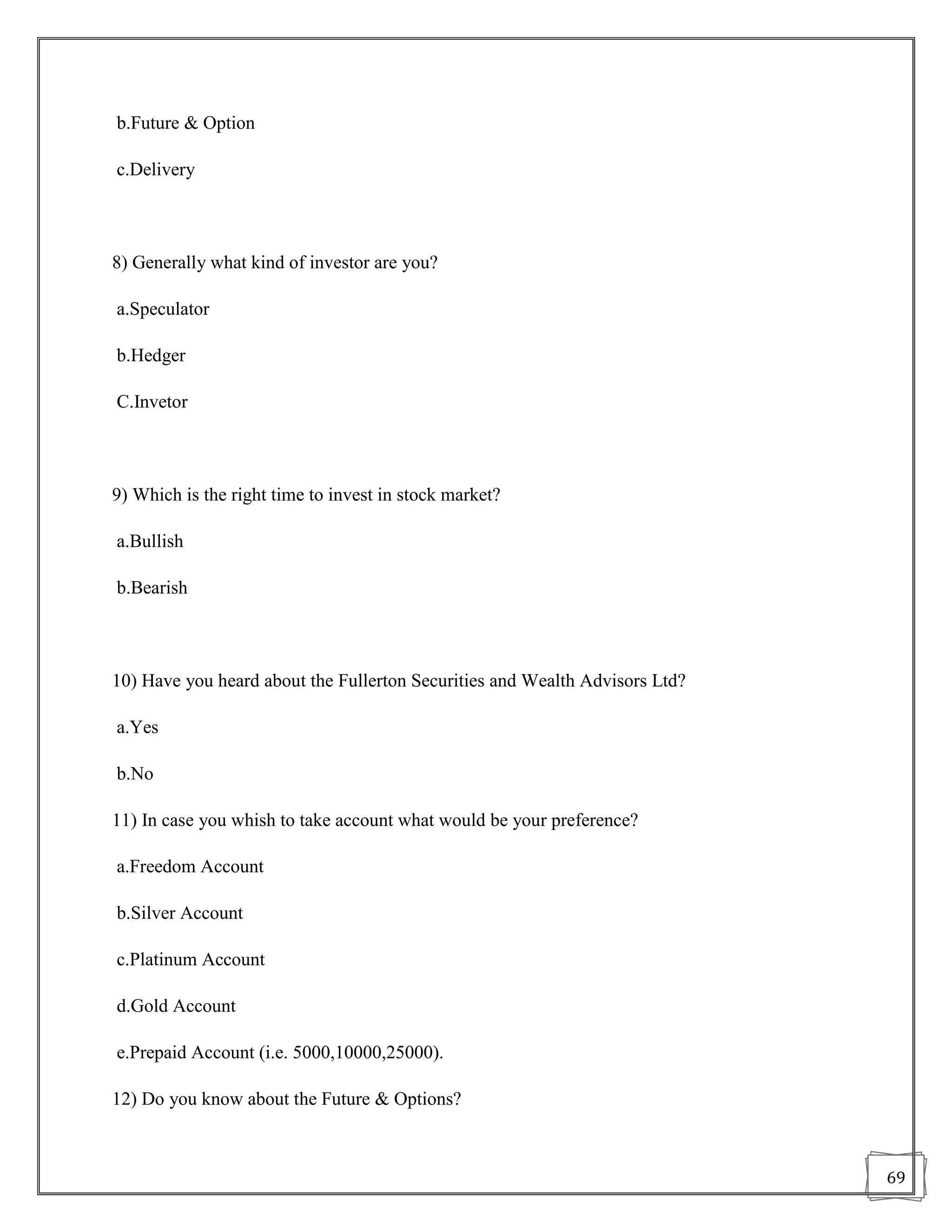
PREFACE
       One cannot swim only by reading the book on swimming. It must
require practice. Theory enables a person to think but theoretical knowledge
is only a half way in the overall development of an individual. Theory has to
be supported by practical understanding of things. By undertaking this
project I have tried to correlate our learning‟s in the college books to
undertake practical work.


      When every organization ventures out to make its mark in the
corporate world, a refined mantra which dictates is, 'Know thy customer '.
Culmination to success summits materializes when this concept has been
assimilated in the veins of its philosophy and valuable human resources.
Indian Trading industry is an exemplary icon to today's aspiring industries,
which proves that in today's tough competitive times it is the customer
satisfaction, which speaks for every industry.


      As a part of my summer internship I did a project to understand and
find out the current scenario of fullerton securities in the financial market.

   During the course of project I conducted a market survey to check the
response of Fullerton‟s customers on its services. The results of the survey
have been summed up in details inside. Here, my sincere efforts have been
directed towards finding the customer satisfaction for Fullerton security .
   I wish that the findings of my project would help Fullerton security to
understand the customer satisfaction level within limitations of my study and
take necessary action to implement the needed steps for customer delight.
Acknowledgment

I have to feel very proud to say that ; theory and practical are essential and
complimentary to each other. I am indebted and thanks full for the assistance
received from various individuals in marketing this project success. I found
a no words those who my gratitude to words those who ware constantly
involved with me throughout my tenure in Fullerton Securities &wealth
advisors limited


      I would you like to great thanks to “Mr. Kumar Kinsuk”. Who is
the head person of the department. He gave me great opportunities in this
company for work as a marketing officer .

       I also heartily great thanks to “Mr.Rahul Shinghvi”,

“Mr.Kapil Joshi” who supported me and always help me in work.


      I also thanks to”Mr.Kartik Sheth, Mr.Umer Rangoonvala”,&
“Mr.Dinesh Shilpakar” and other staff member who always encourage me
and help me.

Now I have to great experience how to work in corporate world so that„s
why I am really thanks for that they gave me chance to work with us

                                                       JIMISH THAKKAR
DECLARATION


We hereby declare that the Summer Project titled “CURRENT SCENARIO OF
BROOKING BUSINESS & INVESTMENT MANAGEMENT” is my original work
and has not been published elsewhere. This has been undertaken for the
purpose   of   partial   fulfillment   of   Gujarat   Technological   University
requirements for the award of the Degree of Master of Business
Administration.


Jimish Thakkar

Date:-


Place :
Executive summery


The primary aim of my project is to study the One the parameter of
economic development is intensive growth of Indian stock market after
2004. The stock market is reaching at new height. It is flooded with
investment for FIIS. which is resulting into more jobs with good pay scale.
The overall purchasing power has also increased. Domestic financial system
is also becoming more and more developed as more facilities in stock
market is provided as internet trading, offline trading etc.


So as the competition increase and new product are launched Indian
customer is having sufficient choice between different avenues which
provide market linked return , so Indian investor are enabled with various
option to suit their financial goals and tax planning requirement.


To fulfill the primary aim of the project. I have studied that factor which are
supporting to the growth of the financial planning in mutual fund, IPO, share
market
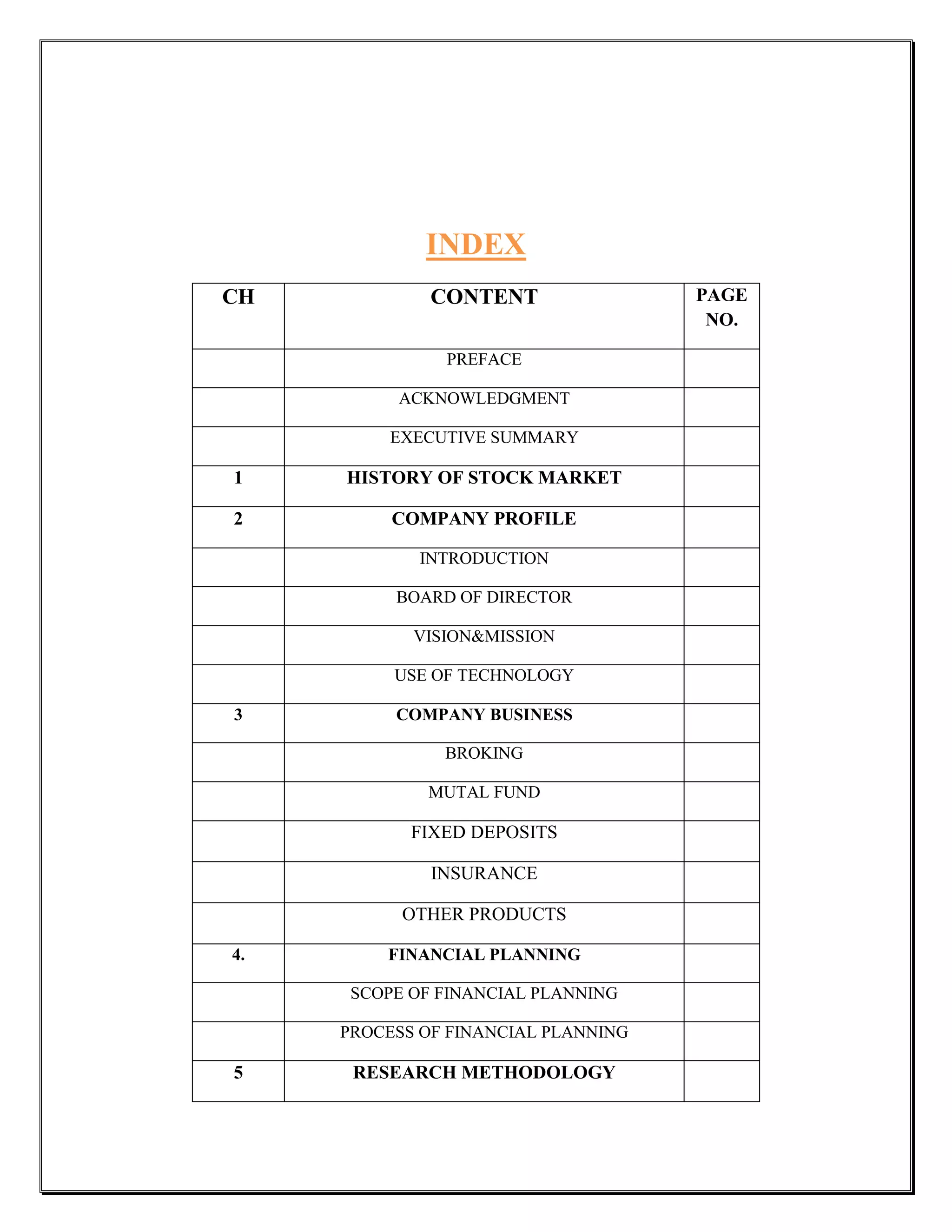
INDEX
CH            CONTENT                PAGE
                                      NO.

               PREFACE

          ACKNOWLEDGMENT

          EXECUTIVE SUMMARY

1    HISTORY OF STOCK MARKET

2         COMPANY PROFILE

             INTRODUCTION

          BOARD OF DIRECTOR

            VISION&MISSION

          USE OF TECHNOLOGY

3         COMPANY BUSINESS

               BROKING

             MUTAL FUND

            FIXED DEPOSITS

              INSURANCE

           OTHER PRODUCTS

4.       FINANCIAL PLANNING

      SCOPE OF FINANCIAL PLANNING

     PROCESS OF FINANCIAL PLANNING

5     RESEARCH METHODOLOGY
6   RECOMMENDATION & SUGGESTIONS

6   RECOMMENDATION & SUGGESTIONS

7          SWOT ANALYSYS

8      BIBLIOGRAPHY& ANNEXURE
CHAPTER: 1


   1. NATIONAL STOCK EXCHANGE (NSE)
   2. BOMBAY STOCK EXCHANGE (BSE)
   3. DOMESTICK STOCK EXCHANGE
   4. TYPE OF GROUP IN MARKET
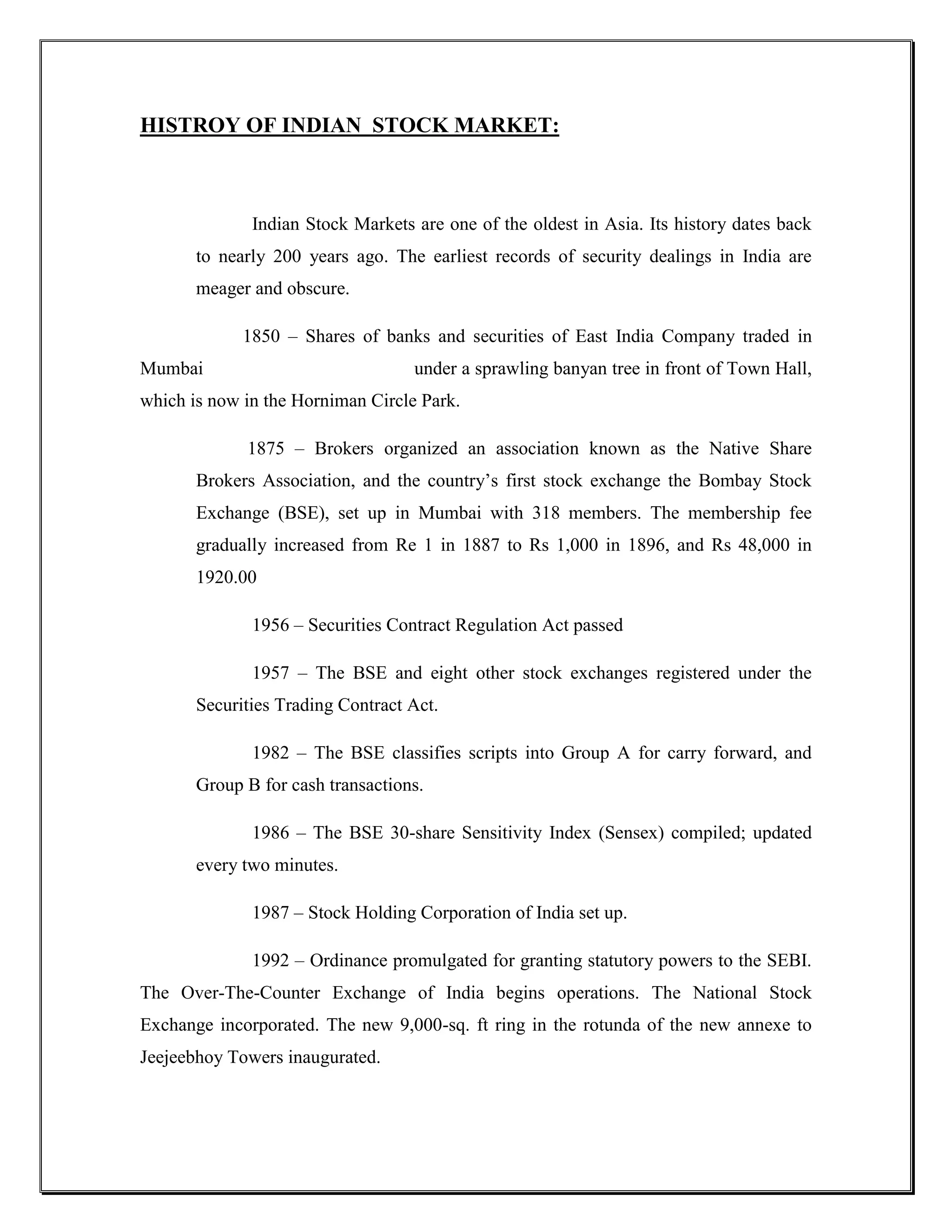
HISTROY OF INDIAN STOCK MARKET:


              Indian Stock Markets are one of the oldest in Asia. Its history dates back
       to nearly 200 years ago. The earliest records of security dealings in India are
       meager and obscure.

             1850 – Shares of banks and securities of East India Company traded in
Mumbai                             under a sprawling banyan tree in front of Town Hall,
which is now in the Horniman Circle Park.

             1875 – Brokers organized an association known as the Native Share
       Brokers Association, and the country‟s first stock exchange the Bombay Stock
       Exchange (BSE), set up in Mumbai with 318 members. The membership fee
       gradually increased from Re 1 in 1887 to Rs 1,000 in 1896, and Rs 48,000 in
       1920.00

              1956 – Securities Contract Regulation Act passed

              1957 – The BSE and eight other stock exchanges registered under the
       Securities Trading Contract Act.

              1982 – The BSE classifies scripts into Group A for carry forward, and
       Group B for cash transactions.

              1986 – The BSE 30-share Sensitivity Index (Sensex) compiled; updated
       every two minutes.

              1987 – Stock Holding Corporation of India set up.

              1992 – Ordinance promulgated for granting statutory powers to the SEBI.
The Over-The-Counter Exchange of India begins operations. The National Stock
Exchange incorporated. The new 9,000-sq. ft ring in the rotunda of the new annexe to
Jeejeebhoy Towers inaugurated.
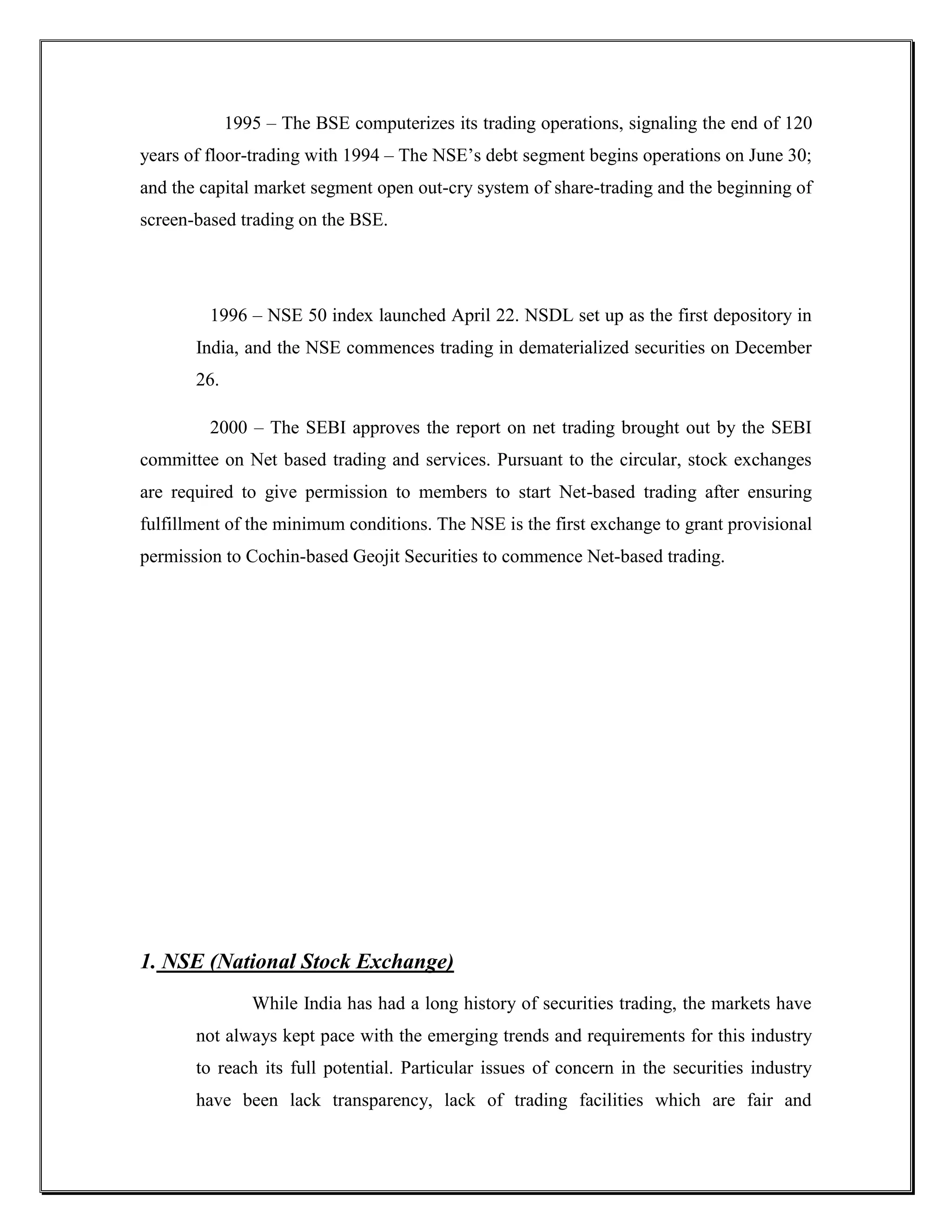
1995 – The BSE computerizes its trading operations, signaling the end of 120
years of floor-trading with 1994 – The NSE‟s debt segment begins operations on June 30;
and the capital market segment open out-cry system of share-trading and the beginning of
screen-based trading on the BSE.


         1996 – NSE 50 index launched April 22. NSDL set up as the first depository in
       India, and the NSE commences trading in dematerialized securities on December
       26.

         2000 – The SEBI approves the report on net trading brought out by the SEBI
committee on Net based trading and services. Pursuant to the circular, stock exchanges
are required to give permission to members to start Net-based trading after ensuring
fulfillment of the minimum conditions. The NSE is the first exchange to grant provisional
permission to Cochin-based Geojit Securities to commence Net-based trading.


1. NSE (National Stock Exchange)
                While India has had a long history of securities trading, the markets have
       not always kept pace with the emerging trends and requirements for this industry
       to reach its full potential. Particular issues of concern in the securities industry
       have been lack transparency, lack of trading facilities which are fair and
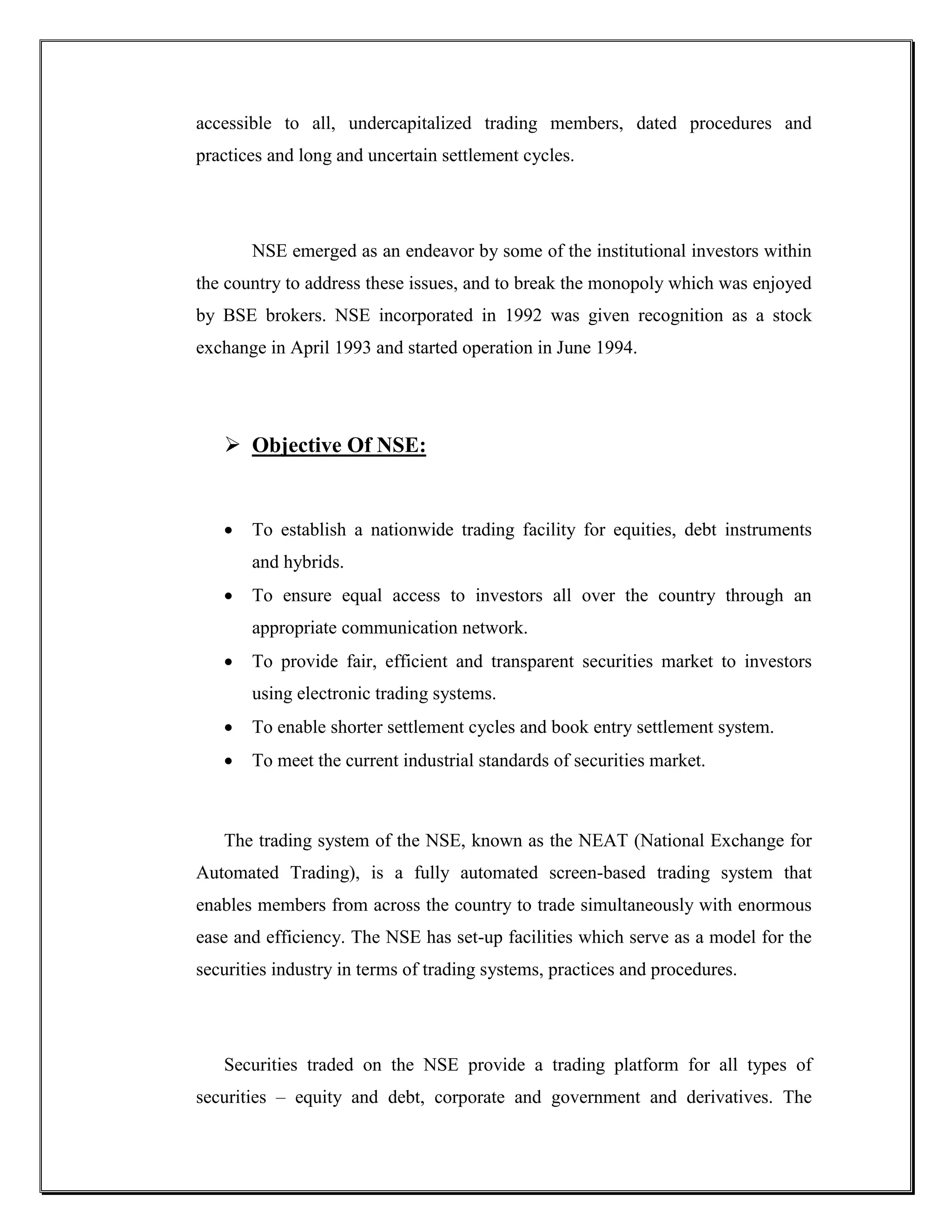
accessible to all, undercapitalized trading members, dated procedures and
practices and long and uncertain settlement cycles.


       NSE emerged as an endeavor by some of the institutional investors within
the country to address these issues, and to break the monopoly which was enjoyed
by BSE brokers. NSE incorporated in 1992 was given recognition as a stock
exchange in April 1993 and started operation in June 1994.


    Objective Of NSE:


      To establish a nationwide trading facility for equities, debt instruments
       and hybrids.
      To ensure equal access to investors all over the country through an
       appropriate communication network.
      To provide fair, efficient and transparent securities market to investors
       using electronic trading systems.
      To enable shorter settlement cycles and book entry settlement system.
      To meet the current industrial standards of securities market.


   The trading system of the NSE, known as the NEAT (National Exchange for
Automated Trading), is a fully automated screen-based trading system that
enables members from across the country to trade simultaneously with enormous
ease and efficiency. The NSE has set-up facilities which serve as a model for the
securities industry in terms of trading systems, practices and procedures.


   Securities traded on the NSE provide a trading platform for all types of
securities – equity and debt, corporate and government and derivatives. The
exchange provided products in 3 different segments : Wholesale Debt Market
       (WDM), Capital Market (CM) and in Futures and Options (F&O) segment and
       the products range from equities, fixed income securities, futures and options on
       indices, stocks and interest rates.


           The national stock index stock exchange index is known as “NIFTY”.

2.BSE (Bombay Stock Exchange):

The roots of the stock exchange, Mumbai can be traced back to 1875, when the Share and
Stockbrokers Association (non-profit organization) was established. BSE is the oldest
stock exchange in Asia and the most important stock exchange in Indian capital market.
It is situated at DALAL street in Mumbai.


The index of Bombay stock exchange is known as “SENSEX” i.e. sensitive index. It is
first compiled in 1986 as market capitalization weighted index, which include 30
component stocks representing a sample of large, well established and financial sound
companies. The index is widely used to measure the performance of Indian stock market.

In May 1995, the BSE took a major step when it started order-cum-quote driven
electronic trading for all the listed securities. The BOLT, the BSE Online Trading System
increased market transparency, liquidity and elimination of mismatches.


3.Domestic Stock Exchanges:
In the year 1956, the government came out with a comprehensive legislation called the
„Securities Contract (Regulation) Act to regulate the functioning of stock exchanges. The
legislation made it compulsory on the part of the stock exchanges to secure recognition
from the Central Government. More stock exchanges were recognized subsequently. At
present there are 23 stock exchanges in India including the OCTEI and NSE. The
recognition accorded to a stock exchange is normally valid for a period of 5 years or a
shorter as prescribed.

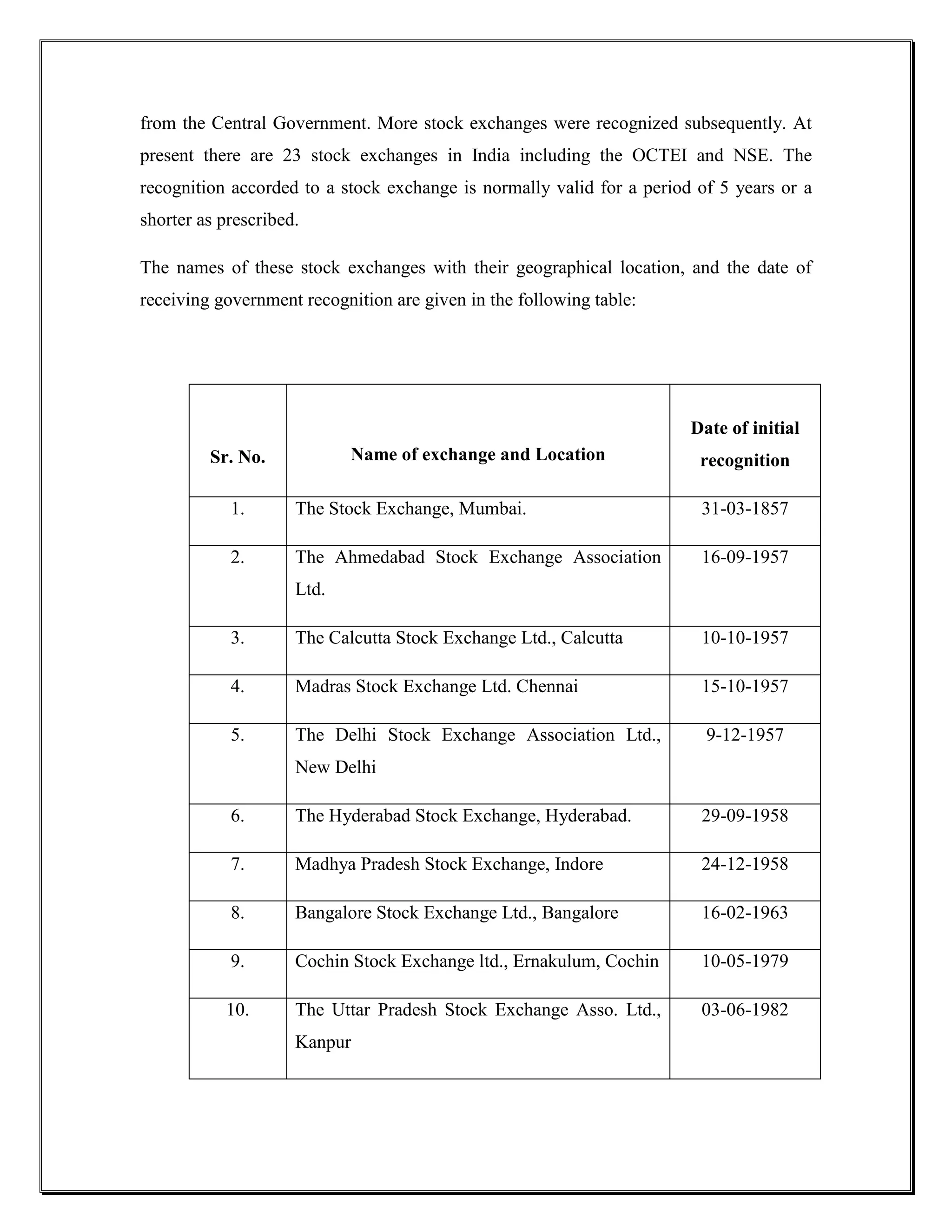
The names of these stock exchanges with their geographical location, and the date of
receiving government recognition are given in the following table:


                                                                       Date of initial
         Sr. No.            Name of exchange and Location               recognition

            1.       The Stock Exchange, Mumbai.                        31-03-1857

            2.       The Ahmedabad Stock Exchange Association           16-09-1957
                     Ltd.

            3.       The Calcutta Stock Exchange Ltd., Calcutta         10-10-1957

            4.       Madras Stock Exchange Ltd. Chennai                 15-10-1957

            5.       The Delhi Stock Exchange Association Ltd.,          9-12-1957
                     New Delhi

            6.       The Hyderabad Stock Exchange, Hyderabad.           29-09-1958

            7.       Madhya Pradesh Stock Exchange, Indore              24-12-1958

            8.       Bangalore Stock Exchange Ltd., Bangalore           16-02-1963

            9.       Cochin Stock Exchange ltd., Ernakulum, Cochin      10-05-1979

           10.       The Uttar Pradesh Stock Exchange Asso. Ltd.,       03-06-1982
                     Kanpur
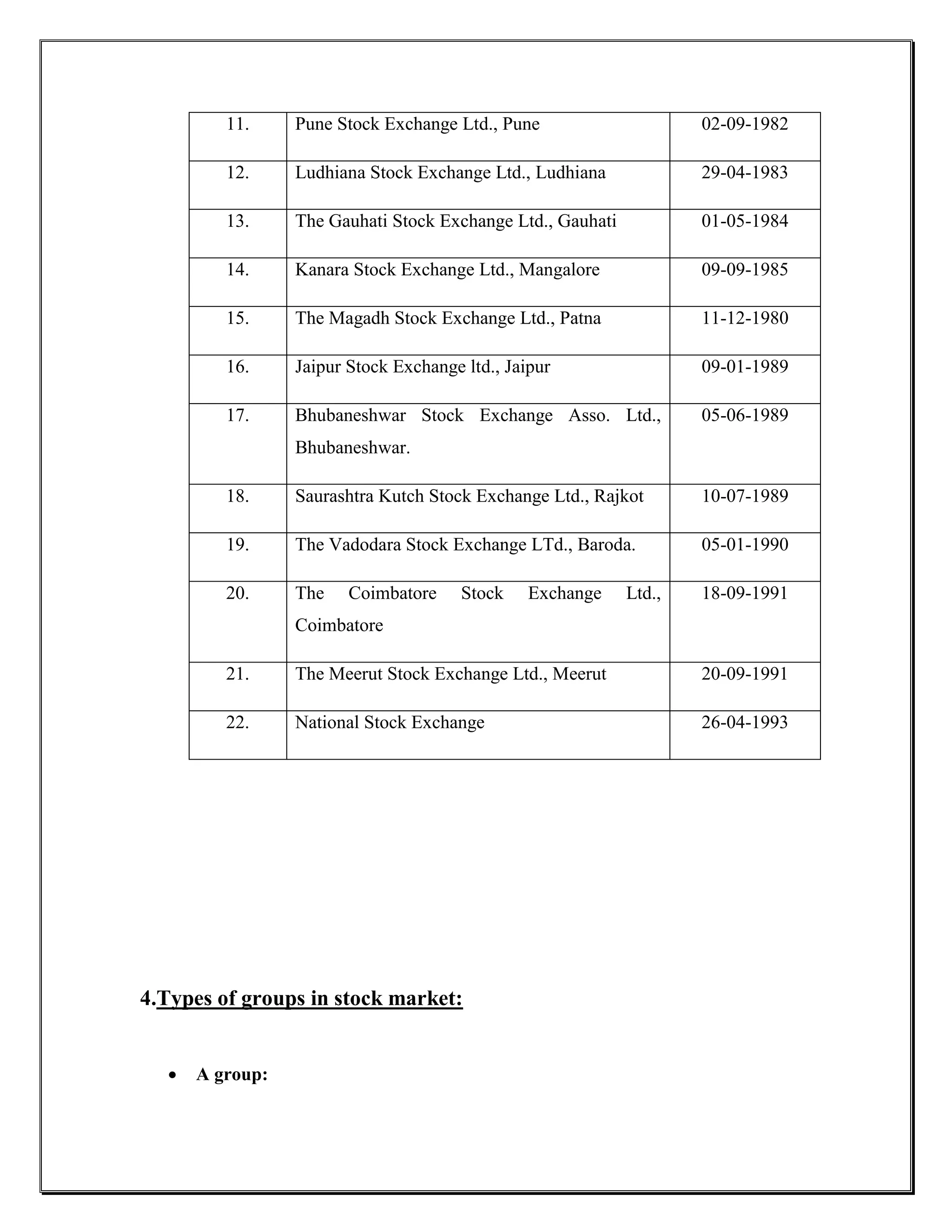
11.     Pune Stock Exchange Ltd., Pune                     02-09-1982

         12.     Ludhiana Stock Exchange Ltd., Ludhiana             29-04-1983

         13.     The Gauhati Stock Exchange Ltd., Gauhati           01-05-1984

         14.     Kanara Stock Exchange Ltd., Mangalore              09-09-1985

         15.     The Magadh Stock Exchange Ltd., Patna              11-12-1980

         16.     Jaipur Stock Exchange ltd., Jaipur                 09-01-1989

         17.     Bhubaneshwar Stock Exchange Asso. Ltd.,            05-06-1989
                 Bhubaneshwar.

         18.     Saurashtra Kutch Stock Exchange Ltd., Rajkot       10-07-1989

         19.     The Vadodara Stock Exchange LTd., Baroda.          05-01-1990

         20.     The    Coimbatore     Stock    Exchange    Ltd.,   18-09-1991
                 Coimbatore

         21.     The Meerut Stock Exchange Ltd., Meerut             20-09-1991

         22.     National Stock Exchange                            26-04-1993


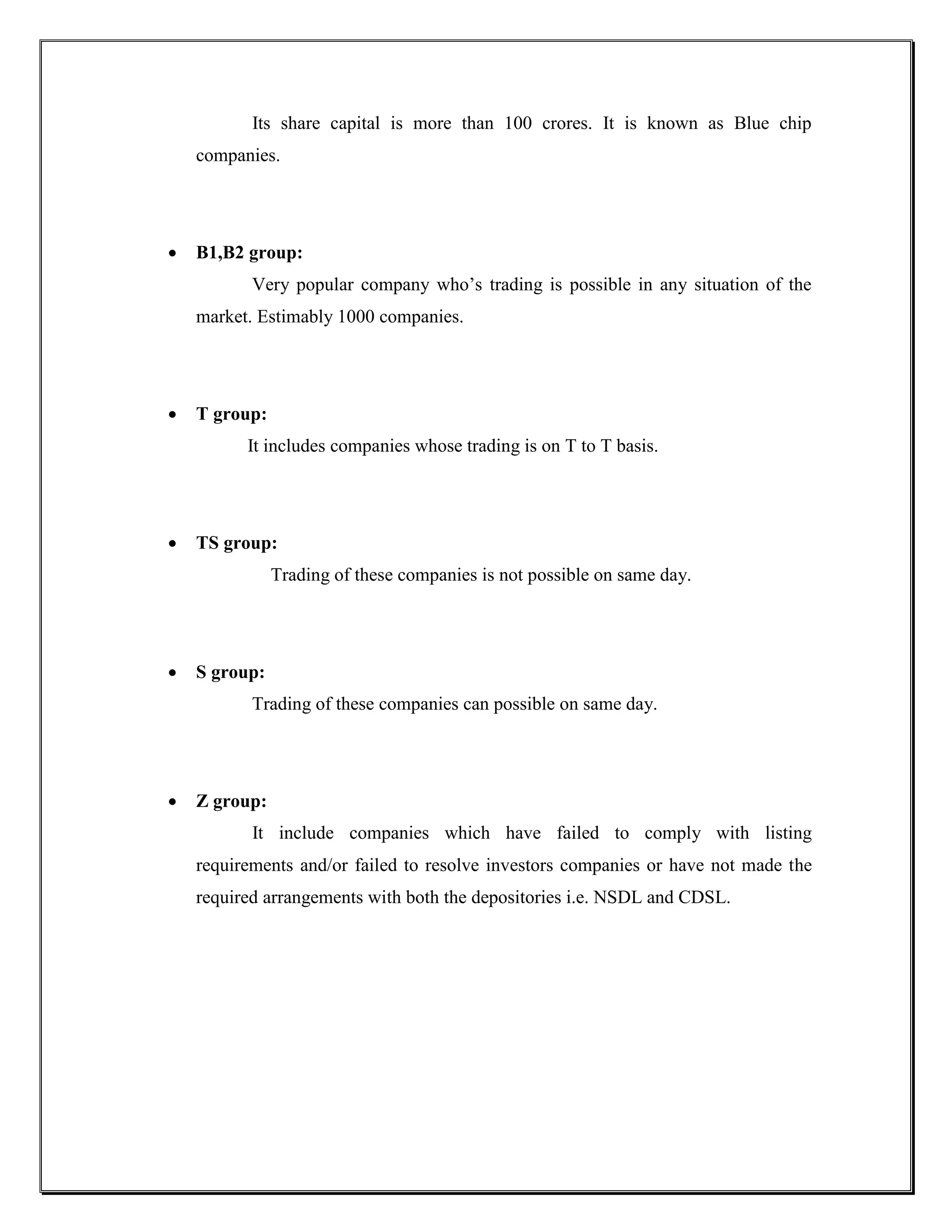
4.Types of groups in stock market:


     A group:
Its share capital is more than 100 crores. It is known as Blue chip
    companies.


   B1,B2 group:
           Very popular company who‟s trading is possible in any situation of the
    market. Estimably 1000 companies.


   T group:
          It includes companies whose trading is on T to T basis.


   TS group:
               Trading of these companies is not possible on same day.


   S group:
           Trading of these companies can possible on same day.


   Z group:
           It include companies which have failed to comply with listing
    requirements and/or failed to resolve investors companies or have not made the
    required arrangements with both the depositories i.e. NSDL and CDSL.
CHAPTER. 2
 INTRODUCTION OF COMPANY

          BOARD OF DIROCTOR

          VISION & MISON

          USE OF TECNOLOGY

          KEY VALUE DIFFERETIATION


              INTRODUCTION OF COMPANY
 Fullerton securities company is a multinational company which is
established in singapore.now this company also working in india during
2002. Fullerton securities & wealth advisors limited is a subsidiary of
fullerton finanancial holding,an asian financial institution with investments
In banks and finance companies in emerging markets including
india,indonesia,china, and Uae.

  In india there are so many branches which is
ahmedabad,banglore,chandigarh,gurgaon,hyderabad,jaipur,kolkata,ludhiana,
and mumbai.

 As we all know that security company has two types ie. corporate entity
and broking company but fullerton securities is corporate entity which is
SEBI regulated

Fullerton Financial Holdings Pte. Ltd. invests in financial institutions in
emerging markets, bringing an operational perspective to all investment
decisions.


As on 31st December, 2007, the total assets of Fullerton Financial Holdings
Pte. Ltd. stood at $59.7 billion and its portfolio comprised investments in 15
different financial institutions.


Fullerton Financial Holdings Pte. Ltd. supervises and influences its banks to
achieve the right risk-reward balance. It seeks to create shareholder value by
differentiating through great people, disciplined development and execution
of unique business models.


Primarily, it focuses on both Business banking and Consumer
banking
 Business banking:

  Fullerton Financial Holdings Pte. Ltd. focuses on the
  Commercial, SME and Self-employed mass market
  segments. On the other hand, it focuses on the Mass affluent
  and Mass salaried segments

 Consumer banking:

  Fullerton Financial Holdings Pte. Ltd. is a wholly owned
  subsidiary of Temasek Holdings, an Asia investment
  house, headquartered in Singapore, focused on creating and
  maximizing long-term shareholder value as an active
  investor and shareholder of successful enterprises.


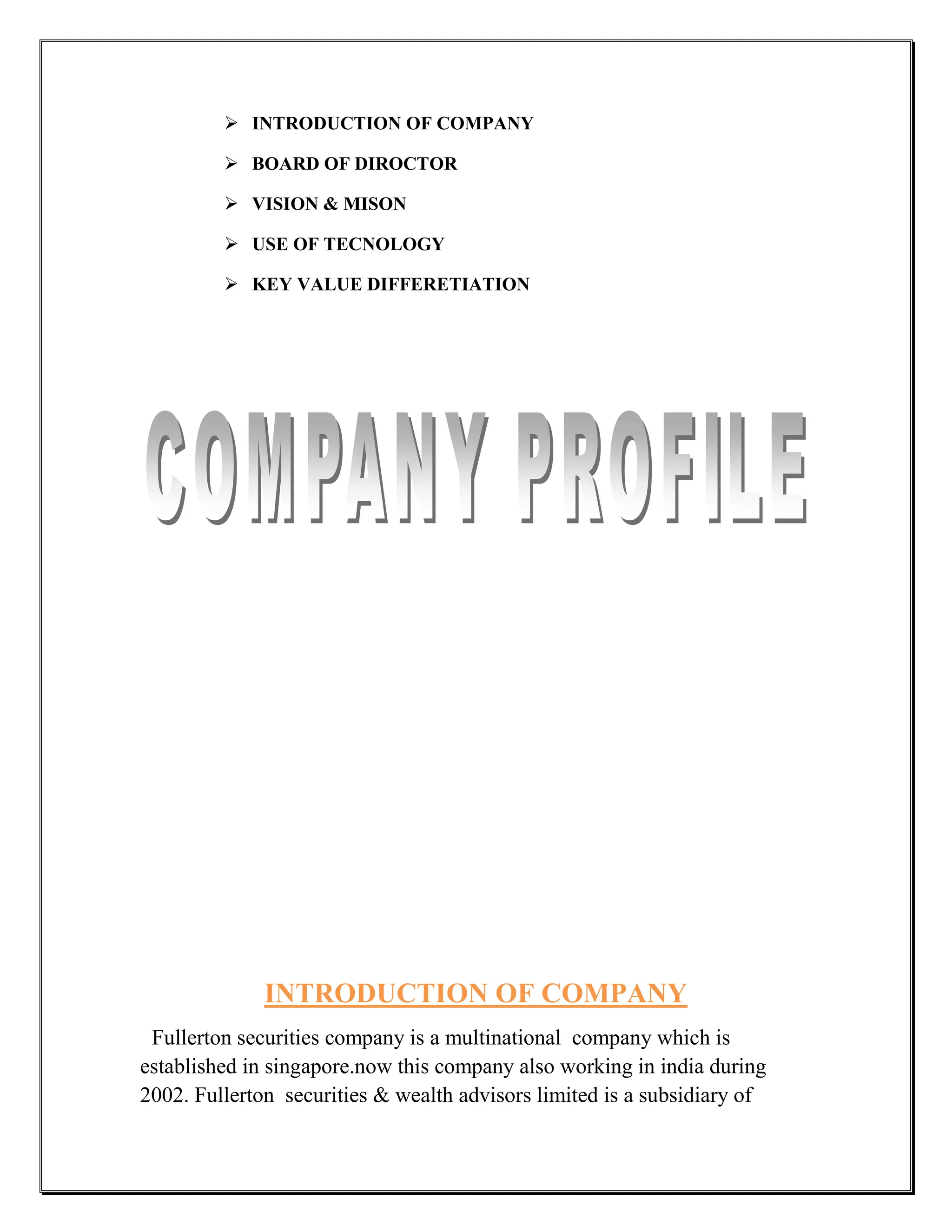
      BOARD OF DIRECTOR


               DR. Richard Hu

              Chairman.
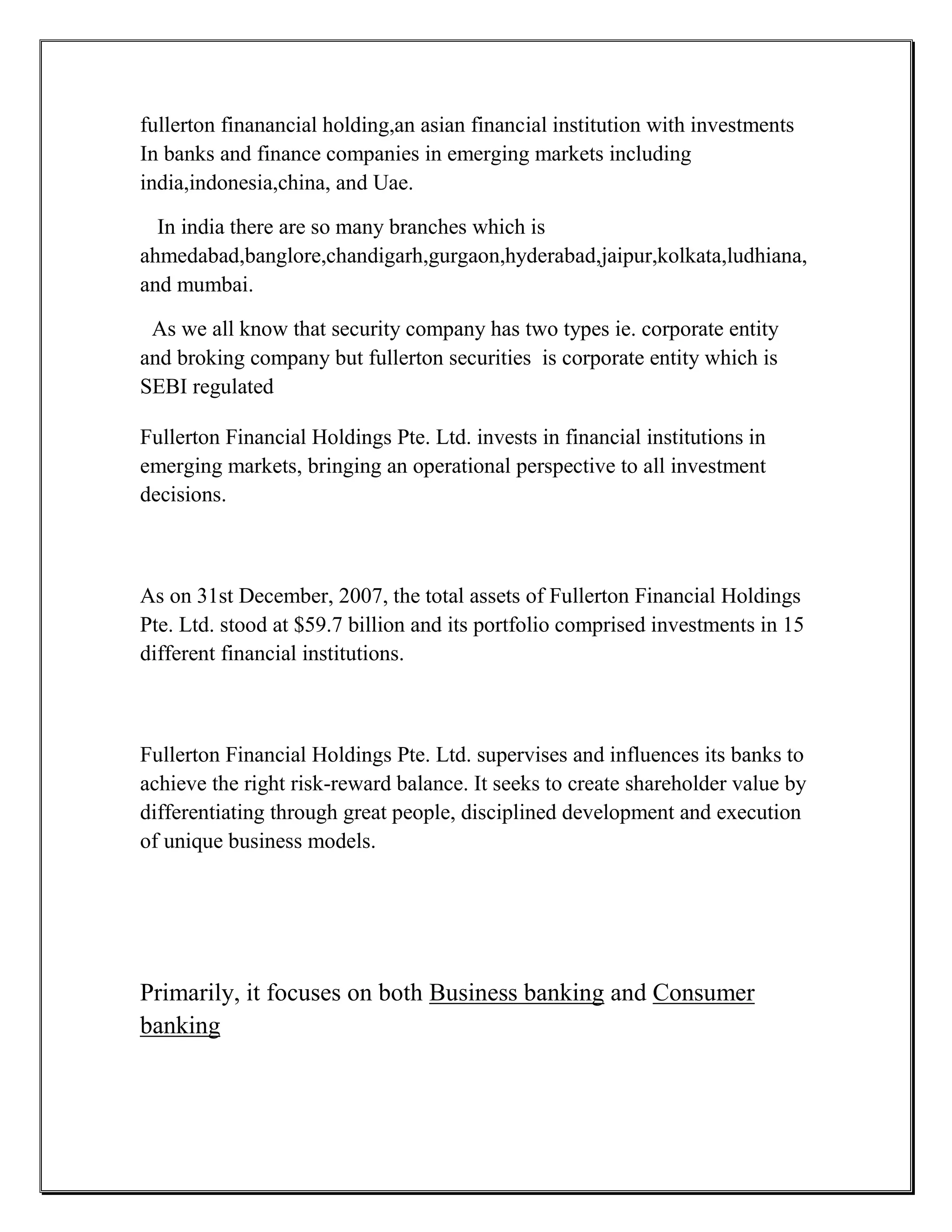
Mr.Peter Seah

Deputy Chairman.


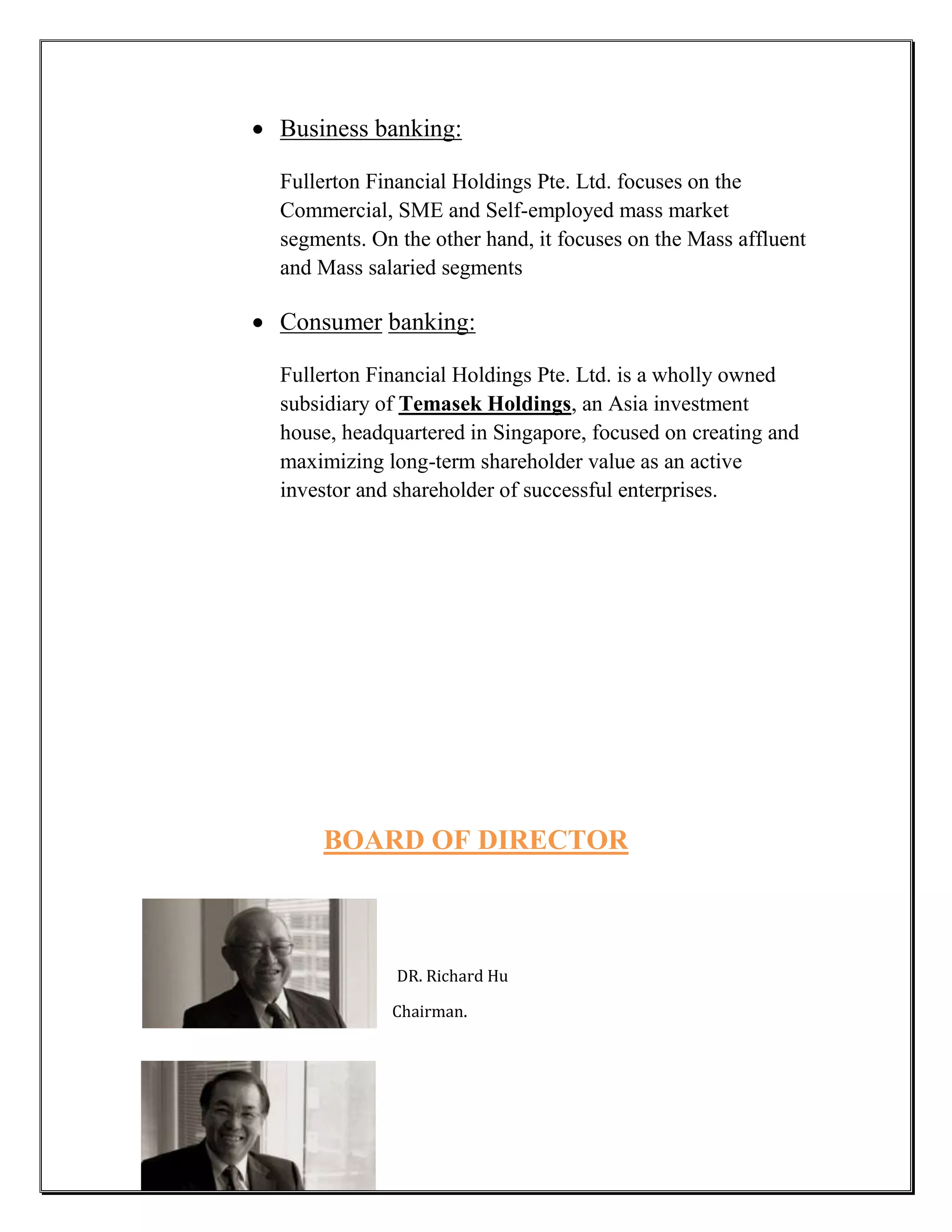
                Mr. Ng Kee Choe

                Director.


                                   .

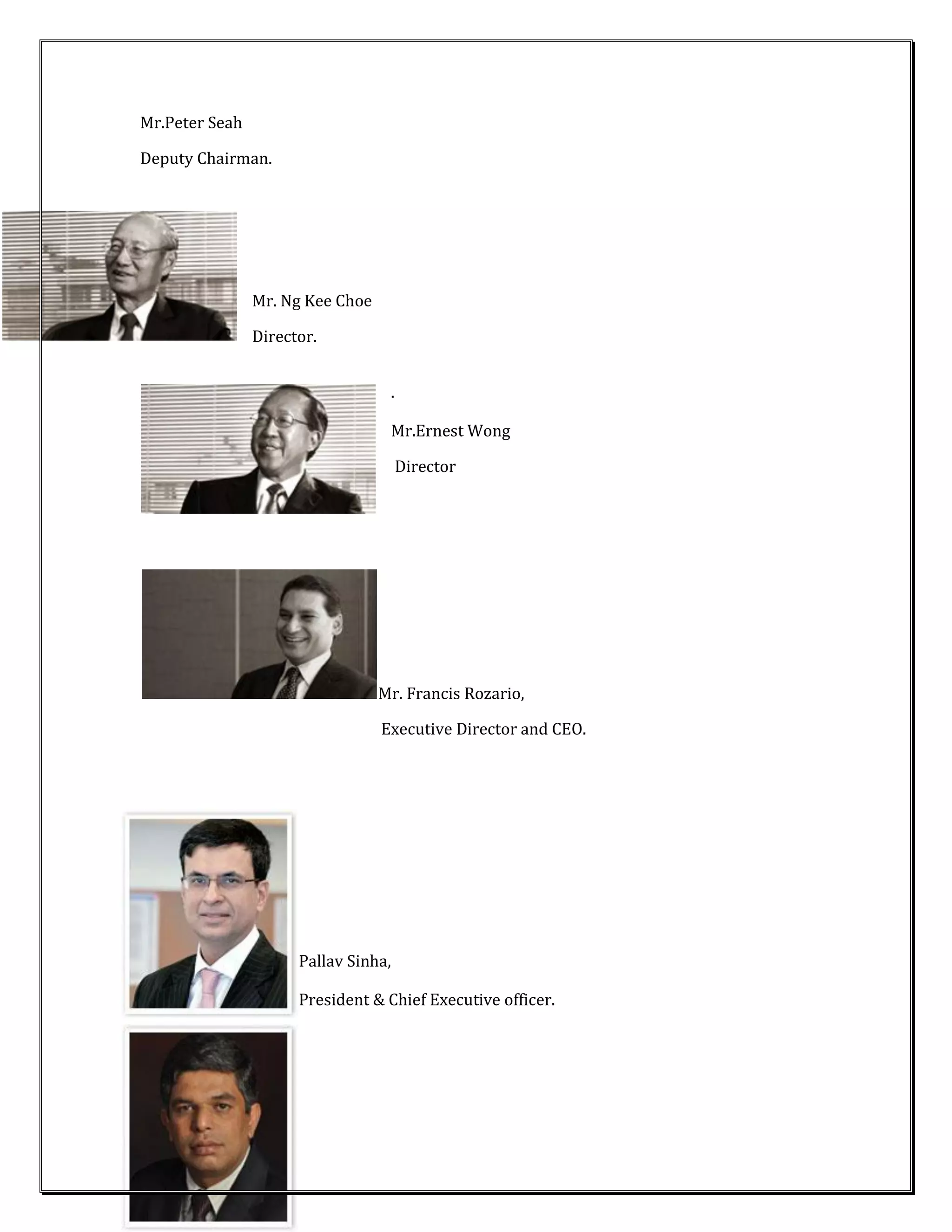
                                   Mr.Ernest Wong

                                       Director


                                  Mr. Francis Rozario,

                                  Executive Director and CEO.


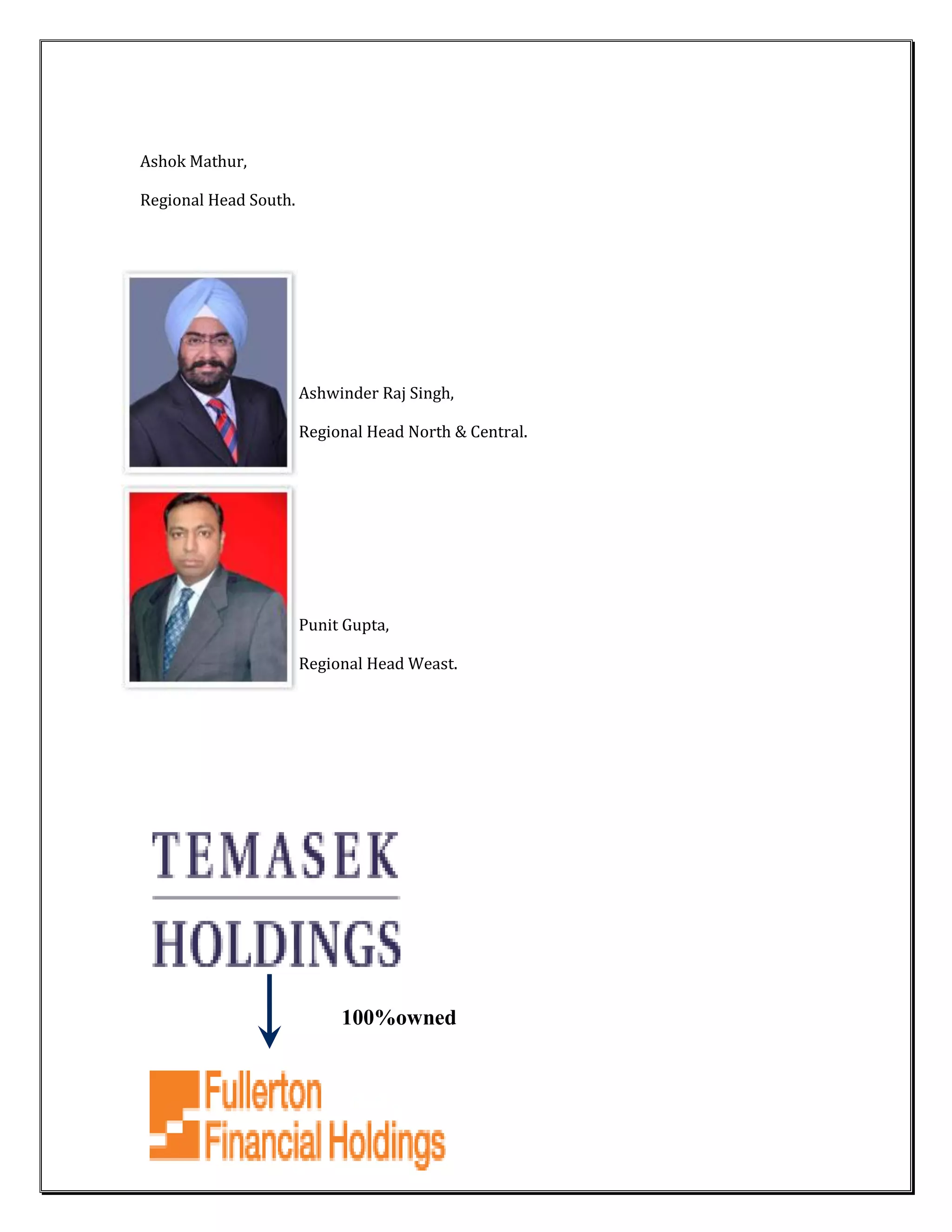
                      Pallav Sinha,

                      President & Chief Executive officer.
Ashok Mathur,

Regional Head South.


                       Ashwinder Raj Singh,

                       Regional Head North & Central.


                       Punit Gupta,

                       Regional Head Weast.


                            100%owned
100%owned


About Fullerton


    Temasek holdings is an Asian investment house managing a portfolio
    of over s$185 billion or us$134 guided by an Independent board, they
    operate autonomously on commercial principle to maximize long term
    shareholder retunes. Fullerton is the banking subsidiary of temasek.

          Rated AAA/Aaa by stand and Poor‟s and Moody‟s
           respectively
          Diversified portfolio is an wide range of industries
          telecommunication &media, singtel, Bharti Airtel, Global
           crossing
    Financial services: DBS, Standerd charted bank, Merrill
                 Lynch, Barclays,
                Real Estate: Capital Land, Maple tree
                 Transportation & Logistics – Singapore Airlines, Neptune
                 orient lines, PSA
                 Energi&Resoures- Singapore Power, Senoko Power,
                 Powerseray
                 Infrastructure, Industrial&Engineering- Keppel Corporation
                 sembcorp
                Technology-Chartered semiconductor, statschipPAC

                         Respectable returns to shareholder over last 34 year

                      Total shareholder retunes of more then 18% per annum

100% owned by the ministry of finance of Singapore
Philosophy   : Baat Faayde Ki

 Company Vision & Mission


Company Vision

                        Enabling Success,
                        Enriching Lives


Company Mission

                        To create superior long-term shareholder
                      value in financial sectors across Emerging
                      Markets

                       • Organic Growth
                       • Acquire and Transform
• Improve Productivity
                         • Optimize Capital
                         • Risk-Reward Balance


 Our Business Philosophy

      Ethical Practices & Transparency In All Our Dealings

      Customers Interest Above Our Own

      Always Deliver What We Promise

      Effective Cost Management.


                   Our Quality Assurance Policy
We are committed to being the Leader in providing World Class Products & Services
which exceed the expectations of our customers achieved by teamwork and a process of
continuous improvement


                             OUR MOTTO
Our motto is to make our customer smile - To have complete harmony between Quality-
in-Process and continuous improvement to deliver exceptional service that will delight
our Customers and Clients.


                       CRM POLICY
Customer is King

“A Customer is the most Important Visitor on Our Premises
He is not Dependant on us but
we are dependant on him
He is not an Interruption in our work,
but is the Purpose of it
We are not doing him a favour by serving He is doing us a favour by giving us an
opportunity to do so”
- Mahatma Gandhi


                   Use of Technology in Company


Electronic Tools:
                                  PC
                                  Laptops
                                  Voice / Telephony
                                  Television
Network &Connectivity:

                                  WAN
                                  LAN
                                  Routers / Switches
  Infrastructure:

                                 • Data Canter
                                 • Servers
                                 • Remote Server Management
  Call Canter:
• Contact Canter
                       • CTI Integration
                       • IVR


Capital Market Applications:

                       • Front-End
                       • Back-Office
                       • Exchange Interfaces
Oracle Business Applications:


                                • CRM
                                • Sales Management
                                • GL


Wealth Management & Portfolio Aggregation:


                                • Mutual Funds
                                • Portfolio Aggregation
                                • Document Management


Delivery Channels – Web, SMS:


                                •   Internet
                                •   SMS
                                •   Emails
                                •   Analytics
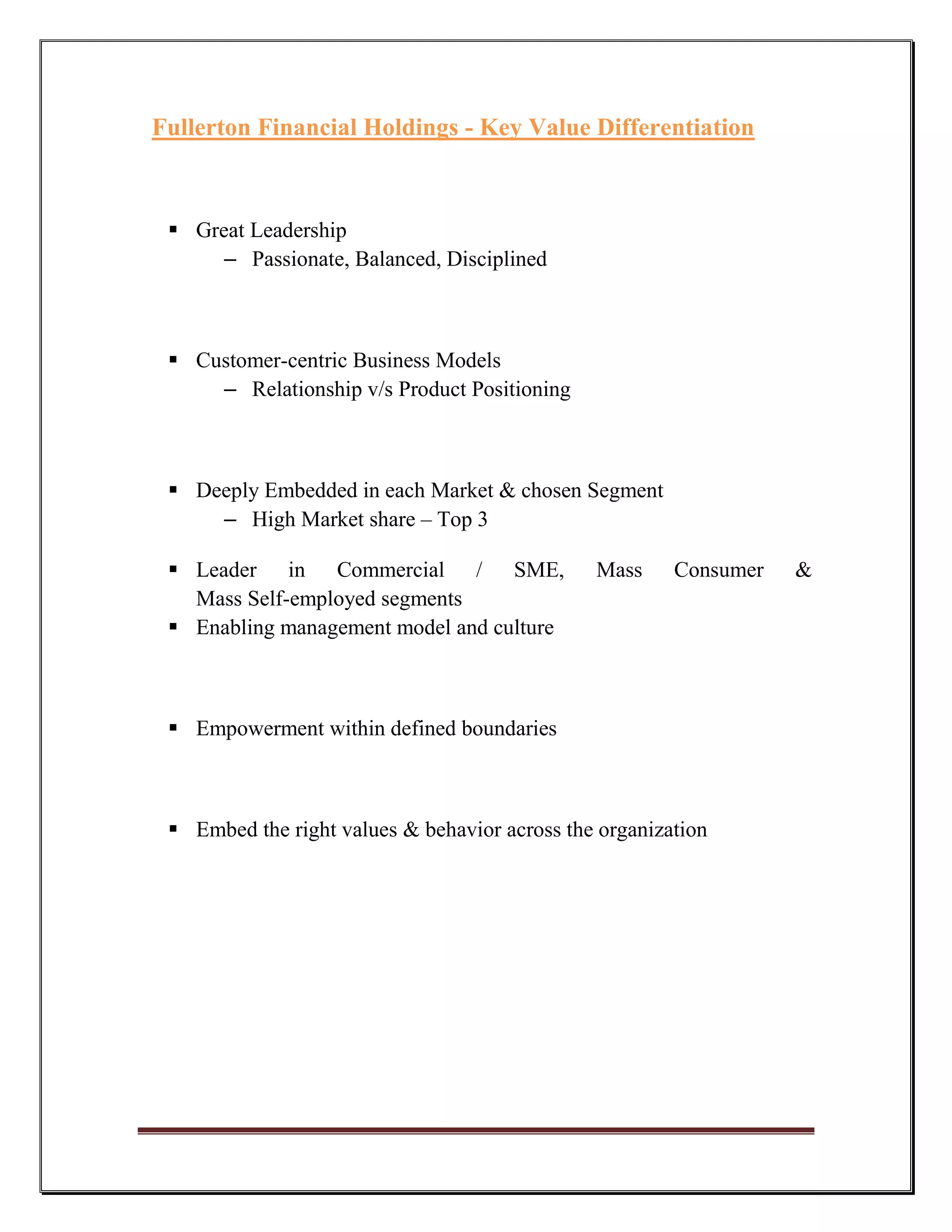
Fullerton Financial Holdings - Key Value Differentiation


  Great Leadership
      – Passionate, Balanced, Disciplined


  Customer-centric Business Models
     – Relationship v/s Product Positioning


  Deeply Embedded in each Market & chosen Segment
     – High Market share – Top 3

  Leader in Commercial / SME,                 Mass     Consumer   &
   Mass Self-employed segments
  Enabling management model and culture


  Empowerment within defined boundaries


  Embed the right values & behavior across the organization
COMPANY BUSINESS

PRODUCTS:
        CAPITAL MARKET:

  Equities


        INVESTMENTS:

  Mutual funds

  Fixed deposits

  Bonds & Debentures


        PROTECTION(Insurance)

  Life insurance

  General insurance


        OTHER PRODUCTS:

  Margin funding

  Real estate
[A] BROKING
FREEDOM ACCOUNT

            It is also called „demate account‟ for which our company takes the charges
       of Rs 1995/- and no ammount is refundable.after opening this account customer
       gets the facility of free brokerage up to   trading of 500,000/- in delivery or
       50,00.000/- in intraday during 6 months.

What Does Equity Market Mean?


The market in which shares are issued and traded, either through exchanges or
over-the-counter markets. It is also known as the stock market, it is one of the most
vital areas of a market economy because it gives companies access to capital and
investors a slice of ownership in a company with the potential to realize gains based
on its future performance.

 What is Derivative Market Mean ?


The Derivatives Market is meant as the market where exchange of derivatives takes
place. Derivatives are one type of securities whose price is derived from the underlying
assets. And value of these derivatives is determined by the fluctuations in the underlying
assets. These underlying assets are most commonly stocks, bonds, currencies, interest
rates, commodities and market indices. As Derivatives are merely contracts between two
or more parties, anything like weather data or amount of raincan be used as underlying
assets. The Derivatives can be classified as Future Contracts, Forward Contracts,
Options, Swaps and Credit Derivatives.
Types of Derivative Market

The Derivative Market can be classified as Exchange Traded Derivatives Market and
Over the Counter Derivative Market.

Exchange Traded Derivatives are those derivatives which are traded through specialized
derivative exchanges

 Over the Counter Derivatives are those which are privately traded between two parties
and involves no exchange or intermediary. Swaps, Options and Forward Contracts are
traded in Over the Counter Derivatives Market or OTC market.

The main participants of OTC market are the Investment Banks, Commercial Banks,
Govt. Sponsored Enterprises and Hedge Funds. The investment banks markets the
derivatives through traders to the clients like hedge funds and the rest.

There are two type of trading ;

Postpaid trading

Prepaid trading

These are the prepaid charges of fullerton securities ……..


What is E-Broking?
E-broking is an Internet enabled system that allows the user to buy and sell shares
on the exchange directly using a PC and a modem. You can log into an E-Broking site
like 5paisa.com, and execute trades on the exchange. In India, the National Stock
Exchange (NSE) allows E-Broking. The Stock Exchange, Mumbai (BSE) will allow
this shortly


SEBI, established in 1988 and became a fully autonomous body by the year 1992
with defined responsibilities to cover both development & regulation of the market.

A Board by the name of the Securities and Exchange Board of India (SEBI) was
constituted under the SEBI Act to administer its provisions in 1992 with one
chairman and five members.
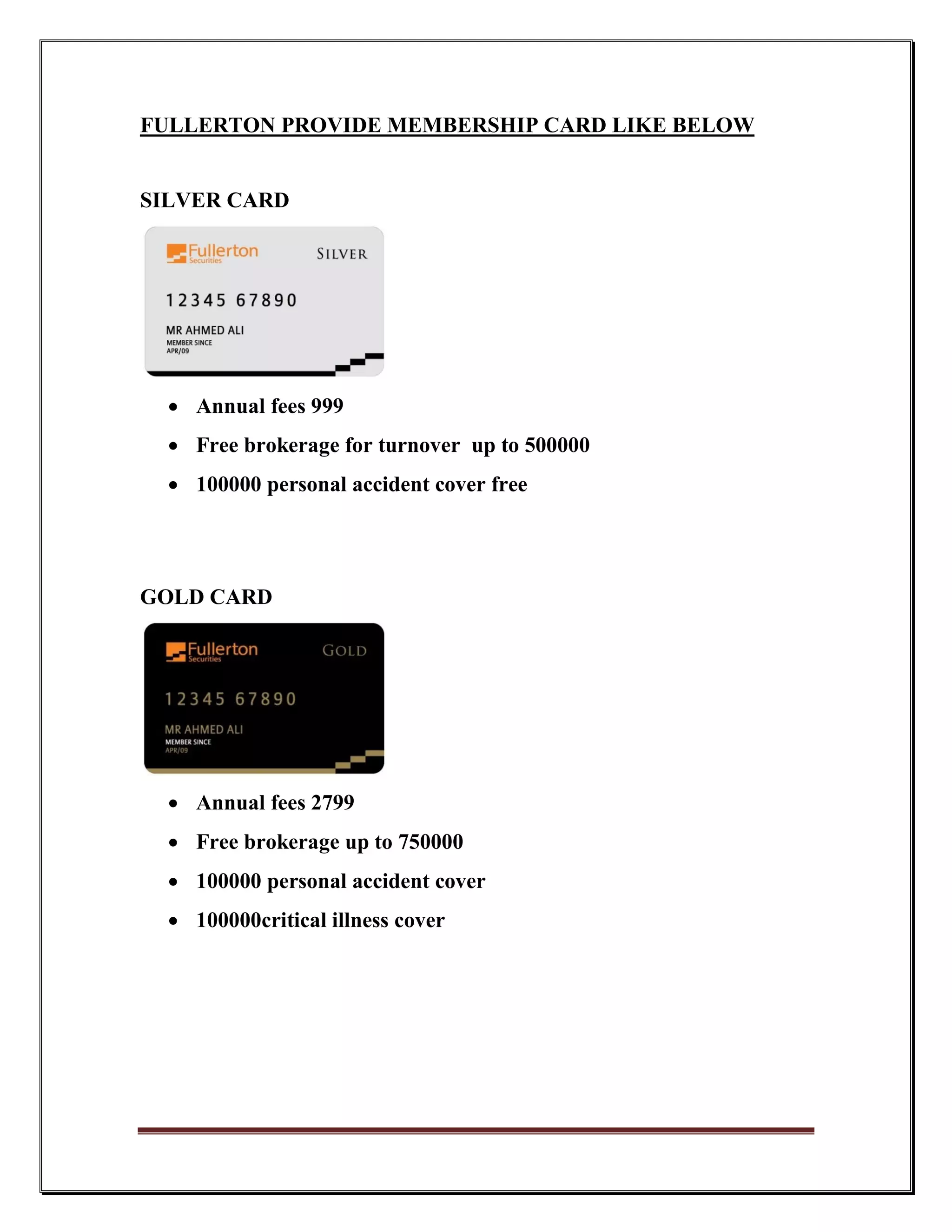
FULLERTON PROVIDE MEMBERSHIP CARD LIKE BELOW


SILVER CARD


   Annual fees 999
   Free brokerage for turnover up to 500000
   100000 personal accident cover free


GOLD CARD


   Annual fees 2799
   Free brokerage up to 750000
   100000 personal accident cover
   100000critical illness cover
PLATINUM CARD


  Annual fees3999
  1000000free brokerage
  200000accident cover
  200000 critical illness cover
[B]      MUTUAL FUND

A Mutual Fund is a trust that pools the savings of a number of investors who share a
common financial goal. The money thus collected is then invested in shares, debentures
and other securities. The income earned through these investments and the capital
appreciations realized are shared by its unit holders in proportion to the number of units
owned by them.


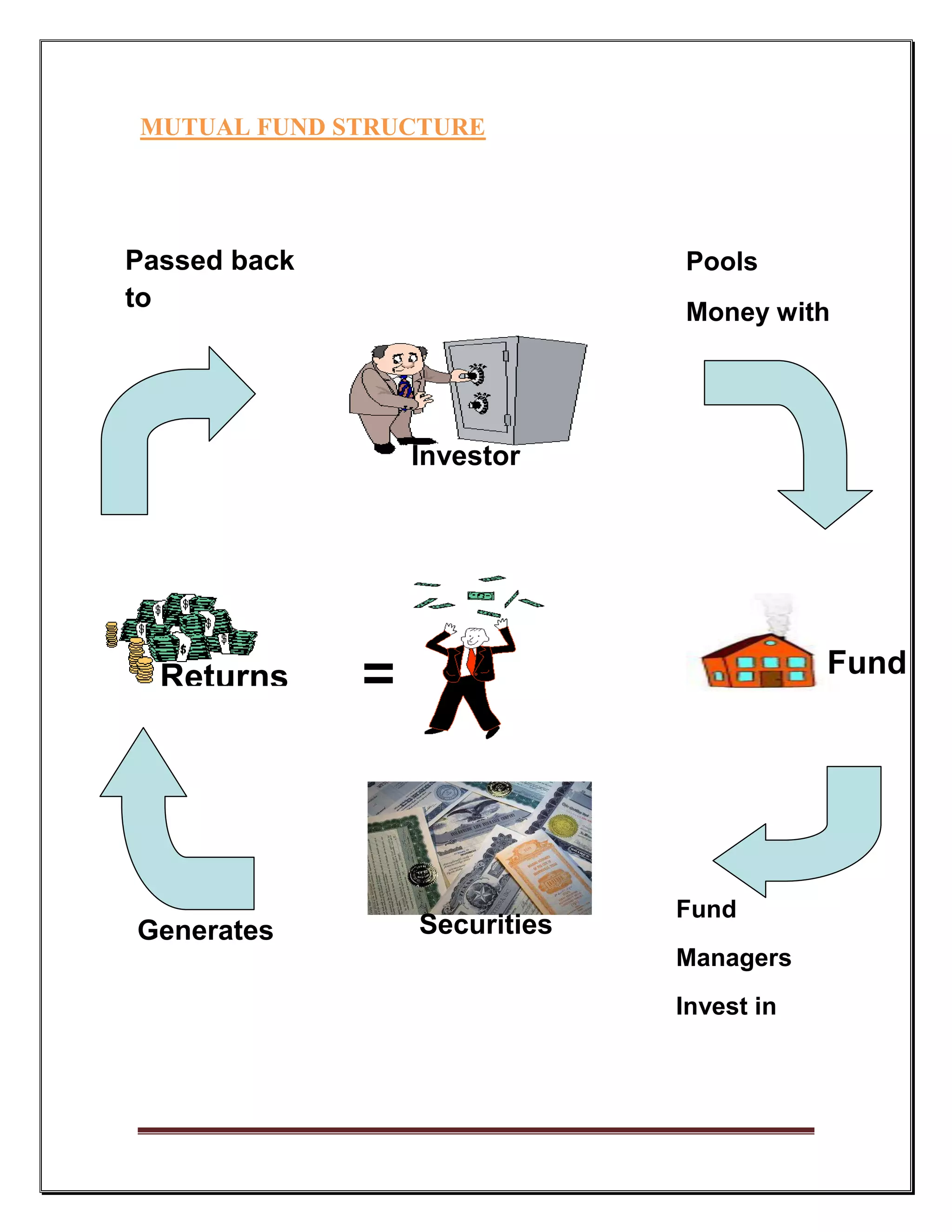
The flow chart below describes broadly the working of a mutual fund. It simply shows
the cyclic flow of funds and how the mutual fund is working.


There are two approaches for investing in Mutual Fund i.e. Lump sum and SIP
(Systematic Investment Plan)
MUTUAL FUND STRUCTURE


Passed back                    Pools
to                             Money with


                  Investor


  Returns     =                            Fund
                                           ddd
                                           Hous
                                           e


                               Fund
Generates         Securities
                               Managers
                               Invest in
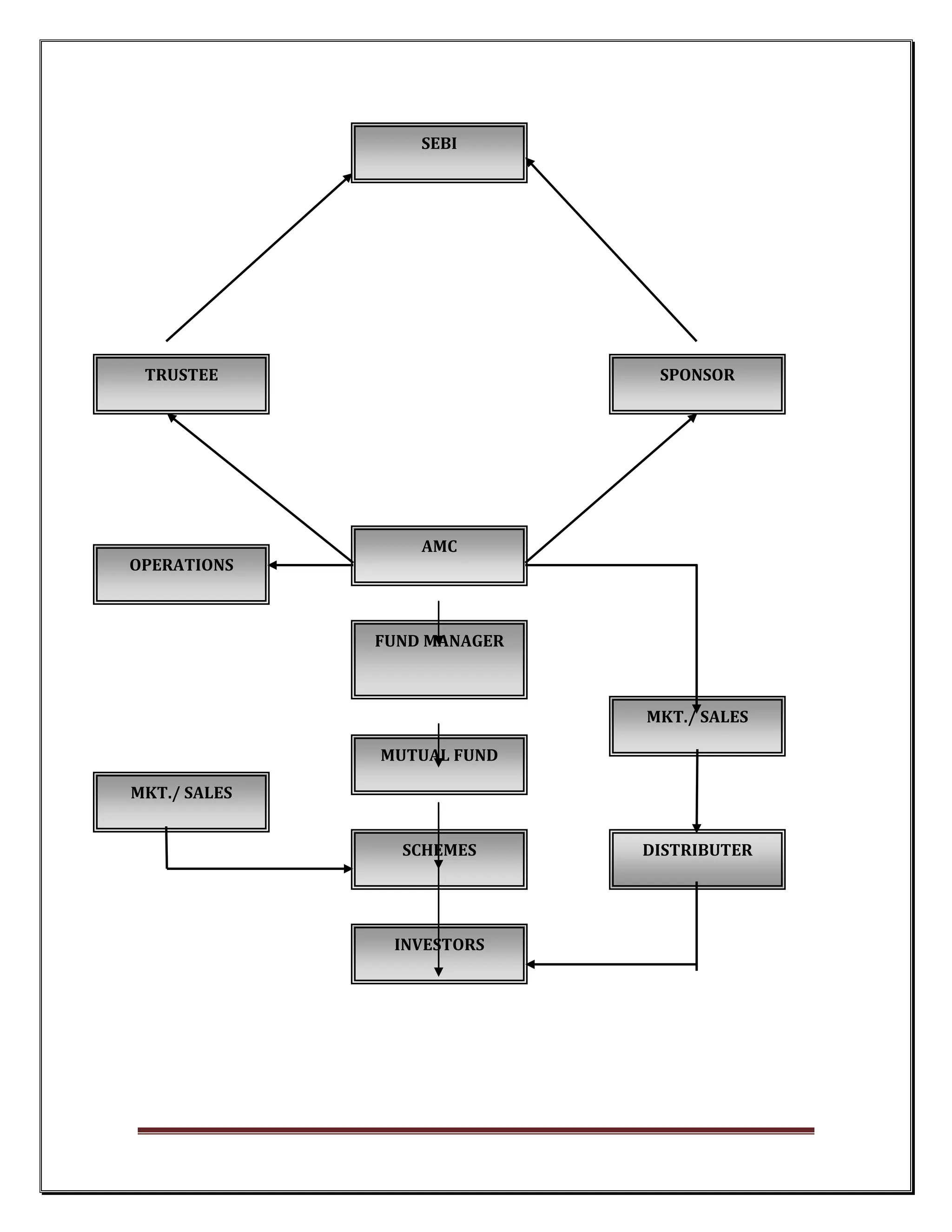
SEBI


 TRUSTEE                      SPONSOR


                  AMC
OPERATIONS


              FUND MANAGER


                             MKT./ SALES

              MUTUAL FUND

MKT./ SALES


                SCHEMES      DISTRIBUTER


               INVESTORS
The Structure Consists
The structure of mutual funds in India is governed by the SEBI Regulations, 1996. These
regulations make it mandatory for mutual funds to have a 3-tier structure of Sponsors-
Trustee-AMC (Asset Management Company).

The Sponsor is the promoter of mutual fund, and appoints the Trustee. The Trustees are
responsible to the investors in the mutual funds, and appoint the AMC for managing the
investment portfolio. The AMC is the business face of the mutual funds, as it manages
all the affairs of mutual funds. The mutual funds and AMC have to be registered by the
SEBI.

Sponsor

Sponsor is the person who acting alone or in combination with another body corporate
establishes a mutual fund. Sponsor must contribute at least 40% of the net worth of the
Investment Managed and meet the eligibility criteria prescribed under the Securities and
Exchange Board of India (Mutual Funds) Regulations, 1996.The Sponsor is not
responsible or liable for any loss or shortfall resulting from the operation of the Schemes
beyond the initial contribution made by it towards setting up of the Mutual Fund

Trust

The Mutual Fund is constituted as a trust in accordance with the provisions of the Indian
Trusts Act, 1882 by the Sponsor. The trust deed is registered under the Indian
Registration Act, 1908.

Trustee

Trustee is usually a company (corporate body) or a Board of Trustees (body of
individuals). The main responsibility of the Trustee is to safeguard the interest of the unit
holders and inter-alia ensure that the AMC functions in the interest of investors and in
accordance with the Securities and
Exchange Board of India (Mutual Funds) Regulations, 1996, the provisions of the Trust
Deed and the Offer Documents of the respective Schemes. At least 2/3rd directors of the
Trustee are independent directors who are not associated with the Sponsor in any manner.

Asset Management Company (AMC)

The AMC is appointed by the Trustee as the Investment Manager of the Mutual Fund.
The AMC is required to be approved by the Securities and Exchange Board of India
(SEBI) to act as an asset management company of the Mutual Fund. At least 50% of the
directors of the AMC are independent directors who are not associated with the Sponsor
in any manner. The AMC must have a net worth of at least 10 crores at all times.

Registrar and Transfer Agent

The AMC if so authorized by the Trust Deed appoints the Registrar and Transfer Agent
to the Mutual Fund. The Registrar processes the application form, redemption requests
and dispatches account statements to the unit holders.

Custodian

A custodian handles the investment back office of a mutual fund. Its responsibilities
include receipt and delivery of securities, collection of income, distribution of dividends,
and segregation of assets between schemes. The sponsor of a mutual fund cannot act as a
custodian to the fund. For example, Deutsche Bank is a custodian, but it cannot service
Deutsche Mutual Fund, its mutual fund arm.


Depository
Indian capital markets are moving away from having physical certificates for securities,
to ownership of these securities in „dematerialized‟ form with a Depository.
TYPES OF MUTUAL FUNDS


  BY DURATION


Open-end schemes:

  The units offered by these schemes are available for sale (investment) and repurchase
  (redemption) on any business day at NAV based prices. Hence, the unit capital of the
  schemes keeps changing each day because the scheme itself buys and sells units from
  investors. Such schemes thus offer very high liquidity to investors and are becoming
  increasingly popular in India.

Closed end schemes:
  You can invest during the initial issue period and your money is locked-in for a stipulated
  period (ranging from 2 to 15 years). After the initial issue, these schemes can be bought
  or sold on the stock exchanges where they are listed. Sometimes, the mutual fund will
  buy units of closed end funds at regular intervals.
What is SIP?

    SIP, Systematic Investment Planning is a way to invest bit-by-bit that yields assured
    returns. Regular fixed investment in a particular Mutual Fund or deposit is made by an
    SIP investor. In simple terms, it is quite the opposite of lump sum investment, which
    involves investing all your money at one go.

    Features of SIP:

 SIP helps in cost averaging as you invest fixed amount regularly every month at different
 NAVs. When the markets are down, the NAV goes down, giving you more number of
 units. Similarly, when markets are up, you get less number of units. But overall, the
 prices are averaged out. Hence, it is benefecial to have SIP in the volatile markets.
 It does not necessarily give better returns, but it is indeed less risky than lump sum
   investments.
 Investors across the globe use this simple yet effective method for savings and wealth
   accumulation.
 You can start SIP in monthly income plans, income funds, equity funds and balanced
   funds. You can also invest in other investment alternatives like recurring deposit
   schemes from post office and banks.

     Positives of SIP

     Disciplined savings - Every month, you tend to keep aside a fixed amount for SIP
      .
     No drastic losses - SIP averages the costs since fluctuations in NAV are directly
      proportionate to the units. This maintains the balance and helps you keep away from
      any drastic losses.

     Easy on entry and exit load - Generally, Mutual Funds do not charge an entry load (a
      percentage of the amount invested) if you opt for an SIP. Moreover, you do not have to
      pay an exit load (percentage of amount charged when you sell your units) if you do not
      exit or sell your units within a year of buying them


      .
     Meet your future needs - Be it owning a dream house or a car, child's education or
      daughter's marriage, we all have dreams, which are hard to realise without money in
      hand. If you start saving a small amount every month or a quarter through SIP, you can
      easily meet all your milestone payments and make all your dreams come true.
[C] CORPORATE FDs-BONDS & DEBENTURES


The fixed deposit space in the industry is gaining some attention as top coporates are raising
funds for their companies through the FD window. Recently Tata Motors has introduced a fixed
deposit scheme where by an interest rate of 11% is offered for deposits parked for three years and
the firm has a sanction to raise up to Rs 1,931.5 crore from the public.


financial advisors say that investors must look at their tax brackets before investing
in such FDs. Director of Transcened Consulting, Kartik Jhaveri says, "It is advisable
for people with very low income. For example, it works out best for people with
income of below Rs 3 lakh or people earning below Rs 5 lakh where they are taxed
at 20%. But it is not at all suited for high net worth clients or people in the higher
tax bracket, as the interest income would be charged at a rate of 30%.".


Two types :-

    1. Bank and NBFC FDs: Offered by banks or non-banking finance companies; the Reserve
       Bank of India (RBI) regulates these institutions.


2. Corporate FDs: These are offered by companies that are looking to raise money from the
open market. Corporate FDs typically pay a higher rate of interest, but also carry a relatively
higher risk than bank FDs.
Advantages:-

• FDs offer a safe return: FDs are usually secure and are very low-risk investments. Bank FDs
are guaranteed up to Rs1 lakh by the Deposit Insurance and Credit Guarantee Corporation.

• You can raise a loan against your FD: You can borrow up to 85% of your deposit amount (in
some cases, only after a few months of your FD‟s existence). This is valid only for bank FDs.

• Low maintenance: Unlike other investments such as stocks, mutual funds or even real estate,
you don‟t need to monitor your FDs on a daily or monthly basis, or undertake any kind of
maintenance work.

• Choice of time period: You can make a deposit for any period of time, from 15 days to 10
years.


Disadvantages :-

• Relatively low returns: Because FDs are very low-risk instruments, they offer low returns
compared with alternative investment options such as stocks and mutual funds.

• Lock-ups: Your money will be locked up in an FD for the duration of the deposit. As a result,
unlike a savings bank deposit, you will lose the flexibility of accessing your funds whenever
needed. You can break your FD if needed, but you would have to pay a penalty, which could
include both a reduced interest rate as well as charges that are typically around 1%of the
investment amount.

• Unfavourable tax treatment: Unlike other investment options, interest income earned from
FDs will be added to your income and taxed.


   Taxes and FDs :-


• FDs and tax deduction at source (TDS): If the aggregate interest income that you are likely to
earn from all your bank FDs held in a single branch is at least Rs10,000 in a financial year
(Rs5,000 in the case of corporate FDs) then TDS will be deducted at 10%.
• If you do not fall in a taxable slab, then furnish Form 15G or 15H to your bank to prevent TDS
on the interest income that is paid to you.


[D] INSURANCE:


             Life Insurance:
                Fullerton securities is tie up with the ICICI Prudencial life insurance.

1.Endowement plan(Traditional plan):

                This plan contains:

                     Guaranteed maturity benefit

                     Insurance+investment+tax benefit

2.ULIPs(Unit linked plan):

                This plan consists of:

                     Insurance+investment+tax benefit

                     Basis-NAV


             Non-Life Insurance:
                Fullerton securities is tie up with the ICICI LOMBARD life
                insurance.


1-Health insurance(Mediclaim)

2-Home Insurance

3-Personal accident
4-Vehicle insurance

5-Travel insuranc

[E] OTHER PRODUCT

        1. MARGIN FUNDING:


        2. REAL ESTATE: 1.Residental

                         2.Commercial
FINANCIAL PLANNING


 The sector of financial planning in a investment also be something you
want to look at. Many sectors invest exist , and they are most often the top-
performing financial planning in a given year, the problem of course , is
guessing which sector will next see uniform growth and avoiding sectors
that can be hard hit by single event such as transportation.


 Financial planning in share market and other social views, political slants
and religious inclination also exit. The best investment for anyone is to have
a good caring family; investment in children to build Capability and
values….


 Education empower! If children have right education and right values then
no investment plan is really needed for the future other then for unforeseen
circumstances…..but none of this can be guaranteed. “Fullerton securities
financial planning provides an investment and protection to take care
of such eventualities”

Financial Planning is a process of taking a holistic view on client’s
financial information so as to meet his financial objectives in an efficient
and disciplined manner. Financial planning is a highly personalized
service that requires a thorough understanding of the process involved.
It requires constant attention as the needs of the client changes as time
passes by. Financial Planning is necessary to Achieve financial goal.
SCOPE OF FINANCIAL PLANING
Risk Management and Insurance Planning
Managing cash flow risks through sound risk management and insurance techniques

Investment and Planning Issues
Planning, creating and managing capital accumulation to generate future capital and cash
flows for reinvestment and spending


Retirement Planning
Planning to ensure financial independence at retirement including 401Ks, IRAs etc.


Tax Planning
Planning for the reduction of tax liabilities and the freeing-up of cash flows for other
purposes.


Estate Planning
Planning for the creation, accumulation, conservation and distribution of assets.


Cash Flow and Liability Management
Maintaining and enhancing personal cash flows through debt and lifestyle management.


Relationship Management
Moving beyond pure product selling to understand and service the core needs of the
client.


Education planning for kids and the family members
Maintaining expense of higher education
FINANCIAL PLANING PROCESS
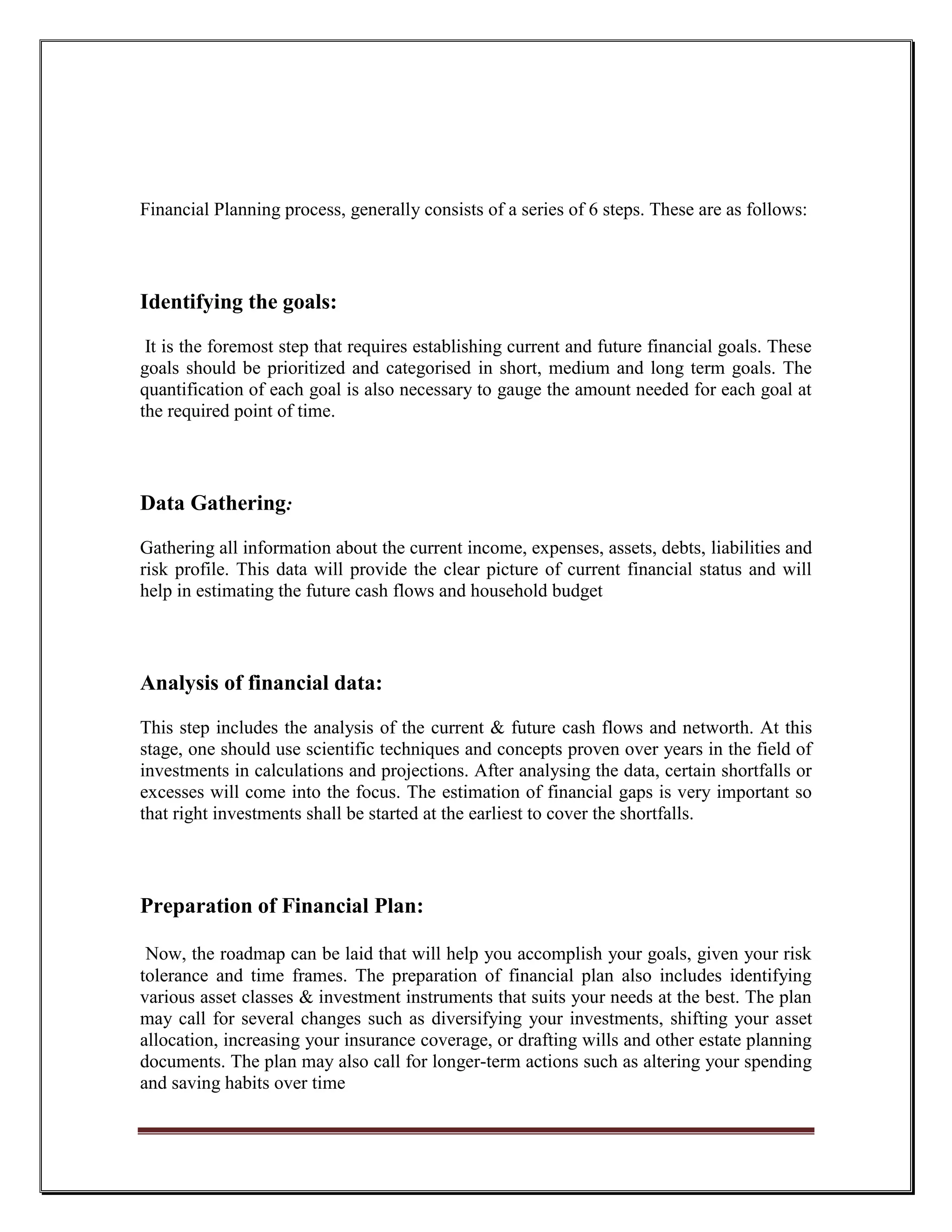
Financial Planning process, generally consists of a series of 6 steps. These are as follows:


Identifying the goals:

 It is the foremost step that requires establishing current and future financial goals. These
goals should be prioritized and categorised in short, medium and long term goals. The
quantification of each goal is also necessary to gauge the amount needed for each goal at
the required point of time.


Data Gathering:
Gathering all information about the current income, expenses, assets, debts, liabilities and
risk profile. This data will provide the clear picture of current financial status and will
help in estimating the future cash flows and household budget


Analysis of financial data:

This step includes the analysis of the current & future cash flows and networth. At this
stage, one should use scientific techniques and concepts proven over years in the field of
investments in calculations and projections. After analysing the data, certain shortfalls or
excesses will come into the focus. The estimation of financial gaps is very important so
that right investments shall be started at the earliest to cover the shortfalls.


Preparation of Financial Plan:

 Now, the roadmap can be laid that will help you accomplish your goals, given your risk
tolerance and time frames. The preparation of financial plan also includes identifying
various asset classes & investment instruments that suits your needs at the best. The plan
may call for several changes such as diversifying your investments, shifting your asset
allocation, increasing your insurance coverage, or drafting wills and other estate planning
documents. The plan may also call for longer-term actions such as altering your spending
and saving habits over time
Implementing the plan:

 This is the step where things are put into actions. Implementing your plan may involve
opening certain types of accounts like bank, demat, trading or purchasing certain types of
securities, policies, funds or other financial and investment-related products. The
implementation should be done immediately and the recommended actions should be
made at the earliest. One should also stick to the plan while implementing it.


Reviewing the plan periodically:
Financial planning is not a one time exercise, rather it is a continuous process. For the
successful planning, it should be reviewed periodically (generally quarterly and atleast
once in 6 months) or at a major event in the life. It also involves keeping an eye on the
performance of your investments, periodically rebalancing / churning / restructuring your
portfolio.


Individuals who feel that the whole financial planning exercise is beyond them are
always advised to consult professional financial planners. Also, the involvement of
specialty areas like investment, insurance, income tax, estate planning and retirement
planning makes it sensible to ask for professional assistance atleast at the beginning.
CHAPTER:4


            RESEARCH OBJECTIVE
Primary objective :
      The study of market in Ahmedabad was conducted with the primary objective to make
       people know about financial planning and our co.FULLERTON SECRUITIES AND
       WEALTH ADVISORS Ltd.

Secondary objective :
      To know priority level between different criteria of investment like safety level, returns,
       liquidity, time horizon, risk.

      To know the investors approach towards their investment.

      To analyze the view of investors.

      To make people understand the process of Financial planning.

      To know the investment pattern


Time scope :
      For completing this project I have taken a time period of 6-weeks of my summer training.


Sample size :


      The sample size of the survey was 100 people,which is randomly taken.

Methods of data collection :
Primary methods

       1. Questionnaire

Secondary methods

       1. Magazines.

       2. Newspapers

       3. Websites

       4. Friend and Relative:-


                                                                                                     54
RESEARCH


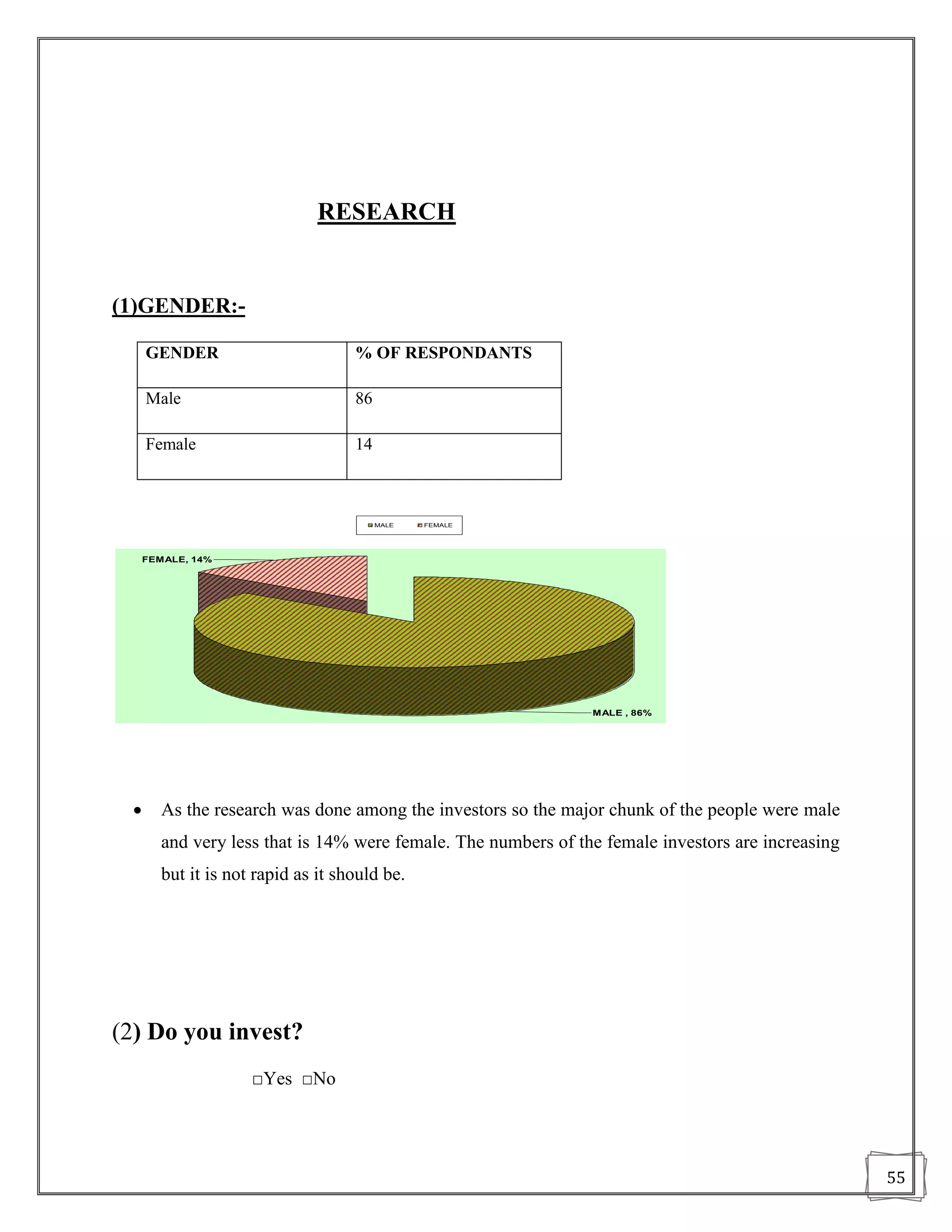
(1)GENDER:-

     GENDER                        % OF RESPONDANTS

     Male                          86

     Female                        14


                                        MALE   FEMALE


     FEMALE, 14%


                                                               MALE , 86%


      As the research was done among the investors so the major chunk of the people were male
       and very less that is 14% were female. The numbers of the female investors are increasing
       but it is not rapid as it should be.


(2) Do you invest?
                    □Yes □No


                                                                                                   55
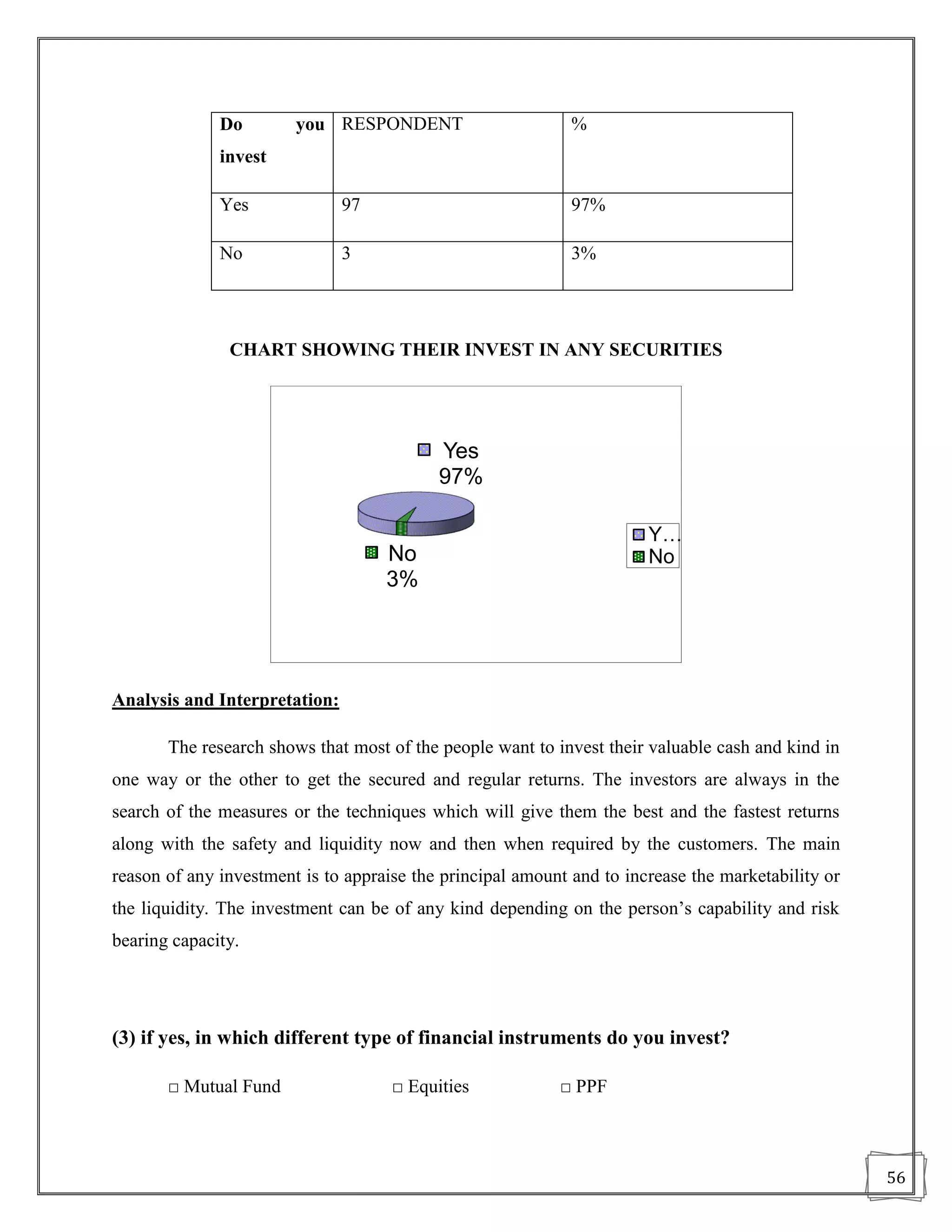
Do        you RESPONDENT                       %
              invest

              Yes              97                            97%

              No               3                             3%


               CHART SHOWING THEIR INVEST IN ANY SECURITIES


                                           Yes
                                           97%

                                                                       Y…
                                    No                                 No
                                    3%


Analysis and Interpretation:

       The research shows that most of the people want to invest their valuable cash and kind in
one way or the other to get the secured and regular returns. The investors are always in the
search of the measures or the techniques which will give them the best and the fastest returns
along with the safety and liquidity now and then when required by the customers. The main
reason of any investment is to appraise the principal amount and to increase the marketability or
the liquidity. The investment can be of any kind depending on the person‟s capability and risk
bearing capacity.


(3) if yes, in which different type of financial instruments do you invest?

       □ Mutual Fund                 □ Equities            □ PPF


                                                                                                    56
□fixed deposits              □insurance            □ Others ________


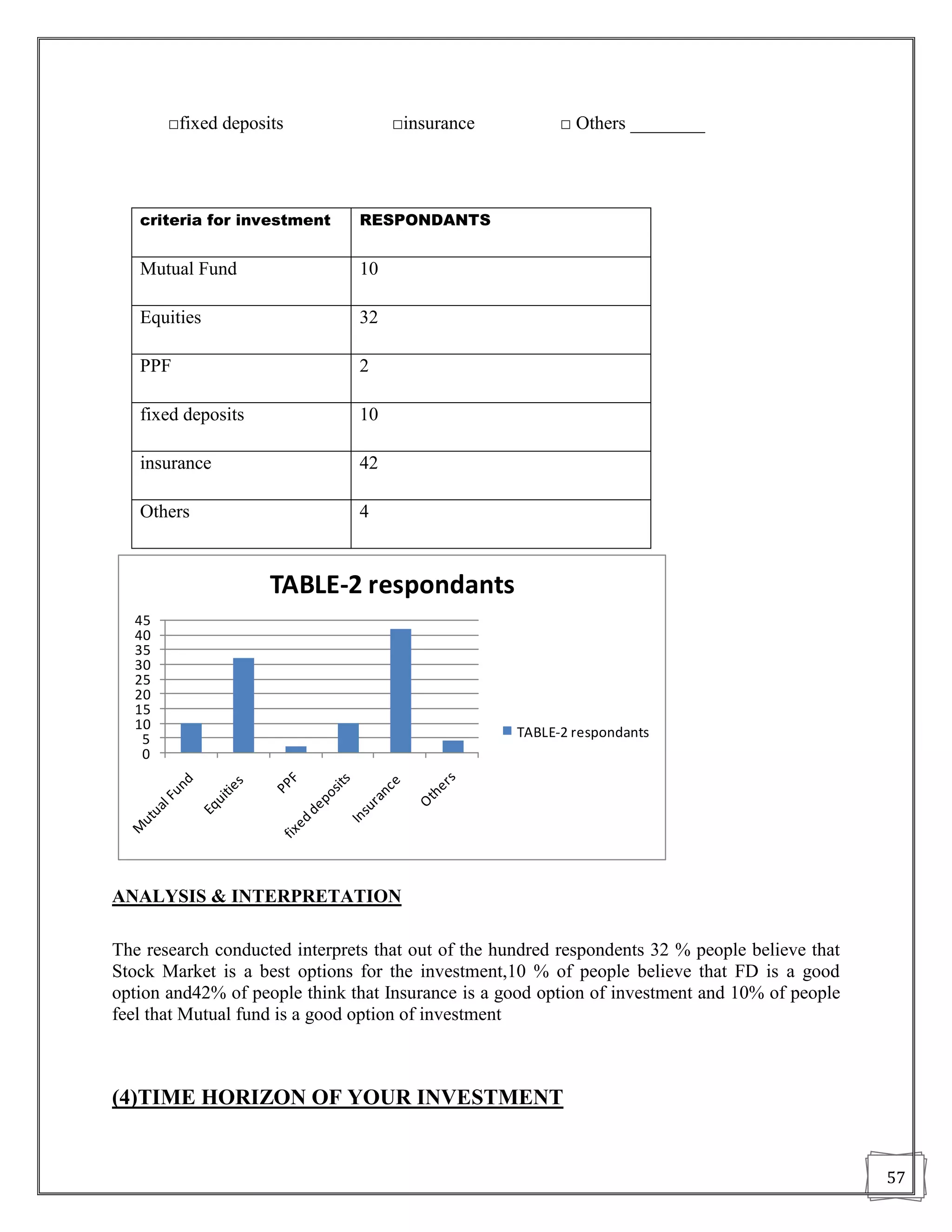
   criteria for investment     RESPONDANTS


   Mutual Fund                 10

   Equities                    32

   PPF                         2

   fixed deposits              10

   insurance                   42

   Others                      4


                    TABLE-2 respondants
  45
  40
  35
  30
  25
  20
  15
  10
   5                                                TABLE-2 respondants
   0


ANALYSIS & INTERPRETATION

The research conducted interprets that out of the hundred respondents 32 % people believe that
Stock Market is a best options for the investment,10 % of people believe that FD is a good
option and42% of people think that Insurance is a good option of investment and 10% of people
feel that Mutual fund is a good option of investment


(4)TIME HORIZON OF YOUR INVESTMENT


                                                                                                 57
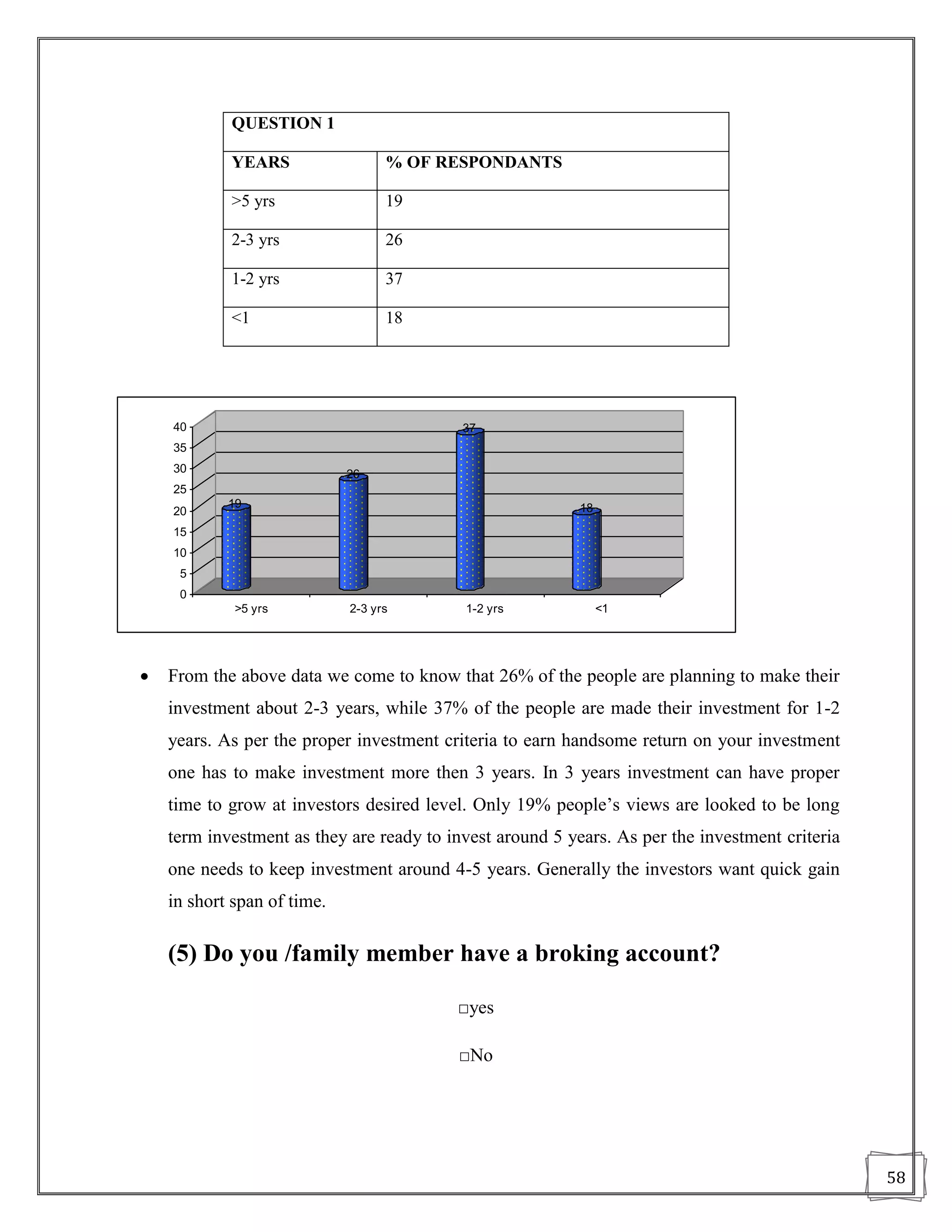
QUESTION 1

            YEARS                  % OF RESPONDANTS

            >5 yrs                 19

            2-3 yrs                26

            1-2 yrs                37

            <1                     18


    40                                     37
    35
    30                       26
    25
            19                                             18
    20
    15
    10
     5
     0
             >5 yrs          2-3 yrs       1-2 yrs              <1


   From the above data we come to know that 26% of the people are planning to make their
    investment about 2-3 years, while 37% of the people are made their investment for 1-2
    years. As per the proper investment criteria to earn handsome return on your investment
    one has to make investment more then 3 years. In 3 years investment can have proper
    time to grow at investors desired level. Only 19% people‟s views are looked to be long
    term investment as they are ready to invest around 5 years. As per the investment criteria
    one needs to keep investment around 4-5 years. Generally the investors want quick gain
    in short span of time.

    (5) Do you /family member have a broking account?

                                          □yes

                                          □No


                                                                                                 58
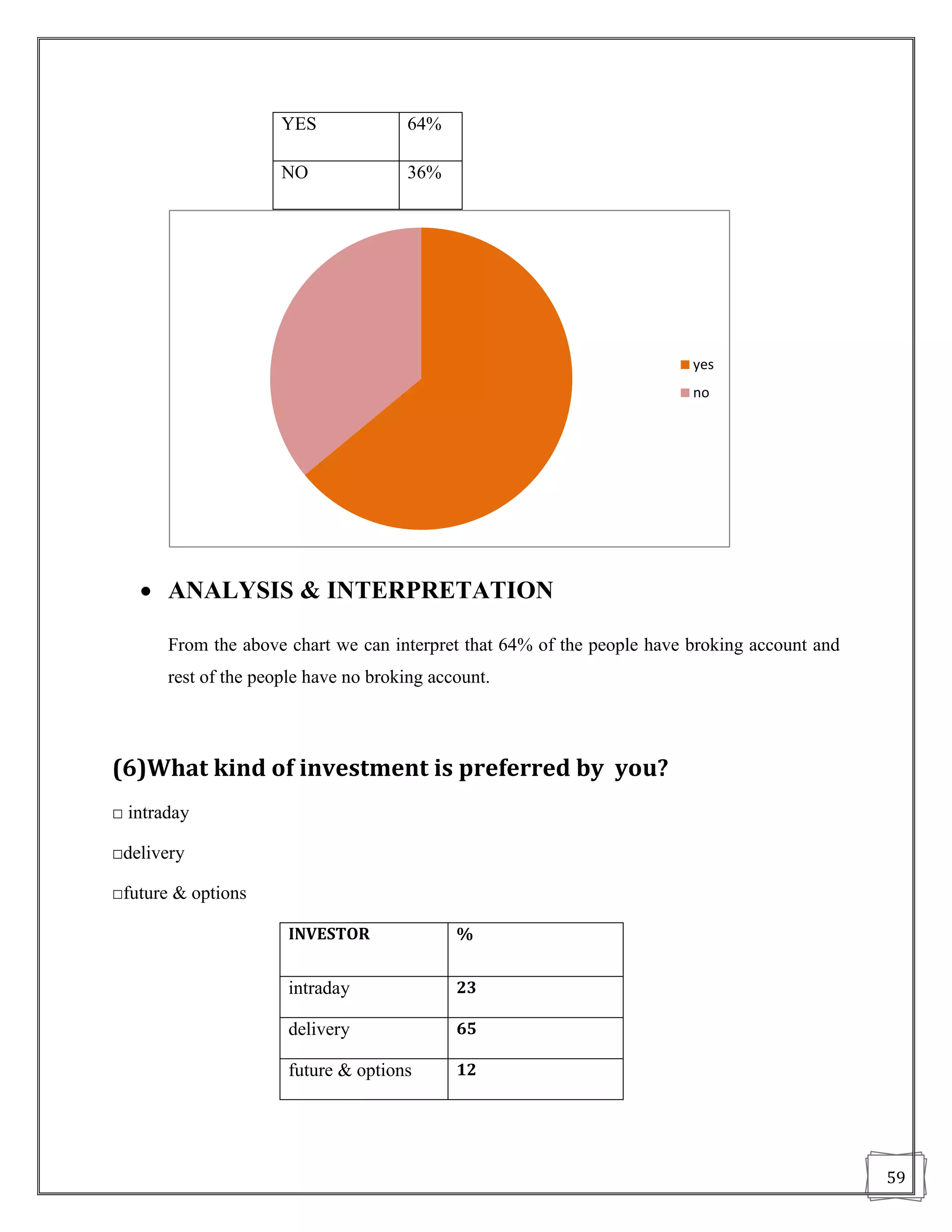
YES             64%

                      NO              36%


                                                                         yes
                                                                         no


    ANALYSIS & INTERPRETATION

       From the above chart we can interpret that 64% of the people have broking account and
       rest of the people have no broking account.


(6)What kind of investment is preferred by you?
□ intraday

□delivery

□future & options

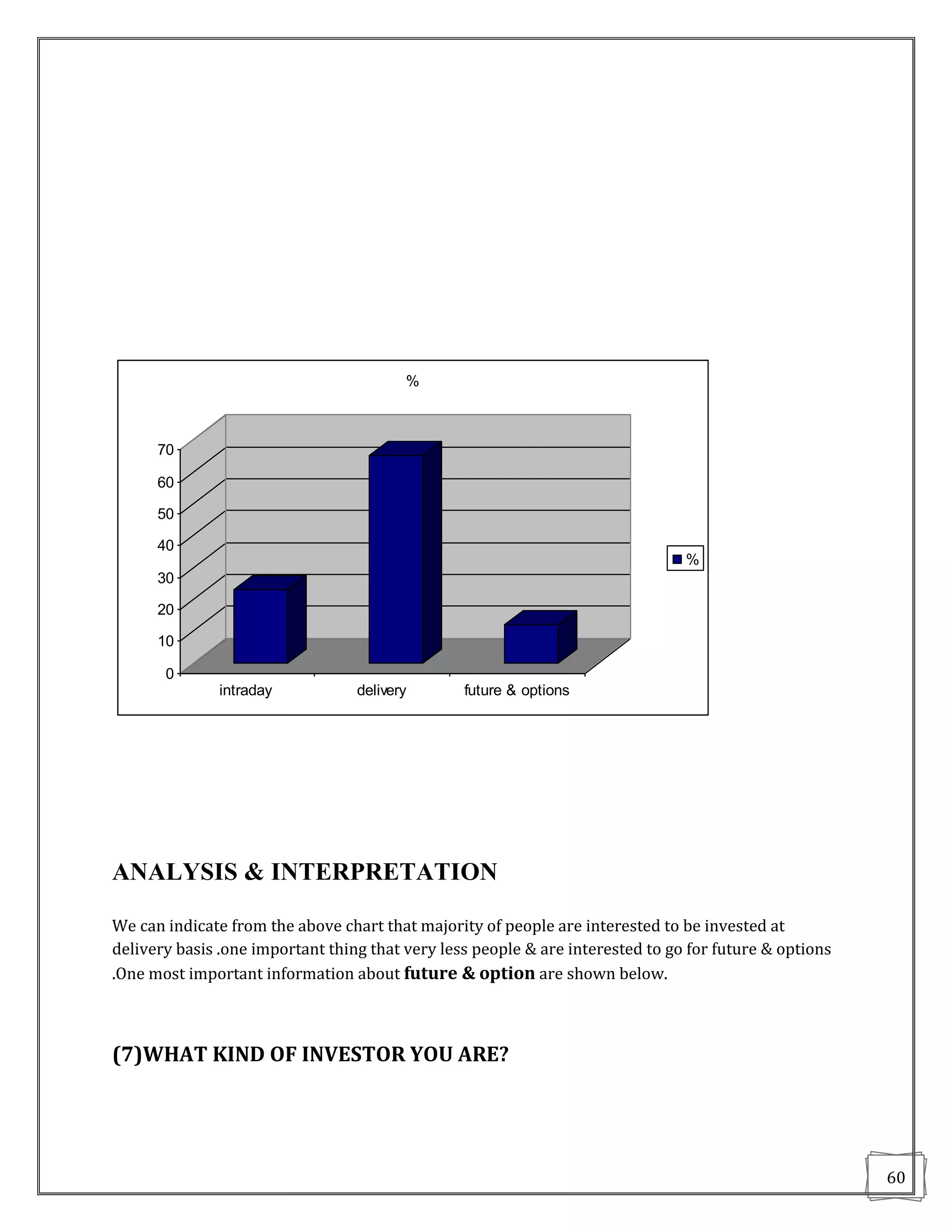
                       INVESTOR              %


                       intraday              23

                       delivery              65

                       future & options      12


                                                                                               59
%


      70

      60

      50

      40
                                                                                %
      30

      20

      10

       0
               intraday           delivery       future & options


ANALYSIS & INTERPRETATION

We can indicate from the above chart that majority of people are interested to be invested at
delivery basis .one important thing that very less people & are interested to go for future & options
.One most important information about future & option are shown below.


(7)WHAT KIND OF INVESTOR YOU ARE?


                                                                                                        60
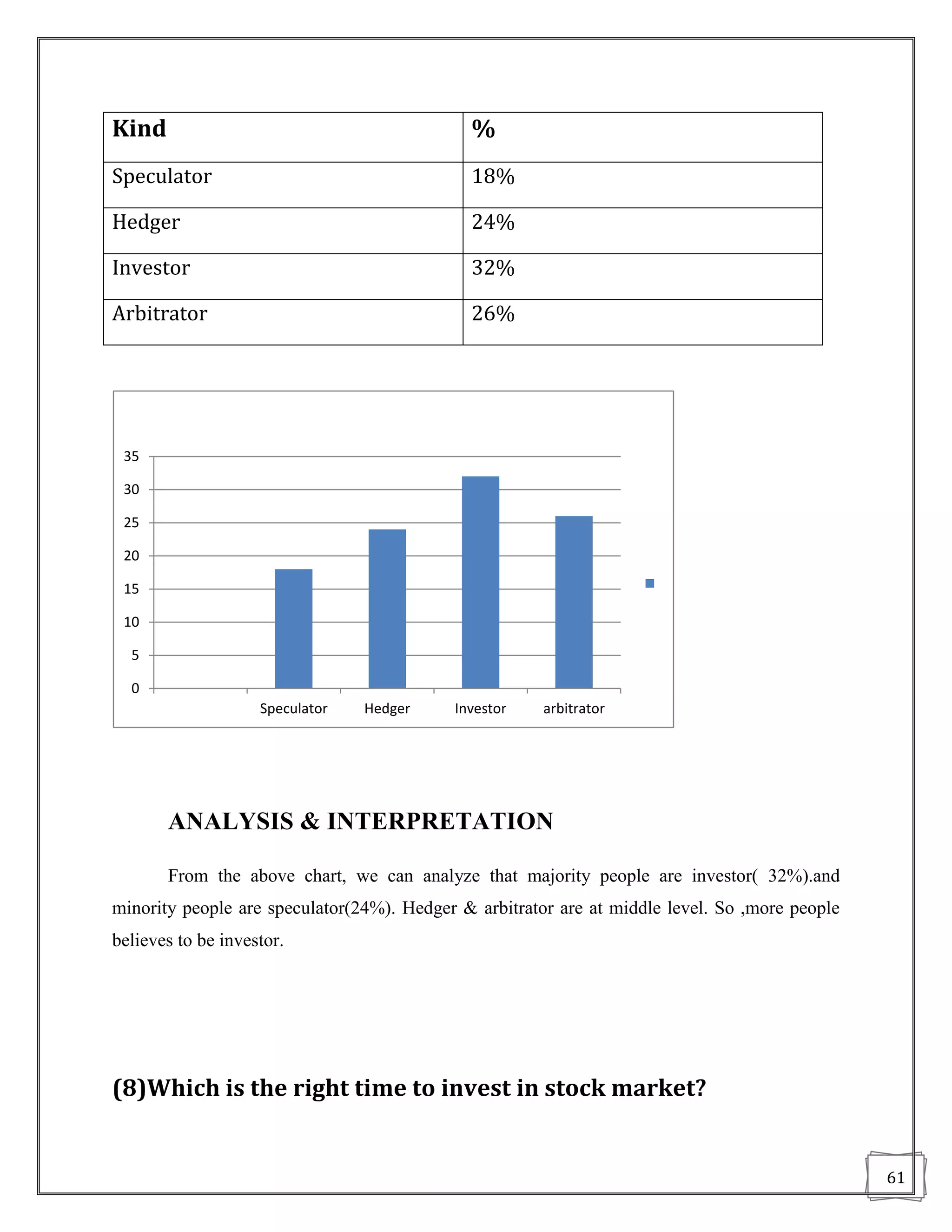
Kind                                         %
Speculator                                   18%

Hedger                                       24%

Investor                                     32%

Arbitrator                                   26%


 35

 30

 25

 20

 15

 10

  5

  0
                    Speculator   Hedger    Investor    arbitrator


       ANALYSIS & INTERPRETATION

       From the above chart, we can analyze that majority people are investor( 32%).and
minority people are speculator(24%). Hedger & arbitrator are at middle level. So ,more people
believes to be investor.


(8)Which is the right time to invest in stock market?


                                                                                                61
□Bullish

□Bearish

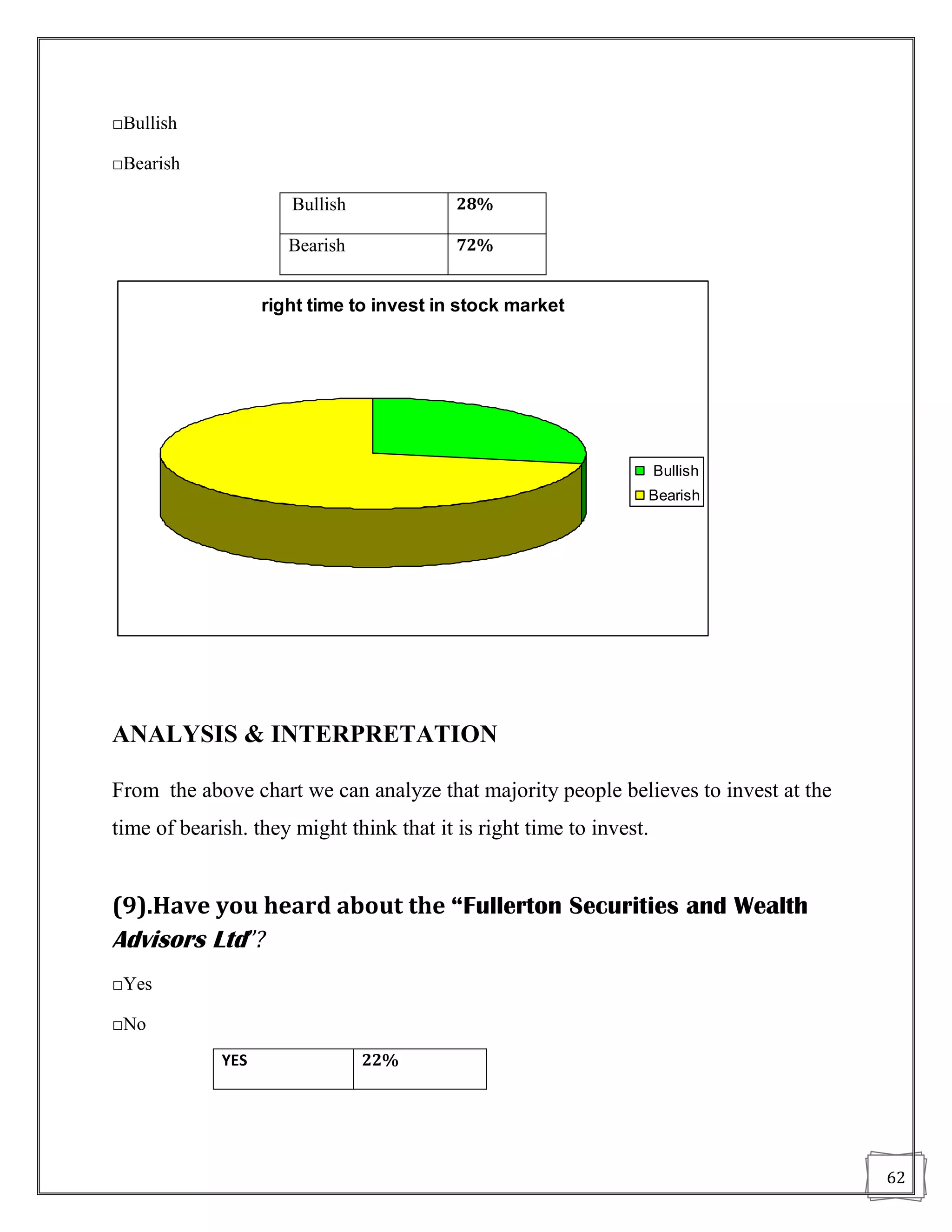
                      Bullish             28%

                      Bearish             72%


                   right time to invest in stock market


                                                                     Bullish
                                                                 Bearish


ANALYSIS & INTERPRETATION

From the above chart we can analyze that majority people believes to invest at the
time of bearish. they might think that it is right time to invest.


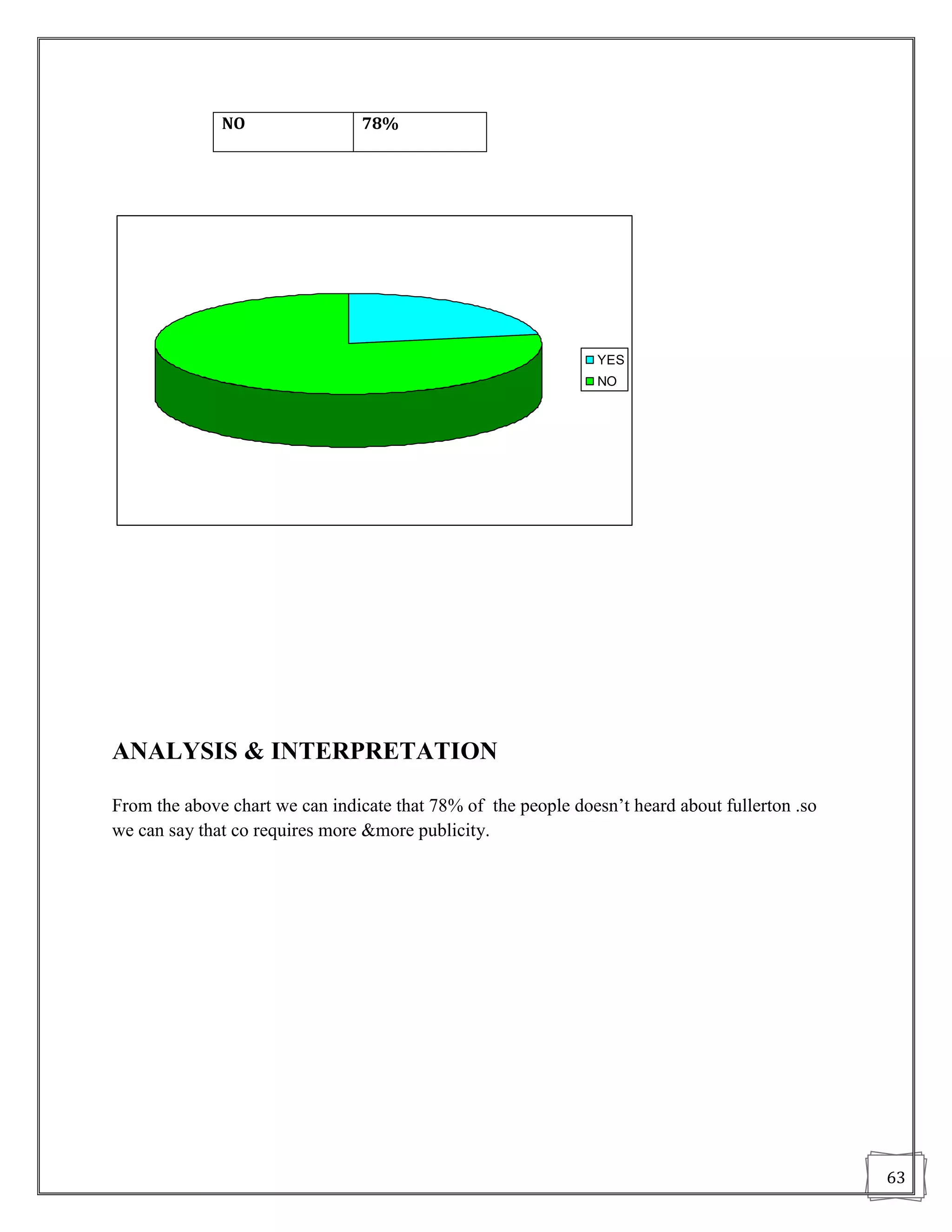
(9).Have you heard about the “Fullerton Securities and Wealth
Advisors Ltd”?
□Yes

□No
             YES                22%


                                                                                     62
NO                78%


                                                                YES
                                                                NO


ANALYSIS & INTERPRETATION

From the above chart we can indicate that 78% of the people doesn‟t heard about fullerton .so
we can say that co requires more &more publicity.


                                                                                                63
CHAPTER: 5


SWOT ANALYSIS:-


  STRENGHTS:

   Low brokerage system
   Effective after sales services system
   Advisory desk operations provided by fullerton


                                                     64
   Well established brand equity
     Tele trade also possible
     Freedom account with different facilities
     Personalize alerts
     Consolidated statements-a unique service offering


WEAKNESSES:

   Lack of Aggressive advertisements and sales promotion
    programmed.
   High charges for demate a/c compare to others
   The working of the sales force is traditional
   Inventory investments should be more.
   Less popularity
   Mis-communication and ineffective co-ordination at various
    level of hierarchy.


OPPORTUNITIES:

     Growing capital market in India & other country
     Political stability in India & other country
     Better governance by SEBI
     Decreasing interest rates in India, so people are motivated to
      earn more returns through capital market.


THREATS:

   Demand & supply
   Increasing competition in security market.
   Lost in faith in share market after big scams in the stock
    market.
   Natural calamities


                                                                       65
 Inability of customers to pay brokerage at the right time.
 High risk involved in the stock market.


 Most of the investors are for the short term period, but financial advisers have to teach
   them about benefits of long term investment.


 Fullerton Securities and wealth advisor ltd. should do some advertisement in the market
   to make people aware about our Company.


                                                                                              66
 Fullerton Securities and wealth advisor ltd. marketing team should promote in such a way
        that clients should not misinterept it as fullerton India credit.


    On that analysis we are come to know that there should be different types of readymade
        plans so that the investors can choose the proper plans according to their requirement.


Questionnaire


Dear Sir/Madam, I am a student of GTU, Ahmedabad. As part of my project "Curent Scenario of
broking business & Different pattern of Investments", I am doning a survey on 'Broking Account
of FULLERTON SECURITUES AND WEALTH ADVISORS LTD. I request you to help me in
it by filling up yhe following questionnaire. The details by you will be kept completely
confidential will not be disclosed to anybody.


1) In which different type of financial instruments do you invest?

a.Mutual fund

b.Equities...

c.Fixed deposits

d.PPF

e.Insuurance..

f.Other specify


                                                                                                  67
2) From How many years are investing in financial intruments?

 a. 1-2 year.

 b. 3-5 year.

 c. 6-10 year.

 d. 11-15 year.

 e. More than 15 years.


3) Do you / family member have a broking account?

 a.Yes

 b.No


4) If yes, where do you have a your broking account?

............................................................

5) Are you looking forward to change your current broker?

 a.Yes

 b.No


6) What is the brokerage that you're paying?

..........................................................

7) Generally what kind of investment is preferred by you?

 a.Intraday


                                                                68
b.Future & Option

c.Delivery


8) Generally what kind of investor are you?

a.Speculator

b.Hedger

C.Invetor


9) Which is the right time to invest in stock market?

a.Bullish

b.Bearish


10) Have you heard about the Fullerton Securities and Wealth Advisors Ltd?

a.Yes

b.No

11) In case you whish to take account what would be your preference?

a.Freedom Account

b.Silver Account

c.Platinum Account

d.Gold Account

e.Prepaid Account (i.e. 5000,10000,25000).

12) Do you know about the Future & Options?


                                                                             69
a.Yes

b.No.


                                       BIBLIOGRAPHY


       www.amfiindia.com
       www.mutualfundindia.com
       www.moneycontrol.com
       www.valueresearchonline.com
       www.fullertonsecurties.co.in
       www.investshoppe.co
       http://www .indianground.com/real_estate.india.aspx
       http://www.savingwala.com/postoffice-saving/index.html
        (as on 05/09/2010)
       http://www.multiutils.com/itp/bk.htm
        (as on 06/09/2010)


                                                                 70

current scenario of stock market

  • 1.
    SUMMER INTERNSHIP PROGRAM PROJET REPORT ON “FULLERTON SCURITIES & WEALTH ADVISORS LIMITED” PROJECT REPORT SUBMITTED IN PARTIAL FULFILLMENT OF MBA DEGREE PROJCT GUIDE: KAPIL JOSHI Submitted by: JIMISH THAKKAR Roll no: 107850592031 Acadmy Year: - 2010-2012
  • 4.
    PREFACE One cannot swim only by reading the book on swimming. It must require practice. Theory enables a person to think but theoretical knowledge is only a half way in the overall development of an individual. Theory has to be supported by practical understanding of things. By undertaking this project I have tried to correlate our learning‟s in the college books to undertake practical work. When every organization ventures out to make its mark in the corporate world, a refined mantra which dictates is, 'Know thy customer '. Culmination to success summits materializes when this concept has been assimilated in the veins of its philosophy and valuable human resources. Indian Trading industry is an exemplary icon to today's aspiring industries, which proves that in today's tough competitive times it is the customer satisfaction, which speaks for every industry. As a part of my summer internship I did a project to understand and find out the current scenario of fullerton securities in the financial market. During the course of project I conducted a market survey to check the response of Fullerton‟s customers on its services. The results of the survey have been summed up in details inside. Here, my sincere efforts have been directed towards finding the customer satisfaction for Fullerton security . I wish that the findings of my project would help Fullerton security to understand the customer satisfaction level within limitations of my study and take necessary action to implement the needed steps for customer delight.
  • 5.
    Acknowledgment I have tofeel very proud to say that ; theory and practical are essential and complimentary to each other. I am indebted and thanks full for the assistance received from various individuals in marketing this project success. I found a no words those who my gratitude to words those who ware constantly involved with me throughout my tenure in Fullerton Securities &wealth advisors limited I would you like to great thanks to “Mr. Kumar Kinsuk”. Who is the head person of the department. He gave me great opportunities in this company for work as a marketing officer . I also heartily great thanks to “Mr.Rahul Shinghvi”, “Mr.Kapil Joshi” who supported me and always help me in work. I also thanks to”Mr.Kartik Sheth, Mr.Umer Rangoonvala”,& “Mr.Dinesh Shilpakar” and other staff member who always encourage me and help me. Now I have to great experience how to work in corporate world so that„s why I am really thanks for that they gave me chance to work with us JIMISH THAKKAR
  • 6.
    DECLARATION We hereby declarethat the Summer Project titled “CURRENT SCENARIO OF BROOKING BUSINESS & INVESTMENT MANAGEMENT” is my original work and has not been published elsewhere. This has been undertaken for the purpose of partial fulfillment of Gujarat Technological University requirements for the award of the Degree of Master of Business Administration. Jimish Thakkar Date:- Place :
  • 7.
    Executive summery The primaryaim of my project is to study the One the parameter of economic development is intensive growth of Indian stock market after 2004. The stock market is reaching at new height. It is flooded with investment for FIIS. which is resulting into more jobs with good pay scale. The overall purchasing power has also increased. Domestic financial system is also becoming more and more developed as more facilities in stock market is provided as internet trading, offline trading etc. So as the competition increase and new product are launched Indian customer is having sufficient choice between different avenues which provide market linked return , so Indian investor are enabled with various option to suit their financial goals and tax planning requirement. To fulfill the primary aim of the project. I have studied that factor which are supporting to the growth of the financial planning in mutual fund, IPO, share market
  • 8.
    INDEX CH CONTENT PAGE NO. PREFACE ACKNOWLEDGMENT EXECUTIVE SUMMARY 1 HISTORY OF STOCK MARKET 2 COMPANY PROFILE INTRODUCTION BOARD OF DIRECTOR VISION&MISSION USE OF TECHNOLOGY 3 COMPANY BUSINESS BROKING MUTAL FUND FIXED DEPOSITS INSURANCE OTHER PRODUCTS 4. FINANCIAL PLANNING SCOPE OF FINANCIAL PLANNING PROCESS OF FINANCIAL PLANNING 5 RESEARCH METHODOLOGY
  • 9.
    6 RECOMMENDATION & SUGGESTIONS 6 RECOMMENDATION & SUGGESTIONS 7 SWOT ANALYSYS 8 BIBLIOGRAPHY& ANNEXURE
  • 10.
    CHAPTER: 1 1. NATIONAL STOCK EXCHANGE (NSE) 2. BOMBAY STOCK EXCHANGE (BSE) 3. DOMESTICK STOCK EXCHANGE 4. TYPE OF GROUP IN MARKET
  • 11.
    HISTROY OF INDIANSTOCK MARKET: Indian Stock Markets are one of the oldest in Asia. Its history dates back to nearly 200 years ago. The earliest records of security dealings in India are meager and obscure. 1850 – Shares of banks and securities of East India Company traded in Mumbai under a sprawling banyan tree in front of Town Hall, which is now in the Horniman Circle Park. 1875 – Brokers organized an association known as the Native Share Brokers Association, and the country‟s first stock exchange the Bombay Stock Exchange (BSE), set up in Mumbai with 318 members. The membership fee gradually increased from Re 1 in 1887 to Rs 1,000 in 1896, and Rs 48,000 in 1920.00 1956 – Securities Contract Regulation Act passed 1957 – The BSE and eight other stock exchanges registered under the Securities Trading Contract Act. 1982 – The BSE classifies scripts into Group A for carry forward, and Group B for cash transactions. 1986 – The BSE 30-share Sensitivity Index (Sensex) compiled; updated every two minutes. 1987 – Stock Holding Corporation of India set up. 1992 – Ordinance promulgated for granting statutory powers to the SEBI. The Over-The-Counter Exchange of India begins operations. The National Stock Exchange incorporated. The new 9,000-sq. ft ring in the rotunda of the new annexe to Jeejeebhoy Towers inaugurated.
  • 12.
    1995 – TheBSE computerizes its trading operations, signaling the end of 120 years of floor-trading with 1994 – The NSE‟s debt segment begins operations on June 30; and the capital market segment open out-cry system of share-trading and the beginning of screen-based trading on the BSE. 1996 – NSE 50 index launched April 22. NSDL set up as the first depository in India, and the NSE commences trading in dematerialized securities on December 26. 2000 – The SEBI approves the report on net trading brought out by the SEBI committee on Net based trading and services. Pursuant to the circular, stock exchanges are required to give permission to members to start Net-based trading after ensuring fulfillment of the minimum conditions. The NSE is the first exchange to grant provisional permission to Cochin-based Geojit Securities to commence Net-based trading. 1. NSE (National Stock Exchange) While India has had a long history of securities trading, the markets have not always kept pace with the emerging trends and requirements for this industry to reach its full potential. Particular issues of concern in the securities industry have been lack transparency, lack of trading facilities which are fair and
  • 13.
    accessible to all,undercapitalized trading members, dated procedures and practices and long and uncertain settlement cycles. NSE emerged as an endeavor by some of the institutional investors within the country to address these issues, and to break the monopoly which was enjoyed by BSE brokers. NSE incorporated in 1992 was given recognition as a stock exchange in April 1993 and started operation in June 1994.  Objective Of NSE:  To establish a nationwide trading facility for equities, debt instruments and hybrids.  To ensure equal access to investors all over the country through an appropriate communication network.  To provide fair, efficient and transparent securities market to investors using electronic trading systems.  To enable shorter settlement cycles and book entry settlement system.  To meet the current industrial standards of securities market. The trading system of the NSE, known as the NEAT (National Exchange for Automated Trading), is a fully automated screen-based trading system that enables members from across the country to trade simultaneously with enormous ease and efficiency. The NSE has set-up facilities which serve as a model for the securities industry in terms of trading systems, practices and procedures. Securities traded on the NSE provide a trading platform for all types of securities – equity and debt, corporate and government and derivatives. The
  • 14.
    exchange provided productsin 3 different segments : Wholesale Debt Market (WDM), Capital Market (CM) and in Futures and Options (F&O) segment and the products range from equities, fixed income securities, futures and options on indices, stocks and interest rates. The national stock index stock exchange index is known as “NIFTY”. 2.BSE (Bombay Stock Exchange): The roots of the stock exchange, Mumbai can be traced back to 1875, when the Share and Stockbrokers Association (non-profit organization) was established. BSE is the oldest stock exchange in Asia and the most important stock exchange in Indian capital market. It is situated at DALAL street in Mumbai. The index of Bombay stock exchange is known as “SENSEX” i.e. sensitive index. It is first compiled in 1986 as market capitalization weighted index, which include 30 component stocks representing a sample of large, well established and financial sound companies. The index is widely used to measure the performance of Indian stock market. In May 1995, the BSE took a major step when it started order-cum-quote driven electronic trading for all the listed securities. The BOLT, the BSE Online Trading System increased market transparency, liquidity and elimination of mismatches. 3.Domestic Stock Exchanges: In the year 1956, the government came out with a comprehensive legislation called the „Securities Contract (Regulation) Act to regulate the functioning of stock exchanges. The legislation made it compulsory on the part of the stock exchanges to secure recognition
  • 15.
    from the CentralGovernment. More stock exchanges were recognized subsequently. At present there are 23 stock exchanges in India including the OCTEI and NSE. The recognition accorded to a stock exchange is normally valid for a period of 5 years or a shorter as prescribed. The names of these stock exchanges with their geographical location, and the date of receiving government recognition are given in the following table: Date of initial Sr. No. Name of exchange and Location recognition 1. The Stock Exchange, Mumbai. 31-03-1857 2. The Ahmedabad Stock Exchange Association 16-09-1957 Ltd. 3. The Calcutta Stock Exchange Ltd., Calcutta 10-10-1957 4. Madras Stock Exchange Ltd. Chennai 15-10-1957 5. The Delhi Stock Exchange Association Ltd., 9-12-1957 New Delhi 6. The Hyderabad Stock Exchange, Hyderabad. 29-09-1958 7. Madhya Pradesh Stock Exchange, Indore 24-12-1958 8. Bangalore Stock Exchange Ltd., Bangalore 16-02-1963 9. Cochin Stock Exchange ltd., Ernakulum, Cochin 10-05-1979 10. The Uttar Pradesh Stock Exchange Asso. Ltd., 03-06-1982 Kanpur
  • 16.
    11. Pune Stock Exchange Ltd., Pune 02-09-1982 12. Ludhiana Stock Exchange Ltd., Ludhiana 29-04-1983 13. The Gauhati Stock Exchange Ltd., Gauhati 01-05-1984 14. Kanara Stock Exchange Ltd., Mangalore 09-09-1985 15. The Magadh Stock Exchange Ltd., Patna 11-12-1980 16. Jaipur Stock Exchange ltd., Jaipur 09-01-1989 17. Bhubaneshwar Stock Exchange Asso. Ltd., 05-06-1989 Bhubaneshwar. 18. Saurashtra Kutch Stock Exchange Ltd., Rajkot 10-07-1989 19. The Vadodara Stock Exchange LTd., Baroda. 05-01-1990 20. The Coimbatore Stock Exchange Ltd., 18-09-1991 Coimbatore 21. The Meerut Stock Exchange Ltd., Meerut 20-09-1991 22. National Stock Exchange 26-04-1993 4.Types of groups in stock market:  A group:
  • 17.
    Its share capitalis more than 100 crores. It is known as Blue chip companies.  B1,B2 group: Very popular company who‟s trading is possible in any situation of the market. Estimably 1000 companies.  T group: It includes companies whose trading is on T to T basis.  TS group: Trading of these companies is not possible on same day.  S group: Trading of these companies can possible on same day.  Z group: It include companies which have failed to comply with listing requirements and/or failed to resolve investors companies or have not made the required arrangements with both the depositories i.e. NSDL and CDSL.
  • 18.
  • 19.
     INTRODUCTION OFCOMPANY  BOARD OF DIROCTOR  VISION & MISON  USE OF TECNOLOGY  KEY VALUE DIFFERETIATION INTRODUCTION OF COMPANY Fullerton securities company is a multinational company which is established in singapore.now this company also working in india during 2002. Fullerton securities & wealth advisors limited is a subsidiary of
  • 20.
    fullerton finanancial holding,anasian financial institution with investments In banks and finance companies in emerging markets including india,indonesia,china, and Uae. In india there are so many branches which is ahmedabad,banglore,chandigarh,gurgaon,hyderabad,jaipur,kolkata,ludhiana, and mumbai. As we all know that security company has two types ie. corporate entity and broking company but fullerton securities is corporate entity which is SEBI regulated Fullerton Financial Holdings Pte. Ltd. invests in financial institutions in emerging markets, bringing an operational perspective to all investment decisions. As on 31st December, 2007, the total assets of Fullerton Financial Holdings Pte. Ltd. stood at $59.7 billion and its portfolio comprised investments in 15 different financial institutions. Fullerton Financial Holdings Pte. Ltd. supervises and influences its banks to achieve the right risk-reward balance. It seeks to create shareholder value by differentiating through great people, disciplined development and execution of unique business models. Primarily, it focuses on both Business banking and Consumer banking
  • 21.
     Business banking: Fullerton Financial Holdings Pte. Ltd. focuses on the Commercial, SME and Self-employed mass market segments. On the other hand, it focuses on the Mass affluent and Mass salaried segments  Consumer banking: Fullerton Financial Holdings Pte. Ltd. is a wholly owned subsidiary of Temasek Holdings, an Asia investment house, headquartered in Singapore, focused on creating and maximizing long-term shareholder value as an active investor and shareholder of successful enterprises. BOARD OF DIRECTOR DR. Richard Hu Chairman.
  • 22.
    Mr.Peter Seah Deputy Chairman. Mr. Ng Kee Choe Director. . Mr.Ernest Wong Director Mr. Francis Rozario, Executive Director and CEO. Pallav Sinha, President & Chief Executive officer.
  • 23.
    Ashok Mathur, Regional HeadSouth. Ashwinder Raj Singh, Regional Head North & Central. Punit Gupta, Regional Head Weast. 100%owned
  • 24.
    100%owned About Fullerton Temasek holdings is an Asian investment house managing a portfolio of over s$185 billion or us$134 guided by an Independent board, they operate autonomously on commercial principle to maximize long term shareholder retunes. Fullerton is the banking subsidiary of temasek.  Rated AAA/Aaa by stand and Poor‟s and Moody‟s respectively  Diversified portfolio is an wide range of industries  telecommunication &media, singtel, Bharti Airtel, Global crossing
  • 25.
    Financial services: DBS, Standerd charted bank, Merrill Lynch, Barclays,  Real Estate: Capital Land, Maple tree  Transportation & Logistics – Singapore Airlines, Neptune orient lines, PSA  Energi&Resoures- Singapore Power, Senoko Power, Powerseray  Infrastructure, Industrial&Engineering- Keppel Corporation sembcorp  Technology-Chartered semiconductor, statschipPAC Respectable returns to shareholder over last 34 year Total shareholder retunes of more then 18% per annum 100% owned by the ministry of finance of Singapore Philosophy : Baat Faayde Ki Company Vision & Mission Company Vision  Enabling Success,  Enriching Lives Company Mission To create superior long-term shareholder value in financial sectors across Emerging Markets • Organic Growth • Acquire and Transform
  • 26.
    • Improve Productivity • Optimize Capital • Risk-Reward Balance Our Business Philosophy  Ethical Practices & Transparency In All Our Dealings  Customers Interest Above Our Own  Always Deliver What We Promise  Effective Cost Management. Our Quality Assurance Policy We are committed to being the Leader in providing World Class Products & Services which exceed the expectations of our customers achieved by teamwork and a process of continuous improvement OUR MOTTO Our motto is to make our customer smile - To have complete harmony between Quality- in-Process and continuous improvement to deliver exceptional service that will delight our Customers and Clients. CRM POLICY Customer is King “A Customer is the most Important Visitor on Our Premises He is not Dependant on us but we are dependant on him He is not an Interruption in our work,
  • 27.
    but is thePurpose of it We are not doing him a favour by serving He is doing us a favour by giving us an opportunity to do so” - Mahatma Gandhi Use of Technology in Company Electronic Tools:  PC  Laptops  Voice / Telephony  Television Network &Connectivity:  WAN  LAN  Routers / Switches Infrastructure: • Data Canter • Servers • Remote Server Management Call Canter:
  • 28.
    • Contact Canter • CTI Integration • IVR Capital Market Applications: • Front-End • Back-Office • Exchange Interfaces
  • 29.
    Oracle Business Applications: • CRM • Sales Management • GL Wealth Management & Portfolio Aggregation: • Mutual Funds • Portfolio Aggregation • Document Management Delivery Channels – Web, SMS: • Internet • SMS • Emails • Analytics
  • 30.
    Fullerton Financial Holdings- Key Value Differentiation  Great Leadership – Passionate, Balanced, Disciplined  Customer-centric Business Models – Relationship v/s Product Positioning  Deeply Embedded in each Market & chosen Segment – High Market share – Top 3  Leader in Commercial / SME, Mass Consumer & Mass Self-employed segments  Enabling management model and culture  Empowerment within defined boundaries  Embed the right values & behavior across the organization
  • 31.
    COMPANY BUSINESS PRODUCTS:  CAPITAL MARKET:  Equities  INVESTMENTS:  Mutual funds  Fixed deposits  Bonds & Debentures  PROTECTION(Insurance)  Life insurance  General insurance  OTHER PRODUCTS:  Margin funding  Real estate
  • 33.
    [A] BROKING FREEDOM ACCOUNT It is also called „demate account‟ for which our company takes the charges of Rs 1995/- and no ammount is refundable.after opening this account customer gets the facility of free brokerage up to trading of 500,000/- in delivery or 50,00.000/- in intraday during 6 months. What Does Equity Market Mean? The market in which shares are issued and traded, either through exchanges or over-the-counter markets. It is also known as the stock market, it is one of the most vital areas of a market economy because it gives companies access to capital and investors a slice of ownership in a company with the potential to realize gains based on its future performance. What is Derivative Market Mean ? The Derivatives Market is meant as the market where exchange of derivatives takes place. Derivatives are one type of securities whose price is derived from the underlying assets. And value of these derivatives is determined by the fluctuations in the underlying assets. These underlying assets are most commonly stocks, bonds, currencies, interest rates, commodities and market indices. As Derivatives are merely contracts between two or more parties, anything like weather data or amount of raincan be used as underlying assets. The Derivatives can be classified as Future Contracts, Forward Contracts, Options, Swaps and Credit Derivatives.
  • 34.
    Types of DerivativeMarket The Derivative Market can be classified as Exchange Traded Derivatives Market and Over the Counter Derivative Market. Exchange Traded Derivatives are those derivatives which are traded through specialized derivative exchanges Over the Counter Derivatives are those which are privately traded between two parties and involves no exchange or intermediary. Swaps, Options and Forward Contracts are traded in Over the Counter Derivatives Market or OTC market. The main participants of OTC market are the Investment Banks, Commercial Banks, Govt. Sponsored Enterprises and Hedge Funds. The investment banks markets the derivatives through traders to the clients like hedge funds and the rest. There are two type of trading ; Postpaid trading Prepaid trading These are the prepaid charges of fullerton securities …….. What is E-Broking? E-broking is an Internet enabled system that allows the user to buy and sell shares on the exchange directly using a PC and a modem. You can log into an E-Broking site like 5paisa.com, and execute trades on the exchange. In India, the National Stock Exchange (NSE) allows E-Broking. The Stock Exchange, Mumbai (BSE) will allow this shortly SEBI, established in 1988 and became a fully autonomous body by the year 1992 with defined responsibilities to cover both development & regulation of the market. A Board by the name of the Securities and Exchange Board of India (SEBI) was constituted under the SEBI Act to administer its provisions in 1992 with one chairman and five members.
  • 35.
    FULLERTON PROVIDE MEMBERSHIPCARD LIKE BELOW SILVER CARD  Annual fees 999  Free brokerage for turnover up to 500000  100000 personal accident cover free GOLD CARD  Annual fees 2799  Free brokerage up to 750000  100000 personal accident cover  100000critical illness cover
  • 36.
    PLATINUM CARD Annual fees3999  1000000free brokerage  200000accident cover  200000 critical illness cover
  • 37.
    [B] MUTUAL FUND A Mutual Fund is a trust that pools the savings of a number of investors who share a common financial goal. The money thus collected is then invested in shares, debentures and other securities. The income earned through these investments and the capital appreciations realized are shared by its unit holders in proportion to the number of units owned by them. The flow chart below describes broadly the working of a mutual fund. It simply shows the cyclic flow of funds and how the mutual fund is working. There are two approaches for investing in Mutual Fund i.e. Lump sum and SIP (Systematic Investment Plan)
  • 38.
    MUTUAL FUND STRUCTURE Passedback Pools to Money with Investor Returns = Fund ddd Hous e Fund Generates Securities Managers Invest in
  • 39.
    SEBI TRUSTEE SPONSOR AMC OPERATIONS FUND MANAGER MKT./ SALES MUTUAL FUND MKT./ SALES SCHEMES DISTRIBUTER INVESTORS
  • 40.
    The Structure Consists Thestructure of mutual funds in India is governed by the SEBI Regulations, 1996. These regulations make it mandatory for mutual funds to have a 3-tier structure of Sponsors- Trustee-AMC (Asset Management Company). The Sponsor is the promoter of mutual fund, and appoints the Trustee. The Trustees are responsible to the investors in the mutual funds, and appoint the AMC for managing the investment portfolio. The AMC is the business face of the mutual funds, as it manages all the affairs of mutual funds. The mutual funds and AMC have to be registered by the SEBI. Sponsor Sponsor is the person who acting alone or in combination with another body corporate establishes a mutual fund. Sponsor must contribute at least 40% of the net worth of the Investment Managed and meet the eligibility criteria prescribed under the Securities and Exchange Board of India (Mutual Funds) Regulations, 1996.The Sponsor is not responsible or liable for any loss or shortfall resulting from the operation of the Schemes beyond the initial contribution made by it towards setting up of the Mutual Fund Trust The Mutual Fund is constituted as a trust in accordance with the provisions of the Indian Trusts Act, 1882 by the Sponsor. The trust deed is registered under the Indian Registration Act, 1908. Trustee Trustee is usually a company (corporate body) or a Board of Trustees (body of individuals). The main responsibility of the Trustee is to safeguard the interest of the unit holders and inter-alia ensure that the AMC functions in the interest of investors and in accordance with the Securities and
  • 41.
    Exchange Board ofIndia (Mutual Funds) Regulations, 1996, the provisions of the Trust Deed and the Offer Documents of the respective Schemes. At least 2/3rd directors of the Trustee are independent directors who are not associated with the Sponsor in any manner. Asset Management Company (AMC) The AMC is appointed by the Trustee as the Investment Manager of the Mutual Fund. The AMC is required to be approved by the Securities and Exchange Board of India (SEBI) to act as an asset management company of the Mutual Fund. At least 50% of the directors of the AMC are independent directors who are not associated with the Sponsor in any manner. The AMC must have a net worth of at least 10 crores at all times. Registrar and Transfer Agent The AMC if so authorized by the Trust Deed appoints the Registrar and Transfer Agent to the Mutual Fund. The Registrar processes the application form, redemption requests and dispatches account statements to the unit holders. Custodian A custodian handles the investment back office of a mutual fund. Its responsibilities include receipt and delivery of securities, collection of income, distribution of dividends, and segregation of assets between schemes. The sponsor of a mutual fund cannot act as a custodian to the fund. For example, Deutsche Bank is a custodian, but it cannot service Deutsche Mutual Fund, its mutual fund arm. Depository Indian capital markets are moving away from having physical certificates for securities, to ownership of these securities in „dematerialized‟ form with a Depository.
  • 42.
    TYPES OF MUTUALFUNDS BY DURATION Open-end schemes: The units offered by these schemes are available for sale (investment) and repurchase (redemption) on any business day at NAV based prices. Hence, the unit capital of the schemes keeps changing each day because the scheme itself buys and sells units from investors. Such schemes thus offer very high liquidity to investors and are becoming increasingly popular in India. Closed end schemes: You can invest during the initial issue period and your money is locked-in for a stipulated period (ranging from 2 to 15 years). After the initial issue, these schemes can be bought or sold on the stock exchanges where they are listed. Sometimes, the mutual fund will buy units of closed end funds at regular intervals.
  • 43.
    What is SIP? SIP, Systematic Investment Planning is a way to invest bit-by-bit that yields assured returns. Regular fixed investment in a particular Mutual Fund or deposit is made by an SIP investor. In simple terms, it is quite the opposite of lump sum investment, which involves investing all your money at one go. Features of SIP: SIP helps in cost averaging as you invest fixed amount regularly every month at different NAVs. When the markets are down, the NAV goes down, giving you more number of units. Similarly, when markets are up, you get less number of units. But overall, the prices are averaged out. Hence, it is benefecial to have SIP in the volatile markets.  It does not necessarily give better returns, but it is indeed less risky than lump sum investments.  Investors across the globe use this simple yet effective method for savings and wealth accumulation.  You can start SIP in monthly income plans, income funds, equity funds and balanced funds. You can also invest in other investment alternatives like recurring deposit schemes from post office and banks.   Positives of SIP   Disciplined savings - Every month, you tend to keep aside a fixed amount for SIP .  No drastic losses - SIP averages the costs since fluctuations in NAV are directly proportionate to the units. This maintains the balance and helps you keep away from any drastic losses.  Easy on entry and exit load - Generally, Mutual Funds do not charge an entry load (a percentage of the amount invested) if you opt for an SIP. Moreover, you do not have to pay an exit load (percentage of amount charged when you sell your units) if you do not exit or sell your units within a year of buying them .  Meet your future needs - Be it owning a dream house or a car, child's education or daughter's marriage, we all have dreams, which are hard to realise without money in hand. If you start saving a small amount every month or a quarter through SIP, you can easily meet all your milestone payments and make all your dreams come true.
  • 44.
    [C] CORPORATE FDs-BONDS& DEBENTURES The fixed deposit space in the industry is gaining some attention as top coporates are raising funds for their companies through the FD window. Recently Tata Motors has introduced a fixed deposit scheme where by an interest rate of 11% is offered for deposits parked for three years and the firm has a sanction to raise up to Rs 1,931.5 crore from the public. financial advisors say that investors must look at their tax brackets before investing in such FDs. Director of Transcened Consulting, Kartik Jhaveri says, "It is advisable for people with very low income. For example, it works out best for people with income of below Rs 3 lakh or people earning below Rs 5 lakh where they are taxed at 20%. But it is not at all suited for high net worth clients or people in the higher tax bracket, as the interest income would be charged at a rate of 30%.". Two types :- 1. Bank and NBFC FDs: Offered by banks or non-banking finance companies; the Reserve Bank of India (RBI) regulates these institutions. 2. Corporate FDs: These are offered by companies that are looking to raise money from the open market. Corporate FDs typically pay a higher rate of interest, but also carry a relatively higher risk than bank FDs.
  • 45.
    Advantages:- • FDs offera safe return: FDs are usually secure and are very low-risk investments. Bank FDs are guaranteed up to Rs1 lakh by the Deposit Insurance and Credit Guarantee Corporation. • You can raise a loan against your FD: You can borrow up to 85% of your deposit amount (in some cases, only after a few months of your FD‟s existence). This is valid only for bank FDs. • Low maintenance: Unlike other investments such as stocks, mutual funds or even real estate, you don‟t need to monitor your FDs on a daily or monthly basis, or undertake any kind of maintenance work. • Choice of time period: You can make a deposit for any period of time, from 15 days to 10 years. Disadvantages :- • Relatively low returns: Because FDs are very low-risk instruments, they offer low returns compared with alternative investment options such as stocks and mutual funds. • Lock-ups: Your money will be locked up in an FD for the duration of the deposit. As a result, unlike a savings bank deposit, you will lose the flexibility of accessing your funds whenever needed. You can break your FD if needed, but you would have to pay a penalty, which could include both a reduced interest rate as well as charges that are typically around 1%of the investment amount. • Unfavourable tax treatment: Unlike other investment options, interest income earned from FDs will be added to your income and taxed. Taxes and FDs :- • FDs and tax deduction at source (TDS): If the aggregate interest income that you are likely to earn from all your bank FDs held in a single branch is at least Rs10,000 in a financial year (Rs5,000 in the case of corporate FDs) then TDS will be deducted at 10%.
  • 46.
    • If youdo not fall in a taxable slab, then furnish Form 15G or 15H to your bank to prevent TDS on the interest income that is paid to you. [D] INSURANCE:  Life Insurance: Fullerton securities is tie up with the ICICI Prudencial life insurance. 1.Endowement plan(Traditional plan): This plan contains:  Guaranteed maturity benefit  Insurance+investment+tax benefit 2.ULIPs(Unit linked plan): This plan consists of:  Insurance+investment+tax benefit  Basis-NAV  Non-Life Insurance: Fullerton securities is tie up with the ICICI LOMBARD life insurance. 1-Health insurance(Mediclaim) 2-Home Insurance 3-Personal accident
  • 47.
    4-Vehicle insurance 5-Travel insuranc [E]OTHER PRODUCT 1. MARGIN FUNDING: 2. REAL ESTATE: 1.Residental 2.Commercial
  • 48.
    FINANCIAL PLANNING Thesector of financial planning in a investment also be something you want to look at. Many sectors invest exist , and they are most often the top- performing financial planning in a given year, the problem of course , is guessing which sector will next see uniform growth and avoiding sectors that can be hard hit by single event such as transportation. Financial planning in share market and other social views, political slants and religious inclination also exit. The best investment for anyone is to have a good caring family; investment in children to build Capability and values…. Education empower! If children have right education and right values then no investment plan is really needed for the future other then for unforeseen circumstances…..but none of this can be guaranteed. “Fullerton securities financial planning provides an investment and protection to take care of such eventualities” Financial Planning is a process of taking a holistic view on client’s financial information so as to meet his financial objectives in an efficient and disciplined manner. Financial planning is a highly personalized service that requires a thorough understanding of the process involved. It requires constant attention as the needs of the client changes as time passes by. Financial Planning is necessary to Achieve financial goal.
  • 49.
    SCOPE OF FINANCIALPLANING Risk Management and Insurance Planning Managing cash flow risks through sound risk management and insurance techniques Investment and Planning Issues Planning, creating and managing capital accumulation to generate future capital and cash flows for reinvestment and spending Retirement Planning Planning to ensure financial independence at retirement including 401Ks, IRAs etc. Tax Planning Planning for the reduction of tax liabilities and the freeing-up of cash flows for other purposes. Estate Planning Planning for the creation, accumulation, conservation and distribution of assets. Cash Flow and Liability Management Maintaining and enhancing personal cash flows through debt and lifestyle management. Relationship Management Moving beyond pure product selling to understand and service the core needs of the client. Education planning for kids and the family members Maintaining expense of higher education
  • 50.
  • 51.
    Financial Planning process,generally consists of a series of 6 steps. These are as follows: Identifying the goals: It is the foremost step that requires establishing current and future financial goals. These goals should be prioritized and categorised in short, medium and long term goals. The quantification of each goal is also necessary to gauge the amount needed for each goal at the required point of time. Data Gathering: Gathering all information about the current income, expenses, assets, debts, liabilities and risk profile. This data will provide the clear picture of current financial status and will help in estimating the future cash flows and household budget Analysis of financial data: This step includes the analysis of the current & future cash flows and networth. At this stage, one should use scientific techniques and concepts proven over years in the field of investments in calculations and projections. After analysing the data, certain shortfalls or excesses will come into the focus. The estimation of financial gaps is very important so that right investments shall be started at the earliest to cover the shortfalls. Preparation of Financial Plan: Now, the roadmap can be laid that will help you accomplish your goals, given your risk tolerance and time frames. The preparation of financial plan also includes identifying various asset classes & investment instruments that suits your needs at the best. The plan may call for several changes such as diversifying your investments, shifting your asset allocation, increasing your insurance coverage, or drafting wills and other estate planning documents. The plan may also call for longer-term actions such as altering your spending and saving habits over time
  • 52.
    Implementing the plan: This is the step where things are put into actions. Implementing your plan may involve opening certain types of accounts like bank, demat, trading or purchasing certain types of securities, policies, funds or other financial and investment-related products. The implementation should be done immediately and the recommended actions should be made at the earliest. One should also stick to the plan while implementing it. Reviewing the plan periodically: Financial planning is not a one time exercise, rather it is a continuous process. For the successful planning, it should be reviewed periodically (generally quarterly and atleast once in 6 months) or at a major event in the life. It also involves keeping an eye on the performance of your investments, periodically rebalancing / churning / restructuring your portfolio. Individuals who feel that the whole financial planning exercise is beyond them are always advised to consult professional financial planners. Also, the involvement of specialty areas like investment, insurance, income tax, estate planning and retirement planning makes it sensible to ask for professional assistance atleast at the beginning.
  • 53.
    CHAPTER:4 RESEARCH OBJECTIVE
  • 54.
    Primary objective :  The study of market in Ahmedabad was conducted with the primary objective to make people know about financial planning and our co.FULLERTON SECRUITIES AND WEALTH ADVISORS Ltd. Secondary objective :  To know priority level between different criteria of investment like safety level, returns, liquidity, time horizon, risk.  To know the investors approach towards their investment.  To analyze the view of investors.  To make people understand the process of Financial planning.  To know the investment pattern Time scope :  For completing this project I have taken a time period of 6-weeks of my summer training. Sample size :  The sample size of the survey was 100 people,which is randomly taken. Methods of data collection : Primary methods 1. Questionnaire Secondary methods 1. Magazines. 2. Newspapers 3. Websites 4. Friend and Relative:- 54
  • 55.
    RESEARCH (1)GENDER:- GENDER % OF RESPONDANTS Male 86 Female 14 MALE FEMALE FEMALE, 14% MALE , 86%  As the research was done among the investors so the major chunk of the people were male and very less that is 14% were female. The numbers of the female investors are increasing but it is not rapid as it should be. (2) Do you invest? □Yes □No 55
  • 56.
    Do you RESPONDENT % invest Yes 97 97% No 3 3% CHART SHOWING THEIR INVEST IN ANY SECURITIES Yes 97% Y… No No 3% Analysis and Interpretation: The research shows that most of the people want to invest their valuable cash and kind in one way or the other to get the secured and regular returns. The investors are always in the search of the measures or the techniques which will give them the best and the fastest returns along with the safety and liquidity now and then when required by the customers. The main reason of any investment is to appraise the principal amount and to increase the marketability or the liquidity. The investment can be of any kind depending on the person‟s capability and risk bearing capacity. (3) if yes, in which different type of financial instruments do you invest? □ Mutual Fund □ Equities □ PPF 56
  • 57.
    □fixed deposits □insurance □ Others ________ criteria for investment RESPONDANTS Mutual Fund 10 Equities 32 PPF 2 fixed deposits 10 insurance 42 Others 4 TABLE-2 respondants 45 40 35 30 25 20 15 10 5 TABLE-2 respondants 0 ANALYSIS & INTERPRETATION The research conducted interprets that out of the hundred respondents 32 % people believe that Stock Market is a best options for the investment,10 % of people believe that FD is a good option and42% of people think that Insurance is a good option of investment and 10% of people feel that Mutual fund is a good option of investment (4)TIME HORIZON OF YOUR INVESTMENT 57
  • 58.
    QUESTION 1 YEARS % OF RESPONDANTS >5 yrs 19 2-3 yrs 26 1-2 yrs 37 <1 18 40 37 35 30 26 25 19 18 20 15 10 5 0 >5 yrs 2-3 yrs 1-2 yrs <1  From the above data we come to know that 26% of the people are planning to make their investment about 2-3 years, while 37% of the people are made their investment for 1-2 years. As per the proper investment criteria to earn handsome return on your investment one has to make investment more then 3 years. In 3 years investment can have proper time to grow at investors desired level. Only 19% people‟s views are looked to be long term investment as they are ready to invest around 5 years. As per the investment criteria one needs to keep investment around 4-5 years. Generally the investors want quick gain in short span of time. (5) Do you /family member have a broking account? □yes □No 58
  • 59.
    YES 64% NO 36% yes no  ANALYSIS & INTERPRETATION From the above chart we can interpret that 64% of the people have broking account and rest of the people have no broking account. (6)What kind of investment is preferred by you? □ intraday □delivery □future & options INVESTOR % intraday 23 delivery 65 future & options 12 59
  • 60.
    % 70 60 50 40 % 30 20 10 0 intraday delivery future & options ANALYSIS & INTERPRETATION We can indicate from the above chart that majority of people are interested to be invested at delivery basis .one important thing that very less people & are interested to go for future & options .One most important information about future & option are shown below. (7)WHAT KIND OF INVESTOR YOU ARE? 60
  • 61.
    Kind % Speculator 18% Hedger 24% Investor 32% Arbitrator 26% 35 30 25 20 15 10 5 0 Speculator Hedger Investor arbitrator ANALYSIS & INTERPRETATION From the above chart, we can analyze that majority people are investor( 32%).and minority people are speculator(24%). Hedger & arbitrator are at middle level. So ,more people believes to be investor. (8)Which is the right time to invest in stock market? 61
  • 62.
    □Bullish □Bearish Bullish 28% Bearish 72% right time to invest in stock market Bullish Bearish ANALYSIS & INTERPRETATION From the above chart we can analyze that majority people believes to invest at the time of bearish. they might think that it is right time to invest. (9).Have you heard about the “Fullerton Securities and Wealth Advisors Ltd”? □Yes □No YES 22% 62
  • 63.
    NO 78% YES NO ANALYSIS & INTERPRETATION From the above chart we can indicate that 78% of the people doesn‟t heard about fullerton .so we can say that co requires more &more publicity. 63
  • 64.
    CHAPTER: 5 SWOT ANALYSIS:- STRENGHTS:  Low brokerage system  Effective after sales services system  Advisory desk operations provided by fullerton 64
  • 65.
    Well established brand equity  Tele trade also possible  Freedom account with different facilities  Personalize alerts  Consolidated statements-a unique service offering WEAKNESSES:  Lack of Aggressive advertisements and sales promotion programmed.  High charges for demate a/c compare to others  The working of the sales force is traditional  Inventory investments should be more.  Less popularity  Mis-communication and ineffective co-ordination at various level of hierarchy. OPPORTUNITIES:  Growing capital market in India & other country  Political stability in India & other country  Better governance by SEBI  Decreasing interest rates in India, so people are motivated to earn more returns through capital market. THREATS:  Demand & supply  Increasing competition in security market.  Lost in faith in share market after big scams in the stock market.  Natural calamities 65
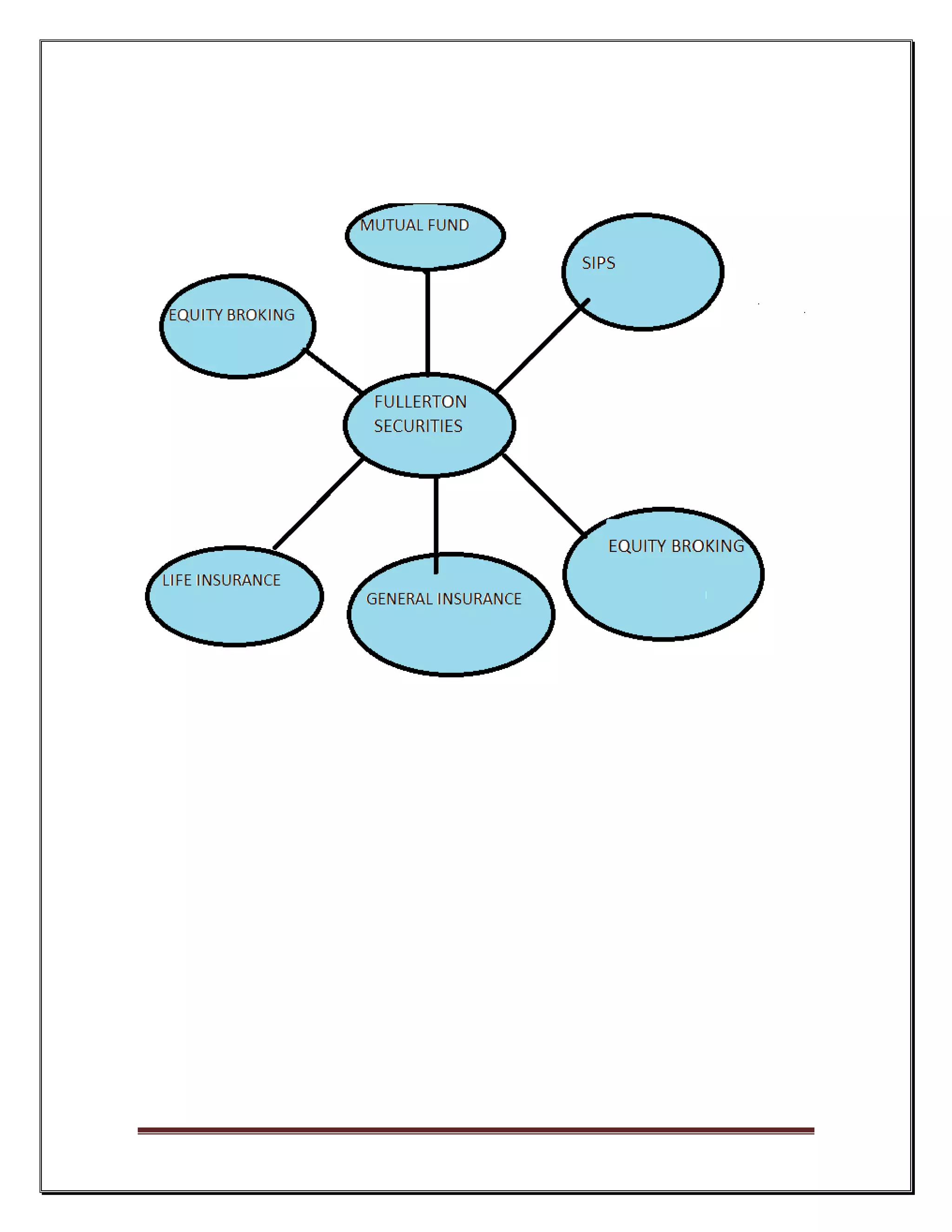
  • 66.
     Inability ofcustomers to pay brokerage at the right time.  High risk involved in the stock market.  Most of the investors are for the short term period, but financial advisers have to teach them about benefits of long term investment.  Fullerton Securities and wealth advisor ltd. should do some advertisement in the market to make people aware about our Company. 66
  • 67.
     Fullerton Securitiesand wealth advisor ltd. marketing team should promote in such a way that clients should not misinterept it as fullerton India credit.  On that analysis we are come to know that there should be different types of readymade plans so that the investors can choose the proper plans according to their requirement. Questionnaire Dear Sir/Madam, I am a student of GTU, Ahmedabad. As part of my project "Curent Scenario of broking business & Different pattern of Investments", I am doning a survey on 'Broking Account of FULLERTON SECURITUES AND WEALTH ADVISORS LTD. I request you to help me in it by filling up yhe following questionnaire. The details by you will be kept completely confidential will not be disclosed to anybody. 1) In which different type of financial instruments do you invest? a.Mutual fund b.Equities... c.Fixed deposits d.PPF e.Insuurance.. f.Other specify 67
  • 68.
    2) From Howmany years are investing in financial intruments? a. 1-2 year. b. 3-5 year. c. 6-10 year. d. 11-15 year. e. More than 15 years. 3) Do you / family member have a broking account? a.Yes b.No 4) If yes, where do you have a your broking account? ............................................................ 5) Are you looking forward to change your current broker? a.Yes b.No 6) What is the brokerage that you're paying? .......................................................... 7) Generally what kind of investment is preferred by you? a.Intraday 68
  • 69.
    b.Future & Option c.Delivery 8)Generally what kind of investor are you? a.Speculator b.Hedger C.Invetor 9) Which is the right time to invest in stock market? a.Bullish b.Bearish 10) Have you heard about the Fullerton Securities and Wealth Advisors Ltd? a.Yes b.No 11) In case you whish to take account what would be your preference? a.Freedom Account b.Silver Account c.Platinum Account d.Gold Account e.Prepaid Account (i.e. 5000,10000,25000). 12) Do you know about the Future & Options? 69
  • 70.
    a.Yes b.No. BIBLIOGRAPHY  www.amfiindia.com  www.mutualfundindia.com  www.moneycontrol.com  www.valueresearchonline.com  www.fullertonsecurties.co.in  www.investshoppe.co  http://www .indianground.com/real_estate.india.aspx  http://www.savingwala.com/postoffice-saving/index.html (as on 05/09/2010)  http://www.multiutils.com/itp/bk.htm (as on 06/09/2010) 70