
THE STUDY OF STOCK EXCHANGE
1
PROJECT REPORT ON:
“THE STUDY OF STOCK MARKET”
SUBMITTED BY:
SHWETA SUDHAKARAN ACHARYA
ROLL NO. : 01
SEMESTER V, T.Y.B.M.S
PROJECT GUIDE:
MS. ANJANA ASHOKAN
SUBMITTED TO:
UNIVERSITY OF MUMBAI
V.K. KRISHNAMENON COLLEGE OF COMMERCE AND ECONOMICS
AND SHARAD DIGHE COLLEGE OF SCIENCE, BHANDUP (EAST),
MUMBAI-400042
ACADEMIC YEAR:
2014-2015
THE STUDY OF STOCK EXCHANGE
2
ACKNOWLEDGEMENT
I take this opportunity to express my profound gratitude and deep regards to my
guide MS.ANJANA ASHOKAN for her exemplary guidance, monitoring and
constant encouragement throughout the course of this thesis. The blessings, help
and guidance given by her time to time shall carry me a long way in the journey of
life on which I am about to embark.
I also take the opportunity to express a deep sense of gratitude to my friends and
teachers for their valuable information and guidance, which helped me in
completing this task through various stages.
Lastly, I thank almighty, my parents, brother, sister and friends for their constant
encouragement without which this assignment would not be possible.
THE STUDY OF STOCK EXCHANGE
3
PREFACE
The successfulcompletion of this project was a unique experience for me as I got
an opportunity to visit many places and also interact with various people, I
achieved a better knowledge about this project. The experience which I gained by
doing this project was essential at this turning point of my career. This project is
being submitted which, whose detailed analysis of the research is undertaken by
me.
This project titled, “ THE STUDY OF THE STOCKMARKET “ is an attempt to
allow the reader to understand the StockMarket, Trading Of Stocks and Role
Played By StockExchanges in the economy of India as well as globally.
THE STUDY OF STOCK EXCHANGE
4
DECLARATION
I, SHWETA ACHARYA, ROLLNO.1 Of V.K. KRISHNA MENON COLLEGE
Studying In T.Y.B.M.S., hereby declare that I have successfully completed this
project on “THE STUDY OF STOCKMARKET” during the Academic Year
2014-2015. The information submitted is true and original to best of my
knowledge.
DATE:
PLACE: MUMBAI ____________________
SHWETA ACHARYA
THE STUDY OF STOCK EXCHANGE
5
CERTIFICATE
I hereby certify that SHWETAACHARYA , a student of V.K.KRISHNA MENON
COLLEGE studying in T.Y.B.M.S. has completed this project on “THE STUDY
OF STOCKMARKET” under my guidance for the academic year 2014-2015. The
information permitted is true and original to the best of my knowledge.
___________________________
Mrs. Saroj Phadnis
(Principal)
____________________________ _______________________
Ms. Anjana Ashokan External supervisor
(Project Guide)
______________________
College seal DATE:
PLACE: MUMBAI
THE STUDY OF STOCK EXCHANGE
6
THE STUDY OF STOCK EXCHANGE
7
Objectives:
 To get a basic understanding of the products, principle investment, players and
functioning of the stock market.
 To understand the terms and jargons used in the financial newspaper,
 To know the regulatory framework for Indian Stock market.
 To understand the concept of stocks and stock market.
 To also get important lessons about the economy and financial responsibility.
 To learn about trading of stocks in the stock exchanges.
 To get in depth study of Indian and other global stock markets.
 To organize stocks in a fair, transparent and competitive way
THE STUDY OF STOCK EXCHANGE
8
INDEX
SR NO. PARTICULARS PAGE NO.
01 EXECUTIVE SUMMARY 12
02 INTRODUCTION TO STOCK MARKET
2.1. WHAT IS STOCK MARKET?
 CAPITAL MARKET.
 PRIMARY MARKET.
2.2. SECONDARY MARKET.
2.3. EXPLAINING STOCKS AND STOCK MARKET.
2.4. TYPES OF STOCKS.
2.5. SHAREHOLDERS.
2.6. WHY DOES COMPANY ISSUE STOCKS?
2.7 ISSUE OF STOCKS.
2.8 HOW ARE SHARE PRICES SET?
2.9 NEED OF STOCK MARKET
2.10 WHY BUY STOCK?
2.11 ADVANTAGES AND DISADVANTAGES OF STOCK
MARKET FLOTATION.
13
03 HISTORY OF STOCK MARKET
3.1 HISTORY.
3.2 HISTORY OF INDIAN STOCK MARKET.
30
THE STUDY OF STOCK EXCHANGE
9
04 EMERGENCE OF THE STOCK EXCHANGES
4.1 NATIONAL STOCK EXCHANGE. (NSE)
4.2 BOMBAY STOCK EXCHANGE. (BSE)
4.3 OVER THE COUNTER EXCHANGE OF
INDIA.(OTCEI)
4.4 OPERATIONAL FEATURES OF BSE AND NSE.
 MARKET TIMINGS
 AUTOMATED TRADING SYSTEM
 MARKET SEGMENT
 SETTLEMENT CYCLE
 BROKERAGE AND OTHER TRANSACTION
COST
 THE ROLE OF STOCK EXCHANGE IN THE
ECONOMY
4.5 THE ROLE OF STOCK EXCHANGE IN THE
ECONOMY.
35
05 TRADING OF STOCKS
5.1. MERITS OF OWNING STOCK.
5.2. DEMERITS OF OWNING STOCK.
5.3. WHAT IS TRADING OF SHARES?
5.4. WHO IS A STOCKBROKER?
5.5. ROLE OF STOCKBROKER IN A STOCKMARKET.
5.6. METHOD OF TRADING IN STOCK EXCHANGES
AND THE TYPES OF BROKERS.
 SPECIALISTS
 FLOOR BROKERS
 STOCK BROKERS/FINANCIAL ADVISORS
 DAY TRADERS
 CASUAL TRADERS
51
THE STUDY OF STOCK EXCHANGE
10
 ONLINE TRADERS
5.7. MARKET CORRECTION
5.8. MARKET TREND
5.9. BULLS AND BEARS
5.10. OTHER ANIMALS ON THE FARM
5.11. BULLISH AND BEARISH BEHAVIOR
5.12. HOW TO READ A STOCK TABLE/QUOTE?
5.13. WHAT IS A STOCK CHART?
5.14. TYPES OF STOCK CHART
5.15. WHAT CAUSES STOCK PRICES TO CHANGE?
5.16. STRATEGIES FOR INVESTING IN STOCK
5.17. RISKS THAT EVERY STOCK FACES
06 THE INDIAN STOCK MARKET
6.1. REGULATORS IN THE STOCK MARKET
6.2. WHAT IS STOCK INDEX
6.3. TYPES OF STOCK INDICES
6.4. INDIAN STOCK INDICES
 NIFTY
 SENSEX
6.5. CALCULATE BROKERAGE RATES AND TAXES
87
07 GLOBAL STOCK MARKET
7.1. WORLD MARKETS
7.2. TOP 11 IMPORTANT STOCK EXCHANGES
GLOBALLY
7.4. MAJOR STOCK EXCHANGES (TOP 21 BY MARKET
CAPITALIZATION), AS AT 31 JUNE 2014 (MONTHLY
102
THE STUDY OF STOCK EXCHANGE
11
REPORTS, WORLD FEDERATION OF EXCHANGES)
7.5. NEWYORK STOCK EXCHANGE (NYSE)
7.6. NATIONAL ASSOCIATION OF SECURITIES DEALERS
AUTOMATED QUOTATIONS (NASDAQ)
7.7. TOKYO STOCK EXCHANGE (TSE)
08 INTERVIEW 118
09 CONCLUSION 122
10 APPENDIX
10.1 10 BIGGEST FALL IN THE INDIAN STOCK MARKET
10.2 CURRENT NEWS:
 INDIA’S STOCK MARKET RISES IN VOLATILE
ELECTION DAYTREND
 INDIA’S NIFTY FUTURES RISES AFTER INDEX AT
RECORD BEFORE EXPIRY
136
11 BIBILOGRAPHY 130
THE STUDY OF STOCK EXCHANGE
12
EXECUTIVE SUMMARY
In the present situation where stock market is going up and down, it is necessary to invest
consciously in the market whatever it is, this is the study about the last two year function in stock
market which enables the investor in taking decision regarding investment. This study tells the
factor which directly or indirectly affects the market and some basic information on stock
market for the new investors or the students who have some interest in the stock market. The
objective of selecting the topic is to know about the market trends of the stock market and the
information related to the investment for future investors. The study of fluctuations of the stock
market makes the investor aquatinted with the factor affecting the investment and stock prices
can be volatile and some analysts argue that this volatility is excessive. This is not easy to prove,
since it is difficult to assess certainty about future earnings and dividend. Companies tend to
smooth dividends, so they will be less volatile than stock prices. Volatile stock prices do not have
a major impact on consumption and capital spending since there is a good chance that price
movements in one direction may be reversed.
THE STUDY OF STOCK EXCHANGE
13
CHAPTER 1
INTRODUCTION
TO
STOCK MARKET
THE STUDY OF STOCK EXCHANGE
14
WHAT IS STOCK MARKET?
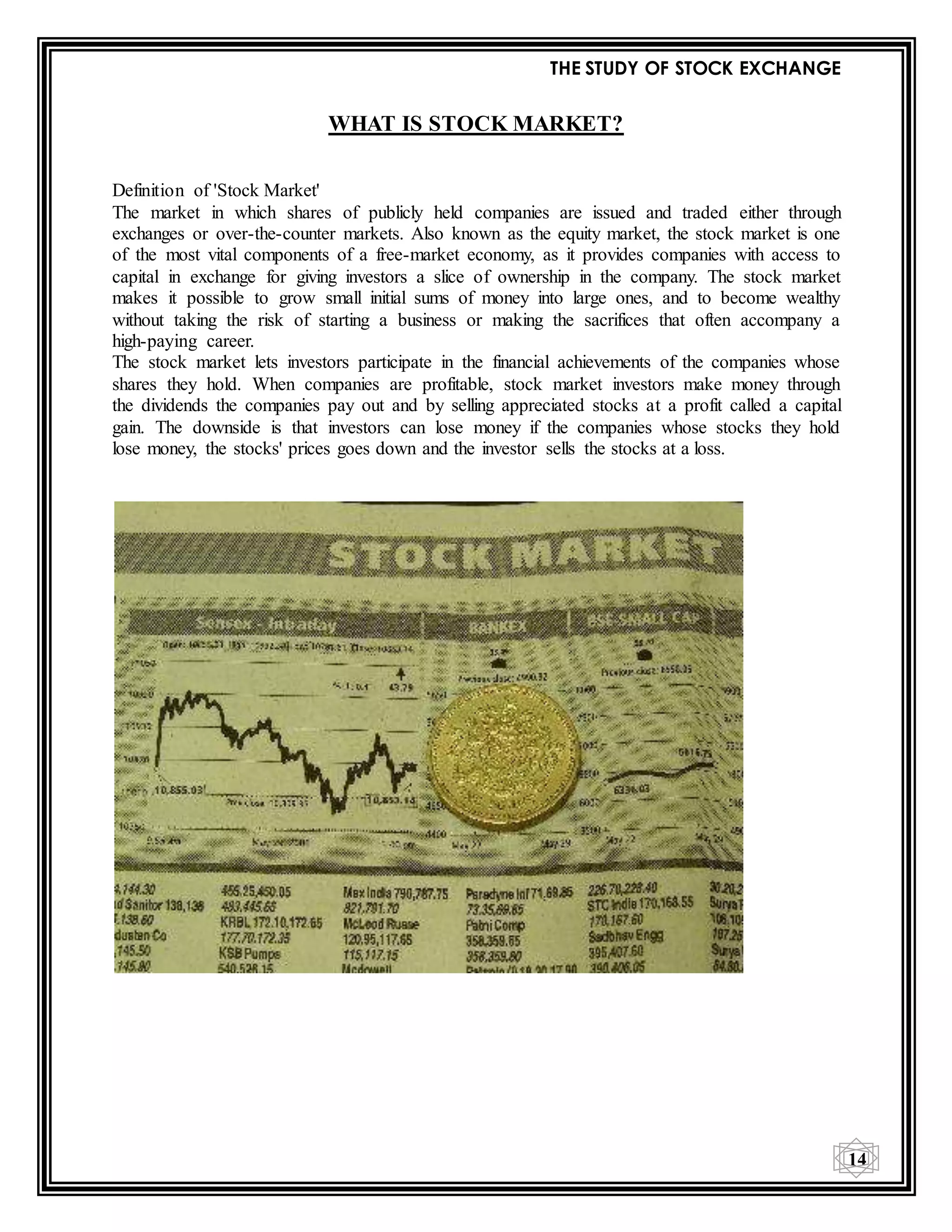
Definition of 'Stock Market'
The market in which shares of publicly held companies are issued and traded either through
exchanges or over-the-counter markets. Also known as the equity market, the stock market is one
of the most vital components of a free-market economy, as it provides companies with access to
capital in exchange for giving investors a slice of ownership in the company. The stock market
makes it possible to grow small initial sums of money into large ones, and to become wealthy
without taking the risk of starting a business or making the sacrifices that often accompany a
high-paying career.
The stock market lets investors participate in the financial achievements of the companies whose
shares they hold. When companies are profitable, stock market investors make money through
the dividends the companies pay out and by selling appreciated stocks at a profit called a capital
gain. The downside is that investors can lose money if the companies whose stocks they hold
lose money, the stocks' prices goes down and the investor sells the stocks at a loss.
THE STUDY OF STOCK EXCHANGE
15
CAPITAL MARKET
Definition of 'Capital Markets'
“Markets for buying and selling equity and debt instruments. Capital markets channel savings
and investment between suppliers of capital such as retail investors and institutional investors,
and users of capital like businesses, government and individuals. Capital markets are vital to the
functioning of an economy, since capital is a critical component for generating economic output.
Capital markets include primary markets, where new stock and bond issues are sold to investors,
and secondary markets, which trade existing securities.”
Capital markets typically involve issuing instruments such as stocks and bonds for the medium-
term and long-term. In this respect, capital markets are distinct from money markets, which refer
to markets for financial instruments with maturities not exceeding one year.
Capital markets have numerous participants including individual investors, institutional investors
such as pension funds and mutual funds, municipalities and governments, companies and
organizations and banks and financial institutions. Suppliers of capital generally want the
maximum possible return at the lowest possible risk, while users of capital want to raise capital
at the lowest possible cost. The stock market falls under the Capital Market Structure.
The capital market is divided further into two markets:
 Primary market
 Secondary market
THE STUDY OF STOCK EXCHANGE
16
PRIMARY MARKET
Definition of 'Primary Market'
“A market that issues new securities on an exchange. Companies, governments and other groups
obtain financing through debt or equity based securities. Primary markets are facilitated by
underwriting groups, which consist of investment banks that will set a beginning price range for
a given security and then oversee its sale directly to investors.“
Also known as "new issue market" (NIM).
The primary markets are where investors can get first crack at a new security issuance. The
issuing company or group receives cash proceeds from the sale, which is then used to fund
operations or expand the business. Exchanges have varying levels of requirements which must be
met before a security can be sold.
Once the initial sale is complete, further trading is said to conduct on the secondary market,
which is where the bulk of exchange trading occurs each day. Primary markets can see increased
volatility over secondary markets because it is difficult to accurately gauge investor demand for a
new security until several days of trading have occurred.
There are three ways in which a company may raise equity capital in the primary market:
 PUBLIC ISSUE:
Issue of stock on a public market rather than being privately funded by the companies own
promoter(s), which may not be enough capital for the business to start up, produce, or continue
running. By issuing stock publically, this allows the public to own a part of the company, though
not be a controlling factor.
 IPO: Intial Public Offer
Initial public offering (IPO) or stock market launch is a type of public offering where shares
of stock in a company are sold to the general public, on a securities exchange, for the first time.
An initial public offering, or IPO, is the first sale of stock by a company to the public. A
company can raise money by issuing either debt or equity. If the company has never issued
equity to the public, it's known as an IPO.
Companies fall into two broad categories: private and public.
A privately held company has fewer shareholders and its owners don't have to disclose much
information about the company. Anybody can go out and incorporate a company: just put in
some money, file the right legal documents and follow the reporting rules of your jurisdiction.
Most small businesses are privately held. But large companies can be private too. Did you know
that IKEA, Domino's Pizza and Hallmark Cards are all privately held?
It usually isn't possible to buy shares in a private company. You can approach the owners about
investing, but they're not obligated to sell you anything. Public companies, on the other hand,
have sold at least a portion of themselves to the public and trade on a stock exchange. This is
why doing an IPO is also referred to as "going public."
Public companies have thousands of shareholders and are subject to strict rules and regulations.
THE STUDY OF STOCK EXCHANGE
17
They must have a board of directors and they must report financial information every quarter. In
the United States, public companies report to the Securities and Exchange Commission (SEC). In
other countries, public companies are overseen by governing bodies similar to the SEC. From an
investor's standpoint, the most exciting thing about a public company is that the stock is traded in
the open market, like any other commodity. If you have the cash, you can invest. The CEO could
hate your guts, but there's nothing he or she could do to stop you from buying stock.
 RIGHTS ISSUES:
An issue of rights to a company's existing shareholders that entitles them to buy additional shares
directly from the company in proportion to their existing holdings, within a fixed time period. In
a rights offering, the subscription price at which each share may be purchased in generally at a
discount to the current market price. Rights are often transferable, allowing the holder to sell
them on the open market. A rights issue is when a company issues its existing shareholders a
right to buy additional shares in the company. The company will offer the shareholder a specific
number of shares at a specific price. The company will also set a time limit for the shareholder to
buy the shares. The shares are often offered at a discounted price to encourage existing
shareholders to take the company up on their offer.
If a shareholder does not take the company up on their rights issue then they have the option to
sell their rights on the stock market just as they would sell ordinary shares, however their
shareholding in the company will weaken.
Companies with a poor cash flow will often use a rights issue to increase cash flow and pay off
existing debts. Rights issues however are sometimes issued by companies with healthy balance
sheets in order to fund research and development projects or to purchase new companies.
Discounted shares issued by a company can be tempting but it is important to find out first the
reason for the rights issue of shares. A company, for example, may be using the rights issue as a
quick cash fix to pay off debts masking the real reason for the company’s cash flow failing such
as bad leadership. Caution is advised when offered with a rights issue.
 PREFERENTIAL ISSUE:
A preferential issue is an issue of shares or of convertible securities by listed companies to a
select group of persons under Section 81 of the Companies Act, 1956 which is neither a rights
issue nor a public issue. This is a faster way for a company to raise equity capital. The issuer
company has to comply with the Companies Act and the requirements contained in Chapter
pertaining to preferential allotment in SEBI (DIP) guidelines which inter-alia include pricing,
disclosures in notice etc. Preferred stock is a different class than the better-known common
stock, with different characteristics. Thus, companies have reasons for issuing preferred stock
that may differ from the reasons they "go public" by issuing common stock to everyday
investors. Preferred stock is still considered equity -- an ownership stake, rather than debt -- but
it often functions more like a bond than a share. Preferred stock is so named because, on a
company's hierarchy of debts, it is favored over common stock -- that is, its owners are paid
before owners of common shares. However, preferred stock normally does not convey voting
rights to owners as common shares do. Preferred stocks attract investors looking for dividends,
which provide owners with a fixed rate of return rather than returns that rise and fall with the
stock market. Thus, it acts more like a bond with its -- usually -- fixed payout. Preferred shares
also provide the company with flexibility for other nondividend-related reasons. For instance,
they provide issuers with an extra ownership option in addition to common stock and bonds. In
THE STUDY OF STOCK EXCHANGE
18
addition, because these shares are a cut above common stock, they can be used as incentives
during transactions because they offer more security to the buyer and a fiscal guarantees to the
seller.
SECONDARY MARKET
Definition of 'Secondary Market'
“A market where investors purchase securities or assets from other investors, rather than from
issuing companies themselves. The national exchanges - such as the NATIONAL STOCK
EXCHANGE and the BOMBAY STOCK EXCHANGE are secondary markets.”
Secondary markets exist for other securities as well, such as when funds, investment banks, or
entities such as Fannie Mae purchase mortgages from issuing lenders. In any secondary market
trade, the cash proceeds go to an investor rather than to the underlying company/entity directly.
A newly issued IPO will be considered a primary market trade when the shares are first
purchased by investors directly from the underwriting investment bank; after that any shares
traded will be on the secondary market, between investors themselves. In the primary market
prices are often set beforehand, whereas in the secondary market only basic forces like supply
and demand determine the price of the security.
In the case of assets like mortgages, several secondary markets may exist, as bundles of
mortgages are often re-packaged into securities like GNMA Pools and re-sold to investors.
In the secondary market, securities are sold by and transferred from
one investor orspeculator to another. It is therefore important that the secondary market be
highly liquid(originally, the only way to create this liquidity was for investors and speculators to
meet at a fixed place regularly; this is how stock exchanges originated. As a general rule, the
greater the number of investors that participate in a given marketplace, and the greater the
centralization of that marketplace, the more liquid the market.
Fundamentally, secondary markets mesh the investor's preference for liquidity (i.e., the investor's
desire not to tie up his or her money for a long period of time, in case the investor needs it to deal
with unforeseen circumstances) with the capital user's preference to be able to use the capital for
an extended period of time.
Accurate share price allocates scarce capital more efficiently when new projects are financed
through a new primary market offering, but accuracy may also matter in the secondary market
because:
1) price accuracy can reduce the agency costs of management, and make hostile takeover a less
risky proposition and thus move capital into the hands of better managers, and
2) accurate share price aids the efficient allocation of debt finance whether debt offerings or
institutional borrowing.
THE STUDY OF STOCK EXCHANGE
19
EXPLAINING STOCKS AND STOCK MARKET
At some point, just about every company needs to raise money, whether to open up a West Coast
sales office, build a factory, or hire a crop of engineers.
In each case, they have two choices:
1) Borrow the money, or
2) raise it from investors by selling them a stake (issuing shares of stock) in the company.
When you own a share of stock, you are a part owner in the company with a claim (however
small it may be) on every asset and every penny in earnings.
Individual stock buyers rarely think like owners, and it's not as if they actually have a say in how
things are done.
Nevertheless, it's that ownership structure that gives a stock its value. If stockowners didn't have
a claim on earnings, then stock certificates would be worth no more than the paper they're
printed on. As a company's earnings improve, investors are willing to pay more for the stock.
Over time, stocks in general have been solid investments. That is, as the economy has grown, so
too have corporate earnings, and so have stock prices.
Since 1926, the average large stock has returned close to 10% a year. If you're saving for
retirement, that's a pretty good deal -- much better than U.S. savings bonds, or stashing cash
under your mattress.
Of course, "over time" is a relative term. As any stock investor knows, prolonged bear markets
can decimate a portfolio.
Since World War II, Wall Street has endured several bear markets -- defined as a sustained
decline of more than 20% in the value of the Dow Jones Industrial Average.
Bull markets eventually follow these downturns, but again, the term "eventually" offers small
sustenance in the midst of the downdraft.
The point to consider, then, is that investing must be considered a long-term endeavor if it is to
be successful. In order to endure the pain of a bear market, you need to have a stake in the game
when the tables turn positive.
THE STUDY OF STOCK EXCHANGE
20
TYPES OF STOCKS
There are two main types of stocks: common stock and preferred stock.
Common Stock
Common stock is, well, common. When people talk about stocks they are usually referring to
this type. In fact, the majority of stock is issued is in this form. We basically went over features
of common stock in the last section. Common shares represent ownership in a company and a
claim (dividends) on a portion of profits. Investors get one vote per share to elect the board
members, who oversee the major decisions made by management.
Over the long term, common stock, by means of capital growth, yields higher returns than almost
every other investment. This higher return comes at a cost since common stocks entail the most
risk. If a company goes bankrupt and liquidates, the common shareholders will not receive
money until the creditors, bondholders and preferred shareholders are paid.
Preferred Stock
Preferred stock represents some degree of ownership in a company but usually doesn't come with
the same voting rights. (This may vary depending on the company.) With preferred shares,
investors are usually guaranteed a fixed dividend forever. This is different than common stock,
which has variable dividends that are never guaranteed. Another advantage is that in the event of
liquidation, preferred shareholders are paid off before the common shareholder (but still after
debt holders). Preferred stock may also be callable, meaning that the company has the option to
purchase the shares from shareholders at anytime for any reason (usually for a premium).
Some people consider preferred stock to be more like debt than equity. A good way to think of
these kinds of shares is to see them as being in between bonds and common shares.
Common and preferred are the two main forms of stock; however, it's also possible for
companies to customize different classes of stock in any way they want. The most common
reason for this is the company wanting the voting power to remain with a certain group;
therefore, different classes of shares are given different voting rights. For example, one class of
shares would be held by a select group who are given ten votes per share while a second class
would be issued to the majority of investors who are given one vote per share.
When there is more than one class of stock, the classes are traditionally designated as Class A
and Class B. Berkshire Hathaway (ticker: BRK), has two classes of stock. The different forms
are represented by placing the letter behind the ticker symbol in a form like this: "BRKa, BRKb"
or "BRK.A, BRK.B"
THE STUDY OF STOCK EXCHANGE
21
SHAREHOLDERS
Definition of 'Shareholder'
“Any person, company or other institution that owns at least one share of a company’s stock.
Shareholders are a company's owners. They have the potential to profit if the company does well,
but that comes with the potential to lose if the company does poorly. A shareholder may also be
referred to as a "stockholder".”
Unlike the owners of sole proprietorships or partnerships, corporate shareholders are not
personally liable for the company’s debts and other obligations. Also, corporate shareholders do
not play a major role in running the company. The board of directors and executive management
perform that function. Common stockholders are, however, able to vote on corporate matters,
such as who sits on the board of directors and whether a proposed merger should go through
(preferred stockholders usually do not have voting rights). They also benefit when the company
performs well and its share price increases, and they have the right to trade their shares on a
stock exchange, which makes stock a highly liquid investment.
Shareholders do have rights, which are defined in the corporation’s charter and bylaws. They can
inspect the company’s books and records, sue the corporation for misdeeds of the directors and
officers, and if the company liquidates, they have a right to a share of the proceeds. However,
creditors, bondholders and preferred stockholders have precedence over common stockholders in
a liquidation. Shareholders also have a right to receive a portion of any dividends the company
declares.
Shareholders can attend the corporation’s annual meeting to learn about the company’s
performance, vote on who sits on the board of directors and other matters. They can also listen to
the meeting via conference call and vote by proxy through the mail or online. To learn more
about a company’s policies toward shareholders, consult the company’s corporate governance
policies.
THE STUDY OF STOCK EXCHANGE
22
WHY DOES COMPANY ISSUE STOCKS?
Why would the founders share the profits with thousands of people when they could keep profits
to themselves? The reason is that at some point every company needs to "raise money". To do
this, companies can either borrow it from somebody or raise it by selling part of the company,
which is known as issuing stock.
A company can borrow by taking a loan from a bank or by issuing bonds. Both methods come
under "debt financing". On the other hand, issuing stock is called “equity financing”. Issuing
stock is advantageous for the company because it does not require the company to pay back the
money or make interest payments along the way.
All that the shareholders get in return for their money is the hope that the shares will someday be
worth more than what they paid for them. The first sale of a stock, which is issued by the private
company itself, is called the initial public offering (IPO).
It is important that you understand the distinction between a company financing through debt and
financing through equity. When you buy a debt investment such as a bond, you are guaranteed
the return of your money (the principal) along with promised interest payments.
This isn't the case with an equity investment. By becoming an owner, you assume the risk of the
company not being successful - just as a small business owner isn't guaranteed a return, neither is
a shareholder. Shareholders earn a lot if a company is successful, but they also stand to lose their
entire investment if the company isn't successful.
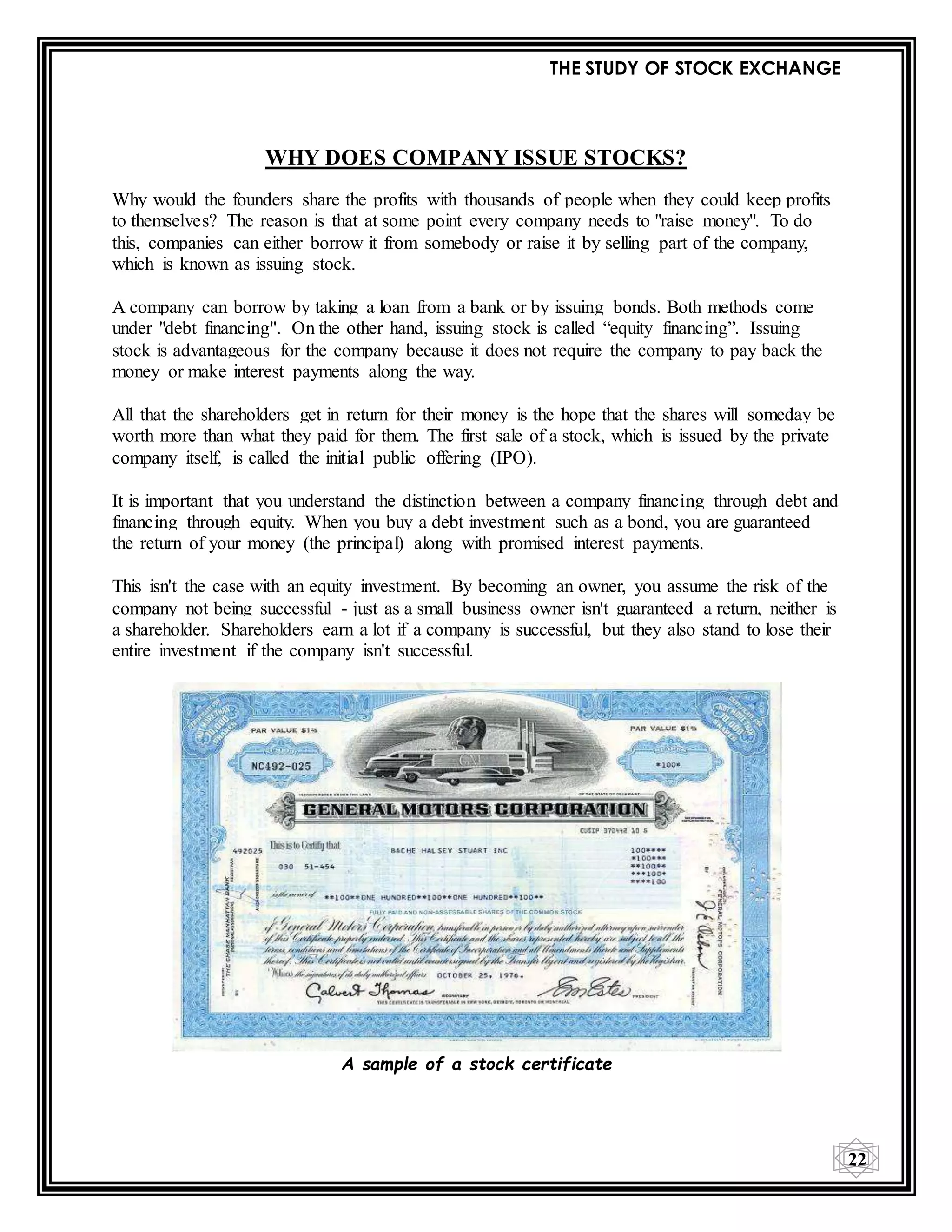
A sample of a stock certificate
THE STUDY OF STOCK EXCHANGE
23
ISSUE OF STOCK
Corporations issue shares of stock to raise money for their business. The shares that are issued
represent the amount of money invested by the shareholders in the company. Shareholders have
an ownership stake in the company and enjoy certain rights such as voting rights and the receipt
of dividends. Therefore it is very important to consider how to issue stock when organizing your
corporation.
Determine how much stock the corporation will be authorized to issue. The Articles of
Incorporation will set out the maximum number of shares that the corporation can issue to
potential shareholders. This does not mean that the corporation must issue all of those shares.
New corporations will likely hold back shares so that, if necessary, it can raise capital at a later
date.
Set forth the value of the shares that will be issued. The value of each share should be
proportionate to the company's net worth. The shares may be marked with a par amount
THE STUDY OF STOCK EXCHANGE
24
establishing the minimum amount that the shares can be purchased from the corporation or with
a no par amount having no set price for purchase of the share of stock. The corporation must
receive consideration of some value for each share issued.
Determine the class of the shares to be issued. A corporation will generally issue common
stock or preferred stock where holders of common stock would get a dividend following those of
preferred stock.
Determine how many shares the corporation will initially issue. Generally this depends on
the size of the corporation. In a small corporation the initial shares may be based upon the
contribution that the shareholders are making to the business. This may be the most important
factor when issuing stocks as the original owner or largest contributor may want to have
controlling (51%) interest in the company. There is no requirement on the number of shares that
have to be issued. The corporation may issue as few as 1 share of stock. There may be an issue as
to the amount of capitalization that the corporation needs. Some states may require that the
corporation have a minimum amount of assets, know as capitalization, before starting its
operation.
THE STUDY OF STOCK EXCHANGE
25
Make sure you are in compliance with state and federal securities law. The amount of
compliance again may be affected by the size of the corporation. Small corporations with only
family members participating in the business and closed corporations with a limited number of
shares may not have to register their securities offerings with the applicable state or federal
agencies. Such registration is likely with a public offering.
Draft the Stock Subscription Agreement. Stock subscription agreements should include the
share price, number of shares purchased and the transaction details. The certificates should be
professionally printed as hard copies and be issued upon the shareholder's purchase.
THE STUDY OF STOCK EXCHANGE
26
HOW ARE SHARE PRICES SET?
When a company goes public though an initial public offering (IPO), an investment bank
evaluates the company's current and projected performance and health to determine the value of
the IPO for the business. The bank can do this by comparing the company with the IPO of
another similar company, or by calculating the net present value of the firm. The company and
the investment bank will meet with investors to help determine the best IPO price through a
series of road shows. Finally, after the valuation and road shows, the firm must meet with the
exchange, which will determine if the IPO price is fair.
Once trading starts, share prices are largely determined by the forces of supply and demand. A
company that demonstrates long-term earnings potential may attract more buyers, thereby
enjoying an increase in share prices. A company with a poor outlook, on the other hand, may
attract more sellers than buyers, which can result in lower prices. In general, prices rise during
periods of increased demand - when there are more buyers than sellers. Prices fall during periods
of increased supply - when there are more sellers than buyers. A continuous rise in prices is
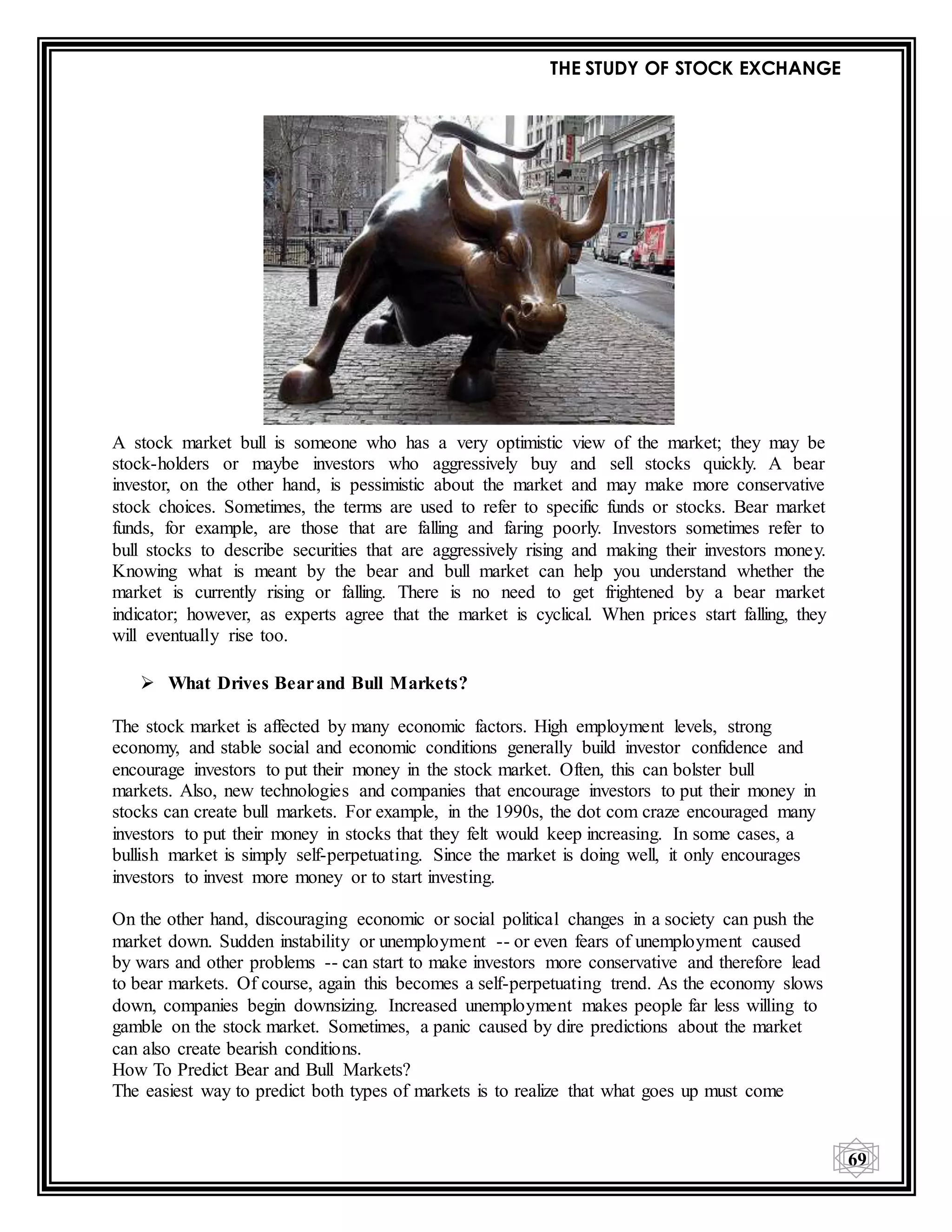
known as an uptrend, and a continuous drop in prices in called a downtrend. Sustained uptrends
form a "bull" market and sustained downtrends are called "bear" markets.
Other factors can affect prices and cause sudden or temporary changes in price. Some examples
of this include earnings reports, political events, financial reports and economic news. Not all
news or reports affect all securities. For example, the stocks of companies engaged in the gas and
oil industry may react to the weekly petroleum status report from the U.S. Energy Information
Administration (the "EIA report").
Stock prices can also be driven by what is known as herd instinct, which is the tendency for
people to mimic the action of a larger group. For example, as more and more people buy a stock,
pushing the price higher and higher, other people will jump on board, assuming that all the other
investors must be right (or that they know something not everyone else knows). There may be no
fundamental or technical support for the price increase, yet investors continue to buy because
others are doing so and they are afraid of missing out. This is one of many phenomena studied
under the umbrella of behavioral finance.
NEED OF STOCK MARKET
Stock market is an important part of the economy of a country. The stock market plays a play a
pivotal role in the growth of the industry and commerce of the country that eventually affects the
economy of the country to a great extent. That is reason that the government, industry and even
the central banks of the country keep a close watch on the happenings of the stock market. The
stock market is important from both the industry’s point of view as well as the investor’s point of
view.
THE STUDY OF STOCK EXCHANGE
27
Whenever a company wants to raise funds for further expansion or settling up a new business
venture, they have to either take a loan from a financial organization or they have to issue shares
through the stock market. In fact the stock market is the primary source for any company to raise
funds for business expansions. If a company wants to raise some capital for the business it can
issue shares of the company that is basically part ownership of the company. To issue shares for
the investors to invest in the stocks a company needs to get listed to a stocks exchange and
through the primary market of the stock exchange they can issue the shares and get the funds for
business requirements. There are certain rules and regulations for getting listed at a stock
exchange and they need to fulfill some criteria to issue stocks and go public. The stock market is
primarily the place where these companies get listed to issue the shares and raise the fund. In
case of an already listed public company, they issue more shares to the market for collecting
more funds for business expansion. For the companies which are going public for the first time,
they need to start with the Initial Public Offering or the IPO. In both the cases these companies
have to go through the stock market.
This is the primary function of the stock exchange and thus they play the most important role of
supporting the growth of the industry and commerce in the country. That is the reason that a
rising stock market is the sign of a developing industrial sector and a growing economy of the
country.
Of course this is just the primary function of the stock market and just an half of the role that the
stock market plays. The secondary function of the stock market is that the market plays the role
of a common platform for the buyers and sellers of these stocks that are listed at the stock
market. It is the secondary market of the stock exchange where retail investors and institutional
investors buy and sell the stocks. In fact it is these stock market traders who raise the fund for the
businesses by investing in the stocks.
For investing in the stocks or to trade in the stock the investors have to go through the brokers of
the stock market. Brokers actually execute the buy and sell orders of the investors and settle the
deals to keep the stock trading alive. The brokers basically act as a middle man between the
buyers and sellers. Once the buyer places a buy order in the stock market the brokers finds a
seller of the stock and thus the deal is closed. All these take place at the stock market and it is the
demand and supply of the stock of a company that determines the price of the stock of that
particular company.
So the stock market is not only providing the much required funds for boosting the business, but
also providing a common place for stock trading. It is the stock market that makes the stocks a
liquid asset unlike the real estate investment. It is the stock market that makes it possible to sell
the stocks at any point of time and get back the investment along with the profit. This makes the
stocks much more liquid in nature and thereby attracting investors to invest in the stock market.
THE STUDY OF STOCK EXCHANGE
28
WHY BUY STOCK?
Ownership has its privileges
As a shareholder, you have some basic rights. You can vote for or against the candidates who’ve
been nominated to the company’s board of directors. They’re the people who set company policy
and choose the chief executive who runs the business. You can also vote for or against proposals
the directors or other shareholders make to influence what happens at the company and how it is
managed. You also have the right to sell your stock at any time — although you may choose to
hold onto it for years.
Let’s be honest. Shareholder rights aren’t the reason you buy stock. The reason is to make money
by investing in companies you believe will make money. In the language of investing, you’re
seeking a positive return.
Here are some ideas that may help you have a positive return:
The company that issued the stock may pay a dividend, or portion of its earnings, to its
shareowners on a regular basis. You can reinvest the dividends to build your portfolio or you can
use it as income.
A stock’s price may go up while you own it. If it does, you can sell some or all of your shares for
a profit if you want to — remember one right of ownership is the right to sell — or you can hold
onto it, which increases the value of your portfolio. Investing in stock has risks, though. You may
have a negative return in some years rather than a positive one. That could reduce your income
and the value of your portfolio.
Here are some of the possible risks you face:
Companies aren’t required to pay a dividend even if they have a profit. And companies that
normally pay a dividend may reduce it or eliminate it entirely if times are tough. It’s their
decision, though investors don’t like it.
Sometimes stock prices go down instead of up, so you could lose money if you sold when your
stock’s price dropped. (Why do prices go down? Sometimes the whole stock market loses steam.
Sometimes a company hits a rough patch. Sometimes investors get nervous and sell.)
If a company goes out of business, as some do, you could lose everything you’d invested in its
stock — if you hadn’t sold your shares in time.
If you can lose money, why would you risk buying stock? The reason is that over time, stocks as
a group — though not every stock on its own — has produced higher returns than other types of
investments. Of course, there are no guarantees that the particular stocks you pick will produce
higher returns, or any return at all on your investment.
THE STUDY OF STOCK EXCHANGE
29
ADVANTAGES AND DISADVANTAGES OF STOCK MARKET
FLOTATION
Even if your business is suited to flotation, it may not be the right choice for you. Being a public
company can present a range of benefits to your business, but there are also issues that might
require careful consideration.
The benefits of stock market flotation could include:
 giving access to new capital to develop the business
 making it easier for you and other investors - including venture capitalists - to realise
their investment
 allowing you to offer employees extra incentives by granting share options - this can
encourage and motivate your employees to work towards long-term goals
 placing a value on your business
 increasing your public profile, and providing reassurance to your customers and suppliers
 allowing you to do business - eg acquisitions - by using quoted shares as currency
 creating a market for the company's shares
However, you should also consider the following potential problems:
 Market fluctuations - your business may become vulnerable to market fluctuations
beyond your control - including market sentiment, economic conditions or developments
in your sector.
 Cost - the costs of flotation can be substantial and there are also ongoing costs of being a
public company, such as higher professional fees.
 Responsibilities to shareholders - in return for their capital, you will have to consider
shareholders' interests when running the company - which may differ from your own
objectives.
 The need for transperancy - public companies must comply with a wide range of
additional regulatory requirements and meet accepted standards of corporate governance
including transperancy, and needing to make announcements about new developments.
 Demands on the management team - managers could be distracted from running the
business during the flotation process and through needing to deal with investors
afterwards.
 Investor relations - to maximise the benefits of being a public company and attract further
investor interest in shares, you will need to keep investors informed.
 Employees may become demotivated - if shares are only offered to selected employees,
there could be resentment. Shareholding employees could feel that there is little left to
work for if they are sitting on valuable shares.
THE STUDY OF STOCK EXCHANGE
30
CHAPTER 2
HISTORY
THE STUDY OF STOCK EXCHANGE
31
HISTORY
During the Roman Republic, the state contracted (leased) out many of its services to private
companies. These government contractors were called publicani, or societas publicanorum as
individual company. These companies were similar to modern corporations, or joint-stock
companies more specifically, in couple of aspects. They issued shares called partes (for large
cooperatives) and particulae which were small shares that acted like today's over-the-counter
shares.[ Polybius mentions that “almost every citizen” participated in the government
leases. There is also an evidence that the price of stocks fluctuated. The great Roman orator
Cicero speaks of partes illo tempore carissimae, which means “share that had a very high price
at that time." This implies a fluctuation of price and stock market behavior in Rome.
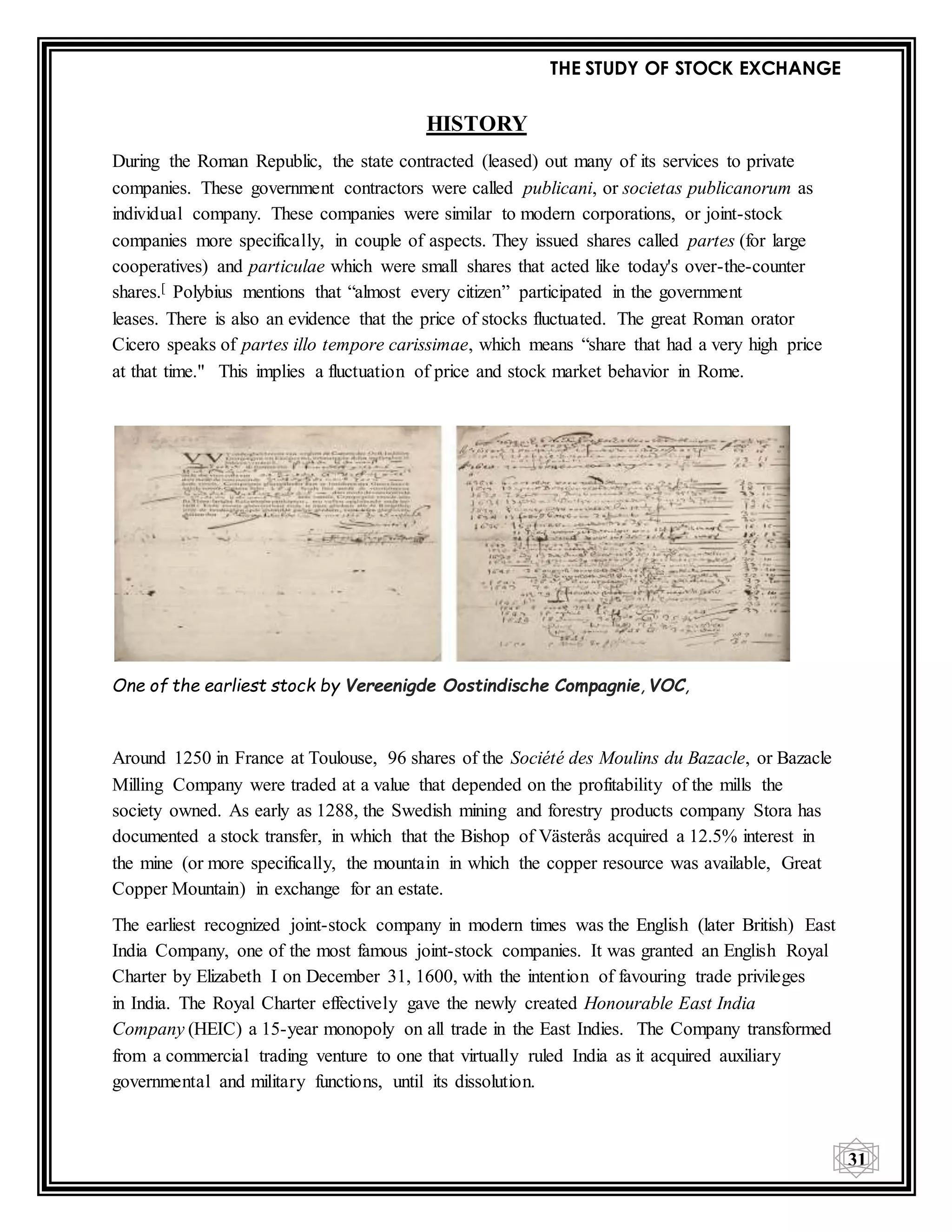
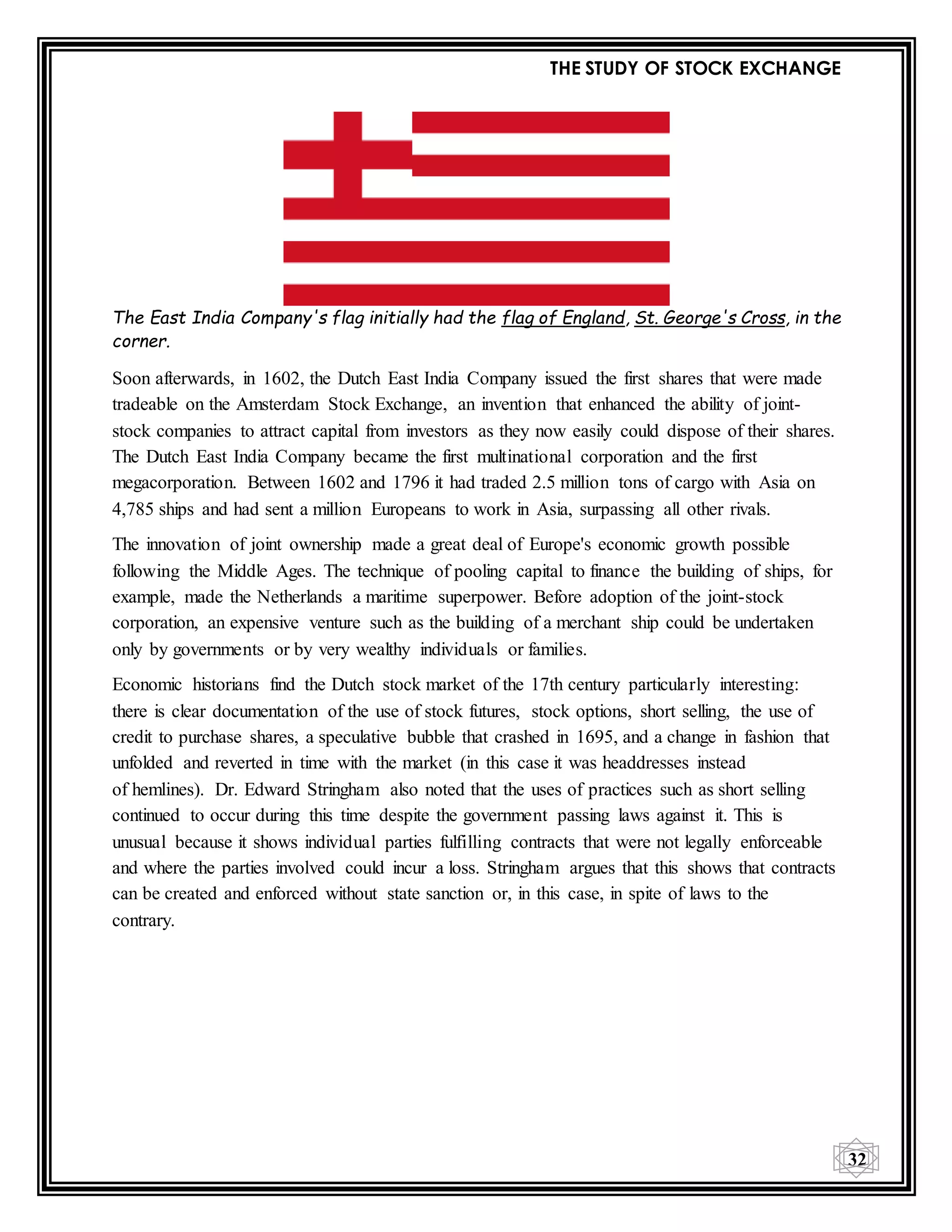
One of the earliest stock by Vereenigde Oostindische Compagnie, VOC,
Around 1250 in France at Toulouse, 96 shares of the Société des Moulins du Bazacle, or Bazacle
Milling Company were traded at a value that depended on the profitability of the mills the
society owned. As early as 1288, the Swedish mining and forestry products company Stora has
documented a stock transfer, in which that the Bishop of Västerås acquired a 12.5% interest in
the mine (or more specifically, the mountain in which the copper resource was available, Great
Copper Mountain) in exchange for an estate.
The earliest recognized joint-stock company in modern times was the English (later British) East
India Company, one of the most famous joint-stock companies. It was granted an English Royal
Charter by Elizabeth I on December 31, 1600, with the intention of favouring trade privileges
in India. The Royal Charter effectively gave the newly created Honourable East India
Company (HEIC) a 15-year monopoly on all trade in the East Indies. The Company transformed
from a commercial trading venture to one that virtually ruled India as it acquired auxiliary
governmental and military functions, until its dissolution.
THE STUDY OF STOCK EXCHANGE
32
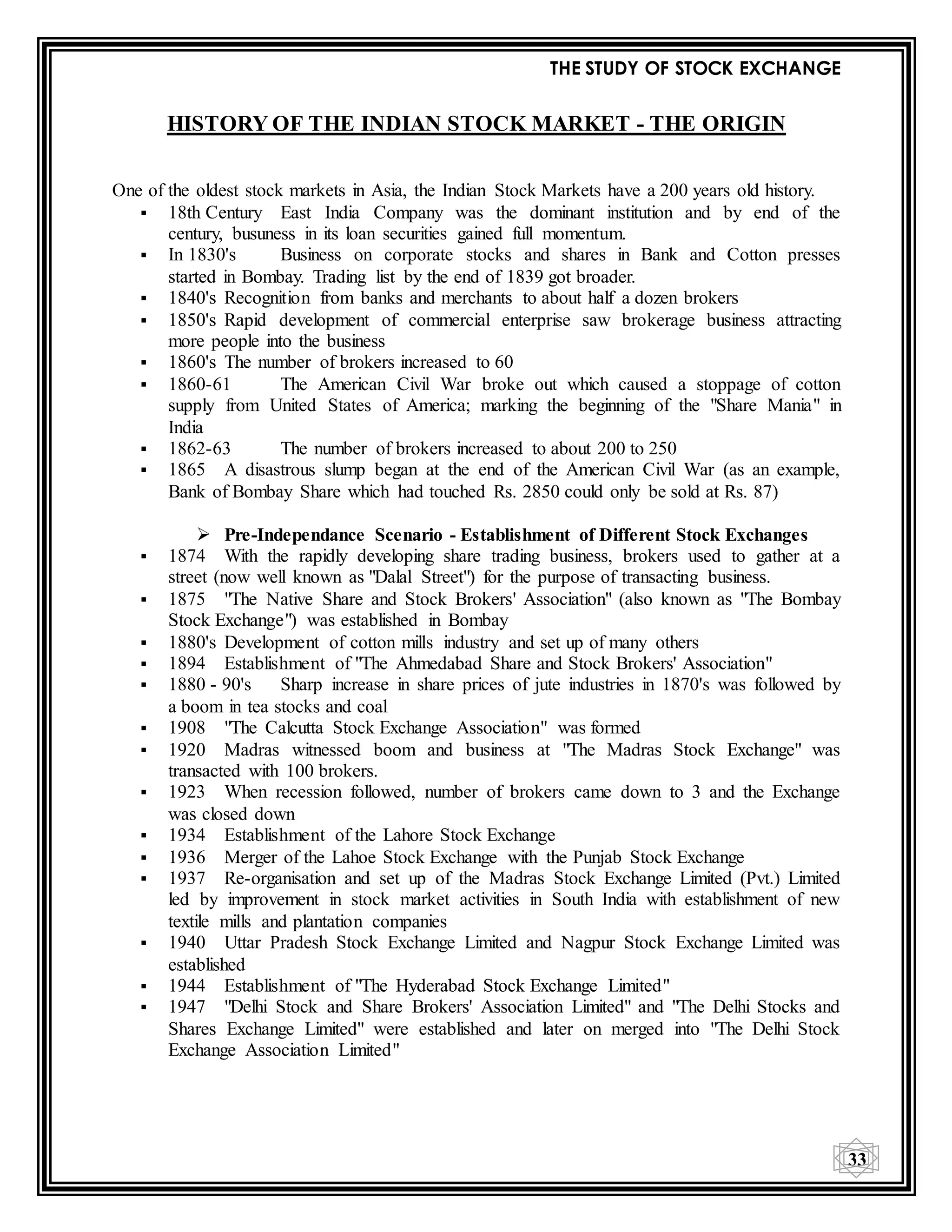
The East India Company's flag initially had the flag of England, St. George's Cross, in the
corner.
Soon afterwards, in 1602, the Dutch East India Company issued the first shares that were made
tradeable on the Amsterdam Stock Exchange, an invention that enhanced the ability of joint-
stock companies to attract capital from investors as they now easily could dispose of their shares.
The Dutch East India Company became the first multinational corporation and the first
megacorporation. Between 1602 and 1796 it had traded 2.5 million tons of cargo with Asia on
4,785 ships and had sent a million Europeans to work in Asia, surpassing all other rivals.
The innovation of joint ownership made a great deal of Europe's economic growth possible
following the Middle Ages. The technique of pooling capital to finance the building of ships, for
example, made the Netherlands a maritime superpower. Before adoption of the joint-stock
corporation, an expensive venture such as the building of a merchant ship could be undertaken
only by governments or by very wealthy individuals or families.
Economic historians find the Dutch stock market of the 17th century particularly interesting:
there is clear documentation of the use of stock futures, stock options, short selling, the use of
credit to purchase shares, a speculative bubble that crashed in 1695, and a change in fashion that
unfolded and reverted in time with the market (in this case it was headdresses instead
of hemlines). Dr. Edward Stringham also noted that the uses of practices such as short selling
continued to occur during this time despite the government passing laws against it. This is
unusual because it shows individual parties fulfilling contracts that were not legally enforceable
and where the parties involved could incur a loss. Stringham argues that this shows that contracts
can be created and enforced without state sanction or, in this case, in spite of laws to the
contrary.
THE STUDY OF STOCK EXCHANGE
33
HISTORY OF THE INDIAN STOCK MARKET - THE ORIGIN
One of the oldest stock markets in Asia, the Indian Stock Markets have a 200 years old history.
 18th Century East India Company was the dominant institution and by end of the
century, busuness in its loan securities gained full momentum.
 In 1830's Business on corporate stocks and shares in Bank and Cotton presses
started in Bombay. Trading list by the end of 1839 got broader.
 1840's Recognition from banks and merchants to about half a dozen brokers
 1850's Rapid development of commercial enterprise saw brokerage business attracting
more people into the business
 1860's The number of brokers increased to 60
 1860-61 The American Civil War broke out which caused a stoppage of cotton
supply from United States of America; marking the beginning of the "Share Mania" in
India
 1862-63 The number of brokers increased to about 200 to 250
 1865 A disastrous slump began at the end of the American Civil War (as an example,
Bank of Bombay Share which had touched Rs. 2850 could only be sold at Rs. 87)
 Pre-Independance Scenario - Establishment of Different Stock Exchanges
 1874 With the rapidly developing share trading business, brokers used to gather at a
street (now well known as "Dalal Street") for the purpose of transacting business.
 1875 "The Native Share and Stock Brokers' Association" (also known as "The Bombay
Stock Exchange") was established in Bombay
 1880's Development of cotton mills industry and set up of many others
 1894 Establishment of "The Ahmedabad Share and Stock Brokers' Association"
 1880 - 90's Sharp increase in share prices of jute industries in 1870's was followed by
a boom in tea stocks and coal
 1908 "The Calcutta Stock Exchange Association" was formed
 1920 Madras witnessed boom and business at "The Madras Stock Exchange" was
transacted with 100 brokers.
 1923 When recession followed, number of brokers came down to 3 and the Exchange
was closed down
 1934 Establishment of the Lahore Stock Exchange
 1936 Merger of the Lahoe Stock Exchange with the Punjab Stock Exchange
 1937 Re-organisation and set up of the Madras Stock Exchange Limited (Pvt.) Limited
led by improvement in stock market activities in South India with establishment of new
textile mills and plantation companies
 1940 Uttar Pradesh Stock Exchange Limited and Nagpur Stock Exchange Limited was
established
 1944 Establishment of "The Hyderabad Stock Exchange Limited"
 1947 "Delhi Stock and Share Brokers' Association Limited" and "The Delhi Stocks and
Shares Exchange Limited" were established and later on merged into "The Delhi Stock
Exchange Association Limited"
THE STUDY OF STOCK EXCHANGE
34
 Post Independance Scenario
 The depression witnessed after the Independance led to closure of a lot of exchanges in
the country. Lahore Estock Exchange was closed down after the partition of India, and
later on merged with the Delhi Stock Exchange. Bnagalore Stock Exchange Limited was
registered in 1957 and got recognition only by 1963. Most of the other Exchanges were in
a miserable state till 1957 when they applied for recognition under Securities Contracts
(Regulations) Act, 1956. The Exchanges that were recognized under the Act were:
 Bombay
 Calcutta
 Madras
 Ahmedabad
 Delhi
 Hyderabad
 Bangalore
 Indore
Many more stock exchanges were established during 1980's, namely:
 Cochin Stock Exchange (1980)
 Uttar Pradesh Stock Exchange Association Limited (at Kanpur, 1982)
 Pune Stock Exchange Limited (1982)
 Ludhiana Stock Exchange Association Limited (1983)
 Gauhati Stock Exchange Limited (1984)
 Kanara Stock Exchange Limited (at Mangalore, 1985)
 Magadh Stock Exchange Association (at Patna, 1986)
 Jaipur Stock Exchange Limited (1989)
 Bhubaneswar Stock Exchange Association Limited (1989)
 Saurashtra Kutch Stock Exchange Limited (at Rajkot, 1989)
 Vadodara Stock Exchange Limited (at Baroda, 1990)
 Coimbatore Stock Exchange
 Meerut Stock Exchange
At present, there are twenty one recognized stock exchanges in India which does not include the
Over The Counter Exchange of India Limited.
THE STUDY OF STOCK EXCHANGE
35
CHAPTER 3
EMERGENCE OF
THE STOCK
EXCHANGES
THE STUDY OF STOCK EXCHANGE
36
Now, I will mention in short on the main stock exchanges of India, i.e. NSE
(National Stock Exchange), BSE (Bombay Stock Exchange) and OTCEI (Over The Counter
Exchange Of India). Though OTCEI plays a part of the key role, NSE and BSE are the most
important Stock Exchanges in India, which dominates and influences the Indian economy.
NATIONAL STOCK EXCHANGE (NSE)
The National Stock Exchange (NSE) is India's leading stock exchange covering various cities
and towns across the country. NSE was set up by leading institutions to provide a modern, fully
automated screen-based trading system with national reach. The Exchange has brought about
unparalleled transparency, speed & efficiency, safety and market integrity. It has set up facilities
that serve as a model for the securities industry in terms of systems, practices and procedures.
NSE has played a catalytic role in reforming the Indian securities market in terms of
microstructure, market practices and trading volumes. The market today uses state-of-art
information technology to provide an efficient and transparent trading, clearing and settlement
mechanism, and has witnessed several innovations in products & services viz. demutualisation of
stock exchange governance, screen based trading, compression of settlement cycles,
dematerialisation and electronic transfer of securities, securities lending and borrowing,
professionalisation of trading members, fine-tuned risk management systems, emergence of
clearing corporations to assume counterparty risks, market of debt and derivative instruments
and intensive use of information technology. The National Stock Exchange of India
Ltd. (NSE) located in the financial capital of India, Mumbai. National Stock Exchange (NSE)
was established in the mid 1990s as a demutualised electronic exchange. NSE provides a
modern, fully automated screen-based trading system, with over two lakh trading terminals,
through which investors in every nook and corner of Indiacan trade.
NSE has a market capitalisation of more than US$1.5 trillion and Number of securities (equities
segment) available for trading are 3,091 as on June 2014.[2]Though a number of other exchanges
exist, NSE and the Bombay Stock Exchange are the two most significant stock exchanges in
India, and between them are responsible for the vast majority of share transactions. NSE's
flagship index, the S&P CNX NIFTY, is used extensively by investors in India and around the
world to take exposure to the Indian equities market.
NSE was started by a clutch of leading Indian financial institutions at the behest of the
Government of India to bring transparency to the Indian market, and has a diversified
shareholding comprising domestic and global investors. The domestic investors includes Life
Insurance Corporation of India, GIC, State Bank of India and Infrastructure Development
Finance Company (IDFC) Ltd, while the foreign investors include MS Strategic (Mauritius)
Limited, Citigroup Strategic Holdings Mauritius Limited, Tiger Global Five Holdings and
Norwest Venture Partners X FII-Mauritius. It offers trading, clearing and settlement services in
equity, debt and equity derivatives. It is India's largest exchange, globally in cash market trades,
in currency trading and index options. As on June 2013, NSE has 1673 VSAT terminals and 2720
leaselines, spread over more than 2000 cities across India.
THE STUDY OF STOCK EXCHANGE
37
The exchange was incorporated in 1992 as a tax-paying company and was recognized as a stock
exchange in 1993 under the Securities Contracts (Regulation) Act, 1956, when Mr. P. V.
Narasimha Rao was the Prime Minister of India and Dr. Manmohan Singh was the Finance
Minister. NSE commenced operations in the Wholesale Debt Market (WDM) segment in June
1994. The Capital market (Equities) segment of the NSE commenced operations in November
1994, while operations in the Derivatives segment commenced in June 2000.
Trading at NSE
 Fully automated screen-based trading mechanism
 Strictly follows the principle of an order-driven market
 Trading members are linked through a communication network
 This network allows them to execute trade from their offices
 The prices at which the buyer and seller are willing to transact will appear on the screen
 When the prices match the transaction will be completed
 A confirmation slip will be printed at the office of the trading member
A PHOTO OF NATIONAL STOCK EXCHANGE
Advantages of trading at NSE
 Integrated network for trading in stock market of India
 Fully automated screen based system that provides higher degree of transparency
 Investors can transact from any part of the country at uniform prices
 Greater functional efficiency supported by totally computerized network.
THE STUDY OF STOCK EXCHANGE
38
History and milestone
Here is the latest history and milestone of NSE (2011-2014):
March 24, 2014 Commencement of trading of CNX NIFTYFutures on OSE.
February 26, 2014 NSE Launches NVIX Futures – Futures on India VIX index.
January 21, 2014 NSE Launches ‘NSE Bond Futures II’
May 13, 2013 NSE launches the first dedicated Debt Platform on the Exchange
January 10, 2013 Agreement on Launch of S&P CNX NIFTYFutures in Japan
January 03, 2013 NSCCL Rated CCR AAA for fifth consecutive year
Septemebr 18, 2012 NSE launches SME operations
June 27, 2012
NSE launches financial literacy initiative ' Jagruti' in Mohali, in partnership with India
Post
May 03, 2012 Futures and Options contracts on FTSE 100
March 22, 2012 NSE and India Post start Unique Financial Inclusion Initiative "Jagruti"
March 14, 2012 NSE launches “EMERGE” - SME Platform
December 2011 NSCCL Rated “CCR AAA” for fourth consecutive year - 28th Dec 2011
September 2011 Launch of derivatives on CNX PSE and CNX Infrastructure Indices
August 2011 Launch of derivatives on Global Indices
July, 2011 Commencement of trading in 91 Day GOI Treasury Bill - Futures
January, 2011 NSE receives "Financial Inclusion" Award.
BOMBAY STOCK EXCHANGE (BSE)
The Bombay Stock Exchange is the oldest exchange in Asia. It traces its history to 1855, when
four Gujarati and one Parsi stockbroker would gather under banyan trees in front of Mumbai's
Town Hall. The location of these meetings changed many times as the number of brokers
constantly increased. The group eventually moved to Dalal Street in 1874 and in 1875 became an
official organization known as "The Native Share & Stock Brokers Association".
On 31 August 1957, the BSE became the first stock exchange to be recognized by the Indian
Government under the Securities Contracts Regulation Act. In 1980, the exchange moved to
the Phiroze Jeejeebhoy Towers at Dalal Street, Fort area. In 1986, it developed the BSE
SENSEX index, giving the BSE a means to measure overall performance of the exchange. In
THE STUDY OF STOCK EXCHANGE
39
2000, the BSE used this index to open its derivatives market, trading SENSEX futures contracts.
The development of SENSEX options along with equity derivatives followed in 2001 and 2002,
expanding the BSE's trading platform. Established in 1875, BSE Ltd. (formerly known as
Bombay Stock Exchange Ltd. and established as "The Native Share and Stock Brokers'
Association") is one of Asia’s fastest stock exchanges, with a speed of 200 microseconds and
one of India’s leading exchange groups. BSE is a corporatized and demutualised entity, with a
broad shareholder-base that includes two leading global exchanges, Deutsche Bourse and
Singapore Exchange, as strategic partners. BSE provides an efficient and transparent market for
trading in equity, debt instruments, derivatives, and mutual funds. It also has a platform for
trading in equities of small-and-medium enterprises (SME). Over the past 139 years, BSE has
facilitated the growth of the Indian corporate sector by providing an efficient capital-raising
platform.
More than 5000 companies are listed on BSE, making it the world's top exchange in terms of
listed members. The companies listed on BSE Ltd. command a total market capitalization of
USD 1.51 Trillion as of May 2014.[1]It is also one of the world’s leading exchanges (3rd largest
in March 2014) for Index options trading (Source: World Federation of Exchanges).
BSE also provides a host of other services to capital market participants, including risk
management, clearing, settlement, market data services, and education. It has a global reach with
customers around the world and a nation-wide presence. BSE systems and processes are
designed to safeguard market integrity, drive the growth of the Indian capital market, and
stimulate innovation and competition across all market segments. BSE is the first exchange in
India and the second in the world to obtain an ISO 9001:2000 certification and the Information
Security Management System Standard BS 7799-2-2002 certification for its On-Line trading
System (BOLT). It operates one of the most respected capital market educational institutes in the
country (the BSE Institute Ltd.). BSE also provides depository services through its Central
Depository Services Ltd. (CDSL) arm.
BSE’s popular equity index - the S&P BSE SENSEX (Formerly SENSEX) - is India's most
widely tracked stock market benchmark index. It is traded internationally on the EUREX as well
as leading exchanges of the BRCS nations (Brazil, Russia, China and South Africa). On
Tuesday, 19 February 2013 BSE has entered into Strategic Partnership with S&P DOW JONES
INDICES and the SENSEX has been renamed as "S&P BSE SENSEX".
THE STUDY OF STOCK EXCHANGE
40
Advantages of trading at BSE
 Historically an open outcry floor trading exchange, the Bombay Stock Exchange
switched to an electronic trading system developed by CMC Ltd in 1995. It took the
exchange only fifty days to make this transition. This automated, screen-based
trading platform called BSE On-line trading (BOLT) had a capacity of 8 million orders
per day. The BSE has also introduced the world's first centralized exchange-based
internet trading system, BSEWEBx.co.in to enable investors anywhere in the world to
trade on the BSE platform.
History and milestones:
Here is the latest history and milestone of NSE (2011-2014):
 17 November 2011 Maharashtra and United Kingdom Environment Ministers launched
Concept Note for BSE Carbon Index
 30 December 2011, picks up a stake in the proxy advisory firm, Institutional Investor
Advisory Services India Limited (IiAS)
 7 January 2011 BSE Training Institute Ltd. with IGNOU launched India's first 2 year
full-time MBA programme specialising in Financial Market
 15 January 2011 Co-location facility at BSE - tie up with Netmagic.com
 22 February 2012 Launch of BSE-GREENEX to promote investments in Green India
 13 March 2012 Launch of BSE - SME Exchange Platform
 30 March 2012 BSE launched trading in BRICSMART indices derivatives
 19 February 2013 - SENSEX becomes S&P SENSEX as BSE ties up with Standard and
Poor's to use the S&P brand for Sensex and other indices.[3]
 28 November 2013 Launch of Currency Derivatives (BSE CDX)
THE STUDY OF STOCK EXCHANGE
41
 28 January 2014 Launch of Interest Rate Futures (BSE –IRF)
 11 Feb 2014 Launch of Institutional Trading Platform on BSE SME
 07 Apr 2014 Launch of Equity Segment on BOLT Plus with Median Response Time of
200
OVER THE COUNTER EXCHANGE OF INDIA (OTCEI)
The OTC Exchange Of India (OTCEI), also known as the Over-the-Counter Exchange of India,
is based in Mumbai, Maharashtra. An electronic stock exchange based in India that is comprised
of small- and medium-sized firms looking to gain access to the capital markets. Like electronic
exchanges in the U.S. such as the Nasdaq, there is no central place of exchange and all trading is
done through electronic networks.
It is India's first exchange for small companies, as well as the first screen-based nationwide stock
exchange in India. OTCEI was set up to access high-technology enterprising promoters in raising
finance for new product development in a cost-effective manner and to provide a transparent and
efficient trading system to investors.
OTCEI is promoted by the Unit Trust of India, the Industrial Credit and Investment Corporation
of India, the Industrial Development Bank of India, the Industrial Finance Corporation of India,
and other institutions, and is a recognised stock exchange under the SCRAct.
OTC Exchange Of India also known as Over-the-Country Exchange of India or OTCEI was set
up to access high-technology enterprising promoters in raising finance for new product
development in a cost effective manner and to provide transparent and efficient trading system to
the investors.
The OTC Exchange Of India was founded in 1990 under the Companies Act 1956 and was
recognized by the Securities Contracts Regulation Act, 1956 as a stock exchange.
Features of OTCEI:-
· Introduced Screen Based trading for the first time in Indian Stock market
· Trading takes place through a network of computers of over the counter (OTC) dealers
located at several places, linked to central OTC computers.
· All the activities of OTC trading process was fully computerized.
Services of OTC Exchange of India
OTC Exchange Of India introduced certain new concepts in the Indian trading system:
 screen based nationwide trading known as OTCEI Automated Securities Integrated
System or OASIS
 Market Making
 Sponsorship of companies
 Trading done in share certificates
THE STUDY OF STOCK EXCHANGE
42
 Weekly Settlement Cycle
 Short Selling
 Demat trading through National Securities Depository Limited for convenient paperless
trading
 Tie-up with National Securities Clearing Corporation Ltd for Clearing.
OPERATIONAL FEATURES OF BSE AND NSE:
The leading stock exchanges in India have developed itself to a large extentsince its emergence.
These stock exchanges aim at offering the investors andtraders better transparency, genuine
settlement cycle, honest transaction and toreduce and solve investor grievances if any. Please
Note: The researcher hasnot covered all the operational features of both the stock exchanges, but
hastaken into consideration only the ones which are important to understand thethesis. The aim
to describe these operational features is for betterunderstanding of the working of stock
exchanges. This is done for the purposeof easy understanding from the reader‘s point of view.
Let us see and understand its general operational features.
1. Market Timings:
Trading on the equities segment takes place on all
days of the week (except Saturdays and Sundays and holidays declared
by the Exchange in advance). The market timings of the equities
segment are:
Normal Market Open: 09:55 hours
Normal Market Close: 15:30 hours
The Post Closing Session is held between 15.50 to 16.00 hours.
2. Automated Trading System:
Today our country has an advancedtrading system which is a fully automated screen based
trading system.This system adopts the principle of an order driven market as opposedto a quote
driven system.
i) NSE operates on the 'National Exchange for Automated Trading'
(NEAT) system.
ii) BSE operates on the „BSE‟s Online Trading‟ (BOLT) system.
 Order Management in Automated Trading System:
The trading system provides complete flexibility to members in the kinds of orders that can be
placed by them. Orders are first numbered and time-stamped on receipt and then immediately
processed for potential match.Every order has a distinctive order number and a unique time
stamp on it. If a match is not found, then the orders are stored indifferent 'books'. Orders are
stored in price-time priority in variousbooks in the following sequence:
Best Price, Within Price, by time priority.
THE STUDY OF STOCK EXCHANGE
43
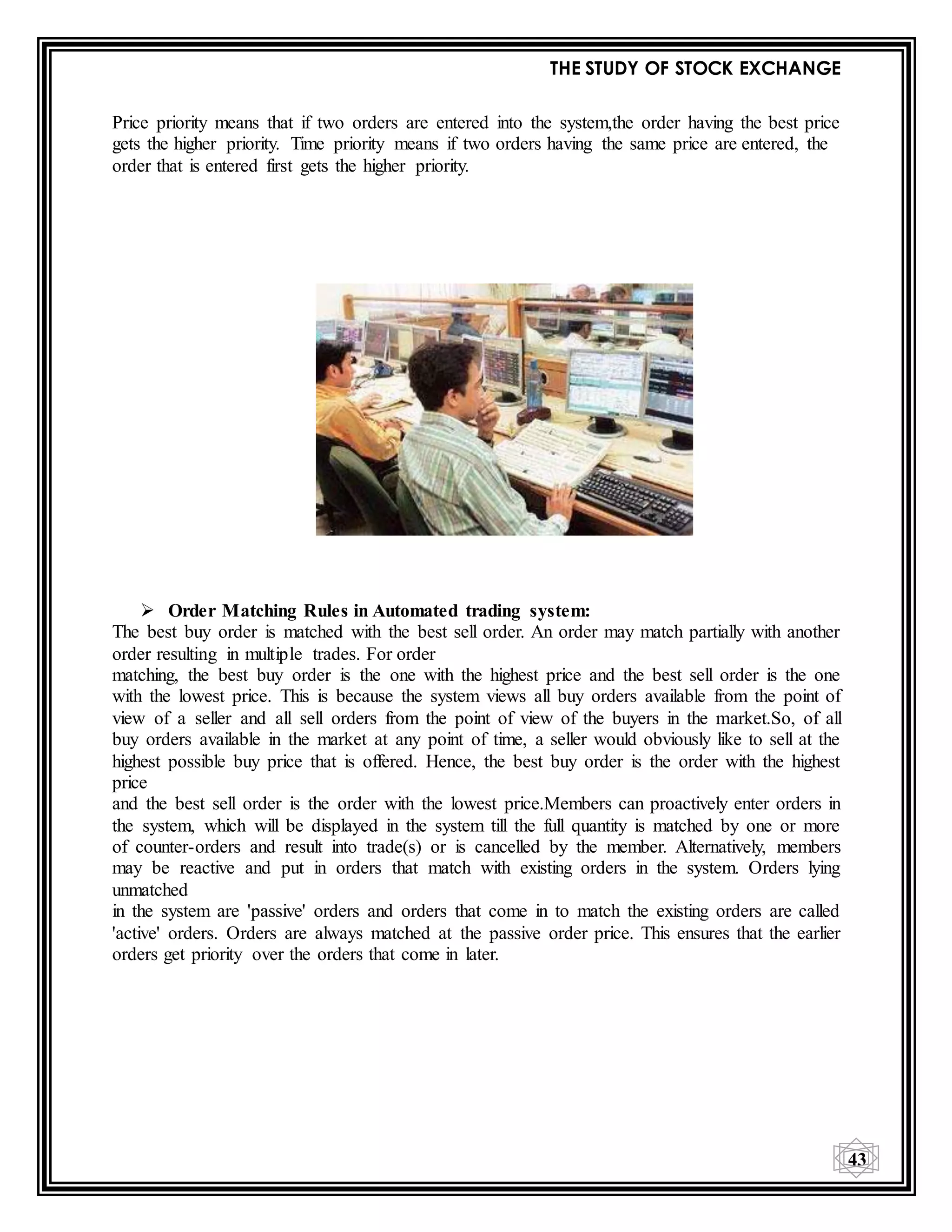
Price priority means that if two orders are entered into the system,the order having the best price
gets the higher priority. Time priority means if two orders having the same price are entered, the
order that is entered first gets the higher priority.
 Order Matching Rules in Automated trading system:
The best buy order is matched with the best sell order. An order may match partially with another
order resulting in multiple trades. For order
matching, the best buy order is the one with the highest price and the best sell order is the one
with the lowest price. This is because the system views all buy orders available from the point of
view of a seller and all sell orders from the point of view of the buyers in the market.So, of all
buy orders available in the market at any point of time, a seller would obviously like to sell at the
highest possible buy price that is offered. Hence, the best buy order is the order with the highest
price
and the best sell order is the order with the lowest price.Members can proactively enter orders in
the system, which will be displayed in the system till the full quantity is matched by one or more
of counter-orders and result into trade(s) or is cancelled by the member. Alternatively, members
may be reactive and put in orders that match with existing orders in the system. Orders lying
unmatched
in the system are 'passive' orders and orders that come in to match the existing orders are called
'active' orders. Orders are always matched at the passive order price. This ensures that the earlier
orders get priority over the orders that come in later.
THE STUDY OF STOCK EXCHANGE
44
 Order Conditions in Automated Trading System:
A TradingMember can enter various types of orders depending upon his/her requirements. These
conditions are broadly classified into three categories:
 Time Related Condition
 Price Related Condition
 Quantity Related Condition
 Time Conditions
a) Day Order –
A Day order, as the name suggests, is an order which is valid for the day on which it is
entered. If the order is not matched during the day, the order gets cancelled automatically
at the end of the trading day.
b) GTC Order –
Good Till Cancelled (GTC) order is an order that remains in the system until it is
cancelled by the Trading Member. It will therefore be able to span trading days if it does
not get matched. The maximum number of days a GTC order can remain in the system is
notified by the Exchange from time to time.
c) GTD –
A Good Till Days/Date (GTD) order allows the Trading Member to specify the days/date
up to which the order should stay in the system. At the end of this period the order will
get flushed from the system. Each day/date counted is a calendar day and inclusive of
holidays. The days/date counted are inclusive of the day/date on which the order is
placed. The maximum number of days a GTD order can remain in the system is notified
by the Exchange from time to time.
d) IOC –
An Immediate or Cancel (IOC) order allows a Trading Member to buy or sell a security
as soon as the order is released into the market, failing which the order will be removed
from the market. Partial match is possible for the order, and the unmatched portion of the
order is cancelled immediately.
 Price Conditions
a) Limit Price/Order –
An order that allows the price to be specified while entering the order into the system.
b) Market Price/Order –
An order to buy or sell securities at the best price obtainable at the time of entering the
order.
c) Stop Loss (SL) Price/Order –
The one that allows the Trading Member to place an order which gets activated only
when the market price of the relevant security reaches or crosses a threshold price. Until
then the order does not enter the market.A sell order in the Stop Loss book gets triggered
when the last traded price in the normal market reaches or falls below the trigger price of
THE STUDY OF STOCK EXCHANGE
45
the order. A buy order in the Stop Loss book gets triggered when the last traded price in
the normal market reaches or exceeds the trigger price of the order.
E.g. If for stop loss buy order, the trigger is 93.00, the limit
price is 95.00 and the market (last traded) price is 90.00, then this order is released into the
system once the market price reaches or exceeds 93.00. This order is added to the regular lot
book with time of triggering as the time stamp, as a limit order of 95.00
 Quantity Conditions:
a) Disclosed Quantity (DQ)-
An order with a DQ condition allows the Trading Member to disclose only a part of the
order quantity to the market. For example, an order of 1000 with a disclosed quantity
condition of 200 will mean that 200 is displayed to the market at a time. After this is
traded, another 200 is automatically released and so on till the full order is executed. The
Exchange may set a minimum disclosed quantity criteria from time to time.
b) MF- Minimum Fill (MF)
orders allow the Trading Member to specify the minimum quantity by which an order
should be filled. For example, an order of 1000 units with minimum fill 200 will require
that each trade be for at least 200 units. In other words there will be a maximum of 5
trades of 200 each or a single trade of 1000. The Exchange may lay down norms of MF
from time to time.
c) AON – All Or None (AON)
All or None orders allow a Trading Member to impose the condition that only the full
order should be matched against. This may be by way of multiple trades. If the full order
is not matched it will stay in the books till matched or cancelled.
Note: Currently, AON and MF orders are not available on the system as per SEBI directives.
3. Market Segments
The Exchange operates the following sub-segments in the Equities segment:
 Rolling Settlement
In a rolling settlement, each trading day is considered as a trading period and trades executed
during the day are settled based on the net obligations for the day.
At NSE, trades in rolling settlement are settled on a T+2 basis i.e. on the 2nd working day. For
arriving at the settlement day all intervening holidays, which include bank holidays, NSE
holidays, Saturdays and Sundays are excluded. Typically trades taking place on Monday are
settled on Wednesday, Tuesday's trades settled on Thursday and so on.
 Limited Physical Market
Pursuant to the directive of SEBI to provide an exit route for small investors holding physical
shares in securities mandated for compulsory dematerialised settlement, the Exchange has
provided a facility for such trading in physical shares not exceeding 500 shares.This market
segment is referred to as 'Limited Physical Market' (small
window). The Limited Physical Market was introduced on June 7, 1999.
Limited Physical Market - Salient Features
THE STUDY OF STOCK EXCHANGE
46
with Book Type ‗OL‘ and series ‗TT‘.
applicable in the Limited Physical Market are same as those
applicable for the corresponding Normal Market on that day.
-open
and post-close sessions are not allowed.
-for-trade basis and delivery obligations
arise out of each trade.
Orders with the same price and quantity match on time priority i.e. orders which have come into
the system before will get matched first.
-till-cancelled (GTC)/Good-till-date (GTD) orders placed and remaining as
outstanding orders in this segment at the close of market hours shall remain available for next
trading day. All orders in this segment, including GTC/GTD orders, will be purged on the last
day of the settlement.
investor(s) before entering orders on their behalf on a trade date.
THE STUDY OF STOCK EXCHANGE
47
4. Settlement Cycle
Settlement for trades is done on a trade-for-trade basis and delivery
obligations arise out of each trade. The settlement cycle for this
segment is same as for the rolling settlement viz:
Salient features of settlement
purchased from the secondary market) is treated as bad delivery. The shares standing in the name
of individuals/HUF only would constitute good delivery. The selling/delivering member must
necessarily be the introducing member.
Any delivery of shares which bears the last transfer date on or after the introduction of the
security for trading in the LP market is construed as bad delivery.
Any delivery in excess of 500 shares is marked as short and such deliveries are compulsorily
closed-out.
Shortages, if any, are compulsorily closed-out at 20% over the actual traded price. Uncertified
bad delivery and re-bad delivery are compulsorily closed-out at 20% over the actual traded price.
All deliveries are compulsorily required to be attested by the introducing/ delivering member.
The buyer must compulsorily send the securities for transfer and dematerialization, latest within
3 months from the date of pay-out.
Company objections arising out of such trading and settlement in this market are reported in the
same manner as is currently being done for normal market segment. However securities would
THE STUDY OF STOCK EXCHANGE
48
be accepted as valid company objection,only if the securities are lodged for transfer
within 3 months from the date of pay-out.
Company objections arising out of such trading and settlement in this market are reported in the
same manner as is currently being done for normal market segment. However securities would
be accepted as valid company objection, only if the securities are lodged for transfer
within 3 months from the date of pay-out.
5. Brokerage And Other Transaction Costs
Brokerage is negotiable. The Exchange has not prescribed any minimum brokerage. The
maximum brokerage is subject to a ceiling of 2.5 percent of the contract value. However, the
average brokerage charged by the members
to the clients is much lower.Typically there are different scales of brokerages for delivery
transaction, trading transaction, etc.
The Stamp Duty on transfer of securities in physical form is to be paid by the seller but in
practice it is paid by the buyer while registering the shares in his name. In case of transfer of
shares, the rate is 50 paise for every Rs.100/- or
part thereof on the basis of the amount of consideration and that for transfer of debentures the
rate of stamp duty varies from State to State, where the registered office of a Company issuing
the debentures is located
6. Transfer Of Ownership
Transfer of ownership of securities, if the same is not delivered in demat form by the seller, is
effected through a date stamped transfer-deed which is signed by the buyer and seller. The duly
executed transfer-deed along with the share certificate has to be lodged with the company for
change in the ownership.A nominal duty becomes payable in the form of stamps to be affixed on
the Transfer-deed remains valid for twelve months or the next book closure
following the stamped date whichever occurs later for transfer of shares in the name of buyer.
However, for delivery of shares in the market, transfer deed is valid till book closure date of the
company.
A.
B. The Role of the Stock Exchange in the Economy
Stock exchanges play a vital role in the functioning of the economy by providing the backbone to
a modern nation's economic infrastructure. Stock exchanges help companies raise money to
expand. They also provide individuals the ability to invest in companies. Stock exchanges
provide order and impose regulations for the trading of stocks. Finally, stock exchanges and all
of the companies that are associated with the stock exchanges provide hundreds of thousands of
jobs.
 Business Expansion
Stock exchanges provide companies the ability to raise capital to expand their businesses. When
a company needs to raise money they can sell shares of the company to the public. They
accomplish this by listing their shares on a stock exchange. Investors are able to buy shares of
THE STUDY OF STOCK EXCHANGE
49
public offerings and the money that is raised from the investors is used by the company to
expand operations, buy another company or hire additional workers. All of this leads to increased
economic activity which helps drive the economy.
 Widespread Investing
Stock exchanges allow any person to invest in the greatest companies in the world. Investors,
both large and small, use the stock exchanges to buy into a company's future. Investing would
not be possible for the average person if there was not a centralized place to trade stocks. The
ability for the average person to invest in these companies leads to increased wealth for the
investors. This increased wealth then leads to additional economic activity when the investors
spend their money.
 Direct Jobs
The stock exchanges and all of the companies that serve the stock exchanges such a brokerage
firms, investment banks and financial news organizations employ hundreds of thousands of
people. Most of the jobs related to stock exchanges are well paying and career orientated jobs. As
a result, the employees of these firms are able to help spur economic activity.
 Warning
If the stock exchanges do not fully carry out their duty of overseeing the stock trading process
the investing public will lose faith in the fairness and safety of the stock market. If this happens
then all of the economic activity that the stock exchanges create will decrease and this will lead
to an overall drop in economic activity. The stock exchanges must be sure that investors are not
taken advantage of and that investors continue to have confidence in the system the stock
exchanges created.
 Profit sharing
They help both casual and professional stock investors, to get their share in the wealth of
profitable businesses.
 Corporate governance
Stock exchanges impose stringent rules to get listed in them. So listed public companies have
better management records than privately held companies.
 Creating investment opportunities for small investors
Small investors can also participate in the growth of large companies, by buying a small number
of shares.
 Government capital raising for development projects
They help government to rise fund for developmental activities through the issue of bonds. An
investor who buys them will be lending money to the government, which is more secure, and
sometimes enjoys tax benefits also.
 Barometer of the economy
THE STUDY OF STOCK EXCHANGE
50
They maintain the stock indexes which are the indicators of the general trend in the
economy.They also regulate the stock price fluctuations.
 Mobilizing savings for investment
They help public to mobilize their savings to invest in high yielding economic sectors, which
results in higher yield, both to the individual and to the national economy.
THE STUDY OF STOCK EXCHANGE
51
CHAPTER 4
TRADING
OF
STOCKS
THE STUDY OF STOCK EXCHANGE
52
MERITS OF OWNING STOCKS
 Earn dividends.
Dividends are nothing but a part of company’s profits distributed to its share holders. The
company’s management may declare dividends either in between a financial year (called interim
dividends) or at the end of the financial year (called final dividends).However, it is not
mandatory for the companies to pay dividends. It can use the profits for alternative uses like
expansion. The decision to pay or not to pay dividends is taken at the annual meeting by the
majority voting of the shareholders. Blue-chip companies (large companies) generally are
consistent dividend payers.
 Capital appreciation.
As the company expands and grows, it acquires more assets and makes more profit. As a result,
the value of its business increases. This, in turn, drives up the value of the stock. So when you
sell, you will receive a premium over what you paid. This is known as capital gain and this is the
main reason why people invest in stocks. They aim capital appreciation.
 Receive bonus shares
For the time being, let us understand that bonus shares are – Free shares are given to you .Later
on we will discuss about bonus shares in detail.
 Rights issue
A company may require more funds to expand it’s business and for that, it may need more funds.
I such cases, the company can issue further shares to the public. However, before approaching
the public, the existing shareholders will be given a chance to subscribe to more shares if they
want. That’s called a rights issue. This is done in order to ensure that the existing shareholders
maintain the same degree of control in the company. Thus you can maintain the participation in
the company profits.
 Stocks can be pledged
Stocks are considered as assets and hence, banks accept shares as security for raising loans.
Should there be an an emergency, shares can quickly pledged to raise funds. Apart from that,
Brokerage firms allow you to borrow money from their account based on the current share
holding you have in your demat account maintained with them. If you want to utilize a sudden
surprise opportunity in markets, but if you don’t have the cash right now, you can adopt this
route.
THE STUDY OF STOCK EXCHANGE
53
 High liquidity
Stocks are highly liquid. It can be converted into cash in no time. With online trading, all it takes
is the click of button to sell you holdings. You can receive your cash in two days.
 Capital appreciation or dividends?
The above mentioned income sources may not be present in every company you buy. For
example- if you’re buying company that has a huge potential to grow, it may not pay it’s surplus
as dividends. Instead, it will be used for further growth. In such cases, huge capital appreciation
may happen. So depending upon your investment strategy, you’ll have to choose what you want.
It’s always wise to go for capital appreciation rather than dividends.
DEMERITS OF OWNING STOCKS
 Since common stock represents ownership of a business, stockholders are the last to get
paid, like all other owners. A company must first pay its employees, suppliers, creditors,
maintain its facilities and pay its taxes. Any money left can then be distributed among its
owners.
 While shareholders are company owners, they do not enjoy all of the rights and privileges
that the owners of privately held companies do. For example, they cannot normally walk
in and demand to review in detail the company’s books.
 Investors in a company may not know all that there is to know about the company. This
limited information can sometimes cause investment decision-making to be difficult.
 Stock prices tend to be volatile. Prices can be erratic, rising and declining quickly. Such
declines often cause investors to panic and sell, which actually only serves to lock in their
losses.
 Stock values can sometimes change for no apparent reason, which can be quite frustrating
for the investor who is trying to anticipate the stock’s behavior based on the actual
performance of the company.
THE STUDY OF STOCK EXCHANGE
54
WHAT IS TRADING OF STOCKS?
Most stocks are traded on exchanges, which are places where buyers and sellers meet and decide
on a price. Some exchanges are physical locations where transactions are carried out on a trading
floor. You've probably seen pictures of a trading floor, in which traders are wildly throwing their
arms up, waving, yelling, and signaling to each other. The other type of exchange is virtual,
composed of a network of computers where trades are made electronically.
The purpose of a stock market is to facilitate the exchange of securities between buyers and
sellers, reducing the risks of investing. Just imagine how difficult it would be to sell shares if you
had to call around the neighborhood trying to find a buyer. Really, a stock market is nothing
more than a super-sophisticated farmers' market linking buyers and sellers.
WHO IS A STOCKBROKER?
Definition of 'Stockbroker'
1. An agent that charges a fee or commission for executing buy and sell orders submitted by an
investor.
2. The firm that acts as an agent for a customer, charging the customer a commission for its
services.
A stockbroker is an individual / organization who are specially given license to participate in the
securities market on behalf of clients. The stockbroker has the role of an agent. When the
Stockbroker acts as agent for the buyers and sellers of securities, a commission is charged for
this service.
As an agent the stock broker is merely performing a service for the investor. This means that the
broker will buy for the buyer and sell for the seller, each time making sure that the best price is
obtained for the client.
An investor should regard the stockbroker as one who provides valuable service and information
to assist in making the correct investment decision. They are adequately qualified to provide
answers to a number of questions that the investor might need answers to and to assist in
participating in the regional market. Here are some questions which arise in the minds of the
investors before the take help of the brokers for investing their money in a particular company.
 Are they governed by any Rules and Regulations?
Of course, yes. Stock brokers are governed by SEBI Act, 1992, Securities Contracts (Regulation)
Act, 1956, Securities and Exchange Board of India [SEBI (Stock brokers and Sub brokers) Rules
and Regulations, 1992], Rules, Regulations and Bye laws of stock exchange of which he is a
THE STUDY OF STOCK EXCHANGE
55
member as well as various directives of SEBI and stock exchange issued from time to
time. Every stock broker is required to be a member of a stock exchange as well as registered
with SEBI. Examine the SEBI registration number and other relevant details can be found out
from the registration certificate issued by SEBI.
 How do I know whether a broker is registered or not?
Every broker displays registration details on their website and on all the official documents. You
can confirm the registration details on SEBI website. The SEBI website provides the details of
all registered brokers. A broker’s registration number begins with the letters “INB” and that of a
sub broker with the letters “INS”.
 What are the documents to be signed with stock broker?
Before start of trading with a stock broker, you are required to furnish your details such as name,
address, proof of address, etc. and execute a broker client agreement. You are also entitled to a
document called ‘Risk Disclosure Document’, which would give you a fair idea about the risks
associated with securities market. You need to go through all these documents carefully.
 SUB BROKERS
According to the BSE website – “Sub-broker” means any person not being a member of a Stock
Exchange who acts on behalf of a member-broker as an agent or otherwise for assisting the
investors in buying, selling or dealing in securities through such member-brokers.
All Sub-brokers are required to obtain a Certificate of Registration from SEBI without which
they are not permitted to deal in securities. SEBI has directed that no broker shall deal with a
person who is acting as a sub-broker unless he is registered with SEBI and it shall be the
responsibility of the member-broker to ensure that his clients are not acting in the capacity of a
sub-broker unless they are registered with SEBI as a sub-broker.
It is mandatory for member-brokers to enter into an agreement with all the sub-brokers. The
agreement lays down the rights and responsibilities of member-brokers as well as sub-brokers.
STOCK BROKERS IN INDIA.
There are a number of broking houses all over India. Many of them have International presence
too. Following are some of the leading Stock Broking firms in India.
 IndiaInfoline
 ICICIdirect
 Share khan
 India bulls
 Geojit Securities
 HDFC
 Reliance Money
THE STUDY OF STOCK EXCHANGE
56
 Religare
 Angel Broking
Investors have to check the broker’s terms and conditions and decide about opening a trading
account. Only Govt. tax rates like, security transaction tax, stamp duty and service tax are
uniform other charges like brokerage for delivery trades, intraday trades, minimum transaction
charge, statement charges, DP charges, annual maintenance charges etc., may vary from one
broker to another.
ROLE OF STOCKBROKER IN ASTOCKMARKET
When you plan to start investing in a stock market, the first thing you have to do is to choose a
stock broker. It is just like choosing a car you think is most suitable for you. You can thoroughly
research the whole market in order to find the best car for you but require a medium or a venue
to execute the actual transaction. The same strategy is needed when you want to buy stock in a
stock market. You can select a company to invest in by conducting detailed research about its
future prospects but you still need to have a broker to make the final transaction and
purchase its stock from the stock market.
A stock broker acts as the agent of an investor and represents his clients to buy or sell
stocks, derivatives and other securities.
The term stock broker applies to companies that deal in securities as well as to its employees
who are technically working for the brokerage and are its registered representatives. Most stock
brokers work far away from stock trading floors. The primary role of a stock broker is to execute
transactions on behalf of his clients by buying and selling securities in the stock market.
As a representative of his clients, a stock broker seeks the best deals to buy and sell stock.
They usually deal in all types of securities and also handle derivatives, such as commodity
futures. They also advise their clients about when to make transactions and guide them about
what to look for in market dealings. However, they are not licensed investment advisor and
therefore, you should always consult Your Personal Financial Mentor before making any
financial investment decision in a stock market. After completion of the transaction, they forward
related information to their clients and make transfer arrangements of stock certificates or other
paperwork.
Stock brokerage firms and individual stock brokers are regulated by the Securities and Exchange
Commission and other specific markets. An individual broker must pass a test administered by
concerned regulatory authorities and must complete his registration through brokerage firms,
which in some cases require registration with a concerned securities commission.
THE STUDY OF STOCK EXCHANGE
57
A PHOTO OF STOCK BROKERS PERFORMING THE ONLINE TRADING
Stock brokers are paid commissions which usually consist of a percentage of a value of the
trade transaction in a stock market.
Brokerage firms are also known as discount brokers as they offer trade transactions at a single
price. They provide recommendations only on those investments that meet financial goals and
needs of a client. A stock broker provides advisory services for investing in a stock market and in
return, an investor pays a fixed fee to them. They also offer special features, such as check
writing, interest-bearing accounts, credit cards and direct deposits and hence, play a role of
providing these limited banking services. Margin interest payments are charged to investors for
borrowing against the brokerage account for investment in a stock market. They also take service
charges from their clients for performing administrative tasks, such as for handling Individual
Retirement Account (IRA) and for mailing stocks in the form of certificates. They can also
purchase options, exchange traded funds (ETFs), bonds, shares, mutual funds, and other
investments on your behalf.
THE STUDY OF STOCK EXCHANGE
58
METHOD OF TRADING IN STOCK EXCHANGES
AND
THE TYPES OF BROKERS
A stock exchange is a corporation or organization that provides trading facilities for stockbrokers
and traders. Instruments traded on stock exchanges include stocks, investment trusts,
commodities, options, mutual funds, unit trusts and bonds. Only members can trade on an
exchange.
 Specialists
A member of an exchange who acts as the market maker to facilitate the trading of a given stock.
The specialist holds an inventory of the stock, posts the bid and ask prices, manages limit orders
and executes trades. Specialists are also responsible for managing large movements by trading
out of their own inventory. If there is a large shift in demand on the buy or sell side, the specialist
will step in and sell out of their inventory to meet the demand until the gap has been narrowed.
Before we address this question, let's review what specialists do. Specialists are people on the
trading floor of an exchange, such as the NYSE, who hold inventories of particular stocks. A
specialist's job is not only to match buyers and sellers, but also to keep an inventory for him or
herself that can be used to shift the market during a period of illiquidity.
The job of the specialist originated in 1872, when it was recognized that there was a need for a
new system of continuous trading - before this, each stock had a set time during which it could
be traded. Under the new system,brokers began to deal in a specific stock to remain at one
location on the floor of the exchange. Eventually, the role of these brokers evolved into that of
the 'specialist'.
It is the specialist's job to act in a way that benefits the public above all. Every specialist
accomplishes this by filling the four vital roles of
 auctioneer,
 catalyst,
 agent and
 principal.
Let's take a closer look at what a specialist does in fulfilling each of these roles:
 Auctioneer – Shows best bids and offers, becoming a 'market maker'.
 Catalyst – Keeps track of the interests of different buyers and sellers and continually
updates them.
 Agent – Places electronically routed orders on behalf of clients. Floor brokers can leave
an order with a specialist, freeing themselves up to take on other orders. Specialists then
take on the responsibilities of a broker.
 Principal – Acts as the major party to a transaction. Since specialists are responsible for
keeping the market in equilibrium, they are required to execute all customer orders ahead
of their own.
THE STUDY OF STOCK EXCHANGE
59
A stock specialist is a member of a stock exchange who provides several services. They make a
market in stocks by providing the best bid and best ask during trading hours. Specialists also
maintain a fair and orderly market.
 Floor Brokers
An independent member of an exchange who is authorized to execute trades on the exchange
floor on behalf of clients. A floor broker is a middleman who acts as an agent for clients,
indirectly giving them the best access possible to the exchange floor. A floor broker’s clients
typically include institutions and wealthy people such as financial-service firms, pension funds,
mutual funds, high net worth individuals and traders. A floor broker’s primary responsibility is
“best execution” of client orders, and to achieve this objective, he or she must continuously
assess myriad factors including market information, market conditions, prices and orders.
Also known as “pit broker.”
A floor broker is different from a floor trader, who trades as principal for his or her own account,
whereas the floor broker acts as an agent for clients. A floor broker also differs from a
commission broker in that the latter is an employee of a member firm, while the floor broker is
an independent member of the exchange.
Floor brokers trade on the floor on the major exchanges. Floor brokers buy and sell securities in
their own account. Floor brokers are required to take and pass written tests in order to trade.
They must abide by exchange rules, and they must be a member of the exchange on which they
trade.
 A floor broker executes orders for their clients. They do not execute on their own
accounts.
To put it simply, a floor broker is someone who represents client orders at the point of sale on the
NYSE (New York Stock Exchange) floor, our source explained.
THE STUDY OF STOCK EXCHANGE
60
Almost all NYSE floor brokers trade on an "agency" basis, meaning they don't trade for
themselves or their firm like market-makers do.
 A floor broker provides information for their clients.
A floor broker's clients can include banks, broker-dealers, hedge funds, mutual funds, pension
funds, day traders and even some high net-worth individuals.
"We are the 'eyes and ears' to our clients' stocks. We give them market color, let them know of
market rumors and find liquidity from the other hundred or so floor brokerage shops," our source
told us.
 They earn a living from commission on each share traded.
A floor broker earns commission for each share traded.
This can be anywhere from half a penny per share or five cents a share, the floor broker
explained.
 A floor broker's workday begins a few hours before the opening bell.
The stock market opens at 9:30 a.m. and the closing bells rings at 4:00 p.m., but a NYSE floor
broker begins his or her day much earlier than that.
A floor broker might get in around 7:30 a.m. or 8:00 a.m, our source said.
At this time, a floor broker will typically read newspapers, go over the news-wires, check their
Bloomberg terminal and perhaps emails stories/links to their customers.
 Then the orders and 'look' requests start coming in.
At about 9:00 a.m. a floor broker starts getting orders and "look" requests.
When someone asks for a "look" near the open or close of the market, it means finding out a
price for the open/close and/or what the buy/sell imbalance is.
If someone asks for a "look" in the middle of the day, that means finding out some color on the
stock such as who's been buying, who's been selling, any rumors or news that's out.
A floor broker would ask a specialist to find this information out.
 Right around the opening bell it's 'complete mayhem.'
The market opens at 9:30 a.m.
From 9:15 a.m. to 9:45 a.m. it's "complete mayhem" like it has been for years.
 Then things start to settle down and the computers and algos do most of the trading.
THE STUDY OF STOCK EXCHANGE
61
Then around 9:45 a.m. to 10:00 a.m. everything begins to settle down and algos and computer
programs do most of the trading.
"We have all the algos and systems they do upstairs plus some. Also we have face-to face
contact when trying to find the other side or complete a trade."
 Then it's time for lunch. The floor brokers typically eat at their booths.
"We each lunch while we work. It's too busy to leave," the floor broker said.
 Around 3:30 p.m. things start to really pick up again.
Things start to get crazy around 3:30 p.m. with customers wanting to know what price the stock
is going to close and how much volume, the source said. At 4 p.m. the closing bell rings and
fifteen minutes later the trading floor basically empties out.
 At 4:00 p.m. the closing bell rings. The next ten or fifteen minutes are spent making
sure everything closed OK and there are no problems.
At 4:15 the floor brokers head for the door. They're done for the day.
 Stockbrokers/Financial Advisers
Stockbrokers, financial advisers, certified financial planners and registered representatives buy
and sell stocks on behalf of their clients and customers. They must pass certain written exams in
order to carry out trades and adhere to ethical standards.
A stockbroker is someone who can buy or sell stock, futures or currencies in your behalf. There
are many good stock broking firms around.
Professional brokers spend a lot of time watching the markets; their systems provide them with
most up to date information on any stock.
Remember, though that your destiny is in your hands not your stockbroker. Don't go blaming
your stockbroker if the market turns around on you. The market will do what it has to do, and all
that is under your control is your own money management skills.
There are several types of stockbrokers: (Internet broker, discount broker, full service brokers).
Internet brokers: This web site explains how to trade and do it yourself. It is the cheapest way; no
advise given by stockbrokers but you get access to all the tools. You are on your own take the
THE STUDY OF STOCK EXCHANGE
62
time to learn the trick of the trade and practice it.
Discount broker: You pay small fee but cheaper than a full service broker. They only take your
buy or sell order.
Full service broker: More expensive as they will provide you with their educated advise about
the order you want them to execute. They also provide any other information you wish to know.
Remember to always double check or confirm your order with your broker, NEVER assume the
person on the other side has heard you correctly.
 Day Traders
Day traders are individuals who buy and sell securities for their own accounts. Day traders will
trade quickly--making purchases and sales on the same day. Day trading is defined as the buying
and selling of a security within a single trading day. This can occur in any marketplace, but is
most common in the foreign-exchange (forex) market and stock market. Typically, day traders
are well educated and well funded. They utilize high amounts of leverage and short-term trading
strategies to capitalize on small price movements in highly liquid stocks or currencies. Day
traders serve two critical functions in the marketplace: they keep the markets running efficiently
via arbitrage and they provide much of the markets' liquidity (especially in the stock market).
This article will take an objective look at day trading, who does it and how it is done. (Did you
know there are schools that teach day trading? See "The Best Day Trading Schools.")
Characteristics of a Day Trader
This article will focus on professional day traders - that is, those who trade for a living, not
simply as a hobby or for a "gambling high." These traders are typically well-established in the
field and have in-depth knowledge of the marketplace. Here are some of the prerequisites to day
trading:
Knowledge and Experience in the Marketplace: Individuals who attempt to day trade without an
understanding of market fundamentals often end up losing money.
Sufficient Capital: One cannot expect to make money day trading. Day traders use only risk
capital, which they can afford to lose. Not only does this protect them from financial ruin, but it
also helps eliminate emotion from their trading. A large amount of capital is often necessary to
capitalize effectively on intra-day price movements.
A Strategy: A trader needs an edge over the rest of the market. There are several different
strategies that day traders utilize, including swing trading, arbitrage and trading news, among
others. These strategies are refined until they produce consistent profits and effectively limit
losses.
THE STUDY OF STOCK EXCHANGE
63
Discipline: A profitable strategy is useless without discipline. Many day traders end up losing a
lot of money because they fail to make trades that meet their own criteria. As they say, "Plan the
trade and trade the plan." Success is impossible without discipline.
 Casual Traders
A casual trader is a person who tries to build up a portfolio by buying and selling securities for
his own account over a period of time. Technology has simplified the process and given the
casual trader much of the same information and tools available to professional traders.
Casual trading is a newly developed variant of financial trading. It consists of the same principles
carried out in trading rooms but involves the use of trading platforms that can be operated from
the trader's residence.
Casual trading is a general name for all trading actions that are carried out by individuals without
the use of a mediator. They can be found in stock exchange, foreign exchange, commodities and
other markets.
 Online Trading
Online trading is available to any person that has an account at an online trading firm. A person
can enter trades from a personal computer and set price limits and targets. Commissions are often
much less than at a full-service brokerage firm. The act of placing buy/sell orders for financial
securities and/or currencies with the use of a brokerage's internet-based proprietary trading
platforms. The use of online trading increased dramatically in the mid- to late-'90s with the
introduction of affordable high-speed computers and internet connections.
The use of online trades has increased the number of discount brokerages because internet
trading allows many brokers to further cut costs and part of the savings can be past on to
customers in the form of lower commissions.
THE STUDY OF STOCK EXCHANGE
64
Another benefit of online trading is the improvement in the speed of which transactions can be
executed and settled, because there is no need for paper-based documents to be copied, filed and
entered into an electronic format.
Legend has it that Joseph Kennedy sold all the stock he owned the day before "Black Thursday,"
the start of the catastrophic 1929 stock market crash. Many investors suffered enormous losses in
the crash, which became one of the hallmarks of the Great Depression.
What made Kennedy sell? According to the story, he got a stock tip from a shoeshine boy. In the
1920s, the stock market was the realm of the rich and powerful. Kennedy thought that if a
shoeshine boy could own stock, something must have gone terribly wrong.
Now, plenty of "common" people own stock. Online trading has given anyone who has a
computer, enough money to open an account and a reasonably good financial history the ability
to invest in the market. You don't have to have a personal broker or a disposable fortune to do it,
and most analysts agree that average people trading stock is no longer a sign of impending doom.
The market has become more accessible, but that doesn't mean you should take online trading
lightly. In this article, we'll look at the different types of online trading accounts, as well as how
to choose an online brokerage, make trades and protect yourself from fraud.
A share of stock is basically a tiny piece of a corporation. Shareholders -- people who buy stock -
- are investing in the future of a company for as long as they own their shares. The price of a
share varies according to economic conditions, the performance of the company and investors'
attitudes. The first time a company offers its stock for public sale is called an initial public
offering (IPO), also known as "going public."
When a business makes a profit, it can share that money with its stockholders by issuing
a dividend. A business can also save its profit or re-invest it by making improvements to the
business or hiring new people. Stocks that issue frequent dividends are income stocks. Stocks in
companies that re-invest their profits are growth stocks.
THE STUDY OF STOCK EXCHANGE
65
MARKET CORRECTION
A market correction refers to a price decline of at least 10% of any security or market index
following a temporary upswing in market prices.
How it works/Example:
The stock market's value is always rising and falling. Sometimes, the market will experience
short-term gains, even though nothing has really changed. These increases in value are usually
due to mass psychology on the part of investors driven by anticipation of perceived gains. As
more investors buy into the trend, the price increases. Once the price is high enough, buying
slows, and some investors begin to sell to lock in their gains. This decrease in price, following a
short-term increase, is called a market correction.
A sample of a stock graph showing market corrections
Why it Matters:
Market corrections are usually tracked once an upswing in market prices has come and gone. A
correction in a stock's price following an upswing is indicative of a stock's true market value and
may not indicate a loss in value so much as a market's return to stability.
Market corrections are a big part of technical analysis. Many investors will use indicators to try
to determine when the correction will begin and end so that they can buy when prices are lower.
MARKET TREND
A market trend is a tendency of a financial market to move in a particular direction over time.
These trends are classified as secular for long time frames, primary for medium time frames,
and secondary for short time frames.Traders identify market trends using technical analysis, a
framework which characterizes market trends as predictable price tendencies within the market
when price reaches support and resistance levels, varying over time.
THE STUDY OF STOCK EXCHANGE
66
The terms bull market and bear market describe upward and downward market trends,
respectively,and can be used to describe either the market as a whole or specific sectors and
securities.
There are three types of market trends in stock market:
 Secular market trend
 Primary market trend
 Secondary market trend
 Secular market trend:
A secular market trend is a long-term trend that lasts 5 to 25 years and consists of a series of
primary trends. A secular bear market consists of smaller bull markets and larger bear markets; a
secular bull market consists of larger bull markets and smaller bear markets.
 Primary market trend:
A primary trend has broad support throughout the entire market (most sectors) and lasts for a
year or more.
o Bull market:
A bull market is a period of generally rising prices. The start of a bull market is marked by
widespread pessimism.
o Bear market:
A bear market is a general decline in the stock market over a period of time. It is a transition
from high investor optimism to widespread investor fear and pessimism.
o Market top:
A market top (or market high) is usually not a dramatic event. The market has simply reached the
highest point that it will, for some time (usually a few years). It is retroactively defined as market
participants are not aware of it as it happens. A decline then follows, usually gradually at first
and later with more rapidity.
o Market bottom:
A market bottom is a trend reversal, the end of a market downturn, and precedes the beginning of
an upward moving trend (bull market).
It is very difficult to identify a bottom (referred to by investors as "bottom picking") while it is
occurring. The upturn following a decline is often short-lived and prices might resume their
decline. This would bring a loss for the investor who purchased stock(s) during a misperceived
or "false" market bottom.
 Secondary market:
Secondary trends are short-term changes in price direction within a primary trend. The duration
is a few weeks or a few months.
One type of secondary market trend is called a market correction. A correction is a short term
price decline of 5% to 20% or so. A correction is a downward movement that is not large enough
to be a bear market (ex post).
THE STUDY OF STOCK EXCHANGE
67
Another type of secondary trend is called a bear market rally (sometimes called "sucker's rally"
or "dead cat bounce") which consist of a market price increase of only 10% or 20% and then the
prevailing, bear market trend resumes. Bear market rallies occurred in the Dow Jones index after
the 1929 stock market crash leading down to the market bottom in 1932, and throughout the late
1960s and early 1970s. The Japanese Nikkei 225 has been typified by a number of bear market
rallies since the late 1980s while experiencing an overall long-term downward trend.
BULLS AND BEARS
The two most commonly used terms in stock markets.
A common story is that the terms ‘Bull market’ and ‘Bear market’ are derived from the way
those animals attack. Bulls are supposed to be aggressive and attacking while bears would wait
for the prey to come down.
Another story is that long back, bear trappers would first trade in the market and fix a price for
bear skins, which they actually didn’t own. Once the price is fixed , they would go hunting for
bear skins. So eventually even if the prices go down, they will still be able to sell if for a high
price. This term eventually was used to describe short sellers and speculators who sell what
they do not own and buy it when the price comes down and makes money in the process.
 What are Bears?
Definition of 'Bear Market'
A market condition in which the prices of securities are falling, and widespread pessimism
causes the negative sentiment to be self-sustaining. As investors anticipate losses in a bear
market and selling continues, pessimism only grows. Although figures can vary, for many, a
downturn of 20% or more in multiple broad market indexes, such as the Dow Jones Industrial
Average (DJIA) or Standard & Poor's 500 Index (S&P 500), over at least a two-month period,
is considered an entry into a bear market.
Bear :
An operator who expects the share price to fall. A bear market is the opposite of a bull market.
When the prices of stocks moves crashes rapidly cracking previous lows , you may assume
THE STUDY OF STOCK EXCHANGE
68
that it’s a bear market. Generally markets must fall by more than 20% to confirm that it’ a bear
market.
Bear Market :
A weak and falling market where buyers are absent.
 What are Bulls?
Definition of 'Bull Market'
A financial market of a group of securities in which prices are rising or are expected to rise.
The term "bull market" is most often used to refer to the stock market, but can be applied to
anything that is traded, such as bonds, currencies and commodities.
Bull :
An operator who expects the share price to rise and takes position in the market to sell at a
later date.
When the prices of stocks moves up rapidly cracking previous highs , you may assume that it’s
a bull market.If there are many bullish days in a row you can consider that as a ‘bull market
run’. Technically a bull market is a rise in value of the market by at least 20%.
Bull Market : A rising market where buyers far outnumber the sellers
A bull market is one where prices are rising, whereas a bear market is one where prices are
falling. The two terms are also used to describe types of investors.
THE STUDY OF STOCK EXCHANGE
69
A stock market bull is someone who has a very optimistic view of the market; they may be
stock-holders or maybe investors who aggressively buy and sell stocks quickly. A bear
investor, on the other hand, is pessimistic about the market and may make more conservative
stock choices. Sometimes, the terms are used to refer to specific funds or stocks. Bear market
funds, for example, are those that are falling and faring poorly. Investors sometimes refer to
bull stocks to describe securities that are aggressively rising and making their investors money.
Knowing what is meant by the bear and bull market can help you understand whether the
market is currently rising or falling. There is no need to get frightened by a bear market
indicator; however, as experts agree that the market is cyclical. When prices start falling, they
will eventually rise too.
 What Drives Bearand Bull Markets?
The stock market is affected by many economic factors. High employment levels, strong
economy, and stable social and economic conditions generally build investor confidence and
encourage investors to put their money in the stock market. Often, this can bolster bull
markets. Also, new technologies and companies that encourage investors to put their money in
stocks can create bull markets. For example, in the 1990s, the dot com craze encouraged many
investors to put their money in stocks that they felt would keep increasing. In some cases, a
bullish market is simply self-perpetuating. Since the market is doing well, it only encourages
investors to invest more money or to start investing.
On the other hand, discouraging economic or social political changes in a society can push the
market down. Sudden instability or unemployment -- or even fears of unemployment caused
by wars and other problems -- can start to make investors more conservative and therefore lead
to bear markets. Of course, again this becomes a self-perpetuating trend. As the economy slows
down, companies begin downsizing. Increased unemployment makes people far less willing to
gamble on the stock market. Sometimes, a panic caused by dire predictions about the market
can also create bearish conditions.
How To Predict Bear and Bull Markets?
The easiest way to predict both types of markets is to realize that what goes up must come
THE STUDY OF STOCK EXCHANGE
70
down. That is, if the market is rising, then you know that at some point it will start to fall
again. Similarly, if the market is currently falling, you can be certain that eventually it will pick
up again. There are no precise ways to predict either bull or bear markets, although general
social economic situations can help you to determine what will happen. A country which wages
a war will experience bullish market conditions as government contracts create more jobs and
boost investor confidence if their expectation is to win. Sudden international crises push the
market downward and create bearish conditions. News is very often a good indicator of where
investors are headed. The reports will inform about loss of investor confidence as well as
sudden economic downturns that may affect the market. If you notice from stock market
research that several indexes have changed by 15% to 20%, you can be sure that market
direction is changing. When you notice such changes, it is time to sit up and take notice. You
may be headed for a bullish or bearish market.
 Market Conditions In Both Cases
While referring to markets is either bull or bear is very general, there are certain types of
specific markets conditions that exist in both markets. For example, a bullish market is often
accompanied by a sudden increase demand for securities and smaller supplies of the same
securities. This is because more investors are willing to buy securities while fewer wish to sell.
This, of course, only pushes prices higher. The very opposite is true in a bearish market.
The investor's behavior is another condition prevalent in both markets. In bullish markets,
there's a sudden increase interest in the stock market. More people are hopeful about possible
profits on the stock market and most people are optimistic about economic conditions. In a
bearish market, investors are not very confident and therefore invest less.
Investing During Bear and Bull Markets
New investors often assume that they need to avoid investing during bear markets, and invest
heavily during bull markets. This is not the case. Experienced investors know that you need to
be able to invest in any sort of market condition, provided that you do so wisely. Each investor
has a different strategy for dealing with a bull market or bearish markets. Many investors try to
take advantage of bull markets by buying stocks as soon as the market gets bullish, and then
starting to sell when prices seem to have reached their peak. The difficulty, of course, is that it
is almost impossible to tell when the trend is beginning and when it will peak. In general,
investors can take more chances with the market during a bullish phase. Since overall prices
will rise, the chances of making a profit are good.
In bearish market conditions, prices are falling and the possibility of loss is pretty good. What
is worse, it is not always possible to tell when bearish conditions will end. Therefore, if you
invest during such market conditions, you may have to suffer some losses before bullish times
return and you're able to realize a profit. For this reason, many investors decide on short selling
or fixed income securities and other more conservative types of investment. Defensive stocks
are another good option that remain stable during bearish conditions. On the other hand, some
investors see bearish market conditions as an ideal time to invest in more stocks. Since many
people are selling off their stocks -- including valuable blue-chip stocks -- at low prices, it is
possible to set up long-term investments that will prove valuable during bullish times.
While every investor loves to see the upswing in prices during a bull market, the wise investor
THE STUDY OF STOCK EXCHANGE
71
will be able to handle a bear market as well. Whether you are just beginning to invest or are an
experienced investor, learning to deal with various market conditions you neen not panic but
decide patiently on investment.
 MARKET TIMING
The basic idea behind stock market investment is simple- Buy low, sell high and make money.
So to make money, you buy stocks in a bear market when stock prices are low and sell stocks in
a bull market when stock prices are high.
However, knowing the exact time when a bear market would start or when a bull market run
would come is not possible. Just when you thought the markets would go up, it may surprise you
by trading low. Your strategy should be to pick up shares in the bear market and sell it when
there’s a bull market run.
OTHER ANIMALS ON THE FARM
The Other Animals on the Farm - Chickens and Pigs
Chickens are afraid to lose anything. Their fear overrides their need to make profits and so they
turn only to money-market securities or get out of the markets entirely. While it's true that you
should never invest in something over which you lose sleep, you are also guaranteed never to see
any return if you avoid the market completely and never take any risk,
Pigs are high-risk investors looking for the one big score in a short period of time. Pigs buy on
hot tips and invest in companies without doing their due diligence. They get impatient, greedy,
and emotional about their investments, and they are drawn to high-risk securities without putting
in the proper time or money to learn about these investment vehicles. Professional traders love
the pigs, as it's often from their losses that the bulls and bears reap their profits.
What Type of Investor Will You Be?
There are plenty of different investment styles and strategies out there. Even though the bulls and
bears are constantly at odds, they can both make money with the changing cycles in the market.
Even the chickens see some returns, though not a lot. The one loser in this picture is the pig.
Make sure you don't get into the market before you are ready. Be conservative and never invest
in anything you do not understand. Before you jump in without the right knowledge, think about
this old stock market saying:
"Bulls make money, bears make money, but pigs just get slaughtered!"
THE STUDY OF STOCK EXCHANGE
72
BULLISH AND BEARISH BEHAVIOUR
The terms bullish and bearish are often used to describe the conditions in the market or the
sentiment of investors. They are very important terms and are used in nearly all types of trading,
from currencies to stocks. Traders can take advantage of both bullish and bearish markets if they
have sufficient knowledge of the market conditions that are associated with these cycles. When
traders understand the meaning of bearish and bullish and are able to identify the cycles, they
will know how to profit off of any market condition.
Investors and Markets
An investor with bearish sentiment believes that a rise in the value of asset prices presents an
excellent opportunity to trade those assets and get out of the market. On the other hand,
investors with bullish sentiment wait until prices are low before entering the market with the
hope that prices will increase and they will then trade their stocks to make a profit. Traders can
generate profits in both bearish and bullish market cycles. When a rise is suspected in the
markets, bullish investors either purchase assets or hold onto long-term investments. Below is an
illustration of investor sentiment.
THE STUDY OF STOCK EXCHANGE
73
Traders may also ‘short’ a stock if they believe it will decline. However, institutional hedge
funds and money managers are the primary players in shorting stocks. Investors who are bullish
may eventually migrate to become bearish investors over time. Meredith Whitney is well-known
for calling bull runs in markets and her fame grew in 2009 when she said the markets were
rallying for no reason and the gains would soon be lost. According to Tom O’Halloran, an expert
trader and Lord Abbeit mutual fund manager, investors who are seeking exposure to the best
assets should not wait until a bear cycle before purchasing those assets. O’Halloran says that
expensive assets are priced in proportion to the market rallying periods.
THE STUDY OF STOCK EXCHANGE
74
HOW TO READ A STOCK TABLE/QUOTE?
Investors use stock charts, or graphs, to evaluate the price behavior of stocks, exchange-traded
funds and other financial instruments. A line graph is the simplest and one of the most common
types of stock charts. You might find one in the business section of the newspaper, on investment
websites or on TV shows that discuss stocks. A line chart displays a line that connects a stock’s
periodic closing prices. A closing price is the last-traded price of a trading session. Because a line
chart shows limited data, you can easily identify a stock’s general price trend.
Any financial paper has stock quotes that will look something like the image below:
Columns 1 & 2: 52-Week High and Low - These are the highest and lowest prices at which a
stock has traded over the previous 52 weeks (one year). This typically does not include the
previous day's trading.
Column 3: Company Name & Type of Stock - This column lists the name of the company. If
there are no special symbols or letters following the name, it is common stock. Different symbols
imply different classes of shares. For example, "pf" means the shares are preferred stock.
Column 4: Ticker Symbol - This is the unique alphabetic name which identifies the stock. If
you watch financial TV, you have seen the ticker tape move across the screen, quoting the latest
prices alongside this symbol. If you are looking for stock quotes online, you always search for a
company by the ticker symbol. If you don't know what a particular company's ticker is you can
search for it at: http://finance.yahoo.com/l.
Column 5: Dividend Per Share - This indicates the annual dividend payment per share. If this
space is blank, the company does not currently pay out dividends.
Column 6: Dividend Yield - The percentage return on the dividend. Calculated as annual
dividends per share divided by price per share.
THE STUDY OF STOCK EXCHANGE
75
Column 7: Price/Earnings Ratio - This is calculated by dividing the current stock price by
earnings per share from the last four quarters. For more detail on how to interpret this, see
ourP/E Ratio tutorial.
Column 8: Trading Volume - This figure shows the total number of shares traded for the day,
listed in hundreds. To get the actual number traded, add "00" to the end of the number listed.
Column 9 & 10: Day High and Low - This indicates the price range at which the stock has
traded at throughout the day. In other words, these are the maximum and the minimum prices
that people have paid for the stock.
Column 11: Close - The close is the last trading price recorded when the market closed on the
day. If the closing price is up or down more than 5% than the previous day's close, the entire
listing for that stock is bold-faced. Keep in mind, you are not guaranteed to get this price if you
buy the stock the next day because the price is constantly changing (even after the exchange is
closed for the day). The close is merely an indicator of past performance and except in extreme
circumstances serves as a ballpark of what you should expect to pay.
Column 12: Net Change - This is the dollar value change in the stock price from the previous
day's closing price. When you hear about a stock being "up for the day," it means the net change
was positive.
Quotes on the Internet
Nowadays, it's far more convenient for most to get stock quotes off the Internet. This method is
superior because most sites update throughout the day and give you more information, news,
charting, research, etc.
WHAT IS A STOCK CHART
In technical analysis, charts are similar to the charts that you see in any business setting. A chart
is simply a graphical representation of a series of prices over a set time frame. For example, a
chart may show a stock's price movement over a one-year period, where each point on the graph
represents the closing price for each day the stock is traded:
THE STUDY OF STOCK EXCHANGE
76
Figure 1
Figure 1 provides an example of a basic chart. It is a representation of the price movements of a
stock over a 1.5 year period. The bottom of the graph, running horizontally (x-axis), is the date or
time scale. On the right hand side, running vertically (y-axis), the price of the security is shown.
By looking at the graph we see that in October 2004 (Point 1), the price of this stock was around
$245, whereas in June 2005 (Point 2), the stock's price is around $265. This tells us that the stock
has risen between October 2004 and June 2005.
Chart Properties
There are several things that you should be aware of when looking at a chart, as these factors can
affect the information that is provided. They include the time scale, the price scale and the price
point properties used.
The Time Scale
The time scale refers to the range of dates at the bottom of the chart, which can vary from
decades to seconds. The most frequently used time scales are intraday, daily, weekly,
monthly, quarterly and annually. The shorter the time frame, the more detailed the chart. Each
data point can represent the closing price of the period or show the open, the high, the low and
the close depending on the chart used.
Intraday charts plot price movement within the period of one day. This means that the time scale
could be as short as five minutes or could cover the whole trading day from the opening bell to
the closing bell.
Daily charts are comprised of a series of price movements in which each price point on the chart
is a full day's trading condensed into one point. Again, each point on the graph can be simply the
closing price or can entail the open, high, low and close for the stock over the day. These data
points are spread out over weekly, monthly and even yearly time scales to monitor both short-
term and intermediate trends in price movement.
Weekly, monthly, quarterly and yearly charts are used to analyze longer term trends in the
THE STUDY OF STOCK EXCHANGE
77
movement of a stock's price. Each data point in these graphs will be a condensed version of what
happened over the specified period. So for a weekly chart, each data point will be a
representation of the price movement of the week. For example, if you are looking at a chart of
weekly data spread over a five-year period and each data point is the closing price for the week,
the price that is plotted will be the closing price on the last trading day of the week, which is
usually a Friday.
The Price Scale and Price Point Properties
The price scale is on the right-hand side of the chart. It shows a stock's current price and
compares it to past data points. This may seem like a simple concept in that the price scale goes
from lower prices to higher prices as you move along the scale from the bottom to the top. The
problem, however, is in the structure of the scale itself. A scale can either be constructed in
a linear (arithmetic) or logarithmic way, and both of these options are available on most charting
services.
If a price scale is constructed using a linear scale, the space between each price point (10, 20, 30,
40) is separated by an equal amount. A price move from 10 to 20 on a linear scale is the same
distance on the chart as a move from 40 to 50. In other words, the price scale measures moves in
absolute terms and does not show the effects of percent change.
Figure 2
If a price scale is in logarithmic terms, then the distance between points will be equal in terms of
percent change. A price change from 10 to 20 is a 100% increase in the price while a move from
40 to 50 is only a 25% change, even though they are represented by the same distance on a linear
scale. On a logarithmic scale, the distance of the 100% price change from 10 to 20 will not be the
same as the 25% change from 40 to 50. In this case, the move from 10 to 20 is represented by a
larger space one the chart, while the move from 40 to 50, is represented by a smaller space
because, percentage-wise, it indicates a smaller move. In Figure 2, the logarithmic price scale on
the right leaves the same amount of space between 10 and 20 as it does between 20 and 40
because these both represent 100% increases.
THE STUDY OF STOCK EXCHANGE
78
TYPES OF STOCK CHARTS
There are four main types of charts that are used by investors and traders depending on the
information that they are seeking and their individual skill levels. The chart types are: the line
chart, the bar chart, the candlestick chart and the point and figure chart. In the following sections,
we will focus on the S&P 500 Index during the period of January 2006 through May 2006.
Notice how the data used to create the charts is the same, but the way the data is plotted and
shown in the charts is different.
Line Chart
The most basic of the four charts is the line chart because it represents only the closing prices
over a set period of time. The line is formed by connecting the closing prices over the time
frame. Line charts do not provide visual information of the trading range for the individual points
such as the high, low and opening prices. However, the closing price is often considered to be the
most important price in stock data compared to the high and low for the day and this is why it is
the only value used in line charts.
Figure 1: A line chart
Bar Charts
The bar chart expands on the line chart by adding several more key pieces of information to each
data point. The chart is made up of a series of vertical lines that represent each data point. This
vertical line represents the high and low for the trading period, along with the closing price. The
close and open are represented on the vertical line by a horizontal dash. The opening price on a
bar chart is illustrated by the dash that is located on the left side of the vertical bar. Conversely,
the close is represented by the dash on the right. Generally, if the left dash (open) is lower than
THE STUDY OF STOCK EXCHANGE
79
the right dash (close) then the bar will be shaded black, representing an up period for the stock,
which means it has gained value. A bar that is colored red signals that the stock has gone down in
value over that period. When this is the case, the dash on the right (close) is lower than the dash
on the left (open).
Figure 2: A bar chart
Candlestick Charts
The candlestick chart is similar to a bar chart, but it differs in the way that it is visually
constructed. Similar to the bar chart, the candlestick also has a thin vertical line showing the
period's trading range. The difference comes in the formation of a wide bar on the vertical line,
which illustrates the difference between the open and close. And, like bar charts, candlesticks
also rely heavily on the use of colors to explain what has happened during the trading period. A
major problem with the candlestick color configuration, however, is that different sites use
different standards; therefore, it is important to understand the candlestick configuration used at
the chart site you are working with. There are two color constructs for days up and one for days
that the price falls. When the price of the stock is up and closes above the opening trade, the
candlestick will usually be white or clear. If the stock has traded down for the period, then the
candlestick will usually be red or black, depending on the site. If the stock's price has closed
above the previous day's close but below the day's open, the candlestick will be black or filled
with the color that is used to indicate an up day.
THE STUDY OF STOCK EXCHANGE
80
Figure 3: A candlestick chart
Point and Figure Charts
The point and figure chart is not well known or used by the average investor but it has had a long
history of use dating back to the first technical traders. This type of chart reflects price
movements and is not as concerned about time and volume in the formulation of the points. The
point and figure chart removes the noise, or insignificant price movements, in the stock, which
can distort traders' views of the price trends. These types of charts also try to neutralize
the skewing effect that time has on chart analysis. (For further reading, see Point And Figure
Charting.)
Figure 4: A point and figure chart
THE STUDY OF STOCK EXCHANGE
81
When first looking at a point and figure chart, you will notice a series of Xs and Os. The Xs
represent upward price trends and the Os represent downward price trends. There are also
numbers and letters in the chart; these represent months, and give investors an idea of the date.
Each box on the chart represents the price scale, which adjusts depending on the price of the
stock: the higher the stock's price the more each box represents. On most charts where the price
is between $20 and $100, a box represents $1, or 1 point for the stock. The other critical point of
a point and figure chart is the reversal criteria. This is usually set at three but it can also be set
according to the chartist's discretion. The reversal criteria set how much the price has to move
away from the high or low in the price trend to create a new trend or, in other words, how much
the price has to move in order for a column of Xs to become a column of Os, or vice versa. When
the price trend has moved from one trend to another, it shifts to the right, signaling a trend
change.
What Causes Stock Prices To Change?
Stock prices change every day as a result of market forces. By this we mean that share prices
change because of supply and demand. If more people want to buy a stock (demand) than sell it
(supply), then the price moves up. Conversely, if more people wanted to sell a stock than buy it,
there would be greater supply than demand, and the price would fall.
Understanding supply and demand is easy. What is difficult to comprehend is what makes people
like a particular stock and dislike another stock. This comes down to figuring out what news is
positive for a company and what news is negative. There are many answers to this problem and
just about any investor you ask has their own ideas and strategies.
THE STUDY OF STOCK EXCHANGE
82
That being said, the principal theory is that the price movement of a stock indicates what
investors feel a company is worth. Don't equate a company's value with the stock price. The
value of a company is its market capitalization, which is the stock price multiplied by the number
of shares outstanding. For example, a company that trades at $100 per share and has 1 million
shares outstanding has a lesser value than a company that trades at $50 that has 5 million shares
outstanding ($100 x 1 million = $100 million while $50 x 5 million = $250 million). To further
complicate things, the price of a stock doesn't only reflect a company's current value, it also
reflects the growth that investors expect in the future.
The most important factor that affects the value of a company is its earnings. Earnings are the
profit a company makes, and in the long run no company can survive without them. It makes
sense when you think about it. If a company never makes money, it isn't going to stay in
business. Public companies are required to report their earnings four times a year (once each
quarter). Wall Street watches with rabid attention at these times, which are referred to as earnings
seasons. The reason behind this is that analysts base their future value of a company on their
earnings projection. If a company's results surprise (are better than expected), the price jumps up.
If a company's results disappoint (are worse than expected), then the price will fall.
Of course, it's not just earnings that can change the sentiment towards a stock (which, in turn,
changes its price). It would be a rather simple world if this were the case! for example, dozens of
internet companies rose to have market capitalizations in the billions of dollars without ever
making even the smallest profit. As we all know, these valuations did not hold, and most internet
companies saw their values shrink to a fraction of their highs. Still, the fact that prices did move
that much demonstrates that there are factors other than current earnings that influence stocks.
Investors have developed literally hundreds of these variables, ratios and indicators.
So, why do stock prices change? The best answer is that nobody really knows for sure. Some
believe that it isn't possible to predict how stock prices will change, while others think that by
drawing charts and looking at past price movements, you can determine when to buy and sell.
The only thing we do know is that stocks are volatile and can change in price extremely rapidly.
The important things to grasp about this subject are the following:
1. At the most fundamental level, supply and demand in the market determines stock price.
2. Price times the number of shares outstanding (market capitalization) is the value of a
company. Comparing just the share price of two companies is meaningless.
3. Theoretically, earnings are what affect investors' valuation of a company, but there are other
indicators that investors use to predict stock price. Remember, it is investors' sentiments,
attitudes and expectations that ultimately affect stock prices.
4. There are many theories that try to explain the way stock prices move the way they do.
Unfortunately, there is no one theory that can explain everything.
THE STUDY OF STOCK EXCHANGE
83
STRATEGIES FOR INVESTING IN STOCKS
Below are ten guidelines that are smart and often necessary to follow in order to be successful at
long term investing in stocks.
1. "Buy low and sell high."
This is a very obvious bit of advice but achieving this goal can be more difficult than it might
seem and this simple rule can be easy to forget. An obvious key to successfully investing in
stocks is to pick investments to buy that will increase in value over time and then eventually sell
the stock at a higher price. Some of the recommendations and guidelines that follow may be
helpful in following this first principle.
It is important to understand that it is impossible to time the market precisely. Even very skilled
investors make mistakes, but they learn from them and gradually make fewer bad investment
decisions over time. No investor buys and then sells at exactly the right price. But good stock
investors have the strategies, knowledge, and discipline to, much more often than not, buy shares
of stock at lower prices than what they sell them at.
A photo showing the bull moving upwards which means the increase in the profits for
the stocks invested.
In order to "buy low" and "sell high" it is sometime necessary to do the opposite of what the
majority of investors seem to be doing. This is called being a contrarian. When everyone else is
pessimistic about a company they have likely acted on their negative opinions and sold shares of
its stock. On the other hand, when investors are very optimistic about the prospects of a
company, they have likely already acted on their hopefulness and purchased the stock. An
investor who can buy at an extreme moment when others have been selling and sell when others
have been aggressively buying may be able to accomplish the goal of "buying low/selling high"
more often than those who follow the general consensus.
THE STUDY OF STOCK EXCHANGE
84
Unfortunately, this strategy doesn't always work! Sometimes there are good reasons for investors'
pessimism and a company is headed from bad to worse. Someone who buys when everyone else
is selling may end up owning stock in a company with grim long term prospects. Alternatively,
selling shares of a great company with wonderful long term potential (e.g., Microsoft in the early
1990s; Apple in the early 2000s) too soon can be very frustrating as well. Needless to say,
successfully investing in stocks is never easy.
2. Understand what you are buying.
It is a good idea to have an understanding of the company you are purchasing shares of its stock
and be able to list solid reasons for why you think the company’s earnings will increase over
time. Many investors rely on the advice of investment professionals and investment services for
recommendations on stocks to purchase (or sell). Seeking out multiple sources of advice and
opinion is a good idea in order to more fully appreciate the pros and the cons of buying a
particular stock. Pay attention to who provides good versus bad advice so that, over time, you
can learn whose opinions to better trust. If you are making your own investment decisions, it is
not a good idea to put all of your trust in any one individual or one investment services' advice.
Consider multiple opinions and do your own thinking as well.
Some investors meet with success by investing in companies for which they already have a very
good understanding (or hold a good opinion of) because they like what the company makes or
the service they provide. This is a perfectly valid and, often, useful strategy. At the same time, it
is a good idea to do some research about the past financial performance of a company and
projections for its future earnings. Personal experience can help, but there are many reasons why
it will not always lead to accurate predictions about the future stock price of a company.
3. Patience is a virtue.
Sometimes an investor can be right about the stock he or she has purchased but wrong on the
timing as to when it was bought. A stock might go down after it is purchased, but ultimately go
way up in price thereby creating a nice profit.
THE STUDY OF STOCK EXCHANGE
85
RISKS THAT EVERY STOCK FACES
There are many sector specific and even company specific risks in investing. In this article,
however, we will look at some universal risks that every stock faces, regardless of its business.
 Commodity Price Risk
Commodity price risk is simply the risk of a swing in commodity prices affecting the
business. Companies that sell commodities benefit when prices go up, but suffer when
they drop. Companies that use commodities as inputs see the opposite effect. However,
even companies that have nothing to do with commodities, face commodities risk. As
commodity prices climb, consumers tend to rein in spending, and this affects the whole
economy, including the service economy.
 Headline Risk
Headline risk is the risk that stories in the media will hurt a company's business. With the
endless torrent of news washing over the world, no company is safe from headline risk.
For example, news of the Fukushima nuclear crisis, in 2011, punished stocks with any
related business, from uranium miners to U.S. utilities with nuclear power in their grid.
One bit of bad news can lead to a market backlash against a specific company or an entire
sector, often both. Larger scale bad news - such as the debt crisis in some eurozone
nations in 2010 and 2011 - can punish entire economies, let alone stocks, and have a
palpable effect on the global economy.
 Rating Risk
Rating risk occurs whenever a business is given a number to either achieve or maintain.
Every business has a very important number as far as its credit rating goes. The credit
rating directly affects the price a business will pay for financing. However, publicly
traded companies have another number that matters as much as, if not more than, the
credit rating. That number is the analysts rating. Any changes to the analysts rating on a
stock seem to have an outsized psychological impact on the market. These shifts in
ratings, whether negative or positive, often cause swings far larger than is justified by the
events that led the analysts to adjust their ratings.
 Obsolescence Risk
Obsolescence risk is the risk that a company's business is going the way of the dinosaur.
Very, very few businesses live to be 100, and none of those reach that ripe age by keeping
to the same business processes they started with. The biggest obsolescence risk is that
someone may find a way to make a similar product at a cheaper price. With global
competition becoming increasingly technology savvy and the knowledge gap
shrinking,obsolescence risk will likely increase over time.
 Detection Risk
Detection risk is the risk that the auditor,compliance program, regulator or other authority
will fail to find the bodies buried in the backyard until it is too late. Whether it's the
company's management skimming money out of the company, improperly
stated earnings or any other type of financial shenanigans, the market reckoning will
come when the news surfaces. With detection risk, the damage to the company's
THE STUDY OF STOCK EXCHANGE
86
reputation may be difficult to repair – and it's even possible that the company will never
recover if the financial fraud was widespread (Enron, Bre-X, ZZZZ Best, Crazy Eddie's
and so on).
 Legislative Risk
Legislative risk refers to the tentative relationship between government and business.
Specifically, it's the risk that government actions will constrain a corporation or industry,
thereby adversely affecting an investor's holdings in that company or industry. The actual
risk can be realized in a number of ways - an antitrust suit, new regulations or standards,
specific taxes and so on. The legislative risk varies in degree according to industry, but
every industry has some.
In theory, the government acts as cartilage to keep the interests of businesses and the
public from grinding on each other. The government steps in when business is
endangering the public and seems unwilling to regulate itself. In practice, the government
tends to over-legislate. Legislation increases the public image of the importance of the
government, as well as providing the individual congressmen with publicity. These
powerful incentives lead to a lot more legislative risk than is truly necessary.
 Inflationary Risk and Interest Rate Risk
These two risks can operate separately or in tandem. Interest rate risk, in this context,
simply refers to the problems that a rising interest rate causes for businesses that need
financing. As their costs go up due to interest rates, it's harder for them to stay in
business. If this climb in rates is occurring in a time of inflation, and rising rates are a
common way to fight inflation, then a company could potentially see its financing costs
climb as the value of the dollars it's bringing in decreases. Although this double trap is
less of an issue for companies that can pass higher costs forward, inflation also has a
dampening effect on the consumer. A rise in interest rates and inflation combined with a
weak consumer can lead to a weaker economy, and, in some cases, stagflation.
 Model Risk
Model risk is the risk that the assumptions underlying economic and business models,
within the economy, are wrong. When models get out of whack, the businesses that
depend on those models being right get hurt. This starts a domino effect where those
companies struggle or fail, and, in turn, hurt the companies depending on them and so on.
The mortgage crisis of 2008-2009 was a perfect example of what happens when models,
in this case a risk exposure model, are not giving a true representation of what they are
supposed to be measuring.
 The Bottom Line
There is no such thing as a risk-free stock or business. Although every stock faces these
universal risks and additional risks specific to their business, the rewards of investing can
still far outweigh them. As an investor, the best thing you can do is to know the risks
before you buy in, and perhaps keep a bottle of whiskey and a stress ball nearby during
periods of market turmoil.
THE STUDY OF STOCK EXCHANGE
87
CHAPTER 5
THE
INDIAN STOCK
MARKET
THE STUDY OF STOCK EXCHANGE
88
REGULATORS IN THE INDIAN STOCK MARKET
The two main important regulators in Indian Stock Market are:
 Reserve Bank Of India
 Securities Exchange Board Of India
 RESERVE BANK OF INDIA
Reserve Bank of India is the apex monetary Institution of India. It is also called as the central
bank of the country.
The RBI building in south mumbai.
THE STUDY OF STOCK EXCHANGE
89
The Reserve Bank of India was established on April 1, 1935 in accordance with the provisions of
the Reserve Bank of India Act, 1934. The Central Office of the Reserve Bank was initially
established in Calcutta but was permanently moved to Mumbai in 1937. The Central Office is
where the Governor sits and where policies are formulated. Though originally privately owned,
since nationalization in 1949, the Reserve Bank is fully owned by the Government of India.
It acts as the apex monetary authority of the country. The Central Office is where the Governor
sits and is where policies are formulated. Though originally privately owned, since
nationalization in 1949, the Reserve Bank is fully owned by the Government of India. The
preamble of the reserve bank of India is as follows:
"...to regulate the issue of Bank Notes and keeping of reserves with a view to securing monetary
stability in India and generally to operate the currency and credit system of the country to its
advantage."
The RBI plays an important part in the Development Strategy of the Government of India. It is a
member bank of the Asian Clearing Union. The general superintendence and direction of the RBI
is entrusted with the 21-member Central Board of Directors: the Governor , 4 Deputy Governors,
2 Finance Ministry representatives, 10 government-nominated directors to represent important
elements from India's economy, and 4 directors to represent local boards headquartered at
Mumbai, Kolkata, Chennai and New Delhi. Each of these local boards consists of 5 members
who represent regional interests, as well as the interests of co-operative and indigenous banks.
 SECURITIES AND EXCHANGE BOARD OF INDIA
SEBI Act, 1992 : Securities and Exchange Board of India (SEBI) was first established in the year
1988 as a non-statutory body for regulating the securities market. It became an autonomous body
in 1992 and more powers were given through an ordinance. Since then it regulates the market
through its independent powers.
The SEBI building in Mumbai.
THE STUDY OF STOCK EXCHANGE
90
 FUNCTIONS
The Preamble of the Securities and Exchange Board of India describes the basic functions of the
Securities and Exchange Board of India as "...to protect the interests of investors in securities and
to promote the development of, and to regulate the securities market and for matters connected
therewith or incidental thereto".
SEBI has to be responsive to the needs of three groups, which constitute the market:
 the issuers of securities
 the investors
 the market intermediaries.
SEBI has three functions rolled into one body:
 quasi-legislative,
 quasi-judicial and
 quasi-executive.
It drafts regulations in its legislative capacity, it conducts investigation and enforcement action in
its executive function and it passes rulings and orders in its judicial capacity. Though this makes
it very powerful, there is an appeal process to create accountability. There is a Securities
Appellate Tribunal which is a three-member tribunal. A second appeal lies directly to
the Supreme Court. SEBI has taken a very proactive role in streamlining disclosure requirements
to international standards
THE STUDY OF STOCK EXCHANGE
91
For the discharge of its functions efficiently, SEBI has been vested with the following
powers:
1. to approve by−laws of stock exchanges.SEBI
2. to require the stock exchange to amend their by−laws.
3. inspect the books of accounts and call for periodical returns from recognized stock
exchanges.
4. inspect the books of accounts of a financial intermediaries.
5. compel certain companies to list their shares in one or more stock exchanges.
6. registration brokers.
WHAT IS A STOCK INDEX?
STOCK INDEX.
The stock index function as an indicator of the general economic scenario of a country / region /
sector. If the stock market indices are growing, it indicates that the overall general economy of
the country is stable and that the investors have faith in the growth story of the economy. If,
however, there is a plunge in the stock market index over a period of time , it indicates that the
economy of the country is in troubled waters. It’a also an indication of what the corporates in
that country are facing.
A stock index is created by selecting a group of high performing stocks . For example – The
FTSE 100 ( the stock index of London stock exchange) is constructed from the top 100
companies trading in the London stock exchange. If the FTSE 100 records a jump over a period
of time, it indicates that most of the top 100 companies in England are doing well at that point of
time and that the investors are positive about putting their money in England.
THE STUDY OF STOCK EXCHANGE
92
TYPES OF INDICES
There are different types of indices and FTSE 100 was just an example. Stock indices can be
constructed -
 For the entire world ( global indices)
 For an entire continent ( regional indices – for example S&P Latin america 40)
 For an entire country ( national indices – for example Sensex & NIFTY for India )
 For a particular sector in a country – ( sectoral indices – for example BSE BANKEX
which tracks top banking companies in India)
 For any other theme / group of economy / companies you want to track. ( example Dow
Jones Islamic world market index)
The MSCI global and the S & P Global 100 are examples of world stock indices which tracks the
largest companies in the world irrespective of their country of origin . The MSCI global id an
index with over 6000 stocks included from different parts of the developed world. It
specifically excludes companies from emerging economies.
When stock indices are constructed to track the performance of the economy of a country
( like Sensex in India), it called a national index.
Irrespective of the type of index, the purpose of any index is the same. It provides to the public, a
quick view of how the economy ( based on which the index is constructed) is functioning. A
sudden slide in indices denotes that the investors have lost faith . There could be several reasons
for that like poor economic reforms , high inflation, high borrowing costs, amendments in laws
that not well received by the business community, downgrades by world credit rating agencies,
scams , corruption .. the list is end less.
These indices also serve as benchmarks for measuring performance of fund managers or for
measuring the performance of an individual’s stock portfolio.
CONSTRUCTION OF STOCK INDEX
A stock index can be calculated in two ways -
 By considering the price of the component stocks alone. This method is called the price-
weighted method.
 By considering the market value or size of the company – called the capitalization
weighted method.
To conclude, stock indices are barometers to measure general economic performance of an
particular country / sector. It’s updated every second throughout on every trading so as to reflect
the exact picture of the economy. It’s also a permanent record of the history of markets – it’s
highs and lows, booms and crashes.
As said before our national indices are NIFTY which is followed for nse and sensex which is
followed for bse, I will be further explaining NIFTY and sensex in short.
THE STUDY OF STOCK EXCHANGE
93
INDIAN STOCK INDICES
There are two main indices of the Indian stock market:
 NIFTY
 SENSEX
NIFTY
NIFTY is a major stock index in India introduced by the National stock exchange.
NIFTY was coined for the two words ‘National’ and ‘FIFTY’. The word fifty is used because;
the index consists of 50 actively traded stocks from various sectors.
So the NIFTY index is a bit broader than the Sensex which is constructed using 30 actively
traded stocks in the BSE.
NIFTY is calculated using the same methodology adopted by the BSE in calculating the Sensex
– but with three differences.
They are:
 The base year is taken as 1995
 The base value is set to 1000
 NIFTY is calculated on 50 stocks actively traded in the NSE
 50 top stocks are selected from 24 sectors.
The CNX NIFTY, also called the NIFTY 50 or simply the NIFTY, is National Stock Exchange of
India's benchmark index for Indian equity market. NIFTY is owned and managed by India Index
Services and Products Ltd. (IISL), which is a wholly owned subsidiary of the NSE Strategic
Investment Corporation Limited. IISL is India's first specialized company focused upon the
index as a core product. IISL has a marketing and licensing agreement with Standard &
Poor's for co-branding equity indices. 'CNX' in its name stands for 'CRISIL NSE Index'.
CNX NIFTY has shaped up as a largest single financial product in India, with an ecosystem
comprising: exchange traded funds (onshore and offshore), exchange-traded futures and options
(at NSE in India and at SGX and CME abroad), other index funds and OTC derivatives (mostly
offshore).
The CNX NIFTY covers 22 sectors of the Indian economy and offers investment managers
exposure to the Indian market in one portfolio. During 2008-12, CNX NIFTY 50 Index share of
NSE market capitalisation fell from 65% to 29%[1] due to the rise of sectoral indices like CNX
Bank, CNX IT, CNX Mid Cap, etc. The CNX NIFTY 50 Index gives 29.70% weightage to
financial services, 0.73% weightage to industrial manufacturing and nil weightage to agricultural
sector.
The CNX NIFTY index is a free float market capitalisation weighted index. The index was
initially calculated on full market capitalisation methodology. From June 26, 2009, the
computation was changed to free float methodology. The base period for the CNX NIFTY index
is November 3, 1995, which marked the completion of one year of operations of National Stock
Exchital Market Segment. The base value of the index has been set at 1000, and a base capital of
Rs 2.06 trillion. The CNX NIFTY Index was developed by Ajay Shah and Susan Thomas. The
CNX NIFTY currently consists of the following 50 major Indian companies:
Kindly Note, post expiration of agreement between IISL and Standard and Poor’s Financial
Service LLC (S&P) on 31st Jan 2013, index is addressed as CNX NIFTY Index. (Formerly, S&P
CNX NIFTY Index)
THE STUDY OF STOCK EXCHANGE
94
Here is the list of 50 companies that form part of CNX NIFTY Index as on 3 March 2014:
Company Name Ticket
ACC Limited 500410
Ambuja Cements Ltd. 500425
Asian Paints Ltd. 500820
Axis Bank Ltd. 532215
Bajaj Auto Ltd. 532977
Bank of Baroda BOB
Bharat Heavy Electricals Limited 500103
Bharat Petroleum Corporation 500547
Bharti Airtel Ltd. 532454
Cairn India Ltd. 532792
Cipla Ltd. CIPLA
Coal India Ltd. 533278
DLF Limited 532868
Dr. Reddy's Laboratories Ltd. 500124
GAIL (India) Ltd. 532155
Grasim Industries Ltd. 500300
HCL Technologies Ltd. 532281
HDFC Bank Ltd. HDFCBANK
Hero MotoCorp Ltd. 500182
Hindalco Industries Ltd. 500440
Hindustan Unilever Ltd. 500696
Housing Development Finance Corporation Ltd. 500010
ITC Limited ITCTY
ICICI Bank Ltd. 532174
IDFC Ltd. 532659
IndusInd Bank Ltd. 532187
Infosys Ltd. 500209
Jaiprakash Associates Ltd. 532532
Jindal Steel & Power Ltd. JINDALSTEEL
Kotak Mahindra Bank Ltd. 500247
Larsen & Toubro Ltd. LTORY
Lupin Limited LUPIN
THE STUDY OF STOCK EXCHANGE
95
Company Name Ticket
Mahindra & Mahindra Ltd. MM
Maruti Suzuki India Ltd. 532500
NMDC Limited 526371
NTPC Limited 532555
Oil & Natural Gas Corporation Ltd. 500312
PowerGrid Corporation of India Ltd. 532898
Punjab National Bank PNB
Ranbaxy Laboratories Ltd. RBXZF
Reliance Industries Ltd. 500325
Sesa Sterlite Limited SSLT
State Bank of India SBKFF
Sun Pharmaceutical Industries Ltd. 524715
Tata Consultancy Services Ltd. 524715
Tata Motors Ltd. 500570
Tata Power Co. Ltd. 500400
Tata Steel Ltd. 500470
UltraTech Cement Ltd. 532538
Wipro WPRO
with effect from March 28, 2014 Tech Mahindra Ltd. and United Spirits Limited are
replacing Jaiprakash Associates Ltd.and Ranbaxy Laboratories Ltd. respectively.
 Major falls
On the following dates, the CNX NIFTY index suffered major single-day falls (of 150 or more
points)
16 Aug 2013 --- 234.45 Points(because of rupee depreciation)
27 Aug 2013 --- 189.05 Points
03 Sep Aug 2013 --- 209.30 Points
In 1991, New Delhi kickstarted the economic reforms process owing mainly to the serious
balance of payments crisis it was facing.
1997 Asian Financial Crisis - Investors deserted emerging Asian shares, including an overheated
Hong Kong stock market. Crashes occur in Thailand, Indonesia, South Korea, Philippines, and
elsewhere, reaching a climax in the October 27, 1997 mini-crash.
The selection criteria for the 50 stocks are also similar to the methodology adopted by the
Bombay stock exchange.
THE STUDY OF STOCK EXCHANGE
96
WHAT IS SENSEX? HOW IS IT CALCULATED?
SENSEX
The SENSEX-(or SENSitve indEX) was introduced by the Bombay stock exchange on January 1
1986. It is one of the prominent stock market indexes in India. The Sensex is designed to reflect
the overall market sentiments. It comprises of 30 stocks. These are large, well-established and
financially sound companies from main sectors.
METHOD ADOPTED FOR SENSEX CACULATION
The method adopted for calculating Sensex is the market capitalisation weighted method in
which weights are assigned according to the size of the company. Larger the size, higher the
weightage.
The base year of Sensex is 1978-79 and the base index value is set to 100 for that period.
The total value of shares in the market at the time of index construction is assumed to be ’100′ in
terms of ‘points’. This is for the purpose of ease of calculation and to logically represent the
change in terms of percentage. So, next day, if the market capitalization moves up 10%, the
index also moves 10% to 110.
HOW IS THE INDEX CONSTRUCTED?
The construction technique of index is quite easy to understand if we assume that there is only
one stock in the market. In that case, the base value is set to 100 and let’s assume that the stock is
currently trading at 200. Tomorrow the price hits 260 (30% increase in price) so, the index will
move from 100 to 130 to indicate that 30% growth. Now let’s assume that on day 3, the stock
finishes at 208. That’s a 20% fall from 260. So, to indicate that fall, the Sensex will be corrected
from 130 to 104(20%fall).
As our second step to understand the index calculation, let us try to extend the same logic to two
stocks – A and B. A is trading at 200 and let’s assume that the second stock ‘B’ is trading at 150.
Since the Sensex follows the market capitalization weighted method, we have to find the market
capitalization (or size of the company- in terms of price) of the two companies and proportionate
THE STUDY OF STOCK EXCHANGE
97
weightage will have to be given in the calculation.
Multiply the total number of shares of the company by the market price. This figure is
technically called ‘market capitalization’.
Back to our example-
We assume that company A has 100,000 shares outstanding and B has 200,000 shares
outstanding. Hence, the total market capitalization is (200 x 100000 + 150 x 200000) Rs 500
lakhs. This will be equivalent to 100 points.
Lets assume that tomorrow, the price of A hits 260 (30% increase in price) and the price of B hits
135. (10% drop in price). The market capitalization will have to be reworked. It would be – 260
x 100,000 + 135 x 200,000 = 530 lakhs. That means, due to the changes in price, the market
capitalization has moved from 500 lakhs to 530 indicating a 6% increase. Hence, the index
would move from 100 to 106 to indicate the net effect.
This logic is extended to many selected stocks and this calculation process is done every minute
and that’s how the index moves!
CALCULATION OF SENSEX.
What we said was the general method to construct indices. Since, the Sensex consists of 30 large
companies and since it’s shares may be held by the government or promoters etc, for the purpose
of calculating market capitalization only the free float market value is considered, instead of the
total number of shares.
What is free float?
That’s the total number of shares available for the public to trade in the market. It excludes
shares held by promoters, governments or trusts, FDIs etc..
To find the free float market value, the total value of the company (total shares x market price) is
further multiplied by a free float market value factor, which is nothing but the percentage of free
float shares of a particular company.
So logically, the company which has more public holding will have the highest free float factor
in the Sensex. This equalizes everything.
Example- let’s assume that the market value of a company is Rs 100,000 Crore and it has 100
Crore shares having a value of Rs 1,000 each but only 20% of it are available to the public for
trade. The free float factor would be 20/100 or 0.20 and the free float market value would be .20
x 100,000 = 20,000 Crores.
You need not calculate the free float market capitalization since its available straight on the BSE
website.
NOW, LET’S SE HOW THE SENSEX MOVES.
Sensex value = Current free-float market value of constituents stocks/Index Divisor
So, the numerator is available straight from the BSE site. It’s the total of free float factors of 30
stocks x market capitalization.
NOW, THE DENOMINATOR.
The index divisor nothing but the present level of index.
THE STUDY OF STOCK EXCHANGE
98
So, now, we have all the figures.
Lets assume that the free-float market capitalisation is Rs 10,00,000 Crore. At that point, the
Sensex is at 12500. What would be the value of Sensex if the free-float market capitalization is
Rs 11,50,000 Crore?
……..The answer is 14,375.
The BSE Sensex currently consists of the following 30 major Indian companies as of 10 April 2014:
THE STUDY OF STOCK EXCHANGE
99
CALCULATE BROKERAGE RATES AND TAXES
Let’s see how to calculate Brokerage and taxes for intraday trading and for delivery trading
in the Indian Stock Market.
The current maximum intraday brokerage offered is 0.05% for buying and 0.05% for selling
(we provide 0.03% for buying and 0.03% for selling, these rates can be reduced further if you do
daily high volume trading)
Brokerage calculation for day trading (intraday trading)
Taxes :
1. The service tax is of 10.36% only on brokerage. (Update Mar 09- The service tax is reduced to
10.30% including education cess )
2. The STT (Security Transaction Tax) is of 0.025% only selling amount.
3. The stamp duty on total turnover for a day which is 0.002%.
4. and finally you have to pay Regulatory charges on total turnover for a day which is 0.004%
Please note - These all taxes will add up to very small amount at the end of the day compared to
your profits.
Brokerage:
A fee charged by an agent, or agent's company to facilitate transactions between buyers and
sellers. The brokerage fee is charged for services such as negotiations, sales, purchases, delivery
or advice on the transaction.
There are many types of brokerage fees added in areas such as insurance, realty, delivery
services or stocks. Brokerage fees will usually be based on a either a percentage of the
transaction or a flat fee. They can also be a combination of the two.
Here is an example of the fee breakdown from a typical stock brokerage:
Stock Price Over $2: $28 flat rate up to 999 shares, 3 cents per share over 999 shares.
Stock Price $2 and Under: 1.4% of principal trade with a minimum of $28 charged.
One example is explained to understand how to calculate brokerage and taxes.
Example -
Suppose the shares of Kotak Bank has been bought at Rs.315, quantity - 100 so the amount
comes to Rs.315 x 100 = Rs.31500.
Now let’s see how to calculate the brokerage and taxes.
Your buying amount
THE STUDY OF STOCK EXCHANGE
100
Rs.31500 (Rs.315x100 Qty shares)
Brokerage charge
0.03% as brokerage (It’s our brokerage rates) on 31,500 which comes to Rs.9.45
Service Tax
The service tax is 10.36% only on brokerage, so 10.36 % on Rs.9.45 comes to Rs 0.98.
Total charges you have pay on buying amount is
The total brokerage + service tax which come to Rs.9.45 + Rs.0.98 = Rs.10.43
Now let’s calculate the brokerage and taxes on selling amount:
Your selling amount
Suppose you sold Kotak Bank shares at Rs.316, Qty - 100 so the amount comes to Rs.31,600
(Rs.316 x 100 Qty shares)
Brokerage charge
0.03% brokerage on 31600, comes to Rs.9.48
Service Tax:
The service tax is 10.36% only on brokerage, so 10.36 % on Rs.9.48 comes to Rs 0.99.
STT(Service Transaction Tax) only on selling amount
The STT (Service Transaction Tax) is 0.025% on selling amount (the selling amount is 31,600)
which comes to Rs.6.32.
Total charges you have pay on Selling amount is
Total brokerage + service tax + STT on selling amount is
= Rs.9.48 + Rs.0.99 + Rs.6.32
= Rs.16.79
Total amount you have to pay on buying and selling is
= Rs.10.43 (buying) + Rs.16.79 (selling)
= Rs.27.22
Also you have to pay stamp duty and regulatory charges on total turnover.
Your total turn over is calculated by adding the buying amount and selling amount.
Buying amount is 31500 and selling amount is 31600 which adds up to Rs. 61300. Stamp duty is
0.002% and Regulatory charges are 0.004% which adds up to 0.006% So on total turnover
amount (Rs. 61300) the stamp duty and regulatory charges comes to Rs 3.8.
So the total amount you have to pay including brokerage and all taxes is only
Rs 27.22 + 3.8 = 31.02
Conclusion
So now the conclusion is you are paying Rs.31.02 while you earned the profit of Rs.100.
So your profit is Rs 100-31 = 69
THE STUDY OF STOCK EXCHANGE
101
So don’t you think more then 69% profit in single trade is quite enough to do thousands per day.
If you continue doing such small trades with such small profits then you will end up with big
amount at the end of the day.
Please visit below link if you are interested to know how to add thousands in a day and earn
minimum 30% returns in single month at below link, its free.
Let’s see how to calculate Brokerage charges for Delivery trading
For delivery trading the brokerage rates are 0.5% for buying and 0.5% for selling ( we charge
0.3% for buying and 0.3% for selling)
Remaining all taxes are same except STT (security transaction tax).
STT is not applicable for delivery based trading.
But in delivery trading DP charges are applicable when you sell shares from your demat
account.
THE STUDY OF STOCK EXCHANGE
102
CHAPTER 6
GLOBAL
STOCK MARKET
THE STUDY OF STOCK EXCHANGE
103
WORLD MARKETS
As on 11:24 Indian Standard Time on 2nd September 2014:
 North And South American Indexes, opening and closing of the stock markets:
THE STUDY OF STOCK EXCHANGE
104
 European markets, opening and closing of the stock markets:
THE STUDY OF STOCK EXCHANGE
105
 Asian Indexes, opening and closing of the stock markets:
TOP 11 IMPORTANT STOCK EXCHANGES GLOBALLY
Here is the list of top 11 important stock exchanges around the world, apart from Bombay Stock
Exchange which also falls in the TOP 10 IMPORTANT STOCK EXCHANGES in the world.
THE STUDY OF STOCK EXCHANGE
106
1. New York Stock Exchange (NYSE) - Headquartered in New York City. Market
Capitalization (2011, USD Billions) – 14,242; Trade Value (2011, USD Billions) – 20,161.
The largest stock exchange in the world by both market capitalization and trade value. NYSE is
the premier listing venue for the world’s leading large- and medium-sized companies. Operated
by NYSE Euronext, the holding company created by the combination of NYSE Group, Inc. and
Euronext N.V., NYSE offers a broad and growin array of financial products and services in cash
equities, futures, options, exchange-traded products (ETPs), bonds, market data, and commercial
technology solutions. Featuring more than 8000 listed issues it includes 90% of the Dow Jones
Industrial Average and 82% of the S&P 500 stock market indexes volume.
2. NASDAQ OMX - Headquartered in New York City. Market Capitalization (2011, USD
Billions) - 4,687; Trade Value (2011, USD Billions) – 13,552.
Second largest stock exchange in the world by market capitalization and trade value. The
exchange is owned by NASDAQ OMX Group which also owns and operates 24 markets, 3
clearinghouses and 5 central securities depositories supporting equities, options, fixed invome,
derivatives, commodities, futures and structured products. It is a home to approximately 3,400
listed companies and its main index is the NASDAQ Composite, which has been published since
its inception. Stock market is also followed by S&P 500 index.
3. Tokyo Stock Exchange - Headquartered in Tokyo. Market Capitalization (2011, USD
Billions) – 3,325; Trade Value (2011, USD Billions) – 3,972.
Third largest stock exchange market in the world by aggregate market capitalization of its listed
companies. It had 2,292 companies which are separated into the First Section for large
companies, the Second Section for mid-sized companies, and the Mothers section for high
growth startup companies. The main indices tracking Tokyo Stock Exchange are the Nikkei 225
index of companies selected by the Nihon Keizai Shimbun, the TOPIX index based on the share
prices of First Section companies, and the J30 index of large industrial companies. 94 domestic
and 10 foreign securities companies participate in TSE trading. The London Stock Exchange and
the Tokyo Stock Exchange are developing jointly traded products and share technology.
4. London Stock Exchange - Headquartered in London. Market Capitalization (2011, USD
Billions) – 3,266; Trade Value (2011, USD Billions) – 2,871.
Located in London City, it is the oldest and fourth-largest stock exchange in the world. The Exchange was
founded in 1801 and its current premises are situated in Paternoster Square close to St Paul’s Cathedral. It is
the most international of all the world’s stock exchanges, with around 3,000 companies from over 70 countries
admitted to trading on its markets. The London Stock Exchange runs several markets for listing, giving an
opportunity for different sized companies to list. For the biggest companies exists the Premium Listed Main
Market, while in terms of smaller SME’s the Stock Exchange operates theAlternative Investment Market and
for international companies that fall outside the EU, it operates the Depository Receipt scheme as a way of
listing and raising capital. FTSE indices available directly from London Stock Exchange. A range
of real-time indices available directly from the London Stock Exchange. The FTSE is similar to
Standard & Poor's in the United States. They are best known for the FTSE 100, an index of blue-
chip stocks on the London Stock Exchange.
THE STUDY OF STOCK EXCHANGE
107
5. Shanghai Stock Exchange - Headquartered in Shanghai. Market Capitalization (2011, USD
Billions) – 2,357; Trade Value (2011, USD Billions) – 3,658.
It is the world’s 5th largest stock market by market capitalization and one of the two stock exchanges operating
independently in the People’s Republic of China. Unlike the Hong Kong Stock Exchange, the SSE is not
entirely open to foreign investors. The main reason is tight capital account controls by Chinese authorities. The
securities listed at the SSE include the three main categories of stocks, bonds, and funds. Bonds traded on SSE
include treasury bonds, corporate bonds, and convertible corporate bonds. The largest company in SSE is
PetroChina (market value – 3,656.20 billion).
6. Hong Kong Stock Exchange - Headquartered in Hong Kong. Market Capitalization (2011,
USD Billions) – 2,258; Trade Value (2011, USD Billions) – 1,447.
It is the third largest stock exchange in Asia and the sixth largest in the world in terms of market
capitalization. Hong Kong Stock Exchange (SEHK) has about 1,477 listed companies and it
operates securities market and a derivatives market in Hong Kong and the clearing houses for
those markets. The three largest stocks by market capitalisation in Hong Kong Stock Exchange
are PetroChina, Industrial & Commercial Bank of China, and China Mobile. Hong Kong stock
exchange use the Hong Kong Hang Seng Index.
7. Toronto Stock Exchange - Headquartered in Toronto. Market Capitalization (2011, USD
Billions) – 1,912; Trade Value (2011, USD Billions) – 1,542.
It is the largest stock exchange in Canada and the third largest in North America. Toronto Stock
Exchange is owned by and operated as a subsidiary of the TMX Group for the trading of senior
equities. A broad range of businesses from Canada, the United States, Europe, and other
countries are represented on the exchange. The exchange lists conventional securities, exchange-
traded funds, split share corporations, income trusts and investment funds. Toronto Stock
Exchange is the leader in the mining and oil & gas sector, including such companies like
Cameco Corporation, Canadian Natural Resources Ltd., EnCana Corporation, Husky Energy
Inc., Imperial Oil Ltd., and others.
8. BM&F Bovespa –
Headquartered in Sao Paulo. Market Capitalization (2011, USD Billions) – 1,229; Trade Value
(2011, USD Billions) – 931.
Founded in 1890, today BM&F Bovespa is the largest stock exchange in South America and 8th
largest in the world by market capitalization. It is the most important Brazilian institution to
intermediate equity market transactions and the only securities, commodities and futures
exchange in Brazil. BM&F Bovespa acts as a driver for the Brazilian capital markets. There are
about 381 listed companies at Bovespa and its benchmark indicator is the Indice Bovespa.
9. Australian Securities Exchange –
Headquartered in Sydney. Market Capitalization (2011, USD Billions) – 1,198; Trade Value
(2011, USD Billions) – 1,197.
THE STUDY OF STOCK EXCHANGE
108
The Australian Securities Exchange is Australia’s primary securities exchange and it was created
back in 2006 when the merger of Australian Stock Exchange and the Sydney Futures Exchange
took place. Today Australian Securities Exchange is 9th largest stock exchange in the world by
market capitalization and has an average daily turnover of 4,685 billion dollar. Products and
services available for trading on ASX include shares, futures, exchange traded options, warrants,
contracts for difference, exchange-traded funds, real estate investment trusts, listed investment
companies and interest rate securities. The major market index is the S&P/ASX 200.
10.Bombay Stock Exchange, National Stock Exchange (India)
Established in 1875, BSE Ltd. (formerly known as Bombay Stock Exchange Ltd.), is Asia’s first
Stock Exchange and one of India’s leading exchange groups. Over the past 137 years, BSE has
facilitated the growth of the Indian corporate sector by providing it an efficient capital-raising
platform. Popularly known as BSE, the bourse was established as "The Native Share & Stock
Brokers' Association" in 1875. BSE is a corporatized and demutualised entity, with a broad
shareholder-base which includes two leading global exchanges, Deutsche Bourse and Singapore
Exchange as strategic partners. BSE provides an efficient and transparent market for trading in
equity, debt instruments, derivatives, mutual funds. It also has a platform for trading in equities
of small-and-medium enterprises (SME).
For more refer to chapter 3.EMERGENCE OF STOCK EXCHANGES.
11. Deutsche Börse –
Headquartered in Frankfurt. Market Capitalization (2011, USD Billions) – 1,185; Trade Value
(2011, USD Billions) – 1,758.
Deutsche Börse is one of the world’s leading exchange organisations providing investors,
financial institutions and companies access to global capital markets. The exchange covers the
entire process chain from securities and derivatives trading, clearing, settlement and custody,
through to market data and the development and operation of electronic trading system. Deutsche
Börse has an approximately 765 listed companies with a combined market capitalization of 1,185
trillion USD.
MAJOR STOCK EXCHANGES (TOP 21 BY MARKET
CAPITALIZATION), AS AT 31 JUNE 2014 (MONTHLY REPORTS,
WORLD FEDERATION OF EXCHANGES)
Now I will mention a list of 21 important stock exchanges (as at 31 June 2014) around the
world which also plays a very crucial rule in the development of Global Economy.
THE STUDY OF STOCK EXCHANGE
109
THE STUDY OF STOCK EXCHANGE
110
Though we have approximately of 144 stock exchanges globally in all continents Africa, Asia,
Europe, North America, South America, Austrilia the main game players in the stock market are
the NYSE, NASDAQ and Tokyo Stock Exchange about which I will be explaining in short.
THE STUDY OF STOCK EXCHANGE
111
NEW YORK STOCK EXCHANGE
The New York Stock Exchange (NYSE), sometimes known as the "Big Board", is a stock
exchange located at 11 Wall Street, Lower Manhattan,New York City, New York, United States.
It is by far the world's largest stock exchange by market capitalization of its listed companies at
US$16.613 trillion as of May 2013. Average daily trading value was
approximately US$169 billion in 2013.
The NYSE trading floor is located at 11 Wall Street and is composed of four rooms used for the
facilitation of trading. A fifth trading room, located at 30Broad Street, was closed in February
2007. The main building, located at 18 Broad Street, between the corners of Wall Street and
Exchange Place, was designated a National Historic Landmark in 1978, as was the 11 Wall Street
building.
The NYSE is owned by IntercontinentalExchange, a holding company it also lists (NYSE: ICE).
Previously, it was part of NYSE Euronext (NYX), which was formed by the NYSE's 2007
merger with the fully electronic stock exchange Euronext. NYSE and Euronext now operate as
divisions of IntercontinentalExchange.
History:
The earliest recorded organization of securities trading in New York among brokers directly
dealing with each-other can be traced to the Buttonwood Agreement. Previously securities
exchange had been intermediated by the auctioneers who also conducted more mundane auctions
of commodities such as wheat and tobacco. On May 17, 1792 twenty four brokers signed the
Buttonwood Agreement which set a floor commission rate charged to clients and bound the
signers to give preference to the other signers in securities sales. The earliest securities traded
were mostly governmental securities such as War Bonds from the Revolutionary War and First
Bank of the United States stock, although Bank of New York stock was a non-governmental
security traded in the early days.
In 1817 the stockbrokers of New York operating under the Buttonwood Agreement instituted
new reforms and reorganized. After sending a delegation to Philadelphia to observe the
organization of their board of brokers, restrictions on manipulative trading were adopted as well
as formal organs of governance.
THE STUDY OF STOCK EXCHANGE
112
New York Stock Exchange, 1882
After re-forming as the New York Stock and Exchange Board the broker organization began
renting out space exclusively for securities trading, which previously had been taking place at
the Tontine Coffee House. Several locations were used between 1817 and 1865, when the present
location was adopted. The invention of the Electrical Telegraph consolidated markets, and New
York's market rose to dominance over Philadelphia after weathering some market panics better
than other alternatives. The Civil War greatly stimulated speculative securities trading in New
York. By 1869 membership had to be capped, and has been sporadically increased since. The
latter half of the nineteenth century saw rapid growth in securities trading.
Securities trade in the latter nineteenth and early twentieth centuries was prone to panics and
crashes. Government regulation of securities trading was eventually seen as necessary, with
arguably the most dramatic changes occurring in the 1930s after a major stock market crash
precipitated an economic depression.
Inside the NYSE
THE STUDY OF STOCK EXCHANGE
113
Indexes:
 Dow Jones Industrial Average
The Dow Jones Industrial Average /also called theIndustrial Average, the Dow Jones, the Dow
Jones Industrial, the Dow 30, or simply the Dow, is a stock market index, and one of several
indices created by Wall Street Journal editor and Dow Jones & Companyco-founder Charles
Dow. The industrial average was first calculated on May 26, 1896. Currently owned by S&P
Dow Jones Indices, which is majority owned by McGraw-Hill Financial, it is the most notable of
the Dow Averages, of which the first (non-industrial) was first published on February 16, 1885.
The averages are named after Dow and one of his business associates, statistician Edward Jones.
It is an index that shows how 30 large publicly owned companies based in the United States have
traded during a standard trading session in the stock market.[3] It is the second oldest U.S.
market index after the Dow Jones Transportation Average, which was also created by Dow.
 S&P 500
The S&P 500, or the Standard & Poor's 500, is a stock market indexbased on the market
capitalizations of 500 large companies having common stock listed on the NYSE or NASDAQ.
The S&P 500 index components and their weightings are determined by S&P Dow Jones
Indices. It differs from other U.S. stock market indices, such as the Dow Jones Industrial
Averageor the Nasdaq Composite index, because of its diverse constituency and weighting
methodology. It is one of the most commonly followed equity indices, and many consider it one
of the best representations of the U.S. stock market, and a bellwether for the U.S.
economy. The National Bureau of Economic Research has classified common stocks, as a
leading indicator of business cycles.
 NYSE Composite
The NYSE Composite is a stock market index covering all common stock listed on the New
York Stock Exchange, includingAmerican depositary receipts, real estate investment
trusts, tracking stocks, and foreign listings. Over 2,000 stocks are covered in the index, of which
over 1,600 are from United States corporations and over 360 are foreign listings; however
foreign companies are very prevalent among the largest companies in the index: of the 100
companies in the index having the largest market capitalization (and thus the largest impact on
the index), more than half (55) are non-U.S. issues. This includes corporations in each of the ten
industries listed in the Industry Classification Benchmark. It uses free-float market
cap weighting.
Notable events:
 The Wall Street Crash of 1929, also known as Black Tuesday or the Stock Market Crash
of 1929, began in late October 1929 and was the most devastatingstock market crash in
the history of the United States, when taking into consideration the full extent and
duration of its fallout. The crash signaled the beginning of the 10-year Great
Depression that affected all Western industrialized countries. The Black Thursday crash
of the Exchange on October 24, 1929, and the sell-off panic which started on Black
Tuesday, October 29, are often blamed for precipitating the Great Depression. In an effort
to try to restore investor confidence, the Exchange unveiled a fifteen-point program
THE STUDY OF STOCK EXCHANGE
114
aimed to upgrade protection for the investing public on October 31, 1938.
 The economic effects arising from the September 11 attacks (The September 11
attacks (also referred to as September 11,September 11th, or 9/11), were a series of four
coordinated terrorist attacks launched by the Islamic terrorist group al-Qaeda upon
the United States in New York City and the Washington, D.C., metropolitan area on
Tuesday, September 11, 2001.) were initial shock causing global stock markets to drop
sharply.The September 11 attacks themselves resulted in approximately $40 billion
in insurance and stocks losses making it one of the largest insured events ever.
 On May 1, 2014 the stock exchange was fined $4.5 million by the Securities and
Exchange Commission to settle charges it violated market rules.
 On 14 August, 2014 Berkshire Hathaway's A Class shares, the highest priced shares on
the NYSE, hit $200,000 a share for the first time.
NATIONALASSOCIATION OF SECURITIES DEALERS AUTOMATED
QUOTATIONS
The NASDAQ Stock Market commonly known as the NASDAQ, is an American stock
exchange. In terms of market share and volume traded, it is the largest stock exchange in the U.S.
The exchange platform is owned by The NASDAQ OMX Group, which also owns the OMX
stock market network and several other U.S. stock and options exchanges.
History:
In 1972, NASDAQ stood for National Association of Securities Dealers Automated Quotations.
NASDAQ was founded in 1971 by the National Association of Securities Dealers (NASD),
which divested itself of NASDAQ in a series of sales in 2000 and 2001. NASDAQ is owned and
operated by the The NASDAQ OMX Group, the stocks of which were listed on its own stock
exchange beginning July 2, 2002, under the ticker symbol NDAQ.
When the NASDAQ began trading on February 8, 1971, it was the world's first electronic stock
market. At first, it was merely a quotation system and did not provide a way to perform
electronic trades. The NASDAQ helped lower the spread (the difference between the bid price
and the ask price of the stock) but was unpopular among brokerages which made much of their
money on the spread.
NASDAQ eventually assumed the majority of major trades formerly executed by the over-the-
counter (OTC) system of trading, although there are still numerous securities traded in this
fashion. As late as 1987, the NASDAQ exchange was still commonly referred to as "OTC" in
media and also in the monthly Stock Guides issued by Standard & Poor's Corporation.
Over the years, NASDAQ became more of a stock market by adding trade and volume reporting
and automated trading systems. NASDAQ was also the first stock market in the United States to
start trading online, highlighting NASDAQ-traded companies (usually in technology) and
closing with the declaration that NASDAQ is "the stock market for the next hundred years." Its
THE STUDY OF STOCK EXCHANGE
115
main index is the NASDAQ Composite, which has been published since its inception. However,
its exchange-traded fund tracks the large-cap NASDAQ-100 index, which was introduced in
1985 alongside the NASDAQ 100 Financial Index.
Until 1987, most trading occurred via the telephone. During the October 1987 stock market
crash, however, market makersoften did not answer their phones. To remedy this, the Small
Order Execution System (SOES) was established. SOES provides an electronic method for
dealers to enter their trades. NASDAQ requires market makers to honor trades executed using
SOES.
In 1992, NASDAQ joined with the London Stock Exchange to form the first intercontinental
linkage of securities markets. The National Association of Securities Dealers spun off NASDAQ
in 2000 to form a publicly traded company, the NASDAQ Stock Market, Inc.
Inside NASDAQ building
Index:
 NASDAQ-100
The NASDAQ-100 is a stock market index made up of 102 stocks issued by 100 of the largest
non-financial companies listed on the NASDAQ. It is a modified capitalization-weighted index.
The stocks' weights in the index are based on their market capitalizations, with certain rules
capping the influence of the largest components. It is based on exchange, and it is not an index of
U.S.-based companies. It does not have any financial companies, since these were put in a
separate index. Both of those criteria differentiate it from the Dow Jones Industrial Average, and
the exclusion of financial companies distinguishes it from the S&P 500.
 NASDAQ Bank Index
The NASDAQ Bank Index is a market capitalization-weighted index. The value of
the Index equals the aggregate value of the Index share weights, also known as the Index Shares,
of each of the Index Securities multiplied by each such security's Last Sale Price1, and divided
by the divisor of the Index.
 Other related indices
In 2006, NASDAQ created a "farm team" index, the NASDAQ Q-50, representing the next fifty
stocks in line to enter the NASDAQ-100. With some exceptions, most stocks that are added to
the index come up through the Q-50. In 2011, NASDAQ created the NASDAQ-500 to track the
THE STUDY OF STOCK EXCHANGE
116
500 largest stocks on NASDAQ, and the NASDAQ-400, tracking those stocks not included in
the NASDAQ-100.
NASDAQ has also divided the 100 into two distinct sub-indices; the NASDAQ-100 Tech
follows those components who service the tech sector, and the NASDAQ-100 Ex-Tech, which
follows those components that are not considered tech companies. The latter index includes
noted E-commerce companies Amazon.com and eBay, which are classified as retailers.
TOKYO STOCK EXCHANGE
The Tokyo Stock Exchange ,which is called Tōshō or TSE for short, is a stock exchange located
in Tokyo, Japan. It is the third largest stock exchange in the world by aggregate market
capitalization of its listed companies. It had 2,292 listed companies with a combined market
capitalization of US$4.5 trillion as of November 2013.
In July 2012 a planned merger with the Osaka Securities Exchange was approved by the Japan
Fair Trade Commission. The resulting entity, the Japan Exchange Group (JPX), was
launched on January 1, 2013.
Other TSE-related institutions include:
The exchange's press club, called the Kabuto Club which meets on the third floor of the TSE
building. Most Kabuto Club members are affiliated with the Nihon Keizai Shimbun (daily
newspaper), Kyodo News (nonprofit cooperative news agency based in Minato, Tokyo), Jiji
Press(A news agency is an organization that gathers news reports and sells them to subscribing
news organizations, such as newspapers, magazines, and radioand television broadcasters), or
business television broadcasters such as Bloomberg LP and CNBC. The Kabuto Club is
generally busiest during April and May, when public companies release their annual accounts.
History:
 Prewar history
The Tokyo Stock Exchange was established on May 15, 1878, as the Tokyo Kabushiki
Torihikijo under the direction of then-Finance Minister Okuma Shigenobu and capitalist
advocate Shibusawa Eiichi. Trading began on June 1, 1878.
In 1943, the exchange was combined with ten other stock exchanges in major Japanese cities to
form a single Japanese Stock Exchange.The combined exchange was shut down and reorganized
shortly after the bombing of Nagasaki.
 Postwar history
The Tokyo Stock Exchange reopened under its current Japanese name on May 16, 1949,
pursuant to the new Securities Exchange Act.
The TSE runup from 1983 to 1990 was unprecedented, in 1990 it accounted for over 60% of the
world's stock market capitalization (by far the world's largest) before falling precipitously in
value and rankings today, but still remains one of the 3 largest exchanges in the world by market
capitalization of listed shares.
The current TSE building was opened on May 23, 1988, replacing the original TSE building
from 1931, and the trading floor of the TSE was closed on April 30, 1999, so that the exchange
could switch to electronic trading for all transactions. A new facility, called TSE Arrows opened
THE STUDY OF STOCK EXCHANGE
117
on May 9, 2000. In 2010, the TSE launched its Arrowhead trading facility.
In 2001, the TSE restructured itself as a stock company: before this time, it was structured as an
incorporated association with its members as shareholders.
Tokyo Stock Exchange Building
Index:
 Nikkei 225
The Nikkei 225 , more commonly called the Nikkei, the Nikkei index, or the Nikkei Stock
Average is a stock market index for the Tokyo Stock Exchange (TSE). It has been calculated
daily by the Nihon Keizai Shimbun (Nikkei) newspaper since 1950. It is a price-weighted
index (the unit is yen), and the components are reviewed once a year. Currently, the Nikkei is the
most widely quoted average of Japanese equities, similar to the Dow Jones Industrial Average. In
fact, it was known as the "Nikkei Dow Jones Stock Average" from 1975 to 1985.
 Topix
Tokyo Stock Price Index, commonly known as TOPIX, along with the Nikkei 225, is an
important stock market index for the Tokyo Stock Exchange (TSE) in Japan, tracking all
domestic companies of the exchange's First Section. It is calculated and published by the TSE.
As of 1 February 2011, there are 1,669 companies listed on the First Section of the TSE, and the
market value for the index was ¥197.4 trillion.
THE STUDY OF STOCK EXCHANGE
118
CHAPTER 7
INTERVIEW
THE STUDY OF STOCK EXCHANGE
119
I Had visited to meet mr. to get an in
depth study and his experience as a investor in the Stock Market. My experience of interacting
with the of was really informative and knowledgable. Here are
these set of questions which I had prepared before meeting him and he answered them each
respectively.
1. What do you understand by Securities Market? What are the different types of securities
market?
Security market is a market where securities are issued and traded. It is the market for different
types of securities namely: debt, equity and derivatives.
Debt market is further divided into three parts:
• Government securities market
• Money market
• Corporate Debt market
Equity market is divided into two parts:
• Primary market
• Secondary market
Derivatives market is also divided into two parts:
• Options market
• Futures market.
2. What is the difference between Bombay Stock Exchange and National Stock Exchange?
• Bombay Stock Exchange index or Sensex was started in 1986 whereas National Stock
Exchange index namely Nifty started in 1995.
• The base year for the sensex is 1978-79 and base value is 100 whereas the base year for nifty is
1994 and base value is 1000.
• BSE consists of 30 scrips whereas NSE consists of 50 scrips.
• BSE is screen based trading whereas NSE is ringless, national, computerized exchange.
• BSE has adopted both quote driven system and order driven system whereas NSE has opted for
an order driven system.
3. What are the types of Risks?
Generally there are two types of risk: Systematic risk and Unsystematic risk.
Systematic risks are:
• Market risk
• Purchasing power risk
• Interest rate risk
Unsystematic risks are:
• Business risk
• Financial risk
• Liquidity risk
• Default risk
4. What kind of stocks would you issue for a startup?
A startup typically has more risk than a well-established firm. The kind of stocks that one would
THE STUDY OF STOCK EXCHANGE
120
issue for a startup would be those that protect the downside of equity holders while giving them
upside. Hence the stock issued may be a combination of common stock, preferred stock and debt
notes with warrants (options to buy stock).
5. When should a company buy back stock?
When it believes the stock is undervalued and believes it can make money by investing in itself.
This can happen in a variety of situations. For example, if a company has suffered some
decreased earnings because of an inherently cyclical industry (such as the semiconductor
industry), and believes its stock price is unjustifiably low, it will buy back its own stock. On
other occasions, a company will buy back its stock if investors are driving down the price
precipitously. In this situation, the company is attempting to send a signal to the market that it is
optimistic that its falling stock price is not justified. It's saying: "We know more than anyone else
about our company. We are buying our stock back. Do you really think our stock price should be
this low?"
6. Is the dividend paid on common stock taxable to shareholders? Preferred stock? Is it tax
deductible for the company?
The dividend paid on common stock is taxable on two levels in the U.S. First at the firm level, as
a dividend comes out from the net income after taxes (i.e., the money has been taxed once
already) and then at the shareholder level. The shareholders are taxed for the dividend as
ordinary income (O.I.). Dividend for preferred stock is treated as an interest expense and is tax-
free at the corporate level.
7. Why would an investor buy preferred stock?
(1.) An investor that wants the upside potential of equity but wants to minimize risk would buy
preferred stock. The investor would receive steady interest-like payments (dividends) from the
preferred stock that are more assured than the dividends from common stock. (2.) The preferred
stock owner gets a superior right to the company's assets should the company go bankrupt. (3.) A
corporation would invest in preferred stock because the dividends on preferred stock are taxed at
a lower rate than the interest rates on bonds.
7. Why would a company distribute its earnings through dividends to common stockholders?
Regular dividend payments are signals that a company is healthy and profitable. Also, issuing
dividends can attract investors (shareholders). Finally, a company may distribute earnings to
shareholders if it lacks profitable investment opportunities.
8. What is your investing strategy?
Different investors have different strategies. Some look for undervalued stocks, others for stocks
with growth potential and yet others for stocks with steady performance. A strategy could also be
focused on the long-term or short-term, and be more risky or less risky. Whatever your investing
strategy is, you should be able to articulate these attributes.
9. Which of the following risk factors disturb the stock market continuously?
 Corporate drawn 25%
 Market value fluctuations 40%
 Economic breakdown 35%
THE STUDY OF STOCK EXCHANGE
121
Factors disturb the stock market continuously.25% Corporate drawn factors disturb the stock
market continuously.40% Market value fluctuations factors disturb the stock market
continuously.35% Economic breakdown factors disturb the stock market continuously.
THE STUDY OF STOCK EXCHANGE
122
CHAPTER 8
CONCLUSION
THE STUDY OF STOCK EXCHANGE
123
CONCLUSION
You can make a lot of money investing in stocks or trading in the stock market, but it is not
something for the new investors. Care must be taken when it comes to stock investments. The
investor must have a solid understanding of stocks and how they trade in the market or risk
losing money in a volatile type of investment.
 Having stock in a company means you are an owner. How many shares of stock you have
determines the extent of that ownership. As part owner, you receive dividends and have
voting rights.
 A stock represents equity, while a bonds is a debt. Bonds are low-risk investment
vehicles with guaranteed returns, while stocks involves more risk. This is why stocks
have a higher rate of return compared to bonds.
 In investing, the riskier the investment the bigger the chance of making more money.
Investing in stocks can make you lots of money if you invest in the right company.
However, you can lose all of it too.
 There are two main types of stocks: common and preferred. Stocks can be further
classified into different classes depending on the company.
 The stock market is a place where people go to trade stocks. Two of the most important
stock exchanges in India are the National Stock Exchange and the Bombay Stock
Exchange and globally it is the United States are the NYSE and Nasdaq.
 Purchase of stocks are commonly done through a brokerage. You can also get a dividend
reinvestment plan (DRIP).
 Stocks are volatile. Prices change according to supply and demand. Many people have
different opinions on why stock prices move the way they do. One of the most important
factors that influence prices is earnings.
 Learning how to read stock tables or a stock quote is a must if you are planning to be a
serious investor in stocks. It is not hard to read a stock quote once you know what the
different terms and symbols stand for.
 The bull phases earned decent returns and the bear phases incurred loss The outlook for India is
remarkably good. Bank, corporate and personal balance sheets are strong. Corporations
are experiencing high profits. The stock market is at a record high. Commodity markets
are at their strongest. Lead manufacturing sectors such as software, textiles and steel have
yielded dividends. Spices exports have reached beyond the targets.
 In the bull phases volatilities were lower than bear phases.
 Always remember the old stock market saying: “Bulls make money, bears make money,
but pigs get slaughtered!”. This will perhaps save you many times from losing on your
investment.
THE STUDY OF STOCK EXCHANGE
124
CHAPTER 9
APPENDIX
THE STUDY OF STOCK EXCHANGE
125
10 BIGGEST FALLS IN THE INDIAN STOCK MARKET:
Here are the ten biggest falls in the Indian stock market history.
• 21 Jan 2008 | Indian markets feel the US slowdown heat
Investors rushed to sell stocks, pulling down Sensex, the benchmark index of the Bombay Stock
Exchange, by 1,408.35 points or 7.41%, its largest single-day fall in absolute terms. A
stockbroker reacts as he monitors share prices during intra-day trade at a brokerage firm in
Mumbai on Friday.
• 24 Oct 2008 | Global events, RBI inaction roil bourses
Indian stocks led the fall across the world, registering one of their worst days ever after the
country’s central bank refrained from reducing its policy rate in a review and a confirmation that
the UK is indeed in recession, with data showing that its economy shrunk in the three months
ended September — the first such decline since 1991.
• 17 Mar 2008 | Bear Stearns keeps a bear grip on Sensex
India’s bellwether Sensex fell 6%, down 951 points to close below the 15,000 level—the index’s
second largest fall ever in absolute terms— as stocks markets worldwide slumped after the near-
collapse of Bear Stearns Cos Inc., Wall Street’s fifth largest investment bank, emergency actions
from the US Federal Reserve and fears of more casualties.
• 3 Mar 2008 | Sensex feels heat of farm loan write-offs, global pressure
The Bombay Stock Exchange’s (BSE) benchmark index suffered its second biggest single-day
drop ever, the first day of trading after the 2008 Union Budget was presented, as plans for the
country’s largest farm loan write-down added to deepening fears of a recession in the US. While
the sell-off on negative global market cues was expected, the massive loan write-off by state-run
banks, announced in the Budget, increased bearishness.
• 22 Jan 2008 | Will US Fed cut provide succour?
India’s bellwether stock index Sensex recouped almost two-thirds of the record 2,272.93 points
loss it suffered intra-day to close at 16,729.94, down 875.41 or 4.97%, even as equity markets
across Asia continued to fall.
• 6 July 2009 | Budget sends stocks into a tizzy; Sensex loses 5.8%
The Sensex slumped 869.65 points, or 5.8%, to 14,043.40, the most since 7 January. The S&P
CNX Nifty index on the National Stock Exchange, too, slumped 5.8%, or 258.55 points, to
4,165.70.
Mark To Market | End of India premium story; more global now?
The 5.8% drop in the Sensex is the biggest ever on a budget day, in many ways the markets have
themselves to blame for having heightened expectations.
• 11 Feb 2008 | Reliance Power stumbles, as does the stock market
As Reliance Power Ltd’s shares stumbled out of opening bell — they would eventually close
down 17.27% — Bombay Stock Exchange’s benchmark index, the 30-stock Sensex, fell 833
THE STUDY OF STOCK EXCHANGE
126
points, or 4.78%, to close at 16,630 on growing global worries over slowing economic
expansion.
• 18 May 2006 | Thursday thud
At the end of a torrid day of trading, the 30-share index stood at 11391 points, a fall of 826
points, or 6.76 per cent. The previous biggest one-day fall was 570.42 points on April 28, 1992.
All the 30 shares that make up the index slumped with ACC, Hindalco and Tata Steel getting
battered the most and ceding over 10% each, reports The Telegraph
• 10 Oct 2008 | Sensex, rupee, industrial growth down
The benchmark index of the Bombay Stock Exchange, the Sensex, and the rupee fell sharply,
following the lead of US markets that closed sharply down and Asian and European markets that
continued to be roiled — a result of the ongoing credit crisis that originated in the US, but had
since spread to Europe and Asia.
• 13 March 2008 | Global meltdown takes toll on Sensex
The Bombay Stock Exchange’s (BSE) Sensex lost 770.63 points, or 4.78%, to close at
15,357.35, its lowest since 31 August, as the short bout of optimism after Tuesday’s cash
injections by five central banks, including the $200 billion boost from the US Federal Reserve,
melted on fresh fears.
THE STUDY OF STOCK EXCHANGE
127
CURRENT NEWS:
India’s Stock Market Rises in Volatile Election-Day Trade
By Rajhkumar K Shaaw and Santanu Chakraborty May 17, 2014 1:54 AM GMT+0530
Photographer: Kevin Frayer/Getty Images
Supporters of Bharatiya Janata Party’s Narendra Modi listens as he speaks at a
rally...
Indian stocks rose to record highs in avolatile trading session after vote counts showed the main
opposition alliance set for the biggest election win in 30 years. The rupee strengthened, while
the India VIX tumbled.
The S&P BSE Sensex (SENSEX) increased 0.9 percent to 24,121.74, after swinging between a
gain of 6.1 percent and a loss of 0.1 percent. The rupee rose 0.9 percent against the dollar. The
India VIX sank 34 percent as the stock market moved in a narrower trading range than the last
election in 2009, when the Sensex surged 17 percent. The Bank of New York Mellon India ADR
Index gained 3.4 percent after the close of trading in Mumbai.
The value of Indian equities has climbed by more than $330 billion since Sept. 13, when the
opposition Bharatiya Janata Party named Narendra Modi as its candidate for prime minister.
While analysts have speculated Modi will do more than the ruling Congress Party to revive
economic growth, some investors sold shares today to lock-in gains, said Alex Mathews, the
head of research at Geojit BNP Paribas Financial Services Ltd. Tom DeMark, the creator of
indicators to show market turning points, said on May 13 that stocks may have a “final impulse
to the upside,” followed by a retreat of about 11 percent.
“The market has largely discounted quite a lot of the positive news,” Sam Mahtani, a director of
emerging markets at F&C Asset Management Plc, which oversees about $150 billion, said in a
telephone interview from London. “There has to be little bit of consolidation and profit taking.”
 Sector Rotation
Lenders including ICICI Bank Ltd. (ICICIBC) were among today’s biggest gainers as investors
speculated faster economic growth will lead to higher credit quality, while power companies
surged on bets that improved infrastructure will boost electricity use. Adani Enterprises Ltd.
THE STUDY OF STOCK EXCHANGE
128
(ADE), one of the biggest companies in Modi’s home state of Gujarat, climbed 5.8 percent to the
highest level since September 2011.
Technology, health-care and consumer staples companies, favored industries as India’s
economy slowed to near the weakest pace in a decade, retreated today as investors shifted money
into stocks that are more geared to recovery. Infosys Ltd. (INFO), an exporter of software
services, and ITC Ltd. (ITC), a producer of cigarettes, were the biggest drags on the Sensex.
Trading in CNX Nifty index shares surged to levels 165 percent higher than the 30-day average,
according to data compiled by Bloomberg. The gauge’s intraday swing was the biggest since an
eight-second crash in October 2012, which was spurred by mishandled trades and briefly erased
more than $50 billion of value.
 Relative Value
Global funds bought a net 36.3 billion rupees of Indian stocks today, the highest single-day
inflow since March 21, according to provisional data from the exchanges.
The Sensex has climbed about 14 percent this year and trades at 15 times projected 12-month
earnings, the most expensive level since 2011. The MSCI Emerging Markets Index is valued at
11 times.
The BJP and its allies lead in 334 of 543 seats up for grabs, more than the 272 needed for a
majority, according to NDTV. Proponents see Modi, who has overseen annual economic growth
of 10 percent as the head of Gujarat state since 2001, as a leader who can speed up infrastructure
projects, while opponents blame him for 2002 riots that killed about 1,000 people, mostly
Muslims. Modi rejects accusations of any wrongdoing.
 Confidence Boost
Public works projects helped Gujarat outpace the national economic growth rate in 11 of the past
12 financial years for which data is available. The BJP has pledged to construct 100 new cities,
build high-speed railway lines and roll out a national fiber-optic network.
“If the government can really push itself, then confidence will increase further,” Rakesh Arora,
the head of research at Macquarie Capital Securities India Pvt. and the most accurate forecaster
for the Sensex in 2013, said by phone. He raised his Nifty target for the year to March 2015 to
8,400 from 7,200. The gauge rose 1.1 percent to a record 7,203 today.
Weak growth and Asia’s second-fastest inflation have eroded purchasing power in a nation where
more than 800 million people live on less than $2 per day.
Projects worth $230 billion are awaiting clearance as lawmaking stalled in Prime
Minister Manmohan Singh’s coalition, data from the Cabinet Committee on Investment show.
Subsidy bills rose fivefold in the past decade to 2.6 trillion rupees ($44 billion) a year, a period in
which the Indian economy only doubled in size.
 ‘Very Excited’
“This is comparable to the election of Ronald Reagan in the U.S. or Margaret Thatcher in the
U.K. in terms of the pro-business stance we expect the Modi government will take,” Sam Gupta,
the chief investment officer of Grand Trunk Capital, a Palo Alto, California-based investment
firm that invests in India, wrote in an e-mail. “We are very excited about the opportunities this
presents.”
Nine rounds of voting started on April 7 to pick representatives in the world’s largest democracy.
Turnout averaged a record 66.4 percent, the Election Commission of India said, compared with
58 percent in 2009 and the previous high of 64 percent in 1984. A Congress party spokeswoman
conceded defeat today, before the final tally was released.
“Modi is very popular,” Adrian Lim, a Singapore-based money manager at Aberdeen Asset
THE STUDY OF STOCK EXCHANGE
129
Management Plc, which oversees $322 billion worldwide, said in an interview on Bloomberg TV
India today. “So many people within the country are tired of what has happened over the last two
to three years, where administration and governance has taken a back seat.”
India’s Nifty Futures Rise After Index at Record Before Expiry
By Santanu Chakraborty Aug 28, 2014 7:34 AM GMT+0530
Indian stock-index futures gained before monthly derivatives contracts expire today.
SGX CNX Nifty Index (NIFTY) futures for August delivery rose 0.2 percent to 7,950 at 9:46
a.m. in Singapore. The most-active September contract added 0.1 percent to 7,995. The
underlying CNX Nifty Index and the benchmark S&P BSE Sensex (SENSEX) both climbed 0.4
percent to records yesterday. The Bank of New York Mellon India ADR Index of U.S.-traded
shares advanced 0.7 percent, also to an all-time high.
Indian derivatives contracts expire on the last Thursday of every month. Benchmark indexes rose
yesterday as international investors extended this year’s net purchases of Indian stocks to $12.9
billion, the most among eight Asian markets tracked by Bloomberg. Data tomorrow may show
gross domestic product expanded at the fastest pace in more than two years in the quarter ended
June 30.
“If Friday numbers turn out better than consensus, this will set the tone for the near term,” Vinod
Nair, head of fundamental research at Geojit BNP Paribas Financial Services Ltd., wrote in an e-
mail.
Indian GDP (INQGGDPY) grew 5.5 percent in the June quarter, according to the median
estimate of 45 economists surveyed by Bloomberg. That compares with 4.6 percent in the
previous three months.
Foreign funds bought a net $109.9 million of Indian stocks on Aug. 26, a ninth straight day of
inflows, according to data compiled by Bloomberg.
The Sensex has advanced 2.6 percent in August, heading for a seventh straight monthly gain, and
is valued at 15.5 times projected 12-month earnings, compared with the MSCI Emerging
Markets Index’s multiple of 11.4.
The Indian gauge has jumped 26 percent this year, the best performer among the world’s 10
biggest markets in 2014.
THE STUDY OF STOCK EXCHANGE
130
CHAPTER 10
BIBILOGRAPHY
THE STUDY OF STOCK EXCHANGE
131
http://m.investorwords.com/4725/stock.html
http://www.investopedia.com/terms/s/stock.asp
http://content.sharebuilder.com/mgdcon/knowledgecenter/Trade/stocks/what_is_a_stock/what-is-a-
stock.htm#.U-IkY3DhXfo
http://m.investor.gov/investing-basics/investment-products/stocks
http://www.massresources.org/investing-stocks-strategies.html
http://www.investopedia.com/university/stocks/stocks2.asp
http://www.investopedia.com/terms/p/primarymarket.asp
http://www.investopedia.com/terms/s/secondarymarket.asp
http://www.investopedia.com/articles/02/101102.asp
http://www.stock-trading-infocentre.com/role-of-stock-exchanges.html
http://www.investopedia.com/articles/07/stock-exchange-history.asp
http://en.wikipedia.org/wiki/Primary_market
http://www.theoptionsguide.com/put-option.aspx
http://www.investopedia.com/terms/s/stockmarket.aspl
http://www.stock-trading-infocentre.com/role-of-stock-exchanges.html.
http://www.nseindia.com/global/content/about_us/about_us.htm
http://www.nseindia.com/global/content/about_us/history_milestones.htm
http://www.mumbai.org.uk/bombay-stock-exchange.html
http://www.appuonline.com/appu/investment/about.html
http://www.yourarticlelibrary.com/economics/market/9-most-important-functions-of-stock-
exchangesecondary-market/8766/
http://www.investinganswers.com/financial-dictionary/stock-market/market-correction-2491
http://www.investopedia.com/terms/o/otcei.asp
http://www.investopedia.com/terms/d/derivative.asp
http://www.sharemarketschool.com/how-is-the-index-constructed/
http://www.sharemarketschool.com/what-moves-the-sensex-and-nifty/
http://www.sharemarketschool.com/what-is-nifty-how-is-it-calculated
http://www.investopedia.com/university/stocks/stocks2.asp
http://www.investopedia.com/university/stocks/stocks6.asp
http://www.investopedia.com/university/stocks/stocks4.asp
http://en.wikipedia.org/wiki/Nifty_Fifty
http://en.wikipedia.org/wiki/S%26P_CNX_Nifty#Major_falls
http://en.wikipedia.org/wiki/Initial_public_offering
http://www.investopedia.com/terms/f/fpo.asp
http://en.wikipedia.org/wiki/Greenshoe
http://en.wikipedia.org/wiki/Chitra_Ramkrishna
http://en.wikipedia.org/wiki/Ashish_Chauhan
http://www.thehindubusinessline.in/2000/08/02/stories/140218y5.htm
http://www.wikihow.com/Issue-Stock
http://legal-dictionary.thefreedictionary.com/Types+of+Brokers
http://en.wikipedia.org/wiki/Stock
http://www.ehow.com/list_7199579_objectives-stock-exchange.html
http://www.ehow.com/facts_5492350_explain-method-trading-stock-exchanges.html
http://www.nibusinessinfo.co.uk/content/advantages-and-disadvantages-stock-market-flotation
http://www.businessinsider.com/heres-what-a-nyse-floor-broker-does-2012-10?op=1
http://info.finweb.com/investing/common-stock.html#axzz3BL4UHVNc
http://www.investopedia.com/terms/s/stockbroker.asp
http://kscripts.com/stock-market/role-of-stock-broker-in-a-stock-market.html
http://www.investopedia.com/terms/p/prospectus.asp
http://www.sharetipsinfo.com/indian-stock-bulls-bear.html
http://www.sharemarketschool.com/bulls-bears-and-stags/
http://www.investopedia.com/terms/b/bearmarket.asp
THE STUDY OF STOCK EXCHANGE
132
http://www.stockmarketindian.com/calculate_brokerage_charges.html
http://www.investopedia.com/terms/b/brokerage-fee.asp
http://www.bloomberg.com/news/2014-05-16/india-s-nifty-stock-index-futures-drop-before-election-
results.html
http://www.bloomberg.com/news/2014-08-28/india-s-nifty-futures-rise-after-index-at-record-before-
expiry.html
http://en.wikipedia.org/wiki/List_of_stock_exchanges
http://en.wikipedia.org/wiki/New_York_Stock_Exchange
http://en.wikipedia.org/wiki/NASDAQ
http://en.wikipedia.org/wiki/Tokyo_Stock_Exchange
REFERENCES FOR PICTURES:
www.forbes.com
http://money.cnn.com/data/world_markets/americas/
http://money.cnn.com/data/world_markets/europe/
http://money.cnn.com/data/world_markets/asia
BOOKS:
Special Study In Finance – Arvind A. Dhond
Special Study In Finance – Pawan Jhabak
Stock Market In India: Working And Reforms – Saloni Gupta

THE STUDY OF STOCK MARKET

  • 1.
    THE STUDY OFSTOCK EXCHANGE 1 PROJECT REPORT ON: “THE STUDY OF STOCK MARKET” SUBMITTED BY: SHWETA SUDHAKARAN ACHARYA ROLL NO. : 01 SEMESTER V, T.Y.B.M.S PROJECT GUIDE: MS. ANJANA ASHOKAN SUBMITTED TO: UNIVERSITY OF MUMBAI V.K. KRISHNAMENON COLLEGE OF COMMERCE AND ECONOMICS AND SHARAD DIGHE COLLEGE OF SCIENCE, BHANDUP (EAST), MUMBAI-400042 ACADEMIC YEAR: 2014-2015
  • 2.
    THE STUDY OFSTOCK EXCHANGE 2 ACKNOWLEDGEMENT I take this opportunity to express my profound gratitude and deep regards to my guide MS.ANJANA ASHOKAN for her exemplary guidance, monitoring and constant encouragement throughout the course of this thesis. The blessings, help and guidance given by her time to time shall carry me a long way in the journey of life on which I am about to embark. I also take the opportunity to express a deep sense of gratitude to my friends and teachers for their valuable information and guidance, which helped me in completing this task through various stages. Lastly, I thank almighty, my parents, brother, sister and friends for their constant encouragement without which this assignment would not be possible.
  • 3.
    THE STUDY OFSTOCK EXCHANGE 3 PREFACE The successfulcompletion of this project was a unique experience for me as I got an opportunity to visit many places and also interact with various people, I achieved a better knowledge about this project. The experience which I gained by doing this project was essential at this turning point of my career. This project is being submitted which, whose detailed analysis of the research is undertaken by me. This project titled, “ THE STUDY OF THE STOCKMARKET “ is an attempt to allow the reader to understand the StockMarket, Trading Of Stocks and Role Played By StockExchanges in the economy of India as well as globally.
  • 4.
    THE STUDY OFSTOCK EXCHANGE 4 DECLARATION I, SHWETA ACHARYA, ROLLNO.1 Of V.K. KRISHNA MENON COLLEGE Studying In T.Y.B.M.S., hereby declare that I have successfully completed this project on “THE STUDY OF STOCKMARKET” during the Academic Year 2014-2015. The information submitted is true and original to best of my knowledge. DATE: PLACE: MUMBAI ____________________ SHWETA ACHARYA
  • 5.
    THE STUDY OFSTOCK EXCHANGE 5 CERTIFICATE I hereby certify that SHWETAACHARYA , a student of V.K.KRISHNA MENON COLLEGE studying in T.Y.B.M.S. has completed this project on “THE STUDY OF STOCKMARKET” under my guidance for the academic year 2014-2015. The information permitted is true and original to the best of my knowledge. ___________________________ Mrs. Saroj Phadnis (Principal) ____________________________ _______________________ Ms. Anjana Ashokan External supervisor (Project Guide) ______________________ College seal DATE: PLACE: MUMBAI
  • 6.
    THE STUDY OFSTOCK EXCHANGE 6
  • 7.
    THE STUDY OFSTOCK EXCHANGE 7 Objectives:  To get a basic understanding of the products, principle investment, players and functioning of the stock market.  To understand the terms and jargons used in the financial newspaper,  To know the regulatory framework for Indian Stock market.  To understand the concept of stocks and stock market.  To also get important lessons about the economy and financial responsibility.  To learn about trading of stocks in the stock exchanges.  To get in depth study of Indian and other global stock markets.  To organize stocks in a fair, transparent and competitive way
  • 8.
    THE STUDY OFSTOCK EXCHANGE 8 INDEX SR NO. PARTICULARS PAGE NO. 01 EXECUTIVE SUMMARY 12 02 INTRODUCTION TO STOCK MARKET 2.1. WHAT IS STOCK MARKET?  CAPITAL MARKET.  PRIMARY MARKET. 2.2. SECONDARY MARKET. 2.3. EXPLAINING STOCKS AND STOCK MARKET. 2.4. TYPES OF STOCKS. 2.5. SHAREHOLDERS. 2.6. WHY DOES COMPANY ISSUE STOCKS? 2.7 ISSUE OF STOCKS. 2.8 HOW ARE SHARE PRICES SET? 2.9 NEED OF STOCK MARKET 2.10 WHY BUY STOCK? 2.11 ADVANTAGES AND DISADVANTAGES OF STOCK MARKET FLOTATION. 13 03 HISTORY OF STOCK MARKET 3.1 HISTORY. 3.2 HISTORY OF INDIAN STOCK MARKET. 30
  • 9.
    THE STUDY OFSTOCK EXCHANGE 9 04 EMERGENCE OF THE STOCK EXCHANGES 4.1 NATIONAL STOCK EXCHANGE. (NSE) 4.2 BOMBAY STOCK EXCHANGE. (BSE) 4.3 OVER THE COUNTER EXCHANGE OF INDIA.(OTCEI) 4.4 OPERATIONAL FEATURES OF BSE AND NSE.  MARKET TIMINGS  AUTOMATED TRADING SYSTEM  MARKET SEGMENT  SETTLEMENT CYCLE  BROKERAGE AND OTHER TRANSACTION COST  THE ROLE OF STOCK EXCHANGE IN THE ECONOMY 4.5 THE ROLE OF STOCK EXCHANGE IN THE ECONOMY. 35 05 TRADING OF STOCKS 5.1. MERITS OF OWNING STOCK. 5.2. DEMERITS OF OWNING STOCK. 5.3. WHAT IS TRADING OF SHARES? 5.4. WHO IS A STOCKBROKER? 5.5. ROLE OF STOCKBROKER IN A STOCKMARKET. 5.6. METHOD OF TRADING IN STOCK EXCHANGES AND THE TYPES OF BROKERS.  SPECIALISTS  FLOOR BROKERS  STOCK BROKERS/FINANCIAL ADVISORS  DAY TRADERS  CASUAL TRADERS 51
  • 10.
    THE STUDY OFSTOCK EXCHANGE 10  ONLINE TRADERS 5.7. MARKET CORRECTION 5.8. MARKET TREND 5.9. BULLS AND BEARS 5.10. OTHER ANIMALS ON THE FARM 5.11. BULLISH AND BEARISH BEHAVIOR 5.12. HOW TO READ A STOCK TABLE/QUOTE? 5.13. WHAT IS A STOCK CHART? 5.14. TYPES OF STOCK CHART 5.15. WHAT CAUSES STOCK PRICES TO CHANGE? 5.16. STRATEGIES FOR INVESTING IN STOCK 5.17. RISKS THAT EVERY STOCK FACES 06 THE INDIAN STOCK MARKET 6.1. REGULATORS IN THE STOCK MARKET 6.2. WHAT IS STOCK INDEX 6.3. TYPES OF STOCK INDICES 6.4. INDIAN STOCK INDICES  NIFTY  SENSEX 6.5. CALCULATE BROKERAGE RATES AND TAXES 87 07 GLOBAL STOCK MARKET 7.1. WORLD MARKETS 7.2. TOP 11 IMPORTANT STOCK EXCHANGES GLOBALLY 7.4. MAJOR STOCK EXCHANGES (TOP 21 BY MARKET CAPITALIZATION), AS AT 31 JUNE 2014 (MONTHLY 102
  • 11.
    THE STUDY OFSTOCK EXCHANGE 11 REPORTS, WORLD FEDERATION OF EXCHANGES) 7.5. NEWYORK STOCK EXCHANGE (NYSE) 7.6. NATIONAL ASSOCIATION OF SECURITIES DEALERS AUTOMATED QUOTATIONS (NASDAQ) 7.7. TOKYO STOCK EXCHANGE (TSE) 08 INTERVIEW 118 09 CONCLUSION 122 10 APPENDIX 10.1 10 BIGGEST FALL IN THE INDIAN STOCK MARKET 10.2 CURRENT NEWS:  INDIA’S STOCK MARKET RISES IN VOLATILE ELECTION DAYTREND  INDIA’S NIFTY FUTURES RISES AFTER INDEX AT RECORD BEFORE EXPIRY 136 11 BIBILOGRAPHY 130
  • 12.
    THE STUDY OFSTOCK EXCHANGE 12 EXECUTIVE SUMMARY In the present situation where stock market is going up and down, it is necessary to invest consciously in the market whatever it is, this is the study about the last two year function in stock market which enables the investor in taking decision regarding investment. This study tells the factor which directly or indirectly affects the market and some basic information on stock market for the new investors or the students who have some interest in the stock market. The objective of selecting the topic is to know about the market trends of the stock market and the information related to the investment for future investors. The study of fluctuations of the stock market makes the investor aquatinted with the factor affecting the investment and stock prices can be volatile and some analysts argue that this volatility is excessive. This is not easy to prove, since it is difficult to assess certainty about future earnings and dividend. Companies tend to smooth dividends, so they will be less volatile than stock prices. Volatile stock prices do not have a major impact on consumption and capital spending since there is a good chance that price movements in one direction may be reversed.
  • 13.
    THE STUDY OFSTOCK EXCHANGE 13 CHAPTER 1 INTRODUCTION TO STOCK MARKET
  • 14.
    THE STUDY OFSTOCK EXCHANGE 14 WHAT IS STOCK MARKET? Definition of 'Stock Market' The market in which shares of publicly held companies are issued and traded either through exchanges or over-the-counter markets. Also known as the equity market, the stock market is one of the most vital components of a free-market economy, as it provides companies with access to capital in exchange for giving investors a slice of ownership in the company. The stock market makes it possible to grow small initial sums of money into large ones, and to become wealthy without taking the risk of starting a business or making the sacrifices that often accompany a high-paying career. The stock market lets investors participate in the financial achievements of the companies whose shares they hold. When companies are profitable, stock market investors make money through the dividends the companies pay out and by selling appreciated stocks at a profit called a capital gain. The downside is that investors can lose money if the companies whose stocks they hold lose money, the stocks' prices goes down and the investor sells the stocks at a loss.
  • 15.
    THE STUDY OFSTOCK EXCHANGE 15 CAPITAL MARKET Definition of 'Capital Markets' “Markets for buying and selling equity and debt instruments. Capital markets channel savings and investment between suppliers of capital such as retail investors and institutional investors, and users of capital like businesses, government and individuals. Capital markets are vital to the functioning of an economy, since capital is a critical component for generating economic output. Capital markets include primary markets, where new stock and bond issues are sold to investors, and secondary markets, which trade existing securities.” Capital markets typically involve issuing instruments such as stocks and bonds for the medium- term and long-term. In this respect, capital markets are distinct from money markets, which refer to markets for financial instruments with maturities not exceeding one year. Capital markets have numerous participants including individual investors, institutional investors such as pension funds and mutual funds, municipalities and governments, companies and organizations and banks and financial institutions. Suppliers of capital generally want the maximum possible return at the lowest possible risk, while users of capital want to raise capital at the lowest possible cost. The stock market falls under the Capital Market Structure. The capital market is divided further into two markets:  Primary market  Secondary market
  • 16.
    THE STUDY OFSTOCK EXCHANGE 16 PRIMARY MARKET Definition of 'Primary Market' “A market that issues new securities on an exchange. Companies, governments and other groups obtain financing through debt or equity based securities. Primary markets are facilitated by underwriting groups, which consist of investment banks that will set a beginning price range for a given security and then oversee its sale directly to investors.“ Also known as "new issue market" (NIM). The primary markets are where investors can get first crack at a new security issuance. The issuing company or group receives cash proceeds from the sale, which is then used to fund operations or expand the business. Exchanges have varying levels of requirements which must be met before a security can be sold. Once the initial sale is complete, further trading is said to conduct on the secondary market, which is where the bulk of exchange trading occurs each day. Primary markets can see increased volatility over secondary markets because it is difficult to accurately gauge investor demand for a new security until several days of trading have occurred. There are three ways in which a company may raise equity capital in the primary market:  PUBLIC ISSUE: Issue of stock on a public market rather than being privately funded by the companies own promoter(s), which may not be enough capital for the business to start up, produce, or continue running. By issuing stock publically, this allows the public to own a part of the company, though not be a controlling factor.  IPO: Intial Public Offer Initial public offering (IPO) or stock market launch is a type of public offering where shares of stock in a company are sold to the general public, on a securities exchange, for the first time. An initial public offering, or IPO, is the first sale of stock by a company to the public. A company can raise money by issuing either debt or equity. If the company has never issued equity to the public, it's known as an IPO. Companies fall into two broad categories: private and public. A privately held company has fewer shareholders and its owners don't have to disclose much information about the company. Anybody can go out and incorporate a company: just put in some money, file the right legal documents and follow the reporting rules of your jurisdiction. Most small businesses are privately held. But large companies can be private too. Did you know that IKEA, Domino's Pizza and Hallmark Cards are all privately held? It usually isn't possible to buy shares in a private company. You can approach the owners about investing, but they're not obligated to sell you anything. Public companies, on the other hand, have sold at least a portion of themselves to the public and trade on a stock exchange. This is why doing an IPO is also referred to as "going public." Public companies have thousands of shareholders and are subject to strict rules and regulations.
  • 17.
    THE STUDY OFSTOCK EXCHANGE 17 They must have a board of directors and they must report financial information every quarter. In the United States, public companies report to the Securities and Exchange Commission (SEC). In other countries, public companies are overseen by governing bodies similar to the SEC. From an investor's standpoint, the most exciting thing about a public company is that the stock is traded in the open market, like any other commodity. If you have the cash, you can invest. The CEO could hate your guts, but there's nothing he or she could do to stop you from buying stock.  RIGHTS ISSUES: An issue of rights to a company's existing shareholders that entitles them to buy additional shares directly from the company in proportion to their existing holdings, within a fixed time period. In a rights offering, the subscription price at which each share may be purchased in generally at a discount to the current market price. Rights are often transferable, allowing the holder to sell them on the open market. A rights issue is when a company issues its existing shareholders a right to buy additional shares in the company. The company will offer the shareholder a specific number of shares at a specific price. The company will also set a time limit for the shareholder to buy the shares. The shares are often offered at a discounted price to encourage existing shareholders to take the company up on their offer. If a shareholder does not take the company up on their rights issue then they have the option to sell their rights on the stock market just as they would sell ordinary shares, however their shareholding in the company will weaken. Companies with a poor cash flow will often use a rights issue to increase cash flow and pay off existing debts. Rights issues however are sometimes issued by companies with healthy balance sheets in order to fund research and development projects or to purchase new companies. Discounted shares issued by a company can be tempting but it is important to find out first the reason for the rights issue of shares. A company, for example, may be using the rights issue as a quick cash fix to pay off debts masking the real reason for the company’s cash flow failing such as bad leadership. Caution is advised when offered with a rights issue.  PREFERENTIAL ISSUE: A preferential issue is an issue of shares or of convertible securities by listed companies to a select group of persons under Section 81 of the Companies Act, 1956 which is neither a rights issue nor a public issue. This is a faster way for a company to raise equity capital. The issuer company has to comply with the Companies Act and the requirements contained in Chapter pertaining to preferential allotment in SEBI (DIP) guidelines which inter-alia include pricing, disclosures in notice etc. Preferred stock is a different class than the better-known common stock, with different characteristics. Thus, companies have reasons for issuing preferred stock that may differ from the reasons they "go public" by issuing common stock to everyday investors. Preferred stock is still considered equity -- an ownership stake, rather than debt -- but it often functions more like a bond than a share. Preferred stock is so named because, on a company's hierarchy of debts, it is favored over common stock -- that is, its owners are paid before owners of common shares. However, preferred stock normally does not convey voting rights to owners as common shares do. Preferred stocks attract investors looking for dividends, which provide owners with a fixed rate of return rather than returns that rise and fall with the stock market. Thus, it acts more like a bond with its -- usually -- fixed payout. Preferred shares also provide the company with flexibility for other nondividend-related reasons. For instance, they provide issuers with an extra ownership option in addition to common stock and bonds. In
  • 18.
    THE STUDY OFSTOCK EXCHANGE 18 addition, because these shares are a cut above common stock, they can be used as incentives during transactions because they offer more security to the buyer and a fiscal guarantees to the seller. SECONDARY MARKET Definition of 'Secondary Market' “A market where investors purchase securities or assets from other investors, rather than from issuing companies themselves. The national exchanges - such as the NATIONAL STOCK EXCHANGE and the BOMBAY STOCK EXCHANGE are secondary markets.” Secondary markets exist for other securities as well, such as when funds, investment banks, or entities such as Fannie Mae purchase mortgages from issuing lenders. In any secondary market trade, the cash proceeds go to an investor rather than to the underlying company/entity directly. A newly issued IPO will be considered a primary market trade when the shares are first purchased by investors directly from the underwriting investment bank; after that any shares traded will be on the secondary market, between investors themselves. In the primary market prices are often set beforehand, whereas in the secondary market only basic forces like supply and demand determine the price of the security. In the case of assets like mortgages, several secondary markets may exist, as bundles of mortgages are often re-packaged into securities like GNMA Pools and re-sold to investors. In the secondary market, securities are sold by and transferred from one investor orspeculator to another. It is therefore important that the secondary market be highly liquid(originally, the only way to create this liquidity was for investors and speculators to meet at a fixed place regularly; this is how stock exchanges originated. As a general rule, the greater the number of investors that participate in a given marketplace, and the greater the centralization of that marketplace, the more liquid the market. Fundamentally, secondary markets mesh the investor's preference for liquidity (i.e., the investor's desire not to tie up his or her money for a long period of time, in case the investor needs it to deal with unforeseen circumstances) with the capital user's preference to be able to use the capital for an extended period of time. Accurate share price allocates scarce capital more efficiently when new projects are financed through a new primary market offering, but accuracy may also matter in the secondary market because: 1) price accuracy can reduce the agency costs of management, and make hostile takeover a less risky proposition and thus move capital into the hands of better managers, and 2) accurate share price aids the efficient allocation of debt finance whether debt offerings or institutional borrowing.
  • 19.
    THE STUDY OFSTOCK EXCHANGE 19 EXPLAINING STOCKS AND STOCK MARKET At some point, just about every company needs to raise money, whether to open up a West Coast sales office, build a factory, or hire a crop of engineers. In each case, they have two choices: 1) Borrow the money, or 2) raise it from investors by selling them a stake (issuing shares of stock) in the company. When you own a share of stock, you are a part owner in the company with a claim (however small it may be) on every asset and every penny in earnings. Individual stock buyers rarely think like owners, and it's not as if they actually have a say in how things are done. Nevertheless, it's that ownership structure that gives a stock its value. If stockowners didn't have a claim on earnings, then stock certificates would be worth no more than the paper they're printed on. As a company's earnings improve, investors are willing to pay more for the stock. Over time, stocks in general have been solid investments. That is, as the economy has grown, so too have corporate earnings, and so have stock prices. Since 1926, the average large stock has returned close to 10% a year. If you're saving for retirement, that's a pretty good deal -- much better than U.S. savings bonds, or stashing cash under your mattress. Of course, "over time" is a relative term. As any stock investor knows, prolonged bear markets can decimate a portfolio. Since World War II, Wall Street has endured several bear markets -- defined as a sustained decline of more than 20% in the value of the Dow Jones Industrial Average. Bull markets eventually follow these downturns, but again, the term "eventually" offers small sustenance in the midst of the downdraft. The point to consider, then, is that investing must be considered a long-term endeavor if it is to be successful. In order to endure the pain of a bear market, you need to have a stake in the game when the tables turn positive.
  • 20.
    THE STUDY OFSTOCK EXCHANGE 20 TYPES OF STOCKS There are two main types of stocks: common stock and preferred stock. Common Stock Common stock is, well, common. When people talk about stocks they are usually referring to this type. In fact, the majority of stock is issued is in this form. We basically went over features of common stock in the last section. Common shares represent ownership in a company and a claim (dividends) on a portion of profits. Investors get one vote per share to elect the board members, who oversee the major decisions made by management. Over the long term, common stock, by means of capital growth, yields higher returns than almost every other investment. This higher return comes at a cost since common stocks entail the most risk. If a company goes bankrupt and liquidates, the common shareholders will not receive money until the creditors, bondholders and preferred shareholders are paid. Preferred Stock Preferred stock represents some degree of ownership in a company but usually doesn't come with the same voting rights. (This may vary depending on the company.) With preferred shares, investors are usually guaranteed a fixed dividend forever. This is different than common stock, which has variable dividends that are never guaranteed. Another advantage is that in the event of liquidation, preferred shareholders are paid off before the common shareholder (but still after debt holders). Preferred stock may also be callable, meaning that the company has the option to purchase the shares from shareholders at anytime for any reason (usually for a premium). Some people consider preferred stock to be more like debt than equity. A good way to think of these kinds of shares is to see them as being in between bonds and common shares. Common and preferred are the two main forms of stock; however, it's also possible for companies to customize different classes of stock in any way they want. The most common reason for this is the company wanting the voting power to remain with a certain group; therefore, different classes of shares are given different voting rights. For example, one class of shares would be held by a select group who are given ten votes per share while a second class would be issued to the majority of investors who are given one vote per share. When there is more than one class of stock, the classes are traditionally designated as Class A and Class B. Berkshire Hathaway (ticker: BRK), has two classes of stock. The different forms are represented by placing the letter behind the ticker symbol in a form like this: "BRKa, BRKb" or "BRK.A, BRK.B"
  • 21.
    THE STUDY OFSTOCK EXCHANGE 21 SHAREHOLDERS Definition of 'Shareholder' “Any person, company or other institution that owns at least one share of a company’s stock. Shareholders are a company's owners. They have the potential to profit if the company does well, but that comes with the potential to lose if the company does poorly. A shareholder may also be referred to as a "stockholder".” Unlike the owners of sole proprietorships or partnerships, corporate shareholders are not personally liable for the company’s debts and other obligations. Also, corporate shareholders do not play a major role in running the company. The board of directors and executive management perform that function. Common stockholders are, however, able to vote on corporate matters, such as who sits on the board of directors and whether a proposed merger should go through (preferred stockholders usually do not have voting rights). They also benefit when the company performs well and its share price increases, and they have the right to trade their shares on a stock exchange, which makes stock a highly liquid investment. Shareholders do have rights, which are defined in the corporation’s charter and bylaws. They can inspect the company’s books and records, sue the corporation for misdeeds of the directors and officers, and if the company liquidates, they have a right to a share of the proceeds. However, creditors, bondholders and preferred stockholders have precedence over common stockholders in a liquidation. Shareholders also have a right to receive a portion of any dividends the company declares. Shareholders can attend the corporation’s annual meeting to learn about the company’s performance, vote on who sits on the board of directors and other matters. They can also listen to the meeting via conference call and vote by proxy through the mail or online. To learn more about a company’s policies toward shareholders, consult the company’s corporate governance policies.
  • 22.
    THE STUDY OFSTOCK EXCHANGE 22 WHY DOES COMPANY ISSUE STOCKS? Why would the founders share the profits with thousands of people when they could keep profits to themselves? The reason is that at some point every company needs to "raise money". To do this, companies can either borrow it from somebody or raise it by selling part of the company, which is known as issuing stock. A company can borrow by taking a loan from a bank or by issuing bonds. Both methods come under "debt financing". On the other hand, issuing stock is called “equity financing”. Issuing stock is advantageous for the company because it does not require the company to pay back the money or make interest payments along the way. All that the shareholders get in return for their money is the hope that the shares will someday be worth more than what they paid for them. The first sale of a stock, which is issued by the private company itself, is called the initial public offering (IPO). It is important that you understand the distinction between a company financing through debt and financing through equity. When you buy a debt investment such as a bond, you are guaranteed the return of your money (the principal) along with promised interest payments. This isn't the case with an equity investment. By becoming an owner, you assume the risk of the company not being successful - just as a small business owner isn't guaranteed a return, neither is a shareholder. Shareholders earn a lot if a company is successful, but they also stand to lose their entire investment if the company isn't successful. A sample of a stock certificate
  • 23.
    THE STUDY OFSTOCK EXCHANGE 23 ISSUE OF STOCK Corporations issue shares of stock to raise money for their business. The shares that are issued represent the amount of money invested by the shareholders in the company. Shareholders have an ownership stake in the company and enjoy certain rights such as voting rights and the receipt of dividends. Therefore it is very important to consider how to issue stock when organizing your corporation. Determine how much stock the corporation will be authorized to issue. The Articles of Incorporation will set out the maximum number of shares that the corporation can issue to potential shareholders. This does not mean that the corporation must issue all of those shares. New corporations will likely hold back shares so that, if necessary, it can raise capital at a later date. Set forth the value of the shares that will be issued. The value of each share should be proportionate to the company's net worth. The shares may be marked with a par amount
  • 24.
    THE STUDY OFSTOCK EXCHANGE 24 establishing the minimum amount that the shares can be purchased from the corporation or with a no par amount having no set price for purchase of the share of stock. The corporation must receive consideration of some value for each share issued. Determine the class of the shares to be issued. A corporation will generally issue common stock or preferred stock where holders of common stock would get a dividend following those of preferred stock. Determine how many shares the corporation will initially issue. Generally this depends on the size of the corporation. In a small corporation the initial shares may be based upon the contribution that the shareholders are making to the business. This may be the most important factor when issuing stocks as the original owner or largest contributor may want to have controlling (51%) interest in the company. There is no requirement on the number of shares that have to be issued. The corporation may issue as few as 1 share of stock. There may be an issue as to the amount of capitalization that the corporation needs. Some states may require that the corporation have a minimum amount of assets, know as capitalization, before starting its operation.
  • 25.
    THE STUDY OFSTOCK EXCHANGE 25 Make sure you are in compliance with state and federal securities law. The amount of compliance again may be affected by the size of the corporation. Small corporations with only family members participating in the business and closed corporations with a limited number of shares may not have to register their securities offerings with the applicable state or federal agencies. Such registration is likely with a public offering. Draft the Stock Subscription Agreement. Stock subscription agreements should include the share price, number of shares purchased and the transaction details. The certificates should be professionally printed as hard copies and be issued upon the shareholder's purchase.
  • 26.
    THE STUDY OFSTOCK EXCHANGE 26 HOW ARE SHARE PRICES SET? When a company goes public though an initial public offering (IPO), an investment bank evaluates the company's current and projected performance and health to determine the value of the IPO for the business. The bank can do this by comparing the company with the IPO of another similar company, or by calculating the net present value of the firm. The company and the investment bank will meet with investors to help determine the best IPO price through a series of road shows. Finally, after the valuation and road shows, the firm must meet with the exchange, which will determine if the IPO price is fair. Once trading starts, share prices are largely determined by the forces of supply and demand. A company that demonstrates long-term earnings potential may attract more buyers, thereby enjoying an increase in share prices. A company with a poor outlook, on the other hand, may attract more sellers than buyers, which can result in lower prices. In general, prices rise during periods of increased demand - when there are more buyers than sellers. Prices fall during periods of increased supply - when there are more sellers than buyers. A continuous rise in prices is known as an uptrend, and a continuous drop in prices in called a downtrend. Sustained uptrends form a "bull" market and sustained downtrends are called "bear" markets. Other factors can affect prices and cause sudden or temporary changes in price. Some examples of this include earnings reports, political events, financial reports and economic news. Not all news or reports affect all securities. For example, the stocks of companies engaged in the gas and oil industry may react to the weekly petroleum status report from the U.S. Energy Information Administration (the "EIA report"). Stock prices can also be driven by what is known as herd instinct, which is the tendency for people to mimic the action of a larger group. For example, as more and more people buy a stock, pushing the price higher and higher, other people will jump on board, assuming that all the other investors must be right (or that they know something not everyone else knows). There may be no fundamental or technical support for the price increase, yet investors continue to buy because others are doing so and they are afraid of missing out. This is one of many phenomena studied under the umbrella of behavioral finance. NEED OF STOCK MARKET Stock market is an important part of the economy of a country. The stock market plays a play a pivotal role in the growth of the industry and commerce of the country that eventually affects the economy of the country to a great extent. That is reason that the government, industry and even the central banks of the country keep a close watch on the happenings of the stock market. The stock market is important from both the industry’s point of view as well as the investor’s point of view.
  • 27.
    THE STUDY OFSTOCK EXCHANGE 27 Whenever a company wants to raise funds for further expansion or settling up a new business venture, they have to either take a loan from a financial organization or they have to issue shares through the stock market. In fact the stock market is the primary source for any company to raise funds for business expansions. If a company wants to raise some capital for the business it can issue shares of the company that is basically part ownership of the company. To issue shares for the investors to invest in the stocks a company needs to get listed to a stocks exchange and through the primary market of the stock exchange they can issue the shares and get the funds for business requirements. There are certain rules and regulations for getting listed at a stock exchange and they need to fulfill some criteria to issue stocks and go public. The stock market is primarily the place where these companies get listed to issue the shares and raise the fund. In case of an already listed public company, they issue more shares to the market for collecting more funds for business expansion. For the companies which are going public for the first time, they need to start with the Initial Public Offering or the IPO. In both the cases these companies have to go through the stock market. This is the primary function of the stock exchange and thus they play the most important role of supporting the growth of the industry and commerce in the country. That is the reason that a rising stock market is the sign of a developing industrial sector and a growing economy of the country. Of course this is just the primary function of the stock market and just an half of the role that the stock market plays. The secondary function of the stock market is that the market plays the role of a common platform for the buyers and sellers of these stocks that are listed at the stock market. It is the secondary market of the stock exchange where retail investors and institutional investors buy and sell the stocks. In fact it is these stock market traders who raise the fund for the businesses by investing in the stocks. For investing in the stocks or to trade in the stock the investors have to go through the brokers of the stock market. Brokers actually execute the buy and sell orders of the investors and settle the deals to keep the stock trading alive. The brokers basically act as a middle man between the buyers and sellers. Once the buyer places a buy order in the stock market the brokers finds a seller of the stock and thus the deal is closed. All these take place at the stock market and it is the demand and supply of the stock of a company that determines the price of the stock of that particular company. So the stock market is not only providing the much required funds for boosting the business, but also providing a common place for stock trading. It is the stock market that makes the stocks a liquid asset unlike the real estate investment. It is the stock market that makes it possible to sell the stocks at any point of time and get back the investment along with the profit. This makes the stocks much more liquid in nature and thereby attracting investors to invest in the stock market.
  • 28.
    THE STUDY OFSTOCK EXCHANGE 28 WHY BUY STOCK? Ownership has its privileges As a shareholder, you have some basic rights. You can vote for or against the candidates who’ve been nominated to the company’s board of directors. They’re the people who set company policy and choose the chief executive who runs the business. You can also vote for or against proposals the directors or other shareholders make to influence what happens at the company and how it is managed. You also have the right to sell your stock at any time — although you may choose to hold onto it for years. Let’s be honest. Shareholder rights aren’t the reason you buy stock. The reason is to make money by investing in companies you believe will make money. In the language of investing, you’re seeking a positive return. Here are some ideas that may help you have a positive return: The company that issued the stock may pay a dividend, or portion of its earnings, to its shareowners on a regular basis. You can reinvest the dividends to build your portfolio or you can use it as income. A stock’s price may go up while you own it. If it does, you can sell some or all of your shares for a profit if you want to — remember one right of ownership is the right to sell — or you can hold onto it, which increases the value of your portfolio. Investing in stock has risks, though. You may have a negative return in some years rather than a positive one. That could reduce your income and the value of your portfolio. Here are some of the possible risks you face: Companies aren’t required to pay a dividend even if they have a profit. And companies that normally pay a dividend may reduce it or eliminate it entirely if times are tough. It’s their decision, though investors don’t like it. Sometimes stock prices go down instead of up, so you could lose money if you sold when your stock’s price dropped. (Why do prices go down? Sometimes the whole stock market loses steam. Sometimes a company hits a rough patch. Sometimes investors get nervous and sell.) If a company goes out of business, as some do, you could lose everything you’d invested in its stock — if you hadn’t sold your shares in time. If you can lose money, why would you risk buying stock? The reason is that over time, stocks as a group — though not every stock on its own — has produced higher returns than other types of investments. Of course, there are no guarantees that the particular stocks you pick will produce higher returns, or any return at all on your investment.
  • 29.
    THE STUDY OFSTOCK EXCHANGE 29 ADVANTAGES AND DISADVANTAGES OF STOCK MARKET FLOTATION Even if your business is suited to flotation, it may not be the right choice for you. Being a public company can present a range of benefits to your business, but there are also issues that might require careful consideration. The benefits of stock market flotation could include:  giving access to new capital to develop the business  making it easier for you and other investors - including venture capitalists - to realise their investment  allowing you to offer employees extra incentives by granting share options - this can encourage and motivate your employees to work towards long-term goals  placing a value on your business  increasing your public profile, and providing reassurance to your customers and suppliers  allowing you to do business - eg acquisitions - by using quoted shares as currency  creating a market for the company's shares However, you should also consider the following potential problems:  Market fluctuations - your business may become vulnerable to market fluctuations beyond your control - including market sentiment, economic conditions or developments in your sector.  Cost - the costs of flotation can be substantial and there are also ongoing costs of being a public company, such as higher professional fees.  Responsibilities to shareholders - in return for their capital, you will have to consider shareholders' interests when running the company - which may differ from your own objectives.  The need for transperancy - public companies must comply with a wide range of additional regulatory requirements and meet accepted standards of corporate governance including transperancy, and needing to make announcements about new developments.  Demands on the management team - managers could be distracted from running the business during the flotation process and through needing to deal with investors afterwards.  Investor relations - to maximise the benefits of being a public company and attract further investor interest in shares, you will need to keep investors informed.  Employees may become demotivated - if shares are only offered to selected employees, there could be resentment. Shareholding employees could feel that there is little left to work for if they are sitting on valuable shares.
  • 30.
    THE STUDY OFSTOCK EXCHANGE 30 CHAPTER 2 HISTORY
  • 31.
    THE STUDY OFSTOCK EXCHANGE 31 HISTORY During the Roman Republic, the state contracted (leased) out many of its services to private companies. These government contractors were called publicani, or societas publicanorum as individual company. These companies were similar to modern corporations, or joint-stock companies more specifically, in couple of aspects. They issued shares called partes (for large cooperatives) and particulae which were small shares that acted like today's over-the-counter shares.[ Polybius mentions that “almost every citizen” participated in the government leases. There is also an evidence that the price of stocks fluctuated. The great Roman orator Cicero speaks of partes illo tempore carissimae, which means “share that had a very high price at that time." This implies a fluctuation of price and stock market behavior in Rome. One of the earliest stock by Vereenigde Oostindische Compagnie, VOC, Around 1250 in France at Toulouse, 96 shares of the Société des Moulins du Bazacle, or Bazacle Milling Company were traded at a value that depended on the profitability of the mills the society owned. As early as 1288, the Swedish mining and forestry products company Stora has documented a stock transfer, in which that the Bishop of Västerås acquired a 12.5% interest in the mine (or more specifically, the mountain in which the copper resource was available, Great Copper Mountain) in exchange for an estate. The earliest recognized joint-stock company in modern times was the English (later British) East India Company, one of the most famous joint-stock companies. It was granted an English Royal Charter by Elizabeth I on December 31, 1600, with the intention of favouring trade privileges in India. The Royal Charter effectively gave the newly created Honourable East India Company (HEIC) a 15-year monopoly on all trade in the East Indies. The Company transformed from a commercial trading venture to one that virtually ruled India as it acquired auxiliary governmental and military functions, until its dissolution.
  • 32.
    THE STUDY OFSTOCK EXCHANGE 32 The East India Company's flag initially had the flag of England, St. George's Cross, in the corner. Soon afterwards, in 1602, the Dutch East India Company issued the first shares that were made tradeable on the Amsterdam Stock Exchange, an invention that enhanced the ability of joint- stock companies to attract capital from investors as they now easily could dispose of their shares. The Dutch East India Company became the first multinational corporation and the first megacorporation. Between 1602 and 1796 it had traded 2.5 million tons of cargo with Asia on 4,785 ships and had sent a million Europeans to work in Asia, surpassing all other rivals. The innovation of joint ownership made a great deal of Europe's economic growth possible following the Middle Ages. The technique of pooling capital to finance the building of ships, for example, made the Netherlands a maritime superpower. Before adoption of the joint-stock corporation, an expensive venture such as the building of a merchant ship could be undertaken only by governments or by very wealthy individuals or families. Economic historians find the Dutch stock market of the 17th century particularly interesting: there is clear documentation of the use of stock futures, stock options, short selling, the use of credit to purchase shares, a speculative bubble that crashed in 1695, and a change in fashion that unfolded and reverted in time with the market (in this case it was headdresses instead of hemlines). Dr. Edward Stringham also noted that the uses of practices such as short selling continued to occur during this time despite the government passing laws against it. This is unusual because it shows individual parties fulfilling contracts that were not legally enforceable and where the parties involved could incur a loss. Stringham argues that this shows that contracts can be created and enforced without state sanction or, in this case, in spite of laws to the contrary.
  • 33.
    THE STUDY OFSTOCK EXCHANGE 33 HISTORY OF THE INDIAN STOCK MARKET - THE ORIGIN One of the oldest stock markets in Asia, the Indian Stock Markets have a 200 years old history.  18th Century East India Company was the dominant institution and by end of the century, busuness in its loan securities gained full momentum.  In 1830's Business on corporate stocks and shares in Bank and Cotton presses started in Bombay. Trading list by the end of 1839 got broader.  1840's Recognition from banks and merchants to about half a dozen brokers  1850's Rapid development of commercial enterprise saw brokerage business attracting more people into the business  1860's The number of brokers increased to 60  1860-61 The American Civil War broke out which caused a stoppage of cotton supply from United States of America; marking the beginning of the "Share Mania" in India  1862-63 The number of brokers increased to about 200 to 250  1865 A disastrous slump began at the end of the American Civil War (as an example, Bank of Bombay Share which had touched Rs. 2850 could only be sold at Rs. 87)  Pre-Independance Scenario - Establishment of Different Stock Exchanges  1874 With the rapidly developing share trading business, brokers used to gather at a street (now well known as "Dalal Street") for the purpose of transacting business.  1875 "The Native Share and Stock Brokers' Association" (also known as "The Bombay Stock Exchange") was established in Bombay  1880's Development of cotton mills industry and set up of many others  1894 Establishment of "The Ahmedabad Share and Stock Brokers' Association"  1880 - 90's Sharp increase in share prices of jute industries in 1870's was followed by a boom in tea stocks and coal  1908 "The Calcutta Stock Exchange Association" was formed  1920 Madras witnessed boom and business at "The Madras Stock Exchange" was transacted with 100 brokers.  1923 When recession followed, number of brokers came down to 3 and the Exchange was closed down  1934 Establishment of the Lahore Stock Exchange  1936 Merger of the Lahoe Stock Exchange with the Punjab Stock Exchange  1937 Re-organisation and set up of the Madras Stock Exchange Limited (Pvt.) Limited led by improvement in stock market activities in South India with establishment of new textile mills and plantation companies  1940 Uttar Pradesh Stock Exchange Limited and Nagpur Stock Exchange Limited was established  1944 Establishment of "The Hyderabad Stock Exchange Limited"  1947 "Delhi Stock and Share Brokers' Association Limited" and "The Delhi Stocks and Shares Exchange Limited" were established and later on merged into "The Delhi Stock Exchange Association Limited"
  • 34.
    THE STUDY OFSTOCK EXCHANGE 34  Post Independance Scenario  The depression witnessed after the Independance led to closure of a lot of exchanges in the country. Lahore Estock Exchange was closed down after the partition of India, and later on merged with the Delhi Stock Exchange. Bnagalore Stock Exchange Limited was registered in 1957 and got recognition only by 1963. Most of the other Exchanges were in a miserable state till 1957 when they applied for recognition under Securities Contracts (Regulations) Act, 1956. The Exchanges that were recognized under the Act were:  Bombay  Calcutta  Madras  Ahmedabad  Delhi  Hyderabad  Bangalore  Indore Many more stock exchanges were established during 1980's, namely:  Cochin Stock Exchange (1980)  Uttar Pradesh Stock Exchange Association Limited (at Kanpur, 1982)  Pune Stock Exchange Limited (1982)  Ludhiana Stock Exchange Association Limited (1983)  Gauhati Stock Exchange Limited (1984)  Kanara Stock Exchange Limited (at Mangalore, 1985)  Magadh Stock Exchange Association (at Patna, 1986)  Jaipur Stock Exchange Limited (1989)  Bhubaneswar Stock Exchange Association Limited (1989)  Saurashtra Kutch Stock Exchange Limited (at Rajkot, 1989)  Vadodara Stock Exchange Limited (at Baroda, 1990)  Coimbatore Stock Exchange  Meerut Stock Exchange At present, there are twenty one recognized stock exchanges in India which does not include the Over The Counter Exchange of India Limited.
  • 35.
    THE STUDY OFSTOCK EXCHANGE 35 CHAPTER 3 EMERGENCE OF THE STOCK EXCHANGES
  • 36.
    THE STUDY OFSTOCK EXCHANGE 36 Now, I will mention in short on the main stock exchanges of India, i.e. NSE (National Stock Exchange), BSE (Bombay Stock Exchange) and OTCEI (Over The Counter Exchange Of India). Though OTCEI plays a part of the key role, NSE and BSE are the most important Stock Exchanges in India, which dominates and influences the Indian economy. NATIONAL STOCK EXCHANGE (NSE) The National Stock Exchange (NSE) is India's leading stock exchange covering various cities and towns across the country. NSE was set up by leading institutions to provide a modern, fully automated screen-based trading system with national reach. The Exchange has brought about unparalleled transparency, speed & efficiency, safety and market integrity. It has set up facilities that serve as a model for the securities industry in terms of systems, practices and procedures. NSE has played a catalytic role in reforming the Indian securities market in terms of microstructure, market practices and trading volumes. The market today uses state-of-art information technology to provide an efficient and transparent trading, clearing and settlement mechanism, and has witnessed several innovations in products & services viz. demutualisation of stock exchange governance, screen based trading, compression of settlement cycles, dematerialisation and electronic transfer of securities, securities lending and borrowing, professionalisation of trading members, fine-tuned risk management systems, emergence of clearing corporations to assume counterparty risks, market of debt and derivative instruments and intensive use of information technology. The National Stock Exchange of India Ltd. (NSE) located in the financial capital of India, Mumbai. National Stock Exchange (NSE) was established in the mid 1990s as a demutualised electronic exchange. NSE provides a modern, fully automated screen-based trading system, with over two lakh trading terminals, through which investors in every nook and corner of Indiacan trade. NSE has a market capitalisation of more than US$1.5 trillion and Number of securities (equities segment) available for trading are 3,091 as on June 2014.[2]Though a number of other exchanges exist, NSE and the Bombay Stock Exchange are the two most significant stock exchanges in India, and between them are responsible for the vast majority of share transactions. NSE's flagship index, the S&P CNX NIFTY, is used extensively by investors in India and around the world to take exposure to the Indian equities market. NSE was started by a clutch of leading Indian financial institutions at the behest of the Government of India to bring transparency to the Indian market, and has a diversified shareholding comprising domestic and global investors. The domestic investors includes Life Insurance Corporation of India, GIC, State Bank of India and Infrastructure Development Finance Company (IDFC) Ltd, while the foreign investors include MS Strategic (Mauritius) Limited, Citigroup Strategic Holdings Mauritius Limited, Tiger Global Five Holdings and Norwest Venture Partners X FII-Mauritius. It offers trading, clearing and settlement services in equity, debt and equity derivatives. It is India's largest exchange, globally in cash market trades, in currency trading and index options. As on June 2013, NSE has 1673 VSAT terminals and 2720 leaselines, spread over more than 2000 cities across India.
  • 37.
    THE STUDY OFSTOCK EXCHANGE 37 The exchange was incorporated in 1992 as a tax-paying company and was recognized as a stock exchange in 1993 under the Securities Contracts (Regulation) Act, 1956, when Mr. P. V. Narasimha Rao was the Prime Minister of India and Dr. Manmohan Singh was the Finance Minister. NSE commenced operations in the Wholesale Debt Market (WDM) segment in June 1994. The Capital market (Equities) segment of the NSE commenced operations in November 1994, while operations in the Derivatives segment commenced in June 2000. Trading at NSE  Fully automated screen-based trading mechanism  Strictly follows the principle of an order-driven market  Trading members are linked through a communication network  This network allows them to execute trade from their offices  The prices at which the buyer and seller are willing to transact will appear on the screen  When the prices match the transaction will be completed  A confirmation slip will be printed at the office of the trading member A PHOTO OF NATIONAL STOCK EXCHANGE Advantages of trading at NSE  Integrated network for trading in stock market of India  Fully automated screen based system that provides higher degree of transparency  Investors can transact from any part of the country at uniform prices  Greater functional efficiency supported by totally computerized network.
  • 38.
    THE STUDY OFSTOCK EXCHANGE 38 History and milestone Here is the latest history and milestone of NSE (2011-2014): March 24, 2014 Commencement of trading of CNX NIFTYFutures on OSE. February 26, 2014 NSE Launches NVIX Futures – Futures on India VIX index. January 21, 2014 NSE Launches ‘NSE Bond Futures II’ May 13, 2013 NSE launches the first dedicated Debt Platform on the Exchange January 10, 2013 Agreement on Launch of S&P CNX NIFTYFutures in Japan January 03, 2013 NSCCL Rated CCR AAA for fifth consecutive year Septemebr 18, 2012 NSE launches SME operations June 27, 2012 NSE launches financial literacy initiative ' Jagruti' in Mohali, in partnership with India Post May 03, 2012 Futures and Options contracts on FTSE 100 March 22, 2012 NSE and India Post start Unique Financial Inclusion Initiative "Jagruti" March 14, 2012 NSE launches “EMERGE” - SME Platform December 2011 NSCCL Rated “CCR AAA” for fourth consecutive year - 28th Dec 2011 September 2011 Launch of derivatives on CNX PSE and CNX Infrastructure Indices August 2011 Launch of derivatives on Global Indices July, 2011 Commencement of trading in 91 Day GOI Treasury Bill - Futures January, 2011 NSE receives "Financial Inclusion" Award. BOMBAY STOCK EXCHANGE (BSE) The Bombay Stock Exchange is the oldest exchange in Asia. It traces its history to 1855, when four Gujarati and one Parsi stockbroker would gather under banyan trees in front of Mumbai's Town Hall. The location of these meetings changed many times as the number of brokers constantly increased. The group eventually moved to Dalal Street in 1874 and in 1875 became an official organization known as "The Native Share & Stock Brokers Association". On 31 August 1957, the BSE became the first stock exchange to be recognized by the Indian Government under the Securities Contracts Regulation Act. In 1980, the exchange moved to the Phiroze Jeejeebhoy Towers at Dalal Street, Fort area. In 1986, it developed the BSE SENSEX index, giving the BSE a means to measure overall performance of the exchange. In
  • 39.
    THE STUDY OFSTOCK EXCHANGE 39 2000, the BSE used this index to open its derivatives market, trading SENSEX futures contracts. The development of SENSEX options along with equity derivatives followed in 2001 and 2002, expanding the BSE's trading platform. Established in 1875, BSE Ltd. (formerly known as Bombay Stock Exchange Ltd. and established as "The Native Share and Stock Brokers' Association") is one of Asia’s fastest stock exchanges, with a speed of 200 microseconds and one of India’s leading exchange groups. BSE is a corporatized and demutualised entity, with a broad shareholder-base that includes two leading global exchanges, Deutsche Bourse and Singapore Exchange, as strategic partners. BSE provides an efficient and transparent market for trading in equity, debt instruments, derivatives, and mutual funds. It also has a platform for trading in equities of small-and-medium enterprises (SME). Over the past 139 years, BSE has facilitated the growth of the Indian corporate sector by providing an efficient capital-raising platform. More than 5000 companies are listed on BSE, making it the world's top exchange in terms of listed members. The companies listed on BSE Ltd. command a total market capitalization of USD 1.51 Trillion as of May 2014.[1]It is also one of the world’s leading exchanges (3rd largest in March 2014) for Index options trading (Source: World Federation of Exchanges). BSE also provides a host of other services to capital market participants, including risk management, clearing, settlement, market data services, and education. It has a global reach with customers around the world and a nation-wide presence. BSE systems and processes are designed to safeguard market integrity, drive the growth of the Indian capital market, and stimulate innovation and competition across all market segments. BSE is the first exchange in India and the second in the world to obtain an ISO 9001:2000 certification and the Information Security Management System Standard BS 7799-2-2002 certification for its On-Line trading System (BOLT). It operates one of the most respected capital market educational institutes in the country (the BSE Institute Ltd.). BSE also provides depository services through its Central Depository Services Ltd. (CDSL) arm. BSE’s popular equity index - the S&P BSE SENSEX (Formerly SENSEX) - is India's most widely tracked stock market benchmark index. It is traded internationally on the EUREX as well as leading exchanges of the BRCS nations (Brazil, Russia, China and South Africa). On Tuesday, 19 February 2013 BSE has entered into Strategic Partnership with S&P DOW JONES INDICES and the SENSEX has been renamed as "S&P BSE SENSEX".
  • 40.
    THE STUDY OFSTOCK EXCHANGE 40 Advantages of trading at BSE  Historically an open outcry floor trading exchange, the Bombay Stock Exchange switched to an electronic trading system developed by CMC Ltd in 1995. It took the exchange only fifty days to make this transition. This automated, screen-based trading platform called BSE On-line trading (BOLT) had a capacity of 8 million orders per day. The BSE has also introduced the world's first centralized exchange-based internet trading system, BSEWEBx.co.in to enable investors anywhere in the world to trade on the BSE platform. History and milestones: Here is the latest history and milestone of NSE (2011-2014):  17 November 2011 Maharashtra and United Kingdom Environment Ministers launched Concept Note for BSE Carbon Index  30 December 2011, picks up a stake in the proxy advisory firm, Institutional Investor Advisory Services India Limited (IiAS)  7 January 2011 BSE Training Institute Ltd. with IGNOU launched India's first 2 year full-time MBA programme specialising in Financial Market  15 January 2011 Co-location facility at BSE - tie up with Netmagic.com  22 February 2012 Launch of BSE-GREENEX to promote investments in Green India  13 March 2012 Launch of BSE - SME Exchange Platform  30 March 2012 BSE launched trading in BRICSMART indices derivatives  19 February 2013 - SENSEX becomes S&P SENSEX as BSE ties up with Standard and Poor's to use the S&P brand for Sensex and other indices.[3]  28 November 2013 Launch of Currency Derivatives (BSE CDX)
  • 41.
    THE STUDY OFSTOCK EXCHANGE 41  28 January 2014 Launch of Interest Rate Futures (BSE –IRF)  11 Feb 2014 Launch of Institutional Trading Platform on BSE SME  07 Apr 2014 Launch of Equity Segment on BOLT Plus with Median Response Time of 200 OVER THE COUNTER EXCHANGE OF INDIA (OTCEI) The OTC Exchange Of India (OTCEI), also known as the Over-the-Counter Exchange of India, is based in Mumbai, Maharashtra. An electronic stock exchange based in India that is comprised of small- and medium-sized firms looking to gain access to the capital markets. Like electronic exchanges in the U.S. such as the Nasdaq, there is no central place of exchange and all trading is done through electronic networks. It is India's first exchange for small companies, as well as the first screen-based nationwide stock exchange in India. OTCEI was set up to access high-technology enterprising promoters in raising finance for new product development in a cost-effective manner and to provide a transparent and efficient trading system to investors. OTCEI is promoted by the Unit Trust of India, the Industrial Credit and Investment Corporation of India, the Industrial Development Bank of India, the Industrial Finance Corporation of India, and other institutions, and is a recognised stock exchange under the SCRAct. OTC Exchange Of India also known as Over-the-Country Exchange of India or OTCEI was set up to access high-technology enterprising promoters in raising finance for new product development in a cost effective manner and to provide transparent and efficient trading system to the investors. The OTC Exchange Of India was founded in 1990 under the Companies Act 1956 and was recognized by the Securities Contracts Regulation Act, 1956 as a stock exchange. Features of OTCEI:- · Introduced Screen Based trading for the first time in Indian Stock market · Trading takes place through a network of computers of over the counter (OTC) dealers located at several places, linked to central OTC computers. · All the activities of OTC trading process was fully computerized. Services of OTC Exchange of India OTC Exchange Of India introduced certain new concepts in the Indian trading system:  screen based nationwide trading known as OTCEI Automated Securities Integrated System or OASIS  Market Making  Sponsorship of companies  Trading done in share certificates
  • 42.
    THE STUDY OFSTOCK EXCHANGE 42  Weekly Settlement Cycle  Short Selling  Demat trading through National Securities Depository Limited for convenient paperless trading  Tie-up with National Securities Clearing Corporation Ltd for Clearing. OPERATIONAL FEATURES OF BSE AND NSE: The leading stock exchanges in India have developed itself to a large extentsince its emergence. These stock exchanges aim at offering the investors andtraders better transparency, genuine settlement cycle, honest transaction and toreduce and solve investor grievances if any. Please Note: The researcher hasnot covered all the operational features of both the stock exchanges, but hastaken into consideration only the ones which are important to understand thethesis. The aim to describe these operational features is for betterunderstanding of the working of stock exchanges. This is done for the purposeof easy understanding from the reader‘s point of view. Let us see and understand its general operational features. 1. Market Timings: Trading on the equities segment takes place on all days of the week (except Saturdays and Sundays and holidays declared by the Exchange in advance). The market timings of the equities segment are: Normal Market Open: 09:55 hours Normal Market Close: 15:30 hours The Post Closing Session is held between 15.50 to 16.00 hours. 2. Automated Trading System: Today our country has an advancedtrading system which is a fully automated screen based trading system.This system adopts the principle of an order driven market as opposedto a quote driven system. i) NSE operates on the 'National Exchange for Automated Trading' (NEAT) system. ii) BSE operates on the „BSE‟s Online Trading‟ (BOLT) system.  Order Management in Automated Trading System: The trading system provides complete flexibility to members in the kinds of orders that can be placed by them. Orders are first numbered and time-stamped on receipt and then immediately processed for potential match.Every order has a distinctive order number and a unique time stamp on it. If a match is not found, then the orders are stored indifferent 'books'. Orders are stored in price-time priority in variousbooks in the following sequence: Best Price, Within Price, by time priority.
  • 43.
    THE STUDY OFSTOCK EXCHANGE 43 Price priority means that if two orders are entered into the system,the order having the best price gets the higher priority. Time priority means if two orders having the same price are entered, the order that is entered first gets the higher priority.  Order Matching Rules in Automated trading system: The best buy order is matched with the best sell order. An order may match partially with another order resulting in multiple trades. For order matching, the best buy order is the one with the highest price and the best sell order is the one with the lowest price. This is because the system views all buy orders available from the point of view of a seller and all sell orders from the point of view of the buyers in the market.So, of all buy orders available in the market at any point of time, a seller would obviously like to sell at the highest possible buy price that is offered. Hence, the best buy order is the order with the highest price and the best sell order is the order with the lowest price.Members can proactively enter orders in the system, which will be displayed in the system till the full quantity is matched by one or more of counter-orders and result into trade(s) or is cancelled by the member. Alternatively, members may be reactive and put in orders that match with existing orders in the system. Orders lying unmatched in the system are 'passive' orders and orders that come in to match the existing orders are called 'active' orders. Orders are always matched at the passive order price. This ensures that the earlier orders get priority over the orders that come in later.
  • 44.
    THE STUDY OFSTOCK EXCHANGE 44  Order Conditions in Automated Trading System: A TradingMember can enter various types of orders depending upon his/her requirements. These conditions are broadly classified into three categories:  Time Related Condition  Price Related Condition  Quantity Related Condition  Time Conditions a) Day Order – A Day order, as the name suggests, is an order which is valid for the day on which it is entered. If the order is not matched during the day, the order gets cancelled automatically at the end of the trading day. b) GTC Order – Good Till Cancelled (GTC) order is an order that remains in the system until it is cancelled by the Trading Member. It will therefore be able to span trading days if it does not get matched. The maximum number of days a GTC order can remain in the system is notified by the Exchange from time to time. c) GTD – A Good Till Days/Date (GTD) order allows the Trading Member to specify the days/date up to which the order should stay in the system. At the end of this period the order will get flushed from the system. Each day/date counted is a calendar day and inclusive of holidays. The days/date counted are inclusive of the day/date on which the order is placed. The maximum number of days a GTD order can remain in the system is notified by the Exchange from time to time. d) IOC – An Immediate or Cancel (IOC) order allows a Trading Member to buy or sell a security as soon as the order is released into the market, failing which the order will be removed from the market. Partial match is possible for the order, and the unmatched portion of the order is cancelled immediately.  Price Conditions a) Limit Price/Order – An order that allows the price to be specified while entering the order into the system. b) Market Price/Order – An order to buy or sell securities at the best price obtainable at the time of entering the order. c) Stop Loss (SL) Price/Order – The one that allows the Trading Member to place an order which gets activated only when the market price of the relevant security reaches or crosses a threshold price. Until then the order does not enter the market.A sell order in the Stop Loss book gets triggered when the last traded price in the normal market reaches or falls below the trigger price of
  • 45.
    THE STUDY OFSTOCK EXCHANGE 45 the order. A buy order in the Stop Loss book gets triggered when the last traded price in the normal market reaches or exceeds the trigger price of the order. E.g. If for stop loss buy order, the trigger is 93.00, the limit price is 95.00 and the market (last traded) price is 90.00, then this order is released into the system once the market price reaches or exceeds 93.00. This order is added to the regular lot book with time of triggering as the time stamp, as a limit order of 95.00  Quantity Conditions: a) Disclosed Quantity (DQ)- An order with a DQ condition allows the Trading Member to disclose only a part of the order quantity to the market. For example, an order of 1000 with a disclosed quantity condition of 200 will mean that 200 is displayed to the market at a time. After this is traded, another 200 is automatically released and so on till the full order is executed. The Exchange may set a minimum disclosed quantity criteria from time to time. b) MF- Minimum Fill (MF) orders allow the Trading Member to specify the minimum quantity by which an order should be filled. For example, an order of 1000 units with minimum fill 200 will require that each trade be for at least 200 units. In other words there will be a maximum of 5 trades of 200 each or a single trade of 1000. The Exchange may lay down norms of MF from time to time. c) AON – All Or None (AON) All or None orders allow a Trading Member to impose the condition that only the full order should be matched against. This may be by way of multiple trades. If the full order is not matched it will stay in the books till matched or cancelled. Note: Currently, AON and MF orders are not available on the system as per SEBI directives. 3. Market Segments The Exchange operates the following sub-segments in the Equities segment:  Rolling Settlement In a rolling settlement, each trading day is considered as a trading period and trades executed during the day are settled based on the net obligations for the day. At NSE, trades in rolling settlement are settled on a T+2 basis i.e. on the 2nd working day. For arriving at the settlement day all intervening holidays, which include bank holidays, NSE holidays, Saturdays and Sundays are excluded. Typically trades taking place on Monday are settled on Wednesday, Tuesday's trades settled on Thursday and so on.  Limited Physical Market Pursuant to the directive of SEBI to provide an exit route for small investors holding physical shares in securities mandated for compulsory dematerialised settlement, the Exchange has provided a facility for such trading in physical shares not exceeding 500 shares.This market segment is referred to as 'Limited Physical Market' (small window). The Limited Physical Market was introduced on June 7, 1999. Limited Physical Market - Salient Features
  • 46.
    THE STUDY OFSTOCK EXCHANGE 46 with Book Type ‗OL‘ and series ‗TT‘. applicable in the Limited Physical Market are same as those applicable for the corresponding Normal Market on that day. -open and post-close sessions are not allowed. -for-trade basis and delivery obligations arise out of each trade. Orders with the same price and quantity match on time priority i.e. orders which have come into the system before will get matched first. -till-cancelled (GTC)/Good-till-date (GTD) orders placed and remaining as outstanding orders in this segment at the close of market hours shall remain available for next trading day. All orders in this segment, including GTC/GTD orders, will be purged on the last day of the settlement. investor(s) before entering orders on their behalf on a trade date.
  • 47.
    THE STUDY OFSTOCK EXCHANGE 47 4. Settlement Cycle Settlement for trades is done on a trade-for-trade basis and delivery obligations arise out of each trade. The settlement cycle for this segment is same as for the rolling settlement viz: Salient features of settlement purchased from the secondary market) is treated as bad delivery. The shares standing in the name of individuals/HUF only would constitute good delivery. The selling/delivering member must necessarily be the introducing member. Any delivery of shares which bears the last transfer date on or after the introduction of the security for trading in the LP market is construed as bad delivery. Any delivery in excess of 500 shares is marked as short and such deliveries are compulsorily closed-out. Shortages, if any, are compulsorily closed-out at 20% over the actual traded price. Uncertified bad delivery and re-bad delivery are compulsorily closed-out at 20% over the actual traded price. All deliveries are compulsorily required to be attested by the introducing/ delivering member. The buyer must compulsorily send the securities for transfer and dematerialization, latest within 3 months from the date of pay-out. Company objections arising out of such trading and settlement in this market are reported in the same manner as is currently being done for normal market segment. However securities would
  • 48.
    THE STUDY OFSTOCK EXCHANGE 48 be accepted as valid company objection,only if the securities are lodged for transfer within 3 months from the date of pay-out. Company objections arising out of such trading and settlement in this market are reported in the same manner as is currently being done for normal market segment. However securities would be accepted as valid company objection, only if the securities are lodged for transfer within 3 months from the date of pay-out. 5. Brokerage And Other Transaction Costs Brokerage is negotiable. The Exchange has not prescribed any minimum brokerage. The maximum brokerage is subject to a ceiling of 2.5 percent of the contract value. However, the average brokerage charged by the members to the clients is much lower.Typically there are different scales of brokerages for delivery transaction, trading transaction, etc. The Stamp Duty on transfer of securities in physical form is to be paid by the seller but in practice it is paid by the buyer while registering the shares in his name. In case of transfer of shares, the rate is 50 paise for every Rs.100/- or part thereof on the basis of the amount of consideration and that for transfer of debentures the rate of stamp duty varies from State to State, where the registered office of a Company issuing the debentures is located 6. Transfer Of Ownership Transfer of ownership of securities, if the same is not delivered in demat form by the seller, is effected through a date stamped transfer-deed which is signed by the buyer and seller. The duly executed transfer-deed along with the share certificate has to be lodged with the company for change in the ownership.A nominal duty becomes payable in the form of stamps to be affixed on the Transfer-deed remains valid for twelve months or the next book closure following the stamped date whichever occurs later for transfer of shares in the name of buyer. However, for delivery of shares in the market, transfer deed is valid till book closure date of the company. A. B. The Role of the Stock Exchange in the Economy Stock exchanges play a vital role in the functioning of the economy by providing the backbone to a modern nation's economic infrastructure. Stock exchanges help companies raise money to expand. They also provide individuals the ability to invest in companies. Stock exchanges provide order and impose regulations for the trading of stocks. Finally, stock exchanges and all of the companies that are associated with the stock exchanges provide hundreds of thousands of jobs.  Business Expansion Stock exchanges provide companies the ability to raise capital to expand their businesses. When a company needs to raise money they can sell shares of the company to the public. They accomplish this by listing their shares on a stock exchange. Investors are able to buy shares of
  • 49.
    THE STUDY OFSTOCK EXCHANGE 49 public offerings and the money that is raised from the investors is used by the company to expand operations, buy another company or hire additional workers. All of this leads to increased economic activity which helps drive the economy.  Widespread Investing Stock exchanges allow any person to invest in the greatest companies in the world. Investors, both large and small, use the stock exchanges to buy into a company's future. Investing would not be possible for the average person if there was not a centralized place to trade stocks. The ability for the average person to invest in these companies leads to increased wealth for the investors. This increased wealth then leads to additional economic activity when the investors spend their money.  Direct Jobs The stock exchanges and all of the companies that serve the stock exchanges such a brokerage firms, investment banks and financial news organizations employ hundreds of thousands of people. Most of the jobs related to stock exchanges are well paying and career orientated jobs. As a result, the employees of these firms are able to help spur economic activity.  Warning If the stock exchanges do not fully carry out their duty of overseeing the stock trading process the investing public will lose faith in the fairness and safety of the stock market. If this happens then all of the economic activity that the stock exchanges create will decrease and this will lead to an overall drop in economic activity. The stock exchanges must be sure that investors are not taken advantage of and that investors continue to have confidence in the system the stock exchanges created.  Profit sharing They help both casual and professional stock investors, to get their share in the wealth of profitable businesses.  Corporate governance Stock exchanges impose stringent rules to get listed in them. So listed public companies have better management records than privately held companies.  Creating investment opportunities for small investors Small investors can also participate in the growth of large companies, by buying a small number of shares.  Government capital raising for development projects They help government to rise fund for developmental activities through the issue of bonds. An investor who buys them will be lending money to the government, which is more secure, and sometimes enjoys tax benefits also.  Barometer of the economy
  • 50.
    THE STUDY OFSTOCK EXCHANGE 50 They maintain the stock indexes which are the indicators of the general trend in the economy.They also regulate the stock price fluctuations.  Mobilizing savings for investment They help public to mobilize their savings to invest in high yielding economic sectors, which results in higher yield, both to the individual and to the national economy.
  • 51.
    THE STUDY OFSTOCK EXCHANGE 51 CHAPTER 4 TRADING OF STOCKS
  • 52.
    THE STUDY OFSTOCK EXCHANGE 52 MERITS OF OWNING STOCKS  Earn dividends. Dividends are nothing but a part of company’s profits distributed to its share holders. The company’s management may declare dividends either in between a financial year (called interim dividends) or at the end of the financial year (called final dividends).However, it is not mandatory for the companies to pay dividends. It can use the profits for alternative uses like expansion. The decision to pay or not to pay dividends is taken at the annual meeting by the majority voting of the shareholders. Blue-chip companies (large companies) generally are consistent dividend payers.  Capital appreciation. As the company expands and grows, it acquires more assets and makes more profit. As a result, the value of its business increases. This, in turn, drives up the value of the stock. So when you sell, you will receive a premium over what you paid. This is known as capital gain and this is the main reason why people invest in stocks. They aim capital appreciation.  Receive bonus shares For the time being, let us understand that bonus shares are – Free shares are given to you .Later on we will discuss about bonus shares in detail.  Rights issue A company may require more funds to expand it’s business and for that, it may need more funds. I such cases, the company can issue further shares to the public. However, before approaching the public, the existing shareholders will be given a chance to subscribe to more shares if they want. That’s called a rights issue. This is done in order to ensure that the existing shareholders maintain the same degree of control in the company. Thus you can maintain the participation in the company profits.  Stocks can be pledged Stocks are considered as assets and hence, banks accept shares as security for raising loans. Should there be an an emergency, shares can quickly pledged to raise funds. Apart from that, Brokerage firms allow you to borrow money from their account based on the current share holding you have in your demat account maintained with them. If you want to utilize a sudden surprise opportunity in markets, but if you don’t have the cash right now, you can adopt this route.
  • 53.
    THE STUDY OFSTOCK EXCHANGE 53  High liquidity Stocks are highly liquid. It can be converted into cash in no time. With online trading, all it takes is the click of button to sell you holdings. You can receive your cash in two days.  Capital appreciation or dividends? The above mentioned income sources may not be present in every company you buy. For example- if you’re buying company that has a huge potential to grow, it may not pay it’s surplus as dividends. Instead, it will be used for further growth. In such cases, huge capital appreciation may happen. So depending upon your investment strategy, you’ll have to choose what you want. It’s always wise to go for capital appreciation rather than dividends. DEMERITS OF OWNING STOCKS  Since common stock represents ownership of a business, stockholders are the last to get paid, like all other owners. A company must first pay its employees, suppliers, creditors, maintain its facilities and pay its taxes. Any money left can then be distributed among its owners.  While shareholders are company owners, they do not enjoy all of the rights and privileges that the owners of privately held companies do. For example, they cannot normally walk in and demand to review in detail the company’s books.  Investors in a company may not know all that there is to know about the company. This limited information can sometimes cause investment decision-making to be difficult.  Stock prices tend to be volatile. Prices can be erratic, rising and declining quickly. Such declines often cause investors to panic and sell, which actually only serves to lock in their losses.  Stock values can sometimes change for no apparent reason, which can be quite frustrating for the investor who is trying to anticipate the stock’s behavior based on the actual performance of the company.
  • 54.
    THE STUDY OFSTOCK EXCHANGE 54 WHAT IS TRADING OF STOCKS? Most stocks are traded on exchanges, which are places where buyers and sellers meet and decide on a price. Some exchanges are physical locations where transactions are carried out on a trading floor. You've probably seen pictures of a trading floor, in which traders are wildly throwing their arms up, waving, yelling, and signaling to each other. The other type of exchange is virtual, composed of a network of computers where trades are made electronically. The purpose of a stock market is to facilitate the exchange of securities between buyers and sellers, reducing the risks of investing. Just imagine how difficult it would be to sell shares if you had to call around the neighborhood trying to find a buyer. Really, a stock market is nothing more than a super-sophisticated farmers' market linking buyers and sellers. WHO IS A STOCKBROKER? Definition of 'Stockbroker' 1. An agent that charges a fee or commission for executing buy and sell orders submitted by an investor. 2. The firm that acts as an agent for a customer, charging the customer a commission for its services. A stockbroker is an individual / organization who are specially given license to participate in the securities market on behalf of clients. The stockbroker has the role of an agent. When the Stockbroker acts as agent for the buyers and sellers of securities, a commission is charged for this service. As an agent the stock broker is merely performing a service for the investor. This means that the broker will buy for the buyer and sell for the seller, each time making sure that the best price is obtained for the client. An investor should regard the stockbroker as one who provides valuable service and information to assist in making the correct investment decision. They are adequately qualified to provide answers to a number of questions that the investor might need answers to and to assist in participating in the regional market. Here are some questions which arise in the minds of the investors before the take help of the brokers for investing their money in a particular company.  Are they governed by any Rules and Regulations? Of course, yes. Stock brokers are governed by SEBI Act, 1992, Securities Contracts (Regulation) Act, 1956, Securities and Exchange Board of India [SEBI (Stock brokers and Sub brokers) Rules and Regulations, 1992], Rules, Regulations and Bye laws of stock exchange of which he is a
  • 55.
    THE STUDY OFSTOCK EXCHANGE 55 member as well as various directives of SEBI and stock exchange issued from time to time. Every stock broker is required to be a member of a stock exchange as well as registered with SEBI. Examine the SEBI registration number and other relevant details can be found out from the registration certificate issued by SEBI.  How do I know whether a broker is registered or not? Every broker displays registration details on their website and on all the official documents. You can confirm the registration details on SEBI website. The SEBI website provides the details of all registered brokers. A broker’s registration number begins with the letters “INB” and that of a sub broker with the letters “INS”.  What are the documents to be signed with stock broker? Before start of trading with a stock broker, you are required to furnish your details such as name, address, proof of address, etc. and execute a broker client agreement. You are also entitled to a document called ‘Risk Disclosure Document’, which would give you a fair idea about the risks associated with securities market. You need to go through all these documents carefully.  SUB BROKERS According to the BSE website – “Sub-broker” means any person not being a member of a Stock Exchange who acts on behalf of a member-broker as an agent or otherwise for assisting the investors in buying, selling or dealing in securities through such member-brokers. All Sub-brokers are required to obtain a Certificate of Registration from SEBI without which they are not permitted to deal in securities. SEBI has directed that no broker shall deal with a person who is acting as a sub-broker unless he is registered with SEBI and it shall be the responsibility of the member-broker to ensure that his clients are not acting in the capacity of a sub-broker unless they are registered with SEBI as a sub-broker. It is mandatory for member-brokers to enter into an agreement with all the sub-brokers. The agreement lays down the rights and responsibilities of member-brokers as well as sub-brokers. STOCK BROKERS IN INDIA. There are a number of broking houses all over India. Many of them have International presence too. Following are some of the leading Stock Broking firms in India.  IndiaInfoline  ICICIdirect  Share khan  India bulls  Geojit Securities  HDFC  Reliance Money
  • 56.
    THE STUDY OFSTOCK EXCHANGE 56  Religare  Angel Broking Investors have to check the broker’s terms and conditions and decide about opening a trading account. Only Govt. tax rates like, security transaction tax, stamp duty and service tax are uniform other charges like brokerage for delivery trades, intraday trades, minimum transaction charge, statement charges, DP charges, annual maintenance charges etc., may vary from one broker to another. ROLE OF STOCKBROKER IN ASTOCKMARKET When you plan to start investing in a stock market, the first thing you have to do is to choose a stock broker. It is just like choosing a car you think is most suitable for you. You can thoroughly research the whole market in order to find the best car for you but require a medium or a venue to execute the actual transaction. The same strategy is needed when you want to buy stock in a stock market. You can select a company to invest in by conducting detailed research about its future prospects but you still need to have a broker to make the final transaction and purchase its stock from the stock market. A stock broker acts as the agent of an investor and represents his clients to buy or sell stocks, derivatives and other securities. The term stock broker applies to companies that deal in securities as well as to its employees who are technically working for the brokerage and are its registered representatives. Most stock brokers work far away from stock trading floors. The primary role of a stock broker is to execute transactions on behalf of his clients by buying and selling securities in the stock market. As a representative of his clients, a stock broker seeks the best deals to buy and sell stock. They usually deal in all types of securities and also handle derivatives, such as commodity futures. They also advise their clients about when to make transactions and guide them about what to look for in market dealings. However, they are not licensed investment advisor and therefore, you should always consult Your Personal Financial Mentor before making any financial investment decision in a stock market. After completion of the transaction, they forward related information to their clients and make transfer arrangements of stock certificates or other paperwork. Stock brokerage firms and individual stock brokers are regulated by the Securities and Exchange Commission and other specific markets. An individual broker must pass a test administered by concerned regulatory authorities and must complete his registration through brokerage firms, which in some cases require registration with a concerned securities commission.
  • 57.
    THE STUDY OFSTOCK EXCHANGE 57 A PHOTO OF STOCK BROKERS PERFORMING THE ONLINE TRADING Stock brokers are paid commissions which usually consist of a percentage of a value of the trade transaction in a stock market. Brokerage firms are also known as discount brokers as they offer trade transactions at a single price. They provide recommendations only on those investments that meet financial goals and needs of a client. A stock broker provides advisory services for investing in a stock market and in return, an investor pays a fixed fee to them. They also offer special features, such as check writing, interest-bearing accounts, credit cards and direct deposits and hence, play a role of providing these limited banking services. Margin interest payments are charged to investors for borrowing against the brokerage account for investment in a stock market. They also take service charges from their clients for performing administrative tasks, such as for handling Individual Retirement Account (IRA) and for mailing stocks in the form of certificates. They can also purchase options, exchange traded funds (ETFs), bonds, shares, mutual funds, and other investments on your behalf.
  • 58.
    THE STUDY OFSTOCK EXCHANGE 58 METHOD OF TRADING IN STOCK EXCHANGES AND THE TYPES OF BROKERS A stock exchange is a corporation or organization that provides trading facilities for stockbrokers and traders. Instruments traded on stock exchanges include stocks, investment trusts, commodities, options, mutual funds, unit trusts and bonds. Only members can trade on an exchange.  Specialists A member of an exchange who acts as the market maker to facilitate the trading of a given stock. The specialist holds an inventory of the stock, posts the bid and ask prices, manages limit orders and executes trades. Specialists are also responsible for managing large movements by trading out of their own inventory. If there is a large shift in demand on the buy or sell side, the specialist will step in and sell out of their inventory to meet the demand until the gap has been narrowed. Before we address this question, let's review what specialists do. Specialists are people on the trading floor of an exchange, such as the NYSE, who hold inventories of particular stocks. A specialist's job is not only to match buyers and sellers, but also to keep an inventory for him or herself that can be used to shift the market during a period of illiquidity. The job of the specialist originated in 1872, when it was recognized that there was a need for a new system of continuous trading - before this, each stock had a set time during which it could be traded. Under the new system,brokers began to deal in a specific stock to remain at one location on the floor of the exchange. Eventually, the role of these brokers evolved into that of the 'specialist'. It is the specialist's job to act in a way that benefits the public above all. Every specialist accomplishes this by filling the four vital roles of  auctioneer,  catalyst,  agent and  principal. Let's take a closer look at what a specialist does in fulfilling each of these roles:  Auctioneer – Shows best bids and offers, becoming a 'market maker'.  Catalyst – Keeps track of the interests of different buyers and sellers and continually updates them.  Agent – Places electronically routed orders on behalf of clients. Floor brokers can leave an order with a specialist, freeing themselves up to take on other orders. Specialists then take on the responsibilities of a broker.  Principal – Acts as the major party to a transaction. Since specialists are responsible for keeping the market in equilibrium, they are required to execute all customer orders ahead of their own.
  • 59.
    THE STUDY OFSTOCK EXCHANGE 59 A stock specialist is a member of a stock exchange who provides several services. They make a market in stocks by providing the best bid and best ask during trading hours. Specialists also maintain a fair and orderly market.  Floor Brokers An independent member of an exchange who is authorized to execute trades on the exchange floor on behalf of clients. A floor broker is a middleman who acts as an agent for clients, indirectly giving them the best access possible to the exchange floor. A floor broker’s clients typically include institutions and wealthy people such as financial-service firms, pension funds, mutual funds, high net worth individuals and traders. A floor broker’s primary responsibility is “best execution” of client orders, and to achieve this objective, he or she must continuously assess myriad factors including market information, market conditions, prices and orders. Also known as “pit broker.” A floor broker is different from a floor trader, who trades as principal for his or her own account, whereas the floor broker acts as an agent for clients. A floor broker also differs from a commission broker in that the latter is an employee of a member firm, while the floor broker is an independent member of the exchange. Floor brokers trade on the floor on the major exchanges. Floor brokers buy and sell securities in their own account. Floor brokers are required to take and pass written tests in order to trade. They must abide by exchange rules, and they must be a member of the exchange on which they trade.  A floor broker executes orders for their clients. They do not execute on their own accounts. To put it simply, a floor broker is someone who represents client orders at the point of sale on the NYSE (New York Stock Exchange) floor, our source explained.
  • 60.
    THE STUDY OFSTOCK EXCHANGE 60 Almost all NYSE floor brokers trade on an "agency" basis, meaning they don't trade for themselves or their firm like market-makers do.  A floor broker provides information for their clients. A floor broker's clients can include banks, broker-dealers, hedge funds, mutual funds, pension funds, day traders and even some high net-worth individuals. "We are the 'eyes and ears' to our clients' stocks. We give them market color, let them know of market rumors and find liquidity from the other hundred or so floor brokerage shops," our source told us.  They earn a living from commission on each share traded. A floor broker earns commission for each share traded. This can be anywhere from half a penny per share or five cents a share, the floor broker explained.  A floor broker's workday begins a few hours before the opening bell. The stock market opens at 9:30 a.m. and the closing bells rings at 4:00 p.m., but a NYSE floor broker begins his or her day much earlier than that. A floor broker might get in around 7:30 a.m. or 8:00 a.m, our source said. At this time, a floor broker will typically read newspapers, go over the news-wires, check their Bloomberg terminal and perhaps emails stories/links to their customers.  Then the orders and 'look' requests start coming in. At about 9:00 a.m. a floor broker starts getting orders and "look" requests. When someone asks for a "look" near the open or close of the market, it means finding out a price for the open/close and/or what the buy/sell imbalance is. If someone asks for a "look" in the middle of the day, that means finding out some color on the stock such as who's been buying, who's been selling, any rumors or news that's out. A floor broker would ask a specialist to find this information out.  Right around the opening bell it's 'complete mayhem.' The market opens at 9:30 a.m. From 9:15 a.m. to 9:45 a.m. it's "complete mayhem" like it has been for years.  Then things start to settle down and the computers and algos do most of the trading.
  • 61.
    THE STUDY OFSTOCK EXCHANGE 61 Then around 9:45 a.m. to 10:00 a.m. everything begins to settle down and algos and computer programs do most of the trading. "We have all the algos and systems they do upstairs plus some. Also we have face-to face contact when trying to find the other side or complete a trade."  Then it's time for lunch. The floor brokers typically eat at their booths. "We each lunch while we work. It's too busy to leave," the floor broker said.  Around 3:30 p.m. things start to really pick up again. Things start to get crazy around 3:30 p.m. with customers wanting to know what price the stock is going to close and how much volume, the source said. At 4 p.m. the closing bell rings and fifteen minutes later the trading floor basically empties out.  At 4:00 p.m. the closing bell rings. The next ten or fifteen minutes are spent making sure everything closed OK and there are no problems. At 4:15 the floor brokers head for the door. They're done for the day.  Stockbrokers/Financial Advisers Stockbrokers, financial advisers, certified financial planners and registered representatives buy and sell stocks on behalf of their clients and customers. They must pass certain written exams in order to carry out trades and adhere to ethical standards. A stockbroker is someone who can buy or sell stock, futures or currencies in your behalf. There are many good stock broking firms around. Professional brokers spend a lot of time watching the markets; their systems provide them with most up to date information on any stock. Remember, though that your destiny is in your hands not your stockbroker. Don't go blaming your stockbroker if the market turns around on you. The market will do what it has to do, and all that is under your control is your own money management skills. There are several types of stockbrokers: (Internet broker, discount broker, full service brokers). Internet brokers: This web site explains how to trade and do it yourself. It is the cheapest way; no advise given by stockbrokers but you get access to all the tools. You are on your own take the
  • 62.
    THE STUDY OFSTOCK EXCHANGE 62 time to learn the trick of the trade and practice it. Discount broker: You pay small fee but cheaper than a full service broker. They only take your buy or sell order. Full service broker: More expensive as they will provide you with their educated advise about the order you want them to execute. They also provide any other information you wish to know. Remember to always double check or confirm your order with your broker, NEVER assume the person on the other side has heard you correctly.  Day Traders Day traders are individuals who buy and sell securities for their own accounts. Day traders will trade quickly--making purchases and sales on the same day. Day trading is defined as the buying and selling of a security within a single trading day. This can occur in any marketplace, but is most common in the foreign-exchange (forex) market and stock market. Typically, day traders are well educated and well funded. They utilize high amounts of leverage and short-term trading strategies to capitalize on small price movements in highly liquid stocks or currencies. Day traders serve two critical functions in the marketplace: they keep the markets running efficiently via arbitrage and they provide much of the markets' liquidity (especially in the stock market). This article will take an objective look at day trading, who does it and how it is done. (Did you know there are schools that teach day trading? See "The Best Day Trading Schools.") Characteristics of a Day Trader This article will focus on professional day traders - that is, those who trade for a living, not simply as a hobby or for a "gambling high." These traders are typically well-established in the field and have in-depth knowledge of the marketplace. Here are some of the prerequisites to day trading: Knowledge and Experience in the Marketplace: Individuals who attempt to day trade without an understanding of market fundamentals often end up losing money. Sufficient Capital: One cannot expect to make money day trading. Day traders use only risk capital, which they can afford to lose. Not only does this protect them from financial ruin, but it also helps eliminate emotion from their trading. A large amount of capital is often necessary to capitalize effectively on intra-day price movements. A Strategy: A trader needs an edge over the rest of the market. There are several different strategies that day traders utilize, including swing trading, arbitrage and trading news, among others. These strategies are refined until they produce consistent profits and effectively limit losses.
  • 63.
    THE STUDY OFSTOCK EXCHANGE 63 Discipline: A profitable strategy is useless without discipline. Many day traders end up losing a lot of money because they fail to make trades that meet their own criteria. As they say, "Plan the trade and trade the plan." Success is impossible without discipline.  Casual Traders A casual trader is a person who tries to build up a portfolio by buying and selling securities for his own account over a period of time. Technology has simplified the process and given the casual trader much of the same information and tools available to professional traders. Casual trading is a newly developed variant of financial trading. It consists of the same principles carried out in trading rooms but involves the use of trading platforms that can be operated from the trader's residence. Casual trading is a general name for all trading actions that are carried out by individuals without the use of a mediator. They can be found in stock exchange, foreign exchange, commodities and other markets.  Online Trading Online trading is available to any person that has an account at an online trading firm. A person can enter trades from a personal computer and set price limits and targets. Commissions are often much less than at a full-service brokerage firm. The act of placing buy/sell orders for financial securities and/or currencies with the use of a brokerage's internet-based proprietary trading platforms. The use of online trading increased dramatically in the mid- to late-'90s with the introduction of affordable high-speed computers and internet connections. The use of online trades has increased the number of discount brokerages because internet trading allows many brokers to further cut costs and part of the savings can be past on to customers in the form of lower commissions.
  • 64.
    THE STUDY OFSTOCK EXCHANGE 64 Another benefit of online trading is the improvement in the speed of which transactions can be executed and settled, because there is no need for paper-based documents to be copied, filed and entered into an electronic format. Legend has it that Joseph Kennedy sold all the stock he owned the day before "Black Thursday," the start of the catastrophic 1929 stock market crash. Many investors suffered enormous losses in the crash, which became one of the hallmarks of the Great Depression. What made Kennedy sell? According to the story, he got a stock tip from a shoeshine boy. In the 1920s, the stock market was the realm of the rich and powerful. Kennedy thought that if a shoeshine boy could own stock, something must have gone terribly wrong. Now, plenty of "common" people own stock. Online trading has given anyone who has a computer, enough money to open an account and a reasonably good financial history the ability to invest in the market. You don't have to have a personal broker or a disposable fortune to do it, and most analysts agree that average people trading stock is no longer a sign of impending doom. The market has become more accessible, but that doesn't mean you should take online trading lightly. In this article, we'll look at the different types of online trading accounts, as well as how to choose an online brokerage, make trades and protect yourself from fraud. A share of stock is basically a tiny piece of a corporation. Shareholders -- people who buy stock - - are investing in the future of a company for as long as they own their shares. The price of a share varies according to economic conditions, the performance of the company and investors' attitudes. The first time a company offers its stock for public sale is called an initial public offering (IPO), also known as "going public." When a business makes a profit, it can share that money with its stockholders by issuing a dividend. A business can also save its profit or re-invest it by making improvements to the business or hiring new people. Stocks that issue frequent dividends are income stocks. Stocks in companies that re-invest their profits are growth stocks.
  • 65.
    THE STUDY OFSTOCK EXCHANGE 65 MARKET CORRECTION A market correction refers to a price decline of at least 10% of any security or market index following a temporary upswing in market prices. How it works/Example: The stock market's value is always rising and falling. Sometimes, the market will experience short-term gains, even though nothing has really changed. These increases in value are usually due to mass psychology on the part of investors driven by anticipation of perceived gains. As more investors buy into the trend, the price increases. Once the price is high enough, buying slows, and some investors begin to sell to lock in their gains. This decrease in price, following a short-term increase, is called a market correction. A sample of a stock graph showing market corrections Why it Matters: Market corrections are usually tracked once an upswing in market prices has come and gone. A correction in a stock's price following an upswing is indicative of a stock's true market value and may not indicate a loss in value so much as a market's return to stability. Market corrections are a big part of technical analysis. Many investors will use indicators to try to determine when the correction will begin and end so that they can buy when prices are lower. MARKET TREND A market trend is a tendency of a financial market to move in a particular direction over time. These trends are classified as secular for long time frames, primary for medium time frames, and secondary for short time frames.Traders identify market trends using technical analysis, a framework which characterizes market trends as predictable price tendencies within the market when price reaches support and resistance levels, varying over time.
  • 66.
    THE STUDY OFSTOCK EXCHANGE 66 The terms bull market and bear market describe upward and downward market trends, respectively,and can be used to describe either the market as a whole or specific sectors and securities. There are three types of market trends in stock market:  Secular market trend  Primary market trend  Secondary market trend  Secular market trend: A secular market trend is a long-term trend that lasts 5 to 25 years and consists of a series of primary trends. A secular bear market consists of smaller bull markets and larger bear markets; a secular bull market consists of larger bull markets and smaller bear markets.  Primary market trend: A primary trend has broad support throughout the entire market (most sectors) and lasts for a year or more. o Bull market: A bull market is a period of generally rising prices. The start of a bull market is marked by widespread pessimism. o Bear market: A bear market is a general decline in the stock market over a period of time. It is a transition from high investor optimism to widespread investor fear and pessimism. o Market top: A market top (or market high) is usually not a dramatic event. The market has simply reached the highest point that it will, for some time (usually a few years). It is retroactively defined as market participants are not aware of it as it happens. A decline then follows, usually gradually at first and later with more rapidity. o Market bottom: A market bottom is a trend reversal, the end of a market downturn, and precedes the beginning of an upward moving trend (bull market). It is very difficult to identify a bottom (referred to by investors as "bottom picking") while it is occurring. The upturn following a decline is often short-lived and prices might resume their decline. This would bring a loss for the investor who purchased stock(s) during a misperceived or "false" market bottom.  Secondary market: Secondary trends are short-term changes in price direction within a primary trend. The duration is a few weeks or a few months. One type of secondary market trend is called a market correction. A correction is a short term price decline of 5% to 20% or so. A correction is a downward movement that is not large enough to be a bear market (ex post).
  • 67.
    THE STUDY OFSTOCK EXCHANGE 67 Another type of secondary trend is called a bear market rally (sometimes called "sucker's rally" or "dead cat bounce") which consist of a market price increase of only 10% or 20% and then the prevailing, bear market trend resumes. Bear market rallies occurred in the Dow Jones index after the 1929 stock market crash leading down to the market bottom in 1932, and throughout the late 1960s and early 1970s. The Japanese Nikkei 225 has been typified by a number of bear market rallies since the late 1980s while experiencing an overall long-term downward trend. BULLS AND BEARS The two most commonly used terms in stock markets. A common story is that the terms ‘Bull market’ and ‘Bear market’ are derived from the way those animals attack. Bulls are supposed to be aggressive and attacking while bears would wait for the prey to come down. Another story is that long back, bear trappers would first trade in the market and fix a price for bear skins, which they actually didn’t own. Once the price is fixed , they would go hunting for bear skins. So eventually even if the prices go down, they will still be able to sell if for a high price. This term eventually was used to describe short sellers and speculators who sell what they do not own and buy it when the price comes down and makes money in the process.  What are Bears? Definition of 'Bear Market' A market condition in which the prices of securities are falling, and widespread pessimism causes the negative sentiment to be self-sustaining. As investors anticipate losses in a bear market and selling continues, pessimism only grows. Although figures can vary, for many, a downturn of 20% or more in multiple broad market indexes, such as the Dow Jones Industrial Average (DJIA) or Standard & Poor's 500 Index (S&P 500), over at least a two-month period, is considered an entry into a bear market. Bear : An operator who expects the share price to fall. A bear market is the opposite of a bull market. When the prices of stocks moves crashes rapidly cracking previous lows , you may assume
  • 68.
    THE STUDY OFSTOCK EXCHANGE 68 that it’s a bear market. Generally markets must fall by more than 20% to confirm that it’ a bear market. Bear Market : A weak and falling market where buyers are absent.  What are Bulls? Definition of 'Bull Market' A financial market of a group of securities in which prices are rising or are expected to rise. The term "bull market" is most often used to refer to the stock market, but can be applied to anything that is traded, such as bonds, currencies and commodities. Bull : An operator who expects the share price to rise and takes position in the market to sell at a later date. When the prices of stocks moves up rapidly cracking previous highs , you may assume that it’s a bull market.If there are many bullish days in a row you can consider that as a ‘bull market run’. Technically a bull market is a rise in value of the market by at least 20%. Bull Market : A rising market where buyers far outnumber the sellers A bull market is one where prices are rising, whereas a bear market is one where prices are falling. The two terms are also used to describe types of investors.
  • 69.
    THE STUDY OFSTOCK EXCHANGE 69 A stock market bull is someone who has a very optimistic view of the market; they may be stock-holders or maybe investors who aggressively buy and sell stocks quickly. A bear investor, on the other hand, is pessimistic about the market and may make more conservative stock choices. Sometimes, the terms are used to refer to specific funds or stocks. Bear market funds, for example, are those that are falling and faring poorly. Investors sometimes refer to bull stocks to describe securities that are aggressively rising and making their investors money. Knowing what is meant by the bear and bull market can help you understand whether the market is currently rising or falling. There is no need to get frightened by a bear market indicator; however, as experts agree that the market is cyclical. When prices start falling, they will eventually rise too.  What Drives Bearand Bull Markets? The stock market is affected by many economic factors. High employment levels, strong economy, and stable social and economic conditions generally build investor confidence and encourage investors to put their money in the stock market. Often, this can bolster bull markets. Also, new technologies and companies that encourage investors to put their money in stocks can create bull markets. For example, in the 1990s, the dot com craze encouraged many investors to put their money in stocks that they felt would keep increasing. In some cases, a bullish market is simply self-perpetuating. Since the market is doing well, it only encourages investors to invest more money or to start investing. On the other hand, discouraging economic or social political changes in a society can push the market down. Sudden instability or unemployment -- or even fears of unemployment caused by wars and other problems -- can start to make investors more conservative and therefore lead to bear markets. Of course, again this becomes a self-perpetuating trend. As the economy slows down, companies begin downsizing. Increased unemployment makes people far less willing to gamble on the stock market. Sometimes, a panic caused by dire predictions about the market can also create bearish conditions. How To Predict Bear and Bull Markets? The easiest way to predict both types of markets is to realize that what goes up must come
  • 70.
    THE STUDY OFSTOCK EXCHANGE 70 down. That is, if the market is rising, then you know that at some point it will start to fall again. Similarly, if the market is currently falling, you can be certain that eventually it will pick up again. There are no precise ways to predict either bull or bear markets, although general social economic situations can help you to determine what will happen. A country which wages a war will experience bullish market conditions as government contracts create more jobs and boost investor confidence if their expectation is to win. Sudden international crises push the market downward and create bearish conditions. News is very often a good indicator of where investors are headed. The reports will inform about loss of investor confidence as well as sudden economic downturns that may affect the market. If you notice from stock market research that several indexes have changed by 15% to 20%, you can be sure that market direction is changing. When you notice such changes, it is time to sit up and take notice. You may be headed for a bullish or bearish market.  Market Conditions In Both Cases While referring to markets is either bull or bear is very general, there are certain types of specific markets conditions that exist in both markets. For example, a bullish market is often accompanied by a sudden increase demand for securities and smaller supplies of the same securities. This is because more investors are willing to buy securities while fewer wish to sell. This, of course, only pushes prices higher. The very opposite is true in a bearish market. The investor's behavior is another condition prevalent in both markets. In bullish markets, there's a sudden increase interest in the stock market. More people are hopeful about possible profits on the stock market and most people are optimistic about economic conditions. In a bearish market, investors are not very confident and therefore invest less. Investing During Bear and Bull Markets New investors often assume that they need to avoid investing during bear markets, and invest heavily during bull markets. This is not the case. Experienced investors know that you need to be able to invest in any sort of market condition, provided that you do so wisely. Each investor has a different strategy for dealing with a bull market or bearish markets. Many investors try to take advantage of bull markets by buying stocks as soon as the market gets bullish, and then starting to sell when prices seem to have reached their peak. The difficulty, of course, is that it is almost impossible to tell when the trend is beginning and when it will peak. In general, investors can take more chances with the market during a bullish phase. Since overall prices will rise, the chances of making a profit are good. In bearish market conditions, prices are falling and the possibility of loss is pretty good. What is worse, it is not always possible to tell when bearish conditions will end. Therefore, if you invest during such market conditions, you may have to suffer some losses before bullish times return and you're able to realize a profit. For this reason, many investors decide on short selling or fixed income securities and other more conservative types of investment. Defensive stocks are another good option that remain stable during bearish conditions. On the other hand, some investors see bearish market conditions as an ideal time to invest in more stocks. Since many people are selling off their stocks -- including valuable blue-chip stocks -- at low prices, it is possible to set up long-term investments that will prove valuable during bullish times. While every investor loves to see the upswing in prices during a bull market, the wise investor
  • 71.
    THE STUDY OFSTOCK EXCHANGE 71 will be able to handle a bear market as well. Whether you are just beginning to invest or are an experienced investor, learning to deal with various market conditions you neen not panic but decide patiently on investment.  MARKET TIMING The basic idea behind stock market investment is simple- Buy low, sell high and make money. So to make money, you buy stocks in a bear market when stock prices are low and sell stocks in a bull market when stock prices are high. However, knowing the exact time when a bear market would start or when a bull market run would come is not possible. Just when you thought the markets would go up, it may surprise you by trading low. Your strategy should be to pick up shares in the bear market and sell it when there’s a bull market run. OTHER ANIMALS ON THE FARM The Other Animals on the Farm - Chickens and Pigs Chickens are afraid to lose anything. Their fear overrides their need to make profits and so they turn only to money-market securities or get out of the markets entirely. While it's true that you should never invest in something over which you lose sleep, you are also guaranteed never to see any return if you avoid the market completely and never take any risk, Pigs are high-risk investors looking for the one big score in a short period of time. Pigs buy on hot tips and invest in companies without doing their due diligence. They get impatient, greedy, and emotional about their investments, and they are drawn to high-risk securities without putting in the proper time or money to learn about these investment vehicles. Professional traders love the pigs, as it's often from their losses that the bulls and bears reap their profits. What Type of Investor Will You Be? There are plenty of different investment styles and strategies out there. Even though the bulls and bears are constantly at odds, they can both make money with the changing cycles in the market. Even the chickens see some returns, though not a lot. The one loser in this picture is the pig. Make sure you don't get into the market before you are ready. Be conservative and never invest in anything you do not understand. Before you jump in without the right knowledge, think about this old stock market saying: "Bulls make money, bears make money, but pigs just get slaughtered!"
  • 72.
    THE STUDY OFSTOCK EXCHANGE 72 BULLISH AND BEARISH BEHAVIOUR The terms bullish and bearish are often used to describe the conditions in the market or the sentiment of investors. They are very important terms and are used in nearly all types of trading, from currencies to stocks. Traders can take advantage of both bullish and bearish markets if they have sufficient knowledge of the market conditions that are associated with these cycles. When traders understand the meaning of bearish and bullish and are able to identify the cycles, they will know how to profit off of any market condition. Investors and Markets An investor with bearish sentiment believes that a rise in the value of asset prices presents an excellent opportunity to trade those assets and get out of the market. On the other hand, investors with bullish sentiment wait until prices are low before entering the market with the hope that prices will increase and they will then trade their stocks to make a profit. Traders can generate profits in both bearish and bullish market cycles. When a rise is suspected in the markets, bullish investors either purchase assets or hold onto long-term investments. Below is an illustration of investor sentiment.
  • 73.
    THE STUDY OFSTOCK EXCHANGE 73 Traders may also ‘short’ a stock if they believe it will decline. However, institutional hedge funds and money managers are the primary players in shorting stocks. Investors who are bullish may eventually migrate to become bearish investors over time. Meredith Whitney is well-known for calling bull runs in markets and her fame grew in 2009 when she said the markets were rallying for no reason and the gains would soon be lost. According to Tom O’Halloran, an expert trader and Lord Abbeit mutual fund manager, investors who are seeking exposure to the best assets should not wait until a bear cycle before purchasing those assets. O’Halloran says that expensive assets are priced in proportion to the market rallying periods.
  • 74.
    THE STUDY OFSTOCK EXCHANGE 74 HOW TO READ A STOCK TABLE/QUOTE? Investors use stock charts, or graphs, to evaluate the price behavior of stocks, exchange-traded funds and other financial instruments. A line graph is the simplest and one of the most common types of stock charts. You might find one in the business section of the newspaper, on investment websites or on TV shows that discuss stocks. A line chart displays a line that connects a stock’s periodic closing prices. A closing price is the last-traded price of a trading session. Because a line chart shows limited data, you can easily identify a stock’s general price trend. Any financial paper has stock quotes that will look something like the image below: Columns 1 & 2: 52-Week High and Low - These are the highest and lowest prices at which a stock has traded over the previous 52 weeks (one year). This typically does not include the previous day's trading. Column 3: Company Name & Type of Stock - This column lists the name of the company. If there are no special symbols or letters following the name, it is common stock. Different symbols imply different classes of shares. For example, "pf" means the shares are preferred stock. Column 4: Ticker Symbol - This is the unique alphabetic name which identifies the stock. If you watch financial TV, you have seen the ticker tape move across the screen, quoting the latest prices alongside this symbol. If you are looking for stock quotes online, you always search for a company by the ticker symbol. If you don't know what a particular company's ticker is you can search for it at: http://finance.yahoo.com/l. Column 5: Dividend Per Share - This indicates the annual dividend payment per share. If this space is blank, the company does not currently pay out dividends. Column 6: Dividend Yield - The percentage return on the dividend. Calculated as annual dividends per share divided by price per share.
  • 75.
    THE STUDY OFSTOCK EXCHANGE 75 Column 7: Price/Earnings Ratio - This is calculated by dividing the current stock price by earnings per share from the last four quarters. For more detail on how to interpret this, see ourP/E Ratio tutorial. Column 8: Trading Volume - This figure shows the total number of shares traded for the day, listed in hundreds. To get the actual number traded, add "00" to the end of the number listed. Column 9 & 10: Day High and Low - This indicates the price range at which the stock has traded at throughout the day. In other words, these are the maximum and the minimum prices that people have paid for the stock. Column 11: Close - The close is the last trading price recorded when the market closed on the day. If the closing price is up or down more than 5% than the previous day's close, the entire listing for that stock is bold-faced. Keep in mind, you are not guaranteed to get this price if you buy the stock the next day because the price is constantly changing (even after the exchange is closed for the day). The close is merely an indicator of past performance and except in extreme circumstances serves as a ballpark of what you should expect to pay. Column 12: Net Change - This is the dollar value change in the stock price from the previous day's closing price. When you hear about a stock being "up for the day," it means the net change was positive. Quotes on the Internet Nowadays, it's far more convenient for most to get stock quotes off the Internet. This method is superior because most sites update throughout the day and give you more information, news, charting, research, etc. WHAT IS A STOCK CHART In technical analysis, charts are similar to the charts that you see in any business setting. A chart is simply a graphical representation of a series of prices over a set time frame. For example, a chart may show a stock's price movement over a one-year period, where each point on the graph represents the closing price for each day the stock is traded:
  • 76.
    THE STUDY OFSTOCK EXCHANGE 76 Figure 1 Figure 1 provides an example of a basic chart. It is a representation of the price movements of a stock over a 1.5 year period. The bottom of the graph, running horizontally (x-axis), is the date or time scale. On the right hand side, running vertically (y-axis), the price of the security is shown. By looking at the graph we see that in October 2004 (Point 1), the price of this stock was around $245, whereas in June 2005 (Point 2), the stock's price is around $265. This tells us that the stock has risen between October 2004 and June 2005. Chart Properties There are several things that you should be aware of when looking at a chart, as these factors can affect the information that is provided. They include the time scale, the price scale and the price point properties used. The Time Scale The time scale refers to the range of dates at the bottom of the chart, which can vary from decades to seconds. The most frequently used time scales are intraday, daily, weekly, monthly, quarterly and annually. The shorter the time frame, the more detailed the chart. Each data point can represent the closing price of the period or show the open, the high, the low and the close depending on the chart used. Intraday charts plot price movement within the period of one day. This means that the time scale could be as short as five minutes or could cover the whole trading day from the opening bell to the closing bell. Daily charts are comprised of a series of price movements in which each price point on the chart is a full day's trading condensed into one point. Again, each point on the graph can be simply the closing price or can entail the open, high, low and close for the stock over the day. These data points are spread out over weekly, monthly and even yearly time scales to monitor both short- term and intermediate trends in price movement. Weekly, monthly, quarterly and yearly charts are used to analyze longer term trends in the
  • 77.
    THE STUDY OFSTOCK EXCHANGE 77 movement of a stock's price. Each data point in these graphs will be a condensed version of what happened over the specified period. So for a weekly chart, each data point will be a representation of the price movement of the week. For example, if you are looking at a chart of weekly data spread over a five-year period and each data point is the closing price for the week, the price that is plotted will be the closing price on the last trading day of the week, which is usually a Friday. The Price Scale and Price Point Properties The price scale is on the right-hand side of the chart. It shows a stock's current price and compares it to past data points. This may seem like a simple concept in that the price scale goes from lower prices to higher prices as you move along the scale from the bottom to the top. The problem, however, is in the structure of the scale itself. A scale can either be constructed in a linear (arithmetic) or logarithmic way, and both of these options are available on most charting services. If a price scale is constructed using a linear scale, the space between each price point (10, 20, 30, 40) is separated by an equal amount. A price move from 10 to 20 on a linear scale is the same distance on the chart as a move from 40 to 50. In other words, the price scale measures moves in absolute terms and does not show the effects of percent change. Figure 2 If a price scale is in logarithmic terms, then the distance between points will be equal in terms of percent change. A price change from 10 to 20 is a 100% increase in the price while a move from 40 to 50 is only a 25% change, even though they are represented by the same distance on a linear scale. On a logarithmic scale, the distance of the 100% price change from 10 to 20 will not be the same as the 25% change from 40 to 50. In this case, the move from 10 to 20 is represented by a larger space one the chart, while the move from 40 to 50, is represented by a smaller space because, percentage-wise, it indicates a smaller move. In Figure 2, the logarithmic price scale on the right leaves the same amount of space between 10 and 20 as it does between 20 and 40 because these both represent 100% increases.
  • 78.
    THE STUDY OFSTOCK EXCHANGE 78 TYPES OF STOCK CHARTS There are four main types of charts that are used by investors and traders depending on the information that they are seeking and their individual skill levels. The chart types are: the line chart, the bar chart, the candlestick chart and the point and figure chart. In the following sections, we will focus on the S&P 500 Index during the period of January 2006 through May 2006. Notice how the data used to create the charts is the same, but the way the data is plotted and shown in the charts is different. Line Chart The most basic of the four charts is the line chart because it represents only the closing prices over a set period of time. The line is formed by connecting the closing prices over the time frame. Line charts do not provide visual information of the trading range for the individual points such as the high, low and opening prices. However, the closing price is often considered to be the most important price in stock data compared to the high and low for the day and this is why it is the only value used in line charts. Figure 1: A line chart Bar Charts The bar chart expands on the line chart by adding several more key pieces of information to each data point. The chart is made up of a series of vertical lines that represent each data point. This vertical line represents the high and low for the trading period, along with the closing price. The close and open are represented on the vertical line by a horizontal dash. The opening price on a bar chart is illustrated by the dash that is located on the left side of the vertical bar. Conversely, the close is represented by the dash on the right. Generally, if the left dash (open) is lower than
  • 79.
    THE STUDY OFSTOCK EXCHANGE 79 the right dash (close) then the bar will be shaded black, representing an up period for the stock, which means it has gained value. A bar that is colored red signals that the stock has gone down in value over that period. When this is the case, the dash on the right (close) is lower than the dash on the left (open). Figure 2: A bar chart Candlestick Charts The candlestick chart is similar to a bar chart, but it differs in the way that it is visually constructed. Similar to the bar chart, the candlestick also has a thin vertical line showing the period's trading range. The difference comes in the formation of a wide bar on the vertical line, which illustrates the difference between the open and close. And, like bar charts, candlesticks also rely heavily on the use of colors to explain what has happened during the trading period. A major problem with the candlestick color configuration, however, is that different sites use different standards; therefore, it is important to understand the candlestick configuration used at the chart site you are working with. There are two color constructs for days up and one for days that the price falls. When the price of the stock is up and closes above the opening trade, the candlestick will usually be white or clear. If the stock has traded down for the period, then the candlestick will usually be red or black, depending on the site. If the stock's price has closed above the previous day's close but below the day's open, the candlestick will be black or filled with the color that is used to indicate an up day.
  • 80.
    THE STUDY OFSTOCK EXCHANGE 80 Figure 3: A candlestick chart Point and Figure Charts The point and figure chart is not well known or used by the average investor but it has had a long history of use dating back to the first technical traders. This type of chart reflects price movements and is not as concerned about time and volume in the formulation of the points. The point and figure chart removes the noise, or insignificant price movements, in the stock, which can distort traders' views of the price trends. These types of charts also try to neutralize the skewing effect that time has on chart analysis. (For further reading, see Point And Figure Charting.) Figure 4: A point and figure chart
  • 81.
    THE STUDY OFSTOCK EXCHANGE 81 When first looking at a point and figure chart, you will notice a series of Xs and Os. The Xs represent upward price trends and the Os represent downward price trends. There are also numbers and letters in the chart; these represent months, and give investors an idea of the date. Each box on the chart represents the price scale, which adjusts depending on the price of the stock: the higher the stock's price the more each box represents. On most charts where the price is between $20 and $100, a box represents $1, or 1 point for the stock. The other critical point of a point and figure chart is the reversal criteria. This is usually set at three but it can also be set according to the chartist's discretion. The reversal criteria set how much the price has to move away from the high or low in the price trend to create a new trend or, in other words, how much the price has to move in order for a column of Xs to become a column of Os, or vice versa. When the price trend has moved from one trend to another, it shifts to the right, signaling a trend change. What Causes Stock Prices To Change? Stock prices change every day as a result of market forces. By this we mean that share prices change because of supply and demand. If more people want to buy a stock (demand) than sell it (supply), then the price moves up. Conversely, if more people wanted to sell a stock than buy it, there would be greater supply than demand, and the price would fall. Understanding supply and demand is easy. What is difficult to comprehend is what makes people like a particular stock and dislike another stock. This comes down to figuring out what news is positive for a company and what news is negative. There are many answers to this problem and just about any investor you ask has their own ideas and strategies.
  • 82.
    THE STUDY OFSTOCK EXCHANGE 82 That being said, the principal theory is that the price movement of a stock indicates what investors feel a company is worth. Don't equate a company's value with the stock price. The value of a company is its market capitalization, which is the stock price multiplied by the number of shares outstanding. For example, a company that trades at $100 per share and has 1 million shares outstanding has a lesser value than a company that trades at $50 that has 5 million shares outstanding ($100 x 1 million = $100 million while $50 x 5 million = $250 million). To further complicate things, the price of a stock doesn't only reflect a company's current value, it also reflects the growth that investors expect in the future. The most important factor that affects the value of a company is its earnings. Earnings are the profit a company makes, and in the long run no company can survive without them. It makes sense when you think about it. If a company never makes money, it isn't going to stay in business. Public companies are required to report their earnings four times a year (once each quarter). Wall Street watches with rabid attention at these times, which are referred to as earnings seasons. The reason behind this is that analysts base their future value of a company on their earnings projection. If a company's results surprise (are better than expected), the price jumps up. If a company's results disappoint (are worse than expected), then the price will fall. Of course, it's not just earnings that can change the sentiment towards a stock (which, in turn, changes its price). It would be a rather simple world if this were the case! for example, dozens of internet companies rose to have market capitalizations in the billions of dollars without ever making even the smallest profit. As we all know, these valuations did not hold, and most internet companies saw their values shrink to a fraction of their highs. Still, the fact that prices did move that much demonstrates that there are factors other than current earnings that influence stocks. Investors have developed literally hundreds of these variables, ratios and indicators. So, why do stock prices change? The best answer is that nobody really knows for sure. Some believe that it isn't possible to predict how stock prices will change, while others think that by drawing charts and looking at past price movements, you can determine when to buy and sell. The only thing we do know is that stocks are volatile and can change in price extremely rapidly. The important things to grasp about this subject are the following: 1. At the most fundamental level, supply and demand in the market determines stock price. 2. Price times the number of shares outstanding (market capitalization) is the value of a company. Comparing just the share price of two companies is meaningless. 3. Theoretically, earnings are what affect investors' valuation of a company, but there are other indicators that investors use to predict stock price. Remember, it is investors' sentiments, attitudes and expectations that ultimately affect stock prices. 4. There are many theories that try to explain the way stock prices move the way they do. Unfortunately, there is no one theory that can explain everything.
  • 83.
    THE STUDY OFSTOCK EXCHANGE 83 STRATEGIES FOR INVESTING IN STOCKS Below are ten guidelines that are smart and often necessary to follow in order to be successful at long term investing in stocks. 1. "Buy low and sell high." This is a very obvious bit of advice but achieving this goal can be more difficult than it might seem and this simple rule can be easy to forget. An obvious key to successfully investing in stocks is to pick investments to buy that will increase in value over time and then eventually sell the stock at a higher price. Some of the recommendations and guidelines that follow may be helpful in following this first principle. It is important to understand that it is impossible to time the market precisely. Even very skilled investors make mistakes, but they learn from them and gradually make fewer bad investment decisions over time. No investor buys and then sells at exactly the right price. But good stock investors have the strategies, knowledge, and discipline to, much more often than not, buy shares of stock at lower prices than what they sell them at. A photo showing the bull moving upwards which means the increase in the profits for the stocks invested. In order to "buy low" and "sell high" it is sometime necessary to do the opposite of what the majority of investors seem to be doing. This is called being a contrarian. When everyone else is pessimistic about a company they have likely acted on their negative opinions and sold shares of its stock. On the other hand, when investors are very optimistic about the prospects of a company, they have likely already acted on their hopefulness and purchased the stock. An investor who can buy at an extreme moment when others have been selling and sell when others have been aggressively buying may be able to accomplish the goal of "buying low/selling high" more often than those who follow the general consensus.
  • 84.
    THE STUDY OFSTOCK EXCHANGE 84 Unfortunately, this strategy doesn't always work! Sometimes there are good reasons for investors' pessimism and a company is headed from bad to worse. Someone who buys when everyone else is selling may end up owning stock in a company with grim long term prospects. Alternatively, selling shares of a great company with wonderful long term potential (e.g., Microsoft in the early 1990s; Apple in the early 2000s) too soon can be very frustrating as well. Needless to say, successfully investing in stocks is never easy. 2. Understand what you are buying. It is a good idea to have an understanding of the company you are purchasing shares of its stock and be able to list solid reasons for why you think the company’s earnings will increase over time. Many investors rely on the advice of investment professionals and investment services for recommendations on stocks to purchase (or sell). Seeking out multiple sources of advice and opinion is a good idea in order to more fully appreciate the pros and the cons of buying a particular stock. Pay attention to who provides good versus bad advice so that, over time, you can learn whose opinions to better trust. If you are making your own investment decisions, it is not a good idea to put all of your trust in any one individual or one investment services' advice. Consider multiple opinions and do your own thinking as well. Some investors meet with success by investing in companies for which they already have a very good understanding (or hold a good opinion of) because they like what the company makes or the service they provide. This is a perfectly valid and, often, useful strategy. At the same time, it is a good idea to do some research about the past financial performance of a company and projections for its future earnings. Personal experience can help, but there are many reasons why it will not always lead to accurate predictions about the future stock price of a company. 3. Patience is a virtue. Sometimes an investor can be right about the stock he or she has purchased but wrong on the timing as to when it was bought. A stock might go down after it is purchased, but ultimately go way up in price thereby creating a nice profit.
  • 85.
    THE STUDY OFSTOCK EXCHANGE 85 RISKS THAT EVERY STOCK FACES There are many sector specific and even company specific risks in investing. In this article, however, we will look at some universal risks that every stock faces, regardless of its business.  Commodity Price Risk Commodity price risk is simply the risk of a swing in commodity prices affecting the business. Companies that sell commodities benefit when prices go up, but suffer when they drop. Companies that use commodities as inputs see the opposite effect. However, even companies that have nothing to do with commodities, face commodities risk. As commodity prices climb, consumers tend to rein in spending, and this affects the whole economy, including the service economy.  Headline Risk Headline risk is the risk that stories in the media will hurt a company's business. With the endless torrent of news washing over the world, no company is safe from headline risk. For example, news of the Fukushima nuclear crisis, in 2011, punished stocks with any related business, from uranium miners to U.S. utilities with nuclear power in their grid. One bit of bad news can lead to a market backlash against a specific company or an entire sector, often both. Larger scale bad news - such as the debt crisis in some eurozone nations in 2010 and 2011 - can punish entire economies, let alone stocks, and have a palpable effect on the global economy.  Rating Risk Rating risk occurs whenever a business is given a number to either achieve or maintain. Every business has a very important number as far as its credit rating goes. The credit rating directly affects the price a business will pay for financing. However, publicly traded companies have another number that matters as much as, if not more than, the credit rating. That number is the analysts rating. Any changes to the analysts rating on a stock seem to have an outsized psychological impact on the market. These shifts in ratings, whether negative or positive, often cause swings far larger than is justified by the events that led the analysts to adjust their ratings.  Obsolescence Risk Obsolescence risk is the risk that a company's business is going the way of the dinosaur. Very, very few businesses live to be 100, and none of those reach that ripe age by keeping to the same business processes they started with. The biggest obsolescence risk is that someone may find a way to make a similar product at a cheaper price. With global competition becoming increasingly technology savvy and the knowledge gap shrinking,obsolescence risk will likely increase over time.  Detection Risk Detection risk is the risk that the auditor,compliance program, regulator or other authority will fail to find the bodies buried in the backyard until it is too late. Whether it's the company's management skimming money out of the company, improperly stated earnings or any other type of financial shenanigans, the market reckoning will come when the news surfaces. With detection risk, the damage to the company's
  • 86.
    THE STUDY OFSTOCK EXCHANGE 86 reputation may be difficult to repair – and it's even possible that the company will never recover if the financial fraud was widespread (Enron, Bre-X, ZZZZ Best, Crazy Eddie's and so on).  Legislative Risk Legislative risk refers to the tentative relationship between government and business. Specifically, it's the risk that government actions will constrain a corporation or industry, thereby adversely affecting an investor's holdings in that company or industry. The actual risk can be realized in a number of ways - an antitrust suit, new regulations or standards, specific taxes and so on. The legislative risk varies in degree according to industry, but every industry has some. In theory, the government acts as cartilage to keep the interests of businesses and the public from grinding on each other. The government steps in when business is endangering the public and seems unwilling to regulate itself. In practice, the government tends to over-legislate. Legislation increases the public image of the importance of the government, as well as providing the individual congressmen with publicity. These powerful incentives lead to a lot more legislative risk than is truly necessary.  Inflationary Risk and Interest Rate Risk These two risks can operate separately or in tandem. Interest rate risk, in this context, simply refers to the problems that a rising interest rate causes for businesses that need financing. As their costs go up due to interest rates, it's harder for them to stay in business. If this climb in rates is occurring in a time of inflation, and rising rates are a common way to fight inflation, then a company could potentially see its financing costs climb as the value of the dollars it's bringing in decreases. Although this double trap is less of an issue for companies that can pass higher costs forward, inflation also has a dampening effect on the consumer. A rise in interest rates and inflation combined with a weak consumer can lead to a weaker economy, and, in some cases, stagflation.  Model Risk Model risk is the risk that the assumptions underlying economic and business models, within the economy, are wrong. When models get out of whack, the businesses that depend on those models being right get hurt. This starts a domino effect where those companies struggle or fail, and, in turn, hurt the companies depending on them and so on. The mortgage crisis of 2008-2009 was a perfect example of what happens when models, in this case a risk exposure model, are not giving a true representation of what they are supposed to be measuring.  The Bottom Line There is no such thing as a risk-free stock or business. Although every stock faces these universal risks and additional risks specific to their business, the rewards of investing can still far outweigh them. As an investor, the best thing you can do is to know the risks before you buy in, and perhaps keep a bottle of whiskey and a stress ball nearby during periods of market turmoil.
  • 87.
    THE STUDY OFSTOCK EXCHANGE 87 CHAPTER 5 THE INDIAN STOCK MARKET
  • 88.
    THE STUDY OFSTOCK EXCHANGE 88 REGULATORS IN THE INDIAN STOCK MARKET The two main important regulators in Indian Stock Market are:  Reserve Bank Of India  Securities Exchange Board Of India  RESERVE BANK OF INDIA Reserve Bank of India is the apex monetary Institution of India. It is also called as the central bank of the country. The RBI building in south mumbai.
  • 89.
    THE STUDY OFSTOCK EXCHANGE 89 The Reserve Bank of India was established on April 1, 1935 in accordance with the provisions of the Reserve Bank of India Act, 1934. The Central Office of the Reserve Bank was initially established in Calcutta but was permanently moved to Mumbai in 1937. The Central Office is where the Governor sits and where policies are formulated. Though originally privately owned, since nationalization in 1949, the Reserve Bank is fully owned by the Government of India. It acts as the apex monetary authority of the country. The Central Office is where the Governor sits and is where policies are formulated. Though originally privately owned, since nationalization in 1949, the Reserve Bank is fully owned by the Government of India. The preamble of the reserve bank of India is as follows: "...to regulate the issue of Bank Notes and keeping of reserves with a view to securing monetary stability in India and generally to operate the currency and credit system of the country to its advantage." The RBI plays an important part in the Development Strategy of the Government of India. It is a member bank of the Asian Clearing Union. The general superintendence and direction of the RBI is entrusted with the 21-member Central Board of Directors: the Governor , 4 Deputy Governors, 2 Finance Ministry representatives, 10 government-nominated directors to represent important elements from India's economy, and 4 directors to represent local boards headquartered at Mumbai, Kolkata, Chennai and New Delhi. Each of these local boards consists of 5 members who represent regional interests, as well as the interests of co-operative and indigenous banks.  SECURITIES AND EXCHANGE BOARD OF INDIA SEBI Act, 1992 : Securities and Exchange Board of India (SEBI) was first established in the year 1988 as a non-statutory body for regulating the securities market. It became an autonomous body in 1992 and more powers were given through an ordinance. Since then it regulates the market through its independent powers. The SEBI building in Mumbai.
  • 90.
    THE STUDY OFSTOCK EXCHANGE 90  FUNCTIONS The Preamble of the Securities and Exchange Board of India describes the basic functions of the Securities and Exchange Board of India as "...to protect the interests of investors in securities and to promote the development of, and to regulate the securities market and for matters connected therewith or incidental thereto". SEBI has to be responsive to the needs of three groups, which constitute the market:  the issuers of securities  the investors  the market intermediaries. SEBI has three functions rolled into one body:  quasi-legislative,  quasi-judicial and  quasi-executive. It drafts regulations in its legislative capacity, it conducts investigation and enforcement action in its executive function and it passes rulings and orders in its judicial capacity. Though this makes it very powerful, there is an appeal process to create accountability. There is a Securities Appellate Tribunal which is a three-member tribunal. A second appeal lies directly to the Supreme Court. SEBI has taken a very proactive role in streamlining disclosure requirements to international standards
  • 91.
    THE STUDY OFSTOCK EXCHANGE 91 For the discharge of its functions efficiently, SEBI has been vested with the following powers: 1. to approve by−laws of stock exchanges.SEBI 2. to require the stock exchange to amend their by−laws. 3. inspect the books of accounts and call for periodical returns from recognized stock exchanges. 4. inspect the books of accounts of a financial intermediaries. 5. compel certain companies to list their shares in one or more stock exchanges. 6. registration brokers. WHAT IS A STOCK INDEX? STOCK INDEX. The stock index function as an indicator of the general economic scenario of a country / region / sector. If the stock market indices are growing, it indicates that the overall general economy of the country is stable and that the investors have faith in the growth story of the economy. If, however, there is a plunge in the stock market index over a period of time , it indicates that the economy of the country is in troubled waters. It’a also an indication of what the corporates in that country are facing. A stock index is created by selecting a group of high performing stocks . For example – The FTSE 100 ( the stock index of London stock exchange) is constructed from the top 100 companies trading in the London stock exchange. If the FTSE 100 records a jump over a period of time, it indicates that most of the top 100 companies in England are doing well at that point of time and that the investors are positive about putting their money in England.
  • 92.
    THE STUDY OFSTOCK EXCHANGE 92 TYPES OF INDICES There are different types of indices and FTSE 100 was just an example. Stock indices can be constructed -  For the entire world ( global indices)  For an entire continent ( regional indices – for example S&P Latin america 40)  For an entire country ( national indices – for example Sensex & NIFTY for India )  For a particular sector in a country – ( sectoral indices – for example BSE BANKEX which tracks top banking companies in India)  For any other theme / group of economy / companies you want to track. ( example Dow Jones Islamic world market index) The MSCI global and the S & P Global 100 are examples of world stock indices which tracks the largest companies in the world irrespective of their country of origin . The MSCI global id an index with over 6000 stocks included from different parts of the developed world. It specifically excludes companies from emerging economies. When stock indices are constructed to track the performance of the economy of a country ( like Sensex in India), it called a national index. Irrespective of the type of index, the purpose of any index is the same. It provides to the public, a quick view of how the economy ( based on which the index is constructed) is functioning. A sudden slide in indices denotes that the investors have lost faith . There could be several reasons for that like poor economic reforms , high inflation, high borrowing costs, amendments in laws that not well received by the business community, downgrades by world credit rating agencies, scams , corruption .. the list is end less. These indices also serve as benchmarks for measuring performance of fund managers or for measuring the performance of an individual’s stock portfolio. CONSTRUCTION OF STOCK INDEX A stock index can be calculated in two ways -  By considering the price of the component stocks alone. This method is called the price- weighted method.  By considering the market value or size of the company – called the capitalization weighted method. To conclude, stock indices are barometers to measure general economic performance of an particular country / sector. It’s updated every second throughout on every trading so as to reflect the exact picture of the economy. It’s also a permanent record of the history of markets – it’s highs and lows, booms and crashes. As said before our national indices are NIFTY which is followed for nse and sensex which is followed for bse, I will be further explaining NIFTY and sensex in short.
  • 93.
    THE STUDY OFSTOCK EXCHANGE 93 INDIAN STOCK INDICES There are two main indices of the Indian stock market:  NIFTY  SENSEX NIFTY NIFTY is a major stock index in India introduced by the National stock exchange. NIFTY was coined for the two words ‘National’ and ‘FIFTY’. The word fifty is used because; the index consists of 50 actively traded stocks from various sectors. So the NIFTY index is a bit broader than the Sensex which is constructed using 30 actively traded stocks in the BSE. NIFTY is calculated using the same methodology adopted by the BSE in calculating the Sensex – but with three differences. They are:  The base year is taken as 1995  The base value is set to 1000  NIFTY is calculated on 50 stocks actively traded in the NSE  50 top stocks are selected from 24 sectors. The CNX NIFTY, also called the NIFTY 50 or simply the NIFTY, is National Stock Exchange of India's benchmark index for Indian equity market. NIFTY is owned and managed by India Index Services and Products Ltd. (IISL), which is a wholly owned subsidiary of the NSE Strategic Investment Corporation Limited. IISL is India's first specialized company focused upon the index as a core product. IISL has a marketing and licensing agreement with Standard & Poor's for co-branding equity indices. 'CNX' in its name stands for 'CRISIL NSE Index'. CNX NIFTY has shaped up as a largest single financial product in India, with an ecosystem comprising: exchange traded funds (onshore and offshore), exchange-traded futures and options (at NSE in India and at SGX and CME abroad), other index funds and OTC derivatives (mostly offshore). The CNX NIFTY covers 22 sectors of the Indian economy and offers investment managers exposure to the Indian market in one portfolio. During 2008-12, CNX NIFTY 50 Index share of NSE market capitalisation fell from 65% to 29%[1] due to the rise of sectoral indices like CNX Bank, CNX IT, CNX Mid Cap, etc. The CNX NIFTY 50 Index gives 29.70% weightage to financial services, 0.73% weightage to industrial manufacturing and nil weightage to agricultural sector. The CNX NIFTY index is a free float market capitalisation weighted index. The index was initially calculated on full market capitalisation methodology. From June 26, 2009, the computation was changed to free float methodology. The base period for the CNX NIFTY index is November 3, 1995, which marked the completion of one year of operations of National Stock Exchital Market Segment. The base value of the index has been set at 1000, and a base capital of Rs 2.06 trillion. The CNX NIFTY Index was developed by Ajay Shah and Susan Thomas. The CNX NIFTY currently consists of the following 50 major Indian companies: Kindly Note, post expiration of agreement between IISL and Standard and Poor’s Financial Service LLC (S&P) on 31st Jan 2013, index is addressed as CNX NIFTY Index. (Formerly, S&P CNX NIFTY Index)
  • 94.
    THE STUDY OFSTOCK EXCHANGE 94 Here is the list of 50 companies that form part of CNX NIFTY Index as on 3 March 2014: Company Name Ticket ACC Limited 500410 Ambuja Cements Ltd. 500425 Asian Paints Ltd. 500820 Axis Bank Ltd. 532215 Bajaj Auto Ltd. 532977 Bank of Baroda BOB Bharat Heavy Electricals Limited 500103 Bharat Petroleum Corporation 500547 Bharti Airtel Ltd. 532454 Cairn India Ltd. 532792 Cipla Ltd. CIPLA Coal India Ltd. 533278 DLF Limited 532868 Dr. Reddy's Laboratories Ltd. 500124 GAIL (India) Ltd. 532155 Grasim Industries Ltd. 500300 HCL Technologies Ltd. 532281 HDFC Bank Ltd. HDFCBANK Hero MotoCorp Ltd. 500182 Hindalco Industries Ltd. 500440 Hindustan Unilever Ltd. 500696 Housing Development Finance Corporation Ltd. 500010 ITC Limited ITCTY ICICI Bank Ltd. 532174 IDFC Ltd. 532659 IndusInd Bank Ltd. 532187 Infosys Ltd. 500209 Jaiprakash Associates Ltd. 532532 Jindal Steel & Power Ltd. JINDALSTEEL Kotak Mahindra Bank Ltd. 500247 Larsen & Toubro Ltd. LTORY Lupin Limited LUPIN
  • 95.
    THE STUDY OFSTOCK EXCHANGE 95 Company Name Ticket Mahindra & Mahindra Ltd. MM Maruti Suzuki India Ltd. 532500 NMDC Limited 526371 NTPC Limited 532555 Oil & Natural Gas Corporation Ltd. 500312 PowerGrid Corporation of India Ltd. 532898 Punjab National Bank PNB Ranbaxy Laboratories Ltd. RBXZF Reliance Industries Ltd. 500325 Sesa Sterlite Limited SSLT State Bank of India SBKFF Sun Pharmaceutical Industries Ltd. 524715 Tata Consultancy Services Ltd. 524715 Tata Motors Ltd. 500570 Tata Power Co. Ltd. 500400 Tata Steel Ltd. 500470 UltraTech Cement Ltd. 532538 Wipro WPRO with effect from March 28, 2014 Tech Mahindra Ltd. and United Spirits Limited are replacing Jaiprakash Associates Ltd.and Ranbaxy Laboratories Ltd. respectively.  Major falls On the following dates, the CNX NIFTY index suffered major single-day falls (of 150 or more points) 16 Aug 2013 --- 234.45 Points(because of rupee depreciation) 27 Aug 2013 --- 189.05 Points 03 Sep Aug 2013 --- 209.30 Points In 1991, New Delhi kickstarted the economic reforms process owing mainly to the serious balance of payments crisis it was facing. 1997 Asian Financial Crisis - Investors deserted emerging Asian shares, including an overheated Hong Kong stock market. Crashes occur in Thailand, Indonesia, South Korea, Philippines, and elsewhere, reaching a climax in the October 27, 1997 mini-crash. The selection criteria for the 50 stocks are also similar to the methodology adopted by the Bombay stock exchange.
  • 96.
    THE STUDY OFSTOCK EXCHANGE 96 WHAT IS SENSEX? HOW IS IT CALCULATED? SENSEX The SENSEX-(or SENSitve indEX) was introduced by the Bombay stock exchange on January 1 1986. It is one of the prominent stock market indexes in India. The Sensex is designed to reflect the overall market sentiments. It comprises of 30 stocks. These are large, well-established and financially sound companies from main sectors. METHOD ADOPTED FOR SENSEX CACULATION The method adopted for calculating Sensex is the market capitalisation weighted method in which weights are assigned according to the size of the company. Larger the size, higher the weightage. The base year of Sensex is 1978-79 and the base index value is set to 100 for that period. The total value of shares in the market at the time of index construction is assumed to be ’100′ in terms of ‘points’. This is for the purpose of ease of calculation and to logically represent the change in terms of percentage. So, next day, if the market capitalization moves up 10%, the index also moves 10% to 110. HOW IS THE INDEX CONSTRUCTED? The construction technique of index is quite easy to understand if we assume that there is only one stock in the market. In that case, the base value is set to 100 and let’s assume that the stock is currently trading at 200. Tomorrow the price hits 260 (30% increase in price) so, the index will move from 100 to 130 to indicate that 30% growth. Now let’s assume that on day 3, the stock finishes at 208. That’s a 20% fall from 260. So, to indicate that fall, the Sensex will be corrected from 130 to 104(20%fall). As our second step to understand the index calculation, let us try to extend the same logic to two stocks – A and B. A is trading at 200 and let’s assume that the second stock ‘B’ is trading at 150. Since the Sensex follows the market capitalization weighted method, we have to find the market capitalization (or size of the company- in terms of price) of the two companies and proportionate
  • 97.
    THE STUDY OFSTOCK EXCHANGE 97 weightage will have to be given in the calculation. Multiply the total number of shares of the company by the market price. This figure is technically called ‘market capitalization’. Back to our example- We assume that company A has 100,000 shares outstanding and B has 200,000 shares outstanding. Hence, the total market capitalization is (200 x 100000 + 150 x 200000) Rs 500 lakhs. This will be equivalent to 100 points. Lets assume that tomorrow, the price of A hits 260 (30% increase in price) and the price of B hits 135. (10% drop in price). The market capitalization will have to be reworked. It would be – 260 x 100,000 + 135 x 200,000 = 530 lakhs. That means, due to the changes in price, the market capitalization has moved from 500 lakhs to 530 indicating a 6% increase. Hence, the index would move from 100 to 106 to indicate the net effect. This logic is extended to many selected stocks and this calculation process is done every minute and that’s how the index moves! CALCULATION OF SENSEX. What we said was the general method to construct indices. Since, the Sensex consists of 30 large companies and since it’s shares may be held by the government or promoters etc, for the purpose of calculating market capitalization only the free float market value is considered, instead of the total number of shares. What is free float? That’s the total number of shares available for the public to trade in the market. It excludes shares held by promoters, governments or trusts, FDIs etc.. To find the free float market value, the total value of the company (total shares x market price) is further multiplied by a free float market value factor, which is nothing but the percentage of free float shares of a particular company. So logically, the company which has more public holding will have the highest free float factor in the Sensex. This equalizes everything. Example- let’s assume that the market value of a company is Rs 100,000 Crore and it has 100 Crore shares having a value of Rs 1,000 each but only 20% of it are available to the public for trade. The free float factor would be 20/100 or 0.20 and the free float market value would be .20 x 100,000 = 20,000 Crores. You need not calculate the free float market capitalization since its available straight on the BSE website. NOW, LET’S SE HOW THE SENSEX MOVES. Sensex value = Current free-float market value of constituents stocks/Index Divisor So, the numerator is available straight from the BSE site. It’s the total of free float factors of 30 stocks x market capitalization. NOW, THE DENOMINATOR. The index divisor nothing but the present level of index.
  • 98.
    THE STUDY OFSTOCK EXCHANGE 98 So, now, we have all the figures. Lets assume that the free-float market capitalisation is Rs 10,00,000 Crore. At that point, the Sensex is at 12500. What would be the value of Sensex if the free-float market capitalization is Rs 11,50,000 Crore? ……..The answer is 14,375. The BSE Sensex currently consists of the following 30 major Indian companies as of 10 April 2014:
  • 99.
    THE STUDY OFSTOCK EXCHANGE 99 CALCULATE BROKERAGE RATES AND TAXES Let’s see how to calculate Brokerage and taxes for intraday trading and for delivery trading in the Indian Stock Market. The current maximum intraday brokerage offered is 0.05% for buying and 0.05% for selling (we provide 0.03% for buying and 0.03% for selling, these rates can be reduced further if you do daily high volume trading) Brokerage calculation for day trading (intraday trading) Taxes : 1. The service tax is of 10.36% only on brokerage. (Update Mar 09- The service tax is reduced to 10.30% including education cess ) 2. The STT (Security Transaction Tax) is of 0.025% only selling amount. 3. The stamp duty on total turnover for a day which is 0.002%. 4. and finally you have to pay Regulatory charges on total turnover for a day which is 0.004% Please note - These all taxes will add up to very small amount at the end of the day compared to your profits. Brokerage: A fee charged by an agent, or agent's company to facilitate transactions between buyers and sellers. The brokerage fee is charged for services such as negotiations, sales, purchases, delivery or advice on the transaction. There are many types of brokerage fees added in areas such as insurance, realty, delivery services or stocks. Brokerage fees will usually be based on a either a percentage of the transaction or a flat fee. They can also be a combination of the two. Here is an example of the fee breakdown from a typical stock brokerage: Stock Price Over $2: $28 flat rate up to 999 shares, 3 cents per share over 999 shares. Stock Price $2 and Under: 1.4% of principal trade with a minimum of $28 charged. One example is explained to understand how to calculate brokerage and taxes. Example - Suppose the shares of Kotak Bank has been bought at Rs.315, quantity - 100 so the amount comes to Rs.315 x 100 = Rs.31500. Now let’s see how to calculate the brokerage and taxes. Your buying amount
  • 100.
    THE STUDY OFSTOCK EXCHANGE 100 Rs.31500 (Rs.315x100 Qty shares) Brokerage charge 0.03% as brokerage (It’s our brokerage rates) on 31,500 which comes to Rs.9.45 Service Tax The service tax is 10.36% only on brokerage, so 10.36 % on Rs.9.45 comes to Rs 0.98. Total charges you have pay on buying amount is The total brokerage + service tax which come to Rs.9.45 + Rs.0.98 = Rs.10.43 Now let’s calculate the brokerage and taxes on selling amount: Your selling amount Suppose you sold Kotak Bank shares at Rs.316, Qty - 100 so the amount comes to Rs.31,600 (Rs.316 x 100 Qty shares) Brokerage charge 0.03% brokerage on 31600, comes to Rs.9.48 Service Tax: The service tax is 10.36% only on brokerage, so 10.36 % on Rs.9.48 comes to Rs 0.99. STT(Service Transaction Tax) only on selling amount The STT (Service Transaction Tax) is 0.025% on selling amount (the selling amount is 31,600) which comes to Rs.6.32. Total charges you have pay on Selling amount is Total brokerage + service tax + STT on selling amount is = Rs.9.48 + Rs.0.99 + Rs.6.32 = Rs.16.79 Total amount you have to pay on buying and selling is = Rs.10.43 (buying) + Rs.16.79 (selling) = Rs.27.22 Also you have to pay stamp duty and regulatory charges on total turnover. Your total turn over is calculated by adding the buying amount and selling amount. Buying amount is 31500 and selling amount is 31600 which adds up to Rs. 61300. Stamp duty is 0.002% and Regulatory charges are 0.004% which adds up to 0.006% So on total turnover amount (Rs. 61300) the stamp duty and regulatory charges comes to Rs 3.8. So the total amount you have to pay including brokerage and all taxes is only Rs 27.22 + 3.8 = 31.02 Conclusion So now the conclusion is you are paying Rs.31.02 while you earned the profit of Rs.100. So your profit is Rs 100-31 = 69
  • 101.
    THE STUDY OFSTOCK EXCHANGE 101 So don’t you think more then 69% profit in single trade is quite enough to do thousands per day. If you continue doing such small trades with such small profits then you will end up with big amount at the end of the day. Please visit below link if you are interested to know how to add thousands in a day and earn minimum 30% returns in single month at below link, its free. Let’s see how to calculate Brokerage charges for Delivery trading For delivery trading the brokerage rates are 0.5% for buying and 0.5% for selling ( we charge 0.3% for buying and 0.3% for selling) Remaining all taxes are same except STT (security transaction tax). STT is not applicable for delivery based trading. But in delivery trading DP charges are applicable when you sell shares from your demat account.
  • 102.
    THE STUDY OFSTOCK EXCHANGE 102 CHAPTER 6 GLOBAL STOCK MARKET
  • 103.
    THE STUDY OFSTOCK EXCHANGE 103 WORLD MARKETS As on 11:24 Indian Standard Time on 2nd September 2014:  North And South American Indexes, opening and closing of the stock markets:
  • 104.
    THE STUDY OFSTOCK EXCHANGE 104  European markets, opening and closing of the stock markets:
  • 105.
    THE STUDY OFSTOCK EXCHANGE 105  Asian Indexes, opening and closing of the stock markets: TOP 11 IMPORTANT STOCK EXCHANGES GLOBALLY Here is the list of top 11 important stock exchanges around the world, apart from Bombay Stock Exchange which also falls in the TOP 10 IMPORTANT STOCK EXCHANGES in the world.
  • 106.
    THE STUDY OFSTOCK EXCHANGE 106 1. New York Stock Exchange (NYSE) - Headquartered in New York City. Market Capitalization (2011, USD Billions) – 14,242; Trade Value (2011, USD Billions) – 20,161. The largest stock exchange in the world by both market capitalization and trade value. NYSE is the premier listing venue for the world’s leading large- and medium-sized companies. Operated by NYSE Euronext, the holding company created by the combination of NYSE Group, Inc. and Euronext N.V., NYSE offers a broad and growin array of financial products and services in cash equities, futures, options, exchange-traded products (ETPs), bonds, market data, and commercial technology solutions. Featuring more than 8000 listed issues it includes 90% of the Dow Jones Industrial Average and 82% of the S&P 500 stock market indexes volume. 2. NASDAQ OMX - Headquartered in New York City. Market Capitalization (2011, USD Billions) - 4,687; Trade Value (2011, USD Billions) – 13,552. Second largest stock exchange in the world by market capitalization and trade value. The exchange is owned by NASDAQ OMX Group which also owns and operates 24 markets, 3 clearinghouses and 5 central securities depositories supporting equities, options, fixed invome, derivatives, commodities, futures and structured products. It is a home to approximately 3,400 listed companies and its main index is the NASDAQ Composite, which has been published since its inception. Stock market is also followed by S&P 500 index. 3. Tokyo Stock Exchange - Headquartered in Tokyo. Market Capitalization (2011, USD Billions) – 3,325; Trade Value (2011, USD Billions) – 3,972. Third largest stock exchange market in the world by aggregate market capitalization of its listed companies. It had 2,292 companies which are separated into the First Section for large companies, the Second Section for mid-sized companies, and the Mothers section for high growth startup companies. The main indices tracking Tokyo Stock Exchange are the Nikkei 225 index of companies selected by the Nihon Keizai Shimbun, the TOPIX index based on the share prices of First Section companies, and the J30 index of large industrial companies. 94 domestic and 10 foreign securities companies participate in TSE trading. The London Stock Exchange and the Tokyo Stock Exchange are developing jointly traded products and share technology. 4. London Stock Exchange - Headquartered in London. Market Capitalization (2011, USD Billions) – 3,266; Trade Value (2011, USD Billions) – 2,871. Located in London City, it is the oldest and fourth-largest stock exchange in the world. The Exchange was founded in 1801 and its current premises are situated in Paternoster Square close to St Paul’s Cathedral. It is the most international of all the world’s stock exchanges, with around 3,000 companies from over 70 countries admitted to trading on its markets. The London Stock Exchange runs several markets for listing, giving an opportunity for different sized companies to list. For the biggest companies exists the Premium Listed Main Market, while in terms of smaller SME’s the Stock Exchange operates theAlternative Investment Market and for international companies that fall outside the EU, it operates the Depository Receipt scheme as a way of listing and raising capital. FTSE indices available directly from London Stock Exchange. A range of real-time indices available directly from the London Stock Exchange. The FTSE is similar to Standard & Poor's in the United States. They are best known for the FTSE 100, an index of blue- chip stocks on the London Stock Exchange.
  • 107.
    THE STUDY OFSTOCK EXCHANGE 107 5. Shanghai Stock Exchange - Headquartered in Shanghai. Market Capitalization (2011, USD Billions) – 2,357; Trade Value (2011, USD Billions) – 3,658. It is the world’s 5th largest stock market by market capitalization and one of the two stock exchanges operating independently in the People’s Republic of China. Unlike the Hong Kong Stock Exchange, the SSE is not entirely open to foreign investors. The main reason is tight capital account controls by Chinese authorities. The securities listed at the SSE include the three main categories of stocks, bonds, and funds. Bonds traded on SSE include treasury bonds, corporate bonds, and convertible corporate bonds. The largest company in SSE is PetroChina (market value – 3,656.20 billion). 6. Hong Kong Stock Exchange - Headquartered in Hong Kong. Market Capitalization (2011, USD Billions) – 2,258; Trade Value (2011, USD Billions) – 1,447. It is the third largest stock exchange in Asia and the sixth largest in the world in terms of market capitalization. Hong Kong Stock Exchange (SEHK) has about 1,477 listed companies and it operates securities market and a derivatives market in Hong Kong and the clearing houses for those markets. The three largest stocks by market capitalisation in Hong Kong Stock Exchange are PetroChina, Industrial & Commercial Bank of China, and China Mobile. Hong Kong stock exchange use the Hong Kong Hang Seng Index. 7. Toronto Stock Exchange - Headquartered in Toronto. Market Capitalization (2011, USD Billions) – 1,912; Trade Value (2011, USD Billions) – 1,542. It is the largest stock exchange in Canada and the third largest in North America. Toronto Stock Exchange is owned by and operated as a subsidiary of the TMX Group for the trading of senior equities. A broad range of businesses from Canada, the United States, Europe, and other countries are represented on the exchange. The exchange lists conventional securities, exchange- traded funds, split share corporations, income trusts and investment funds. Toronto Stock Exchange is the leader in the mining and oil & gas sector, including such companies like Cameco Corporation, Canadian Natural Resources Ltd., EnCana Corporation, Husky Energy Inc., Imperial Oil Ltd., and others. 8. BM&F Bovespa – Headquartered in Sao Paulo. Market Capitalization (2011, USD Billions) – 1,229; Trade Value (2011, USD Billions) – 931. Founded in 1890, today BM&F Bovespa is the largest stock exchange in South America and 8th largest in the world by market capitalization. It is the most important Brazilian institution to intermediate equity market transactions and the only securities, commodities and futures exchange in Brazil. BM&F Bovespa acts as a driver for the Brazilian capital markets. There are about 381 listed companies at Bovespa and its benchmark indicator is the Indice Bovespa. 9. Australian Securities Exchange – Headquartered in Sydney. Market Capitalization (2011, USD Billions) – 1,198; Trade Value (2011, USD Billions) – 1,197.
  • 108.
    THE STUDY OFSTOCK EXCHANGE 108 The Australian Securities Exchange is Australia’s primary securities exchange and it was created back in 2006 when the merger of Australian Stock Exchange and the Sydney Futures Exchange took place. Today Australian Securities Exchange is 9th largest stock exchange in the world by market capitalization and has an average daily turnover of 4,685 billion dollar. Products and services available for trading on ASX include shares, futures, exchange traded options, warrants, contracts for difference, exchange-traded funds, real estate investment trusts, listed investment companies and interest rate securities. The major market index is the S&P/ASX 200. 10.Bombay Stock Exchange, National Stock Exchange (India) Established in 1875, BSE Ltd. (formerly known as Bombay Stock Exchange Ltd.), is Asia’s first Stock Exchange and one of India’s leading exchange groups. Over the past 137 years, BSE has facilitated the growth of the Indian corporate sector by providing it an efficient capital-raising platform. Popularly known as BSE, the bourse was established as "The Native Share & Stock Brokers' Association" in 1875. BSE is a corporatized and demutualised entity, with a broad shareholder-base which includes two leading global exchanges, Deutsche Bourse and Singapore Exchange as strategic partners. BSE provides an efficient and transparent market for trading in equity, debt instruments, derivatives, mutual funds. It also has a platform for trading in equities of small-and-medium enterprises (SME). For more refer to chapter 3.EMERGENCE OF STOCK EXCHANGES. 11. Deutsche Börse – Headquartered in Frankfurt. Market Capitalization (2011, USD Billions) – 1,185; Trade Value (2011, USD Billions) – 1,758. Deutsche Börse is one of the world’s leading exchange organisations providing investors, financial institutions and companies access to global capital markets. The exchange covers the entire process chain from securities and derivatives trading, clearing, settlement and custody, through to market data and the development and operation of electronic trading system. Deutsche Börse has an approximately 765 listed companies with a combined market capitalization of 1,185 trillion USD. MAJOR STOCK EXCHANGES (TOP 21 BY MARKET CAPITALIZATION), AS AT 31 JUNE 2014 (MONTHLY REPORTS, WORLD FEDERATION OF EXCHANGES) Now I will mention a list of 21 important stock exchanges (as at 31 June 2014) around the world which also plays a very crucial rule in the development of Global Economy.
  • 109.
    THE STUDY OFSTOCK EXCHANGE 109
  • 110.
    THE STUDY OFSTOCK EXCHANGE 110 Though we have approximately of 144 stock exchanges globally in all continents Africa, Asia, Europe, North America, South America, Austrilia the main game players in the stock market are the NYSE, NASDAQ and Tokyo Stock Exchange about which I will be explaining in short.
  • 111.
    THE STUDY OFSTOCK EXCHANGE 111 NEW YORK STOCK EXCHANGE The New York Stock Exchange (NYSE), sometimes known as the "Big Board", is a stock exchange located at 11 Wall Street, Lower Manhattan,New York City, New York, United States. It is by far the world's largest stock exchange by market capitalization of its listed companies at US$16.613 trillion as of May 2013. Average daily trading value was approximately US$169 billion in 2013. The NYSE trading floor is located at 11 Wall Street and is composed of four rooms used for the facilitation of trading. A fifth trading room, located at 30Broad Street, was closed in February 2007. The main building, located at 18 Broad Street, between the corners of Wall Street and Exchange Place, was designated a National Historic Landmark in 1978, as was the 11 Wall Street building. The NYSE is owned by IntercontinentalExchange, a holding company it also lists (NYSE: ICE). Previously, it was part of NYSE Euronext (NYX), which was formed by the NYSE's 2007 merger with the fully electronic stock exchange Euronext. NYSE and Euronext now operate as divisions of IntercontinentalExchange. History: The earliest recorded organization of securities trading in New York among brokers directly dealing with each-other can be traced to the Buttonwood Agreement. Previously securities exchange had been intermediated by the auctioneers who also conducted more mundane auctions of commodities such as wheat and tobacco. On May 17, 1792 twenty four brokers signed the Buttonwood Agreement which set a floor commission rate charged to clients and bound the signers to give preference to the other signers in securities sales. The earliest securities traded were mostly governmental securities such as War Bonds from the Revolutionary War and First Bank of the United States stock, although Bank of New York stock was a non-governmental security traded in the early days. In 1817 the stockbrokers of New York operating under the Buttonwood Agreement instituted new reforms and reorganized. After sending a delegation to Philadelphia to observe the organization of their board of brokers, restrictions on manipulative trading were adopted as well as formal organs of governance.
  • 112.
    THE STUDY OFSTOCK EXCHANGE 112 New York Stock Exchange, 1882 After re-forming as the New York Stock and Exchange Board the broker organization began renting out space exclusively for securities trading, which previously had been taking place at the Tontine Coffee House. Several locations were used between 1817 and 1865, when the present location was adopted. The invention of the Electrical Telegraph consolidated markets, and New York's market rose to dominance over Philadelphia after weathering some market panics better than other alternatives. The Civil War greatly stimulated speculative securities trading in New York. By 1869 membership had to be capped, and has been sporadically increased since. The latter half of the nineteenth century saw rapid growth in securities trading. Securities trade in the latter nineteenth and early twentieth centuries was prone to panics and crashes. Government regulation of securities trading was eventually seen as necessary, with arguably the most dramatic changes occurring in the 1930s after a major stock market crash precipitated an economic depression. Inside the NYSE
  • 113.
    THE STUDY OFSTOCK EXCHANGE 113 Indexes:  Dow Jones Industrial Average The Dow Jones Industrial Average /also called theIndustrial Average, the Dow Jones, the Dow Jones Industrial, the Dow 30, or simply the Dow, is a stock market index, and one of several indices created by Wall Street Journal editor and Dow Jones & Companyco-founder Charles Dow. The industrial average was first calculated on May 26, 1896. Currently owned by S&P Dow Jones Indices, which is majority owned by McGraw-Hill Financial, it is the most notable of the Dow Averages, of which the first (non-industrial) was first published on February 16, 1885. The averages are named after Dow and one of his business associates, statistician Edward Jones. It is an index that shows how 30 large publicly owned companies based in the United States have traded during a standard trading session in the stock market.[3] It is the second oldest U.S. market index after the Dow Jones Transportation Average, which was also created by Dow.  S&P 500 The S&P 500, or the Standard & Poor's 500, is a stock market indexbased on the market capitalizations of 500 large companies having common stock listed on the NYSE or NASDAQ. The S&P 500 index components and their weightings are determined by S&P Dow Jones Indices. It differs from other U.S. stock market indices, such as the Dow Jones Industrial Averageor the Nasdaq Composite index, because of its diverse constituency and weighting methodology. It is one of the most commonly followed equity indices, and many consider it one of the best representations of the U.S. stock market, and a bellwether for the U.S. economy. The National Bureau of Economic Research has classified common stocks, as a leading indicator of business cycles.  NYSE Composite The NYSE Composite is a stock market index covering all common stock listed on the New York Stock Exchange, includingAmerican depositary receipts, real estate investment trusts, tracking stocks, and foreign listings. Over 2,000 stocks are covered in the index, of which over 1,600 are from United States corporations and over 360 are foreign listings; however foreign companies are very prevalent among the largest companies in the index: of the 100 companies in the index having the largest market capitalization (and thus the largest impact on the index), more than half (55) are non-U.S. issues. This includes corporations in each of the ten industries listed in the Industry Classification Benchmark. It uses free-float market cap weighting. Notable events:  The Wall Street Crash of 1929, also known as Black Tuesday or the Stock Market Crash of 1929, began in late October 1929 and was the most devastatingstock market crash in the history of the United States, when taking into consideration the full extent and duration of its fallout. The crash signaled the beginning of the 10-year Great Depression that affected all Western industrialized countries. The Black Thursday crash of the Exchange on October 24, 1929, and the sell-off panic which started on Black Tuesday, October 29, are often blamed for precipitating the Great Depression. In an effort to try to restore investor confidence, the Exchange unveiled a fifteen-point program
  • 114.
    THE STUDY OFSTOCK EXCHANGE 114 aimed to upgrade protection for the investing public on October 31, 1938.  The economic effects arising from the September 11 attacks (The September 11 attacks (also referred to as September 11,September 11th, or 9/11), were a series of four coordinated terrorist attacks launched by the Islamic terrorist group al-Qaeda upon the United States in New York City and the Washington, D.C., metropolitan area on Tuesday, September 11, 2001.) were initial shock causing global stock markets to drop sharply.The September 11 attacks themselves resulted in approximately $40 billion in insurance and stocks losses making it one of the largest insured events ever.  On May 1, 2014 the stock exchange was fined $4.5 million by the Securities and Exchange Commission to settle charges it violated market rules.  On 14 August, 2014 Berkshire Hathaway's A Class shares, the highest priced shares on the NYSE, hit $200,000 a share for the first time. NATIONALASSOCIATION OF SECURITIES DEALERS AUTOMATED QUOTATIONS The NASDAQ Stock Market commonly known as the NASDAQ, is an American stock exchange. In terms of market share and volume traded, it is the largest stock exchange in the U.S. The exchange platform is owned by The NASDAQ OMX Group, which also owns the OMX stock market network and several other U.S. stock and options exchanges. History: In 1972, NASDAQ stood for National Association of Securities Dealers Automated Quotations. NASDAQ was founded in 1971 by the National Association of Securities Dealers (NASD), which divested itself of NASDAQ in a series of sales in 2000 and 2001. NASDAQ is owned and operated by the The NASDAQ OMX Group, the stocks of which were listed on its own stock exchange beginning July 2, 2002, under the ticker symbol NDAQ. When the NASDAQ began trading on February 8, 1971, it was the world's first electronic stock market. At first, it was merely a quotation system and did not provide a way to perform electronic trades. The NASDAQ helped lower the spread (the difference between the bid price and the ask price of the stock) but was unpopular among brokerages which made much of their money on the spread. NASDAQ eventually assumed the majority of major trades formerly executed by the over-the- counter (OTC) system of trading, although there are still numerous securities traded in this fashion. As late as 1987, the NASDAQ exchange was still commonly referred to as "OTC" in media and also in the monthly Stock Guides issued by Standard & Poor's Corporation. Over the years, NASDAQ became more of a stock market by adding trade and volume reporting and automated trading systems. NASDAQ was also the first stock market in the United States to start trading online, highlighting NASDAQ-traded companies (usually in technology) and closing with the declaration that NASDAQ is "the stock market for the next hundred years." Its
  • 115.
    THE STUDY OFSTOCK EXCHANGE 115 main index is the NASDAQ Composite, which has been published since its inception. However, its exchange-traded fund tracks the large-cap NASDAQ-100 index, which was introduced in 1985 alongside the NASDAQ 100 Financial Index. Until 1987, most trading occurred via the telephone. During the October 1987 stock market crash, however, market makersoften did not answer their phones. To remedy this, the Small Order Execution System (SOES) was established. SOES provides an electronic method for dealers to enter their trades. NASDAQ requires market makers to honor trades executed using SOES. In 1992, NASDAQ joined with the London Stock Exchange to form the first intercontinental linkage of securities markets. The National Association of Securities Dealers spun off NASDAQ in 2000 to form a publicly traded company, the NASDAQ Stock Market, Inc. Inside NASDAQ building Index:  NASDAQ-100 The NASDAQ-100 is a stock market index made up of 102 stocks issued by 100 of the largest non-financial companies listed on the NASDAQ. It is a modified capitalization-weighted index. The stocks' weights in the index are based on their market capitalizations, with certain rules capping the influence of the largest components. It is based on exchange, and it is not an index of U.S.-based companies. It does not have any financial companies, since these were put in a separate index. Both of those criteria differentiate it from the Dow Jones Industrial Average, and the exclusion of financial companies distinguishes it from the S&P 500.  NASDAQ Bank Index The NASDAQ Bank Index is a market capitalization-weighted index. The value of the Index equals the aggregate value of the Index share weights, also known as the Index Shares, of each of the Index Securities multiplied by each such security's Last Sale Price1, and divided by the divisor of the Index.  Other related indices In 2006, NASDAQ created a "farm team" index, the NASDAQ Q-50, representing the next fifty stocks in line to enter the NASDAQ-100. With some exceptions, most stocks that are added to the index come up through the Q-50. In 2011, NASDAQ created the NASDAQ-500 to track the
  • 116.
    THE STUDY OFSTOCK EXCHANGE 116 500 largest stocks on NASDAQ, and the NASDAQ-400, tracking those stocks not included in the NASDAQ-100. NASDAQ has also divided the 100 into two distinct sub-indices; the NASDAQ-100 Tech follows those components who service the tech sector, and the NASDAQ-100 Ex-Tech, which follows those components that are not considered tech companies. The latter index includes noted E-commerce companies Amazon.com and eBay, which are classified as retailers. TOKYO STOCK EXCHANGE The Tokyo Stock Exchange ,which is called Tōshō or TSE for short, is a stock exchange located in Tokyo, Japan. It is the third largest stock exchange in the world by aggregate market capitalization of its listed companies. It had 2,292 listed companies with a combined market capitalization of US$4.5 trillion as of November 2013. In July 2012 a planned merger with the Osaka Securities Exchange was approved by the Japan Fair Trade Commission. The resulting entity, the Japan Exchange Group (JPX), was launched on January 1, 2013. Other TSE-related institutions include: The exchange's press club, called the Kabuto Club which meets on the third floor of the TSE building. Most Kabuto Club members are affiliated with the Nihon Keizai Shimbun (daily newspaper), Kyodo News (nonprofit cooperative news agency based in Minato, Tokyo), Jiji Press(A news agency is an organization that gathers news reports and sells them to subscribing news organizations, such as newspapers, magazines, and radioand television broadcasters), or business television broadcasters such as Bloomberg LP and CNBC. The Kabuto Club is generally busiest during April and May, when public companies release their annual accounts. History:  Prewar history The Tokyo Stock Exchange was established on May 15, 1878, as the Tokyo Kabushiki Torihikijo under the direction of then-Finance Minister Okuma Shigenobu and capitalist advocate Shibusawa Eiichi. Trading began on June 1, 1878. In 1943, the exchange was combined with ten other stock exchanges in major Japanese cities to form a single Japanese Stock Exchange.The combined exchange was shut down and reorganized shortly after the bombing of Nagasaki.  Postwar history The Tokyo Stock Exchange reopened under its current Japanese name on May 16, 1949, pursuant to the new Securities Exchange Act. The TSE runup from 1983 to 1990 was unprecedented, in 1990 it accounted for over 60% of the world's stock market capitalization (by far the world's largest) before falling precipitously in value and rankings today, but still remains one of the 3 largest exchanges in the world by market capitalization of listed shares. The current TSE building was opened on May 23, 1988, replacing the original TSE building from 1931, and the trading floor of the TSE was closed on April 30, 1999, so that the exchange could switch to electronic trading for all transactions. A new facility, called TSE Arrows opened
  • 117.
    THE STUDY OFSTOCK EXCHANGE 117 on May 9, 2000. In 2010, the TSE launched its Arrowhead trading facility. In 2001, the TSE restructured itself as a stock company: before this time, it was structured as an incorporated association with its members as shareholders. Tokyo Stock Exchange Building Index:  Nikkei 225 The Nikkei 225 , more commonly called the Nikkei, the Nikkei index, or the Nikkei Stock Average is a stock market index for the Tokyo Stock Exchange (TSE). It has been calculated daily by the Nihon Keizai Shimbun (Nikkei) newspaper since 1950. It is a price-weighted index (the unit is yen), and the components are reviewed once a year. Currently, the Nikkei is the most widely quoted average of Japanese equities, similar to the Dow Jones Industrial Average. In fact, it was known as the "Nikkei Dow Jones Stock Average" from 1975 to 1985.  Topix Tokyo Stock Price Index, commonly known as TOPIX, along with the Nikkei 225, is an important stock market index for the Tokyo Stock Exchange (TSE) in Japan, tracking all domestic companies of the exchange's First Section. It is calculated and published by the TSE. As of 1 February 2011, there are 1,669 companies listed on the First Section of the TSE, and the market value for the index was ¥197.4 trillion.
  • 118.
    THE STUDY OFSTOCK EXCHANGE 118 CHAPTER 7 INTERVIEW
  • 119.
    THE STUDY OFSTOCK EXCHANGE 119 I Had visited to meet mr. to get an in depth study and his experience as a investor in the Stock Market. My experience of interacting with the of was really informative and knowledgable. Here are these set of questions which I had prepared before meeting him and he answered them each respectively. 1. What do you understand by Securities Market? What are the different types of securities market? Security market is a market where securities are issued and traded. It is the market for different types of securities namely: debt, equity and derivatives. Debt market is further divided into three parts: • Government securities market • Money market • Corporate Debt market Equity market is divided into two parts: • Primary market • Secondary market Derivatives market is also divided into two parts: • Options market • Futures market. 2. What is the difference between Bombay Stock Exchange and National Stock Exchange? • Bombay Stock Exchange index or Sensex was started in 1986 whereas National Stock Exchange index namely Nifty started in 1995. • The base year for the sensex is 1978-79 and base value is 100 whereas the base year for nifty is 1994 and base value is 1000. • BSE consists of 30 scrips whereas NSE consists of 50 scrips. • BSE is screen based trading whereas NSE is ringless, national, computerized exchange. • BSE has adopted both quote driven system and order driven system whereas NSE has opted for an order driven system. 3. What are the types of Risks? Generally there are two types of risk: Systematic risk and Unsystematic risk. Systematic risks are: • Market risk • Purchasing power risk • Interest rate risk Unsystematic risks are: • Business risk • Financial risk • Liquidity risk • Default risk 4. What kind of stocks would you issue for a startup? A startup typically has more risk than a well-established firm. The kind of stocks that one would
  • 120.
    THE STUDY OFSTOCK EXCHANGE 120 issue for a startup would be those that protect the downside of equity holders while giving them upside. Hence the stock issued may be a combination of common stock, preferred stock and debt notes with warrants (options to buy stock). 5. When should a company buy back stock? When it believes the stock is undervalued and believes it can make money by investing in itself. This can happen in a variety of situations. For example, if a company has suffered some decreased earnings because of an inherently cyclical industry (such as the semiconductor industry), and believes its stock price is unjustifiably low, it will buy back its own stock. On other occasions, a company will buy back its stock if investors are driving down the price precipitously. In this situation, the company is attempting to send a signal to the market that it is optimistic that its falling stock price is not justified. It's saying: "We know more than anyone else about our company. We are buying our stock back. Do you really think our stock price should be this low?" 6. Is the dividend paid on common stock taxable to shareholders? Preferred stock? Is it tax deductible for the company? The dividend paid on common stock is taxable on two levels in the U.S. First at the firm level, as a dividend comes out from the net income after taxes (i.e., the money has been taxed once already) and then at the shareholder level. The shareholders are taxed for the dividend as ordinary income (O.I.). Dividend for preferred stock is treated as an interest expense and is tax- free at the corporate level. 7. Why would an investor buy preferred stock? (1.) An investor that wants the upside potential of equity but wants to minimize risk would buy preferred stock. The investor would receive steady interest-like payments (dividends) from the preferred stock that are more assured than the dividends from common stock. (2.) The preferred stock owner gets a superior right to the company's assets should the company go bankrupt. (3.) A corporation would invest in preferred stock because the dividends on preferred stock are taxed at a lower rate than the interest rates on bonds. 7. Why would a company distribute its earnings through dividends to common stockholders? Regular dividend payments are signals that a company is healthy and profitable. Also, issuing dividends can attract investors (shareholders). Finally, a company may distribute earnings to shareholders if it lacks profitable investment opportunities. 8. What is your investing strategy? Different investors have different strategies. Some look for undervalued stocks, others for stocks with growth potential and yet others for stocks with steady performance. A strategy could also be focused on the long-term or short-term, and be more risky or less risky. Whatever your investing strategy is, you should be able to articulate these attributes. 9. Which of the following risk factors disturb the stock market continuously?  Corporate drawn 25%  Market value fluctuations 40%  Economic breakdown 35%
  • 121.
    THE STUDY OFSTOCK EXCHANGE 121 Factors disturb the stock market continuously.25% Corporate drawn factors disturb the stock market continuously.40% Market value fluctuations factors disturb the stock market continuously.35% Economic breakdown factors disturb the stock market continuously.
  • 122.
    THE STUDY OFSTOCK EXCHANGE 122 CHAPTER 8 CONCLUSION
  • 123.
    THE STUDY OFSTOCK EXCHANGE 123 CONCLUSION You can make a lot of money investing in stocks or trading in the stock market, but it is not something for the new investors. Care must be taken when it comes to stock investments. The investor must have a solid understanding of stocks and how they trade in the market or risk losing money in a volatile type of investment.  Having stock in a company means you are an owner. How many shares of stock you have determines the extent of that ownership. As part owner, you receive dividends and have voting rights.  A stock represents equity, while a bonds is a debt. Bonds are low-risk investment vehicles with guaranteed returns, while stocks involves more risk. This is why stocks have a higher rate of return compared to bonds.  In investing, the riskier the investment the bigger the chance of making more money. Investing in stocks can make you lots of money if you invest in the right company. However, you can lose all of it too.  There are two main types of stocks: common and preferred. Stocks can be further classified into different classes depending on the company.  The stock market is a place where people go to trade stocks. Two of the most important stock exchanges in India are the National Stock Exchange and the Bombay Stock Exchange and globally it is the United States are the NYSE and Nasdaq.  Purchase of stocks are commonly done through a brokerage. You can also get a dividend reinvestment plan (DRIP).  Stocks are volatile. Prices change according to supply and demand. Many people have different opinions on why stock prices move the way they do. One of the most important factors that influence prices is earnings.  Learning how to read stock tables or a stock quote is a must if you are planning to be a serious investor in stocks. It is not hard to read a stock quote once you know what the different terms and symbols stand for.  The bull phases earned decent returns and the bear phases incurred loss The outlook for India is remarkably good. Bank, corporate and personal balance sheets are strong. Corporations are experiencing high profits. The stock market is at a record high. Commodity markets are at their strongest. Lead manufacturing sectors such as software, textiles and steel have yielded dividends. Spices exports have reached beyond the targets.  In the bull phases volatilities were lower than bear phases.  Always remember the old stock market saying: “Bulls make money, bears make money, but pigs get slaughtered!”. This will perhaps save you many times from losing on your investment.
  • 124.
    THE STUDY OFSTOCK EXCHANGE 124 CHAPTER 9 APPENDIX
  • 125.
    THE STUDY OFSTOCK EXCHANGE 125 10 BIGGEST FALLS IN THE INDIAN STOCK MARKET: Here are the ten biggest falls in the Indian stock market history. • 21 Jan 2008 | Indian markets feel the US slowdown heat Investors rushed to sell stocks, pulling down Sensex, the benchmark index of the Bombay Stock Exchange, by 1,408.35 points or 7.41%, its largest single-day fall in absolute terms. A stockbroker reacts as he monitors share prices during intra-day trade at a brokerage firm in Mumbai on Friday. • 24 Oct 2008 | Global events, RBI inaction roil bourses Indian stocks led the fall across the world, registering one of their worst days ever after the country’s central bank refrained from reducing its policy rate in a review and a confirmation that the UK is indeed in recession, with data showing that its economy shrunk in the three months ended September — the first such decline since 1991. • 17 Mar 2008 | Bear Stearns keeps a bear grip on Sensex India’s bellwether Sensex fell 6%, down 951 points to close below the 15,000 level—the index’s second largest fall ever in absolute terms— as stocks markets worldwide slumped after the near- collapse of Bear Stearns Cos Inc., Wall Street’s fifth largest investment bank, emergency actions from the US Federal Reserve and fears of more casualties. • 3 Mar 2008 | Sensex feels heat of farm loan write-offs, global pressure The Bombay Stock Exchange’s (BSE) benchmark index suffered its second biggest single-day drop ever, the first day of trading after the 2008 Union Budget was presented, as plans for the country’s largest farm loan write-down added to deepening fears of a recession in the US. While the sell-off on negative global market cues was expected, the massive loan write-off by state-run banks, announced in the Budget, increased bearishness. • 22 Jan 2008 | Will US Fed cut provide succour? India’s bellwether stock index Sensex recouped almost two-thirds of the record 2,272.93 points loss it suffered intra-day to close at 16,729.94, down 875.41 or 4.97%, even as equity markets across Asia continued to fall. • 6 July 2009 | Budget sends stocks into a tizzy; Sensex loses 5.8% The Sensex slumped 869.65 points, or 5.8%, to 14,043.40, the most since 7 January. The S&P CNX Nifty index on the National Stock Exchange, too, slumped 5.8%, or 258.55 points, to 4,165.70. Mark To Market | End of India premium story; more global now? The 5.8% drop in the Sensex is the biggest ever on a budget day, in many ways the markets have themselves to blame for having heightened expectations. • 11 Feb 2008 | Reliance Power stumbles, as does the stock market As Reliance Power Ltd’s shares stumbled out of opening bell — they would eventually close down 17.27% — Bombay Stock Exchange’s benchmark index, the 30-stock Sensex, fell 833
  • 126.
    THE STUDY OFSTOCK EXCHANGE 126 points, or 4.78%, to close at 16,630 on growing global worries over slowing economic expansion. • 18 May 2006 | Thursday thud At the end of a torrid day of trading, the 30-share index stood at 11391 points, a fall of 826 points, or 6.76 per cent. The previous biggest one-day fall was 570.42 points on April 28, 1992. All the 30 shares that make up the index slumped with ACC, Hindalco and Tata Steel getting battered the most and ceding over 10% each, reports The Telegraph • 10 Oct 2008 | Sensex, rupee, industrial growth down The benchmark index of the Bombay Stock Exchange, the Sensex, and the rupee fell sharply, following the lead of US markets that closed sharply down and Asian and European markets that continued to be roiled — a result of the ongoing credit crisis that originated in the US, but had since spread to Europe and Asia. • 13 March 2008 | Global meltdown takes toll on Sensex The Bombay Stock Exchange’s (BSE) Sensex lost 770.63 points, or 4.78%, to close at 15,357.35, its lowest since 31 August, as the short bout of optimism after Tuesday’s cash injections by five central banks, including the $200 billion boost from the US Federal Reserve, melted on fresh fears.
  • 127.
    THE STUDY OFSTOCK EXCHANGE 127 CURRENT NEWS: India’s Stock Market Rises in Volatile Election-Day Trade By Rajhkumar K Shaaw and Santanu Chakraborty May 17, 2014 1:54 AM GMT+0530 Photographer: Kevin Frayer/Getty Images Supporters of Bharatiya Janata Party’s Narendra Modi listens as he speaks at a rally... Indian stocks rose to record highs in avolatile trading session after vote counts showed the main opposition alliance set for the biggest election win in 30 years. The rupee strengthened, while the India VIX tumbled. The S&P BSE Sensex (SENSEX) increased 0.9 percent to 24,121.74, after swinging between a gain of 6.1 percent and a loss of 0.1 percent. The rupee rose 0.9 percent against the dollar. The India VIX sank 34 percent as the stock market moved in a narrower trading range than the last election in 2009, when the Sensex surged 17 percent. The Bank of New York Mellon India ADR Index gained 3.4 percent after the close of trading in Mumbai. The value of Indian equities has climbed by more than $330 billion since Sept. 13, when the opposition Bharatiya Janata Party named Narendra Modi as its candidate for prime minister. While analysts have speculated Modi will do more than the ruling Congress Party to revive economic growth, some investors sold shares today to lock-in gains, said Alex Mathews, the head of research at Geojit BNP Paribas Financial Services Ltd. Tom DeMark, the creator of indicators to show market turning points, said on May 13 that stocks may have a “final impulse to the upside,” followed by a retreat of about 11 percent. “The market has largely discounted quite a lot of the positive news,” Sam Mahtani, a director of emerging markets at F&C Asset Management Plc, which oversees about $150 billion, said in a telephone interview from London. “There has to be little bit of consolidation and profit taking.”  Sector Rotation Lenders including ICICI Bank Ltd. (ICICIBC) were among today’s biggest gainers as investors speculated faster economic growth will lead to higher credit quality, while power companies surged on bets that improved infrastructure will boost electricity use. Adani Enterprises Ltd.
  • 128.
    THE STUDY OFSTOCK EXCHANGE 128 (ADE), one of the biggest companies in Modi’s home state of Gujarat, climbed 5.8 percent to the highest level since September 2011. Technology, health-care and consumer staples companies, favored industries as India’s economy slowed to near the weakest pace in a decade, retreated today as investors shifted money into stocks that are more geared to recovery. Infosys Ltd. (INFO), an exporter of software services, and ITC Ltd. (ITC), a producer of cigarettes, were the biggest drags on the Sensex. Trading in CNX Nifty index shares surged to levels 165 percent higher than the 30-day average, according to data compiled by Bloomberg. The gauge’s intraday swing was the biggest since an eight-second crash in October 2012, which was spurred by mishandled trades and briefly erased more than $50 billion of value.  Relative Value Global funds bought a net 36.3 billion rupees of Indian stocks today, the highest single-day inflow since March 21, according to provisional data from the exchanges. The Sensex has climbed about 14 percent this year and trades at 15 times projected 12-month earnings, the most expensive level since 2011. The MSCI Emerging Markets Index is valued at 11 times. The BJP and its allies lead in 334 of 543 seats up for grabs, more than the 272 needed for a majority, according to NDTV. Proponents see Modi, who has overseen annual economic growth of 10 percent as the head of Gujarat state since 2001, as a leader who can speed up infrastructure projects, while opponents blame him for 2002 riots that killed about 1,000 people, mostly Muslims. Modi rejects accusations of any wrongdoing.  Confidence Boost Public works projects helped Gujarat outpace the national economic growth rate in 11 of the past 12 financial years for which data is available. The BJP has pledged to construct 100 new cities, build high-speed railway lines and roll out a national fiber-optic network. “If the government can really push itself, then confidence will increase further,” Rakesh Arora, the head of research at Macquarie Capital Securities India Pvt. and the most accurate forecaster for the Sensex in 2013, said by phone. He raised his Nifty target for the year to March 2015 to 8,400 from 7,200. The gauge rose 1.1 percent to a record 7,203 today. Weak growth and Asia’s second-fastest inflation have eroded purchasing power in a nation where more than 800 million people live on less than $2 per day. Projects worth $230 billion are awaiting clearance as lawmaking stalled in Prime Minister Manmohan Singh’s coalition, data from the Cabinet Committee on Investment show. Subsidy bills rose fivefold in the past decade to 2.6 trillion rupees ($44 billion) a year, a period in which the Indian economy only doubled in size.  ‘Very Excited’ “This is comparable to the election of Ronald Reagan in the U.S. or Margaret Thatcher in the U.K. in terms of the pro-business stance we expect the Modi government will take,” Sam Gupta, the chief investment officer of Grand Trunk Capital, a Palo Alto, California-based investment firm that invests in India, wrote in an e-mail. “We are very excited about the opportunities this presents.” Nine rounds of voting started on April 7 to pick representatives in the world’s largest democracy. Turnout averaged a record 66.4 percent, the Election Commission of India said, compared with 58 percent in 2009 and the previous high of 64 percent in 1984. A Congress party spokeswoman conceded defeat today, before the final tally was released. “Modi is very popular,” Adrian Lim, a Singapore-based money manager at Aberdeen Asset
  • 129.
    THE STUDY OFSTOCK EXCHANGE 129 Management Plc, which oversees $322 billion worldwide, said in an interview on Bloomberg TV India today. “So many people within the country are tired of what has happened over the last two to three years, where administration and governance has taken a back seat.” India’s Nifty Futures Rise After Index at Record Before Expiry By Santanu Chakraborty Aug 28, 2014 7:34 AM GMT+0530 Indian stock-index futures gained before monthly derivatives contracts expire today. SGX CNX Nifty Index (NIFTY) futures for August delivery rose 0.2 percent to 7,950 at 9:46 a.m. in Singapore. The most-active September contract added 0.1 percent to 7,995. The underlying CNX Nifty Index and the benchmark S&P BSE Sensex (SENSEX) both climbed 0.4 percent to records yesterday. The Bank of New York Mellon India ADR Index of U.S.-traded shares advanced 0.7 percent, also to an all-time high. Indian derivatives contracts expire on the last Thursday of every month. Benchmark indexes rose yesterday as international investors extended this year’s net purchases of Indian stocks to $12.9 billion, the most among eight Asian markets tracked by Bloomberg. Data tomorrow may show gross domestic product expanded at the fastest pace in more than two years in the quarter ended June 30. “If Friday numbers turn out better than consensus, this will set the tone for the near term,” Vinod Nair, head of fundamental research at Geojit BNP Paribas Financial Services Ltd., wrote in an e- mail. Indian GDP (INQGGDPY) grew 5.5 percent in the June quarter, according to the median estimate of 45 economists surveyed by Bloomberg. That compares with 4.6 percent in the previous three months. Foreign funds bought a net $109.9 million of Indian stocks on Aug. 26, a ninth straight day of inflows, according to data compiled by Bloomberg. The Sensex has advanced 2.6 percent in August, heading for a seventh straight monthly gain, and is valued at 15.5 times projected 12-month earnings, compared with the MSCI Emerging Markets Index’s multiple of 11.4. The Indian gauge has jumped 26 percent this year, the best performer among the world’s 10 biggest markets in 2014.
  • 130.
    THE STUDY OFSTOCK EXCHANGE 130 CHAPTER 10 BIBILOGRAPHY
  • 131.
    THE STUDY OFSTOCK EXCHANGE 131 http://m.investorwords.com/4725/stock.html http://www.investopedia.com/terms/s/stock.asp http://content.sharebuilder.com/mgdcon/knowledgecenter/Trade/stocks/what_is_a_stock/what-is-a- stock.htm#.U-IkY3DhXfo http://m.investor.gov/investing-basics/investment-products/stocks http://www.massresources.org/investing-stocks-strategies.html http://www.investopedia.com/university/stocks/stocks2.asp http://www.investopedia.com/terms/p/primarymarket.asp http://www.investopedia.com/terms/s/secondarymarket.asp http://www.investopedia.com/articles/02/101102.asp http://www.stock-trading-infocentre.com/role-of-stock-exchanges.html http://www.investopedia.com/articles/07/stock-exchange-history.asp http://en.wikipedia.org/wiki/Primary_market http://www.theoptionsguide.com/put-option.aspx http://www.investopedia.com/terms/s/stockmarket.aspl http://www.stock-trading-infocentre.com/role-of-stock-exchanges.html. http://www.nseindia.com/global/content/about_us/about_us.htm http://www.nseindia.com/global/content/about_us/history_milestones.htm http://www.mumbai.org.uk/bombay-stock-exchange.html http://www.appuonline.com/appu/investment/about.html http://www.yourarticlelibrary.com/economics/market/9-most-important-functions-of-stock- exchangesecondary-market/8766/ http://www.investinganswers.com/financial-dictionary/stock-market/market-correction-2491 http://www.investopedia.com/terms/o/otcei.asp http://www.investopedia.com/terms/d/derivative.asp http://www.sharemarketschool.com/how-is-the-index-constructed/ http://www.sharemarketschool.com/what-moves-the-sensex-and-nifty/ http://www.sharemarketschool.com/what-is-nifty-how-is-it-calculated http://www.investopedia.com/university/stocks/stocks2.asp http://www.investopedia.com/university/stocks/stocks6.asp http://www.investopedia.com/university/stocks/stocks4.asp http://en.wikipedia.org/wiki/Nifty_Fifty http://en.wikipedia.org/wiki/S%26P_CNX_Nifty#Major_falls http://en.wikipedia.org/wiki/Initial_public_offering http://www.investopedia.com/terms/f/fpo.asp http://en.wikipedia.org/wiki/Greenshoe http://en.wikipedia.org/wiki/Chitra_Ramkrishna http://en.wikipedia.org/wiki/Ashish_Chauhan http://www.thehindubusinessline.in/2000/08/02/stories/140218y5.htm http://www.wikihow.com/Issue-Stock http://legal-dictionary.thefreedictionary.com/Types+of+Brokers http://en.wikipedia.org/wiki/Stock http://www.ehow.com/list_7199579_objectives-stock-exchange.html http://www.ehow.com/facts_5492350_explain-method-trading-stock-exchanges.html http://www.nibusinessinfo.co.uk/content/advantages-and-disadvantages-stock-market-flotation http://www.businessinsider.com/heres-what-a-nyse-floor-broker-does-2012-10?op=1 http://info.finweb.com/investing/common-stock.html#axzz3BL4UHVNc http://www.investopedia.com/terms/s/stockbroker.asp http://kscripts.com/stock-market/role-of-stock-broker-in-a-stock-market.html http://www.investopedia.com/terms/p/prospectus.asp http://www.sharetipsinfo.com/indian-stock-bulls-bear.html http://www.sharemarketschool.com/bulls-bears-and-stags/ http://www.investopedia.com/terms/b/bearmarket.asp
  • 132.
    THE STUDY OFSTOCK EXCHANGE 132 http://www.stockmarketindian.com/calculate_brokerage_charges.html http://www.investopedia.com/terms/b/brokerage-fee.asp http://www.bloomberg.com/news/2014-05-16/india-s-nifty-stock-index-futures-drop-before-election- results.html http://www.bloomberg.com/news/2014-08-28/india-s-nifty-futures-rise-after-index-at-record-before- expiry.html http://en.wikipedia.org/wiki/List_of_stock_exchanges http://en.wikipedia.org/wiki/New_York_Stock_Exchange http://en.wikipedia.org/wiki/NASDAQ http://en.wikipedia.org/wiki/Tokyo_Stock_Exchange REFERENCES FOR PICTURES: www.forbes.com http://money.cnn.com/data/world_markets/americas/ http://money.cnn.com/data/world_markets/europe/ http://money.cnn.com/data/world_markets/asia BOOKS: Special Study In Finance – Arvind A. Dhond Special Study In Finance – Pawan Jhabak Stock Market In India: Working And Reforms – Saloni Gupta