NSE & BSE

By-Prof.Binny Bhogal Rawat
          HLCPE
• National Stock Exchange of India or in short NSE
  happens to be India’s largest Stock Exchange and
  World’s third largest stock exchange in terms of
  transactions.
• It is located in Mumbai and was incorporated in November
  1992 as a tax-paying company. It was in April 1993 that
  NSE was recognized as stock exchange under the
  Securities Contract Act 1956
• BSE or Bombay Stock Exchange is the oldest stock
 exchange in Asia that was established in 1875. What’s
 more, it is also the biggest stock exchange in the world.
 BSE is located at Dalal Street, Mumbai
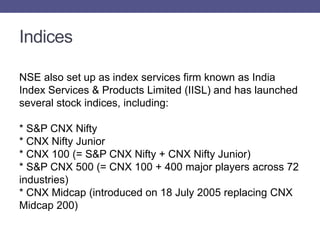
Indices

NSE also set up as index services firm known as India
Index Services & Products Limited (IISL) and has launched
several stock indices, including:

* S&P CNX Nifty
* CNX Nifty Junior
* CNX 100 (= S&P CNX Nifty + CNX Nifty Junior)
* S&P CNX 500 (= CNX 100 + 400 major players across 72
industries)
* CNX Midcap (introduced on 18 July 2005 replacing CNX
Midcap 200)
• Apart from BSE SENSEX, which is the most popular stock
 index in India, BSE uses other stock indices as well:
 * BSE 500
 * BSE 100
 * BSE 200
 * BSE PSU
 * BSE MIDCAP
 * BSE SMLCAP
 * BSE BANKEX
 * BSE Teck
 * BSE Auto
 * BSE Pharma
 * BSE Fast Moving Consumer Goods (FMCG)
 * [[BSE Consumer Durables (SYMBOL: Cons Dura)]]
 * BSE Metal
Objectives of Stock exchange
• Establishing nationwide trading facilities for all types of
  securities.
• Ensuring equal access to investors all-over the country
  through an appropriate communication network.
• Meeting international benchmarks and standards.
• Enabling shorter settlement cycles and book entry
  settlements
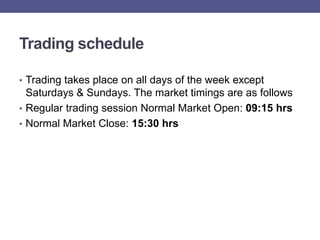
Trading schedule

• Trading takes place on all days of the week except
  Saturdays & Sundays. The market timings are as follows
• Regular trading session Normal Market Open: 09:15 hrs
• Normal Market Close: 15:30 hrs
Certifications
• NSE also conducts online examination and awards
 certification, under its programmes of NSE's Certification
 in Financial Markets (NCFM).[10] Currently, certifications
 are available in 32 modules, covering different sectors of
 financial and capital markets, both at beginner and
 advanced levels. The list of various modules can be found
 at the official site of NSE India

Nse

  • 1.
    NSE & BSE By-Prof.BinnyBhogal Rawat HLCPE
  • 2.
    • National StockExchange of India or in short NSE happens to be India’s largest Stock Exchange and World’s third largest stock exchange in terms of transactions. • It is located in Mumbai and was incorporated in November 1992 as a tax-paying company. It was in April 1993 that NSE was recognized as stock exchange under the Securities Contract Act 1956
  • 3.
    • BSE orBombay Stock Exchange is the oldest stock exchange in Asia that was established in 1875. What’s more, it is also the biggest stock exchange in the world. BSE is located at Dalal Street, Mumbai
  • 4.
    Indices NSE also setup as index services firm known as India Index Services & Products Limited (IISL) and has launched several stock indices, including: * S&P CNX Nifty * CNX Nifty Junior * CNX 100 (= S&P CNX Nifty + CNX Nifty Junior) * S&P CNX 500 (= CNX 100 + 400 major players across 72 industries) * CNX Midcap (introduced on 18 July 2005 replacing CNX Midcap 200)
  • 5.
    • Apart fromBSE SENSEX, which is the most popular stock index in India, BSE uses other stock indices as well: * BSE 500 * BSE 100 * BSE 200 * BSE PSU * BSE MIDCAP * BSE SMLCAP * BSE BANKEX * BSE Teck * BSE Auto * BSE Pharma * BSE Fast Moving Consumer Goods (FMCG) * [[BSE Consumer Durables (SYMBOL: Cons Dura)]] * BSE Metal
  • 6.
    Objectives of Stockexchange • Establishing nationwide trading facilities for all types of securities. • Ensuring equal access to investors all-over the country through an appropriate communication network. • Meeting international benchmarks and standards. • Enabling shorter settlement cycles and book entry settlements
  • 7.
    Trading schedule • Tradingtakes place on all days of the week except Saturdays & Sundays. The market timings are as follows • Regular trading session Normal Market Open: 09:15 hrs • Normal Market Close: 15:30 hrs
  • 8.
    Certifications • NSE alsoconducts online examination and awards certification, under its programmes of NSE's Certification in Financial Markets (NCFM).[10] Currently, certifications are available in 32 modules, covering different sectors of financial and capital markets, both at beginner and advanced levels. The list of various modules can be found at the official site of NSE India