

Current Pension Risk
Management Strategies
Worldwide Employee Benefits Network
New York Chapter
www.pwc.com/us/hrs
Lisa Herrnson
David Cantor
Cornell Staeger
Andrew Cecchetti
November 19, 2015
PwC
Introductions
2
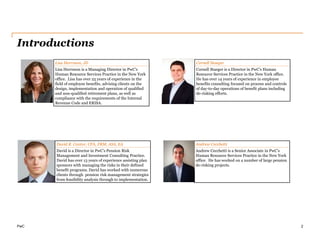
David R. Cantor, CFA, FRM, ASA, EA
David is a Director in PwC’s Pension Risk
Management and Investment Consulting Practice.
David has over 13 years of experience assisting plan
sponsors with managing the risks in their defined
benefit programs. David has worked with numerous
clients through pension risk management strategies
from feasibility analysis through to implementation.
Andrew Cecchetti
Andrew Cecchetti is a Senior Associate in PwC’s
Human Resource Services Practice in the New York
office. He has worked on a number of large pension
de-risking projects.
Lisa Herrnson, JD
Lisa Herrnson is a Managing Director in PwC’s
Human Resource Services Practice in the New York
office. Lisa has over 25 years of experience in the
field of employee benefits, advising clients on the
design, implementation and operation of qualified
and non-qualified retirement plans, as well as
compliance with the requirements of the Internal
Revenue Code and ERISA.
Cornell Staeger
Cornell Staeger is a Director in PwC’s Human
Resource Services Practice in the New York office.
He has over 14 years of experience in employee
benefits consulting focused on process and controls
of day-to-day operations of benefit plans including
de-risking efforts.
PwC
Objectives
• Discuss the drivers behind the decision to pursue a pension risk
management strategy
• Provide a current overview of pension risk management strategies
• Consider legal and regulatory developments concerning current
pension risk management approaches
• Implementation and execution issues
3
PwC
Pension Risk Management
4
PwC
Key themes
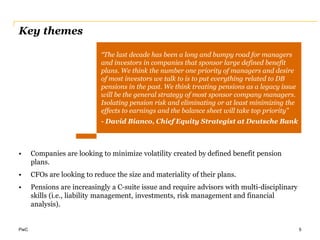
• Companies are looking to minimize volatility created by defined benefit pension
plans.
• CFOs are looking to reduce the size and materiality of their plans.
• Pensions are increasingly a C-suite issue and require advisors with multi-disciplinary
skills (i.e., liability management, investments, risk management and financial
analysis).
“The last decade has been a long and bumpy road for managers
and investors in companies that sponsor large defined benefit
plans. We think the number one priority of managers and desire
of most investors we talk to is to put everything related to DB
pensions in the past. We think treating pensions as a legacy issue
will be the general strategy of most sponsor company managers.
Isolating pension risk and eliminating or at least minimizing the
effects to earnings and the balance sheet will take top priority”
- David Bianco, Chief Equity Strategist at Deutsche Bank
5
PwC
Why are companies focused on managing pension
risk?
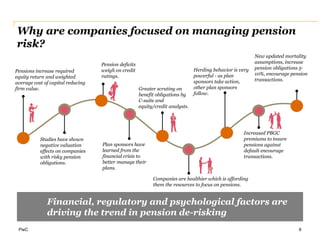
Pensions increase required
equity return and weighted
average cost of capital reducing
firm value.
Studies have shown
negative valuation
effects on companies
with risky pension
obligations.
Pension deficits
weigh on credit
ratings.
Plan sponsors have
learned from the
financial crisis to
better manage their
plans.
Greater scrutiny on
benefit obligations by
C-suite and
equity/credit analysts.
Companies are healthier which is affording
them the resources to focus on pensions.
Herding behavior is very
powerful - as plan
sponsors take action,
other plan sponsors
follow.
Increased PBGC
premiums to insure
pensions against
default encourage
transactions.
New updated mortality
assumptions, increase
pension obligations 5-
10%, encourage pension
transactions.
Financial, regulatory and psychological factors are
driving the trend in pension de-risking
6
PwC
Bipartisan Budget Act of 2015 will likely further
spur pension risk management activity
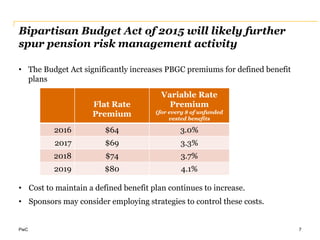
• The Budget Act significantly increases PBGC premiums for defined benefit
plans
• Cost to maintain a defined benefit plan continues to increase.
• Sponsors may consider employing strategies to control these costs.
7
Flat Rate
Premium
Variable Rate
Premium
(for every $ of unfunded
vested benefits
2016 $64 3.0%
2017 $69 3.3%
2018 $74 3.7%
2019 $80 4.1%
PwC
Bipartisan Budget Act of 2015 will likely further
spur pension risk management activity
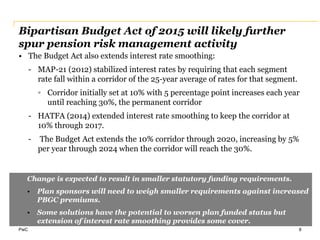
• The Budget Act also extends interest rate smoothing:
- MAP-21 (2012) stabilized interest rates by requiring that each segment
rate fall within a corridor of the 25-year average of rates for that segment.
◦ Corridor initially set at 10% with 5 percentage point increases each year
until reaching 30%, the permanent corridor
- HATFA (2014) extended interest rate smoothing to keep the corridor at
10% through 2017.
- The Budget Act extends the 10% corridor through 2020, increasing by 5%
per year through 2024 when the corridor will reach the 30%.
8
Change is expected to result in smaller statutory funding requirements.
• Plan sponsors will need to weigh smaller requirements against increased
PBGC premiums.
• Some solutions have the potential to worsen plan funded status but
extension of interest rate smoothing provides some cover.
PwC
Bipartisan Budget Act of 2015 will likely further
spur pension risk management activity
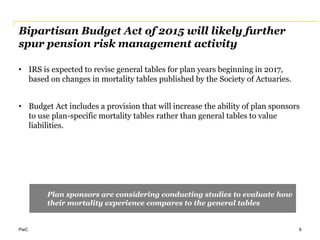
• IRS is expected to revise general tables for plan years beginning in 2017,
based on changes in mortality tables published by the Society of Actuaries.
• Budget Act includes a provision that will increase the ability of plan sponsors
to use plan-specific mortality tables rather than general tables to value
liabilities.
9
Plan sponsors are considering conducting studies to evaluate how
their mortality experience compares to the general tables
PwC
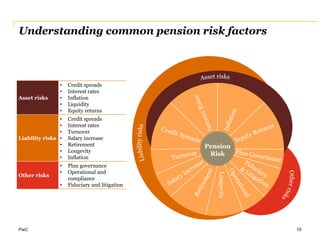
Understanding common pension risk factors
Pension
Risk
Asset risks
• Credit spreads
• Interest rates
• Inflation
• Liquidity
• Equity returns
Liability risks
• Credit spreads
• Interest rates
• Turnover
• Salary increase
• Retirement
• Longevity
• Inflation
Other risks
• Plan governance
• Operational and
compliance
• Fiduciary and litigation
10
PwC
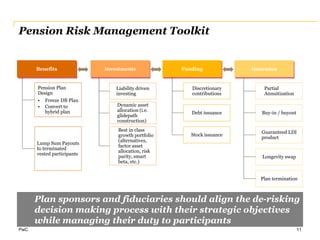
InsuranceFundingInvestmentsBenefits
Pension Plan
Design
• Freeze DB Plan
• Convert to
hybrid plan
Lump Sum Payouts
to terminated
vested participants
Liability driven
investing
Dynamic asset
allocation (i.e.
glidepath
construction)
Best in class
growth portfolio
(alternatives,
factor asset
allocation, risk
parity, smart
beta, etc.)
Discretionary
contributions
Debt issuance
Stock issuance
Partial
Annuitization
Buy-in / buyout
Guaranteed LDI
product
Longevity swap
Plan termination
Plan sponsors and fiduciaries should align the de-risking
decision making process with their strategic objectives
while managing their duty to participants
Pension Risk Management Toolkit
11
PwC
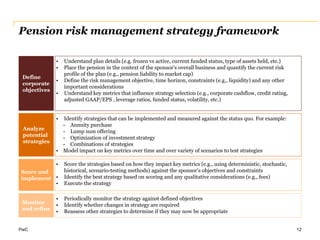
Pension risk management strategy framework
• Understand plan details (e.g. frozen vs active, current funded status, type of assets held, etc.)
• Place the pension in the context of the sponsor’s overall business and quantify the current risk
profile of the plan (e.g., pension liability to market cap)
• Define the risk management objective, time horizon, constraints (e.g., liquidity) and any other
important considerations
• Understand key metrics that influence strategy selection (e.g., corporate cashflow, credit rating,
adjusted GAAP/EPS , leverage ratios, funded status, volatility, etc.)
Define
corporate
objectives
• Identify strategies that can be implemented and measured against the status quo. For example:
- Annuity purchase
- Lump sum offering
- Optimization of investment strategy
- Combinations of strategies
• Model impact on key metrics over time and over variety of scenarios to test strategies
Analyze
potential
strategies
• Score the strategies based on how they impact key metrics (e.g., using deterministic, stochastic,
historical, scenario-testing methods) against the sponsor’s objectives and constraints
• Identify the best strategy based on scoring and any qualitative considerations (e.g., fees)
• Execute the strategy
Score and
implement
• Periodically monitor the strategy against defined objectives
• Identify whether changes in strategy are required
• Reassess other strategies to determine if they may now be appropriate
Monitor
and refine
12
PwC
Lump Sum Buyouts
13
PwC
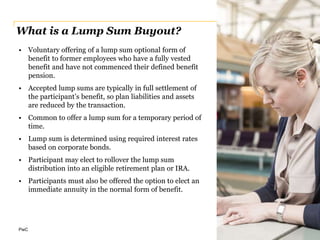
What is a Lump Sum Buyout?
• Voluntary offering of a lump sum optional form of
benefit to former employees who have a fully vested
benefit and have not commenced their defined benefit
pension.
• Accepted lump sums are typically in full settlement of
the participant’s benefit, so plan liabilities and assets
are reduced by the transaction.
• Common to offer a lump sum for a temporary period of
time.
• Lump sum is determined using required interest rates
based on corporate bonds.
• Participant may elect to rollover the lump sum
distribution into an eligible retirement plan or IRA.
• Participants must also be offered the option to elect an
immediate annuity in the normal form of benefit.
14
PwC
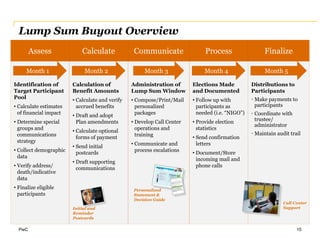
Lump Sum Buyout Overview
15
Assess Calculate Communicate Process Finalize
Identification of
Target Participant
Pool
• Calculate estimates
of financial impact
• Determine special
groups and
communications
strategy
• Collect demographic
data
• Verify address/
death/indicative
data
• Finalize eligible
participants
Calculation of
Benefit Amounts
• Calculate and verify
accrued benefits
• Draft and adopt
Plan amendments
• Calculate optional
forms of payment
• Send initial
postcards
• Draft supporting
communications
Administration of
Lump Sum Window
• Compose/Print/Mail
personalized
packages
• Develop Call Center
operations and
training
• Communicate and
process escalations
Elections Made
and Documented
• Follow up with
participants as
needed (i.e. “NIGO”)
• Provide election
statistics
• Send confirmation
letters
• Document/Store
incoming mail and
phone calls
Distributions to
Participants
• Make payments to
participants
• Coordinate with
trustee/
administrator
• Maintain audit trail
Month 1 Month 2 Month 3 Month 4 Month 5
Personalized
Statement &
Decision Guide
Call Center
SupportInitial and
Reminder
Postcards
PwC
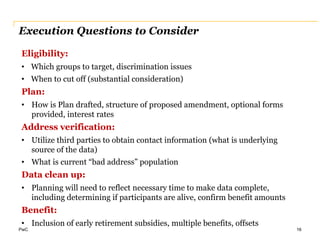
Execution Questions to Consider
16
Eligibility:
• Which groups to target, discrimination issues
• When to cut off (substantial consideration)
Plan:
• How is Plan drafted, structure of proposed amendment, optional forms
provided, interest rates
Address verification:
• Utilize third parties to obtain contact information (what is underlying
source of the data)
• What is current “bad address” population
Data clean up:
• Planning will need to reflect necessary time to make data complete,
including determining if participants are alive, confirm benefit amounts
Benefit:
• Inclusion of early retirement subsidies, multiple benefits, offsets
PwC
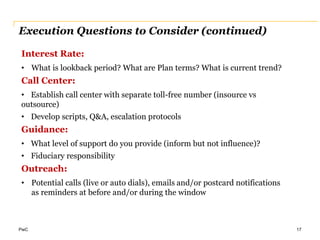
Execution Questions to Consider (continued)
17
Interest Rate:
• What is lookback period? What are Plan terms? What is current trend?
Call Center:
• Establish call center with separate toll-free number (insource vs
outsource)
• Develop scripts, Q&A, escalation protocols
Guidance:
• What level of support do you provide (inform but not influence)?
• Fiduciary responsibility
Outreach:
• Potential calls (live or auto dials), emails and/or postcard notifications
as reminders at before and/or during the window
PwC
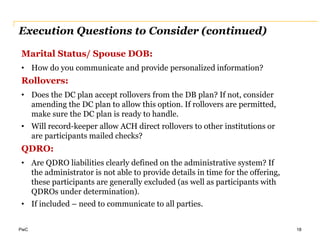
Execution Questions to Consider (continued)
18
Marital Status/ Spouse DOB:
• How do you communicate and provide personalized information?
Rollovers:
• Does the DC plan accept rollovers from the DB plan? If not, consider
amending the DC plan to allow this option. If rollovers are permitted,
make sure the DC plan is ready to handle.
• Will record-keeper allow ACH direct rollovers to other institutions or
are participants mailed checks?
QDRO:
• Are QDRO liabilities clearly defined on the administrative system? If
the administrator is not able to provide details in time for the offering,
these participants are generally excluded (as well as participants with
QDROs under determination).
• If included – need to communicate to all parties.
PwC
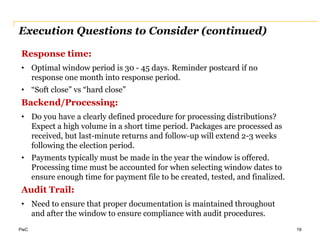
Execution Questions to Consider (continued)
19
Response time:
• Optimal window period is 30 - 45 days. Reminder postcard if no
response one month into response period.
• “Soft close” vs “hard close”
Backend/Processing:
• Do you have a clearly defined procedure for processing distributions?
Expect a high volume in a short time period. Packages are processed as
received, but last-minute returns and follow-up will extend 2-3 weeks
following the election period.
• Payments typically must be made in the year the window is offered.
Processing time must be accounted for when selecting window dates to
ensure enough time for payment file to be created, tested, and finalized.
Audit Trail:
• Need to ensure that proper documentation is maintained throughout
and after the window to ensure compliance with audit procedures.
PwC
Legal and Regulatory Developments
20
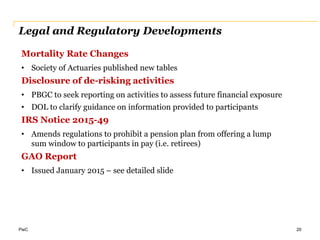
Mortality Rate Changes
• Society of Actuaries published new tables
Disclosure of de-risking activities
• PBGC to seek reporting on activities to assess future financial exposure
• DOL to clarify guidance on information provided to participants
IRS Notice 2015-49
• Amends regulations to prohibit a pension plan from offering a lump
sum window to participants in pay (i.e. retirees)
GAO Report
• Issued January 2015 – see detailed slide
PwC
GAO – Participants Need Better Information When
Offered Lump Sums That Replace Their Lifetime
Benefits
21
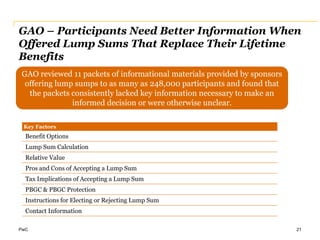
GAO reviewed 11 packets of informational materials provided by sponsors
offering lump sumps to as many as 248,000 participants and found that
the packets consistently lacked key information necessary to make an
informed decision or were otherwise unclear.
Key Factors
Benefit Options
Lump Sum Calculation
Relative Value
Pros and Cons of Accepting a Lump Sum
Tax Implications of Accepting a Lump Sum
PBGC & PBGC Protection
Instructions for Electing or Rejecting Lump Sum
Contact Information
PwC
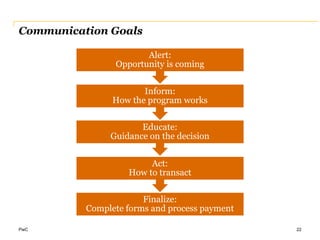
Communication Goals
22
Finalize:
Complete forms and process payment
Act:
How to transact
Educate:
Guidance on the decision
Inform:
How the program works
Alert:
Opportunity is coming
PwC
Communication Considerations
23
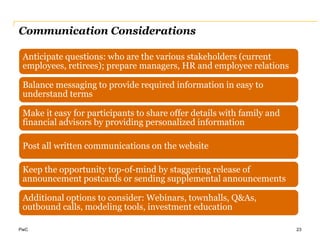
Anticipate questions: who are the various stakeholders (current
employees, retirees); prepare managers, HR and employee relations
Balance messaging to provide required information in easy to
understand terms
Make it easy for participants to share offer details with family and
financial advisors by providing personalized information
Post all written communications on the website
Keep the opportunity top-of-mind by staggering release of
announcement postcards or sending supplemental announcements
Additional options to consider: Webinars, townhalls, Q&As,
outbound calls, modeling tools, investment education
PwC
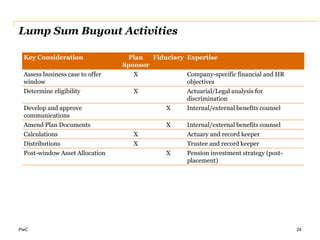
Lump Sum Buyout Activities
24
Key Consideration Plan
Sponsor
Fiduciary Expertise
Assess business case to offer
window
X Company-specific financial and HR
objectives
Determine eligibility X Actuarial/Legal analysis for
discrimination
Develop and approve
communications
X Internal/external benefits counsel
Amend Plan Documents X Internal/external benefits counsel
Calculations X Actuary and record keeper
Distributions X Trustee and record keeper
Post-window Asset Allocation X Pension investment strategy (post-
placement)
PwC
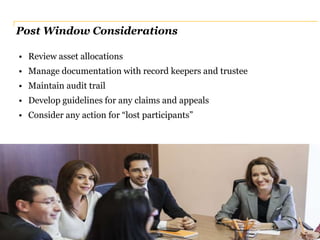
Post Window Considerations
• Review asset allocations
• Manage documentation with record keepers and trustee
• Maintain audit trail
• Develop guidelines for any claims and appeals
• Consider any action for “lost participants”
25
PwC
Pension Risk Transfer
26
PwC
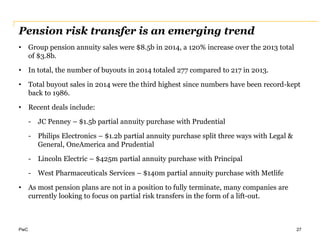
Pension risk transfer is an emerging trend
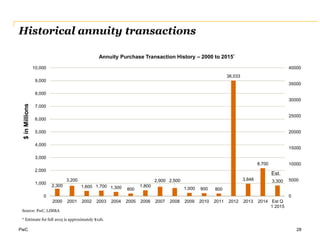
• Group pension annuity sales were $8.5b in 2014, a 120% increase over the 2013 total
of $3.8b.
• In total, the number of buyouts in 2014 totaled 277 compared to 217 in 2013.
• Total buyout sales in 2014 were the third highest since numbers have been record-kept
back to 1986.
• Recent deals include:
- JC Penney – $1.5b partial annuity purchase with Prudential
- Philips Electronics – $1.2b partial annuity purchase split three ways with Legal &
General, OneAmerica and Prudential
- Lincoln Electric – $425m partial annuity purchase with Principal
- West Pharmaceuticals Services – $140m partial annuity purchase with Metlife
• As most pension plans are not in a position to fully terminate, many companies are
currently looking to focus on partial risk transfers in the form of a lift-out.
27
PwC
Historical annuity transactions
28
2,300
3,200
1,600 1,700 1,300 800
1,800
2,900 2,500
1,000 900 800
36,033
3,848
8,700
3,300
0
5000
10000
15000
20000
25000
30000
35000
40000
0
1,000
2,000
3,000
4,000
5,000
6,000
7,000
8,000
9,000
10,000
2000 2001 2002 2003 2004 2005 2006 2007 2008 2009 2010 2011 2012 2013 2014 Est Q
1 2015
Annuity Purchase Transaction History – 2000 to 2015*
Est.
Source: PwC, LIMRA
* Estimate for full 2015 is approximately $12b.
$inMillions
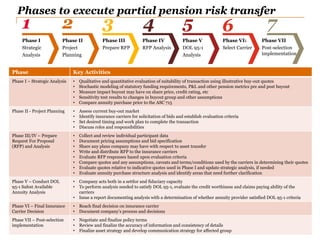
Phases to execute partial pension risk transfer
Phase VI:
Select Carrier
Phase V
DOL 95-1
Analysis
Phase IV
RFP Analysis
Phase III
Prepare RFP
Phase II
Project
Planning
Phase I
Strategic
Analysis
1 2 3 4 5 6 7
Phase VII
Post-selection
implementation
Phase Key Activities
Phase I – Strategic Analysis • Qualitative and quantitative evaluation of suitability of transaction using illustrative buy-out quotes
• Stochastic modeling of statutory funding requirements, P&L and other pension metrics pre and post buyout
• Measure impact buyout may have on share price, credit rating, etc
• Sensitivity test results to changes in buyout group and other assumptions
• Compare annuity purchase price to the ASC 715
Phase II - Project Planning • Assess current buy-out market
• Identify insurance carriers for solicitation of bids and establish evaluation criteria
• Set desired timing and work plan to complete the transaction
• Discuss roles and responsibilities
Phase III/IV – Prepare
Request For Proposal
(RFP) and Analysis
• Collect and review individual participant data
• Document pricing assumptions and bid specification
• Share any plans company may have with respect to asset transfer
• Write and distribute RFP to the insurance carriers
• Evaluate RFP responses based upon evaluation criteria
• Compare quotes and any assumptions, caveats and terms/conditions used by the carriers in determining their quotes
• Evaluate quotes relative to indicative quotes used in Phase I and update strategic analysis, if needed
• Evaluate annuity purchase structure analysis and identify areas that need further clarification
Phase V – Conduct DOL
95-1 Safest Available
Annuity Analysis
• Company acts both in a settlor and fiduciary capacity
• To perform analysis needed to satisfy DOL 95-1, evaluate the credit worthiness and claims paying ability of the
carriers
• Issue a report documenting analysis with a determination of whether annuity provider satisfied DOL 95-1 criteria
Phase VI – Final Insurance
Carrier Decision
• Reach final decision on insurance carrier
• Document company’s process and decisions
Phase VII – Post-selection
implementation
• Negotiate and finalize policy terms
• Review and finalize the accuracy of information and consistency of details
• Finalize asset strategy and develop communication strategy for affected group
PwC
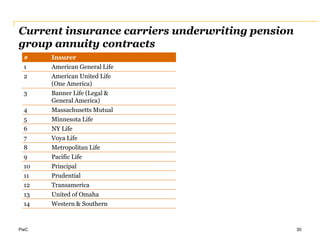
Current insurance carriers underwriting pension
group annuity contracts
30
# Insurer
1 American General Life
2 American United Life
(One America)
3 Banner Life (Legal &
General America)
4 Massachusetts Mutual
5 Minnesota Life
6 NY Life
7 Voya Life
8 Metropolitan Life
9 Pacific Life
10 Principal
11 Prudential
12 Transamerica
13 United of Omaha
14 Western & Southern
PwC
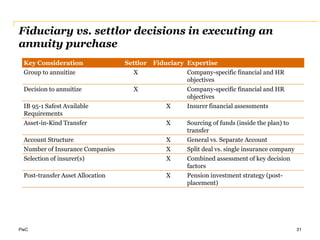
Fiduciary vs. settlor decisions in executing an
annuity purchase
31
Key Consideration Settlor Fiduciary Expertise
Group to annuitize X Company-specific financial and HR
objectives
Decision to annuitize X Company-specific financial and HR
objectives
IB 95-1 Safest Available
Requirements
X Insurer financial assessments
Asset-in-Kind Transfer X Sourcing of funds (inside the plan) to
transfer
Account Structure X General vs. Separate Account
Number of Insurance Companies X Split deal vs. single insurance company
Selection of insurer(s) X Combined assessment of key decision
factors
Post-transfer Asset Allocation X Pension investment strategy (post-
placement)
PwC
Independent Fiduciary
Plan sponsor may use an independent fiduciary to avoid conflicts of
interest when the same individuals act in corporate and fiduciary
capacities
• An independent fiduciary can advise the fiduciaries charged with selecting the annuity
• Be the final decision-maker on the annuity provider
32
PwC
DOL 95-1 requirements
DOL Standards require that a fiduciary consider (at a minimum) the
following issues.
Unless they possess the necessary expertise to evaluate such factors,
fiduciaries would need to obtain the advice of a qualified, independent
expert.
• The quality and diversification of the insurer’s investment portfolio;
• The size of the insurer relative to the proposed annuity contract;
• The level of the insurer’s capital and surplus;
• The lines of business of the insurer and other indications of an insurer’s exposure
to liability;
• Structure of the annuity contract and guarantees supporting the annuities, such as the
use of insurance company separate accounts; and
• The availability of additional protection through state guaranty associations and the
extent of the guarantees
Carrier ratings may (and should) be considered but may not be the sole criteria
33
PwC
Potential Litigation – Lee v. Verizon
• Plan sponsor purchased a group annuity contract through Prudential and transferred
significant pension liabilities ($7.5B).
• Annuity purchase affected 41,000 participants while 50,000 remained in the Verizon
DB plan.
• Case brought by two classes of plaintiffs – one representing those transferred to
Prudential and one by participants who remained with Verizon.
• Participants argued for breach of fiduciary duty on the prudence of the transaction and
that Verizon failed to get consent and also discriminated against specific classes of
retirees.
• 5th Circuit recently confirmed that Verizon did not violate ERISA.
34
PwC
Discretionary Contributions
35
PwC
Issuing Debt to Fund a Pension Plan
• The Bipartisan Act extends interest rate smoothing. This will lead to reductions in
statutory funding amounts. Sponsors will need to weigh reduced contributions against
higher PBGC premiums and other uses of capital. Issuing debt to finance the plan may
be an attractive solution:
- Reduces PBGC Premiums
- Does not impact company capital structure as transaction is really a debt for debt
exchange
- Take advantage of low interest rate environment
- Create own amortization schedule, extending the funding period beyond seven
years
- Creates predictable and stable contributions
- Increased earnings per share due to expected return on asset assumption allowed
under US GAAP
- Accounting stabilization – financing debt can be carried at historical cost
- Credit impact neutral according to publically released statements by Moody’s
36
PwC
Impact on Credit Rating – From Moody’s
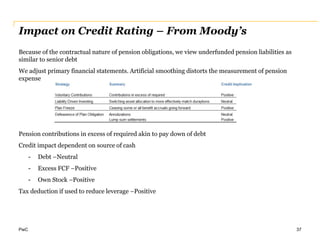
Because of the contractual nature of pension obligations, we view underfunded pension liabilities as
similar to senior debt
We adjust primary financial statements. Artificial smoothing distorts the measurement of pension
expense
Pension contributions in excess of required akin to pay down of debt
Credit impact dependent on source of cash
- Debt –Neutral
- Excess FCF –Positive
- Own Stock –Positive
Tax deduction if used to reduce leverage –Positive
37
PwC
Simple Case Study – Fund Now via Debt Offer or
Contribute Over Time
38
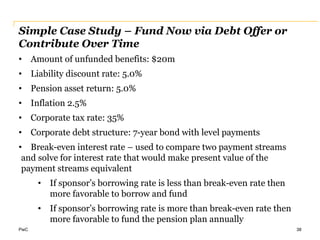
• Amount of unfunded benefits: $20m
• Liability discount rate: 5.0%
• Pension asset return: 5.0%
• Inflation 2.5%
• Corporate tax rate: 35%
• Corporate debt structure: 7-year bond with level payments
• Break-even interest rate – used to compare two payment streams
and solve for interest rate that would make present value of the
payment streams equivalent
• If sponsor’s borrowing rate is less than break-even rate then
more favorable to borrow and fund
• If sponsor’s borrowing rate is more than break-even rate then
more favorable to fund the pension plan annually
PwC
Determining the Breakeven Rate
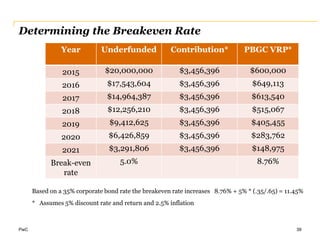
Year Underfunded Contribution* PBGC VRP*
2015 $20,000,000 $3,456,396 $600,000
2016 $17,543,604 $3,456,396 $649,113
2017 $14,964,387 $3,456,396 $613,540
2018 $12,256,210 $3,456,396 $515,067
2019 $9,412,625 $3,456,396 $405,455
2020 $6,426,859 $3,456,396 $283,762
2021 $3,291,806 $3,456,396 $148,975
Break-even
rate
5.0% 8.76%
39
Based on a 35% corporate bond rate the breakeven rate increases 8.76% + 5% * (.35/.65) = 11.45%
* Assumes 5% discount rate and return and 2.5% inflation
PwC
Additional Factors that Affect the Break-even Rate
40
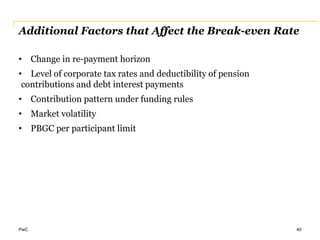
• Change in re-payment horizon
• Level of corporate tax rates and deductibility of pension
contributions and debt interest payments
• Contribution pattern under funding rules
• Market volatility
• PBGC per participant limit
PwC
Take-aways
41
PwC
Closing points
• Companies with defined benefit plans are looking to better
manage these programs for financial, regulatory and
psychological reasons.
• While many solutions exists, the specifics of the particular
organization will drive the ultimate choice of strategy.
• Lump sum windows, pension risk transfer and borrowing to fund
are three popular strategies companies are using.
• To execute these strategies, plan sponsors need to employ a
holistic and disciplined approach that considers financial and
legal perspectives.
42
PwC 43
This webcast and presentation have been prepared for general guidance on matters of interest only, and does not constitute professional advice. You should not act upon the
information contained in the webcast or presentation without obtaining specific professional advice. No representation or warranty (express or implied) is given as to the
accuracy or completeness of the information contained in this webcast and publications, and, to the extent permitted by law, PricewaterhouseCoopers LLP, its members,
employees and agents do not accept or assume any liability, responsibility or duty of care for any consequences of you or anyone else acting, or refraining to act, in reliance on
the information contained in this publication or for any decision based on it.
© 2015 PricewaterhouseCoopers LLP. All rights reserved. PwC refers to the United States member firm, and may sometimes refer to the PwC network. Each member firm is a
separate legal entity. Please see www.pwc.com/structure for further details
For more information on PwC events and thought
leadership, please visit www.pwc.com/us/hrs.
Questions?
Contact Information:
Lisa Herrnson
(646) 471- 8227
lisa.b.herrnson@pwc.com
David R. Cantor
(646)-471-5104
david.r.cantor@pwc.com
Cornell Staeger
(646) 471-1243
cornell.staeger@pwc.com
Andrew Cecchetti
(646) 313-3000
andrew.cecchetti@pwc.com

Current Pension Risk Management Strategies

  • 1.
    Current Pension Risk ManagementStrategies Worldwide Employee Benefits Network New York Chapter www.pwc.com/us/hrs Lisa Herrnson David Cantor Cornell Staeger Andrew Cecchetti November 19, 2015
  • 2.
    PwC Introductions 2 David R. Cantor,CFA, FRM, ASA, EA David is a Director in PwC’s Pension Risk Management and Investment Consulting Practice. David has over 13 years of experience assisting plan sponsors with managing the risks in their defined benefit programs. David has worked with numerous clients through pension risk management strategies from feasibility analysis through to implementation. Andrew Cecchetti Andrew Cecchetti is a Senior Associate in PwC’s Human Resource Services Practice in the New York office. He has worked on a number of large pension de-risking projects. Lisa Herrnson, JD Lisa Herrnson is a Managing Director in PwC’s Human Resource Services Practice in the New York office. Lisa has over 25 years of experience in the field of employee benefits, advising clients on the design, implementation and operation of qualified and non-qualified retirement plans, as well as compliance with the requirements of the Internal Revenue Code and ERISA. Cornell Staeger Cornell Staeger is a Director in PwC’s Human Resource Services Practice in the New York office. He has over 14 years of experience in employee benefits consulting focused on process and controls of day-to-day operations of benefit plans including de-risking efforts.
  • 3.
    PwC Objectives • Discuss thedrivers behind the decision to pursue a pension risk management strategy • Provide a current overview of pension risk management strategies • Consider legal and regulatory developments concerning current pension risk management approaches • Implementation and execution issues 3
  • 4.
  • 5.
    PwC Key themes • Companiesare looking to minimize volatility created by defined benefit pension plans. • CFOs are looking to reduce the size and materiality of their plans. • Pensions are increasingly a C-suite issue and require advisors with multi-disciplinary skills (i.e., liability management, investments, risk management and financial analysis). “The last decade has been a long and bumpy road for managers and investors in companies that sponsor large defined benefit plans. We think the number one priority of managers and desire of most investors we talk to is to put everything related to DB pensions in the past. We think treating pensions as a legacy issue will be the general strategy of most sponsor company managers. Isolating pension risk and eliminating or at least minimizing the effects to earnings and the balance sheet will take top priority” - David Bianco, Chief Equity Strategist at Deutsche Bank 5
  • 6.
    PwC Why are companiesfocused on managing pension risk? Pensions increase required equity return and weighted average cost of capital reducing firm value. Studies have shown negative valuation effects on companies with risky pension obligations. Pension deficits weigh on credit ratings. Plan sponsors have learned from the financial crisis to better manage their plans. Greater scrutiny on benefit obligations by C-suite and equity/credit analysts. Companies are healthier which is affording them the resources to focus on pensions. Herding behavior is very powerful - as plan sponsors take action, other plan sponsors follow. Increased PBGC premiums to insure pensions against default encourage transactions. New updated mortality assumptions, increase pension obligations 5- 10%, encourage pension transactions. Financial, regulatory and psychological factors are driving the trend in pension de-risking 6
  • 7.
    PwC Bipartisan Budget Actof 2015 will likely further spur pension risk management activity • The Budget Act significantly increases PBGC premiums for defined benefit plans • Cost to maintain a defined benefit plan continues to increase. • Sponsors may consider employing strategies to control these costs. 7 Flat Rate Premium Variable Rate Premium (for every $ of unfunded vested benefits 2016 $64 3.0% 2017 $69 3.3% 2018 $74 3.7% 2019 $80 4.1%
  • 8.
    PwC Bipartisan Budget Actof 2015 will likely further spur pension risk management activity • The Budget Act also extends interest rate smoothing: - MAP-21 (2012) stabilized interest rates by requiring that each segment rate fall within a corridor of the 25-year average of rates for that segment. ◦ Corridor initially set at 10% with 5 percentage point increases each year until reaching 30%, the permanent corridor - HATFA (2014) extended interest rate smoothing to keep the corridor at 10% through 2017. - The Budget Act extends the 10% corridor through 2020, increasing by 5% per year through 2024 when the corridor will reach the 30%. 8 Change is expected to result in smaller statutory funding requirements. • Plan sponsors will need to weigh smaller requirements against increased PBGC premiums. • Some solutions have the potential to worsen plan funded status but extension of interest rate smoothing provides some cover.
  • 9.
    PwC Bipartisan Budget Actof 2015 will likely further spur pension risk management activity • IRS is expected to revise general tables for plan years beginning in 2017, based on changes in mortality tables published by the Society of Actuaries. • Budget Act includes a provision that will increase the ability of plan sponsors to use plan-specific mortality tables rather than general tables to value liabilities. 9 Plan sponsors are considering conducting studies to evaluate how their mortality experience compares to the general tables
  • 10.
    PwC Understanding common pensionrisk factors Pension Risk Asset risks • Credit spreads • Interest rates • Inflation • Liquidity • Equity returns Liability risks • Credit spreads • Interest rates • Turnover • Salary increase • Retirement • Longevity • Inflation Other risks • Plan governance • Operational and compliance • Fiduciary and litigation 10
  • 11.
    PwC InsuranceFundingInvestmentsBenefits Pension Plan Design • FreezeDB Plan • Convert to hybrid plan Lump Sum Payouts to terminated vested participants Liability driven investing Dynamic asset allocation (i.e. glidepath construction) Best in class growth portfolio (alternatives, factor asset allocation, risk parity, smart beta, etc.) Discretionary contributions Debt issuance Stock issuance Partial Annuitization Buy-in / buyout Guaranteed LDI product Longevity swap Plan termination Plan sponsors and fiduciaries should align the de-risking decision making process with their strategic objectives while managing their duty to participants Pension Risk Management Toolkit 11
  • 12.
    PwC Pension risk managementstrategy framework • Understand plan details (e.g. frozen vs active, current funded status, type of assets held, etc.) • Place the pension in the context of the sponsor’s overall business and quantify the current risk profile of the plan (e.g., pension liability to market cap) • Define the risk management objective, time horizon, constraints (e.g., liquidity) and any other important considerations • Understand key metrics that influence strategy selection (e.g., corporate cashflow, credit rating, adjusted GAAP/EPS , leverage ratios, funded status, volatility, etc.) Define corporate objectives • Identify strategies that can be implemented and measured against the status quo. For example: - Annuity purchase - Lump sum offering - Optimization of investment strategy - Combinations of strategies • Model impact on key metrics over time and over variety of scenarios to test strategies Analyze potential strategies • Score the strategies based on how they impact key metrics (e.g., using deterministic, stochastic, historical, scenario-testing methods) against the sponsor’s objectives and constraints • Identify the best strategy based on scoring and any qualitative considerations (e.g., fees) • Execute the strategy Score and implement • Periodically monitor the strategy against defined objectives • Identify whether changes in strategy are required • Reassess other strategies to determine if they may now be appropriate Monitor and refine 12
  • 13.
  • 14.
    PwC What is aLump Sum Buyout? • Voluntary offering of a lump sum optional form of benefit to former employees who have a fully vested benefit and have not commenced their defined benefit pension. • Accepted lump sums are typically in full settlement of the participant’s benefit, so plan liabilities and assets are reduced by the transaction. • Common to offer a lump sum for a temporary period of time. • Lump sum is determined using required interest rates based on corporate bonds. • Participant may elect to rollover the lump sum distribution into an eligible retirement plan or IRA. • Participants must also be offered the option to elect an immediate annuity in the normal form of benefit. 14
  • 15.
    PwC Lump Sum BuyoutOverview 15 Assess Calculate Communicate Process Finalize Identification of Target Participant Pool • Calculate estimates of financial impact • Determine special groups and communications strategy • Collect demographic data • Verify address/ death/indicative data • Finalize eligible participants Calculation of Benefit Amounts • Calculate and verify accrued benefits • Draft and adopt Plan amendments • Calculate optional forms of payment • Send initial postcards • Draft supporting communications Administration of Lump Sum Window • Compose/Print/Mail personalized packages • Develop Call Center operations and training • Communicate and process escalations Elections Made and Documented • Follow up with participants as needed (i.e. “NIGO”) • Provide election statistics • Send confirmation letters • Document/Store incoming mail and phone calls Distributions to Participants • Make payments to participants • Coordinate with trustee/ administrator • Maintain audit trail Month 1 Month 2 Month 3 Month 4 Month 5 Personalized Statement & Decision Guide Call Center SupportInitial and Reminder Postcards
  • 16.
    PwC Execution Questions toConsider 16 Eligibility: • Which groups to target, discrimination issues • When to cut off (substantial consideration) Plan: • How is Plan drafted, structure of proposed amendment, optional forms provided, interest rates Address verification: • Utilize third parties to obtain contact information (what is underlying source of the data) • What is current “bad address” population Data clean up: • Planning will need to reflect necessary time to make data complete, including determining if participants are alive, confirm benefit amounts Benefit: • Inclusion of early retirement subsidies, multiple benefits, offsets
  • 17.
    PwC Execution Questions toConsider (continued) 17 Interest Rate: • What is lookback period? What are Plan terms? What is current trend? Call Center: • Establish call center with separate toll-free number (insource vs outsource) • Develop scripts, Q&A, escalation protocols Guidance: • What level of support do you provide (inform but not influence)? • Fiduciary responsibility Outreach: • Potential calls (live or auto dials), emails and/or postcard notifications as reminders at before and/or during the window
  • 18.
    PwC Execution Questions toConsider (continued) 18 Marital Status/ Spouse DOB: • How do you communicate and provide personalized information? Rollovers: • Does the DC plan accept rollovers from the DB plan? If not, consider amending the DC plan to allow this option. If rollovers are permitted, make sure the DC plan is ready to handle. • Will record-keeper allow ACH direct rollovers to other institutions or are participants mailed checks? QDRO: • Are QDRO liabilities clearly defined on the administrative system? If the administrator is not able to provide details in time for the offering, these participants are generally excluded (as well as participants with QDROs under determination). • If included – need to communicate to all parties.
  • 19.
    PwC Execution Questions toConsider (continued) 19 Response time: • Optimal window period is 30 - 45 days. Reminder postcard if no response one month into response period. • “Soft close” vs “hard close” Backend/Processing: • Do you have a clearly defined procedure for processing distributions? Expect a high volume in a short time period. Packages are processed as received, but last-minute returns and follow-up will extend 2-3 weeks following the election period. • Payments typically must be made in the year the window is offered. Processing time must be accounted for when selecting window dates to ensure enough time for payment file to be created, tested, and finalized. Audit Trail: • Need to ensure that proper documentation is maintained throughout and after the window to ensure compliance with audit procedures.
  • 20.
    PwC Legal and RegulatoryDevelopments 20 Mortality Rate Changes • Society of Actuaries published new tables Disclosure of de-risking activities • PBGC to seek reporting on activities to assess future financial exposure • DOL to clarify guidance on information provided to participants IRS Notice 2015-49 • Amends regulations to prohibit a pension plan from offering a lump sum window to participants in pay (i.e. retirees) GAO Report • Issued January 2015 – see detailed slide
  • 21.
    PwC GAO – ParticipantsNeed Better Information When Offered Lump Sums That Replace Their Lifetime Benefits 21 GAO reviewed 11 packets of informational materials provided by sponsors offering lump sumps to as many as 248,000 participants and found that the packets consistently lacked key information necessary to make an informed decision or were otherwise unclear. Key Factors Benefit Options Lump Sum Calculation Relative Value Pros and Cons of Accepting a Lump Sum Tax Implications of Accepting a Lump Sum PBGC & PBGC Protection Instructions for Electing or Rejecting Lump Sum Contact Information
  • 22.
    PwC Communication Goals 22 Finalize: Complete formsand process payment Act: How to transact Educate: Guidance on the decision Inform: How the program works Alert: Opportunity is coming
  • 23.
    PwC Communication Considerations 23 Anticipate questions:who are the various stakeholders (current employees, retirees); prepare managers, HR and employee relations Balance messaging to provide required information in easy to understand terms Make it easy for participants to share offer details with family and financial advisors by providing personalized information Post all written communications on the website Keep the opportunity top-of-mind by staggering release of announcement postcards or sending supplemental announcements Additional options to consider: Webinars, townhalls, Q&As, outbound calls, modeling tools, investment education
  • 24.
    PwC Lump Sum BuyoutActivities 24 Key Consideration Plan Sponsor Fiduciary Expertise Assess business case to offer window X Company-specific financial and HR objectives Determine eligibility X Actuarial/Legal analysis for discrimination Develop and approve communications X Internal/external benefits counsel Amend Plan Documents X Internal/external benefits counsel Calculations X Actuary and record keeper Distributions X Trustee and record keeper Post-window Asset Allocation X Pension investment strategy (post- placement)
  • 25.
    PwC Post Window Considerations •Review asset allocations • Manage documentation with record keepers and trustee • Maintain audit trail • Develop guidelines for any claims and appeals • Consider any action for “lost participants” 25
  • 26.
  • 27.
    PwC Pension risk transferis an emerging trend • Group pension annuity sales were $8.5b in 2014, a 120% increase over the 2013 total of $3.8b. • In total, the number of buyouts in 2014 totaled 277 compared to 217 in 2013. • Total buyout sales in 2014 were the third highest since numbers have been record-kept back to 1986. • Recent deals include: - JC Penney – $1.5b partial annuity purchase with Prudential - Philips Electronics – $1.2b partial annuity purchase split three ways with Legal & General, OneAmerica and Prudential - Lincoln Electric – $425m partial annuity purchase with Principal - West Pharmaceuticals Services – $140m partial annuity purchase with Metlife • As most pension plans are not in a position to fully terminate, many companies are currently looking to focus on partial risk transfers in the form of a lift-out. 27
  • 28.
    PwC Historical annuity transactions 28 2,300 3,200 1,6001,700 1,300 800 1,800 2,900 2,500 1,000 900 800 36,033 3,848 8,700 3,300 0 5000 10000 15000 20000 25000 30000 35000 40000 0 1,000 2,000 3,000 4,000 5,000 6,000 7,000 8,000 9,000 10,000 2000 2001 2002 2003 2004 2005 2006 2007 2008 2009 2010 2011 2012 2013 2014 Est Q 1 2015 Annuity Purchase Transaction History – 2000 to 2015* Est. Source: PwC, LIMRA * Estimate for full 2015 is approximately $12b. $inMillions
  • 29.
    Phases to executepartial pension risk transfer Phase VI: Select Carrier Phase V DOL 95-1 Analysis Phase IV RFP Analysis Phase III Prepare RFP Phase II Project Planning Phase I Strategic Analysis 1 2 3 4 5 6 7 Phase VII Post-selection implementation Phase Key Activities Phase I – Strategic Analysis • Qualitative and quantitative evaluation of suitability of transaction using illustrative buy-out quotes • Stochastic modeling of statutory funding requirements, P&L and other pension metrics pre and post buyout • Measure impact buyout may have on share price, credit rating, etc • Sensitivity test results to changes in buyout group and other assumptions • Compare annuity purchase price to the ASC 715 Phase II - Project Planning • Assess current buy-out market • Identify insurance carriers for solicitation of bids and establish evaluation criteria • Set desired timing and work plan to complete the transaction • Discuss roles and responsibilities Phase III/IV – Prepare Request For Proposal (RFP) and Analysis • Collect and review individual participant data • Document pricing assumptions and bid specification • Share any plans company may have with respect to asset transfer • Write and distribute RFP to the insurance carriers • Evaluate RFP responses based upon evaluation criteria • Compare quotes and any assumptions, caveats and terms/conditions used by the carriers in determining their quotes • Evaluate quotes relative to indicative quotes used in Phase I and update strategic analysis, if needed • Evaluate annuity purchase structure analysis and identify areas that need further clarification Phase V – Conduct DOL 95-1 Safest Available Annuity Analysis • Company acts both in a settlor and fiduciary capacity • To perform analysis needed to satisfy DOL 95-1, evaluate the credit worthiness and claims paying ability of the carriers • Issue a report documenting analysis with a determination of whether annuity provider satisfied DOL 95-1 criteria Phase VI – Final Insurance Carrier Decision • Reach final decision on insurance carrier • Document company’s process and decisions Phase VII – Post-selection implementation • Negotiate and finalize policy terms • Review and finalize the accuracy of information and consistency of details • Finalize asset strategy and develop communication strategy for affected group
  • 30.
    PwC Current insurance carriersunderwriting pension group annuity contracts 30 # Insurer 1 American General Life 2 American United Life (One America) 3 Banner Life (Legal & General America) 4 Massachusetts Mutual 5 Minnesota Life 6 NY Life 7 Voya Life 8 Metropolitan Life 9 Pacific Life 10 Principal 11 Prudential 12 Transamerica 13 United of Omaha 14 Western & Southern
  • 31.
    PwC Fiduciary vs. settlordecisions in executing an annuity purchase 31 Key Consideration Settlor Fiduciary Expertise Group to annuitize X Company-specific financial and HR objectives Decision to annuitize X Company-specific financial and HR objectives IB 95-1 Safest Available Requirements X Insurer financial assessments Asset-in-Kind Transfer X Sourcing of funds (inside the plan) to transfer Account Structure X General vs. Separate Account Number of Insurance Companies X Split deal vs. single insurance company Selection of insurer(s) X Combined assessment of key decision factors Post-transfer Asset Allocation X Pension investment strategy (post- placement)
  • 32.
    PwC Independent Fiduciary Plan sponsormay use an independent fiduciary to avoid conflicts of interest when the same individuals act in corporate and fiduciary capacities • An independent fiduciary can advise the fiduciaries charged with selecting the annuity • Be the final decision-maker on the annuity provider 32
  • 33.
    PwC DOL 95-1 requirements DOLStandards require that a fiduciary consider (at a minimum) the following issues. Unless they possess the necessary expertise to evaluate such factors, fiduciaries would need to obtain the advice of a qualified, independent expert. • The quality and diversification of the insurer’s investment portfolio; • The size of the insurer relative to the proposed annuity contract; • The level of the insurer’s capital and surplus; • The lines of business of the insurer and other indications of an insurer’s exposure to liability; • Structure of the annuity contract and guarantees supporting the annuities, such as the use of insurance company separate accounts; and • The availability of additional protection through state guaranty associations and the extent of the guarantees Carrier ratings may (and should) be considered but may not be the sole criteria 33
  • 34.
    PwC Potential Litigation –Lee v. Verizon • Plan sponsor purchased a group annuity contract through Prudential and transferred significant pension liabilities ($7.5B). • Annuity purchase affected 41,000 participants while 50,000 remained in the Verizon DB plan. • Case brought by two classes of plaintiffs – one representing those transferred to Prudential and one by participants who remained with Verizon. • Participants argued for breach of fiduciary duty on the prudence of the transaction and that Verizon failed to get consent and also discriminated against specific classes of retirees. • 5th Circuit recently confirmed that Verizon did not violate ERISA. 34
  • 35.
  • 36.
    PwC Issuing Debt toFund a Pension Plan • The Bipartisan Act extends interest rate smoothing. This will lead to reductions in statutory funding amounts. Sponsors will need to weigh reduced contributions against higher PBGC premiums and other uses of capital. Issuing debt to finance the plan may be an attractive solution: - Reduces PBGC Premiums - Does not impact company capital structure as transaction is really a debt for debt exchange - Take advantage of low interest rate environment - Create own amortization schedule, extending the funding period beyond seven years - Creates predictable and stable contributions - Increased earnings per share due to expected return on asset assumption allowed under US GAAP - Accounting stabilization – financing debt can be carried at historical cost - Credit impact neutral according to publically released statements by Moody’s 36
  • 37.
    PwC Impact on CreditRating – From Moody’s Because of the contractual nature of pension obligations, we view underfunded pension liabilities as similar to senior debt We adjust primary financial statements. Artificial smoothing distorts the measurement of pension expense Pension contributions in excess of required akin to pay down of debt Credit impact dependent on source of cash - Debt –Neutral - Excess FCF –Positive - Own Stock –Positive Tax deduction if used to reduce leverage –Positive 37
  • 38.
    PwC Simple Case Study– Fund Now via Debt Offer or Contribute Over Time 38 • Amount of unfunded benefits: $20m • Liability discount rate: 5.0% • Pension asset return: 5.0% • Inflation 2.5% • Corporate tax rate: 35% • Corporate debt structure: 7-year bond with level payments • Break-even interest rate – used to compare two payment streams and solve for interest rate that would make present value of the payment streams equivalent • If sponsor’s borrowing rate is less than break-even rate then more favorable to borrow and fund • If sponsor’s borrowing rate is more than break-even rate then more favorable to fund the pension plan annually
  • 39.
    PwC Determining the BreakevenRate Year Underfunded Contribution* PBGC VRP* 2015 $20,000,000 $3,456,396 $600,000 2016 $17,543,604 $3,456,396 $649,113 2017 $14,964,387 $3,456,396 $613,540 2018 $12,256,210 $3,456,396 $515,067 2019 $9,412,625 $3,456,396 $405,455 2020 $6,426,859 $3,456,396 $283,762 2021 $3,291,806 $3,456,396 $148,975 Break-even rate 5.0% 8.76% 39 Based on a 35% corporate bond rate the breakeven rate increases 8.76% + 5% * (.35/.65) = 11.45% * Assumes 5% discount rate and return and 2.5% inflation
  • 40.
    PwC Additional Factors thatAffect the Break-even Rate 40 • Change in re-payment horizon • Level of corporate tax rates and deductibility of pension contributions and debt interest payments • Contribution pattern under funding rules • Market volatility • PBGC per participant limit
  • 41.
  • 42.
    PwC Closing points • Companieswith defined benefit plans are looking to better manage these programs for financial, regulatory and psychological reasons. • While many solutions exists, the specifics of the particular organization will drive the ultimate choice of strategy. • Lump sum windows, pension risk transfer and borrowing to fund are three popular strategies companies are using. • To execute these strategies, plan sponsors need to employ a holistic and disciplined approach that considers financial and legal perspectives. 42
  • 43.
    PwC 43 This webcastand presentation have been prepared for general guidance on matters of interest only, and does not constitute professional advice. You should not act upon the information contained in the webcast or presentation without obtaining specific professional advice. No representation or warranty (express or implied) is given as to the accuracy or completeness of the information contained in this webcast and publications, and, to the extent permitted by law, PricewaterhouseCoopers LLP, its members, employees and agents do not accept or assume any liability, responsibility or duty of care for any consequences of you or anyone else acting, or refraining to act, in reliance on the information contained in this publication or for any decision based on it. © 2015 PricewaterhouseCoopers LLP. All rights reserved. PwC refers to the United States member firm, and may sometimes refer to the PwC network. Each member firm is a separate legal entity. Please see www.pwc.com/structure for further details For more information on PwC events and thought leadership, please visit www.pwc.com/us/hrs. Questions? Contact Information: Lisa Herrnson (646) 471- 8227 lisa.b.herrnson@pwc.com David R. Cantor (646)-471-5104 david.r.cantor@pwc.com Cornell Staeger (646) 471-1243 cornell.staeger@pwc.com Andrew Cecchetti (646) 313-3000 andrew.cecchetti@pwc.com