Research. Analysis. Insight.
Conduent Human Resource Services
Knowledge Resource Center
Form 5500 Update for the 2017 Filing Season
Mary Miller
June 21, 2018
Research. Analysis. Insight. 2
Agenda
• Form 5500 Series
‒ Purpose of Form 5500
‒ Information Reported on the Form 5500 Filing
‒ Plans & Entities That File Form 5500
‒ Filing Deadline
‒ Required Signature on Form 5500
‒ Record Retention
‒ Extensions
‒ Late Filing Penalties
‒ Form 5500 Series
‒ Amending Form 5500
• Changes to 2017 Form 5500
• Changes to 2017 Form 8955-SSA
• Proposed Changes to the 2019 Form 5500/5500-SF & Schedules
Research. Analysis. Insight.Research. Analysis. Insight. 3
Form 5500 Series
Research. Analysis. Insight. 4
What is the Form 5500?
• Annual report of employee benefit plans and
certain direct filing entities
• Primary source of information about employee
benefit plans
• Used by DOL, IRS, and PBGC
• Used for enforcement, research and disclosure to
participants and beneficiaries
• Most annual reports publicly available
Research. Analysis. Insight. 5
What type of information is
reported on the Form 5500 filing?
• Basic identifying information about plan or direct filing entity
• Information about the sponsor of the plan or direct filing entity
• Information about the plan administrator
• Participant information
• Plan features and benefits provided
• Funding and benefit arrangement
• Financial and insurance information
• Compliance information
• Information about plan termination and transfer of assets
• Service provider information
• Actuarial information
• Information about interests/participating plans in direct filing entities
Research. Analysis. Insight. 6
What may be included in the Form
5500 filing?
• Form 5500 and Applicable Schedules
− Schedule A (Insurance Information)
− Schedule C (Service Provider Information – Large Plans & DFEs)
− Schedule D (DFE/Participating Plan Information)
− Schedule G (Financial Transaction Schedules – Large Plans & DFEs)
− Schedule H (Financial Information – Large Plans & DFEs)
− Schedule I (Financial Information – Small Plans)
− Schedule MB (Multiemployer Defined Benefit Plan and Certain Money
Purchase Plan Actuarial Information)
− Schedule SB (Single-Employer Defined Benefit Plan Actuarial Information)
• Form 5500-SF – only Schedules MB and SB are applicable
• Form 5500-EZ – has no applicable Schedules
Research. Analysis. Insight. 7
Who files the Form 5500?
• Pension Plans
─ Defined benefit (traditional DB, cash-balance, pension equity, floor offset plan)
─ Defined contribution (profit-sharing, 401(k), 403(b), money purchase, target benefit,
stock bonus, ESOP, certain IRAs)
• Welfare Plans
─ Medical, dental, vision, life, short term and long term disability, long term care,
accidental death and dismemberment, certain severance plans, pre-paid legal
services, certain employee assistance programs, etc.
─ Medical flexible spending accounts
• Direct filing entities (DFEs)
─ Master Trust Investment Account
─ Common/Collective Trust
─ Pooled Separate Account
─ 103-12 Investment Entity
─ Group Insurance Arrangement
Research. Analysis. Insight. 8
Who is required to sign Form
5500?
• Although the Internal Revenue Code permits either the plan
sponsor/employer or plan administrator to sign the plan filing, under
ERISA, the signature of the plan administrator is required. If the
filing is not electronically signed by the plan administrator, it will be
subject to rejection and civil penalties under Title I of ERISA.
− If the plan administrator is an entity, the electronic signature must
be in the name of the individual authorized to sign on behalf of the
plan administrator.
• Signature of the person authorized to sign on behalf of the DFE is
required for a DFE filing.
• Plan administrators must keep a manually signed copy of the Form
5500, with all required schedules and attachments, as part of the plan’s
records.
Research. Analysis. Insight. 9
Can service providers sign the Form
5500?
• Plan Administrators can elect to have a service provider who manages the
filing process sign the filing electronically. When this E-Signature alternative is
used, the service provider should:
− Obtain written authorization from the plan administrator, plan sponsor/employer, or DFE
− Keep a copy of the authorization for the service provider’s records
− Attach PDF copy of first two pages of the manually signed Form 5500/5500-SF, which
was signed by the plan administrator, plan sponsor/employer, or DFE
− Notify plan administrator, plan sponsor/employer, or DFE image of signature will be
seen on DOL’s website for public disclosure
− Communicate to the plan administrator, plan sponsor/employer, or DFE any inquiries
and information received from EFAST2, DOL, IRS or PBGC regarding the Form
5500/5500-SF filing
• The instructions for Form 5500 caution service providers to consider
implications of IRS tax return preparer rules.
Research. Analysis. Insight. 10
How long should the Form 5500
be kept?
The rules and regulations for records retention come from three distinct sources: DOL,
IRS, and PBGC
• Under Section 107 of ERISA, the DOL requires employers that file Form 5500 keep all related
records to support the filing for at least six years following the date the Form 5500 is filed.
However, if there was any information reported on prior Form 5500 filings relating to the
determination of benefits for participants and their beneficiaries, this information should be
retained indefinitely (for example, Schedule SSA, which was part of the Form 5500 filings prior
to the 2009 plan year).
• The IRS rules on the length of time plan fiduciaries should keep plan records mirror the length
of time the IRS can audit them. For qualified retirement plans, plan fiduciaries must keep
records associated with any plan filing for at least three years from the date it was filed.
‒ According to informal guidance from the IRS, if issues are discovered on audit, the IRS could extend
their audit authority to filings occurring more than three years in the past if a substantial error is
identified.
• PBGC regulations require that all records that validate the insurance premiums paid to the
PBGC must be kept for at least six years after the premiums were due. In addition, the plan
sponsor of a terminated plan must maintain records to demonstrate compliance with the plan
termination provisions for six years after the date the post-distribution certification is filed with
the PBGC.
Research. Analysis. Insight. 11
When is the Form 5500 due?
• Plans and GIAs
─ Last day of the 7th month after the plan/GIA year end
─ May be extended to 9½ months after the plan/GIA year end
• Proposed 10½ month extension withdrew by the Fixing America’s Surface Transportation
(FAST) Act of 2015
• DFEs other than GIAs
─ 9½ months after the DFE year end
─ No extensions
If filing due date is Saturday, Sunday or Federal holiday, filing due on next business day
• Form 5500 filing deadline is based on plan administrator’s time zone and
not return preparer’s time zone
─ File Form 5500 for plan/GIA based on year in which plan/GIA year began
─ File Form 5500 for DFE (other than a GIA) based on year in which DFE year ended
Example: If plan and DFE year is 10/1/16 – 9/30/17, use 2016 Form 5500 for the plan and 2017 Form
5500 for the DFE
Research. Analysis. Insight. 12
Extensions
• File Form 5558 with IRS
─ Must be submitted to the IRS no later than the filing deadline for Form 5500 and/or
8955-SSA
─ Grants 2½ months extension for plans and GIAs (15th day of third month after normal
filing deadline)
─ Signature or explanation not required if filing for an extension for Form 5500 and/or
Form 8955-SSA
• Automatic extension
─ Sponsor receives an automatic extension to file Form 5500 and/or 8955-SSA if:
• Plan year and plan sponsor’s tax year are the same
• Plan sponsor has been granted an extension of time to file its federal income tax return to a
date later than normal due date for Form 5500 series
• Must retain copy of application for extension of time to file federal income tax return with
records
• Prior to a recent change to certain corporate return filing deadline and extensions, the
automatic extension granted the Plan/GIA only 1½ months extra time to file Form 5500/8955-
SSA (not the 2½ months granted by filing Form 5558)
• Extension requests are no longer required to be attached to Form
5500/5500-SF
Research. Analysis. Insight. 13
Extensions (cont.)
• Special Extension
─ IRS, DOL, and PBGC may announce special extensions of time under certain
circumstances, such as extensions for Presidentially-declared disasters or for
service in, or in support of, the Armed Forces of the United States in a combat zone
─ Must check on Form 5500/5500-SF, Part I, Line D box for special extension and
enter description of the announced authority for the extension
─ Check www.irs.gov, www.efast.dol.gov, and www.pbgc.gov/practitioners for
announcements regarding special extensions
─ Not required to attach to Form 5500/5500-SF the IRS, DOL, or PBGC notice granting
the special extension
Research. Analysis. Insight. 14
Form 5558
• Used to extend Form 5500 Series, Form 8955-SSA, or Form 5330
• Must use the most current version (August 2012)
• Must file separate Form 5558 for each plan
─ May use a single Form 5558 to extend the Form 5500 and Form 8955-SSA for
the same plan
─ Lists attached to the form will no longer be processed
• Checkbox added for recently adopted plans that are requesting an
extension for a plan that will be filing a Form 5500 Series report for the first
time
• Only required to sign Form 5558 and provide an explanation of why an
extension is needed when requesting extension for filing Form 5330
• Must file Form 5558 (by paper) with the IRS in Ogden, Utah
− Do not mail to the DOL
─ Can be mailed through U.S. Postal Service or through one of the approved IRS’
private delivery services (DHL, FedEx, and UPS)
Research. Analysis. Insight. 15
Form 5558 (cont.)
• Copies of extension request used to extend the filing deadlines of Form
5500 series or Form 8955-SSA will not be returned to filer
− Keep a copy of extension request and proof of mailing and delivery for
records
• Sometimes the IRS will send filers one of the following notices:
− CP 216F (Application for Extension of Time to File an Employee Plan
Return – Approved)
− CP 216H (Application for Extension of Time to File an Employee Plan
Return – Denied Not Timely Filed)
• Need to provide proof to the IRS Form 5558 was timely filed
It is important to check notices received from the IRS for errors (for example,
wrong plan year ending date, plan number, or extended filing date, etc.).
− If errors are discovered in the notice, mail or fax to the IRS a copy of the notice, along
with a letter outlining the errors in the notice. The IRS’ fax number is (855) 214-7520
Research. Analysis. Insight. 16
Automatic Extension
• The Surface Transportation and Veterans Health Care Choice Improvement
Act of 2015 (Surface Transportation Act) changed the tax return filing deadlines
for corporations, partnerships, and tax-exempt entities for tax years beginning
after December 31, 2015 and, in turn, affects the automatic extensions to file
Form 5500 and Form 8955-SSA.
• Before the Surface Transportation Act, if plan sponsors used the automatic
extension option for filing Form 5500 and/or Form 8955-SSA instead of filing
Form 5558 there was always a one month gap between the extended filing
deadline under the automatic extension and the extended filing deadline under
the Form 5558 extension.
− For example, plan year and the plan’s sponsor tax year is a calendar year the
corporation applied for an extension for filing its corporate return. If the plan relied on
the automatic corporate extension, the Forms 5500/8955-SSA filing deadline was
September 15. However, had the plan sponsor filed the Form 5558, the Form
5500/8955-SSA extended filing deadline is October 15.
Research. Analysis. Insight. 17
Automatic Extension (cont.)
• After the Surface Transportation Act, if the plan sponsor is a C corporation
and the plan year and the tax year coincide, and the plan sponsor applied for
an extension for its corporate return, the corporate extension filing deadline
corresponds to the Form 5558 extended filing deadline (except for C
corporation with tax year ending June 30th).
− For example, plan year and the plan’s sponsor tax year is a calendar year and the
corporation applied for an extension for filing its 2017 corporate return. The
corporate extension filing deadline is October 15, 2018 so the 2017 Form
5500/8955-SSA automatic extension filing deadline is October 15, 2018, which is the
same filing deadline as the extended filing deadline granted by filing Form 5558 to
the IRS on or before July 31, 2018.
• However, if the plan sponsor is a calendar year partnership or S corporation
and the plan year and the tax year coincide, and the plan sponsor applied for
an extension for its 2017 corporate/partnership return, the
corporate/partnership extended filing deadline is September 15, 2018 but the
Form 5558 extended deadline is October 15, 2018. By filing the Form 5558,
the plan sponsor is granted an extra month to file the Form 5500/8955-SSA.
Research. Analysis. Insight. 18
Special Extension
• IRS, DOL and PBGC may announce special extensions of time under certain
circumstances, such as extensions for Presidentially-declared disasters (for example,
Hurricane Maria, Irma, Harvey and Matthew, California October Wildfires, tornado and
severe storms in North Carolina, etc.), or for service in, or in support of the Armed
Forces of the United States in combat zone.
− For the disaster relief, individuals who live, and businesses whose principal place of business is
located in the covered disaster area specified in the notice, including individuals or businesses
located in the covered disaster area whose records are necessary to meet a filing deadline are
covered.
• Earlier this year, the IRS sent Form 5500 late filing notices to some plan sponsors who
submitted their Form 5500 filings under the special extension granted by one of the IRS’
disaster relief programs. The plan sponsors received these notices even though the
Form 5500/5500-SF was properly identified as using the special extension and indicated
the applicable disaster relief program.
− The letter assessed late filing penalties of:
• $25 per day (Up to $15,000) for each day the filing is late
• $1,000 for not filing a required actuarial statement (Schedule SB/MB), if applicable
− After the plan sponsors responded to the IRS by again identifying which disaster relief the plan
sponsors/service provider was granted, the IRS rescinded the late filing penalties indicated in the
notice.
Research. Analysis. Insight. 19
When the Form 5558, Automatic,
or Special Extension Is Not Enough
If the required audited financials are not ready on the extended Form
5500 filing deadline (for example, October 15 for calendar year end
plans):
• Can submit Form 5500 filing without required accountant's report, however,
filing considered incomplete and may be subject to further review or rejection
and assessment of civil penalties
‒ If required accountant's report is not attached, leave line 3 of the Schedule H (Form
5500) blank
‒ If filing without required accountant’s report, submit amended filing with report as
soon as possible (the DOL is sending to plan administrators a notice of rejection,
which gives the plan administrator 45 days to correct the filing)
Research. Analysis. Insight. 20
What are the late filing penalties
for the Form 5500?
• DOL Penalties
‒ Late filers – may be assessed up to $50 per day, with no limit (if filed voluntarily), for
the period the plan administrator failed to file, determined without regard to any
extensions for filing
‒ Non-filers – may be assessed a penalty of $300 per day (if discovered by DOL), up
to $30,000 per year, until a complete annual report is filed
‒ Civil Penalty – up to $2,140 per day (formerly, $1,100) if plan administrator fails or
refuses to file annual report
‒ Deficient Filing Penalties – missing or deficient audit report – $150 per day capped
at $50,000
‒ Criminal penalties – intentional violation of ERISA
• IRS Penalties
‒ $25 per day (up to $15,000) for failure to file complete annual return/report
‒ $1,000 for not filing Schedule SB or MB (Actuarial Statement)
One or more of the above penalties may apply to a single filing
Research. Analysis. Insight. 21
Which form should be used?
• Form 5500
─ Used by large pension and welfare benefit plans with 100 or more
participants (or not relying on 80-120 participant rule) and DFEs
─ Used by multiple-employer welfare benefit plans required to file Form M-1,
regardless of the number of participants in plan or how the plan is funded
• Form 5500-SF
─ Pension plans and funded welfare benefit plans with fewer than 100
participants as of the beginning of the plan year (or relying on 80-120
participant rule)
─ Form 5500-EZ filer option for one participant and foreign plans
• However, Form 5500-SF is mandatory for certain one participant and foreign
pension plans if plan administrator/employer filed more than 250 returns during
the calendar year
Forms 5500 and 5500-SF filed electronically with the DOL
Research. Analysis. Insight. 22
Which form should be used?
(cont.)
Form 5500-EZ
• Used by one-participant plans with $250,000 or more in assets as of the end of
the plan year
‒ Form 5500-EZ must be filed for each of the employer’s one-participant pension
plans, including those with $250,000 or less in assets at the end of the plan year if
the $250,000 threshold is satisfied by taking into account all of the employer’s one
participants plans on a combined basis
‒ Includes owners or partners and spouses – no employees covered
• Used by certain foreign pension plans maintained outside the U.S. primarily for
non-resident aliens
• Sponsors of foreign pension plans file Form 5500-EZ if:
‒ the employer is a domestic employer or foreign employer with income derived from
sources within the U.S. (including foreign subsidiaries of domestic employers), and
‒ contributions to the plan are deducted on its U.S. income tax return
• Must be filed for foreign plans that cover US citizens and residents
Research. Analysis. Insight. 23
Form 5500-EZ
• Form 5500-EZ is filed by paper with the IRS but Form 5500-SF may be
voluntarily filed electronically with the DOL instead of Form 5500-EZ
─ However, mandatory Form 5500-SF electronic filing instead of paper Form
5500-EZ if plan administrator/employer filed at least 250 returns with the
IRS during the calendar year
• Economic hardship waivers available but must be requested at least 45 days
before the due date (including extension) for filing Form 5500-EZ
• Form 5500-SF filings with ”One-Participant Plan” or “Foreign Plan” box
checked are blocked from public access
Research. Analysis. Insight. 24
Form 5500-SF
• Three-page form
• Includes basic identifying information and financial information similar
to Schedule I
• No schedules are required except for Schedule SB for defined benefit
plans
• Filed electronically with DOL
Research. Analysis. Insight. 25
Who may file Form 5500-SF?
Used for small pension and funded welfare plans with < 100 participants
(or 80 to 120 participant rule applies)
• Plan must be eligible for small plan audit waiver (not with enhanced bonding)
• Plan is not invested in employer securities
• All plan assets must have readily determinable FMV
‒ Plan assets that have a readily determinable FMV include mutual funds, investment
contracts with insurance companies and banks, publicly traded securities held by
registered broker dealer, cash and cash equivalents held by a bank, loans to
participants, etc.
‒ Plan assets invested in alternative investments, which include financial assets such
as real estate, limited partnerships, hedge funds, venture capital, private equities
and/or collectibles such as gold, art, antiques, coins, or stamps do not have a readily
determinable fair market value
• Plan is not a multiemployer pension or welfare benefit plan
• Plan is not a multiple employer welfare benefit required to file Form M-1
Direct filing entitles are not eligible to file Form 5500-SF
Research. Analysis. Insight. 26
Amended Forms 5500
• All amended returns must be filed electronically through EFAST2 – even if
originally filed on paper.
• If amending a filing for a plan year prior to 2014, must use current year’s
Form 5500 or 5500-SF and Schedules A, D, G, H, I if required for that
year.
• For defined benefit plans, must use the correct year Schedule B, Schedule
SB, or Schedule MB.
• Must use correct year Schedules E, P, R and T, if required for that year.
• May use the Schedule C for correct year rather than the current year form.
• If the prior year schedule is not listed on line 10 of the current year’s Form
5500, then there is nothing to check on that line (include schedule as an
attachment).
• DOL’s EBSA website has Form 5500 version selection tool to assist in
determining which Form 5500 and schedules to use. Check out the online
Form Selection tool at http://askebsa.dol.gov/FormSelector/.
Research. Analysis. Insight. 27
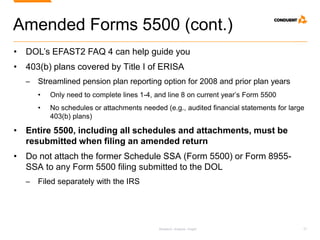
Amended Forms 5500 (cont.)
• DOL’s EFAST2 FAQ 4 can help guide you
• 403(b) plans covered by Title I of ERISA
─ Streamlined pension plan reporting option for 2008 and prior plan years
• Only need to complete lines 1-4, and line 8 on current year’s Form 5500
• No schedules or attachments needed (e.g., audited financial statements for large
403(b) plans)
• Entire 5500, including all schedules and attachments, must be
resubmitted when filing an amended return
• Do not attach the former Schedule SSA (Form 5500) or Form 8955-
SSA to any Form 5500 filing submitted to the DOL
─ Filed separately with the IRS
Research. Analysis. Insight.Research. Analysis. Insight. 28
Changes to 2017 Form 5500
Research. Analysis. Insight. 29
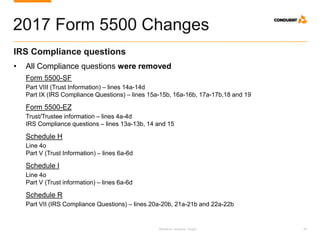
2017 Form 5500 Changes
IRS Compliance questions
• All Compliance questions were removed
Form 5500-SF
Part VIII (Trust Information) – lines 14a-14d
Part IX (IRS Compliance Questions) – lines 15a-15b, 16a-16b, 17a-17b,18 and 19
Form 5500-EZ
Trust/Trustee information – lines 4a-4d
IRS Compliance questions – lines 13a-13b, 14 and 15
Schedule H
Line 4o
Part V (Trust Information) – lines 6a-6d
Schedule I
Line 4o
Part V (Trust information) – lines 6a-6d
Schedule R
Part VII (IRS Compliance Questions) – lines 20a-20b, 21a-21b and 22a-22b
Research. Analysis. Insight. 30
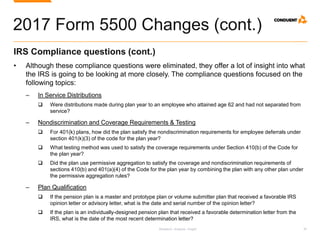
2017 Form 5500 Changes (cont.)
IRS Compliance questions (cont.)
• Although these compliance questions were eliminated, they offer a lot of insight into what
the IRS is going to be looking at more closely. The compliance questions focused on the
following topics:
‒ In Service Distributions
 Were distributions made during plan year to an employee who attained age 62 and had not separated from
service?
‒ Nondiscrimination and Coverage Requirements & Testing
 For 401(k) plans, how did the plan satisfy the nondiscrimination requirements for employee deferrals under
section 401(k)(3) of the code for the plan year?
 What testing method was used to satisfy the coverage requirements under Section 410(b) of the Code for
the plan year?
 Did the plan use permissive aggregation to satisfy the coverage and nondiscrimination requirements of
sections 410(b) and 401(a)(4) of the Code for the plan year by combining the plan with any other plan under
the permissive aggregation rules?
‒ Plan Qualification
 If the pension plan is a master and prototype plan or volume submitter plan that received a favorable IRS
opinion letter or advisory letter, what is the date and serial number of the opinion letter?
 If the plan is an individually-designed pension plan that received a favorable determination letter from the
IRS, what is the date of the most recent determination letter?
Research. Analysis. Insight. 31
2017 Form 5500 Changes (cont.)
Preparer Information
• Preparer information question was removed
Form 5500
Preparer information (bottom of page one)
Form 5500-SF
Preparer information (bottom of page one)
Form 5500-EZ
Preparer information (bottom of page two)
PBGC Premium Insurance Program
• An additional question was added to line 6c of the Form 5500-SF, which
requests the MyPAA generated confirmation number from the PBGC premium
filing for the 2017 plan year for defined benefit plans covered by the PBGC
premium insurance program.
‒ Please note that this question was added last year to line 5c of the 2016 Schedules
H and I (Form 5500) but was not reflected on the 2016 Form 5500-SF.
Research. Analysis. Insight. 32
2017 Form 5500 Changes (cont.)
Plan Name Change
• Line 4 of Form 5500/5500-SF/5500-EZ now requires reporting of a change in
the plan name, plan sponsor or EIN since the previous Form 5500/5500-
SF/5500-EZ was filed. In the past, only a change in the name and/or EIN of the
plan sponsor was required to be reported.
Authorized Service Provider
• The instructions for Form 5500/5500-SF were updated to allow service
providers to sign the Form 5500/5500-SF electronically on behalf of the plan
sponsor and DFE, in addition to signing the Form 5500/5500-SF on behalf of
the plan administrator or employer/plan sponsor.
Form 5500-EZ
• The principal business activity codes have been updated to reflect the updates
to the North American Industry Classification System (NAICS).
Research. Analysis. Insight. 33
2017 Form 5500 Changes (cont.)
Small Welfare Benefit Plan Filing Exemptions
• The instructions were revised to remind filers that a Form 5500 is not required
for welfare benefits plans with fewer than 100 participants (determined as of
the beginning of the plan year) that are either unfunded, fully insured, or a
combination of unfunded and fully insured unless the plan is subject to the
Form M-1 filing requirement (applicable to multiple employer welfare benefit
arrangements – MEWAs).
Schedule MB
• The instructions for line 6c have been updated to add mortality codes for
several variants of the RP-2014 mortality table and to add a description of the
mortality projection technique and scale to the Schedule MB, line 6 –
Statement of Actuarial Assumptions/Methods.
Research. Analysis. Insight. 34
2017 Form 5500 Changes (cont.)
Failure to Pay Benefits When Due
• The instructions for line 4l of Schedules H and I were revised to reflect the
recently issued IRS Field Directive outlining acceptable steps for attempting to
locate missing participants or beneficiaries due required minimum distributions
(RMDs). Under those guidelines, missed RMDs are considered a failure to pay
benefits when due only if the plan administrator did not make reasonable
efforts to locate such participants/beneficiaries.
Prior year’s Form 5500
• For the 2013 and prior plan years, Form 5500/5500-SF for the applicable year
cannot be used for late or amended Form 5500 filings. The 2017 Form
5500/5500-SF must be used. Please note the following exceptions:
‒ Schedules B, E, P, MB, SB, R, and T for the applicable year must be used
‒ Schedule C for the applicable year or the current year (2017) can be used
Research. Analysis. Insight. 35
2017 Form 5500 Changes (cont.)
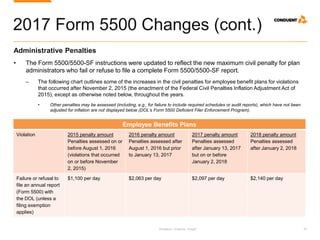
Administrative Penalties
• The Form 5500/5500-SF instructions were updated to reflect the new maximum civil penalty for plan
administrators who fail or refuse to file a complete Form 5500/5500-SF report.
‒ The following chart outlines some of the increases in the civil penalties for employee benefit plans for violations
that occurred after November 2, 2015 (the enactment of the Federal Civil Penalties Inflation Adjustment Act of
2015), except as otherwise noted below, throughout the years.
• Other penalties may be assessed (including, e.g., for failure to include required schedules or audit reports), which have not been
adjusted for inflation are not displayed below (DOL’s Form 5500 Deficient Filer Enforcement Program).
Employee Benefits Plans
Violation 2015 penalty amount
Penalties assessed on or
before August 1, 2016
(violations that occurred
on or before November
2, 2015)
2016 penalty amount
Penalties assessed after
August 1, 2016 but prior
to January 13, 2017
2017 penalty amount
Penalties assessed
after January 13, 2017
but on or before
January 2, 2018
2018 penalty amount
Penalties assessed
after January 2, 2018
Failure or refusal to
file an annual report
(Form 5500) with
the DOL (unless a
filing exemption
applies)
$1,100 per day $2,063 per day $2,097 per day $2,140 per day
Research. Analysis. Insight.Research. Analysis. Insight. 36
Change to 2017
Form 8955-SSA
Research. Analysis. Insight. 37
2017 Form 8955-SSA Change
Minor change in the instructions for the Form 8955-SSA
• Where to File – Private delivery service
‒ The names of the private overnight delivery carriers were removed in the instructions
and replaced with a link to the IRS’ website for a current list of the IRS approved
private delivery services. This is only applicable to filers who are eligible to file the
Form 8955-SSA by paper instead of filing Form 8955-SSA electronically.
Research. Analysis. Insight.Research. Analysis. Insight. 38
Proposed Changes to the
2019 Form 5500/5500-SF
and Schedules
Research. Analysis. Insight. 39
New EFAST2 Contract
• EFAST2 is an electronic system of the DOL, IRS, and PBGC to
simplify and expedite the submission, receipt, and processing of the
Form 5500/5500-SF.
• New EFAST2 contract expected for processing the 2019 Form 5500
filings beginning January 2020.
Research. Analysis. Insight. 40
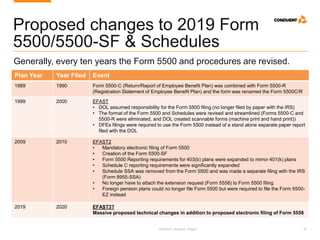
Proposed changes to 2019 Form
5500/5500-SF & Schedules
Generally, every ten years the Form 5500 and procedures are revised.
Plan Year Year Filed Event
1989 1990 Form 5500-C (Return/Report of Employee Benefit Plan) was combined with Form 5500-R
(Registration Statement of Employee Benefit Plan) and the form was renamed the Form 5500C/R
1999 2000 EFAST
• DOL assumed responsibility for the Form 5500 filing (no longer filed by paper with the IRS)
• The format of the Form 5500 and Schedules were revised and streamlined (Forms 5500-C and
5500-R were eliminated, and DOL created scannable forms (machine print and hand print))
• DFEs filings were required to use the Form 5500 instead of a stand alone separate paper report
filed with the DOL
2009 2010 EFAST2
• Mandatory electronic filing of Form 5500
• Creation of the Form 5500-SF
• Form 5500 Reporting requirements for 403(b) plans were expanded to mirror 401(k) plans
• Schedule C reporting requirements were significantly expanded
• Schedule SSA was removed from the Form 5500 and was made a separate filing with the IRS
(Form 8955-SSA)
• No longer have to attach the extension request (Form 5558) to Form 5500 filing
• Foreign pension plans could no longer file Form 5500 but were required to file the Form 5500-
EZ instead
2019 2020 EFAST3?
Massive proposed technical changes in addition to proposed electronic filing of Form 5558
Research. Analysis. Insight. 41
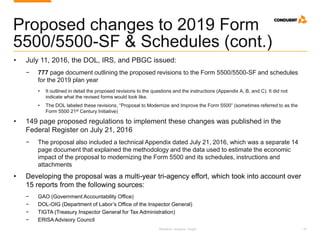
Proposed changes to 2019 Form
5500/5500-SF & Schedules (cont.)
• July 11, 2016, the DOL, IRS, and PBGC issued:
− 777 page document outlining the proposed revisions to the Form 5500/5500-SF and schedules
for the 2019 plan year
• It outlined in detail the proposed revisions to the questions and the instructions (Appendix A, B, and C). It did not
indicate what the revised forms would look like.
• The DOL labeled these revisions, “Proposal to Modernize and Improve the Form 5500” (sometimes referred to as the
Form 5500 21st Century Initiative)
• 149 page proposed regulations to implement these changes was published in the
Federal Register on July 21, 2016
− The proposal also included a technical Appendix dated July 21, 2016, which was a separate 14
page document that explained the methodology and the data used to estimate the economic
impact of the proposal to modernizing the Form 5500 and its schedules, instructions and
attachments
• Developing the proposal was a multi-year tri-agency effort, which took into account over
15 reports from the following sources:
− GAO (Government Accountability Office)
− DOL-OIG (Department of Labor’s Office of the Inspector General)
− TIGTA (Treasury Inspector General for Tax Administration)
− ERISA Advisory Council
Research. Analysis. Insight. 42
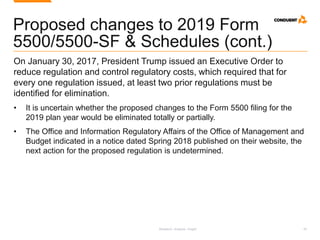
Proposed changes to 2019 Form
5500/5500-SF & Schedules (cont.)
On January 30, 2017, President Trump issued an Executive Order to
reduce regulation and control regulatory costs, which required that for
every one regulation issued, at least two prior regulations must be
identified for elimination.
• It is uncertain whether the proposed changes to the Form 5500 filing for the
2019 plan year would be eliminated totally or partially.
• The Office and Information Regulatory Affairs of the Office of Management and
Budget indicated in a notice dated Spring 2018 published on their website, the
next action for the proposed regulation is undetermined.
Research. Analysis. Insight. 43
Questions
Mary Miller
Senior Consultant, Compliance Consulting Center
Knowledge Resource Center
Conduent HR Services, LLC
500 Plaza Drive, 2nd Floor
Secaucus, NJ 07096-1533
Office: (201) 902-2446
Cell: (917) 687-3870
Email: Mary.Miller@conduent.com
Research. Analysis. Insight.© 2018 Conduent Business Services, LLC. All rights reserved. Conduent and Conduent Agile Star are trademarks of Conduent Business Services, LLC in the United States and/or other countries.

Conduent pw c_web (06-21-18) nsformatted (formatted)rev 6-20

  • 1.
    Research. Analysis. Insight. ConduentHuman Resource Services Knowledge Resource Center Form 5500 Update for the 2017 Filing Season Mary Miller June 21, 2018
  • 2.
    Research. Analysis. Insight.2 Agenda • Form 5500 Series ‒ Purpose of Form 5500 ‒ Information Reported on the Form 5500 Filing ‒ Plans & Entities That File Form 5500 ‒ Filing Deadline ‒ Required Signature on Form 5500 ‒ Record Retention ‒ Extensions ‒ Late Filing Penalties ‒ Form 5500 Series ‒ Amending Form 5500 • Changes to 2017 Form 5500 • Changes to 2017 Form 8955-SSA • Proposed Changes to the 2019 Form 5500/5500-SF & Schedules
  • 3.
    Research. Analysis. Insight.Research.Analysis. Insight. 3 Form 5500 Series
  • 4.
    Research. Analysis. Insight.4 What is the Form 5500? • Annual report of employee benefit plans and certain direct filing entities • Primary source of information about employee benefit plans • Used by DOL, IRS, and PBGC • Used for enforcement, research and disclosure to participants and beneficiaries • Most annual reports publicly available
  • 5.
    Research. Analysis. Insight.5 What type of information is reported on the Form 5500 filing? • Basic identifying information about plan or direct filing entity • Information about the sponsor of the plan or direct filing entity • Information about the plan administrator • Participant information • Plan features and benefits provided • Funding and benefit arrangement • Financial and insurance information • Compliance information • Information about plan termination and transfer of assets • Service provider information • Actuarial information • Information about interests/participating plans in direct filing entities
  • 6.
    Research. Analysis. Insight.6 What may be included in the Form 5500 filing? • Form 5500 and Applicable Schedules − Schedule A (Insurance Information) − Schedule C (Service Provider Information – Large Plans & DFEs) − Schedule D (DFE/Participating Plan Information) − Schedule G (Financial Transaction Schedules – Large Plans & DFEs) − Schedule H (Financial Information – Large Plans & DFEs) − Schedule I (Financial Information – Small Plans) − Schedule MB (Multiemployer Defined Benefit Plan and Certain Money Purchase Plan Actuarial Information) − Schedule SB (Single-Employer Defined Benefit Plan Actuarial Information) • Form 5500-SF – only Schedules MB and SB are applicable • Form 5500-EZ – has no applicable Schedules
  • 7.
    Research. Analysis. Insight.7 Who files the Form 5500? • Pension Plans ─ Defined benefit (traditional DB, cash-balance, pension equity, floor offset plan) ─ Defined contribution (profit-sharing, 401(k), 403(b), money purchase, target benefit, stock bonus, ESOP, certain IRAs) • Welfare Plans ─ Medical, dental, vision, life, short term and long term disability, long term care, accidental death and dismemberment, certain severance plans, pre-paid legal services, certain employee assistance programs, etc. ─ Medical flexible spending accounts • Direct filing entities (DFEs) ─ Master Trust Investment Account ─ Common/Collective Trust ─ Pooled Separate Account ─ 103-12 Investment Entity ─ Group Insurance Arrangement
  • 8.
    Research. Analysis. Insight.8 Who is required to sign Form 5500? • Although the Internal Revenue Code permits either the plan sponsor/employer or plan administrator to sign the plan filing, under ERISA, the signature of the plan administrator is required. If the filing is not electronically signed by the plan administrator, it will be subject to rejection and civil penalties under Title I of ERISA. − If the plan administrator is an entity, the electronic signature must be in the name of the individual authorized to sign on behalf of the plan administrator. • Signature of the person authorized to sign on behalf of the DFE is required for a DFE filing. • Plan administrators must keep a manually signed copy of the Form 5500, with all required schedules and attachments, as part of the plan’s records.
  • 9.
    Research. Analysis. Insight.9 Can service providers sign the Form 5500? • Plan Administrators can elect to have a service provider who manages the filing process sign the filing electronically. When this E-Signature alternative is used, the service provider should: − Obtain written authorization from the plan administrator, plan sponsor/employer, or DFE − Keep a copy of the authorization for the service provider’s records − Attach PDF copy of first two pages of the manually signed Form 5500/5500-SF, which was signed by the plan administrator, plan sponsor/employer, or DFE − Notify plan administrator, plan sponsor/employer, or DFE image of signature will be seen on DOL’s website for public disclosure − Communicate to the plan administrator, plan sponsor/employer, or DFE any inquiries and information received from EFAST2, DOL, IRS or PBGC regarding the Form 5500/5500-SF filing • The instructions for Form 5500 caution service providers to consider implications of IRS tax return preparer rules.
  • 10.
    Research. Analysis. Insight.10 How long should the Form 5500 be kept? The rules and regulations for records retention come from three distinct sources: DOL, IRS, and PBGC • Under Section 107 of ERISA, the DOL requires employers that file Form 5500 keep all related records to support the filing for at least six years following the date the Form 5500 is filed. However, if there was any information reported on prior Form 5500 filings relating to the determination of benefits for participants and their beneficiaries, this information should be retained indefinitely (for example, Schedule SSA, which was part of the Form 5500 filings prior to the 2009 plan year). • The IRS rules on the length of time plan fiduciaries should keep plan records mirror the length of time the IRS can audit them. For qualified retirement plans, plan fiduciaries must keep records associated with any plan filing for at least three years from the date it was filed. ‒ According to informal guidance from the IRS, if issues are discovered on audit, the IRS could extend their audit authority to filings occurring more than three years in the past if a substantial error is identified. • PBGC regulations require that all records that validate the insurance premiums paid to the PBGC must be kept for at least six years after the premiums were due. In addition, the plan sponsor of a terminated plan must maintain records to demonstrate compliance with the plan termination provisions for six years after the date the post-distribution certification is filed with the PBGC.
  • 11.
    Research. Analysis. Insight.11 When is the Form 5500 due? • Plans and GIAs ─ Last day of the 7th month after the plan/GIA year end ─ May be extended to 9½ months after the plan/GIA year end • Proposed 10½ month extension withdrew by the Fixing America’s Surface Transportation (FAST) Act of 2015 • DFEs other than GIAs ─ 9½ months after the DFE year end ─ No extensions If filing due date is Saturday, Sunday or Federal holiday, filing due on next business day • Form 5500 filing deadline is based on plan administrator’s time zone and not return preparer’s time zone ─ File Form 5500 for plan/GIA based on year in which plan/GIA year began ─ File Form 5500 for DFE (other than a GIA) based on year in which DFE year ended Example: If plan and DFE year is 10/1/16 – 9/30/17, use 2016 Form 5500 for the plan and 2017 Form 5500 for the DFE
  • 12.
    Research. Analysis. Insight.12 Extensions • File Form 5558 with IRS ─ Must be submitted to the IRS no later than the filing deadline for Form 5500 and/or 8955-SSA ─ Grants 2½ months extension for plans and GIAs (15th day of third month after normal filing deadline) ─ Signature or explanation not required if filing for an extension for Form 5500 and/or Form 8955-SSA • Automatic extension ─ Sponsor receives an automatic extension to file Form 5500 and/or 8955-SSA if: • Plan year and plan sponsor’s tax year are the same • Plan sponsor has been granted an extension of time to file its federal income tax return to a date later than normal due date for Form 5500 series • Must retain copy of application for extension of time to file federal income tax return with records • Prior to a recent change to certain corporate return filing deadline and extensions, the automatic extension granted the Plan/GIA only 1½ months extra time to file Form 5500/8955- SSA (not the 2½ months granted by filing Form 5558) • Extension requests are no longer required to be attached to Form 5500/5500-SF
  • 13.
    Research. Analysis. Insight.13 Extensions (cont.) • Special Extension ─ IRS, DOL, and PBGC may announce special extensions of time under certain circumstances, such as extensions for Presidentially-declared disasters or for service in, or in support of, the Armed Forces of the United States in a combat zone ─ Must check on Form 5500/5500-SF, Part I, Line D box for special extension and enter description of the announced authority for the extension ─ Check www.irs.gov, www.efast.dol.gov, and www.pbgc.gov/practitioners for announcements regarding special extensions ─ Not required to attach to Form 5500/5500-SF the IRS, DOL, or PBGC notice granting the special extension
  • 14.
    Research. Analysis. Insight.14 Form 5558 • Used to extend Form 5500 Series, Form 8955-SSA, or Form 5330 • Must use the most current version (August 2012) • Must file separate Form 5558 for each plan ─ May use a single Form 5558 to extend the Form 5500 and Form 8955-SSA for the same plan ─ Lists attached to the form will no longer be processed • Checkbox added for recently adopted plans that are requesting an extension for a plan that will be filing a Form 5500 Series report for the first time • Only required to sign Form 5558 and provide an explanation of why an extension is needed when requesting extension for filing Form 5330 • Must file Form 5558 (by paper) with the IRS in Ogden, Utah − Do not mail to the DOL ─ Can be mailed through U.S. Postal Service or through one of the approved IRS’ private delivery services (DHL, FedEx, and UPS)
  • 15.
    Research. Analysis. Insight.15 Form 5558 (cont.) • Copies of extension request used to extend the filing deadlines of Form 5500 series or Form 8955-SSA will not be returned to filer − Keep a copy of extension request and proof of mailing and delivery for records • Sometimes the IRS will send filers one of the following notices: − CP 216F (Application for Extension of Time to File an Employee Plan Return – Approved) − CP 216H (Application for Extension of Time to File an Employee Plan Return – Denied Not Timely Filed) • Need to provide proof to the IRS Form 5558 was timely filed It is important to check notices received from the IRS for errors (for example, wrong plan year ending date, plan number, or extended filing date, etc.). − If errors are discovered in the notice, mail or fax to the IRS a copy of the notice, along with a letter outlining the errors in the notice. The IRS’ fax number is (855) 214-7520
  • 16.
    Research. Analysis. Insight.16 Automatic Extension • The Surface Transportation and Veterans Health Care Choice Improvement Act of 2015 (Surface Transportation Act) changed the tax return filing deadlines for corporations, partnerships, and tax-exempt entities for tax years beginning after December 31, 2015 and, in turn, affects the automatic extensions to file Form 5500 and Form 8955-SSA. • Before the Surface Transportation Act, if plan sponsors used the automatic extension option for filing Form 5500 and/or Form 8955-SSA instead of filing Form 5558 there was always a one month gap between the extended filing deadline under the automatic extension and the extended filing deadline under the Form 5558 extension. − For example, plan year and the plan’s sponsor tax year is a calendar year the corporation applied for an extension for filing its corporate return. If the plan relied on the automatic corporate extension, the Forms 5500/8955-SSA filing deadline was September 15. However, had the plan sponsor filed the Form 5558, the Form 5500/8955-SSA extended filing deadline is October 15.
  • 17.
    Research. Analysis. Insight.17 Automatic Extension (cont.) • After the Surface Transportation Act, if the plan sponsor is a C corporation and the plan year and the tax year coincide, and the plan sponsor applied for an extension for its corporate return, the corporate extension filing deadline corresponds to the Form 5558 extended filing deadline (except for C corporation with tax year ending June 30th). − For example, plan year and the plan’s sponsor tax year is a calendar year and the corporation applied for an extension for filing its 2017 corporate return. The corporate extension filing deadline is October 15, 2018 so the 2017 Form 5500/8955-SSA automatic extension filing deadline is October 15, 2018, which is the same filing deadline as the extended filing deadline granted by filing Form 5558 to the IRS on or before July 31, 2018. • However, if the plan sponsor is a calendar year partnership or S corporation and the plan year and the tax year coincide, and the plan sponsor applied for an extension for its 2017 corporate/partnership return, the corporate/partnership extended filing deadline is September 15, 2018 but the Form 5558 extended deadline is October 15, 2018. By filing the Form 5558, the plan sponsor is granted an extra month to file the Form 5500/8955-SSA.
  • 18.
    Research. Analysis. Insight.18 Special Extension • IRS, DOL and PBGC may announce special extensions of time under certain circumstances, such as extensions for Presidentially-declared disasters (for example, Hurricane Maria, Irma, Harvey and Matthew, California October Wildfires, tornado and severe storms in North Carolina, etc.), or for service in, or in support of the Armed Forces of the United States in combat zone. − For the disaster relief, individuals who live, and businesses whose principal place of business is located in the covered disaster area specified in the notice, including individuals or businesses located in the covered disaster area whose records are necessary to meet a filing deadline are covered. • Earlier this year, the IRS sent Form 5500 late filing notices to some plan sponsors who submitted their Form 5500 filings under the special extension granted by one of the IRS’ disaster relief programs. The plan sponsors received these notices even though the Form 5500/5500-SF was properly identified as using the special extension and indicated the applicable disaster relief program. − The letter assessed late filing penalties of: • $25 per day (Up to $15,000) for each day the filing is late • $1,000 for not filing a required actuarial statement (Schedule SB/MB), if applicable − After the plan sponsors responded to the IRS by again identifying which disaster relief the plan sponsors/service provider was granted, the IRS rescinded the late filing penalties indicated in the notice.
  • 19.
    Research. Analysis. Insight.19 When the Form 5558, Automatic, or Special Extension Is Not Enough If the required audited financials are not ready on the extended Form 5500 filing deadline (for example, October 15 for calendar year end plans): • Can submit Form 5500 filing without required accountant's report, however, filing considered incomplete and may be subject to further review or rejection and assessment of civil penalties ‒ If required accountant's report is not attached, leave line 3 of the Schedule H (Form 5500) blank ‒ If filing without required accountant’s report, submit amended filing with report as soon as possible (the DOL is sending to plan administrators a notice of rejection, which gives the plan administrator 45 days to correct the filing)
  • 20.
    Research. Analysis. Insight.20 What are the late filing penalties for the Form 5500? • DOL Penalties ‒ Late filers – may be assessed up to $50 per day, with no limit (if filed voluntarily), for the period the plan administrator failed to file, determined without regard to any extensions for filing ‒ Non-filers – may be assessed a penalty of $300 per day (if discovered by DOL), up to $30,000 per year, until a complete annual report is filed ‒ Civil Penalty – up to $2,140 per day (formerly, $1,100) if plan administrator fails or refuses to file annual report ‒ Deficient Filing Penalties – missing or deficient audit report – $150 per day capped at $50,000 ‒ Criminal penalties – intentional violation of ERISA • IRS Penalties ‒ $25 per day (up to $15,000) for failure to file complete annual return/report ‒ $1,000 for not filing Schedule SB or MB (Actuarial Statement) One or more of the above penalties may apply to a single filing
  • 21.
    Research. Analysis. Insight.21 Which form should be used? • Form 5500 ─ Used by large pension and welfare benefit plans with 100 or more participants (or not relying on 80-120 participant rule) and DFEs ─ Used by multiple-employer welfare benefit plans required to file Form M-1, regardless of the number of participants in plan or how the plan is funded • Form 5500-SF ─ Pension plans and funded welfare benefit plans with fewer than 100 participants as of the beginning of the plan year (or relying on 80-120 participant rule) ─ Form 5500-EZ filer option for one participant and foreign plans • However, Form 5500-SF is mandatory for certain one participant and foreign pension plans if plan administrator/employer filed more than 250 returns during the calendar year Forms 5500 and 5500-SF filed electronically with the DOL
  • 22.
    Research. Analysis. Insight.22 Which form should be used? (cont.) Form 5500-EZ • Used by one-participant plans with $250,000 or more in assets as of the end of the plan year ‒ Form 5500-EZ must be filed for each of the employer’s one-participant pension plans, including those with $250,000 or less in assets at the end of the plan year if the $250,000 threshold is satisfied by taking into account all of the employer’s one participants plans on a combined basis ‒ Includes owners or partners and spouses – no employees covered • Used by certain foreign pension plans maintained outside the U.S. primarily for non-resident aliens • Sponsors of foreign pension plans file Form 5500-EZ if: ‒ the employer is a domestic employer or foreign employer with income derived from sources within the U.S. (including foreign subsidiaries of domestic employers), and ‒ contributions to the plan are deducted on its U.S. income tax return • Must be filed for foreign plans that cover US citizens and residents
  • 23.
    Research. Analysis. Insight.23 Form 5500-EZ • Form 5500-EZ is filed by paper with the IRS but Form 5500-SF may be voluntarily filed electronically with the DOL instead of Form 5500-EZ ─ However, mandatory Form 5500-SF electronic filing instead of paper Form 5500-EZ if plan administrator/employer filed at least 250 returns with the IRS during the calendar year • Economic hardship waivers available but must be requested at least 45 days before the due date (including extension) for filing Form 5500-EZ • Form 5500-SF filings with ”One-Participant Plan” or “Foreign Plan” box checked are blocked from public access
  • 24.
    Research. Analysis. Insight.24 Form 5500-SF • Three-page form • Includes basic identifying information and financial information similar to Schedule I • No schedules are required except for Schedule SB for defined benefit plans • Filed electronically with DOL
  • 25.
    Research. Analysis. Insight.25 Who may file Form 5500-SF? Used for small pension and funded welfare plans with < 100 participants (or 80 to 120 participant rule applies) • Plan must be eligible for small plan audit waiver (not with enhanced bonding) • Plan is not invested in employer securities • All plan assets must have readily determinable FMV ‒ Plan assets that have a readily determinable FMV include mutual funds, investment contracts with insurance companies and banks, publicly traded securities held by registered broker dealer, cash and cash equivalents held by a bank, loans to participants, etc. ‒ Plan assets invested in alternative investments, which include financial assets such as real estate, limited partnerships, hedge funds, venture capital, private equities and/or collectibles such as gold, art, antiques, coins, or stamps do not have a readily determinable fair market value • Plan is not a multiemployer pension or welfare benefit plan • Plan is not a multiple employer welfare benefit required to file Form M-1 Direct filing entitles are not eligible to file Form 5500-SF
  • 26.
    Research. Analysis. Insight.26 Amended Forms 5500 • All amended returns must be filed electronically through EFAST2 – even if originally filed on paper. • If amending a filing for a plan year prior to 2014, must use current year’s Form 5500 or 5500-SF and Schedules A, D, G, H, I if required for that year. • For defined benefit plans, must use the correct year Schedule B, Schedule SB, or Schedule MB. • Must use correct year Schedules E, P, R and T, if required for that year. • May use the Schedule C for correct year rather than the current year form. • If the prior year schedule is not listed on line 10 of the current year’s Form 5500, then there is nothing to check on that line (include schedule as an attachment). • DOL’s EBSA website has Form 5500 version selection tool to assist in determining which Form 5500 and schedules to use. Check out the online Form Selection tool at http://askebsa.dol.gov/FormSelector/.
  • 27.
    Research. Analysis. Insight.27 Amended Forms 5500 (cont.) • DOL’s EFAST2 FAQ 4 can help guide you • 403(b) plans covered by Title I of ERISA ─ Streamlined pension plan reporting option for 2008 and prior plan years • Only need to complete lines 1-4, and line 8 on current year’s Form 5500 • No schedules or attachments needed (e.g., audited financial statements for large 403(b) plans) • Entire 5500, including all schedules and attachments, must be resubmitted when filing an amended return • Do not attach the former Schedule SSA (Form 5500) or Form 8955- SSA to any Form 5500 filing submitted to the DOL ─ Filed separately with the IRS
  • 28.
    Research. Analysis. Insight.Research.Analysis. Insight. 28 Changes to 2017 Form 5500
  • 29.
    Research. Analysis. Insight.29 2017 Form 5500 Changes IRS Compliance questions • All Compliance questions were removed Form 5500-SF Part VIII (Trust Information) – lines 14a-14d Part IX (IRS Compliance Questions) – lines 15a-15b, 16a-16b, 17a-17b,18 and 19 Form 5500-EZ Trust/Trustee information – lines 4a-4d IRS Compliance questions – lines 13a-13b, 14 and 15 Schedule H Line 4o Part V (Trust Information) – lines 6a-6d Schedule I Line 4o Part V (Trust information) – lines 6a-6d Schedule R Part VII (IRS Compliance Questions) – lines 20a-20b, 21a-21b and 22a-22b
  • 30.
    Research. Analysis. Insight.30 2017 Form 5500 Changes (cont.) IRS Compliance questions (cont.) • Although these compliance questions were eliminated, they offer a lot of insight into what the IRS is going to be looking at more closely. The compliance questions focused on the following topics: ‒ In Service Distributions  Were distributions made during plan year to an employee who attained age 62 and had not separated from service? ‒ Nondiscrimination and Coverage Requirements & Testing  For 401(k) plans, how did the plan satisfy the nondiscrimination requirements for employee deferrals under section 401(k)(3) of the code for the plan year?  What testing method was used to satisfy the coverage requirements under Section 410(b) of the Code for the plan year?  Did the plan use permissive aggregation to satisfy the coverage and nondiscrimination requirements of sections 410(b) and 401(a)(4) of the Code for the plan year by combining the plan with any other plan under the permissive aggregation rules? ‒ Plan Qualification  If the pension plan is a master and prototype plan or volume submitter plan that received a favorable IRS opinion letter or advisory letter, what is the date and serial number of the opinion letter?  If the plan is an individually-designed pension plan that received a favorable determination letter from the IRS, what is the date of the most recent determination letter?
  • 31.
    Research. Analysis. Insight.31 2017 Form 5500 Changes (cont.) Preparer Information • Preparer information question was removed Form 5500 Preparer information (bottom of page one) Form 5500-SF Preparer information (bottom of page one) Form 5500-EZ Preparer information (bottom of page two) PBGC Premium Insurance Program • An additional question was added to line 6c of the Form 5500-SF, which requests the MyPAA generated confirmation number from the PBGC premium filing for the 2017 plan year for defined benefit plans covered by the PBGC premium insurance program. ‒ Please note that this question was added last year to line 5c of the 2016 Schedules H and I (Form 5500) but was not reflected on the 2016 Form 5500-SF.
  • 32.
    Research. Analysis. Insight.32 2017 Form 5500 Changes (cont.) Plan Name Change • Line 4 of Form 5500/5500-SF/5500-EZ now requires reporting of a change in the plan name, plan sponsor or EIN since the previous Form 5500/5500- SF/5500-EZ was filed. In the past, only a change in the name and/or EIN of the plan sponsor was required to be reported. Authorized Service Provider • The instructions for Form 5500/5500-SF were updated to allow service providers to sign the Form 5500/5500-SF electronically on behalf of the plan sponsor and DFE, in addition to signing the Form 5500/5500-SF on behalf of the plan administrator or employer/plan sponsor. Form 5500-EZ • The principal business activity codes have been updated to reflect the updates to the North American Industry Classification System (NAICS).
  • 33.
    Research. Analysis. Insight.33 2017 Form 5500 Changes (cont.) Small Welfare Benefit Plan Filing Exemptions • The instructions were revised to remind filers that a Form 5500 is not required for welfare benefits plans with fewer than 100 participants (determined as of the beginning of the plan year) that are either unfunded, fully insured, or a combination of unfunded and fully insured unless the plan is subject to the Form M-1 filing requirement (applicable to multiple employer welfare benefit arrangements – MEWAs). Schedule MB • The instructions for line 6c have been updated to add mortality codes for several variants of the RP-2014 mortality table and to add a description of the mortality projection technique and scale to the Schedule MB, line 6 – Statement of Actuarial Assumptions/Methods.
  • 34.
    Research. Analysis. Insight.34 2017 Form 5500 Changes (cont.) Failure to Pay Benefits When Due • The instructions for line 4l of Schedules H and I were revised to reflect the recently issued IRS Field Directive outlining acceptable steps for attempting to locate missing participants or beneficiaries due required minimum distributions (RMDs). Under those guidelines, missed RMDs are considered a failure to pay benefits when due only if the plan administrator did not make reasonable efforts to locate such participants/beneficiaries. Prior year’s Form 5500 • For the 2013 and prior plan years, Form 5500/5500-SF for the applicable year cannot be used for late or amended Form 5500 filings. The 2017 Form 5500/5500-SF must be used. Please note the following exceptions: ‒ Schedules B, E, P, MB, SB, R, and T for the applicable year must be used ‒ Schedule C for the applicable year or the current year (2017) can be used
  • 35.
    Research. Analysis. Insight.35 2017 Form 5500 Changes (cont.) Administrative Penalties • The Form 5500/5500-SF instructions were updated to reflect the new maximum civil penalty for plan administrators who fail or refuse to file a complete Form 5500/5500-SF report. ‒ The following chart outlines some of the increases in the civil penalties for employee benefit plans for violations that occurred after November 2, 2015 (the enactment of the Federal Civil Penalties Inflation Adjustment Act of 2015), except as otherwise noted below, throughout the years. • Other penalties may be assessed (including, e.g., for failure to include required schedules or audit reports), which have not been adjusted for inflation are not displayed below (DOL’s Form 5500 Deficient Filer Enforcement Program). Employee Benefits Plans Violation 2015 penalty amount Penalties assessed on or before August 1, 2016 (violations that occurred on or before November 2, 2015) 2016 penalty amount Penalties assessed after August 1, 2016 but prior to January 13, 2017 2017 penalty amount Penalties assessed after January 13, 2017 but on or before January 2, 2018 2018 penalty amount Penalties assessed after January 2, 2018 Failure or refusal to file an annual report (Form 5500) with the DOL (unless a filing exemption applies) $1,100 per day $2,063 per day $2,097 per day $2,140 per day
  • 36.
    Research. Analysis. Insight.Research.Analysis. Insight. 36 Change to 2017 Form 8955-SSA
  • 37.
    Research. Analysis. Insight.37 2017 Form 8955-SSA Change Minor change in the instructions for the Form 8955-SSA • Where to File – Private delivery service ‒ The names of the private overnight delivery carriers were removed in the instructions and replaced with a link to the IRS’ website for a current list of the IRS approved private delivery services. This is only applicable to filers who are eligible to file the Form 8955-SSA by paper instead of filing Form 8955-SSA electronically.
  • 38.
    Research. Analysis. Insight.Research.Analysis. Insight. 38 Proposed Changes to the 2019 Form 5500/5500-SF and Schedules
  • 39.
    Research. Analysis. Insight.39 New EFAST2 Contract • EFAST2 is an electronic system of the DOL, IRS, and PBGC to simplify and expedite the submission, receipt, and processing of the Form 5500/5500-SF. • New EFAST2 contract expected for processing the 2019 Form 5500 filings beginning January 2020.
  • 40.
    Research. Analysis. Insight.40 Proposed changes to 2019 Form 5500/5500-SF & Schedules Generally, every ten years the Form 5500 and procedures are revised. Plan Year Year Filed Event 1989 1990 Form 5500-C (Return/Report of Employee Benefit Plan) was combined with Form 5500-R (Registration Statement of Employee Benefit Plan) and the form was renamed the Form 5500C/R 1999 2000 EFAST • DOL assumed responsibility for the Form 5500 filing (no longer filed by paper with the IRS) • The format of the Form 5500 and Schedules were revised and streamlined (Forms 5500-C and 5500-R were eliminated, and DOL created scannable forms (machine print and hand print)) • DFEs filings were required to use the Form 5500 instead of a stand alone separate paper report filed with the DOL 2009 2010 EFAST2 • Mandatory electronic filing of Form 5500 • Creation of the Form 5500-SF • Form 5500 Reporting requirements for 403(b) plans were expanded to mirror 401(k) plans • Schedule C reporting requirements were significantly expanded • Schedule SSA was removed from the Form 5500 and was made a separate filing with the IRS (Form 8955-SSA) • No longer have to attach the extension request (Form 5558) to Form 5500 filing • Foreign pension plans could no longer file Form 5500 but were required to file the Form 5500- EZ instead 2019 2020 EFAST3? Massive proposed technical changes in addition to proposed electronic filing of Form 5558
  • 41.
    Research. Analysis. Insight.41 Proposed changes to 2019 Form 5500/5500-SF & Schedules (cont.) • July 11, 2016, the DOL, IRS, and PBGC issued: − 777 page document outlining the proposed revisions to the Form 5500/5500-SF and schedules for the 2019 plan year • It outlined in detail the proposed revisions to the questions and the instructions (Appendix A, B, and C). It did not indicate what the revised forms would look like. • The DOL labeled these revisions, “Proposal to Modernize and Improve the Form 5500” (sometimes referred to as the Form 5500 21st Century Initiative) • 149 page proposed regulations to implement these changes was published in the Federal Register on July 21, 2016 − The proposal also included a technical Appendix dated July 21, 2016, which was a separate 14 page document that explained the methodology and the data used to estimate the economic impact of the proposal to modernizing the Form 5500 and its schedules, instructions and attachments • Developing the proposal was a multi-year tri-agency effort, which took into account over 15 reports from the following sources: − GAO (Government Accountability Office) − DOL-OIG (Department of Labor’s Office of the Inspector General) − TIGTA (Treasury Inspector General for Tax Administration) − ERISA Advisory Council
  • 42.
    Research. Analysis. Insight.42 Proposed changes to 2019 Form 5500/5500-SF & Schedules (cont.) On January 30, 2017, President Trump issued an Executive Order to reduce regulation and control regulatory costs, which required that for every one regulation issued, at least two prior regulations must be identified for elimination. • It is uncertain whether the proposed changes to the Form 5500 filing for the 2019 plan year would be eliminated totally or partially. • The Office and Information Regulatory Affairs of the Office of Management and Budget indicated in a notice dated Spring 2018 published on their website, the next action for the proposed regulation is undetermined.
  • 43.
    Research. Analysis. Insight.43 Questions Mary Miller Senior Consultant, Compliance Consulting Center Knowledge Resource Center Conduent HR Services, LLC 500 Plaza Drive, 2nd Floor Secaucus, NJ 07096-1533 Office: (201) 902-2446 Cell: (917) 687-3870 Email: Mary.Miller@conduent.com
  • 44.
    Research. Analysis. Insight.©2018 Conduent Business Services, LLC. All rights reserved. Conduent and Conduent Agile Star are trademarks of Conduent Business Services, LLC in the United States and/or other countries.