Pension Funds 2014 Year in Review
Tailwinds Turn to Headwinds
Kevin O’Brien, CFA
Consultant
Strategic thinking. Customized solutions.
January 2015
Overview
Tailwinds such as strong asset returns and increasing discount rates helped to improve the funded status of
many pension funds in the 2013 calendar year. Plans were well funded in December of 2013, estimated at
96% in some cases (source: JP Morgan Pension Pulse Fall/Winter 2013).
What a difference a year makes, as plan sponsors have a new set of headwinds to consider.
A combination of factors contributed to declining funded ratios in 2014. This paper seeks to highlight some
of the issues facing pension plans as we begin 2015.
Market Performance Review
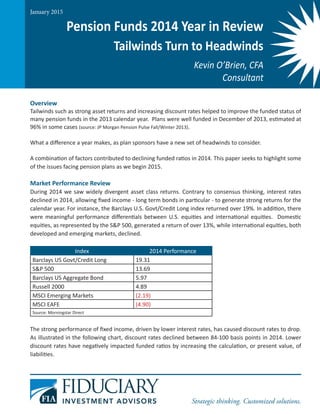
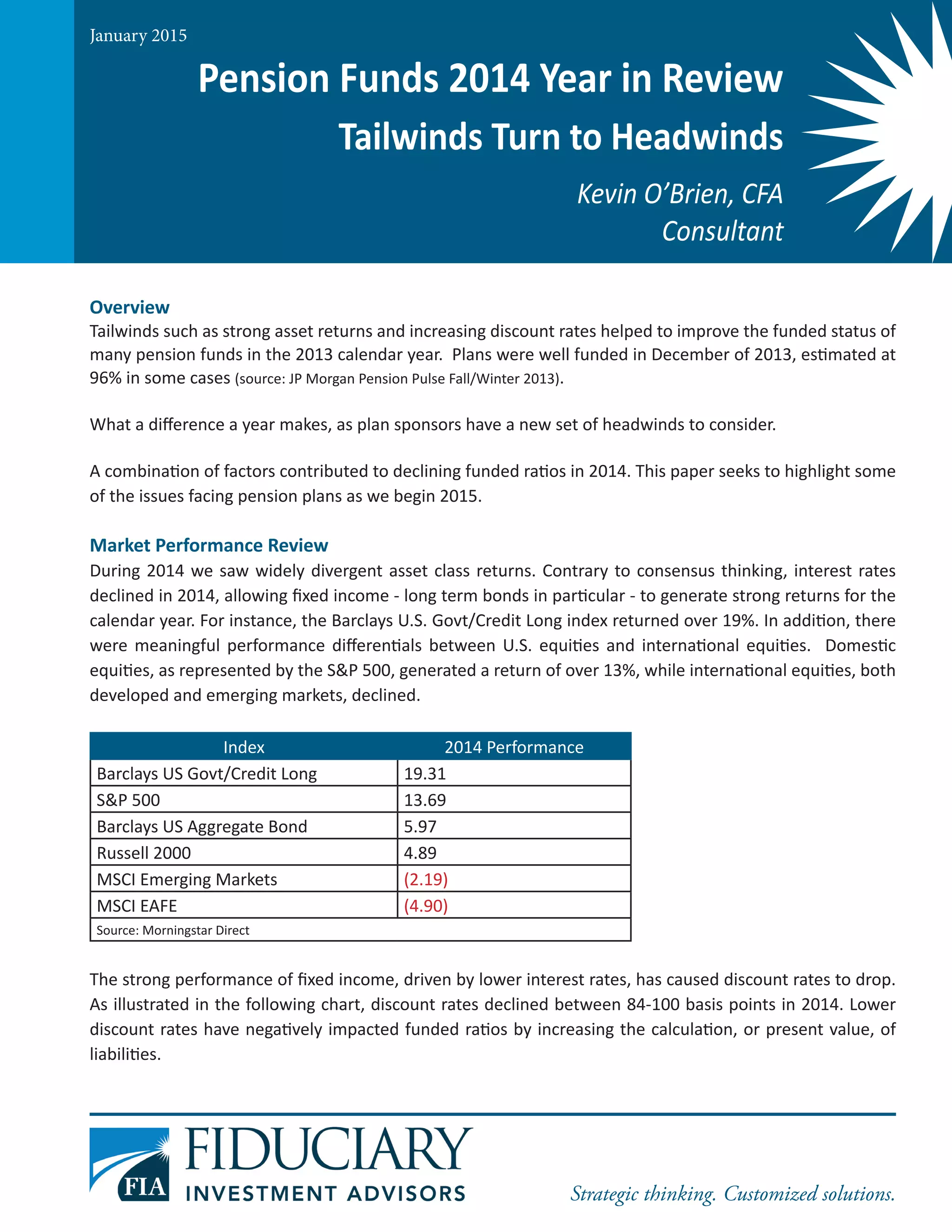
During 2014 we saw widely divergent asset class returns. Contrary to consensus thinking, interest rates
declined in 2014, allowing fixed income - long term bonds in particular - to generate strong returns for the
calendar year. For instance, the Barclays U.S. Govt/Credit Long index returned over 19%. In addition, there
were meaningful performance differentials between U.S. equities and international equities. Domestic
equities, as represented by the S&P 500, generated a return of over 13%, while international equities, both
developed and emerging markets, declined.
Index 2014 Performance
Barclays US Govt/Credit Long 19.31
S&P 500 13.69
Barclays US Aggregate Bond 5.97
Russell 2000 4.89
MSCI Emerging Markets (2.19)
MSCI EAFE (4.90)
Source: Morningstar Direct
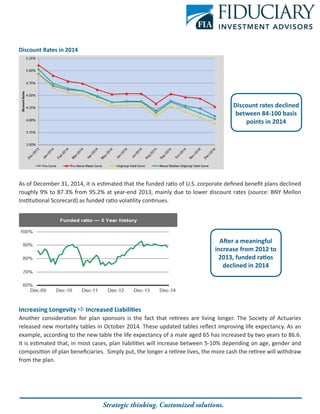
The strong performance of fixed income, driven by lower interest rates, has caused discount rates to drop.
As illustrated in the following chart, discount rates declined between 84-100 basis points in 2014. Lower
discount rates have negatively impacted funded ratios by increasing the calculation, or present value, of
liabilities.
Discount Rates in 2014
As of December 31, 2014, it is estimated that the funded ratio of U.S. corporate defined benefit plans declined
roughly 9% to 87.3% from 95.2% at year-end 2013, mainly due to lower discount rates (source: BNY Mellon
Institutional Scorecard) as funded ratio volatility continues.
Increasing Longevity a Increased Liabilities
Another consideration for plan sponsors is the fact that retirees are living longer. The Society of Actuaries
released new mortality tables in October 2014. These updated tables reflect improving life expectancy. As an
example, according to the new table the life expectancy of a male aged 65 has increased by two years to 86.6.
It is estimated that, in most cases, plan liabilities will increase between 5-10% depending on age, gender and
composition of plan beneficiaries. Simply put, the longer a retiree lives, the more cash the retiree will withdraw
from the plan.
Strategic thinking. Customized solutions.
Discount rates declined
between 84-100 basis
points in 2014
After a meaningful
increase from 2012 to
2013, funded ratios
declined in 2014
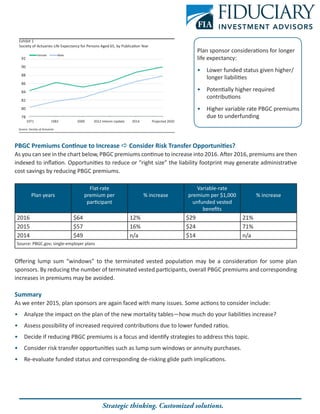
PBGC Premiums Continue to Increase a Consider Risk Transfer Opportunities?
As you can see in the chart below, PBGC premiums continue to increase into 2016. After 2016, premiums are then
indexed to inflation. Opportunities to reduce or “right size” the liability footprint may generate administrative
cost savings by reducing PBGC premiums.
Plan years
Flat-rate
premium per
participant
% increase
Variable-rate
premium per $1,000
unfunded vested
benefits
% increase
2016 $64 12% $29 21%
2015 $57 16% $24 71%
2014 $49 n/a $14 n/a
Source: PBGC.gov; single-employer plans
Offering lump sum “windows” to the terminated vested population may be a consideration for some plan
sponsors. By reducing the number of terminated vested participants, overall PBGC premiums and corresponding
increases in premiums may be avoided.
Summary
As we enter 2015, plan sponsors are again faced with many issues. Some actions to consider include:
•	 Analyze the impact on the plan of the new mortality tables—how much do your liabilities increase?
•	 Assess possibility of increased required contributions due to lower funded ratios.
•	 Decide if reducing PBGC premiums is a focus and identify strategies to address this topic.
•	 Consider risk transfer opportunities such as lump sum windows or annuity purchases.
•	 Re-evaluate funded status and corresponding de-risking glide path implications.
Strategic thinking. Customized solutions.
Exhibit 1
Society of Actuaries Life Expectancy for Persons Aged 65, by Publication Year
92
90
88
86
84
82
80
78
Source: Society of Actuaries
1971	 1983	 2000 2012 Interim Update 2014 Projected 2020
Female Male
Plan sponsor considerations for longer
life expectancy:
•	 Lower funded status given higher/
longer liabilities
•	 Potentially higher required
contributions
•	 Higher variable rate PBGC premiums
due to underfunding
Fiduciary Investment Advisors, LLC (“FIA”)
FIA is an independent institutional consulting group with over 20 years of investment consulting experience.
FIA is an employee owned firm with 100% of the firm’s revenue derived from fees clients pay for investment
advice. Our mission is to provide customized investment consulting services to assist our clients in achieving
their investment and financial objectives, while fulfilling their fiduciary obligations. Our clients include corporate
retirement plans, endowments & foundations, healthcare organizations, captive insurance companies and public
plans. Our consulting services include:
•	 Investment Policy Statement Review/Creation;
•	 Retirement Service Provider Search (RFI/RFP);
•	 Plan Benchmarking;
•	 Investment Menu Analysis and Design;
•	 Total Plan Fee Analysis (full fee disclosure);
•	 Fiduciary Governance Consulting;
•	 Investment Fund Performance Measurement, Analysis and Reporting;
•	 Risk-Based Model Portfolio Construction;
•	 Assistance with Employee Communication and Education;
•	 Asset Allocation Analysis;
•	 Investment Manager Searches;
•	 Liability Driven Investment (“LDI”) Strategies for Pension Plans;
•	 Quarterly In-Person Meetings with Finance/Investment Committees;
•	 Strategic Guidance on Relevant Topics of Interest;
For More Information Please Contact:
Kevin O’Brien, CFA
Consultant
Fiduciary Investment Advisors, LLC
100 Northfield Drive
Windsor, CT 06095
Direct: (860) 697-7453
Email: kobrien@fiallc.com
Please remember that past performance may not be indicative of future results. Different types of investments involve varying
degrees of risk, and there can be no assurance that the future performance of any specific investment, investment strategy, or product
(including the investments and/or investment strategies recommended or undertaken by Fiduciary Investment Advisors, LLC), or any
non-investment related content, made reference to directly or indirectly in this newsletter will be profitable, equal any corresponding
indicated historical performance level(s), be suitable for your portfolio or individual situation, or prove successful. Due to various factors,
including changing market conditions and/or applicable laws, the content may no longer be reflective of current opinions or positions.
Moreover, you should not assume that any discussion or information contained in this newsletter serves as the receipt of, or as a
substitute for, personalized investment advice from Fiduciary Investment Advisors, LLC. To the extent that a reader has any questions
regarding the applicability of any specific issue discussed above to his/her individual situation, he/she is encouraged to consult with
the professional advisor of his/her choosing. Fiduciary Investment Advisors, LLC is neither a law firm nor a certified public accounting
firm and no portion of the newsletter content should be construed as legal or accounting advice. A copy of the Fiduciary Investment
Advisors, LLC’s current written disclosure statement discussing our advisory services and fees is available for review upon request.
Strategic thinking. Customized solutions.

Pension Funds 2014_O'Brien

  • 1.
    Pension Funds 2014Year in Review Tailwinds Turn to Headwinds Kevin O’Brien, CFA Consultant Strategic thinking. Customized solutions. January 2015 Overview Tailwinds such as strong asset returns and increasing discount rates helped to improve the funded status of many pension funds in the 2013 calendar year. Plans were well funded in December of 2013, estimated at 96% in some cases (source: JP Morgan Pension Pulse Fall/Winter 2013). What a difference a year makes, as plan sponsors have a new set of headwinds to consider. A combination of factors contributed to declining funded ratios in 2014. This paper seeks to highlight some of the issues facing pension plans as we begin 2015. Market Performance Review During 2014 we saw widely divergent asset class returns. Contrary to consensus thinking, interest rates declined in 2014, allowing fixed income - long term bonds in particular - to generate strong returns for the calendar year. For instance, the Barclays U.S. Govt/Credit Long index returned over 19%. In addition, there were meaningful performance differentials between U.S. equities and international equities. Domestic equities, as represented by the S&P 500, generated a return of over 13%, while international equities, both developed and emerging markets, declined. Index 2014 Performance Barclays US Govt/Credit Long 19.31 S&P 500 13.69 Barclays US Aggregate Bond 5.97 Russell 2000 4.89 MSCI Emerging Markets (2.19) MSCI EAFE (4.90) Source: Morningstar Direct The strong performance of fixed income, driven by lower interest rates, has caused discount rates to drop. As illustrated in the following chart, discount rates declined between 84-100 basis points in 2014. Lower discount rates have negatively impacted funded ratios by increasing the calculation, or present value, of liabilities.
  • 2.
    Discount Rates in2014 As of December 31, 2014, it is estimated that the funded ratio of U.S. corporate defined benefit plans declined roughly 9% to 87.3% from 95.2% at year-end 2013, mainly due to lower discount rates (source: BNY Mellon Institutional Scorecard) as funded ratio volatility continues. Increasing Longevity a Increased Liabilities Another consideration for plan sponsors is the fact that retirees are living longer. The Society of Actuaries released new mortality tables in October 2014. These updated tables reflect improving life expectancy. As an example, according to the new table the life expectancy of a male aged 65 has increased by two years to 86.6. It is estimated that, in most cases, plan liabilities will increase between 5-10% depending on age, gender and composition of plan beneficiaries. Simply put, the longer a retiree lives, the more cash the retiree will withdraw from the plan. Strategic thinking. Customized solutions. Discount rates declined between 84-100 basis points in 2014 After a meaningful increase from 2012 to 2013, funded ratios declined in 2014
  • 3.
    PBGC Premiums Continueto Increase a Consider Risk Transfer Opportunities? As you can see in the chart below, PBGC premiums continue to increase into 2016. After 2016, premiums are then indexed to inflation. Opportunities to reduce or “right size” the liability footprint may generate administrative cost savings by reducing PBGC premiums. Plan years Flat-rate premium per participant % increase Variable-rate premium per $1,000 unfunded vested benefits % increase 2016 $64 12% $29 21% 2015 $57 16% $24 71% 2014 $49 n/a $14 n/a Source: PBGC.gov; single-employer plans Offering lump sum “windows” to the terminated vested population may be a consideration for some plan sponsors. By reducing the number of terminated vested participants, overall PBGC premiums and corresponding increases in premiums may be avoided. Summary As we enter 2015, plan sponsors are again faced with many issues. Some actions to consider include: • Analyze the impact on the plan of the new mortality tables—how much do your liabilities increase? • Assess possibility of increased required contributions due to lower funded ratios. • Decide if reducing PBGC premiums is a focus and identify strategies to address this topic. • Consider risk transfer opportunities such as lump sum windows or annuity purchases. • Re-evaluate funded status and corresponding de-risking glide path implications. Strategic thinking. Customized solutions. Exhibit 1 Society of Actuaries Life Expectancy for Persons Aged 65, by Publication Year 92 90 88 86 84 82 80 78 Source: Society of Actuaries 1971 1983 2000 2012 Interim Update 2014 Projected 2020 Female Male Plan sponsor considerations for longer life expectancy: • Lower funded status given higher/ longer liabilities • Potentially higher required contributions • Higher variable rate PBGC premiums due to underfunding
  • 4.
    Fiduciary Investment Advisors,LLC (“FIA”) FIA is an independent institutional consulting group with over 20 years of investment consulting experience. FIA is an employee owned firm with 100% of the firm’s revenue derived from fees clients pay for investment advice. Our mission is to provide customized investment consulting services to assist our clients in achieving their investment and financial objectives, while fulfilling their fiduciary obligations. Our clients include corporate retirement plans, endowments & foundations, healthcare organizations, captive insurance companies and public plans. Our consulting services include: • Investment Policy Statement Review/Creation; • Retirement Service Provider Search (RFI/RFP); • Plan Benchmarking; • Investment Menu Analysis and Design; • Total Plan Fee Analysis (full fee disclosure); • Fiduciary Governance Consulting; • Investment Fund Performance Measurement, Analysis and Reporting; • Risk-Based Model Portfolio Construction; • Assistance with Employee Communication and Education; • Asset Allocation Analysis; • Investment Manager Searches; • Liability Driven Investment (“LDI”) Strategies for Pension Plans; • Quarterly In-Person Meetings with Finance/Investment Committees; • Strategic Guidance on Relevant Topics of Interest; For More Information Please Contact: Kevin O’Brien, CFA Consultant Fiduciary Investment Advisors, LLC 100 Northfield Drive Windsor, CT 06095 Direct: (860) 697-7453 Email: kobrien@fiallc.com Please remember that past performance may not be indicative of future results. Different types of investments involve varying degrees of risk, and there can be no assurance that the future performance of any specific investment, investment strategy, or product (including the investments and/or investment strategies recommended or undertaken by Fiduciary Investment Advisors, LLC), or any non-investment related content, made reference to directly or indirectly in this newsletter will be profitable, equal any corresponding indicated historical performance level(s), be suitable for your portfolio or individual situation, or prove successful. Due to various factors, including changing market conditions and/or applicable laws, the content may no longer be reflective of current opinions or positions. Moreover, you should not assume that any discussion or information contained in this newsletter serves as the receipt of, or as a substitute for, personalized investment advice from Fiduciary Investment Advisors, LLC. To the extent that a reader has any questions regarding the applicability of any specific issue discussed above to his/her individual situation, he/she is encouraged to consult with the professional advisor of his/her choosing. Fiduciary Investment Advisors, LLC is neither a law firm nor a certified public accounting firm and no portion of the newsletter content should be construed as legal or accounting advice. A copy of the Fiduciary Investment Advisors, LLC’s current written disclosure statement discussing our advisory services and fees is available for review upon request. Strategic thinking. Customized solutions.