Mr Riel Casinillo
10/25/2022
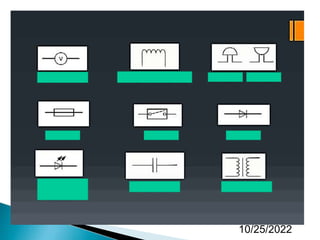
1. Recall electrical symbols
2. Define the terms potential difference,
current, electromotive force.
3. Recall and use the equation linking charge,
energy transferred and voltage, and the
relevant units for these.
4. Use the equation linking charge, energy
transferred and voltage to show that the
volt is equivalent to the joule per coulomb.
10/25/2022
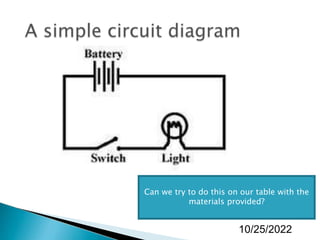
 Make the bulb light
1 with least possible wire
2 which can be turned on or off
10/25/2022
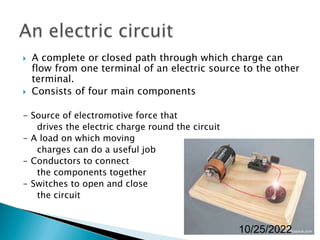
 A complete or closed path through which charge can
flow from one terminal of an electric source to the other
terminal.
 Consists of four main components
- Source of electromotive force that
drives the electric charge round the circuit
- A load on which moving
charges can do a useful job
- Conductors to connect
the components together
- Switches to open and close
the circuit
10/25/2022
Can we try to do this on our table with the
materials provided?
10/25/2022
Can we try to do this?
Nah!!! Some other
time!!! :p
10/25/2022
10/25/2022
10/25/2022
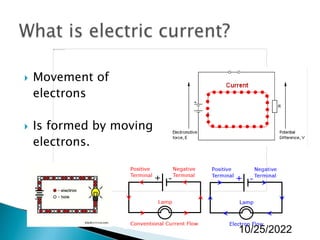
 Movement of
electrons
 Is formed by moving
electrons.
10/25/2022
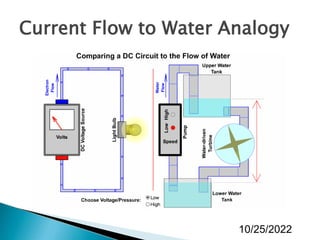
Current Flow to Water Analogy
10/25/2022
 An electric current (I) is a measure of the rate
of flow of electric charge Q through a given
cross section of a conductor.
 In symbols,
where: I is the current (in Ampere A)
Q is the charge (in Coulombs C)
t is the time taken (in seconds s)
What is electric current?
10/25/2022
Right!!! Use an
ammeter!
10/25/2022
 Can you draw the difference?
 How about an illustration of a short-circuit?
 Can you explain why it is called a short-
circuit?
10/25/2022
An analogy of a water pump to the electromotive force
10/25/2022
 The electric force produced by the energy
source which pushes the electrons through a
circuit.
 More scientific definition:
- Electromotive force (e.m.f.) of an electrical energy
source is defined as the work done by the source in
driving a unit charge round a complete circuit.
where: Ɛ is the emf of the power supply (V)
W is the work done ( J )
Q is the amount of charge ( C )
10/25/2022
Right!!! Use a voltmeter!!!
10/25/2022
 The amount of energy which is converted
across a light bulb for each unit of charge
 More scientific definition:
◦ The potential difference between two points in an
electric circuit is defined as the amount of electrical
energy converted into other forms of energy when
one coulomb of positive charge passes between two
points.
Where V is the potential difference ( V)
W is the electrical energy ( J )
Q is the amount of charge ( C )
10/25/2022
W
V Q
Q
I t
10/25/2022
10/25/2022
 Learning Outcomes:
◦ Define resistance and state that resistance is
measured in Ω
◦ State Ohm’s Law
◦ Apply the definition of resistance to solve problems
◦ Describe an experiment to determine resistance
◦ Describe the effect of temperature on resistance
◦ Sketch and interpret the I-V characteristic graphs
for ohmic and non – ohmic conductors.
10/25/2022
 A measure of how difficult it is for an electric
current to pass through a material.
 Is a property of a material
 Determines the size of electric current
passing through a material
 a.k.a “friction”
10/25/2022
 Fixed resistor
 Variable resistor
 This is the ratio of the
p.d. across a conductor
to the current flowing
through it.
◦ i.e. R = V
I
Unit: Ohm 
 http://micro.magnet.fs
u.edu/electromag/java
/filamentresistance/
-Use Ohmmeter
10/25/2022
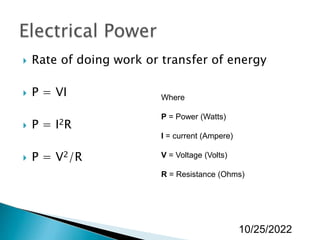
 Rate of doing work or transfer of energy
 P = VI
 P = I2R
 P = V2/R
Where
P = Power (Watts)
I = current (Ampere)
V = Voltage (Volts)
R = Resistance (Ohms)
10/25/2022
 This states that for certain
conductors (mainly metals)
the current flowing through
them is directly proportional
to the potential difference
across them at a constant
temperature.
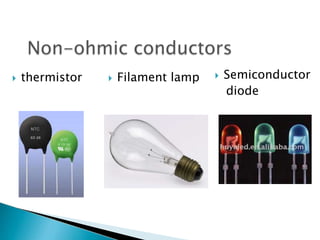
 Filament lamp
 thermistor  Semiconductor
diode
1 Differentiate Ohmic and Non Ohmic Conductors
1 Plot the graph of Ohmic Conductors
1 Plot the graphs of the following:
a Filament lamp
b thermistor
c semiconductor diode
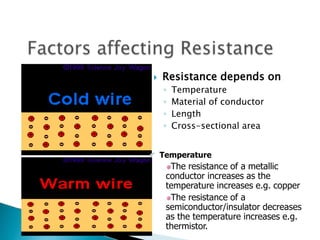
 Resistance depends on
◦ Temperature
◦ Material of conductor
◦ Length
◦ Cross-sectional area
Temperature
The resistance of a metallic
conductor increases as the
temperature increases e.g. copper
The resistance of a
semiconductor/insulator decreases
as the temperature increases e.g.
thermistor.
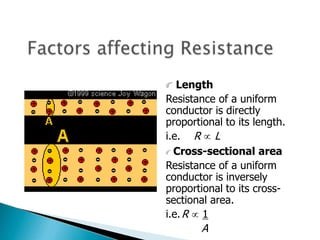
Length
Resistance of a uniform
conductor is directly
proportional to its length.
i.e. R  L
Cross-sectional area
Resistance of a uniform
conductor is inversely
proportional to its cross-
sectional area.
i.e.R  1
A
R =
A
l

Where
R = resistance (Ω)
= resistivity (Ω m)
l = length (m)
A = area (m2)

https://phet.colorado.edu/en/simulation/battery-resistor-
circuit

Current Electricity PRESENTATION.ppt

  • 1.
  • 2.
    1. Recall electricalsymbols 2. Define the terms potential difference, current, electromotive force. 3. Recall and use the equation linking charge, energy transferred and voltage, and the relevant units for these. 4. Use the equation linking charge, energy transferred and voltage to show that the volt is equivalent to the joule per coulomb. 10/25/2022
  • 3.
     Make thebulb light 1 with least possible wire 2 which can be turned on or off 10/25/2022
  • 4.
     A completeor closed path through which charge can flow from one terminal of an electric source to the other terminal.  Consists of four main components - Source of electromotive force that drives the electric charge round the circuit - A load on which moving charges can do a useful job - Conductors to connect the components together - Switches to open and close the circuit 10/25/2022
  • 5.
    Can we tryto do this on our table with the materials provided? 10/25/2022
  • 6.
    Can we tryto do this? Nah!!! Some other time!!! :p 10/25/2022
  • 7.
  • 8.
  • 9.
     Movement of electrons Is formed by moving electrons. 10/25/2022
  • 10.
    Current Flow toWater Analogy 10/25/2022
  • 11.
     An electriccurrent (I) is a measure of the rate of flow of electric charge Q through a given cross section of a conductor.  In symbols, where: I is the current (in Ampere A) Q is the charge (in Coulombs C) t is the time taken (in seconds s) What is electric current? 10/25/2022
  • 12.
  • 13.
     Can youdraw the difference?  How about an illustration of a short-circuit?  Can you explain why it is called a short- circuit? 10/25/2022
  • 14.
    An analogy ofa water pump to the electromotive force 10/25/2022
  • 15.
     The electricforce produced by the energy source which pushes the electrons through a circuit.  More scientific definition: - Electromotive force (e.m.f.) of an electrical energy source is defined as the work done by the source in driving a unit charge round a complete circuit. where: Ɛ is the emf of the power supply (V) W is the work done ( J ) Q is the amount of charge ( C ) 10/25/2022
  • 16.
    Right!!! Use avoltmeter!!! 10/25/2022
  • 17.
     The amountof energy which is converted across a light bulb for each unit of charge  More scientific definition: ◦ The potential difference between two points in an electric circuit is defined as the amount of electrical energy converted into other forms of energy when one coulomb of positive charge passes between two points. Where V is the potential difference ( V) W is the electrical energy ( J ) Q is the amount of charge ( C ) 10/25/2022
  • 18.
  • 19.
  • 20.
     Learning Outcomes: ◦Define resistance and state that resistance is measured in Ω ◦ State Ohm’s Law ◦ Apply the definition of resistance to solve problems ◦ Describe an experiment to determine resistance ◦ Describe the effect of temperature on resistance ◦ Sketch and interpret the I-V characteristic graphs for ohmic and non – ohmic conductors. 10/25/2022
  • 21.
     A measureof how difficult it is for an electric current to pass through a material.  Is a property of a material  Determines the size of electric current passing through a material  a.k.a “friction” 10/25/2022
  • 22.
     Fixed resistor Variable resistor
  • 23.
     This isthe ratio of the p.d. across a conductor to the current flowing through it. ◦ i.e. R = V I Unit: Ohm   http://micro.magnet.fs u.edu/electromag/java /filamentresistance/
  • 24.
  • 25.
     Rate ofdoing work or transfer of energy  P = VI  P = I2R  P = V2/R Where P = Power (Watts) I = current (Ampere) V = Voltage (Volts) R = Resistance (Ohms) 10/25/2022
  • 26.
     This statesthat for certain conductors (mainly metals) the current flowing through them is directly proportional to the potential difference across them at a constant temperature.
  • 27.
     Filament lamp thermistor  Semiconductor diode
  • 28.
    1 Differentiate Ohmicand Non Ohmic Conductors 1 Plot the graph of Ohmic Conductors 1 Plot the graphs of the following: a Filament lamp b thermistor c semiconductor diode
  • 29.
     Resistance dependson ◦ Temperature ◦ Material of conductor ◦ Length ◦ Cross-sectional area Temperature The resistance of a metallic conductor increases as the temperature increases e.g. copper The resistance of a semiconductor/insulator decreases as the temperature increases e.g. thermistor.
  • 30.
    Length Resistance of auniform conductor is directly proportional to its length. i.e. R  L Cross-sectional area Resistance of a uniform conductor is inversely proportional to its cross- sectional area. i.e.R  1 A
  • 31.
    R = A l  Where R =resistance (Ω) = resistivity (Ω m) l = length (m) A = area (m2) 
  • 32.

Editor's Notes

  • #5 Draw a simple circuit diagram of your circuit using electrical symbols that you know.
  • #13 Connect the ammeter and measure the current in your circuit.