CURRENT CHALLENGES
IN TEACHING/LEARNING
ENGLISH FOR EFL LEARNERS: THE CASE OF JUNIOR HIGH
SCHOOL AND HIGH SCHOOL
Kittichai Nilubol
Faculty of Liberal Arts, KKU Nong Khai Campus
GLOBAL
•Let’s get it started
WHAT HAVE BEEN DONE OUT THERE??
•Watch this!
WHAT ARE THEIR PROBLEMS?
Akbari, Zahra. (2015). Current Challenges in Teaching/Learning English for EFL Learners:
The Case of Junior High School and High School.
PROBLEMS ON THE PART OF STUDENTS
• No environment that makes them familiar with English in
use.
• Various accents
• Vocabulary
• Idioms
• Terms
PROBLEMS ON THE PART OF TEACHERS
• Examination does not match with the evaluation
• Lesson plan
• No time to prepare for the lesson
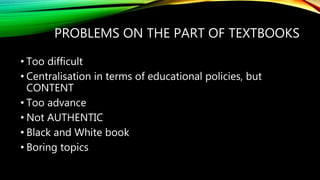
PROBLEMS ON THE PART OF TEXTBOOKS
• Too difficult
• Centralisation in terms of educational policies, but
CONTENT
• Too advance
• Not AUTHENTIC
• Black and White book
• Boring topics
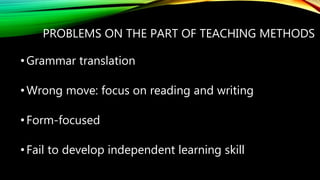
PROBLEMS ON THE PART OF TEACHING METHODS
•Grammar translation
•Wrong move: focus on reading and writing
•Form-focused
•Fail to develop independent learning skill
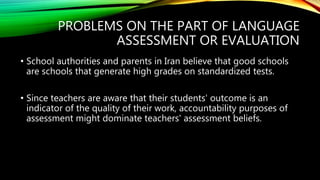
PROBLEMS ON THE PART OF LANGUAGE
ASSESSMENT OR EVALUATION
• School authorities and parents in Iran believe that good schools
are schools that generate high grades on standardized tests.
• Since teachers are aware that their students' outcome is an
indicator of the quality of their work, accountability purposes of
assessment might dominate teachers' assessment beliefs.
PROBLEMS ON THE PART OF THE CURRICULUM
• Although the authorities and curriculum developers are
attempting to incorporate a communicative syllabus at public
schools.
• BUT
• what is commonly delivered to students is at best a traditional
course where the focus is primarily on reading comprehension
(Razmjoo & Riazi 2006) and the sub-skills of grammar and
vocabulary (both of which are instrumental for the development
of reading skill).
POLITICAL PROBLEMS
• There are voices postulating that English as it is presently taught in
Iran is nothing but a representation of the Persian or Islamic
ideology.
• According to Navidinia et al. (2009 as cited in Mojtahedzadeh &
Mojtahedzadeh, 2012), Iran has always been a country with one
official language called Persian. We are proud that we have never
been colonized.
LOCAL
•How about us???

Current Challenges in Teaching ESL.pptx

  • 1.
    CURRENT CHALLENGES IN TEACHING/LEARNING ENGLISHFOR EFL LEARNERS: THE CASE OF JUNIOR HIGH SCHOOL AND HIGH SCHOOL Kittichai Nilubol Faculty of Liberal Arts, KKU Nong Khai Campus
  • 2.
  • 3.
    WHAT HAVE BEENDONE OUT THERE?? •Watch this!
  • 4.
    WHAT ARE THEIRPROBLEMS? Akbari, Zahra. (2015). Current Challenges in Teaching/Learning English for EFL Learners: The Case of Junior High School and High School.
  • 5.
    PROBLEMS ON THEPART OF STUDENTS • No environment that makes them familiar with English in use. • Various accents • Vocabulary • Idioms • Terms
  • 6.
    PROBLEMS ON THEPART OF TEACHERS • Examination does not match with the evaluation • Lesson plan • No time to prepare for the lesson
  • 7.
    PROBLEMS ON THEPART OF TEXTBOOKS • Too difficult • Centralisation in terms of educational policies, but CONTENT • Too advance • Not AUTHENTIC • Black and White book • Boring topics
  • 8.
    PROBLEMS ON THEPART OF TEACHING METHODS •Grammar translation •Wrong move: focus on reading and writing •Form-focused •Fail to develop independent learning skill
  • 9.
    PROBLEMS ON THEPART OF LANGUAGE ASSESSMENT OR EVALUATION • School authorities and parents in Iran believe that good schools are schools that generate high grades on standardized tests. • Since teachers are aware that their students' outcome is an indicator of the quality of their work, accountability purposes of assessment might dominate teachers' assessment beliefs.
  • 10.
    PROBLEMS ON THEPART OF THE CURRICULUM • Although the authorities and curriculum developers are attempting to incorporate a communicative syllabus at public schools. • BUT • what is commonly delivered to students is at best a traditional course where the focus is primarily on reading comprehension (Razmjoo & Riazi 2006) and the sub-skills of grammar and vocabulary (both of which are instrumental for the development of reading skill).
  • 11.
    POLITICAL PROBLEMS • Thereare voices postulating that English as it is presently taught in Iran is nothing but a representation of the Persian or Islamic ideology. • According to Navidinia et al. (2009 as cited in Mojtahedzadeh & Mojtahedzadeh, 2012), Iran has always been a country with one official language called Persian. We are proud that we have never been colonized.
  • 12.